

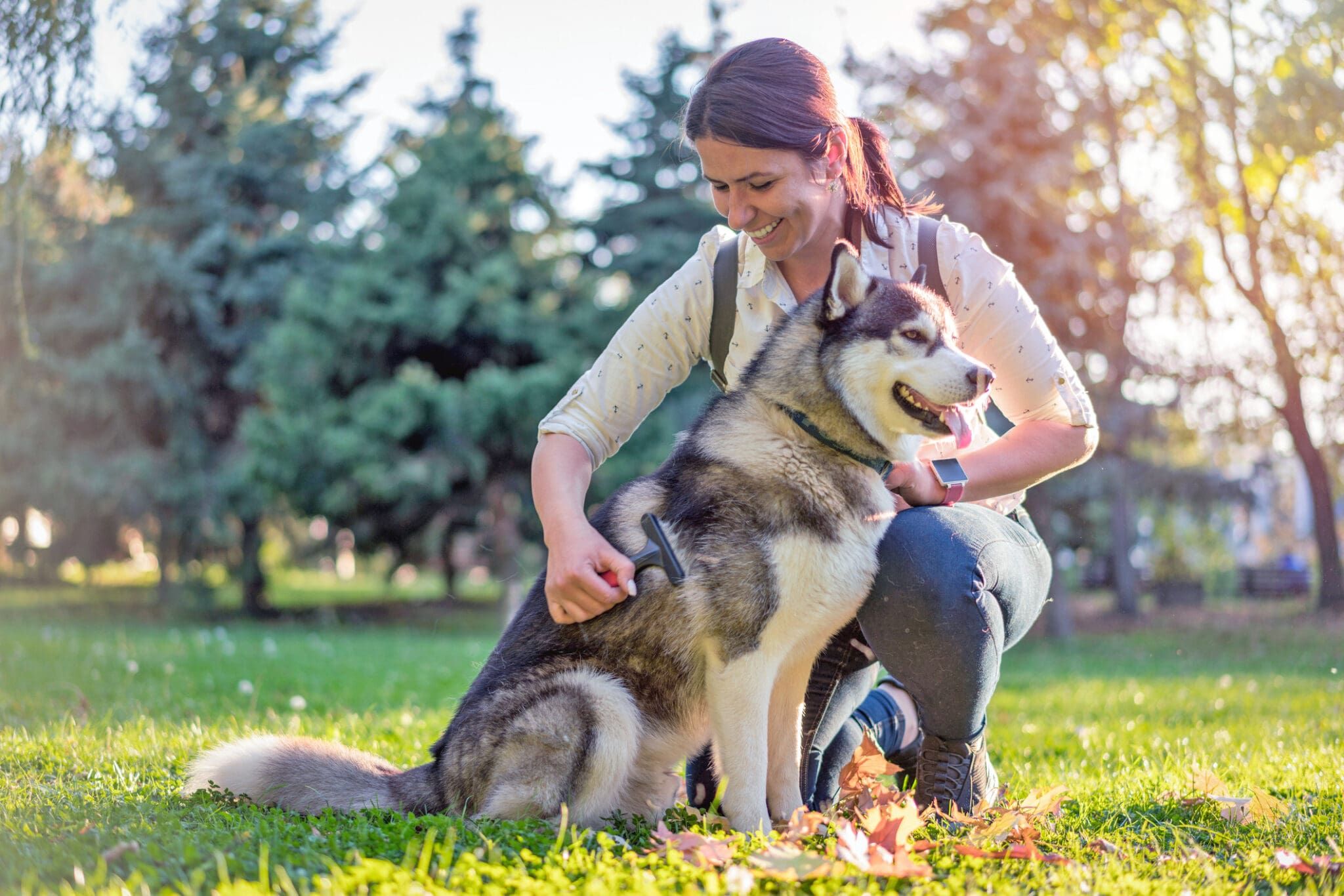
Dogs shed. It’s normal as long as the skin underneath is healthy and ready to grow more hair. Dogs who lose enough hair to leave thin or bare patches and or chew and scratch relentlessly need a closer look. While dogs battling alopecia—the medical term for hair loss—is upsetting, the reason is often simple. You just need to find the source.
“The most common cause of alopecia in dogs is trauma from scratching, chewing, pulling, or licking,” says William Miller Jr., VMD, emeritus professor of dermatology at Cornell University’s College of Veterinary Medicine.
Start with these basic scenarios:
- Does your dog’s collar or harness rub him?
- Is your dog licking or chewing his own coat or is another dog (or puppy!) chewing on him?
- Does your dog routinely try to slide under furniture or fences?
In these cases, you need to adjust the collar or address the behavior problem.
While you do that, you can provide comfort to relieve itching with medicated shampoos, mousses, and creams. Adding fish oil to your dog’s diet can also help address itchy, dry skin.
Fleas Can Cause Dog Hair Loss
If you don’t find a simple reason for hair loss, fleas and other external parasites are high on the list for dog hair loss because these bugs injure the skin, which becomes itchy.
With careful observation, you should be able to spot fleas. Look for scattering insects as you comb through your dog’s coat. You’ll usually find them around the tailhead or across the thinly haired area of the groin when your dog rolls over. Lice can be seen if you look carefully at hairs and spot the attached nits.
Mites are trickier. Sarcoptic mange mites stimulate severe pruritus (itchy skin) but may be hard to find on skin scrapes. One anecdotal way to identify sarcoptic mange is to rub the edges of your dog’s ear together. If that sets off intense scratching, sarcoptic mange is a strong possibility. Demodectic mites are also found by skin scrapes.
Once you can just address the problem with flea control and preventatives, and the dog won’t feel so itchy or be compelled to chew on himself.
Medical Reasons for Hair Loss in Dogs
If your dog is losing hair in patches and the skin has scabs, dandruff, inflamed areas, or obvious infection with pustules, seek veterinary help. The bare patches and scabs are secondary to chewing and itching, but you need to find the cause, such as folliculitis (infection of the hair follicles).
Your veterinarian may consider doing:
- Cultures for fungal infections like ringworm
- Bloodwork to check for hypothyroidism
- A food trial, as the itching can be due to a food that doesn’t agree with your dog
Bacteria may be a cause. The Staphylococcus species of bacteria are the most common bacterial skin infections. These can cause patchy crusts and itching on their own or occur secondary after damage from your dog chewing through his hair to get at his skin. While bacterial infections do respond to antibiotics, the rise of antibiotic-resistant staph species has led to an increased interest in handling these infections with topical therapy, such as medicated baths.
Your veterinarian will consider sebaceous adenitis. Sebaceous adenitis is a “new” disease, first noted in 1986 in Sweden. It is associated with some chronic conditions such as hypothyroidism, but it can be a primary illness with a genetic predisposition.
Sebaceous adenitis is associated with some chronic conditions such as hypothyroidism, but it can be a primary illness with a genetic predisposition. Akitas and Standard Poodles have autosomal recessive inheritance, which means both sexes can be affected, and a dog must have two copies of the defect to show clinical signs. The Doodle breeds also can be prone to this disease. Other breeds can be affected as well with both long- and short-haired dogs as victims. Young to middle-aged dogs are most diagnosed with this skin problem.
There may even be other genetic reasons, too, such as Alopecia X in Pomeranians, which causes hair loss and pigmentation of the skin.
Normal Seasonal Hair Loss in Dogs
Seasonal alopecia—where dogs lose hair based on seasonal changes and then grow it back—is common in some dogs and rarely a concern. This is usually a winter event.
Other natural causes for hair loss include:
- Routine seasonal sheds, when the coat turns over from season changes
- The dog’s coat is changing from puppy coat to adult hair
- Coat “blowing” after a bitch has whelped and weaned her puppies
Some dogs will have minimal sheds, while others look unkept for a bit. Some dogs have what we call “pluckables,” which are clumps of free hair that are easily removed from the dog’s coat. A short-coated dog may just leave a bit of hair on your clothes or your hand hand when you pet them. In these cases, the skin underneath should look normal, the coat overall is affected, and the hair will grow back. Let’s repeat that: If the skin looks normal, chances are high the hair will grow back.
Seasonal sheds/alopecia are affected by temperature and light, which influence the phases of hair growth. Some dogs lose hair faithfully every spring and fall, while others may only do so once a year. While there are products touted to help speed up or reduce shedding, the reality is that a good diet and regular grooming do as much good as any supplement when it comes to seasonal alopecia.

Dogs who have undergone treatments for infections where antibiotics were heavily used can suffer from loss of the balanced system that provides for coat growth. The gastric system of my dog was so compromised, and hair began to fall out. Visits to veterinary dermatologists didn’t identify the problem. It was only a visit to a “holistic vet” that solved the issue: it was a pervasive fungal overgrowth (internal and external) that led to the problem. Feeding her with NO GRAINS (in treats or other foods) plus giving a good probiotic eventually solved the problem. Readers hould not overlook holistic treatments (herbal, acupuncture, nutritional) that address problems that are caused by other her allopathic interventions.