Dry skin in dogs contributes to dull coats, dander, hair loss, skin odor, itching, scratching, and irritation. And, as annoying as all that is to you, it’s even worse for dogs. They’re just not comfortable in their own skin (literally!).
The outermost layer of skin, called the epidermis, creates new skin cells and retains moisture in healthy dogs but when dry, cracked, and flaky, it creates irritation, dander, hair loss, scabs, bumps, itching, and scratching. Your veterinarian can diagnose and treat conditions that require medical attention, but if your dog is otherwise healthy, you can improve her dry skin and coat with simple home remedies. Frequent brushing will help, too, by distributing the natural oils in your dog’s coat.
Plus, Dr. Noelle Perry says conservative remedies like quality food and supplementing omega-3 fatty acids may help your dog achieve healthier skin. Of course, if the home remedies suggested in this article fail to bring relief to your dog, schedule an appointment with your veterinarian to make sure there is not an underlying health issue contributing to the problem.
Understanding Causes of Dry Skin on Dogs
Dry skin in dogs can be caused by:
Allergies, sensitivities, or contact dermatitis
Drying soaps or shampoos
Failing to adequately rinse out soaps or shampoo
Baths that are too frequent or too hot
Dry weather or low humidity
External parasites like fleas or mites
Autoimmune disorders
Underlying illnesses like Cushing’s disease or hypothyroidism
Dry Dog Skin Home Remedies
Oatmeal and aloe vera are proven skin protectors that help form a protective barrier that slows the loss of natural oils from your dog’s coat while soothing itchy, irritated, flaking skin.
Make your own oatmeal bath:
Place 1/2 to 1 cup of plain, unflavored oatmeal (instant, quick, or slow-cooking) in a blender, coffee grinder, or food processor.
Process on the highest setting until the oats form a very fine powder.
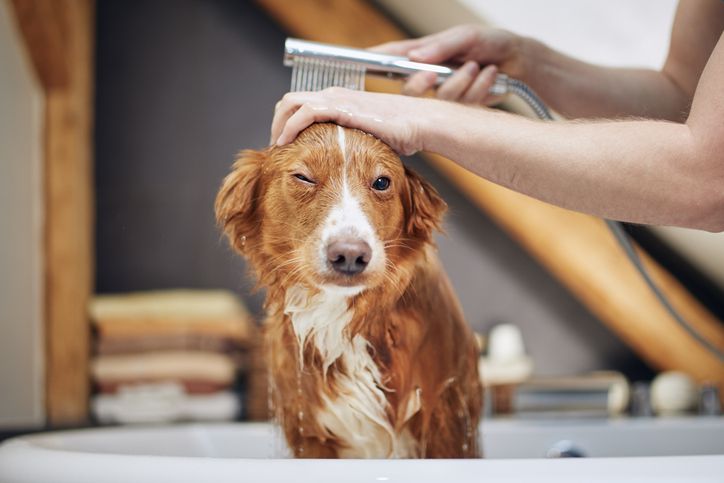
Pour the oat powder into warm (not hot) running water in your tub. Fill the tub to a comfortable level for your dog.
Place your dog in the tub and use a cup to pour the oatmeal bath over his body.
Massage the bath water into the dog’s skin and if possible, keep him soaking for 5 to 10 minutes.
Rinse your dog well with warm (not hot) water, then dry well with towels and gently brush the coat.
Apply aloe vera:
Pure aloe vera juice or gel (one made with aloe vera alone, without additives) is an economical skin treatment for your dog. Simply apply, work it into the skin, and let dry.
Rinse or spray your dog with herbal tea:
Place 6 teabags or 6 teaspoons of dried herbs (chamomile, calendula, or green tea) in a 1-quart glass jar.
Fill the jar with boiling water and close the lid.
Let stand until it cools to room temperature. This tea will stay fresh in your refrigerator for a week.
Strain and use as a final rinse after bathing or spray onto your dog’s wet or dry coat, working It in well so it reaches the skin.
Let the coat air dry, then gently brush your dog.
Is Coconut Oil Good for My Dog’s Skin?
Yes, and it can be applied topically (massaged into the skin) or added to food. Apply by working 1/2 teaspoon at a time into your dog’s skin, head to tail, and brush well.
To feed coconut oil, start with small amounts and gradually increase to 1 teaspoon per 10 pounds (1 tablespoon per 30 pounds) of body weight daily.
There are, of course, commercial products to help with dry skin. Our reviewer explains which one is best for what you’re dealing with, such as Douxo Skin & Coat SPA Ultra-Safe Itch Relief Dog Shampoo for a dog with sensitive skin.
Finally, Dr. Deb Elredge, DVM, advises that sometimes you do need the help of your veterinarian. “Dogs can have many different skin conditions. Some skin problems are minor and easily fixed, while others are trickier to diagnose,” says Dr. Eldredge. “Some may be controllable but not curable, while others can be cured. Diagnosing skin problems in dogs takes a good detective, which starts with you, the dog owner. One thing’s for sure, don’t wait if your dog is losing hair or has abnormal skin crusting or scaling.”