
The Best Life Jackets for Dogs: Summer 2016
A proper life jacket should be bright so you can see it from the beach or edge of a lake, and should have a snug fit. If it's too loose, it can entangle the dog or come off, or it will float above the dog while the dog bobs along in the water. If it's too tight, it can chafe and become uncomfortable, making it unlikely the dog will enjoy wearing it. A properly fitting life jacket should not restrict the dog's movement in or out of the water. And, of course, a life jacket should be well made, with strong materials and an adequate amount of buoyant material. We have two favorite doggy flotation devices this year - the West Marine Neoprene Pet vest for experienced swimmers, and the Ruffwear K9 Float Coat for beginners.
Best Dog Gear of the Year Part II
In the January issue, we shared our contributors' favorite dog toys, training tools, and treats, but we didn't have enough room to include all of their recommendations for the things they can't imagine living without" in their dog-care kits. Here are more favorite products things that improve the health and well being of our dogs
Best Dog Gear of the Year: 2015
See Whole Dog Journal's top dog accessories of 2015. We cover reflective gear for your nocturnal hound, artisan leather collars for the posh pup in your life, indestructible dog toys, biodegradable waste bags, a treat dispenser that does more than your smartphone, paw cream for salty winters, and much more!
Product Review: Wingaing It
Recently, I found myself with too many dogs who needed exercise, and not enough time to put in the miles that could have worked off all that excess energy. I rooted through the dog-toy baskets in my office, looking for things I could throw for the pack to fetch. I used to have a Chuckit! tennis ball launcher, but some puppy or other chewed up the part that holds the tennis ball, so I threw it away and hadn't yet replaced it. Then I remembered that I had bought a very similar device that is used for launching small rubber discs for dogs to chase: the Winga.
Technology That Can Help You Protect And Enjoy Your Dog
It's incredible how many aspects of our lives have been enhanced and transformed by technology in just the past few years. Anyone who uses a computer or mobile phone is at least aware of his or her ability to obtain recommendations for businesses or directions to a location. If you're a dog owner and need a reputable emergency veterinary clinic in a strange town, having the tools to find such a clinic and get there in record time may literally save a dog's life. But web- and mobile-device-based technology can also be used by dog owners in countless other important ways and we're sharing some of the most fun and useful ones with you.
High-Tech Dogs
My Border Collie Duncan solves all 10 of his interactive puzzles within five minutes; it takes me longer than that to fill them with treats! So when CleverPet announced its Kickstarter campaign for the development of a next-generation pet-learning console, I signed right up. Thirteen-year-old Duncan has pretty severe arthritis so I'm constantly searching for low-activity ways to engage him. This eagerly anticipated device features three durable yet sensitive touch pads that interactively light up and are designed to be touched by a dog's nose or paw, triggering food to be dispensed. CleverPet adjusts learning levels based on your dog's performance, which can be monitored through the website and an app-based program.
A Healing Coat
the author's 9-year-old agility dog
No-Pull Dog Harness Product Review
Once upon a time, a harness was the last thing you wanted to use for a dog who pulled, because they were designed to make pulling comfortable. By distributing pressure evenly across the chest they removed pressure from the throat, where damage could be done to a dog's trachea sometimes even to the point of tracheal collapse. Harnesses are better for the dog from a health perspective, but from a training viewpoint, a standard harness actually encourages pulling. There's a reason sled dogs wear harnesses! Head halters were introduced in the late 1990s as a gentle control tool. While they did, indeed, work well to control a dog's head (and where the head goes, the body follows), some trainers noticed that a significant number of dogs found head halters to be fairly aversive, requiring, in many cases, extensive conditioning to convince the dog to accept them.
What’s the Best Frisbee Disc for Dogs?
I used to live with a Frisbee-addicted dog (a Border Collie named Rupert), and a disc-addicted son, who is now off at college (and still addicted). So how is it that WDJ has never before reviewed flying disc toys for dogs? There is a wide variety of flying toys made for dogs, with different key features for different applications. The overarching concept is to create a disc that flies well enough to inspire a dog to chase it, catch it, and return with it uninjured. Most of us owners want a toy that won't be ruined within three catches between a dog's teeth, but you don't want it to be so tough that it can hurt a dog's teeth or mouth if he doesn't catch it perfectly.
Orthopedic Equipment for Dogs that Increase Joint Support and Overall Mobility
In our March 2011 issue, we introduced you to a very small sampling of some of the neat “assistive equipment” options that are available to help our canine companions who have limited mobility or other physical issues. We received such a great response that we thought we’d share with you a few more finds that can help make life easier for you and your dog, particularly if he or she is aging or has orthopedic or neurologic issues. Remember: the products mentioned here are only the tip of the iceberg. There are numerous companies making innovative assistive products; what we’re hoping to do here is to get you thinking about some of the possibilities!
Orthopedic Equipment for Dogs Designed for Increased Mobility and Extra Support
Do you have a dog recovering from orthopedic or neurologic surgery, one who has mobility issues, or a senior dog who has arthritis? If so, at some point, you have probably wished you could do something anything! to help make your dog's life (and your own) a little easier. I asked two veterinarians who specialize in canine rehabilitation to share some of their top picks for canine assistive/rehabilitative equipment. Laurie McCauley, DVM, CCRT, is founder and medical director of TOPS Veterinary Rehabilitation in Grayslake, Illinois, and is considered one of the pioneers in the field of veterinary rehabilitation. Evelyn Orenbuch, DVM, CAVCA, CCRT, recently opened Georgia Veterinary Rehabilitation, Fitness and Pain Management in Marietta, Georgia, and has focused on veterinary rehab medicine since 2003.
Comfortable Dog Cone Alternatives
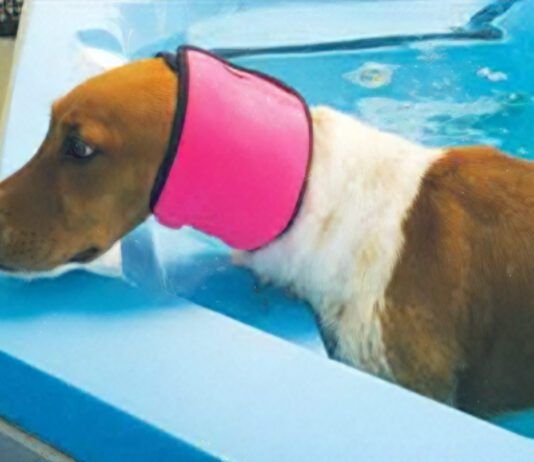
Are the classic plastic cones really all that bad? It depends on which dog you ask. Some dogs seem to accept the weight of the heavy plastic, the restricted visibility imposed by the opaque material, the need for increased clearances around the house, and even being gouged by the thick plastic tabs that are supposed to be belted by the dog's collar at the base of the cone. Today there are a number of alternatives to the classic Elizabethan collars to prevent a dog from licking a wound, aggravating a hot spot, tearing out his surgical stitches, or removing a bandage. The alternatives offer a dog greater comfort, better mobility, and improved visibility.