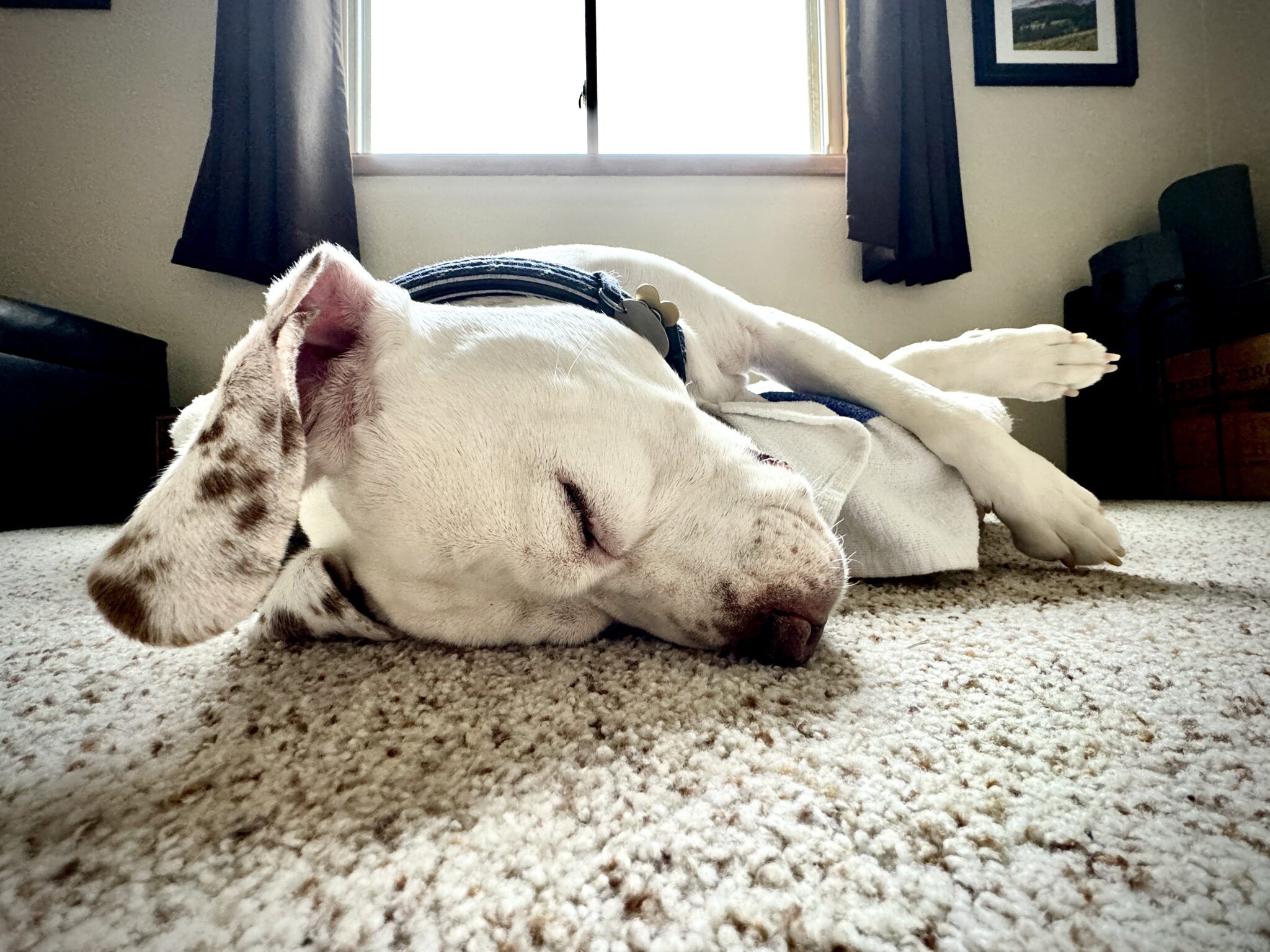
Have you ever blamed your partner for snoring, only for them to blame the dog? Or been watching a movie and start chuckling, not at the film, but at your dog overpowering the soundtrack, sawing logs?
While it may strike us as funny at times, some experts say dog snoring may not be a laughing matter and could be a sign of a serious health problem.
The key is determining: why does my dog snore?
Why Do Dogs Snore?
First, it’s important to understand what snoring is.
“Basically, snoring is some kind of an obstruction to air flow and vibrations in the back of the throat that causes the snoring sound,” says Daniel Spector, DVM, a senior veterinarian and surgeon at The Schwarzman Animal Medical Center in New York City.
But when is dog snoring cause for concern?
If your dog snores, pay attention to:
- How often the snoring occurs
- When the snoring happens
- If your dog has any nasal congestion or discharge
If your dog has never snored in the past and then starts snoring, choking while they sleep, or stops breathing, there may be a problem.
“Snoring does indicate an abnormality to their breathing,” Dr. Spector says. “I think that, just like in people, dog snoring should be something that should be evaluated.”
Experts say not to panic if your dog snores, but to keep track of it and look for patterns.
“It’s less the snoring that exists and more, is it changing? Is it progressing? Was it not there, and now it is? New or progressive snoring or a change to their airway or breathing sounds does warrant a conversation with your veterinarian,” Dr. Spector says.
But how do you explain to your veterinarian what’s going on when your dog is snoozing? It’s challenging to reenact it.
There are no overnight dog sleep labs for monitoring and your pooch may not be inclined to nap at the animal hospital. So, grab your smartphone, start recording, and catch your dog snoring on camera.
“We love videos, so then you won’t have to imitate the snoring for us. We’re fine with imitations, but not everybody likes to make a snoring noise in front of the vet,” says veterinarian Jessica Pritchard from the University of Wisconsin-Madison School of Veterinary Medicine.
Videos of a dog snoring away, relaxed in their own home, are a great way to start figuring out why your dog snores.
“It doesn’t mean that your vet is going to have a diagnosis based on the video,” Dr. Pritchard says. “Hearing it can be really helpful for us to localize where the problem is. The next steps would be an exam and possible follow-up tests.”
Diagnosing Dog Snoring
During a medical exam, your veterinarian will likely start by checking out your dog’s eyes, nose, and mouth.
“They’re going to feel all around the face for any asymmetry or pain in any particular areas,” Dr. Pritchard says. “They’ll look at the symmetry of your dog’s nose and feel the airflow through both sides of the nose.”
Your veterinarian will also likely evaluate your dog’s teeth.
“The oral cavity connects to the nose, so we occasionally see dogs that have dental disease, or a tooth abscess, which can contribute to snoring,” Dr. Pritchard says.
Some dogs may need to be sedated so your veterinarian can more closely examine or take X-rays or scans of their airways. They will look for:
- Obstructions
- Foreign bodies
- Infections
- Inflammation or signs of allergies
- Soft palate issues
- Tonsil enlargement
- Tissue thickening
- Narrowing of the nose
- Structural abnormalities
- Growths or tumors
“The worst-case scenario is probably a tumor in the nose causing that snoring noise as they’re breathing past that obstruction,” Dr. Pritchard says. “But there are actually treatment options available.”
Solving Dog Snoring Problems
These days, there are typically snoring solutions if your dog’s breathing is indicative of a health issue.
To manage tumors, veterinarians may consider using radiation, administering chemotherapy, or surgically removing the growth.
Surgery can also help remove abscessed teeth, foreign bodies (vets report finding sticks stuck in dogs’ noses), and improve structural problems commonly seen in brachycephalic breeds, like French and English Bulldogs, Boston Terriers, Pugs, and other dogs with flatter faces.
“Very broadly and generally speaking, these dogs will almost always have some degree of snoring, because they’re brachycephalic,” Dr. Spector says. “Even with surgery, we almost never completely eliminate the sound. I tell people their dogs will still never sneak up on them; they’ll hear them coming, but we can improve the sound by improving airflow.”
And if structural issues are causing your dog to snore and go unaddressed, the problem can worsen over time.
However, snoring may also be caused by something relatively minor and easily treatable, such as antihistamines for allergies or antibiotics for infections.
Some dogs may benefit from weight loss, as excess weight can contribute to snoring, while others might simply be sleeping in a funny position.
“Just like with us, they might be tired, they might be a little congested because of pollen, or a wildfire,” Dr. Pritchard says.
And, just like us, it’s important your dog gets a good night’s sleep.
“If people are snoring and have sleep apnea, they can have detrimental health problems, ranging from not enough sleep to breathing issues,” Dr. Spector says. “And absolutely, the same sort of general health impact that can have on people is very similar to dogs.”
Sleep-deprived dogs may develop behavioral and physical problems, such as a weakened immune system or irritability, and no one wants a grumpy, sick pooch.
Is It Normal for Dogs to Snore?
When it comes to snoring, there’s no one-size-fits-all cause and answer. However, it’s possible that your dog has no underlying health issues and no treatment is necessary. Perhaps your pup is chilled out, overtired, or sleeping in an unusual position.
“Snoring in dogs can be a normal thing, just like humans,” Dr. Pritchard says. “When we snore when we’re sleeping, we are really relaxed, and so it is air moving across tissues and making a noise.”
If your veterinarian believes a medical problem isn’t the culprit causing your dog’s snoring, and it’s just an occasional thing, keep an eye on it.
And in the meantime, your partner can go back to blaming the dog for waking you up in the middle of the night, and you can laugh when your dog catches some noisy zzzs during a movie without worry.