
[Updated December 12, 2018]
DEMANDING DOGS: OVERVIEW
- Identify your dog’s demand behaviors and make deliberate decisions about which ones to keep and which to modify.
- Embark on a behavior modification program to teach an incompatible behavior and extinguish the unwanted ones.
- Educate everyone who comes in contact with your dog so they don’t inadvertently reinforce demand behaviors you’re working to extinguish.
Missy sidles up to me as I type and nudges her nose under my arm, lifting my hand off the keyboard. “I want you to pet me, now!” she says. As much as I’m reluctant to reinforce demand behaviors, her rakish one-blue-eyed, one-brown-eyed expression is irresistible. My hand drops onto the soft fur of her head, and I scratch briefly behind her ear before asking her to go lie down. She obliges, curling up under my desk.
I laugh as Scooter, our recently rescued Pomeranian, stands on his hind legs in front of the sofa and waves his front paws at me. “I want up, now!” he says. Because he’s cute, and because I want to reinforce his affiliative social behavior, I reach down and scoop up his furry little body and deposit him next to me.
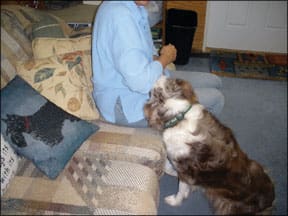
These are “demand behaviors,” often frowned upon in the dog training world. Yet, from another perspective, they are simply my dogs’ way of communicating their desires to me. There’s a grey area between acceptable communication and unacceptable demand behavior; what’s perfectly appropriate to one dog-person may be annoyingly inappropriate to the next. Who gets to decide what’s acceptable for your dog? You do.
A dog’s mission in life is to make his world work for him to get good stuff. His goal is to get as much good stuff as possible, perhaps including a safe, predictable environment, lots of attention from his human, opportunities to herd sheep or chase rabbits, plenty of bone-chewing time, hikes in the woods, running after flying discs, sailing over flyball hurdles, or a soft bed upon which to lay his body.
Recognizing that those with opposable thumbs are more able than he to open doors, throw tennis balls, and operate can openers, a dog spends a good part of his time figuring out how to manipulate his humans into making good stuff happen. Although he’s never studied B.F. Skinner and the science of behavior, he knows exactly how operant conditioning works. He repeats behaviors that make good stuff happen or those that make bad stuff go away, and controls himself from repeating behaviors that make bad stuff happen or ones that make good stuff go away.
Demand behaviors occur because they make good stuff happen. Initially, your dog may offer a new behavior to see if it works. A dog with a strong reinforcement history for a behavior such as sitting may offer a sit to get your attention. If you, like a lot of humans, are too absorbed in your computer, your book, or your TV program to reinforce your dog for sitting, he may fidget a little, stand up and sit again, or inch a little closer to you.

If he’s just looking for a scratch behind the ear, he may give up and lie down on his bed. But if his need is urgent – say he has to go out to pee – he may woof at you or nudge your arm to get your attention. When he does, you look at him and say, “Oh hi, Buddy, you have to go out?” He dances happily, you get up to let him out, and his brain registers this important note-to-self: woofing (or nudging) gets reinforced. The new behavior strategy gets added to his repertoire – and he’ll happily generalize it when he realizes it works to get other things, like that scratch behind the ear. That’s all fine and good if you’re okay with your dog communicating with you by woofing or nudging. But if you find those to be undesirable behaviors, it’s time to take note and take action.
All Behaviors Are Trained
Every moment you are with your dog, one of you is training the other. Behaviors are constantly being reinforced – or not – and you and your dog are constantly making choices – deliberate, or not – about how to behave, based on which behaviors get reinforced. In general, your relationship with your dog is more successful if you are the trainer more often than you are the trainee – that is, if you’re manipulating your dog’s behavior more often than he’s manipulating yours.
When I realized this vitally important concept, I started paying a lot more attention to what my dogs are doing all the time, and started being more deliberate about reinforcing behaviors that I like, and not reinforcing those I don’t.
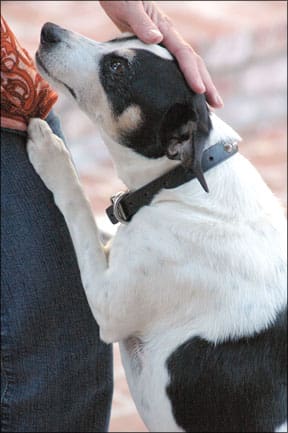
While I really don’t mind Missy’s nose-nudge, when she comes and sits by my chair, I do try to notice and pet her before the nudge happens. She also knows that my “That’s all!” cue means petting is done; it’s time to leave me alone. And if the nudge escalates to “paws scratching on my leg” I tell her “Oops!” and turn away.
The “Oops” is a “no reward” marker (NRM). Just as the clicker tells my dog which of her behaviors earned her a reward, the NRM tells her the behavior she just did – pawing at my leg – made my attention go away.
You can avoid having to deal with demand behaviors if you remember an important concept from puppyhood on. The key is to teach your pup from the outset that deference behaviors such as “sit” or “down” will work to get attention, rather than pushy behaviors such as pawing or barking.
If you never reinforce a communication behavior that you don’t want, and you make sure it never gets reinforced by anyone else, or the environment, your dog will have no reason to keep the behavior in his repertoire. The more often a pushy behavior does get reinforced, the more likely your dog will decide it’s a successful behavior strategy, and the more quickly and persistently he’ll offer it the next time.
What is a Demand Behavior?
Before we continue, let’s define demand behavior. Also called “attention-seeking behavior,” Dr. Karen Overall in her excellent book, Clinical Behavioral Medicine for Small Animals (1997), says “Dogs that exhibit attention-seeking behaviors can bark, whine, or ‘talk’ to the client to get attention, or they can use physical behaviors like rooting, pawing, pushing, leaning, jumping, scratching, or mouthing.” According to Overall, “The hallmark of attention-seeking behavior is that it . . . elicits some attentive response.”
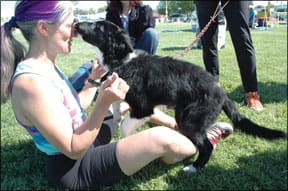
The problem with demand behaviors is that they are usually intermittently reinforced (sometimes the behavior gets reinforced, and sometimes it doesn’t), which makes them very durable, or “resistant to extinction.”
This means that if and when you do decide to try to make the behavior go away, it’s difficult to succeed. With intermittent reinforcement, your dog learns to play the slot machine – “Maybe it’ll pay off this time!” – and keeps on trying, hopeful that the next try will win the jackpot. If, on the other hand, a behavior is on a “continuous schedule of reinforcement,” the dog expects to get reinforced every time, and is likely to give up sooner after missing a few reinforcers when he realizes the game is no longer on.
Incompatible Behavior
One way to modify demand behavior is to find an incompatible behavior – one your dog can’t do at the same time as the unwanted one – and reinforce that. Lucy, our Cardigan Corgi, has an annoying habit of demanding her meal – in a very shrill voice – when two of our other dogs get fed first (necessary for pack management purposes). She’s a very vocal dog anyway, but her mealtime barking is particularly annoying.
While you wouldn’t think that “sit” was incompatible with barking, I recently discovered that to Lucy, it is. She doesn’t bark when she’s sitting, only when she’s dancing around, demanding her dinner. So now I ask Lucy to sit-and-wait while I place bowls down for the first two dogs – and give her a treat when I return to her. The dinner-demand barking has stopped, and a reasonable level of calm has returned to mealtime in the Miller household.
If your dog nudges for attention, like Missy, an incompatible behavior might be lying at your feet to ask for attention, or touching her nose to a designated target – perhaps a yogurt lid stuck to the wall near her normal sitting spots. “Sit” is an incompatible behavior commonly taught to dogs who demand attention by jumping up.
Extinguishing Demand Behaviors
The other way to modify demand behavior is to remove all reinforcement for a previously reinforced but now unwanted behavior; say “Oops!” and turn away. This is “negative punishment”; the dog’s behavior makes the good thing go away, and when carried out to its conclusion (the behavior goes away entirely), it’s called “extinction.”
If the dog jumps up, say “Oops!” and turn away. If he persists, walk away, perhaps even through a door, and close the door behind you. Or, practice with him on a tether so he can’t follow you. The behavior of jumping up results in the removal of all reinforcement. If he demand-barks for treats, say “Oops!” and turn away. If he paws at you to demand his walk, say “Oops!”, put the leash down, and sit until he calms, then pick up the leash again.
A caveat about extinction is that when you use “removal of reinforcement” to extinguish behavior you may witness an extinction burst, in which the dog’s behavior becomes worse before it gets better. This is a frustrated canine’s equivalent of a temper tantrum because a behavior that used to work isn’t working any longer. It often happens shortly before he gives up.
As he nudges or paws harder, or barks louder, he’s saying, “Hey! Hey! I want it! I want it now! This used to work, darn it! Hey! Hey! Give it to me!” It’s the equivalent of kicking the soda machine when you’ve put your money in and it won’t give you your drink – before you finally decide to walk away without the soda.
Here’s the big problem with the extinction burst. Many people think the extinction process isn’t working when they see their dog doing the behavior louder or harder, and give in to the dog’s demands. Don’t! If you reinforce the more intense presentation of the behavior, your dog will offer the more intense version more quickly next time. Grit your teeth, turn your back, walk away, and wait for it to stop. Beware the extinction burst!
Positive Reinforcement
You’ll see the best results with your demand-behavior modification efforts if you do both: reinforcing an incompatible behavior and extinction. You’ll get the most bang for your treat if you:
1. Pre-empt the unwanted behavior by asking for and reinforcing an incompatible behavior. With enough repetitions, the incompatible behavior will become the dog’s offered “default” behavior. When it does, be sure to reinforce it, gradually putting the new behavior on an intermittent schedule of reinforcement so it becomes very resistant to extinction. Otherwise the dog may quickly revert to his original demand behavior, especially if the behavior has a long history of reinforcement.
2. Remove reinforcement if the unwanted behavior does occur. If you miss the opportunity to pre-empt the behavior, or your efforts to forestall the behavior didn’t work, your second line of defense is the “Oops!” Remove your attention until the behavior stops and you can reinforce an alternative or incompatible behavior.
3. Reinforce an incompatible behavior. Your dog will be the least frustrated (and you’ll be the most successful) with your extinction program if you also remember to positively reinforce incompatible behaviors. Negative punishment works best when it’s followed by positive reinforce for a desirable behavior.
If Missy starts pawing at my leg, I say “Oops!” and turn away. When the pawing stops I turn back and give her the attention she seeks. I use a “variable schedule of reinforcement” – sometimes waiting longer after the pawing, sometimes only a second or two. I gradually increase the average wait time until she realizes that it’s waiting quietly with her paws on the floor that gets reinforced, not the pawing.
This is an important step, required to avoid creating a “behavior chain” of paw, turn away, get petted. If there’s only a brief pause between the pawing and the petting each time, she’ll still think that pawing is earning the reward of attention and petting.
Remember that consistency is vitally important. If a well-used demand behavior is reinforced even only rarely, it will likely persist. If Dad sneaks a bit of steak to the family dog under the table once a month, the dog will continue to beg for food at the table. If, instead, Dad tosses a bit of food occasionally to the family dog who is lying on his bed on the other side of the dining room, the dog will learn to “beg” by lying politely on his bed (a deference behavior) on the far side of the room. This is much more acceptable to most people than begging at the table.
Remember, you get to choose which behaviors you want to reinforce. If you like a particular demand behavior, be my guest – reinforce to your heart’s content. So yes, I consistently reinforce Scooter’s demand-waving, and the behavior will persist. I intermittently reinforce Missy’s nose-nudging, and it, too, will persist – although in my defense I only reinforce mild nose-nudging. But Lucy’s demand barking? That one we’re very consistently working to modify. Sorry, Lucy!
The “No Reward Marker”
There is some difference of opinion in the positive training world about the appropriate use of the “No Reward Marker” (NRM). Some trainers suggest that simply withholding reinforcement, without a marker, is sufficient consequence to reduce a behavior, and that the use of a “wrong” marker is too aversive. This can be true if the marker is offered in an aversive tone, or if the dog is sensitive to any suggestion that he did the wrong thing.
For example, some trainers use an “eh-eh, no” or “wrong,” as their NRM. All of these can be spoken softly, but they are often uttered in a harsher tone, with a subliminal meaning of “bad dog!” It may be unintentional, but people tend to use a harsher tone when they are even slightly upset.
I do use an NRM for my dogs, to communicate to them exactly which behavior earned the withdrawal of reinforcement. I believe that, like the clicker, it helps the dog identify the behavior in question. I like to use “Oops!” as my NRM; it’s almost impossible to say it in a harsh tone unless you try really hard, and because it’s a humorous sound it tends to lighten the emotion even if the human is upset.
Marine mammal trainers don’t, as a rule, use an NRM. I am told that whales, dolphins, and other marine mammals tend to shut down very quickly if told they are “wrong,” and
that lack of reinforcement is adequate to send them the “try again” message. The same is true with some dogs — and your choice to use an NRM, or not, is wisely based on your own philosophical position on the question as well as your own dog’s response to some kind of “Oops!” marker.
While we call it a “No Reward Marker,” any indication that the dog made a wrong choice is, in fact, a form of negative punishment: the dog’s behavior made a good thing – the
opportunity to earn a reward – go away. So, while it might be more accurately called a “Punishment Marker,” I recently saw it described by noted positive trainer Gail Fischer as a
“Loss of Opportunity Marker,” or LOM. I like that, and think I’ll use it. Thanks, Gail!
Pat Miller, CBCC-KA, CPDT-KA, is WDJ’s Training Editor. Miller lives in Hagerstown, Maryland, site of her Peaceable Paws training center. Pat is also author of many books on positive dog training.