

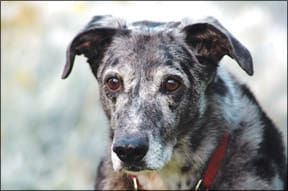
If we’re fortunate enough to have them live to old age, at some point, most of our canine companions begin to lose their hearing and may eventually be, for all intents and purposes, deaf. It’s painful to watch a beloved dog become less and less responsive to his environment because he’s unaware of what’s going on around him, and even more so when it limits your ability to communicate with him. The thought of a hearing-impaired dog wandering off and not being able to hear your calls is frightening. Here are five things you can do if your dog’s hearing isn’t what it used to be:
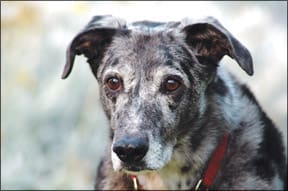
1) Purchase a disaster whistle and condition it as a recall cue, by pairing its sound with high-value treats. The Storm Whistle, reported to be twice as loud as any other mouth-blown whistle in the world, is available in stores, catalogues, and from stormwhistles.com (314-436-3332). We used a Storm Whistle as our recall signal when our aging Kelpie, Katie, lost her hearing; it worked like a dream. Instead of having to walk the fenced backyard looking for her, we could just blow the whistle, and she’d come trundling out from behind the garage. Blow the whistle, and give your dog a high-value treat until your dog gets the whistle-equals-food association. Then you should be good to go.
By the way, you might want to first try the whistle outside, and cover your ears or use earplugs. It’s really loud.
2) Use hand signals. Every time our dogs reach the old-age-can’t-hear stage I appreciate having taught them basic hand signals as well as verbal cues. Since dogs communicate primarily through body language, hand signals are easy to teach, especially if you do it when your dog can still hear well. (See “What’s Your Sign?” in the February 2009 issue of WDJ.) As your dog ages, it’s a great opportunity to expand your visual cue vocabulary. Some owners use American Sign Language (ASL) to communicate with their hearing-impaired dogs.
3) Run interference at home. This is all about management. If you have a multi-dog household, one or more of your other dogs make take offense when your geriatric pal doesn’t respond quickly enough to their signals – because he doesn’t hear them, and therefore doesn’t look and notice their body language. Manage your household to prevent encounters that cause tension due to his lack of hearing and subsequent lack of response. This often includes keeping potential problem dogs separated when you are not home. (See “Peace in the Pack,” July 2002.)
4) Run interference in the real world. There are many situations outside your home where your increasingly hearing-impaired dog may run into trouble. If you’ve been casual about letting her be off-leash near traffic, tighten up the reins. She may no longer be able to hear oncoming cars, and a misstep could be deadly. Same thing if you hike on bike paths and sidewalks; you may not be aware of the extent to which she has relied on her hearing to move out of the way of approaching bikes, skateboards, and joggers. She may also need help around other non-family dogs, since she can’t hear them coming either. You could try scheduling supervised play dates with a small circle of appropriate canine friends instead of trips to the dog park, where you have little to no control over her dog encounters.
5) Make reasonable accommodations and give her the benefit of the doubt. Keep in mind that she’s not ignoring you; she can’t hear you! It’s easy to get cross when your dog doesn’t respond to your cues. Condition her to an unexpected touch from behind (touch makes chicken happen!) so you can let her know you’re there and need her to move – or go around her. And if you feel yourself becoming annoyed with your dog, take a deep breath and remember that she probably didn’t hear you. Heck, if it’s age-related hearing loss she could be losing her vision too, so she may not even see as well as you think. Don’t be annoyed if she doesn’t move out of your path as quickly as she once did, or she fails to come flying to your call. She’s doing the best she can; be patient with her.
Pat Miller, CPDT-KA, CDBC, is WDJ’s Training Editor. Miller lives in Fairplay, Maryland, site of her Peaceable Paws training center. Pat is also author of several books on positive training. See page 24 for more information.


Very helpful.I have 2 dogs the 16 year old has gone deaf and the 14 is not far behind in sure so I will start teaching him hand signals if I can