

Home Search
heart%20disease - search results
If you're not happy with the results, please do another search
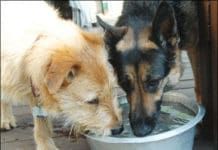
Preventing Bladder and Kidney Stones in Dogs
Bladder and kidney stones are serious problems in dogs as well as people. These conditions which are also known as uroliths or urinary calculi can be excruciatingly painful as well as potentially fatal. Fortunately, informed caregivers can do much to prevent the formation of stones and in some cases actually help treat stones that develop. Last month, we described struvite stones (see Canine Kidney Stone and Bladder Stone Prevention" Whole Dog Journal April 2010). Struvites contain magnesium
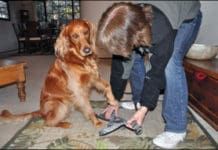
Walking An Excited Dog
You contemplate taking your dog for a walk with mixed emotions. You love the idea of going for a companionable stroll through the neighborhood together, but it's a major hassle to get out the door. When you pick up his leash he becomes the Tasmanian Devil body slamming you, racing around the foyer, and bouncing off the plate glass door with such intensity you're afraid he'll crash right through it.

How to Stop Dogs From Fighting in Your Household
Knowledgeable dog people are quite aware that not all dogs get along with each other, despite the fact that canis lupus familiaris (domestic dog) is a social species. Hey, we humans are a social species, and we certainly don't all get along! Dog-dog aggression is unhappily common in our world. As a professional behavior consultant who works with aggression cases, I probably see more than my fair share of it. By far the most difficult and most distressing presentations of dog-dog aggression are intra-pack aggression cases: dogs in the same family who aren't getting along with each other. I've had a spate of these clients in recent weeks. Even our own Lucy and Missy, a Cardigan Corgi and Australian Shepherd who don't always get along seamlessly, seem to have experienced an increase in relationship tensions this winter.
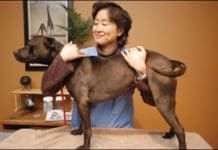
Less Stressful Veterinary Visits
A training friend suggested that I read Low Stress Handling, Restraint, and Behavior Modification of Dogs and Cats, by applied animal behaviorist Sophia Yin, DVM, MS. As an owner whose dogs have taken their fair share of visits to vet clinics, I really liked what I read. Dr. Yin's text takes a critical look at how our pets are often handled in veterinary clinics and it's not pretty, as you may have seen yourself. Fortunately, she also offers common sense advice on approaching veterinary care so as to make it as stress-free as possible for our pets. Popular myths abound that force is needed to get animals to behave. Instead, Dr. Yin focuses on how to modify behavior quickly in a veterinary setting using a systematic and positive approach. Her methods involve classical conditioning to change the pet's emotional state; setting up the veterinary environment to ensure the pet's comfort; teaching us how to handle animals with appropriate, rather than stronger, restraint; and how to behave around animals so as to avoid creating problems.

Caring for an Elderly Dog
Aaron Epstein's 14-year-old Australian Shepherd-mix, Sam, was losing weight and his appetite wasn't the same. I just thought he was getting old because in addition to not eating with the same vigor

Problems With Adopting Two Puppies Simultaneously
There's no denying it: a new puppy is one of the world's most wonderful things. It's a cold, hard heart that doesn't get all mushy over puppy breath, soft pink puppy pads, and the fun of helping a baby dog discover his new world. So, if one puppy is wonderful, two puppies must be twice as wonderful, right? Well, not usually. Most training professionals strongly recommend against adopting two pups at the same time. The biggest challenge of adopting puppy pairs is their tendency to bond very closely with each other, often to the exclusion of a meaningful relationship with their humans. They can become inseparable. Also, owners often underestimate the time commitment required to properly care for and train two puppies; as a result the pups often end up untrained and undersocialized.
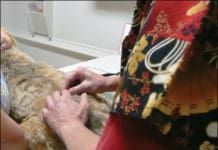
Acupuncture For Dogs With Cancer
without any hesitation

A Puppy From Hell
About five years ago, my then-next-door neighbors decided to get a dog, and not just any dog. They’d spent years dreaming about and planning for the day they’d have both a landlord who allowed dogs and the time to spend with a dog. Now they had both, and they wanted to get a miniature Poodle, preferably female, and “apricot” colored. And they wanted to know if I knew any Poodle breeders.

Selecting The Best Family Dog and Preparing Him for Children
not just tolerate them. And if she shows signs of discomfort (such as looking away or moving away from children)
Demand Behaviors in Dogs
jumping up
Conditioning Confidence in Your Dog or Puppy
There was once a time when you rarely encountered the word socialization" in dog circles. Today it's the new training buzzword; if you haven't heard it at least three dozen times by the time your dog is a dozen weeks old

Training the Dog to Stay
Recently, I was struck by the realization that while "Wait!" is one of the most valuable cues I use with my dogs, it's a behavior we didn't usually teach in old-fashioned choke-chain obedience classes. Oh, we taught rock-solid obedience ring "Stays." Some trainers substituted the word "wait" for "stay" to differentiate between recalls ("wait" means you're going to get up and come to me when I call you) and the one-minute and three-minute sit-and-down-stays (stay means you are never to move no matter what happens until I come back to release you). Generally, though, we didn't use "Wait" to mean "pause" as many of us dog owners do today. "Wait" is a valuable cue; I'd be lost without it. Of course, a cue takes on whatever meaning you give to it when you teach your dog a new word or hand signal. We tend to use words that are meaningful to us (they are much easier to remember!) but if you wanted, you could teach your dog that "Banana!" means sit, "Orange" means down, "Pumpkin" means stay, and "Kiwi" means wait. As long as you teach your dog what behavior you want him to associate with your words and use them consistently, your dog will learn the meaning you've assigned to them and the cues will work for you.