

Home Search
heart%20disease - search results
If you're not happy with the results, please do another search

Caring for an Elderly Dog
Aaron Epstein's 14-year-old Australian Shepherd-mix, Sam, was losing weight and his appetite wasn't the same. I just thought he was getting old because in addition to not eating with the same vigor

Problems With Adopting Two Puppies Simultaneously
There's no denying it: a new puppy is one of the world's most wonderful things. It's a cold, hard heart that doesn't get all mushy over puppy breath, soft pink puppy pads, and the fun of helping a baby dog discover his new world. So, if one puppy is wonderful, two puppies must be twice as wonderful, right? Well, not usually. Most training professionals strongly recommend against adopting two pups at the same time. The biggest challenge of adopting puppy pairs is their tendency to bond very closely with each other, often to the exclusion of a meaningful relationship with their humans. They can become inseparable. Also, owners often underestimate the time commitment required to properly care for and train two puppies; as a result the pups often end up untrained and undersocialized.
Acupuncture For Dogs With Cancer
without any hesitation

A Puppy From Hell
About five years ago, my then-next-door neighbors decided to get a dog, and not just any dog. They’d spent years dreaming about and planning for the day they’d have both a landlord who allowed dogs and the time to spend with a dog. Now they had both, and they wanted to get a miniature Poodle, preferably female, and “apricot” colored. And they wanted to know if I knew any Poodle breeders.

Selecting The Best Family Dog and Preparing Him for Children
not just tolerate them. And if she shows signs of discomfort (such as looking away or moving away from children)
Demand Behaviors in Dogs
jumping up
Conditioning Confidence in Your Dog or Puppy
There was once a time when you rarely encountered the word socialization" in dog circles. Today it's the new training buzzword; if you haven't heard it at least three dozen times by the time your dog is a dozen weeks old

Training the Dog to Stay
Recently, I was struck by the realization that while "Wait!" is one of the most valuable cues I use with my dogs, it's a behavior we didn't usually teach in old-fashioned choke-chain obedience classes. Oh, we taught rock-solid obedience ring "Stays." Some trainers substituted the word "wait" for "stay" to differentiate between recalls ("wait" means you're going to get up and come to me when I call you) and the one-minute and three-minute sit-and-down-stays (stay means you are never to move no matter what happens until I come back to release you). Generally, though, we didn't use "Wait" to mean "pause" as many of us dog owners do today. "Wait" is a valuable cue; I'd be lost without it. Of course, a cue takes on whatever meaning you give to it when you teach your dog a new word or hand signal. We tend to use words that are meaningful to us (they are much easier to remember!) but if you wanted, you could teach your dog that "Banana!" means sit, "Orange" means down, "Pumpkin" means stay, and "Kiwi" means wait. As long as you teach your dog what behavior you want him to associate with your words and use them consistently, your dog will learn the meaning you've assigned to them and the cues will work for you.

Selecting Your Next Dog or Puppy
Thinking of getting a new dog? Chances are you're inundated with well-intentioned advice from every friend, family member, and canine professional you know about where to go and who to avoid in your quest to find your next canine pal. You may also feel the added burden of finding the right dog - one who will be as close to perfect as caninely possible. It's an awesome challenge. Many years ago, I was living on my own for the first time, and missed having a dog in my life. I went on a Collie search, and soon answered an ad in the paper for Marty's Pride, a tri-color Rough Collie whose owner had gone off to college. Marty was near canine-perfect: the first dog I showed in AKC obedience competition (he earned his Companion Dog title in three trials with scores of 194.5, 196, and 197), and the first dog I ever owned who died of old age. He was also the last dog I deliberately went looking to adopt. Since then my selections have been much more serendipitous. My husband and I tend to adopt the dogs who find us, or we trip over them at the shelter and bring them home. I realize that we're the exception, not the rule. Most people make more deliberate decisions than we do about the kind of dog they want, and where to find him - or her. Those decisions, although deliberate, are not always wise. I'm constantly amazed by the number of clients in my behavior consultation practice who thought they were making well-educated, well-researched decisions about the acquisition of their new four-legged family member, and ended up with something vastly different from what they expected. So how do you make an educated, responsible decision about selecting your next dog?
Your Children Should Help Train the Dog
Unless you've been living in a cave for the past year, you know that Malia and Sasha Obama will soon be getting their very first dog. Every year, children all over the world experience the joy of holding a dog or puppy in their arms for the very first time. We trust that the Obamas will select wisely, and make the right training choices for the newest member of the First Family. If a new dog is in your future, we hope that you'll do the same.For many kids, getting a family dog is one of the happiest experiences imaginable. However, disturbing dog bite statistics from the Centers for Disease Control (CDC) suggest that all is not well in the kid-dog kingdom. According to the CDC, each year, 800,000 Americans seek medical attention for dog bites. Half of these are children. Your best insurance against your family being part of these statistics is a puppy-raising program that incorporates proper management and supervision and tons of carefully orchestrated, positive social experiences for your new dog. (For more about how to carry out an ideal socialization program, see The Social Scene
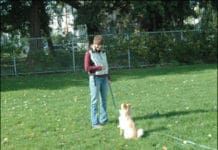
Teaching a Reliable Recall
The recall response seems to come naturally to some dogs. For others, it’s a hard-won behavior. The Miller pack has some of both.

Tug O’ War is a Fun Game to Play With Your Dog
Contrary to conventional wisdom in some dog training circles, tug is a great game to play with most dogs - as long as you and your canine pal play by the rules. Lots of my clients have dogs with aggressive, reactive, and other stress-related behaviors. One of the best ways to help reduce stress is to increase exercise. Tug is great exercise. I'm constantly encouraging my clients to play tug with their dogs. Inevitably when I suggest it I get a puzzled look and a tentative protest that "some trainer" told them playing tug would make their dog dominant and aggressive. I sure wish I could meet that pervasive "some trainer" some day and convince him/her otherwise. It just isn't so. Tug has a lot going for it besides just being good exercise. Most dogs love to tug. Of course, the caveat is that you play tug properly - with rules, which I'll discuss in a minute. Here are some of the many other reasons this game ranks high on my list of approved activities.