

Home Search
heart%20disease - search results
If you're not happy with the results, please do another search

What Does The Dog Think?
Current research has demonstrated that many species, including our beloved canines, share brain circuitry very similar to the human part of the brain that controls emotion the amygdala and the periaqueductal grey. While there's no doubt among most dog lovers that dogs have emotions, this concept is still being discussed in the halls of academia. Some insist that even though animals show emotional behaviors that we can observe, we can't assume the behaviors mean the animals who display them have emotional feelings. (I don't know how anyone can think this, but some scientists really do!) Others, such as the esteemed neurobiologist Dr. Jaak Panskepp of Washington State University, argue that if it walks like a duck and quacks like a duck it's probably a duck!
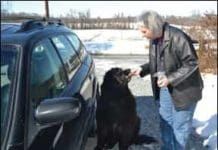
Help For a Dog With Car Phobia
Behavior issues, from simple good manners infractions to the more concerning problems of phobias and aggression, appear in dogs both large and small. But while training to modify behavior issues might look the same regardless of size, in other respects, the bigger the dog, the bigger the problem. When a Dachshund has a lapse in housetraining, the cleanup process is significantly easier than if an Irish Wolfhound has an accident. If a Havanese frantically jumps up on your elderly Aunt Tilly, the collateral damage is less than if a Great Dane does the same. And if a Yorkie is terrified of riding in the car and refuses to get in for an emergency trip to the vet, he can be picked up and placed inside – not so when a Newfoundland steadfastly refuses.

Blood Transfusions for Dogs
Denise Mankin, DVM, was on duty late one night in a Des Moines, Iowa, emergency veterinary clinic when Yeller, a Labrador Retriever, was rushed in sporting a fresh wound to his back. Yeller had been shot after escaping from his rural home. After stabilizing Yeller with IV fluids, antibiotics, and pain medications, Mankin opened up the dog's abdomen to find blood filling his abdominal cavity. A bullet had perforated Yeller's small intestine in five different locations, and two of the sites were hemorrhaging profusely. Within moments, his blood pressure plummeted. As Mankin worked desperately to tie off the blood supply to his damaged bowel, Yeller went into cardiac arrest. Cardiac drugs restored Yeller's heart beat, and donor blood, having been warmed for transfusion, was pumped into him.

Bone Marrow Transplants Offer a Promising Treatment for Canine Lymphoma
Exciting news regarding bone marrow transplants for dogs with lymphoma has recently emerged. North Carolina State University’s College of Veterinary Medicine in Raleigh is the first university in the world to open a canine clinical bone marrow transplant (BMT) unit. Dr. Steven Suter, assistant professor of veterinary oncology at NCSU, is about to perform his 30th transplant, all done over the past two years. Lymphoma, also called lymphosarcoma, is one of the most common cancers to occur in dogs. While it used to be considered a disease of middle-aged and older dogs, those demographics have changed in the past 5 to 10 years, with more and more young dogs being diagnosed. Golden Retrievers have a particularly high risk for this type of cancer.
Obsessive Compulsive Behavior in Dogs
Owners of herding and sporting breeds Border Collies, Aussies, Kelpies, Labradors, Goldens, and others often cheerfully talk about their dogs' obsession" with tennis balls. What they really mean is that their dogs are very reinforced by the opportunity to chase a ball. That kind of intense interest in a ball or toy can be useful for training and management purposes
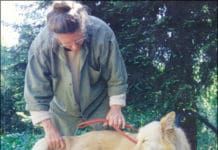
The Tellington TTouch For Dogs
of Berkeley

Are Raw-Fed Dogs a Risk?
Delta Society is one of the largest and best-known organizations that registers and insures “pet therapy” volunteers and their companion animals. Pet/handler teams – known as Pet Partners – brighten lives in hospitals, nursing homes, group homes, schools, pre-kindergarten programs, libraries, jails, women’s shelters, homeless shelters, senior centers, adult day programs, and a host of other facilities. But on May 19, Delta Society triggered a firestorm of controversy, complete with conspiracy theories, angry denunciations, frustration, and confusion, when it announced that effective June 30, “any dog or cat from a household where raw protein food is fed is not eligible to be a Delta Society Pet Partner.” Delta’s Raw Protein Diet Policy raises serious questions about the safety of feeding raw food regardless of an animal’s pet-therapy status.

Using Your Dog’s Bowl As a Training Tool
You may think feeding your dog is a simple matter of dumping food in his bowl and plopping it down on the floor in front of him. You may be wrong. Mealtime is fraught with significance for your dog, and loaded with opportunities for you to influence his health and his behavior. Failure to take advantage of these could actually contribute to the development and/or escalation of problems that might otherwise be averted. A few deliberate decisions and choices on your part can go far in creating harmony in your home.
Preventing Bladder and Kidney Stones in Dogs
Bladder and kidney stones are serious problems in dogs as well as people. These conditions which are also known as uroliths or urinary calculi can be excruciatingly painful as well as potentially fatal. Fortunately, informed caregivers can do much to prevent the formation of stones and in some cases actually help treat stones that develop. Last month, we described struvite stones (see Canine Kidney Stone and Bladder Stone Prevention" Whole Dog Journal April 2010). Struvites contain magnesium
Walking An Excited Dog
You contemplate taking your dog for a walk with mixed emotions. You love the idea of going for a companionable stroll through the neighborhood together, but it's a major hassle to get out the door. When you pick up his leash he becomes the Tasmanian Devil body slamming you, racing around the foyer, and bouncing off the plate glass door with such intensity you're afraid he'll crash right through it.

How to Stop Dogs From Fighting in Your Household
Knowledgeable dog people are quite aware that not all dogs get along with each other, despite the fact that canis lupus familiaris (domestic dog) is a social species. Hey, we humans are a social species, and we certainly don't all get along! Dog-dog aggression is unhappily common in our world. As a professional behavior consultant who works with aggression cases, I probably see more than my fair share of it. By far the most difficult and most distressing presentations of dog-dog aggression are intra-pack aggression cases: dogs in the same family who aren't getting along with each other. I've had a spate of these clients in recent weeks. Even our own Lucy and Missy, a Cardigan Corgi and Australian Shepherd who don't always get along seamlessly, seem to have experienced an increase in relationship tensions this winter.
Less Stressful Veterinary Visits
A training friend suggested that I read Low Stress Handling, Restraint, and Behavior Modification of Dogs and Cats, by applied animal behaviorist Sophia Yin, DVM, MS. As an owner whose dogs have taken their fair share of visits to vet clinics, I really liked what I read. Dr. Yin's text takes a critical look at how our pets are often handled in veterinary clinics and it's not pretty, as you may have seen yourself. Fortunately, she also offers common sense advice on approaching veterinary care so as to make it as stress-free as possible for our pets. Popular myths abound that force is needed to get animals to behave. Instead, Dr. Yin focuses on how to modify behavior quickly in a veterinary setting using a systematic and positive approach. Her methods involve classical conditioning to change the pet's emotional state; setting up the veterinary environment to ensure the pet's comfort; teaching us how to handle animals with appropriate, rather than stronger, restraint; and how to behave around animals so as to avoid creating problems.