

As dog lovers, we want to help a stray dog and ensure he is safe until his owner is found. But once you’ve caught him, you’re wondering who to call about that stray dog, and where you can take him.
Wonder no longer. Here are the steps you should take after you have found a lost dog:
- Bring him to your local animal shelter. They will scan for a microchip, check for a “lost dog” report, and file a “found dog” report. If you are not sure where the correct shelter is located, call the closest veterinary hospital. They will always know where local strays should be taken.
In the best-case scenario, he’s in possession of a registered identification microchip, and a quick scan at the shelter gives the staff the information they need to quickly reunite the dog and his owner. Yay! If he has no microchip, however, or the one he has is not registered with current contact information for the owner (Boo!), then someone, either you or the shelter staff, will have to do some detective work to see if the owner can be found.
Most shelters maintain a log of “lost dog” and “found dog” reports. At my local shelter, they allow people to look through the log themselves, and they try to make matches when someone at the front counter has time, which isn’t all that often. But if someone is making an honest effort to find their lost dog, this is one of the places they will look.
- Leave him at the shelter. We know. You now feel responsible for him. He’s a super nice dog, and you don’t want to leave him at the shelter. Most shelters will allow you to take him home and forward your contact information to anyone who comes to the shelter looking for him. However, if the dog is not at the shelter, his picture probably will not appear on the shelter website. And, sometimes, people only search their shelter websites for pictures of their lost dogs. The odds of being reunited with his owner are better if the dog is at the shelter than anywhere else. A caveat: If you live in an area where unclaimed stray dogs get euthanized fairly quickly, and you have the ability to securely house and feed the dog, by all means, let the shelter know that you will care for him while you add the following steps to your “to do” list
- Use social media to advertise the dog. Ask your friends to share the post. Take a good, clear photo of the dog and post a description on your own social media (make sure your posts are public, so they can be shared) and on the pages of any animal-welfare sites in your area.
In my area, there are Facebook groups with names like “Oroville Lost and Found Pets” (serving my town), Butte County Lost/Found Animals (serving my county), “530 Lost and Found Pets” (serving a several-country area served by the 530 area code). Search for the term “lost and found pets” on Facebook and you should find several for your area.
- Consider Craig’s List. Don’t forget about that you can post a description of the found dog there, too. Not long ago, the roommate of a friend accidentally allowed my friend’s dog to escape the house when my friend was not home. Dozens of his friends quickly shared his “lost dog” posts on Facebook, but he received a call from someone he knew who saw a “found dog” post on craigslist.org that sounded like it was about his dog (and it was). The finders were an older couple who eschew social media. Hedge your bets and post in every forum you can! Note: Be sure you “hide” something about the dog, whether it’s his collar color or a marking like a white toe on his right hind leg that can help you determine if the person sounds like the legitimate owner or not. No one needs to be reminded that there are unscrupulous people out there.
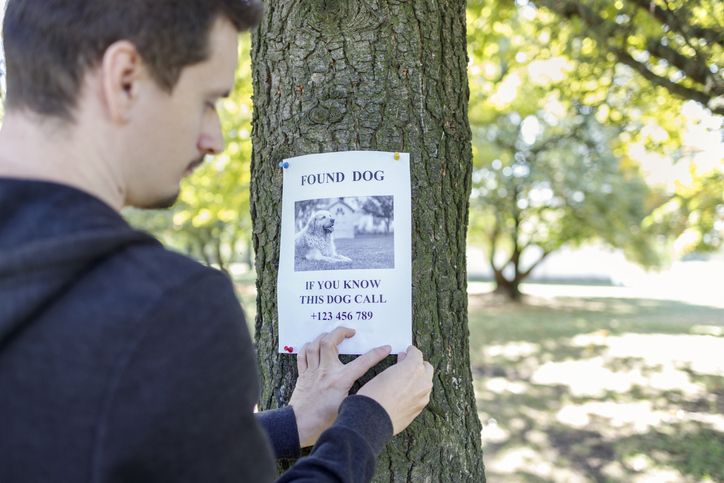
- Make some “Found Dog” signs. As noted above, some people don’t have a computer or use social media. Posting some “Found Dog” fliers in well-trafficked areas near where the dog was found will reach those people. Use a big, clear photo and a large font with your phone number. Post it on store bulletin boards and the like. You can also make a large poster without a photo but briefly describing the dog, such as, “Found: Large black male dog, short tail.” That’s enough for someone who has lost their dog to recognize that the dog you have might be theirs. Try to post them at major intersections within a mile or three of where the dog was found, as long as it’s legal to do so in your town.
- Don’t forget the local veterinary clinics, pet supply stores, groomers, and other animal-related businesses. Most will have a bulletin board or other location for fliers. At the least, they will now be aware that the dog was found.
- Rethink rehoming. Don’t be too quick to try to find a home for the dog. If you can’t keep him indefinitely the shelter is better than rehoming yourself. For example, say you were on vacation for two weeks and your dog got away from the dog walker or neighborhood kid you hired to care for your dog while you were gone. Someone found the dog, but because they didn’t get a response to their found-dog posts or the report at the shelter, they assumed the dog had been “dumped” and gave the dog to their brother-in-law (or someone else). That person, your dog’s new owner, might never be aware that “your” dog is very much loved and missed and wanted.
If you fall in love with the dog, and are tempted to keep him yourself, just keep in mind that there can be any number of reasons why a person may be unable to search for their beloved dog, or see and respond to “found dog” ads.
The Washington Post ran a story about a man who was in the hospital, with a friend taking care of his little dog. His condition worsened, and his doctors put him into a medically induced coma for over three weeks. Sometime after he was reawakened, his friend came to tell him the sad news that his dog had run away weeks before. The dog had been picked up and taken to a shelter, where, after being unclaimed for weeks, he was put up for adoption and was adopted by a person who fostered him for the shelter.
Fortunately, an intermediary who was familiar with the shelter connected the adopter and the dog’s original owner and convinced the new owner that the little dog really did belong with his original owner, who lost the dog through no fault of his own. The media is full of stories like this with more contentious endings, where the new owners won’t give up their newly adopted dog, and the shelter is unable to legally intervene.
If you host the dog yourself—and keep the shelter aware the dog is still a stray—you should continue to share occasional found-dog posts, at least for a couple months, before determining that no one is out there still looking for their dog. Ask your local shelter staff what the law in your state requires before you can consider a “found dog” your own, and when sufficient time has passed, get the dog licensed in your name and get microchipped – and make sure you register it as soon as possible.




I question the safety for the dog if a picture or very detailed description is posted. Aren’t there significant risks that someone who is NOT the dog’s owner will respond with those very details in order to obtain the dog for their own purposes? (Obviously, this depends on where you live and the frequency of pet theft in the area). It seems that the finder/temporary keeper of the dog should ask for some proof of ownership–a picture, vet referral, previous social media post of their own, etc–before handing the dog over. (You may not get one, but it may deter someone who casually “collects” pets, and at least you tried). Also, observing the response of the dog to the person claiming them–is there happy recognition?
This was well written and helpful. But what I had hoped it would be about was what to do and what not to do BEFORE you take a stray somewhere safe. How exactly do you get a dog to that point?
If I see a dog on the side of the road, what are the proper ways to approach it? One might have the impression that all of the dogs the author was referring to went easily into someone’s car—yet that’s probably not the case.