

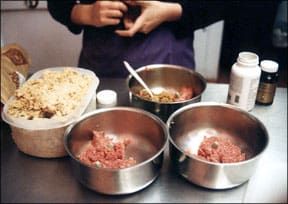
Whether you want to try feeding your dog raw food or you’re looking for home-cooked dog food ideas, the components of a good homemade dog food plan are not complicated, but do require diligence and dedication from you – the dog guardian.
Calcium levels in your dog’s diet are important: you can’t feed too little or too much. A balance of nutrients over time is also essential: mixing and matching different types of vegetables and meat over the weeks and years. So how do you make sure your dog’s homemade diet is complete and balanced enough? You need to feed a high variety of foods.
3 Essential Ingredients for Homemade Dog Food:
1. Muscle meat
2. Raw meaty bones and offal (animal organs)
3. Vegetables (leafy, non-starchy)
Whole Dog Journal steers away from providing dog guardians with step-by-step recipes for dog food, raw or cooked. We can share expert dog companions’ personal protocols for feeding their dogs home-prepared, but quickly you will realize not only that the perfect dog food recipe does not exist, but that in order for your dog to receive all necessary nutrients, you really need many recipes that include many different whole food ingredients.
1. Muscle meat
We all know what this is. Chicken, lamb, beef, pork, venison, rabbit – these are the meats you see on commercial pet food labels, and the type of meat humans mostly eat. Fish also falls under this food category: common fish meats to feed dogs include jack mackerel and salmon. Unlike people, there is no limit to the amount of protein a dog should eat; dogs can survive entirely on animal meat if necessary. It does not matter if dogs eat raw meat, either – though there have been cases of dogs getting sick from salmonella or E. coli, this is rare and generally comes down to a preexisting immune deficiency.
2. Raw meaty bones and other animal parts
Here is the trickiest component of homemade dog food. Raw meaty bones refer to a specific type of animal bone that is for eating, not just for chewing (we call these recreational bones). RMBs are fed to dogs unprocessed, with muscle meat and tendons still adhered. They aren’t dried and therefore are not brittle, and usually are big enough not to be swallowed whole. Raw meaty bones are an essential source of calcium for dogs; if for whatever reason your dog can’t handle RMBs, alternatives like ground bones, or ground eggshells, in their food can supply the calcium.
Organ meats like liver, kidney, hearts, and necks are required for home-fed dogs as well. For raw-fed dogs, organs should make up about 10% of their overall diet, which may be a challenge for some dog guardians. Offal meats contain all the rich vitamins and minerals that make your dog glow, but since they aren’t widely eaten (in the United States at least), they aren’t widely available.
3. Vegetables
What veggies should you definitely include in your dog’s diet? There are plenty of vegetables that are good for dogs.
Spinach
Carrots
Peas
Lettuce
All types of squash (pumpkin, zucchini, acorn, butternut)
Cauliflower
Broccoli
Cucumbers
Asparagus
Vegetables and Fruits That Benefit Dogs, But Are Not Essential
Sweet potato
Celery
Kale
Cabbage
Brussels sprouts
Tomatoes
Mushrooms
Green beans (when they’re cooked)
Any edible berry
Any kind of melon
Avocado
Apples
Oranges
Pears
Bananas
Pineapple
Lemons and limes
Need more details on vegetables for dogs? Here you go!
Nutritious plant-based food options are plentiful for dogs, but there are a handful of foods dogs should avoid or limit eating:
Onions
Garlic
Nightshades (potatoes, eggplant, peppers)
Grapes and raisins
Do these foods kill every dog who ingests them? No, of course not. Some dogs eat potatoes and bell peppers their whole lives and don’t have any issues. Other dogs get the occasional grape as a treat and they’re fine. Garlic, in small amounts, is actually good for dogs. The problem is that each of these ingredients contains toxins which, if eaten in excess, can make your dog sick, so we do not recommend using them in your home-prepared dog food.
Grains in Homemade Dog Food
Dogs do not need to eat grains for a complete and balanced diet, nor do they need to eat beans and legumes. Grains and beans aren’t bad for dogs, they just aren’t an essential part of the canine diet. As a filling source of protein, these starchy ingredients can be included in your dog’s meals from time to time, but they should not be main ingredients in the homemade diet you design.



I give my dogs marrow and soft bone material daily. I have two setters, one 40 the other 50 lbs. I pull the marrow from chicken bones and I also chop up the soft round ends of the bones for them. How much of this marrow and bone material should I give them daily? I would say they are getting about a teaspoon to a tablespoon per day. They also get a teaspoon of powdered eggshells daily.
Good tips here. Definitely going to add some fruits and veggies to my dogs diet.
Dogs should NOT eat avocado. Please remove this from the list!
4. Can dogs eat avocado?
Parts of the avocado tree and fruit contain a natural antifungal agent called persin, which is hazardous to dogs when consumed in great enough quantities. Needless to say the pit or seed of an avocado should not be given to a dog; aside from the natural toxins it contains, it can cause intestinal blockages. However, it’s safe for dogs to eat the green, fruit part of an avocado in small amounts.
I am still feeding my dogs dog food but less because he’s overweight. I want to add fresh fruit and vegetables to it so he seem full. How much should I add. His a Havanese/Beagle mix, weighs 26 lbs.
Avocados are not safe for dogs…I don’t know why they are listed here.
How safe is it to feed raw ground beef and raw organ meat from the grocery store to my dog? Is there anything i can do to it to make sure it has nothing in it that can make him sick? I am feeding my dog cooked ground beef 85% with carrots, kale, and rice, but am no hearing that he might need more balance.
I thought avocados were a definite no for dogs. Why are they listed here as ok?
That’s where I was stumped I was under the impression avocados were to be poisonous to dogs
Yeah, I’ve heard that too, my girl LOVES them!! Come to find out…..it’s the skins ~ also the ‘meat’ close to it can be toxic when either too ripe or not ripe enough (can’t remember which) ~ but mainly…..wait for it…..the pit/seed!! Claimed it was a serious choking Hazard?? It seems to me, sometimes, they’re just making this stuff up!! LOL
I’m so happy to see the trend towards the more responsible and educated feeding of pets. One key point I need to make specific to this article: I didn’t even get through the entire article before I found errors…..when talking about organs, heart is not considered an organ…..it’s considered muscle meat. Same with necks…they are absolutely not organs but are part of the bone/RMB component of a raw diet. Muscle meats include the obvious, but lung, heart, tongue are also part of the meaty component. Organs are liver, kidney, sweetbreads (Thymus), brain.
Completely agree that no one recipe fits all (our one Frenchie was extremely uncomfortable and gassy when given veggies, particularly cauliflower, in the evening, while our other was completely fine with it). Also, rotating and varying the protiens is key…as any one meat-type will have different nutritional balances than another, and serving a variety ensues that all bases are covered.
We’ve been raw feeding our dogs for 6+ years now using various canine-nutritionist guides and the results have been transformative.
My vet said that feeding raw meats is NOT good and she is seeing more and more cases of Salmonella. She said to think of it as if you were going to eat it. Would you eat raw meats? It was first thought that because they ate raw in the Wild it was ok however as she put it out dogs are domesticated and they should never eat raw meats.
Thanks for tips. I am dealing with pancreatitus. Do u think probiotics might help?