

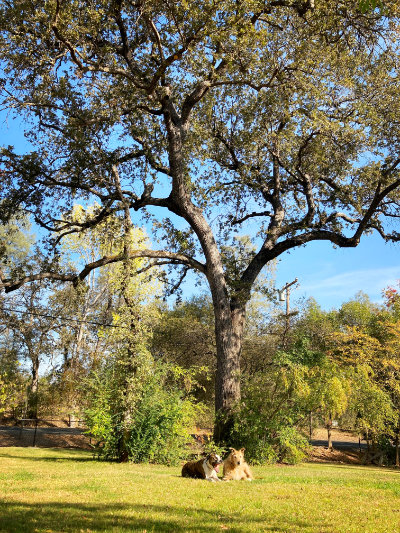
Not that anyone asked, but my favorite tree in the whole world is the oak tree. We have dozens of species of oaks in California, and where I grew up, in the great Sacramento Valley, the Valley Oak (Quercus lobata) is the most ubiquitous and also the largest oak tree around. They live to be hundreds of years old and grow into massive, photogenic shapes. When my husband and I bought the property where we have lived for the past (almost) three years, one of the key selling points was the magnificent hundred-year-old Valley Oak that stands in front of the house, and several other smaller Valley Oaks sprinkled around the property, along with some lesser oak varieties, the Blue Oak and the Live Oak.
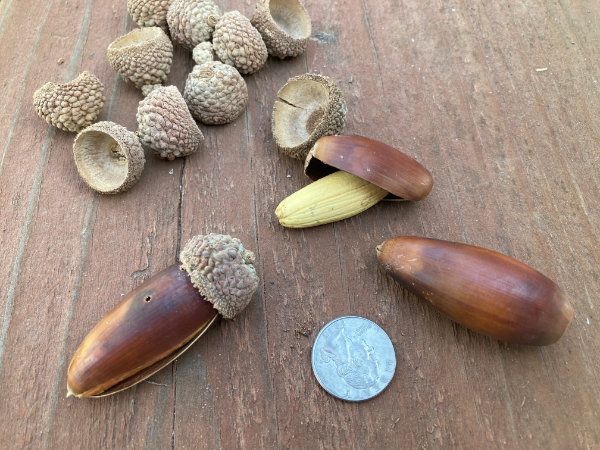
Here’s the down side of living with oak trees, one that I never fully appreciated until now: acorns. So. Many. Acorns. And while all the oak trees are producing them, the Valley Oak makes some of the largest ones; they exceed the size of a standard tube of lip balm. Their distinctive “caps”, too, are a hazard. When they separate from the acorn, they become a separate large, hard, marble-shaped hazard.
Acorns underfoot on the lawn. (“Ow! OW!”)
Acorns getting mowed by the mower (turning the mower into a dangerous, projectile-throwing machine).
And worst of all: Dogs chewing on and (sometimes) eating the acorns.
California kids grow up with the information that the native indigenous people in California harvested the acorns and made them a staple of their diet – and every California kid who lives near an oak tree tries to reenact this. You gather acorns, peel off the skin to expose what appears to be a big, delicious nut, and find some rocks capable of grinding the nuts into a coarse flour. The goal is to then add some water and use your hands to mix the flour and water into a dough and try to make a tortilla. At some point in the process, you dip your finger into the flour and lick it, or take a little bite of the dough, and – ACK! Blech! It’s bitter!
When California kids get a little older, they learn that acorns are full of bitter tannins, and that the native people used to leach the flour with water, sometimes many times, to remove the bitter substance and make the acorns safe to eat.
And, as vet-bill-paying adults, we learn that in addition to being bitter-tasting, these tannins can be toxic to humans, horses, and dogs. Shoot!
Tannins in acorns can be toxic to dogs
I know several people whose dogs get sort of addicted to chewing the bitter-tasting nuts and end up with an extremely upset stomach – and in severe cases, kidney failure and death. A dog who becomes inappetent after eating acorns requires immediate veterinary care. My sister had a little dog who, at least once a year, would require a vet visit after sneaking a few acorns. She liked them after it had rained a time or two in the fall, when the nuts have gotten soaked with rainwater and fermented slightly – which seemed to increase their toxicity.
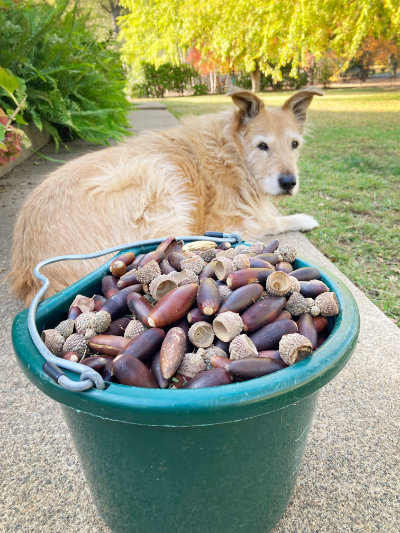
Despite the wealth of nuts littering my property in the fall, neither of my dogs has been interested in picking them up or chewing them, even speculatively, and up until now, neither have any of my foster dogs. That is, until my most recent foster dog arrived. I have to keep a very close eye on Coco, who has become inexplicably drawn to chewing on the acorns, to the extent that I basically can’t have her out of my sight on my fenced, two-acre property. Wah!
Like my sister’s dog from years ago, Coco is (thankfully) uninterested in the dry ones that cover most of my property, and is mostly drawn to the ones that have been soaked by the sprinklers on my front lawn. While this is quite a lot, given the GINORMOUS Valley Oak, the pride of our property, at least it’s just those. So it’s my new evening hobby: hanging out on the front lawn in the evenings with my dogs, throwing the ball for Woody, watching Woody and Coco wrestle, watching Otto watch for feral cats and squirrels … and picking up acorns from the lawn, and dumping them in our “green waste” barrel. I probably have a few more weeks to enjoy this new hobby before the tree’s supply is done and I can relax again.
Have you ever had trouble with an acorn-eating dog? Spread the word about this danger.




This article jiggled something in my memory about pigs eating acorns, even having them as a diet staple among feral or wild hogs, and exploited by pork farmers using natural feeds and forage for their herds. So I looked it up online and found a whole spectrum of opinion, from “acorns are toxic to pigs” to whole articles in ag journals about acorns as important components of pig diets. I wondered if pigs could be taken round to feast on seasonal acorns the way goats are to clear brush? Obviously, this is a bountiful harvestable foodstuff – and couldn’t the tannins be used for something, too, if one soaked one’s acorns? I hate to think of the waste – acorns are about 6% protein – and the harm to animals not equipped to utilize this source. Has anyone inquired about a way to get acorns away from curious canines and into beings and processes that could use this naturally abundant “crop”? Maybe starting with scientific studies of the varying levels of toxicity among different oak species?
Our house came with many oaks — a dozen or so that were more than 100 years old. For the first 10 years we lived there I didn’t know that the acorns were toxic to dogs. Every day I’d sweep the ones on the porch into a bucket because walking on them was like walking on ball bearings. The bucket got dumped into the compost heap. We never bothered with the ones in the yard — just too many of them. Our northern-breed dogs loved to crunch them up and swallow some. When I said something to my vet about acorns being toxic to sheep and asked about any problems with dogs, she said to move the dogs to an oak-free area or cut down the trees. Neither was possible, since we couldn’t let dogs out without close proximity to an oak tree. And we could not afford $2000 – $5000 per tree to remove them (somewhere around $40,000 total). We never had a problem with sick dogs. The dogs never didn’t eat breakfast or dinner unless they got a sock or leather work glove. (Husband learned the hard way about those! He was a slow learner, though.) We lived there for 14 years. I guess we really were lucky. And, I have always known that my self-sufficient-if-necessary northern breed dogs can eat almost anything!
Wow Nancy I love your columns so much good and useful information!
My chinook, Nell, loved acorns. One year as a young dog after we moved to house with an oak tree, she ate so many she had a rather significant gastric upset. She recovered but It was significant enough that she gave the habit up completely. My other chinook has never tried to eat them. I like to think his “big sis” warned him.
My dachshund almost died. He carefully chews his food, and the acorns were no different. The vet thinks that’s why he got so sick. He required sub-cutaneous fluids for a week. I hadn’t met my husband yet. He doesn’t really know how bad it was and he thinks I’m overreacting.
I have an Oak tree in my back yard and my Aussie has been eating the Acorns. I will go and rake them up! She loves ALL nuts, but I don’t give her Pistachio because I read they are not good for dogs, however I worry because she loves them so much. Should I not give her any nuts? I worry she is missing something in her diet, but I feed her a good balanced commercial raw diet.
Many nuts are poisonous for dogs, especially macadamia nuts. I would not feed them.
My little senior terrier mix dog, Connor, was chewing on something he found in a pile of oak leaves. Of course, I yelled, “drop it.” And he promptly swallowed it. The next morning he vomited twice. He never vomits. He didn’t want to eat for the rest of the day. Now I wonder if he had eaten an acorn. Thanks for the information. You’re amazing!
My coonhound mix does not have a taste for acorns (yay for this!) but he did have an ow-ow moment recently when he came in limping with an acorn cup lodged between his front paws.
Perhaps this is the reason that my newest rescue has some pretty gross diarrhea not too long after she got here. I have a huge oak tree in my back yard that has become quite prolific in acorns the past few years. I am used to occasionally have to pick a half shelf that has perfectly fit a paw pad, but never really worried about the dogs actually eating them. I think she learned her lesson though, and my other dog never messes with them.
I had a Ridgeback who loved acorns. We used to tell him if he didn’t watch out he’d end up with an oak tree growing in his tummy. I did not know they were toxic and I feel blessed he never had a stomach issue and lived to a ripe old age. He didn’t eat a lot of them, usually one or two and then stopped.
Thanks for the advice to add to my list of no-nos for pups.