


Copophagia, or eating feces, disgusts most humans, but many dogs find it quite satisfying. That’s why, if the cat’s litter box is easily accessible, some dogs will grab that readily available “snack.” The best way to stop your dog from eating cat poop is to use supervision and training, such as teaching the Leave It cue, and train your dog to stay away from the cat’s litter box.
Make the Litter Box Inaccessible
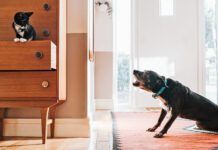
That said, you can deter your dog from eating cat poop with litter box management. If your dog is stealing “food” from the litter box, move the litter box to a place your dog cannot access it by using cat doors or a baby gate to prevent the dog from getting to the box. Some people place the litter box in the basement. Others sacrifice a bathroom cabinet with a small access hole in it that the dog can’t use. A simple method is a baby gate that the cat can easily leap to access his box in one room (obviously, if your cat is injured or frail and unable to jump, that won’t work for you). Most dogs won’t challenge the gate.
You can also look for a “dog-proof” litter box. Consider both your cat and your dog when making a choice. Many of these litter boxes are pricey, and cats can be very set in their ways. A litter box that forces a cat to jump in and out of may cause your cat to avoid it. Another one that not all cats accept are self-cleaning boxes that move and make noise.
Don’t be too hasty in your decision and don’t force your cat to use a new box, which may cause your cat to think under the couch might be a better spot to relieve himself than a litter-box contraption that looks like a monster. If you find a litter box you think might suit your cat, place it next to his current litter box and watch to see if he engages. Give him time.
Will a Commercial Product Stop Dog Poop Eating?
Unlikely. Many commercial products are available to help stop your dog from wanting cat poop because the 16% to 25% of dogs who do eat poop have created a market for those products. That doesn’t mean those products work. If you choose to go this route, consider it a trial-and-error adventure, and don’t expect a miracle.
A 2018 study published in Veterinary Medicine and Science by Dr. Benjamin Hart tried 11 different products designed to stop poop eating and found none were effective. “The reported success rate of the commercial products and behavior modification approaches was close to zero, indicating that the behavior is not readily changed,” according to the study. Products in the study were: 21st Century Deterrence, Coproban, Deter, Dis‐Taste, For‐Bid, Nasty Habit, NaturVet Deterrent, Potty Mouth, S.E.P, Stop Stool Eating, and Stop Tablets.
The researchers determined that most dogs who eat poop are greedy eaters, a behavior that is difficult to change, and that age of the dog has nothing to do with it. (Interestingly, spayed female dogs are most likely to eat poop.) The study found most dogs ate fresh stools, which were defined as no more than 2 days old.
Why Do Dogs Eat Cat Poop?
Cat poop may be especially attractive due to the feline diet. Cats eat a high protein/low fiber diet—they are, after all, obligate carnivores—and that results in poop with a high protein content. And protein will attract your dog.
Of course, dogs don’t just eat cat poop. They also eat horse poop, wild animal poop, poop from their friends, and not just at poop they find at home. Dr. Hart’s researchers hypothesized that dogs eat poop due to ancestral behavior designed to keep the wolf den clean and free from parasites, so it may be due to an instinctual drive to clean up the litter box and help keep your home clean. Additional guesses as to why dogs want to eat cat poop—and other feces—include boredom, anxiety, and greedy eating.
Can Eating Poop Make Your Dog Sick?
Mostly, a house cat’s poop is not going to harm your dog, but the litter that goes with it could. Clumping litters are extremely dangerous as they will expand inside the dog’s stomach. And other litters, although nearly always deemed “non-toxic,” may have crystals or scented flakes that could make your dog ill. A few pieces may not be a problem, but a consistent habit could bring you a big veterinary bill, especially if the dog gets an intestinal blockage.
Eating poop from wild animals is more of a problem than from your house cat as it may expose him to parasites and bacteria. If you know your dog has been eating feces and he’s vomiting, has diarrhea, or is lethargic, consider making an appointment with your veterinarian.



I am wondering if the litter boxes where the cat jumps down into a hole in the top would deter dogs. They are quite a bit taller than the more common side entry or open boxes.
Why do you assume that the dog is eating the cat poop only from a liter box? We don’t have a cat. But my dog will find it as we are out on a walk. Gourmet treat that he grabs so fast and we can’t even see it until he gotten it. Yuck!