

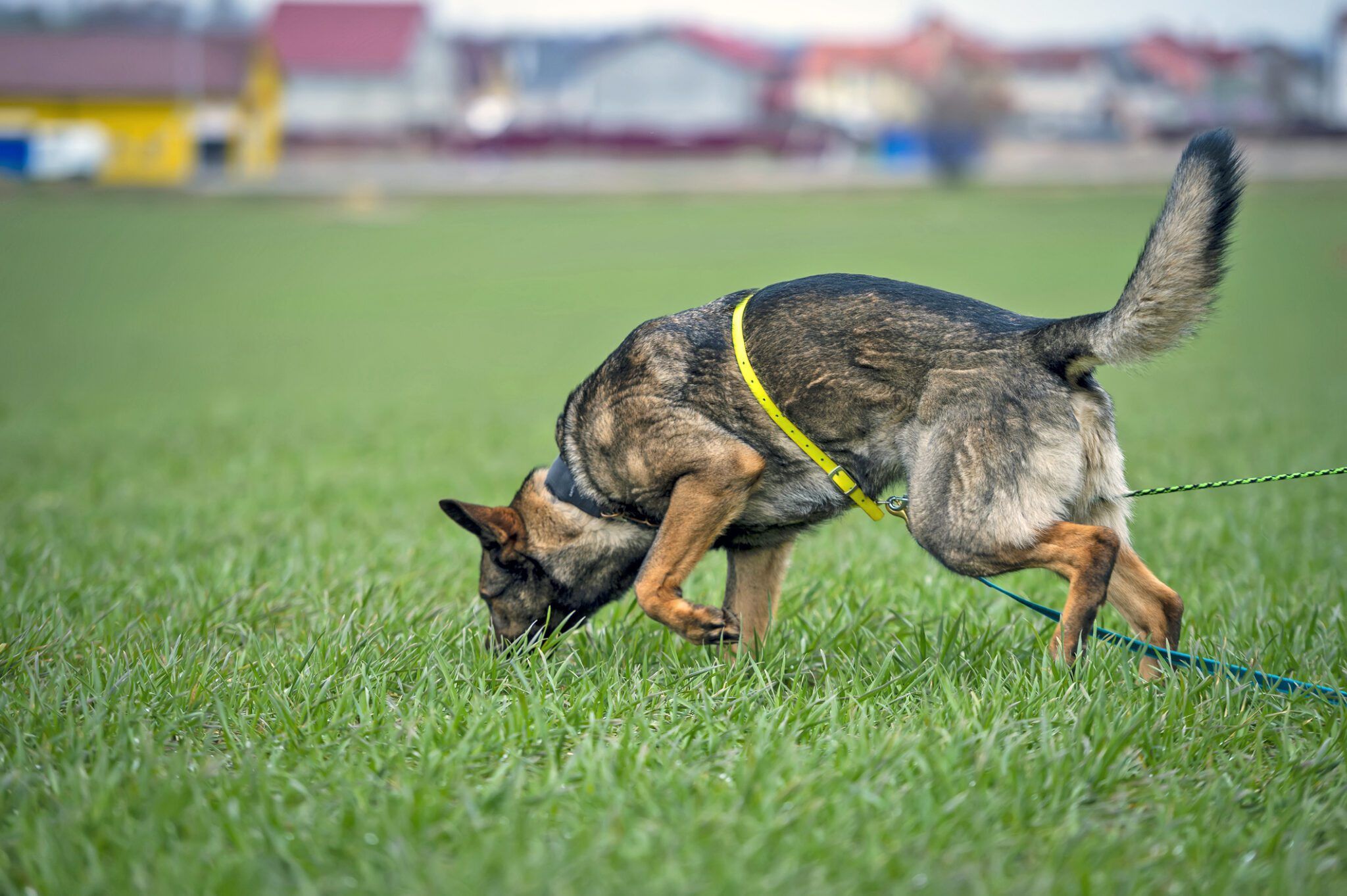
Your world is most often defined by sights and sounds, but for your dog smell is where it’s at. Your dog’s nose is a marvel of biology, capable of detecting scents that are undetectable to us.
How Far Away Can Dogs Smell Their Owners?
It’s quite amazing, really. “In perfect conditions, a dog can pick up a scent up to 12 miles away, so this indicates that some breeds may be able to smell their owners from miles away,” according to PetRadar, a company specializing in reuniting lost pets with their owners.
The distance your dog can detect your scent varies widely and is subject to the same environmental rules as any other scent, which includes things like wind and humidity, as you will learn here.
That said, your dog knows your specific scent, a unique mix of sweat, breath, skin, hormones, laundry detergent, and diet. To your dog, your scent is as unique as a fingerprint. A variety of studies have shown that dogs are powerfully motivated by their owner’s scent, making them far more persistent in tracking it.
Dogs can even been shown to detect disease through scent. High blood sugar spikes in people with diabetes, those battling Parkinson’s disease, even the onset of seizures. Studies are showing they may also be able to detect cancer.
How Far A Dog Can Smell Depends
There is no solid answer to the question of how far a dog can smell, even under “perfect” conditions. That’s because the distance is heavily influenced by factors, including:
1. Air and Wind Conditions
For a dog to detect a scent over a long distance, the wind must be blowing directly from the source to the dog. Scientists refer to the path of this wind-borne scent as the scent cone or plume. That is, the scent starts narrow, billows and begins to dissipate.
How dramatic is the impact of wind conditions? A dog downwind of a scent source could potentially detect it over miles. In contrast, a dog positioned upwind would only detect the odor once they were virtually on top of the source.
In ideal conditions (e.g., a steady, favorable wind, moderate humidity, and a strong, concentrated odor) a dog’s effective detection range can extend many miles. For example, search-and-rescue dogs have reportedly picked up human scent trails several miles away under ideal conditions.
2. Humidity
Scent molecules adhere better to moisture. Humidity helps keep microscopic scent particles suspended in the air, preventing them from drying out and dropping to the ground too quickly. “Increased humidity could be responsible for increased odor intensity, positively influencing the tracking efficiency of dogs,” according to National Library of Medicine.
3. Scent Strength and Concentration
A potent, concentrated odor such as a fresh blood trail will be detectable over a far greater distance than a faint, weak odor The stronger the odor, the greater the number of molecules released into the environment, and thus the farther the scent cone will extend.
4. Ground vs. Air Scent
Most impressive distance feats involve air scenting, where the dog detects airborne particles carried by the wind. Ground scenting—tracking a scent trail left by footfalls—is highly effective for detail, but its distance is usually limited to the integrity of the trail on the surface, which rarely extends past a few hundred yards or a mile before dilution becomes too great. (The sports of scent work and Barn Hunt are rapidly growing as a wide variety of breeds of dogs and mixes excel in this fun new activity.)
Why Can Dogs Smell So Far Away?
“Olfaction [the sense of smell] in dogs is crucial for gathering information about the environment, recognizing individuals, making decisions, and learning. It is far more specialized and sensitive than humans’ sense of smell,” according to the National Library of Medicine (NLM).
Olfactory receptors, according to the NLM, are located on the ethmoturbinates — a complex structure in the nose that increase surface area. The vomeronasal organ is an additional source of odor detection for chemical signals that stimulate behavioral and/or physiological changes
Why Dogs Smell Better Than Us
If our dogs knew how our sense of smell worked, they would feel sorry for us. The average human has about 5 million olfactory receptors in their nose. However, a standard dog breed has about 300 million.
But the difference is more than just quantity. A dog’s nasal structure is complex and highly effective:
- Two Streams: When a dog inhales, its nose separates the air into two streams: one for breathing and one for olfaction. This means dogs can continually analyze odors without interfering with their breathing.
- The vomeronasal organ ( also known as Jacobson’s Organ): This secondary olfactory system, located just above the roof of the mouth, is dedicated to detecting specific, heavy moisture-borne chemical signals, particularly pheromones, which are vital for social and reproductive communication.
“The nerves from Jacobsen’s organ lead directly to the brain. They are different from other nerves in the nose in that they do not respond to ordinary smells, but to a range of substances that often have no odor at all. In other words, they detect ‘undetectable’ odors,” according to VCA Hospitals, a national network of hometown hospitals.
- Exhaling Through Side Slits: Dogs exhale through the side slits in their nose. This directs the outgoing air away from their sniffing path, preventing the dilution of new odors and helping to cycle new scent molecules into their environment.
This complex system allows a dog to detect an incredible range of scents, but distance depends on other factors.
Let Your Dog Enjoy the Sniff
Understanding power and precision of your dog’s nose helps you understand their behavior. When dogs sniff intensely for a minute on your morning walk, they are doing the equivalent of you reading the morning news, scrolling social media, checking the weather, and identifying who walked by last night. Allowing your dog to smell around him is a way to show our love to our canine companion.

This is an almost exact copy of an AI article! I agree with an earlier comment, the quality of WDJ’s articles since Nancy departed has decreased. Plus, this contributor is a free-lance journalist and not a professional in nutrition, training or animal physiology or veterinary medicine. Other articles have lacked facts or are copied and constructed with AI bites!
I apologize to Dan Muse, because this article is probably the work of editors. WDJ was unique in the dog care space for their lengthy and detailed treatment of 3-5 topics per month.
What a joke WDJ has become:
“Many miles”, “standard dog breed has about 300 million” (what is the standard dog breed? The most popular pet dog? A rescue mix breed? A pedigreed golden retriever? A chihuahua? A Blood hound? The average dog employed in scent work?)
“Substances that have no odor at all” ooo,…how mysterious!
Meanwhile, no shortage of product placement for VCA Hospitals (hometown hospitals? Lol), featured dog food? How is that not an ad? Or maybe I missed the memo where WDJ now takes money from sponsors.
Really losing respect and patience for this “journal”
I enjoyed this interesting and informative article.
Very interesting facts on the scent of dogs.
Thank you for this interesting summary!