


Your dog’s paw is a complex piece of anatomy, serving as a shock absorber, climate control system, grip enhancer, and even a form of communications with other dogs.
“Dog paw pads are relatively tough, as they are composed of thick calloused skin, fat, and connective tissue,” says Liza Cahn, DVM, a Seattle-based veterinarian. This design allows them to bear weight, provide insulation against cold, and protect bones and joints from high impact. “However, they still need protection from weather extremes, like hot pavement, snow, and ice.”
Color of a Dog Paw
“Just like coat and eye color, the color of a dog’s paw pads is determined primarily by genetics. Lighter-colored dogs often have pink paw pads, while those with darker coats may have brown or black. Some dogs have a mixture of pink and black,” says Dr Cahn. “In most cases, these variations are completely normal. However, if you notice a change in the appearance of your dog’s paw pads, especially if accompanied by other symptoms, it could be associated with an underlying medical issue such as allergies, trauma, or infection.
The color difference is caused by melanin. Darker pads are dense with this pigment and are generally considered slightly tougher due to their genetic predisposition for pigmentation. Pink pads, which lack this heavy melanin concentration, are typically thinner, less pigmented, and therefore can be more sensitive, prone to dryness, and susceptible to cracking or burning if exposed to extremes.
Webbed Paws and Dew Claws
Two important anatomical features of the dog’s foot define the functional structure of the canine paw: the webbing and the dew claws.
“Nearly all dogs have some degree of webbing, or fusion, between their toes. If you look closely at a dog’s paw, you’ll notice that you cannot separate each toe completely from the next one,” says Amy Fox, DVM, a New York-based veterinarian. “In some breeds, this webbing may be more pronounced, as they have been selectively bred for jobs like swimming or digging. This includes retrievers like the Labrador and Chesapeake Bay, the Newfoundland, and the Portuguese water dog.”
A dew claw is a small, vestigial toe located higher up on the paw, which is often compared to a human thumb. While often viewed by dog people as useless, the dewclaw, especially on the front legs, have a clear function in specific situations.
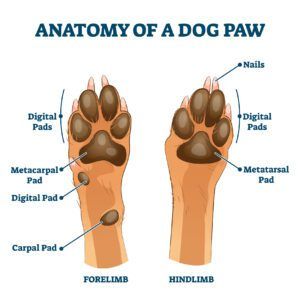
“For most dogs, the dew claw does not make contact with the ground when they walk. However, dogs that perform tight turns at high speeds use their front dew claws to stabilize their carpus, or wrist, during these kinds of maneuvers,” says Dr. Fox. When a dog is running and fast and making sharp turns. For example, as in agility sports, the dew claw provides extra traction and stability, acting like a specialized cleat like what human athletes wear on their feet.
Rear dewclaws are less common and often lack bone or muscle attachment, making them more prone to catching and injury. However, due to the stabilizing role of front dewclaws in high-impact movement, handlers of agility dogs typically don’t remove them, believing they play an important role in preventing acute injuries and chronic arthritis.
Paws as Communication Tools
What may surprise dog parents is that the paw is also a powerful tool for communication. This function is achieved through interdigital glands located in the paw pads. These glands release pheromones, which are potent chemical signals.
When a dog scratches the ground vigorously, especially after urinating or defecating, they deposit a unique scent from their paws onto the ground. This leaves a message for other dogs, broadcasting important information such as their identity, sex, and reproductive status. When your dog kicks backward, they are using their paws to broadcast a lasting, complex message to their canine neighbors.
Decoding “Frito Feet”
This sophisticated scent communication system sometimes leads to a familiar smell. You may notice that your dog’s paws sometimes emit a distinct odor — often likened to corn chips, or Frito feet.
“A mild corn chip scent is quite normal and is associated with yeast and bacteria (such as Proteus and Pseudomonas) that live on the surface of the skin. Paws are warm, moist areas of the body, and in some cases, prone to yeast and bacterial overgrowth,” Dr Cahn says. “If you notice a strong or foul odor from your dog’s paws, or other signs of infection, such as redness, hair loss, discharge, or excessive chewing or licking, you should schedule an appointment with your vet. Keeping paws clean and dry can also help mitigate the smell.
While Frito feet is typically benign, according to the Hampton Veterinary Hospital, an AAHA-accredited facility, owners should be mindful of certain conditions that could be signs of an underlying infection or inflammation that requires veterinary attention:
- Redness or swelling
- Excessively licking or chewing
- Limping or discomfort
- Sores or lesions
Dog Paw Pad Protection
Given a paw’s critical and constantly exposed design, protection is vital to its long-term health.
The main ways to protect a dog’s paw pads are to avoid surfaces that may be extremely hot or cold or use protective footwear. For example, asphalt in full sun on the hottest part of the day is going to be significantly hotter than a dirt path in the shade. A good rule of thumb is the “seven-second test.” If you can’t hold your hand comfortably on the pavement for seven seconds, it’s too hot for your dog’s paws.
Choose walking routes that avoid the hottest or coldest surfaces whenever possible and try to walk your dog early in the morning or in the evening after the sun goes down and the ground starts to cool off on hot days.
In cold weather, it is best to walk dogs in areas where a path has been shoveled and cleared of ice and snow. For dogs that will tolerate them, there different dog booties and shoes that can protect their paws from extreme temperatures as well as irritants like ice melt.


Interesting article 😊