For anyone who transports their dogs via car—which is pretty much all of us—dog car safety is a must. It’s not just about preventing the dog from interfering with the driver. Good behavior won’t protect a dog in the event of a sudden stop or car accident. Thankfully, there are products designed to do just that.
Some of these are more successful than others. When shopping for dog car safety devices, pay attention to what the product actually does. Look for products that have been thoroughly crash-tested—preferably by an independent organization such as the Center for Pet Safety. Given that there are no established standards for crash testing car restraints for dogs, independent testing provides an important second look at the product’s safety.
Whole Dog Journal is reader-supported. If you purchase through links on our site we may earn a commission. Whole Dog Journal does not accept money for its food and product reviews.
Dog Seatbelts
Dog seatbelt tethers are one of the easiest methods for securing a dog in the car as well as being the least expensive. They are usually designed with a clip on one end and an attachment for a car’s seatbelt latch, latch bar, or backseat headrest.
While a dog seatbelt can help keep your dog in the car and out of the driver’s seat, it isn’t really enough to protect her in an accident. Dog seatbelt tethers are rarely, if ever, crash-tested, and typically give the dog a good amount of room to move around. On the plus side, this makes dog seatbelts one of the more comfortable and least restrictive options for securing your dog in the car. However, that also means there’s not much preventing the dog from getting hurt in a crash.
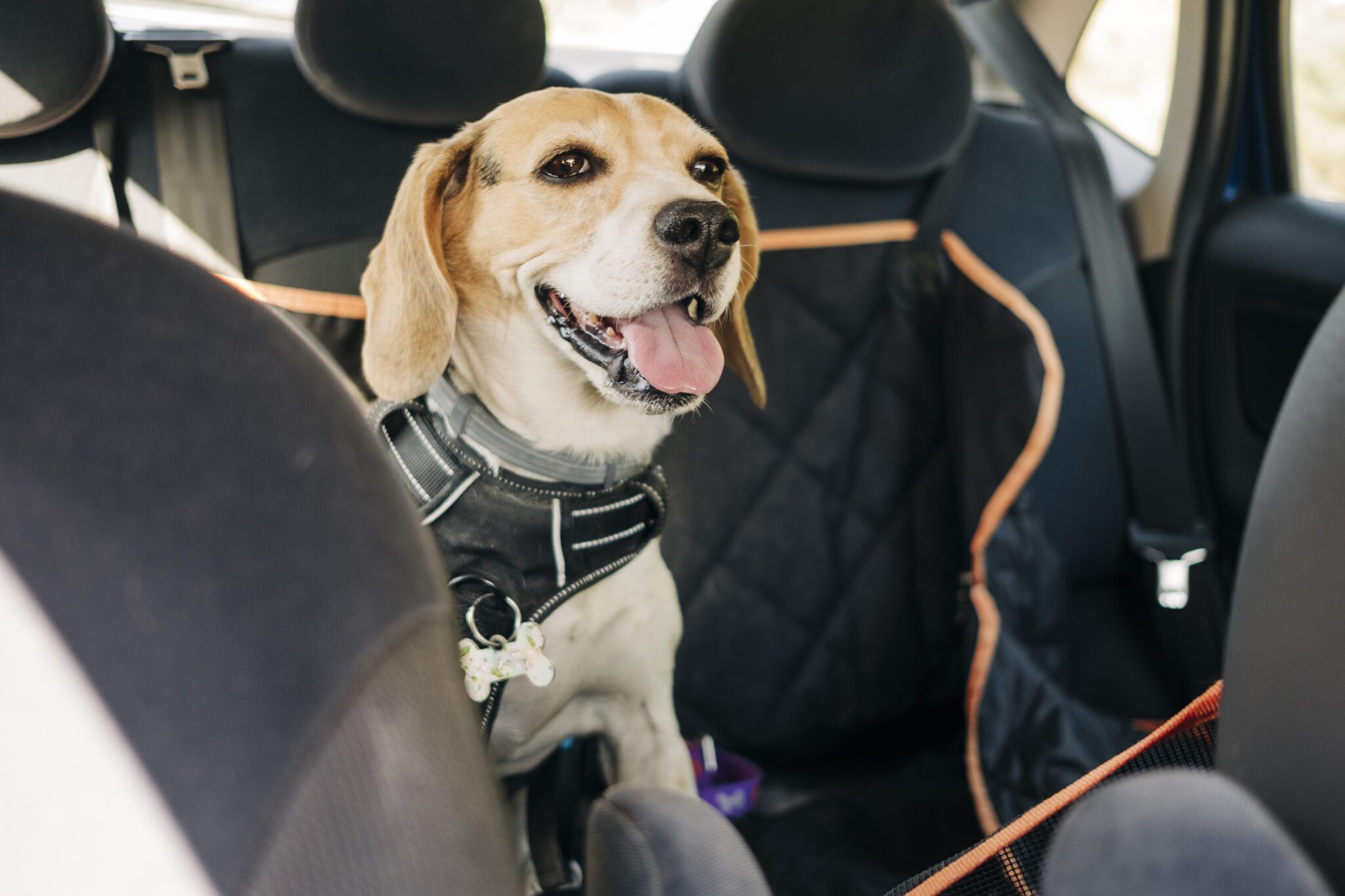
It is also extremely important to note that a dog seatbelt should always be clipped to a harness rather than the dog’s collar. The reason for this is that if too much pressure is applied to a collar through the seatbelt—such as during an accident or sudden stop—severe head and neck injuries are a significant risk. A harness will spread the pressure out across less vulnerable areas of the dog’s body.
Pros:
- Prevents the dog from jumping out of the car or into the front seat
- Easy to install or move
- Inexpensive
- Allows freedom of movement
Cons:
- Dogs may be able to release themselves (accidentally or on purpose) by stepping on the seatbelt release button
- Must be used with a compatible harness
- Provides minimal safety in the event of an accident
Popular dog seatbelts include:
- Leashboss Heavy Duty No-Chew Dog Car Restraint Seatbelt
- Mighty Paw Nylon Dog Seat Belt
- SlowTon Adjustable Dog Car Headrest Restraint
Dog Car Seats
In addition to keeping a dog contained in the car, dog car seats are useful in that they can elevate your pup so she can see out the window. This can be especially helpful for dogs who get carsick as it gives them a better chance to visually orient themselves and often gets them more airflow from car vents (which are designed with sitting humans in mind).
Most dog car seats attach to the vehicle’s seat using a seatbelt and include a short tether designed to clip to the dog’s harness. As discussed above, it’s not safe to attached a tether to a dog’s collar in a vehicle.
While dog car seats may improve comfort and limit movement, most are designed more for convenience than true crash protection. With a few exceptions, many are lightly constructed and are not crash-tested, meaning they may collapse or detach during an accident.
Pros:
- Keeps dogs contained and prevents them from roaming around in the car
- Allows dogs to see out the window, which may reduce anxiety or car sickness
- Often easy to install and remove
Cons:
- Rarely suitable for large dogs
- Most provide limited protection in a collision
- Crash-tested models can be expensive
Popular examples dog car seats include:
- Sleepypod Mobile Pet Bed (crash-tested)
- Tavo Pets Maeve iso (crash-tested)
- Petsfit Dog Car Booster Seat
Car Harnesses for Dogs
Dog car harnesses are a good middle-of-the range option for increasing safety on car trips. These harnesses are designed to distribute force across the dog’s chest and shoulders and attach to a seatbelt or tether system.
Some car harnesses for dogs have been crash-tested, with mixed results. The best-performing models significantly limit forward movement and reduce the risk of serious injury but do so by significantly restricting the dog’s movement.
Pros:
- Better protection than seatbelt tethers alone
- Distributes force across stronger parts of the dog’s body
- Many can double as a walking harness
- Available for a wide range of dog sizes
Cons:
- Can be difficult to properly fit
- Can be extremely restrictive
Popular car harnesses for dogs include:
- Ruffwear Load Up Dog Car Harness (crash-tested)
- EzyDog Drive Dog Car Harness (crash-tested)
- Sleepypod Clickit Terrain Plus (crash-tested)
For detailed recommendations, see “Dog Car Harnesses Review”.
Dog Crates for the Car
A properly secured, strongly built dog crate is by far the safest way to travel with your pet. Even if the crate is not crash-tested, it can provide protection in the event of an accident. The best crates will be crash-tested and have a number of anchor points which allow you to easily secure the crate in the car.
Hard-sided crates or reinforced metal crates designed specifically for vehicle transport perform far better than wire crates or soft-sided carriers, which can collapse or break apart during an impact.
Pros:
- Provides the highest level of protection
- Less restrictive
- Difficult or impossible for dogs to escape
Cons:
- Crash-tested models can be extremely expensive
- Takes up significant space in the car
- May be difficult to fit in smaller vehicles
- Can be very heavy
Popular examples of dog car crates include:
- Gunner G1 (crash-tested up to intermediate size)
- Thule Allax Dog Crate (crash-tested)
- MIM Safe Variocage (crash-tested)
Hammocks and Dividers
Seat hammocks and vehicle dividers are popular for keeping dogs confined to the back seat or cargo area. Depending on the model, dog car hammocks can also help keep your dog from sliding off the seat and falling into the footwell. Dog car hammocks and dividers typically attach to the vehicle’s headrests with either clips or loops.
While these products are useful for protecting upholstery and preventing driver distraction, they offer no real crash protection.
Pros:
- Helps keep dogs from interfering with the driver
- Protects vehicle interior from dirt and hair
- Least restrictive
Cons:
- Dog is not secure
- Provides little protection against impact or sudden stops
Popular dog car hammocks and dividers include:
- URPOWER Dog Car Seat Cover
- Frisco Quilted Water Resistant Hammock
- Bushwhacker Deluxe 50″ Wide Dog Barrier
- Pawple Adjustable Universal Fit SUV Dog Barrier
While crash-tested, secured dog crates remain the gold standard in dog car safety, they’re not feasible for everyone. At the end of the day, choosing the right car safety option for your canine companion depends on your dog, vehicle, and budget. Just remember, every little bit helps.