

Home Search
heart+disease/feed/rss2/Rawhide%20chews%20are%20potentially%20dangerous%20because%20they%20can%20be%20a%20choking%20hazard%20or%20cause%20gastrointestinal%20obstructions%20if%20your%20dog%20manages%20to%20chew%20off%20a%20piece%20that%20is%20small%20enough%20to%20swallow,%20but%20too%20large%20to%20pass%20unimpeded.%20In%20addition,%20some%20rawhide%20chews%20are%20hard%20enough%20to%20break%20or%20damage%20teeth. - search results
If you're not happy with the results, please do another search
Dog Growling: 5 Steps to Help Your Dog
Growling is a valuable means of communication for a dog something that dog owners should appreciate and respect rather than punish. Of course, we don't want our dog to growl at us, but neither do we want him to fail to growl if something makes him uncomfortable; that's very important information in a successful canine-human relationship. It's very common for dog owners to punish their dogs for growling. Unfortunately, this often suppresses the growl eliminating his ability to warn us that he's about to snap, literally and figuratively. On other occasions, punishing a growling, uncomfortable dog can induce him to escalate into full-on aggression.

The Benefits of Rehabilitation Therapy for Dogs
About a decade ago, my then-young Bouvier, Jolie, had surgery to repair a herniated disc. From reading Whole Dog Journal, I was vaguely aware that veterinary physical therapy or rehabilitation existed; these specialties were mentioned in Recovery From a Fetch Injury" in the August 1999 issue
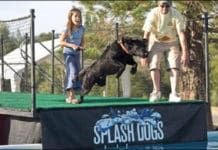
Dock Diving: A Dog Jumping Competition
A Labrador leaps into a pool in a Splash Dogs contest, one type of dock jumping.

DNA Testing for Mixed Breed Dogs
The sequencing of the canine genome, accomplished as a public research project in 2004, opened the floodgates to endless possibilities for canine genetic testing. The holy grail for many scientists engaged in this work is the understanding of, and ultimately, the elimination of inherited canine diseases. For many dog owners, though, the most exciting outcome of this serious work is the possibility that they can learn exactly what breeds their mutts are made of. Though there are already several commercial companies offering products that purport to be able to do just that, our assessment of the breed identification tests is that the results may be just as mixed as the dogs they seek to explain. The test results may be nearly as varied, interesting, and enjoyable as our mixed-breed friends, but it seems that, at least right now, they may not be able to absolutely satisfy the question of your mutts parentage. The tests are getting better every day, though! And as the understanding of DNA, the size of the sample databases, and the power of computers grow, its likely that the tests will, at some point, truly live up to the marketing hype currently being used to sell them.

Installing Safe and Affordable Fencing for Dogs
There was a time when no one thought twice about letting their dogs roam the neighborhood. A fenced yard was almost unheard of. If you grew up in the 1950s and '60s as I did, you may remember those times. Dogs were well socialized, loved kids, and it was no big deal when the neighbor's dog came over and visited your female dog in season. Of course, they also chased cars, got pregnant a lot, and occasionally although rarely bit someone. You may also remember, as I do, a long list of childhood pets who got shot, hit by cars, or simply vanished, having fallen victim to who knows what fate. Today, our canine companions are more likely to be spayed or neutered, vaccinated, and responsibly contained. As a result, they tend to live safer, longer lives. But having a fence isn't always the be-all, end-all solution that it seems to be. Fences can bring on a host of challenges that our parents never faced with the family dog a generation ago.

Canine Swimming Lessons: The Perfect Exercise For Your Dog
For those of us who regularly swim for fitness, we know why swimming is often referred to as “the perfect exercise.” In addition to the physical benefits shared with other forms of aerobic exercise, swimming offers some unique benefits. It eliminates the effects of weight-bearing on the joints, exercises the entire body – upper and lower – at the same time, and, in most cases, is something we can do for our entire lives, even if age precludes us from taking part in other forms of exercise. The physical benefits of swimming are the same for your canine companion as they are for you – that is, if you have a dog who will swim. Even though they actually have a stroke named after them, the notion that all dogs are “natural swimmers” is an erroneous one. Some breeds were developed to work in water and are more physically adapted for swimming than others. The problem here is not getting these dogs into the water, but keeping them on terra firma when we want them to stay clean and dry. However, occasionally, even a water breed shows disdain for water – yes, there are some Labrador Retrievers who hate swimming. Conversely, there are dogs you’d never imagine taking kindly to the water who become devoted and skilled swimmers. Although not blessed with the physical advantages of a water breed, and despite sinking rear ends or heavy, wet coats, these Boston Terriers, Rhodesian Ridgebacks, and Siberian Huskies have learned to enjoy swimming. They don’t know or care that they have to work a little harder than a Poodle, Cocker Spaniel, or a Newfoundland – they just want to have fun!

Building a Healthy Relationship With Your Dog
Like most positive dog trainers, I constantly remind my students that, whether they are conscious of it or not, they are training their dogs every moment they spend together. Whatever you choose to reinforce -- even when you’re not in a formal training session -- will affect your dog’s future behavior. The things that your dog does that you frequently reinforce are likely to increase, so it makes sense to reinforce him as frequently as you can for the behaviors that you enjoy. Here’s an interesting and powerful side-effect of frequent positive reinforcement: This practice can not only influence your dog’s behavior in a way that you like, but also improve your relationship in a sort of positive feedback loop. When a dog (or anyone!) is rewarded, it makes him feel good – about himself and the person giving the reward. And when your dog feels good about you, it tends to make him want to be with you more, and it motivates him try to earn even more reinforcements. Said simply, frequent positive reinforcements strengthen the relationship between you and your dog.
Teaching Your Dog to “Leave It” On Cue
mark the desired behavior with the click of a clicker (or the word "Yes!") and feed him a different treat.üPractice "Leave it!" with everything your dog likes in real life: food

How to Help With Separation Anxiety in Dogs
Fixing a dog's separation anxiety is hard work. It's all too easy to get frustrated with your dog's destructive behavior. Remember that he's not choosing to do it out of spite or malice - he is panicked about his own survival without you, his pack, there to protect him. It's not fun for him, either; he lives in the moment, and the moments that you are gone are long and terrifying. If you make the commitment to modify his behavior and succeed in helping him be brave about being alone, you'll not only save your home from destruction, you will enhance the quality of your dog's life immensely - as well as your own - and perhaps save him from destruction, too.

Train Your Dog to Greet People
Recently, I switched the group class format at my Peaceable Paws Training Center to Levels." Instead of a progressive curriculum with new exercises introduced each week
The Dangers of Vinyl Dog Toys
which are made with natural rubber."
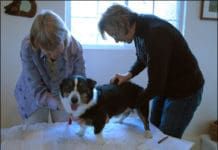
Chiropractors for Canines
Everyone knows that chiropractors are bone and joint doctors. They help alleviate back pain and other aches by making adjustments that improve skeletal alignment and musculoskeletal function. In recent years, chiropractic adjustments have become popular for dogs, especially those recovering from accidents or injuries. But did you know that chiropractic care can improve a dog’s digestion; speed healing after illness or surgery; treat behavior or mood changes; help alleviate ear infections, urinary incontinence, and allergies; and even correct neurological imbalances? Cheryl Morris, DC (Doctor of Chiro-practic), a chiropractor for humans in Congers, New York, knew something was wrong with Stanley Queue, her five-year-old Scottie. He vomited spontaneously three or four times a day several times a week, and when she palpated his abdomen, his diaphragm felt tight.