

Home Search
allergies/feed/rss2/Rawhide%20chews%20are%20potentially%20dangerous%20because%20they%20can%20be%20a%20choking%20hazard%20or%20cause%20gastrointestinal%20obstructions%20if%20your%20dog%20manages%20to%20chew%20off%20a%20piece%20that%20is%20small%20enough%20to%20swallow,%20but%20too%20large%20to%20pass%20unimpeded.%20In%20addition,%20some%20rawhide%20chews%20are%20hard%20enough%20to%20break%20or%20damage%20teeth. - search results
If you're not happy with the results, please do another search
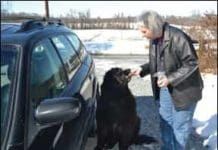
Help For a Dog With Car Phobia
Behavior issues, from simple good manners infractions to the more concerning problems of phobias and aggression, appear in dogs both large and small. But while training to modify behavior issues might look the same regardless of size, in other respects, the bigger the dog, the bigger the problem. When a Dachshund has a lapse in housetraining, the cleanup process is significantly easier than if an Irish Wolfhound has an accident. If a Havanese frantically jumps up on your elderly Aunt Tilly, the collateral damage is less than if a Great Dane does the same. And if a Yorkie is terrified of riding in the car and refuses to get in for an emergency trip to the vet, he can be picked up and placed inside – not so when a Newfoundland steadfastly refuses.
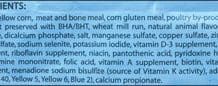
Problems With Artificial Preservatives in Dog Food
Recently we've heard from a number of dog owners who are concerned about the use of ethoxyquin to preserve fish meal that is used in dog foods. We've had one e-mail forwarded to us several times expressing worry over links between undeclared ethoxyquin in pet foods and canine cancer. We have long advised owners to pass over dog food that contains artificial preservatives such as butylated hydroxyanisole (BHA), butylated hydroxytoluene (BHT), tert-butyl hydroquinone (TBHQ), propyl gallate, and ethoxyquin, in favor of products made with natural preservatives, such as tocopherols (vitamin E), citric acid (vitamin C), and rosemary extract. Though synthetic preservatives were once as recently as 20 years ago the usual preservative found in all dry dog foods, today, they appear only on the labels of low-cost and lower-quality products.
Detecting Canine Anal Sac Problems
Anal sacs are located on either side of your dog’s anus, between the external and internal sphincter muscles. Depending on the dog, they range in size from that of pea to a lima bean. Sebaceous glands within the lining secrete a foul-smelling liquid. Under normal circumstances, the sacs empty on their own during bowel movements via a pair of ducts. This natural, routine emptying serves as a means of olfactory communication and establishing territory. Each dog possesses his own unique scent, which is why ritualized dog-to-dog greetings include copious rear-end sniffing. When a dog presents his rear for information gathering, the muscle movements involved in raising the tail apply pressure to the sac, prompting the release of additional scent.
Alternatives to Surgery for Ligament Injuries in Dogs
Dogs go lame for all kinds of reasons. Arthritis, Lyme disease, paw injuries, muscle sprains, bee stings, interdigital dermatitis, and dislocated kneecaps can make any dog limp. But when an active dog suddenly can't put weight on a hind leg, the most common diagnosis for more than a million American dogs every year is a torn cruciate ligament. In 2003, according to the Journal of the American Veterinary Medical Association, the cost of treating those injuries exceeded $1.32 billion, and the price tag keeps rising. The most common prescription for canine knee injuries is surgery. Unfortunately, operations don't always work and some patients, because of age or other conditions, are not good candidates. In recent years a nonsurgical approach called conservative management" has helped thousands of dogs recover from ligament injuries

How to Identify and Pick Top Quality Dog Treats
Surely there is no such person as a dog owner who never gives his or her dog a treat. We all like to see our dog's tail wag, and his face light up with attentive anticipation, right? But how do you know that the treats you give him are healthy? It's actually pretty simple. As with every food you buy (for yourself or your dog), it's all about the ingredients. If you do not already read the label of every food item you consider buying, get in the habit! Most of the information you need to know in order to determine the product's quality is legally required to appear on the label. Ingredients are listed on the label by weight; there is more of the first ingredient on the list present in the treat than the second ingredient, and so on. (One exception: If equal amounts - by weight - of different ingredients are present, the manufacturer can list those ingredients in any order; that is, as long as they are still in order relative to the other ingredients). The first few ingredients on the list are the most significant; since they comprise the majority of the content, they should be especially high in quality.

Selecting The Best Family Dog and Preparing Him for Children
not just tolerate them. And if she shows signs of discomfort (such as looking away or moving away from children)

Hemorrhagic Gastroenteritis in Dogs
The symptoms came on fast and furious. One day Chloe was a healthy, tail-wagging Labrador Retriever and the next day she was vomiting mucus all over the house. Then her vomit turned red with blood and then came matching diarrhea. Chloe had hemorrhagic gastroenteritis, or HGE. Hemorrhagic gastroenteritis is a mystery disease. No one knows what causes it and there is no recommended prevention. It does not seem to be contagious from one dog to another, although dogs living together sometimes develop HGE at the same time, and some parts of the country have reported outbreaks of several cases. It's most dangerous for small dogs, and although some veterinarians consider toy and miniature breeds between the ages of two and four the most typical HGE patients, males and females of all breeds and ages have been affected. There are few, if any, HGE warning signs. It is not usually accompanied by a fever. Diarrhea containing bright or dark red blood is the illness's signature symptom. Vomiting, which usually accompanies the diarrhea, typically begins as mucus or bile and then becomes bloody. Affected dogs may eat grass and vomit that as well.
Train Your Dog to Behave During Grooming
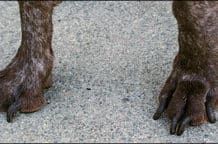
Two months ago, I read a news story about a dog owner in Minnesota who had shared her home and her life with her 10-year-old Great Pyrenees for eight years. On December 30, 2008, the dog attacked his owner as she was trying to trim his nails, sending her to the hospital for multiple bite wounds to her arms. The news report on the incident stated, “[The dog owner] was able to reach another room and closed the door, keeping the dog out.” The owner in this sad story was treated and released from the hospital the same day. The dog is now dead – euthanized at the veterinary hospital for safety reasons, at the owner’s request.Nail-trimming should not be a matter of life and death. Nor should any other routine grooming procedure. If a dog objects strongly to any sort of physical contact or restraint that may occur in the process of ordinary care, a smart, responsible owner needs to take immediate steps to overcome his objections in a positive, nonaversive manner. Fortunately, this process (described in detail below) is not difficult (or dangerous!) to do – but it does take a serious commitment of time.

Dog Training With Hand Signals
as long as you are consistent.üThis is the gesture I use for cuing "Down!" It's a large signal that can be seen by a dog who is far away.üThis is the gesture I use for cuing "Sit!"I start with my arms at my sides
Teaching a Reliable Recall
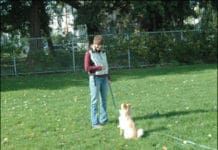
The recall response seems to come naturally to some dogs. For others, it’s a hard-won behavior. The Miller pack has some of both.
Chiropractors for Canines
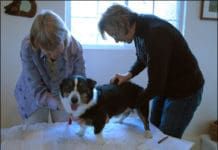
Everyone knows that chiropractors are bone and joint doctors. They help alleviate back pain and other aches by making adjustments that improve skeletal alignment and musculoskeletal function. In recent years, chiropractic adjustments have become popular for dogs, especially those recovering from accidents or injuries. But did you know that chiropractic care can improve a dog’s digestion; speed healing after illness or surgery; treat behavior or mood changes; help alleviate ear infections, urinary incontinence, and allergies; and even correct neurological imbalances? Cheryl Morris, DC (Doctor of Chiro-practic), a chiropractor for humans in Congers, New York, knew something was wrong with Stanley Queue, her five-year-old Scottie. He vomited spontaneously three or four times a day several times a week, and when she palpated his abdomen, his diaphragm felt tight.
Canine Earth Energy Healing
Who doesn’t have at least one quartz crystal, turquoise pendant, jade figurine, or amethyst geode? You probably have a strand of beads, too, maybe aventurine, bloodstone, citrine, coral, garnet, or sodalite. What you may not realize is that, according to crystal enthusiasts, these items can help both you and your dog improve your health, balance your emotions, and enhance your quality of life.Whether they’re novelty items or elegant jewelry, crystals – precious and semiprecious gems as well as humble stones and river rocks – have been valued for thousands of years for their healing and aesthetic properties. The more people explore the use of crystals, stones, and gems, the more their dogs, cats, horses, and other animals are likely to benefit from this branch of energy medicine. Your pets can sleep near crystals, wear them, drink water that has been “charged” by crystals, and in other ways receive the energy that is said to be unique to each type of stone.