
Home Blog Page 13

Could My Dog Have ADHD?

5
A dog with a tennis ball leaping playfully up. Leaping continuously is an obssessive behavior that is similar to ADHD in dogs.
ADHD-like behaviors in dogs may include having trouble staying still, barking excessively, being obsessed with play, having extreme destructive tendencies, and/or struggling to interact calmly with humans and other dogs. Credit: Alberto Menendez Cervero|Getty Images

I suspect we’ve all been there, maybe more than once: your dog is off playing and acts like he’s lost his hearing completely: you call his name—over and over—but he pays absolutely no attention. Or maybe he gets so excited that he seems to be bouncing off the walls, and there’s nothing you can do to calm him down. Or even after hours of training, he still jumps up on visitors when he first sees them.

At times like these, when you’re ready to tear out your hair in frustration, you may have wondered if it’s possible that your dog has ADHD…because he’s sure acting like it.

What is ADHD?

Attention-deficit hyperactivity disorder (ADHD) is a highly inheritable, neurodevelopmental disorder characterized by symptoms including overactivity, impulsivity, and inattention. It usually exhibits in early childhood, can persist into adulthood, and can occur alongside other disorders such as anxiety and learning impairment.

So, could your dog have ADHD?

No, not really. ADHD as a disorder is exclusive to human beings. However, dogs can exhibit behaviors that mimic ADHD: inattention, hyperactivity, and impulsivity.

ADHD-Like Behaviors in Dogs

Some experts have referred to ADHD-like behaviors in dogs as hyperkinesis or  hypersensitivity–hyperactivity disorder. Today, many in the scientific establishment use the term ”ADHD-like” due to its similarity with ADHD in humans. Research has shown that up to 20 percent of dogs show high levels of these traits.

Dogs with ADHD-like behaviors may exhibit all of them simultaneously or may display one rather than another: they may be predominantly impulsive, predominantly hyperactive, predominantly inattentive, or may present with a blend of all three. The most problematic characteristic of the ADHD-like behavior in dogs is generally considered to be hyperactivity and/or impulsivity, resulting in difficulty staying still, excessive barking or vocalization, constant movement, obsession with play, extreme destructive tendencies, lack of self-control, and difficulty interacting with humans and other dogs. These behavioral symptoms are frequent enough that the quality of life of both the dog and its caretaker are affected.

The Role of Genetics, Living Conditions, and Physiology In ADHD-Like Behaviors in Dogs

In 2020, researchers in Finland studied over 13,000 dogs to determine their levels of ADHD-like behavior, and made some remarkable discoveries. In a nutshell, the study revealed that a combination of genetics, physiology and living environment contribute to a dog’s susceptibility to exhibit ADHD-like behaviors. As is the case with humans, ADHD-like behavior in dogs depends in large measure on the interaction between genes and environment.

Genetics

In humans, ADHD is associated with a disruption in various neurotransmitters such as serotonin, dopamine, and norepinephrine. Studies suggest that the origin of canine behaviors that resemble human ADHD could be very similar. For instance, in humans the neurotransmitter serotonin is involved in regulating our mood and emotions; altered serotonin transmission in humans with ADHD can be related to conditions such as obsessive–compulsive disorder, aggression, and major depression and/or anxiety. In dogs, low serotonin is associated with aggression, impulsiveness, fear, and ADHD-like behavior. Another example is dopamine: in humans, dopamine plays a critical role in attention and cognition. In dogs, abnormal dopamine levels are related to problems of aggression, impulsivity, attention deficits, and/or general nervousness.

Recent studies have shown that dogs with impulsive, hyperactive, and aggressive behaviors have low serotonin and dopamine levels in their urine, as well as low levels of serotonin in their blood. One study focused on English Cocker Spaniels—a breed often associated with idiopathic aggression—with genetic analysis finding that aggressive spaniels had significantly lower levels of serum serotonin than aggressive dogs of other breeds.

We also know that some dogs have been selectively bred to perform high-energy tasks: among them are hunting dogs, working breeds such as herding dogs, and terriers. The characteristics of these breeds such as high activity, excitability, and reactivity are inevitably passed down from one generation to the next through these dogs’ genes.

Living Conditions and Environment

Research shows that lack of socialization, especially in puppies, the use of punishment or aversive training techniques, limited nurturing from caregivers, and spending long periods of time alone are associated with ADHD-like behaviors in dogs. Dogs exercised irregularly or infrequently and those not exposed to outside activities and training tend to be more hyperactive and inattentive although it should be noted that the reverse can be true: hyperactivity and low attention levels could be due to a lack of exercise and/or training.  This is just one limitation of canine research, in that unlike with human subjects, researchers can’t directly access a dog’s feelings. (Scientists aren’t the only ones who wish they could!)

Physiology

A dog’s age tends to be a major contributor to the prevalence of hyperactivity, impulsiveness, and inattention, with these behaviors being more common in young dogs.  Unfortunately, even though this is a lifelong neurodevelopmental disorder, no longitudinal studies on ADHD-like conditions in dogs have ever been done.

As a rule, male dogs tend to develop ADHD-like conditions more frequently than females; the results are much less conclusive, however, when it comes to intact versus neutered males. Some studies found that intact dogs were more prone to ADHD-like behaviors, while others pointed to castrated dogs being more susceptible.

The Role of Breed

Numerous studies have shown that some breeds have a propensity for ADHD-like behaviors. Working dogs like German Shepherds and terriers show the highest levels of hyperactivity and impulsivity, whereas breeds with the highest levels of inattention were terriers, Golden Retrievers, and Chinese Crested dogs. Border Collies were an interesting mix, exhibiting very high levels of hyperactivity and impulsivity, but low measures of inattention. The most impulsive breeds were found to be terriers, German Shepherds, Labrador Retrievers, and Border Collies; the least impulsive were Standard Poodles, Golden Retrievers, and Shetland Sheepdogs.

It must be remembered, however, that breed is not determinative, nor is it all-encompassing. Again, each individual dog’s life experiences (especially those forged in puppyhood), environment, and socialization all contribute to their characteristics and behavior.

Treating ADHD-Like Behavior in Dogs

First and foremost, if you suspect that your dog may have the canine equivalent of ADHD, talk with your veterinarian to rule out any medical or health issues. If it’s determined that the dog’s behavior may be related to an ADHD-like condition, your vet may direct you to a behaviorist for further evaluation. That being said, be aware that no clear consensus exists for the diagnosis of canine ADHD in veterinary medicine. At the same time, there are no guidelines for ADHD-like behavior modification therapy or published studies showing the effectiveness of any behavior-modification treatment regimen.

That is not the case, however, with the use of pharmaceuticals. Veterinary specialists have found that dogs with ADHD-like problems respond to the same medication used to treat ADHD in humans. In particular, selective serotonin reuptake inhibitors (SSRIs) or tricyclic antidepressants are often recommended if aggression is a factor. Fluoxetine (Prozac) has been shown to be quite beneficial in cases of hyperactivity and is often considered a first-line treatment for ADHD-like conditions in dogs.

Clearly, there is a need for much more research into ADHD-like behavior in dogs, particularly with regard to effective treatments. The symptoms of ADHD in humans were initially described in the 16th century, and the first medication to treat the condition dates back to 1955. But it wasn’t until 1973 that the first study on what we now call ADHD-like behaviors in dogs was conducted, and the first experimental use of fluoxetine for dogs didn’t take place until 1993.

However, thanks to continued research into how dogs with this condition can be a powerful model for humans with ADHD, we may soon be able to offer our canine companions even more in the way of effective treatment for this debilitating condition.

Why Do Dogs Have Tails?

0
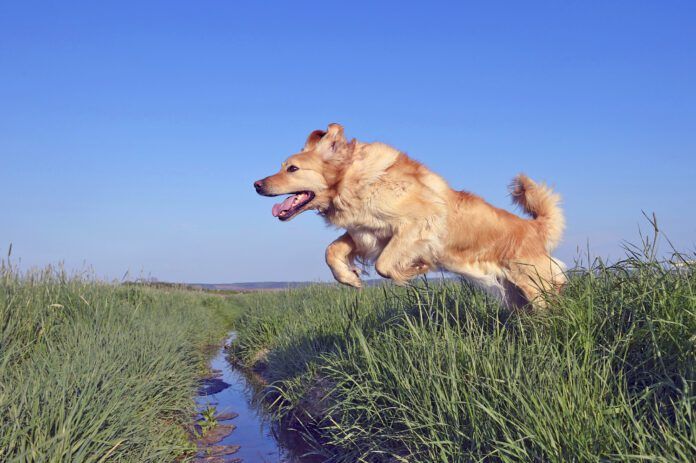
Why do dogs have tails? Their tails help them with balance, mobility, and communication.
Caption: A dog’s tail helps him with movement, communication, and balance. Credit: Martin Ruegner | Getty Images

A wagging tail is often seen as a sign of a happy dog. But your dog’s tail is far more than a barometer of emotion: It’s a complex and highly functional extension of its spine that serves a variety of purposes.

Do Dogs Have Bones in Their Tails?

The short answer is, yes. A dog’s tail is a series of vertebrae that gets progressively smaller toward the tip. On average, a dog’s tail has between five and 20 vertebrae, which are surrounded by muscles, nerves, and blood vessels. “Dogs’ spines continue in their tails with caudal vertebrae. The number of caudal vertebrae varies between dogs,” says Jamie Whittenburg, DVM, chief of staff at Kingsgate Animal Hospital in Lubbock, Texas.

According to Bond Vets, a chain of veterinary clinics, because tails are made up of skeletal muscle and tendons/ligaments which, unlike the smooth muscle of intestines and blood vessels, it is under voluntary control. “It stands to reason that dogs have control over their tail movements just like they do over their leg movements,” says Bond Vets.

What’s the Purpose of a Dog’s Tail?

Your dog’s tail communicates a wide range of emotions and intentions to other dogs and to people. “Each dog is unique and has their own way to communicate their feelings and emotions,” says Dr. Whittenburg. “Some dogs use their tails more than others.”

And some of those uses are often misinterpreted, according to Tufts University. For example, a relaxed, friendly dog may have a tail that wags in a swishing or circular motion. However, if a dog is feeling anxious, fearful, or stressed, its tail is often lowered or tucked between its legs.

Lastly, a dog that is aroused or hyper alert may hold its tail up high and wag it in a stiff, quick motion. Rather than a sign of friendliness, it indicates a state of excitement, alertness, or aggression.

In addition to communications, a dog’s tail serves especially when the dog is running, jumping, or navigating uneven terrain. Fast, agile breeds use their tails like a rudder to shift weight and maintain stability. Think of your dog’s tail like a tightrope walker’s pole, which is used to constantly adjust their center of gravity.

What Is Dog Tail Docking?

Dog tail docking is the controversial practice of surgically removing part or all of a dog’s tail. It is typically performed on puppies that are only a few days old, often without anesthesia.

Historically, tail docking was performed on working dogs to prevent injuries that might occur while hunting or herding. It was also done for cosmetic reasons or to conform to specific breed standards set by kennel clubs.

However, the practice is now a subject of much debate. “Removing a dog’s tail can affect its communication and hinder the ability to express and convey emotions. I believe that tail docking is an unnecessary and cruel cosmetic procedure that negatively impacts dogs,” says Whittenburg.

Many veterinary organizations, including the American Veterinary Medical Association (AVMA) and the Royal Society for the Prevention of Cruelty to Animals (RSPCA), agree and  oppose the procedure.

The AVMA finds the question isn’t how harmful the procedure is but whether there is justification for removing it. “The only benefit that appears to be derived from cosmetic tail docking of dogs is the owner’s impression of a pleasing appearance. In the opinion of the AVMA, this is insufficient justification for performing a surgical procedure. deeming it medically unnecessary and a cause of pain and distress for the dog.”

The AVMA and RSPCA argue that a dog’s tail is essential for its well-being and communication, and as a result, the practice is now banned or heavily restricted in many countries.

Ultimately, the practice of tail docking is considered by most of the veterinary community to be a painful and unnecessary mutilation that deprives a dog of an integral part of its anatomy, essential for communication and overall well-being.

Broken and Injured Tails

Because it’s made up of vertebrae, your dog’s tail can be broken or injured.

Dr. Whittenburg says one of the common injuries she sees is degloving, where the skin is forcibly ripped from the tail. “This happens for a variety of reasons,” she says, “including being hit by a car and having their tails accidentally shut in doors.”

And then there’s “happy tail.” This also occurs frequently and is due to the impact of an exuberantly wagging tail hitting the wall and other objects. “The end of the tail splits open and typically there is a lot of blood seen,” says Dr. Whittenburg.

While typically not emergencies, these tail injuries expose delicate nerves that cause pain, so veterinary intervention is advised.  “Sometimes, bandaging the injured area and giving antibiotics and pain medication will prevent infection, calm the nerves, and allow the tail to heal. In severe, chronic cases where the wagging will not stop and the injury will not heal, the best solution is surgical shortening of the tail,” advises the VCA Animal Hospitals.

Ultimately, a tail is a multifaceted part of your dog’s anatomy. It’s an indispensable tool for balance and communication, and a vital component of its overall well-being. Understanding the function of the tail—beyond just a wag—lets you better interpret your dog’s emotions, appreciate their unique physical abilities, and advocate for their health.

Temporary Fences for Dogs

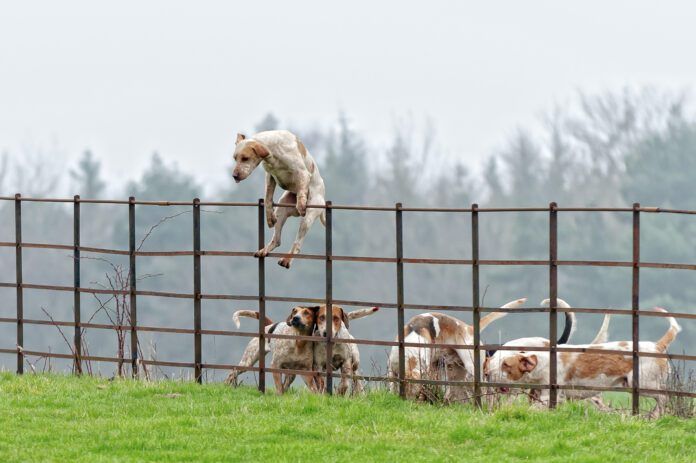
Not all temporary fencing for dogs can keep dogs restrained as this dog climbing over a fence demonstrates.
Be aware that some temporary dog fences can offer a terrific escape route to a dog who doesn’t mind the climb. Credit: Dageldog | Getty Images

Whether you’re traveling, remodeling your backyard, or need a fence to put up at camp or at your RV, a good outdoor temporary dog fencing for dogs can keep you and your dog happy.  A portable temporary fence can give your dog a little freedom, but it must be safe and secure.

But not just any old fence will do, and the internet is flooded with temporary dog fence ideas—many of which won’t give us peace of mind.

Types of quality temporary dog fences include:

  • Plastic mesh
  • Wire mesh
  • Ex-pens, also called exercise pens
  • Free-standing kennels with or without a roof
  • Metal no-dig fence panels by the piece

Let’s dig into more about each of these choices.

Plastic Mesh as a Temporary Dog Fence

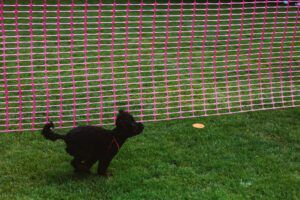
Temporary fences for dogs made from plastic mesh may work for competition, but may not be much of a barrier long term.
Plastic mesh fence is often used as temporary dog fencing at dog sporting events, but it often lacks the sturdiness and safety needed for long-term, unsupervised control. Credit: Basak Gurbuz Derman | Getty Images

Often called snow fence or safety fence, this is typically the type of fencing that you might see at construction sites. It comes in many colors. Standard size is 4 feet high by 100 feet long but can also be purchased in shorter heights and smaller rolls.

You can use metal rods to secure it or wrap it around trees if the area supports such an option. This is what I used to patch a tree made hole in my fence until the fencing repair people could get me on their schedule. I have also used this for a temporary fence for a rescue group picnic for the dogs who came along to socialize. It is often used at dog sporting events, where the dogs are under verbal control or on a leash. This is not the best fence to choose if your dog will be unsupervised.

You can buy this type of fence online from home supply stores as well as U-Line and Amazon. There are countless brands, some of which are marketed as temporary dog fences, and some are simply sold as safety/snow fencing.

Pros of plastic mesh fencing: Relatively inexpensive, easy to use, very visible.

Cons of plastic mesh fencing: Can be difficult to secure, making it of questionable use for a determined canine escape artist, even with a secure bottom.

Wire Mesh as a Temporary Dog Fence

There are a multitude of wire mesh options, including chicken wire, which is made of flexible galvanized steel to varying strengths of welded steel mesh. The thickness determines the cost, with chicken wire being less expensive than a sturdier welded weave. This can make a very solid temporary fence along with the metal poles necessary to secure it.

Pros of wire fence: Sturdier than plastic mesh, which makes it easier to handle while installing install and a stronger choice than plastic, especially for a large dog. Woven wire chicken wire can be relatively inexpensive.

Cons of wire fence: Welded steel can be nearly as expensive and challenging to install as a permanent fence when looking at the hardier weaves. Yardgard offers quality fence in this category.

Exercise Pens as a Temporary Fence for Dogs

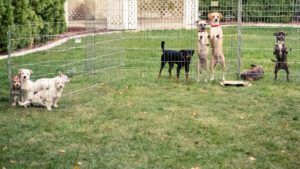
Shelter dogs in wire kennel cage outdoors on a grass lawn
Stringing together a number of ex-pens and ensuring the resulting enclosure is sturdy is probably the simplest temporary dog fence. Just be aware of the height the dogs behind the enclosure can jump and any dogs who enjoy a good climb.
Credit: Debibishop | Getty Images

You can get several ex-pens and link them together as well as securing them to the ground with the metal rods for such that come with most models. There are also some very nice choices meant to be used outdoor models that come in various sizes, including quite large. They come in varying heights, with or without built-in gates.

I prefer them without gates. I simply open the securing connectors when releasing the dog(s). I find that to be the more secure option. Gates can be accidentally opened. The clips, when clipped properly, are far less likely to do so.

Pros of ex-pens: In many ways, this can be the most inexpensive option, especially if you find some at garage sales, and they’re oh-so-easy to set up.

Cons of ex-pens: These aren’t the most sturdy option for determined escapers. Brands that I found for outdoor use include FXW Rollick and Zippity Outdoor Products. Most are widely available with FXW even being available on Chewy. They also make indoor versions that can be used outdoors. Midwest products offers a wide variety of ex-pen options as well.

Free-Standing Kennels as Temporary Fencing for Dogs

This type of temporary fencing is exactly what it sounds like. An actual kennel, freestanding and not needing to be secured in ground, available with or without a roof. They are probably the most secure type of temporary fencing of the options, simply because the fencing for these is so high, even more secure when you opt for the type with a roof.

Pros of free-standing kennels: Kennels are generally secure, easy to set up, and self-shaded when opting for roofed version.

Cons of free-standing kennels: Kennels are expensive for a large enough option to include sufficient room to run, perhaps the least attractive option if you are not fond of the cage-like look. Brands that I liked include Veikhous, Retriever Lodge, KennelMaster, and K9 Kennelstore.

Metal No-Dig Fence Panels as Temporary Fencing for Dogs

I found this to be a most interesting option for a temporary dog fence. Some of the options don’t really specify the type of metal used but other options mention wrought iron. All state there is no need to dig to install and that only a rubber mallet is necessary to pound each piece into place. They range in heights from 24 inches to 48 inches. You choose how many panels to purchase and that determines the total cost.

Pros of metal no-dig fence panels: They’re easy to install and relatively inexpensive compared to some other options, sturdy if you choose wrought iron.

Cons of metal no-dig fence panels: The lack of posts concerns me, as it can make this option much less secure. Brands for this option include Zippity Outdoor Products and Jinligogo (wrought iron option).

Considerations In Choosing a Temporary Dog Fences

Some important points to take into consideration that can help you choose the best option for your dog, the location of the fence, and how long you’ll need to use it.

Height of the fence: For smaller dogs, 4 feet is sufficient. Large dogs may need 6 feet. Keep in mind that most experts suggest that a dog can jump one to three times his shoulder height. Additionally, many dogs can and will scale a metal fence easily, especially younger dogs.

Sturdiness of the fence: Your dog should not be able to wobble the fence or tip it over by jumping on it or leaning against it.

Your dog’s climbing/digging abilities: If your dog is an expert climber or digger, then this means special additions for your temporary fence are necessary. For your darling digger, I love Dig Defence. For the climbers, you can consider a Coyote Roller. If you’re clever, y ou may be able to do a DIY version using inexpensive PVC as opposed to the original metal version. Originally created to keep coyotes out of fenced-in areas, it also keeps your climbing canine monkey inside.

Your dog’s energy and activity levels: If you have an adolescent who considers zoomies light cardio, then you need more room than if you have a senior who just wants to sit/lay outside and meditate with nature. Of course, this also depends on how you intend to use the fence.

Your dog’s reactivity level: If your dog is the type to bark or react in any way to typical triggers that may include other dogs, passing humans, children playing, bicycles/wheeled recreational toys, cars, etc., then what they see from inside of the fence is an important consideration for the type or fencing as well as the location of such. Again, this will depend on how you intend to use this temporary fence.

Typical Uses for a Temporary Dog Fence

All the above-mentioned options can be successfully used on a temporary basis while remodeling or saving up for a permanent fence. Some will require more supervision than others, such as the snow fence, no-dig panels, and ex-pen options.

If you are installing this temporary fence on grass or dirt, which is the typical choice, then metal with secured poles will be the sturdiest choice but also the most labor intensive to install. This is the way to go if you have a large sturdy dog who will challenge the fence. Add the Dig Defence options for diggers or the Coyote Roller top for climbers.

But if you truly want this fence to be temporary and as low maintenance as possible, the best prevention for digging is simply supervision. One cannot say the same for jumpers, who will jump whether supervised or not. So, choose as tall a fence as appropriate for your beloved jumper. For your reactive dog, you can easily cover the metal fence with privacy screen made from polyethylene mesh.

The kennel options can be placed on either a grass surface or a concrete surface such as a driveway, if you are remodeling your yard. This option requires the least supervision, if you properly secure it, but it’s also typically the most confining option, which is not ideal depending on your needs.

For traveling, the choices are less abundant. How you are traveling determines the size of your temporary fence. The larger options can be stored on an RV/motor home. Smaller options can be transported on a roof rack. Most of the travel options are basically larger metal ex-pen type containment systems that are suited for outdoors rather than indoors. Or you can link several smaller ex-pens together to create a larger area, along with the metal yard poles that typically come with the pens. There are also very lightweight interlinking plastic ex-pen options for smaller or more sedate dogs. Several of the No Dig Panels are marketed as RV fences for traveling. Supervision is recommended for these types of temporary fences, especially since traveling can add some excitement or anxiety to your dog’s typical temperament.

Whatever option you end up with, think in terms of safety and cover all your bases—climbing, jumping, digging—and you should be able to keep your dog safe, temporarily, of course.

Can Dogs Have Panic Attacks?

Dogs can have panic attacks, or at least sudden fear episodes that are very similar.
If your dog is having a panic attach, stay calm, find a safe place for them, and use soothing strategies where possible. Never punish a dog experiencing a panic attach as it could make the fear and anxiety worse. Credit: Alexandra Jursova | Getty Images

Have you ever wondered if dogs can have panic attacks? Many pet owners are surprised to learn that our four-legged friends can experience sudden and overwhelming episodes of fear that look a lot like human panic attacks. If you dog has ever trembled, panted heavily, sweat from their paws, or frantically tried to escape for no obvious reason, you’ll understand how distressing it can be to watch.

In this article we’ll explore what a dog panic attack looks like, why it happens, and what you can do to help your dog feel safe and reduce their anxiety.

Can Dogs Have Panic Attacks?

In humans, a panic attack is defined as a sudden episode of intense fear that triggers severe physical and emotional responses (American Psychiatric Association, 2013). Although we don’t currently have a diagnostic framework available for dogs, we do see that dogs can exhibit similar episodes of acute distress.

Indeed, veterinary behaviorists and animal welfare researchers recognise that dogs can show signs of severe panic, especially related to noise phobias, separation anxiety, or post-traumatic stress disorder (Dreschel, 2010). These episodes often involve a sudden and extreme fear and/or anxiety response that overwhelms a dog’s ability to cope in the moment.

So, while there is no official veterinary diagnosis for dog panic attacks, dogs can certainly experience episodes of intense fear and anxiety that mirror human panic attacks.

Dog Panic Attack Symptoms

Recognising the signs that your dog is having a panic attack is the first step to helping your dog. Common symptoms of a panic attack in dogs include physical changes such as rapid breathing, dilated pupils, and raised heart rate (Beerda et al., 1997) and behavioural signs including pacing, excessive barking or whining, destructive behaviour, and attempts to escape.

Panic attacks in dogs differ from general anxiety in that they are intense and sudden. Anxiety may be present in the background, but a panic attack is like a sudden storm; overwhelming and often extreme. Dogs will typically not be interested in eating food or treats during a panic attack.

What Causes Panic Attack Symptoms in Dogs?

Panic attacks in dogs can have several different underlying causes. These include:

  • Situational triggers like loud noises (e.g. fireworks, thunderstorms), car rides, vet visits, or confinement (Blackwell et al., 2013).
  • Underlying anxiety disorders such as separation anxiety and noise phobias (Overall, 2013; Ogata, 2016).
  • Medical issues like pain, neurological conditions, or thyroid disease (Mills et al., 2014).
  • Genetic and developmental factors. Some dogs can be predisposed to panic attacks due to breed tendencies, a lack of early socialisation, or previous traumatic experiences (Tira & Lohi, 2014).

In short, some dogs are more prone to panic attacks due to a combination of genetics, past experiences, and the environment.

What To Do If Your Dog Has a Panic Attack

If your dog is having a panic attack the goal is to help relieve their fear and anxiety and help them feel safe. Practical steps include:

  • Remain calm—this can be difficult but remember that dogs are sensitive to our emotional states.
  • Provide a safe space—a quiet room, covered crate, or hiding spot can help when the trigger is occurring at home. If the panic attack is happening during a walk, try to create distance between your dog and the trigger by moving away out of sight.
  • Soothing strategies—calming music or white noise can help drown out auditory triggers while pheromone diffusers or a pressure wrap can help reduce arousal.
  • Offer comfort—being present can help however avoid excessive reassurance if it escalates your dog’s agitation.
  • Distraction—food enrichment or treats (e.g. lick mats or chews) may help to distract your dog if their panic attack is not too severe.
  • Avoid punishment—this can make fear and anxiety worse.

Medium- and Long-Term Management Strategies for Dogs with Panic Attacks

Knowing what to do when your dog has a panic attack is important in the short term, however medium and long term management and training strategies will help to reduce the duration, frequency and intensity of panic attacks in dogs:

Lifestyle Support

Lifestyle strategies such as maintaining consistent routines, ensuring your dog is getting adequate physical and mental exercise and enrichment, and staying in more predictable environments can help minimise anxiety and reduce stress.

Behaviour Modification

Desensitisation and counterconditioning—gradual exposure to triggers paired with positive experiences (e.g. treats, praise and play)—can help change the dogs underlying emotional response to the trigger (Levine et al., 2007). In addition, relaxation training and pattern games can help to promote calmer behaviour, especially in the presence of triggers.

Complementary Aids and Professional Help

If your dog is having panic attacks, getting a veterinary consultation to rule out a medical issue is important. If no relevant medical conditions are found, a referral to a veterinary behaviorist or certified applied animal behaviorist is a good next step.

Medications such as SSRIs, tricyclic antidepressants or anxiolytics may be recommended by a vet for severe or frequent panic attacks (Overall, 2013). Calming supplements, pheromones (e.g. Adaptil), and weighted/pressure garments can also be worthwhile additions to help reduce stress and anxiety.

The goal of medium- and long-term strategies is to improve your dog’s ability to cope with fear and anxiety caused by the trigger of their panic attacks and, ultimately, stop them from occurring.

Prognosis for Dogs Who Have Panic Attacks

So, can dogs have panic attacks? Yes, they can experience sudden and overwhelming episodes of fear and anxiety that look very similar to those experienced by humans. The good news is that with the right support, management, behaviour modification, and sometimes veterinary support, most dogs can improve significantly.

If your dog shows panic attack symptoms, don’t wait. It’s important to seek guidance from your vet or qualified behaviour professional. Helping your dog through panic isn’t just about reducing their fear in the moment, it’s about building long term resilience and trust through a consistent, kind, and positive approach.


References
American Psychiatric Association. (2013). Diagnostic and statistical manual of mental disorders. American psychiatric association.

Beerda, B., Schilder, M. B., van Hooff, J. A., & de Vries, H. W. (1997). Manifestations of chronic and acute stress in dogs. Applied Animal Behaviour Science52(3-4), 307-319.

Blackwell, E. J., Bradshaw, J. W., & Casey, R. A. (2013). Fear responses to noises in domestic dogs: Prevalence, risk factors and co-occurrence with other fear related behaviour. Applied Animal Behaviour Science145(1-2), 15-25.

Dreschel, N. A. (2010). The effects of fear and anxiety on health and lifespan in pet dogs. Applied Animal Behaviour Science125(3-4), 157-162.

Levine, E. D., Ramos, D., & Mills, D. S. (2007). A prospective study of two self-help CD based desensitization and counter-conditioning programmes with the use of Dog Appeasing Pheromone for the treatment of firework fears in dogs (Canis familiaris). Applied Animal Behaviour Science105(4), 311-329.

Mills, D., Karagiannis, C., & Zulch, H. (2014). Stress—its effects on health and behavior: a guide for practitioners. Veterinary Clinics: Small Animal Practice44(3), 525-541.

Ogata, N. (2016). Separation anxiety in dogs: What progress has been made in our understanding of the most common behavioral problems in dogs?. Journal of Veterinary Behavior16, 28-35.

Overall, K. (2013). Manual of Clinical Behavioral Medicine for Dogs and Cats-E-Book: Manual of Clinical Behavioral Medicine for Dogs and Cats-E-Book. Elsevier Health Sciences.

Tiira, K., & Lohi, H. (2015). Early life experiences and exercise associate with canine anxieties. PloS one10(11), e0141907.

Why Is My Dog Eating Leaves?

Although they're crunchy and have a nice mouthfeel a dog eating leaves can be a problem if those leaves are toxic.
Your dog may be eating leaves because he’s bored. The concern is whether those leaves contain toxins. Credit: Standret | Getty Images

More to the point, can your dog eat leaves? In most cases, the answer is no! Some leaves are toxic. Most leaf chewing is done in an exploratory way by puppies, and they aren’t really going all out and “eating” leaves. Dogs may also chew on leaves out of boredom.

For example, foxglove and oleander contain digitalis-like toxins that may affect the way heart’s ability to beat normally. With oleander, even one or two leaves could be fatal to your dog. There are even accounts of dogs dying after drinking from a water bowl that had oleander leaves blown into the bowl.

Many plant leaves are not deadly for dogs, but their leaves may cause gastric irritation, diarrhea, and vomiting.

Locust tree leaves may be deadly. Oak leaves are not usually deadly, for example, but can cause lots of gastrointestinal symptoms.

Can dogs run and play in leaf piles? Yes, and many dogs love to do that. Be aware, however, that the leaf pile may contain fleas or ticks because they gravitate to those piles too. While playing in a leaf pile, your dog may grab and toss leaves, but they don’t usually ingest them.

Why Do Dogs Chew on Plants?

It may be to add fiber to their diets. While you could grow a safe mini grass plot like many cat owners do, it is simpler to add some plain canned pumpkin to your dog’s diet.

Why Do Dogs Eat Sticks?

Sticks seem to be an attractive play toy. Many dogs chew on sticks because they are handy, especially if your dog is out in the yard and bored, and because you throw them. While a sturdy, non-toxic stick may be relatively safe for your dog to chew on, if he is ingesting wood that can cause problems down the road. Sticks from poisonous trees and plants are toxic, so unless you know for sure, it’s best if your dog doesn’t play or consume stick pieces.

Despite the fun your dog can have with a stick, it is best to avoid getting your dog “hooked” on them. Dogs have knack for getting short pieces of sticks stuck on the roof of their mouth. You will see your dog drooling, panting, and pawing somewhat frantically at his mouth. If your dog is relatively calm, you may be able to remove this yourself but if he is frantic, be careful or you may get bitten by accident.

There are many horrifying tales of dogs running with sticks and accidentally impaling themselves. Those injuries can range from minor emergency room visits to serious surgeries or even death.

How to Stop Dogs From Chewing on Sticks

In addition to adding plain pumpkin to your dog’s diet, make sure your dog has plenty of safe chew items.

Sturdy chew toys can safely take the place of sticks. For my dogs, Kong products tend to survive the best. Most “tough” stuffed type toys are destroyed quickly. West Paws toys also hold up well. Even with these tough toys, I try to check every day or so for any ripped off areas or places where the dogs are chewing little pieces off.

Pet-Friendly Weed Killers

Pet safe weed killer can keep your yard looking great while keeping your dog safe.
Many commercial weed killers contain ingredients that are harmful to dogs. However, there are some pet-friendly options—commercial and DIY—that can help keep your yard weed-free and dog-safe. Credit: Akifyeva Svetlana | Getty Images

Well-designed research studies show that conventional lawn care exposes dogs to herbicides like 2,4-D and glyphosate (Roundup), increasing their risk of developing bladder cancer, non-Hodgkin’s lymphoma, multicentric lymphoma, and other malignancies.

Risk factors include the frequency of herbicide applications, the chemicals involved, proximity to agricultural land that is routinely treated, and geographical location. In August 2025, the Dog Aging Project reported that its survey of 47,444 dogs across the United States gathered from January 2020 to December 2023 compared environmental exposures to health outcomes in four regional areas. Regular weed control corresponded with adverse health outcomes in dogs living in the South and Midwest more than in the West or Northeast. This finding corresponds with a 2019 NBC News map of toxic herbicide application by state.

Alternative Weed Killers That Are Safer for Pets

Rather than chemical herbicides, organic garden stores offer weed-killing products with safer ingredients such as:

  • Vinegar (acetic acid, household or concentrated for horticultural use)
  • Sodium chloride, sea salt, table salt, pool salt, or Epsom salts
  • Citric acid or lemons
  • Essential oils used in aromatherapy
  • Iron sulfate
  • Corn gluten meal

These ingredients disrupt cell walls, cause dehydration and nutrient imbalances, or suppress weed seed germination. Soap, fatty acids, and sodium lauryl sulfate are used as surfactants to mix ingredients and break down surface tension, helping sprays penetrate leaves.

Differences between brands depend on ingredient combinations and their concentration. For example:

An Experiment with Pet-Friendly Weed Killers
The authors experiements with homemade pet-friendly weed killers yielded exciting results.
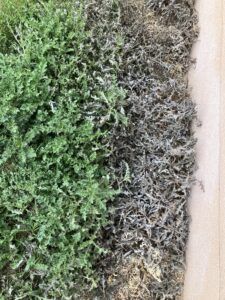
The author sprayed a DIY formula on part of a persistent thistle patch, with visible results. Credit: CJ Puotinen

For years, Montana thistles have thrived in my yard. This year I tried pet-friendly herbicides, starting with Spruce, which contains surfactants and essential oils. I followed label instructions (air temperatures were above 60 degrees F, the weather was sunny, and the ground was dry) but even though I applied the weed killer hours before rain came (the product claims to be rain-proof 10 minutes after application), and even though results looked dramatic within an hour (weeds wilted and turned grey), my thistle patch quickly revived and looked vibrant.

After watching several DIY weed-killer videos, I mixed 1 cup of pool salt with 1 gallon 30% horticultural vinegar, 2 tablespoons dish washing liquid, and 3 gallons water in a battery-operated garden sprayer. On that hot, dry August day I sprayed thistles and other weeds, staying far from lawn grass. Within an hour, the sprayed plants wilted and died. A month later, they are still dead.

Easy DIY Formulas for Pet-Friendly Weed Killers

There are also dozens of do-it-yourself pet-friendly weed sprays, all of which are less expensive than commercial brands. To apply them, use a garden watering can, hand-held sprayer, or battery-operated spray tank. Double or triple ingredients to create larger quantities.

Basic Vinegar Weed Killer

  • Combine 1 gallon distilled white vinegar (the concentration sold for household use) with 1 cup salt (any type) and 1 tablespoon dish soap.
  • Mix in a clean sprayer and apply to weeds. Protect nearby plants from overspray that will kill them, too. Most weeds will wilt and die within 24 to 48 hours.
  • Repeat for tough or resistant weeds.

Epsom Salt Blend

  • Combine 1 gallon vinegar with 2 cups Epsom salts and 1/4 cup dish soap.
  • Pour into a spray bottle and apply to unwanted plants. Use around patios and walkways but not near lawns.

Vinegar-Baking Soda Blend

  • Combine 1 gallon vinegar with 2 tablespoons baking soda and 1 teaspoon dish soap.
  • Vigorously shake to mix the ingredients, then spray thoroughly on weeds.

Borax Weed Killer

  • Mix 1 cup Borax (laundry additive) with just enough water to create a sticky paste. Wear gloves while mixing.
  • Use pruning shears to cut target weeds to the ground, leaving a small stump.
  • Apply the paste generously to freshly cut stems. This cut-and-paste method works best on large, semi-woody weeds like thistles. Keep the paste away from plants you don’t want to damage.

Essential Oil Weed Killer

  • Mix together 1 tablespoon essential oil (any combination of clove, peppermint, wintergreen, orange, citrus, and/or cinnamon) in a spray bottle with 1 tablespoon liquid soap and 1 gallon water.
  • Shake well to combine ingredients and spray on weeds.

Alcohol Weed Killer

  • Combine 3 cups vodka (ethanol) or rubbing (isopropyl) alcohol with 2 teaspoons dishwashing liquid.
  • Spray to cover weeds.

Cornmeal Pre-Emergent Weed Killer

  • Prevent weed seeds from germinating by spreading cornmeal gluten labeled for use on lawns and gardens around flower beds and paths. This will not affect existing plants but prevents new weed growth.
  • Apply whenever weed sprouts appear.

Mulching

Heat Kills Weeds

  • Boiling water is recognized by the S. Environmental Protection Agency as an effective spot treatment for weed removal. Simply pour boiling water from a pan or tea kettle over weeds to cover them completely.
  • Another way to provide damaging heat is with a flame thrower, which is best used immediately after rain or watering, when there is minimal danger of spreading a fire.

Safe Application of Pet-Friendly Weed Killers

Use common sense when applying weed killers, even those considered pet safe. If recommended, wear rubber gloves, clothing that protects your skin, and, in breezy weather or when using strong concentrations, a face mask.

None of the products mentioned here claim to be safe for pets to touch or lick when first applied. Dogs should be kept indoors or away from treated vegetation until it has completely dried. Most surfaces should be safe for pets to walk on or near after 12 to 24 hours unless labels instruct otherwise. None of these products make weeds taste better, so it would be unusual for most dogs to consume them, but because swallowing treated weeds is not recommended and salt or other residues can irritate canine paw pads, redirect your puppy’s attention away from recently treated areas.

Tips for Best Results with Pet-Friendly Herbicides

Before applying a pet-friendly weed killer, prepare the area by trimming tall weeds so herbicide solutions can reach exposed leaves and stems. If possible, treat weeds during midday under direct sun, when temperatures are high, and when no rain has fallen for a few days. Follow label directions, most of which recommend saturating weeds from leaf tips to roots. Thirsty weeds absorb weed killers quickly and results are obvious within an hour or two. Multiple treatments may be needed, so be ready to reapply weed killers if plants recover or new weeds sprout.

Conditions that interfere with a treatment’s effectiveness include cool temperatures, high humidity, recent rain, or rain after treatment.

Deep-rooted weeds resist most nontoxic weed killers, so hand-pulling from damp ground, such as after rain, is an effective removal method.

Keep weed killers away from plants or grass that you want to preserve. This is especially important when using products that contain salt, borax, or concentrated vinegar, which can spread from treated areas to grass or desired plants and damage them. Salt- or borax-treated areas can become sterile so that nothing grows there until the soil is replaced.

Your Pet-Friendly Weed Control Calendar

Time of year can affect the best ways to manage weeds in your yard. Here are some seasonal tips for pet-friendly weed control:

Autumn doesn’t mean that weed season is over—in fact, it’s just beginning. September and October are ideal months for targeting perennial weeds before dormancy. Use spot treatments after raking or mowing leaves. Overseed lawns with native grasses to crowd out existing weeds. Helpful autumn ingredients include vinegar, salt, citric acid, clove oil, and citrus essential oils.

Winter weeds are usually dormant, but some cold-hardy annuals may appear in mild climates. If weeds appear in paths or patio cracks, apply boiling water or vinegar spot treatments. Salt blends are useful where decorative plants won’t be growing next spring.

Spring brings life, along with sprouting weeds, to lawns and gardens. Focus on prevention and weed removal. Apply pet-safe pre-emergent products like corn meal gluten and apply vinegar, boiling water, essential oils, or citric acid to inhibit weeds.

Summer warmth supports rapid weed growth, especially perennials. Spot treat weeds with natural sprays. For patios and cement cracks, apply boiling water or salt-based sprays. Summer’s heat maximizes the effectiveness of vinegar, salt, and essential oils in pet-friendly sprays.

Not sure which weeds you have or which are annuals or perennials? See

37 Lawn and Garden Weeds or Common Garden Weed Identification for help.

Preventing Future Weeds in Pet-Friendly Ways

Simple precautions can keep weeds from coming back. To help maintain a weed-free yard:

  • Don’t mow your lawn too low. Keep grass length at 2 to 3 inches to shade seeds and minimize weed growth.
  • Seed and repair patchy lawn areas to prevent weeds.
  • Use phosphorus-rich fertilizers to help grass roots spread, creating thicker lawns.
  • Mulch garden beds to prevent spreading weeds.
  • Pull weeds as soon as you notice them.
  • Minimize foot traffic, vehicles driving over the area, or unnecessary digging to keep from disturbing the soil and inviting opportunistic weeds.


What Are the Best Dog Exercises for Canine Conditioning?

0
Exercise for dogs is just as important as it is for humans it can improve their balance and overall conditioning level.
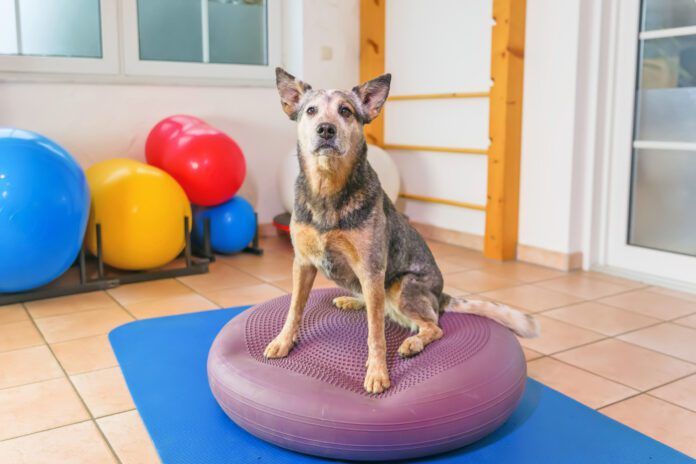
Balancing exercises for your dog build core strength and are fun for both you and your dog. Credit: Chris Mueller | Getty Images

All dogs can benefit from dog exercise of some sort, but especially canine conditioning, as it’s appropriate for canine athletes as well as senior couch potatoes and everything in between and beyond, including puppies.

Last summer, I helped a client keep her pup physically exercised while we were going through an intense heat wave in my area. Walks in her neighborhood were out of the question due to hot pavement. The yard was great for short ball play, but the dog needs more than that. That led me down the rabbit hole that is canine conditioning, and I am hooked on this subject. I had no idea that there were so many ways to physically condition dogs with simple but effective exercises like what humans do.

Obviously, before you begin any sort of exercise program for your dog, get approval from your veterinarian. Knowing what to avoid for your pup is important to staying safe, especially if you have a dog with even a tiny bit of arthritis or any kind of joint issues. It also helps to obtain at least a baseline education on dog anatomy. Puppies should not be participating in anything that involves jumping, running on hard surfaces, or balancing until their bones are fully formed.

For dogs who can do cardio, that is a great part of a fitness program. Cardio is anything that uses more lung capacity such as running, swimming, jogging, fetch, agility, and other dog sports. But cardio alone is not canine conditioning.

Fast twitch muscles are utilized in short but intense movements such as the zoomies, intense tug exercises, jumping stair climbing, juking back and forth, and so on.

Canine conditioning for dog sports generally includes specific strength training and/or stretching exercises for the individual sport that a dog is participating in. While strengthening the muscles needed for that sport, it is important to consider the SAID principle, which is equally a consideration for human physical conditioning and strength training.

SAID stands for Specific Adaptation to Imposed Demands. It is believed that muscles, tendons, ligaments, and bones respond to purposeful stress by getting stronger. The physical patterns that are used in each sport being replicated by training gets the body used to those movements. In dog behavior modification, we call this creating new nerve patterns. I expect that it will be similar here. See this website for more on this subject

Now let’s delve into how some of these strength training/stretching exercises can be done at home, even if your dog is not participating in sports. Truly, all dogs can benefit from strengthening their core and muscles.

Stretching Exercises for Dogs

Natural stretches: You can capture your dog stretching when they do it naturally by using a marker word or clicker, if they already know what that means. Once they understand what you are marking, you can put it on cue. My puppy often moves into a sit from a down in to stretch his upper body and his neck, as well as stretching his front legs out with his toes extended. These are excellent stretches to capture. Some people teach their dogs to offer a play bow on cue, and that is also a stretch. The possibilities are nearly endless. Once you mark the behavior consistently, name it to put it on cue.

Figure 8s: Walking in figure 8s like you might do in Rally or zigzagging through weave poles are also versions of stretching. If you’re not training agility, you can lure your dog through poles with either a treat in your hand or a target stick to start. That will also work with figure 8s. Placing objects that you want to curve around for figure 8s will help your dog better understand this process.

Balancing Exercises for Dogs

Teaching your dog to place all four paws on a stable surface is how you start this process. Most dogs already have some sort of cue or even just an inclination to jump up on raised surfaces. If your dog doesn’t, make sure that the initial surface is low enough to not be uncomfortable for that dog. I simply use an “up” cue. Once this is mastered, consider a less stable surface such as a pillow for a small dog or the couch or a large dog bed for a larger dog. The trick here is to work with the dog standing on that surface rather than laying down.

If you have not already taught your dog to stand on cue, start there. I use a flat hand, palm down with fingers tight together, and move my hand face down horizontally from the dog’s nose when they are seated with a small treat between my fingers. I mark the moment that the dog is on all fours and then food reward and then add the cue word when it’s consistently being followed. Make sure that your dog feels safe on the surface with all four paws before you add the cue for this. Balancing uses their muscles in such a way that they strengthen their core. If your dog is more athletic, use a balance/wobble board or even make one with a hard flat surface with a ball underneath one end.

Strengthening Exercises for Dogs

A popular exercise in puppy classes is puppy pushups (also called “puppy aerobics”). This is one of the easiest ways to strengthen your dog with low impact. First get that sit, and then the down. Repeat. You can add a stand in there as well for even more strengthening exercise. Make sure that you are naming/marking/rewarding each step.

If you have ever taken a fun agility class, you have likely seen some of the equipment that can double as conditioning equipment. These include wobble boards, low-set teeter totters, the A-frame (lowered), weave poles, low jumps, ladder walks, and the like. All of these tools help teach body awareness.

Not all of these are right for all dogs needing conditioning, of course. Puppies and senior dogs don’t need to do jumps, teeter totters, or anything that can affect mobility issues. Wobble boards can scare some dogs so there are other options that can achieve the same results such as the soft surfaces mentioned above. Ladder walks teach paw/spatial awareness and help with stability control.

Physical conditioning exercises will keep your dog in top shape while exercising both their body and mind. It’s important to make all the exercises fun with treats for a job well done, never over face your dog with too many repetitions or obstacles he’s not ready for, and—of course—safety first.

What You Need to Know About Anemia in Dogs

Anemia in dogs can cause fatigue and a lack of desire to play.
An anemic dog may ignore formerly enticing games—like a ball rolling by—because he lacks energy. Anemia seriously reduces blood oxygen levels. Credit: Westend61 | Getty Images

Anemia in dogs is defined as a deficiency of red blood cells. Red blood cells deliver nutrients and oxygen to cells and organs and carry carbon dioxide to the lungs to be exhaled. Without adequate red blood cells, your dog’s heart and lungs go into overdrive to try to make up for the lack of oxygen in the dog’s body and keep the body functioning. Anemia is serious.


What Causes Anemia in Dogs?

A healthy dog has a nice balance of new red blood cells being produced in the bone marrow and obsolescent and damaged cells being extracted in the spleen. Any disease that reduces the production of new cells or hastens the destruction of red blood cells can cause anemia. Disease, trauma, and parasitic infections can cause anemia.

How Do I Know My Dog Is Anemic?

With a lack of circulating red blood cells, your dog’s heart and lungs are working overtime to try make up for body’s oxygen deficit. Most dogs with anemia will be lethargic, often not interested in usual fun activities or only able to do them for a short time.

A dog battling anemia may show:

  • Pale gum and mucous membrane color
  • Slow capillary refill time
  • Lethargy
  • Weakness
  • Lack of appetite
  • Increased heart rate
  • Increased respiratory rate

How Is Anemia in Dogs Diagnosed?

Diagnosis of the cause will start with bloodwork, a tick-disease panel, fecal analysis, and a thorough physical examination, including checking for external parasites. More extensive testing might include imaging studies or a bone-marrow aspiration.

What Causes Anemia in Dogs?

Obviously, heavy blood loss, such as from trauma, will result in anemia, but anything that causes inadequate red blood cell production in the bone marrow will result in anemia. Common causes include:

Parasites: Heavy loads of parasites, both internal and external, can cause anemia in a puppy or any dog in poor nutritional status.

Autoimmune disease: Anemia may be related to autoimmune diseases. In these cases, your dog’s body attacks and destroys its own red blood cells.

Ulcers: Other causes include slow gastrointestinal bleeding associated with stomach or intestinal ulcers.

Urinary disease: Chronic blood loss through the urinary system can result in anemia.

Hemolytic anemia: This is a process where the red blood cells break down prematurely. Drug reactions and poisonous snake bites can cause hemolytic anemia.

Chronic illness: Any disease, like kidney or liver disease, can result in inadequate red blood cell production in your dog. Depending on the cause, some dogs may bleed from various orifices.

Cancer: Not surprisingly, some cancers interfere with red blood cell production, such as leukemia. Others may cause dangerous major blood loss such as bleed-outs of hemangiosarcoma masses in the liver or spleen.

How Do I Treat Anemia in My Dog?

True anemia is not something you can just treat at home. You will need veterinary assistance, prescribed medications, and possibly a blood transfusion for your dog. Veterinary treatment will aim at eliminating or controlling the cause of anemia.

If the cause is parasitic, proper use of dewormers and drugs to manage fleas, ticks, and lice are required to gain control. Anemia due to tick-borne disease will require appropriate antibiotics.

Corticosteroids and immune-modulating medications will be necessary if the cause is an autoimmune disease. In some cases, these medications may be temporary and tapered off, but some dogs will need to stay on them for life.

Erythropoietin is a substance made by the kidneys that helps to stimulate red blood cell production. Injections of erythropoietin may help to speed recovery.

A healthy, well-balanced diet is important in treating anemia. Most dogs do not have iron deficiency, but if your veterinarian feels it is warranted, iron may be prescribed.

Depending on the exact cause, anemia may be a treatable condition, or it may be a sign of a potentially fatal health condition, like cancer.

How To Soothe a Dog’s Irritated Anus

0
Soothing a dog's irritated anus can be done by first diagnosing the condition.
An irritated anus can be extremely uncomfortable for a dog. Keeping the area clean, applying warm compresses, and using pet-safe medications can help soothe irritation and itchiness while you determine the source of the issue. Credit: Vincent Scherer | Getty Images

Things you never thought you’d do an internet search for, right? But if your dog keeps licking his butt, he’s going to need a little help from you to get some relief. When a dog’s anus is red and irritated, the key is to soothe those delicate tissues without causing harm and then get to the bottom of the problem.

Quick Relief for a Dog’s Irritated Anus

When it comes to how to soothe your dog’s irritated anus quickly, you can provide some relief safely and easily at home using the following methods:

  1. Clean the affected area with a warm, damp cloth or pet-safe wipes.

Many of the causes of anal irritation are messy. If your dog has dried poop, scabs, or pus on his back end, removing this debris can make him feel a lot better. Be gentle when cleaning, as an irritated butt can be painful. It may help to soak caked-on debris to soften it before trying to remove it.

  1. Apply a warm compress.

Hold a warm, damp cloth over the irritated area for 5-10 minutes. This can help to soothe your dog’s anus. It is better to err on the cooler side with the compress, as applying a hot cloth could burn the sensitive skin and cause more damage. You can test the temperature on your wrist or lips—if it’s too hot for you, it’s too hot for the dog.

  1. Apply a pet-safe ointment.

If you have a pet-safe ointment on hand, you can apply a thin layer to the irritated area around the dog’s anus. I really like Veterinus Derma GeL for any small wound—it is easy to use, safe if the dog licks it, and provides both some antimicrobial effect and pain relief.

Why a Dog Might Keep Licking His Butt

For long-term relief, you will need to figure out why your dog’s anus is red and irritated. Some common reasons include:

Diarrhea

Diarrhea isn’t fun. It is uncomfortable and repeated episodes of diarrhea can irritate your dog’s anus. Loose poop getting stuck in the hair and on the skin around the anus only worsens the discomfort.

If your dog is having diarrhea, make sure his bum is clean each time he finishes pooping. A damp cloth can handle small messes but washing off with a hose outside or in the bathtub may be necessary for bigger catastrophes. Keeping his skin clean will help to prevent further irritation.

Diarrhea can be caused by many different things, ranging from eating something foolish to intestinal parasites or viral illnesses. If your dog overall seems happy and healthy, you can withhold all food for 12 hours and then feed a bland diet for a day or two. If the diarrhea lasts more than two days, it’s time to make a vet appointment. Diarrhea and vomiting at the same time is an emergency.

Anal Gland Issues

The anal glands are two sacs located just inside your dog’s anus. Normally they express a little stinky liquid each time your dog defecates. But sometimes they can become overfilled, impacted, or even infected. This is uncomfortable!

The classic sign of anal gland issues is a dog scooting his butt across the ground. Your dog may also lick or chew at his rear end in an effort to relieve the pressure. Scooting, licking, and chewing all irritate the skin around the anus, and can make the discomfort worse.

Minor anal gland impactions can be resolved with manual expression. You can learn to do this yourself at home or you can schedule an appointment for your vet or a vet tech to do it. Manually expressing the anal glands relieves the pressure from the overfilled gland, allowing your dog to get back to business as usual. The color, odor, and texture of the contents can also tell your vet if your dog might have an infection or other problem with the glands.

While waiting for a vet appointment, you can soothe your dog’s irritated anus by applying a warm compress for 5-10 minutes several times a day. This will provide some pain relief and may help to loosen the anal gland contents and make your dog more comfortable.

For many dogs, this is a one-time misfortune. However, some dogs are prone to chronic anal gland issues and may need regular manual expressions, increased fiber in their diet, or in rare cases a surgical procedure. If your dog is frequently scooting his butt or chewing at his back end, it’s time to call your vet.

Allergies

While humans with allergies sniffle and sneeze, dogs scratch and chew. The butt, ears, and paws are common areas where dogs with allergies get red, itchy skin.

If your dog has seasonal allergies, you will only notice his perianal area being irritated at specific times of year. For example, early fall is a common time for many dogs’ seasonal allergies to flare up. Other environmental allergies—such as allergies to dust, indoor allergens, or trees—can be a problem year-round. Food allergies are also consistent and do not let up with the changing of the seasons.

Your veterinarian will help you determine if your dog’s itchiness is due to allergies and parse out whether the cause is likely food, environmental allergens, or a combination of both. She will also diagnose and treat any secondary infections that may have taken advantage of your poor dog’s compromised skin.

Food allergies are treated with diet trials to determine which ingredient(s) give your dog trouble. It can take several months to see complete improvement, but stay the course—it will be worth it once you know what foods your dog tolerates best.

Diphenhydramine (Benadryl) is an easy way to provide relief for some dogs experiencing an itchy butt from environmental allergies. A general guideline for dogs is one milligram of Benadryl per pound of body weight (meaning a 25-pound dog would get one 25mg tablet) but call your vet to get an exact dose for your dog. Loratidine (Claritin) and cetirizine (Zyrtec) are also helpful for some dogs.

Unfortunately, many dogs with environmental allergies require a more robust, dog-specific treatment plan to keep them itch and irritation free. This may include medicated shampoos, the monthly injectable medication Cytopoint, or the tablets Apoquel or Zenrelia. It can take some trial and error to determine the best treatment plan for your dog, but his itch-free butt will thank you for your persistence.

Fleas

Fleas can bite anywhere on a dog’s body but often focus on the hind end. Each bite is itchy, and dogs with flea allergy dermatitis will experience dramatic swelling, redness, and itchiness all along the back end of the body from even a single bite.

If your dog’s anus is irritated and itchy due to a flea infestation, the solution is to give your dog a bath with Dawn dish soap and then give a prescription-grade flea preventive medication for three consecutive months. Don’t forget to vacuum your house and wash bedding thoroughly to remove any flea eggs or larvae hiding there.

Perianal Fistula

Perianal fistulas are painful draining tracts that can occur around a dog’s anus. You will notice an extra hole or two that has a bloody or pus-like discharge. If you suspect your dog has perianal fistulas, it’s time to make a vet visit.

Perianal Tumor

Dogs can get cancer near the anus. Tumors in this area are more common in intact male dogs, and neutering can often resolve the issue if it is a benign tumor. Malignant tumors and ones in female or neutered male dogs will likely require surgical removal.

While waiting for a vet appointment, you can provide relief for your dog’s anus by applying a dog-safe ointment to the irritated area.

When To See a Vet About a Dog’s Irritated Anus

A dog who keeps licking his butt should see a vet if:

  • He is having diarrhea for more than two days, or has other signs of illness (diarrhea and vomiting is an emergency)
  • He scoots his butt frequently
  • He has sores or wounds around the anus
  • There is bleeding or draining pus coming from anywhere around the anus
  • Itchiness and irritation persists
  • He has a new lump in the area that seems to be bothering him

Top Couch Covers for Dogs

2
A couch cover can prevent dogs like this sleeping King Charles Cavalier Spaniel from damaging a couch.
Dogs can be hard on the furniture but finding the right couch cover can help. The best couch covers for dogs are water- and stain-resistant, don’t slip, and can be easily cleaned. Credit: Branko Mihailovic | Getty Images

When my 14-year-old dog Harper was in her last months of life, I bought a white sofa. She no longer had the ability to jump on the sofa and wasn’t interested in using her steps. And when she was gone, it was our plan to be dogless for a couple of years while we traveled. So why not get a white sofa?

Well, mainly because even without a dog sprawling on it every day, it still got dirty fast. And the vow to not get another dog right away? Pfft. That lasted all of two months. Then Sparkles came to live with us. At a young 10.5 years, she had no problem jumping on the sofa.

I used a lot of makeshift covers to protect the sofa: throws, sheets, quilts, large tablecloths purchased inexpensively at Home Goods. Why didn’t I buy an actual sofa cover? From past experience, they never looked very attractive and they didn’t stay on well. But when I received this assignment to review sofa covers, I was happy to discover that manufacturers have taken those criticisms to heart. The best couch covers for dogs now come in a number of styles and colors suited to most decors and are designed in various ways to be nonslip.

What We Looked for in Couch Covers for Dogs

Fit: A good sofa cover doesn’t look sloppy. It’s easy to put on or remove and, depending on the style, provides good coverage of all or most of the sofa.

Features: The best options have non-slip backing or adjustable straps that hold them in place and are water- and stain-resistant.

Ease of Cleaning: Life with dogs can be messy so suitable couch covers should be able to be machine washed and dried and still looks good afterward.

Attractiveness: It helps if the cover comes in a variety of colors, patterns, and styles to suit multiple decors and sofa designs.

Note: Be sure to measure your sofa thoroughly and call before ordering to make sure you get the correct size. Even if returns or exchanges are free, it’s still a hassle to package and mail the wrong one back.

In an attempt to get an additional cover to review, I ordered one from a company whose website said it was Surefit, a well-known sofa cover brand that is sold through Amazon, Chewy, Wayfair, Lowes, and other retailers. This one appeared to be based in Eastern Europe and I was billed $1,500 (approximately 221,000 Japanese yen) instead of the $15 it was supposed to be. I disputed the charge immediately with both the credit card company and PayPal, with a satisfactory resolution—after a couple of nail-biting weeks. While I usually like to order direct from the manufacturer, this was a rare instance where that wasn’t a good idea.

The Best Dog Couch Covers for Dogs

Whole Dog Journal RatingProduct and MakerPricesSizes and ColorsNotes
Orvis Grip-Tight Furniture Protector$219-$319Loveseat, 55”
Couch, 70”
XL couch, 86”

Colors: brown, slate, granite, khaki
This heavy-duty couch cover fit well and offered great coverage and protection. Sturdy enough to stand up to large, active dogs. Worth the money.
Dovercourt Diamond Sofa Slipcover$33.99-$40.9975” and 86”
Colors: stone blue, khaki, burgundy, ivory, black
This high-quality, reasonably-priced option provides good protection and cleans up easily. The visible straps aren’t the best look and it may not fit well on longer sofas.
Your Cool Pet Store Soft Couch Cover for Pets$49-$79.99S, 70”
M, 82”
L, 94”

Colors: gray, dark gray, blue, white, light brown, dark brown, khaki, pink, red

This cover is simple to use, stain resistant, and easy to clean but only protects the seating section of the sofa and isn’t waterproof.
Whisker Bark Sectional Sofa Dog Cover$16-$48S (Square), 28”
S, 63”
M, 70”
L, 82”
XL, 94”

Colors: salmon orange, sky blue, dark blue, sand
Also covering the couch cushions only, this option is inexpensive, scratch- and water-resistant, and easy to put on and remove. However, the chemical smell and unattractive appearance are drawbacks.

Overall Best Couch Cover for Dogs: Orvis Grip-Tight Furniture Protector

The Orvis couch cover is a furniture protector that covers most couch surfaces and is our pick for the best overall couch cover.
Our top pick for best dog-friendly couch covers, the Orvis Grip-Tight Furniture Protector does a great job protecting the sofa. However, it may be more heavy-duty than necessary for small dogs who don’t make much of a mess. Credit: Kim Campbell Thornton

The Orvis Grip-Tight Furniture Protector has a quilted design on the seat section. It’s made of 90-percent recycled polyester and has a non-slip backing to hold it in place. The machine washable cover is lined with a water-resistant membrane to protect from spills or accidents. A fur-masking microweave is supposed to keep it looking cleaner, longer, but I have to say that a Sparkles dust bunny showed up on it pretty quickly, even though she had just had a bath.

I sent my sofa measurements to the Orvis representative and asked them to choose the appropriate size. After I wrestled it onto the sofa, the heavy-duty cover fit well and is sturdy enough to stand up to big, roughhousing dogs. One buyer noted that their dog couldn’t pull it off the sofa or move it out of place. If you have large dogs or a dog who likes to “nest” or “dig” on the couch, this may be the cover for you. It’s also a great choice for dogs who like to rub up against furniture, depositing their skin oils—like my late Greyhound—or lick furniture, a habit Sparkles indulges in.

To test its water-resistance, I spilled a glass of water on it. It beaded right up, wiped away easily with a towel, and didn’t soak through to the cushion below. I also took the opportunity to use the damp towel to pick up loose hairs Sparkles had deposited.

I like that the arm covering hangs most of the way down the sofa—I think this feature could make it appealing not only for dog lovers but also for people with cats who scratch the side or arms of the sofa. However, the front panel is short and would do a better job of keeping the sofa clean if it covered the entire area.

For people with big drooly dogs, multiple dogs, or puppies in the chewing/accident stage, I think this cover is probably well worth the money. It is possibly overkill for Sparkles, though. Cushion protectors, chair protectors, and throws are also available.

Best Couch Cover for Small Dogs: Dovercourt Diamond Sofa Slipcover Reversible 100% Waterproof Box Cushion Sofa Slipcover

A King Charles Spaniel tests out a couch cover.
The Dovercourt Diamond Sofa Slipcover is well-made and stood up nicely to being cleaned. Credit: Kim Campbell Thornton

The Dovercourt Diamond Sofa Slipcover was the first sofa cover I tested. Unfortunately, even after taking detailed measurements of my sofa, I did not request the correct size. Or it might not have been available—I discovered that was the case with a lot of covers. Apparently, an 88-inch sofa is longer than the norm. A strap that went over the back held it in place. The ends of the strap are visible where it wraps around the sofa, which isn’t the most attractive look, but throw pillows can help to hide them. Throw pillows also helped to keep the too-short arm covers from falling over. I also tried it on my neighbor Cathy’s sofa, which is not quite as long as mine, and it fit much better.

Shortly after it arrived, Sparkles had her teeth cleaned and for a couple of days afterward she had diarrhea. I had put the cover on our bed to protect it in case of any late-night accidents. Fortunately, we were spared that, although I did find some small brown spots. After going through the washer and dryer, the 100-percent polyester cover was stain-free and looked like new.

This is a good quality cover at a reasonable price of $37.99. It gets good reviews from buyers. One wrote: “My sofa is extra-long, so I had to order two slipcovers in order to have my sofa protected. They are very nice, made well and would certainly recommend them!” So apparently mine isn’t an uncommon problem. Another says, “They go on and off easily so I can remove them when we have company.” Critics said, “It slips around and needs reseated a lot,” and “Don’t recommend if you have a leather sofa.” The latter may have been more of a fit issue or perhaps a big-dog issue. Cathy’s sofa is leather and with the strap in place, the cover stayed on with no problem.

My own quibble is that because it’s polyester, it’s easy to get too hot after sitting on it for a while. Overall, though, I think it’s a good choice.

Best for Basic Coverage: Your Cool Pet Store Soft Couch Cover for Pets

A King Charles Spaniel rests in the middle of a covered couch amidst a range of throw pillows.
In spite of not being waterproof, the Your Cool Pet Store Soft Couch Cover for Pets offered good basic coverage and was easy to clean. Credit: Kim Campbell Thornton

The Your Cool Pet Store Soft Couch Cover for Pets covered only the seating portion of the sofa, not the back cushions, front, or sides. However, it was easy to put on and take off, stays in place well, and comes in three sizes and a variety of colors. The plush polyester quilted velvet is comfortable to sit on, although it might be too warm for summer use, depending on whether your body temperature runs hot or cold. The manufacturer describes it as “breathable for summer, warm for winter.”

The drawback is that it’s not waterproof. That makes it not the best choice for a young puppy or an incontinent adult. To check for stain resistance, I spilled a little wine on it and threw it in the washing machine. It came out looking like new. I like it overall but knocked off half a star for lack of waterproofing and because it covers only the cushions. The maker does have other versions that are waterproof.

Best Budget Couch Cover for Dogs: Whisker Bark Sectional Sofa Dog Cover

A King Charles Cavalier Spaniel resting in the middle of a covered couch.
While somewhat lacking in the looks department, the Whisker Bark Sectional Sofa Dog Cover is a sturdy, affordable option. Credit: Kim Campbell Thornton

The Whisker Bark Sectional Sofa Dog Cover was another cover made only to protect the cushions, although purchasing a second one would allow the buyer to drape it over the back cushions, protecting them as well. The budget price would make that financially feasible. Like the other cushion cover, it was easy to put on and remove. A non-slip lining keeps it in place. It’s described as scratch-resistant, so I took a steel-pin slicker brush and scraped away at it. No marks or tears resulted.

“It looks like a bathmat,” my husband said when I pulled it out of the box. I think with its salmon-orange color, the thin polyester-blend couch cover was supposed to resemble leather, or at least faux leather. It did not. However, the length was appropriate.

It had a chemical odor right out of the box, so I started by spilling some tea on it for the waterproofing test. It pooled on the top, did not soak through, and wiped up easily. Then I threw it in the washing machine and dryer. Afterward, the odor was gone and there were no wrinkles or stains.

Despite not looking like much, overall it was sturdy, water-resistant, and easy to use. If you are a bargain hound and need only a cushion protector, this is the couch cover for you.

Practical Dog Clothes

1
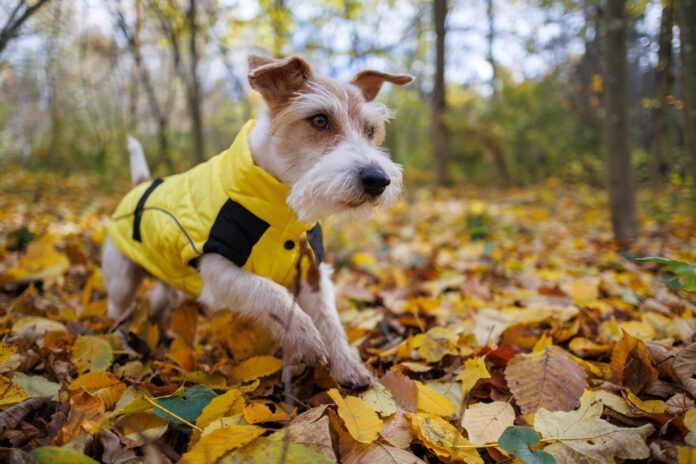
A jack russel terrier wearing a wet weather dog jacket while exploring the undergrowth of a forest.
Whether it’s protecting them from the elements or helping ease anxiety, dog clothing has a number of practical purposes. Credit: Alexander Pytskiy | Getty Images

Dog clothes, pup apparel, canine costumes, and pooch gear are a booming market.

The American Pet Products Association tells Whole Dog Journal that nearly one in four dog parents have clothes for their dog, and that number has increased 35% in the last few years.

Veterinarians say dog clothes can serve practical purposes, and industry experts say apparel and gear designed for dogs can help keep them safe and even enrich the bond between you and your pooch.

Whole Dog Journal is reader-supported. If you purchase through links on our site we may earn a commission. Whole Dog Journal does not accept money for its food and product reviews.

Do Dogs Need Clothes?

While a dressed-up pup in a costume can look cute for a social media post or annual holiday card, many dog clothes serve essential purposes.

Sun and Heat Protective Dog Clothes

There are entire clothing lines of vests, suits, visors, hats, and even nose protectors designed to shield dogs from the sun’s harmful rays, but not all dogs need these kinds of safeguards.

“The average, darker pigmented-haired dog with a dark colored nose does not need that protection,” says veterinarian Mitzi Clark, an assistant clinical professor of dermatology at Cornell University College of Veterinary Medicine.

But hairless breeds like the Chinese Crested or dogs missing fur due to medical problems may be at higher risk of developing skin cancer—as their hair helps protect their skin from the sun’s rays—and may benefit from protective clothing.\

“The white pit bull who has a pink nose, sparse hair on their belly, who’s going to sunbathe, or the dog that doesn’t have hair, because they’re a hairless breed—maybe, especially if you live in Arizona,” Dr. Clark says.

“If those dogs are going to spend time outside and if they’re not going to have sunscreen, clothing that has SPF protection could be useful.”

Some of the sun shield clothing is also designed to keep a dog’s body temperature lower in hot weather; they’re typically called cooling suits or vests.

“That can be very helpful for brachycephalic dogs,” says extension veterinarian Aly Cohen from the Cornell University College of Veterinary Medicine.

Snow and Cold Protective Dog Clothes

When the temperature drops from sunny summer to snowy winter, it’s time for some dogs to sport fleeces, coats, snow gear, and booties. Should your pup bundle up?

“Some older dogs do need clothes for warmth, because they’ll start to lose muscle mass or could have an underlying health condition that makes it harder for them to generate and maintain warmth,” Dr. Cohen says. “It’s like the 90-year-old grandma who’s wearing her sweater outside in the summer.”

Dogs with little to no hair, or a pooch that appears to be unhappy in the cold, may need protection from the chilly elements.

“Shivering is a dead giveaway,” Dr. Cohen says. “If they’re trying to go back inside right away, or they’re reluctant to walk, or vocalizing outside with whining or barking for no other obvious reason, those may be the telltale signs that they’re just uncomfortable with the temperature.”

Dog Clothes to Improve Mental and Physical Health

Some pet parents swear by weighted, calming vests, and ThunderShirts, which are supposed to take the edge off their dog’s anxiety. The clothing wraps around a dog like a coat while applying pressure to their body. The theory is that the vest-like shirts have a calming effect, like a parent swaddling a baby.

There are also “spay suits” or recovery clothing, which can be a reasonable option to the dreaded “cone of shame” after surgery. These pajama-like outfits cover the incision area and sutures so your dog can’t lick or scratch them. (If a dog is very intent on getting at their stitches, the cone of shame may be necessary.)

With any dog clothes, always supervise your pooch so they don’t chew or ingest any material, and of course, ensure they’re comfortable.

Why Have Dog Clothes Gotten So Popular?

Some industry experts attribute the massive growth in the dog clothing market to the exploding number of pet owners who are treating their dogs like family.

“That just enriches both the human and the dog’s life,” says Peter Kearns, head of product at Ruffwear, which specializes in making dog performance gear, including jackets, raincoats, and snowsuits.

Tapping into that human-dog bond, Ruffwear’s product lines, popularity, and business have expanded exponentially in the last three decades. The company is now a global brand sold in 52 countries.

“Our growth has come purely from our curiosity about how else can we create a connection between dogs and their human companions,” Kearns says. “We really exist to be able to enable adventure, and we want to bring the connection that dogs and humans have together to the outdoors, and we want to do that in a way that empowers both the dog and the human.”

The company also makes specialized gear that goes beyond protecting your dog from the rain or snow, tapping into the massive number of people bringing their dog on outings, saying, “I’m so glad we included our dog…” instead of, “Our dog would have really loved this…”

“We have products that allow people to get on stand-up boards with their dogs for the first time,” Kearns says. “If you have a small dog, an elderly dog, or maybe a tripod who has a hard time going many miles on a hiking trail, we have a pack that you can carry that dog with. We have boots that enable them to go into areas where maybe it’s obsidian and very sharp rock or hot sand.”

Of course, the key to making sure dog clothes, outerwear, and gear are enjoyable for your pup is to ensure you have the right dog measurements for a perfect fit.

How To Measure a Dog for Clothes

When you order dog clothes, there’s always the dreaded moment where you have to get out the tape measure and get your dog’s measurements. Some take off running, others think the measuring device is a toy, or they won’t stand still.

It’s essential to pay close attention to a company’s clothing size guide when you order. Different retailers’ sizing may vary. A medium in one brand may be totally different than another.

“From a fit standpoint, it’s going to be dependent on the dog,” Kearns says–and shares some dog measuring tricks of the trade.

How To Measure a Dog’s Girth

Kearns says accurately measuring your pup’s girth is key to getting a good fit. Be sure your dog is standing on a completely flat and level surface.

Girth is the single most important measurement when shopping for dog clothes.
A dog’s girth can be determined by measuring the widest part of the torso. This is usually right behind the dog’s elbow. Credit: Carolyn O’Connor

“Measure around the widest part of your dog,” Kearns says. “Generally speaking, that’s right behind the armpit of the dog. It’s going to be a little bit different on each dog, but kind of find the broadest or the widest circumference, and that’s where you want to measure–that’s your starting point for the measurement.”

Each product will have some variation in the fit, and the dog’s fur type is also a factor.

“If you have a dog with longer, fluffier hair, tighten it (the tape measure) up a little bit so that you can kind of compress that fur a little bit; know that the true fit of the product is going to be, against the dog’s body, not kind of out where the fur might come to,” Kearns says.

How To Measure a Dog’s Height

Height, girth, and length are all important dimensions to fit dog clothes.
To figure out your dog’s height, measure from the ground to the point where the neck meets the shoulder blades. Make sure the dog is standing squarely on a flat surface. Credit: Carolyn O’Connor

To measure a dog’s height, keep them on that flat, level surface and as still as possible. “Give them a little peanut butter and they’ll stay in place,” Kearns says. “That’s going to be the trick to get a good measurement for just about anything.”

Locate the highest point where the dog’s neck aligns with their shoulder blades. Use a tape measure or a yardstick to measure the distance between that point and the ground where they’re standing.


How To Measure a Dog’s Length

Since dogs come in all shapes and sizes, you may want to measure their length to see how the clothing will fit on their body.

Length is another critical dimension to measure when fitting dog clothes.
To get a sense of how a clothing will fit on a dog, you can take a measurement from the base of the dog’s neck to the base of their tail. Credit: Kate O’Connor

“Measure from the base of the neck to the base of the tail to understand where that dog jacket is going to land on your dog,” Kearns says. “If you want to size up a little bit, because you want it to go a little bit longer on the dog’s back, you can do that. If you want to size down a little bit, then you can shorten up a little. So always start with the girth measurement and then use those other measurements as kind of a reference point for how it will look on your dog.”

Ruffwear has videos on its website that demonstrate how to get a dog’s measurements successfully.

And once your dog’s new threads arrive, remember that you may be thrilled to try out their new gear, but your pooch may not be.

“Go slowly,” Dr. Cohen says. “Use treats to encourage them to have a positive experience.”

Is That Ringworm or a Hot Spot on My Dog?

0
Is the sore spot on this dog's nose ringworm vs a hot spot?
If you notice a non-healing lesion on your dog, you might try one of the treatments in our article, like chlorhexidine. But, if it doesn’t heal, you need veterinary help. Credit: Yellow Garnet Photograph | Getty Images

Ringworm on a dog appears as a dry, hairless, circular spot, while a hot spot tends to angry, red, moist lesions that are itchy.

What does ringworm look like on a dog? Ringworm causes small, circular, hairless patches. You may notice scales or crusting, possibly with a red outline on the patches. These tend to be “dry” lesions. While ringworm may be itchy, it is generally a mild pruritus. If it’s itchy, there may be a secondary infection. Note: Ringworm is highly contagious to you and other animals.

What is a hot spot on a dog? Hot spots are usually angry, red, moist lesions. They come on fast and are painful and itchy. Most lesions start out small but grow rapidly as your dog licks and chews. The shape of the lesion is usually irregular. There may be a pus like or yellow serous discharge. Hot spots are often a warm-weather problem.

Ringworm vs. Hot Spots in Dogs

RingwormHot Spot
CauseFungal infectionVaries; most common is a bacterial infection
AppearanceDry, scaley, usually circular patchesAngry, red, moist lesions that are painful and itchy
ContagiousYes to other animals and humansNo
Common CausesContact with another infected animal, bedding, or soilFleas, allergies, wet undercoat such as from swimming
TreatmentAntifungal medicationsAntibacterial cleansing solutions

Both disease processes may appear on the head and neck, with hot spots often showing up under a dropped ear or on the hip or groin area as well. While ringworm is a primary skin problem, hot spots have an underlying cause such as allergies or flea infestations.

Treatment of Hot Spots in Dogs

Treatment for a hot spot is relatively uncomplicated. Because the lesions are “wet,” you want to dry the area. Start by trimming the hair around the hot spot. Long hairs will delay healing and irritate the sore area. Hot spots are painful, so enlist a helper to restrain your dog and consider the use of a muzzle.

Chlorhexidine is a popular medicinal antibacterial cleaning solution. Clean gently, then dry gently. Your veterinarian may recommend an ointment or a powder (foot powder often works well). If the site was badly infected, antibiotics may be dispensed. A low, tapering dose of a corticosteroid may be prescribed to help with the pruritus (itching).

Pain medications may be dispensed for the first couple of days post diagnosis. It is important to keep your dog from going back and licking and chewing at the hot spot again. An Elizabethan collar may be necessary.

Try to determine the underlying cause, which is likely fleas or allergies. Treat those to prevent recurrence (getting rid of fleas is not easy). However, it may be something as simple as not drying your dog completely after a swim on a hot, humid day.

Treatment of Ringworm in Dogs

Treating ringworm is more complicated due to its contagiousness. You may need to treat all your pets. If you only have the one dog, you can try isolation to contain the fungus.

The hair itself may have fungal spores, so you need to clean and disinfect the house thoroughly. Vacuum and mop daily, taking precautions to keep you ringworm-free as well. All bedding, toys, bowls, and grooming tools need to be frequently and carefully cleaned.

Antifungal baths and topicals may work for a limited infection caught early on, but most dogs will need a prescription for an antifungal medication.

Both these skin infections use require the help of a veterinarian. Delaying the help of your vet with makeshift remedies will make treatment longer and more difficult.