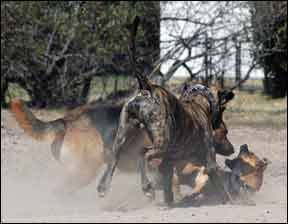
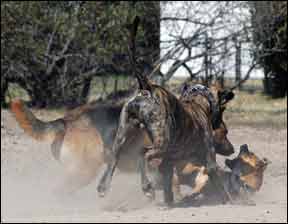
A dog fight that goes beyond a brief scuffle and doesn’t resolve quickly is frightening to behold. In fact, it’s one of the behavior scenarios most likely to result in significant injury to humans, not to mention the dogs. The first, most important thing to remember is keep yourself safe. After that, here are five things to do to try to end the conflict as quickly as possible, with minimal bloodshed.
1. Spray me a river. Blast the dogs with water from a nearby hose – assuming a nearby hose with a powerful enough spray. An easily portable aversive such as lemon juice in a spray bottle can be an effective alternative. In a pinch, even a fire extinguisher makes a handy and effective fight-stopping tool.
2. Sound strategies. Depending on the intensity of the fight, a loud yell might put it to rest. Try dropping one (or several) metal pans on the floor. A lit match held under a smoke detector alarm might also do the trick. Available at boating supply stores, a marine air horn can be effective at breaking up a fight. Warning: they are loud!
3. An object lesson. Keep your hands out of the danger zone by using a physical object to break up a fight. (You have to plan in advance.) Attach two handles to a sheet of plywood. When a fight happens, lower the board between the sparring dogs. The board will push them apart and provide a physical barrier between them to prevent a new grab.
288
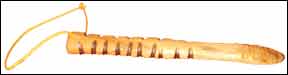
Dogfighters – and some bully breed owners who don’t fight their dogs but know their dogs’ potential – always carry a “parting stick” or “breaking stick” with them. This is often a carved hammer or axe handle, tapered to a rounded point at one end. When dogs are locked in combat, the parting stick is forced between a dog’s teeth and turned sideways to pry open the jaws. Caution: Parting sticks can break teeth, and a dog whose jaws have just been “parted” may turn on the person doing the parting.
Tossed over fighters, one over each, blankets muffle outside stimuli, reducing arousal. This also allows humans to physically separate the combatants by picking up the dogs and pulling them apart with less risk of a serious bite; the blanket will cushion the effect of teeth on skin if the dog does whirl and bite.
4. Air supply. When life and limb are at stake, extreme measures may be called for. Wrap a leash round the aggressor’s neck or twist his collar to cut off his airflow. When he lets go for a breath of air, pull the dogs apart. You can also cover the dog’s nose with a plastic bag to cut off the air supply. These are more challenging than they sound. It’s difficult to get a leash around the neck of a dog who is “attached” by mouth to another dog; grabbing a collar to twist puts you at risk of being bitten and your fingers at risk of getting caught in the collar; and the nose is a moving target.
288
5. Let’s get physical. I heard about (never tried) a rather drastic technique observed at a dog show decades ago. The elderly judge was a tiny woman. When two dogs got combative in her ring she had the handlers both grab their dogs and hold on tight. Then she took the dog on top by the tail and jammed her thumb up his rectum. He let go in an instant and whirled around to see what was happening. The judge excused the two dogs, calmly washed her hands, and continued her classes. Note: A client of mine tried this recently. It didn’t work for her.
Here’s another approach for smallish dogs in a one-on-one fight; it is not recommended for a multi-dog brawl. Lift the rear of the clearly identified aggressor so he’s suspended with forefeet barely touching the ground. The dog lets go, and the target can scoot free. Supposedly, in this position the dog is not able to turn on the human suspending him, although I’m not giving any guarantees.
There are no guarantees for any of these methods; the best answer is management and modification. If you have dogs who fight, keep them apart, unless and until they learn to get along. The best of management plans can fail, however. If and when that fight happens, take a deep breath, resist your instincts to leap into the fray, quickly review your available options, and choose the one (or ones) that are most likely to work in that place and time. When the fight is over and no one is being rushed to the hospital in an ambulance, remember to take a moment to relax and breathe, and then congratulate yourself for your quick thinking.
It’s a ton of fun to see an athletic, healthy dog sprinting across a sprawling lawn of thick green grass – but could this practice be dangerous to the dog’s health? A study presented in the January 2012 issue of the journal Environmental Research concluded that exposure to professionally applied lawn pesticides was associated with a significantly (70 percent) higher risk of canine malignant lymphoma (CML).
It’s a broad conclusion and light on specifics. The case-control study, conducted between January 2000 and December 2006 at the Foster Hospital for Small Animals at Tufts University’s Cummings School of Veterinary Medicine, was structured around a 10-page questionnaire that was mailed to dog owners who were having their pets treated at the Foster Hospital; the resulting data came from the owners of 266 dogs with confirmed cases of CML and 478 dogs in two control groups (non-CML cases).
The questionnaire was not included in the article; a summary stated that it covered a wide variety of data considerations, including breed, weight, medical history, and the types of chemicals used in the home. The characteristics of the CML cases did not vary much from the controls, other than in the weight category (the CML dogs tended to weigh more than 50 pounds). Exposure to types of flea and tick products and frequency of administration was similar among the groups, as was overall exposure to lawn care products.
What did show cause for concern was that the CML cases were more likely to live in homes that reported professionally applied pesticides and herbicides, though the results were only marginally significant for the herbicides. Exposure to other types of professionally applied lawn care products was not associated with increased risk. There was an increased risk, however, for dogs who live in homes where owners applied lawn-care products containing insect growth regulators – substances that inhibit the development of insect eggs and larvae.
One disappointment: specific lawn care chemicals or insect-growth regulators were not identified. Instead, the umbrella categories of herbicide, pesticide, insect growth regulators, fungicide, rodenticide, and fertilizer were used. It could be that some of these chemicals are already designated as known carcinogenics. The article notes that studies evaluating frequency of exposure and exposure dose are needed; thus it appears that the researchers did not determine which chemicals the dogs were exposed to, in what quantities, or for how long.
Also disappointing was the fact that genetic factors were apparently not considered as part of the study. Three-fourths of the CML dogs were classified as purebred, as was the control group. The incidence rate of CML is not the same for all breeds; increased risk has been reported for several breeds including Basset Hounds, Boxers, Airedales, Golden Retrievers, Saint Bernards, Bulldogs, Bullmastiffs, and Scottish Terriers. This predisposition could indicate an inherited characteristic.
Like the canary in the mineshaft, dogs can serve as sentinels for human disease because they are our close companions and are subjected to many of the same environmental influences. Canine cancers have the same biology and behavior as human cancers, and in some cases have identical histology and response rates to treatment. The goal of this study was to identify risk factors for CML from exposure to environmental chemicals in an effort to provide insight to risk factors for humans in developing non-Hodgkin’s lymphoma.
Keep in mind that exposure to lawn care products is different for canines than it is for humans. People can know if a lawn has been recently treated with chemicals and thus avoid it and take precautions when handling such chemicals. Our pets have no such option; their uncovered and unprotected bodies come in direct contact with the environment. They see an enticing outdoor carpet, perfect for rolling around on, running across, playing fetch and wrestling with playmates on, and even ingesting. Dogs have their mouths on everything: themselves (grooming), their playmates, their toys and sticks lying in the grass, and yes, the grass itself. And those mouths can be the conduit from external to internal exposure.
Though more study is needed, the preliminary findings of this study suggest that you can reduce your dog’s risk through the following:
–Don’t use pesticides on your own lawns, or allow lawn-service providers to use them on your property.
–Don’t use lawn care products that contain insect growth regulators.
–Prevent your dog from walking on (or rolling on, eating, etc.) any lawns, unless you are able to determine that absolutely no pesticides are used to maintain them. (Most municipalities are required to make their chemical lawn-care regimens available to the public. It says something about these chemicals that their use is prohibited on most public school grounds.)
Because only one out of five Americans has an up-to-date will and only 20 percent of those include provisions for pets, an estimated 500,000 dogs and cats are euthanized every year when their owners die and they have nowhere to go. Is your dog at risk?
Unless you make effective plans for your dog’s welfare in case you die or are incapacitated, the worst could happen.
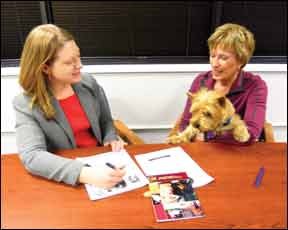
When setting up a pet trust, it helps to work with an attorney who is familiar with what pets need. Estate planning attorney Heidi Goettel reviews pet trust details with author CJ Puotinen and Seamus, her husband’s Cairn Terrier. Photo by Stephen Nagy
But preparing for your pet’s future can seem a daunting task. Wills, trusts, and financial instruments are complicated enough. Add caretakers, backup caretakers, specific instructions, and veterinary care. No wonder so many of us just hope we’ll outlive our pets.
“Lifetime care planning for pets doesn’t have to be complicated, expensive, or overwhelming,” says estate-planning attorney Heidi Goettel of Helena, Montana. “Pet owners have many options, and the peace of mind good planning provides is worth the effort.”
Don’t Leave Your Dog’s Future to Chance
If you assume that a friend or relative will love Fluffy as much as you do or that someone will always be there for Fido, think again. Every animal shelter in the country deals with orphaned pets. They arrive for one reason: their owners didn’t plan to die or become incapacitated. That didn’t prevent them from having heart attacks or accidents, and now Fido and Fluffy are homeless.
Worse, they may be alone, starving, and frightened. Does anyone know they exist? Do they need medication? Are they on special diets?
Accidents can happen anywhere at any time, but the following are risk factors for your companion animals:
-You live alone.
-You are a senior citizen, or getting close.
-You have health problems.
-Your pets are elderly or have health problems.
-Your pets are shy or don’t do well when their daily routines are disturbed.
-Even a temporary incapacity – you are hospitalized, require treatment away from home, or have to be away for other reasons – can disrupt your pets’ lives.
Establish a Pet Protection Agreement
The best way to prevent your pets from being harmed by your temporary or long-term absence, say legal experts, is through careful planning.
A will or testament is a legal declaration by which a person names one or more people to manage his or her estate and transfer its property at death.
You cannot leave money or property to an animal, but you can leave assets to a person who agrees to care for your pet. Even if the person who agrees to take your pet can afford to pay for the animal’s upkeep, you may want to leave both the animal and a sum of money to that individual.
If a financial inheritance will be a hardship for your dog’s new owner (for example, if the money makes that person ineligible for financial assistance from Social Security or another agency), or if the person might not be able to manage a lump sum inheritance, you can leave your pet to the caretaker and the money to another person with instructions for reimbursing the new owner for dog-related expenses.
Because wills are not acted upon immediately – there is a waiting period before wills are read and property changes hands, and, should legal disputes arise, final settlements can be prolonged for months or years – a will cannot guarantee that an animal’s needs will be met in a timely manner. A will that includes specific instructions for an animal’s care cannot be enforced. Wills do not allow the disbursement of funds over a pet’s lifetime. Courts can change the provisions of a will that is challenged by relatives or other interested parties.
These potential problems do not mean wills should not include provisions for pets. Instead, they reflect the need for additional arrangements.
Pet trusts are just such plans. They involve a trustee, which can be an individual, a bank, or a non-profit organization such as a humane society, which handles the finances; a beneficiary, who is the person you choose as your dog’s new owner and caretaker; and you, the settlor, the dog owner who is setting up the trust.
“Technically,” says Goettel, “the animals are the beneficiaries of pet trusts. The caretaker definitely benefits from there being a trust for the animal, and the funds go to the caretaker for practical purposes, but when the beneficiary is defined as the animal or for the benefit of the animal, the trustee, who may also be the caretaker, is legally obligated to use the trust funds for the animal’s care.”
A traditional pet trust, which is legal in all 50 states, instructs a trustee to help a beneficiary by paying for the pet’s expenses according to the settlor’s directions as long as the beneficiary takes proper care of the pet. Traditional pet trusts provide the owner with significant control over the animal’s care, such as by specifying who will be the trustee, who will be the beneficiary/caretaker, what pet-related expenses the trustee will pay, what type of care the pet will receive, what will happen if the caretaker can no longer care for the animal, whether the animal will be buried or cremated after death, and where the pet’s remains will be interred or stored.
A statutory pet trust, which may also be known as an honorary pet trust, is valid during the pet owner’s life as well as after his or her death. This type of trust controls the disbursement of funds, which can occur prior to the owner’s death, and it can include specific instructions for the animal’s care. As of 2010, all states within the United States except for Kentucky, Louisiana, Massachusetts, Minnesota, Mississippi, and West Virginia allow this type of trust, which is more flexible than the traditional trust and does not require the pet owner to make as many decisions regarding its terms. State law “fills the gaps,” making a simple provision in a will or other document (such as, “I leave $3,500 in trust for the care of my dogs, Ranger and Rover”) effective.
“When state law ‘fills the gaps,'” explains Goettel, “the owner’s intentions are followed even if they are hand-written on a sheet of paper. This is the simplest arrangement you can make for your pet. It works best if you and your designated caretaker have already discussed your plans and that person understands and agrees with your wishes.”
Baillie, a therapy dog belonging to Marilyn Grant of Helena, MT, will always have a forever home thanks to carefully selected friends who will care for him should she not be able to. Estate planning experts say that finding a willing caregiver is the most important step in planning a pet’s lifetime care. Photo by CJ Puotinen.
A revocable living trust allows you to avoid probate, the legal process for transferring property after death. A living trust lets you make changes or amendments to the trust document; allows the transfer of your personal assets to remain private rather than public; and eliminates most of the family disputes and challenges that a standard will can create. However, revocable trusts provide minimal asset protection, they can generate planning and administrative expenses, and assets must be transferred into the trust name (which won’t affect your access to them).
A testamentary trust is less expensive because it does not take effect until after you die and your will is probated (declared valid by a court). This type of trust does not provide funds for the care of a pet during the period between your death and when your will is probated, nor does it protect your pet if you become disabled and unable to provide care.
Pet Trust Factors to Consider
“The most important and challenging factor in providing lifetime care for your dog is finding a 100-percent committed caretaker,” says Goettel. “The owner is in the best position to identify a care provider. Equally important is that the identified caretaker and care plan are in writing and are found when needed, so that the care provider is notified before the animal is surrendered to a shelter or euthanized at the direction of an uninformed third party. It often happens that people do have a plan, but no one knows of it. That is especially tragic.”
Even if a friend or relative promises to take your pets in, promises can’t always be kept. Today’s uncertain economy is hard on pets, who are adversely affected by unemployment, divorce, home foreclosures, and relocations.
Even if your friend or relative remains willing and has a stable home, additional pets can be a source of stress, not to mention expensive. This is especially so if the animals are elderly, on special diets, on presecription medication, require frequent veterinary visits, and have challenging symptoms like incontinence, seizures, severe arthritis, or confusion. Puppies and young dogs place a different kind of stress on caretakers, including their need for training and exercise.
Your caretaker will be your dog’s new owner. Transferring ownership through your will or the establishment of a trust is important because without this provision, your pet will go to your residuary beneficiary (the beneficiary who inherits everything that’s not taken care of by the rest of your will); or, if you don’t have a will, your pet will go to your next of kin, as determined by state law.
Once you find a willing caretaker, it’s important to sit down with that person and review everything that’s important to you. Does your dog eat a home-prepared diet containing special ingredients? Compete in agility? Have a job? Get monthly massages, chiropractic adjustments, hydrotherapy treatments, or acupuncture? Enjoy a cheese-stuffed Kong after dinner? Require frequent trips to the groomer? Special diets, special treatments, special training, and special activities cost time and money. Well-intentioned friends and relatives who don’t share your interests or income may provide a loving home but not necessarily the one you want your dog to have.
Do you have more than one dog? Are they closely attached? Do you know someone who would foster these pets while looking for someone who would adopt them both?
It’s essential that any prospective caretaker understand what he or she might have to provide. If that person has a full-time job, young children, other pets, limited space, and limited time, the burden might be impossible even if your estate paid all the expenses. It’s much better for you and your prospective caretaker to realize this now, while your estate is still in the planning stage, than to have your caretaker discover that the arrangement won’t work after you have passed away. Your dog might be surrendered to the nearest shelter or given to a stranger who knows nothing about you or your pet.
Seamus says, “I’m worried. I don’t see anything about my raw meaty bones guarantee!” It’s important to review all the details, and build alternatives into the plan in case some aspects of your ideal scenario are not feasible for your pet’s caretaker. Photo by Stephen Nagy
Once you find a willing caretaker, look for another one. Having a backup caretaker can save the day if your first choice loses her job, has to move, is in an accident, falls ill, gets divorced, or is for some other reason unable to accept your pet or continue its care. In fact, having at least two backup caretakers and at least two backup trustees (if you create a trust) is recommended.
Another factor to consider is the size of your estate. The larger it is, the more likely your plans will be challenged by relatives, individuals, organizations, or tax collectors. The legal literature describes many cases in which courts sided with plaintiffs who considered an animal’s share of an estate to be excessive or inappropriate. In 2007, real estate billionaire Leona Helmsley died and left $12 million to her Maltese, Trouble. Because Helmsley disinherited several relatives, her will and the dog’s trust were challenged in court, and Trouble’s legacy was reduced to $2 million. In some cases, judges have reduced an animal’s share of an estate to nothing.
An experienced estate-planning lawyer can help you establish a trust that’s more likely to survive with your instructions intact.
To prevent fraud, pet owners should clearly identify pets that are to receive care under a will, pet trust, or powers of attorney. The most effective identification tools are microchips and DNA samples, but detailed descriptions, photographs, and veterinary records can be helpful.
If You Obtained Your Dog with a Contract…
If you purchased your dog from a reputable breeder, you probably signed a contract agreeing to return your dog to the breeder if you cannot keep or are unable to provide for the dog. The same arrangement is used by most animal shelters, service dog programs, and rescue organizations.
“The breeder or organization wants to ensure that the dogs they place always have a good home,” says Goettel. “By making arrangements ahead of time, you spare them the effort and expense of fostering your dogs and finding new homes for them. Most breeders and organizations would be thrilled to learn that the owner or adopter is making plans for the animal, and they would likely make a record of the information. If the care provider does not know about the contract, attaching it to the will or care plan for the animal will ensure that the care provider knows of it and follows its terms. To keep everyone informed, attach your original contract and related correspondence to your will or trust documents, and provide copies of these to everyone involved.”
Make Plans for Future Veterinary Care
Because veterinary care is likely to be the greatest expense incurred by your pet’s new owner, consider the following options for providing the care your dog may need.
If you already have health insurance for your dog, provide funds for keeping it up to date. If your dog does not already have health insurance, consider leaving money for the purchase of health insurance. This option is most appropriate for young dogs in good health as premiums increase as dogs age; some plans exclude dogs age nine and older; most policies have exclusions and limits; and canine health insurance premiums, copays, and deductibles can be just as complicated as they are in human health plans.
You can leave money to your vet. This amount will vary according to your dog’s age and condition along with the treatments you are prepared to pay for. The best way to make this arrangement is through discussion with your vet. You can request that any funds left over when your pet dies be given to a relative, charity, or the veterinarian, though this request is not legally enforcible.
Signing a contract in advance with your veterinarian is a third option. In this case, you leave to the veterinarian a specific amount as credit toward expected services. If and when that money runs out, the new owner will be charged for services provided to your dog. If your dog dies before the money is spent, your contract specifies what will be done with the excess.
If You Can’t Find a Good Caretaker…
If your dog came from a breeder, shelter, or organization that requires the dog’s return, you have a safety net. But what if you don’t know anyone who could care for your pets for the rest of their lives?
Members of dog organizations, such as kennel clubs, dog sport clubs, therapy dog organizations, and rescue organizations, along with those who take their dogs to trainers, can network with fellow members and trainers to find appropriate temporary care (think foster homes) for your dogs if needed.
Many veterinarians are named in wills or trusts as temporary guardians or as the new owners of their clients’ pets. Obviously this arrangement works best when the owner and veterinarian discuss and agree on the details.
The tireless volunteers of rescue organizations save the lives of dogs and cats every day. They provide foster homes, medical care, training, spaying or neutering, and anything else an animal needs to become adoptable. To provide for your animal through a rescue organization, contact the organization now to learn what arrangements will work best.
To find such organizations, search online for your breed, such as Labrador Retriever rescue, Poodle rescue, mixed breed rescue, senior rescue, etc. You’ll find national and regional organizations and networks, some of which are 501(c)3 non-profit organizations, independent organizations, or affiliates of national or regional kennel or breed clubs, all of which are dedicated to matching homeless dogs with good homes. Becoming a volunteer yourself can be a satisfying activity that will keep you informed about fostering and adoption.
Your local animal shelter may be a good choice, especially if your dog is young, healthy, and well behaved, as these dogs find new homes more quickly. Older dogs and dogs with medical problems are usually harder to place, as are dogs with behavioral problems. Shelter volunteers have an inside view of the organization and its adoption process, and because circumstances vary from one shelter to another, becoming a volunteer or consulting with shelter staff about your plans can be an important step toward your dog’s future care.
Pet sanctuaries provide permanent care for the animals they take in. As with conventional shelters, conditions vary from one sanctuary to another, and careful research is a must. Your dog might or might not be happy living for an indefinite time in a sanctuary. Some pet sanctuaries don’t actually provide permanent sanctuary to all of their wards, but seek to rehome as many animals as possible. Before making arrangements to leave your dog to a sanctuary, you should familiarize yourself with the sanctuary’s requirements, and be sure it will accept your animal.
The single owner of two dogs with significant behavioral issues (both exceedingly shy Shar-pei), Mary Straus wrote a pet trust to enable and ensure that her dogs could be cared for in her home in case of her death.
Some veterinary schools and sanctuaries have continuing pet care programs in which the pets either live the rest of their lives on-site in comfortable surroundings or are adopted out or put in foster care. These programs typically require an enrollment fee (such as $1,000) and an endowment (such as $10,000 or more) either at the time of enrollment or as a bequest in your will.
Fund Your Pet’s Future Without You
Once you decide what arrangements you want to make, the important question is where will the money come from to support your pets after you die or when you are no longer able to care for them? Trust funding or direct bequests can come from cash, life insurance, annuities, stocks, bonds, or property that can be sold, such as a vehicle, house, or boat.
-Direct transfers. To create a living trust (which you create now, while you’re still alive), you must transfer money or other property to your trust. Your attorney can help you arrange the transfer so that it is properly executed.
To create a trust in your will, which becomes effective after your death, you will use the property distribution section of your will to specify the amount of money or description of property that fund the trust.
-Pour over will provision. If you create a living trust, you may add property (a “pour over”) from your estate to the trust.
-Life insurance. Pet trusts can be funded by naming your trust as a life insurance policy’s beneficiary. Because life insurance “creates” property when you die, this is an easy way to fund your pet’s future should you not have sufficient assets to do so otherwise. Consult with your lawyer or life insurance agent in order to correctly name your beneficiary.
“Many people believe that naming the caretaker as beneficiary on life insurance or arranging a bequest with just the caretaker’s name and nothing further, is sufficient,” says Goettel, “when they really need to make some reference to a ‘pet trust’ or ‘for the benefit of my pet,’ so the caretaker does not consider the funds an unrestricted gift and so the funds are used as the owner intended.”
-Pay on death accounts, annuities, retirement plans, and other contracts. If you have an annuity, retirement plan, or other contractual arrangement that permits you to name a person to receive the property after you die, you may use those assets to fund your pet trust. Consult with your lawyer, banker, or broker about the correct way to name the recipient of these funds.
-A charitable remainder trust. If you transfer property to a tax-exempt charity, it can serve as trustee of the trust and manage or invest the property so it produces income for you. The charity then pays to the trustee of your pet trust a portion of the income for a specified number of years or for the duration of the trust. When the trust ends, the remainder of the property goes to the charity. Because of its tax advantages, this has become a popular type of trust.
-Durable powers of attorney. This standard financial planning tool authorizes someone other than the pet owner to conduct certain acts on his or her behalf. Such a document can be written to become effective upon the pet owner’s physical or mental incapacity.
A Pet Trust in Action
In 1995, when she left a long-term relationship with a partner who would have cared for her dogs if something happened to her, canine nutrition expert and WDJ contributor Mary Straus found an attorney who specialized in living trusts for pets. “I was 43 at the time and had no health issues,” she says, “but I’m a worrier and prefer to know that everything’s covered, just in case. At the time I owned two genetically shy Shar-Pei, Piglet and Nattie (Piglet was so shy initially that it took three months before she voluntarily let me touch her). These dogs would not be easy to place and they wouldn’t handle disruptions well. I agonized over what I could do to protect them should something happen to me.”
Straus’s attorney helped her create a living trust. “Basically,” she says, “I left my house to my dogs, with instructions to my successor trustee that someone be found to live there and take care of them as long as needed, with much of my estate covering the cost.”
In addition, Straus prepared a separate, non-legal document covering diet, health history, special needs, likes and dislikes, and other information such as what you might leave for a pet sitter but in more detail. “I included what kind of home my dogs might best fit into,” she says, “such as with other dogs, cats, and kids, whether my dogs need to be placed together, and so forth, in hopes that the right kind of home(s) can be found sooner or later. I also included information about friends and rescue people I know who might help find someone to stay at my house or find a home for my dogs.” She updates these dog care instructions at least twice a year.
Straus chose a living trust because it allows her estate to avoid probate.
“A trust relies on your trustee,” says Straus. “Since no courts get involved, you have to trust (hence the name) the person you choose to carry out your wishes. My trust is quite simple and most of it is just boilerplate. The pet trust portion is two paragraphs that come after a paragraph that specifies the amount of money or percentage of the trust estate that will fund the trust.”
Here is the text of Straus’ Pet Trust:
Pet Trust. Settlor’s present and future primary concern upon her death is the safety, welfare, and continued care for her pets. The animals which will be living with settlor at the date of her death will be referred to hereinafter as the settlor’s “PETS”. Upon the settlor’s death, the settlor’s residence and usual furnishings shall remain in trust for a period of ten (10) years or until the natural death of the last of the PETS or until such time as the trustee has found suitable, substitute housing, shelter and care for the PETS (whichever occurs first). The retention of the residence and furnishings is for the primary purpose of providing suitable, familiar housing and shelter for settlor’s PETS during the term of the trust. Settlor expects the residence to be rented during the existence of the trust. In keeping with the settlor’s primary concern for her PETS, settlor directs the trustee to screen any and all potential tenants to assure any renter has the same or similar concern and ability to care for settlor’s PETS as settlor has, and that such care shall be compensated in such a manner that any renter shall receive an appropriate reduction in the fair rental value of the residence with is commensurate with the value of such services.
The balance of the pet trust estate and all income is to be accumulated (i.e., without distributions) during the term of the trust in a reserve account for the real property maintenance and for the feeding and veterinary care of settlor’s PETS through the term of the trust. Upon termination of the trust as described above, the balance of the trust estate shall be distributed in accordance with the residue of the trust as described in paragraph C (11) above.
Nattie passed away in 2005 at the age of 16, and Piglet followed in 2009 at 17. Straus now shares her life with Ella, a Norwich Terrier.
“My trust is still in effect,” she says, “although my successor trustee knows (and I’ve included in my instructions) that my current dog, Ella, would do fine in another home, so there would be no need to keep the house for her. I am still leaving money for her care in an arrangement where veterinary bills and other costs would be reimbursed to the new owner rather than giving that person a lump sum. In my instructions I keep a list of people who I think might provide or help find a good home for Ella. My only problem with her is that she prefers being an only dog, and everyone I know already has dogs!”
Do You Need a Pet Trust Laywer?
For the simplest of care arrangements – your best friend, a member of your family, or someone who loves your dog volunteers to care for him if something happens to you – the transfer of ownership and a simple bequest probably don’t require a lawyer, assuming you live in one of the 44 states that honor statutory pet trusts.
But if your estate is large or complicated, if relatives are likely to challenge your plans, or if you want to maintain as much control of your dog’s future as possible, you need a lawyer.
Some legal firms offer do-it-yourself will-writing software or programs that create pet trusts. “These can be inexpensive,” says Goettel, “but will programs are not usually state-specific, and law on estates and trusts varies from state to state. Also, these will programs come with general, but not specific, advice about estate planning. Although almost everyone believes their estate planning is simple and straightforward, many do not realize they have issues that should be dealt with very specifically. Also, a will document is only a piece of estate planning. Beneficiary designations, joint tenancy ownership, and other property issues need to be coordinated with the planning that is in a will, and the online programs may not be comprehensive in that regard.” In other words, it’s a good idea to check with a local lawyer who has estate-planning and pet trust experience.
Helpful Resources for Starting a Pet Trust
One online resource that comes highly recommended by estate planning attorneys and the animal welfare community is 2nd Chance for Pets, a non-profit organization that helps pet owners provide for their animals’ care should the owners die or become incapacitated.
The organization’s free eight-page Pet Care Workbook, available online or in print, includes Care Instruction Forms that you can complete, make copies of, and share with everyone involved in caring for your pets. As the workbook reminds us, the components of a lifetime care plan are simple:
1. Identify (and communicate with) future caretakers for your pets.
2. Prepare written instructions outlining how your pets should be cared for.
3. Set up a fund specifically for the care of your pets.
A detailed questionnaire includes everything from caretaker information to pet sitters, boarding facilities, emergency contact information, veterinarian information, trustee information, and details about your pet.
The organization also provides Emergency Identification Cards that tell first-responders or medical staff that you have pets, where they are, and who should be contacted if you are in an accident or are incapacitated.
Prebiotics (no, it’s not a typo) nourish probiotics, the beneficial bacteria discussed last month that support digestive health, the immune system, and more. A prebiotic is defined as “a nondigestible food ingredient that beneficially affects the host by selectively stimulating the growth and/or activity of one or a limited number of bacteria in the colon and thus improves host health.”
Prebiotics are soluble, fermentable fiber, a type of nondigestible carbohydrate, also called resistant starch. Fructooligosaccharides (FOS) are the most common, but other oligosaccharides, arabinogalactans, and lactulose are also considered prebiotics. Sources include inulin (a form of FOS extracted from chicory), larch (a source of arabinogalactins), pectins, beet pulp, gums (e.g., guar gum), and wheat dextrin (Benefiber).
Prebiotics are included in many probiotic supplements (the combination is called “synbiotic,” referring to the synergy between the two). Food sources of soluble fiber include legumes (beans, lentils, peas), whole grains, fruits, vegetables, and Jerusalem artichokes (sunchokes). Some commercial dog foods have added sources of soluble fiber, such as chicory. Soluble fiber supplements are also available.
Why Should Dogs Use Prebiotics?
Prebiotics support the growth of probiotics, which help keep bad bacteria under control in the dog’s gut. By supporting the good bacteria, prebiotics help to prevent disease, improve digestion and nutrient absorption (especially minerals), and enhance the immune system. Dogs fed prebiotics are less likely to get diarrhea caused by the overgrowth of bad bacteria, and soluble fiber also helps to prevent or treat diarrhea by absorbing water and slowing intestinal transit. Fed to females during pregnancy and lactation, prebiotics provide enhanced immune protection to the puppies through colostrum and milk, and the puppies have an enhanced response to vaccines.
Soluble fiber is fermented by bacteria in the colon to short-chain fatty acids (SCFAs), the primary fuel for the cells of the colon. Increased concentration of SCFAs and numbers of beneficial bacteria support gastrointestinal health and the immune system.
Prebiotics may be especially beneficial for dogs with immunosuppression or digestive disorders, and for all dogs following antibiotic therapy. Studies done on rats show that prebiotics may help correct hyperlipidemia (high blood triglycerides or cholesterol) brought about by diabetes and other conditions. Human studies have shown that prebiotics may reduce the risk of colon cancer and irritable bowel disorders.
Use Care When You Give Your Dog Fiber Supplements
Prebiotics included in probiotic supplements are unlikely to cause any problems. Fiber supplements, however, should be used with caution. Too much soluble fiber can lead to gas and loose stools. Insoluble fiber (roughage), such as cellulose, speeds intestinal transit time (laxative effect) and reduces mineral absorption. Both types of fiber bulk up stools.
It’s important that dogs drink enough water when taking fiber supplements (especially insoluble fiber); add water to food if needed.
Dosing Prebiotics
Probiotics and prebiotics are best given together. Follow label instructions when using products made for dogs. When using products made for humans, adjust the dosage based on the size of your dog compared to an adult human (e.g., give about half the human dose to a dog weighing 50 to 60 pounds, or one-quarter the human dose to a dog weighing 25 to 30 pounds). If using a fiber-only supplement, start with low doses and increase gradually. Decrease the amount or switch to a different product if you see signs of gas or diarrhea.
Recommended Prebiotic Sources:
1. Thorne Veterinary’s ArabinexVET, an arabinogalactan product
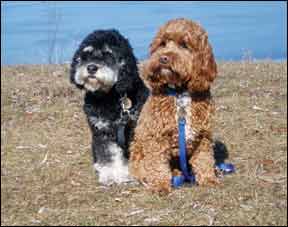
Bill and Marin Corby of Romeo, Michigan, feed a homemade diet to their two rescued Cockapoos. Max, estimated to be anywhere from 6 to 9 years old, has been with them for three and a half years. Max weighed 32 pounds when first adopted, but his current weight is a healthy 20 pounds. Mickey was four months old and very sick when they first brought him home, as he had problems digesting his food. The Corbys switched Mickey to a raw diet, and he’s now thriving at 20 months of age and 16½ pounds.
288
The Corbys feed a raw diet with a lot of variety. They make the food in large batches, then freeze it in 7-cup containers that hold a few days’ food each and are thawed as needed. Amounts shown below are for the complete batch, which lasts 34 days. Most ingredients are pureed in a food processor, then mixed with meat, Sojo’s, and spices in a large, shallow Rubbermaid storage container.
Each dog gets 8.5 ounces of this recipe per day (the amounts shown in parentheses are the daily amounts per dog):
–17 pounds meat (4 ounces), comprised of the following:
–15 pounds ground beef (27 percent fat), OR ground turkey (7 percent fat), OR 10 pounds venison plus 5 pounds ground beef
–1 pound heart (turkey or venison)
–1 pound liver (beef or venison)
–1 dozen eggs with shells (1/3 ounce)
–32 ounces plain, low-fat yogurt (½ ounce)
–6 cups Sojo’s Original Dog Food Mix (about 7 grams or ¼ ounce)
–10 pounds vegetables (2.4 ounces), including sweet potato, green beans, kale, broccoli, spinach, yellow squash, zucchini, butternut squash, acorn squash, and carrots. Each batch contains 2 pounds each of five different vegetables. The starchy foods (sweet potato, winter squashes, and carrots) are cooked.
–5 pounds fruit (1.2 ounces), including bananas, berries, melon, and pears.
Supplements:
–1 cup molasses (¾ teaspoon)
–1 cup organic apple cider vinegar (¾ teaspoon)
–1 Tablespoon each turmeric, garlic, and ginger
–Each dog also gets one raw, skinless duck neck daily (averaging 3 to 4 ounces each), and a squirt (about ½ teaspoon or 2 grams) of salmon oil.
First Look I was pleased to see that this diet includes a wide variety of foods, with appropriate proportions of the various food groups: approximately 30 percent raw meaty bones, 33 percent meat (including 2 percent liver), 5 percent eggs and dairy, 20 percent vegetables, 10 percent fruit, and 2 percent supplements. It provides each dog with about 550 calories daily.
I winced, however, at the high-fat ground beef. Many homemade diets, particularly raw diets, are much higher in fat than most pets need. While dogs don’t suffer from clogged arteries the way people do, too much fat can lead to obesity, digestive upset, and even pancreatitis in susceptible dogs. It can also reduce the dog’s total nutritional intake because portions must be reduced to keep the dog from becoming obese.
I like to look at grams of fat per 1,000 calories (kcal), abbreviated GFK. A diet with 25 GFK, which is about 10.5 percent fat on a dry matter basis (DM), is considered low fat, suitable for dogs prone to pancreatitis or fat intolerance. A working sled dog might eat as much as 81 GFK (about 50 percent fat DM). Most pet dogs do well with 30 to 50 grams of fat per 1,000 calories (around 13 to 25 percent fat DM), depending on their activity level, how easily they gain weight, and whether they have any problems tolerating fat.
288
An analysis of this diet showed it to be over 57 GFK (30 percent fat DM), which is too high. Using 85 percent lean ground beef would drop the GFK to 51 (26 percent fat DM); 90 percent lean beef would decrease it to 48 GFK (24 percent fat DM).
The only food group missing is fish. Fish supplies vitamin D, which must otherwise be supplemented using cod liver oil or a multivitamin. The National Research Council (NRC) recommends about 100 IUs vitamin D daily for dogs weighing 20 pounds. The recommended amount of vitamin D for humans has been increasing in recent years; the same will likely happen for dogs in the future as well.
Tinkering With the Diet Adding 4 pounds (drained) of canned pink salmon or jack mackerel (about 1 ounce per dog daily) to the recipe would provide enough vitamin D and omega-3 fatty acids so that no supplementation is needed. These fish are also relatively low in fat, so 85 percent lean ground beef could be used with the recipe. Sardines are higher in fat than salmon or mackerel, so if sardines were used, I’d suggest combining them with 90 percent lean ground beef. I also recommend rinsing the canned fish if the amount of salt is a concern, and using sardines packed in water, not oil.
Using leaner beef reduces the calories in the recipe. To keep the daily calories the same, the Corbys need to increase the amount they feed by about 30 percent, to 11 ounces per dog daily. Caloric needs are always an estimate, so it’s important to keep an eye on the dogs’ weights and adjust the amount fed as needed to keep them slim and trim.
I don’t advise feeding whole eggs with shells. If the shells are needed to supply calcium, they should be ground to a powder in a clean coffee grinder to ensure that the calcium can be absorbed. One large eggshell makes 1 teaspoon of eggshell powder, which provides about 2,000 mg calcium. If the shells are not needed to supply calcium, it’s best to leave them out in order to avoid giving the dog too much calcium. Adult dogs have the ability to regulate their uptake of calcium, so excess amounts won’t cause the kind of orthopedic problems one might see in large-breed puppies, but calcium binds other minerals, so too much can reduce the nutritional quality of the diet.
There is no need to add calcium to this diet, since the duck necks supply more than enough. Without the raw meaty bones, they would need to give each dog 500 mg calcium daily.
The amount of Sojo’s mix in this diet is not significant; it would be fine to use oatmeal or other grains instead.
Poultry is high in linoleic acid, an omega-6 essential fatty acid, so there is no need to add plant oils to this diet. The amount of salmon oil that the Corbys feed is about twice what their dogs need. When fish is added to the diet as described above, there is no need for added salmon oil at all. This would improve the ratio of omega-6 to omega-3 fatty acids in the overall diet and lower the GFK.
All the homemade diets I’ve analyzed have been low on vitamin E, and added oils increase vitamin E requirements, so this vitamin should always be supplemented. Recent human research, however, has shown that high doses of vitamin E may be counter-productive, negating its antioxidant benefits. I recommend giving 10 to 20 IUs daily to dogs weighing 20 pounds. This is most easily done using a canine multivitamin.
Despite the excellent variety and proportions in this diet, an analysis indicates it’s slightly low in a few minerals (zinc, copper, and selenium) when compared to NRC recommendations. I’m never sure how significant this is, since the NRC bases their guidelines on commercial diets that are high in grains, and grains contain phytates that bind certain minerals. The amounts recommended by NRC may therefore be higher than are needed when feeding a homemade diet that is relatively low in carbohydrates. To be safe, though, it would be easy to give a canine multivitamin and mineral tablet to each dog daily. Most will meet requirements for vitamin E and the minerals listed above.
Summary of Recommended Changes
–Use 85 percent lean ground beef (90 percent lean if using sardines) in place of 27 percent fat.
–Add four pounds of canned fish (drained and rinsed) to the recipe and eliminate the added fish oil.
–Leave out eggshells.
–Increase total amount of recipe fed to 11 ounces per dog daily (new recipe should last 30 days). Adjust as needed to keep the dogs at their proper weights.
–Add vitamin E or a multivitamin and mineral supplement.
–Revised diet has 47 GFK (about 23 percent fat on a dry matter basis).
Mary Straus is the owner of DogAware.com. Contact her via her website if you would like to submit a diet to be critiqued.
Many raw diet proponents claim that the nutrients and/or chemical composition of a raw diet keeps dogs from developing gingivitis or periodontitis. We’re not aware of any studies that have proven these claims, but the persistence of the anecdotal evidence of this phenomenon (to say nothing of its evolutionary success) suggest that there are dental benefits to a diet that includes raw, meaty bones.
Interestingly, it’s not just the physical action of the chewing; many owners, who fear the potential for bone fragments to impact or perforate their dog’s intestines, use commercial food grinders to grind raw meaty bones into a fine paste before feeding them to their dogs. Many of them report the same dental advantages as those who feed whole raw meaty bones to their dogs.
Again, there are likely to be outliers – dogs whose teeth and gums develop disease even when fed a supremely healthy raw diet.
However, it’s been our experience that people are either open to the idea of feeding a raw diet (whether commercial or home-prepared) or not; the condition of their dog’s teeth may be a contributing motivation, but not the sole factor guiding the decision.
Many people think of chewing as “just a puppy thing” but the fact is, canines in the wild spend quite a bit of time every day chewing on bones, in order to extract every last calorie and mineral they need. Our dogs have a ready food supply, so they don’t have to spend every spare moment in pursuit of every last nutrient, but the chewing behavior is hard-wired in them, anyway. Encouraging the chewing habit by providing a steady supply of appropriate chew items can promote a dog’s mental and emotional health.
Chewing also helps keep the teeth and gums clean and strong, and encourages the flow of cleansing, antibacterial saliva through the dog’s mouth.
Pups who are given the private space and leisure time to chew on a raw, meaty bone or food-stuffed toys will quickly develop the habit of spending time by themselves, chewing contentedly – and are less likely to develop separation distress or anxiety.
When pups are raised from the earliest age with ample opportunity to chew on raw meaty bones, most learn to take their time and chew in a casual manner, without damaging their teeth or bolting down over-large bone fragments. There are always outliers, however – dogs who, despite being raised with a ready supply of raw meaty bones, chew so aggressively that they are in danger of breaking teeth or swallowing dangerous chunks of bone. (The behavior is far more common, though, in dogs who were denied the pleasure of bones early in life.) If your dog is an aggressive chewer or greedily bolts any fragment of bone he can break off, he should be given a safer alternative to bones, such as a food-stuffed rubber toy. This will allow him to experience the zoned-out bliss of chewing and licking bits of food out of a safe facsimile of his hereditary chew item.
From front to back: Incisors are the little teeth in the front of the dog’s mouth. Immediately behind these are the canine teeth (fangs); behind them are the premolars and then molars. Note how the dog’s premolars and molars are mostly peaked, not mostly flat like ours. Photo by Nancy Kerns
It’s funny: We share our homes with another species of animal, whose most dangerous feature is its teeth – and most of us know little or nothing about those teeth, other than the fact that we should probably be brushing them. It’s time to correct this situation.
First, some canine dental basics. Most animals (including humans) have teeth that reflect the diet they subsisted on as they evolved. Though we humans have a few mildly sharp teeth in the front of our mouths that we can use for tearing, most of our teeth are built for grinding plant-based foods so that we can better digest them. Conversely, most of the teeth in a dog’s mouth are built for tearing animal-based foods, with just a few teeth that crush their food before they swallow it.
Dogs’ teeth are not as sharp as cats’ teeth, but their teeth and jaws are much stronger. Their dental anatomy enables them to grab and kill prey animals that may be much larger than themselves, tear through thick hides, slice and pull flesh from bones, crack open small bones in order to consume the marrow inside, and gnaw on bigger bones to strip away and consume every bit of meat and connective tissue.
Most adult dogs have 42 teeth, though our genetic manipulation of the species has resulted in dogs with fewer or more. Reportedly, the gene that is responsible for hairlessness in the hairless breeds, such as the Chinese Crested, also modifies dentition, often leaving these breeds with fewer teeth. Doberman Pinschers often are missing molars.
Most adult dogs have six incisors (front teeth) on the top jaw and six on the bottom; two canine teeth (the largest “fangs”) on the top and two on the bottom; eight premolars on the top and eight on the bottom; and two molars on the top and three molars on the bottom.
The dog uses his front teeth – the smallest and most fragile teeth – for his most delicate operations. He uses these teeth to groom himself, pulling burrs and insects from his skin and coat. He also uses them when scraping edible tissue from the surface of bones. (This is likely the evolutionary basis for the behavior that many dogs engage in when they strip the “fuzz” off of tennis balls. Some dogs do this so persistently that they wear down the incisors if not prevented from access to tennis balls.)
While the term “canine teeth” is admittedly somewhat confusing (aren’t all the teeth in a dog’s mouth canine teeth?) the appellation is somewhat understandable when you realize that the dog’s “fangs” are the most distinguishing feature of his species. Whether it’s a Chihuahua or Great Dane, a dog’s canines are the ones that look most impressive when bared, and leave the deepest holes in a person they’ve bitten.
Few of us look far enough back in our dogs’ mouths to appreciate this, but dogs’ premolars and molars are far pointier than human molars. Many of us imagine that dogs are chewing and grinding their kibble much as we chew cereal, but in fact, dog premolars and molars can’t actually grind. Grinding requires an animal’s jaws to move sideways; think about how a cow or llama grinds its food, with extreme sideways jaw action. Dog jaws can’t move sideways! Instead, the dog’s strong jaws and large peaks on the premolars and molars are used to crush large chunks into smaller ones. Not much more physical processing of their food occurs in the dog’s mouth.
As much as dogs can be said to chew, most of the chewing action is provided by the premolars. The molars, located at the far back of the mouth – where the dog has the most jaw strength, like the base of a pair of pliers – are mostly used for extreme crunching.
Puppy Tooth Eruption
We can use the timing of the eruption of puppy teeth and adult teeth to help us estimate the age of a young dog, but after he’s about eight months old and has all his adult teeth, we have to use other clues to estimate his age, such as the amount of staining, wear, and accumulation of tartar on his teeth.
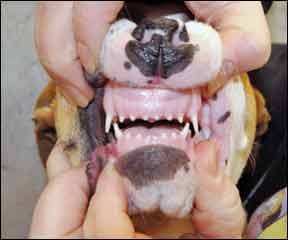
This pup still has her deciduous canines (the teeth people think of as “fangs”), and some of her deciduous incisors (front “baby” teeth). Some of her adult incisors are emerging, though. She’s probably between 3 and 4 months old. Photo by Nancy Kerns
Puppies are born without teeth. The “deciduous” or “puppy” teeth start emerging when pups are about 4 weeks old. First to arrive are the front teeth (incisors, six on top and six on bottom), which emerge when the pup is 4 to 6 weeks old; the canines (two on top and two on bottom) erupt when the pup is about 5 to 6 weeks old; and the premolars (six on top and six on bottom) erupt at about 6 weeks. There are no deciduous molars.
The deciduous teeth are incredibly sharp. It has been speculated that the sharpness of puppy teeth serves to further two important developmental processes: weaning and bite inhibition. Too-vigorous biting, during nursing or play, causes an abrupt end to the previously gratifying activity, teaching the pup, through trial and grievous error, to restrict the severity of his bite. (For more about the development of bite inhibition, see “A Light Bite: Teaching Bite Inhibition,” WDJ June 2010.)
Soon enough (although perhaps not soon enough for most puppy owners), the pin-sharp puppy teeth begin to fall out – or, rather, are pushed out by the eruption of the adult teeth. The puppy teeth are generally lost in the order in which they arrived; and the adult teeth erupt in the same order: first the incisors, then the canines, and then the premolars. There is more variation in the timing of the eruption of the adult teeth, a wider window through which they may first be glimpsed. The adult incisors generally erupt between 3 to 5 months; the canines usually appear between 4 to 6 months; and the premolars between 4 to 5 months. The molars emerge between 5 and 7 months.
Sometimes a single tooth or a few deciduous teeth fail to shed even as the adult teeth erupt, resulting in a crowded-looking mouth. When this happens, it’s best to have your veterinarian extract the unshed puppy teeth, to prevent them from allowing the adult teeth to develop in an improper position.
This entire process of tooth eruption, loss, and eruption, lasting for many months, keeps the puppy’s mouth in constant torment, and he has to chew on things to relieve the sensation – hard things, soft things, chewy things, gummy things, crunchy things, anything, and everything! Knowing this, the wise puppy owner makes certain that the pup has lots of “legal” chew toys, and toys in every category (hard, soft, gummy, chewy, crunchy, and everything in between). If you fail to be thorough in providing chew toys of all textures, he’ll be sure to explore anything that you don’t want him to have that provides that missing, novel chewing experience.
Brushing Your Dog’s Teeth: Yes, You Need To
Here’s what most dog owners really want to know about their dogs’ teeth: “Do I really have to brush them?”
Although veterinary dental specialists would prefer that all owners brush their dogs’ teeth, the fact is that some dogs need it more than others. Whether it’s due to their genes, diet, chewing habits, and/or the chemical composition of their saliva, some dogs go to their graves with clean, white teeth and healthy gums with absolutely no effort put forth by their owners. Others develop tartar (also known as calculus) at an alarming rate.
The accumulation of plaque (a “biofilm” on the teeth that contains bacteria) and tartar (a mineralized concretion of plaque) is not just unsightly, it’s unhealthy. Tartar buildup at and under the gum line enables the entrance and growth of bacteria under the gums. Most dogs who have bad breath also have gingivitis – swollen and inflamed gums, usually bright red or purple, and which bleed easily. Unchecked, these bacterial infections in the gums slowly destroy the ligament and bony structures that support the teeth (periodontitis). Because of the ample blood supply to the gums, infections in the mouth can also poison the dog systemically, potentially causing disease of the heart, kidneys, and/or liver.
If your dog’s teeth are free of plaque or tartar, and his gums are tight and free of any signs of inflammation, you are one of the lucky ones. If, however, his gums are noticeably more red at the gum line and he has any visible tartar buildup on his teeth, you need to have his teeth cleaned by a veterinarian and then maintain the health of his teeth and gums with regular brushing and veterinary cleaning.
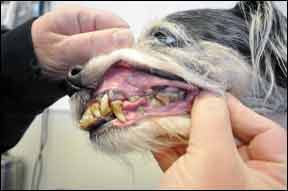
This poor dog’s dental hygiene has been severely neglected. The thick layer of tartar on her teeth has led to severe gingivitis (note the swollen, purple gums). Her incisors are practically falling out, and she’s likely to feel chronically ill from the bacterial burden she’s bearing.
If you are one of the unlucky ones, and your dog’s teeth and gums need your intervention to stay healthy, how often do you really need to brush your dog’s teeth? Put it this way: the more you brush, the less frequently you’ll need to pay for a veterinary cleaning. Whether you would prefer to invest your time in patiently training your dog to enjoy having his teeth brushed or would prefer to invest in your veterinarian’s time is up to you!
A Few Dog Tooth Brushing Tips:
– Start out slow, and be patient. Don’t try to brush all of your dog’s teeth on the first day. Use a circular motion, gently scrubbing plaque away from the gum line. Reward your dog frequently and richly with treats and praise.
– The “brushes” that you wear on your fingertips don’t tend to work as well as brushes with softer bristles – and they make it much easier for your dog to accidently bite down on your finger. Look for very soft-bristled brushes with long handles, so you can make sure you reach the molars. For larger dogs, soft brushes meant for adult humans work fine; baby human toothbrushes work well for smaller dogs.
– If your dog will tolerate it (or you can positively and patiently teach him to accept it), electric toothbrushes work great! For some dogs, however, these whirring, vibrating brushes are a deal-breaker, no matter what kind of treats you offer.
– Use a toothpaste designed for dogs. They come in flavors that are meant to appeal to dogs (meaty, not minty) – and they are free of fluoride, which can be toxic to dogs. (Remember, dogs don’t know to spit the toothpaste out!) Look for products that contain antibacterial enzymes, which help discourage bacterial growth and resulting gingivitis.
– Dip the brush in water frequently as you brush, to help rinse the plaque away from your dog’s teeth, and to facilitate a thorough application of the antibacterial enzymes in the toothpaste.
Get to a Veterinarian
It can be painfully expensive, but the value of having your dog’s calculus-encrusted teeth cleaned at your veterinarian’s office is incalculable! The only way all of his teeth (even the molars) can be scrubbed completely of the tartar, above and below the gums, is under general anesthesia. This must be done at a veterinary clinic.
Whether due to the cost or the perceived risk of anesthesia, people want so much to believe that there is another way to get the dog’s teeth clean. Once a dog has a lot of tartar on his teeth, though, the only effective treatment is a professional cleaning under anesthesia. Once his teeth are clean, you can prevent the need for further veterinary cleaning only through scrupulous home care (brushing) – but you just can’t brush a tartar-encrusted mouth back to health. For one thing, you can’t (and shouldn’t try) to brush under the dog’s gums; this area is cleaned at the vet’s office with sterile instruments and with the use of a fine mist of water, which washes the bacteria out of the dog’s mouth. The ultrasonic (vibrating) tools available to the technician are also much faster and more accurate than any tool you would have access to.
What about “anesthesia-free” cleaning? Witnessing a veterinary cleaning, with the dog under anesthesia, is pretty much all you need to realize that no one is capable of doing what needs to be done to get a fully conscious dog’s teeth really clean. The most cooperative dog in the world just isn’t going to lie down on a table under necessarily super bright lights (so the technician can thoroughly examine the teeth for any signs of chips or painful fractures) and allow a vibrating, misting tool to be employed on his molars.
Further, in most states, it’s illegal for anyone to use a scaler on an animal’s teeth except under the supervision of a veterinarian. While there are many technicians and groomers who may be capable of removing some dental calculus from your dog’s teeth, only a veterinarian is qualified and equipped to recognize, diagnose, and treat any related (or unrelated) conditions the dog may have, such as fractured teeth or oral cancer. If his periodontal disease is advanced, x-rays will be needed to evaluate the supporting structures of the teeth.
Of course, in order to safely anesthetize your dog, your veterinarian will likely require a blood test in advance of the cleaning appointment, to evaluate your dog’s kidney and liver function. If his function is reduced, extra precautions and perhaps a different anesthetic protocol can be used.
Depending on your dog’s age and condition, your veterinarian may also administer intravenous fluids to your dog during the procedure, which can help regulate the dog’s blood pressure. The presence of an IV catheter and proper hydration levels also make it possible for a veterinarian to immediately administer life-saving medications in case of an adverse reaction to the anesthesia. In an emergency, the use of calcium, epinephrine, and/or atropine needs to occur as quickly as possible; having an IV in place makes this possible.
Finally, veterinarians can prescribe and dispense antibiotics to help your dog fight off any bacteria that was dislodged by the cleaning and absorbed into his bloodstream, as well as provide any sort of consultation or aftercare needed. The price tag of all of this can be large – and it can vary a lot from vet to vet, ranging from $400 to $1,400 (or even more if the dog requires tooth extractions).
After all this, you’ll probably be motivated to give that toothbrushing a try. Do it now, while you’re good and motivated; it could add years to your dog’s life.
There’s nothing like a good dog-pack hike to give our canine companions an opportunity to have fun with their peers and run themselves into a happy state of exhaustion – provided there are no bullies in the group. Just like human bullies on a school playground, canine bullies take the fun out of the game, put everyone on edge, and bring to the party a real risk of physical as well as psychological damage. A dog who is bullied, especially at a young age, can quickly develop a negative association with other dogs and become defensively aggressive as a result.
My love affair with group dog hikes goes back to my days working at the Marin Humane Society in California. Employees were allowed to bring dogs to work with them, and many a lunch hour found several of us hiking together. I don’t recall incidents of bullying from those days, perhaps because our dogs were well socialized from their “go-to-work” privileges, perhaps due to selective memory, or perhaps because of my blissful relative ignorance of canine behavior in those early days. But bullying is a very real possibility anytime a group of dogs gets together – at dog parks, daycare, at organized or impromptu play sessions, or when multiple dogs live together in the same household.
I recently invited all our Peaceable Paws trainers to come for a dog-pack hike on our 80-acre campus in conjunction with one of our occasional trainer meetings. We hike before our meetings so our four-legged pals are too tired to pester us while we plan future Peaceable Paws events and debrief past ones. As you might expect, the canine participants in this group were varied and enthusiastic, including a German Shepherd/Rottweiler-mix, an American Pit Bull Terrier, a pair of Dachshunds, a hound-mix, a Labrador Retriever, a Border Collie, a Miniature Pinscher, and two of my own dogs: Lucy the Cardigan Welsh Corgi and Missy the Australian Shepherd.
Much as I love a good group hike, I was dismayed when, throughout the hike, Lucy demonstrated a strong penchant for bullying Belle, the very soft, extremely appeasing Border Collie belonging to Peaceable Paws trainer Beth Joy.
Bullying – an inappropriate canine behavior – is often misidentified as “dominance.” Much has been said lately in the dog world about dominance, but the short version of the discussion is that, while dominance is a correct term for a very narrow selection of appropriate social behaviors, it is not a correct term for a wide range of inappropriate social behaviors that include bullying and aggression. (See “Alpha Schmalpha,” WDJ December 2011.)
Although the “bully” term isn’t found in most behavior literature, in her excellent book, Fight!, trainer and author Jean Donaldson defines bullying dogs – not to be confused with “Pit Bull-type dogs” – as those dogs for whom “roughness and harassment of non-consenting dogs is quite obviously reinforcing.” Like the human bully on the school playground, the bully dog gets a kick out of tormenting less-assertive members of his playgroup. Donaldson says, “They engage at it full tilt, with escalating frequency, and almost always direct it at designated target dogs.” Target dogs are most likely to be those who, like Belle, are non-assertive and quickly offer exaggerated appeasement signals. Appeasement signals are meant to cut off another dog’s overly assertive behavior, but with bullies, it just seems to egg on the bullying behavior.
Like all behavior, bullying is a combination of genetics and environment. A dog who becomes a bully is born with a genetic predisposition to be reinforced by another dog’s appeasing response to his socially overbearing behavior, just as a Border Collie finds it reinforcing to chase things that move, or a Lab is reinforced by holding things in his mouth.
If a pup or a young dog has an opportunity to test a bully behavior strategy on another pup or dog who offers a satisfyingly appeasing response, the behavior has been reinforced and the bully-to-be is more likely to attempt the behavior again, perhaps more forcefully (inappropriately) the next time. If, however, his early attempts at bullying are ignored, or squashed by a more assertive response from his intended targets, the bully behavior may never develop. Hence, bullying, like other undesirable behaviors, is easiest to modify early on, before the dog has a long and strong reinforcement history for the behavior.
Playing v. Bullying It can be difficult for some owners to differentiate between appropriate rough play and bullying. Some may think that perfectly acceptable play behavior is bullying because it involves growling, biting, and apparently pinning the playmate to the ground. Appropriate play can, in fact, look and sound quite ferocious. The difference is in the response of the playmate.
If both dogs appear to be having a good time and no one’s getting hurt, it’s usually fine to allow the play to continue. Thwarting your dog’s need to play by stopping him every time he engages another dog in rough-but-mutually-agreeable play, can lead to other behavior problems, including aggression, from the frustration of not being able to fulfill his desire for social interaction.
I recently saw a couple for a private consult who had added a third dog to their happy family, and now everyone was miserable. The wife was stressed because she thought the dogs were playing too roughly; the husband was stressed because he thought the dogs should be allowed to play together; the senior dog (10 years old) was stressed because he didn’t like the new young upstart (1 year old) playing with his canine pal (5 years old); and the two younger dogs were stressed because they weren’t being allowed to play together.
I watched the two younger dogs interact while the husband restrained the elder to keep him out of the mix. Their play was lovely to watch. Rough, yes, with lots of “chew-face,” growling, and body-slamming, but perfectly appropriate. Both dogs were fully engaged in play, and each, when given the opportunity, chose to come back and re-engage. After a full 90 minutes of non-stop play, they finally ended the session of their own accord and lay happily panting on the floor, at which point the senior dog, who was indeed very tense about the high-energy play session, was also able to relax. So was the wife.
I reassured the couple that there was no bullying happening here, and that they were fortunate the two younger dogs would be able to play together regularly. What a great way to provide exercise for the young, energetic dogs! Over time, the intensity of their play would likely diminish somewhat, as they were allowed to “get it out of their system.” A bigger challenge was the senior dog. They would need to remove him from the play area when the other two were playing, and/or implement a behavior modification counter-conditioning program to help the elder dog become comfortable with the younger dogs’ play.
Modifying Bully Behavior If you do have a dog who is bullying others, you may be able to successfully modify the behavior, especially if you start young. If not, you will need to always manage his behavior by selecting playmates for him who don’t fall into the “target” category. Successful modification of bullying behavior requires:
1. Skilled application of intervention tools and techniques: Use leashes, long lines, “no-reward markers” (NRMs), and time-outs to prevent and remove reinforcement for inappropriate play behavior.
2. Excellent timing of intervention: Prompt application of NRMs and time-outs will let your dog know exactly what behavior makes the fun stop.
3. Reinforcement for appropriate behavior: Allow play to continue or resume when the bullying dog is calm and can play nice.
4. Selection of appropriate play partners: Dogs who are not intimidated or traumatized by bullying behavior, and who don’t take offense by fighting back, may be appropriate playmates for bullies.
The most appropriate human intervention for bullying is the use of negative punishment, in which the dog’s behavior makes a good thing go away. Negative punishment, in this case a time-out, works best for bullying behavior in conjunction with a “no-reward maker” (NRM) or “punishment” marker.
The opposite of the clicker (or other reward marker, such as the word “Yes!”), the NRM tells the dog, “That behavior made the good stuff go away!” With bullying, the good stuff is the opportunity to play with the other dog. Just as the clicker or other reward marker always means a treat is coming, the NRM always means the good stuff goes away; it’s not to be used repeatedly as a threat or warning!
My preferred NRM, the one I teach and use if/when necessary, is the word “Oops!” rather than the word “No!” The word “No!” is often used by dog owners to deliberately shut down behavior. It’s also usually delivered firmly or harshly – and unfortunately, often followed by physical punishment. In contrast, “Oops!” simply means, “You made a wrong behavior choice; the good stuff is going away.” Deliver your NRM in a cheerful or neutral, non-punitive tone of voice; your intent is not to intimidate your dog with the no-reward marker. Thus my choice of “Oops!” – it’s almost impossible to say the word harshly. Try it!
Timing is just as important with your NRM as it is with your reward marker. It says, “Whatever you were doing the exact instant you heard the ‘Oops!’ is what earned the time-out.” You’ll use it the instant your dog starts bullying. Then grasp his leash or drag-line (a long, light line attached to his collar) and calmly remove him from play. Don’t repeat the NRM. Give him at least 20 seconds to calm down, more if he needs it, then release him to go play again. If several time-outs don’t dampen the behavior even slightly, make them longer and make sure he’s calm prior to returning to play. If a half-dozen time-outs have absolutely no effect, end the play session for the day. If the NRM does stop the bullying, thank your dog for responding, and allow him to continue playing under direct supervision as his reward.
Another approach to bully modification that is sometimes effective requires access to an appropriate “neutral dog” who is confident enough to withstand the bully’s assault without being traumatized or responding with inappropriate aggression in return. A flash of the pearly whites as a warning is fine. A full-out dogfight is not. It’s important to watch closely during interactions with the bully. Any sign the neutral dog is becoming unduly stressed by the encounters should bring the session to an immediate halt. A neutral dog may be able to modify your bully’s behavior, and have it transfer to other dogs – or not. If not, you may be able to find one or two sturdy, neutral dogs who can be your dog’s play companions, and leave the softer dogs to gentler playpals. Not all dogs get along with all other dogs – and that’s perfectly normal.
Managing My Bully We managed Lucy and Belle on our dog-pack hike by putting a lot of space between them, and by keeping Lucy occupied with chasing a stick (one of her favorite activities). Since Belle was more than happy to keep her distance from Lucy, we only had to body-block Lucy a few times when we saw her zeroing in on her target. The after-hike meeting was without incident; I put Lucy back in the house so Belle could hang out, worry-free, with the rest of the dogs.
Holistic dog care . . . It sounds so trendy, so green, so Whole Foods. But it’s not as cut and dried as it sounds: You don’t just add bottled water and get Andrew Weil. Developing a holistic approach to your dog’s care is a process … a process of self-discovery on your part, leavened with lots of trial and error.
The real meaning of “holistic,” of course, is doing what’s right for your individual dog – and for you, taking into account your circumstances, lifestyle, budget, and beliefs. There is no template to follow, other than: Know your dog – and yourself.
Little more than a decade ago, inspired by a skinny, diarrhea-plagued puppy, I started exploring a new way of feeding my dogs. From there, I shifted my attitudes about vaccination, veterinary care, even training. It didn’t happen overnight: I made plenty of mistakes, and I continue to learn and grow and evolve my approach.
Here are 10 things I learned along the way. A lot of them are common sense, others may sound “woo-woo” if you’re not in a place where you’re receptive. And that’s okay, because the whole point of this journey we’re on is that your mileage can – and should – vary.
1. Get (Many) Tips from Successful Holistic Dog Handlers
I’m not going to compare feeding my first raw doggie meal to having to swallow centipedes on “Fear Factor,” but the undeniable truth is that many people feel trepidation on a Jungian scale when they begin to tinker with their dog’s diet. Many are anxious at just the thought of changing brands – “Will he get diarrhea? What I am I going to do with this $45 bag of food if he does?” – let alone feeding something as “out there” as raw meat. You visualize the microbes crawling all over the dish. You mentally plot your course to the nearest emergency clinic when . . . When what? When the ground opens and your beloved pooch is swallowed up, Hades-style?
The biggest antidote to that hollow-stomached, lung-squeezing sensation of not knowing if you are doing the right thing is finding people who have done it – successfully. In this, the Internet is a great place to find kindred spirits. They’ve been there, done that. Their experiences can reassure you. The biggest problem with turning to such people for comfort is that they’re so accustomed to doing what they’re doing that it’s now second nature – they don’t see it as any big deal. But it is a big deal to you, and having someone to talk to and compare notes with often makes the difference between plucking up your courage and blazing forward – or just abandoning ship and continuing with what hasn’t worked.
2. Don’t Worry About the What-Ifs
All this isn’t to say that any “holistic” course that you take – whether it’s raw feeding or minimal vaccination or “alternative” therapies, from Chinese medicine to chiropractic – is entirely safe. Everything comes with a degree of risk, including that bag of kibble, that syringe of attenuated live virus, that dose of prednisone.
We have no idea what tomorrow brings, and worrying about it is not only a waste of time, but – some would argue – only serves to roll out the welcome mat. I suppose when I walk down the street in Manhattan, a piano could fall on me. That doesn’t mean the risk of falling pianos outweighs the rewards of catching a Broadway show.
The doggie equivalent of 42nd Street is a walk in the woods. I know of dogs who have literally impaled themselves on sticks in their gorgeous frolicking abandon that is a wild race through a crunchy-leafed trail. This doesn’t mean that you never walk in the woods together, or that you do a stick sweep of the area. It just means you balance the risk with the reward of a gorgeous day out getting exercise and stimulation, and you decide accordingly. (And if your dog does impale herself, as counterintuitive as it sounds, don’t remove the stick. Just get her to a vet – any kind of vet.)
It’s easy to say, “Don’t get overwhelmed with the ‘what ifs'” – especially if, as luck would have it, a “what if” has actually happened to you before. But when making any important decisions in life, your mind has to be clear. And obsessing over what could go wrong – as opposed to weighing risks calmly and rationally – dooms you to failure before you even start. In order to successfully make a decision about your dog’s care, it has to feel good to you. Find a way to make that happen – which, for many, sounds easier than it actually is.
3. Pick 1 Holistic Dog Care Practice to Start
The great thing about complementary and alternative medicine is that there are so many options, so many different healing traditions available. That’s also the most frustrating thing: How do you know what route to choose? What’s the best way to treat your dog’s problem? Homepathy? Flower essences? Essential oils? Acupuncture? Kinesiology? I can’t even spell it, much less wrap my brain around it.
In this, research can take you only so far. If you’ve narrowed your search down to a few modalities that keep coming up over and over again, just pick one. Maybe you’ve heard about a local veterinarian who specializes in one particular modality. Maybe you have a friend who had great success using another. (See revelation #1.) Maybe – and I don’t diminish the power of this for one moment – one just “feels” right. Whatever your rationale, as those sneaker commercials exhort: Just do it.
Sometimes, of course, things don’t work out. When one of my dogs developed an ear hematoma, I researched how best to treat the growing, sausage-sized, blood-filled lump on his ear. I came across very few holistic options, and none of the conventional treatments – surgery to “quilt” the ear, cannula implants to drain the fluid – sounded appealing.
“Acupuncture!” I thought, and I made an appointment with a vet whose success with Chinese medicine I had long heard about. But during our consult, I was made to understand why acupuncture didn’t come up as an option for these annoying blood blisters of the ear: It doesn’t work on them. “Chinese medicine is not good for everything,” the vet shrugged. Lesson learned.
Blitz’s ear eventually did heal, as wizened and cauliflowered as any old prize fighter’s. But that visit was not a waste of time or money: It established a relationship between me and that vet, and taught me the limits of his modality. Today, 12-year-old Diva and I are regulars, and the vet’s herbal formulations are doing wonders for her degenerative disc disease. Trial and error – and all I ask is that I learn something from the error.
4. Keep a Dog Journal
In these Facebooking times, it seems that every meal we eat, every television show we watch, every speck of minutia in our daily lives is broadcast to the world. But you’re only as good as your last post or share, and sometimes, in the flood of all that information, and the relentless scroll of the News Feed, the most important thing is lost: continuity and context.
Holistic veterinarian Christina Chambreau has a great idea that too few owners follow: Keep a journal for each of your dogs. You don’t have to write in it religiously, but make a notation of things that may seem different or noteworthy: increased water consumption, changes in coat color or texture, seemingly minor health issues like a passing ear infection, sleeping later than usual, eating more ravenously, unusual discharge (from any of a number of places!), an odd odor (my son maintains that one of my Ridgebacks smells like pancakes, which may not be journal-worthy, but I still like hearing it).
Those little scraps of information – impressions, mostly – are fleeting and seemingly insignificant on a day-to-day basis, but taken as a whole they can illuminate patterns that can help in managing your dog’s health. For example, my dogs’ journals showed that bleeding ear tips – and by extension that annoying hematoma – happen mostly in winter. Turned out our toasty house was drying out the dogs’ skin, which made them more itchy, which made them shake more, which increased the likelihood they’d whack a flapjack ear on a table corner. The solution? A pan of water on the radiator in each room.
5. Prevention is the Best Medicine
Most alternative healing modalities believe that disease is a manifestation of deeper imbalances. Rather than treat the symptoms you must go deeper and bring things into equilibrium.
The easiest thing to do, of course, is to make sure that the imbalance doesn’t occur to begin with. That requires a strong, clean foundation: good food, good water, adequate exercise, mental stimulation, and a safe, toxin-free environment.
That last requirement was missing with a dog I bred. He was naturally reared, raw-fed, and minimally vaccinated, but since puppyhood, he was beset with all kinds of allergic reactions – red ear flaps, rashes on his undersides, puffy eye rims. He had every test under the sun, hypoallergenic diets, and nothing worked.
The dog lived in a rented house on a canal that had been flooded multiple times, and instinctively I thought: mold. When a new puppy arrived on the scene (from a different litter) she too started getting itchy and scratchy.
The family moved – far from the water this time – and at last report, the itchiness was receding. Good news not just for the dog, but his family as well: Dogs are our sentinels, and what unbalances their bodies and their health is a risk to ours, too.
6. Does the Vet Stay in the Picture?
In a perfect world, you and your vet would be one – cue babbling brook and clinking wind chimes – when it comes to your dog’s holistic care. If you have a relationship of respect and equality, any differences of opinion are more than surmountable.
But personality conflicts sometimes can create havoc with this relationship, all the more so if your conventional vet is unfamiliar with or suspicious of alternative modalities.
A common first reaction – especially if you encounter resistance – is to think about just leaving your vet, but sometimes you’re better off with the devil you know: There may not be a holistic vet nearby, and you may not click with him or her, either. Some holistic vets do not provide “nuts and bolts” holistic dog care, but rather operate more of a specialty-based practice. And remember that geography doesn’t have to be an issue: You can supplement your conventional vet’s knowledge with a phone consultation with a more holistic-minded practitioner.
I’ve found that a two-prong approach works best in having your dog treated holistically by a conventionally minded vet: You need to have respect and regard for your veterinarian’s expertise, and you need to become educated about the approach you are advocating.
Part of having respect for the veterinarian is making her aware of what treatments you are pursuing outside of her office – nobody likes surprises. And becoming educated about holistic medicine means acknowledging the risks as well as the advantages. If you want to follow a less aggressive vaccine protocol, for example, tell the vet up front that you are aware there is a risk of not vaccinating for X, but here is your rationale for why the pros do not outweigh the cons. Remember that vets are human, too, and direct experience often informs their reactions: Treating just one case of parvo can make a vet super-sensitive about vaccinating lightly against the disease; being blamed by clients when things go wrong is another reason for a reflexive reluctance to try new things.
To put it bluntly, often what you are up against is the combined stupidity of all your vets’ other clients, those who can’t or won’t follow directions, screw up even the most basic instructions, and are quick to blame everyone else when things don’t go just right. There aren’t enough people willing to do the research and go the extra mile to provide the kind of care you are advocating for your dog. When your vet realizes that, chances are you’ll see a change of attitude, too.
7. Do What You Can
It’s the height of irony that while a holistic approach is supposed to be about doing what’s best for the individual dog – and the human who is charged to care for him – that so much criticism can be leveled for not “doing it right.”
But holism isn’t an all-or-nothing approach: Even if you’re limited by what you can do, that doesn’t mean you do nothing at all. Feel good about what you can do; don’t focus on what you can’t do.
For example, I’d be lying if I said that I thought raw feeding wasn’t the best way to feed most dogs: It’s natural, bioavailable, and species-appropriate. I’ve seen a difference not only between dogs fed kibble and those that are raw fed, but also between dogs that have their food cooked as opposed to fed raw. Raw, in my experience, always comes out ahead, hands down.
But that doesn’t mean everyone is in a position to feed this way. Budget and supply come into play. Maybe there are infants or immune-compromised individuals in the household. Maybe someone just isn’t ready to take the leap.
Similarly, even if you are an ardent supporter of minimal vaccination, if you live in a microclimate where, say, lepto-spirosis is circulating, you might opt to protect your dog against that disease, despite the limitations of the vaccine, its relatively short duration, and concerns about its side effects.
Giving a lepto vaccine doesn’t invalidate your holism any more than feeding a high-quality kibble does. You do the best you can, with the resources you have, at the pinprick of time that you are living in. Don’t let anybody make you feel otherwise.
8. Avoid Extremes in Holism
Our animals, our bodies, our energy fields, crave balance, and that’s what we should strive for in caring for our dogs. On the one hand, be consistent: Give modalities a chance to work. Remember that problems take a while to brew and manifest, and so they can take a spell of time to resolve, too.
At the same time, don’t get stuck in a rut. Changing up every once in a while isn’t just a good idea, it’s a necessity. Rotating food sources, exercise patterns, and herbal supplements is important. As opportunistic omnivores, dogs are biologically programmed for variety. Their bodies crave it, and if we are to develop one habit, it is to remind ourselves in our busy lives to give it to them.
9. Fresh Air, Good Light, the Time and Room to Run Free…
Every time I am tempted to overthink or overdo things, I pick up a copy of Juliette de Bairacli Levy’s The Complete Herbal Handbook for the Dog and Cat, first published in 1955. Long before it became fashionable to feed locally or organically, de Bairacli Levy was there, sharing the wisdom she learned from the Gypsies, Berbers, and Bedouins.
In this day and age, when we expect precise directions and how-tos, her books can seem quaint. But there is powerful wisdom in them, reminders that the less interference we place between our animals and their source energy, the better off they are. De Bairacli Levy is one of the few authors who bothers to talk about the importance of sunshine in rearing healthy dogs. Fresh air, good light, the time and room to run free . . . I am reading The Secret Garden to my children at bedtime, and these are precisely the things that transformed the cranky, coddled twosome in the story, Mary and Colin, into healthy youngsters. They are as crucial as food in that regard. And sometimes we need pragmatists such as de Bairacli Levy to remind us of the basics.
“I pray you who own me, let me continue to live close to Nature,” de Bairacli Levy wrote on behalf of the dogs. “Know that: I love to run beneath the sun, the moon, and the stars; I need to feel the storm winds around me, and the touch of rain, hail, sleet, and snow; I need to splash in streams and brooks, and to swim in ponds, lakes, rivers, and seas; I need to be allowed to retain my kinship with Nature.”
It is no coincidence, I think, that de Bairacli Levy’s line of Turkuman Afghan Hounds was so sought-after, and no mere happenstance that the stock she sent to the United States went on to produce a dynasty of the world’s most beautiful and biggest-winning Afghan Hounds.
10. Believe in Intention
Here we are at number 10, the most diffuse and hardest to grasp of these lessons, because it’s one that you feel your way to.
Early on, a good friend of mine who I consider a wonderful healer told me, “Intention is important.” In other words, wanting to make your dog well is an important part of getting there. I thought that was kind of obvious: Who doesn’t want their dog to get better?
Then I learned more about vibrational medicine, about the power of thoughts and feelings, and about the law of attraction, which created a big buzz a few years ago but which was brought home more powerfully to me in the Abraham work of Esther and Jerry Hicks. (Google them if the names are unfamiliar: The premise behind their work is a little “out there” for many, but make like a buffet, take what you like, and leave the rest.)
Yes, you can want your dog to be well, but that intention can be so clouded and weighed down with worry about things not going right, with visions of worst-case scenarios, with fear and doubt, that it defeats the purpose.
My outcomes are always best when I envision what I want for my dog, let go of any underlying wanting that feels desperate or forced, and just proceed in the moment, not fast-forwarding to dissect any of the what-ifs.
The best way I can describe it is knowing how I want things to be, acknowledging that in the end I have no control over how they actually will be, but deciding that things will work out fine regardless. No more thinking beyond that, which is the tough part.
It’s sort of like watching a movie: I am invested in the outcome, know I want person A to fall for person B, but don’t micromanage my expectation of every scene. In the end, Spielberg never disappoints, anyway – even when the ending is not what I envisioned.
Denise Flaim of Revodana Ridgebacks in Long Island, New York, shares her home with three generations of Ridgebacks, three 8-year-olds, and a very patient husband.
To provide the best experiences, we use technologies like cookies to store and/or access device information. Consenting to these technologies will allow us to process data such as browsing behavior or unique IDs on this site. Not consenting or withdrawing consent, may adversely affect certain features and functions.
Functional
Always active
The technical storage or access is strictly necessary for the legitimate purpose of enabling the use of a specific service explicitly requested by the subscriber or user, or for the sole purpose of carrying out the transmission of a communication over an electronic communications network.
Preferences
The technical storage or access is necessary for the legitimate purpose of storing preferences that are not requested by the subscriber or user.
Statistics
The technical storage or access that is used exclusively for statistical purposes.The technical storage or access that is used exclusively for anonymous statistical purposes. Without a subpoena, voluntary compliance on the part of your Internet Service Provider, or additional records from a third party, information stored or retrieved for this purpose alone cannot usually be used to identify you.
Marketing
The technical storage or access is required to create user profiles to send advertising, or to track the user on a website or across several websites for similar marketing purposes.
This website uses cookies and other tracking technologies to offer you a better experience, personalize content and ads, and analyze our site traffic. Before proceeding, you agree to our Terms and that you’ve read our Privacy Policy. Update Settings
Functional
Always active
The technical storage or access is strictly necessary for the legitimate purpose of enabling the use of a specific service explicitly requested by the subscriber or user, or for the sole purpose of carrying out the transmission of a communication over an electronic communications network.
Preferences
The technical storage or access is necessary for the legitimate purpose of storing preferences that are not requested by the subscriber or user.
Statistics
The technical storage or access that is used exclusively for statistical purposes.The technical storage or access that is used exclusively for anonymous statistical purposes. Without a subpoena, voluntary compliance on the part of your Internet Service Provider, or additional records from a third party, information stored or retrieved for this purpose alone cannot usually be used to identify you.
Marketing
The technical storage or access is required to create user profiles to send advertising, or to track the user on a website or across several websites for similar marketing purposes.