Download the Full September 2008 Issue PDF
Building a Healthy Relationship With Your Dog
Like most positive trainers, I constantly remind my students that, whether they are conscious of it or not, they are training their dogs every moment they spend together. Whatever you choose to reinforce — even when you’re not in a formal training session — will affect your dog’s future behavior. The things that your dog does that you frequently reinforce are likely to increase, so it makes sense to reinforce him as frequently as you can for the behaviors that you enjoy.
Here’s an interesting and powerful side-effect of frequent positive reinforcement: This practice can not only influence your dog’s behavior in a way that you like, but also improve your relationship in a sort of positive feedback loop. When a dog (or anyone!) is rewarded, it makes him feel good – about himself and the person giving the reward. And when your dog feels good about you, it tends to make him want to be with you more, and it motivates him try to earn even more reinforcements. Said simply, frequent positive reinforcements strengthen the relationship between you and your dog.

288
The Center for the Human-Animal Bond at the Purdue University School of Veterinary Medicine defines the bond that connects us to our beloved canines as “…the dynamic relationship between people and animals in that each influences the psychological and physiological state of the other.” It also says that “People in the presence of animals are often perceived to be more happy and healthy.” But what about the happiness and health of the animals? If we do a good job as caretakers on our side of the dog-human bond, our dogs should be happier and healthier in our presence as well.
This leads us to the underlying foundation of the positive training philosophy (training without force, pain, or fear) where the goal is to create dogs who are joyful and willing partners in our activities. It also underscores the contrast with old-fashioned thinking: “My dog should do what I ask because he ‘loves’ or ‘respects’ me – not because he might get a treat.” Those who espouse this anti-treat position usually train with prong collars, choke chains, and even shock collars. Ultimately their dogs’ performance has nothing to do with love, and everything to do with pain avoidance and fear of unpleasant consequences.
How simple it is to help our dogs be healthier and happier – and well-trained – by remembering to reinforce them frequently during our interactions with them throughout the day, especially when we take advantage of the wide range of reinforcers available to us. The bond isn’t just about food – although food, because it’s a strong, primary reinforcer for most dogs, is certainly a part of it. Other powerful reinforcers include toys, play, attention, touch, and the sound of your voice.
Relationship-building opportunities
Psychologist John Gottman, a marital and relationship researcher based at the University of Washington, has conducted dozens of studies in which the interactions between a couple are recorded and analyzed, in order to try to predict the ultimate success or breakup of the relationship.
Gottman’s researchers closely observe the subjects’ body movements and posture, facial expressions, tone of voice, and content of their speech, and each minute expression is categorized into either a positive, affirming category, or a negative category.
Further, Gottman and his researchers look for and tally what they call “bids” – moments in which one of the partners attempts to seek out attention or affirmation from the other. These bids can be a verbal question, a look, an affectionate touch, or any single expression that says, “I want to feel connected to you,” says Dr. Gottman. A response to a bid can be a turn toward, away, or against the other’s request for emotional connection.
Gottman stores this data, then tracks the couples over time, to see which ones end up separating or divorcing and which ones stay together. He then analyzes all the data, looking for interactions that predict whether or not the couple succeeds in staying together. He now claims that within five minutes of observing a couple interact, he can predict, with 91 percent accuracy, whether the couple will ultimately separate or stay together. What is he looking for? In short, more positive expressions than negative ones, and more positive responses to the partners’ bids for attention than moments in which these bids are ignored.
Interestingly, Gottman found that people who (consciously or unconsciously) ignore their partners’ bids more often than they respond to them are just as unsuccessful in their relationships as people who are negative with their partners. Husbands who eventually were divorced ignored the bids from their wives 82 percent of the time, compared to 19 percent for men in stable marriages. Women who later divorced ignored their husbands’ bids 50 percent of the time, while those who remained married only disregarded 14 percent of their husbands’ bids.
What on earth does this have to do with positive dog training? Studies of this kind have not been conducted with dogs, but based on my own anecdotal experience, I’m certain that similar statistics would emerge from a canine/human relationship study. I’d be willing to bet the farm that the more frequently a person looks at her dog with a happy, playful, or otherwise positive expression; engages her dog in a way the dog clearly enjoys (petting, running, sitting together); and rewards her dog with something the dog likes (food, praise, toys, play, petting), the more likely the dog is to be well-trained, well-behaved, and secure in that person’s home for life.
Dogs are no different from humans; almost everyone responds positively to others who are attentive, interested, and responsive to us. So, to build a strong relationship with your dog, take as many opportunities as you can to respond to your dog’s “bids” for attention, and reward him for responding appropriately to yours.

288
These moments don’t have to be big; I’m talking about frequent, small gestures. For example, you can simply say “Good dog!” in a bright, happy tone when you notice your dog looking at you. Toss him a treat when you walk by as he’s lying in the sun. “Catch him in the act” of lying quietly on his bed and rub his chest or tummy, as he prefers. Try to notice when he goes to the door and open it for him right away. Give him something he likes – a toy, a quick play session, a treat – if he comes into the room when you are watching TV and offers a sit and eye contact. The point is to not ignore him during moments of potential interaction; reinforce him, even in a small or momentary way.
Of course, another tenet of positive training is that it’s best to ignore – not reinforce in any way, with any attention whatsoever –those behaviors we would like to extinguish.
So if your dog’s “bid” for attention is jumping up on you, persistently nudging your elbow as you try to work on the computer, or barking at you, the last thing you want to do is reward or reinforce him – even with so-called negative attention, such as yelling at him or smacking him. Ignore him, even if you have to turn away or leave the room to do so. And try to respond positively within a minute or two after he ceases the negative sort of attention-seeking.
Keep a journal
One way to make yourself more aware of the opportunities you have in your daily life to strengthen your relationship with your dog is to keep a journal – even if only for a day. Make a note every time you have a positive interaction with your dog.
If the number of notations for the day is very low – say, less than four or five – it should alert you that you are not being as reinforcing, enjoyable, or significant to your dog as you should be. Try to increase the number . . . try to discover what the highest number of positive interactions you can have in a day!
If you make steady progress in increasing the number of times you have small, reinforcing moments with your dog, you’ll be sure to see his behavior, and your relationship improve.
My husband Paul and I have a pack of dogs – they are impossible to ignore! Seriously, though, we try to make sure that each dog has numerous positive interactions with us throughout the day. Here is a sample journal, so you can see what sort of interactions I’m trying to encourage you to have with your dogs!
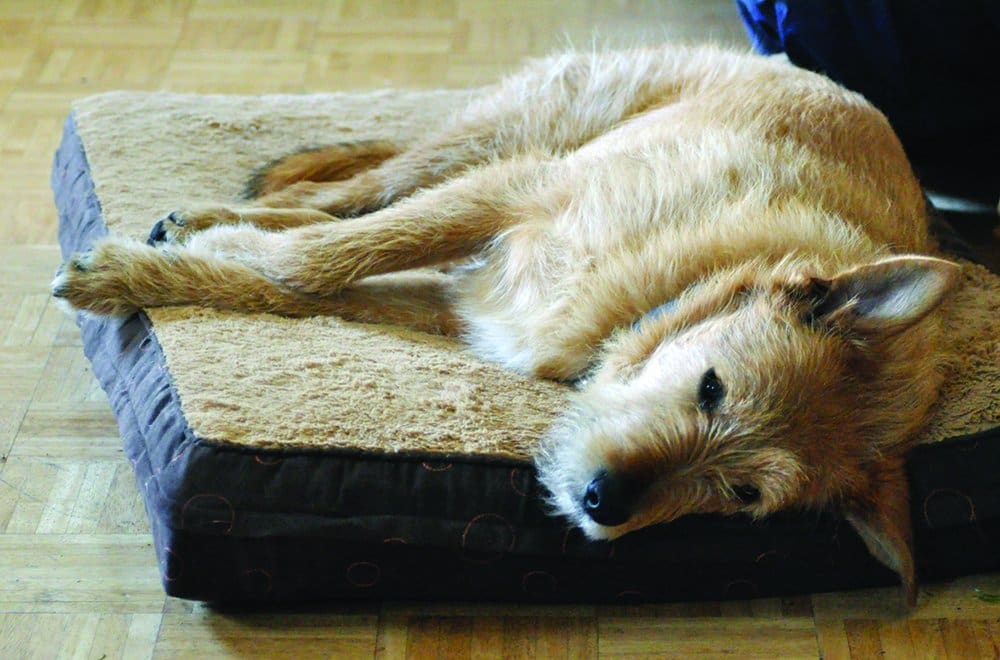
6:00 am – The alarm goes off. Time to hop out of bed (or crawl, depending on my mood) to clean stalls and feed horses. As I stumble to the bathroom I pass Dubhy, our Scottish Terrier, lying on his foam pad by our bed. I give him a warm “Good morning Dubhy!” as I stoop to run my hands over his wiry coat, pet his furry face, scratch his ear, and rub his tummy when he rolls belly up for more attention.
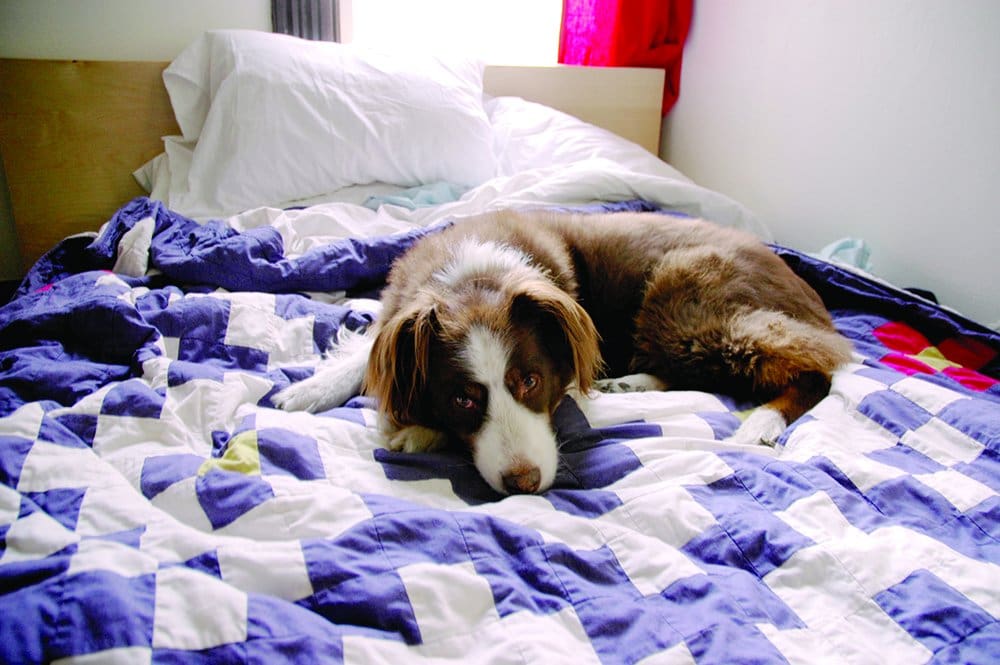
6:10 am – I’m sitting on the bed, putting on my socks, and Missy, our Australian Shepherd, wanders over and sits with a beguiling look on her face. “Hi Miss Miss,” I say as I scratch her behind the ear.
6:20 am – Dressed and ready to hit the manure fork, I greet Bonnie (Scottie/Corgi mix) and Lucy (Cardigan Corgi) as I let them out of their crates and we head down the stairs to the landing. There we pause while I trade Bonnie a treat for Paul’s (husband) sock that she nabbed on her way out of the bedroom. “Bonnie, give. Yes!” and treat.
6:20 am – Now we play the “wait!” game on the stair landing while I descend to the bottom of the stairs, occasionally returning to the landing to award treats for good “wait” behavior. (This ritual is to save me from becoming entangled with 16 happy dog legs as we all troop down the stairs.)
Finally I reach the bottom of the staircase and invite them all to come down. Major reinforcement for the “wait” behavior: we’re all headed for the barn!
6:25 am – Similar rituals happen at the back door as Lucy and Missy sit and wait to be let out, and Dubhy and Bonnie sit to be leashed and go out with me.
6:30-8:00 am – Tons of bonding moments, as Paul and I do barn chores. Some of the highlights:
•We kick and throw a ball endlessly for Lucy to chase and fetch.
•Dubhy gets to ride in the empty wheelbarrow (his favorite thing) on return trips from the manure pile.
•Bonnie and Dubhy get treats for waiting quietly while shut in the hay room, hanging out on the hay stack, while we move horses in and out.
•All four dogs park themselves outside a boarder’s stall waiting for us to bring out her food bucket – this horse always leaves a little grain in her bowl and the dog’s delight in cleaning up the bits of molasses-flavored grain when we dump the bucket out on the barn floor.

288
•Paul kneels and calls Lucy when he returns from feeding horses across the road. Lucy, delighted to see him, charges up the barn aisle and throws herself into his lap.
•I play the trade game with Bonnie again. This time she gets a chunk of dried beef liver in exchange for the fledgling sparrow she’s retrieved from the indoor arena. The unharmed baby bird is stashed in a box until we’re done with chores, at which time he’ll be released to the care of his anxious parents.
•Paul loads water buckets into the wheelbarrow to dump them in the indoor arena. Lucy follows at his heels, eager to play one of her favorite games – “chase the water” as it flies through the air and splashes on the arena surface.
•Missy runs up to me with a sparkle in her eye, inviting me to take a break from sweeping the barn aisle to play “puppy rush” with her. I’m happy to oblige.
•Finally, done with chores, we troop to the tack room for another “wait at the door ritual” and head for the house. I won’t bore you with a moment-by-moment rendition of the rest of the day, but here are a few more highlights:
•Feeding time is happy time! Lucy gets a treat for “woo-wooing” instead of barking as she waits for her meal. Everyone does a sit/wait for food bowl delivery.
•Lunch time. I eat on the back deck and play with the dogs – tossing a disc toy for Lucy to retrieve while playing a “down/wait” game with Bonnie to prevent her from spoiling Lucy’s fun (otherwise she’ll try to play tug with Lucy’s disc toy). Missy and Dubhy get random treats and massage.
•Private client with a reactive dog. Lucy, Missy, and Bonnie get to take turns playing “neutral” dog for counter-conditioning and desensitization practice. They love this game; they get lots of treats, too. Dubhy doesn’t get to play; he has his own dog-reactive issues!
•Hike the farm – a favorite for all of us. Lucy, Missy, and Bonnie get to run off-leash. Lucy and Missy stay close. Bonnie ranges farther afield but checks in regularly for family recall games. Dubhy, on a 40-foot long line, plays recall games in between checking out gopher holes.
•Evenings in the living room. Bonnie and Dubhy cuddle with me on the sofa while I type on my laptop. Lucy, at my feet or on the sofa, gets counter-conditioning treats when a cat enters the living room, or if a dog barks on television. All four cluster around Paul’s recliner when he opens a box of pretzels; they know pretzel pieces will come flying their way. When the pretzels are gone, Lucy claims her favorite spot and falls asleep cuddled in Paul’s lap on his recliner.
•Go to bed. Bonnie and Lucy fly up the stairs to their crates when they hear this bedtime cue. Dubhy waits on the landing for an extra bedtime cookie, and Missy follows at my heels up the stairs to bed.
I give Lucy bedtime treats in her crate, then trade Bonnie treats for the sock she’s taken to bed in hers. Missy gets a last scratch behind the ear along with her bedtime cookie. Dubhy hops up his bedsteps onto the bedspread, waiting for us to climb in and give him his bedtime massage, curled between us as we watch the Tonight Show.
Because I work from home, I’m fortunate to have endless opportunities throughout the day to do things that will enhance my relationship with my dogs. Even still, I sometimes feel I don’t do enough. I should hike with my dogs every day – and I don’t. I should groom each of them every day – and I don’t. I should do formal training sessions with each of them every day – and I don’t. But I always have dog cookies in my pockets. You never know when a bonding opportunity might present itself!
Pat Miller, CPDT, is Whole Dog Journal’s Training Editor. Miller lives in Hagerstown, Maryland, site of her Peaceable Paws training center. Pat is also author of The Power of Positive Dog Training; Positive Perspectives: Love Your Dog, Train Your Dog; Positive Perspectives II: Know Your Dog, Train Your Dog, and the brand-new Play with Your Dog.
Guilty Pleasure
Whats your guilty pleasure? Right now, mine is a TV show that I did not have high hopes for: CBSs Greatest American Dog. Its a reality show, sort of, in that the contestants on the show are real people who have been taken out of their ordinary lives and sent to live together in a huge house, with cameras recording much of their days and nights. And its a sort of American Idol contest, with dogs, where the contestants are challenged with various tasks they must get their dogs to complete, and they win various prizes and privileges. A contest at the end of each show is viewed by a panel of three judges, who vote one dog/human pair to be the winner and send one team packing. The ultimate winner of the show, at series end, will win $250,000.
I knew this show was coming to television months ago; a casting agency contacted me and asked if I would audition for one of the judges spots. I couldnt say No, thanks! fast enough or emphatically enough, for several reasons. The first, quite honestly, is that I think Im awful in front of a camera. Secondly, my life is complex enough, and my time in short supply; I couldnt imagine taking on another responsibility.
The third reason? I was scared that the show would be terrible, dogs would be put into stressful situations, and force-based training would be featured.
The show was actually on the air for several weeks before I saw it. My dog-crazy sister Pam was the first to tell me that I had to watch Greatest American Dog. I groaned. Oh boy, I said. Is it awful?
No! she enthused. The people are really diverse, and its interesting to watch how differently they train their dogs and how their dogs respond. And the dogs are adorable!
I was pleased to discover that I could view all of the first episodes, in their entirety, on the CBS website, and I was hooked from the first episode. My sisters review was spot-on. The people and dogs are really different. The show features individuals who are young, middle-aged, and older; athletic and phlegmatic; apparently sane and perhaps a bit unbalanced. (All the dogs, of course, are cute!)
Best of all, from my perspective, most of the training we see is positive. Force-based training does not appear to be a violation of the rules (and thats too bad), but it is criticized by the judges. Even better: its shown in a fairly realistic light. Its apparent that the owners who use the most punitive training have dogs with the most behavior problems, and their relationships are plainly strained. The dogs who get yelled at, or pushed and pulled around, are shown shutting down, tuning out, turning (or running!) away from their owners. Under the challenges and time limits that the show imposes, the pairs with relationship problems just cant perform as well as the competitors who really keep things fun for their dogs. And some of the least-fun owners are getting voted off the show.
I cant vouch for the rest of the season, or say I agree with everything thats allowed on the show. But Ill admit I have to watch Greatest American Dog on Thursday nights, just to see whats going to happen next.
Tug O’ War is a Fun Game to Play With Your Dog
[Updated February 5, 2019]
TUG O’ WAR OVERVIEW
1. Teach your dog and other family members to play tug by the 10 Rules (explained below).
2. Play the game frequently to help get rid of your dog’s excess energy and to teach him self-control and good manners habits.
3. Use your dog’s tug toy to redirect him from inappropriate behaviors and keep his attention on you around distractions and stressors.
Contrary to conventional wisdom in some dog training circles, tug is a great game to play with most dogs – as long as you and your canine pal play by the rules. Lots of my clients have dogs with aggressive, reactive, and other stress-related behaviors. One of the best ways to help reduce stress is to increase exercise. Tug is great exercise.
I’m constantly encouraging my clients to play tug with their dogs. Inevitably when I suggest it I get a puzzled look and a tentative protest that “some trainer” told them playing tug would make their dog dominant and aggressive. I sure wish I could meet that pervasive “some trainer” some day and convince him/her otherwise. It just isn’t so.
Tug has a lot going for it besides just being good exercise. Most dogs love to tug. Of course, the caveat is that you play tug properly – with rules, which I’ll discuss in a minute. Here are some of the many other reasons this game ranks high on my list of approved activities.
Why Tug is Good for Dogs

1. Provides a legal outlet for roughhousing
Often, one or more members of the family want to play inappropriate roughhousing games with Bruiser. Said family members are usually male. Sorry, guys, but it’s true! Of course, not all male humans want to roughhouse inappropriately with the family dog, but chances are if someone is going to, it’s Dad, Junior, or the Boyfriend. If you can get your male family members to compromise on a rousing game of tug, everyone wins.
2. Strengthens bonds between dog and guardian
Dogs love to tug. Humans love to play with dogs. Anytime you and your dog can do something together that you both love, it strengthens the bond that holds you together through think or thin, good times or bad, until death do your part. The four to six million dogs who end up in shelters every year in this country are a stark reminder of how much those bonds need strengthening.
3. Builds healthy relationships
You control access to the tug toy. “Leader” is defined as the one who controls the good stuff. By playing tug and granting your dog access to the tug toy, you remind him that the toy belongs to you, the higher-ranking member of the social hierarchy, and out of the goodness of your benevolent-leader heart, you let him play with it sometimes. It actually teaches him that deference behavior (sitting and waiting) makes the game happen. (So much for the “It will make your dog dominant” myth!)
4. Offers incredibly useful reinforcement potential
While it’s important to play sometimes just for the sake of playing, play can be a valuable reinforcer for training purposes as well. Agility trainers are well aware of this; they usually have a bag full of tug toys they can use to help maintain their dogs’ enthusiasm. They even use tug-leashes! You can also use tug to motivate a dog to do really enthusiastic recalls. My own Cardigan Corgi, Lucy, would much rather stay outside and play when the farm work is done and it’s time to come inside. I used tug games with her favorite Udder Tug toy to convince her that coming inside could be fun, too.
5. Redirects inappropriate use of teeth
Some dogs, especially some puppies and adolescent dogs, just want to bite something. It can be annoying, painful, and life-threatening (the dog’s life) when dogs bite human skin, even in play. In the positive training tradition, you get better results if you redirect undesirable behavior, telling your dog what you want him to do rather than what you don’t want him to do.

When you play tug to redirect inappropriate mouthing behavior you get two benefits for the price of one – in addition to directing the teeth to an appropriate object, you exercise your dog and tire him out – which also makes him less likely to engage in inappropriate mouthing. (Again, so much for the “It will make your dog aggressive” myth.)
6. Teaches dogs self-control
The rules of tug require that your dog sit and wait when you hold up the tug toy. He can only grab for it when you give him permission. If he jumps to grab it prematurely, you say “Oops!” and hide the toy behind your back. This is negative punishment; the dog’s behavior makes a good thing (the opportunity to play tug) go away. Since he doesn’t want the tug game to go away, he learns to control his jump-and-grab impulse in order to make the tug game happen.
7. Creates a useful distraction
When we first got Lucy three years ago, she took delight in tormenting Dubhy, our Scottie, who hikes with me on a long line because his recall is not reliable. The long blue leash snaking through the grass would catch Lucy’s eye, and she’d latch onto it and drag poor Dubhy around. A tug toy, stuck in my back pocket was perfect for redirecting her desire to grab and pull his leash. You can also use a tug toy to keep your dog’s attention focused on you in the presence of general distractions.
8. Modifies behavior
I normally suggest using a high-value treat for the behavior modification process of counter-conditioning and desensitization (CC&D) – giving a dog a new, positive association with a previously aversive stimulus.
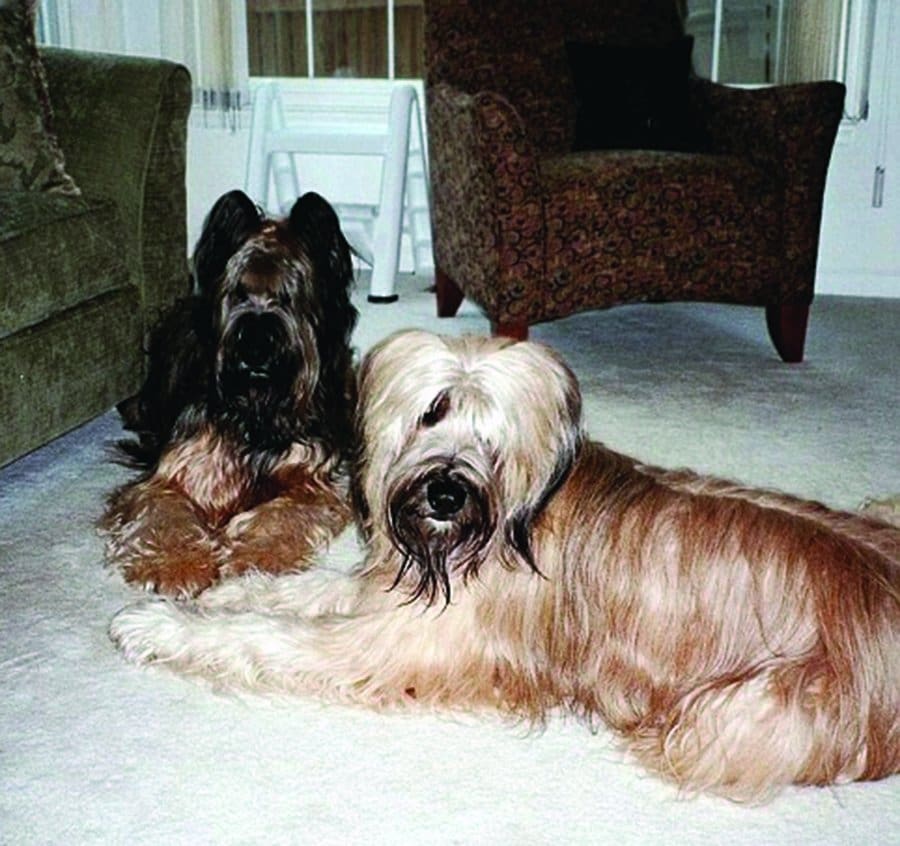
Canned (rinsed and drained) or boiled chicken ranks high on most dogs’ list of favorite treat. I had a client with a dog-reactive Briard, however, who was so overly aroused by the presence of a neighbor’s dog on the next-door back deck that she couldn’t even do CC&D with him in her own backyard; he was too stressed to eat chicken. She discovered that playing a low-key game of tug helped change her dog’s emotional state from anxious to happy, which then allowed her to proceed with the CC&D program using food treats.
9. Builds confidence
You can use tug to help a timid dog become more confident. A dog who lacks confidence may be reluctant to play tug at all, at first. Smear a dab of peanut butter or other tasty-but-gooey treat on the end of the toy, and let him lick it off. Keep doing this until he’s licking eagerly, even nibbling at the toy. When you see him nibbling, gently move the toy a little – not enough to scare him! He should eventually grab onto the toy. You can pull a little – gently! Over time, as he gets braver, he’ll be willing to tug harder, until you can work up to a full-blown game of tug.
Variations on the Tug O’ War
The most common style of tug consists of a dog on one end of the toy, a human on the other. You don’t have to stop there, however. Make or buy a “tease pole” toy for extra exercise benefits: tie a toy on a rope and attach it firmly to the end of a sturdy pole, then swing it around at dog-level to encourage your dog to chase it. When he catches it you can play tug, then ask him to “Give” and play chase again.
If you have two compatible dogs who love to tug you can give them each one end of a toy and let them go at it with each other. The key word here is compatible. Because tug does create a certain level of arousal, dogs who are prone to getting into fights should not be encouraged to tug together. Don’t equate growling and snarling with fights, however – a lot of healthy noise often results when compatible dogs play tug together.
If you have two dogs who can tug together, try a threesome! Find a tug toy with one handle for the human and two ends for the dogs. Tug: a game the whole family can play!
At the other end of the spectrum, you can teach your dog to play tug by himself.
Run a rope through a Kong and knot it so the knot is inside the Kong. Stuff the Kong and tie the rope to something so that your dog can tire himself out by tugging at the Kong. Of course, you lose the relationship value of tug with this variation of the game, but you might increase the exercise benefits!
Tug toys come in all shapes, sizes, colors, and materials, but the best ones have these characteristics in common:
• They are long enough that your dog’s teeth stay far away from your hand. I like toys that are at least 12-24 inches in length for teaching tug (the longer the better). Once your dog knows the rules, you can graduate to shorter toys. For some training purposes, a small tug toy you can stuff in a pocket is ideal.
• They are made of a substance that invites your dog to grab and hold, and won’t easily cause damage to teeth and gums. Braided rope and fleece toys work well, as does rubber. Stay away from wood, hard plastic, or metal.

• They are sturdy enough to withstand significant abuse. Fleece may not do quite as well in this department, especially if you have a very vigorous tugger, but could be perfect for the lightweights. Remember, you’ll put the toy away when you are done tugging, so it doesn’t have to stand up to rough chewing, just tugging.
• The “human end” has a comfortable handle or is otherwise easy to maintain a grip on. This allows you to win most of the time – an important tug rule. If it’s hard to hold onto the toy, your dog will more easily yank it out of your hands.
• They provide good value for their cost. You should be able to find a good sturdy tug toy in the $5 to $25 range, depending on your dog’s size and how energetically he tugs.
The 10 Rules of Tug
There are really only two good reasons not to play tug with your dog: 1) If either you or your dog has some kind of medical condition that rules out this kind of vigorous play (and then you still might be able to play low-key tug) or 2) if you have one of those very rare dogs who just can’t seem to learn to play by the rules, and insists on putting his mouth on you despite your best efforts to teach him otherwise. Barring those, the game is on, with the following rules:
1. Use a toy that is long enough to keep dog teeth far away from your hands, and that is comfortable for you to hold when he pulls.
2. Keep the tug toy put away. Bring it out when you want to play tug.
3. Hold up the toy. If he lunges for it say “Oops” and quickly hide it behind your back. It’s your toy – he can only grab it when you give him permission.
4. When he’ll remain sitting as you offer the toy, tell him to “Take it!” and encourage him to grab and pull. If he’s reluctant, be gentle until he learns the game. If he’s enthusiastic, go for it!
5. Randomly throughout tug-play, ask him to “Give” and have him relinquish the toy to you. If necessary, trade him for a yummy treat. After he gives it to you, you can play again (see steps 2 and 3). You should “win” most of the time – that is, you end up with possession of the toy, not your dog.
6. If, while you are playing, your dog’s teeth creep up the toy beyond a marked or imaginary line, say “Oops! Too bad” in a cheerful voice, have him give you the toy, and put it away briefly. (You can get it out and play again after 15 seconds or so.)
7. If your dog’s teeth touch your clothing or skin, say “Oops! Too bad” and put the toy away for a minute.
8. Children should not play tug with your dog unless and until you are confident they can play by the rules. If you do allow children to play tug with your dog, always directly supervise the game.
9. Only tug side-to-side, not up-and-down (up-and-down can cause injury to your dog’s spine), and temper the vigor of your play to the size and age of your dog. You can play tug more intensely with a 120-pound adult Rottweiler than you can with a Rottie puppy, or a four-pound Chihuahua.
10. When you are done playing, put the toy away until next time. You control the good stuff.
Happy tugging!
Pat Miller is Whole Dog Journal’s Training Editor. She is the author of The Power of Positive Dog Training; Positive Perspectives: Love Your Dog, Train Your Dog; Positive Perspectives II: Know Your Dog, Train Your Dog, and the brand-new Play with Your Dog.
Pet Food Politics
Were you one of the millions of concerned dog owners who struggled to follow and make sense of the pet food recalls last year? If so (and what dog owner wasn’t), I predict that you’ll find Pet Food Politics: The Chihuahua in the Coal Mine to be the most riveting book you’ll read this year. Just released by the University of California Press, Pet Food Politics provides an in-depth look at the record-setting (and not in a good way) pet food recalls in 2007.
Pet Food Politics is authored by Marion Nestle, PhD, an expert in human nutrition and the food industry. Dr. Nestle (rhymes with pestle, not like the chocolate company) is the Paulette Goddard Professor in Nutrition, Food Studies and Public Health (an endowed professorship) at New York University, where she was the department chair from 1988 to 2003.
Nestle also holds appointments as Professor of Sociology in NYU’s College of Arts and Sciences and as a Visiting Professor of Nutritional Sciences in the College of Agriculture at Cornell University. Her degrees include a PhD in molecular biology and an MPH in public health nutrition, both from the University of California, Berkeley.

288
Dr. Nestle’s credentials in the human food industry transcend academia. She has served as senior nutrition policy advisor in the Department of Health and Human Services and as a member of the FDA Food Advisory Committee and Science Board. In 2004, she was awarded the American Public Health Association’s David P. Rall Award for Advocacy in Public Health for her work to shed light on the impact food and nutrition policies have on the nation’s health.
She is also author of a number of highly acclaimed books on food and the food industry, including Food Politics: How the Food Industry Influences Nutrition and Health (2002, second edition 2007, both from University of California Press); Safe Food: Bacteria, Biotechnology, and Bioterrorism (2003, University of California Press); and What to Eat: An Aisle-by-Aisle Guide to Savvy Food Choices and Good Eating (2006, North Point Press).
Why is this sort of human food expert poking her nose into pet food?
Dr. Nestle says that she was aware that she skipped past the pet food section of the grocery store, so to speak, when she wrote What to Eat, which was otherwise (as the subtitle describes) an aisle-by aisle guide to making food choices in supermarkets. Given that her life partner, Malden Nesheim, PhD, is a retired expert in human and animal nutrition, that omission must have been glaring.
With her work on What to Eat completed, Dr. Nestle cooked up the idea of doing a dog and cat version of the book with Dr. Nesheim. In February 2007, they signed a contract to co-author What Pets Eat for Harcourt – to the puzzlement and dismay, Nestle says, of many of their colleagues in human nutrition; why on earth would they bother with pet nutrition? Who cares?
When the pet food recall starting hitting the headlines the following month, their colleagues’ disapproval melted into wonderment at the couple’s prescience. Because, as it turns out, just about everyone with a dog or cat cares about dog and cat food – especially when some of it turns out to be deadly.
Dr. Nesheim and Dr. Nestle outlined the topics that they wanted to cover in What Pets Eat and divided up the research and writing work. One of Dr. Nestle’s responsibilities was a small appendix, envisioned as 10 or so pages that would appear in the back of the book, discussing the recalls of spring 2007. Her research about the pet food disaster grew in complexity and scope, along with her fascination for the story. Eventually the topic expanded into a chapter, and then took on a life of its own.
The result is Pet Food Politics, a separate book that actually got finished in advance of What Pets Eat – largely due to Dr. Nestle’s insatiable appetite for more information about the dramatic event. “Every question I had led to more questions,” she laughs. “And none of my experience with human food recalls prepared me for how this recall was handled – by the companies involved, government regulators, the media, and the public.”
Genesis of the book
I first met Drs. Nestle and Nesheim at Global Pet Expo – the world’s largest annual pet industry trade show – in February 2008. They were still deep into the research for What Pets Eat (which is due out from Harcourt late in 2009). I can’t tell you how much I enjoyed witnessing their immediate response to their first (and very overwhelming) experience with a pet industry trade show.
Held in San Diego’s enormous convention center, the 2008 installment of Global Pet featured almost 800 vendors, in more than 230,000 square feet of exhibitor space. The couple was fascinated, exhausted, and incredulous at the size and scope of the industry. We compared notes about the companies that were promoting pet food, treats, and chews, and as they shared their observations with me, I began to get a sense that their upcoming books were going to be quite revelatory.
This summer, I was thrilled to receive an advance copy of Pet Food Politics from its publisher, the University of California Press. A publicist for the book asked me if I would read it and perhaps contribute a blurb for its cover. After reading the first chapter, I sent Dr. Nestle an e-mail asking when I could schedule an interview with her to promote the book, because it is great.
Pet Food Politics not only delivers the most complete account of the 2007 wheat gluten/Menu Foods/Chinese ingredient recalls that pet owners will ever get, but also provides critical background information about each of the involved parties and the industry as a whole.
Dr. Nestle presents a detailed timeline of events – including all of the developments we read about in the newspapers, and many that we didn’t – and then analyzes the response of each of the players at each juncture. If you still have questions about the recall, you’re sure to find the answers in Pet Food Politics. And, if the title hasn’t already tipped you off, the book provides a fascinating look at the wider context of the tragic event. All the potential disadvantages and dangers of a globalized food supply were highlighted during the event.
Interview with Marion Nestle
I spoke with Dr. Nestle just before the publication of Pet Food Politics.
Nancy Kerns, Whole Dog Journal: Hello, Dr. Nestle. The first thing I want to say is thanks so much for writing this book! It’s a fascinating read, and full of new information, even for someone who really followed the story at the time. What sparked your interest in the recall?
Marion Nestle: Pet Food Politics was meant to be an appendix to What Pets Eat, a bigger book about the entire pet food industry that Mal Nesheim and I are writing. I was going to write a 10-page summary of the events around the recalls – and then I got caught up in it; it’s such a fascinating story and I could not believe how difficult it was to figure out what on earth was going on.
I was late getting to the story. When the recall happened, I was on a book tour for the paperback edition of What to Eat, and I couldn’t do the kind of tracking that I usually do when some food crisis happens that I’m really interested in. I was all over the country, and barely able to keep up with the travel, so most of what I knew about it was from USA Today. The USA Today reporters, by the way, did a fantastic job with the story.
When I finally sat down to work on what I thought would be an appendix, it was July 2007; the first recall happened in March. Our research assistant had prepared a timeline of the events for someone else, and I asked her for her sources, because it didn’t make sense in a lot of ways. One of the questions I had right away was, “Why did it take Menu Foods so long to issue the recall?” I was so curious about that; it seemed to me a rather long wait, and I couldn’t understand why.

Photo by Larry Cohen
288
In trying to sort out the timeline, I went to the PetConnection.com blog about the recall, starting from the most recent posts and working my way back. I spent several days doing that, just reading the day-to-day posts on the events. I couldn’t believe how much information they had there – newspaper clippings, FDA hearings, other blog posts – just an amazing accomplishment.
Whole Dog Journal: You must have felt like you fell down a rabbit hole . . .
MN: Yes and no. The fact of a food recall is one thing. But there were so many holes in the story that was publicly available! The story of melamine, for example. From the press accounts, it seemed as if no one could possibly imagine what melamine might be doing in pet food – or whether it could be responsible for the effects in dogs and cats that had been seen.
Whole Dog Journal: How were you were able to come up with so much information about melamine and cyanuric acid?
MN: I was able to write about the toxicity and use of melamine and cyanuric acid, thanks to my ability to read – and I’m being only a little sarcastic.
One of the things I came across on the PetConnection blog was an abstract from the Journal of the American Veterinary Medical Association (JAVMA), referring to a study on melamine that had been done in the 1960s. I’m trained in research, and one of the first things you learn when you do research is never to believe what you read in an abstract of a study, or, for that matter, anyone else’s account of what’s in a paper; you have to read the whole thing yourself. I found the study in the Cornell veterinary medical library; it was about deliberately feeding melamine to sheep and finding out that high doses formed crystals that blocked their kidneys.
Whole Dog Journal: One of the first things Dr. Nesheim said to me when I met you two was that he had access to these amazing research tools that hardly anyone uses: books. In today’s world, everyone looks to the Internet, and if what they are looking for is not there, they assume it doesn’t exist.
MN: In this case, the Internet had the abstract, but the abstract didn’t say why they did the study, and the reason they did the study was absolutely crucial. We read the study, and then all the ones in the references, just like they teach you to do in grad school.
The 1960s investigators knew that melamine contains nitrogen, and they wanted to find out if ruminant animals like sheep could use melamine nitrogen to make protein. That would have been a legitimate use if it had worked, but it killed the sheep. But melamine is a lot cheaper than protein, which is why it was used fraudulently by the Chinese wheat gluten manufacturers.
What was amazing about that old research was that the toxicity of melamine was so well worked out by the 1960s. There were incidents of melamine-contaminated feed – fish food – in the 1970s and 1980s. But nobody was talking about any of this. The FDA commissioned a big toxicology review that didn’t cite those old papers.
We submitted the findings of our literature review as a letter to the editor of JAVMA – as an academic exercise, really. One of our Cornell colleagues took us to task over this. He wrote us a “disappointed” letter saying that the old studies didn’t mean anything, that veterinarians were thoroughly aware of the studies; they just didn’t think they were relevant. Well, Mal and I thought they were relevant. The amounts of melamine that killed sheep in the 1960s weren’t all that different from the amounts in the recalled pet foods.
Whole Dog Journal: From the perspective of an average consumer, the initial message that Menu Foods and the FDA put out seemed to be that we were dealing with “contamination” . . . not fraud. The recall was announced on March 16. According to your timeline, it wasn’t until April 6 that the FDA mentioned the possibility that melamine could be a “deliberate adulterant.”
MN: Mal is an animal nutritionist. As soon as we heard that melamine was in the foods, we looked up its structure and saw how much nitrogen it contained. He knew right away that it must have been put there deliberately. Part of it was because he’s of a certain age; we’re really old! (Laughs). He remembers the old days when animal feed was routinely adulterated.
Whole Dog Journal: I have to admit, it makes me angry and frustrated to learn that any animal nutritionists “of a certain age” would immediately understand the potential significance of melamine “contamination” – and yet, no pet food industry people would suggest fraud as a possibility; the industry really closed ranks neatly on that possibility. It wasn’t until the New York Times article – “Filler in Animal Feed Is an Open Secret in China” – came out on April 30 that this was openly discussed.
MN: I’m with you. But perhaps I’m more suspicious than most. I wrote a book about the human food industry, called Food Politics, where I looked at how food corporations influence food choices. They don’t just advertise. They also lobby federal agencies and Congress, and do everything they can to convince food and nutrition professionals never to suggest that people would be healthier if they didn’t eat so much.

288
Whole Dog Journal: Given your experience with human food companies and government, was the response to this recall different from what you would have expected if something similar had happened to a human food company?
MN: Yes! First, the FDA didn’t really get involved in this in a serious way until they thought there was a potential threat to the human food supply. My initial impression from both government and industry was that they viewed the problem as “just pets.” The pet food companies should have known better. I can’t think of anything more inflammatory to anyone who owns a dog or cat than the expression “just pets.”
The FDA eventually realized that if melamine was in pet food, it could also be in the human food supply. And then, of course, it was. Who knew that surplus pet food was fed to pigs and chickens, or that wheat gluten is in fish food. That was one of the many surprises. The others? One company made more than 100 brands of pet food, from the cheapest to the most expensive. Pet food companies had no idea where their ingredients came from. Lots of the ingredients came from China. And nobody was minding the store.
Whole Dog Journal: Not to brag, but Whole Dog Journal’s readers knew about co-packers. Although the size of that particular co-packer was a surprise even to me.
MN: The scale! One of the things I have in this book is a list of the brands that were involved – not even all the lines made by each brand, just the list of brands – it’s a very long list.
Whole Dog Journal: In terms of the companies involved: What would you have expected if this sort of thing had happened to a human food company?
MN: Forgive me, but some of the companies that were involved are human food companies! We’re talking about Procter & Gamble here! [Editor’s note: Procter & Gamble makes Iams and Eukanuba, which were among the brands of foods that were recalled.]
These companies know exactly what they are supposed to do! They’ve heard food safety experts talk. They know about recalls. You document everything, you immediately go public with everything that you’ve got, you take your licks, and you move on. And the quicker you come clean, the better it goes. This one dragged on forever. From March 16 to the end of May, notices about affected products were still dribbling in. What were people who needed to buy food for their pets supposed to do? And didn’t anyone care? It didn’t look like it to me.
Whole Dog Journal: So what sort of conclusions have you drawn about the pet food industry as a whole?
MN: They have a lot of growing up to do. They have to take what they are doing much more seriously. This is a $17 billion a year industry, soon to be a $20 billion a year industry. This is big.
But I think that the corporate giants see pet food as a relatively small money generator. The pet food divisions are extremely profitable, but they represent just a few percent of the companies’ total revenue. Our next book, What Pets Eat, discusses this issue much further. The level of profit for these pet food giants is hefty. The ingredients are relatively cheap; by-products are waste products and don’t cost much. The companies can package pet foods and market them in all the fancy ways they add value, and make a very nice profit on them.
The other conclusions have to do with the Chihuahua part – the early warning about deep problems with FDA regulation and food trade, especially with developing countries. We’ve already seen that with the recent heparin poisonings.
What I keep hoping is that some good will come of all of this. At the pet food meetings we went to this year, we heard company after company talking about how they were now paying more attention to what goes into the foods, how they are trying to source ingredients from places they can actually inspect, and how they are sourcing better ingredients. Maybe they are doing this because they learned a lesson, or maybe they are just reading the handwriting on the wall: sales are up on foods with no by-products and with sources identified, and lots of people are doing home cooking. That’s not so good for the pet food business, but it may be just terrific for pets.
Whole Dog Journal: Thanks for your time. We look forward to What Pets Eat next year!
Download the Full August 2008 Issue PDF
Join Whole Dog Journal
Already a member?
Click Here to Sign In | Forgot your password? | Activate Web AccessTeaching Your Dog to “Leave It” On Cue
[Updated August 9, 2017]
There’s nothing like a steaming-fresh pile of moist, warm horse manure to convince a dog owner of the vast difference between canine and human sensibilities – or of the great value of a reliable “Leave it!” cue. Since my husband and I share our lives with four dogs and 15-some equines, you can imagine that “Leave it!” is an important entry in our dogs’ lexicon.
You don’t have to live on a horse farm to appreciate the value of “Leave it.” A kitty-litter box can be just as tempting as a stall full of horse “apples.” The “Leave it” behavior, defined as “look away from whatever you’re looking at or coveting at this moment,” is useful in an almost infinite number of possible canine encounters:
• You drop your high-blood pressure pill on the floor. “Leave it! Good dog!”
• Your two-year-old child toddles past with a melting ice cream cone in his hand at canine nose level. “Leave it! Good dog!”
• You see your Irish Wolfhound studying the holiday turkey on the kitchen counter at canine eye-level. “Leave it! Good dog!”
• Your adolescent Labrador Retriever is preparing to offer an enthusiastic greeting to your elderly Aunt Maude who is approaching up the front walkway with the assistance of her wheeled walker. “Leave it! Good dog!”

• Your cat-chasing Jack Russell Terrier spots a black-and-white “kitty” (think skunk) trundling across your backyard at dawn when you let him out to potty as you’re rushing to get to a critically important meeting on time. “Leave it! Very good dog!” You just saved your job!
• You’re walking your dog in the park and spot a half-dozen suspicious-looking balls of raw hamburger at the same instant your dog does. “Leave it! Very very good dog!” You just saved your dog’s life; the hamburger was laced with strychnine.
I could go on, but I’m sure you get the picture. A cue that can divert your dog’s intention to chase, greet, or eat someone or something is a life-saving, sanity-saving, versatile, mandatory part of every well-mannered canine companion’s behavior repertoire. So how do you go about helping your dog acquire this vital skill? It’s easier than you might think.
Training a Dog to Leave It: Step 1
The foundation “Leave it” behavior is so important – and so simple – that we teach it in our Puppy and Adult Basic Good Manners classes. We introduce it in Week 4, and it’s an exceedingly rare dog who doesn’t perform it to near-perfect on graduation night just three weeks later. Here’s how it works:
Show your dog a high-value “forbidden object” – something you’re going to tell him he can’t have. I like to use freeze-dried liver cubes for this – they are high value and durable. (You’ll see why durability is important in just a minute). Let him sniff it, lick it, even nibble at it, but don’t let him have it.
Now say “Leave it!” as you hold up the cube, then immediately place it on the floor under your foot, to protect it. Note: Be sure to wear sturdy shoes. Do not do this exercise barefooted, with open sandals, or in your Sunday-best patent leathers.
Let your dog sniff, lick, and nibble at the treat under your foot. He might even chew at it. If his tongue can reach the cube under your shoe, tip your toe forward so he can’t actually lick it. You don’t want him getting reinforced even by a tiny taste, if you can help it.

Now just wait. Don’t repeat the cue; he will eventually give up. I promise. The split second he stops sniffing, licking, etc. or looks away, even if it is by accident, “mark” the moment by clicking your clicker or saying “Yes!” and give him a tasty treat. He’ll probably return his attention to the forbidden object under your foot after the click and treat, so just wait some more. Don’t repeat the cue. (See why below.) When he looks away again, click and treat again.
If you can, give him another click and treat before his nose returns to your foot. You want to reinforce the behavior of “look away, look away, look away, keep looking away” as much as possible; you’re not looking to create a behavior chain of “look at foot, look away, look at foot, look away (although you will get some of this, at least at first). After several repetitions, pick the cube up from under your foot, show it to him again, now repeat the “Leave it” cue, and place it under your foot again.
When he looks away from the inaccessible cube easily, you’re ready for the next step. Move your foot away slightly to uncover the treat and give repeated clicks and treats as long as his nose doesn’t return to the treat. This communicates to him that he gets rewarded for staying away from the cube, even when it’s visible and seemingly accessible. Keep your foot close! You may want to just keep your heel in place and pivot your toe away from the treat at first. If your dog dives for the food, just re-cover it with your toe to prevent him from getting it. Click (and treat) again when he looks away.
If your dog appears to have completely forgotten that the forbidden object is on the ground, every once in a while you can tap your toe next to it to draw his attention back, but be ready to cover it up quickly! Remember, he doesn’t have to look back at the cube and then look away – you want continuous “look away” behavior.
Eventually you will see your dog’s “Aha!” moment – that golden moment in training when you get to see your dog really understand what you’re asking him to do. With “Leave it” that golden moment happens when he looks at the exposed cube, considers it for a moment, and then looks up at you in anticipation of his click and treat. Celebrate!
Don’t Repeat the Cue!
It is almost irresistibly compelling to repeat the cue when your dog makes a move for that liver cube. It’s hard to resist the normal human automatic reaction to tell the dog what to do even when you know your dog doesn’t yet understand what the words mean. We are a verbal species; our dogs are not.
When you cover the cube with your foot rather than repeating the cue, you’re speaking your dog’s language – using body language to communicate to your dog that the cube belongs to you, and he can’t have it. In fact, the reason this exercise works so well is that when you cover the forbidden object with your foot, you’re resource-guarding. Now that’s a behavior your dog understands – dogs do it all the time!
You also want your dog to understand that once you’ve said “Leave it” you mean “leave it forever.” You don’t want to have to keep reminding him.
Imagine you’re having a cocktail party. You carry your tray of hors d’oeurves into the living room, and as you bend down to place them on the coffee table, you tell your dog to “Leave it!” You don’t want to spend the rest of the evening guarding the goodies; you want your dog to leave them alone for the duration of the party.
ln order to accomplish that desirable end, don’t repeat the cue. Use your foot to protect that liver cube, or body block to send the resource-guarding message. Show your dog with your body language that the cube belongs to you; resist the temptation to tell him. Then when you’re done practicing, pick the cube up and put it away for the next training session, or feed it to him in a different location. Don’t make the mistake of telling him he can have it. Remember, “Leave it” – one cue – means “Ieave it forever.”
Training a Dog to Leave It: Step 2
When you can routinely place the forbidden object on the floor without your dog trying to get it, without having to cover it with your foot, you’re ready for step two – the “Leave it/Drop.” This step starts to approximate some real-life applications of “Leave it.” For example, the situation described in example #1 above, where you drop your medication – or perhaps a piece of chocolate candy (chocolate can be deadly to dogs).

Warm up your dog’s “Leave it” as described above. When he’s easily leaving the cube, stand facing him with the cube in your hand, say “Leave it!” and drop it slightly behind you and slightly off to one side.
Whoops, be careful! A poorly placed drop and the cube can take a bad bounce, landing directly under your dog’s eager jaws. Err on the side of caution, especially at first. Behind, and slightly off to one side. If your dog moves to grab the cube, body block by stepping in front of the dropped object or by covering it with your foot. Don’t yell “Leave it!” or make any other aversive noise. Just protect the object so your dog can’t get it, wait for him to look away from it, and then click and treat.
Now pick the cube up and try again, using your calm “Leave it!” cue with each drop repetition, until you can give the cue and drop the cube without having to make any protective maneuvers. Practice this until your dog will do “Leave it/Drop” without any prior warm-ups. Remember to click and treat each time your dog leaves the forbidden object alone, and to click and treat several times to extend the duration of his leave-it behavior. Now you’re ready for step three.
Training a Dog to Leave It: Step 3
How often do you have the chance to say “Leave it” before you accidentally drop your box of chocolates on the floor? Not too often, I’ll wager. To more closely approximate real life, you need to make one more adjustment to the “Leave it” exercise: the “Drop/Leave it.”
Warm up with several of your step two “Leave it/drop” repetitions. Now switch the order: drop the cube and say “Leave it” immediately after it hits the floor. Again, start with strategically placed drops so you can body block if necessary. In fairly short order you should be able to drop the cube in random locations, followed by a well-timed “Leave it” cue. Practice until your dog will leave it for you after the drop, even on “cold” trials.
Now you can generalize “Leave it” to more real-life situations.
The Generalized “Leave It”
It’s best to start generalization work with your dog on a leash. You’re going to be doing set-ups with forbidden objects that you won’t be able to cover with your foot, so you’ll need your leash to restrain your dog so he can’t help himself to the objects.
On a surface such as an asphalt or concrete driveway, or hardwood or tile floor, set up a “temptation alley” – a line of moderate- to high-value objects. Place the items in a line, five to 10 feet apart. Then approach the first item with your dog on his leash, far enough from the line that your dog can’t reach the objects.

When your dog notices the first item in the line, say “Leave it!” in a cheerful tone of voice, and stop moving. Restrain your dog so he can’t grab the object. You should be far enough from the line that you don’t have to jerk him back to keep him from getting it. Like you did with the liver cube under your foot, just wait for him to give up and look away from the object. The instant he looks away, click and treat, then move forward. If he pulls toward the object when you move forward, stop, give another “Leave it!” cue, and wait until you can click him again for looking away. If he doesn’t look at the object as you move forward, continue to click and treat him for good leash walking, until he notices the next object.
Repeat the exercise with that object. Continue on until you can pass the whole line of tempting items, and he will respond to your “Leave it” cue without ever putting any tension on the leash.
Your goal is to get your dog to reliably respond to the “Leave it!” cue on cold trials (first time you present a new forbidden object) without putting any tension on the leash. When he’ll do that, he’s ready to try it off leash!
Now look for random real-life opportunities to try out his new skill, on-leash or off. Remember to keep your cue cheerful; you’re just giving your dog information (“Look away from that object for an opportunity to be reinforced”). You’re not trying to intimidate him away from the object. If you see any lapses in his real-life random trial “Leave it” responses, schedule more on-leash set-up training sessions. If his training carries over successfully to real life, the two of you have earned another celebration!
With 15 horses on our farm, each producing approximately 35 pounds of poop per day; random groundhogs, deer, toads, and baby birds outdoors; three chaseable indoor-only cats, and a variety of dropped items and other “forbidden object” occasions around the house, “Leave it” is a common household cue for our dogs.
One of my most rewarding stories comes from a client of mine in Tennessee, however, who tells of his dog finding poison meatballs in his own backyard, immediately returning to his owner’s side when cued to “Leave it.” His dog’s prompt response even when tempted by the tasty but deadly morsels likely saved his life.
Pat Miller, CBCC-KA, CPDT-KA, is Whole Dog Journal’s Training Editor. Miller lives in Hagerstown, Maryland, site of her Peaceable Paws training center. Pat is also author of The Power of Positive Dog Training; Positive Perspectives: Love Your Dog, Train Your Dog; Positive Perspectives II: Know Your Dog, Train Your Dog, and the brand-new Play with Your Dog.
Training Your Dog with Rewarding Treats and Praise
Why should training be fun for the dog? Briefest possible answer? “It’s the law.”
How animals learn is the most-studied phenomenon in the history of psychology and is up there with gravity in terms of its lawfulness.
One of the big ticket principles is that anything one tries to teach a new learner (such as a beginner dog) will get stronger in direct proportion to how many times it is rewarded. And (of perhaps even greater interest) every time the new learner does the behavior and is not rewarded (as in, say, “drilling” the same behavior over and over again) the behavior gets weaker. (Not just “doesn’t get stronger” – gets weaker.) In other words, it’s better to do nothing at all than to drill without rewards.

288
Amazingly, this simple principle has failed to trickle down to people who train dogs. I’m going to lay part of the blame for this client problem at the door of the professionals. How on earth could owners get it right when dog trainers are leading the charge? Dog trainers! Dog trainers are not required to take one undergraduate level course – let alone a semester, let alone a degree – in how animals learn, a relevant topic for those who purport to be experts on changing behavior. This profession can’t get its story straight! The dog-owning public has been sold nonsense for a couple of generations now, even by some of the “good guys” – non-aversive trainers, but incompetent non-aversive trainers.
Dogs do what works for them, period. “Disobedience” has nothing to do with your “relationship,” “status,” how much the dog “respects” you or any other such tripe. I know the idea of determinism (of the genetic or learning variety) is an anathema to our society, but the sooner we grow up and face the lawfulness of behavior, the sooner we will train competently.
So, a question: What person would repeat an action over and over (for example, sit in a chair, get out of the chair, sit in it again, etc.) for nothing – no exercise benefit, nothing the person likes or wants, no “zone” or intrinsic reinforcer (nothing in your body says “ahhh”), and in preference to other things the person might otherwise do with her time? The answer is hardly anyone! But this is the sort of thing people ask their dogs to do all the time!

288
If training isn’t fun for the dog (if there are no pay-offs), there actually isn’t any training, except what’s called “extinction” – the decreased likelihood of the animal doing the behavior. Trainers must keep training fun for the dog.
Anyone can do it
What are some things anyone can do to keep the training fun? Audition the likely reinforcers, especially ones the owner might enjoy furnishing: roughhousing, fetch, tug, chase-me games, massage/scritchies. How neat would it be to find an activity that both participants love! Then come up with creative ways to initiate these right after nice behavior. Stuff a toy up your shirt, and quickly whip it out when your dog does a smart recall. If you come home and your dog sits rather than jumps up, say “Yippee, I’m-a-gonna-get-you!” and play chase chase chase around the house (alternate chaser-chasee, to taste).
One of the engaging things about dogs (and about all relationships) is finding out the little quirks, small things that float the other’s boat. For instance, I have a foster puppy; having him would have been generic hell-on-earth puppy rearing, but I discovered he likes scritchies right there on his chest. He grooms me when I do it, and gets a milky expression. Mutual reinforcement! He also loves it when I pant at him – makes him grin. Delightful! I can haul these cheap activities out when he demonstrates restraint and doesn’t bite my ankle at the usual time, or sits.
I also advise people to teach more tricks. Trainers need to knock it off with their lists of things “all good dogs should know . . .” What a guilt trip! Let the owner set the itinerary. What could get the dog on “Stupid Pet Tricks” on David Letterman or amaze their friends? It’s very reinforcing for owners to have people go “Wow!” at the dog’s trick or make people laugh.
Keeping Dog Training Fun and Playful
Dogs are one of the rare species of animals who play throughout their lifetimes; perhaps it’s one of the reasons we have such strong bonds with dogs, because we too play as grown ups.
Humans and canines appear to be what scientists call “neotenous”: as adults, we retain many of the behavioral traits of juveniles. In most species, play is for the young. Think about it: calves and lambs frisk about and chase each other; but how often do you see adult cows and sheep playing with one another?! Dogs and humans, though, maintain high levels of play even into adulthood.
We are also obsessed with toys, or “object play” in scientific terminology. This is very rare in animals, and I think it’s another reason why we are so bonded to dogs. (Look at how much we love balls! There is more time devoted to baseballs, footballs, tennis balls, basketballs, golf balls, and soccer balls on the evening news than there is to world peace, hunger, politics, and our local government . . . Just listing the different “object” related sports could take up a paragraph. We are truly obsessed with balls – we must be Labradors at heart!)
Of course, there are dogs who don’t exhibit an interest in balls, and I empathize with them. I was one of those kids who wasn’t very sports-minded. When I was forced to play softball in elementary school I used to stand in right field repeating “Please don’t hit the ball to me, please don’t hit the ball to me!” But overall, people (and dogs) like me are the exception and there are an awful lot of people and dogs who are crazy about balls.
So, given that play is something both people and dogs love, surely we should use it frequently as a reinforcement in training. Even though I love food, both personally (!) and for training, I think play is often underutilized as reinforcement. I have seen play be even more successful than food in some cases, and play is such fun for both species that sometimes I think it reinforces both species at the same time. That encourages people to do more training, and what a good thing that is! I’m not alone; many other trainers in search and rescue, scent detection, and bomb detection use play as a reinforcement because it is so highly motivating.
I’ve found play to be helpful in some cases with serious behavior problems, with, for example, dogs who are aggressive with other dogs. If you have a dog-aggressive dog who loves to play, one of the best reinforcements you can use for appropriate behavior around other dogs is play: tug of war or chase the ball, for example. Often, the magic of classical conditioning takes place, and ultimately the dog associates the sight of other dogs with the light-hearted emotions associated with play.
Play for Family Dog Training
However, it’s not just professional dog trainers working with serious behavior problems who should use more play in their training: Play can be a cornerstone of positive-based family dog training. Do you want to teach your dog to not run to the door and jump on a visitor? If he likes toys, teach him to go get a toy when he hears the doorbell. Encourage him to bring it out and show it to everybody. Want your dog to drop something on cue? Teach him “Take it” and “Drop it” when you play tug games.

In addition, trick training is a wonderful way to incorporate a playful demeanor into your dog’s life. We all like to show off our dogs’ tricks, and we don’t seem to take it personally when dogs don’t perform up to our expectations like we do with standard “obedience” signals. Think about it: When we teach our dog tricks, we tend to have a cheerful and fun-loving attitude, but often when we’re training something like lie down, we get stern and serious. “DOWN!” we often say with a low, commanding voice, and if our dog disobeys it is tempting to take it personally.
But when we are training a dog to jump through a hoop, it’s more like, “Jump through the hoop, jump through the hoop! Yay! What a good boy! Aren’t you cute?!” Even if our dog doesn’t do it right, we say “Oh well, it’s just a trick!” Of course, we do need to train our dogs to do some things first time, every time, but it’s much more successful if we make it fun for both the teacher and the student!
It’s easy to do: Make asking a dog to sit the most fun game in the world. “Sit! Yay! GOOD DOG! Here, have a tennis ball!” Intersperse “sit” and “down” with tricks – jump through the hoop or “Aren’t you ashamed of yourself?” (This is one of my favorite tricks. You say “Aren’t you ashamed?” and your dog hides his head under a pillow!) Work on sit and then play tug. Ask for a down, and then throw a toy. You’ll end up with a dog who listens better, instead of tuning in only after the third time he hears the cue: “Sit! Sit! Sit!”
Observation is Critical
A word of warning for a potential pitfall: Don’t confuse your fun with the dog’s fun. In other words, what is enjoyable for you may not be enjoyable to the dog. All dogs are different; they enjoy different things, so you can’t assume that if it’s fun for you, or another one of your dogs, it’s equally fun for every dog.
For example, most dogs love to be petted, but not in every context and not in all ways. Most people like petting their dogs, but some don’t notice that their dogs don’t like being pat-patted on top of the head as reinforcement for coming when called.
Observe your dog carefully; if he backs away from you when you reach to pet him, pay attention! He’s telling you he doesn’t want to be petted – and that if you persist, you are actually punishing the behavior you meant to reward! I’ve seen this scenario repeated literally hundreds (thousands?) of times, when a person calls their dog away from something really tempting – say, for example, another dog who is getting food. The dog leaves a handful of liver, comes back to his owner . . . and the owner happily and enthusiastically pats the dog on the head. The person feels so good and is so happy – “Good dog!” And the dog turns his head away and hates it!
If a dog turns and walks away, that’s invaluable information: he doesn’t like what you did. Even if he just closes his mouth and/or turns his face away, pay attention. That could be your dog telling you, “Um, I really don’t like this.”
Get in the habit of carefully observing your dog’s response to your rewards, but also observe his response to training overall. Does he quickly engage with you any time you initiate a training session? Or does he dodge your gaze and wander off when he hears you call, or sees you gathering your training equipment? If he responds with the latter, you need to rethink your sessions.
Are you training too many times a day? Are your sessions too long? If your dog’s response is anything less than highly enthusiastic, do whatever it takes to make the sessions more enjoyable. If you are training a lot, try reducing your sessions in number and/or length. (In my experience, some motivated trainers tend to overdo it. Try one schedule for three days; then try another schedule for three days. See how the dog does with each.)
Novice trainers more often tend to give up too fast, sometimes before the dog has had a chance to figure out what was expected. Most importantly, ask yourself if you and your dog are having a good time, and if both of you are learning something in the process.
Just Go Play!
There’s so much to talk about on the topic of training, and using play as a part of that – I could go on and on. However, I’d much rather you finished this article, and then go out and play some more with your dog. Let the games begin!
Dog Vaccination Information
Dog vaccinations are something that every dog owner should be educated about, and yet few seem to think about them at all, except to wonder about the need for them after they get a new dog. However, many people base this concern on the vet bill, rather than worries about the potential for side effects in their dogs!
Immunology expert Ronald Schultz, PhD, Diplomate ACVIM (American College of Veterinary Internal Medicine), has spent much of his career studying animal vaccines. Dr. Schultz is professor and chair of the Department of Pathobiological Sciences at the University of Wisconsin-Madison School of Veterinary Medicine, and has more than 40 years’ experience in the field of immunology. His long-time university employment – as opposed to a career in industry – has provided him with a unique position of neutrality from which to observe the dog vaccination industry.

Dr. Schultz is on the American Animal Hospital Association (AAHA) Canine Vaccine Task Force and the American Association of Feline Practitioners (AAFP) Feline Vaccine Task Force; these two organizations provide guidelines to the veterinary industry for canine and feline vaccination programs. Recently, Dr. Schultz was also asked to help develop the canine and feline vaccination guidelines for the World Small Animal Veterinary Medical Association.
Known for his research on the duration of immunity (DOI) of common canine vaccinations through serological (antibody titers) and challenge studies as far back as the 1970s, Dr. Schultz co-published a paper in 1978 in which triennial vaccination was recommended over then-standard annual vaccination. It took 25 years, but in 2003, the American Animal Hospital Association (and the American Veterinary Medical Association) at last supported his thesis that canine “core” vaccines need not be given more often than every three years.
Dr. Ron Schultz was also one of the few canine vaccine experts to point out that the yearly recommendation included on vaccine labels was not based on any scientific studies nor ever scientifically validated!
Most vaccine makers today perform duration of immunity studies in order to ensure the minimum duration of immunity for their products; they have to be able to guarantee that their products convey immunity in most animals for a minimum period. But they lack any sort of incentive to run DOI studies to determine the maximum period of immunity conveyed by their products; indeed, if the products work longer, people will need less of them.
Long studies are astronomically expensive. According to Dr. Schultz, the cost of running a three- to five-year DOI trial involving 20 animals is roughly a half million dollars.
Since the industry won’t do it, dog owners will. Among many other research projects, Dr. Schultz’ current work includes partnering with W. Jean Dodds, DVM, on the privately funded Rabies Challenge Study. This study is testing the hypothesis that current rabies vaccines offer protection of at least five to seven years, if not longer. The study is overseen by a 501(c)(3) non-profit, the Rabies Challenge Fund Charitable Trust, which accepts donations to cover the costs of this important project. (For more information on this worthy project, see the Rabies Challenge Fund.)
Dog Vaccine Basics
Unlike some busy professors and research scientists, Dr. Schultz also frequently makes himself available to the communities who are most interested in his work – in this case, dog and cat enthusiasts.
Earlier this year, I had the honor of arranging for Dr. Schultz to make a presentation to a club I am involved with, the American Bouvier Rescue League in Alpharetta, Georgia. In his talk, Dr. Schultz discussed the pros and cons of types of vaccines (i.e., modified live vaccines [MLV], killed, etc.), the immune response to vaccines, vaccine protocols (core and non-core), risk/benefit assessments, titers, and adverse reactions.
The following are topics Dr. Schultz covered in his talk. I summarized points in his presentation; Dr. Schultz generously offered to proofread my summation for accuracy.
Duration of immunity
Duration of immunity is the length of time an animal is protected from a disease.
Antibody titers
A titer is a measurement of antibody to a specific virus (or other antigen). The antibody is in the liquid portion of blood. With parvo, distemper, and adenovirus titers, the presence of any measurable antibody shows protection in vaccinated dogs older than 16 weeks of age. The positive antibody test result is fairly straightforward; it shows you don’t have to revaccinate for these viruses. A negative antibody test result shows you need to vaccinate or revaccinate.
Using vaccine antibody testing as a means to assess vaccine-induced protection is likely to result in preventing the animal from receiving needless and unwise booster vaccinations.
Serological study, challenge study
A serological study measures the animal’s antibody levels (titer) against a specific virus or agent. In very simple terms, a challenge study is one in which animals are injected or “challenged” with the infectious agent, post-vaccination, and observed for signs of disease.
“Core” vaccines for dogs
Dr. Schultz considers the following vaccines to be the “core” (or basic) vaccines that every dog should receive: canine distemper (CDV), canine parvovirus 2 (CPV-2), canine adenovirus 2 (CAV), and rabies. Core vaccines protect animals from severe, life-threatening diseases that have global distribution.
Puppies should not be vaccinated before five weeks of age because their immune systems are immature, and the presence of maternal antibodies can block the puppy’s immune system from responding appropriately. Ideally, in a nonshelter situation, the first puppy shots (CDV, CPV, CAV) should be given at eight to nine weeks of age. The rest of the series should be administered with a minimum of two weeks between doses, but preferably three to four weeks, to give the immune system time to properly respond. Thus, ideally, the next shots would be at 11 to 12 weeks, followed by the last at 14 to 16 weeks.

A series is necessary because we do not know at what point the maternal antibodies are low enough not to block the puppy’s immune response. Research shows that less than 50 percent of puppies will respond at six weeks; 75 percent at nine weeks; 90 percent at 12 weeks; and by 14 to16 weeks, close to 100 percent will respond. However, a titer can be checked two or more weeks after the last shot in the series to see whether the puppy’s immune system responded in the desired fashion.
After that, recommendations are to “boost” one year later, then vaccinate healthy dogs not more often than every three years thereafter, or better yet, run antibody titers. This, again, is a conservative approach from a veterinary standpoint as Dr. Schultz and other researchers have data showing that after the initial round of vaccines, most dogs will have immunity for life from CDV, CPV, and CAV.
Rabies
The rabies vaccine is the only vaccine mandated by law in most states. The first rabies vaccine should be given no earlier than 12 to 16 weeks of age, or as local law dictates, then again one year later. The three-year vaccine, if accepted by state law, can be administered at that time, and then every three years thereafter. The rabies vaccine should be administered by itself at a later date, in a different area on the dog’s body, from the other three core vaccines. Some states offer exemption policies from the rabies vaccine for dogs who have medical conditions that contraindicate vaccination.
The rabies vaccine is the most reactive virus vaccine, and it is the only core vaccine that requires a minimum DOI study to be approved by the USDA.
Despite a French study that has shown (by challenge) a DOI of five years, and serological studies have shown a DOI of at least seven years, currently, the USDA has approved only studies of just three years’ duration for the rabies vaccine. This is why the Rabies Challenge Fund Study, which will follow the strictly defined federal APHIS/USDA standards for licensing rabies vaccines in concurrent five- and seven-year challenge trials, is so critically important to our dogs’ health.
Annual vaccination
The adage that “if it doesn’t help, it won’t hurt” is not true for vaccines. If a dog were vaccinated (and did not require it), the dog would not respond with a significant increase in antibody titer, but might develop a hypersensitivity to vaccine components (e.g., fetal bovine serum). Furthermore, the dog should not be revaccinated since the vaccine could cause an adverse reaction (hypersensitivity disorder).
In a 1992 paper Dr. Schultz wrote, “Extending the revaccination intervals for canine core vaccines does not place the animal at increased risk to developing vaccine preventable disease, but it does reduce the potential for adverse reactions.” Even the three-year protocol is very conservative, as studies point to the core vaccines having a minimum DOI of seven years or more. This is why running a titer, versus vaccinating even only every three years, is preferable.
Dogs with unknown vaccination histories (rescue or shelter dogs)
For a rescue dog with an unknown vaccine history, the first choice would be to run antibody titers, particularly if it is an older dog. Otherwise, with a healthy dog, Dr. Schultz would recommend vaccinating for parvo, distemper, adenovirus, and rabies. A conservative approach is to give two doses of CPV, CDV, and CAV, three to four weeks apart. However, one dose is considered protective and acceptable in a dog over sixteen weeks of age, according to Schultz’ research.
The rabies vaccine would be administered per state law (typically an initial dose, followed by another one year later, then on a three-year schedule). A dog coming in with a known vaccine history should not immediately be re-vaccinated; use the three-year time frame from the date of the last vaccine, or better yet, run a titer, especially if there is doubt about the validity of the shot records.
Don’t “do it all at once”
In the short-term interest of time and money, dogs are often vaccinated while at the vet clinic for spay/neuter surgery. However, it is best not to do this; the dog may develop a hypersensitivity reaction and vomit, leading to an increased risk of aspiration. Also, anesthetic agents may be immunomodulatory. Whenever possible, vaccinate prior to a surgical visit.
“Non-core” vaccinations
Non-core vaccinations include para-influenza, Bordetella bronchiseptica (kennel cough), Borrelia burgdorferi (Lyme), and leptospirosis. These vaccines should be administered only to dogs whose geographical location, local environment, or lifestyle places them at risk of contracting each of the specific infections.
Interestingly, as opposed to the viral vaccines, immunity from bordetella and lepto vaccines often lasts less than one year because they are bacterial diseases. And neither actually prevents the disease, but rather manages the disease and its severity. Lepto vaccines are the most reactogenic of all the vaccines, even more so than the rabies vaccines.

Coronavirus (CCV) and giardia vaccines are not recommended, as the 2006 AAHA Guidelines note, “Prevalence of clinical cases of confirmed CCV disease does not justify vaccination.”
If vaccinating a puppy with non-core vaccines, in general, with the exception of intranasal bordetella, which can be given with the core vaccines, the viral vaccinations should be given first, and the bacterials should not be mixed.
Need for vaccination
A study of shelter dogs revealed that only 50 percent were vaccinated. To achieve “herd (population) immunity” and prevent epidemic outbreaks, at least 75 percent of the population should be vaccinated. Clearly these diseases still exist in our society, but our desires to protect our dogs both from disease and the dangers of overvaccination do not have to be mutually exclusive. A well thought-out vaccination protocol for our dogs can help us to protect them from disease, yet at the same time, reduce the risk of adverse reactions.
Dr. Schultz notes that if the public could be educated to have pets older than 16 weeks of age vaccinated even once with the core vaccines, this would help immensely with herd immunity. With rabies, one vaccine is better than none in offering protection, but a minimum of two is considered better yet. The CDC notes that “no documented vaccine failures occurred among dogs or cats that had received two [rabies] vaccinations.”
Individual Immunization Decisions
The most important message from Dr. Schultz’ talk is that there is no one vaccine program; vaccine programs must be tailored to the specific needs of each animal. Although there is a tendency to want to treat all dogs the same, the program should be designed for the individual, not the masses. Often, the burden falls on the shoulders of the dog’s guardian to ensure that the pet receives the optimal program that takes into account his age, health, environment, and lifestyle.