
Subscribe

The best in health, wellness, and positive training from America’s leading dog experts

Home Blog Page 260

Positive Dog Training for Hunting Dogs

Retrievers, yes. Pointers, yes. Setters, yes. Spaniels, yes. Curs . . . wait. Curs? Wait a minute. Feists? Plott Hounds? Not so fast! What’s going on here? I thought we were talking “hunting dogs.”

Depending on who you talk to, “hunting dog” means very different things. The only thing in common may very well be that the human end of the leash historically toted a gun in pursuit of some type of “game.” The game in question was not after-dinner parlor entertainment, but the entree on your dinner table. That might be pheasant, duck, or squirrel. Through hundreds of years, the real-life pursuit of food for one’s family has morphed into a competitive sport for people who rely upon Safeway to meet their nutritional needs.
Training Hunting Dogs

288

The diversity of breeds and types of competition is simply mind-boggling, with separate sanctioning organizations, each with its own standards of competition for retrievers, pointers, setters, etc., as well as for coon hounds, curs, and feists. There are many different kinds of hunting (bird dogs, treeing dogs, scent hounds, etc.) and each type of hunting competition has its own unique rules and regulations – and owners who are hunting for ribbons for their walls and bragging rights among friends and competitors.

Hunting is also another sport in which, historically, dogs are usually trained with at least a certain amount of traditional, force-based training methods. It is common practice in all the hunting disciplines to use shock collars and other compulsive training techniques, even on very young puppies.

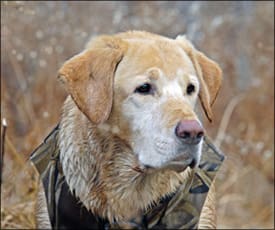
However, there are more and more people in the hunt and field sports who are breaking from tradition and using positive reinforcement in their hunting dog training. I found two Yahoo discussion lists dedicated to positive gun dog training, and met some wonderful proponents of this new approach. You are in for a treat. Meet three pioneers from a small but growing band of people whose quest for ribbons has not trumped their love of their dogs nor their belief in the power of positive reinforcement training.

Inga From: Bringing clickers and gun dogs together
Inga From, CPDT-KA, is a professional trainer and the behavior and training coordinator for the Minnesota Valley Humane Society. In her day job she manages shelter volunteers, runs the shelter’s dog training program, and offers pet education to the public and to shelter staff and volunteers. In 2008 she was the recipient of the Association of Pet Dog Trainers’ Premier Shelter Staff Award.
Training Hunting Dogs

288

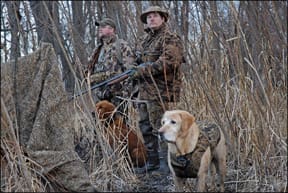
In addition to her day job, she runs a private training business that offers a variety of services and classes, including gun dog training. She is an ex-game warden, and she and her husband hunt waterfowl and upland birds with their yellow Lab (Loki) and Springer Spaniel (Ammo).

From grew up with dogs. Her mother was a groomer and the family had Springers. From started 4-H in grade school and dog training became her favorite hobby. She showed in county, state, and regional fairs in obedience and conformation all through high school. Her father taught her hunting ethics: “I hunt only what I will eat and I will not be wasteful with game or disrespectful to habitat, land owners, or animals.”

From learned how to work with gun dogs from friends during high school. Later, she joined a program called Women in the Outdoors, a division of the National Wild Turkey Federation. All the training was traditional. Then she met her husband Mike, who also had a hunting dog (Loki), but was not comfortable with some conventional, force-based training.

“He listened to the dog and if Loki seemed unhappy, he would change things to fit the situation. He worked Loki in a non-traditional way and was not even aware of it. Loki has been working years in the field and is a very successful retriever without being taught a force fetch. Loki has hunted season after season without the use of an electronic collar. I figured if my husband can do this as a dog owner, why can’t I, a professional dog trainer?”

From’s crusade was about to begin.

She started by clicker training her dog, Ammo, for pet manners. “I knew that he was going to be trained with a clicker for manners so why would I switch training methods on him just because he was going to hunt? I stayed the course with him and his clicker, and he has never known any other way. Ammo has also enjoyed many seasons in the field hunting with Loki, my husband, and me, and he does just fine; we rarely lose any birds.”

From attended a seminar on the East Coast by Jim Barry, and she looked into the United Kingdom Gundog Club, which she heard might fit her philosophy about training and hunting. “I teach positive training and I use clickers. I use the LIMA (least invasive, minimally aversive) principle in all my teaching. Because of the training methods I choose to use, the U.K. gun dog award fits the best for this type of training. All of the current U.S. organizations that test gun dogs are dominated by traditional force-based training.”

From’s clients are supportive. They have not felt welcome at many trials because they don’t use traditional methods. Some have even been told they can’t use clickers. But the U.K. Gundog Club puts a heavy emphasis on obedience training before training for a sport. Also, electronic shock collars are not embraced by British trainers generally, and it is believed that the use of shock collars will be outlawed in the U.K. With such an emphasis on basic training first, From feels that clicker training will have a much better chance in the U.K. program.

From sees a trend from the people who attend her seminars. Instead of being hunters themselves, they have a family dog that they are interested in training for what he or she was bred to do.

“I hope to pioneer this new field of family dog field training; it’s increasing in demand, especially in my state of Minnesota. I had people come to my last seminar from not only Minnesota, but also Iowa, Wisconsin, and Illinois. I am a hunter myself, but train my dogs in a non-traditional method for the gun dog world. People like me are out there, and they want something more than what is now available in the gun dog world.

“It’s not that traditional training does not work with gun dogs; it does. It’s that there are other alternatives that will work just as well in the long run. Why not blaze a new trail and see if anyone will follow? I cannot wait for the day when this type of training is mainstream and there is an organization in the U.S. that supports and expands it. Maybe I’ll have to start my own club for positive-trained gun dogs! I am working on that now, slowly, step by step with Positive Gun Dogs of Minnesota.”

Jim Barry: Writing guides for others
Jim Barry, CPDT-KA, CDBC, is the author of The Ethical Dog Trainer and co-author of Positive Gun Dogs: Clicker Training for Sporting Breeds. In addition to running a private dog training business (Reston Dog Training, in Reston, Virginia), Barry is a senior fellow at the Center for International Development and Conflict Management of the University of Maryland, where he conducts research on international issues and teaches programs in negotiation and crisis leadership.
Training Hunting Dogs

288

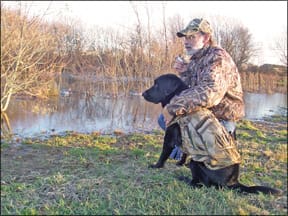
Barry is one of only two people in the U.S. to have been authorized to give awards for field tests sponsored by the U.K. Gundog Club. His entry into the gun dog world came about after he got his black Labrador, Toby. Barry and his wife Vicki planned on doing therapy dog work with their new pup, purchased from a breeder of show/obedience lines. That quickly changed as Toby demonstrated his love of water and a strong retrieving instinct. “I started working on a formal retrieve and one thing led to another,” said Barry.

At the time, Barry was an intern with Carole Peeler, CDBC, CPDT-KA in Falls Church, Virginia. Barry completed all of Peeler’s clicker training classes, and then started looking for a trainer who used clicker training for field work. “I was disappointed to discover that no one in my area taught field work with positive methods,” he says. He joined the Positive Gun Dogs discussion list on Yahoo.com, started reading everything he could get his hands on, talked to experienced gun dog trainers, and then tried applying clicker training to it all. As a result, Toby now has a Working Certificate from the Labrador Retriever Club of the United States. “In a sense, Toby and I were the ‘lab rats’ for this new method of gun dog training.”

Barry met his co-authors on the Yahoo list, and together, they decided the world needed a book about clicker training for gun dogs. Their resulting book was published in 2007. “It seemed like every time a new person joined the Yahoo list, he or she asked, ‘Where’s the book on positive field training?’ There were none at the time, although Helen Phillips in the U.K. later wrote Clicker Gundogs, so we decided to write one. Sue Smith took the lead on the learning theory and basic training chapters, I wrote the retrieving sections, and Mary Emmen did the upland hunting portions.”

The mere thought that dogs could be trained without shock collars, much less with a clicker, was to say the least, novel. And unproven. To have a book published on the subject gave a small, but growing, community of positive trainers the boost they needed. However, Barry is circumspect about the growth of positive training in the sport.

“All dog sports are challenging, but in gun dog training there are three specific issues that stand out. The first is that the tasks are inherently very demanding, both physically and mentally. They may involve working in difficult terrain and nasty weather for long periods of time, searching for game that is hidden in deep cover. Dogs may have to swim long distances, climb banks, and jump fences. And all of this must be done while being attentive to the handler and the goals.

“The second challenge is that much of the work is done at great distance. In higher-level retriever tests, for examples, multiple retrieves at distances of hundreds of yards are not uncommon. Finally, in field work, there are many opportunities for dogs to engage in inherently rewarding behaviors, such as chasing game or following scents that do not coincide with the handler’s desires.

“Because of these complexities, we had to think creatively not only about basic training methods, but also how to organize training and the sequence in which various skills are introduced. We know that you can train a reliable hunting companion without using an electric collar. I’ve done it and so have many others. We also know that you can train pointing dogs to Master Hunter level and, with patience and dedication, retrievers to at least Senior Hunter level.

“Finally, thousands of high-performing gun dogs have been trained in the U.K. and other European countries where e-collars are either banned or rarely used. What we don’t know, and may not know for some time, is whether dogs can be trained to the highest levels in U.S. retriever trials using positive reinforcement exclusively. As noted above, these trials are exceedingly difficult and require training dogs to do things that are in some ways counter-intuitive, such as holding straight lines rather than taking routes that require less energy. Several dedicated people are working on this goal, and time will tell.”

Barry agrees with Inga From that the U.K. Gundog Club is a good fit for training the family dog to be a gun dog. He, too, believes that the emphasis on steadiness and reliability before training hunting skills is a good fit for positive training. This is because training at a skill level that is too advanced for the dog (e.g., long-distance retrieves) often prompts trainers to use aversive methods such as the shock collar.

Barry is both hopeful and realistic about the trend in positive gun dog training. “I think it’s largely a reflection of the general interest in more humane training. However, the growth is slow because there is little overlap between people who hunt and people who are interested in operant conditioning! But the Positive Gun Dogs (Yahoo) list now has some 800 members, up from 300 when I joined, so that’s progress!”

That said, Barry is not overly optimistic about positive training becoming mainstream any time soon. “I believe this is beginning to occur for pointing and versatile breeds. In the U.S. retriever trial world, I believe it will take a very long time. This is both because of the demands of the sport and because there is currently a strongly held belief, fostered by professional field trainers and e-collar manufacturers, that existing training systems are highly effective. Having said that, I also believe that positive training has begun to catch on for recreational hunters and people who want enrichment activities for their family dogs. This is where I see the greatest opportunity for acceptance and growth.”

Training Hunting Dogs

288

Lindsay Ridgeway: Proving it can be done
Lindsay Ridgeway, of Laytonsville, Maryland, is a software designer by day, but some of his proudest moments have come from designing dog training plans and seeing his dogs blossom as a result. Ridgeway is an active proponent of positive gun dog training and is considered by some to be the poster child of the movement toward positive training in the sport. He and his Golden Retrievers, Lumi and Laddie, achieved AKC’s Junior Hunter (JH) and Senior Hunter (SH) titles, with some first-place finishes along the way. They also have been awarded the highest field title (Working Certificate Excellent) from the Golden Retriever Club of America – all without using aversives in training.

It could be argued that Ridgeway’s influence in the sport is a result of two of his hobbies. In the past, he participated in endurance sports, running 14 marathons, and thus has a keen understanding of the mental and physical stamina required to go the distance. His other hobby, which he applies skillfully, is writing about dog training! More than likely, it will be the combination of stamina and writing that will help him pursue personal training goals as well as getting the word out about positive gun dog training.

In 2003, Ridgeway got his first Golden Retriever, Lumi. He discovered clicker training after trying puppy training techniques that he found scary for his pup and detrimental to his relationship with her. He started the DogTrek (Yahoo) list in 2005 to share his experiences.

He competed with Lumi in agility, but retired her from that sport when arthritis made competing and training too difficult. It was then that he began the search for alternatives to conventional gun dog training techniques. In 2007 he brought home Laddie. Three years later he had JH, SH, and GRCA titles on both dogs. How did he do it?

“Like nearly all clicker trainers who come to the sport, I initially found books on traditional field training useless except for their interesting anecdotes, because the stated goal of every exercise seemed to be to teach the dog to accept force, and that was simply not my goal. I reached the same conclusion that clicker trainers attempting field work almost invariably reach: whole new training methods would be needed.”

Ridgeway spent hours reading books and participating in online discussion groups and met two traditional trainers who were willing to share their methods and love of the sport.

“They took me under their wings. They helped me understand that those traditional drills were exactly what my dogs needed; I just needed to subtract the coercion element. As they helped me to understand the procedures, I saw that in most cases, in addition to training the dog to accept force, the drills also taught the dog vital concepts of field work.

“Generations of trainers had discovered not only what concepts the field dog needs to learn, but equally important, in what order those concepts need to be learned. I simply had to train those concepts in new ways, while allowing my dogs to go through the same crucial sequence of learning. The missteps my mentors helped me and my dogs to avoid became as crucial as finding the correct stepping stones to follow,” says Ridgeway.

Key to his success, Ridgeway believes, was his ability to put aside philosophical differences and to learn from those experienced traditional trainers. “Several times a week, I’d watch expert trainers and their dogs perform the skills that Lumi and Laddie were also learning to perform. Yes, I was ‘different’ because of my strange refusal to use ‘corrections,’ and as in any group some of the relationships were smoother than others. But real friendships were forged and became the key to continued progress. Without them, my dogs’ field careers would have ended before they started.”

When asked how he responds to people who say that dogs in this sport simply can’t be trained without shock collars, Ridgeway’s response reflects both his pragmatism and optimism. “I think that it is far more difficult to train without aversive methods in sports that are closely bound to the dog’s breeding traits – sports such as herding, police-dog work, and field work. For the trainers who first attempt such training, progress may be significantly slower than for traditional trainers following a well-established program, and it may even be that generations from now, such methods will still be slower than traditional methods.

“In addition, my dogs have only attained their Senior Hunter titles so far, and it remains to be seen whether more advanced titles are even possible for [dogs trained with positives]. So my answer is: Yes, training without an e-collar makes participation in the sport more challenging than training with one. But Lumi and Laddie, dogs with very different breeding and personalities, have shown that it is possible to train a retriever to advanced titles using [positive] methods.”

Ridgeway has every intention of continuing to train Laddie for other advanced titles. He has a list of training goals and is in the process of designing training plans to attain them. “Unless and until I, or someone else, shows that positive training can accomplish the same goals as traditional tools and methods without significantly more time and effort, I see little incentive for most serious amateurs or professionals to switch to [positive] methods unless they have personal reasons for doing so. On the other hand, the traditional tools and methods for training a retriever have become dramatically more humane over the years, and I suspect that trend may continue. Whether the efforts and achievements of positive trainers, who comprise an infinitesimal fraction of the sport, will have any effect on that trend, I consider doubtful. I think it’s just that as time goes by, traditional trainers discover new tools and methods that are more effective and also happen to be more humane.”

But that doesn’t mean that he isn’t going to do his best to prove that it can be done.

Terry Long, CPDT-KA, is a writer, agility instructor, and behavior counselor in Long Beach, CA. She lives with four dogs and a cat and is addicted to agility and animal behavior. See page 24 for contact info.


Volunteer

0

I volunteer for my local animal shelter. I serve on the Board of Directors. I help the shelter staff with their newsletter. I’m in the process of putting together a volunteer’s manual, so we can get all the dog-walkers on the same page in terms of handling the dogs. But they recently tossed me a hot potato: Leading a two-hour tour of the shelter for kids from the local YMCA.

Nancy Kerns

288

I thought to myself, “Kids, dogs? What’s the problem?” Sure, I said. I’ll do it. I had only a slight misgiving when the woman who last ran the tour did a little tap dance of joy upon hearing she didn’t have to do it this time.

As it turned out, it was a joy, for me, anyway. I was thrilled to have the opportunity to try to indoctrinate kids with some pointed messages about pet care.

I started out with some positive training. I had equipped myself with about 1,000 little individually wrapped candies (Smarties and Tootsie Rolls). As the kids filed into the reception area, I walked among them and started clicking and treating the ones who were being quiet. Of course, some of them started begging. “Hey! I want one!” When this happened, I did what you’d do to any puppy who did the same: I turned my back and walked away. It took about two minutes for whole group to catch onto the game, and another minute or two for a few kids to “offer a sit.” I poured treats down on those kids, and within another minute, the whole group was seated quietly on the floor, paying rapt attention. Positive training works on any animal species!

That exercise really was all about getting them settled in and paying attention, but I also used it as an example of how we train the dogs at the shelter to sit quietly in front of their doors. I asked them, “How did I get you to sit down and be quiet? Did I yell at you? Did I push you onto the floor? No! All I did was reward the kids who were doing what I wanted them to do. Anyone who was doing the right thing got treats, but the ones who were doing something I didn’t want them to do got ignored. That’s how we train the dogs here to behave well enough that someone will want to adopt them.” How likely is it, I asked them, that mom or dad will want to adopt a dog who barks and leaps all over the door? We have to help the dogs learn to be calm and quiet, I said, so you have to be quiet and calm, too.

I told them about the “four on the floor rule,” and explained that they could give treats to any dog who had all four feet on the floor, but if a dog jumped up, the kid should step away from the kennel. And then step back quickly with a treat when the dog had four on the floor again.

 But before we went out into the kennels, I asked them what they knew about the animal shelter. How did animals end up there? Even the smallest kids knew that some animals were there because they were lost or ran away from home, and that other ones were there because their owners didn’t want them anymore. Heartbreaking.

So I talked to them about the fact that the shelter takes care of the animals that are lost or unwanted. I let them know that although the animals had been through a lot, they were lucky to have ended up at this shelter, because now they got food, medicine, love, and training, and with luck, they’d find a home, too. I talked to them about spay and neuter surgery, and how all the dogs and cats had this surgery before they left the shelter, so they could never have babies that no one wanted and weren’t cared for. I also wanted them to make sure their pets had identification on their collars, and we talked about ways they could accomplish this even if their parents didn’t buy an ID tag.

Finally I gave each kid a handful of hot dog slivers and we went out into the kennels. And it was quiet – vibrantly, electrically quiet.

Does Your Dog Bite Your Hand While Receiving Treats?

Many of us have dogs who bite down too hard when taking treats – the behavior sometimes known as “hard mouth.” Some dogs take treats forcefully all the time; others get hard mouths only when stressed or excited. One theory is that a hard mouth is a function of bite inhibition – or lack thereof. If a dog doesn’t learn to use his mouth softly during puppyhood, he’s likely to resort to using too much pressure with his mouth throughout his life. But some dogs with acceptably soft mouths take treats hard when stressed or excited. Here are five things you can do when facing a “hard mouth” challenge:

Dog Treats and Bite Inhibition

288

1. Teach remedial bite inhibition (see “Light Bite,” WDJ June 2010). Even though this may not get you through the higher arousal situations with your fingers intact, it will help a lot with everyday treat-feeding.

2. Use lower-value treats. Wait, what? I often exhort you to use high-value treats for effective training. But the chances are good that an “alligator dog” is very motivated to work for food; he may work just as hard for pieces of kibble as he does for chunks of chicken – and it may tone down his enthusiasm enough to save your digits. Try training after meals instead of before. This goes against our standard advice to train when you know your dog is hungry – which logically means before he eats his dinner. The exception is the dog who strains your hand through his teeth as he forcibly removes the treat from your grasp. Taking the edge off his appetite may help him remember to be gentle.

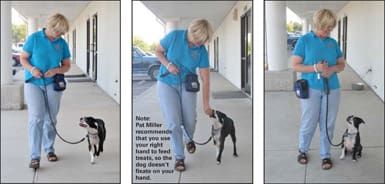
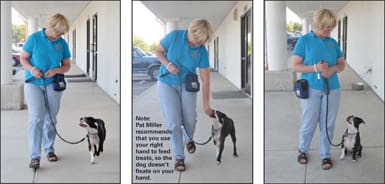
3. Feed him like a horse. Equestrians feed treats on the flat of the hand; horses can have trouble distinguishing fingers from carrots. You can do the same with your dog. It’s a little trickier because we’re often luring with treats, which can make fingers a prime target, but you can lure to get your dog to do the behavior, then click and quickly feed a treat from the flat palm of your other hand.

4. Toss or spit treats to your dog. Treats don’t always have to be delivered to your dog’s mouth from your hand; you can often toss them on the ground for your dog to eat. This isn’t a good choice when you want to reinforce a non-moving behavior (such as wait, stay, or down) by giving your dog a treat while he’s in the correct position, because a tossed treat may pull your dog out of position. But tossing works just fine for many others behaviors such as targeting and “leave it.” An old obedience competition trick is to teach your dog to catch treats that you spit to him from your mouth. That reinforces him for the behavior you asked for as well as for looking adoringly at you – when actually he’s staring intently at your mouth waiting for the next treat to fly out. (Of course, you have to use treats you’re willing to put in your own mouth, such as slices of hot dog.)

5. Use a treat-feeding tool. My favorite is a camping tube, designed for holding moist foods on camping trips in secure, easy-to-carry containers (available at camping supply stores). These require that you use treats that are in a gel or paste form, such as peanut butter, cream cheese or other soft cheese, or canned dog food. The back end of the tube opens wide so that you can load the food in and then close it up, and a cap screws off the other end so you can squeeze out a little when desired. (You may need to experiment to get your treats to be the proper consistency to ooze out the end of the tube at the desired rate.) Other treat-feeding tools that you can use to protect your hands include:

  • Gloves: My least favorite, as gloves can be awkward and interfere with dexterity, and are hot in the summer!
  • Finger splints: These are small foam-padded metal finger covers that Velcro onto your fingers. Many dogs don’t like to bite on metal, and if it doesn’t slow your dog down, the metal splint still protects your finger. Using a finger splint, you can still deliver treats in the normal fashion, rather from the flat of your hand.
  • Spoons: A metal spoon, like the finger splint, can convince many dogs to bite softly because it doesn’t feel good to bite on metal. You will need to use a soft treat that will stick to the spoon.
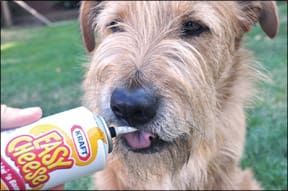
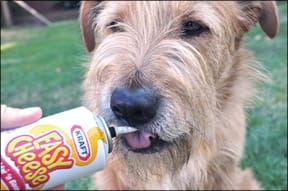
  • Easy Cheese (made by Kraft Foods) or similar “squeeze cheese” spread: These are not the healthiest snacks, but used in moderation as training treats, they can be very helpful. You bend the nozzle at its base with your finger to release a few drops or globs and your dog licks the cheese-like substance off the end of the nozzle. No teeth needed at all!

Pat Miller, CPDT-KA, cdbc, of Fairplay, Maryland, is WDJ’s Training Editor. See page 24 for contact info for Pat or her Peaceable Paws training center.

Topical Estrogen Products Can Hurt Your Dog

0

Many women use topical estrogen creams, lotions, gels, or sprays to help relieve symptoms associated with menopause, such as hot flashes, mood swings, and bone loss. These preparations contain progesterone, estradiol, or similar hormones and are available both over-the-counter and by prescription.

According to the Veterinary Information Network (VIN) News Service, veterinarians have recently become aware that symptoms of hyperestrogenism in dogs can be linked to their owners’ use of topical hormone preparations. These products are often applied to the inner arms, and the hormones are then transferred from the hands or arms when the owner pets or holds the dog. Hormones can also be ingested if the dog licks the ointment from the skin or swallows a transdermal patch.

Signs of hyperestrogenism
Exogenous estrogen can cause swollen vulvas in spayed female dogs or young female puppies, often with even more swelling than if they were in heat. Females may be attractive to males and even allow mating.

Affected male dogs can develop enlarged mammary glands, and male pups may have an underdeveloped penis and testes. Prostate infection, particularly in young dogs, may also be linked to exposure to hormones.

These excess hormones can also cause hair loss in both sexes. Often referred to as endocrine alopecia, Alopecia X, or Adrenal Hyperplasia-Like Syndrome, the hair loss (alopecia) is described as bilaterally symmetric, meaning it affects both sides of the body similarly.

Veterinarians are often at a loss to explain such signs, and may try treatment with antibiotics or corticosteroids such as prednisone. Ovarian remnant syndrome, where part of the ovary is accidentally left behind during a spay, is often suspected, particularly if the dog was spayed during the prior year, and some dogs have been subjected to a second surgery to search for the ovarian tissue thought to be causing the symptoms.

Special endocrinology tests may reveal elevated levels of estradiol, called hyperestrogenism or hyperestrinism, but will not indicate the cause of the excess hormones. Adrenal disorders such as atypical Cushing’s disease (Canine Atypical Hyperadrenocorticism, or CAH) may be suspected, with treatments ranging from melatonin and high-lignan flaxseed oil to Lysodren or other drugs used to treat Cushing’s disease. None will have any effect on symptoms caused by exogenous hormones.
Cats may also be affected, often behaving as though continually in heat.

Treatment and prevention
If you use topical hormone preparations, apply them to areas that are covered by clothing, such as your inner thighs. It’s best to use gloves to apply the ointments, or at least wash your hands thoroughly afterwards.

Signs in affected dogs often resolve within a couple of months once exposure ceases, though it may take longer, particularly if exposure has been prolonged. In some cases, it may be necessary for the dog owner to switch to a transdermal patch rather than using topical ointments before signs in the affected dog improve.

Awareness
Veterinarians need to be aware of the possibility of secondary estrogen exposure when confronted with patients exhibiting signs of hormone imbalance, and should ask their clients whether anyone in the household is using topical hormone preparations. Even young women may be using these products in certain cases, such as following a hysterectomy.
Comparable problems have also been seen in children exposed to hormones in a similar way. The FDA issued a warning in 2009 regarding the adverse effects that testosterone gel, used by both men and women, can have on young children who are inadvertently exposed through secondary contact.

According to VIN, the FDA said it “has received reports of inadvertent exposure to topical estrogen products in children and pets through contact with another person being treated with the products (secondary exposure). The Center for Drug Evaluation and Research and the Center for Veterinary Medicine are evaluating these reports.”

While problems relating to topical estrogen preparations appear to be on the rise, particularly as baby boomers reach the age of menopause, they don’t account for all cases of elevated hormones. One internal medicine specialist who is well versed in this issue estimates that ovarian remnant syndrome still outnumbers secondary hormone exposure by a ratio of ten to one.

Reporting
The Veterinary Information Network is considering conducting a survey to determine the prevalence of secondary exposure to pets of topical hormone products. If your dog or cat (or, if you are a veterinarian, your client’s pet) has exhibited signs associated with such exposure and you would like to participate in the survey, please send your name and contact information to news@vin.com.

To report a suspected case to the FDA, call (888) FDA-VETS and request form 1932a; fill it out and return. Or go to www.fda.gov/AnimalVeterinary/SafetyHealth and select “Veterinary Adverse Event Voluntary Reporting.” – Mary Straus

Obsessive Compulsive Behavior in Dogs

[Updated January 10, 2019]

CANINE OCD: OVERVIEW

1. Manage your dog’s world to maximize structure and consistency and minimize stress and the likelihood she will develop compulsive behavior.

2. Be on the lookout for any signs your dog is developing a compulsive disorder and address them immediately if they appear.

3. Avoid engaging in behaviors with your dog that are likely to elicit compulsive disorder such as chasing a flashlight or laser beam, or reinforcing tail-chasing.

4. If your dog has an established obsessive compulsive disorder, seek the help of a qualified behavior professional, and realize that effective treatment will probably include the use of behavior modification drugs.

Owners of herding and sporting breeds – Border Collies, Aussies, Kelpies, Labradors, Goldens, and others – often cheerfully talk about their dogs’ “obsession” with tennis balls. What they really mean is that their dogs are very reinforced by the opportunity to chase a ball.

Obsessive Compulsive Behavior in Dogs

That kind of intense interest in a ball or toy can be useful for training and management purposes, and it’s definitely not what we’re talking about when we use the term “obsessive compulsive disorder” or OCD. An OCD can be a difficult and debilitating behavior for you and your dog to live with; it’s not a cause for cheerful discussion.

What is Obsessive Compulsive Disorder in Dogs?

Also called canine compulsive disorder (CCD) and compulsive behavior disorder (CBD), OCDs have been defined by behavior researchers Drs. Andrew Luescher and Caroline Hewson as, “Behaviors that are usually brought on by conflict, but that are subsequently shown outside of the original context . . . Compulsive behaviors seem abnormal because they are displayed out of context and are often repetitive, exaggerated, or sustained.” Dr. Luescher, a veterinary behaviorist and director of Purdue University’s Animal Behavior Clinic, estimates that about 1 dog out of 50 suffers from canine compulsive disorder. Luescher and Hewson suggest that examples of environmental stressors that can trigger compulsive behaviors include:

– Physical restraints such as close confinement and chaining.

– Social conflicts that arise from competition for status, changes in social group, or separation.

– An unpredictable or uncontrollable environment.

– A lack of target object for normal behavior. For example, a dog kept isolated has no normal outlet for its instinct to interact within a group, whether animal or human.

Common OCDs include behaviors such as spinning, tail chasing, fly snapping, shadow chasing, air licking, flank sucking, pica, persistent barking, and “hallucinating.” Despite the intriguing names for these behaviors, they are not fun for a dog or for his humans. In fact, they can make life pretty miserable, and are evidence that the dog is living in an environment that is stressful for him.

Much of the underpinnings of OCDs are still a mystery to the veterinary medical and behavior world. There is evidence that suggests while they are all neurologically based, they are not all caused by the same physiological phenomenon; there may be several different classes of OCDs. Results of studies suggest that locomotive disorders such as spinning, and oral disorders such as licking, are controlled by different parts of the brain. Still, all of the different classes appear to be related to conflict resulting from stress or arousal, and all seem to respond to similar treatment.

According to Steve Lindsay in his Handbook of Applied Dog Behavior and Training, Volume Three: Procedures and Protocols, “Dogs most prone to develop compulsive behavior problems are frequently high-strung and impulsive . . . Highly motivated and high-strung dogs who are intolerant of conflict and frustration seem to be particularly at risk for developing compulsive habits.” It would stand to reason that dog breeds whose propensity for intense motivation has been enhanced by selective breeding – such as the herding and sporting breeds – would be more prone to compulsive behaviors.

Indeed, there is a genetic component to the propensity to develop OCDs, and certain breeds do have a predisposition for certain compulsive behaviors. It has been suggested that seizure activity may play a role in triggering canine compulsive behaviors, but there is no scientific evidence to support that theory, and most behaviorists agree the primary culprit is stress. Dr. Andrew Luescher was quoted in a January 7, 2010, ScienceDaily article saying, “You could probably make every dog have compulsive disorder if you provide enough threats or conflict.”

A Menu of Obsessive Compulsive Canine Behaviors

The following are some of the more common canine obsessive compulsive disorders.

LOCOMOTIVE

Spinning: Dog turns in place in rapid circles.

Tail chasing: The dog turns in place in rapid circles, but appears to be focused on his tail.

Shadow or light chasing: Chases light reflections with extreme intensity; fixates on possible light sources.

Pacing: Repetitive movement back and forth in a straight line – can be walking or running. Often seen in zoo animals and dogs in kennels, or along line fences.

ORAL

Fly snapping: Dog snaps randomly in air, apparently at invisible objects. Seeing a flying insect may spark the behavior, but it persists when insects are not present.

Pica: Ingesting inappropriate objects (far beyond normal/expected chewing) – sometimes to the point that emergency surgery is need to remove objects, such as stones, acorns, or socks.

Chewing or licking self: Dog licks and/or chews feet, legs, or anywhere on body; can cause the development of “lick granulomas,” sores, or dermatitis. If your dog is a chronic tail biter, other underlying problems may be present.

Air or nose licking: The dog licks at the air in front of his face.

Licking others or objects: Dog persistently licks humans, other dogs, blankets, toys or other objects.

Polyphagia or polydipsia: Dog eats or drinks excessively, resulting in excessive defecation and/or urination. There is sometimes a medical cause for these behaviors, but sometimes it is OCD.

Flank sucking or object sucking: Dog sucks on his own flank or on toys, blankets, or other objects.

VOCALIZATION

Persistent howling or rhythmic barking for no discernible reason.

AGGRESSION

Inexplicable self-directed aggression – attacking hindquarters, legs, tail; attacking food bowl and other inanimate objects.

What to Do with an OCD Dog

As with any undesirable behavior, you’re better off not letting an OCD become established in the first place. Whether you have a breed that is prone to OCD or not, you can dodge the bullet by keeping your dog in a well-structured environment with a regular routine, and avoiding introducing obvious stressors such as yelling at, hitting, or alpha-rolling your dog. If, despite your best efforts you do see the glimmerings of OCD behavior, you’ll have greatest success in extinguishing it if you address it immediately rather than waiting until it’s full-blown.

Your attention can reinforce an OCD behavior. Tail-chasing is often perceived as cute by owners who laugh and praise the dog and encourage the behavior. OCD tail-chasing is not cute. Fortunately, it can sometimes be extinguished in early stages by removing all attention.

I had clients whose four-month-old Golden Retriever pup had OCD pica and had already had one emergency surgery to remove pebbles and acorns from his stomach. When Corky showed interest in chasing his tail, I counseled his owners to immediately leave the room as soon as he started the behavior. (Dogs with one OCD often easily adopt another.) Within a few weeks the tail-chasing had stopped.

There are a number of things you can do to reduce general stress levels for your dog. Prophylactic stress reduction can prevent OCD, and reducing the dog’s stress in the early stages may extinguish it. But reducing the dog’s stress (as part of a complete behavior modification program) can reduce even well-established OCD behaviors. Stress-reducing tactics include:

– Explore, rule out, or treat medical conditions that might contribute to stress, including thyroid. (See “Help for Dogs With Hypothyroidsim,” June 2005.)

– Increase exercise on a consistent schedule. This is an important one. Not only does exercise use up energy that might otherwise feed OCD behaviors, but aerobic exercise promotes endorphin release, which has a calming effect.

– Train your dog. Training helps your dog understand what’s expected of him, and what you are communicating to him. His world makes more sense, so it’s less stressful to him. If your dog is trained and responds to your requests for behavior, it’s less stressful for you as well, and you’re less likely to be tempted to punish him, which is, in turn, less stressful for him.

– Use plug-in, spray, and collar-infused Dog Appeasing Pheromones (DAP/Comfort Zone). DAP is a synthetic substance that mimics the pheromones emitted by a mother dog when she’s nursing her pups. It has a calming effect on a significant number of adult dogs.

– Play “Through a Dog’s Ear.” These bio-acoustically engineered CDs feature soothing classical music, and have been clinically demonstrated to reduce canine heart rates. (They calm people, too!)

– Make sure your dog is on a high-quality (or at least good-quality) diet.

– Utilize products such as Doggles (canine sunglasses) to reduce visual stress, the Thundershirt and the Anxiety Wrap to reduce environmental stress.

– Apply calming massage or T-Touch, in conjunction with aromatherapy. If your dog associates calming touch with the scent of lavender, that scent can be used at other times to help evoke calmness.

OCD and Stress in Dogs

With any stress-induced behaviors, including OCDs, your first assignment is to identify and reduce as many of your dog’s stressors as possible. Of primary importance is identification and removal, if possible, or at least management, of the proximate cause of the dog’s stress or conflict.

Obsessive Compulsive Behavior in Dogs

Following that, you want to address all stressors, not just the one(s) that seem to trigger the OCD behavior. Most households can identify a list of 10 to 20 stressors for their dogs. A short list might look like this:

1. Being crated

2. Small children

3. People and/or dogs walking past the front windows

4. Nail trimming

5. Riding in the car

6. Threats to his resources

7. Thunder

8. Prong collar

9. Verbal and/or physical punishment

10. Owner stress

Decide which of the following strategies you can effectively apply to each stressor on the list to reduce its effect on your dog’s overall stress level:

– Use counter-conditioning to change the dog’s opinion of (that is, his association with) the stressor.

– Teach the dog a new, incompatible behavior using operant conditioning.

– Manage the dog’s environment to reduce his exposure to the stressor.

– Get rid of the stressor.

– Live with it.

You could get rid of crating stress simply by not crating the dog anymore. Or you could change his opinion by giving him a new, positive association with the crate. You could use counter-conditioning to help him like children, or, if there aren’t children in the home, you could simply manage them as a stressor by removing him when children are around. You can manage your dog’s arousal at passers-by simply by blocking his access to the window, and you can also counter-condition his response so he no longer becomes aroused. You could also teach him a new behavior, so that someone walking by the window is his cue to go lie down on his rug in the kitchen.

Stressors 4 through 7 are also good candidates for counter-conditioning. You could manage thunder stress with the use of anti-anxiety medication and a Thundershirt.

Stressors 8 and 9 fall into the “get rid of it” group. Stop using a collar that causes pain and stop doing bad things to your dog and his stress is guaranteed to decrease. By themselves those two stressors could be the proximate cause for a compulsive disorder.

Stressor 10 is a “live with it.” Just be aware that when you are stressed (any stress; it doesn’t have to be dog-related) that you add to your dog’s stress load, and it is likely that you will trigger one of your dog’s OCD incidents.

When to Call A Veterinary Behaviorist

Of course, removing stressors alone is not likely to “fix” most well-established OCDs. Chances are quite high that all the above steps to reduce stress and promote calm won’t be enough to extinguish your dog’s OCD behavior.

You can try removing reinforcement for the behavior, and you can try positively reinforcing an alternative behavior that’s incompatible with the OCD (sit, instead of spin, for example). However, it’s well-accepted in the behavior field that a serious compulsive behavior almost always requires intervention with behavior modification drugs.

For this, you need a veterinary behaviorist, or at least your own veterinarian needs to work in close consultation with a veterinary behaviorist. The use of psychotropic drugs is complex and requires a thorough education in the field – it’s not acceptable for a veterinarian to reach for the first behavior drug that the last pharmaceutical company salesman talked him into buying.

Also, I cannot stress strongly enough the critical importance of working with a board-certified veterinary behaviorist when it comes to selecting, administering, and monitoring the use of drugs for your dog’s compulsive disorder. Virtually every veterinary behaviorist will do free phone consultations with other veterinarians, so there’s no excuse not to. There are fewer than 50 of them in the United States.

Obsessive Compulsive Behavior in Dogs

How Common is Dog OCD?

So what are the chances, really, that you’ll need all this information about OCDs? I think Dr. Luescher’s estimate of 2 percent of the canine population might be quite conservative. In our pack of five dogs, only Dubhy, the Scottie, shows a total lack of OCD tendencies. That’s a whopping 80 percent in our household!

Bonnie, our Scorgidoodle, likes to lick others incessantly. Exercise goes a long way toward minimizing her annoying licking behavior, as does reinforcing an incompatible behavior. (Here, Bonnie, chew on this orange. She loves oranges.)

Scooter the Pomeranian will lick objects, especially blankets or sheets. This behavior has decreased significantly since we adopted him over a year ago. A lot of his stress, I’m sure, had to do with all the upheaval and uncertainty in his tiny world. (He was left to fend for himself on the streets, then spent weeks in a noisy shelter. And even though he has a nice home with us, it’s been stressful for him to have to adapt to living with four dogs who are two to four times his size!)

Lucy, the Cardigan Corgi, will engage in spinning if she doesn’t get enough exercise. She spun during her shelter assessment after being confined to the shelter kennel for several days, and started spinning here on two separate occasions when she was on “restricted activity” for medical reasons. Usually, normal farm activity and occasional hikes are enough to keep the spinning demon at bay.

Missy, the Aussie, licks her feet and does air and nose licks. Her stress is probably a combination of multiple rehomings prior to coming to live with us, status conflicts with Lucy, and separation distress; we’re still working on those.

Please note: Our dogs all came to us from the shelter with these behaviors, so I’m not taking credit – or blame – for their compulsive behaviors!

Pat Miller, CBCC-KA, CPDT-KA, is WDJ’s Training Editor. Miller lives in Fairplay, Maryland, site of her Peaceable Paws training center. Pat is also author of several books on positive training, including her latest: Do Over Dogs: Give Your Dog a Second Chance for a First Class Life

How To Find The Best Dog Trainer For Your Dog

FINDING A DOG TRAINER: OVERVIEW

1. If you can, look for a positive, dog—friendly trainer before you adopt your new dog or puppy, so you can thoroughly research candidates in your area.

2. Watch the candidates in action, preferably while they teach several different classes.

3. If your dog has serious behavior challenges, look for an animal behavior professional with the education and experience needed to properly assess your dog and recommend appropriate treatment.


People have many questions when it comes to dog training: Lure-reward training or clicker training? Group classes or private lessons? Basic obedience or beyond? What type of trainer is best for dealing with your dog’s behavior challenges?

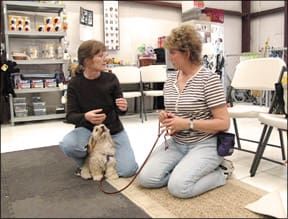
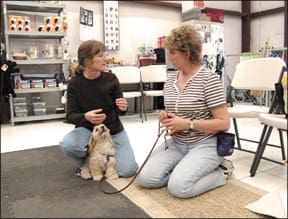
A dog trainer talking to a training client, who is holding her dog's leash
Dog training professionals may have widely varying amounts and types of experience and education. The perfect puppy class instructor may not be the best consultant for dealing with your dog’s fear-based or aggression problem.

Finding the right trainer is an important piece of the training puzzle. Dog training is an unregulated industry; anyone can hang up a sign and instantly become a dog trainer. If you mix some decent Web-authoring skills with a college-level book on public relations, even yesterday’s Fed-Ex clerk can have the Web presence of a seasoned dog training professional. Adding to the confusion is the complicated assortment of titles used to describe dog trainers: trainer, behavior consultant, behaviorist, dog psychologist, human-canine relationship counselor, and many others. How does one make sense of the dog trainer name game?

The reality is that anyone who studies the field of behavior can call themselves a behaviorist. But not all behaviorists are created equal. I like to ride my bike. Does that make me a cyclist? Does it make me a cyclist in a Lance Armstrong way?

In the professional dog world, the term “behaviorist” is somewhat controversial. Some trainers call themselves “behaviorists” because they help clients modify their dogs’ behavior. This can range from annoying behaviors such as stealing food or jumping up, to more severe problems such as fear and aggression. Other trainers refrain from calling themselves behaviorists out of respect for “applied animal behaviorists” and “veterinary behaviorists” – two types of professionals who have met certain educational and certification requirements.

Dog Training Professional Titles and What They Mean

Let’s take a look at the credentialed training professionals who are available for consultation.

  • Applied Animal Behaviorists are certified by the Animal Behavior Society (ABS), a professional organization dedicated to the study of animal behavior. In order to apply for ABS certification, the professional must possess a graduate-level education in ethology, learning theory, comparative psychology, psychology, biology, zoology, animal science, or experimental design. She must also have a minimum of three to five years of professional experience.

Candidates with a Master’s degree in a related field may apply for certification at the Associate level (Associate Certified Applied Animal Behaviorist or ACAAB). Professionals with a PhD or veterinarians with at least five years of clinical experience may be certified at the Full level (Certified Applied Animal Behaviorist or CAAB).

When would an owner consult a certified applied animal behaviorist? Perhaps in cases of extreme aggression – such as a dog who causes physical harm by biting humans or other dogs – or for a dog whose fear issues impact his quality of life. Often, local trainers will consult with an applied animal behaviorist on a specific case. This provides the benefit of the behaviorist’s additional educational and clinical expertise in a manner that is generally more cost-effective for the client.

  • Veterinary behaviorists have completed a minimum of a two-year residency under the guidance of a board-certified veterinarian and are professionally certified as Diplomates of the American College of Veterinary Behaviorists (ACVB). Veterinary behaviorists are knowledgeable in psychopharmacology and may incorporate pharmaceutical therapy into behavior modification protocols. DACVBs are a rare breed. As of this writing, only 48 were listed on the ACVB website.

In human terms, a veterinary behaviorist is comparable to a psychiatrist, whereas an applied animal behaviorist may be comparable to a psychologist. Veterinary behaviorists are often consulted when behavior modification alone does not affect change. In extreme cases (such as clinical separation anxiety, obsessive-compulsive disorders, phobias, and idiopathic aggression), medication is often needed to help the dog achieve a mental state in which learning can occur.

When medicating dogs for behavioral problems, it’s extremely important that they are closely monitored by a professional with an educational and professional background in animal behavior. Subtle behavior changes, often easy for the family veterinarian alone to miss, can mean that a change in medication type or dosage is urgently needed.

If you cannot access a veterinary behaviorist, contact an applied animal behaviorist who can work with you and your veterinarian to determine if medication is appropriate. The standard vet school education does not include an in-depth study of animal behavior. We generally recommend against using your family veterinarian as the sole source of expertise when it comes to behavior problems.

Please note that all types of training professionals will potentially work with the same types of animal behavior problems. The difference is, while a good self-titled behaviorist will have years of experience and continuing education behind him, applied animal behaviorists and veterinary behaviorists must have a certain amount of education and experience under their belts in order to become certified, credentialed professionals. Any good self-titled behavior professional will also have a relationship with one or more certified behaviorists they can consult with and/or refer to when a client has needs beyond the scope of her own education and training.

Who We Refer to as Dog “Trainers”

In the world of noncredentialed behaviorists, there are a variety of dog training professionals. Depending on the types of issues they feel comfortable working with (basic obedience training versus behavior problems) titles usually include dog trainer, behavior consultant, behavior specialist, or behavior therapist. Recently, and I suspect in response to the proliferation of the Cesar Millan brand, the term “dog psychologist” can even be found with greater frequency.

(It’s worth noting that there is no educational field of “dog psychology,” only mentions of it in the context of understanding canine social behavior and how dogs learn.)

Regardless of what they call themselves, people who teach human clients to teach new behaviors to the clients’ dogs or to change the dogs’ existing behaviors offer a variety of skill sets, educational backgrounds, and degrees of experience. There are lots of schools that offer education in dog training, many of which provide students with a certification upon completion of a fee-based program. Such certifications are the program’s way of acknowledging that the student satisfactorily completed the requirements of the program. This differs from an independent assessment of the student’s general knowledge and ability as a trainer.

One popular independent trainer certification is offered by the Certification Council for Pet Dog Trainers. Those who meet the requirements and pass the evaluation and testing can use the title, “Certified Pet Dog Trainer, Knowledge-Assessed” (CPDT-KA). Requirements for certification include:

  • Trainer must have completed at least 300 hours of dog training experience within the past five years, most of which must be actual teaching time as the lead instructor in a class or private setting.
  • Trainer must pass a 250-question examination covering instructor skills, animal husbandry, ethology, learning theory, and training equipment.
  • CPDT trainers must undergo recertification every three years, either by re-taking the exam or earning a minimum of 36 continuing education units by attending approved educational seminars.

Another in-depth certification program is offered by the International Association of Animal Behavior Consultants (IAABC). This organization grants certified membership to professionals who have completed a minimum of three years and 1,500 hours in animal behavior consulting; 500 hours minimum of verifiable advanced instruction/education related to the core areas of competency (assessment, consulting skills, learning theory, general behavior knowledge, and species-specific knowledge); and the ability to communicate clearly through written work and case studies.

Professionals with a high school diploma, 300 hours in behavior consulting with their species of choice, a CPDT-KA or equivalent knowledge, and experience in two of five core areas of competency can apply for associate membership.

Prerequisites for Finding a Good Dog Trainer

It’s important to note that many gifted and talented trainers hold no formal certification at all, yet they successfully change the lives of dogs and their owners for the better on a daily basis.

When choosing a trainer, it’s critical to do a lot of research in order to avoid being misled by important-sounding terminology. Whatever the title, from “dog trainer” to “behavior specialist,” a competent training professional will have a solid understanding of dog behavior and learning theory, combined with a thirst for knowledge and a commitment to continuing education.

A superior training professional should be well-versed in humane, dog-friendly training techniques. She should promote her clients’ ability to get their dogs to comply because of a relationship based on mutual trust, understanding, and respect, not one based on fear, dominance, or submission.

When choosing a trainer, take your time and find someone you’re comfortable with. Not all trainers are the same, and your dog is counting on you to help make learning a positive (in every sense of the word!) experience. Do some research before starting school – preferably even before you acquire your dog or puppy! Ask your friends, family members, local veterinarians, or even folks at your local dog park for references. Ask the owners of the best-behaved and happiest-looking dogs you meet where they went for training and if they were happy with the experience.

Observe carefully! Do the dogs comply with their owners’ requests slowly and with tucked tails, lowered heads and ears, and averted eyes? These may be signs that the dogs are being trained with force- or fear-based training methods. Note the name of the trainer – but don’t go there unless you see ample proof that these dogs are exceptions to the typical canine graduates of that program.

If, in contrast, the dogs comply cheerfully, ears and tails up, eyes bright and interested, their owners may have been taught to train with truly positive methods. There are resilient force-trained dogs who fit this description, but generally, an eager countenance and eagerness to volunteer behavior is a hallmark of a dog who has been trained without punitive methods.

Questions to Ask Your Prospective Dog Trainers

Once you’ve established your short list of trainer prospects, contact each of them and learn a bit about them. What is their background? If the trainer is going to help you train your dog for an activity such as therapy dog work, competitive obedience, or agility, do they have experience in (or sufficient knowledge of) the activity to successfully guide your training journey?

If you’re seeking help with a complex behavioral issue such as fear, anxiety, or aggression, find out if the trainer has successfully worked with similar cases in the past. These issues may be beyond the ability of a novice trainer. Matters can quickly be made worse in even a single short session with someone who lacks the education and experience to succeed with an aggressive or deeply fearful or anxious dog. Ask for references from clients or fellow dog professionals who are familiar with the trainer’s work.

Also, find out what specific training techniques a candidate would expect to employ. Ideally you’ll have been referred to trainers who practice scientifically sound, modern, dog-friendly training techniques. If they describe themselves as “positive trainers,” ask specifically what that means. Some trainers call themselves positive because they use treats for correct behavior, but they use physical corrections for unwanted behavior. (We suggest asking: “Do you ever use leash corrections?” Pay attention to any “weasel words” in the answer, such as, “No, but we sometimes use a quick ‘pop’ on the leash when the dog pulls.” Pop goes the weasel!)

Modern, educated professionals agree that when working with aggressive or fearful dogs, fear- and pain-based training methods make matters worse, not better.

Inquire about the equipment that is used in class. Reward-based trainers stay away from choke chains and pinch collars in favor of plain, flat collars, or head halters and no-pull body harnesses if needed.

Some trainers feel it’s okay to employ dramatically different training techniques or equipment for different dogs; for example, switching from lure-reward training with one dog to corrections with a choke, pinch, or remote collar with another. It can be quite disconcerting to students practicing positive training methods to watch the student next to them employing such corrections, so be sure to find out in advance what the instructor’s policy is.

A good reward-based instructor will be able to offer several positive alternatives for teaching the same behavior, recognizing that one size does not fit all when it comes to training dogs. To that end, find out if the trainers regularly participate in continuing education to stay abreast of the latest developments in positive training.

Now Sit In on a Dog Training Class

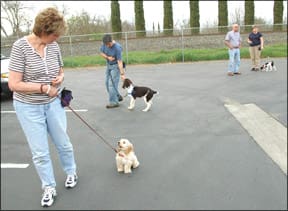
It’s also important to take the time to watch the trainer in action. A good trainer will have no problem with you coming to observe a group class. Pay attention to both the human and canine students. Do they appear to be enjoying the experience? Is the class safely under control? Does it seem like there are too many dogs and people in the class? Does the instructor have an assistant to help keep an eye on things?

Find out what behavioral issues can be safely incorporated into the class. For example, many instructors can successfully incorporate overly excited or even dog-aroused dogs (within reason) into the class by using strategically placed barriers that help block the aroused dog’s visual access to his canine peers. If the instructor allows such dogs in a class setting, watch to make sure that they are handled in a way that makes the rest of the class feel safe.

Find out what procedures are in place to help students who might be struggling. Is there adequate time and personnel in class to help students who need it? Do the trainers and assistants make the rounds to each student during practice time, or do students appear to be on their own as the trainers chat amongst themselves?

Is the instructor available before or after class to answer questions? What about between class sessions? Are written handouts provided? Watch how the instructor interacts with the students. Is there a genuine interest in what they’re doing and an overall feeling of support? Does she seem like someone you would be comfortable working with and learning from?

In a group class setting, the most significant teaching happens between the instructor and the dog’s owner. It’s the instructor’s job to teach the owner how to effectively communicate with the dog so that successful training can take place throughout the week between classes. If you don’t mesh well with the instructor, you won’t get as much out of the class.

Take note of what’s being taught in the class and make sure that those behaviors are aligned with your personal goals for you and your dog. Some classes may focus on exercises required for competition obedience events, while others focus on improving the behavior of the family pet.

For example, coming when called in a competition obedience class might focus on teaching the dog to wait as you walk away and come sit in front of you when called. A pet-friendly class might stress the need to teach your dog to turn away from high-level distractions and race to you upon hearing his recall word. Be sure to find a class that covers what will be most useful to you and your family.

Speaking of family, if you have kids, find out if the instructor has an age restriction or other special rules or requirements for children attending the training class.

How to Handle a Dog Training Class Gone Wrong

Even when you research a class or enroll on a strong recommendation, you still might encounter a training situation that makes you uncomfortable. Always remember that it’s your dog and you have final say about how he’s trained.

  • If a trainer talks about a training technique that makes you uncomfortable and then wants to demonstrate with your dog, it’s okay to say, “No.” A simple, “I’d rather not use that technique on my dog,” can politely convey your position without causing a scene. Later, ask if the instructor has an alternate method of teaching the behavior in question. By engaging the instructor after class, it shows that you’re willing to learn, but have set boundaries.
  • If you find yourself in a class where other students’ behavior toward their dogs makes you uncomfortable, take note of who they are and plan not to sit next to them or quietly move away. If the handling is extreme, approach the instructor after class and ask if that behavior is acceptable. She might not have observed it first-hand and should appreciate you bringing it up so that she can potentially suggest alternatives.
  • If a trainer corrects your dog in a way that you find unacceptable, definitely speak up. If he is not being abusive and your dog is not in imminent danger, wait until class is finished. Politely explain that you avoid using such techniques and ask that he refrain from using them on your dog, A good trainer will respect this. If he challenges you, consider leaving the class. Maintaining a healthy relationship with your dog is worth far more than forfeiting class tuition.
  • Rarely, there are reports of trainers who are downright abusive to dogs during training. If you encounter such handling, step in and gain control of your dog immediately. Yelling, hitting, alpha-rolling, etc, is never okay. Withdraw from the class and consider notifying any professional organizations in which the trainer is a member, as well as posting an honest review on consumer websites such as Yelp.
  • Most importantly, always remember that it’s your dog and that you have the final say over how he’s treated. If something makes you uncomfortable, it’s okay to put an immediate stop to it.

How to Be a Star Student When Attending a Dog Training Class

Your behavior is just as important as your dog’s. The following tips will help you and your dog get the most out of your training experience:

1. Do your best to come prepared. If the instructor sends pre-class information, be sure to read through it so you know what to bring.

2. Communicate with the instructor. If you have a handicap that will prevent you from doing the exercises that the instructor suggests, let her know, so she can modify the exercises to your benefit. If you’re struggling with something between classes, speak up! The instructor can’t help you if she doesn’t know you have a problem.

3. Be patient. Your “bad habits” don’t go away overnight. Your dog’s won’t either! Avoid being too quick to label a training technique as “not working” just because you haven’t seen results in a week. Keep at it. Think in terms of progress, not perfection. Persistence is key.

4. Practice! Training your dog is like joining a gym. You have to spend time working out to see results. Be sure to do your homework between class sessions.

5. Focus your attention on your dog during training. Try to set the kids up with an activity to keep them safely occupied and turn off mobile phones and other distractions.

6. Come to class with an open mind. Be willing to experiment with techniques that might be different from what you’re used to. At the same time, remember that you are your dog’s best advocate. Never let a trainer talk you into doing something to your dog that makes you uncomfortable.

The Work Pays Off

Finding the right trainer and class can make all the difference. At a minimum, it helps ensure that you and your dog learn how to effectively communicate with each other, allowing you to create a well-mannered canine companion that you’re proud of. For some, finding the right class is what sparks a lifelong love of dog training and opens the door to the wide world of activities that can be enjoyed in the company of a dog. You may well find you learn as much – if not more – from your dog as he learns from you!

Reinforcing Your Dog’s Training Throughout His Lifetime

It wasn’t so bad, really, as behavior slips go. My dog Otto woofed at a kid at close range. The kid thought Otto was playing; I knew that Otto was scared, and I mentally smacked myself for being inattentive. I was taking pictures at a dog park, and Otto had been happily playing with the other dogs as I worked. I hadn’t noticed that a small boy – perhaps five years old? – had entered the park and had started chasing the dogs around.

Practicing Reliable Recall

288

We can certainly debate the wisdom of having small children in dog parks (I hate to see them there; it’s much too easy for them to get knocked over or even attacked in a moment of arousal). But the fact is, I wasn’t paying enough attention to my dog – and frankly, it’s because I sometimes take it for granted that he’s generally so well-behaved. He’s not perfect, though; no dog is. (No people are, either.) And so I should have been – should always be – more vigilant.

I’ve mentioned before that Otto is a little spooked by kids. He’s also afraid of cars, garbage trucks, and the gardeners who service some of the yards in our neighborhood. My husband and I joke about a scenario in which Otto was kidnapped as a puppy by a garbageman and then abused by gardeners and their kids before being tossed out of a moving car. It’s a joke because I know that it’s more likely that a young dog who is fearful of certain things is more likely to lack experience and exposure to these things than to have been abused by them. People always say, “Oh, he must have been abused by a man in a hat!” I say, “He probably never saw, and met, and was given treats from a man in a hat!”

Back to the kids, though. I take every opportunity possible to expose Otto to kids. I carry treats on every walk we take, and if we so much as see a kid at a distance, I practically make it rain hot dogs. “Oh, Otto! Look, kids! Good boy! We love kids, don’t we?”

If the kids are interested and (most importantly) under control, I ask them if they would like to give Otto some treats; I ask Otto to sit and offer a paw first, and then he takes the treats very gently. If the kids look impulsive or twitchy, however, I’m quick to keep Otto at a distance, and feed him some treats myself.

Unfortunately, my own son is 18 years old, and my closest niece (only one year old) is an hour away; I don’t have the resources for practicing that I used to, in terms of kids I know and can trust to behave around a wary dog. It was so easy when my son was little, and his friends were always over, and we were always going to soccer and baseball games and practice! Kids galore! Now I need to hire some. Or something!

Never get complacent about training
The thing is, Otto has been doing so well for so long. He’s got a rock-star, rock-solid recall: fast, enthusiastic, completely trusting that coming to me right away is the most fun thing ever. It practically brings tears to my eyes, it’s so pretty. I can (and have) called him away from a running feral cat, a skunk (eating a bowl of cat food left out for said feral cats), and even a loose dog that started chasing us. (Otto started to hold his ground, but the dog looked scary, and I thought we’d be better off farther from what appeared to be the dog’s home. And sure enough, he stopped chasing us after half a block.)

Yes, in each of the cases where his recall was tested, I was walking with Otto off-leash. We can do that in our tiny town in the off-hours; we rarely see anyone else on the streets or trails before 7 a.m. and after about 8 p.m. It’s quiet, there is no traffic, but mostly we can do this because we practiced, practiced, practiced that whole first year we were together. We practiced recalls in the yard, we added distractions (another person bouncing a ball, say), and then we moved to a neighborhood park on a long-line. When Otto’s recall was solid on a long-line in the park (and no one was around) I’d take off the long-line and practice some more. Then we started the process on trails. We’ve built that recall brick by brick.

Reinforcement of Dog Training

288

He failed – that is, I failed – only twice that I remember. In each case, I raised the criteria too soon; I expected him to resist temptations that he hadn’t had much practice resisting, and I didn’t have a long-line on him to prevent him from being rewarded by the fun of his misadventure. (Both times, he was off-leash and spotted a feral cat alongside the trail. The cats were safe; they dive into a blackberry bramble that only tiny animals can get in and out of.)

After each failure, we had to do a lot of remedial work on that section of trail. At first we worked on a short leash, and I gave him an “Off!” cue, to get him to look away from the cats (or the places where the cats usually hang out) and look at me. I marked (with a clicker or a verbal “Yes!”) and gave him delicious treats each time he looked at me.
Soon, I no longer had to cue the “Off!” He would glance toward the cats, and then look at me, knowing he had earned a treat. He really liked chasing the cats the two times that he was able to, so he’s never going to be a dog who will pass by the cats while staring at me fixedly, like a dog in an obedience show ring. But he just glances, and then looks at me for his treat. And I think that as long as it continues to be more rewarding for him to pass the cats than it is to chase them, he’ll resist.

We walk a lot – if not daily, then at least several times a week. So it’s no wonder that his on-leash and off-leash walking skills are so good. But kids! We need more work with kids. I’m not sure what we’re going to do about that. I do my best to take advantage of the chance meetings we have with kids in public, but I just don’t have regular access to some reliable kid volunteers.

Whiffed the woof
Back to the woof. As I said, I wasn’t looking at Otto when I heard him bark at something at the dog park; I turned around to see him trotting away from a young boy. His tail was wagging, but he looked a little alarmed. The boy, too, looked uncertain for about a second, and then he ran off in pursuit of another dog. Although Otto was already coming toward me, I called him and gave him a treat, then snapped his leash on and asked him to sit. Then I looked to see who was with the boy. It wasn’t that hard; his dad was retrieving the boy from chasing another dog.

I approached them to a distance of about 10 feet, and said, “I’m sorry, I didn’t see what happened when my dog barked at your son. Is he okay?” I could see that he was okay, but I was curious to get some information about what exactly had transpired. The dad said, “He’s fine. He was just running up to your dog and it looked like your dog got scared.”

I said, this time to the boy, “Yeah, buddy, sometimes dogs are scared of kids! Next time, maybe you should hold still and let the dog come up to you! That way you won’t scare him. You know, sometimes scared dogs bite!” And then, because I could see that the boy was already losing interest in this conversation, I said, “Do you want to see Otto do some tricks? And you can throw him some cookies when he does his tricks?”

I asked Otto to sit and stay, and approached the boy, handing him a few cookies. Then I stepped back over to Otto and told him, “Down.” “Okay, throw him a cookie!” The cookie didn’t land all that close, but Otto got it. Then I said, “Point your finger at him and say ‘Bang!’” Otto really enjoys this “playing dead” trick. The only problem is getting the “dead” dog to stop wagging his tail and rolling his eyes mischievously. It still delighted the boy, though, and he was happy to toss a few more cookies before we took our leave.

I did what I could to salvage the situation, but really, it was another “fail” for me. I wasn’t watching my dog closely enough to protect him from a situation that had the potential for leading up to a dog bite. I allowed my dog to be approached by something he is afraid of, in a scary way, and to actually become scared enough to give a warning woof. Talk about “past threshold!”

So, like I did after my off-leash training failures, I’m going to have to find some kids and that I can instruct so I can set up some remedial socialization sessions for Otto.

Does this sound like I’m taking all this too seriously? When I was a kid, nobody talked about “socializing” their dogs, and most of the dogs we knew were just fine with kids. What’s the big deal? At risk of sounding old, when I was a kid, it was a different world. The only dogs I knew who weren’t free to run around my rural neighborhood were either hunting dogs or watchdogs; kids knew not to fool around with any of those dogs. And all the ones running loose in the neighborhood (the ones that weren’t hit by cars!) were extremely “good with kids.” That’s because they were constantly exposed to kids!

I want my dog to be as rock-solid with kids – and every other type of person – as he is at resisting the urge to chase cats. So we’re going to have to practice.

Nancy Kerns is Editor of WDJ. She adopted Otto from a shelter on June 13, 2008.

Download the Full August 2010 Issue PDF

To continue reading this article or issue you must be a paid member.

Join Whole Dog Journal

Get full access to Whole-Dog-Journal.com – more than 4,000 articles – for just $20.
Join today and save 30% off our full price.
Already a member?
| Forgot your password? | Activate Web Access

When Your Dog Refuses To Walk On A Leash

It’s frustrating and embarrassing when your dog puts on the brakes and refuses to move. If he’s small you can pick him up and carry him; although that might not be the best training solution, at least it gets you out of there and you can save face. But what if it’s a Great Dane, a Newfoundland, or any breed – or combination of breeds – that’s too big to be portable? Whether your dog is giant or tiny, here are five things to do when your dog gets stuck in neutral:

Leash Training

288

1) Evaluate possible medical problems: Your dog may be in pain or otherwise not feeling up to par, and the last thing she wants is a jaunt around the block. If your dog refuses to move routinely, or even occasionally – not just once – it’s time for a trip to the dog doctor to look for a physical reason. You don’t want to force her to walk if she’s hurting.

2) Look for environmental aversives: Pavement gets painfully hot on warm sunny days – enough to cause considerable discomfort. Prickly weed seeds, sharp stones, sometimes even tall or wet grass can be aversive. (Dog boots can protect paws from surfaces that cause discomfort.) Maybe your dog is just hot and trying to stay in a shady spot! Be sensitive to aversive environments you can avoid; walk your dog morning and evening on very hot days. Conversely, maybe he needs a down jacket or more indoor exercise on frigidly cold winter days.

3) Consider fear issues: A temporary environmental aversive can create a negative association with the location where it occurs. Maybe your dog stepped on a bee and got stung, or a loud scary noise happened at his sticking spot. If his body language tells you he’s worried or fearful (head down, looking away, ears back, leaning back, perhaps even showing a whale eye and trembling), you’ll need to counter-condition at the place (or places) where he shows fear. (For in-depth information on counter-conditioning, see “Reducing Your Dog’s Anxieties,” WDJ April 2007.) Even better, identify specifically what causes his fear, and counter-condition that stimulus in a safer environment first, before trying it on a walk.

If he puts on the brakes as you approach the car, something about the car may be aversive. Counter-condition! Perhaps there’s a reactive dog behind a fence. If your dog gets sticky as you approach a barking, growling, berserk dog behind a fence, he may not be comfortable being barked and snarled at as you walk past. Cross the street, and then counter-condition to convince him that a snarling dog makes chicken fall from the sky, and/or arrange with your neighbors to have their dog indoors when you’re going to walk your dog.

4) Reinforce movement: If you always click and treat your dog for sitting when you stop, she may decide that stopping gets reinforced. Spend lots more time clicking for movement. If she does get stuck, avoid luring to get her unstuck, so she doesn’t learn to put the brakes on in order to get you to bring out the treats.

5) Do stuff she loves: These four tips are good for prevention and diagnosis. But what do you do in the moment, when your dog won’t move?

Do something that she loves, to get her mind off being stuck and get happy about moving. If she gets happy about targeting, play-target in a direction she is willing to move (usually back the way you came from). When she’s acting playful, target forward in the direction you want to go. Play a simple “Find it!” game, by tossing treats on the ground in the direction she’s willing to go, and then repeat the game in the other direction. Play with a ball, play tug, play any games that get her happy and moving. If it’s safe to do so, put her on a long line and run past her, fast, to the end of the line to see if she’ll chase happily after you. (Don’t use your “come” cue; do use random happy chatter).

If she gets stuck going home on walks because she’d rather stay out and have fun with you, backchain going home (start close to your front door and gradually move farther and farther away). Each time you arrive home, have a fantastic play party with her favorite toys and games so she eagerly looks forward to going home and having fun.

Pat Miller, CPDT-KA, cdbc, of Fairplay, Maryland, is WDJ’s Training Editor.

Beware of Over-Vaccinating Your Dog

21

VACCINATING YOUR DOG: OVERVIEW

1. Keep accurate records of your dog’s vaccination and titer history.

2. Arm yourself with accurate, credibly sourced information when having a discussion with your veterinarian about vaccine protocols.

3. Consider using antibody titer tests to accurately detemine whether your dog needs to be re-vaccinated.

4. Commit to taking your dog to your veterinarian for annual checkups; consider twice-annual visits for dogs seven years of age and older.

Should you vaccinate your dog? Should your dog receive all the recommended vaccines at once? How important are common shots, like the DHPP vaccine, or rabies vaccine? Over-vaccinating dogs is a definite problem in the veterinary world, but immunizing your pet is nonetheless a necessary part of having one.

You check your mailbox and there it is: a reminder postcard from your dog’s veterinarian. If you’re like many of us dog owners, you groan and toss the card aside.

If you’ve not yet found an enlightened, up-to-date veterinarian, the postcard is likely to say, “It’s time for your dog’s annual vaccinations! Call us today for an appointment!”

We hope, however, that you’ve done your homework and found a veterinary practice whose postcards say something more like, “It’s time for your dog’s wellness examination! Call us today for an appointment!”

dog Over-Vaccination

What’s the difference? In 2003, the American Animal Hospital Association (AAHA) revised its vaccination guidelines, recommending that vets vaccinate adult dogs only every three years – not annually. Many enlightened veterinarians changed their canine healthcare protocols to reflect the guidelines, and now suggest annual wellness examinations with vaccinations only every three years.

In WDJ’s opinion (and that of the experts we consult), annual vaccination for most canine diseases is unnecessary and potentially harmful. Dog owners should avoid employing those old-fashioned veterinarians who recommend annual vaccines. Owners should also avoid those veterinary service providers who provide inexpensive vaccines and other routine care without the benefit of a relationship with you and your dog beyond a brief transaction in a parking lot or pet supply store. While the financial cost of vaccine clinics may be appealing, the fact is, your dog’s health may pay the price of unnecessary or inappropriate vaccines.

Vaccines for Dogs: The Basics

Core vaccines protect animals from severe, life-threatening diseases that have global distribution. According to the AAHA, core vaccines that every dog should receive initially as a puppy (a series of three vaccines given between 8-16 weeks of age) are:

1. canine distemper (CDV)
2. canine parvovirus 2 (CPV-2)
3. canine adenovirus 2 (CAV)

The core vaccines should be administered one year later, and every three years thereafter, unless antibody titer test results indicate that the dog possesses antibody levels that have been determined to be protective. (For more about titer tests, see
Dog Vaccination Information“.)

The rabies vaccine is also considered a core vaccine, but should be given once at age 12 to 16 weeks (or as late as local law allows), then again one year later, followed by every three years. (Unfortunately, some locales require rabies vaccination more frequently than every three years, so check your local laws.)

Non-core vaccinations should be administered only to dogs whose geographical location, local environment, or lifestyle place them at risk of contracting each of the specific infections. These vaccines are:

Bordetella bronchiseptica (kennel cough) & parainfluenza
Borrelia burgdorferi (Lyme)
– Leptospirosis

Vaccines not recommended, per 2006 AAHA Guidelines are:

– coronavirus (CCV)
– giardia

Note: The above recommendations are per the AAHA. Dr. Dodds no longer recommends the CAV vaccine, and advocates administration ofthe initial rabies vaccine after 20 weeks of age (if allowable by local law).

Be Prepared with Your Dog’s Vaccination History

That said, don’t think for a minute that you need to take your dog to the vet only every three years. It’s imperative that you take your canine companions in for yearly checkups. Rather than throw that postcard in the trash, pick up the phone and call for an appointment. Yearly wellness examinations help our veterinarians develop a good baseline on our dog’s health, be better able to take notice of subtle changes in his health over time, and develop a relationship with our dog and us.

While these annual trips to the vet might now be called “wellness checks” rather than “vaccine visits,” the odds are good that the topic of vaccines will come up. And despite our good intentions, many of us head in with our dog for his annual exam and feel blindsided as the vet suggests an array of vaccines for our dogs. Often, we nod in agreement, get that “deer in the headlights” look and agree with her recommendations (she is the expert after all), then go home with regrets.

Remember the Scout motto and “Be prepared” as you get ready for your dog’s next veterinary appointment. Being prepared means more than remembering to take your dog’s leash, collar with ID, treats, and showing up on time, on the right day, with the right dog. How to best prepare for your dog’s annual veterinary visit and be ready for a discussion on the most appropriate vaccine strategy for him?

  • Bring veterinary records and/or a list with you of your dog’s vaccination history; do not assume the veterinary clinic will have all the most recent information, especially if you’ve changed clinics. Other test dates and results to bring include most recent heartworm test, antibody titer test results, and blood and/or urinalysis test results. Ideally, you’ll collect all the data ahead of time and enter into a table so that you have a timeline of the pet’s life.

My dogs’ veterinarian, Susan Wynn, DVM, recommends creating a table with vaccines/yearly wellness test along the vertical axis, with dates along the top. If visiting a new clinic, chances are they’ll want proof that your summary is accurate, so request copies of any previous vet records for your dog’s new file.

  • Have a clear idea in your mind whether you want/need your dog to receive any vaccinations (and for which diseases), an antibody titer test, or none of the above. If you are unsure, cultivate a good understanding of the vaccines available. And ask your veterinarian if any particular vaccines are warranted due to conditions in the area in which you live.
  • Educate yourself using reputable sources so that you can have an intelligent conversation with your veterinarian on the pros and cons of vaccination for your dog; a good place to start are the AAHA Guidelines. Writings and research by Ronald Schultz, PhD, DACVIM, and Jean Dodds, DVM, are also excellent references.
  • Know the status of your dog’s health, and whether he has any health or behavioral issues that your veterinarian should be aware of.
  • Bring a list of your dog’s current medications and supplements, including dose, strength, and frequency.
  • Have an idea of what the visit will cost, including any tests, to avoid sticker shock or making hasty (bad) decisions based solely on price. Call ahead.
  • Be prepared to take your dog and go home if you are uncomfortable with your veterinarian’s recommendations. There’s no need to get nasty or defensive. We suggest something along the lines of, “I’m not sure I’m comfortable with those recommendations. I’d like to go home and think about them.”

If you are going to see a veterinarian who is new to you and your dog, consider making an appointment with the veterinarian, without your dog, to discuss her philosophy toward vaccinations and antibody titer tests.

Educate Yourself About Vaccines

Michelle Kitzrow, of Sugar Hill, Georgia, had a change in thinking regarding vaccine protocols after hearing immunology expert Dr. Schultz speak on the topic (see “Vaccinations 101,” WDJ August 2008). Armed with a new understanding of vaccine protocols, Kitzrow took her then-four-year-old Bouvier, Casey, in to see her longtime veterinarian for Casey’s annual exam.

She admits that it “wasn’t very easy” to convince her veterinarian that, in lieu of vaccinations, Casey should receive an antibody titer test to determine whether she had what vaccination experts regard as a “protective level” of circulating antibodies from past vaccinations. But in the end, Kitzrow’s veterinarian relented, and agreed to take and send a blood sample off to a lab for the titer test.

Kitzrow believes that it was the relationship she already had established with Casey’s veterinarian, along with a new and accurate understanding of vaccines, that helped her veterinarian to support her decision. “He knows that I bring in my dogs regularly for veterinary care, and he trusts me to do the right thing. He also appreciated that I had taken the time to educate myself about vaccine protocols and titers.”

An acquaintance of mine, Diane (name changed at her request), had a bit harder time at the annual exam convincing her veterinarian to check her dog’s antibody titers instead of reflexively vaccinating – despite an 18-year relationship with her dogs’ veterinary clinic and the fact that she takes in her dogs twice a year for checkups. Diane’s 16-month-old Bouvier had received a puppy vaccine series, with the final boosters given after she was 16 weeks of age. The series included distemper, hepatitis (adenovirus), parvovirus, parainfluenza (shorthand for this combination of four vaccinations is DHPP), rabies, Leptospirosis, and Bordetella.

dog Over-Vaccination

“At my dog’s most recent vet checkup, I requested that only the rabies vaccine be given. I asked that titers be checked for distemper and parvovirus, and I requested a SNAP 4Dx test, which checks for heartworm disease, as well as the most prevalent tick-borne diseases: ehrlichiosis, Lyme disease, and anaplasmosis.

“I declined the combo, ‘all-in-one’ vaccine for distemper, hepatitis, parvovirus, and parainfluenza, as well as the Leptospirosis and Bordetella vaccines. I did not want all of those vaccines given at the same time and hoped that the titer results would show adequate immunity. I was adamant that my dog receive only the rabies vaccine at that time. The vet marked ‘refused’ on my dog’s chart next to the other vaccines she wanted my dog to receive that day.”

Diane understands that Lepto and Bordetella need to be given at least yearly to be effective, but has made the decision not to re-vaccinate her dog for those diseases at this time and understands the risk. Dr. Wynn notes that while we as clients might consider a notation of “refused” on our dog’s chart to be judgmental on the veterinarian’s part, the reason that the vet must note in the file that the client declined vaccination is to limit liability in case the animal is infected with that disease and subsequently blames the vet. (Dr. Wynn assures me that this has happened.)

“In this particular situation, it turns out that my decision to decline all of the ‘recommended’ vaccines, except for the rabies booster, was a good choice as the SNAP 4Dx (checked in-house afterward) indicated that my dog has Lyme disease. A follow-up Lyme Quantitative C6 Antibody Test confirmed an active Lyme disease infection, which means that her immune system was already compromised at the time of the exam. The distemper and parvo vaccine titers showed adequate immunologic response, indicating that my dog was still protected against these diseases, most likely from her previous round of vaccinations.”

In fact, vaccinating a dog who has an active Lyme infection might have been harmful. “It is never wise to vaccinate a dog whose immune system is preoccupied with something else,” asserts internal medicine specialist Nancy Kay, DVM, DACVIM, author of Speaking for Spot: Be the Advocate Your Dog Needs to Live a Happy, Healthy, Longer Life. “The vaccine might ‘distract’ the immune system from the more important task at hand. Also, in theory and for the same reason, the vaccine might not be as likely to create protective immunity.”

Similar to Kitzrow, Diane finds that “Although my dogs’ veterinarian gets exasperated by the decisions I make that are counter to her recommendations, she knows that I appreciate and respect her knowledge and experience. I always ask for her advice regarding my pets’ well-being and do not hesitate to bring my pets to the hospital whenever I have concerns about their health, above and beyond checkups twice a year. She is also aware that I obtain information from a variety of other sources and that I become concerned and wary when there is a real discrepancy or controversy.

“Although she stresses the importance of following her recommendations, she has come to understand that I feel a strong sense of personal responsibility in the decisions made and their effect on the long-term well-being of my pets. If I have serious doubts about a stand that she takes, I will seek a second opinion, elsewhere. On this day, I guess you could say that we agreed to disagree.”

Diane is a little saddened that she and the veterinarian were unable to reach common ground, or at least have a more comfortable dialogue, noting, “It’s important for me to have a good rapport with the vets who care for my beloved pets. It’s important to me that they consider themselves an essential part of a team working for the well-being of the animals. Open communication and teamwork between pet owners and their veterinarians is essential.”

How Antibody Titer Tests May Affect Your Decisions

Antigens are any substance that the immune system identifies as an invader and responds to by producing a chemical defense: antibodies. When everything is working as it should, your dog’s immune system will recognize disease antigens that were introduced to his system via a vaccine (weakened or killed) or by natural exposure to the antigen that causes the disease (viral or bacterial).

A “titer” is a measurement of how much antibody to a certain antigen is circulating in the blood at that moment. The result is usually expressed in a ratio. A positive titer test result is strongly correlated with a good antibody response to either a recent infection or vaccination. A dog who has received “core” vaccines and who displays a positive antibody titer test result should be considered protected from the diseases for which he was vaccinated (meaning, he doesn’t need vaccines at that time). See WDJ blog entry, “Vaccine Titer Tests,” for more insight.

Your dog must undergo a blood draw in order to have an antibody titer test. Labs such as Antech, IDEXX, and most veterinary college laboratories offer these tests. Antibody titer testing is typically run for parvovirus and distemper, since the dog’s antibody response to these two antigens is highly predictive as to the dog’s immunologic competence in dealing with any other antigen to which he has been exposed.

Rarely, there are exceptions. When an antibody titer test is negative, the owner and veterinarian should consider revaccinating and then testing the titers again. It may turn out that the animal simply needed another exposure to the antigen in order to stimulate a stronger immune response. Or, it may develop that the dog lacks the ability to respond normally to vaccines, that is, by mounting a proper immune response. In this case, the owner and veterinarian have gained very valuable information about the dog’s compromised immune status – information they never would have gained by simply vaccinating and assuming the dog was “protected,” as is usually the case with healthy dogs.

Dr. Kay comments, “There are several reasons I can think of why a vet might be loathe to run titers, but of these, I consider only a couple of them to be ‘honorable.'” Two examples she gives are:

  • Some veterinarians question the accuracy of titers in terms of accurately assessing immunity.
  • If a dog is truly at a high risk of infectious disease, revaccination might be a safer bet than relying on the results of an antibody titer test. She adds, “Very few dogs are truly in this situation, such as those who live in the midst of lots of completely unvaccinated dogs and in a lower socioeconomic setting.”

When I pressed Dr. Kay on the first point, asking what information “Dr. Doe” would have that trumps information provided by someone such as Dr. Schultz, she replied, “You will get no argument from me on this. I suppose that if Dr. Doe professes that titer tests are not accurate, one could ask to see the data that leads him (or her) to this conclusion.”

Although Dr. Wynn adds, “If a distemper or parvo titer is positive, we know that the dog is protected. If it is negative, the dog might be protected, but we have no practical further test to know whether or not it is. Hence, some veterinarians have said the titer isn’t accurate to point out that we don’t know what a negative titer means.” In the case of negative titers, Dr. Schultz recommends revaccination, even though the dog could already be protected.

If You Choose to Vaccinate Your Dog

If you determine that your dog is in need of vaccination, consider the following:

  • Ask the veterinarian to perform the health exam and other tests first; you might even wait to vaccinate until those results are in, and schedule a follow-up vaccine visit once you know your dog is in the clear, health-wise.
  • Avoid a combination vaccine (five-in-one-type vaccinations) that offers multiple vaccines in only one shot. Note: some veterinary clinics only carry this type of vaccine. We recommend that you look elsewhere for care.
  • Do not vaccinate your adult dog more frequently than every three years (unless local conditions suggest a heightened need for Lepto, Bordetella, or Lyme vaccines; these each last a year or less).
  • At a minimum, try to schedule the rabies vaccine for a different visit than the other vaccines, if your dog needs them. The rabies vaccine should be administered by itself at a later date, apart from the other three “core” vaccines (distemper, parvo-virus, and adenovirus), and in another part of the dog’s body.

If you’re considering vaccinating simply for financial reasons (because vaccines cost less than running a titer test) a well-planned vaccine/titer strategy might have you coming out ahead in the long run if you scale back on vaccines and run titers on a strategically planned schedule.

Veterinary medicine today has advanced to the point of acknowledging that there is no single “perfect” vaccine program; vaccine programs must be tailored to the specific needs of each animal. Although there is a tendency to want to treat all dogs the same, the program should be designed for the individual, not the masses. The dog’s health, age, environment, activities, lifestyle, and whether he has previously had any adverse vaccine reactions all need to figure in to the equation.

If you encounter a veterinarian who continues to advocate yearly vaccination, schedule a sit-down talk with her, or take your business elsewhere. In Dr. Kay’s book, she notes that a “deal breaker” when choosing a veterinarian is when the clinician “vaccinates dogs for everything, every year.”

It’s Up to You to Make Vaccination Decisions

Don’t expect your veterinarian to ask you broadly what you want to do when you take your dog in for an annual exam. Most veterinarians, unless prompted by the client, will assume that you’re there for “the usual” and will go ahead and recommend annual vaccinations. It is up to you to educate yourself and advocate for your dog and know what vaccines and tests might benefit him, and to know the laws concerning how frequently the rabies vaccine must be administered.

If you and your veterinarian are not on the same page, try having a rational, objective discussion. Put yourself in her position and try to understand her concerns. Take a step back to be sure that what you propose is reasonable. Keep in mind that taking your dog in regularly for annual checkups will help your veterinarian to develop further trust in you and your intentions. If you’ve got a good relationship and you’re armed with the facts, you just might be able to reach common ground.

Lisa Rodier is a frequent contributor to WDJ. She lives in Alpharetta, Georgia, with her husband and two Bouviers, and volunteers with the American Bouvier Rescue League.

Comfortable Dog Cone Alternatives

dog cone alternatives

ALTERNATIVES TO THE DOG “CONE”: OVERVIEW

1. Shop for a dog cone alternative before your dog’s surgery, when he’s still feeling well.

2. Have your dog “try on” several different products. Have him wear them around the store for as much time as you can afford, to see how he deals with each product’s challenges.

3. When choosing a product, take your dog’s anatomy and size into account.

4. If your dog may have to wear one of these products for an extended period of time, consider buying a couple or three, so you can find the one that works best for him.


My mother once phoned me to tell me that one of our family dogs, an oversized German Shepherd, had required surgery for an embedded foxtail in one of his back paws. She told me that the vet sent her home with a gigantic plastic disc that she understood was to be put on the dog, to prevent him from licking or chewing his bandage or paw. Giggling, my mother told me, “Your father put it together…but how do I put it on the dog? I mean, is he supposed to look like a tulip or a prince?”

Elizabethan collar

I could understand her confusion. The dog was so leggy that he actually could wear the Elizabethan collar either way; wearing a conventional “cone” like a “prince” would render dogs with shorter legs immobile. In contrast, most dogs have to wear these protective cones the way in which they were designed to be worn – like a dejected, bumbling tulip. Most dogs are miserable while wearing a classic, veterinary-supplied cone. Lacking peripheral visibility, they crash into furniture and doorways. With the wide, flaring cone, they get stuck in tight spots in the house.

Every dog owner should be aware that, today, there are a number of dog cone alternatives to the classic Elizabethan collars to prevent a dog from licking a wound, aggravating a hot spot, tearing out his surgical stitches, or removing a bandage. The alternatives offer a dog greater comfort, better mobility, and improved visibility.

Cons of Classic Cones

Are the classic plastic cones really all that bad? It depends on which dog you ask. Some dogs seem to accept the weight of the heavy plastic, the restricted visibility imposed by the opaque material, the need for increased clearances around the house, and even being gouged by the thick plastic tabs that are supposed to be belted by the dog’s collar at the base of the cone.

But many dogs seem to suffer more from the cones than from whatever necessitated their use! I’ve known many dogs who wouldn’t eat or drink with a cone on. I’ve seen some dogs who, after bashing into doorways and furniture, became extremely reluctant to move – or even lift their bodies or heads from the floor – as long as the cone was on.

Very recently, this very thing happened to a friend’s Shetland Sheepdog, Rickey, who had to undergo a long and complicated surgery. His surgeon removed a large (but fortunately benign) tumor that had surrounded the poor little dog’s esophagus, stomach, and other areas in his abdominal cavity, leaving a surgical scar almost the entire length of Rickey’s tummy. After a day or two of recovery in the hospital, the veterinarian sent Rickey home with a classic, heavy, opaque cone to keep him from fussing at his stitches.

Soft-E-Collar

Rickey’s family was delighted to have him home. But the usually spunky Sheltie seemed depressed, deflated by difficulties with his Elizabethan collar.

And so his owner called me; we had communicated about Rickey all through his long illness, diagnosis, and even the surgery. “He may be in pain from the operation,” she told me. “But honestly, I think he’s far more upset about the cone!” She asked me if I knew of anything she could do to keep Rickey from bothering his stitches . . . but without making him as miserable as he was with the cone.

If you and your dog were ever in a similar position, and you called your vet for advice, you were probably told that being quiet was good for the dog, and that it was just as well that the cone reduced his activity. There is a certain value to the advice; you certainly don’t want a post-surgical dog to race around the house. But what if he won’t even eat or drink, or fails to walk around enough to eliminate urine and feces as frequently as he should?

I knew there were dog cone alternatives to the classic cones – and that all of them are more comfortable for dogs. I also knew that WDJ hadn’t reviewed those alternatives for quite some time. So I made a list of other products designed for the same purpose as classic cones, and told my friend to buy every one that fit Rickey and give them all a try. WDJ would repay her – and take them off her hands when she was done. You know, in exchange for a little product feedback?

Glad to have something to do to help Rickey, my friend’s husband raced all over the Bay Area, picking up products in a variety of pet supply stores. The good news: While Rickey was unable to lick or chew at his sutures while wearing any of the products, he was happier (and hungrier) in every single alternative product than he was when wearing the classic veterinary-supplied cone. His legendary appetite quickly returned, as did his spunk and spark (and bark!).

Not long after Rickey had his stitches removed, he modeled all the products for my camera. I can attest that the dreaded white classic cone literally depressed the underweight (but gaining!) Sheltie. In contrast, he appeared considerably brighter with the alternatives.

Dog Cone Alternatives

ProCollar

ProCollar

Rickey seemed to be most comfortable wearing a product that his owners guessed he’d hate; so much for being able to tell what might work best while in the store. You really should take your dog to the store and try various models on him.

The doughnut-shaped ProCollar, distributed by G&B Marketing, of Vista, California, features an inflatable core with a durable cover. (The cover feels like vinyl – not our favorite material – but doesn’t have the distinctive “stink” of vinyl. The package doesn’t say what the material is.) A Velcro strap secures the outer perimeter of the collar; the dog’s collar is run through loops on the inside ring of the product. (One must have a collar that can be unsnapped or unbuckled; collars that slip over the dog’s head won’t work with this design.)

The ProCollar is available in five sizes (X Small to X Large). That sounds like plenty, maybe, except that 25-pound Rickey required the “large” size. Truly large dogs would not be able to use this product.

Rickey was easily able to navigate his home while wearing the ProCollar. He seemed to understand his limitations and cope with them without getting upset. Unlike his peeved response to crashing into the furniture with the stiff vet-supplied cone, Rickey barely seemed to notice when the cushioned ProCollar knocked into something. He also seemed to appreciate that when he lay down, the cushion provided him with a little pillow. Seriously! His owner thought he missed sleeping with his chin on something after his need for the ProCollar was past.

We were able to find the ProCollar in a number of chain pet supply stores (Petco and Petsmart) and catalogs, from $15 to $25, depending on size.

Soft-E-Collar

Soft-E-Collar

Jorgensen Laboratories, Inc., of Loveland, Colorado, offers the Soft-E-collar. It’s another cushioned collar, but this product is shaped more like a life-saving ring than a doughnut: wider and flatter. The outer material appears to be a nylon blend. A flap of material on the inner perimeter of the product is tightened by tying a cord (which runs through some grommets on the material flap) to secure the collar on the dog’s neck (see photo below).

The width (and perhaps weight) of this product made navigation a bit more difficult for Rickey; lying down was also more difficult in this collar. A larger dog may not find it as difficult as Rickey did.

The Soft-E-Collar comes in nine sizes (yay!), from XX Small (0 to 5 pounds) to XX Large (95 pounds and up). (Rickey wore a Medium, for dogs 30 to 55 pounds.) We found this product in an independent pet supply store; we also found it offered in many pet supply catalogs. As but one example: we found it for $19 to $49 (depending on its size) from BellasPainRelief.com. (By the way; this site is a great source for products for disabled dogs of all types.)

BiteNot

BiteNot dog collar

Here’s a dog cone alternative product with a very different design. The BiteNot collar, distributed by Bite Not Products, Inc., of San Francisco, California, resembles a neck brace for humans – the kind people have to wear after they get whiplash. The interior surface is a thinly padded foam rubber material; the outer surface is a stiff plastic shell. Velcro fasteners – and a nylon strap that wraps around the dog’s shoulders and under his armpits – hold the product very securely in place.

The BiteNot collar is available in seven sizes. In this case, the required size is determined by the length of the dog’s neck, from the back of his ears to the top of his shoulder. (It’s meant to prevent him from bending his neck enough to lick himself.) The smallest size is 3.5 inches wide; the largest is 8 inches wide.

This would be my top choice for a dog who had succeeded in removing all other products; as long as the dog has a discernible neck, it fits really securely. What if the dog is one of the (nearly) neckless breeds, like a Pug? Probably not the best pick. This worked fine on Rickey (although fastening the Velcro with all his ruff hair was a challenge), but dogs with extraordinarily long necks or wounds on their front feet might not benefit at all from the collar.

This product ranges in price from about $20 (smallest size) to $45 (largest) and is sold at several online retailers.

The Comfy Cone

The Comfy Cone

The final two dog cone alternatives that Rickey tried most resemble the classic cone; each offers improvements to the concept, however.

As suggested by its name, The Comfy Cone is a cone, but instead of being stiff and unyielding, it’s cushioned and bendable. The inner material seems to be foam rubber; the outer material is a tough nylon. Numerous strips of Velcro fasteners and a ring of elastic “belt loops” (meant to be laced through by the dog’s collar) hold the cone in place.

As also suggested by its name, the product was perfectly comfortable for Rickey. He seemed unperturbed when the cushioned collar crashed into things – and it did crash, since it affords its wearer with just as little visibility as a classic cone.

The Comfy Cone is available in five sizes, from Extra Small to Extra Large. Rickey wore a Large, which was probably larger than necessary; there is a lot of overlap built in (as you can see in the photo, left), so the sizing need not be precise in order for the product to be secure.

All that is good news. The bad news? While Rickey, like most post-surgical patients, was easily deterred from licking his sutures be this product, a very determined dog (such as one who suffers from chronic hot spots), could probably turn his head with enough force to bend the walls of the cone and reach parts of his body.

We found The Comfy Cone in many online and brick-and-mortar stores, from about $10 for the Extra Small to $30 for the Extra Large.

Distributed by All Four Paws, Los Angeles, California. See allfourpaws.com for a list of retailers, or call (866) 454-7768.

Kong EZ Collar

This product is another plastic cone. So what makes it an alternative? First, the plastic it’s made of is transparent; the dog can see through it! Brilliant! This one tiny thing makes a huge difference to the dog. It’s also much lighter in weight than the vet-supplied conventional cones, though not so light that its protective rigidity is compromised. And finally, both its inner and outer edges are lined with a material that feels like vinyl. This means no stiff edges cut into the dog’s neck, and when the dog does bump into something solid, the impact is a bit blunted.

The Kong EZ Collar is distributed by the Kong Company, of Golden, Colorado, and is available in five sizes, from Small to XXL. Rickey’s owner bought the Extra Large, which was also larger than required and has a lot of size overlap built in.)

We found the Kong E-Collar in numerous online and independent pet supply stores. For example, Pet Street Mall carries them for $8 to 16; petstreetmall.com or (800) 957-5753.

Note: Cardinal Pet Care makes a very similar, transparent, light-weight cone for a very similar price. These can be found in chain stores like Petco.

How to Train Proper Leash Walking – Pull Over!

One of the more frustrating experiences for positive dog trainers is watching their clients being dragged by their dogs across the parking lot toward their cars, just moments after training class is dismissed. “Dang,” we sometimes think, “Will they ever teach their dogs to walk politely on-leash? What part of ‘Don’t reinforce your dog for pulling!’ didn’t they hear?”

Of course, it’s equally frustrating for dog owners when their dogs drag them. And the training solution – stopping every time the dog pulls – gets tiresome. Owners often wonder if they will ever be able to go anywhere without handfuls of dog treats in their pockets. In some cases, owners are actually injured when their dogs yank on their arms, or even pull them off their feet. Many dogs have their social outings severely restricted, simply because their owners have difficulty controlling them on-leash.

Train Proper Leash Walking

288

If none of us want dogs to pull, then why is it that so many dogs do pull? There are several reasons:

  • Their humans haven’t managed to reinforce polite leash walking strongly enough to overcome the high-value competing reinforcers in their dogs’ environments.
  • Pulling is sometimes reinforced (by allowing the dog to go where he wants when he pulls) and behaviors that are intermittently reinforced become very durable/resistant to extinction (it’s hard to make then go away).
  • Dogs are confused by owners who sometimes want their dogs to walk in perfect heel position, and sometimes let their dogs wander, sniff, and yes, pull.
  • It’s just not a natural behavior. Unlike sit, down, touch, jump, and many of the other behaviors we put on cue, dogs rarely plod sedately along in a straight line of their own accord. Since it’s not a behavior that comes naturally to them, we have to work hard to make it reinforcing and convince them it’s a behavior worth offering.

Avoidance behavior
Training your dog to walk politely on-leash used to be so simple, some folks say. When he stepped out of position you simply yanked, hard, on his choke or prong collar. He learned to march lock-step next to you to avoid being garroted, and all was well.

Only it wasn’t that simple. I used to train the “old” way, and we still had plenty of owners dragged across the parking lot by their dogs after class. Besides, dogs get hurt that way.

Some of the same owners who are inconsistent about reinforcement now were just as inconsistent about punishment then. Others were (rightfully) horrified at the prospect of yanking on their dogs’ necks hard enough to suppress natural sniffing and pulling behaviors, and they just ignored our instructions to “jerk harder!”

At any rate, many dogs who were “trained” to walk politely on-leash were really only trained to avoid the punishment of the collar, which is why dogs still wore their choke chains in the obedience competition ring (many still do) as a not-so-subtle reminder of what could happen if they stepped out of line. This, despite the American Kennel Club’s odd pretense that you’re not allowed to use “training equipment” in the ring. What is a choke chain if not training equipment? And we all know dog owners who still walk their dogs in prong collars months – even years – after completing old-fashioned training classes. The dog didn’t really learn how to walk politely on-leash; it’s just avoidance behavior; he doesn’t want those prongs to dig into his neck!

Train Proper Leash Walking

288

A partnership
Trainers and owners who subscribe to a positive approach to training are committed to making the process a partnership, with the dog willingly and happily participating in the behaviors asked of him. The exact opposite of the avoidance model, positive training asks the dog to voluntarily choose to offer the behavior so we can reinforce him for his choice.

The less natural and more complicated the behavior, the more practice – and reinforcement – the dog needs, to make the behavior a well-conditioned habit. Failures of leash training are most often a function of insufficient amount and value of reinforcement, lack of commitment to the necessary amount of practice, and impatience (increasing distraction and decreasing reinforcement too quickly).

Attention!
Realize that attention and focus behaviors are a hugely important piece of polite leash walking, and ones that you can practice with your dog separately from the actual leash-walking part. (See “Look at Me,” February 2004.) If your dog is paying attention to you, he’s not trying to sniff the bush you’re passing. You can practice attention exercises with your dog any place, any time, simply by reinforcing him with treats, attention, or a favorite toy any time he voluntarily glances your way. Shape for longer duration of attention by very gradually (a second or two increase at a time) waiting a little longer before you reinforce him for looking at you.

To get your dog’s attention when he hasn’t offered it voluntarily, teach him that a “Look at me!” cue is followed by a high value reinforcer. Say “Watch!” or whatever you want your cue to be, and feed a piece of something very tasty. When he has made a strong classical association with the cue (“Watch!” makes chicken happen!) you will be able to use your “Watch” cue to get his attention, even if he’s on-leash and distracted by a scent, a scampering squirrel, or the sight of another dog.

Age differences
Of course, polite walking lessons are best taught in puppyhood, before your baby dog has the opportunity to be repeatedly reinforced for pulling. Most young puppies naturally cling to the heels of their humans because they’re not confident enough to explore the world on their own. Start reinforcing this wonderful behavior early and often, and you build a foundation of a polite walking behavior that will make future leash training much easier for you. Your pup doesn’t even have to be on-leash for you to reinforce him for walking with you; just convince him from day one that being close to you while you walk makes very good things happen.

Once again, this proves the value of enrolling your puppy in a good, positive puppy training class as soon as possible. Sometime between the age of eight weeks and 16 weeks your pup will likely get bolder, and more willing to leave you to investigate his surroundings. A well-run positive puppy class is the ideal controlled environment in which to be able to reinforce him for walking with you even when there’s really interesting stuff nearby – like other puppies and humans.

When choke chains were de rigueur, training classes didn’t take puppies until the age of early adolescence, at six months, in part due to the potential for damage to tender puppy tracheas from enthusiastic jerks on the leash. With the advent of gentler training methods it has become perfectly safe – and appropriate – to start puppies in class at the age of eight weeks, as long as they are kept current on vaccinations throughout the class.

If it’s too late to start early, it’s still not too late to teach your dog polite leash-walking. It just means you’ll need more diligence and commitment to the training process to convince your adult dog that pulling on the leash no longer pays off. You will likely experience more and stronger pulling; you may need higher-value reinforcers and a higher rate of reinforcement; and you will probably find your dog reverting to pulling behavior more easily around novel or highly rewarding stimuli.

When you replace an existing unwanted behavior (pulling) with an incompatible one (walking politely) the original behavior never completely goes away (extinguishes). It lurks silently in the background, waiting for an opportunity to be triggered again (what’s called a “spontaneous recovery”). If that happens, you have to do the work, again, to prevent reinforcement for the pulling, and to reinforce the incompatible behavior that you prefer in its place.

Train Proper Leash Walking

375

If you’re prompt and consistent about it, pulling should extinguish again with relative ease. If you’re inconsistent – if you sometimes reinforce pulling by allowing the dog to move forward with a tight leash – it’s even harder to extinguish pulling behavior. Trainers actually put some behaviors on an “intermittent schedule of reinforcement” in order to make them very “durable” (resistant to extinction). On an intermittent schedule, your dog learns if he just does the behavior often enough, like playing a slot machine, eventually the reinforcement will come.

Separate but equal
Does this mean your dog always has to walk in step by your side, never looking to the right or left? Not at all. You can teach your dog two different leash-walking behaviors; you just have to use two different cues, being clear about which behavior you reinforce at any given time, and making sure neither one involves reinforcing your dog for pulling.

For my dogs, “Heel!” means, “Do that pretty obedience walking where you prance by my left side, gaze adoringly into my eyes and sit with your shoulder by my left knee when I stop.” “Let’s walk!” means “We’re heading in the same direction and you can wander and sniff a little as long as you don’t pull.” That way, we can go on some walks in tune with my agenda: get from Point A to Point B in the most efficient manner; and some that are in tune with my dog’s agenda: taking time to stop and smell the pee-mail.

How do you teach your dog to walk politely? First, have a clear mental image of the behavior you want. Second, prevent your dog from being reinforced for behavior you don’t want. Next, generously reinforce approximations of the behavior you do want; it’s a shaping process. I teach my dogs two leash-walking behaviors:

How to heel
My mental image of “Heel” is my dog walking at my left side with her shoulder in line with my knee. She watches me closely so she can read my body language and anticipate my movements. She turns when I turn, changes speed when I go faster or slower, and stops and sits when I stop.

Train Proper Leash Walking

288

  • I prevent her from being reinforced for pulling by stopping or even backing up when she tightens the leash. I try to prevent her from reaching the end of the leash by using a high rate of reinforcement when she’s within the bounds of the leash-length. As training progresses, I reinforce (with a click! or another marker such as the word “Yes!” and a treat) ony for closer and closer approximations to actual heel position.
  • Initially, I may reinforce (click and treat) her any time she’s close to the position I’d like her to be in, on my left side, as we walk. I also click and treat for any attention (direct eye contact) she gives me. I’ll add the “Heel” cue when she’s staying reasonably close to my left leg.
  • I talk to her in a cheerful tone to keep her happy and attentive. I also change speed and direction frequently to keep the exercise interesting for her. I want her to think that “Heel!” is a fun game, not a boring trudge in a circle.
  • As she tends to stay closer and closer to my left side (because that’s where I deliver the treats) I gradually raise the criteria for her to earn a reward (click and treat), by looking for (and clicking and treating) increasingly closer approximations of a perfect heel, until she eventually is walking in perfect heel position, her shoulder at my left knee. I also reinforce (click and treat) her for sitting when we halt, and gradually shape the sit so she learns that to sit in a perfect heel position as well.

Let’s walk
This is the behavior most dog owners (at least those who aren’t into rally and obedience competitions) want from their dogs: a nice, leisurely stroll around the block with canine as compatible companion – not glued to the leg, but also not dragging the owner down the sidewalk.

  • Here’s my mental image: my dog ranges within 5.5 feet of me on her 6-foot leash, on my left side. She stops and sniffs if she wants, but also responds if I ask for her attention. If I give her the “Let’s walk” cue, she moves forward with me again.
  • I prevent her from being reinforced for pulling by stopping or even backing up when she tightens the leash. I try to prevent her from reaching the end of the leash by using a high rate of reinforcement when she’s within the leash-length.
  • As training progresses I reduce the rate of reinforcement so that, eventually, my dog needs only very occasional clicks and treats on our walks. Of course, I always increase rate of reinforcement if I think circumstances demand it – such as the appearance of very exciting distractions.
  • Since this is a less precise behavior than “Heel,” I don’t have to spend time shaping to a very specific position. I do like my dogs to stay on one side rather than criss-crossing back-and-forth or worse, wrapping around me, so I shape for a left-side “Let’s walk” by gradually raising criteria until I’m reinforcing only loose-leash walking on my left side.
Train Proper Leash Walking

385

Technique
I’ll leave you with a final word or three on technique:

  • Remember to click for behavior (Click! That behavior just earned you a treat!) and feed for position. If, for example, you’re shaping “Heel” in the early stages, you may click for a behavior that’s still far from perfect heel position, but if you feed the treat at the side of your left knee, you’ll encourage your dog to stay closer to that perfect spot.
  • Many trainers carry their treat in the left hand to encourage left-side walking. This is actually a bit of luring, and makes it harder to eventually fade out the presence of the treat. I prefer to hold treats in my right hand (leash in my left) with my hand out of sight behind my right hip, and deliver across my front to the side of my left knee after I click. This way your dog has to think about where he needs to be to earn the click, not just follow the tempting scent of the treat in your left hand.
  • I don’t generally wear a treat bag; I prefer to wear loose clothing where I can stash bags of treats in pockets. A treat bag is a flashing neon sign to your dog that now he has the opportunity to earn treats. I’d rather my dogs know they may be reinforced at any time, not just when I’m wearing the bag.
  • Vary your reinforcers. As the late positive trainer Patty Ruzzo frequently said, be variable and unpredictable. Don’t always make it about food treats. If your dog never knows when, where, or how you might reinforce him, he has to stay attentive to you; he won’t want to miss anything! My personal choice is this: If I click my dog gets a food treat; if I use some other reinforcer I use my verbal “Yes!” marker. Now, go walk your dog!

Thanks to Sarah Richardson, CPDT-KA, CDBC, of The Canine Connection, in Chico, California, for modeling the techniques discussed in this article.

Pat Miller, CPDT-KA, CDBC, is WDJ’s Training Editor. Miller lives in Fairplay, Maryland, site of her Peaceable Paws training center. Pat is also author of The Power of Positive Dog Training; Positive Perspectives: Love Your Dog, Train Your Dog; Positive Perspectives II: Know Your Dog, Train Your Dog; and Play with Your Dog.