
To continue reading this article or issue you must be a paid member. Sign in

Join Whole Dog Journal
Get full access to Whole-Dog-Journal.com – more than 4,000 articles – for just $20.
Join today and save 30% off our full price.

Subscribe
The best in health, wellness, and positive training from America’s leading dog experts
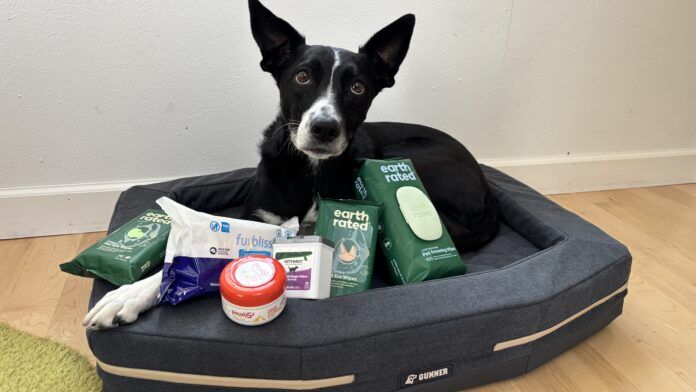
Whether you just need to wipe down your dog’s dirty paws or want to give their coat a refresh in between baths, dog grooming wipes are a convenient solution.
The best dog grooming wipes are ideal for pups with oily coats and can help keep your pup odor-free between full grooms. If your dog has allergies, wiping them down with a wipe can help remove allergens from their coat as well.
Read on for how to choose the best dog grooming wipes for your pooch.
Ingredients: Look for ingredients that are gentle on the skin. Opt for wipes that are PH-balanced for your dog’s skin, and avoid using wipes designed for humans, cats, or other species. Avoid options with soaps, sulphates, and parabens. Note that alcohols (like propylene glycol) may dry out some dogs’ coats.
Natural ingredients like aloe and oats can help soothe dry, irritated skin. Ingredients like salicylic acid and benzoyl peroxide are antimicrobial and antibacterial.
Some ingredients (especially those in medicated wipes) may only be suitable for adult dogs, so check the labels on your wipes before using them on young puppies and talk to your vet about suitability.
Durability: Wipes that shred to pieces during use are no help, so choose for a wipe that’s durable enough to withstand firm wiping.
Scent: Dogs are more sensitive to scents than humans are, so unscented or lightly-scented wipes are best.
| Whole Dog Journal Rating | Product | Price | Notes |
|---|---|---|---|
  | Earth Rated Thick Hypoallergenic Dog Grooming Wipes | $10 | These gentle, unscented wipes are made with hypoallergenic ingredients that help moisturize your dog’s skin and coat. |
 | Furbliss Refreshing Scent Dog & Cate Grooming Wipes | $13 | The Furbliss Refreshing Dog Wipes made my dog’s oily coat feel soft and clean, but they contain an alcohol ingredient that may be drying for dogs with sensitive skin. |
| Douxo S3 Pyo Pads | $19 | For everything from minor skin irritation to hot spots, these Duoxo antiseptic and antifungal wipes are commonly vet-recommended—and are easier to use than over-the-counter medicated shampoos. |
| Earth Rated Pet Ear Wipes | $12 | These pleasantly oat-scented wipes did a great job of cleaning out my dogs’ ears and didn’t rip during testing. |
| Vet's Best Ear Relief Finger Wipes | $18 | These finger wipes are an innovative design to get in the small crevices of your dog’s ears but the shape may encourage pet owners to clean the inside of the ears instead of just the exterior. |
| Earth Rated Pet Eye Wipes | $12 | Though they’re made with gentle ingredients and are unscented, during testing, these wipes were too sudsy to comfortably use to wipe away eye crusties. |
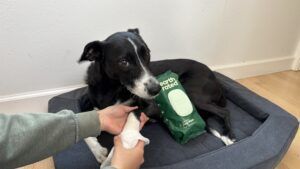
The Earth Rated Thick Hypoallergenic Dog Grooming Wipes are gentle and are completely unscented (though they also come in white tea & basil and lavender scents). Soothing ingredients like aloe, shea butter, chamomile, and cucumber help moisturize skin and coats and leave them feeling soft.
My only qualm about these wipes is that because they contain moisturizing ingredients, they leave a bit of residue on your hands and on some dogs’ coats (especially on short-coated dogs with very oily coats).
This is a good option for dogs with skin folds, like Bulldogs, French Bulldogs, and Pugs, who need regular wiping to prevent dirt buildup and infection. Earth Rated wipes are also a good option for regularly wiping down muddy paws. They won’t dry out your dog’s paw pads and are durable and textured to help get mud and other debris off your pup’s feet.
Since they’re made of plant-based cellulose fibers, these wipes may be compostable at some composting facilities based on their guidelines.
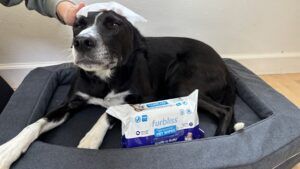
The Furbliss Refreshing Scent Dog Grooming Wipes have a light fresh scent that smells like clean laundry. I have a dog with a coat that gets quite oily in between baths and these wipes helped her coat feel less greasy. They also leave slightly less residue on your hands after use than the Earth Rated wipes.
However, this option does contain an alcohol ingredient (propylene glycol), which can dry your dog’s skin out with frequent use—especially on dogs with sensitive skin or allergies.
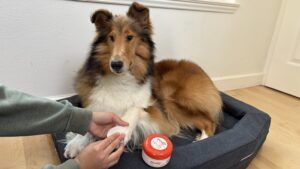
When my Collie got a hot spot on her tail, my vet recommended the Duoxo S3 shampoo and pads to keep the hot spot clean. I found the Douxo S3 Pyo Pads much easier to use on a regular basis since I didn’t have to put my dog in the bath every time I wanted to clean her hot spot. After about five days of regular use, my Collie’s hot spot had drastically decreased in size and irritation thanks in part to the use of these wipes.
The Duoxo S3 Pyo Pads work best for small areas of minor skin irritation, itching, and hot spots. For dogs with large areas of irritation, a medicated shampoo or mousse may be better suited since they can be more evenly distributed.
These wipes contain Chlorhexidine and Ophytrium and are both antiseptic and antifungal. During testing, I found that they weren’t overly drying (they actually seemed to help moisturize my dog’s skin) and had a pleasant vanilla-like scent.
Though this is an over-the-counter product, always consult with your vet before using any product on a dog with sensitive or itchy skin.
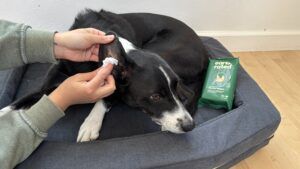
The Earth Rated Pet Ear Wipes come in a pleasant wild oat scent that isn’t too strong. These wipes are quite big, which is helpful for larger dogs with big, floppy ears, like the hound breeds. The large size allows you to move the wipe around to a clean spot as needed. However, they may be a bit too large for small- and toy-sized dogs.
During testing, these wipes did a great job at clearing dirt and wax buildup in my dog’s ears and removed more gunk and grime than the Vet’s Best Ear Relief Finger Wipes. They’re made with gentle, hypoallergenic ingredients, like aloe and chamomile, that can help soothe your dog’s skin.
The wipes themselves are quite durable and, as an added bonus for eco-conscious pet parents, they’re made of plant-based cellulose fibers.
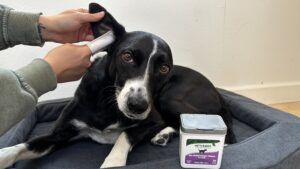
The finger cover design of the Vet’s Best Ear Relief Finger Wipes is handy for getting into small crevices in your dogs ears and is especially helpful for toy-sized dogs. However, there is alcohol in these wipes which may be drying for some dogs’ skin. The finger wipe design may also encourage pet parents to clean the inside of their dog’s ear canals, which isn’t recommended.
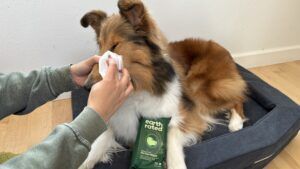
The Earth Rated Pet Eye Wipes are meant to help wipe away discharge, crust, and tear stains from your dog’s eyes. However, they were very sudsy and tended to get suds too close to my dogs’ eyes for comfort during testing. I also wish they wiped away dried-on eye discharge a little bit more effectively.


For anyone who transports their dogs via car—which is pretty much all of us—dog car safety is a must. It’s not just about preventing the dog from interfering with the driver. Good behavior won’t protect a dog in the event of a sudden stop or car accident. Thankfully, there are products designed to do just that.
Some of these are more successful than others. When shopping for dog car safety devices, pay attention to what the product actually does. Look for products that have been thoroughly crash-tested—preferably by an independent organization such as the Center for Pet Safety. Given that there are no established standards for crash testing car restraints for dogs, independent testing provides an important second look at the product’s safety.
Whole Dog Journal is reader-supported. If you purchase through links on our site we may earn a commission. Whole Dog Journal does not accept money for its food and product reviews.
Dog seatbelt tethers are one of the easiest methods for securing a dog in the car as well as being the least expensive. They are usually designed with a clip on one end and an attachment for a car’s seatbelt latch, latch bar, or backseat headrest.
While a dog seatbelt can help keep your dog in the car and out of the driver’s seat, it isn’t really enough to protect her in an accident. Dog seatbelt tethers are rarely, if ever, crash-tested, and typically give the dog a good amount of room to move around. On the plus side, this makes dog seatbelts one of the more comfortable and least restrictive options for securing your dog in the car. However, that also means there’s not much preventing the dog from getting hurt in a crash.
It is also extremely important to note that a dog seatbelt should always be clipped to a harness rather than the dog’s collar. The reason for this is that if too much pressure is applied to a collar through the seatbelt—such as during an accident or sudden stop—severe head and neck injuries are a significant risk. A harness will spread the pressure out across less vulnerable areas of the dog’s body.
In addition to keeping a dog contained in the car, dog car seats are useful in that they can elevate your pup so she can see out the window. This can be especially helpful for dogs who get carsick as it gives them a better chance to visually orient themselves and often gets them more airflow from car vents (which are designed with sitting humans in mind).
Most dog car seats attach to the vehicle’s seat using a seatbelt and include a short tether designed to clip to the dog’s harness. As discussed above, it’s not safe to attached a tether to a dog’s collar in a vehicle.
While dog car seats may improve comfort and limit movement, most are designed more for convenience than true crash protection. With a few exceptions, many are lightly constructed and are not crash-tested, meaning they may collapse or detach during an accident.
Dog car harnesses are a good middle-of-the range option for increasing safety on car trips. These harnesses are designed to distribute force across the dog’s chest and shoulders and attach to a seatbelt or tether system.
Some car harnesses for dogs have been crash-tested, with mixed results. The best-performing models significantly limit forward movement and reduce the risk of serious injury but do so by significantly restricting the dog’s movement.
For detailed recommendations, see “Dog Car Harnesses Review”.
A properly secured, strongly built dog crate is by far the safest way to travel with your pet. Even if the crate is not crash-tested, it can provide protection in the event of an accident. The best crates will be crash-tested and have a number of anchor points which allow you to easily secure the crate in the car.
Hard-sided crates or reinforced metal crates designed specifically for vehicle transport perform far better than wire crates or soft-sided carriers, which can collapse or break apart during an impact.
Seat hammocks and vehicle dividers are popular for keeping dogs confined to the back seat or cargo area. Depending on the model, dog car hammocks can also help keep your dog from sliding off the seat and falling into the footwell. Dog car hammocks and dividers typically attach to the vehicle’s headrests with either clips or loops.
While these products are useful for protecting upholstery and preventing driver distraction, they offer no real crash protection.
While crash-tested, secured dog crates remain the gold standard in dog car safety, they’re not feasible for everyone. At the end of the day, choosing the right car safety option for your canine companion depends on your dog, vehicle, and budget. Just remember, every little bit helps.

Yak cheese chews have become a popular, natural treat for dogs, loved for their durable qualities and minimal ingredient list. Originating from a traditional preservation method in the Himalayan regions of Nepal and Tibet, the hardened cheese was initially developed as a way for people to preserve milk for human consumption. Today, this same recipe, made from a simple blend of yak’s milk, cow’s milk, salt, and lime juice, has been adapted into a dog-friendly version that has captured the attention of many pet owners. Once formed, the cheese mixture is compressed, dried, and aged, creating a hardened, long-lasting chew that dogs love.
Even though these treats are made of milk, yak cheese chews have extremely low levels of lactose, a milk sugar that adult dogs are unable to digest. During the cheese-making process, most of the lactose is removed, making the finished product easy to digest for most dogs. Because of this, they are very unlikely to cause any gastrointestinal upset, such as gas, bloating, or diarrhea. However, if your dog has a sensitivity or known allergy to dairy products, it would be best to avoid feeding these chews.
One of the main benefits of yak cheese chews is their exceptional durability. Unlike soft treats or biscuits that are consumed in seconds, yak chews can keep dogs busy for hours. Providing both mental and physical stimulation. Chewing is a natural, soothing behavior for dogs and helps release pent-up energy, reduces boredom, and can even help alleviate mild anxiety. The firm, abrasive texture also helps promote dental health by helping to mechanically scrape away plaque and tartar buildup from the teeth as dogs gnaw.
Nutritionally, yak chews are high in protein and relatively low in fat, with no artificial preservatives or additives, making them a wholesome alternative to many dog dental treats available on the market that are heavily processed and carb heavy. They are free of artificial preservatives, colors, and flavorings and provide a naturally rich source of calcium and other nutrients.
However, as with any hard chew, yak cheese chews do come with some risks. Because they are hard and dense, there is a very real potential for tooth fractures, especially in aggressive chewers. Because of this, you should always supervise your dog during chewing sessions and choose appropriate size chews to reduce the risk of injury. Another risk arises when the chew becomes small enough to become a choking hazard. Dogs may try to swallow the remaining nub, which can lead to not only choking, but gastrointestinal obstruction as well.
Fortunately, there is a clever and safe way to repurpose any leftover pieces of yak chews: Turn them into yak cheese puffs! When the chew becomes too small to safely gnaw, you can take the remaining piece, soak it in warm water for 5 to 10 minutes, place it on a microwave safe plate, and microwave it for roughly 30 to 90 seconds, depending on its size. The piece will puff up into a light, crunchy treat, like the texture of a cheese-puff snack. It will be extremely hot, so do not handle it until it cools. Once it cools completely, it can be given to your dog as a safe, tasty, and easily digestible treat.
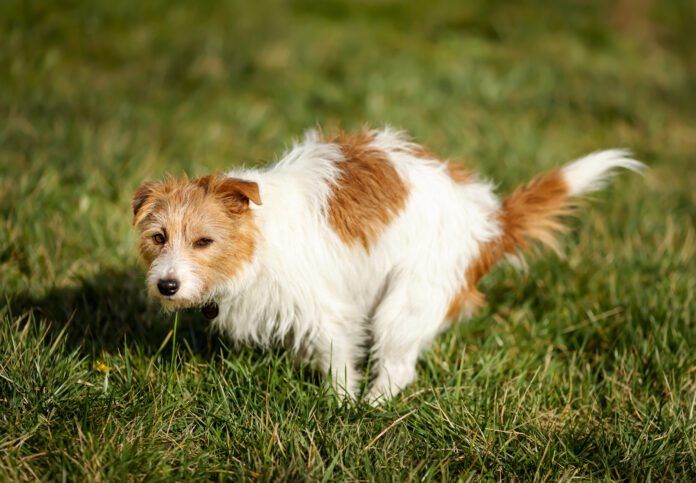
Constipation is uncomfortable for anyone and dogs are no exception. If your dog is straining to poop, a laxative may provide the relief he needs—but only when used correctly. To help identify any potential problems early, monitor your dog’s defecation routine to ensure that everything that goes in is indeed coming back out easily and without drama. If something seems slightly amiss, there are things you can do to help your dog at home.
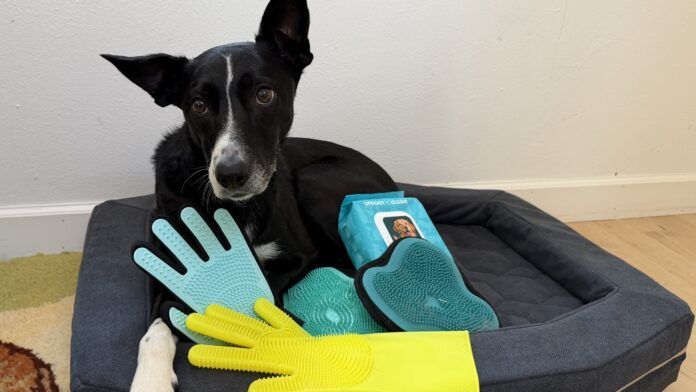
The best dog grooming gloves tend to be used for one of two reasons: helping to lather your dog and remove hair during bathtime or removing hair from your clothes and furniture.
Some dog grooming gloves are marketed as brush alternatives or as options to help with shedding on a dry dog. During testing, I found that they don’t tend to work well for this purpose in most cases.
If you have a double-coated dog right in the middle of shedding season and you’re pulling big tufts of hair out, a grooming glove can help. However, it’s not a better tool than simply brushing your dog out or giving them a bath and drying with a dog blow dryer.
However, dog grooming gloves are great at helping you lather your dog up in the tub more effectively. They can help you reduce the amount of shampoo you use, get your dog soapy down to the skin, and help take some shedding hair out while you scrub (they’re generally better at removing hair in the bath than dry).
Ease of use: The best dog grooming gloves should be easy to put on, easy to use to get your dog lathered up (or easy to remove hair), and straightforward to clean once you’re done using them.
Durability: A dog grooming glove needs to stand up to rigorous scrubbing or hair removal, so it should be well-built enough to last for multiple years.
Performance: We tested how well each of these options lathered, removed hair, and cleaned our tester dogs. We found options that work for varying use cases, so the glove you should go for depends on what your main use case will be.
Whole Dog Journal is reader-supported. If you purchase through links on our site we may earn a commission. Whole Dog Journal does not accept money for its food and product reviews.
| Whole Dog Journal Rating | Product and Maker | Price | Notes |
|---|---|---|---|
| Messy Mutts Reversible Silicone Pet Grooming Glove | $16 | The Messy Mutts grooming glove is a great option for bathing short-haired dogs. It lathers shampoo well, removes hair in the bath, and has a washcloth side for washing the face and delicate areas. |
| Artero Kira Double Sided Rubber Glove Mitt | $23 | The Artero Kira glove is a good option for baths and it adds on a handy hair removal feature to banish stray pet hair from your clothes quickly. |
| FurZapper Pet Grooming Glove | $12 | During shedding season, pet owners need all the help they can get to keep their homes clean. The FurZapper Pet Grooming Glove does a good job at removing hair from large areas, like furniture, bedding, and rugs. |
| Uproot Grooming Gloves Pro | $20 | If you want to give your dog a quick wipe down between baths, the Uproot Grooming Gloves Pro are a niche but useful option. They leave your dog’s coat feeling clean and won’t get your hands dirty or hairy. |
| Well & Good Grooming Gloves for Dogs | $7 | At just $7, the Well & Good Grooming Glove is best for pet owners on a budget. It’s double sided so can be worn on either hand and is a no-frills option for getting your pup clean during bathtime. |
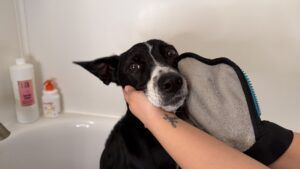
Some short haired dogs and single coated dogs don’t lather well in the bath, and a grooming glove can help distribute shampoo and conditioner more efficiently. The Messy Mutts Reversible Silicone Pet Grooming Glove is one I’ve used on my single-coated Border Collie mix for the past few years to get her clean during baths. She has a short coat that tends to get greasy, and if you don’t lather it well enough, it doesn’t feel clean after a bath.
This glove has two interior straps to hold your hand in place inside the glove regardless of which side you’re using. It has a soft, comfortable interior that feels nice on your hand, and the washcloth side is ideal for washing your dog’s face and other sensitive areas that don’t necessarily need to be scrubbed.
In terms of cons, the drainage of this glove isn’t as good as other options on this list (it tends to fill up with a bit of water, and the wrist strap closure is a little bit looser than the Artero grooming glove.
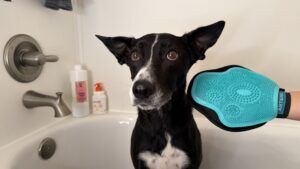
The Artero Kira Double Sided Rubber Glove Mitt goes beyond just bathtime. This versatile, double-sided option features one side with rubber bristles for scrubbing and removing hair, and a textile side that removes hair from clothes, furniture, and other fabrics. The hair remover side only works in one direction though—if you swipe it the other direction, it re-deposits any hair you took off back onto your clothes or furniture. Still, it’s a good alternative to sticky lint rollers.
This grooming glove is easy to put on and secure on your wrist with a Velcro strap. The tight, secure Velcro keeps hair and dirt from getting inside it during baths. It also has an interior strap that helps the glove stay on your hand (but it only has one as opposed to the two that the Messy Mutts glove has).
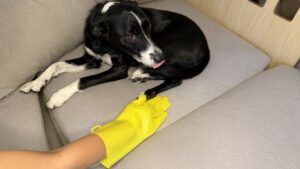
The FurZapper Pet Grooming Glove is best used for removing hair from couches, clothes, blankets, and other furniture. It does a good job at getting rid of hair on large couch and furniture cushions and is easier to use than some other pat hair removers, like the ChomChom.
It can also be used for scrubbing during bath time, but I found that the other bath-specific gloves tended to lather better and remove more hair off of the dogs during baths. The perk of this glove though, is that it’s long like a dishwashing glove and waterproof, so there’s less likelihood of getting hair and soap all over your hand. It can also easily be rinsed clean and laid out to dry on a dish rack.
However, there are a few cons to this option. The fingers are a bit small for people with large hands and it only comes in one size. It also doesn’t have any drainage, so if you do get water in it, you’ll have to take it off completely to empty it out.

Need to give your dog’s coat a quick refresh between baths? The Uproot Grooming Gloves Pro are handy disposable glove wipes that work well to wipe your pup down. In comparison to a traditional dog wipe, these gloves are more durable and less likely to rip, and they protect your hand from any messes (they’re especially good for wiping butts and muddy paws).
They’re fairly large, fit most hand sizes, and leave both your dog’s coat and your hand feeling fresh after use. I didn’t notice any residue during testing.
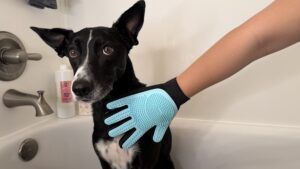
If you’re on a strict budget, this Well & Good Grooming Glove for Dogs is worth a look. At just $7, it gets the job done for folks who simply want a grooming glove to help lather their dogs and remove extra hair while bathing.
This glove is a true glove as opposed to a mitt, like the Artero and Messy Mutts option, so it gives more finger dexterity, which can be especially useful for small dogs or hard-to-reach areas. However, the material is very thick and rigid, so it needs some breaking-in before it’s truly comfortable to use.
This is another option that isn’t great for large hands, but it can be used on both your left and right hands since it’s double sided. Overall, it’s a budget-friendly, no-frills option that can help stretch your shampoo and get your dog a little cleaner.
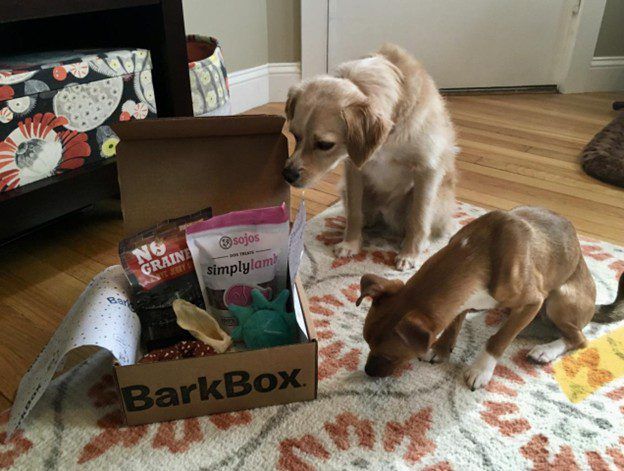
First-time dog parents Ashley and Ryan Bremberg wanted to spoil the two dogs they adopted so the Boston area couple signed up for a BarkBox dog box subscription.
“I liked that it gave us ideas of what to get them,” Ashley says. “Their marketing made me want to get the box.”
Whole Dog Journal found that the Brembergs are among the estimated millions of people who have signed up to receive a dog subscription box of toys and treats delivered to their door.
Subscription-based purchases are on the rise among pet owners, with more than half buying online—a 33% increase over the past six years. Gen Z-ers and millennials are especially likely to enroll in online subscription services.
“This growth has fueled the popularity of subscription boxes, a favorite way for owners to explore new products that keep pets engaged and entertained,” says Patrick O’Brien, Chief Marketing Officer with the American Pet Products Association.
But how exactly do dog subscription boxes work? How much do they cost? How do you figure out if you’re getting your money’s worth? We break down dog box subscription secrets.
Dog box subscriptions are popular because they combine convenience and the element of surprise. Someone else is doing the shopping for you, and of course, whose dog doesn’t like getting a delivery of new pooch presents?
“Pet parents love getting curated selections without having to shop around,” says Daniel M. McCarthy, an associate professor of marketing at The Robert H. Smith School of Business at the University of Maryland. “There’s an emotional component—it feels like giving your dog a monthly gift, which taps into how we increasingly treat pets as family members.”
The dog subscription box model works similarly to meal, wellness, and beauty delivery subscription boxes for people.
“There’s a discovery aspect where you get to try new brands and products you might not have found otherwise,” McCarthy says.
The secret to saving on many of these dog box subscriptions is signing up for long-term plans. Some companies offer steep discounts for being a regular customer. The more you subscribe, the more you save.
“The way it works is you get a discount for the longer you commit,” says Paul Banker, vice president of marketing for BARK, the company behind BarkBox.
For example, a month-to-month subscription for a BarkBox basic, or what the company calls a classic box, is $30. But a six-month subscription is $27 per month, and a 12-month subscription drops to $24 per month. There’s also a 10% discount for prepaying for the six or 12-month plans.
| Dog Subscription Box | Basic Box Cost | What You Get |
|---|---|---|
| BarkBox | $24-$40 a month, depending on subscription type & frequency | ● Two toys ● Two bags of healthy treats ● Offers toys only plan |
| PupJoy | $32.29-$35.99, depending on dog size & subscription frequency | ● One unique toy ● Two premium treats ● Two grass-fed bully sticks |
| PupBox | $29-$39, depending on subscription frequency | ● Five to seven products like toys, treats, accessories & training tips |
| Pet Treater | $15 a month | ● Three to four items featuring toys & treats ● Offers toys only plan |
| Rescue Box | $29.95-$34, depending on subscription frequency | ● Five premium pet products: Toys, treats, & chews. |
| BullyMake | $29-$45 a month, depending on subscription | ● Two to three tough toys ● Three healthy treats ● Offers toys only plan |

Each BarkBox contains two toys, two bags of all-natural treats, and a dog chew, but dog owners can opt to receive more or less of toys or treats in place of the other. While there are no all-treat boxes, subscribers can choose three toys instead of two toys and two bags of treats.
BARK, which started in 2011, is one of the most well-known dog subscription box companies, popular for its themed boxes, such as Howl-O-Ween Party and Barkbuster movie night.
“There’s a new theme every month that never repeats,” Banker says. “We’re always offering completely custom toys that you can’t get anywhere else.”
While BARK started out with offerings from other brands, the company now makes all its own toys and treats. Pet parents can customize their dog box delivery by choosing treats that exclude ingredients their dog may be allergic to – or selecting a “super chewer” toy option for active dogs who love to gnaw on their stuff.
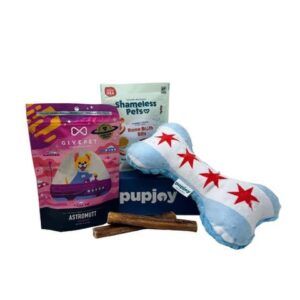
Another popular dog subscription box company, PupJoy, which started in 2014, says it opened its doors with the goal of allowing more customization for customers.
PupJoy’s pre-built boxes arrive with one toy, two premium treats, and two grass-fed bully sticks.
The company also makes a “power chewer box” with durable chews and toys and has a build-your-own box preference, which allows you to pick exactly what you want.
“You can select a certain number of items from six sets of categories, things like jerky treats, freeze-dried treats, various types of toys, and then we’ve got a number of add-ons that tend to be pretty popular, like bully sticks,” says Dustin McAdams, founder and CEO of PupJoy.
McAdams says the vast number of the company’s new customers are selecting the build your own box option.
“The feedback we’ve gotten is that people like being able to choose,” McAdams says. “If they’re getting a few too many bags of treats in the pantry or they don’t have enough, they’re able to modify that easily and fix it.”
Many dog subscription boxes have similar types of toy and treat combos, but with a few different choices.
PupBox boxes include toys, treats, and accessories like leashes, grooming products, and training guides.
Rescue Box sends toys, treats, and chews, and every box purchased helps feed animals in shelters.
In addition to treats, Pet Treater and BullyMake both have a dog toy subscription box only selection. BullyMake’s website touts that its toys are super tough and also has themed boxes.
How do you find the best dog subscription box for you and your pooch?
Typically, the value of what you get in a box is worth more than what you pay. But if you want to do the math, there are a few ways to think about it.
“Compare the box price to what you’d spend buying similar items individually—most boxes offer a 20-40% discount relative to the manufacturer’s suggested retail price on longer-term subscription plans,” McCarthy says. “Consider the time, savings, and convenience factor, especially if you’re someone who regularly buys new toys and treats anyway. Look at the quality of brands included: are these premium products you’d actually want?”
Another important factor: When you sign up for a subscription, estimate what you really need, or you could end up with a stockpile of toys and treats. (Though your dog may not see this as a problem.)
“That ‘accumulation governor’ is a big driver of pauses and cancellations,” McCarthy says. “Cadence control is very helpful. If you see toys and treats piling up, switching to quarterly or using a skip/pause option is the smarter move.”
Toy overload was the main reason the Brembergs canceled their subscription, but now that they know they can pause it, they may re-subscribe.
“Our dogs don’t destroy toys, so we just ended up having so many, we donated some to shelters,” Ashley says. “But maybe I’ll sign up again.”

Seeing your dog looking unusually tired, restless, or uncomfortable understandably leaves you searching for answers on how to help. Knowing how to take your dog’s temperature is an important first step in helping her.
The normal body temperature for a dog is considered between 99.5 and 102.5 degrees Fahrenheit, according to the Merck Manual of Veterinary Medicine.
You’ll most likely use a digital thermometer, which you can find online or at pet supply store for about $10 to $20, to take your dog’s temperature in one of these three ways:
“A rectal temperature using a digital thermometer is considered the gold standard ,” according to Dr. Rebecca Greenstein, chief veterinarian of Kleinburg Veterinary Hospital in Ontario, Canada, and veterinary medical advisor for Rover.com.
While you may be tempted to use an ear thermometer for convenience, they are often less reliable and can be difficult to use correctly.
To take your dog’s rectal temperature, in addition to a digital thermometer, you need a lubricant (like petroleum jelly), and a helper to keep your dog calm.
Follow these steps to take your dog’s rectal temperature:
However, VCA Animal Hospitals warns, “If you feel stool in the rectum, try to place thermometer around the fecal matter rather than through it, to ensure an accurate reading. If the pet clamps their anal sphincter, do not force the thermometer into the rectum to avoid injury and pain for the pet.”
“An elevated thermometer reading in an otherwise normal dog may be from anxiety, stress, panting, trembling/shaking, or hot weather. It can also be a sign of heatstroke, infection, inflammation, immune-mediated disease, or certain cancers,” according to Dr. Greenstein.
Remember that a fever is not an illness, but rather a symptom that your dog’s body is fighting something. As Dr. Greenstein notes, high temperatures can be caused by a variety of factors.
Common causes of a high body temperature in a dog include:
While it’s less common than fever, a low temperature is just as serious. According to the American Red Cross, signs of hypothermia in dogs include body temperature below 98.5 degrees , decreased heart rate, dilated pupils, shivering, unconsciousness or coma, and weak pulse. While dogs can cope with small changes in body temperature, a large or sudden drop can be life-threatening. The serious effects of sustained hypothermia can include a slow, irregular heartbeat, kidney and gut damage, blood clots, and a reduced ability to fight infection.
If you suspect that your dog may be suffering from hypothermia, the Red Cross recommends that you follow these steps:
You should contact your veterinarian immediately if your dog has a temperature of 104°F or higher or below 99°F, says Dr. Greenstein. However, beyond those extremes, “A lot of it depends on context. If your calm pet has a slightly elevated temperature [of 103.1°F ] or your usually excitable panting dog has a slightly decreased temperature [99.86°F], and is lethargic, not eating, having tummy upset or any unusual behavior, then I’d be concerned enough to have that patient seen by your family doctor.”
Remember that despite your concern, never give your dog Tylenol (acetaminophen) or other human fever reducers like ibuprofen. These are highly toxic to dogs and can be fatal.
As in all cases if you have concerns about your dog’s health or think he or she may be in danger, the best course of action is to contact your veterinarian for professional guidance.

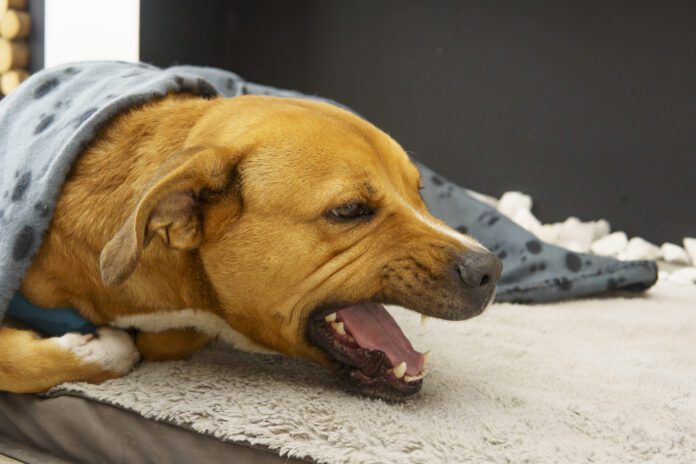
As I listened to my dog cough the other night, I found myself shifting out of my logical veterinarian mindset and into my role as pet parent. Nobody likes it when their fur baby is not feeling 100%, including us veterinarians. When it does happen, I do try to remind myself that it is an opportunity to reacquaint myself with what it feels like to be on the other side of the exam table. Having a coughing dog is a great example of this because when there is a kennel-cough outbreak in the area, my veterinary hospital fields a lot of questions.
However, remember that kennel cough isn’t the only reason dogs cough. Heart disease and heartworms can also make a dog cough.
Pneumonia, which involves the lung more than the trachea/bronchi, can cause coughing but is more likely to be a softer, moist cough than a honking cough. Dogs with pneumonia often feel sicker. They are more likely to be febrile, lethargic, and expend more respiratory effort to breathe.
Other causes of coughing include collapsing trachea, allergies, internal parasites, irritants, and neoplasia.
But, kennel cough does have a classic cough that sounds very much like a honking goose. The cough is loud, dry, and harsh. Concerned pet parents often describe the cough as sounding like their dog has something lodged in his throat. If your dog was totally fine and had something in his mouth right before sudden onset significant coughing/gagging began, then an object/food in her airway (or esophagus) is more of a possibility than if onset of coughing was more gradual.
So, what do you do when you suspect your dog has kennel cough?
Kennel cough is the common name for a highly contagious respiratory illness of dogs also known as infectious tracheobronchitis and canine infectious respiratory disease complex (CIRDC). Most commonly it presents as a dog that is still active but has a honking cough, often with a gag at the end of the coughing spell. If the gag is significant enough sometimes the dog will bring up phlegm or some of their most recent meal.
In otherwise healthy pets, most of the time it is an illness that is more annoying than life-threatening. When I say annoying, I mean both for the dog (because we all know coughing is not fun) and for the pet parent who empathizes with the dog and may experience some additional inconvenience such as cleaning up the phlegm/stomach contents that the dog gags up or disruption to plans.
Because kennel cough is highly contagious and spread through aerosol, direct contact, or contact with contaminated objects, other challenges for the pet parent can include having the illness go through all the dogs in the house one by one or having make short notice pet care arrangements because the dog can’t attend day care, grooming, or boarding facilities while contagious. Dogs should also not frequent dog parks, attend any dog competitions or go with their pet parents to visit households with other dogs.
Humans who are in contact with kennel-cough dogs should take care to wash hands thoroughly, change shoes, and clothes before being around other dogs so as not to spread the illness. There should be no sharing of toys or bowls although if in the same household there is probably already so much direct contact between family dogs that this may be a moot point.
As the name suggests, kennel cough most commonly spreads when a group of dogs are in common space together indoors such as in a boarding or daycare setting. Dog shows, dog performance events, or animal shelters can be another location of common spread because pets are coming together from many different areas and spending time in relative proximity to each other. It only takes a single dog that is infected with kennel cough (and possibly not even showing signs yet) to infect another dog.
The kennel cough vaccine usually starts with Bordetella bronchiseptica (bacteria) and often includes parainfluenza with or without adenovirus, but they are not the only infectious agents that cause these symptoms. If you have ever wondered why this vaccine is commonly given intranasally, it is because it allows not just for systemic antibodies but also antibodies that stay in the respiratory tract (secretory IgA) where they can act as a first line of defense. There is also a separate vaccine for two different strains of canine influenza (another virus that can often cause the same symptoms).
“Why is my dog coughing from kennel cough when I got her vaccinated?” is one of the most common questions I get asked when I diagnose a dog with kennel cough. The reality is that kennel-cough symptoms can be caused by many different bacteria and viruses, and sometimes they can appear in combination. This is why a more recent medical term for kennel cough is CIRDC.
Kennel cough is most often diagnosed by physical exam and patient history. A common physical exam finding is increased tracheal sensitivity on palpation of the trachea. For cooperative dogs, this is a quick easy thing for your veterinarian to check as part of your dog’s exam because they can reproduce the coughing in the exam room to hear it for themselves.
Dogs can have tracheal sensitivity for other reasons so the veterinarian must consider the history and entire “picture” the dog presents but an absence of tracheal sensitivity typically moves kennel cough down my list. Most commonly the dog has a history of boarding, daycare, dog park (yes, it can spread outdoors), recent grooming, being in a shelter, or being exposed to another dog that has been one of these places. Sometime the infected dog isn’t coughing because she hasn’t started showing symptoms or she could have a subclinical case and appear asymptomatic.
It is possible to test for the offending infectious agent(s) but getting a conclusive diagnosis can be challenging. The samples usually need to be collected within the first couple of days of onset of symptoms. Many dogs don’t even see the veterinarian that early in their illness. Also, sample collection involves swabbing the pharynx (throat), nasal passage, and/or conjunctival area of the eye. We have probably all had enough COVID testing swabs done on ourselves by this point to understand that many dogs will object to this process and could requite mild sedation to collect samples.
Add on top of these factors that the test itself is not inexpensive, takes several days to return results, and may not produce a diagnosis. Reasons for not identifying an organism on the respiratory panel can include sample collection issues (timing, uncooperative patient) or a causative agent not severe enough/not studied enough to be included in the panel. All this is in the face of an illness that is generally self-limiting. This means a lot of pet parents will opt not to test. That doesn’t necessarily mean it is never worth testing, it just means one should have proper expectations.
In addition to the physical exam and patient history, additional diagnostics such as X-rays, complete blood count, heartworm testing, and a fecal exam may help with diagnosing the cause of a cough.
The good news is most dogs get better from kennel cough on their own with just a little time and TLC. Most of them don’t need antibiotics (remember, it is often viral, which antibiotics won’t help). Limiting high-energy activity can help because often the more excited the dog, the more they cough.
If the coughing is severe, your dog may need medication or treatment to help manage the cough either through suppressing the cough or decreasing the inflammation. The bad news is your dog needs to not go anywhere where she could infect other dogs for about two weeks AFTER symptoms resolve and the dog is off medication. It also means you should take appropriate precautions if you are in contact with any other dogs when you leave the house. As I mentioned earlier, this involves things like changing clothes/shoes and handwashing.