
To continue reading this article or issue you must be a paid member. Sign in

Join Whole Dog Journal
Get full access to Whole-Dog-Journal.com – more than 4,000 articles – for just $20.
Join today and save 30% off our full price.

Subscribe
The best in health, wellness, and positive training from America’s leading dog experts
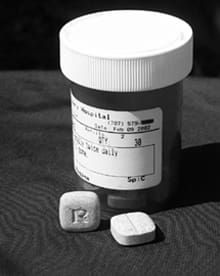
Deborah, one of the members of the local dog-training club, regularly fills her prescription for Synthyroid at a large chain pharmacy in town. She will take this drug for life due to her underactive thyroid gland. Deborah regularly checks pricing for the drug at several pharmacies to ensure she continues to pay competitive rates.
Susan, also a club member, regularly purchases Soloxine, a lifetime prescription medication also indicated for an underactive thyroid condition. Both prescriptions have the same basic active ingredient: Levothyroxine.
Susan, however, administers the prescription she buys to her dog, Jo.
Like many guardians of companion dogs, Susan is faced with new options about deciding where to economically and safely purchase prescription medicines for her dog.
Traditionally dispensed solely from the veterinarian’s office, prescription drugs for companion dogs represent a ripe peach – ready for picking by retail chain pharmacies and emerging Internet-based pharmacies that have sniffed out a promising new niche in the lucrative pharmaceutical market. These drug retailers have discovered the more than 35 million dog owners in the United States who anticipate the same access to sophisticated medicines for their dogs as they have come to expect for themselves.
As quickly as animal pharmaceutical companies rush to the Food and Drug Administration’s Center for Veterinary Medicine (CVM) with applications requesting approval for new drugs or new drug uses for animals, the pharmaceutical retailers are rushing to the consumer with discount price offers. But just how attractive are these discount drug deals, and how will this increased competition for the guardian’s dollar in the companion animal drug market affect the veterinarians’ practices?
New competition
When the telephone company was affectionately known as “Ma Bell,” it held a monopoly position in telephone communications. AT&T sometimes used revenues collected for its most profitable services to subsidize less lucrative activities, such as providing telephone service to remote towns at affordable rates. Then, competitors focusing on the most profitable pieces of the market, like long distance service in major cities, picked off those segments of the business, leaving the less-lucrative segments behind. Thus began a restructuring of the telecommunications industry’s rates, with each individual service either fully supporting itself or disappearing.
Until very recently, most veterinary practices ran their businesses much like the Ma Bell of 20 years ago. The sale of veterinary pharmaceuticals was a profitable part of the average veterinary practice, accounting for about 20 to 30 percent of the total average practice income. Most veterinarians follow the recommendations of practice consultants and drug manufacturers to mark-up pharmaceuticals about 100 percent over their cost of the drugs. This subsidizes other veterinary services, such as affordable spay and neuter programs and upgrades in medical equipment. It also helps to hold fees at moderate levels for hospitalization, radiographs, and professional services like examination and diagnosis, thereby enabling these procedures to be available to a greater number of animals.
In other words, just as in the “old Ma Bell” model, many of the services provided by the veterinarian’s office are not priced to the consumer in direct relationship to the veterinarian’s cost of providing the service. And today, just as with the lucrative long-distance slice of the telephone industry, one of the most lucrative segments of the veterinary market – long-term prescription drugs – is under siege by other drug retailers and Internet pharmacies.
Some veterinarians, feeling the pinch as more and more clients request written prescriptions that they can fill elsewhere (rather than purchasing their dogs’ medications from the veterinarian), have instituted a charge for writing prescriptions.
However, other veterinarians say they understand why some clients, especially those whose dogs require long-term or especially expensive drug therapy, need to economize where possible, given their significant and ongoing investment in their animals’ care.
Different prescription needs
Generally speaking, there are a handful of situations involving prescription veterinary medications. Some lend themselves to bargain hunting; others do not.
In the first scenario, a dog has an acute illness of some kind, requiring the immediate administration of a short-term medication. Say, he’s got conjunctivitis, and needs an antibiotic ointment, or a urinary tract infection, and needs antibiotic therapy for a week. Most of us, in situations such as these, would gladly pay the veterinarian for the relatively inexpensive medications, and take them home with the dog.
Emergency medical situations are another example of a time when most of us would rather pay our veterinarians for immediate access to any medications required– at almost any price – to save our dogs.
But there are other situations where doing some bargain hunting makes sense. One is in the case of common veterinary preparations that a dog owner might use fairly frequently, such as Heartgard, a heartworm preventive. Typically, these items are marked up 100 percent, but they can be found at prices representing as much as 200 or 300 percent of their wholesale price. Finding a discount outlet for these brand-name items, especially if one has several dogs, only makes sense.
More significant is the case where someone has a dog with a serious medical condition that calls for expensive, long-term drug therapy. People whose dogs receive prescription medication for long-term health problems such as heart conditions, thyroid, seizure disorders, Cushing’s Disease, and even serious behavior problems may spend as much as hundreds of dollars a month on their dogs’ drugs. (See “A Tale of Two Prescriptions” sidebar) Saving half of that money by buying the drugs for less from an outlet other than the veterinarian may well be imperative for preventing what some veterinarians call “economic euthanasia,” where an owner feels forced to put a dog to sleep because she can’t afford the medicine needed to keep him well.
Keep in mind that insuring your dog with a veterinary health insurance plan or joining a membership discount organization may eliminate the need to shop for discounted prices. For more information on these plans, see “Covered Pup,” WDJ July 2002.
Pricing a prescription
The most important piece of information to take away from this article is that prescription drug prices vary dramatically among retailers. It takes a bit of work to gather all the relevant information from the possible sources of prescription medications for your dog, but it’s well worth the effort.
First, check for human brand name equivalents and generics. Ask your veterinarian if she can prescribe a human drug with the same ingredients as the veterinary drug. Sometimes, the equivalent human drug costs less than the veterinary drug, even though there may be absolutely no difference between them. The practice of giving drugs that have been approved for humans to animals is known as prescribing “off-label,” and is restricted by the FDA to animals not used in the production of food for human consumption.
An example of this is Etogesic, manufactured for animals by Fort Dodge Animal Health, and Lodine, the human equivalent manufactured by Wyeth-Ayerst Pharmaceuticals. Both drugs are nonsteroidal anti-inflammatories commonly prescribed for pain. Both utilize the same active ingredient: Etodolac. Price both prescriptions for a full accounting of available costs for the drug.
Next, call every pharmacy in your area and ask how much they charge for that prescription. Make sure to ask for the price of the veterinary drug, its human equivalent (if it has one), and its generic form. Make sure you confirm the dose and the amount with the pharmacist.
If the drug comes in tablets, ask about “pill splitting.” Often, drugs cost less, compared milligram to milligram, in higher-dose tablets than lower-dose tablets. For example, say your dog is supposed to take 80 mg of a drug per day; 40 mg in the morning and 40 mg at night. It may be less expensive to buy 80 mg tablets and cut them in two, feeding him half a tablet twice a day, than to buy 40 mg tablets. (This won’t work with capsules, and works best with tablets that are scored in the middle. Tiny tablets may be too difficult to cut accurately.)
Trying alternative pharmacies
You may be able to realize further savings by taking your veterinarian’s prescription to an Internet or catalog pharmacy. These outlets can sometimes offer deeper discounts than “brick and mortar” businesses, since they have less overhead. However, keep the following in mind when shopping at mail-order pharmacies:
For an accurate price analysis, add shipping and handling costs to the price quoted for the medicine. These factors may erase any savings that you thought you would realize by purchasing from a catalog or Internet pharmacy.
It’s easier for unscrupulous pharmacies to get away with illegal practices when they don’t maintain local retail outlets. There have been numerous complaints that Internet pharmacies, especially, dispense “knock-off” and foreign drugs, or drugs not approved by the FDA for use in animals. Ask for a written guarantee that the pharmacy offers only drugs approved by the Food and Drug Administration (FDA), does not use bulk drug chemicals manufactured for overseas production to concoct imitations of approved drugs, and does not sell foreign-made versions of U.S. products. Some U.S. drug companies will not accept responsibility for their products purchased in the U.S. over the Internet if the products were manufactured to non-U.S. specifications. (See “Problems with Internet Pharmacies” sidebar.)
Your veterinarian must be kept “in the loop.” Several Internet pharmacies have engaged “staff” veterinarians to write prescriptions for consumers who order drugs online. In all but a few states it is illegal to dispense prescription drugs without the benefit of a traditional doctor-patient relationship. This law ensures that a medical professional monitors the condition of any patient taking the prescription medication, including making a proper diagnosis, checking for drug interactions, and managing the possible side-effects of the drug.
The administration of some drugs to a dog may require follow-up blood tests, urine tests, or other actions to monitor the impact of the drug on the dog’s various body systems. Also, a veterinarian should check dogs taking multiple prescription medications for the possible harmful effects of drug interactions. No matter where you buy your dog’s medications, their use must be monitored by your veterinarian.
Mail-order pharmacies may not be fast enough. Some prescriptions, such as antimicrobials prescribed to treat infections, should be administered to the animal immediately. Adding time for shopping, ordering, and shipping drugs may endanger the dog’s health.
Work with your vet
We’re not trying to put the squeeze on veterinarians, but we do think that cost-conscious guardians who purchase prescription medications can be responsible consumers by buying from a reputable source while maintaining the doctor-patient relationship between their veterinarian and their dog.
If you contemplate buying medicines from retailers, catalogs, or Internet sources, run the prices by your veterinarian before making your purchase. Several veterinarians we interviewed mentioned that, if their good clients find a much lower price for prescription medications outside their practice, they would do everything they could to at least meet the price.
-by Lorie Long
Lorie Long lives in North Carolina with two Border Terriers, Dash (a three-year-old female and agility queen) and Chase (a five-month-old male with an agility future).

“She’s a wonderful dog at home. But I can’t take her anywhere because she simply goes crazy when she sees another dog.”
“I was asked to leave my agility class because my dog kept barking and lunging at the other dogs. We have to channel her energy somehow. What are we going to do now?”
“I just don’t know if I should keep him. He’s a great dog with us, but he’s so wild around other animals and people. I’m afraid he’ll hurt someone or get into a serious dog fight.”
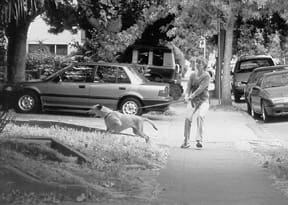
Does this sound like your dog? Every dog gets “wild” sometimes. But some of us live with dogs who exhibit difficult or wild behaviors every day!
It might help you to learn that many dogs who exhibit “difficult” behaviors such as hyperactivity, aggression, and destructive separation anxiety do so as a result of stress. The behaviors that we find so troublesome – barking, overenthusiastic greetings, dragging us around on leash, destructiveness, etc. – are all efforts by the dog to relieve his stress.
By your own standards, your dog’s life may not seem all that stressful – after all, he doesn’t have bills to pay, does he? But when you apply the more scientific definition of the word – anything that alarms or excites him, triggering his sympathetic nervous system into action and flooding him with the “fight or flight” chemicals adrenaline and noradrenaline – you may be able to see how many seemingly unrelated things in his environment actually contribute to his “misbehavior.”
Again, the triggers could be anything the dog sees as exciting or threatening. For some dogs, this may be strange people or dogs. For others, visual stimulation such as the sight of squirrels or cars going by out the window could trigger stress. Auditory cues such as trains, sirens, or garbage trucks might set off their internal alarms. For emotionally needy dogs, being left home alone might trigger a stress reaction.
And imagine how difficult it must be to not act out in some physical way while being flooded with adrenaline! (For a long discussion of the physiology of stress, see “Stressed Out?” WDJ January 2000.)
There is hope
Dogs whose stress results in behavior issues like nonstop barking or even aggression are often labeled “difficult” dogs. Living with a difficult dog can be unpredictable and sometimes even frightening. Simple things – like friends or family coming to dinner, going for a walk in the neighborhood, even taking him to the vet – can be an ordeal.
I know, because I live with a “difficult” dog. My Jesse is sweet, sensitive, playful, and a great companion. She is also, to put it mildly, difficult in many day-to-day situations. My family has dealt with typical stress issues such as separation anxiety, hyperactivity, and jumping, as well as more serious stress-related problems, like dog to dog aggression. Jesse’s natural response to stress manifests in fight rather than flight.
Yet today life with Jesse is so easy and enjoyable that I sometimes forget that she is a difficult dog. What has made the difference? It hasn’t been one single change, but rather a holistic approach. By integrating a positive attitude, lifestyle changes, training, and behavior modification, life with our difficult dog has become much easier than I ever thought possible.
I am what I am
Changing your attitude about your dog is the first and possibly the most difficult step in developing a saner life together. It probably seems obvious that a positive outlook can make a huge difference. But when you live with a dog who sometimes behaves in a frightening way (like snarling at other dogs), it’s hard to remember his wonderful qualities. It’s also hard to have faith that things can and will get better.
Focus on your dog’s good traits. Every dog has traits we see as positive and some we see as negative. By identifying your dog’s good traits, you’ll begin laying a foundation for strengthening those traits and bringing out the best in your dog. Try writing down all of your dog’s good qualities. Post them on the refrigerator or somewhere else where you will see them often.
Take some time to re-frame the negative traits, too. I used to think about Jesse’s protectiveness and aggression toward other dogs as a “problem.” Like many trainers, I assumed her behavior issues were because of a lack of something – like not enough early socialization or not enough training.
Then, one day, I challenged myself to think about what Jesse, a cattle dog mix, would be like on a working ranch. In the city, her ushering other dogs away from her home and family is seen as aggressiveness. On a ranch, her protectiveness over her “flock” would help keep predators away. Her hyperactive nature, which is difficult to cope with in a small home with a small yard, would lend itself to endless hours of herding. Even her relentless hunting of small furry creatures (like rats, gophers, and squirrels) would most likely be appreciated in a rural setting where it is important to control the vermin population. On a ranch, she would not be seen as a difficult dog. She might even be a prized dog!
Identifying the aspects of your dog’s nature that are natural and normal can help you understand that your dog is not being bad – or even difficult – but just being true to her genetically inherited nature. Many of the qualities that I think of as “difficult” in Jesse would actually be desirable under the right circumstances.
Of course, that doesn’t mean I can just ignore Jesse’s natural behavior traits. After all, I don’t live on a ranch. But by looking at your dog’s positive qualities, and re-framing the challenging behaviors, it may be easier to appreciate who your dog is, and not expect her to be someone she isn’t.
Prevent emotional overload
Before implementing any training or behavior program with a difficult dog, you will need to figure out a short-term management plan to help prevent the emotional overload that leads to stressful outbursts. A stressed dog can’t learn and a stressed person can’t teach.
Management means controlling your dog’s environment to the extent that he doesn’t have the opportunity to become hyperreactive, anxious, or aggressive – at least long enough for you to help him learn new coping skills. Management may involve confinement, head halters, changing routines – anything to help prevent the dog from acting out. Remember, each time a dog has the opportunity to act out, he stands a good chance of being rewarded for doing so, increasing the likelihood that he will act out again in the future.
Consider this example: Muffin and her human companion are walking down the street. Muffin sees another dog coming her way. Perhaps Muffin is worried and unsure how to behave. She barks and lunges in hopes that the other dog will move away. The human companions of both dogs cooperate, by moving the dogs to opposite sides of the street. For Muffin, her barking and lunging just successfully resulted in the other dog moving out of her space. While she may not have been given a single treat, Muffin was definitely rewarded for her behavior.
Of course, from the human perspective, if a dog is acting aggressively toward another dog while on a walk, crossing the street is a perfectly reasonable solution. So how can you avoid rewarding a dog like Muffin for aggressive behavior?
If possible, do not give her the opportunity or place her in a situation where she is likely to be aggressive. Hyper-vigilance on the part of Muffin’s human companion could be the initial management strategy. By turning corners, walking the other way, or crossing the street when another dog came into sight, before Muffin had a chance to bark or lunge, Muffin’s human could successfully prevent Muffin’s angry outbursts. Walking her earlier in the day, before the prime dog walking hours, could also help.
In addition, it would help to use a head halter on Muffin for all her walks so that her head could easily be turned away when she did see other dogs.
Train for the brain
According to James O’Heare, executive director of the Academy of Canine Behavioral Theory, the best strategy to get a dog through a stressful event is to focus the dog’s attention on a specific cognitive task. In other words, give him something to do – engage his brain. A dog whose brain is engaged is much less likely to react emotionally in any given situation. (Conversely, a dog who is in an emotional state generally cannot think or focus on a specific task. In our home, we say that the dog has “lost his brain” when emotions take over.)
Teaching a dog an incompatible behavior is one of the first courses of action and will help both in physically managing the dog and with gradually desensitizing him to the stimuli that sets him off. For example, teaching your dog to watch you while heeling can be a terrific management tool for dogs with compulsive greeting problems or on-leash aggression. If the dog is watching you, he can’t lunge at that other dog!
In addition, develop a repertoire of fun and engaging behaviors to help your dog de-stress. These should not be control exercises, but rather, active behaviors that are strictly for fun and play. For some dogs, catch games with a ball or toy work very well to de-stress. Use these fun activities to help your dog unwind after a stressful event.
For example, if you are walking down the street and pass a strange dog, have your dog heel and watch you, keeping her engaged and offering plenty of great treats until you are well past the other dog. Then, let loose with a few fun games to help you both let go of any residual stress. Are there specific behaviors your dog does well and enjoys doing? Make the behaviors you love in your dog the highlight of your training. This can, in and of itself, help defuse stress-related behavior.
Improving, one treat at a time
I am a huge fan of classical conditioning. In Jesse’s case, classical conditioning is what tipped the scale, shifting her from a well-behaved stress case, to a mostly relaxed, engaged, and happy dog.
Classical conditioning shifts a dog’s emotional response from a negative one to a positive one. For example, you can use classical conditioning to help a dog who is stressed or afraid of kids, other dogs, or even scary sounds, to learn to love the very things that used to scare him. While training a dog can help him behave in stressful situations, behavior modification can shift the very way the dog views those same situations.
Classical conditioning works best when you can expose your dog to specific stress producers at very low levels of intensity, simultaneously pairing this with something that is purely positive and enjoyable. If your dog gets overexcited or stressed when he sees kids, exposing him to children at a great distance while feeding him wonderful treats can help him learn that children make good things happen. As he becomes more comfortable with kids in the distance, you gradually position yourself and your dog ever closer to the children, all the while pouring on the treats.
This technique is not an immediate solution to most stress-related behavior problems, however. It takes time and commitment. (For in-depth information about this powerful behavior-altering tool, see “Classical Conditioning” in the June 2001 issue.)
Solutions abound
The above strategies are just a few of the many available to those of us living with difficult dogs. Many others tools are also available, including visualization, TTouch, massage, and homeopathic remedies. But perhaps the best tools we have are our positive outlook, and faith in our dogs.
The journey we travel with our difficult dogs can be a gift (though admittedly, it is sometimes disguised as a curse). My difficult dog has taught me to evaluate what is important in my relationships with my dog friends and to change my expectations of both my dog and myself. But possibly the most important thing she has taught me is that living with a difficult dog doesn’t really have to be all that difficult.
Also With This Article
Click here to view “Reforming a Reactionary Dog”
Click here to view “Dog Rehoming: When is the Right Decision?”
-by Mardi Richmond
Mardi Richmond is a freelance writer and trainer living in Santa Cruz, California, with her two wonderful dogs, Jesse and Blue. She is also the co-author of Ruffing It: The Complete Guide to Camping with Dogs.
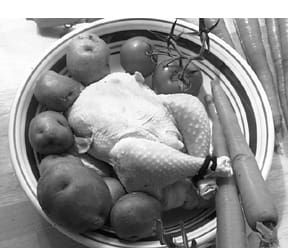
We have established, over the course of five years’ worth of articles, that we really do think that homemade, fresh food is best for dogs – with very few exceptions. Commercial food has its uses, as we thoroughly outlined in, “Commercial Dog Food or Homemade?” in the July 2002 issue. But if you really want to know what your dog is eating, and you really want it to be fresh and nutritious, you really have to buy the ingredients and prepare the food yourself.
But what, exactly, does “preparing your dog’s food” entail?
For some purists, it means chopping, dicing, or pureeing various combinations of raw vegetables, fruits, sprouted grains, meat (or meaty bones), and/or supplements, and feeding this to their dogs – yes, raw, and only raw. The cornerstone of the “raw feeders” philosophy is the fact that dogs have eaten raw foods for thousands of years and are still here to tell the tale.
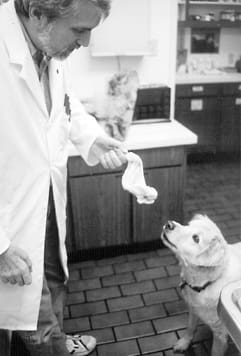
Other purists only cook for their dogs. They steam vegetables, cook grains, roast or boil meats, and/or add supplements. They are quick to thank cooking for the fact their dogs have not yet succumbed to bacterial threats, and they point to the increased digestibility of many cooked foods.
Then there are the “fusion” thinkers: People who mix and match food preparation techniques. They may use raw or lightly cooked vegetables, raw or cooked meats, and either raw sprouted or cooked grains in addition to the raw fruits and supplements. These people say, “Why not be flexible?”
Who’s right? Who’s wrong? Whose dogs are healthiest?
Before we attempt to answer those questions, let’s look a little closer at each “school” of canine diet preparation.
Even the most rabid opponents of raw foods can’t deny that dogs wouldn’t even be here today if they couldn’t thrive on an uncooked diet. Canines have eaten raw for a whole lot longer than they’ve eaten cooked foods! It’s difficult for us to understand, in the face of this one fact, how any dog guardians (much less thousands of veterinarians) could deny that raw food diets are healthful for dogs.
But people are quick to forget history, especially events that occurred more than 50 years ago. Many people have a hard time remembering that, before the commercial pet food industry, people fed dogs raw meaty bones and other food scraps. It took a veterinarian who was uniquely positioned in time and place to witness, firsthand, how raw-fed dogs actually decline on commercial foods, and to start a campaign for a return to common sense, raw feeding.
The commercial pet food industry developed in Australia several decades behind the industry in the U.S. American dog owners in the 1950s and 1960s were already well converted to commercial dog food; many Australians in the 1960s still fed their dogs raw bones and other household scraps. So it was that Australian Ian Billinghurst grew up in a society that fed its dogs raw foods, but was suddenly converted to commercial foods when he entered graduate school seeking a veterinary doctorate in the early 1970s.
In “vet school,” Billinghurst learned that a scientifically designed commercial diet was “best for dogs.” After earning his veterinary degree, he went into practice, advocating commercial foods and feeding them to his own dogs. But he experienced continual doubts; why were the dogs he saw every day in his practice – and his own dogs – so unhealthy? And why did he remember the dogs of his youth as so robust, untouched by the maladies he saw so frequently in veterinary practice: skin problems and itches; runny eyes; scurfy, smelly coats; sore ears; bad breath and dental problems; problems with anal sacs; and worms. He began to think it had something to do with what the dogs ate.
Over a period of a few years, Dr. Billinghurst began experimenting with his own dogs, feeding them what he remembered most people feeding dogs when he was a kid: raw, meaty bones and household scraps. He saw an immediate difference. As he writes in his groundbreaking 1993 book, Give Your Dog a Bone, “No more skin problems, dental problems, eye problems, growth problems, reproductive problems, etc. etc. Less need for worming. Their feces were less smelly and there were less of them. Their breath became pleasant. Feeding them was cheaper, both in the cost of the food, and because they no longer needed expensive drugs or dentistry.”
As he observed the success of his “new” diet, Dr. Billinghurst began suggesting that clients try it on their dogs. Again, he saw nothing but success, which fanned his interest in the subject of raw feeding into an obsession. He studied nutrition, compared information and case studies with colleagues, and eventually wrote Give Your Dog a Bone. Today, the book is considered a primer for anyone interested in home-prepared diets for dogs, and numerous raw-food advocates credit it with inspiring their own interest in the subject. In it, among other things, Dr. Billinghurst coined a phrase for his suggested diet plan (BARF, for “bones and raw food”) that has been thoroughly co-opted and adapted at will by raw food advocates. (Frequently, you will hear “BARF” decoded as “biologically appropriate raw foods.” Note that the “raw foods” part stays intact.)
Dr. Billinghurst’s diet plan and opinions regarding different supplements or food ingredients have shifted a little since publication of his first book, as close readers of his next books (Grow Your Pups With Bones, 1998, and The BARF Diet, 2001) will attest. His main themes, however, remain consistent. We previously discussed his most controversial tenet – that dogs thrive on a diet that includes raw, meaty bones (see “Feeding Bones or Raw Food to Puppies,” WDJ September 2000). But another rock-solid cornerstone of his canine diet philosophy is that a dog’s food should absolutely not be cooked.
We recently asked Dr. Billinghurst, “Are there any dogs whom you prefer to receive a cooked homemade diet rather than a raw one? If so, what dogs and why?” His response was that the only times he recommended a cooked diet was when the dog’s owner could not or would not feed raw.
“I suspect the expected answer to that question is that I would prefer an immune-compromised animal to receive cooked food because of the potential danger of an opportunistic infection,” says Dr. Billinghurst. “In fact, the only times I have recommended cooked over raw in that particular situation was when the owner was particularly concerned. In other words, the recommendation is always as a concession to the deep concerns of the particular dog owner, rather than from any conviction that there is any genuine necessity to cook the food.
“It has long been my experience that with immune-compromised animals, the raw food simply speeds the return to a more normally functioning immune system. That, of course, is one of the many reasons I wrote Give Your Dog a Bone, which started this whole raw movement.
“Looking back at my real life experiences as a vet who has recommended raw foods for dogs for a very long time, I have to say that there have been and there will continue to be instances where I am constrained to prefer that a dog receives a cooked homemade diet, but rarely is it ‘rather than’ a raw one.
“For example, with food contaminated by parasites such as hydatid tapeworms – where that is the only food available and the alternative is no food, starvation, and death – then I would prefer that the dog receive that food as cooked food. Or, if a dog has a severe reaction to raw food and is healthier with cooked food, then so be it; feed the dog cooked food. If the owner will not feed raw, and will only choose between cooked and kibble – and this does happen, particularly where the dog has trained the owner not to feed raw, then cooked it must be.
“Other than that, I always recommend raw.”
Not everyone who has walked along Dr. Billinghurst’s path is still convinced that raw diets are always best. Many people who are completely convinced that home-prepared diets are the only way to guarantee that a dog is getting the best possible nutrition have come to believe that cooking offers some legitimate advantages for certain dogs.
As Dr. Billinghurst hinted, the most prevalent “break” from his theories has to do with immune-compromised dogs. Many holistic veterinarians suggest cooked foods (especially meats) for weak or immune-suppressed dogs, in order to eliminate the potential threat of bacterial infection.
Jean Hofve, DVM, is a holistic veterinarian practicing in Englewood, Colorado, and a frequent contributor to WDJ. In her opinion, dogs with a compromised immune system, “leaky gut” problems (inflammatory bowel disease), or who are extremely debilitated should not be given raw meats. “One consideration is whether the dog is healthy enough to handle a moderate bacterial burden,” she says. Dr. Hofve further extends that concern to other members of the household. “Is there anyone in the home who should not handle raw meat, or get hold of it in some way, such as a toddler exploring the dog bowl? So many kids these days have asthma and other immune-mediated diseases, and many are on immunosuppressive drugs. I don’t think I’d want raw meat anywhere around that.”
In response to our query, Susan Wynn, DVM, a holistic veterinarian who practices in Marietta, Georgia, also mentioned concerns about weak or debilitated dogs. Her list of dogs that she would prefer to see eating cooked food includes “very old dogs, dogs who are weak with chronic illness, dogs with severe bouts of pancreatitis, and dogs with TCM (traditional Chinese medicine) ‘dampness’ conditions.”
Mark Newkirk, VMD, has a holistic veterinary practice in Margate, New Jersey. An ardent fan of raw home-prepared diets, his main concern has to do with dogs who have severe bowel problems. Dr. Newkirk suggests feeding those dogs cooked food, but only for a short period.
If you spend much time talking to dog guardians who make their dogs’ food, or lurking on Internet discussion lists devoted to the topic, you will quickly understand that the “raw vs. cooked” controversy also rages on the front lines. With untold thousands of people feeding hundreds of different breeds of dogs different types of home-prepared diets, you can count on the fact that some people do experience problems feeding raw food to some dogs. (To be fair, many dogs have problems eating cooked food, and many more have problems eating commercial food!)
Fortunately, you will probably also learn easy, practical solutions for any problem you experience with your dog. For example, while many people report their dogs being crazy about “going raw,” some guardians have found it difficult to transition middle-aged dogs to raw foods after a lifetime of kibble. More experienced raw feeders can tell you to start out by lightly cooking your dog’s home-prepared meats, vegetables, and grains (bones are never cooked), and then gradually cooking the food less and less, transitioning the dog’s palate from “well-done,” to “rare,” to raw.
Newcomers to BARF-type diets will naturally have a lot of questions about bones, safe meat handling, whether or not to include grains in the diet, how to prepare vegetables, and which supplements their dogs may need. Fortunately, many people are using these diets today, and most of them are more than willing to help; just ask.
As you have probably guessed, we tend to belong to the group of fusion thinkers. We rarely find ourselves advocating that all dog guardians strictly adhere to any specific dog care practice, because there exceptions to every rule.
We do strongly believe that complete and balanced raw diets are most likely to produce and maintain health in the majority of the canine population. However, there will always be some individual dogs who cannot tolerate some raw foods. In our humble opinion, it’s sheer stupidity to persist in feeding raw foods to raw-intolerant dogs, even in the face of physical evidence that the dog is not thriving, and may even by declining in health, simply because one feels that “raw is best for all dogs.” Don’t let the Emperor’s tailor convince you otherwise!
The decision really ought to be based on what your dog “says” about his diet. If, after a fair trial (perhaps three months?) on a complete and balanced raw diet, he’s got more health and/or behavior problems than he did before the trial, a smart owner should start a new trial including cooked foods.
Similarly, there is no use denying that some humans cannot bring themselves to prepare and feed raw foods. It doesn’t really matter why they can’t or won’t, because if they don’t believe in what they are doing, and feel really good about it, their dogs are bound to experience trouble with the diet. And nothing good will result from trying to make them feel bad about their decision, or attempting to force or guilt them into a different course of action.
In our opinion, true holistic care for dogs is, by definition, tailored for the individual – and that’s the individual dog and guardian. We strongly encourage guardians to think for themselves and do what they think is best: feed raw, cook, or do both; to observe their own dogs with open minds, staying alert to any improvement or decline in their dogs’ condition; and to remain flexible and willing to change their approach in response to the evidence in front of them.
For a discussion of three prominent home-prepared diet advocates and their diet plans, see “Comparing the Best Raw Dog Food Diet Plans,” WDJ June 2001. For advice about feeding raw foods to puppies, see “Raw-Fed Puppies,” December 2000. To address concerns about bacterial contamination of raw meat, see “When Feeding a Raw Diet Use Safe Meat Handling Practices,” August 2000. And for advice on preparing vegetables for raw-fed dogs, see “It’s all In How You Make It: Traditional Food Preparation,” March 2001, and “Feed Your Dog Vegetables,” October 1998.
Nancy Kerns is Editor of WDJ.
To most people, the word “house-trained” refers to a dog who has been trained not to urinate or defecate indoors. For my parent’s generation, this bit of training was usually accomplished by Mom, who stayed home while the rest of the family went to work or to school.
As double-income families became the norm, the home-alone dog was faced with a serious problem. By the time you add a lunch hour and commute time onto an eight-hour work day, a house dog may have to “hold it” for as long as 10 hours before someone finally comes home to let her out. Her legs are probably tightly crossed for at least the last two.
From my first job as a riding instructor at a Wisconsin hunter/jumper barn, through 20 years at a California animal shelter, and now as a trainer/behaviorist, I have been blessed throughout my entire life with careers that welcomed the presence of my dogs. I never knew what a problem the home-alone housetraining issue was until I became a dog trainer and realized how many people are faced with the logistics of what to do with their dogs during the long workday. Plus, there is a whole world of people who live in high-rise apartments in cities, who don’t have easy access to the outdoors – an alien concept to me, forever a country girl. There’s another subset of dog owners with physical problems who are unable to take their canine companions out to potty on a regular basis, and still another of people who live on houseboats and sailboats, where grass is a very rare commodity.
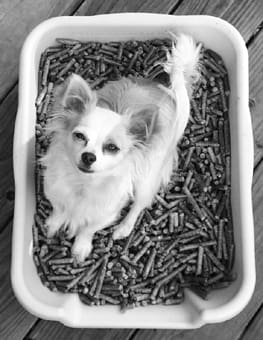
A well-housetrained adult dog should routinely be able to be confined, in the house, for eight hours. Any more than that and you’re asking for accidents, or possible damage to bladder or kidneys. A healthy adult dog who is not as well housetrained can usually handle the same length of time in a crate without flooding her bedding. But since the average wage earner is gone for eight hours and then some, the doggie door was invented. Great idea – the dog can let herself in and out as needed!
However, I am decidedly not a member of the doggie-door fan club. There are huge drawbacks to giving your dog free access to your backyard. She can bark and disturb your neighbors. She can escape when she gets bored, by digging under, jumping over, or chewing through your fence. Someone might let her out – accidentally or maliciously. She can be poisoned, shot or stolen, hit by a car, attacked by other dogs, bite someone . . .
You also risk visits from other intruders, such as opossums, raccoons, and skunks – some of whom may carry rabies, distemper, and other diseases and parasites that can transfer to your dog – or you. Plus, the dog door doesn’t help the apartment dwelling Dachshund on the 48th floor of a high rise in New York City.
The paper chase
Paper training also became popular, recently replaced by the commercially produced puppy pee pads. These were initially marketed for puppies whose owners couldn’t be bothered to take the pup out on a regular schedule even when they were home. But some owners figured that this was a reasonable compromise for dogs whose bladders were made of something less substantial than iron. This was no doubt a great relief to the dog who had been crossing her legs for years, or suffering the ire of her owners when they got home and discovered that she really couldn’t hold it for 10 hours on a hot day when she had needed to drink a lot of water to stay cool.
One of the drawbacks of using newspapers was that dogs develop a substrate preference for their bathroom deposits, and at least some dogs are incapable of distinguishing between paper laid on the vinyl floor for them to pee on, and the Sunday paper that slides off the sofa onto the Berber carpeting in the living room. Puppy pee pads solved this problem with their greater bulk and different composition, but puppies seem to love to play with them. Many a puppy owner has arrived home from work to find urine-soaked shreds of pee pad scattered across the puppy room. And many a dog owner has despaired over ever teaching his dog to go to the bathroom outside, once the dog has developed a preference for peeing on paper or pee pads. There had to be a better solution.
Thinking outside the box
Cats have been using litter boxes for years, so why not our canine companions? Only recently did someone finally “think outside the box” and suggest using a litter box for dogs. There are some distinct benefits to the litter box concept, but unfortunately, also some kinks to work out.
We found only one company manufacturing a special litter and litter box for dogs, but perhaps the size of the company – the Nestle Purina PetCare Company – has discouraged copycat manufacturing. The product, “secondnature Dog Litter,” is now widely available at pet supply stores and supermarkets.
The “secondnature” concept closely mirrors the feline litter box, with a litter pan and pelleted litter made of recycled (70 percent post-consumer waste), biodegradable newspaper. The pellets are advertised as “super-absorbent” and containing a “highly-effective odor control system”; we found them smelly, exuding a strong, perfumey odor obviously meant to mask dog odors. The boxes are made in three sizes: Toy, for dogs up to 6 pounds; Miniature, meant for dogs up to 15 pounds; and Standard, meant for dogs up to 35 pounds. And that’s it!
The litter pellets, on the other hand, come in just one size, which we found to be overlarge and uncomfortable for dogs to step on. Their size – about the diameter of most pencils and anywhere from a half-inch to a couple of inches long – made us dubious about their ability to absorb liquid before it hit the bottom of the litter box and spread, but they actually are fairly absorbent. When we poured a full glass of water onto the pellets in the middle of the box, the moisture did not spread throughout the bottom of the box, but soaked into the pellets in the middle. So far, so good.
Unfortunately, removing the wet material from the box without taking many of the dry pellets is much more difficult than with the much-smaller sized material generally used for cat litter. We found ourselves wondering what the problem would be with simply using cat litter, instead.
Another problem with litter boxes is that male dogs who lift their legs to urinate may well pee on the outside of the box or over the edge of the box. Carefully locate the box somewhere that this wouldn’t pose a cleanup problem.
Patio potty
Another alternative for housebound dogs capitalizes on the fact that most dogs feel perfectly comfortable relieving themselves on grass. At least a handful of entrepreneurs have taken a stab at selling a litter box that involved turfgrass. One product that seems to be doing well is called “Nelson’s Backyard,” a system of boxes that contains about four inches of soil with turf planted on top (for a more thorough review of this product, see sidebar).
Developed in Florida by Audra Winston, the product is meant to provide apartment dogs with a “balcony bathroom,” rather than an indoor litter box. Because it utilizes real, live, growing grass, Nelson’s Backyard needs sunlight to live, and won’t do well indoors.
The grass litter box concept is intriguing, and avoids some of the problems we would anticipate with the “secondnature” system. Most dogs will readily recognize it as, ahem, worthy of their attention, and feel comfortable stepping onto the box. Feces is easily picked up and discarded; urine soaks into the dirt, where its odor is neutralized by the microbial action of the soil. According to Winston, the longevity of the grass depends on how often your dog uses it, but four to six months is average. After that, the grass can be ripped up and discarded, and new sod can be planted.
The biggest disadvantage to the concept is that it’s not really designed to be used indoors; it’s absolutely brilliant when used as designed, on an outdoor patio or porch that the dog can get to any time she needs to. While some clients have reportedly had success using grow lights to maintain the grass indoors, this is much less successful than when the grass lives outdoors.
How about buying two Backyards, and rotating them in and out of the house? A person could, but they are sort of heavy, particularly after watering.
The people who are most in need of a litter box for their dogs – again, people who are away from home for particularly long stretches of time, high-rise or sailboat dwellers, and disabled people – will likely be motivated enough to figure out solutions for the accompanying problems presented by their choice of litter box. Their next task is litter box training, and we can help!
Litter training your puppy
Cat owners have a big advantage in the litter box training department. Kittens naturally dig and eliminate in dirt or sand, so for most felines, the litter box just happens without any real contribution from the owner, other than keeping the box clean. Puppies, on the other hand, will go almost anywhere, so dogs take a greater commitment to housetraining on the human’s part, whether indoors or out.
It’s easiest, of course, to start with a puppy who hasn’t already been programmed to go in a specific spot or on a particular surface. You simply take a standard housetraining program and substitute the indoor litter or grass box for the outdoor bathroom spot. (See “Minding Your Pees and Cues, WDJ December 2001). Your puppy’s box should be large enough that she has room to move around and explore a little. Every hour on the hour, and every time your puppy finishes eating, playing, wakes up from a nap, or just looks restless, take her to the box, put her on the grass or litter, and wait for her to go. If she hops off, gently put her back and wait. If she seems wary of the box, use yummy treats to lure her onto it.
When you can see that she is about to urinate or defecate, use your “go potty” cue. The instant that she is done, Click! your clicker (or say Yes!) and feed her a treat. Be sure she is done – if you Click! while she is still going she may stop in midstream, eat the treat, and then pee on the rug when you take her back to the living room.
Unless you are positive that you want your pup to only go to the bathroom indoors for the rest of her life, be sure to also train her to go to the bathroom outdoors. Who knows – you may someday dock that houseboat, move to Kansas, and want her to poop and pee on the Great Plains.
To avoid housetraining accidents, young puppies should be under constant supervision when they are not in their crates or pens. The best housetraining programs never give a puppy the opportunity to make a mistake. Immediately after your pup has emptied herself in the box, you can give her 10 to 15 minutes of supervised freedom – then she should go back in her crate until the next litter box trip.
As she gets older, you can gradually lengthen the time between bathroom trips, and give her longer periods of time out of the crate, decreasing the amount of direct supervision as she earns that privilege.
In case of accident
If an accident does happen, examine your training program and figure out what you did wrong. Too much time between litter box trips? Too much freedom, a little too soon?
Resist the temptation to get angry with her if you catch her in an accident – if you punish her verbally or physically, you are likely to teach her to hide from you the next time she needs to go to the bathroom. There is also nothing to be gained by punishing your puppy after the fact – she won’t make the connection between the punishment and the behavior. If you catch her in the midst of an accident, just interrupt with a cheerful “Oops!” and carry her to the litter box. It may take a few minutes before she is ready to finish – some dogs get a little flustered when they are interrupted mid-potty.
As your pup gets older, you should start to see her heading for the bathroom box on her own. This part is actually easier than outdoor housetraining, since she’s not dependent on you to give her access to the bathroom spot. Be sure the box is kept in a place she can get to easily, and that any doors to the doggie bathroom are left open. Continue to follow her to the box and reward her on a schedule of random reinforcement, with high frequency at first, gradually decreasing the rate of reinforcement until using her bathroom box is routine.
Litter training an adult dog
The most difficult dogs to train to use a litter box are those who have fully accepted the concept that they should never go to the bathroom in the house. These are the dogs who suffer when housed at a kennel or animal shelter that doesn’t allow outdoor playtime on grass – those who would “hold it” for days and burst their bladders rather than soil their dens. Convincing these dogs that it is now appropriate to go to the bathroom in the house can take some doing!
If you use pellets, try spreading some outside in your dog’s regular bathroom area. Spread them lightly at first, increasing the amount as your dog becomes comfortable with the new bathroom surface. Then set her litter box up outside and encourage her to use it, by taking her to the box on leash, luring her in with treats if necessary, and clicking and rewarding her when she urinates or defecates in the box. If you use a grass box she is probably already familiar with grass as her bathroom substrate, so just set the box up outside and encourage her, on leash, to use it.
When your dog is willing to use the box outside, you’re ready to bring it indoors. Do this on a weekend, when you can spend a day or two on the training project. Bring the box in Friday night, and prepare to start the next day. Wake up your dog in the morning, take her to the bathroom box on leash, and ask her to use it. If nothing happens, cheerfully put her in her crate, feed her a treat, and then give her breakfast – in the crate. After she eats, bring her out and try again. If she still doesn’t oblige, return her to her crate – still being cheerful. You cannot intimidate her into using the bathroom box.
Every couple of hours, throughout the day, take her to the box on leash and use your “go potty” cue to encourage her to use it. Make sure you keep the process upbeat and happy, accompanied by a generous supply of treats.
If she hasn’t accommodated you by bedtime, take the box outside, have her use it there, then bring it back in and try again the next day. If you still don’t succeed by the end of the weekend, put the box back outside and have her use it outdoors at every opportunity for the next week. Then try again, indoors, the following weekend.
When the breakthrough comes, ply her with treats and praise, but be careful not to get so excited that you scare her into never using it again!
Also With This Article
Click here to view “Tips on House Training Your Dog”
Click here to view “House Training for Adult Dogs”
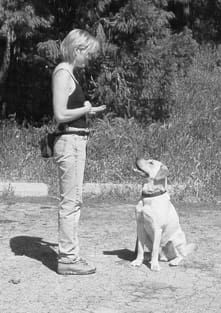
Well over a decade ago, I enrolled my Terrier mix, Josie, in an obedience class with Judie Howard at Arydith Obedience School in Moraga, California, and was startled on the first day of class to discover that Judie advocated using food in training.
At that time, conventional wisdom frowned heavily on the use of food for training purposes; Judie was one of the first nationally acclaimed competition trainers to admit – no, to boast of – using food in her training programs. Of course, it took no time at all for me to thoroughly convert to using this powerful training tool, because of both its tremendous success rate and its ability to engage a dog’s attention and enthusiasm.
In order to accommodate the baggies-full of hot dog ‘pennies’ that we learned to spit from our mouths to our dogs’, one of Judie’s assistants designed and created denim bait bags that clipped onto your belt, laid flat against your hip, and snapped closed. We wore the bags as a badge of honor, knowing that they identified us as one of Judie’s students.
As the popularity of using treats and bait bags grew, however, so did the debate over whether or not bait bags were a good dog-training tool. The arguments in favor of baits bags are mostly obvious. They offer a handy, easily accessible place to carry your dog’s favorite snacks. They protect your clothes from being permeated with hot dog slime and essence of freeze-dried liver. String cheese does not melt as quickly in a bait bag as when it’s held tightly against your body heat in snug blue jean pockets. And finally, the commercially produced bags, made of high-quality nylon in a variety of rich colors, endow the wearer with a certain panache: “Here,” the bags seem to say, “is a serious dog training enthusiast.”
The arguments against bait bags are not so obvious. The most compelling is that the presence of a bait bag is like a flashing neon sign – an obvious cue to your dog that it’s training time and treats are handy. Use a bait bag consistently, and you risk creating a dog who works great when the bait bag is on your hip, but tends to find other activities more rewarding when the neon sign isn’t flashing. In addition, dogs who haven’t yet learned their good manners lessons may try to help themselves to the treats in the bag – and sometimes succeed. Finally, unless the clip that fixes the bag to your side attaches securely to your waist, the bag can fall off and provide your dog with an unexpected (and unearned) jackpot!
Baited breath
I stand firmly in the middle of the bait bag debate. I shop for lots of lightweight, loose-fitting jackets with large pockets so I can stash my bags of treats comfortably on my person without turning on the neon sign. Of course, my dogs know that I have treats in my pockets, but I always have treats in my pockets, so the presence of treats is not the cue that training is happening. Paradoxically, because I always have treats in my pockets, training and treat rewards can (and do) happen anytime, without warning.
On the other hand, there are times during Tennessee’s hot and humid summers that wearing a jacket of any weight is out of the question, and my pants, while a comfortable fit, are not loose enough to accommodate bulging bags of dog yummies in the pockets. On those days I will stuff a few dry cookies in my pockets, but for serious training sessions and to teach classes, I put my bait bag to use. I have one of the early commercially-produced bait bags, and it suffers from the loose-clip syndrome; a bump of my arm or a dog’s head, and it falls to the floor. I was delighted when Whole Dog Journal decided to review bait bags, giving me the opportunity to test several and pick the best to replace my antiquated one.
We evaluated five bags from three different companies. All were well constructed, with good quality materials. Each has different features, however, and your choice for Best Bait Bag will depend on your personal needs and preferences. Some of the differences include closure style (drawstring, Velcro, or hinged); material; size; attachment hardware, lining, color selection, and cost. So take the time to determine what features are important to you, and then go train and cut bait!
Our findings
We have several reasons to justify our selection of Legacy’s Quick Draw Training Pouch as our top pick in bait bags. It’s large enough to hold a good supply of treats. It is well constructed, and has a nice nylon inner lining that can be wiped clean easily. We like the attached belt – no way will this bait bag fall off. We do wish the belt were made of a slightly softer nylon.
But our absolute favorite feature is matched by none of the other bags: the metal French hinge sewn into the mouth of the bag to keep it open or snap it closed at a single touch. Since we usually hold a clicker, a leash, or both in one hand when training, we like a bait bag that can easily be accessed, opened, and closed with just one hand. The French hinge – the same kind used on many change purses – made this bag the easiest to open and close with just one hand. The maker recommends that the user keeps the hinge well-lubricated with an occasional touch of Vaseline.
The bag itself is made af a high quality washable nylon, and the inside is easily wiped clean with a damp sponge.
The Quick Draw Training Pouch does cost a few dollars more than the other bags, but we think it’s worth it!
The Pro LineTracking/Training Bag is for anyone who is very serious about training. Its big advantage is its size. With two good-sized pouches and one humongous one, all with Velcro closures, there is plenty of room for you to carry treats, toys, a leash, your cell phone, a sandwich, and maybe more! This is a great advantage for people whose dogs grow bored of the same treat or toy; you can carry enough different reward items with you to keep any dog interested and engaged, even on a long walk.
We liked it so much we wanted to give it a 4 PAWS rating, except for one fairly glaring flaw – at its smallest adjustment, the waist belt is still way too big for many people – 44 inches at the smallest adjustment. That’s good news for bigger people, but not thinner ones. We’re not accomplished tailors by any stretch, but we like this product well enough that we will get out needle and thread and shorten the belt so we can use it.
Again, for us training fanatics the three pouches on one belt offer a tremendous variety of rewarding opportunities. But if you’re not into hauling lots of training gear around with you, you will probably find this get-up too bulky for your taste.
The large, center pouch is 11 by 8 inches, and the two side pouches are 7 by 6 ½ inches. They close with Velcro, which is not quite as easy to open one-handed as the hinged pouch of the product described above, but easier than the drawstring models described below. None of the pouches are lined, making them more difficult to clean.
Pro Line, maker of the product described above, does make a single-pouch bait bag, the Pro Line Training Bait Bag. It comes with a sturdy plastic clip or a nylon belt.
We liked a lot of things about this bag – its size (7″ x 6½”); the Velcro closure; the plastic D-ring for attaching keys, a tab leash, or your choice of small items. We also liked its two mesh pockets – a small one on the side for (empty) poop bags or a clicker, and a larger one on the front, also with a Velcro closure, for a toy, ball, clicker, and/or other small accessories. If you choose the clip-on model, be careful when you plunge your hand into the bag for a treat; with the clip positioned in the center of the wide bag, it’s easy to make it unclip when rooting in the corners for the last treats. We like the model with the attached belt better, although this belt (like the one on Pro Line?s Tracking/Training Bag) is too big for many people, even at its smallest adjustment.
A more adjustable belt and a lined pouch might have boosted this bait bag into earning our 4 paws rating.
The most beautifully made bait bags we found are manufactured and sold by Doggone Good, a San Jose, California-based company that also makes one of our favorite soft-sided crates. Doggone Good was one of the original producers of commercial bait bags, and they still offer an attractive, high quality product.
Both the Doggone Good ProTrainer Bait Bag and Doggone Good Clicker Bait Bag come with two attachments – a clip and a snap. We love the way you can use one, the other, or both for total security. The bag also features a plastic D-ring for attaching accessories. The nylon lining is another nice feature, making it easy to wipe the inside clean after use.
The smaller size of this bag will appeal to some, although we found ourselves refilling it more often than we’d like. Also, we found the drawstring closure the least convenient of the various styles we tried, requiring two hands to open and close.
Anyone who has used a clicker knows how annoying it is when you forget where you stashed it. Doggone Good’s Clicker Bait Bag solves the problem with a handy pocket for your clicker on the front of the bag. Not losing clickers will reimburse the $1 extra purchase price.
-by Pat Miller
I am in love with a fantastic man and his eight-month-old Dalmatian, Lexi. My dog Bailey and Lexi are becoming fast friends, despite their age difference and Bailey’s limited patience with the puppy. The problem is that Lexi lives in relative harmony with two indoor cats. Bailey has never quite understood cats, except as something to forget her training over and chase down the street, through an alley, across a yard, or under a bed. I am afraid she will never understand or overcome her instinct to chase the cats. Is there a way to transition a cat-unfriendly eight-year-old dog to live with two younger cats?
-Lori Spar
San Diego, CA
We asked our Training Editor, Pat Miller, to answer these questions. Miller is a Certified Pet Dog Trainer in Chattanooga, Tennessee. She is also the President of the Board of Directors of the Association of Pet Dog Trainers, and recently published her first book, The Power of Positive Dog Training.
What great news that Bailey and Lexi get along! At least you don’t have to deal with dog aggression getting in the way of your new relationship. There are a number of things you can do to help Bailey live in peace with her new feline family members. It will be easiest if the cats are ‘indoor only’ kitties. It is much easier for a dog to learn to leave cats alone inside the house than outside, where the sight of small prey-type animals rocketing across the grass tends to trigger the prey instinct. My dogs live in perfect harmony with our indoor cats, but are happy to chase a stray feline full speed across the backyard.
Indoors, have Bailey on a leash or tether when you introduce her to the cats. Be prepared with lots of fantastic food rewards – canned chicken is my favorite for this type of challenge, since many dogs absolutely adore the stuff. Ask Bailey to sit or lie down quietly at your side, and have someone bring the cat into the room in a sturdy cat carrier. Set the carrier on the far side of the room and feed Bailey non-stop bits of chicken, until she decides that you are much more interesting than a boring old cat in a carrier.
Repeat this exercise many times over several days, until Bailey’s response to the arrival of the cat carrier is to happily look at you with her “Where’s my chicken?” expression. Now start walking her around the room, on leash, keeping her attention focused on you with chicken rewards. Move closer to the carrier as her response tells you that she will continue to stay focused on you. Occasionally have her lie down and stay, gradually moving nearer and nearer to the carrier until she will lie quietly next to it.
Now you are ready to introduce the cats sans carrier. Again with Bailey leashed, sit in a chair and have your partner tempt one of the cats into the room – as far away from Bailey as possible. Be generous with the chicken to keep Bailey calm and focused while the cat moves around the room. When you think she is ready, start walking her on leash in the presence of the uncrated cat.
When she can clearly control herself and remain calm in the cat’s presence without effort, you are ready to try it off-leash. Go back to the cat-in-carrier exercise, but this time have Bailey sitting next to you, unleashed. Do the chicken thing, and be careful to keep your own body language the same; if she senses that you are stressed about not having the leash, her behavior is likely to change. When you are comfortable with her response sitting still, again start walking around the room, plying her with chicken. When she passes that step with flying colors, do the same thing, off-leash, with the cat loose in the room.
When Bailey is well-controlled around the cats under supervision, you can begin to relax and let her interact with the cats normally. If she is too rowdy with them, use a tether as needed, giving her more free access to them after a good hard workout, when her energy level is lower. Continue to use treats to reward her for calm behavior around the cats.
At the same time, make good use of baby gates, by closing off several rooms so the cats have plenty of safe zones where they can get away from Bailey. Put their litter boxes and food in the safe rooms, so they have easy access to them.
You have a close relationship with Bailey. You may be surprised how quickly she learns to behave herself when she realizes that chasing cats in the house is not a desirable behavior, and being calm around them earns lots of great rewards.
Outside, however, your best hope is that the cats get smart and learn not to hang out in Bailey?s yard. Or keep the cats indoors – where they are safest and live longest.
Best of luck with your extended family!
———-
Dog driven to distraction by stray cat
Beginning a few months ago, a cat has taken over our yard. In certain areas the odor of cat ‘spray’ is so strong it brings tears to my eyes. The cat has taken to sleeping on our back porch or front door mat. My dog is so distracted when we go out she has difficulty ‘doing her business.’ I don’t believe the cat is a stray but I have no idea who owns it. It is always at our house so it must only return home to be fed.
Can anyone suggest what I can do to keep the cat off our grounds without hurting it or my dog? I am at my wits’ end.
-Nancy Pollard
via e-mail
Miller responds:
I can sympathize; it vexes me that dog owners are expected to keep their canine companions safely and responsibly at home, while cat owners think nothing of letting their feline friends roam the neighborhood, soiling sandboxes and flower beds, leaving pawprints on car hoods, getting attacked by dogs, and run over by cars. My beloved cats live safely indoors!
If your property is fenced, the most innocuous way to keep cats out is to install a product called Cat Fence-In. It is actually designed to keep cats in the owner’s yard, but if you put it up backward it does the opposite. You can find information on this product by calling (888) 738-9099 or by viewing www.catfencein.com.
Other suggestions would be to find the cat’s owners and ask them to keep him home, either by following the cat to see where he goes, or putting on a break-away collar (in case he gets it caught on something) and attaching a note.
Sounds to me like he may be lost or abandoned, so you could check at your local animal shelters to see if anyone has reported a cat of his description missing.
The strong smell indicates that your guest may be an unneutered male, so having him neutered might reduce the odor, although that won’t make the cat go away.
I know you don’t want to harm the cat, but if your investigations indicate that he is truly lost or abandoned, it is kinder to him to capture him and take him to an animal shelter than to leave him to wander and survive (or not) on his own. The average lifespan of an outdoor cat is three years, and their deaths are usually not pretty. Many shelters will loan or rent humane traps so you can catch him without risking bites or scratches to yourself.
I do hope you can find an owner who will be responsible for this guy, but if not, remember that his quality of life without a human guardian is poor at best, and the quality of yours and your dog’s is declining as well, due to his presence. I wish you the best, and hope you find a satisfactory solution for your dilemma.
———-
Stop that ‘thieving’ dog!
Each of my two wonderful Labrador Retrievers has been with me since the age of eight weeks and has been to two positive training classes. Lakota is 12 months old and Nevada is 6 months old. Ever since Nevada came into our family, Lakota began acting in an odd way: He steals items in my presence. He takes things such as potholders, towels, valuable items such as eyeglasses, wallets etc. I have tried everything I can think of to stop this behavior. For example, I have batted him with a towel, which causes him to drop the item. But then he will look for another prize with which to taunt me.
I have tried ignoring him, but I can’t do this with valuable items. I have tried a sharp ‘No!’ at the same time holding his head and making eye contact until he looks away, but I still have to catch him to do this – hence he thinks it’s a game. I have tried putting him in his crate for two minutes for a ‘time out.’ Nothing works, and I am out of ideas.
Lakota is quite smart, and I believe part of his stealing is due to the presence of Nevada, but I am very consistent with giving Lakota my attention, any rewards or treats, and his food before Nevada gets his. Am I doing something to provoke this behavior?
Arlene A. Gorczycki
via e-mail
Many people choose Labradors out of affection for the breed’s commonly seen traits: these dogs are often amiable, curious, and affectionate. It’s all too easy to forget that Labs are also commonly obsessed with retrieving; after all, they have been bred for hundreds of generations to pick up things and bring them to their handlers.
Lakota’s behavior sounds like an effective attention-getting device. I don?t recommend punishment, but rather teaching him to trade. Punishment can teach him to play keep-away – another great attention game. Teaching him to trade may not stop him from picking up things, but at least he will bring them to you and readily give them up. Punishment can also make him not want to retrieve when you do want him to. Oops!
I always have treats in my pocket. When my young Scottie picks up something he shouldn’t have, I just ask him to ‘Give’ and trade him for a treat. Then I put the thing up where he can?t get it again. I also do ‘Give’ as an exercise several times a day with his toys, so he gets the items back after he gives them to me for a treat. That way he doesn’t think ‘Give’ always means the good thing goes away – and he is more likely to pick up his toys than things he is not supposed to have. Plus, when he does pick up something he shouldn’t, he brings it to me for a trade instead of trying to keep it away from me.
To avoid having Lakota pick up things that he shouldn’t have, keep things picked up and put away (to the extent possible). Also, give him lots of good things he can play with (like stuffed Kongs), and restrict his activities to areas that are dog-proofed or where you can supervise him closely.
By the way, I prefer not to call it ‘stealing.’ Stealing implies an ethic that dogs are incapable of. Dogs just do what feels good at the moment. Lakota is just having fun, and doing something to get your attention. Your attention feels good to him.
We received a number of letters regarding our review of frozen dog treats, “Chilled Out,” published in the August 2002 issue. Most of the letter writers were concerned about the dietary sugar content of both the commercial treats we reviewed and in the whole-food, homemade alternatives we offered.
“You referenced making treats at home, flavoring the treats with cantaloupe, strawberries, etc. I thought sugar was bad for dogs and these fruits have sugar in them . . .”
“I was a bit puzzled to see vanilla yogurt recommended as a possible ingredient for a ‘pupsicle.’ Every vanilla yogurt label I’ve read has some kind of sugar in it. I don’t know about other folks, but I don’t like to give my dog any kind of sugar product if it can be avoided. It seems to me that sugar would be an ingredient to avoid if we are to give our canine friends the most healthy of treats and the best chance at a healthier life.”
First, there is no evidence that, in a healthy dog, low amounts of dietary sugar is hazardous to a dog’s health. (When we say “low amounts,” we mean low in relation to a dog’s normal diet. We’re discussing occasional treats, not a significant part of a dog’s daily diet.)
Of course, dogs who suffer health disorders that cause them to process sugar abnormally (such as diabetes mellitus or hyper-lipidemia) are well advised to avoid any foods or treats that contain sugar.
Dogs generally like sugar, which occurs naturally in certain foods, including fruit, milk, and vegetables. When dealing with anything that dogs eat, our bias is toward natural, whole foods, rather than artificial or highly processed ingredients. We’d rather see a dog eat a strawberry, for example, than a treat with an artificial strawberry-flavored, artificially sweetened treat. This may be an unscientific, instinctive response, but dogs (and people) have been eating real foods a lot longer than they have been eating artificial foods; we trust real foods more.
Speaking of real foods, one reader caught us making a throwaway reference to Häagen Dazs, her own favorite ice cream, and one she frequently feeds to her own dogs!
“Häagen Dazs contains nothing artificial – in fact, its vanilla flavor contains only five natural ingredients: milk, cream, eggs, sugar, and REAL vanilla (not vanillin). No fillers, preservatives, no nothing. Few people feed their dogs ice cream on a daily basis, but even dogs who don’t receive dairy products often seem to have little trouble with a Häagen Dazs ‘baby cone’ (i.e., a small serving – not a pint!)”
Okay, okay. Here are our parting words of wisdom about sweet treats for dogs:
When feeding anything new, start with a tiny amount and monitor your dog. If he suffers digestive upset or any other reaction, consider not feeding that food again.
Each dog will do best within a certain range of daily caloric intake. Nutritionally incomplete treats should not displace foods that are of greater benefit to the dog, nor should they routinely cause the dog to exceed his ideal caloric intake.
Finally, the following letter is a response from the maker of one of the commercial treats we reviewed:
“I am very pleased that [our product, Dog-E-Licious Ice Pudding, was] able to rank at the top of your list (3 paws) and that the Ice Pudding had universal appeal for your test dogs. However, I would like to clarify a couple of points:
“Glucono Delta Lactone (GDL) is a natural ingredient and not an artificial preservative. It is a natural constituent of many foods and helps preserve foods from deterioration by enzymes and microorganisms. Potassium sorbate is an artificial preservative (very small amount used) to prevent yeast formation due to high moisture. We were not able to find a natural product to accomplish this. This is why the label reads ‘natural ingredients with added vitamins, minerals, and preservatives.’
“We do not add ‘acidophilus’ but dried fermentation Lactobacillus acidophilus, lactis, and casei fermentation solubles. These are not live bacteria but byproducts of good bacteria that retard the growth of bad bacteria and encourage the growth of good bacteria in the small intestine . . .
“The simple sugars in our product include sucrose, maltodextrins, and glucose. These are commonly found in foods. The IcePudding contains about 27.5 calories per ounce. Dry dog foods range between 40-60 calories per ounce. The ingredients that you listed in your homemade treats included honey (1 tbsp = 90 cals) and banana (1 oz = 16 cals).
“Dogs eat fruits in order to obtain the simple sugars (sucrose, fructose, etc.) and get more energy. This is why they evolved with the dominate Type A (sweetness buds) in their mouth. Simple sugars excite their taste buds – just like humans. But, I agree with you that with 40 – 60 percent of dogs being obese, we must be cognizant of calories in our daily diet.
-Dr. Steve Tsengas
OurPet’s Company
———-
I love the Journal and have found it to contain very helpful articles, especially the “Danger Signals” article in the August issue. It did a good job of explaining what to look for on labels. I liked the suggestion that readers make and use their own nontoxic cleaners – something I would never have thought of doing! The problem is that it gave no information at all as to how to go about making them. How about an article that discusses how to make some nontoxic cleaners?
-Robin Riley
via e-mail
That’s a great idea, Robin. There are numerous resources for this information on the Internet, but it’s certainly worth a short article. We’ll prepare one as soon as possible. In the meantime, the following tips should be a good start:
Use a mixture of white vinegar and table salt in place of commercial abrasive cleansers.
Use baking soda to clean and deodorize kitchens and bathrooms. Use four tablespoons in a quart of warm water for general cleaning. Use baking soda on a damp sponge for grungier spots.
A half-cup of white vinegar in a half-gallon of hot water leaves vinyl floors sparkling clean.
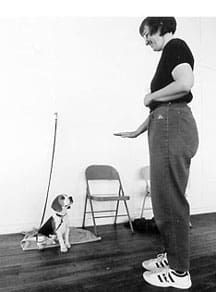
Weddings always make me cry. I like to believe that’s because it touches the part of my heart that cherishes my own husband and our hard-won 15 years of marriage (so far!), but, knowing how hard it is to make relationships work and how easily they can fail, I wonder sometimes if at least a few of my tears are bittersweet. It’s human nature to predict the likely success or failure of a marriage, especially when a friend seems to have made an unwise choice of a life partner.
I often find myself mentally doing the same crystal ball exercise when a new client enters my training center with a seemingly mismatched canine companion. Sometimes I see right away that we are really going to have our work cut out for us. However, I really don’t ever despair; relationship miracles can, and do, happen. Seemingly misfit human/canine matches can grow into solid partnerships . . . as long as the partners have a few things going for them – the major components of a good relationship, the kind that’s built to last.
Different trainers may have other ideas, but the following are what I would consider required elements of a happy, ’til-death-do-us-part sort of relationship.
1: Trust
Just as with human partners, a dog/human relationship can’t thrive if either party lives in fear of the other. Dogs whose owners have reason to be afraid of them tend to have short life spans. If your dog scares you, seek immediate guidance from a positive trainer who has lots of experience, confidence, and success in dealing with aggressive dogs. (See “Once Bitten,” April 2002, for more information on aggression.)
If, however, your dog is fearful of you, it’s also unlikely that you will enjoy each others’ company very much, either in public or in your home. Training proceeds much more slowly when a dog is too scared to hear or understand your communications, to offer new behaviors, or even be near you.
If you have a fearful dog, you’ll have to work to earn his trust, through building a long history of positive interactions (which we’ll discuss). But you will also have to work hard to avoid damaging his developing trust; the use of force- or intimidation-based tactics is likely to make a cautious dog more frightened and quickly erase whatever progress you have made through your positive efforts.
2: High occurrence of positive reinforcement
John Gottman, Ph.D., a psychologist and professor in the Department of Psychology at the University of Washington in Seattle has studied marriage for the last 20 years. A pioneer in the use of videotape to monitor and then quantify various aspects of the human couples’ interactions, Dr. Gottman has identified relationship and communication factors that can predict – with 91 percent accuracy, he says – whether or not the couple will divorce.
According to Gottman, the most important predictor of long-term relationship success is the ratio of positive to negative interactions. If the ratio falls below 5 – 1 (five positive interactions to every one negative interaction) the marriage is bound to fail.
What does this have to do with dogs? Positive trainers, too, have found that dogs respond magnificently to training that utilizes a high rate of positive reinforcement. The more frequently you notice your dog’s good behaviors, and reward him with something he enjoys, the more frequently he will repeat those behaviors.
Remember, you have to be able to identify and make use of the things your dog likes or wants in order to truly “reward” or reinforce his good behavior. As we discussed in detail in “Just Rewards” (March 2002), patting a dog who does not like being patted is a punishment for him, rather than the kindly reward you may have intended it to be.
Positive trainers often rely on an abundant supply of extra-delicious food treats, because most dogs enjoy food. But anything the dog values can be used as a positive reinforcement for good behavior, thus creating another one of Dr. Gottman’s recommended “positive interactions.”
If you can figure out what your dog likes, control his access to these resources and then mete them out generously at appropriate times – when you want to reinforce good behavior or give him a more positive outlook on his surroundings – he will quickly learn to offer the behaviors you want more frequently. (For more information about how to put this principle into practice, see sidebar, “More on Motivation.”)
As an added bonus for doling out frequent rewards at appropriate times, your dog will associate you with all those good things, which will cause him to like being around you even more, pay more attention to you, and even anticipate your wishes – because that makes even more good stuff happen. Who doesn’t want that in a relationship?
3: Clear, frequent communication
I know that dogs can’t speak our language. What do I mean by communication?
When dogs receive unambiguous signals, and are consistently rewarded for correctly interpreting those signals and following through with the desired behavior, communication has clearly occurred. The more frequently this happens between dog and human, the better.
Jean Donaldson is an internationally known trainer, author of best-selling books The Culture Clash and Dogs Are From Neptune, and training director of the San Francisco SPCA. Donaldson once conducted a video study similar to Dr. Gottman’s study of human couples, only in her research, Donaldson turned the camera on trainers working with dogs, and dog owners training their own dogs. She found that, on average, trainers communicate with their canine pupils – either giving a cue or giving the dog a reinforcing marker and reward – more than three times as frequently as the average dog owner communicates with his or her dog.
Like children, co-workers, spouses, and (according to many reports) even houseplants, dogs do best with people who communicate with them. After all, they are pack animals with strong social instincts. They are most apt to respond to humans with whom they are familiar and comfortable, and whose communications they can understand.
4: Consistency
One of the most common behavior complaints of new Peaceable Paws clients (the human ones) is that their dogs jump up on them. Yet almost invariably I observe the new client telling her dog “Off!” (or worse, “Down”) one minute when he jumps up on her, and then mindlessly petting him for the exact same behavior the next minute. One of the most common behavior complaints of my new canine clients might well be their humans’ lack of consistency: “Well, darn it all, is it okay for me to jump up or not?!”
While it’s unfortunate that the owner’s inconsistency results in a poorly mannered dog who persists in jumping up because the behavior pays off frequently enough to make it worthwhile, the fallout is far worse than that. The lack of consistency that encourages the dog’s persistent jumping up (or any other unwanted behavior that is randomly reinforced) can cause serious damage to the relationship – on both sides.
The owner likes her dog less because of her perception that the dog doesn’t do what she says. Frustration rises, and she is more likely to resort to trust-damaging punishment-based techniques when the dog continues to “ignore” or “defy” her. The dog learns to look upon his irrational owner with mistrust and perhaps fear, maybe even becoming aggressive when the behavior that was rewarded yesterday is met today with anger and a hurtful knee in the chest.
On the other hand, consistent responses to a dog’s behaviors, both desirable and undesirable, are predictable for the dog, which helps him make sense of his world and feel safe. A dog whose world is orderly and safe is usually calmer, more relaxed, predictable, and better-behaved than one whose world is chaotic and intimidating. Dogs and owners who perceive each other as safe, predictable, and well-behaved, tend to enjoy a better mutual relationship.
5: Understanding of and accommodation to the dog’s personality, needs, and interests
Many people believe that some dogs are “eager to please.” In fact, all dogs are eager to please . . . themselves. It just so happens that some dogs enjoy doing the things that please us, giving rise to the pervasive misconception that they are turning themselves inside out to make us happy.
These mislabeled “eager-to-please” dogs are often the breeds that have been selectively bred for their ability to work closely with humans, such as the sporting, herding, and some of the working breeds. They tend to look to us for direction, which pleases us, and they generally enjoy praise and petting, which we tend naturally to offer as a reward for good behavior. What a happy fit!
Other breeds – terriers and hounds, for example – have been highly valued for their ability to work without close supervision – careening over hill and dale after foxes, raccoons, rabbits, and deer, or burrowing after varmints – all with a single-minded purpose that excludes the need for human direction or reinforcement. If anything, the presence of humans is often a hindrance to the mission, as those two-legged pack members have a bothersome habit of getting in the way and calling off the hunt just when things are getting exciting.
These dogs, like our two-year-old Scottish Terrier, Dubhy (prounounced Duffy), require more creativity and imagination to keep the training game fun, as we try to build relationship, willingness, and motivation to work – all in the quest for a well-mannered dog. It’s my job to work with and adapt to his interests and preferences if I want to end up with an enthusiastic training partner.
However, he constantly tests my positive training theories and creativity as I attempt, with varying degrees of success, to convince him that he wants to work with me – that fetching a ball, coming when called, or doing a down-stay is as much fun as harassing the blue-tailed skink that he has trapped in a crack between two boards of the back deck. But it would be unreasonable – and a recipe for failure – to expect him to adjust his interests in life to mine.
6: Ample quality time spent together in mutually enjoyable activities
My students often ask how much time they should spend each day training their dogs. My answer is a non-specific “the more, the better.” I remind them that any time they are with their dogs, one of them is training the other – and the more time the human is the trainer rather than the dog, the more successful the end relationship is likely to be.
Regardless of who is training whom in any given moment, for this time spent together to benefit the relationship, you and your dog have to do things together that you both think are swell. We prefer to be in the company of those with whom we have a relationship of mutual trust and respect, and especially those who consistently make good things happen when we are around them.
Dubhy is the first dog I have ever owned who prefers outdoors to indoors, perhaps because outdoors is where he thinks the best fun stuff happens. When we let the Miller pack out in the backyard to “do their business,” the other three quickly get the job done and cluster around the back door, waiting to come in. Not Dubhy. He’s out cruising the fence line, looking for lizards to harass or neighbor dogs to bark at, and is most reluctant to come in when called.
When I first realized his preference for the great outdoors, I just figured “Fine, he can stay out then.” This worked unless I really needed him to come in, and then the frustration of not being able to get him to come threatened to fray my patience and our relationship.
Eventually the training light bulb came on – for me. Dubhy was having more fun outside, by himself, than inside with me. Unless he really wanted to come in at that moment, it was much more exciting to stay outside. I started spending more time playing with him outside and more time doing fun things with him when I call him inside so he would be happier about coming in.
Our relationship saved, Dubhy and I still spend plenty of quality time together. Outside, I sometimes call him to me and turn over rocks and boards to help him look for lizards. (The lizards always get away.) We play “Find It!” where I have him lie down and wait while I hide liver treats and then release him to seek them out with his nose. When I do call him in we practice a few of his favorite tricks – a few minutes on his electronic keyboard, a rousing game of “Fetch the Jolly Ball,” or more “Find It!”
Now, when I am too busy writing to play training games with him, he curls up on the dog bed underneath my computer, smiling up at me with his impish Scottie eyes, happy to be in my company – for life!
Also With This Article
Click here to view “Building A Healthy Relationship With Your Dog”
Click here to view “Socializing With Your Dog Increases Socialization and Relationships”
Click here to view “Let’s Talk About Our Relationship”
Some time ago I attended a doggie birthday celebration and was startled to see the hostess serving ice cream to the canine partygoers. Unless a dog regularly eats dairy products, a creamy confection like human ice cream can play havoc with her digestive system – and let’s not even get into the potential health hazards of feeding sugar-laden treats to dogs. So naturally I hustled over to butt in and save us all from doggie diarrhea and diabetes.
I was surprised and relieved to discover that the hostess was not dishing up any Häagen-Dazs, but serving a product called Frosty Paws, an ice-cream-like frozen treat created especially for dogs.
Recently, we noticed a couple other ersatz ice-cream treats offered in pet supply catalogues, so we decided to check them out during the 90-degree, 90 percent humidity of our Tennessee summer days. While dogs may not be quite the frozen confection connoisseurs that we are, we suspect that a cool pause on a hot day feels as good to them as it does to us.
When buying any sort of treat for our dogs, we look for products that are:
• Palatable – Do our dogs love it?
• Healthful – Are all the ingredients the wholesome, real-food sort of things we like to see in treats?
• Affordable – Either inexpensive enough for frequent feeding, or, in the case of a very occasional, special treat, not unreasonably expensive
Ice cream findings
We found only four commercial products intended as hot-weather treats – though, truthfully, this was a bit of a reach. Only one product is an actual frozen treat, purchased in grocery stores or pet supply stores equipped with freezers (many stores that sell top-quality frozen raw dog foods also sell this treat). Two other products are sold in a form similar to pre-made Jello or pudding cups: edible in that form, but intended to be frozen or refrigerated and eaten cold. The fourth product actually is ice cream – freeze dried and meant to be fed in small, not cold pieces. This product niche could use a few more contestants!
Happy dogs, disappointed dog guardians
We’re sorry to report that we were not wildly impressed with any of the products we found – although our test dogs didn’t know what our problem was; they liked all the treats, and would have gladly eaten seconds and thirds of all but one. Two of the four products, we thought, were just okay – neither so healthful nor inexpensive that we would ever consider placing a regular monthly order – but neither did they contain any harmful ingredients or offend us in any meaningful way.
OurPet’s Company, of Fairport Harbor, Ohio, is the maker of one of these products, Dog-E-Licious Ice Pudding. Dog-E-Licious wouldn’t fool any humans into thinking they were looking at (or eating) real ice cream or real pudding, but our dogs certainly didn’t mind the somewhat grainy appearance of this product. One taste of this stuff and they were eager for more. Both flavors (mint and vanilla) were a hit. OurPet’s suggests that the room-temperature treat can be drizzled over a dog’s regular food (essentially, used as a sweet palatant) or given to a dog all by itself, frozen or not. Our dogs liked it every which way.
I wish we could say the same, but there is really nothing all that attractive – to us – about the ingredients. OurPet’s used natural flavorings (mint and vanilla), and added vitamins, minerals, and acidophilus. But the sweeteners are what the dogs were after, and the product contains several: sucrose, maltodextrin (also used as a texturizer), glycerin (also used as a bodying agent), and glucose. The manufacturer was unable to offer us a sugar content, but did volunteer that each serving of Dog-E-Licious contains 27.5 calories.
The ingredients also include several natural preservatives (mixed tocopherols and rosemary extract) and artificial preservatives (glucono delta lactone and potassium sorbate). Since this product is clearly meant as an occasional treat, not part of a dog’s daily diet, we’d look the other way regarding the artificial preservatives.
Unfortunately, there are even more chemical ingredients in the next product we examined, Frosty Paws Frozen Treat For Dogs – which was the first ice cream-style product intended just for dogs that I ever saw. The contents are especially disappointing, because this product is made and sold in a form that would accommodate healthy, whole food ingredients. Made by Associated Ice Cream of San Ramon, California, this frozen product is available only in grocery stores and pet stores with freezers.
Unlike Dog-E-Licious, Frosty Paws is loaded not with sweeteners, but with several “fractions” (by-products) of whey, itself a by-product of milk. We’re quite averse to the use of generic fats and proteins in any edible dog product, so the appearance of the artificially preserved “animal fat” so high on the ingredients list is a turnoff for us. Nevertheless, the fat is probably what the dogs like about the product.
We were happy to see some ingredients we recognize as food in the next product we tried, Pooch Passions Freeze Dried Ice Cream For Dogs, marketed by Pet Goods Mfg. & Imports, of Alpharetta, Georgia. But then, this appears to be real ice cream – intended for humans – that has been dehydrated and marketed in a creative way. As such, it probably contains more sugar than a dog should eat on a regular basis. But at this price, no dog is going to have the opportunity to eat it regularly. At least, no dogs we know.
When the package is first opened, the freeze-dried chunks are very brittle and crumbly, which is nice if you want to break it into tiny slivers for use as training treats. Left in the open package for a week on a shelf, the product turned the consistency of taffy, now too soft and rubbery to easily break into training treat-sized pieces. Our dogs were happy to eat it, brittle or rubbery.
We must mention, of course, that this product does nothing to cool a dog or quench his thirst, like the other products we selected. In fact, the dehydrated ice cream seemed to make our test dogs especially thirsty.
Perhaps the best application for this treat would be for dogs who have a sweet tooth, and are not motivated to work for meat-or fish-based treats.
Out of contention
The final frozen treat product we reviewed is Dog-Ice, made in Japan for Vitakraft Pet Products Co., Inc, of Bound Brook, New Jersey. We were taken aback, to say the least, when the package bearing this product arrived. The catalog description did not offer a size or weight, and the photo in the catalog offered nothing for scale comparison. The tiny plastic treat cups came as a shock – they can’t contain more than a tablespoon or two. No wonder this item cost so much less than the other products we ordered!
While the list of ingredients starts with either “fish extract” or “beef extract” (depending on the flavor), with the moisture content on the label listed as 98 percent, we presume “extract” actually means broth. The rest of the ingredients, then, are essentially just sugar and preservatives.
It would be far less expensive – and far healthier – to make your own “brothicles” by stirring a little honey into organic chicken or beef broth, and freezing in ice cube trays.
Our test dogs did eat these treats, but with far less enthusiasm than they displayed for the other treats – or for the homemade experiments that these products inspired.
Also With This Article
Click here to view the products tested.
Click here to view “More on Frozen Foods”
-by Pat Miller
What you can do…
– Using the procedures outlined in the sidebars, examine your dog and note any problems you could find on your own.
– Look for a practitioner who has been certified by the American Veterinary Chiropractic Association (AVCA).
– Bring your notes to the appointment, to offer the practitioner as much background information as he or she wants.
– Make sure you also note and date improvements in your dog’s condition after treatment.
The following is a guide that I use to help clients evaluate their own dog’s biomechanical status. Using this guide should provide you with the necessary information to help you decide whether or not chiropractic adjustments might be indicated for your dog.
I chiropractically evaluate and treat every one of my patients whom I can comfortably get my hands on. I do this for several reasons. First, because I feel it’s important to have a free-flow of healing energetics that is possible only when the body’s “scaffolding” is free of kinks. Second, because when I adjust an animal, I personally receive the added benefits of being body-to-body, heart-to-heart with that animal. This is one of the prime aspects of holistic veterinary medicine – a personally healing aspect – that was not available to me in a western-style practice.
I like to have as much background information about the dog as I can get . . . and then I put it all in a “safe-keeping” place somewhere in the back of my mind. I do not want an overload of information to confuse my hands’ ability to feel and sense what is really going on in my patient.
However, it is important for me to learn what my clients expect from our treatments: what they want their dogs to be able to do after the treatments; and discuss how soon (how many treatments) we feel is appropriate before results should be seen. I also want to discuss what I’ve seen clinically in similar cases so we have (I hope) a common ground to work from.
As I speak with the dog’s guardian, I try to hunker down and make myself available for the dog to come to me of his own accord. In a few minutes after our introductions we will become pretty intimate, and I want him to have some trust before I begin.
I usually do a quick gait analysis to see if I can detect obvious lameness. If, and only if, the dog’s “job” depends on her athletic skills, I make a concerted effort to determine the site of lameness. Otherwise, it is enough to know the animal is lame; my chiropractic treatment will depend on what I find with my fingers anyway.
Chiropractic adjustments are much easier (on me and the patient) when the patient is relaxed. As soon as I can get my hands on, I use basic Tellington Touch massage techniques for calming. (A dose of the calming herbs kava or valerian, or the flower essence called Rescue Remedy, given about 30 – 60 minutes before the veterinary visit, can also be very helpful.
I also do a quick pass over the dog to feel differences in energetics. In my Kansas practice I try to do this surreptitiously; when I’m working in California, I make a big show of it! Energetic differences – areas where I feel or sense increased or decreased energy – almost always indicate an area where chiropractic adjustments will be needed.
As we get more familiar with each other, I do more hands-on investigation of the dog. As I conduct an anatomic palpation, I’m checking to see whether all the bones are where they should be and whether they are connected properly; is the hip bone connected to the back bone, connected to the neck bone, connected to the head bone? More importantly, are the adjacent bones connected to each other as they should be?
I also check the range of motion of the joints. Each joint has its own normal range of motion. Spinal vertebrae, for example, move around three axes – lateral flexion (side-to-side, hula motion), flexion/extension (up and down motion), and rotation. Joints of the extremities have their own specific normal range of motion, depending on the joint involved. For evaluation, I will check each spinal vertebra for its range of motion, then those that are stuck, I’ll adjust it so they are able to return to a normally functional range of motion. Joints of the extremities are usually simply moved through their normal range of motion.
Note: I think a properly aligned skeletal system (which in turn gives the nervous system its best chance to be healthy) is such a vital component of any healing process, I chiropractically adjust every one of my animal patients that I can get my hands on. I don’t try to claim that my chiropractic adjustments cure non-musculoskeletal conditions, but then again, I don’t believe that I cure anything; I simply make it easier for the animal’s own innate healing powers to perform their miracles. Following are some of the conditions I have treated with chiropractic that have responded positively:
– Some skin conditions, including “hot spots” and “lick granulomas.”
– Some cases of urinary incontinence.
– Some acute cases of digestive upset.
– Some reproductive problems.
By realigning skeletal components of the body so that the nervous system can function in its normally healthy manner, chiropractic offers another way to aid in the overall healing process of almost any disease.
There are more than 100 different chiropractic methods, each with its own name, specific technique or focal area of the body that it addresses, and its own advantages and disadvantages. I’ve adapted several of these methods into my own practice, and I suppose I use some stuff that has no name or list of practitioner-adherents.
I find that some of the light-touch methods – “Network Chiropractic” and “Logan Basic” – are helpful, especially for hypersensitive animals and/or those who have chronic disease. At the American Veterinary Chiropractic Association’s course for veterinarians and chiropractors, the major techniques we learned were combined adaptations of the “Gonstead” and “Diversified” methods.
Although many practitioners have found it helpful, I do not use an activator (a mechanical devise that activates a spring-loaded plunger) to assist with adjustments. I don’t use an activator because I feel it takes away from my ability to feel what is going on with the area I am adjusting. Also, I don’t like the idea of anything mechanical being used in a process that I feel requires an awareness of the energetics involved. Plus, an activator is incredibly powerful; used improperly, it can do real damage to joints. And finally, I think it is too easy to half-learn the technique, which lets a lot of half-skilled people use the method in inappropriate ways.
The way I was taught, a chiropractic adjustment consists of the following. First, identify the specific site of the subluxation and identify the direction the joint is “stuck or “loose.” The contact point (the bony part of the anatomy where the adjustment will be performed) is located, and the adjuster creates a firm contact with the underlying bone, and the patient’s body is stabilized. Then, the actual adjustment is performed by moving the hand in a short-lever, high-velocity, controlled thrust, aimed in the direction that is specific for the way that the joint needs to be returned to normal function.
Since the spinal column is functionally one long string of bones, one subluxation is almost always associated with other dysfunctional areas in other parts of the body; this is referred to as “associated subluxations.” One treatment does not fix them all, so the entire back (and the hips and extremities) needs to be evaluated.
After the treatment, I’ll recheck the areas that were abnormal, check them for pain and motion. Then, we’ll watch the dog walk to check for any improvement.
We’ll also discuss home care. I like to let the dog’s guardian know what she can do at home to help the chiropractic (and other) treatments achieve their expected results. Exercises, stretches, nutrition, herbs, and supplements are all a part of a continuing home healthcare program.
Before the clients leave, I like to review our treatment objectives, time frames involved, and expected results, so we are still on the same page as the dog walks out the door.
And finally, even as the dog walks out the door, I watch to see what kind of immediate results we have had: good (I hope) or bad (ugh).
First, I conduct an “eyes-on” examination, looking for the following:
Dog should be symmetrical, side to side.
Muscle groups should be equal in size, side to side.
Foreleg to foreleg, hind to hind, should look the same, viewed from front and back.
Where is your eye drawn? Often to the site of dys-symmetry.
Toe in or out.
Over at elbow/back at elbow.
Too straight or too much angle to the shoulder/elbow.
Angle of hips to the spine and to the horizon (requires knowledge of what is correct for the breed and what is biomechanically sound).
Look for tail tilt. In most breeds, the tail should hang or be carried on a centered, plumb-line. Hanging off-center may mean that the sacrum and/or hips are out of alignment).
Straight hind legs, sickle hocks, cow hocks? All may create mis-aligned spinal vertebrae.
Short leg? Almost always the result of hip or shoulder being out of alignment.
Base wide/base narrow (chest too wide or narrow)? May create mis-aligned spinal vertebrae.
I examine the three natural dorsal (upward) spinal curves: 1) the upper cervical/neck (atlas and axis or upper neck bones), 2) the lower cervical, and 3) the thoracolumbar (the junction of the rib cage and lower back region. These natural curves provide spinal flexibility within a sturdy support system, and they help to allow sensitive spinal nerves to exit properly from the central nervous system. When one or more of these natural curves are absent, it predisposes the animal to skeletal and nervous system dysfunction.
Resting one leg; constantly shifting weight; reluctance to jump, to climb stairs, or to walk on unusual surfaces.
Anxiety – pain or behavioral?
Wants to lies down on only one side or sits (or lies) in an odd position; moans on getting up or lying down.
Moves slow (or painfully) at first, then loosens up (rusty gait syndrome), and/or seems to have more pain after exercise.
Keep in mind that weight and condition dramatically affect the animal’s ability to maintain good posture/stance/attitude.
The “natural” neck forms a supple “S” shape, due to the upper and lower cervical curvatures. A neck that is held in a posture that is too straight (or too curved) may predispose to problems related to cervical vertebral instability, abnormal bone formation, and/or intervertebral disc disease.
Posture should be as indicated for the breed AND as indicated for biomechanical soundness.
Head tilt (always to one side) indicates a problem.
A line drawn across the tops of the eyes should be horizontal. Eyes should be the same size. If the eyes are off horizontal or of different size, it’s a good possibility that the upper cervicals need adjustment. This is a common problem with dogs constantly on a tight leash.
Next, conduct a whole-body, lighttouch exam. Feel for:
Heat (as compared to the rest of the body and adjacent areas) or swelling.
Muscle tone that is either firmer or softer than adjacent muscles and/or the corresponding muscle on the other side. This indicates an abnormally functioning muscle and a possible misalignment.
Pain on palpation, as shown by a dog who flinches (or whose skin will flinch), whines, gives you the “evil eye,” or tries to move away from you.
Pain or reluctance to move on flexion, extension, rotation.
I also feel for increases or decreases in the dog’s energy or vital force.
Some chiropractors disagree, but in my opinion, radiographs are best used to rule out non-chiropractic problems, such as fractures, tumors, etc. I regard them as having almost no value for seeing chiropractically subluxed or “stuck” joints.
Use a loose lead, which allows the dog to move in his most natural way.
Have an experienced “lead person” walk and jog.
Walk first (easier to evaluate), then jog in straight line. Then walk and jog in tight circles or figure eights (pylons are helpful).
View from behind, in front, side.
Sand walk: Have the dog walk and jog in sand to see if the feet are tracking on a straight line. Most canine types single-track at a trot, with the front and hind feet landing on (or very close to) a straight line drawn along the dog’s path. Look to see if there is a lack of symmetry in foot placings, off-line foot prints, and/or foot prints that are irregular in their depth in the sand.
Foot prints: Walk the dog through talcum powder and then walk and jog, to see if the footprints show evidence of gait asymmetry.
Walk over a curb, up and down steps or a hill. Look for a noticeable limp, obvious pain or reluctance to move up or down.
First, know what a normal gait for the breed looks like. Look, listen, use your intuition; is there something that looks, sounds, or just feels odd about this animal’s gait? One or more of the following observations might indicate that a biomechanical problem exists:
Noticeable limp – this can be fairly easy to see; picking which leg is lame is almost always more difficult than knowing a lameness exists.
Shuffling – Often noticeable when the dog walks on hard surface. It may be heard as a dragging sound of the nails, with one or more feet affected. Or the sounds of the dog’s feet hitting the ground may be asynchronous.
Head nodding – This is often associated with biomechanical problems of the legs. Also look for asymmetrical movement of the head during motion.
Uneven roll, side to side – Often a biomechanical problem of the thoracolumbar region.
Shortened stride – An inability to extend one or more legs to a normal distance. May be involved in hip or shoulder misalignments as well as limb problems.
Hip hike – One side of the hips carried higher (or lower) than the other.
Uneven tail swing – Should swing symmetrically side to side. If uneven, suspect hip and/or sacral problems.
Uneven view of pads – Should see an equal amount of foot pads as the dog walks or trots away
Breed – Some breeds are predisposed to certain types of genetic diseases that create biomechanical problems. Some of these problems are responsive to chiropractic treatment; some (in my experience) are not.
Age – Some ages are more prone to specific types of problems than other ages.
Nutrition – Foods, including herbs, vitamins, minerals and other supplements.
Duration – How long ago did you first notice lameness?
Severity – Does this change? When is it worst? When is it best?
Occurrence – Intermittent; after exercise; gets better with exercise; etc.
Other treatments and the response to these treatments – Including medications, herbs, supplements, etc. that the dog is on now.
Can your dog be a dog?
What is your dog’s “job” and what do you expect of her in her job?
What is your dog’s daily exercise regime?
In what kind of environment does your dog live?
“In our tribal ways, we believed that the domestic animals were sent here to accept our diseases and mirror them back to us. It was from our animals that we could learn the best ways to cure our own diseases.” – Tis Mal Crow, Shaman and herbalist
What other animals are in the household?
What status among the other animals in the family does this dog have? Among human family members? Do other family members have medical or social problems? Are they similar to the dog’s problems?
Dr. Randy Kidd has a DVM degree from Ohio State University and a Ph.D. in Pathology/Clinical Pathology from Kansas State University. He is a past president of the American Holistic Veterinary Medical Association, and author of, Dr. Kidd’s Guide to Herbal Dog Care, and, Dr. Kidd’s Guide to Herbal Cat Care.