Subscribe

The best in health, wellness, and positive training from America’s leading dog experts

Home Blog Page 303

Heartworm Treatment Options

2

[Updated January 9, 2019]

The heartworm (Dirofilaria immitis) is a nematode or roundworm named for its place of residence, inside the heart. To understand the challenge of controlling this parasite, you have to understand its life cycle, a complex and slightly bizarre process.

Living in a dog’s pulmonary arteries, adult heartworms mate. Each female (which can reach sizes of up to 11 inches) produces thousands of eggs, each less than 1/800th of an inch, which are called microfilariae, and circulate in the blood. (A dog who hosts breeding adults may have as many as 10-15 microfilariae circulating in each drop of his blood.) The microfilariae cannot develop any further unless the dog meets up with mosquitoes, which are essential to the parasite’s development.

Heartworm microfilariae conduct the next stage of their life cycle in the mosquito. When a mosquito drinks blood from an infected dog, it obviously drinks in some of the microfilariae, which undergo changes and are called larvae at this stage. They molt twice in the next two to three weeks (and are referred to as L1, L2, and L3 as they molt and change) after entering the mosquito. Then they must leave the mosquito and find a new host or they will die. The larvae move to the mosquito’s mouth, positioned so the insect’s next bite allows them to migrate into the victim’s subcutaneous tissue.

If the mosquito bites an animal that does not host heartworm, the larvae die. If the mosquito bites an animal that heartworms thrive in, the larvae molt again (within three to four days) and take the form (called L4 or “tissue larvae”) they will use to migrate through the dog’s body to reach the circulatory system. It takes the L4 about 60 – 90 days to reach the heart, where, in three to four months, they become adults and begin to reproduce.

Heartworm is most successful when hosted by dogs, red wolves, coyotes, red foxes, and grey foxes.

Wild and domestic felids (cats), ferrets, wolverines, and California sea lions also host heartworm, but its life cycle differs significantly in these species. Few of these animals host adult heartworms that produce microfilariae, which generally die within a month of circulating in the animal’s blood. Also, adult heartworms live for much shorter periods in these animals, compared with five to seven years in the dog.

Humans, bears, raccoons, and beavers are considered “dead-end hosts.” The larval form of the heartworm, transmitted by mosquito bites, do not reach adulthood in dead-end hosts.

Facts about Heartworm (D. immitis)

For heartworms to thrive and become endemic in an area, they require:

1) a susceptible host population (dogs),
2) a stable reservoir of the disease (dogs infected with breeding adults and circulating microfilariae),
3) a stable population of vector species (mosquitoes), and
4) a climate that supports the life cycle of both the heartworm’s reservoir species (dogs and wild canids), its vector species (mosquitoes), and its larval stages within the mosquito. The development of the larvae within the mosquito requires temperatures of about 80 degrees F or above for about two weeks.

Only female mosquitoes suck blood and transmit heartworm microfilariae.

The mosquito is the only known vector for the transmission of heartworm (except for scientists who inject research animals with heartworminfected blood). Heartworm shows a preference for certain species of mosquito. However, during its spread throughout the United States it has adapted well to using other mosquito species as vectors. It has also adapted to a wider temperature range for development of larval stages in the mosquito.

Adult heartworms prefer to live in the heart and in veins leading to it, but they have been found in dogs’ liver, trachea, esophagus, stomach, feces, eye, brain, spinal cord, and vomit.

For more information about heartworm, see the American Heartworm Society’s website.

Effects of Heartworm Infestation in Dogs

The number of adult worms in a dog’s body and the dog’s activity level determine the severity of heartworm disease symptoms.

Sedentary dogs with 25 or fewer worms often remain symptom-free. A dog with a mild heartworm infestation – only a couple of heartworms – may exhibit a mild, occasional cough.

Active dogs with the same number of heartworms and most dogs with 50 or more worms have moderate to severe symptoms. Moderate symptoms may include a cough, exercise intolerance, and abnormal lung sounds.

A dog whose heart is clogged with worms may develop the same symptoms as one with congestive heart failure, including fatigue, a chronic cough, and fluid retention (edema). If adult worms fill the right side of the heart, increased venous pressure can damage liver tissue, alter red blood cells, and lead to blood disorders that cause a sudden, dramatic collapse called caval syndrome. Severe symptoms include a cough, exercise intolerance, difficulty breathing, abnormal lung sounds, radiographs showing visible changes to the pulmonary artery, liver enlargement, temporary loss of consciousness because of impaired blood flow to the brain, edema in the abdominal cavity, and abnormal heart sounds.

Resistance to Heartworm

However, as we have reported before, the immune systems of some dogs seem to be able to wage war, to a limited extent, on the heartworm. An immune-mediated response is thought to be responsible for some dogs’ ability to remove microfilariae from the dog’s circulatory system. And a very healthy dog may be able to outlive a light infestation of adult worms.

This makes sense from a biological perspective. Parasites want to continue their own life cycle; if they kill their host, they kill themselves. Nature’s plan for parasites generally calls for a few hosts to die – thus weeding out weaker individuals of the host species – but for more hosts to live in great enough numbers to provide the parasite with a stable environment.

In order for this to occur, says Richard Pitcairn, DVM, Ph.D., author of the best-selling book, Natural Health for Dogs and Cats, animals in the wild (coyotes, wolves, foxes, and other wild canines) develop a natural resistance to heartworm. “They get very light infestations and then become immune,” he explains. What few people realize, says Dr. Pitcairn, is that many domestic dogs display the same response.

According to Dr. Pitcairn, an estimated 25 to 50 percent of dogs in high-heartworm areas are able to kill (through an immune-mediated response) any microfilariae in their bodies, so they cannot pass along the developing microfilariae. “Also, after being infested by a few heartworms, most dogs do not get more of them even though they are continually bitten by mosquitoes carrying the parasite. In other words, they are able to limit the extent of infestation. All of this points to the importance of the health and resistance mounted by the dogs themselves.”

Despite the extensive use of heartworm preventive drugs, the rate of heartworm infestation in dogs in high-heartworm areas has not declined in 20 years. To Dr. Pitcairn, this statistic proves that drug treatments are not the answer.

Conventional Veterinary Treatments for Heartworm Infection

Years ago, there was only one option offered by conventional veterinary medicine for treating a dog harboring adult heartworms – an arsenic-based drug called Caparsolate that was administered several times intravenously. The treatment was effective, but fraught with potential side effects. Caparsolate has to be injected carefully into the dog’s veins; if even a minute amount comes in contact with muscle or other tissue, it causes horrible wounds accompanied by massive tissue sloughing.

In 1995, Rhone-Merieaux introduced Immiticide, a drug that is injected into spinal muscles, which has quickly replaced Caparsolate as the treatment of choice. This drug, now made by Merial, also presents some side effects, including irritation at the injection site, pain, swelling, and reluctance to move, but none quite as dramatic as the tissue-sloughing danger of Caparsolate.

Post-treatment symptoms are similar with both the old and the new treatment. The drugs kill the adult heartworms, and the dead and decaying worms must work their way out of the dog’s circulatory system. The dead worms are carried in the bloodstream to the lungs, where they are gradually reabsorbed. Depending on the dog’s health and the total number of worms in his system, this can be a mild or a violent process. Dogs usually cough, gag, and vomit, experience fever and lung congestion, and are understandably depressed and lethargic.

Both treatments require the dog to be kept as quiet as possible (preferably caged) for the first few days. All increases in heart rate and respiration force a greater amount of dead worm fragments into circulation. If too many particles flood into the lungs at once, they can block the blood vessels to the lungs and cause death.

Both the Immiticide and the Caparsolate treatments are contraindicated (not recommended) for the most severely infested dogs with Caval syndrome. Ten to 20 percent of dogs with a high worm burden will die as a result of the Immiticide treatment. The number seems grim until you consider that even without treatment, dogs with that level of infestation suffer a much slower, progressively debilitating death. If a heart radiograph, antigen test, or the dog’s symptoms suggest that the infestation is very severe, the dog can undergo a modified treatment protocol, consisting of a single injection, which kills the weaker worms, followed by two more injections a month later.

A dog that experiences difficulties may require extended veterinary care, including administrations of fluids, steroids to reduce any fever or inflammation and help quell the coughing, and supportive therapies for the liver.

After the adult heartworms are killed, the next step in conventional treatment is to kill any microfilariae that are still in circulation. Since the microfilariae cannot mature without an intermediate host (time spent in a mosquito), you’d think you could skip this step. However, at the dose at which they will surely be used to prevent further heartworm infections, heartworm preventive drugs can kill microfilariae at a dangerous rate, potentially causing shock and subsequent death of the dog. The veterinarian will dispense a filaricidal drug and monitor the dog until tests show that the microfilariae are absent from the blood, usually within one to two weeks.

Conventional Veterinary Heartworm Preventive Drugs

All commercial heartworm preventive medicines are targeted to kill heartworm in the “tissue larval” (L4) life stage (after the larvae have been deposited in the dog by an infected mosquito). For this reason, the preventives must be administered within the period of time that begins when the dog is bitten by an infected mosquito and the time it reaches the dog’s circulatory system – about 63-91 days. The preventives do not affect the heartworms once they reach the circulatory system. To provide a safe overlap of time, guaranteeing that any larvae that have been administered to a dog by an infected mosquito are killed before they reach the next, invulnerable life stage, most of the preventives are given every 30 days.

All the preventives listed below kill some (but not all) heartworm microfilariae. If a dog hosts adult, breeding heartworms, has microfilariae in his bloodstream, and receives a preventive, the subsequent die-off of the microfilariae may cause the dog to suffer from labored respiration, vomiting, salivation, lethargy, or diarrhea. These signs are thought to be caused by the release of protein from dead or dying microfilariae. This is why the makers of all of the preventives recommend that dogs receive a heartworm test – to rule out the possibility that the dog hosts adults and/or microfilariae – before receiving a heartworm preventive.

The U.S. Food and Drug Administration has approved four oral, one injectable, and one topical medication for use as heartworm preventives. These include:

Filaribits (diethylcarbamazine citrate), manufactured by Pfizer, is widely considered to be the safest preventive, causing the fewest adverse reactions and deaths. Filaribits Plus adds oxibendazole, which targets hookworm, whipworm, and ascarid infections. Filaribits and Filaribits Plus are given to the dog daily.

Heartgard Chewables or Heartgard Tabs (ivermectin), made by Merial, is given monthly. Heartgard Plus Chewables adds pyrantel, which controls ascarids and hookworms.

Interceptor (milbemycin), by Novartis, is similar to ivermectin and also controls hookworm, roundworm, and whipworm. Novartis’ other heartworm preventive is Sentinal (milbemycin plus lufenuron). The added ingredient controls fleas by inhibiting the development of flea eggs (it does not kill adult fleas).

ProHeart (moxidectin), by Fort Dodge, is a derivative of ivermectin that is given monthly. Fort Dodge also makes ProHeart6, an injectable form of moxidectin that is administered by a veterinarian every six months. This formulation allows for the moxidectin to be time-released, affecting heartworm larvae for a period of six months following injection.

Revolution (selamectin) from Pfizer, is not an oral drug but a topical preparation that is applied monthly. It also kills fleas, ear mites, sarcoptes scabiei (the cause of sarcoptic mange), and the American Dog Tick, and prevents flea eggs from hatching.

The following data are extracted from the 1987-2000 Adverse Drug Experience (ADE) Summary published by the Food and Drug Administration’s Center for Veterinary Medicine (FDA CVM). The summaries include all adverse drug reaction reports submitted to the CVM which the CVM has determined to be “at least possibly drug-related.”

In reviewing these reports, the CVM takes into consideration “confounding factors such as dosage, concomitant drug use, the medical and physical condition of the animals at the time of treatment, environmental and management information, product defects, extra-label uses, etc.”

The CVM warns readers that these complex factors cannot be fully addressed in its summaries, which are intended only as a general reference to the type of reactions that veterinarians, animal owners, and others have voluntarily reported to the FDA or the manufacturer after drug use.

Also, the drugs or drug combinations listed below are not necessarily the products mentioned above.

DRUG # OF REACTIONS # OF DOGS DIED TOP 5 SIGNS AND % OF DOGS WHO DISPLAYED THEM
Diethylcarbamazine 187 7 vomiting (32%), depression/lethargy (15%), diarrhea (12%), anorexia (6%), collapse (4%)
Diethylcarbamazine/oxybendazole 1033 128 vomiting (27%), increased alanine aminotransferase (liver enzyme)/blood outside the vascular system oxybendazole (hemorrhage, 25%), increased alkaline phosphatase (liver or bone enzyme)/blood outside the vascular system (hemorrhage,22%), anorexia (18%), depression/lethargy (18%)
Ivermectin 681 134 depression/lethargy (31%), vomiting (26%), ataxia (loss of muscle coordination, 23%), mydriasis (prolonged dilatation of the pupil, 18%), death (13%)
Ivermectin/pyrantel 209 30 vomiting (22%), depression/lethargy (17%), diarrhea (16%), death (11%), anorexia (9%)
Milbemycin 460 67 depression/lethargy (34%), vomiting (31%), ataxia (12%), death (12%), diarrhea (11%)
Milbemycin/lufenuron 400 14 vomiting (31%), depression/lethargy (23%), diarrhea (18%), pruritis (itching, 16%), anorexia (13%)
Moxidectin 283 51 ataxia (56%), convulsions (22%), depression/lethargy (18%), trembling (17%), recumbency (lying down, won’t get up, 16%)
Selamectin (topical) 1716 67 vomiting (17%), depression/lethargy (13%), diarrhea (13%), anorexia (9%), pruritis (9%)
Figures for the injectable form of moxidectin not yet available. ProHeart 6 (injectable moxidectin) was released to market in late 2001.

Problems with Heartworm Preventives

There is no doubt that preventive drugs have protected millions of dogs that may have otherwise become infected with heartworm. However, a small percentage of dogs treated with commercial preventives do suffer from mild to serious side effects. And many veterinarians, faced with a sick dog with no changes in its routine except a recent administration of heartworm preventive, are reluctant to consider the possibility that a veterinarian-developed and -prescribed drug may cause illness. In some cases, in fact, these drugs are the last thing veterinarians seem to consider.

This was certainly the case in March 2000, when Terri Eddy of Rincon, Georgia, asked her veterinarian for a heartworm preventive for Sage, her two-year-old Australian Shepherd. Sage had been spayed, was an indoor dog, and had no bleeding or clotting disorders. Eddy’s veterinarian recommended Revolution, a topical medication that is used to kill heartworm larvae, fleas, the American Dog Tick, ear mites, and the mites that cause sarcoptic mange.

Two days after Revolution was applied to Sage, the young Aussie developed a cough. Three days after that, she became quiet, didn’t want to play, developed bruising, and whimpered in pain. Eddy took Sage back to the veterinarian, and asked whether the Revolution could have caused Sage’s signs of distress. The veterinarians at the practice agreed that Sage’s symptoms, including blood in the whites of her eyes, could not have been caused by Revolution; they speculated that Sage must have ingested rat poison and/or suffered a blow to the head.

Eddy, a nurse, felt that neither diagnosis was correct, and Sage did not respond to the treatment provided.

The next day, Eddy took Sage to an emergency clinic when the dog lost her balance, could not stand, and began vomiting blood. At the clinic, she began having seizures. A few hours later at a specialist’s clinic, she continued to have seizures and bled into the orbits of her eyes. The following morning, she died. Eddy was told that another dog had died the previous month at the same clinic with identical symptoms after being treated with Revolution.

An autopsy on Sage showed low platelets and intracranial hemorrhage from a toxin. “No dog should ever suffer the way Sage did,” says Eddy. “I encourage all owners to approach this product with caution.”

Alternative Options for Treating A Dog’s Heartworm

Sage’s story is an extreme example of what can go wrong when toxic drugs are used, and, of course, dogs with severe heartworm infestation suffer, too. However, dog guardians have many heartworm prevention options available to them – certainly more than either using the most toxic chemicals or going without any protection whatsoever from heartworm.

Many veterinarians, holistic and conventional, take a conservative approach to heartworm preventives and other medicines. Rather than availing oneself of the most complicated combination drug on the market, a dog owner can focus on one threat at a time, and only when that threat is imminent. For example, in most parts of the country, mosquitoes are a seasonal danger, so an owner could safely discontinue heartworm preventives when mosquitoes are not present. If a dog was suffering from a second parasite, such as ear mites, an owner could address that issue separately, and with the least-toxic preparation available, rather than turning to a multi-target drug.

Another approach is to keep careful records of your administration of preventive drugs, and stretch the time period between applications from the recommended 30 days to something a bit longer – thus reducing the number of doses per season a dog will receive. It takes heartworm larvae a minimum of 63 days after being deposited in a dog’s body by an infected mosquito to develop into a juvenile worm that cannot be affected by preventive drugs. It’s critical, then, to make sure the dog receives a preventive drug within that period, even allowing for some overlap. Some owners give their dogs preventives every 45 – 50 days, rather than every 30 days, sparing their dogs one or two doses per mosquito season. Obviously the success of this approach absolutely depends on the owner’s reliable record-keeping and administration.

Still other guardians make their preventive decisions based on the incidence of heartworm in their part of the country. A person who lives in an area with lots of heartworm cases and a long mosquito season may make different decisions than a person living in an area where veterinarians rarely or never see heartworm cases.

And then there are the guardians who forego conventional preventives in favor of alternative approaches.

Fighting Heartworm by Fighting Mosquitoes (Without Toxins)

ANTI-MOSQUITO MACHINES

The most effective way to avoid biting insects is to reduce their population, and the latest weapons in the war against mosquitoes – as wells as no-see-ums, biting midges, sand flies, and black flies – are machines that pretend to be people. The Mosquito Magnetemits a plume of carbon dioxide, warmth, and moisture in combination with octenol, a natural attractant that lures biting insects. A vacuum pulls them into a net, where they dehydrate and die. According to the maker, two months of continuous use causes local mosquito populations to collapse. The Mosquito Magnet comes in three models powered by electricity or propane, each protecting 3/4 to 1 acre. The machines cost $500 to $1300.

ALTERING THE MOSQUITO’S ENVIRONMENT

Low-tech mosquito control methods are important, too. Remove buckets, tires, and other objects that collect and hold rainwater; empty and refill birdbaths every few days; and maintain screens on doors, windows, and porches. “Mosquito fish” (Gambusia affinis), tiny fish that eat mosquito larvae, can be added to ponds, rain barrels, and other potential mosquito nurseries. They are available from some garden stores, agricultural extension offices, and fish & game departments.

Look at your local organic garden supply for Bacillus thuringiensis (BTI), a biological control product that is added to standing water to prevent mosquito larvae from maturing.

Agnique MMF is an environmentally friendly product that covers ponds and other standing water with an invisible film that smothers mosquito larvae and drowns egg-laying adults. Agnique MMF spreads rapidly, is safe for recreational and drinking water, and remains effective for 10 to 14 days.

Arbicois a mail order company in Tucson, Arizona, that sells organic gardening supplies and biological insect control products, including BTI, plus battery-operated mosquito inhibitors. Arbico also sells fly parasites and all kinds of other organic pest control products.

Infected Dog Recovers Without Conventional Treatment:

While some dog guardians focus on finding alternative heartworm preventives, others find themselves in the unfortunate situation of needing alternative treatment for their dog’s heartworm infection. That was the case with Georgia resident Robin Sockness Snelgrove, the guardian of a small mixed-breed dog named Bandit.

In January 2000, at the age of 10, Bandit developed signs of a heartworm infection, including a chronic cough and loss of appetite. Snelgrove’s veterinarian diagnosed a moderate to severe infection. Concerned about Bandit’s age and serious potential side effects, Snelgrove declined the option of conventional treatment. The veterinarian offered steroids to make Bandit more comfortable – and Snelgrove began investigating alternative treatments.

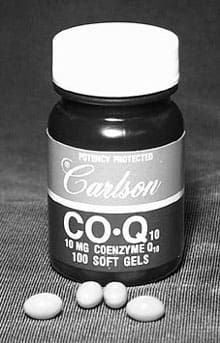
Snelgrove contacted a friend who raises dogs holistically, and followed her friend’s suggestions for a herbal treatment program. This included using products made by Nature’s Sunshine, including two artemisias (mugwort and sweet Annie, or annual wormwood) and several other herbs in combination with black walnut* to kill the heartworms and their microfilariae; coenzyme Q10, hawthorn, garlic, and cayenne to strengthen the heart and help prevent clotting; and yucca to help relieve Bandit’s cough.

The cough continued intermittently for four or five months before diminishing. “Then, almost overnight, he came back to life and started acting like a puppy again,” says Snelgrove. She kept Bandit on the herbs for a year before going back to the veterinarian for another heartworm test. “The vet couldn’t believe he was still alive,” she says, “but here he was, with a shiny new coat and full of energy.” Snelgrove says Bandit has tested negative for heartworm for the last two years, during which he has taken the same herbal products on a maintenance schedule.

After Snelgrove posted Bandit’s story on her Web site, eight people put their heartworm-positive dogs on the same program. “So far two are completely cured with negative heartworm tests to prove it,” she says, “and the others are improving.”

Snelgrove appreciates the seriousness of heartworm disease, and says she would rather prevent it than have to treat it. “But what I’ve learned from all this,” she says, “is that a diagnosis of heartworm infection doesn’t mean having to choose between expensive, dangerous treatments and letting your dog die. There are other options.”

*Controversy over black walnut preventive: Some holistic veterinarians have reported having some success using black walnut capsules or extracts as heartworm preventives and even as a treatment for adult heartworm infections. In recent years, perhaps because more people have been trying this approach, more reports have surfaced of black walnut’s shortcomings as a preventive, with some dogs testing positive for heartworm despite their owners’ use of black walnut. Has black walnut been over-promoted as an alternative to conventional veterinary heartworm preventives?

If a dog eats commercial pet foods, receives annual vaccinations, is exposed to pesticides and other chemicals, and has taken prescription drugs, her impaired immune system may fail to discourage heartworms. In addition, poorquality herbal preparations or good-quality products that have been damaged by exposure to heat, light, and air won’t help her. Because most powders lose their effectiveness quickly, tinctures (alcohol extracts) are usually a better choice than capsules, but even a freshly made tincture that wasn’t aged long enough or did not contain enough plant material may be too weak to help.

One way to protect dogs from heartworm and other parasites with black walnut is to buy the best products you can find (Gaia and HerbPharm are excellent brands) from a store that receives frequent shipments. Freshness matters when products are stored under fluorescent lights or exposed to sunlight or heat.

For additional protection from heartworm, intestinal worms, fleas, and mosquitoes, add garlic and other parasite-repelling herbs to your dog’s dinner. Several products designed for pets contain wormwood and other artemisias, noni, neem, rue, thyme, the white rind of pomegranates, or cloves.

Building Your Dog’s Immune Competence

Stephen Blake, DVM, of San Diego, California, is a holistic veterinarian who consults with preventive-drug-adverse clients all over the country, including areas where heartworm is endemic.

“Many of my clients either never used conventional heartworm preventives or quit using them decades ago,” says Dr. Blake. “Today’s preventives are much improved, but they still can cause adverse side effects. Some dogs develop autoimmune disorders when heartworm chemicals alter normal cells so that the body considers them foreign and attacks them. The drug’s active ingredients wind up in the liver, where they may cause a form of hepatitis, or the drug might affect some other part of the body. The end result is that in trying to prevent heartworm, you might lose the patient to an autoimmune complex, liver failure, or the failure of whatever organ was most damaged by the drug.

“Sometimes the damage caused by heartworm preventive medication is so subtle,” he says, “that no one makes the connection. It could show up as slightly reduced energy, a picky appetite, skin problems, ear infections, or any number of benign chronic conditions that the dog didn’t have before it went on the medication. Several of my patients had symptoms like this that went away when their owners discontinued the medication. That’s when I realized that the risk of damage from preventive drugs was greater than the risk of heartworm, and I started to focus on nutrition and natural preventives instead.”

Dr. Blake monitors patients with heartworm blood tests every six months. “Negative test results reassure clients,” he says, “but even if a dog tests positive, it doesn’t mean the dog is going to die. This is a common misconception. If the dog’s test was negative six months ago, a positive result probably indicates the presence of just a few heartworms rather than a large number. In that case, nutritional and herbal supplements, dietary improvements, and other holistic strategies can help the dog eliminate adult worms and prevent microfilariae from maturing.”

Dr. Blake is fond of citing a study conducted several years ago at Auburn University Veterinary Medical School by Dr. Ray Dillon, who attempted to infect impounded stray dogs with heartworm by injecting them with blood containing 100 microfilariae. At the end of the study, each of the dogs had only three to five heartworms.

In contrast, Dr. Dillon found that when dogs bred for research were given 100 microfilariae, they typically developed 97 to 99 adult worms. “That’s a huge difference,” says Dr. Blake. “The stray dogs were from a control facility in Mississippi, which is a heartworm-endemic area, and no one was giving them heartworm protection medication. These dogs had developed their own resistance to heartworm in order to survive, which they probably did by manufacturing antibodies that prevented the heartworm larvae from maturing.”

To improve a dog’s overall health in order to help him repel and eliminate heartworms, Dr. Blake recommends improving the diet (more protein, better-quality protein, and a gradual transition to raw food), digestive support (colostrum, digestive enzymes, and probiotics such as acidophilus), clean water (filtered or bottled), ample exposure to unfiltered natural light outdoors (something he believes kept the stray dogs healthy), and the elimination of everything that weakens the canine immune system. This includes pesticide treatments for fleas or ticks, vaccinations, exposure to garden chemicals, and most prescription drugs.

“It isn’t necessary to fear every mosquito,” says Dr. Blake, “or to equate every positive heartworm test with a death sentence. Mother Nature has given your dog plenty of defense weapons that will work fine if you keep chemicals and inadequate nutrition from interfering. When I first stopped using heartworm prevention medicines, I went through stages of using homeopathic nosodes, herbs, and natural repellents in their place. I no longer use any of those replacements because I believe a dog’s best protection comes from a clean, toxin-free life-style and good nutrition.”

Heartworm-Infected Mosquitoes: A Spreading Threat

The first description of heartworm in dogs appeared 155 years ago in the October 1847 Western Journal of Medicine and Surgery. But until the late 20th century, America’s canine heartworm was a regional illness, with most cases occurring in the Southeast. Dogs living in Rocky Mountain and Western states rarely contracted heartworm, and if they did, it was because they picked it up while traveling through areas in which heartworm was endemic, or permanently established.

Warm summer temperatures, conditions that favor mosquitoes, and an increasingly mobile canine population have contributed to the spread of heartworm. Mosquitoes thrive in swampy areas and wherever they have access to standing water. Sometimes natural disasters such as storms or floods spread heartworm by expanding the mosquitoes’ habitat. Other factors that contribute to heartworm infestation include the agricultural irrigation of previously dry land or the installation of swimming pools, ponds, and fountains.

Wendy C. Brooks, DVM, at the Mar Vista Animal Medical Center in Los Angeles, California, is keeping a close eye on heartworm infections in areas thought to be safe from the parasite. Consider Salt Lake City, Utah, historically a low-risk area for heartworm.

“A beautification project led to the planting of new trees throughout the city,” says Dr. Brooks. “The following year, these trees were pruned for the first time, leaving thousands of knot holes throughout Salt Lake City. This suited Aedes sierrensis, the ‘tree hole mosquito,’ just fine. Soon heartworm cases began appearing. Salt Lake City is now considered as endemic an area for heartworm as Texas, Louisiana, or Florida. Planting trees throughout a city is hardly a major climatic event, but it was enough to establish heartworm and its mosquito vector in a new area.”

Between 1996 and 1998, researchers at the University of California at Davis School of Veterinary Medicine reviewed the heartworm tests of 4,350 dogs in 103 cities in Los Angeles County. Eighteen dogs tested positive, or 1 in 250. The result startled veterinarians not only because it was unexpected but because the infection rate was as high for dogs that had never traveled as it was for dogs that had, and 50 percent of the infected dogs were “indoor” dogs, which are considered less susceptible to heartworm than dogs that live outdoors. Age, sex, and coat length were ruled out as risk factors.

“Veterinarians in Southern California do not usually test for heartworm,” says Dr. Brooks, “but we’re beginning to. In areas with swimming pools, reservoirs, lakes, ponds, and other mosquito-friendly environments, heartworm is infecting our dogs.”

Is Alaska next? Thanks to global warming, mosquitoes have appeared in Barrow, the northernmost city in North America, and the mosquito-friendly Kenai Peninsula southwest of Anchorage reached heartworm-incubating temperatures in May.

Making Decisions on Heartworm Treatment

The success of alternative approaches for preventing or treating heartworm – or any other condition, for that matter – depends upon a complex multitude of factors. One should not simply replace conventional medications with “natural” remedies and expect miracles to happen; this is the sort of ill-considered approach that often fails and gives alternative medicine a bad reputation.

Instead, dog guardians who are concerned about the risks of conventional prevention or treatment drugs should consult with a holistic veterinarian and look into a “whole dog” heartworm prevention program. This should include a review of and improvements in the dog’s diet, overall health status, exposure to toxins, and stress levels. Local conditions should also be taken into account, including the incidence of mosquitoes and of heartworm in any areas that you and your dog frequent.

The decisions of whether or not to use natural or conventional preventives, and how and whether to treat a heartworm infection are not easy to make – but they are your choices. Find a veterinarian who will support and help you protect your dog according to your dog-care philosophy.

HEARTWORM: OVERVIEW

1. Inquire about the prevalence of heartworm in any areas where you and your dog frequent.

2. Rigorously employ a protection program (any protection is better than none) that suits your dog-care philosophy.

3. Have your dog tested for heartworm infection annually. The competence of your dog’s immune system is critical for protecting him from heartworm.

4. Use immune boosters such as an improved diet, pure water, reduced exposure to toxins, etc.

Download the Full July 2002 Issue

0
To continue reading this article or issue you must be a paid member.

Join Whole Dog Journal

Get full access to Whole-Dog-Journal.com – more than 4,000 articles – for just $20.
Join today and save 30% off our full price.
Already a member?
| Forgot your password? | Activate Web Access

How to Manage a Multi-Dog Household

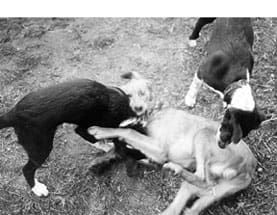
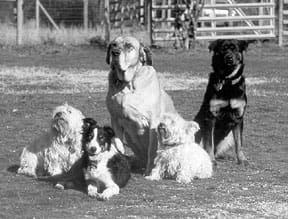
As I write this, our four dogs are scattered across my office floor dozing in happy harmony. Dusty, our 8-pound Pomeranian, is curled up under my computer station on one side of my feet, Dubhy, the Scottie, on the other. Eighty-five-pound Tucker is sprawled across two dog beds next to the file cabinet, and Katie-the-Crazy-Kelpie is stretched out on the purple fleece on the far side of the room. All is well in the Peaceable Paws kingdom.

It is not always so, however. Katie and Dubhy have squabbles from time to time – usually a result of ownership disputes over some mutually coveted possession, or claim-staking for the highly prized location at our feet in front of the sofa. An occasional defensive falsetto Pomeranian snarl will ring out when Dusty perceives a pending threat to his small self by one of the larger dogs. And when Tucker and Dubhy engage in rowdy bouts of Chew-Face and Chase-and-Maul-the-Scottie, Katie, driven by her herding dog genes to maintain order, will often spoil the fun with fear-inducing glares, backed up by painful and effective nips to the offenders’ hocks.

Because dogs are pack animals, we have high expectations about their abilities to live peacefully in groups. If you are a human member of a multiple dog household, it is important to be realistic about what you can and cannot accomplish with your canine family members. Your own personality, behavior, commitment to managing and training your pack, as well as your choice of packmates, will all play important roles in your ability to create your own peaceable kingdom.

family of dogs

It’s in the Genes

Once upon a time, our dogs’ ancestors were all wild and lived in packs. It was critically important to pack survival that they get along well with each other. Even a minor injury from an aggressive packmate’s tooth could become infected and cause the disability and death of a pack member. Wild dogs depended on the abilities of the whole canine family to help with hunting and pack defense – a disabled member was a liability to all. For these survival reasons, dogs developed a highly ritualized language that enabled them to maintain pack order without bloodshed. Meaningful eye and facial expression, body posture, snapping, snarling, and even tooth contact without enough pressure to break skin all contributed to harmonious pack life.

Enter the human. Over the centuries, as we molded the canine species’ exceptionally plastic phenotype, we created breeds such as Beagles, Bassets, Foxhounds, Coonhounds, Labradors, Golden Retrievers, and others – the hounds and sporting breeds that still have very strong genes for pack harmony. At the opposite extreme, we also created breeds such as the American Pit Bull Terrier, that genetically have very little tolerance for the proximity of others of their kind.

If you are just starting out on your path to pack life, your shortest route to a peaceful pack is to select canine family members from the harmonious end of the scale, and avoid the pugnacious fighting breeds, feisty terriers, and obsessive herding dog types. That’s not to say that some Pit Bulls, Scottish Terriers, and Australian Kelpies can’t live in group homes – they certainly can – it just takes more effort on the part of the human to make it work.

Order in the Pack

Pack management is as much an art as a skill. If you have always had a multi-dog household, never had problems, and never thought twice about it, congratulations! You are one of the lucky ones – a natural. You probably instinctively have done all the right things to help your pack be well-adjusted. Many dog owners aren’t so fortunate.

Pack problems run the continuum from simple delinquent behaviors to serious intra-pack aggression. While many dog owners tolerate the former, group bad manners is often the precursor to aggression, and is far more easily addressed before canine emotions escalate to the blood-letting level.

The basic tenet for a successful multi-dog household is simple: The more dogs in the home, the more “in charge” the human pack member must be. The “in charge” tenet for pack management is closely followed by this corollary: The more dogs in the household, the more well-trained and well-behaved the canine members of the pack must be. So how does a floundering human leader restore order to the pack?

The first step is management. If you are facing pack behavior challenges, start by identifying the key areas of conflict, so you can figure out how to put a management plan in place while you work on long-term training solutions.

Conflicts Between Family Dogs

A sample list of common conflict situations might look something like the following. We’ll call our sample dog guardian Jane, and describe representative personalities of various players in her pack.

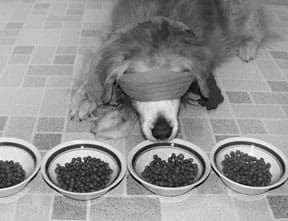
• Feeding time: Angel devours her food and then runs over to eat Sweetie’s, which sometimes starts a fight. Meanwhile, Sugar tries to pick up her bowl and carry it under the sideboard, often spilling it in the process. Honey wolfs down her food, growling and making evil faces all the while.

• Going outside: All four dogs jostle for position at the door, accompanied by snapping and growling, and an occasional full-on battle. Jane has been bitten trying to maintain order at the door while restraining Angel by the collar.

• Watching TV: Jane’s house routine is to eat dinner on the coffee table while watching TV. Dogs all vie for the closest spot to catch dropped crumbs and hand-fed tidbits. Fights most often occur between Angel and Honey.

• Playing: Sugar and Sweetie love to roughhouse together, biting and chewing on each other. All goes well for some time, but Jane can see their energy level rise as they play; three out of five times it ends in a fight.

• Getting home from work: All the dogs are very excited when Jane walks in the door after a long day at work. She is happy to see them too, so she greets them effusively, in a high-pitched voice, with lots of hugs and kisses. Occasionally in the excitement Honey turns on Angel and pins her to the ground.

• Bedtime: Sugar has claimed the human bed as her own, and that’s okay with Jane, she’s willing to share. The others usually work out who gets which dog bed on the floor with only minor grumbling, but Honey will sometimes test Sugar’s claim and jump up to join Jane and Sugar, to the tune of much snapping and snarling.

Why Do Dogs Fight? Stress!

Aggression is caused by stress, and there is clearly plenty of it in Jane’s pack. Jane is obviously not “a natural.” She knows she has a problem – if she had any doubts, the $800 vet bill for the last incident between Angel and Honey erased them.

She has tried to control her rowdy family members, but failed miserably. On the advice of a well-meaning friend she was letting the dogs work it out themselves, but things have only gotten seriously worse. She read a book that suggested supporting the “alpha” dog. As best she can tell, Honey is top dog in the pack, so she feeds Honey first, tries to let him out the door first (hence the bite by Angel), and lets him sit by her feet while she eats her dinner and feeds him treats. If a fight happens, she yells to break it up, then puts the other dogs out in the yard but lets Honey stay in, to support his position in the pack.

Jane needs a whole new approach to pack management. As the benevolent leader, she needs to decide what dog behavior is appropriate, not Honey. Order is best restored through calm management and positive training, not yelling and punishment.

Solutions to Multi-Dog Conflicts

Here are management plans and training suggestions for each of Jane’s six trouble spots:

• Feeding time: Feed the dogs separately, either in different rooms, in opposite corners of the same room, in crates, or by letting them come in one at a time to eat. Doors and baby gates can keep dogs confined to their separate rooms, while crates or tethers can allow them to eat safely in opposite corners of the same room. (See “A Gated Community,” this issue.) Eventually, after the dogs are trained to “Leave It,” Jane may be able to referee feeding time without having to physically restrain the dogs. (See “Off Limits,” January 2002.)

• Going out: The “Wait” exercise is exceptionally useful for maintaining peace at doorways with groups of dogs (see “Wait a Bit, Stay a While,” May 2001). Until she has taught her pack members to “wait,” Jane can use baby gates or tethers to restrain two or three of the dogs while letting them out one or two at a time to reduce the excitement and arousal that leads to aggression.

Once Jane has taught each of the dogs to “wait” at the door she can start practicing with them two at a time, then three, then all four. The pack should learn to be released from the “wait” one at a time so there’s no door jam, and Jane should vary the order in which she releases them so they don’t learn to anticipate the release.

• Watching TV: Jane is setting her dogs up for conflict by feeding them from her plate. She needs to stop this practice immediately. She can use tethers to keep the dogs safely separated, comfortable on their own beds, while she eats dinner at the coffee table (see “Tethered to Success,” April 2001). She can eventually teach them to go to their designated beds on cue by rewarding them generously when they are there. Chances are good that with time and practice, they will go to and stay on their beds when asked, without being tethered.

• Playing: It’s good that Jane can see the energy level rising between Sugar and Sweetie, because that enables her to step in calmly and break up the play session before it turns ugly. She can tether or crate the playmates for several minutes to give the arousal level time to subside, and then release them to play together again – no harm, no foul.

In time, Sugar and Sweetie may figure out that too much excitement makes the fun stop, and learn to better control their own energy. Jane’s intervention needs to be calm and cool; if she yells, punishes, or moves quickly, she is likely to escalate the energy between the dogs and actually trigger a fight.

• Getting home from work: Jane adds fuel to the fire with her excited homecomings; after a day spent inside, and a few hours of anticipating her return, the dogs are already keyed-up. The joyous greeting is too stimulating, and the dogs’ responses boil over.

Jane can manage her dogs’ greeting behavior while she does long term training by crating the dogs in her absence, assuming she won’t be gone longer than the dogs can tolerate. For pups, a good rule of thumb is one hour longer than the pup’s age in months – four hours for a three-month-old pup, etc. Adult dogs shouldn’t be routinely crated for longer than about eight hours a stretch.

When Jane comes home, she can let the dogs out one at a time and greet them calmly. If they get charged up she can just quietly turn her back and walk away from them, or even turn and walk out the door.

She can also simply start entering the house without greeting the dogs, ignoring them completely until they calm down. Once again, this teaches the dogs to control their own behavior, rather than submitting to her forcibly imposed will. Chances are good that if she does not “feed” their energy, they will settle quickly and fights won’t happen.

• Bedtime: One word – crates! I am not opposed to dogs sleeping on the bed, unless “dogs on the bed” is causing problems, which in Jane’s case it clearly is. She is at risk for injury herself, lying on her bed beneath two squabbling canines.

She could start by crating all the dogs at night, then, if her ultimate goal is to have them uncrated at night, experiment with letting one out, then two, and as long as good manners hold, eventually all four. (See “Crate Training Made Easy,” August 2000.) Any nighttime growling or snapping is grounds for a renewal of crating.

Of course, while Jane effectively manages her dogs’ behavior in the home, we also expect her to enroll in a good, positive training class. She may not be “a natural,” but she can learn. Her class instructor will be a valuable resource to her in identifying and resolving her dogs’ pack behavior challenges.

It will take her some time to complete basic classes with each of the four dogs, but the improvement in her communication with and understanding of her pack members’ behaviors and thought processes will be well worth the effort. In fact, it will be the ultimate key to her long-term success in turning her home into a peaceable kingdom, and ensuring that she enjoys mutually rewarding lifelong relationships with each of the members of her pack.

10 Steps to a Peaceful Pack

1. Manage the behavior

Use management tools such as tethers, crates, and baby gates to maintain order while you modify your dogs’ behavior through positive training.

2. Train

The more dogs in a household, the more important it is that all dogs be well-trained and well-behaved. Intervention in an escalating conflict is easier and more effective when the dogs respond to calm cues. The Web site of the Association of Pet Dog Trainers (apdt.com) offers a “Trainer Locater” list of APDT members, as well as suggestions for finding a good training professional. APDT members may use positive methods to varying degrees; however, there is an increased likelihood of finding a positive trainer on this list who meets your expectations.

3. Be calm

Aggression is caused by stress. If you can maintain a calm demeanor around your dogs, especially when they are becoming aroused, you will help defuse potential conflict. Resist the impulse to scream or yell when dogs are squabbling; this will only increase stress. If you must intervene in a scuffle that doesn’t quickly resolve itself, keep a plywood board handy that you can slip between the combatants to separate them. Then make a mental note to analyze the incident and develop a management plan to avoid a recurrence.

4. See your veterinarian

Medical conditions can exacerbate tense pack relations. A physical condition or illness that causes pain or discomfort to your dog is stressful. Stress causes aggression, so anything you do to alleviate pain or discomfort in any individuals can help reduce the overall stress level in the pack. Ask your veterinarian for a full thyroid panel for any of your dogs who seem particularly anxious and aggressive. Thyroid levels that are on the low end of the scale but still within the clinically normal range can contribute to aggression. Your veterinarian can consult with Jean Dodds, DVM, a pioneer in studying the connection between thyroid and aggression.

5. Let dogs be dogs

While it is not appropriate to let dogs “work it out” if conflicts are escalating, it is effective to let pack members settle small scuffles themselves. These are part of the inherited behavior developed for group survival, and can help to resolve hierarchy unrest and restore pack equilibrium.

6. Exercise

A tired dog is a well-behaved dog. Excess energy is a stressor, and a pack of tired dogs is less stressed, less excitable, and far more likely to live in harmony than one whose members are spilling over with surplus energy.

7. Cultivate individual relationships

Spend quality time with each dog outside the presence of the others. This is necessary for training purposes anyway, and will help you develop a relationship with each dog as an individual. This will make it easier for you to establish your position as benevolent leader and manage the pack as a whole.

8. Protect vulnerable pack members

Very old, young, small, sick, or disabled members of your canine family may be unable to defend themselves, especially if one or more pack members are determined to commit mayhem. You must keep such fragile members physically safe by separating them from the rest of the pack. This may be a temporary solution until the invalid has recovered enough to rejoin the group, or it may be a permanent fix if the size/strength disparity between participants is long term or the conflict too serious.

9. Better living through drugs

Some dog owners find flower essence and herbal remedies to be quite useful for reducing the stress that leads to pack conflict. Rescue Remedy is the most commonly suggested flower essence product, and herbs such as Valerian, Kava Kava, and St. John’s Wort are all used as calming agents. For more extreme cases, pharmaceuticals prescribed by your veterinarian may be indicated. Natural remedies, while usually less risky than prescription drugs, can have unwanted side effects; we recommend that you and your training professional work together with a veterinarian well-versed in complementary medicine to determine if and when drugs or natural remedies are appropriate. (See the American Holistic Veterinary Medical Association for a listing of holistic veterinarians around the country.)

10. Be realistic

Quality of life is an important consideration for all the family members. If dynamics in your pack are stressing you or your dogs so much that your quality of life is poor, and if your efforts to improve relationships aren’t helping, then it’s time to consider other options. The worst case scenario – euthanasia – might be the best option for a dog who is so troubled that finding an enjoyable environment is unrealistic. Finding one or more of the troublemakers new homes may alleviate the stress for the rest of the family, although finding homes for difficult dogs can be a challenge. Alternatively, you may choose to keep the more difficult ones and place one or more of the easy-going or vulnerable dogs with friends or family members. This could be a win-win for all, creating an extended family for your canine friends while making everyone’s life more peaceful.

Pat Miller, WDJ’s Training Editor, is also a freelance author and Certified Pet Dog Trainer in Maryland. She is the author of, The Power of Positive Dog Training.

Using Baby Gates as Puppy Management Tools

puppy gate

When we found the six-month-old Scottish Terrier running loose and brought him home to stay in February of 2001, the scrappy little guy gave us a graphic reminder of the trials and tribulations that go along with the joys of puppy-raising. It didn’t take many chewed-up possessions and puddles on the carpet to send us scrambling to unearth the baby gates that had long since been retired from past use with our now-mature canine pack members. We found the old gates behind some boxes in the loft of our barn, dusted them off, and pressed them into immediate service.

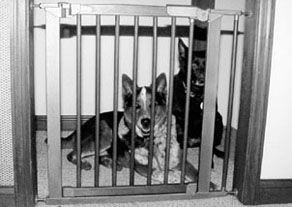
What a relief! Of course we crated the puppy at night, but during the day, one gate stood sentry across my office door so I didn’t have to jump up from my computer every 30 seconds to see what he was getting into. The other blocked the doorless opening between our den and our dining area, so we could enjoy peaceful evenings without worrying about what the little terror – oops, terrier – was doing in the rest of the house. Sanity restored, life settled back into peaceful harmony.

It took only a few months until the Scottie’s behavior was reliable enough for me to remove the gate to my office, so that i could work on the computer without supervising him full-time. But only in the last month have we opened the den/dining room gate in the evenings and given him almost full house freedom. The bedroom door stays closed, thanks to his penchant for picking up shoes and socks, and my inability to consistently put them where he can’t get them.

Unlimited uses
There are lots of other wonderful applications for baby gates in addition to basic puppy management. We have long used one to bar the dogs from our cats’ room (the cats jump over the gate); this keeps the canines from dining on kitty kibble, and prevents them from devouring that grossly delectable dog treat, litter box “kitty rocca.”

Gates can also be used to keep a dog out of a baby’s nursery, or out of the bedroom of any family member who is allergic to dog hair. And if your clever Collie has learned that the sofa is off limits when you are there but fair game when you’re away, you can use a gate to block her access to the room with the forbidden furniture. (See “Upper Level Management,” October 2001.)

The dog-management possibilities are endless. Having a dispute with your spouse about whether the dog can be in the house? Wrangle a compromise, and use gates to keep him (the dog, of course!) in the approved areas of the house; maybe you can gain more territory for him later. Just refinished the hardwood floors? Baby gate! Have an incurable counter-surfer? Baby gate! Having intra-pack relationship problems? Baby gate!

You get the idea. Rather than yell, spank, shock, or otherwise try to punish your dog into submission, use baby gates to manage their behavior while time, training, and behavior modification work together positively to extinguish unwanted behaviors without the use of force or pain.

The right gate for you
Your ideal baby gate will install easily, be sturdy enough to withstand canine assaults, and tall enough to prevent Bounder from leaping over. It should open and close easily, and be safe, aesthetically pleasing, and affordable. (Fortunately, many dog owners have a somewhat lower-than-Martha-Stewart standard for aesthetics!)

Baby gate prices cover a wide range, offering something for every budget – from $18 for a cut-rate model to more than $150 for the classy, décor-matching gates. They are available in different widths to cover a variety of doorway sizes, and may be made of wood, plastic, metal, tubular steel, PVC pipe, wire mesh, nylon, nylon mesh, or a combination thereof. Some screw into the wall and require installation with tools; others are pressure-mounted. Some open easily with one hand. Others require you to remove the whole gate in order to pass – definitely a two-handed task.

Because there are so many variables, we are going to stray from our normal format of rating several different products. Instead, we will describe the many options that are available, and some of their advantages and disadvantages, to help you understand how to analyze your own needs and select the gate that would work best for your dog and your home.

Consider your dog
The size of the dog or dogs you want to contain is the first thing you have to consider, in relation to the size of the gaps in the gate. A gate with bars that are four inches apart – the widest gap allowed in the industry – will perfectly prevent a human baby or broad-headed dog like a Rottweiler from sticking his head through, but pose a hazard for any dog whose head juuust fits through. Such a dog could slip her head through the gap, get stuck, and panic. And, of course, your Chihuahua could walk right through the bars!

The height of the gate is also important if your dog is a jumper, climber, or particularly tall. The most common height range for baby gates is about 24 to 32 inches. For smaller dogs who are not apt to attempt a leap over the gate, such as a Maltese or Peke, a shorter gate is convenient; it’s often easier to step over a short gate than to open and close it. Especially tall gates are needed for tall dogs or those who specialize at leaping. We found a 48-inch-tall, wire mesh, pressure-mounted gate in several stores and catalogs, including the Care-A-Lot Pet Supply Warehouse, where it was priced at $60 (800-343-7680, carealotpets.com). The Rover Company of Prescott, Arizona, offers “Rover Closers” made of PVC pipe. Their 48-inch-tall model sells for $85; order at roverpet.com or by calling (800) 658-5925.

In addition to his size and athleticism, you also must keep your dog’s personality in mind when buying a gate. Dogs who have been properly conditioned to enjoy spending time alone might require only the slightest barrier, such as the Evenflo Extra-Wide Soft Gate, for those extra-wide spaces. At $43, it is made of tubular steel and a nylon and mesh panel. It is pressure-mounted, and expands from 38 to 60 inches. The Infantino Kiddy Guard, made of polyester mesh, retracts into itself and covers openings from 6 to 51 inches wide. At $106 it’s pricey, but you have the lovely convenience of “disappearing” the gate when not in use. (We found the latter two gates online at child-safety-gates.com; you can also call 610-539-8736 to order.) Any dog who is secure in a mesh soft-sided crate would probably be just as respectful of this gate.

In contrast, dogs who are determined to defeat any restrictions of their free movement require a maximally secure gate. Many gates are pressure-mounted in doorways; some of these contain strong springs to keep the tension high. However, if your dog is likely to test the barrier’s strength, go for the sturdiest hardware-mounted model you can find. If your dog does manage to defeat a gate and win his freedom, even just once, he is very likely to try and try again. Every time he succeeds in a “jailbreak,” he has been rewarded and thus firmly conditioned to try it again.

An especially strong, hardware-mounted gate we admire is the KidCo Safeway Gate. We purchased this very popular model from a baby supply store, but have seen it offered in many stores and catalogs. The lowest price we saw was $54, from both Care-A-Lot (see contact numbers above) and Ryan’s Pet Supply, 800-525-PETS or www.ryanspet.com.

A final canine personality point to consider: If your dog or puppy is a chewer, irresistibly drawn to munching on wood furniture, avoid wood or plastic gates. A bored puppy with a natural need to chew may not be able to resist gnawing on the only thing between her and the rest of the house.

Ease of human use
Of course, humans are the other users you have to consider when choosing a gate. The gate has to be easy enough for all human members of the family to open and close again securely. Some gates don’t open, but have to be stepped over or taken down and then replaced when you want to pass through – beyond the ability of most children to manage. Other gates swing open and close with a latch, but if a latch is difficult to refasten, chances are it will be left not-quite-fastened sometimes, potentially putting the dog in danger. If you live alone, or with another competent, concerned grown-up, tricky latches may not be much of a problem. But it could be a big issue if you have a lot of foot-traffic in your home, kids, or anyone who suffers arthritis in her hands.

The importance of matching the latch with the human users became amply apparent when I purchased KidCo’s Center Gateway Pressure Gate in wood ($90) for my home, and in tubular steel model ($70), for use at my training center (both from J-B Wholesale, www.jbpet.com, 800-526-0388). I selected the wooden model for my home for aesthetic reasons, and the steel model for the training center because it was less expensive and more likely to survive potential assault by doggie daycare clients. I chose this particular brand of gate because it was pressure-mounted (which I knew would be adequate for my dogs), could be easily opened with one hand, and opens in both directions for easy passage. In addition, the frame lies flat on the floor (nothing to step over) and, although the bars were widely spaced, I thought it highly unlikely that our dogs would put their heads through.

The gate was a perfect choice for my home. It’s well made, easy to open and pass through, and looks nicer than any gate I’ve ever used in the past. My husband and I like it so well that we continue to leave it in place even though the Scottie doesn’t need it any more; we’ve realized that our 19-year-old cat, Jackson, appreciates the daytime respite from the nonstop attentions of Katie, our cat-crazy Kelpie.

The gate has not fared so well at my training center, however. The pressure-mounted feature that works so beautifully for my home hasn’t performed as well with the high traffic level and the large, rambunctious dogs that sometimes grace my center. Despite numerous tightenings, the rubber feet that hold the gate in place keep slipping. The gate mechanism that we find blissfully simple to manipulate at home seems to confound new users, and I am constantly explaining, “Push the button, lift up the handle, then lift slightly on the gate and swing it open.”

Other people considerations
If you rent, rather than own your home, or have really nice woodwork around your doors, you’ll want a pressure-mounted gate, rather than something that requires you to screw hardware into doorframes. Keep in mind that the strongest pressure-mounted gate is not as secure as hardware-mounted gates.

If the best spot for your gate lacks a good strong wood surface to fasten the gate to, you may want to buy KidCo’s neat installation kit. It contains materials and fasteners that enable installation on a hollow wall, wooden banister, or a wrought iron railing. (You’ll need one kit for each side of the gate that lacks a solid wood surface.) We paid just $10 for the kit from Care-A-Lot (800-343-7680 or www.carealotpets.com).

Many gate manufacturers offer additional panels that can be added to gates, so as to span extra-wide doorways.

Once upon a time, expandable “accordion” type gates were very common – you know, the kind with the diamond-shaped openings that expand and retract across doorways. These expansion gates did offer two advantages not seen elsewhere: they are extremely adjustable, and they latch easily with just a hook and eye that is screwed into the wall. However, we would recommend that you avoid these gates; it’s too easy for pets and human fingers to get pinched as you open and close them. Also, with some of the largest openings of any baby gates, they tempt smaller animals to try to crawl through, inviting entrapment and disaster.

No bad dogs
Using baby gates doesn’t mean you have bad dogs. It means you are a wise owner who knows how to manage your dogs’ behavior to make life more pleasant for all concerned.

And you don’t need all the fancy/expensive bells and whistles for all your baby gate applications. The one I use for my home’s “cat room” is an older, inexpensive model made of wood and wire mesh, the kind that does not swing open, but must be stepped over or taken down. It’s a low traffic area, so my husband and I suffer with climbing over the gate twice a day to feed and clean litter boxes (and tell ourselves that it keeps us limber). The wire mesh feature is perfect for this application – it allowed us to cut a small opening in one corner of the gate for the geriatric cat who can no longer leap tall gates in a single bound.

There is no universally perfect baby gate. Do your research, find the one – or ones – that work best for your needs, and live with your family in the peaceful comfort of a gated community.

Commercial Dog Food or Homemade?

Everyone who cares about their dogs wants to feed them “good food.” By and large, our readers – and a growing number of non-subscribing dog owners – want to take that one step further. They have learned that improving a dog’s diet can result in improved health. So they want to feed their dogs the very best diet that money can buy.

So far, so good. We love people who love their dogs and want to take care of them in the best way they can.

Unfortunately, for some strange reason, when it comes to a discussion of the relative merits of top-quality store-bought food versus top-quality homemade diets, otherwise rational people have been known to lose their cool.

At conferences, rooms full of concerned dog owners and dedicated canine nutrition experts have exploded into shouted arguments while debating minute aspects of the topic. At dog parks, casual conversations have ended in pointed recriminations, and dogs get whisked into cars, fast.

It’s obvious to us that good-quality commercial and home-prepared diets offer certain advantages and disadvantages to dogs and their guardians. And before you decide “what’s best” for your dog, we suggest that you familiarize yourself with all of the arguments, pro and con, complete with rebuttals.

How commercial foods replaced homemade
The commercial pet food industry began manufacturing dog food to meet a nationally accepted standard of nutritional requirements only in 1953. The industry itself is only about 100 years old; before that, all pets were fed home-prepared diets, and with enough success, apparently, that the species is still hanging out with us today.

The fact that the industry has enjoyed such fantastic success is due to many factors. Many of us are too busy to shop and cook for ourselves, much less our dogs. Many people believe the slogans and promises printed in industry publications and on the food labels themselves; many have simply never questioned the fact that the food-making companies profits depend on convincing them that the commercial products are “best for dogs.”

Another critical contributor to the success of the pet food industry has been its sustained and successful efforts to intertwine and ingratiate itself with the veterinary profession. Veterinarians tend to tell people to use commercial food, but then, they have been strongly indoctrinated to truly believe that this is the only wise choice a dog owner can make; they learned it in vet school! But it’s no secret that the dog food companies sponsor veterinary nutrition textbooks, provide grant money for university research, and give vet students free dog food throughout school.

So, what with one thing and another, commercial food has come to represent the norm – what most people feed their dogs. This has been true long enough that a predictable backlash has begun to build momentum. Today, homemade diets are gaining in popularity, as evidenced by an ever-increasing number of books, lectures, and Web sites on the subject, and people who make their dogs’ food.

Keep this history in mind as we explore the benefits and drawbacks of feeding dogs commercial and homemade diets.

Conclusion
So, would it be better to stay with kibble, the quick, convenient option preferred by the majority, or to venture onto the lesser-trod path of home-prepared food?

As always, it depends on the dog and his guardian. There is no single type of food or type of preparation that will produce unblemished health in all dogs, just as there is no diet that suits all humans. The “best” food for a dog depends on its age, sex, breed, genetic inheritance, state of health, level of activity, geographic location, reproductive status, etc.

Individual human factors must also be taken into account, since the selection, storage, and administration of dogs’ diets depends on us. As evidenced by the wide variety of adult human shapes and health conditions, people have varying levels of ability to wisely plan, shop, prepare, and safely store their own diets. Not everyone has what it takes to “pull off” a good diet for themselves; not every well-meaning dog owner has what it takes to successfully formulate a home-prepared diet for their dogs, either.

We actually are firmly convinced that a proper home-prepared diet, carefully tailored to its individual recipients and guided by an informed, open-minded veterinarian is, truly, “best for dogs.”

However, we are averse to blanket prescriptions for all dogs and directives for all people. Some dogs are probably better off with a commercial diet. If a person doesn’t have the time, resources, and interest in preparing a “complete and balanced” homemade diet for their dogs, or if a dog doesn’t seem to thrive on the homemade diet his owner has provided for him, he undoubtedly has better prospects on a top-quality commercial food. Or even a well-considered mixture of the two.

In order to make intelligent decisions, a person has to be informed about all the advantages and disadvantages of each of her options, and then weigh her own individual circumstances against the general conditions. We hope that the abridged depictions of the pros and cons of the two types of feeding dogs will help inform your own dog feeding deliberations – and even offer rebuttals to anyone who criticizes your decision.

Nancy Kerns is Editor of WDJ.

Milk Thistle for Dogs

Milk thistle (Silybum marianum) is a flowering plant in the Aster family. A native of Europe, it has been used since the time of the Roman emperors as a liver tonic. Milk thistle is one of very few traditionally used herbs that has been widely accepted by conventional science to have significant medicinal value. Using milk thistle for dogs is also believed to have a number of beneficial effects.

Today we know the active ingredient of milk thistle seed extract as a flavonoid compound called “silymarin.” Most milk thistle extracts available today contain about 80 percent silymarin.

Milk Thistle for Dogs

Silymarin, which is itself a combination of several other active compounds, has been extensively studied around the world, and has been shown to be safe and effective in treating a variety of liver diseases and other conditions. It specifically protects the liver against toxins (including some drugs and heavy metals), activates protein synthesis, and stimulates growth of new liver cells to replace those that are dead or damaged. Milk thistle also has strong antioxidant (destroys oxygen free radicals) and anti-inflammatory actions.

Silymarin reaches high levels in the bile and liver (it also reaches significant levels in the lungs, pancreas, prostate, and skin). It can be used in the treatment of hepatic lipidosis, chronic hepatitis, cholangitis (inflammation of the bile ducts), and pericholangitis (inflammation of the tissue around the bile ducts). It may be useful in preventing or treating gallstones by thinning the bile. Many dogs with inflammatory bowel disease (IBD) have concurrent inflammation of the liver/bile system and the pancreas. This suite of symptoms is called “triaditis.” Because milk thistle’s beneficial actions concentrate on the liver and bile systems, it may also be helpful in dogs with IBD.

Milk thistle should be considered as an aid to healing after drug therapy, vaccinations, and infections such as canine parvovirus, as well as an potential adjunct treatment for cancer. Researchers at Case Western University concluded from their work that “silymarin possesses exceptionally high protective effects against tumor promotion . . . ” One human study even suggests a role for milk thistle in diabetes mellitus through its normalizing effects on red blood cells. It may also help prevent diabetic neuropathy, a common complication of the disease that causes degeneration of the nerves controlling the hind limbs, which consequently produces weakness and an abnormal gait.

Milk thistle generally supports the immune system through its powerful antioxidant, free-radical scavenging action, its ability to preserve the supply of another important antioxidant, glutathione, as well as direct effects on immune cells. Glutathione, which is stored primarily in the liver, naturally declines over time, and depletion of this protein appears to accelerate the aging process.

While it’s not exactly the fountain of youth, milk thistle clearly has wide-ranging positive effects throughout the body. However, before you add this potent herb to your dog’s daily regimen “just in case” it might do some good, it’s important to consider that some herbalists believe milk thistle is best reserved as a treatment for existing disease, rather than being used by itself in a healthy dog.

While moderate use of milk thistle is very safe, there is some experimental evidence to suggest that long-term ingestion of very high dosages of milk thistle will eventually suppress liver function.

Milk Thistle Dosage for Dogs

The standard dosage of milk thistle extract is based on a silymarin content of around 80 percent; most supplements contain anywhere from 50-500 milligrams (175 mg is typical). As with many supplements, it’s probably better to buy a milk thistle derivative rather than a silymarin-only or other fractional supplement, since there may be other compounds found in the whole herb that significantly enhance the effects of what science has decided is the main player.

Because of its excellent safety record and lack of adverse drug interactions, when I’m treating a very sick dog with advanced liver disease, I do not hesitate to use up to 200 mg per 10 pounds of body weight of milk thistle extract daily. For most canine purposes, however, one-third to one-half of that dose is more than adequate. (Dogs with liver disease typically will not eat, but it’s a simple matter to open up a capsule, mix the appropriate amount of powdered herb with a little blenderized food or baby food, and feed it to the dog in a syringe.) Too high a dose can cause an upset tummy, gas, or mild diarrhea; these are easily resolved by giving less.

Human research studies have shown that it is more effective to administer this herb in three or four small portions over the day than in one large daily dose. When it is not possible to split the daily dose and administer the fractional portions three or four times a day, give it at least twice a day.

The capsule form is easy to find – any health food store, and even most pharmacies and grocers, will have them in stock. The herb also comes in a liquid extract, but most human products contain a fair bit of alcohol. If you prefer a liquid preparation, get one specifically intended for use in animals.

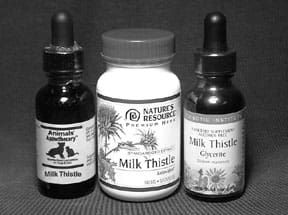
One safe, reliable source of a liquid extract is Animals’ Apawthecary (available through some pet specialty shops and many mail order suppliers).

Jean Hofve, DVM, is a regular contributor to WDJ. Her veterinary practice is in Englewood, Colorado.

CoQ10 for Heart Health in Dogs

1

[Updated August 22, 2018]

Who hasn’t heard of CoQ10? A powerful antioxidant, coenzyme Q10 is one of America’s most popular supplements. Literally every cell of the body contains CoQ10. In fact, its other name is ubiquinone, reflecting its widespread distribution in the body.

CoQ10 is most concentrated in the mitochondria, the portion of cells that produce energy. The heart and liver contain more mitochondria per cell than other body parts and thus contain the most CoQ10. Human and animal deficiencies are not yet well understood, but low CoQ10 blood levels have been reported in patients with heart disease, gingivitis (inflammation of the gums), morbid obesity, muscular dystrophy, and AIDS.

coq10 for dogs


As a nutritional supplement for humans, CoQ10 is used to treat angina, congestive heart failure, high blood pressure, mitral valve prolapse, diabetes, gum disease, Alzheimer’s disease, chronic obstructive pulmonary disease (COPD), AIDS, and infertility, and to improve athletic performance. In dogs, it is most widely prescribed for congestive heart failure and gum disease.

CoQ10’s Effect on Dogs

Not everyone agrees that CoQ10 works. Bruce West, DC, dismisses CoQ10’s popularity as unsubstantiated hype. In the November 2000 edition of his popular Health Alert newsletter, Dr. West cites a double-blind study showing CoQ10 to be useless in the treatment of congestive heart failure in humans. He expects CoQ10 supplements to simply die a slow death. “It will be around for years, create plenty of millionaires, and then disappear,” he predicts.

Yet other studies have shown completely different results, and many holistic veterinarians and physicians credit CoQ10 for improving their patients’ health dramatically. One explanation may be the type of CoQ10 that is used, as oil-based preparations are usually considered more effective or more easily assimilated than powders. Oil-based CoQ10 is sold in soft gel caps, while crystalline CoQ10 is sold in capsules, tablets, or powders.

Like many veterinarians, Stephen Blake, DVM, of San Diego prescribes daily doses of one milligram (mg) oil-based CoQ10 per pound of body weight for dogs with congestive heart failure and twice that amount (two mg per pound of body weight) if powdered CoQ10 is used. Similar recommendations are common for dogs with gum disease and other health problems.

The October 2001 issue of the Townsend Letter for Doctors & Patients offers additional insight. In a short article, retired chemist Wayne Martin describes his conversations with two leading CoQ10 researchers, Karl Folkers and William Judy. Martin’s friend Karl Folkers, Ph.D., who died in 1999, discovered vitamin B12 in 1948 and later worked with CoQ10 at the University of Texas at Austin and at an institute he founded. According to Martin, Professor Folkers hoped for a better way to get CoQ10 into blood circulation, as the crystalline form of CoQ10 does not pass easily through intestinal mucosa. Because CoQ10 is fat-soluble, Professor Folkers recommended taking it with a teaspoon of coconut oil.

William Judy, Ph.D., a colleague of Professor Folkers, investigated the treatment of hormone-refractory prostate cancer with CoQ10. He discovered that one way to improve the absorption of CoQ10 into the blood circulation is by melting it. Coenzyme Q10 melts at 104 degrees Fahrenheit, which is only slightly above normal body temperature. In Dr. Judy’s highly successful trial, patients taking CoQ10 consumed it in a cup of hot coffee or tea to which fat was added.

How to Give CoQ10 to Dogs

A dog’s normal body temperature (100.5 to 101.5 degrees F) is higher than the normal human temperature but still lower than the melting point of CoQ10. “If one can get a dog to drink warm water,” says Martin, “this should be a good way to give coenzyme Q10 to a dog.” Consider stirring the appropriate amount of CoQ10 into a small amount of hot water to which you have added a teaspoon of coconut oil or butter. Most dogs enjoy the taste of fats and oils, which simplifies its delivery. If necessary, the water/CoQ10/oil mixture can be poured over a favorite food.

In our follow-up interview, Martin explained that all of the world’s CoQ10 comes from a single Japanese supplier. Supplement makers may mix it with oil or put it in different types of capsules or tablets, but the main ingredient of all these products is identical.

Considering the price of CoQ10 supplements, it is reassuring to know that with the help of hot water and a small amount of saturated fat, inexpensive CoQ10 can be more easily absorbed and more thoroughly assimilated than the most expensive oil-based CoQ10 gel cap.

CJ Puotinen is the author of The Encyclopedia of Natural Pet Care, Natural Remedies for Dogs and Cats, and several books about human health including, Natural Relief from Aches and Pains, published last summer. She and her husband live in New York with Samantha, a nine-year-old black Labrador Retriever, and two cats.

Download the Full June 2002 Issue

0
To continue reading this article or issue you must be a paid member.

Join Whole Dog Journal

Get full access to Whole-Dog-Journal.com – more than 4,000 articles – for just $20.
Join today and save 30% off our full price.
Already a member?
| Forgot your password? | Activate Web Access

Protecting Your Dog from Parvovirus

1

[Updated February 23, 2016]

When parvo strikes, it moves fast. Infected dogs may appear to be in perfect health one day and violently ill the next. Emergency veterinary care is expensive, and unless dogs are diagnosed and treated early, many die from this serious disease.

However, reactions to parvovirus vary widely – both among dogs and their human caretakers. In a world in which parvovirus is ubiquitous – it is literally everywhere except environments that have been sterilized – parvo kills some dogs and leaves others unscathed. And in the debate about vaccination against this disease, some people vaccinate their dogs early and often, while others refuse to vaccinate against parvo at all.

In this article, we’ll discuss a number of parvovirus prevention and treatment approaches taken by veterinarians and dog guardians today. We’ll also share personal stories from two people whose dogs had parvovirus, and describe how these guardians’ experiences affected their healthcare strategies.

puppy in the park

But we won’t tell you which approach you should take with your dog. That, like all health-related issues, is a personal decision that must be made after you learn as much as possible about the risks and benefits of the various approaches.

Understanding Parvo

The smallest and simplest of the microscopic infectious agents called viruses, which cause disease by replicating within living cells, parvovirus consists of a single strand of DNA enclosed in a microscopic capsid, or protein coat. This protein coat, which differs from the envelope of fat that encases other viruses, helps the parvovirus survive and adapt.

Parvoviruses infect birds and mammals (including humans), but until the 1960s, parvovirus did not infect domestic dogs or their wild cousins. The original canine parvovirus, later labeled CPV-1, was discovered in 1967. Eleven years later, CPV-2 emerged in the United States. It apparently mutated from feline distemper, which is the feline parvovirus. CPV-2 quickly infected dogs, wolves, coyotes, foxes, and other canines around the world. A second mutation, CPV-2a, was identified in 1979, and a third, CPV-2b, is in circulation today.

Infection takes place when a susceptible host inhales or ingests the virus, which attacks the first rapidly dividing group of cells it encounters. Typically, these cells are in the lymph nodes of the throat. Soon the virus spills into the bloodstream, through which it travels to bone marrow and intestinal cells. The incubation period between exposure and the manifestation of symptoms such as vomiting and diarrhea is usually three to seven days.

When it attacks bone marrow, parvo damages the immune system and destroys white blood cells. More commonly, it attacks the intestines, causing copious diarrhea and debilitating nausea, which further weakens the dog’s system. Dogs who die of parvo typically do so because fluid loss and dehydration lead to shock, and/or because intestinal bacteria invade the rest of the body and release septic toxins.

Any dog that survives a parvovirus infection is believed to have lifelong immunity; serum antibody titers tend to stay high for prolonged periods after recovery from the virus.

Young puppies and adolescent dogs whose maternal antibodies no longer protect them but whose immune systems have not yet matured are at greatest risk of contracting parvo. Most parvo victims are less than one year old, but the disease can and does occasionally strike adults, too.

Some breeds are particularly susceptible to contracting parvovirus, including Alaskan Sled Dogs, Doberman Pinschers, German Shepherd Dogs, Labrador Retrievers, Rottweilers, and American Staffordshire Terriers.

How Parvo Spreads

Veterinary experts agree that virtually all of the world’s dogs have been exposed to canine parvovirus. The virus begins to “shed,” or be excreted by a dog, three to four days following his exposure to the virus, often before clinical signs of the infection have appeared. The virus is also shed in huge amounts from infected dogs in their feces for 7-10 days; a single ounce of fecal matter from a parvo-infected dog contains 35,000,000 units of the virus, and only 1,000 are needed to cause infection.

In addition, the virus can be carried on shoes, tires, people, animals (including insects and rodents), and many mobile surfaces, including wind and water. Because it is difficult to remove from the environment and because infected dogs shed the virus in such profusion, parvo has spread not only to every dog show, veterinary clinic, grooming salon, and obedience school, but every street, park, house, school, shopping mall, airplane, bus, and office in the world.

While a dog that is diagnosed with parvo will be quickly isolated by his veterinarian and his recent environment will be cleaned and disinfected, some infected dogs have such minor symptoms that no one realizes they are ill. Infected dogs, with or without symptoms, shed the virus for about two weeks. If conditions are right, the virus can survive for up to six months. Although parvo is destroyed by sunlight, steam, diluted chlorine bleach, and other disinfectants, sterile environments can be quickly reinfected.

Medical Treatment

Most veterinarians treat parvovirus with intravenous fluids and antibiotics. In addition, treatment may include balancing the blood sugar, intravenous electrolytes, intravenous nourishment, and an antiemetic injection to reduce nausea and vomiting. None of these treatments “cure” the disease or kill the virus; they are supportive therapies that help stabilize the dog long enough for his immune system to begin counteracting the virus.

According to Los Angeles veterinarian Wendy C. Brooks, DVM, “Every day that goes by allows the dog to produce more antibodies, which bind with and inactivate the virus. Survival becomes a race between the damaged immune system, which is trying to recover and respond, and potentially fatal fluid loss and bacterial invasion.” Puppies and very small dogs are at greatest risk because they have the smallest body mass and can least afford to lose vital fluids.

Bill Eskew, DVM, sees more parvo patients than many veterinarians because he specializes in emergency care. A veterinarian for 25 years, Dr. Eskew currently works in busy clinics in California and Florida. He says fluids and electrolyte balance are the most important aspects of parvo treatment.

“My typical parvo patient is a four-month-old unvaccinated or partially vaccinated puppy,” says Dr. Eskew, “and I see as many as 20 a week. I’m convinced that of all the treatments we use, intravenous fluids make the most difference. In one case I treated a litter of puppies for a man who couldn’t afford antibiotics or other drugs, so I used fluids alone, and the pups all recovered. In fact, as far as I know, all my parvo patients have survived.”

While antibiotics have no effect on viruses, they are considered an important aspect of treatment, especially for puppies. The parvovirus causes the gastrointestinal mucosa, which usually serves as a protective barrier to infection, to slough away, leaving the puppy vulnerable to bacterial infections. Antibiotics protect the puppy from infection until his body’s own system of protection recovers.

CPV Recovery Rates

According to Dr. Brooks, an estimated 80 percent of parvo-infected dogs treated at veterinary clinics recover.

Dr. Eskew credits his success rate to early diagnosis. “The minute we see a puppy that’s been vomiting or has diarrhea,” he says, “we give it a parvo test. The one we use is a rectal swab that shows results within 10 minutes.”

Of course, such early detection tools can be used only if the dog’s guardian is alert to the early signs of illness and hustles him to the veterinary clinic as soon as possible. The sooner the dog receives supportive care, the better his odds of recovery.

Vaccines: Imperfect Protection

Properly administered, vaccines protect most puppies and dogs from parvovirus. But there are cases of vaccinated canines contracting the disease.

In late 1998, WDJ received a letter from a reader whose nine-month-old puppy had contracted (and, happily, recovered from) parvovirus. She was perplexed as to how her properly vaccinated puppy could have become infected, especially since she also owned a brother from the same litter who did not become sick, even though both pups had received the same vaccinations and had been exposed to the same things and places!

parvovirus vaccine titer test

The experience of the letter writer’s next-door neighbor added to the mystery. After hearing about the puppy with parvo, the neighbor took her six-month-old, vaccinated puppy to the veterinarian for titer tests, to make sure this puppy was protected. The test indicated that the puppy had no immunity to parvovirus, so she had the pup revaccinated immediately.

For explanations for all these puzzling events, we turned to Jean Dodds, DVM, an expert in veterinary hematology and immunology. Dr. Dodds is also founder and president of Hemopet/Pet Life-Line, of Garden Grove, California. Hemopet is a national nonprofit animal blood bank and adoption program for retired Greyhounds.

Dr. Dodds offered numerous explanations as to why, sometimes, the parvovirus vaccine fails to work as intended.

First, she made clear, no vaccine produces 100 percent protection 100 percent of the time. “Vaccination is not a sure thing,” she explained. “It certainly improves the odds that an animal will be protected from disease, but it does not guarantee this. There is no way, even with the best vaccines, to be sure that any given individual’s immune system will respond in the desired way to protect that animal.”

Not all dogs have perfectly functioning immune responses, and, similarly, not all vaccines function perfectly, either. “There will always be an occasional case of a ‘vaccine break,’ which is what we call it when a vaccine fails to protect an individual against an infectious disease challenge,” said Dodds. “However, when a break occurs, if the animal has been appropriately vaccinated, it will usually experience only a mild form of the disease.” Dr. Dodds speculated that this is the most probable explanation for what happened with the infected puppy mentioned above.

“While there are some rare exceptions, where an appropriately vaccinated animal nonetheless experiences a lethal form of the disease, it is far more typical that such an animal will experience only a mild form of the disease and will recover quickly,” she said.

However, the most common reason for vaccine failures in puppies is maternal antibody interference. Dr. Dodds explained that if a puppy receives a particularly high level of antibodies (passive immunity) from his mother’s colostrum (and to a lesser extent, in utero), these maternal antibodies may cause any vaccine antigens that are administered to be neutralized. Then, when these antibodies wane (usually between 6 and 16 weeks of age), the puppy is left without adequate protection, and has not become actively immunized.

“Maternal antibodies wane at an unpredictable rate, which is why puppies are vaccinated several times at intervals of two to four weeks apart,” said Dr. Dodds. “This is designed in an effort to cover any potential gap in protection or ‘window of susceptibility’ that arises from the waning of maternal passive immunity and the onset of active immunization and protection by vaccination.”

Because of this, a test for serum antibody titer or an additional vaccination is sometimes recommended at 15-16 weeks, especially in high-risk breeds.

Trouble with Titers

Regarding the neighbor’s vaccinated puppy, whose antibody titers showed no antibody protection for parvo: Dr. Dodds thinks that the chances are very good that the puppy actually did have adequate protection from parvovirus, despite the misleading titer test results.

“There are two types of titer tests commonly offered by most veterinary medical laboratories,” Dr. Dodds explained. “One type is intended to detect whether or not a dog has the disease (a viral infection); the other type of titer test checks the level of immunity the dog received from vaccination. In the latter case (a vaccine titer test), antibody levels are expected to be several titer dilutions lower than those conveyed by active viral infection.

“When a veterinarian requests an immunity or antibody level measurement for parvovirus or other disease, the laboratory typically assumes that disease diagnosis, rather than vaccine immunity, is to be performed. When the lab technicians do a test to see whether the dog has parvovirus, they start with a much greater dilution in the test system than is normally used for the detection of vaccine titers. They do this to conserve reagent and reduce cost of testing. But because vaccine titers are lower than disease titers, they won’t be detected until the test reagent dilution is set lower.

“I’ll put it a different way: If they utilize disease exposure methodology, when what is really wanted is a test to assess the adequacy of vaccination, the results will be negative nearly every time,” said Dodds.

While this scenario sounds like an obvious oversight, Dr. Dodds said she has seen it numerous times. Given her expertise and research on vaccine-related issues, many veterinarians consult with Dr. Dodds regarding supposed vaccination failures.

“I’ve seen it again and again: The owner calls me and says, ‘But I keep vaccinating this animal, and my veterinarian keeps testing him and there is no immunity; what do I do?!’

“Very often,” said Dr. Dodds, “it’s a case where the veterinarian looked at the lab catalog and selected the test called ‘Parvovirus Antibody’ rather than the intended one, which would be ‘Parvovirus Vaccine Antibody’ or ‘Parvovirus Vaccine Titer.’ Meanwhile, the poor animal has been vaccinated repeatedly and unnecessarily, and when we finally get the correct measurement, we find that the animal actually had good immunity all along.”

Not Necessarily Parvo

Back to the puppy who was vaccinated but was stricken with parvo anyway: A final explanation is that his illness might have been incorrectly diagnosed. Dr. Dodds explained that veterinarians diagnose parvo by its symptoms – fever, depression, diarrhea, vomiting – and by checking the dog’s stool for presence of parvovirus or serum antibody level. But other gastrointestinal diseases can produce symptoms that closely resemble those of parvo. And even the presence of low levels of parvovirus in the stool doesn’t necessarily mean that the dog’s symptoms are caused by it.

“Dogs who are vaccinated and fully protected against parvovirus may still shed the virus in their stool if they are exposed to the disease agent,” said Dr. Dodds. “Unless the stool sample revealed a moderate to heavy parvovirus infection, I would suspect that the dog’s symptoms could be caused by something else, or a combination of parvovirus exposure and another infectious agent. For example, the puppy could have been exposed to both parvovirus and corona virus, and then suffered diarrhea and other symptoms as a result of the corona virus alone, because he was adequately protected by vaccination against parvovirus.”

Preventive Measures for Unvaccinated Dogs

Can a superior diet protect unvaccinated dogs against parvo? When parvovirus first infected the world’s dogs, thousands credited Juliette de Bairacli Levy’s Herbal Handbook for the Dog and Cat and its Natural Rearing philosophy for saving their dogs’ lives. Levy was the first to advocate a well-balanced raw, natural diet for pets.

Marina Zacharias raised four Basset Hound pups on the Natural Rearing diet. When they were six months old, they played with a puppy the day before it was diagnosed with parvo. “For 10 days after exposure, I gave them one of Juliette’s disinfecting herbal formulas plus homeopathic remedies to help boost their immune function,” she says. “On the tenth day, one of my pups started to show symptoms so I treated it with castor oil to help sweep away the virus as Juliette describes in her book, and I continued with homeopathics. Within two hours this pup was completely back to normal. The other three never showed symptoms and remained healthy.”

Zacharias has received similar reports from numerous clients whose raw-fed, unvaccinated puppies were exposed to parvo. Homeopathic nosodes, which are highly diluted remedies made from the disease material of infected animals, have become popular alternatives to conventional vaccines. But many veterinary homeopaths believe their use as surrogate vaccines is inappropriate.

One is Maryland veterinarian Christina Chambreau, who explains, “The best time to use a homeopathic nosode is after exposure. If you know your dog has been exposed to parvo, you would give a single dose of a 200C-strength homeopathic parvo nosode. This treatment can be given any time after exposure and before the animal gets really sick, such as when it shows minor symptoms like throwing up once or having soft stools.”

Dr. Chambreau says she is aware of about 50 cases in which unvaccinated or minimally vaccinated litters of puppies, kennels of dogs, or individual dogs were exposed to parvo, and after a single treatment with the parvovirus nosode, either did not get the disease at all or had only minor symptoms.

Dr. Chambreau also recommends feeding the best possible diet and boosting the dog’s immune system with supplements such as vitamin C and infection-fighting herbs like echinacea. It is not uncommon, she says, for holistically raised, unvaccinated puppies to have parvo without being diagnosed.

“Many of my clients choose not to vaccinate at all,” Chambreau says, “and it’s not uncommon for their puppies to get sick with a mild case of diarrhea or vomiting that we treat homeopathically or with other holistic therapies. These puppies recover quickly, and what’s interesting is that later, when they’re directly exposed to parvo, they don’t catch it. That minor bout of diarrhea was probably parvo. It’s possible to raise puppies so that they get a natural exposure rather than a vaccine exposure to parvo, and that builds a better immunity than the vaccine in most animals.”

California veterinarian Gloria Dodd first dealt with parvovirus when it appeared 20 years ago. “When parvo first mutated from the Feline Distemper virus, it hit the canine world hard,” she says. “Here was an entire population with no immunity to this new viral infection. In a single week, I was overwhelmed with 55 dogs that had severe clinical infection with bloody diarrhea, vomiting, dehydration, and shock.” The virus affected dogs of all ages, from puppies to 15-year-old dogs with congestive heart failure and others with liver and kidney disease.

“To treat this new illness,” she says, “I made an autoisode. An autoisode is a homeopathic remedy made from the secretions, excretions (saliva, urine, or feces), blood, and hair of the infected animal, for these substances contain the infective agent. I used them to make a sterile intravenous injection and gave this to all of the animals. I didn’t lose a single patient.”

The 30C potency parvovirus autoisode that she made during the epidemic has become the basis of her homeopathic parvo prevention, and she is not aware of any animals, either her own or her clients’, breaking with parvo. “On the contrary,” she says, “it has proven to be protective for unrelated infections by building and strengthening the dog’s own immune system to ward off other infective agents. When I gave it to a Connecticut kennel of Boston Terrier show dogs, they were the only dogs that did not contract kennel cough during an outbreak at a dog show in Massachusetts.”

Weighing the Risks

We want our dogs be healthy and to live forever. Conventional veterinarians see parvo-virus as an easily prevented, unnecessary illness, and vaccination as a simple, inexpensive component of basic care. Many holistic vets take a different view. Both sides make compelling arguments.

“These are difficult decisions,” says Dr. Chambreau. “Which is more devastating: To have an animal die at any age from an acute disease? Or to protect it from the acute disease and watch it develop chronic skin problems, allergies, or autoimmune disorders before it dies of cancer? There are no easy answers.”

Dealing With Submissive Urination

The phone call came into the front office of the Marin Humane Society from a woman who had glanced over her fence and noticed her neighbor’s adolescent Dalmatian, apparently tangled up in her tie-out rope so badly that she couldn’t move.

Rushing to the address, the Society’s humane officer did, indeed, find the tangled dog, but there was something suspicious about the scene. The rope was coiled and knotted so neatly around the dog’s legs that it was obvious to the officer that it had been applied to the dog on purpose. On a warm, sunny California day, the dog had been deliberately hog-tied and left for hours with no access to water or shade. The dog was given veterinary care and taken into protective custody, but an investigation was clearly called for.

When questioned, the 19-year-old owner of the dog explained that he had put her on the “punishment rope” because she had peed in the house, and he had forgotten to release her before he left for work. You must, he asserted with confidence, punish your dog for peeing in the house or she would never be housebroken. His method of punishment-based training clearly wasn’t working, since at the age of 10 months, the young dog still peed in the house.

The Dalmatian’s owner was unclear on at least two major concepts: First, punishment is a highly ineffective means of house training a puppy, and second, his dog didn’t even have a house training problem. The dog was actually a submissive urinator, and all of the punishment her owner had meted out only made the problem worse.

Inherited behavior
In the canine world, when one dog wants to show deference to another, more dominant dog, he may urinate as a sign of submission. The more threatened he feels, the more likely he is to urinate. This is an involuntary reaction, an instinctive behavior that all dogs are born “knowing” how and when to exhibit.

In a pack of dogs, this programmed behavior is a valuable survival mechanism. Puppies are extremely vulnerable to the wrath of adult dogs in the pack, and built-in submissive responses signal normal adult dogs to automatically shut off the aggression, thus keeping puppies from being hurt. These programmed responses (submission from puppies, turning off adults’ aggression) support survival of the pack. As puppies mature, they eventually become more skilled at detecting and avoiding aggression sooner, and no longer need the submissive urination to protect them (except in dire situations, where under a fierce attack, this involuntary response may again get triggered).

Speaking different languages
Unfortunately for humans, as we raise young puppies and dogs, actions that seem perfectly natural and innocuous to us, such as bending over a puppy or patting him on the head, can be very threatening gestures in the DogSpeak dictionary, and inadvertently trigger the involuntary bladder-release response. It is a relatively common behavior in puppies, and more prevalent in some breeds than others. Cocker Spaniels, for example, are notorious submissive wetters, giving rise to the trainers’ joke:

Q: How do you get a Cocker Spaniel to urinate on cue?
A: Pat him on the head!

If properly handled, puppies usually grow out of the behavior as they mature. However, if an owner misperceives the behavior as a house training challenge and punishes the puppy, the problem worsens.

That’s because, unlike normal elimination, which the dog has some control over, submissive urination can quickly become a classically conditioned behavior; the presence of a particular stimulus automatically triggers the response.

Think of Pavlov’s dogs, who drooled at the sound of a bell that had been associated with the arrival of food. Pavlov’s dogs didn’t decide to salivate when they heard the bell – it just happened. A submissive dog doesn’t decide to pee when approached – it just happens.

It might take only one episode of punishment for peeing to condition the dog to automatically pee when she sees or hears stimuli that she associates with the punishment. Sadly, the harder the owner punishes, the more the puppy pees in order to acknowledge the owner’s superiority and deflect his wrath. The more the puppy pees, the harder the owner punishes.

And “punishment” in this case doesn’t only refer to cruel and unusual treatments such as hog-tying the dog outside. One loud squawk of alarm from a surprised person may frighten an extremely sensitive individual enough to classically condition her to pee every time she hears a shout, whether it’s a happy shout of “Good dog!” or even just, “Honey, I’m home!”

This is clearly an interspecies communication problem that begs the intervention of a translator before it does permanent damage to the relationship between dog and human. Humans don’t like dogs who pee in the house, and dogs become fearful and mistrusting of humans who are always yelling at – or worse, hitting them despite their best efforts to appease.

Get out the cork
The most effective way to modify a dog’s submissive urination is to stop doing the things that make him pee. This means avoiding all of the behaviors that are considered threatening to dogs and are likely to trigger the involuntary response.

This may be more difficult than it sounds, as many of the behaviors that are threatening to dogs are instinctive greeting behaviors for humans, such as making direct eye contact, approaching in a straight line (head-on), bending over the dog, patting him on top of the head, and speaking in a loud or deep voice.

Visitors, as well as all family members, must be counseled and frequently reminded to approach and interact with Spot in a non-threatening way until the dog matures and gains enough confidence that he no longer releases his bladder so easily.

It is critically important to avoid getting angry with your dog when an accident or some other misbehavior occurs. Dogs are masters at reading body language, and even a slight stiffening of your body or change in the tone of your voice can release a stream from a very sensitive dog. It is easier to stay calm if you can remember that Spot has no control over his submissive urination – when the stimulus is presented, the response occurs involuntarily. He can’t help it.

If you take full advantage of all available behavior management tools it will prevent most incidents from occurring, and will greatly reduce the environmental damage done when an incident does occur, making it easier for you to stay calm in the face of Spot’s occasional flood.

How exciting!
Excitement urination is a little different, but a very close cousin to submissive urination. It occurs when a puppy gets so excited that he “wets his pants.” Again, this is an involuntary response that the dog cannot control, and nothing is gained by punishing him.

Calm human behavior – body language and voice – are also important with the excitement urinator. Greetings are best accomplished by ignoring the dog until he settles of his own accord, then acknowledging him very calmly and quietly. Give him opportunities to empty his bladder outside on a regular basis, and implement a “Practiced Calm” program so he learns to control his own behavior, eliminating the trigger for the inappropriate urination. (See “Practiced Calm,” WDJ February 2002.)

Success stories
If you have a submissive or excitement urinator, you can be very optimistic. Most dogs can overcome these problems relatively easily with appropriate management and modification techniques.

Pebbles, our hog-tied Dalmatian, is a great example. Her owner pleaded guilty to a misdemeanor violation and, to the dog’s everlasting good fortune, forfeited ownership of his dog. She was adopted to a more understanding owner who successfully implemented a proper training program, and in just a few short months Pebbles’ submissive urination was no longer a problem.

-by Pat Miller

Hiking With Your Dog

[Updated June 15, 2018]

If you spend your time in the company of dogs, you’re probably used to walking – long walks, short walks, walks for potty stops, walks for exercise, walks to relieve boredom, and walks for walking’s sake. So, what’s the difference between walking and hiking? In practical application, not much. But in attitude, everything!

Think of hiking as an adventure, getting wild, and leaving the mainstay of human existence – even if only for a few hours. And sharing the hiking experience with a dog offers rewards beyond explanation.

hiking with dogs

I’ve heard people warn that hiking with a dog scares off the wildlife, that you’ll see or hear less. In my experience, hiking with dogs brings me deeper into the adventure.

Recently, I was walking with my dog friend, Jesse, through a wilderness area on the edge of our city. As we were passing through a large meadow, I was distracted by the views of the ocean. But I noticed Jesse’s stance change. She air-scented for a moment, then the set of her ears shifted. I looked in the direction of her ear set. Her eyes followed mine. At that moment, I saw him, about 100 feet away – a beautiful young coyote. He’d been watching us, but I hadn’t noticed.

Jesse and I both stood still, eyes fixed on the coyote. When the coyote realized he had a captive audience, he began dancing through the tall wildflowers. He did not approach or retreat, but instead he rolled on his back, spun circles, made playful leaps into the air. It appeared as though he was inviting Jesse to come and play.

Jesse watched with interest, but stayed calm next to me (thanks to the leash!). After a few minutes, the young coyote must have decided we weren’t going to play and gave up his antics. He headed past us through the meadow and disappeared into the tall grass. We also continued on our way, but that experience – one that I would have surely missed if not for my dog friend – is forever etched in my mind.

Prepare Your Dog for the Woods

If you’ve never hiked with your dog, but are thinking of trying it, you are in for a lot of fun. You may want to start out with a casual adventure – close to home and not too long. I’ve witnessed a few city dogs who became nervous when walking in the woods for the first time. But by making the experience fun (bring along lots of great treats or your dog’s favorite toy), you can assure that he’ll soon overcome his nervousness and be as excited about hiking as you are.

Even for those dogs who obviously love the great outdoors, be sure to choose an adventure that suits both of your abilities. Think about the kind of physical condition you are in, and how adapted you are to the altitude, the outside temperature, and the terrain. For example, a dog (or person, for that matter) who lives and hikes regularly along the coast may have a tough time when hiking in higher altitudes. Likewise, a dog from a cool region may have some trouble in the heat of a summer desert. Muscles that are well suited for level or gently climbing trails may tire much faster on a steep climb. Don’t try to go too far or climb too high if you or your dog is not up to the challenge.

Finding the Right Dog Trail

Finding a great place to hike with dogs can sometimes be a challenge, especially if you live in an urban or other populated area. Many places that offer great hiking are off limits to our dogs. Some areas will allow dogs, but only on certain trails or at specific times of the year. But places to hike with dogs are out there – you just have to look!  

Probably the best way to find fun hiking spots is to talk with other people who like to hike. Ask your friends, or the folks who work at the local outdoor equipment store or feed store. You can also search through hiking guidebooks – there are dozens in most libraries and bookstores. Some say if dogs are allowed in the area, and sometimes they even include leash restrictions.

You can also check online resources. A quick search for “Hiking in Santa Cruz,” for example, came up with a few great sites, complete with directions to the trailheads and maps of the area. Once you’ve got a place in mind, double-check the dog rules. It’s disappointing to get to a trailhead only to discover that an area that was once open to dogs is not anymore.

Here are a few additional tips for your search. National Forests can be a gold mine for hikers with dogs – dogs are allowed on most trails, and are often permitted off leash. National Parks, on the other hand, are usually less dog-friendly and rarely allow dogs on trails. Other places to check are local wilderness areas, county parks, and state parks. Rules and regulations vary dramatically from place to place and park to park, so call ahead to find out the specifics about dog regulations.

Leave Only Paw Prints

Hiking with dogs has become an endangered activity in some areas. More and more places are restricting access for dogs. The reasons may be obvious. Wilderness areas are shrinking, the population of people and dogs is ever-growing, and the places where the two meet have become more congested. Those of us who love the great outdoors are rightly concerned about the well-being of our wilderness areas, and about the future of hiking with dogs. So what can you do?

Respect wildlife and help your dog do the same.

If your dog enjoys a good chase, keep him on leash! While a wild animal is likely to outrun a domestic dog (though not always), your dog’s chase could leave the animal tired, and much more likely to become another’s dinner. Also, the animal or bird may be an overworked parent, foraging for its young. Using its energy resources to escape your dog may cause it to fail to provide food for its vulnerable babies.

Try to have as little impact on the area as possible.

Pack your trash. Scoop your dog’s poop and carry it out. Try not to disrupt plants and other natural features. Use special care not to pollute water sources, too.

Act as an ambassador for all dog people.

Always follow posted guidelines and rules for dogs. It’s hard to remember, but not everyone likes dogs! It could be terrifying for some people to have your dog bark and run
up to them on the trail – or just plain rude to allow your wet, dirty dog to crash some other hiker’s picnic lunch. Help others see that those of us who hike with our dogs really care about others and the wilderness. We want to see it remain available and untouched for all to enjoy — dogs included!

Respect the wilderness as a precious and fragile treasure. “Take only memories, leave only paw prints.”

The Hiking Dog Basics

When you’re heading out for a hike – whether it be a quick romp through your local woods or an all-day adventure – remember this rule of thumb about what to bring: If you need it, your dog will likely need it too. For even the shortest of hikes, you will probably need to bring a few basic items:

A Leash

Of course. Even if the area is open to off-leash dogs and your dog is reliably responsive to your voice control, you may need a leash under certain circumstances (like if you run into a skunk on the trail and don’t want your friendly dog to investigate).

Identification

Your dog should always wear identification, with your contact numbers and, if you have traveled far from home, the best number to reach you locally. (See “Proper Identification Tags,” WDJ October 2001 for sources of permanent and temporary identification tags.)

Plastic Bags for Scooping Poop 

If you’ll be a distance from a trash can, take an extra, heavy duty Ziploc bag for double-bagging so you can stash the goods in a pack.

Water for You and Your Dog

A hiking dog may need to drink two to three times as much as he does when hanging out at home. Give your dog drinks of water frequently when hiking. Use caution not to wait until your dog is so thirsty that he’ll want to drink too much, too fast.

Note: It’s not a good idea to let your dog drink straight from streams, rivers, or lakes as many harbor waterborne diseases such as giardia. If it’s not safe for you to drink, it’s probably not safe for your dog.

Snacks and Training Treats

I get hungry when I hike so I bring raisins, cheese, apples, and other yummy snacks. My dogs are always hungry, but they get a bit more so when hiking too. I like to give my dogs’ their hiking snacks as rewards for sticking close and coming when called.

First Aid Kit

You may not need to bring a first aid kit for a short walk in a local park or close to home, but for longer hikes and wilderness adventures, a first aid kit for you and your dog is a must.

In addition, you may want to have a few items stashed in your car, for those “just in case” moments. If your dog enjoys romping through puddles and creeks, or is likely to roll in that delightfully smelly something, grooming supplies can make the ride home a little more pleasant for the human half of the team. I like to bring a couple of dog towels, a jug of water, and a comb and brush. That way I’m prepared for Blue’s mud baths and Jesse’s odoriferous rolls. Plus, I’d rather leave the ticks and burrs at the trailhead than carry them home in the car!

Other Gear and Gizmos

While the “basics” above will be enough for many adventures, you may want to consider a few additional items:

Dog Booties 

When I think about hiking, especially long hikes, I think about how to avoid blisters on my feet. My dog’s feet may need protecting, too – especially if I’m hiking over rough surfaces, hot sand, or through the snow.

Dog booties come in a variety of sizes, styles, and materials and it’s important to pick a type that will be both easy to put on and appropriate for the elements. Nylon or neoprene booties that fasten with Velcro are easy to get on and off your dog. Look for booties with heavy duty soles, such as those made with Cordura. Leather booties lace up and are a bit of a task to get onto a dog’s paws, but may hold up well in seriously rough conditions (like traveling over shale or volcanic rock). Polarfleece may be a good choice in cold and snow. (For a review of dog booties, see “The Best Boots for Your Dog,” WDJ January 2001.)

Dog Packs 

Many dogs love carrying packs. Most dogs who weigh more than 30 pounds can safely carry a pack. Hip dysplasia, back problems, and other health issues can make packing unsafe for some dogs, so if your dog has any health problems, it’s a good idea to check in with your veterinarian before fitting your dog with a pack.

Dog packs come in different sizes and styles, from daypacks to heavy-duty mountaineering packs. If you’d like your dog to pack his own stuff, you’ll want to train him to wear the pack before you head out on the trail.

Get your dog used to wearing a pack:

Most dogs love wearing packs once they get used to them. Strutting down the trail on hikes or backpacking trips, your dog can help lighten your load. Dog packs come in a variety of styles, from daypacks to heavy-duty mountaineering packs.

Just how much weight can a dog carry in a pack? Most experts suggest that the average dog not carry more than about 10 percent of his body weight. Packs vary in size from small to extra large, and should be carefully fitted to your dog. And, as with people packs, the more padding they have the more comfortable they will be for long treks. Many packs have padding along the saddle and the straps. Here are a few additional tips to
ensure comfort and safety.

The pack needs to fit properly. It should ride high on the dog’s shoulders and the straps should be snug but loose enough so that you can stick your finger between the strap and the dog’s body. Your dog should be able to move his legs freely, and he should be able to lie down in the “Sphinx” position without the pack touching the ground.

Balance the pack. If your dog is carrying his food, for example, divide it into two bags and put one on each side of the pack. Also, pack heavy items near the bottom and lighter items near the top.

Use plastic bags to protect items that could be damaged by moisture. Dogs always get wet when you don’t expect them to.

Spending a little time getting your dog used to wearing a pack before you hit the trail will pay off with a happy hiker:

Make the experience fun. The first time you show your dog the pack, have a handful of treats in your pocket. Place the empty pack across your dog’s back and focus his attention on you. When he stands for a moment with the pack on, give him a treat. Then take the pack off and repeat the process. When he stands easily with the pack on his back (for some dogs this happens after a few times, for others it can take 10 times or more), you can go on to the next step.

Fasten the empty pack securely around your dog and take him for a short walk in a safe, comfortable place. This could be around your neighborhood or even in your backyard. If your dog is at all hesitant about the pack, continue to feed him treats and keep his attention on you. Repeat this a few times until you are sure your dog is comfortable with the pack on his back.

When your dog can walk comfortably with the empty pack, start adding light items. At first, put in soft items that won’t shift around with the dog is walking. Gradually increase the weight in the pack until your dog can easily and happily carry 10 percent of his body weight.

Watch out. Once your dog is a happy hiker and packer, he may start subtly suggesting that you take longer, more adventurous hikes – or even head out on a backpacking trip.

Collapsing Water Bowls and Handy Bottles

I love those collapsing water bowls, the kind that fold or twist and can be stashed in a pack. And the water bottles with built-in bowls for dogs to drink from? Very cool. In a pinch, however, you can use an extra plastic bag; simply roll down the sides for an “instant” bowl.

Protection from the Elements

Being too hot or too cold can be dangerous for people and dogs. Be sure that you are both prepared for the expected conditions – and if you’re going more than a few miles, make sure you are prepared for the unexpected, too. For example, if your dog needs a sweater or coat for cold days at home, take one along on your hike if the conditions warrant it. If you’re taking a long hike or backpacking in extreme conditions, check into a lined parka with a waterproof shell for your dog; she’ll appreciate it.

In addition, be sure your pooch doesn’t overheat on your adventure. Keep her cool by wetting her down.

Wildlife Encounters on Hikes

I’d like to say that every wild animal encounter will be as pleasant as the day Jesse and I spent a few moments in the company of the coyote. Most are, but there are exceptions, and “better safe than sorry” is a code all hikers should follow. Certain wild creatures can pose a real danger to you and your dog. It’s not just the big animals (like mountain lions and bears) that can be trouble, either. Some of the biggest risks come from the smallest beings.

hiking with dogs

Ticks, spiders, and other things that crawl can certainly be trouble for dogs. In many states, for example, ticks carry Lyme’s disease. In other areas, they may carry Rocky Mountain spotted fever. If you’re hiking where ticks live, check your dog frequently and remove any that you find. Some places are home to black widow or brown recluse spiders, both of which can be dangerous to dogs. Most snakes, scorpions, and toads are not harmful to dogs (your dog will generally pose more of a risk to them!), but there are a few exceptions. Rattlesnakes, copperheads, cottonmouths, and coral snakes, for example, can all be dangerous to dogs.

Perhaps I don’t need to mention the problems with a dog running into a skunk? But in case you haven’t considered it, just imagine the car ride home if your dog does decide to investigate a skunk.

Wild dogs, mountain lions, and bears are all serious concerns. If you are traveling in an area where these animals live, it is imperative that your dog is with you and on leash at all times.

Small furry creatures, like gophers, squirrels, and mice, will generally be in more danger from dogs than the other way around, as will deer and elk. Don’t allow or enable your dog to chase animals – for his safety and theirs. A simple chase, even if your dog is not likely to catch or hurt them, can tire an animal, making it an easier target for another predator. A dog chasing any animal can easily become lost – many people have permanently lost their dogs in this very way. And a dog who becomes accustomed to chasing every animal he sees is likely to cause a serious accident someday, when he encounters someone on a horse.

Along with taking care around animals, you’ll want to be aware of other natural features that may pose a hazard to you or your dog. For example, fast-moving or very cold water can also be dangerous. And some dogs are oblivious to the risk of cliff edges; keep them close to you.

If the area where you hike features poison oak, ivy, or sumac, take special care to protect yourself. Dogs seldom suffer the itchy, painful rash associated with these three plants. A more realistic fear is that your dog will play in the poisonous plant, and the oils will get on you when you pet him.

The rash that humans get from these infamous plants is caused by a chemical called urushiol, which is present in the plant’s leaves, bare branches, and even its roots. Under hot, humid conditions, the poisonous oil becomes harmless in about a week. However, under dry conditions, the oil can retain its harmful effect for as long as six weeks.

If you are particularly sensitive to the rash, keep your dog away from these plants, even if it means keeping him on leash for the entire hike. If he does romp through the plants, try not to touch him until you’ve bathed him, which you should do as soon as possible. Use a soap (like Fels Naptha laundry bar) or a commercial solution formulated to cut the oil, and wear rubber gloves and protective clothing.

Hiking is Habit-Forming

Don’t be scared off by all of these words of caution and hints at possible dangers. In the 25 years I’ve been hiking with dogs, I’ve only encountered problems a handful of times, and none was terribly serious.

Still, it’s good to know what might be there, so that you can take the simple precautions needed to protect yourself and your dog. If you’re new to hiking or traveling to a new area, how do you find out what animal, plant, and other natural dangers might be found along the trail? Many trailheads have signboards that will update you on animal sightings and any special dangers.

If the area you are visiting has a ranger station, you may be able to call ahead and ask. You can also quiz people who have visited the area and look in the guidebooks. If these options aren’t available, simply be aware of your surroundings and use common sense.

Hiking is, in my opinion, one of the most wonderful experiences you can share with a dog. Traveling down a trail together lets you share the adventure and fun. Plus, when hiking with a dog, you will get to see the wilderness through different eyes – your dog’s. Pay attention when her ears go up, or when she lifts her nose to the wind. Her canine curiosity may lead you places you would never go on your own.

Get more information on planning the best hike for your dog at Dogster.com!

For more information on hiking, backpacking, camping, and other outdoor adventures with your dog, check out  Ruffing It: The Complete Guide to Camping with Dogs, by Mardi Richmond and Melanee L. Barash. The book includes what-to-bring checklists, tips for getting your dog into shape for long hikes, a complete first aid section tailored to outdoor adventures, and much more.

Download the Full May 2002 Issue

0
To continue reading this article or issue you must be a paid member.

Join Whole Dog Journal

Get full access to Whole-Dog-Journal.com – more than 4,000 articles – for just $20.
Join today and save 30% off our full price.
Already a member?
| Forgot your password? | Activate Web Access