There’s a reality show that airs on TLC called Little People, Big World that chronicles the daily lives of the Roloffs, an Oregon family made up of both small (both parents are under 4 feet tall) and average-sized people. The series tastefully portrays how every day activities and seemingly uneventful situations can affect the family members differently based on their size and how society views them. Most importantly, it successfully shows that size does matter, particularly in a society built for the average-sized person. I just wish there was a show, or at least an effective way to get that point across regarding small dogs. They and their owners have long been misjudged and misunderstood.
288
According to the 2009 American Kennel Club registration statistics, nearly half of the top 20 breeds are small dogs that weigh less than 20 pounds at full adulthood. This appeal makes a lot of sense. Small dogs are much more portable and can be taken virtually anywhere, even to places where dogs usually aren’t allowed (not that I advocate that). They require less space, making them a viable choice for apartment or condo dwellers. They’re much easier to exercise; a regular-sized room can easily be converted to a play area without moving even a single piece of furniture.
Despite all this, intolerance and a lack of understanding of smaller dogs is prevalent in society. Stereotypes deem them “snippy,” “yappy,” and “bratty” – and perhaps the most cutting of all, “not even real dogs.” I’ve heard this even from people who consider themselves dog lovers!
Small dogs and those who choose to share their lives with small dogs are different. Throughout my 25-plus years as a professional in the field of dog behavior and training, it’s been my experience that small dog owners do tend to be much more protective of their dogs (sometimes to the point of being overprotective) and are less likely to socialize their dogs or attend group training classes. They also tend to be more tolerant of – and apt to make apologies and excuses for – their dogs’ inappropriate behavior.
Before you write me off as just another one of those little dog haters, let me also say that I currently share my household with three Malteses: 9-lb. Leo, 7-lb. Andrew (with whom I appeared on the CBS show “Greatest American Dog”), and Geoffrey, who at five years of age still barely tips the scale at 3 pounds. However, I also have four big dogs, and have had large dogs for most of my life, affording me the opportunity to see both sides of the spectrum. But unfortunately, throughout all my years teaching group training and socialization classes, I’d estimate that the owners of small dogs (15 lbs and less) make up barely 10 percent of the people who come to – or even inquire about – my classes. In fact, it’s probably closer to 5 percent. That’s very sobering.
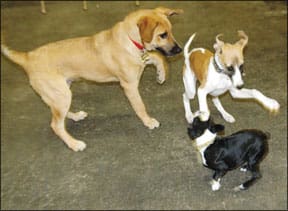
Unfortunately, it’s also understandable. Stop in and look at an average puppy kindergarten class; what you’ll usually find will be a boisterous 15-week-old Labrador Retriever puppy jumping all over his owner on one side of the room, a Shepherd-mix lunging at the Husky pup bouncing on the other side of him, and then there might be an already 40-lb. Rottweiler puppy dragging her owners through the door. All the new puppy parents are clearly having difficulty trying to maintain control of their dogs while holding onto the leash and a bag full of treats.
Is it any wonder that this environment might be uninviting for the new, nervous parent of a 4-lb. toy Poodle puppy? Subsequently, many owners of small dogs never return to that or any other training class or socialization session. As a result, too many toy breed and small dogs miss out on crucial training and positive socialization experiences at the time they need it the most, which in turn leads to the undesirable behaviors we sometimes see in small dogs that perpetuate the stereotypes.
This is why I say “bravo” to any trainer or facility that includes “Mighty Mites” or “Tiny Tots” classes, geared toward the small dog, in its programming. While these types of classes may not be as prevalent as I’d like, I do encourage small dog owners to seek them out. If no class exists in your area, go and talk to your area trainers and request one, or at least find out if they provide modifications for the smaller dog in their regular classes.
That said, failure to find a suitable group class for you and your little dog is not an excuse to fail to train your small dog! By being proactive and tweaking your training environment a little, you can successfully train your small dog at home, or even better, manipulate and modify the environment in a regular group training class to meet your dog’s specific needs.
288
Level the training field Have you ever really tried to imagine how different the environment looks to a dog who stands less than 10 or 12 inches tall? Undoubtedly everything and everyone likely looks bigger and much farther away. Just for a little perspective, try placing an alarm clock at the top of a 20 foot ladder. Then get down on all fours and look up. How far away does that clock look to you now? Is your neck feeling a little strained? Are you finding it difficult to read the numbers? All in all, it’s just not very comfortable, is it?
That’s just a small glimpse of what it might be like for a little dog to look at your face and try to decipher your expression. Getting and keeping your dog’s attention is paramount in training, and it’s difficult to accomplish that with a dog who finds it physically uncomfortable to look up at you. It’s also uncomfortable for a handler – especially if she has a bad back – to bend over (almost to the floor) again and again.
Therefore, the first thing that must be done is to give that dog a boost, helping him get closer to you – and especially your hands, which give cues and deliver treats and petting as rewards. Placing the dog on a table or chair is a good option. I love to “sofa train” my little ones with quick little training sessions while they’re sitting on the sofa with me. This makes the sofa much more than a place to cuddle; now it becomes a special place to work and have fun as well.
Another great option is to grab a yoga mat and have a seat on the floor next to your dog. Again, establishing focus and attention will be easier when both of you are closer to each other. These options are good starting points to introduce behaviors, and just like shaping any other behaviors, you can gradually bring the dogs’ focus upward until you’re eventually standing in a full, upright position.
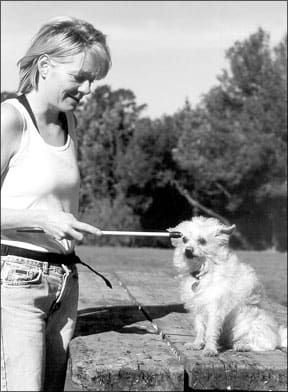
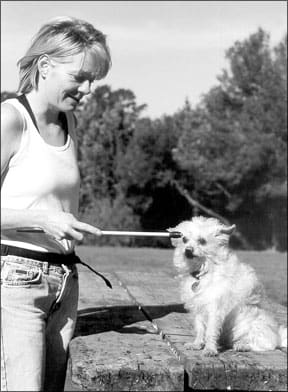
On target Something that should be in every small dog owner’s toolbox is a target stick. Since our arms only reach so far, and constantly bending over can literally be a pain, extending your reach by two or more feet can be a lifesaver.
Target sticks add this extension and can be used as a lure or focal point for your small dog. They can be purchased ready-made or can be fashioned from a wooden dowel with a baby spoon taped onto the end. I’ve even seen some people use a back scratcher as a target! Rubbing a high value food (like squeeze cheese, soft cream cheese, or peanut butter) onto the end of the stick will “load up” the target stick and make it an object of desire for your dog. Soon, the dog will follow that stick anywhere. Suddenly, teaching loose leash walking becomes much more manageable. You can click and reward the small dog without breaking a stride. Like any lure, the target stick can and should be faded once the dog has learned what position is the most rewarding.
With a little creativity you can find additional items that can be used as training aids for small dogs, most of which are inexpensive and readily available. You can set up a mini-agility course using those small, portable tunnels intended for toddlers, plungers for weave poles, and shoe boxes for tables or pause boxes. Dogs of any size love to run, jump, and go through tunnels, but most importantly these kinds of activities are great for relationship-building and instilling confidence.
Even little dogs have noses, so why not try some scent discrimination activities? Place treats in a mini-muffin tin and then cover the treats by placing mini tennis balls or ping pong balls on top. Encourage your dog to sniff the tin and “find” the treats by moving the tennis balls and claiming his reward. Almost anything you’d use for training a larger dog can be modified and downsized for a smaller dog if you use your imagination.
288
Social work The importance of socialization cannot be disputed. Unsocialized dogs are often fearful and socially inept; they have difficulty reading the body language signals of other dogs or performing appropriately friendly signals themselves. Those small dogs who bark and snarl and kick up a fuss when they see other dogs – especially dogs who are much bigger than they are? They are displaying fear-based aggression, but their behavior endangers themselves and their owners if they antagonize another dog into starting a fight. And dogs of any size who get scared and snap at people often end up getting permanently left at home, or surrendered to a shelter.
Here’s the bottom line: if you want your small dog to be comfortable with people and other dogs, you must socialize him or her, and as early as possible. Again, your goal is to find a group puppy class conducted by a knowledgeable instructor who knows how to provide a positive socialization experience for all puppies, regardless of size. However, if you can’t find a class like this, you need to create opportunities for yourself. There are many small dog “meet up” groups. You can find them through an Internet search, or through your favorite veterinarian, trainer, or independent pet supply store.
Before participating in one of the socialization sessions, though, attend without your dog and speak with the participants and facilitator. Surely some of them have puppies, so inquire about setting up a playgroup for the puppies only. If other small breed puppies can’t be found, don’t count out larger breed puppies. Gentle, calm, and easygoing puppies of all breeds do exist, and frankly, positive interactions with dogs who are larger than your pup are just as important (if not more so).
If your small dog is already an adult and has problems getting along with other dogs, seek out an experienced behavior professional. Counter-conditioning and desensitization exercises and other training can increase your dog’s comfort with other dogs and improve his response.
Even though your dog should be able to get along with other dogs (of any size), for his own safety, it’s best to exercise and socialize him at dog parks that have a special section for small dogs. Sadly, we’ve heard numerous reports of small dogs getting injured and even killed by larger, overstimulated, and predatory dogs in dog parks.
Smaller is good, too I’ll be the first to admit that I do have a different kind of relationship with my little dogs than I have with my larger ones. A little dog’s size and dependency on us does promote a kind of intimacy that is hard to explain to someone who hasn’t experienced it. Remember how much you loved to coo, cuddle, and pick up your Golden or Labrador puppy when he was small? Can you blame a small dog owner for enjoying those experiences throughout her small dog’s life?
Further, if I have to maneuver through a crowd or need to get from point A to point B quickly, I’ll hoist my small dog into my arms so I can get to my destination faster. I don’t do it because I’m too lazy to get my small dogs to walk on lead politely. I do it because it’s more convenient – and because I can!
Despite my years of experience with dogs of all sizes, I consider myself fortunate to have experienced all the joys of sharing my life with my little (and well-trained and well-socialized) dogs. No matter how much you love your small dog, I’d be willing to bet that you would enjoy her even more if she were better behaved, so get busy training!
Laurie C. Williams is a dog trainer, rally obedience judge, and owner of Pup ’n Iron, Canine Fitness and Learning Center, in Fredericksburg, Virginia. See “Resources,” page 24, for contact information.
Take the time to teach your puppy the invaluable skill of inhibiting his bite. It could be one of the most important lessons he learns – one that will serve him well for a lifetime.
Supervise children with your puppy so your puppy doesn’t get reinforced for inappropriate biting, and so your children don’t have to suffer the pain of uninhibited puppy mouthing.
Resist the pressure from some members of the dog community to use pain and force to suppress your puppy’s biting behavior. You know there’s a better way.
My dog bites me. A lot. Scooter, the 10-pound Pomeranian we adopted from the shelter after he failed a behavior assessment (for serious resource-guarding), has bitten me more times than I can count. Most of the time I don’t even feel his teeth. He has never broken skin, and the few times I have felt any pressure, it’s been because I’ve persisted in what I was doing despite his clear request to stop. Scooter has excellent bite inhibition.
In the dog training world, bite inhibition is defined as a dog’s ability to control the pressure of his mouth when biting, to cause little or no damage to the subject of the bite. We know that all dogs have the potential to bite, given the wrong set of circumstances. Some dogs readily bite with little apparent provocation, but even the most saintly dog, in pain, or under great stress, can be induced to bite. When a bite happens, whether frequently or rarely, bite inhibition is what makes the difference between a moment of stunned silence and a trip to the nearest emergency room for the victim (and perhaps the euthanasia room for the dog).
A bite is at the far end of a long line of behaviors a dog uses to communicate displeasure or discomfort. To stop another dog, human, or other animal from doing what he perceives to be an inappropriate or threatening behavior, the dog often starts with body tension, hard eye contact, a freeze, pulling forward of the commissure (corners of the lips). These “please stop!” behaviors may escalate to include a growl, snarl (showing teeth), offensive barking, an air-snap (not making contact), and finally, an actual bite. The dog who does any or all of these things is saying, “Please don’t make me hurt you!”
Some foolish humans punish their dogs for these important canine communications. “Bad dog, how dare you growl at my child!” Punishing your dog for these warning signals can make him suppress them; he’ll learn it’s not safe to let you know he’s not comfortable with what you’re doing -and then bites can happen without warning. (See “Understand Why Your Dog Growls,” October 2005.)
Others ignore the signals and proceed with whatever was making the dog uncomfortable. This is also foolish, because it can prompt the dog to express his feelings more strongly, with a less inhibited bite that might break skin and do damage.
The wise dog owner recognizes the dog’s early signals, and takes steps to reduce or remove the stimulus that is causing the dog to be tense, to avoid having her dog escalate to a bite. She then manages the environment to prevent the dog from constant exposure to the stressful stimulus, and modifies her dog’s behavior to help him become comfortable with it. Sometimes, however, even the best efforts of the wisest dog owners can’t prevent a bite from happening. If and when it does, one hopes and prays that the dog has good bite inhibition.
Installing Bite Inhibition
In the best of all worlds, puppies initially learn bite inhibition while still with their mom and littermates, through negative punishment: the pup’s behavior makes a good thing go away. If a pup bites too hard while nursing, the milk bar is likely to get up and leave. Pups learn to use their teeth softly, if at all, if they want the good stuff to keep coming. As pups begin to play with each other, negative punishment also plays a role in bite inhibition. If you bite your playmate too hard, he’ll likely quit the game and leave.
For these reasons, orphan and singleton pups (as well as those who are removed from their litters too early) are more likely to have a “hard bite” (lack of bite inhibition) than pups who have appropriate interactions for at least seven to eight weeks with their mother and siblings. These dogs miss out on important opportunities to learn the consequences of biting too hard; they also fail to develop “tolerance for frustration,” since they don’t have to compete with littermates for resources. They may also be quicker to anger -and to bite without bite inhibition -if their desires are thwarted. Note: Being raised with their litter doesn’t guarantee good bite inhibition; some dogs have a genetic propensity to find hard biting (and its consequences) to be reinforcing; others may have had opportunity to practice and be reinforced for biting hard.
Your dog may never bite you in anger, but if he doesn’t have good bite inhibition you’re still likely to feel a hard bite when he takes treats from your fingers -and removes skin as well as the tasty tidbit.
If you find yourself with a puppy who, for whatever reason, tends to bite down harder than he should with those needle-sharp puppy teeth, you need to start convincing him that self-restraint is a desirable quality. You can’t start this lesson too early when it comes to putting canine teeth on human skin and clothes. Ideally, you want to teach your pup not to exert pressure when mouthing by the time he’s five months old, just as his adult canine teeth are coming in, and before he develops adult-dog jaw strength. Here are the four R’s of how to do it:
1. Remove
When your puppy bites hard enough to cause you pain, say “Ouch!” in a calm voice, gently remove your body part from his mouth, and take your attention away from him for two to five seconds. You’re using negative punishment, just like the pup’s mom and littermates. If he continues to grab at you when you remove your attention, put yourself on the other side of a baby gate or exercise pen. When he is calm, re-engage with him.
2. Repeat
Puppies (and adult dogs, and humans) learn through repetition. It will take time, and many repetitions of Step #1, for your pup to learn to voluntarily control the pressure of his bite. Puppies do have a very strong need to bite and chew, so at first you’ll “ouch and remove” only if he bites down hard enough to hurt you. Softer bites are acceptable -for now. If you try to stop all puppy biting at once, both of you will become frustrated. This is a “shaping” process (see “Fun Training Techniques Using Shaping,” March 2006).
At first, look for just a small decrease in the pressure of his teeth. When he voluntarily inhibits his bite a little -enough that it’s not hurting you -start doing the “ouch and remove” procedure for slightly softer bites, until you eventually shape him not to bite at all. By the time he’s eight months old he should have learned not to put his mouth on humans at all, unless you decide to teach him to mouth gently on cue.
3. Reinforce
Your pup wants good stuff to stick around. When he discovers that biting hard makes you (good stuff) go away, he’ll decrease the pressure of his bite and eventually stop biting hard. This works especially well if you remember to reinforce him with your attention when he bites gently. It works even better if you use a reward marker when he uses appropriate mouth pressure. Given that your hands are probably full of puppy at that particular moment, use a verbal marker followed by praise to let him know he’s doing well. Say “Yes!” to mark the soft-mouth moment, followed by “Good puppy!” praise to let him know he’s wonderful.
4. Redirect
You probably are well aware that there are times when your pup is calmer and softer, and times when he’s more aroused and more likely to bite hard.
It’s always a good idea to have soft toys handy to occupy your pup’s teeth when he’s in a persistent biting mood. If you know even before he makes contact with you that he’s in the mood for high-energy, hard biting, arm yourself with a few soft toys and offer them before he tries to maul your hands. If he’s already made contact, or you’re working on repetitions of Step #1, occasionally reinforce appropriate softer bites with a favorite squeaky toy play moment.
If there are children in the home with a mouthy puppy, it’s imperative that you arm them with soft toys and have toys easily available in every room of the house, so they can protect themselves by redirecting puppy teeth rather than running away and screaming -a game that most bitey pups find highly reinforcing.
It is possible to suppress a puppy’s hard biting by punishing him when he bites too hard. That might even seem like a quicker, easier way to get him to stop sinking his canine needles into your skin. However, by doing so, you haven’t taught him bite inhibition. If and when that moment comes where he really does feel compelled to bite someone, he’s likely to revert to his previous behavior and bite hard, rather than offering the inhibited bite you could have taught him.
Teaching Bite Inhibition to An Adult Dog
Teaching an adult dog to inhibit his bite is far more challenging than teaching a puppy. A dog easily reverts to a well-practiced, long-reinforced behavior in moments of high emotion, even if he’s learned to control his mouth pressure in calmer moments.
I know this all too well. Our Cardigan Corgi, now six years old, came to us at the age of six months with a wicked hard mouth. Hand-feeding her treats was a painful experience, and I implemented a variation of the “Ouch” procedure. Because she was biting hard for the treat rather than puppy-biting my flesh, I simply said “Ouch,” closed my hand tightly around the treat, and waited for her mouth to soften, then fed her the treat. Hard mouth made the treat disappear (negative punishment); soft mouth made the treat happen (positive reinforcement). She actually got the concept pretty quickly, and within a couple of weeks could thoughtfully and gently take even high value treats without eliciting an “Ouch.”
She still can take treats gently to this day, except when she’s stressed or excited; then she reverts to her previous hard-bite behavior. When that happens, I close the treat in my fist until she remembers to soften her mouth, at which time I open my hand and feed her the treat. So, while our bite inhibition work was useful for routine training and random daily treat delivery, if Lucy ever bites in a moment of stress, arousal, fear and/or anger, I have no illusions that she’s going to remember to inhibit her bite. Of course, I do my best to make sure that moment doesn’t happen.
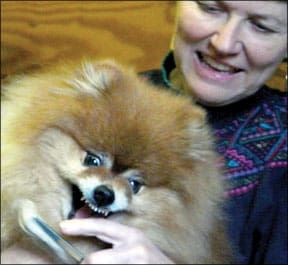
Because I have more leeway with Scooter and his excellent bite inhibition, it’s tempting to be a little complacent with him. I try not to. One of Scooter’s “likely to bite” moments is grooming time. The poor guy has a horrible undercoat that mats, literally, in minutes. This is a highly undesirable Pomeranian coat characteristic. I could groom my first Pomeranian, Dusty, once a week without worrying about mats. I have to groom Scooter every night.
Of course he hates it; brushing always causes him some discomfort as I work to ease the tangles out without pulling too hard on his skin. We’ve made progress in the year we’ve had him; I can comb the top half of his body without encountering much resistance, but I can feel him tense up as I approach the more sensitive lower regions. Rather than relying on his good bite inhibition to get us through, I continue to use counter-conditioning and desensitization. I feed him treats (or have my husband Paul feed him) as I groom, or let him lick my hands (an activity he enjoys mightily -and one I can tolerate in place of his biting) while I comb out the tangles.
Whether you’ve taken the time to teach your puppy good bite inhibition or had the good fortune to inherit a dog who has it, don’t take it for granted. Continue to reinforce soft-mouth behavior for the rest of his life, and don’t be tempted to push the envelope of his tolerance just because you can. Even saints have limits.
What to NEVER Do if Your Dog Bites
Over the years, I’ve cringed at a variety of puppy-mouthing modification suggestions. Here are some of the things you don’t want to do:
Alpha-Rolls
Whole Dog Journal readers might think “no alpha-rolls” goes without saying by now, but I still see clients with mouthy puppies who have had their trainers, dog walkers, dog-owning friends, or veterinarians tell them to alpha-roll their bitey pups. Don’t do it. You are likely to elicit a whole lot more biting — truly aggressive biting — as your frightened pup tries to defend himself. (See “Puppies Who Demonstrate ‘Alpha’ Behavior,” WDJ July 2006.)
High-Pitched Yelps
This might surprise you. It’s often suggested by positive trainers, some of whom I respect greatly, but I don’t recommend it. The theory is that a high-pitched yelp makes you sound like a puppy in pain and communicates to your young dog in a language he understands.
The fallacy with this theory is that we think our feeble attempt to speak “puppy” with our human yelp might really communicate the same message as a real puppy yelp – like
trying to speak a foreign language by mimicking what we think the sounds are, without actually knowing any of the words. In my experience, the high-pitched yelp is as likely to incite an excited biting puppy to a higher level of arousal (and harder biting) as it is to tell him he bit too hard and should sofien his mouth. Don’t do it. A calm “Ouch!” sends a much more consistent, useful, and universal message, which is simply, “That behavior makes the good stuff go away.”
Hold the Dog’s Mouth Closed
Another classic bad idea. What self-respecting puppy wouldn’t struggle and try to bite harder with this inappropriate restraint? All the while, you’re giving your pup a bad association with your hands near his face, which isn’t going to help with grooming, tooth-brushing, mouth exams, or even petting. Don’t do it.
Push Your Fist Down His Throat
Seriously. For the same reasons as in the prior two suggestions, this is a really bad idea.
Don’t do it.
Push His Lip Under His Canine Tooth So He Bites Himself
There really is no end to the inappropriate ways people can think up to try to change behavior. This is another one that has a strong possibility of causing your pup to associate hands near his face with pain. Don’t do it.
Bite Your Puppy Back
Yep, some folks actually recommend this. I shouldn’t have to say this, but I will anyway: Don’t do it.
Pat Miller, CBCC-KA, CPDT-KA, is Whole Dog Journal’s Training Editor. Miller lives in Fairplay, Maryland, site of her Peaceable Paws training center.
1. Get an accurate diagnosis and follow nutritional guidelines for your dog’s type of uroliths.
2. If your dog is prone to urate stones, consider switching to a low-purine home-prepared diet.
3. Avoid low-protein prescription foods when they are unnecessary or ineffective at preventing stone formation.
4. For male dogs who continue to form stones, consider urethrostomy surgery to greatly reduce the risk of obstruction.
Canine kidney and bladder stones may be painful and life-threatening, but an informed caregiver can help prevent them. By far the most common uroliths or stones in dogs are struvites (see “Canine Kidney Stone and Bladder Stone Prevention“) and calcium oxalate stones (see “Preventing Bladder and Kidney Stones in Dogs“). These two types represent about 80 percent of all canine uroliths.
Now we address the remaining stones that can affect our best friends: urate, cystine, calcium phosphate, silica, xanthine, and mixed or compound uroliths.
Urate or Purine Stones
Of the remaining stone categories, urate or purine stones are the most common. They contain ammonium acid urate, sodium urate, or uric acid.
Only 6 to 8 percent of all uroliths are urate or purine stones, but their presence in certain breeds is significant. Dalmatians, English Bulldogs, Russian Black Terriers, and Large Munsterlanders develop urates because of a genetic metabolic abnormality. Miniature Schnauzers and Yorkshire Terriers do so as a result of their tendency to have portosystemic shunts, which are abnormal blood vessels that bypass the liver, predisposing dogs to urate stones. These stones can form in dogs of any age, from very young puppies to seniors, but the most common age for forming urates is 1 to 4 years.
Of the breeds that develop urate stones, Dalmatians are most adversely affected. Between 1981 and 2000, the University of Minnesota College of Veterinary Medicine’s Minnesota Urolith Center analyzed 7,560 stones from Dalmatians. Of these, 97 percent were from males and 95 percent were composed of urates. It’s estimated that between 27 and 34 percent of male Dalmatians form urate stones, while the incidence in females is much lower.
It’s tempting to assume that any stone a Dalmatian forms is a urate, but although 97 percent of stones from male Dalmatians were urate, they also included small percentages of struvite, xanthine, calcium oxalate, cystine, calcium phosphate, silica, and mixed or compound stones. The uroliths formed by female Dalmatians were 69 percent urate and 29 percent mixed or compound, with 2 percent struvite and 0.7 percent xanthine. Correct identification is a crucial first step in treating and preventing uroliths in all breeds, including Dalmatians.
The culprits in urate stone formation are purines, a type of organic base found in the nucleotides and nucleic acids of plant and animal tissue. As dietary purines degrade, they form uric acid, which is best known in human medicine for its connection to gout, a sharply painful form of arthritis. In susceptible dogs, purines trigger the formation of urate uroliths.
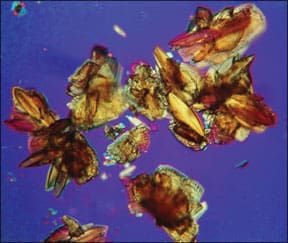
Urate stones are radiolucent – that is, they cannot be identified in abdominal X‑rays – so their diagnosis is often made by the use of ultrasound, contrast dye X-rays, or analysis of urinary crystals or stones that were collected or removed.
Signs of Stones
As noted in our previous articles, an accurate diagnosis is essential because what prevents or treats one type of stone may actually cause another. The only way to be sure of a stone’s identity is to have it analyzed. However, your veterinarian can make an educated guess based on urinary pH; the dog’s age, breed, and sex; the identification of urinary crystals; radiographic (X-ray) density; whether infection is present; and certain blood test abnormalities.
When should your veterinarian become involved? As soon as you notice symptoms or, if your dog’s breed is strongly predisposed to developing stones, even sooner. Not all bladder and kidney stones are dangerous; some are flushed during urination while still small in size and others remain unnoticed in the kidney or bladder. Stones don’t create complications until they interfere with urination. It’s important to become familiar with urinary stone symptoms, which include straining to urinate, blood or pus in the urine, painful or difficult urination, increased frequency of urination, the passage of small amounts of urine, licking the genitals more than usual, “accidents” in house-trained dogs, or discomfort in the lower back.
A dog who strains and then releases a flood of urine may have just passed a stone and should be examined. If you can find the stone, take it with you so it can be accurately identified. A dog who is unable to urinate needs immediate medical attention because a plugged urethra can cause urine to back up into the system, resulting in a ruptured bladder or kidney failure. A bladder that has been stretched can lose muscle tone, making it difficult to empty completely, which can lead to infection or more stones. Bladder stones are much less likely to cause an obstruction in females than in male dogs, thanks to the shorter and wider urethra in females.
Increasing urine volume and opportunities to void urine are important factors in preventing uroliths of all types. The more a dog drinks and the more frequently he urinates, the less concentrated his urine and the less likely the formation of crystals that can become stones. Encourage your dog to drink more by adding water to his food and offering flavored water in addition to plain. For dogs with urate stones, you can add salt
to food to increase thirst (start with a pinch, watch your dog’s response, and add more in small steps until your dog drinks more water), but added salt should be avoided for dogs prone to forming cystine, calcium phosphate, or silica stones.
Be sure that your dog has frequent opportunities to urinate because when dogs have to hold their urine for extended periods, their urine is more likely to become supersaturated, at which point its minerals begin to precipitate out as crystals.
Treating and Preventing Urate Stones
The key to keeping urate-forming dogs healthy is to feed them a low-purine diet. Without the purines that trigger urate stone formation, even susceptible dogs can lead normal lives.
Some Dalmatian owners believe that giving dogs who are prone to forming stones only mineral-free distilled water has helped prevent more stones from forming. However, no scientific evidence for this exists. The quantity of water the dog consumes may be more important than its mineral content.
Because urate stones develop in acidic urine, an added prevention strategy is to feed foods that have an alkalizing effect. In general, meat is an acidifying food while most fruits and vegetables have an alkalizing effect. Vegetarian dog foods are sometimes recommended for this reason, but we consider vegetarian foods incomplete. Also, foods that use soy as a protein source are inappropriate for dogs who are prone to forming urate stones because soy is high in purines. However, soy-free vegetarian foods could be used as a base to which eggs, yogurt, cheese, and other low-purine protein sources are added.
The same is true of some dog food pre-mixes, such as Sojo’s Grain Free Dog Food Mix. Sojo’s Complete is based on sweet potatoes, turkey, and eggs and might also be appropriate for dogs with hyperuricosuria (excessive amounts of uric acid in the urine). Avoid mixes that contain a lot of alfalfa, oats, barley, or other foods that are high in purines (see “Purine Content of Various Foods”).
Urate stones can be dissolved with a combination of a low-purine diet, urine alkalization, and control of secondary infections. The target range of urine pH during dissolution is 7.0 to 7.5. Care must be taken not to alkalize too much, making the urine pH higher than 7.5, because that can lead to the formation of calcium phosphate stones or shells around urate stones, making them difficult or impossible to dissolve.
The xanthine oxidase inhibitor allopurinol (brand name Zyloprim) may be prescribed short-term to reduce or inhibit the dog’s production of uric acid, which can help dissolve stones. This drug should not be used in patients with portosystemic shunts. A low-purine diet must be fed while giving allopurinol, as otherwise it predisposes dogs to the formation of xanthine stones and shells, making dissolution difficult. The long-term use of allopurinol as a preventative is not recommended but can be considered at low dosages when problems persist despite other treatment.
On average, it takes about 3½ months for stones to dissolve using allopurinol in combination with a low-purine diet and urinary alkalizination, but it can take as little as one month or as long as 18 months. As stones become smaller, they may move into the urethra and cause obstruction.
Some cases of severe kidney stones presumed to be ammonium urate resolved spontaneously following surgical shunt correction alone.
Monitoring Urine pH
Urinary pH can be monitored using test strips with the goal of maintaining a neutral (7.0) pH in dogs prone to urate stones. Test strips can be held in the urine stream or urine can be collected in a paper cup, bowl, or other container for testing. Collecting the urine makes it possible to check for tiny stones or gritty “gravel” that the dog might be passing as well as any blood, pus, or other indications of infection. The recommended testing time is first thing in the morning, before feeding.
A change in urinary pH does not indicate the presence or absence of stones but does reveal conditions that are more or less likely to trigger stone production and will show the effect of dietary changes on the dog’s pH. A sudden jump in pH may signal a bacterial infection, which requires medical attention. It’s important to control urinary tract infections in dogs prone to forming stones. If urine remains acidic and crystalluria (the formation of urinary crystals) persists, alkalizing agents such as potassium citrate or sodium bicarbonate can be added.
Testing for Canine Hyperuricosuria
Hyperuricosuria is characterized by the excretion of high levels of uric acid leading to urate stone formation. After the defective gene that causes hyperuricosuria was discovered by researchers at the University of California, Davis, a test was developed to detect the mutation associated with the disease. This test is valid for all breeds.
Dogs affected by hyperuricosuria have two copies of the mutation, one inherited from each parent. Dogs with only one copy of the mutation are symptom-free carriers who pass the mutation on to an average of 50 percent of their offspring. Breeders can use DNA testing to identify carriers and effectively erradicate hyperuricosuria from their lines in breeds other than Dalmatians. (At present, all Dalmatians registered in the United States are affected by the mutation. See “LUA Dalmatians”. When both dam and sire are clear of the mutation, all of their puppies will be clear as well.
The DNA test identifies dogs in three categories: clear of hyperuricosuria (the dog has two copies of the normal gene and no mutation), a carrier of hyperuricosuria (the dog has one copy of the normal gene and one of the mutation), or affected with hyperuricosuria (the dog has two copies of the mutation, causing high acid levels that can lead to urate stone disorders).
All dogs affected with hyperurico-suria are potential urate stone-formers. At any time, a combination of high-purine foods, insufficient fluids, insufficient opportunities to urinate, and overly acidic urine might cause the formation of urate uroliths. Periodic routine urinalysis to check for urate crystals can be used to monitor dogs with hyperuricosuria. The most accurate sample for this purpose is collected in the morning, assuming the dog has not urinated all night, so the urine is more concentrated. The sample should be collected in a clean glass, plastic, or other chemically inert container. To avoid false crystallization, the sample should not be refrigerated and should be tested within 30 minutes or as soon as possible.
While many Dalmatians never generate stones, it isn’t safe to assume that they can’t. In one widely reported case, a 13-year-old Dalmatian who had never shown symptoms began receiving two spoonfuls of a new supplement per day. Prior to this, his diet had been the same for all of his adult life. Within a few weeks, his urinary tract became completely obstructed by urate stones. While the supplement was low in protein (only 14 percent), its protein source was liver, a high-purine food.
The Low-Purine Diet
Reducing purines in food is an effective way to reduce the risk of urate stones. Because most high-protein foods are also high in purines, veterinarians often recommend switching urate-forming dogs to a low-protein diet. However, it is not the quantity of protein that causes urate problems; it’s the type of protein. Dalmatians and other urate-prone dogs thrive on protein-rich diets that are low in purines, while these same dogs can develop stones after eating low-protein foods that contain even small amounts of high-purine ingredients. Low-protein diets can lead to nutritional deficiencies when fed to adult dogs for long periods, and they are not appropriate for puppies and pregnant or nursing females at all. (See “The Side Effects of Low-Protein Diets,” below.)
Because it’s difficult to find commercial pet foods that are low in purines without being nutritionally deficient, many owners of urate-forming dogs feed a home-prepared diet. Australian veterinarian Ian Billinghurst, whose book Give Your Dog a Bone introduced the BARF (Bones and Raw Food or Biologically Appropriate Raw Food) diet to dog lovers around the world, describes how to adapt his menus for urate-forming dogs in a report posted at several websites.
“In Western countries today,” he says, “I am led to believe that a typical homemade diet for stone formers would contain about 80 percent rice, 10 percent vegetables, and 5 percent meat. This is an appalling diet to feed any dog. This is borne out by dogs forced to endure it. They suffer from numerous problems including continual hunger, a lack of energy, poor coat condition, and difficulty in maintaining weight or severe losses of weight.” Such a diet is not only deficient in protein, fat, vitamins, and minerals, he says, but it does not prevent stone formation.
The raw meaty bones Dr. Billinghurst recommends are chicken necks, chicken backs, chicken wings, and turkey necks. “Use plenty of puréed or pulped vegetables,” he says, “including lots of leafy greens. The diet could also include eggs, cottage or ricotta cheese, yogurt, and olive or flaxseed oil, supplemented with vitamin B complex, vitamin E, kelp, and a teaspoon of cod liver oil several times a week.” Cod liver oil is important for urate-forming dogs fed a homemade diet that does not include liver.
Feeding a changing variety of eggs, cheese, dairy products, and small amounts of medium-purine meat, poultry, and fish along with low-purine vegetables, fruits, and supplements – as well as ample water to keep urine diluted – can help any urate-forming dog stay healthy and happy.
Cystine Stones
Cystine is a sulfur-containing amino acid essential to the health of skin, hair, bones, and connective tissue. Excess cystine is normally filtered by the kidneys so that it doesn’t enter the urine, but some dogs are born with cystinuria, an inherited metabolic disorder that prevents this filtering action. When cystine passes into the urine, it can form crystals and uroliths.
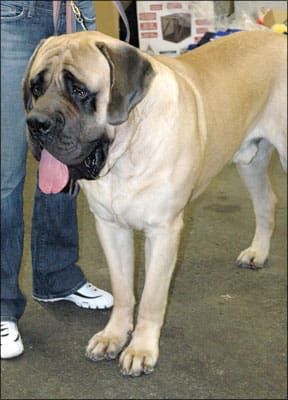
Cystine stones are rare, representing 1 percent or less of uroliths identified in laboratories. Although any breed can develop cystinuria, certain breeds are most affected. An estimated 10 percent of male Mastiffs have cystinuria. It is also common in Newfoundlands, English Bulldogs, Scottish Deerhounds, Dachshunds, Staffordshire Bull Terriers, and Chihuahuas. Cystine stones are faintly radiopaque, which makes them more difficult to see on X-rays than stones that contain calcium.
There are at least two types of cystinuria. The more severe form affects Newfoundlands and, rarely, Labrador Retrievers, and possibly some other breeds and mixes. In these dogs, males and females are equally affected (though as always, males are more likely to become obstructed). The age at onset can be as young as 6 months to 1 year. Recurrence of stones following surgery is more rapid in these dogs, and they are more likely to form kidney stones. The gene that causes cystinuria in these breeds has been identified and a simple, reliable genetic test can identify both affected dogs and carriers.
In other breeds, dogs with cystinuria are almost always male. No genetic test is available for them, though the University of Pennsylvania School of Veterinary Medicine (PennVet) is collecting blood samples from affected Mastiffs and their genetic relatives to try to produce a DNA test. The average age at onset of clinical signs is about 5 years.
A basic urinalysis can sometimes detect cystine in urine, though this is the least reliable method of detection. A nitroprusside (NP) test performed at the University of Pennsylvania (PennGen) is considered more reliable. A quantitative amino acid analysis performed by PennGen or a human medical laboratory is most reliable but very expensive. If cystine is found in the urine on any of these tests, the diagnosis is considered positive for cystinuria, though that doesn’t necessarily mean the dog will form stones.
Unfortunately, a negative result on any of these tests does not guarantee that the dog is “clear.” Note that sulfa drugs and supplements, including sulfa antibiotics, MSM, and Deramaxx, may cause false positive results.
“Cystinuria is a particularly frustrating condition to manage,” says San Francisco Chronicle pet columnist Christie Keith, who started a Canine Cystinuria e-mail list and website when one of her Scottish Deerhounds developed cystine uroliths. “A dog known to have cystinuria may go his whole life without obstructing, while another dog, never diagnosed, can have a life-threatening obstruction as his first symptom. It’s not known at this time why some dogs with cystinuria form stones and others do not.”
Cystine, like all amino acids, is one of the building blocks of protein. That’s why most veterinarians (including many kidney specialists) prescribe a low-protein diet, speculating that reducing the cystine supply will reduce the formation of cystine stones. Another common recommendation is to alkalize the dog’s urine because cystine stones form in acid urine.
Unfortunately, says Keith, these strategies are ineffective. “Most of us on the Canine Cystinuria list have found that diet and urinary alkalization have failed to prevent our dogs from forming stones,” she says, “and they have sometimes caused other problems, including other types of stones that form in alkaline urine. If the urine goes into acidity even briefly, cystine stones can form and they won’t dissolve just because alkaline urine is achieved soon after. In addition, feeding ultra-low-protein diets can be dangerous, especially to giant breeds and breeds prone to cardiomyopathy.” (See “The Side Effects of Low-Protein Diets”, below.)
It’s important to provide your dog with extra fluids and frequent opportunities to urinate in order to keep his urine from becoming supersaturated. Salt should not be added to increase fluid consumption for dogs with cystinuria; according to studies conducted on humans, a low-sodium diet may decrease the amount of cystine in the urine.
If urine alkalization is attempted, the target pH is 7.0 to 7.5; higher can predispose dogs to calcium phosphate uroliths. Potassium citrate is preferred for alkalization when needed rather than sodium bicarbonate because sodium may enhance cystinuria.
Cystine stones cannot be dissolved with diet or supplements, but two prescription drugs can help dissolve and prevent them. Cuprimine (d-penicillamine) has potentially serious side effects but is less expensive and more readily available, and many dogs do well on it. According to Keith, Thiola (tiopronin, also referred to as 2-mercaptopropionylglycine or 2‑MPG), has fewer side effects, but one of them is the depletion of the owner’s bank account. Maintaining a giant-breed dog on Thiola can cost as much as $500 per month. Because the severity of cystinuria tends to decline with age, the dosage of preventative medications can sometimes be decreased or even stopped.
Dissolution requires a combination of medication, low-protein diet, and urinary alkalinization. Even then it may not be successful or practical for a dog with numerous stones. When it does work, dissolution commonly takes one to three months.
For some dogs, the solution has come not from prevention strategies or medication but from surgery. “It sounds extreme,” says Keith, “but many of us who have stone-forming male dogs with cystinuria have opted for a scrotal urethrostomy. This surgery redirects the dog’s urethra away from the penis to a new, surgically created opening in front of the scrotum.”
The wider opening that results enables males to more easily pass small stones and help prevent urinary blockages. “While future obstruction is not impossible,” says Keith, “this procedure reduces the risk substantially.” Still, she cautions, this surgery should not be undertaken lightly. It’s expensive, requiring the expertise of a skilled board-certified surgeon, and because the affected area is rich in blood vessels, there can be significant post-surgical bleeding, though the surgery is not particularly painful.
“The good news,” she says, “is that many dogs, including stone-formers and those who had serious complications when their condition was first diagnosed, have lived not just normal but longer-than-normal lives.”
The Remaining Three
Like cystine stones, stones composed of xanthine, calcium phosphate, and silica are rare, each representing less than 1 percent of analyzed uroliths. Ironically, they often occur while the patient is undergoing treatment for the prevention of other stones.
– Although xanthine is a type of purine, xanthine stones are associated not with diet but with the use of allopurinol. Xanthine crystals almost never occur naturally, though they have been reported in some cats, Cavalier King Charles Spaniels, and Dachshunds. The average age at onset is 6 to 7 years. Like urate stones, they are radiolucent; that is, they cannot be seen on X-rays.
In some cases, discontinuing allopurinol while feeding a low-purine diet has dissolved xanthine uroliths, but in general, treatment consists of surgical removal, urohydropropulsion (a nonsurgical procedure performed with the dog under anesthetic, in which the bladder is filled with saline through a catheter, and the bladder is manually squeezed to force stones out through the urethra), or lithotripsy (the use of high-energy sound waves to break up the stones).
A low-protein diet is usually recommended for dogs receiving allopurinol treatment (to help prevent formation of xanthine uroliths); but again, what’s really needed is a low-purine diet.
– Calcium phosphate stones often develop when the urine is over-alkalized (at a pH greater than 7.5), in an effort to prevent the formation of calcium oxalate, urate, or cystine stones. The average age at onset is 7 to 8 years, but these stones have been found in dogs of all ages, including puppies and seniors.
Calcium phosphate stones are commonly called apatite uroliths, with hydroxyapatite and carbonate apatite the most common. They are radiographically dense, so they are easily seen on X-rays. Uroliths composed primarily of calcium phosphate are rare and associated with metabolic disorders such as hyperadrenocorticism (Cushing’s disease), hypercalcemia, renal tubular acidosis, or excessive calcium and phosphorus in the diet.
Because they cannot be dissolved medically, these stones are usually removed surgically, though that may be unnecessary if the stones are clinically inactive (not growing or causing problems). They have been known to dissolve spontaneously following parathyroidectomy surgery for primary hyperparathyroidism. Unless the patient has a metabolic condition that contributes to calcium phosphate stones, the strategies used for prevention are similar to those used for calcium oxalate stones, although it’s important to avoid excessive alkalization of the urine.
Medications that can enhance calcium excretion, including prednisone and furosemide (Lasix), should be avoided if possible. Salt should not be added to the diet, as sodium increases urinary calcium.
– Silica stones are most common in male German Shepherds, Old English Sheepdogs, Golden Retrievers, and Labrador Retrievers, although other breeds and mixed breed dogs have developed them as well. More than 95 percent of silica stones occur in males. The problem can develop in dogs as young as four months or as old as 12 years, but most stones occur in dogs aged 6 to 9 years. Silica stones are radiopaque and can be seen on X-rays. No relationship has been found between urinary pH and silicate urolith formation.
The formation of silica stones is associated with diets high in cereal grains, particularly corn gluten and soy bean hulls, both of which are high in silicates. Corn gluten and soy bean hulls (also called soybean mill run) are ingredients in low-quality prescription diets and dog foods.
Other foods that are high in silica, and which should be avoided, include the hulls of wheat, oats, and rice (hulls are found in whole grains); sugar beets; sugar cane pulp; seafood; potatoes and other root vegetables; onions (which shouldn’t be fed to dogs, anyway); bell peppers; asparagus; cabbage; carrots; apples; oranges; cherries; nuts and seeds; grains; soybeans; and the herbs alfalfa, horsetail, comfrey, dandelion, and nettles. Bentonite clay, a mineral supplement, is also high in silicates.
Because no drug or diet dissolves silica stones, they may be removed surgically, flushed out with urohydropropulsion, or shattered with lithotripsy; no treatment may be required for clinically inactive stones. Silica stones do not usually recur, but it makes sense to feed a diet that is high in protein from animal sources and low in plant foods, including fiber and bran. As with all stones, keep the urine diluted by increasing fluids and giving your dog frequent opportunities to urinate. Don’t add salt, which is another source of silica.
Dogs who drink water from sources containing sand may develop silica uroliths, so water that contains silica (a primary mineral in sand) should be avoided. In hard-water areas, distilled water is recommended for dogs who form silica stones. Silica stones have also been associated with pica, an eating disorder that causes dogs to eat dirt, rocks, and other non-food items.
Mixed and Compound Uroliths
Most bladder stones are caused by a single type of mineral. Sometimes a stone consists of two or more minerals in approximately equal proportions, in which case it is called a mixed urolith. These stones are rare, comprising only 2 percent of analyzed uroliths.
A stone that consists of a core mineral surrounded by a smaller amount of a different mineral is called a compound urolith. These make up 10 to 12 percent of analyzed stones. Compound uroliths can sometimes be identified based on differing radiographic density of their stone layers.
Compound uroliths develop when a stone’s environment changes, such as when a struvite stone is treated by reducing urinary pH, magnesium, and phosphorus, resulting in a calcium oxalate shell around the struvite core. Struvite shells caused by infection commonly form over calcium oxalate and other cores, especially since all stones predispose dogs to bladder infections.
One treatment strategy is to try to dissolve the outer layer first. This is especially effective for stones with an infection-induced struvite shell, which make up more than 80 percent of compound uroliths with cores other than struvite. The struvite shell should dissolve with appropriate antibiotic or infection-fighting treatment. X-rays can be used to monitor dissolution. Once the outer shell disappears, treatment strategy switches to the inner core, also called the nucleus, or the stones may then be small enough to remove by urohydropropulsion.
More than half of the compound uroliths analyzed in 2002 by the Minnesota Urolith Center contained a calcium oxalate core, and almost all of these were surrounded by a struvite shell caused by infection. Unlike calcium oxalate uroliths, these compound uroliths were found primarily in female dogs; again, this is because the female dogs’ anatomy makes them more susceptible to urinary tract infections, which play a role in causing struvite stones. Treatment and prevention should be focused on controlling infections and reducing the risk of calcium oxalate stones.
Stones with a struvite core made up amost a quarter of compound uroliths, more than half of which were surrounded by a calcium phosphate shell and most of the rest by a calcium oxalate shell. As is common with infection-induced stones, most of these dogs were female.
Urinary acidifiers can contribute to urinary calcium that leads to the formation of calcium-containing stones. Treatment is the same as for struvites: appropriate medication for the infection and possibly a reduced-protein diet short-term to help dissolve the stones quickly. Urinary acidification is not recommended due to the increased risk of calcium oxalate and calcium phosphate formation.
Small percentages (3 to 5 percent each) of compound uroliths were comprised of the following:
- Silica core. Most of these had a calcium oxalate shell and were found in male dogs. Since both silica and calcium oxalate stones are associated with plant-based foods, diets containing substantial plant proteins should be avoided.
– Calcium phosphate core surrounded by struvite or calcium oxalate shells. These are treated the same way as struvite or calcium oxalate stones.
– Urate core, most of which were surrounded by struvite. Treatment is aimed at controlling the infection along with management of the urate core.
– Compound uroliths with a core or shell of xanthine are treated by discontinuing or reducing the dose of allopurinol.
Sulfa drugs may create a shell around struvite uroliths when used at high doses for prolonged periods, or in dogs with acidic or highly concentrated urine. For this reason, sulfa drugs should be avoided when treating lower urinary tract (bladder) infections, particularly for dogs known to have stones or one of these risk factors.
Preventive treatment should focus on whatever minerals comprised the stone’s inner core. As with all types of stones, increasing fluid intake and opportunities to urinate are recommended. Adding salt to the diet is not recommended, however, as it increases urinary calcium and calcium is commonly found in uroliths.
The Side Effects of Low-Protein Diets
Without sufficient protein in the diet, protein is pulled from muscles to meet the body’s requirements. Nutritionally inadequate, low-protein diets should never be fed to puppies or dogs who are pregnant or nursing, and they can cause health problems if given to adult dogs for prolonged periods.
According to the Merck Veterinary Manual (9th Edition, 2008), “The signs produced by protein deficiency or an improper protein-to-calorie ratio may include any or all of the
following: weight loss, skeletal muscle atrophy, dull unkempt coat, anorexia, reproductive problems, persistent unresponsive parasitism or low-grade microbial infection, impaired protection via vaccination, rapid weight loss after injury or during
disease, and failure to respond properly to treatment of injury or disease.”
Ultra-low-protein diets such as Hill’s Prescription u/d have been linked to dilated cardiomyopathy (DCM) in English Bulldogs, Dalmatians, and other breeds. Dogs with cystinuria, which predisposes dogs to carnitine deficiency even when a normal-protein diet is fed, are particularly at risk. Some Newfoundland dogs are prone to taurine deficiency leading to DCM even when fed regular commercial diets, especially lamb and
rice diets, though many manufacturers now add taurine to their lamb and rice diets to help prevent this side effect.
According to a study of cardiac function in healthy dogs fed protein-restricted diets published in the American Journal of Veterinary Research in 2001, “Dogs fed protein-restricted diets can develop decreased taurine concentrations…The possibility exists that AAFCO [Association Of American Feed Control Officials] recommended minimum requirements are not adequate for dogs consuming protein-restricted diets. Our results also revealed that, similar to cats, dogs can develop DCM secondary to taurine deficiency, and taurine supplementation can result in substantial improvement in cardiac function.”
Low-protein diets are not needed in most cases to prevent the development of kidney or bladder stones. lf you choose to feed a low-protein diet, you should supplement with carnitine and taurine to help prevent the development of DCM. Dogs with cystinuria may benefit from supplementation even if fed a regular diet. Suggested preventative dosages are 25 to 50 mg L-carnitine and 5 mg taurine per pound of body weight two or three times a day. For example, a 50-pound dog should receive 1,250 to 2,500 mg L-carnitine and 250 mg taurine twice or three times a day. Higher dosages are needed to treat DCM.
You can also add eggs and dairy products to a low-protein diet for dogs with hyperuricosuria to increase protein.
Preventing Recurrence
Once your dog’s stones are successfully treated, you’ll want to use the strategies described in this article to help keep them from coming back. Stone-forming dogs can be monitored by their veterinarians with X‑rays, ultrasound, and urinalyses.
Infection-induced struvites can recur in as little as a few days to a few weeks, while calcium oxalate and silica stones may take a few months to recur. Cystine and urate stones can recur rapidly. Some dogs continue to form stones despite diet changes and medical therapy. For them the key is monitoring with radiographic imaging (X-rays or ultrasound) at least every 3 to 6 months (more often to start with and for rapidly recurring types) in order to detect stones while they are still small enough to pass through the urethra using urohydropropulsion or catheter-assisted retrieval.
A final solution for males with recurring stone blockages is urethrostomy surgery, which redirects the flow of urine to avoid its normal narrow passage.
CJ Puotinen is the author of The Encyclopedia of Natural Pet Care and other holistic health books. She lives in Montana, and is a frequent contributor to Whole Dog Journal. San Francisco Bay Area resident Mary Straus has spent more than a decade investigating and writing about canine health and nutrition topics for her website, DogAware.com.
Those last few minutes of sleep before the alarm goes off are a treasured sanctuary where we hide in dreams before the reality of the world intrudes. Few dog owners appreciate it when their dog wakes up too early, robbing them of those golden moments. But some dogs seem to have an uncanny knack for anticipating the alarm by 15 or 20 minutes, and manage to routinely do just that.
Of course, puppy owners expect to be awakened by their baby dogs – or they should. It’s unreasonable to think a young puppy can make it through the night without a potty break. Crated or otherwise appropriately confined, even an eight-week-old puppy will normally cry when his bowels and bladder need emptying, rather than soil his own bed. When this happens you must get up and take your pup out to empty his bladder and bowels, and then immediately return him to his crate so he doesn’t learn to wake you up for a wee-hours play or cuddle session.
Adult dogs, however, barring a health problem, should wait for you to get up rather than pushing back your wake-up time in eager anticipation of breakfast, or other morning activities. If your grown-up dog has made it his mission to make sure you’re never late for work (or breakfast) by waking you up every morning before your alarm does, try this:
1) Rule out medical conditions.
Make sure your dog doesn’t have a legitimate reason for getting up early. If he has a urinary tract infection or digestive upset, or some other medical issue that affects his elimination habits or otherwise makes him uncomfortable, he may have to go out 30 minutes (or more!) before you normally get up to let him out.
2) If your dog wakes up too early, tire him out the night before.
A tired dog is a well-behaved happy dog and a late sleeper. Exercise uses up much of the energy that he presently can’t wait to wake you up with – and also releases endorphins, which regulate mood, producing a feeling of well-being. Tiredness promotes sleeping in, and endorphins help reduce anxieties that may play a role in his early-bird activities.
3) Feed him earlier/ better; make “last call” later.
Increase the time between your dog’s last meal and his last bathroom opportunity to minimize the chance that he’s waking you up because he really has to go. It only takes a few “I really have to go” mornings to set an early-riser routine, especially when rising is reinforced with, “Well, we’re up now, no point in going back to bed . . . here’s your breakfast!” Don’t forget that high-quality diets are more digestible, which reduces fecal output, which reduces early-morning urgency.
4) Reduce stimuli in the bedroom.
The less there is to awaken your dog, the less likely he is to awaken you. Close the drapes. Turn off the television. Turn on a white noise machine or soft classical music. Cover his crate. He is crated, isn’t he? If not, restricting his movement is a simple way of preventing him from pouncing on you at 5:30 am. If he doesn’t crate well, perhaps you can use an exercise pen, or a baby gate to keep him in the bathroom next to your bedroom.
5) If your dog wakes up too early, train him to sleep in.
If these management solutions alone don’t work, you may be able to train him to sleep later. If your normal wake-up time is 6:30 am and he consistently wakes you at 6:15, for one week set your alarm for 6:05. For the second week, set it for 6:10. Do not get up before the alarm goes off (unless you’re pretty sure he has an urgency problem)! This will condition him to the sound of the alarm as his cue to wake up. Each week set the alarm forward five more minutes until you’re at your desired wake-up time. It might take you a few weeks to get there, but it’s gloriously simple, and it works. Unless you have young children who starting running through the house at 5:00 am, or garbage trucks start rumbling and banging down your street every morning at 5:30 – in which case all bets are off!
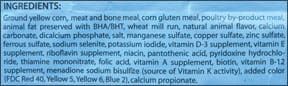
Recently we’ve heard from a number of dog owners who are concerned about the use of ethoxyquin to preserve fish meal that is used in dog foods. We’ve had one e-mail forwarded to us several times expressing worry over links between undeclared ethoxyquin in pet foods and canine cancer.
We have long advised owners to pass over dog food that contains artificial preservatives such as butylated hydroxyanisole (BHA), butylated hydroxytoluene (BHT), tert-butyl hydroquinone (TBHQ), propyl gallate, and ethoxyquin, in favor of products made with natural preservatives, such as tocopherols (vitamin E), citric acid (vitamin C), and rosemary extract.
Though synthetic preservatives were once – as recently as 20 years ago – the usual preservative found in all dry dog foods, today, they appear only on the labels of low-cost and lower-quality products. Pet food companies appreciate the fact that artificial preservatives are less expensive, and they preserve food longer and more reliably than their natural counterparts. But owners who have their dogs’ life-long health foremost in their minds are willing to pay more for more natural products that don’t needlessly expose their dogs to potentially toxic chemicals.
It is possible, however, for pet foods to contain ethoxyquin or other artificial preservatives even if those substances don’t appear on the list of ingredients.
Preservatives Myth Busting
When we get worried (or panicked) mail about this issue, the writer is usually concerned about fish meal that’s been loaded with ethoxyquin. The apparent source of this concern is the fact that the U.S. Coast Guard requires that fish meal that is transported on boats be treated with ethoxyquin, to prevent the volatile fatty acids in the product from spontaneously combusting while traveling on the high seas.
It turns out, though, that this is just part of the story. Only fish meal that is shipped by boat must be treated to prevent combustion; plenty of fish meal is manufactured on land and is not subject to any Coast Guard regulations. Also, the Coast Guard allows the use of other antioxidants to treat the fish meal – and even permits untreated fish meal to be shipped, if the shipper can provide documentation that the product does not display self-heating properties.
What seems to be a surprise to most dog owners is the fact that all animal protein meals – and animal fats – are treated by their manufacturers with preservatives. It’s not just fish meal! Chicken meal, lamb meal, beef meal . . . preservatives are added to all of them.
As alarming as this might sound, it’s only prudent; without some sort of preservation, the fat in these ingredients is subject to oxidation and rancidity. Oxidation is an irreversible process, so antioxidants must be added as early in the food manufacturing process as possible. However, natural preservatives can be used; when buying ingredients for use in their products, the preservation system used is just one of a number of specifications the pet food manufacturers can make. Naturally preserved meat meals cost more and are not as shelf-stable as artificially preserved meat meals, so the decision to use only naturally preserved animal protein meals in their products is a costly and deliberate choice that pet food manufacturers must make.
Preservatives Not on the Label
It’s the fat in meat or poultry meal that needs protection from oxidation. Animal protein meals (i.e., “chicken meal,” “lamb meal,” etc.) usually contain 10 to 14 percent fat. While the preservative used to protect the major fat sources in a dog food (such as “chicken fat”) must be declared on pet food labels, the amount of preservative used in protein meals is generally considered low enough to meet the definition of an “incidental additive,” which is not required to appear on the product label. At least, that’s one explanation for why the preservatives used in protein meals don’t have to appear on pet food labels.
A more prevalent explanation is that there is no legal requirement for pet food makers to disclose substances that were added to an ingredient before it reaches the pet food manufacturing plant. We’ve been told countless times that a pet food maker is responsible for disclosing only the ingredients they themselves mix in during the manufacture of the pet food. In other words, “We didn’t put ethoxyquin in the fish meal; it was already there when we bought the meal! And because we didn’t put ethoxyquin in our pet food, we don’t have to list it among our products’ ingredients.”
We’ve heard this claim so many times, in fact, that we were surprised to learn that it’s not wholly accurate. Dave Dzanis, DVM, PhD, DACVN, a consultant on animal nutrition, labeling, and regulation, writes in his December 2009 column in the trade publication Petfood Industry:
“For a labeling exemption as an ‘incidental additive’ to apply, the level in the final product would have to be low enough to where it no longer had any technical or functional effect [21 CFR 501.100(a)(3)(i)]. Considering that fish meal processors may add 1,000 ppm or more, the residual amount of ethoxyquin in the petfood still could be functional, hence would have to be declared.
“Also, FDA regulation 21 CFR 573.380 expressly specifies that any animal feed containing ethoxyquin must declare it, which is unique language compared to the codified requirements for other approved food additives. That statement can be interpreted as superseding any labeling exemption. In fact, if memory serves me, in the 1990s FDA did advise that ethoxyquin must be declared whether added directly or indirectly, irrespective of source or level.”
We’re not sure how this information can be reconciled with the fact that many pet food companies use fish meal that has been preserved with ethoxyquin, yet ethoxyquin does not appear on the label. Perhaps most companies do not fully understand or have a different interpretation of these rules, and the regulations are simply not enforced.
A Closer Look at Ethoxyquin
Ethoxyquin is a chemical antioxidant and was approved as a pet food additive in 1959. It is used to preserve certain spices (chili powder, paprika, and ground chili only), and is also used as a pesticide and a rubber preservative. Residual levels from animal feed are allowed in meat, poultry, and eggs for human consumption.
The FDA’s Center for Veterinary Medicine (CVM) began receiving reports in 1988 of health issues that pet owners and some veterinarians suspected could be linked to ethoxyquin in pet foods, such as allergic reactions, skin problems, major organ failure, behavior problems, and cancer. Studies done by Monsanto (the manufacturer of ethoxyquin) at the request of the CVM, showed dose-dependent effects on liver enzymes and pigment. As a result, in 1997 the CVM asked the pet food industry to voluntarily lower the maximum level of ethoxyquin in dog foods from 150 ppm (parts per million) to 75 ppm. It said that most pet foods never exceeded the lower amount, even before this recommended change.
Is this level safe? According to a document produced by the Environmental Protection Agency (EPA), “Dogs are more susceptible to ethoxyquin toxicity than rats, with elevated liver enzymes and microscopic findings in the liver occurring at doses as low as 4 mg/kg/day over a 90-day feeding period.” The “4 mg/kg” means 4 mg ethoxyquin per kilogram of the dog’s body weight (not the weight of the food).
Per CVM calculations, 4 mg/kg body weight is the equivalent of 160 ppm in food, just barely above the upper limit that is still allowed in pet food. It’s possible that longer-term ingestion could reduce the amount needed to cause adverse effects and increase the potential for harm. In addition, dogs who eat more food in relation to their body weight, such as puppies, nursing females, and working or other very active dogs, are at risk of exceeding the amount known to cause liver damage.
Let’s look at the fish meal that is processed at sea and treated with ethoxyquin at time of production. Coast Guard regulations say that this fish meal must contain at least 100 ppm ethoxyquin at time of shipment. It’s questionable, though, how much ethoxyquin remains in a finished pet food made with this fish meal. The amount of fish meal used and the method and temperature of the dog food’s manufacture will affect the amount of ethoxyquin present in the final product. We’ve seen claims from companies whose dog foods contain fish meal preserved with ethoxyquin that the foods contain 5 ppm or less ethoxyquin.
Is this lower level safe? No one knows for sure, but it’s certainly less toxic than the amounts that the FDA allows in pet food. And it’s within the limits allowed in some human foods (0.5 to 5 ppm in meat and fat, with higher amounts allowed for spices).
The FDA and pet food industry officials defend the use of ethoxyquin, saying that ethoxyquin is safer than rancid fats. While this may be true, artificial preservatives are not the only way to prevent rancidity. In addition, if ethoxyquin is safe, why is it not permitted to be added to human foods (other than three spices), and why is the acceptable level for pet foods 50 times the residual amount allowed in human food?
Other Artificial Preservatives
Some dog breeders and consumer advocates suspect ethoxyquin of causing cancer, though studies don’t seem to bear that out except at very high levels (5,000 ppm or more). On this point, the EPA concluded, “potential cancer risk is below the Agency’s level of concern.” The artificial preservatives BHA and BHT are considered more likely carcinogens.
BHA and BHT are used in human and pet foods to keep fats from going rancid. Both have been linked to cancer in laboratory animals; it’s unknown whether they cause the same in people and dogs. There is evidence that certain people may have difficulty metabolizing BHA and BHT, resulting in health and behavior changes. Again, we don’t know if the same is true for our dogs.
Yet Another Matter of Trust
In the past, we’ve felt confident in recommending dog foods whose labels do not reflect the inclusion of artificial preservatives. That’s because we were under the impression that the maximum amount of artificial preservatives that could be present in a food whose label did not include them couldn’t possibly be high enough to cause harm. Since “doing the math” on the amount of synthetic antioxidants that can be present in a food whose label does not reflect its inclusion, though, we’ve become uneasy. It no longer seems sufficient to trust that a label review will always reveal the presence of artificial preservatives.
How then can a consumer find out if their dog’s food contains ethoxyquin, BHA, BHT, or other artificial preservatives? Unfortunately, there are no easy answers. You can contact the companies or check their websites, in an effort to find out if they use only naturally preserved meat meals in their foods. Some companies have started making “ethoxyquin-free” claims on their labels and product literature. One would have to trust the company’s answer, though; short of conducting expensive laboratory tests, there is no way to verify these claims. And even usually trustworthy companies can be duped by a contract manufacturer or ingredient supplier.
If you are adamant about avoiding any amount of artificial preservative in your dog’s diet, you would be well-advised to switch to a diet that does not contain meat meals. Canned foods and frozen diets are generally made with fresh and frozen animal ingredients, which are not usually treated with preservatives. Of course, feeding your dog a well-planned home-prepared diet made of fresh ingredients is the only way to be absolutely certain of ingredient content and quality.
Bladder and kidney stones are serious problems in dogs as well as people. These conditions – which are also known as uroliths or urinary calculi – can be excruciatingly painful as well as potentially fatal. Fortunately, informed caregivers can do much to prevent the formation of stones and in some cases actually help treat stones that develop.
Last month, we described struvite stones. Struvites contain magnesium, ammonium, and phosphate. They almost always occur in the bladder in combination with a bacterial infection and are most frequently found in small-breed females.
This month, we examine calcium oxalate or “CaOx” stones.
Calcium oxalate stones CaOx stones occur in both the bladder (lower urinary tract) and kidneys (upper urinary tract) of male and female dogs. Most calcium oxalate uroliths are nephroliths (found in the kidney), and most of the affected patients are small-breed males. CaOx uroliths are radiopaque and most are easily seen on radiographs (X-rays).
In addition to breed and sex, risk factors for CaOx stones include being overweight, under-exercised, neutered, and eating a dry food diet, which contributes to more concentrated urine. Small dogs are thought to be more susceptible because they drink less water relative to their size than large dogs do.
One risk factor is insufficient or abnormal nephrocalcin, a strongly acidic glycoprotein present in normal urine that inhibits calcium oxalate crystal growth. Dogs who produce normal and sufficient nephrocalcin have a reduced risk of developing calcium oxalate stones.
Certain prescription drugs contribute to the formation of CaOx uroliths. Prednisone and other cortisone-type medications prescribed for inflammatory illnesses such as arthritis, itchy skin, or inflammatory bowel disease, can contribute to the formation of CaOx stones. So can the diuretic drug furosemide (brand names Lasix or Salix), which is given to dogs with congestive heart failure. Thiazide-class diuretics are recommended in place of furosemide for dogs who are prone to forming CaOx stones. Some nutritional supplements, such as vitamins C and D, are believed to contribute to oxalate stone formation.
Uroliths can develop in any breed, but the greatest number of calcium oxalate stones presented for analysis have come from Miniature Schnauzers, Bichon Frises, Standard Schnauzers, Lhasa Apsos, Shih Tzus, Yorkshire Terriers, Miniature Poodles, Pomeranians, Parson Russell Terriers, Papillons, Keeshonds, Samoyeds, Chihuahuas, Cairn Terriers, Maltese, Toy Poodles, West Highland White Terriers, Dachshunds, and mixed breeds.
Cocker Spaniels, German Shepherds, Golden Retrievers, and Labrador Retrievers are believed to be at decreased risk of CaOx stones.
Conventional veterinary practitioners tend to consider calcium oxalate stones irreversible, unaffected by diet or medical therapy, and untreatable except by surgery. They may attempt to remove small bladder stones by flushing the bladder with sterile saline, or perform shock wave or laser lithotripsy (processes that break stones into small pieces that can be flushed out or excreted in the dog’s urine).
Uroliths pose a more serious problem for male dogs than females, because their urine travels through a hollow bone (os penis) that surrounds the urethra within the penis. The bone cannot stretch or expand to accommodate a stone traveling through it, and obstructions readily result.
For males with recurring stones, a surgical procedure called urethrostomy sends urine on a new path, avoiding the os penis. The urethrostomy creates a new urinary opening in the scrotum area. This type of surgery cannot be performed unless the dog is neutered; if he is intact, he can be neutered at the time of the urethrostomy.
In up to 60 percent of conventionally treated patients, calcium oxalate stones recur within three years. In dogs with Cushing’s Disease (hyperadrenocorticism) or excessive calcium in the blood (hypercalcemia), both of which predispose dogs to CaOx stones, the recurrence rate is faster. It’s important to treat these underlying causes, if found, to help prevent recurrence. The recurrence rate among Bichons is higher than for any other breed.
Calcium oxalate crystals are of concern, but their presence doesn’t necessarily mean your dog is at risk of forming stones. Crystals are significant only if found in fresh urine. Crystals that form when urine is refrigerated or analyzed more than 30 minutes after collection may be incidental and not indicative of a problem. Dogs with calcium oxalate crystals in fresh urine should be monitored, and if the finding continues, steps should be taken to reduce the risk of stone formation, particularly in breeds most commonly affected.
Death sentence to discovery In 1997, Molly McMouse, a 14-year-old Lhasa Apso belonging to Leslie Bean of Houston, Texas, was diagnosed with very dense, inoperable calcium oxalate stones affecting both kidneys. Bean owned three more Lhasas – 15-year-old FuzzerBear, 13-year-old Peepers, and 11-year-old CB Wigglesworth – who were closely related to Molly. Fearful that her other dogs could be afflicted by the same condition, Bean had them tested, and was shattered when each received the same diagnosis.
“My husband and I were told that oxalates only proliferate in size and number,” she recalls, “and that as the calcification of their kidneys increased, all four of our dogs would die, probably within six to nine months.”
At the time, Bean was founding director of patient advocacy at the University of Texas MD Anderson Cancer Center, a position that helped her contact medical experts of every description. She checked with veterinarians, veterinary researchers, and directors of veterinary schools and laboratories around the country, only to receive the same sad news from all.
“Every one of them said these stones cannot be dissolved,” she says. “They all felt bad about it, but they agreed that the prognosis for my dogs was hopeless.”
Bean’s Lhasas had been on a premium, holistic food, but after their diagnoses, at the recommendation of their veterinarians, Bean put them on a low-protein, low-phosphorus, low-sodium prescription diet. The dogs disliked the new food and their to-the-floor show coats rapidly dulled.
At that point, Bean says, “I accepted the fact that my dogs were going to die but I wanted to make their final months as terrific as possible.” Tossing the prescription food, she began feeding fresh foods such as lamb and peas, chicken and rice, and beef and broccoli. “I figured if they had so little time, they were damned well going to enjoy what they ate,” she says, “and they loved it. I can still see them dancing with joy when I carried their bowls to their places. Literally within two weeks they began acting more energetic, looked younger, had a spring in their step, and their eyes were clearer. Their coats looked better, too, and we soon had to cut almost an inch in length from each dog every month. Although that is common in young Lhasas in show coat, the rate of growth slows with age, so this was a really noticeable difference.” Because oxalic acid forms strong mineral bonds that can become calcium oxalate crystals and eventually CaOx stones, Bean speculated that low-oxalate foods might help prevent the stones’ formation (see “Oxalates in food,” page 9), and she made those ingredients the foundation of her dogs’ menus.
Protein In the past, diets restricted in both protein and phosphorus were thought to reduce the risk of calcium oxalate formation. Studies found, however, that dietary phosphorus restriction increased calcium absorption and the risk of calcium oxalate formation, while higher levels of dietary protein reduced the risk of uroliths. Current recommendations for dogs prone to forming CaOx stones say that diets should not be restricted in protein, calcium, or phosphorus.
In February 2002, The American Journal of Veterinary Research published a study conducted at the University of Minnesota College of Veterinary Medicine’s Minnesota Urolith Center that compared dietary factors in canned food with the formation of calcium oxalate uroliths in dogs, with surprising results. Canned diets with the highest amount of carbohydrate were associated with an increased risk of CaOx urolith formation. Contrary to commonly accepted beliefs, the study concluded that “canned diets formulated to contain high amounts of protein, fat, calcium, phosphorus, magnesium, sodium, potassium, chloride, and moisture and a low amount of carbohydrate may minimize the risk of CaOx urolith formation in dogs.”
In contrast, Hill’s Canine u/d, often prescribed for dogs prone to forming CaOx stones, is low in protein, calcium, phosphorus, magnesium, and potassium.
At the beginning of her nutritional experiment, Bean reduced her dogs’ protein levels so much that they began to lose muscle mass. “After much research, analysis, and discussion with my veterinarians,” she says, “I increased their protein levels to 33-40 percent of the total volume of food. They quickly regained their lost weight and muscle, and there were no further problems with muscle loss.”
As Bean discovered, it’s very important not to reduce protein too much. Even the most severely phosphorus-restricted diets for renal failure recommend feeding a minimum of 1 gram of protein per pound of body weight daily.
Recheck As the Lhasas continued to thrive, their primary veterinarian, Jane Milan, encouraged Bean to return them for another ultrasound test to the veterinarian, a specialist in internal medicine, who had first diagnosed them. “I just didn’t want to hear bad news,” says Bean, “so I kept putting it off.”
Eight months after their diet change and past or near their predicted death dates, she made the appointment. “I was really nervous,” she says. “They looked terrific, but I had no way of knowing what was going on inside them. And the vet was with them for an unusually long time, which made me even more anxious.” Finally the somber-looking veterinarian returned to the waiting room carrying two of the dogs and said, “I don’t know how to tell you this.”
Bean assumed that her other two dogs had died during their ultrasound tests and she nearly fainted, but the vet’s good news revived her. The calcium oxalate stones that had been ticking time bombs were nowhere to be found. That’s what caused the long delay – he could not at first believe his test results. “The two older dogs still had five tiny stones,” she says, “but they had shrunk to the size of pin-dots, and they soon disappeared.”
Despite the kidney damage already caused by their calcium oxalates, each of the already senior Lhasas lived several more years. FuzzerBear died at age 19, the other three lived to be 18, and frequent check-ups showed all four to be completely free from calcium oxalate stones for the rest of their lives.
At the suggestion of their veterinarians, Bean continued to study canine nutrition and assembled a set of guidelines that described her dogs’ regimen.
“I am not a veterinarian licensed to practice veterinary medicine in any state and make no claims or representations as such,” Bean reminds everyone. “I am simply a pet owner whose dogs suffered from intractable problems. I developed FuzzerFood, named for Fuzzerbear, based upon the independent research I conducted to help my own dogs. My discoveries are not intended to be veterinary advice, nor are they a drug, biologic, or other therapeutic or diagnostic substance or technique designed to replace a consultation with a qualified veterinarian.”
She recommends that owners of dogs with calcium oxalate stones work closely with their veterinarians, beginning with a baseline ultrasound, complete blood panel, and urinalysis. “Start now if you have not already,” she suggests, “to maintain records of blood work and urinalysis reports as well as your own notes as you go.”
Water, the key ingredient The most important thing you can do for a stone-prone dog is increase fluid consumption and opportunities to urinate. Urine becomes concentrated when insufficient fluids are consumed or when dogs are not able to relieve themselves and have to hold their urine for long periods. And concentrated urine contributes to supersaturation with minerals that can precipitate into crystals and lead to stones.
One way to encourage dogs to increase their water consumption is to add salt to their food, but salt is controversial when it comes to calcium oxalate uroliths. Increasing dietary salt encourages the kidneys to excrete more calcium, raising urinary calcium levels.
One might predict that increased sodium would therefore lead to increased calcium oxalate formation, but that isn’t necessarily true. In a 2003 study, dogs were fed dry diets containing varying amounts of sodium. The diets that contained 300 mg sodium (about ⅛ teaspoon of salt) per 100 calories significantly reduced urinary calcium oxalate supersaturation over diets containing 60 mg or even 200 mg sodium per 100 calories. Increased fluid consumption resulting from the thirst generated by additional salt probably offset the increase in calcium excretion. A human retrospective study published in 2009 concluded, “Increasing urine sodium does not appear to increase the risk of calcium oxalate nephrolithiasis (kidney stones).”
Bean, however, does not add salt to food. The majority of human studies indicate that adding salt is inadvisable, and many who elected to apply the FuzzerFood regimen for their own dogs were unsuccessful in attempts to dissolve or prevent recurrence of calcium oxalate stones when they departed from the guidelines Bean developed for her own dogs.
You can help your dog drink more by providing fresh water in clean dishes in several locations; changing the water frequently; adding small amounts of tuna water, salt-free or low-sodium broth, a favorite juice, or other flavoring agent to drinking water in addition to offering plain water; adding water to food; offering ice cubes as treats; using a pet water fountain to provide continuously filtered fresh running water; offering water at every opportunity; and carrying water and a portable bowl while hiking or traveling.
What type of water should you use? Bean prefers steam-distilled water because it contains no minerals that might combine with excess oxalic acid. Physicians she consulted with told her that both hard and soft water may increase the risk of calcium oxalate formation. Reverse-osmosis water filters remove 95 percent of minerals, making RO-filtered water nutritionally similar to distilled water.
Not all minerals in water contribute to kidney or bladder stones. In several studies conducted in the 1990s, human patients who formed calcium oxalate nephroliths drank a French mineral water containing high levels of calcium (202 parts per million) and magnesium (36 ppm). Nearly every risk factor for calcium oxalate nephroliths improved significantly. The same patients also drank local tap water and mineral water with low calcium/magnesium concentrations, neither of which improved the measured risk factors. The researchers concluded, “The risk of calcium oxalate stone formation can be significantly reduced by consumption of mineral water which is rich in calcium and magnesium.”
Other research on the effects of hard and soft water on urolith formation has shown mixed results regarding risk, possibly due to variations in mineral content and ratios, along with factors such as whether the water was given with or between meals. For this reason, distilled water may be safest, particularly for dogs with kidney stones or recurrent bladder stones.
Getting extra water into your dog is only part of the urolith-prevention strategy. Just as important is the frequent release of urine. Give your dog many opportunities to go outside during the day. If your dog is indoors alone or crated for hours each day, find a way to create a convenient elimination area using plastic, newspapers, towels, a patch of sod, or whatever you can devise to keep your dog from having to hold her urine for long periods.
Urinary pH Calcium oxalate stones form in urine that is acidic, typically measuring between 5.0 and 6.5 on the pH scale. Calcium oxalate crystals are generally not sensitive to urinary pH, but marked acidification that induces metabolic acidosis can promote calcium oxalate stone formation due to increased urinary calcium concentration.
A common recommendation for dogs prone to forming calcium oxalate stones is to alkalize the body with foods or medications to bring the urinary pH closer to 7, which is neutral. Alkalizing the urine will not cause existing stones to dissolve but may help prevent new stones from forming. It’s important not to try to alkalize the urine too much, as this can lead to the formation of calcium phosphate stones.
You can monitor your dog’s urine by holding a pH test strip in the stream or by collecting urine in a paper cup or clean dish for testing.
But don’t be surprised if your dog’s urinary pH stays where it is. Leslie Bean describes her careful monitoring of her dogs’ urinary pH as a source of discouragement. “I thought that unless I could bring their pH higher, their stones would increase,” she says. “To the contrary, not only did they not increase, the stones dissolved. I learned that the key is to monitor the pH and know where you are, but not to panic if the urine stubbornly remains more acidic than you would like.”
Oxalates in food Oxalic acid is found in both plants and animals, with plants containing higher levels. It forms strong bonds with sodium, potassium, magnesium, and calcium, creating oxalate salts. The term “oxalate” usually refers to a salt of oxalic acid, one of which is calcium oxalate. Sodium and potassium oxalate salts are water-soluble, but calcium oxalate is not, and it is what forms CaOx uroliths.
Interest in low-oxalate diets has increased recently because of possible links between oxalates and human kidney stones, arthritis, fibromyalgia, female vulvar pain, autism and other pervasive developmental disorders, and chronic inflammation. As a result, there is growing demand for accurate data on the oxalate content of foods. When Bean began her research 13 years ago, much of the information published about this subject was quite old. Eventually she found a small booklet published by the University of California at San Diego, “Oxalate Content of Select Foods,” which featured more current data and gave her a list of foods to include and avoid.
Today, the Oxalosis and Hyperoxaluria Foundation publishes an up-to-date list of foods and their oxalate content. Based on research from 2008 and revised as new figures become available, this report divides foods into very high, high, medium, and low levels of oxalates according to serving size. The foods in Group 1 (very high-oxalate foods) are best avoided by dogs prone to calcium oxalate stones. Group 2 (high-oxalate) foods should also be avoided.
Group 3 foods have moderate oxalate levels. They can be fed in moderate amounts as long as calcium is also given with the meal. Group 4 (low-oxalate foods) are “green light” ingredients, and can be fed in any quantity, though they should still be combined with calcium. See the complete list, available through the Oxalosis and Hyperoxaluria Foundation, for information about additional foods, including herbs, spices, combination foods, and beverages.
Some websites and publications incorrectly list meat, liver, other organ meats, shellfish, cheese, yogurt, broccoli, sardines, cherries, brussels sprouts, olives, and strawberries as dangerous for CaOx-sensitive dogs, based on outdated information. All of those foods are actually low in oxalates.
Designing the menu Because it’s difficult to find commercial foods made without ingredients that are problematic for dogs prone to CaOx stones, home-prepared diets may produce the best results. For those who already feed a home-prepared diet to their dogs, the adjustments are simple. For those who are new to dog food preparation, designing an effective menu need not be complicated. Your dog’s food can be prepared along with your own meals or made in advance and refrigerated or frozen in single portions for later use.
Start by feeding different types of meat, poultry, eggs, fish, and dairy in order to provide a variety of flavors and nutrients. The food Bean feeds her dogs is about 40 percent protein by volume, but higher protein levels work well for many dogs. The rest of the diet should be low-oxalate grains and/or vegetables.
While Bean doesn’t include organ meats in her FuzzerFood guidelines, adding ½ ounce (about 1 tablespoon) of liver per pound of other foods will add valuable nutrients to a home-prepared diet.
Meat can be ground, cut into cubes, or served in a single piece, assuming your dog doesn’t have problems chewing. It can be fed raw or cooked. Because CaOx dogs on raw bone-based diets have continued to form stones, the FuzzerFood regimen does not include bones. Freeze-dried liver and similar dog treats are appropriate for training and special occasions. Avoid treats that contain high-oxalate ingredients, and factor treats into the daily food allotment of overweight dogs.
Boiling vegetables in water greatly reduces their oxalate content, while steaming reduces levels slightly. Of course, boiling reduces nutritional content, so it’s a trade-off. When you feed Group 3 (moderate-oxalate) vegetables, consider giving smaller amounts raw and larger amounts cooked. Adding digestive enzymes to food at serving time helps replace enzymes destroyed by heat.
Most 10-pound dogs need less than 1 cup of food by volume, while dogs weighing 50 pounds may need closer to 3 cups per day. Bean’s Lhasas maintain their 12- to 14-pound body weight on slightly more than 1 cup per day. The amount to feed will vary according to your dog’s activity level and the amount of low-calorie vegetables in the diet. Because key supplements should be given twice a day with food, consider feeding breakfast and dinner rather than one meal per day.
Calcium In the past, calcium was thought to be a risk factor for the formation of calcium oxalate stones. Later studies found, however, that calcium binds oxalate and thus actually reduces the risk of calcium oxalate stones when given with meals.
When she spoke with urologists who deal with human kidney stones, Bean learned that supplementing homemade food with calcium citrate neutralizes oxalates in urine, so she began giving it to her dogs with meals while avoiding all other mineral supplements. “Citrate is an important natural inhibitor of calcium oxalate stones,” she says. “When calcium citrate is combined with food at mealtime, it helps absorb and bind excess oxalic acid in the gut. This bound oxalate cannot be absorbed and is excreted through the feces. This means that it does not get into the bloodstream or kidneys to cause stones.”
Pure calcium citrate powder is inexpensive and easy to use. Bean adds 300 to 350 mg of NOW brand Vegetarian Powdered Calcium Citrate to each 8 ounces (½ pound) of fresh food to balance the diet’s calcium:phosphorus ratio. Calcium citrate should only be added to homemade diets, or to the fresh portion of a combined diet, as commercial diets should already contain the right amount of calcium (though, unfortunately, they rarely use calcium citrate).
Supplements For more than 40 years, the medical literature has reported on the success of a simple nutritional therapy for the prevention of calcium oxalate stones in humans using magnesium and vitamin B6. In studies published in The American Journal of Clinical Nutrition, The Journal of the American College of Nutrition, and other medical journals since 1967, patients with longstanding, recurrent calcium oxalate kidney stones received 200, 300, or 500 mg magnesium oxide with or without 10 mg pyridoxine (vitamin B6) daily for five years or more, during which their stone formation fell by more than 90 percent. When measured, their urine increased its ability to keep calcium oxalate in solution.
Because vitamin B6 deficiencies can contribute to an increase in oxalate production, many veterinarians prescribe this vitamin for dogs prone to CaOx stones. Severe vitamin B6 deficiencies may result from genetic disorders. Vitamin B6 is available as an oral supplement or by injection. Follow label directions or, if using a human product, give ¼ of the total dose for each 25 pounds of body weight.
A B-complex supplement provides all of the needed B-family vitamins. Give 50 mg twice per day to dogs weighing 50 pounds or more, and one-fourth or half that amount to smaller dogs. The FuzzerFood regimen includes Omega-3 fish or salmon oil, a B-complex vitamin, and vitamin E, with optional CoQ10, magnesium, glucosamine, digestive enzymes, and probiotics.
Magnesium can have a laxative effect, so begin at the low end of the range, which is 3 to 5 mg per pound of body weight per day, divided into morning and evening doses and given with meals. Magnesium supplementation is contraindicated for dogs in renal failure, so if that is your dog’s condition, use this under your veterinarian’s supervision only as long as there are stones, then discontinue.
Bean does not use either vitamin C or vitamin D (including cod liver oil, which contains vitamin D) because vitamin C is reported to convert to oxalate, thus possibly increasing the risk of stone formation, and vitamin D promotes calcium absorption, which leads to increased urinary calcium.Most multi-vitamins contain vitamins C and D, so it’s important to read labels.
Supplements manufactured for human consumption come in a wider variety than do veterinary supplements, making it easier to find human products that avoid these ingredients. Adjust the recommended human dose for your dog by weight.
Some researchers have found that glucosamine supplements, which are commonly used for arthritis, may help prevent calcium oxalate crystals from adhering to the bladder wall. While this treatment is still speculative, glucosamine is safe to give and may be helpful in preventing CaOx bladder stone formation.
When Bean asked Traditional Chinese Medicine veterinarian Cory Stiles, DVM, for advice from that perspective, Dr. Stiles recommended Lysimachia-3, a traditional Chinese blend of three herbs, Jin Qian Cao or Desmodium, Hai Jin Sha or Lygodium Spores, and Ji Nei Jin or Gallus, which is designed to treat human digestive disorders, gall stones, and kidney stones.
“Lysimachia-3 comes in tablets,” says Bean, “which we crushed and mixed with food, or the tablet can be placed in a small amount of low-fat cream cheese, or the dog can simply be ‘pilled’ by putting it down the throat. My dogs had no objection to having these tablets crushed and mixed with their food, and Lhasas are notoriously picky.” Dr. Stiles’ recommended dose is 1 tablet per 25 pounds body weight given twice daily until stones are dissolved. Then give Lysimachia-3 daily for another month, then start using it every other day, then every three days, and if all looks good, dose it three times per week every other week, and finally, daily for one week out of every four to six weeks.
Preventive medical treatment Potassium citrate is a nutritional supplement that increases citrate levels in the urine, attracting calcium away from oxalates. When calcium binds to citrate, the resulting calcium citrate tends to remain dissolved instead of precipitating out as a mineral deposit. Potassium citrate also has an alkalizing effect on the urine, which can help to prevent the formation of calcium oxalate stones, though it won’t dissolve existing stones. High blood potassium levels are dangerous, so a veterinarian’s supervision and follow-up blood tests are recommended when using potassium citrate. This supplement should usually not be given when dietary changes alone maintain the urine’s pH at 6.5 or above.
Calcium citrate achieves the same goals of alkalizing urine and binding oxalates without the risk of elevated potassium that can be posed by potassium citrate. That’s why Bean considers calcium citrate a better option for her dogs’ homemade diets.
Dogs who continue to form stones despite other steps to minimize risk may be prescribed hydrochlorothiazide, a thiazide diuretic, to increase the amount of urine produced while reducing urinary calcium oxalate saturation.
The stress connection In addition to good food and ample water, dogs need a stable home life, active exercise, and interesting activities. Some researchers speculate that stress plays a role in the development of kidney and bladder stones. When changing your dog’s diet, do what you can to keep the introduction of new foods fun and stress-free. Fortunately, most dogs love fresh food. Just as importantly, do what you can to relax and let go of the stress that concern about your dog’s health brings to your own life. The more you and your best friend enjoy each other’s company with play, exercise, and shared quiet moments, the better you’ll both feel.
Next month: The final installment of our bladder/kidney stone series examines cystine, calcium phosphate, silica, and ammonium urate or uric acid uroliths.
CJ Puotinen is the author of The Encyclopedia of Natural Pet Care and other holistic health books. She lives in Montana, and is a frequent contributor to WDJ.
San Francisco Bay Area resident Mary Straus has spent more than a decade investigating and writing about canine health and nutrition topics for her website, DogAware.com.
1. Meet with your veterinarian in advance to explore, discuss, and understand all of your options regarding end-of-life decisions for your dog.
2. Take time to say goodbye to your beloved companion, thank him for all the time you’ve spent together, and give him permission to go.
3. Know that you are not in it alone; you should neither mitigate nor apologize for your feelings.
4. Reach out to get the help you need to begin processing your loss.
For many of us, the death of our dog will be the first time that we’ve experienced the loss of a loved one, human or otherwise. And even for those who have lost a relative, spouse, or close friend, dealing with the death of a beloved dog can be a whole new experience, unleashing a wave of emotions that just might sweep us off our feet. Although no amount of preparation can make the pain disappear, planning ahead for the loss of a pet can allow us to make better decisions and be ready with the right resources should we find ourselves on an emotional roller coaster.
Joan MacDonald
Plan Ahead to Give Your Dog the Best Death Possible
If you have a senior or terminally ill dog, it’s a good idea to plan ahead for his passing to ensure a quality death for him, as free from pain and suffering as possible. Advance planning, no matter how difficult, lets us make better decisions and ensures a “good” death for our dog. Many guardians find they have regrets if they wait and try to make decisions in the throes of emotion.
Consider the following well in advance of saying goodbye to your beloved companion:
Do you wish for your dog to die an unassisted death at home?
Can you provide the 24/7 support and care he needs to be sure that he does not suffer? If the process is relatively controlled – that is, you have received professional veterinary guidance to keep your pet pain-free until his last breath – dying an unassisted death at home involves setting up a quiet and comfortable environment for your pet and removing collars, slings, and braces from his body in advance.
Respect your pet’s need to die in peace; stories abound of pets who wait to die until their caregivers leave them alone, preferring a quiet departure to one filled with histrionics.
If striving for an unassisted death at home, what is your backup plan if your dog’s condition rapidly deteriorates or she is in distress?
Know to which veterinary clinic you can take your dog on a moment’s notice, any time of day – for euthanasia should it be necessary. Or, find a veterinarian who offers emergency house call service. Alice Villalobos, DVM, and proponent of “pawspice,” reminds us that breathing is the most important criterion. If your pet can’t breathe comfortably enough to sleep, then there is no quality of life.
If you anticipate that euthanasia will be necessary, where do you wish for your pet to be euthanized?
At home? In another special place? Explore your options in advance, including interviewing house call veterinarians. For some people, choosing in-home euthanasia allows them to more easily express their emotions, pay tribute to the animal, and feel relaxed about spending as much time as they wish, prior to and after their pet passes.
Joan Macdonald, of Atlanta, Georgia, knew in her heart that her 10-year-old, beautiful, black-and-tan German Shepherd, Buck, who was suffering from protein losing enteropathy, would require euthanasia. She says, “I had spoken with a couple of different veterinarians who performed in-home euthanasia about six to eight weeks before Buck’s death and selected the person with whom I felt most comfortable. I understood the process well before the day arrived. I had spoken with the vet two days before to assure myself that I knew she would be available.”
Macdonald’s previous three pets had all died at home; she felt that in-home euthanasia was the most loving option for Buck. “We could be there with him while he was outside in our backyard, a place he loved, surrounded by people and animals who loved him. I had dragged him to enough places while battling his illness; the least I could do was to give him a peaceful death surrounded by blue skies and chirping birds.”
Do you prefer the option of euthanasia at your dog’s veterinary clinic?
Are you comfortable with your veterinarian and her staff, and do you understand the procedure? How does your dog feel about the clinic? If it is a place of stress for her, or if she is very old and relatively immobile, you might wish to consider at-home euthanasia. Or, ask your veterinarian in advance if she would be willing to come out to your car to euthanize the dog, rather than requiring you to bring the dog into the clinic.
When it was time for Dakota, Cathy Maher’s 17-year-old Lhasa Apso-mix to be euthanized, she chose to go to the veterinary clinic, where Dakota was euthanized outside, under a tree, in the nature preserve on the clinic’s grounds. If you prefer to take your dog to the veterinary clinic, consider whether you will need someone there for support – either to stay with you, or at least, to drive you safely to and from the clinic.
Do you want to be present for the euthanasia, whether at-home or at the veterinary clinic?
If so, understand that the dog can make vocalizations, involuntary movements, and lose bladder or bowel control. This is not unusual, nor is it indicative that the animal is suffering. Whether you are present for the euthanasia or not, experts in the field of pet loss recommend that we, at the least, see our pet’s body before burial or cremation as a way to help us begin to process the loss, and help us to understand that our pet is indeed gone.
Do you understand the euthanasia process that the clinic will use?
Don’t hesitate to schedule a consult with your veterinarian – perhaps without your dog present – to learn about it. Take the opportunity to ask questions about payment, aftercare arrangements and any other questions you have. Inquire whether the clinic has a special room for euthanasia, and if they allow you to spend time with your dog, both before and after he has been euthanized. Ask if the veterinarian typically performs euthanasia at the end of the day, when the office might be quieter, or at any particular time of day.
The Gwinnett Animal Hospital in Snellville, Georgia, typically euthanizes pets in “Room 6,” also known as the “Transition Room.” Clinic co-owner, Andrea Haupt, RVT, CVMRT and a Guild Certified TTouch Practitioner, relates that the room is not set up like an exam room; instead, it features soft lighting, comfortable chairs, and a small fountain. Haupt believes that the energy in the room is different, in a good way. After staff have helped an animal to “transition,” a candle is lit and the caregiver is encouraged to spend as much time with her pet as she wishes.
Even if our dogs are healthy or young at the moment, we’d do well to know in advance what our options are lest an accident or serious illness take us by surprise.
Christy Waehner, of Atlanta, Georgia, didn’t have much time to prepare for the death of her seven-year-old Doberman Pinscher, Jones, but previous experiences and her clinic helped guide her decisions. One weekend, Jones became very ill; after taking Jones in and out of the emergency vet clinic for three days, Christy took Jones, clearly failing, back to the Gwinnett Animal Hospital in hopes of finding something that would help him.
Sadly, she soon received a call that they had exhausted all avenues. “I love and respect his veterinarians, as did Jones,” says Waehner. “I have had a dog euthanized at home, and it was very nice. It all depends on the circumstance; Jones was already at the vet clinic. The clinic has a lovely room that has a water fountain Jones always loved. While he and I sat together, he got up and drank out of it just like he always did. That was special for me. I sat with him for an hour until I felt like he and I were both ready to say goodbye. The vet came in and I held him while she let him go. This has always been a special time for me – being there at the end. It’s a gentle process, and as sad as I am, it’s comforting to know that we’re together as he moves on.”
Additional Considerations to Make Before Your Dog Passes
Planning ahead also involves knowing what you wish to do with your pet’s body once he has passed. For some, once the animal is gone, the body is just a shell that remains and the caregiver has no desire to take the body, preferring to remember her companion as he once was. Others find burial or cremation as a means to remember and honor their pets.
• Burial: The least costly option is for the caregiver to take her pet’s body home and bury him, local ordinances and other considerations (i.e., depth needed to properly bury) notwithstanding. One of the more significant downsides to this is today’s very mobile society: many of us don’t live forever in the same place, so leaving a beloved canine companion’s resting place behind might not work for some individuals.
Burial in a pet cemetery is another alternative and many people find the sense of permanence and security reassuring, knowing that even if they move, they will know that their pet’s body will not be disturbed. Having a quiet place to spend time, or to hold a memorial service when the pet is buried, can help with processing the loss. One resource for locating a pet cemetery near you is the International Association of Pet Cemeteries and Crematories (IAOPCC). Figure in pricing for a casket and burial and the total, here in Georgia, can run anywhere from $300 and up.
• Cremation: Another good reason for planning ahead is to have opportunity to research the company providing the cremation service and feel comfortable that your dog’s body – and you – will be treated with care and compassion. Unfortunately, just as has been the case with human funeral homes, there are unscrupulous pet crematories, too. Keep that in mind when looking for a cremation provider.
Most veterinary clinics offer their clients the choice of a private cremation, wherein a representative from a pet crematory picks up the pet’s body from the clinic, cremates the body, then returns the ashes to the clinic or directly to the owner. Ashes might be placed in a simple box or in a more elaborate urn, either picked out by the caregiver, or provided by the crematory. There also exist pet crematories that offer a wide range of services (i.e., chapel, urn gallery, cemetery) to the pet guardian, including allowing the caregiver to bring the pet’s body herself to the crematory, and making available a quiet room where she can spend time with her pet before the body is cremated.
Cremated remains (sometimes referred to as “cremains”) are commonly called ashes, but the material, comprised of bits of bone, more resembles a gritty sand than wafting ashes. These remains can be memorialized in a pet cemetery, or taken home by the pet’s guardian. Some people like to scatter their pets’ ashes somewhere special, or have the ashes buried or co-mingled with their own when they die.
“Community cremation” is a lower-cost option to individual cremation, in which the bodies of several pets are cremated together. In this case, the ashes are not returned to the owner.
Both the cost of euthanasia and cremation, and the amount of ashes left after cremation, are dependent on the size of the pet. Private cremations at a local Atlanta pet crematory range from $160-$260; community cremations cost less.
When Waehner lost her first dogs several years ago, she had them cremated but didn’t take the ashes home with her. She relates, “I had a real separation of ‘being’ and body and just saw no need to keep ashes.” But in the years since, she has elected to take the ashes of her dogs home after they have been cremated. “I decided I wanted something to scatter to the wind. It gave me a sense of setting them free from a physical body, even though they were no longer in that body and were already free. I realize that it’s my sense of freedom for them.” She already had a relationship with a local pet crematory – Paws, Whiskers and Wags in Decatur, Georgia – so when Jones died, the vet clinic put his body in Waehner’s van. “I kept my hand on his warm body as I drove him to Paws,” says Waehner. “For me, this was very comforting.”
Coping with the Loss of Your Dog
Judy Rath, a licensed professional counselor (LPC) in St. Simons Island, Georgia, draws on personal experience to counsel clients who have lost pets. She lost Cousteau, her own nine-year-old Briard (and a beloved companion and therapy dog), to a quick battle with cancer. Her husband, Steve, died a mere six months later. I asked her if she could compare the emotional pain of the two experiences; her words echo those of others. “In some ways, the death of Cousteau was worse. Equally, or no less horrendous, at the least, and in some cases, worse.” She shares that even Steve, when they lost Cousteau, remarked that he thought his pain was deeper than when his own father had passed away.
The primary issue to understand is that losing a pet is no different than losing a human, and even if you have done okay after the loss of one pet, you might have a whole different experience with losing another. Our relationships with each of our pets is as unique as each our relationships with the various people in our lives. Sandra Barker, PhD, NCC, LPC, reminds pet owners that grief is a natural and normal response to a significant loss, and while painful, it is also a healing process. Some of us will have a harder time dealing with the loss than others.
“So many factors can affect the intensity of our grief response,” she says. “These include our previous experiences with death, our physical and mental health and support systems, the circumstances related to the death (was it sudden or was there time to plan, did the pet die naturally or was euthanasia chosen), what the pet symbolized to the owner (companionship, protection, last link to a deceased relative), others’ responses to the death (including veterinarians and their staff), and our perception of whether the pet suffered.”
Melba Atkinson founded and subsequently led a pet loss support group in Charlottesville, Virginia for eight years. She says, “As a society, we grieve very poorly. We expect people to move on very quickly. And for a lot of people, they wind up tucking away their feelings inside. If you don’t deal with a loss when it happens, sometime in the future it will rear its head, and you’ll encounter even more complicated grieving than the first time. Allow yourself to deal with it; don’t let social or societal pressure make you think ®It’s just a pet; I shouldn’t have these feelings.'”
Stages of Grief: An Evolution
Decades ago, Elisabeth Kubler-Ross conceived the “five stages of grief” (denial, anger, bargaining, depression, acceptance).
Wallace Sife, PhD, founder of the Association ofPet Loss and Bereavement (APLB‘), prefers the term “stages of bereavement,” which include shock and disbelief; anger, alienation, and distancing; denial; guilt; depression; and resolution/closure).
Melba Atkinson, who founded and facilitated a pet loss support group, takes things a step further and explains that she prefers the term “dimensions” to “stages” since there is no set order in which we will experience these emotions, we can feel more than one at a time, and they can surprise us — both with their intensity and when we might find ourselves experiencing them.
Whatever model you identify with, keep in mind that grieving the loss of your canine companion can be a long and complicated process. Allow yourself to experience the emotions fully; allow your human and animal friends to care for you as you recover.
Don’t Try to Grieve Alone
When we experience a loss – and even before – it’s important that we acknowledge it and begin processing. Today, a variety of resources are available to help us; the hardest part is admitting that we might need help, and making the effort to avail ourselves of these resources. The one common thread is that whatever we are going through, we are not alone.
Christy Waehner
• Pet support/loss groups. Attendance at these community-based groups is usually free; some ask for a small donation. Your veterinarian might be able to refer you to a group; otherwise, try an online search or contact other pet-related businesses to see if they can provide a reference. Many groups welcome participants who are anticipating the loss of a pet, rather than limiting the group to only those who have already lost pets.
In general, Atkinson says, a group’s purpose is neither to judge nor to “fix.” These groups are there to offer listening and support, and unless someone asks for advice, it should not be given. All information shared should be in confidence. There should be no pressure for you to speak: if you want to sit and listen, that’s fine. “You feel supported even if you don’t talk,” Atkinson reports, and admits that while a group setting might not be for everyone, it can be comforting to hear others relate stories of experiencing the same feelings that we are, having the same problems sleeping and eating, for example, to let us know that we aren’t going crazy.
• Pet loss telephone hotlines. Many organizations, including several veterinary schools, offer grieving individuals the opportunity to speak one-on-one with trained volunteers via telephone. Typically these lines are staffed on certain days, at specific times, and usually are toll calls.
• Online chat rooms. This Internet phenomenon gives us the opportunity to remain relatively anonymous while “chatting” with others who have lost pets. Chats are typically moderated by trained volunteers or therapists. The chat environment can be a little unnerving at first if you are unfamiliar with it, as multiple threads occur simultaneously. Skilled moderators do their best to be sure that no one gets lost or ignored. The Association of Pet Loss and Bereavement (APLB) is one group offering chats on a regular schedule. My take on this is that it’s a lot easier to type and cry than it is to talk and cry!
• Books. I discovered a number of excellent titles that discuss why our relationships with our pets are so meaningful and why our grief can run so deep when we lose them. I highly recommend reading at least one book on pet loss well before it’s time to say goodbye to your canine companion. The books create an awareness of a variety of issues to consider, and help the reader begin to do her “emotional homework.” Most books are typically very affordable, but I found that my library system also had a nice selection. Pet support groups (such as Atkinson’s) might also maintain a lending library.
• Friends. Some friends will understand while others won’t. Seek out those whom you respect and who have dealt with the loss of a pet. Distance yourself temporarily from those who don’t seem to understand that your pet was a beloved family member and who tell you to “get over it.”
• Websites. Lots of websites offer ideas for processing and dealing with grief. A quick search will turn up a plethora of options. As with anything on the Internet, proceed cautiously and look for credible sources for information.
One-on-one guidance from a therapist or counselor as we prepare for a loss, or afterward, is another option. How do we know whether help from a therapist might become necessary? Dr. Barker answers, “I think a general rule of thumb is when our pain persists over a period of time (such as several weeks) with no improvement. Anyone who experiences suicidal thoughts or whose symptoms significantly interfere with daily functioning should seek professional help as well.”
Spiritual Support for Pet Grieving
Our spiritual beliefs can play a part in how we deal with our pet’s passing or “transition.” Dr. Barker encourages clients to consider how their spiritual beliefs might help them during the difficult grief process. Clients practicing a religious faith may turn to their church, temple, or synagogue for support, or might also seek out other religious/spiritual opinions.
When I spoke with Haupt, she used the term “helping the animal transition” to describe our role in our pet’s passing. She believes that animals don’t view the transition – which she describes as moving from one life form to another – the way we do, and that our animals, even when physically gone, don’t ever leave us.
Rath adds, “We have a fear of death. Pets don’t fear death, and we have trouble grasping this. We are fear-based as humans; our pets don’t have that fear of the next piece of their existence. We project our emotions on to our dogs. That’s where you need to step back and look at the big picture.”
In Atkinson’s experience, people take comfort from the image that their dogs are waiting for them, and when they die, they’ll be reunited. She found that spirituality was important to people and encouraged those in her pet loss support group to feel okay with that. She believes that strong religious and spiritual beliefs might help some deal with loss a little more easily.
But even before our pets die, if we have the opportunity, animal communicator Penelope Smith, author of Animals in Spirit, encourages us to “Sit quietly with our animal friends, listening as best you can, making peace with them, going over the life you’ve had together, and being willing to let them go are the best things to do when it’s obvious that life can no longer be sustained.” She also says, “If you are also willing to view death as a natural, profound, and even beautiful part of life, it becomes easier for the animal to relax and either get well or leave peacefully. Accept your emotions as they come, but don’t put the burden on your animal friends to handle your feelings by requiring them to hang on to life.” She explains that while the loss of our canine friend’s physical presence is saddening, the connection we have with the animal as spirit helps to put the whole process into perspective.
Waehner says, “I’ve been raised to believe that there is no death. And this enables me to just know that he [Jones] has transformed his energy from a physical form that I was able to see for seven years, to one that I’m now aware of, but just can’t see.”
HeartGlass Studio
Receiving Signs from the Great Beyond
Many people talk about signs they receive from their animals, a feeling they get of their animals’ presence nearby, or even a dream in which they see their pets as healthy, happy, and whole. Fanna Easter of Buford, Georgia lost Armond, her nine-year-old, three-legged Bouvier to osteo-sarcoma.
Four sleepless nights after Armond passed, Easter had a dream about her dog that she says “healed my heart more” than crying. In the dream, Armond was lying down and he was looking up at her. “I had this sense of calm. He looked beautiful, as if he had just been groomed and had glitter in his hair. He looked so handsome; he had all four legs, too! I could ‘feel’ him saying, ‘It’s okay, I’m okay, we are all okay. I had to go, it was my time.’ I remember smiling and telling him he could go play.”
Haupt has a solar-powered chime in her home that she says occasionally rings at night, or on overcast days – times when it really shouldn’t be ringing! When this happens, she is certain that her beloved animals (who have transitioned) are stopping in to say hello.
Others consult animal communicators as a means of connecting with their pets’ spirits. “I had a wonderful conversation with Tina Hassett, RN, BSN, who has communicated with my animal companions,” says Waehner. “It was a mixture of much sadness, gentleness, and comfort. I feel that Jones’ energy is still here with me, and occasionally he pops in on conversations with Tina.”
Create Something in Remembrance of Your Dog
Memorializing our pets is a means to preserve memories and honor our canine friends, but just as important, it helps us process our loss. Wallace Sife, PhD, and founder of the Association of Pet Loss and Bereavement (APLB), tells us that “Rituals can focus, center, and calm us, and convert something painful into something less painful.” Commonly, veterinary clinics or pet crematories will give the caregiver an imprint of a paw taken from the dog after his death, or locks of hair. Beyond that, the list of ideas for remembrances is endless. A few ideas include:
• A memorial service with family and friends featuring songs, eulogies, or even a feast
• Lighting candles
• Planting flowers, trees, or plants
• Writing poetry or music in tribute
• Creating a memorial plaque, photo collage, scrapbook, or diary
• Writing letters to the pet
• Creating a special place in the home that holds the pet’s ashes, photos, flowers, and other mementos such as her collar and ID tags
• Announcements or memorial cards
• Donations to animal-related causes
Some of my favorites include:
• Pam Green of California has a collection of ashes from the numerous dogs she has loved throughout her life. She searches out unique boxes, suitable for holding ashes, at thrift stores and antique shops. All the boxes are kept on a shelf in her home, lit continuously by a night light.
• Waehner plans to order a blown glass Memory Sphere from HeartGlass Studio to commemorate Jones. Artists create the spheres incorporating the pet’s ashes, which manifest themselves as a spiral of white particles and bubbles running through the glass. Waehner says that the sphere will be “a reminder of all of Jones’ lovely qualities that made my life better for having him in it.”
• Maher, every day, wears a beautiful pendant that holds a small amount of Dakota’s ashes.
• Paws, Whiskers, & Wags brings together clients at their annual “Celebration of Life” memorial, featuring a slide show of their pets – and lots of tissues! This year’s event was attended by 300 people.
Lessons Learned From Dogs Lost
Planning for, and subsequently dealing with, the loss of a beloved canine companion is possibly one of the hardest, most painful situations we’ll encounter. Preparing for the loss will be difficult, but might be the best decision you can make to help your friend transition peacefully and with honor.
Once he is gone, and your pain omnipresent, remember that with the gift of time, you will recover and the pain will lessen or go away, though wonderful memories will remain.
Waehner says, “While you never completely forget the pain of loss, there comes a time when the soft chorus of joyful memories is the stronger song that plays in your heart.”
And Maher, who thought that it would be a long while before a “new” dog graced the doorstep of her home, found herself welcoming Dugan, a sweet, troubled stray, rescued by her sister, into her family a few months after she lost Dakota. “I learned that even though I lost the dog love of my life and my heart was broken, our hearts do heal and can expand to accept and love another pet.”
What is this sport? Dogs and handlers work together to demonstrate the water work for which the dogs were bred: rescue work or working alongside fishermen.
Prior training required? Minimal.
Physical demands? On the dog: Moderate, until the higher levels of competition are reached. Then, high. On the handler: Moderate.
Best-suited structure? Many dogs can enjoy water work, although the dogs bred specifically for the work (such as Newfies and PWDs) do best.
Best-suited temperament? Dogs who love to work and who love water.
Cost? Moderate.
Training complexity? Moderate.
Mental stimulation? High.
Physical stimulation? High.
Recreational opportunities? Depends on where you live (you need a lake or body of water, preferably not infested with alligators or sharks).
Competition opportunities and venues? Moderate.
The curly brown dog stamped his feet and stared at his handler. He had retrieved the plastic dummy countless times. Now what? Something as simple as that look is all it took to start Kathryn Monroe of Mahtomedi, Minnesota, on a quest. It would ultimately take her across the country in search of the knowledge and skills to train her Portuguese Water Dog, Gaucho, to do what his breeding dictated. Work. Water work, specifically.
“Gaucho was the kind of pup we all dream of,” remembers Monroe. “Attentive to humans, determined to retrieve. He forced me to examine what else I could do to keep up with him. This was before there was a Portuguese Water Dog Club of America (PWDCA) water trial. There were only hunting trials for the organized sports world, rescue trials for Newfoundlands, and, for the rest of us, throwing a stick on the beach. So I had a lot of work to do to understand what the PWD did historically, and how it could be reflected in today’s sports. Gaucho was a willing guinea pig!”
History of Water Sports for Dogs
Like many people, Monroe had gotten involved with a breed because she was looking for a dog with an affinity for something she loved. Monroe is a boater. When asked if she had water sports in mind when she chose a PWD, she said, “Water sports? I hate water sports! I don’t swim, and I don’t like to be cold and wet. I love to be on the water, but not in the water. I love to sail and ran a sailboat dealership for many years. And I do love dogs. I just wanted a dog that liked boats. I figured since I didn’t swim, my dog should know how to.”
And the rest is truly history since Gaucho went on to become Ch Glad Tidings do Mar, CD, WWD (Working Water Dog), multiple year Top Ten PWDCA producer, POM (Producer of Merit), ROM (Registry of Merit). And for her part, Monroe was instrumental in developing the PWDCA water trial standards. Monroe must have a lot of working lines in her own DNA since it took her, along with several other dedicated PWD owners, more than six years to finalize the standards that were finally approved in December of 1990. The first PWDCA trials took place in 1991 in Connecticut, Minnesota, and Washington.
Some of the standards for the PWDCA water work trials were inspired by another breed’s trial standards. The Newfoundland Club of America’s (NCA) standards had been approved back in 1972. Although the focus of NCA trials is on human rescue, the retrieve work is similar, as well as the requirement that dogs work from both land and water.
Water Work Competitions for Dogs
The requirements for titling your dog in water work differ depending upon the dog’s breed. Although there are a couple of avenues available to people with other breeds or mixed breeds, most water work standards are based on either the PWDCA or the NCA.
For example, the PWDCA’s first trial level could be considered a “certificate of readiness,” which assesses a dog’s interest in water tasks, as well as basic teamwork. Each of the next three levels test more advanced skills. Monroe explains how the PWDCA trial standards were developed: “The PWD trials boast a singular suitability for this breed and its work. Every exercise in the titling levels is a useful task. The model is of teamwork and crew rather than dog and master. Teams have latitude in style, as long as the job gets done. Judging assesses achievement. The rules deal only with safety, equalizing physical differences, and making the task easier to judge. The task is either completed or not, pass or fail.”
“The pinnacle of the PWDCA water trial is the Courier Water Dog level, in which the dog works from the boat in a compelling display of its history. The dog delivers a message pouch to another boat and returns with the reply; it swims to shore to locate and retrieve a line of floats. The dog executes a double, directed retrieve in the order determined by the judge based on conditions at the time of the trial, and it pulls a fishing net from one boat to another.
“By far the most difficult task is the next one. When nets are in place, they float beneath the water’s surface, extending a hidden hazard that could foul the rudders and nets of other boats in the area. Traditionally, marker buoys are set to designate the net’s trailing edge. In the final task of the water trial, the dog follows a complex chain of commands: jump off the boat; return to the handler; grasp a large marker buoy by the attached rope; turn and swim 75 feet away in the direction indicated, beyond the course boundaries into unmarked water; and drop the ball when signaled to do so. The dog must leave the marker in place and return to the handler.”
Clearly, these dogs are not just good-looking. As with many other working breeds, people sometimes purchase PWDs without understanding how much energy they have and how much training is required to keep their minds and their bodies busy. Beware!
Training Your Dog for Water Work Competitions
Karrie Cook has owned five Newfoundlands over the past 13 years, four of whom have been rescues. Although she always took her dogs swimming, she didn’t know where to start to train for water work. She began by helping out at water tests as a “steward” to learn more about it, did a lot of reading, and eventually joined the Newfoundland Club of Southern California (NCSC). Stewards fulfill a variety of roles including moving gear around, holding dogs, rowing boats, assisting judges, placing articles for retrieving, etc.
“I learned a lot from mentor-level trainers and through offering to steward and help out at tests. Many of the exercises and pre-training of ‘take,’ ‘hold,’ and ‘give’ can be done on land and then transferred to the water. Prior to transferring learned skills to the water, your dog needs to clearly understand ‘take,’ ‘hold,’ and ‘give’ as three distinctly different tasks. These commands are fundamental to successful water training.
“In addition, your dog needs a good foundation in basic obedience as all three levels of NCA water tests are completed off-leash. The junior level test includes a basic control section (i.e., heel off-lead, recall, and one-minute down).”
Monroe, with the PWDs, had her work cut out for her as well, figuring out how to train for the skills that she had helped establish as part of the PWD water work standards. “I really had started out just wanting a pal to go sailing with me, and the world of dogs and titling events seemed rather stylized and competitive; I got enough of that on the sailing circuit, thank you very much. I wanted to work with my dog, not just command him to fetch and carry.
“Gaucho quickly let me know that traditional ‘jerk and praise’ or forced retrieve methods were not going to work at all. Play training was not demanding enough for him. Lucky for me, Joan Telfer, a tracking judge, introduced me to clicker training. This was the ticket: specific parameters for the goal, building on progress that meets the canine learning style, and positive enough to be comfortable for me. With this method, Gaucho figured he was training me quite well!”
Back in those early days of PWD water work, there were no classes. Monroe continued to learn from others and adapted training to fit water work and ended up giving classes and workshops herself. “I figured out how to break down the tasks into each part, train that part, and then chain them together. Then I trained other trainers. As a judge, it’s really fun to see an exhibitor I’ve never met using a technique that I pioneered and taught to others!”
These days, many local breed clubs offer training. Monroe believes that a lot of training that people have done with other sports can be transferred to water work because it’s the relationship with your dog that is the foundation for the teamwork required. She has had Standard Schnauzers, Poodles, Border Terriers, Vizlas, Boxers, and many other breeds do quite well in her basic water work seminars.
Water Work Looks Like Fun, But It Really Is Work
The first thing one discovers from talking to people who work their Newfoundlands or Portuguese Water Dogs in the water is that this is work. Although some would call it a water sport, they would beg to differ. Their dogs are working dogs, and work is what they have been bred to do. Yes, these dogs are handsome, affectionate, and playful, but when they are in the water, they are working. And their water trials are uniquely designed to demonstrate the skills for which they were bred.
There are two major categories of water work. One is rescue work, performed by New foundlands (Newfies) and the other is working alongside fishermen, performed by Portuguese Water Dogs (PwDs).
Rescue Work
Focuses on swimming to the aid of a human in distress and coming to the rescue of stranded boaters. Skills tested in water trials include:
• Swimming to a person who grabs the harness of the dog and towing the person to shore or to a boat
• Swimming to an “unconscious victim” and bringing them to a boat or to shore
• Underwater retrieves
• Jumping off a boat to retrieve objects overboard (cushions, life jackets)
• Taking life rings and knotted lines to “victims”
Working with Fishermen
Focuses on work from land or boat to aid fishermen. Skills include:
• Carrying messages between boats
• Placing buoys to mark nets
• Towing nets and placing them as directed
• Underwater retrieves
• Retrieve objects overboard so fishing nets and ropes don’t become tangled by them
• Carrying gear between boats and to shore
PWD Sport Team Attributes
Water work will appeal to people who want something fun to do with their dogs, and who enjoy the relationship that develops from training to higher and higher levels of accomplishment with their canine partner. It is relatively easy to get started in water work, but watch out! Although attaining foundation water work skills is satisfying, the bond that develops during training and working can be addictive. Many in this sport say it is the lifelong work together, learning advanced skills and rising to increasing challenges that keeps them coming back for more.
“The PWD Water Trial,” says Monroe, “is intentionally staged so that the beginning certificate is easy to try to see if you like it, with a minimum investment of time and money and, second, so that each level builds on the skills mastered in the level before it. So when you start with the Junior Certificate, the way you train lays the foundation for the pinnacle title, the Courier Water Dog Title. Somewhere along the way, the satisfaction of working with your dog means more than the titles, but the titles give you clear goals to reach for.”
The most physically demanding aspect of this sport for people is hauling gear, including boats, nets, crates, and float lines. Since handlers can wear life jackets, you don’t have to be a good swimmer. Monroe believes that doing something you love with your dog is the most important human attribute.
“The people who will stick with water work are those with a sense of humor, a sense of adventure, a love of seeing their dog light up over his or her own success, and people who are willing to help; water trials and their preparation take lots of manpower. Some of my best and longest friendships arose from coming together over our mutual love of schlepping around in the water with our dogs.”
Cook, the Newfie owner, concurs. “I love watching the natural instincts and intelligence of this breed in the water. I’m an animal person and a people person so I enjoy training the dogs and spending a beautiful day out on the lake with friends who share similar interests. We all have memories of funny times, frustrating times, and great accomplishments with our dogs. It’s pretty amazing seeing how much a dog can learn and achieve over the course of a summer of training.”
If you are thinking about getting a dog that will excel at water work, look for a dog whose structure and temperament are well suited. Monroe is a qualifier of the PWDCA Outstanding Breeder Achievement Award, which recognizes combined health, conformation, and performance achievement of dogs produced. She insists that temperament is paramount in choosing your dog.
“The frenetic dog is fun to watch, but harder to train. The dog who doesn’t have a strong desire to work for its human will have a tendency to run around on the beach, not deliver to hand, and not retrieve articles in the correct order, etc. I describe the ideal as ‘workmanlike.’ “
Dogs who excel at water work need both the temperament and the structure to perform the wide variety of physically demanding tasks involved. Although swimming is a low-impact activity that helps develop overall fitness and aerobic capacity, there is risk of injury. “Swimmers tail,” also known as “dead tail,” is when the tail droops and cannot wag. It typically happens in the spring when the water hasn’t yet warmed to summer temperatures and the dogs are not yet in peak condition. It goes away in a couple of days, but has surprised handlers who are not familiar with the syndrome.
Dogs can also get hurt getting back into the boat after an exercise. Care must be given to support the dog’s effort and not to grab and drag the dog up into the boat, which can cause bruising. That said, water work provides a pretty safe working environment for dogs even later in life when other activities become too difficult.
Monroe remembers two dogs who achieved PWDCA titles at advanced ages. “We’ve had dogs earn their Courier title at the age of 10, and others whose handlers are severely arthritic. We’ve had veteran dogs with Addison’s disease competing at the Working level. I once saw a UDX [an advanced competition obedience title] dog, 13 years old and totally deaf, get his Apprentice title based totally on hand signals. There wasn’t a dry eye on the beach that day. I saw a retired brood bitch get her Junior Certificate at the age of 11. “In short, like swimming for humans, water work is a ‘lifetime sport’ for our canine buddies.”
Water Work Equipment and Expenses
The biggest challenge of this sport is finding a body of water large enough that allows dogs. “Believe it or not,” said Cook, “I think the biggest challenge in training for this sport in Southern California is finding a body of water in which to train the dogs. City and county regulations are becoming more and more stringent, and most areas in Southern California do not allow dogs to swim. It is also necessary to have a rowboat with a platform, as well as a number of volunteers, since most of the exercises either involve a boat or people in the water.”
Water work equipment includes a special harness that has rings attached for people to grab in rescue exercises by Newfies, while the PWDs use a tracking-style harness to ensure that the dog doesn’t get choked while working. Other miscellaneous items include fishing lines, retrieving dummies (called bumpers in some sports), life jackets, boat seat cushions, and life rings and knotted lines used in rescue work and, of course, water shoes for you. Monroe advises budgeting about $100 to start, $200 for general equipment expenses at the advanced levels, and much more if you need a boat outfitted with a working platform.
Training classes and workshops, when you can find them, can be invaluable. Workshops can cost $150 for a two-day workshop and classes can run $100 for a series of six classes. Clubs usually provide practices and “run throughs” for a minimal contribution from members. Trial fees run between $25-$40 per entry.
The best way to get started in water work is to offer to get involved in local practices. It takes a lot of people for this sport. By helping out, you learn as you build bonds with both people and dogs. And that’s what it’s all about, isn’t it?
Obie to the Rescue…Times Three!
Eeeny, meeny, miney, moe. To which drowning victim do I go, thought Obie, the seven-year-old male Newfoundland. Decisions, decisions. No time to waste, these folks are all in distress and my person cued me to go to the rescue, confident that I can do what we’ve trained to do. S-P-L-A-S-H!
It is the “multiple person rescue” exercise of the Water Rescue Dog, Excellent division (WRDX), of a Newfoundland Club of America (NCA) water trial. Handler and dog are in a boat 150 feet from shore. Three “victims” swim out to locations varying between 75-100 feet from shore with 35 feet between each victim. At the judge’s signal, the handler cues her dog to go to the rescue and the dog has 15 seconds to launch out of the boat and six minutes to “save” all three victims by bringing them back to the boat. The dog can save the victims one at a time, two at once, or all three at once.
Karrie Cook of Huntington Beach, California, watches proudly as her hero displays the strength and brains she loves about the Newfoundland. Obie first makes a beeline to the victim on the right. Without breaking stride, he then swims to the one in the center and then, yes, to the victim on the left and brings them all in at once. That’s her boy! Karablue’s Ocean Breeze.
“Most dogs I’ve seen complete this exercise by picking up one victim at a time and returning that person to the boat prior to getting another victim,” says Cook. “Although he doesn’t always do it this way, Obie usually jumps from the boat, swims to the victim on the right, then to the center victim, then to the victim on the left, and then brings all three victims back in one trip.
“I think he’s learned that this is the quickest and most efficient way for him to complete this exercise. It’s very cool to watch and shows that he can problem-solve this exercise and complete it with very little guidance from me. He’s a very amazing dog and I know that he would be able to complete a real rescue should the need ever arise.” That’s what it’s all about for water work fanatics: knowing that their dog could actually do real-life work.
Terry Long, CPDT, is a writer, agility instructor, and behavior counselor in Long Beach, CA. She lives with four dogs and a cat and is addicted to agility and animal behavior.
What is this sport? In herding competitions, cued by handlers, dogs use their physical presence to move livestock to specific locations.
Prior training required? Moderate. A candidate should possess good self-control skills and above-average performance at basic obedience tasks.
Physical demands? On the dog: High. On the handler: Moderate.
Best-suited structure? This is a physically strenuous sport. Dogs should be very fit.
Best-suited temperament? Dogs with natural herding instincts, but many breeds enjoy herding.
Cost? Moderate to high.
Training complexity? Moderate to high.
Mental stimulation? High.
Physical stimulation? High.
Recreational opportunities? Depends on where you live.
Competition opportunities and venues? Moderate.
Fetch. Drive. Flank. Come-bye. Go-bye. Way to me. Outruns. Flight zones. Pressure point. That’ll do! The sport of herding has a unique vocabulary that distinguishes it from all the other canine sports. In addition to basic obedience cues such as sit, down, stay, and come, dogs are trained to respond to cues that tell them when to start moving livestock, in which direction to move them, when to stop moving them, when and how to move them into pens, and how to use their physical presence to pressure the stock to move but not to scare them into running or stampeding. There is dirt, there is dust, there is livestock that can break bones and bruise a body, and there is livestock poop. And herding teams love it all.
History of Herding Competitions
Working collies were imported into the United States in the 1800s, which coincided with the arrival of the Cotswold, Leicester, and Merino sheep breeds. U.S. President Thomas Jefferson wrote in personal correspondence that the French herding dogs he imported from France, similar to modern-day Briards, proved to be excellent herders for his Merino and Barberry sheep.
Today, herding competions offer a wide variety of “courses” to test a herding dog’s ability to move livestock in specific directions over varying distances depending upon the competition venue and level of competition. According to Carolyn Wilki, who runs Raspberry Ridge Sheep Farm in Bangor, Pennsylvania, “Courses can take place in an open field or a small arena and involve hundreds of yards or hundreds of feet, three to 100 sheep, and each run on a course can take anywhere from 10 to 45 minutes.” Wilki, a full-time dog trainer, herding instructor, and shepherd, has helped her students attain more than 100 herding titles with their dogs.
There are a number of different groups that organize competition and titles in herding activities; see the list on the next page. The rules, and even the type of livestock used in competitions, vary depending on the organization and the specific trial. Sheep, ducks, and cattle are common, and geese, turkeys, and goats are also used. Types of herding competition include:
■ Fetching and driving livestock through a course – The dog must “pick up” or gather livestock from a starting point and, under the handler’s direction, move them through a course into a pen. As the level of competition increases, the courses get longer, include a greater variety of turns in direction, and require the dog to work at a greater distance from the handler.
■ Ranch courses – These take place in larger areas, outside the standard competition arena. Dogs must select specific sheep from a group and move them to specific locations. The number of livestock can range from just a few to large flocks.
■ Tending courses – The dog must move the sheep from one location to another for grazing and keep them there by acting as a “living fence.”
Each group requires demonstration of different skills and has unique rules. For example, the Australian Shepherd Club of America (ASCA) offers “driving” courses rather than “fetching” courses and requires two qualifying legs for each title before moving up to the next level. ASCA’s rules are more lenient than others when dogs make contact with the livestock while other organizations penalize teams whose dogs grip the livestock. ASCA also allows any breed to compete; others restrict which breeds can compete.
Border Collie trials involve huge outruns to compete successfully while others may only require distances of 15-25 feet at the beginning levels. Each organization specifies the distance of outruns as well as many other rules.
Competition points are assigned to different elements involved in running a course. For example, a sample point schedule for an American Herding Breed Association (AHBA) course includes the following elements: Outrun: 20; Fetch: 20; Wear/drive through first panel: 15; Wear/drive through second panel: 15; Weave/drive to pen: 10; Pen: 10; Hold: 10.
Positive Training Challenges in Herding Competition
If herding piques your interest, be aware of two challenges you will face in getting started. The first is perhaps the easiest to overcome. Is there an instructor or school within a reasonable driving distance? The availability of herding training and competition varies widely depending on where you live. Clearly, there will not be as much opportunity to find large pieces of land and livestock in urban areas.
The second challenge can be more daunting. Many herding instructors use training techniques that include verbal and physical corrections. Yelling, hitting with hands and poles, and harsh physical handling have long played a role in some shepherds’ training. These techniques stem from the belief that herding dogs’ “drives” or instincts make it impossible to control them any other way in order to protect livestock and get the dog trained quickly.
Sound familiar? The belief is not exclusive to herding. It is, unfortunately, an entrenched belief in other dog activities or sports, too. You might hear it in relation to big, physical breeds. In some sports you might hear about the need to “proof” training by setting the dog up to fail in a particular exercise and then correcting him, in the belief that corrections are the only way to get reliable behavior. Whole Dog Journal and its contributors eschew this belief. Since our start in 1998, we have promoted only positive training solutions for all situations.
The trainers interviewed for this article use positive reinforcement. Your challenge will be to find a trainer in your area who is committed to using positive reinforcement or who is at least willing to listen to your needs and adapt his/her training to match those.
Herding Without Physical Corrections? Yes!
Herding has a long history of using harsh training methods to teach dogs not to injure the stock while doing their job of moving the stock from place to place. Although there are many trainers who train with positive reinforcement and negative punishment (such as a timeout from the prized activity), there are just as many who still use training techniques that include hitting the dog with poles, heavy-handed handling, and other harsh corrections.
With every sport, but perhaps this one in particular, we recom-mend that you ask about the trainer’s philosophy regarding positive training and corrections, to make sure that it is congru-ent with your own. Also, be sure to watch several classes with an instructor before enrolling.
The trainers interviewed for this article are both experienced and accomplished shepherds, trainers, and instructors commit-ted to using positive reinforcement. Here are their comments on the subject of using positive reinforcement in herding.
One must be careful about the way the herding training is done. The shepherds I learned from believed that you could not punish a dog without consequence, and that the dog should always be set up for success in training, not failure.
The herders who influenced me the most used minimal punishment. They might remove an out-of-control dog or not let a dog herd if he looked out of control before herding. They might step on a leash or use a longline to slow the dog down.
If the dog made a mistake, these trainers would never blame the dog. They would blame themselves for not being clear enough to their dogs; then they would try to think of future training setups to convey that training message with more clarity. They never used harsh physical punishment or correction. Instead, they tried to show the dog what to do, not what not to do.
I have seen dogs who were trained with compulsion and correction develop issues that did not exist before the herding training, including (but not limited to) person aggression, dog aggression, sheep aggression, noise phobias; and leash, stick, hand, voice, and human sensitivities and shyness.
Kathy Warner TeeCreek Dog Training Center, Welland, Ontario
A person who has done her groundwork will not need to make many adjustments to the dog’s position. You will not see how a skilled trainer uses subtle body movements to adjust the dog’s position. A slight lean by the trainer toward a specific spot on the dog’s body will convey volumes of information to a dog who has been trained to respond to body cues during groundwork training. For these dogs, placing the rake between the stock and the dog becomes an effective “barrier” to the dog that he will not move beyond.
People tend to expect the animals they are working with to understand them; instead, they need to learn to understand animals. Herding is a predator and prey situation and handlers need to educate themselves on this before starting herding.
Training Herding Dogs
Many people’s first introduction to herding is an “instinct test” offered at local dog events. This is an opportunity to put your dog in with a small group of goats or sheep and an experienced trainer who is able to evaluate your dog’s potential. Carolyn Wilki has conducted thousands of instinct tests.
“The phrase ‘instinct test’ is sort of a misnomer because the dog brings the sum of his experience to a herding instinct test, not just his ‘instinct.’ However, it is a shorthand way to refer to the naïve dog’s first exposure to herding livestock and what happens in a more or less standardized setting.
“It gives me a snapshot of what a dog wants to do with livestock that day. If the dog ‘flunks’ – shows insufficient interest or over-the-top aggression – it could mean he has other issues that impede the expression of his herding behaviors that day. It does not mean that the dog has no herding instinct. There is a saying among wise shepherds that you don’t know what the true herding instinct is in the dog until after you have finished training him/her.”
Wilki says that most herding instinct tests involve the use of a stick, rake, lunge whip, or livestock paddle to protect the livestock from an out-of-control dog. People might also yell at your dog in a strong voice or run at your dog or throw a hat or other object.
“I do none of these when I test dogs,” says Wilki. “These things are used on your dog as aversive consequences, i.e., punishments for out-of-control chasing behavior. If the use of the aversive objects bothers you, have a discussion with the instinct tester before you enter the test. Some might allow you to work your dog outside the livestock fence. Others might allow you to handle your own dog or handle your own line. But have that discussion. There are gentler ways of doing things; but herding trainers can only do what they know how to do.”
Instinct testing can tell the instructor more about the dog’s current level of training and relationship with the owner than about long-term predictions about successful herding training. That is because much more goes into herding training than just an innate interest in livestock.
To the casual observer watching her first herding team work together, it can look deceptively like a dog simply chasing livestock around a pen. In actuality, herding is about controlled movement under “stimulus control” (the cues of the handler). Although many herding instructors start lessons with dogs working immediately with livestock, Kathy Warner of TeeCreek Dog Training Center in Welland, Ontario, prefers to start dogs with “groundwork.”
At their working farm and training center, Warner and her partner Dave Harris train a variety of dogs for a variety of dog sports. But herding is Warner’s passion.
“There is a lot of training and teamwork that goes into herding,” says Warner. “Dogs are expected to know what direction to flank around the sheep, when to slow down, when to stop, when to look back for escaped stock, how close to get to the stock, how much pressure to put on the stock to get it to move, how to cut out one animal from the flock, and much more. Groundwork is where I use the clicker and food or toy as the reward.”
Common groundwork for herding includes:
■ Motivation to work for food or toys
■ Circle in both directions around the toy or food (flanking)
■ Walk a straight line to the toy or food (walkup)
■ Out (turn away from toy or food and walk)
■ Stop (stand)
■ That’ll do (leave what he is doing and come to you)
■ There (turn into the toy or food and face it)
■ Down (instantaneous response from a distance and stay until released)
Another important element in Warner’s beginning herding training is called “dry work” during which she practices the dog’s training without livestock. For example, she practices the dog’s understanding of “visual pressure” so that he knows to move into or away from the livestock. She uses a rake, presenting this visual object to cue the dog where to move.
Warner will also use a clicker in the ring with the handler, dog, and livestock when she needs it to precisely identify correct behaviors from either the handler or dog. “Dogs who do not have a great interest in stock or have too much attention on the owner benefit from the clicker. The clicker can capture that exact instant the dog looks at the stock. It also can capture the exact instant the handler pays attention to the stock instead of her dog!”
Like many dog sports, herding training can reap benefits far beyond the sport itself. Wilki works with many dogs with challenging behavioral problems. “Herding training can be helpful in teaching a dog to respect the owner, people, dogs, and other animals; and for teaching the dog how to control his basic canine impulses to chase, to run away, to bite, etc. It’s also good for teaching the dog to listen and calm and focus in extremely tense, demanding situations. Herding training can help the dog become more tolerant of the usual bumps and bruises in life, and it can help to boost his confidence. If a dog can handle difficult herding situations, there is not much else in life the dog cannot handle.”
What It Takes to Be A Herding Dog
Herding is “an equal opportunity sport” according to Kathy Warner. “We have people of all ages and walks of life herding with us. Some grew up on farms and some grew up in cities. We have had several physically challenged handlers as well.”
This sport requires a lot of room and livestock. Although you can practice the groundwork skills at home, this is a sport that requires at least a flock of ducks, if not goats and sheep.
In addition to livestock costs, herding lessons are expensive. They range from $40 to $120 per 30-minute private lesson and $20 to $40 for group lessons. Depending on the individual instructor, group lessons may allow you several times with the livestock and trainer or as few as two to three times, waiting your turn as in most group classes.
Entry fees and travel will be your second biggest expenses. Depending upon the competition venue, entry fees run between $35 to $65 per entry.
Even if you don’t want to compete, herding is a great outlet for dogs with a lot of energy and a desire to move livestock. Warner believes it is one of the best sports for both people and dogs. “I think the most important thing is that it builds a strong bond between the dog and owner. If nothing else, it sure brings out your shortcomings in your relationship with animals! Herding teaches you more about yourself then you would ever think possible.”
Realizing a Dream of Herding
As long as she could remember, Sharon Arthur has loved dogs, doting on a variety of mixed-breeds her family adopted from a shelter in her medium-sized city in Ontario, Canada. When she was six years old she saw a working Border Collie on a relative’s farm, and her fascination with Border Collies began. She was enthralled by how the farm hand appeared to just slowly move around and the dog brought the sheep to him.
As a young adult, the first thing Sharon did when she moved from an apartment to a house with a yard was to fulfill her dream. A good friend had found a local breeder who bred working collies on his farm. Together, they went to look at a litter, watched the parents work, met the puppies, and came home with an eight-week-old red and white male pup she named Madigan, called Maddie for short.
Maddie was typical of his breed: he was precocious, ac-tive, and smart. Arthur had researched the breed and looked forward to the training she knew it would take to get him ready for her dream of herding. Even so, she wasn’t quite prepared for a puppy who quickly grew into a “single-minded intellect inside and an overactive and single-minded four-legged body.” A basic obedience class she took when Maddie was six months old was frustrating. “It was quickly clear that the instructor may have understood how to teach obedience to most breeds, but had no understanding of the herding breeds. Maddie had trouble handling all the movement around him. The trainer just kept telling me that herding breeds were no good for obedience as they lacked focus.” Arthur didn’t give up and worked hard to train a basic recall, sit, and down. She also began to search in earnest for a trainer who could help her.
Arthur’s search took her to TeeCreek Dog Training Center and Kathy Warner and Dave Harris in Welland, Ontario, about 10 minutes north of Niagra Falls, New York. “Kathy’s inexplicable connection and ability to translate Maddie’s behavior and our relationship led us to move out of the herding ring to find a means to harness and focus his energies while teaching me my role in this team.”
Under Kathy’s tutelage, Arthur took up clicker training, tricks, basic pet manners, and flyball. “Flyball is a game of send and teamwork. You train your dog to go away from you, travel the hurdle path, retrieve the ball from a target, and return to you for the reward — tug, food, whatever works. Train-ing the small pieces to complete the whole relay race taught me patience, my role in team leadership, and trust in Maddie’s role in the team. It taught him that it was alright to be sent away from me.”
Finding a trainer who understood the bigger training picture was essential for Arthur to hold onto her dream of herding with Maddie. “Kathy knew that all this other training could translate into a dog and handler who had a better understanding of each other and trust in their abilities to work as a team. Our herding sessions became more fluid and less fear-based. I relaxed and so did he. I began to listen to the lessons he could teach me about herding and realized I needed to learn more about the livestock so I could understand what he was trying to tell me.
“After lots of hard work, fun, and frustration, a year later I realized my lifelong dream: I stood with tears streaming down my face while my boy and I were handed the score sheet qualifying us for our first leg on an AHBA herding title in our very first trial.”
Since then, Arthur and Maddie have earned more flyball titles, learned more tricks, and completed their first AHBA Ranch Dog title. Arthur has also added one of Maddie’s sons and a Corgi to her pack.
Arthur says herding has given her more than just an outlet for her dog’s high energy and genetics. “I know how important the smallest success and the lessons learned from the worst failure are both positive human motivators, and I will never tire of witnessing the power of animals as companions, teachers, and healers in our lives. As the TeeCreek motto says, ‘We do not stop playing because we grow old. We grow old because we stop playing.'”
Terry Long, CPDT, is a writer, agility instructor, and behavior counselor in Long Beach, CA. She lives with four dogs and a cat and is addicted to agility and animal behavior.
It’s the stuff nightmares are made of. You’re relaxing on the sofa after a long day of work. The dogs have been walked, fed, and played with, and as you reach for the remote or your favorite book, out of the corner of your eye you spot one of your dog’s innocently dragging his bum across your bearskin rug! You have just been sacked by anal sacs.
Anal sacs are located on either side of your dog’s anus, between the external and internal sphincter muscles. Depending on the dog, they range in size from that of pea to a lima bean. Sebaceous glands within the lining secrete a foul-smelling liquid.
288
Under normal circumstances, the sacs empty on their own during bowel movements via a pair of ducts. This natural, routine emptying serves as a means of olfactory communication and establishing territory. Each dog possesses his own unique scent, which is why ritualized dog-to-dog greetings include copious rear-end sniffing. When a dog presents his rear for information gathering, the muscle movements involved in raising the tail apply pressure to the sac, prompting the release of additional scent.
Anal sac scent marking is also what makes dogs so interested in each others’ feces. A good whiff of anal sac intel can reveal a lot about the name, rank, and serial number of the depositor. Under normal circumstances, dogs successfully manage their anal sacs all on their own to the extent that many owners never even realize they exist. When problems develop, however, they are difficult, if not impossible to ignore (did we mention the strong smell?), and can quickly go from bad to worse, so it’s important to know what to look for and how best to respond to signs of trouble.
Location, location, location! Knowing where to look is the first step in identifying potential trouble. It’s more challenging to examine the “business end” of a long-coated breed, but don’t let the added difficulty deter you. Raise the dog’s tail and examine the anal area. If the anus was a clock, the sacs would be located just below the opening at the five and seven o’ clock positions.
Not seeing anything suspicious is a good sign. You generally won’t see the sacs of healthy, problem-free dogs. In contrast, redness, irritation, heat, or obvious signs that the dog has been chewing at his backside are all signs of trouble. In extreme cases of anal sac abscess, the swollen, infected gland may be visible underneath the skin and is prone to rupturing. When signs of trouble exist, a trip to the vet is in order.
As with all routine pet care, it’s a good idea to practice often and reward with calm praise and a tasty tidbit. Routinely handling all parts of your dog will help make necessary inspections like this one less stressful for all involved.
Scooting When good glands go bad, anal sac problems generally present as impaction, infection, or abscess. Impaction is the most common problem and is the result of an accumulation of secretions in the anal sac that the dog is unable to express on his own. This is typically caused by a thickening of the secretions or because the ducts from which the secretions exit the body have become temporarily clogged.
The most noticeable symptom of impacted anal glands is the “scooting” behavior where the dog drags his rear-end along the ground in an attempt to facilitate relief. Once they are impacted to the point that you see signs of your dog’s discomfort, the sacs need to be manually expressed by the skilled hands of a veterinarian, groomer, or brave dog owner who has been properly taught how to correctly do the deed.
Impacted glands are most often caused by consistently soft stool or after a short bout with diarrhea. When the stool is too soft, the sphincter muscle doesn’t apply enough pressure to empty the sacs as the dog expels feces.
Lack of proper exercise, excess body fat, poor muscle tone, and diet-related allergies are also contributing factors, according to Dody Tyneway, DVM, of Holistic Veterinary Center in Calabasas, California. Dr. Tyneway sees a high number of dogs who suffer from ear and skin issues along with repeated anal gland problems and says that, in the case of “itchy ears and rears,” it’s a good idea to look at a potential food allergy as the underlying source of trouble.
Diet is considered by many to play a critical role in managing and treating impacted anal glands. Once the problem sacs have been manually emptied, you can help your dog maintain her comfort by adding fiber to her diet; this will help bulk up the stool enough for muscle contractions to naturally move secretions along as the dog defecates.
You can add fiber to a dog’s diet via a bulk-forming laxative. Suggested sources of fiber include unprocessed wheat bran (1 to 5 tablespoons per day, depending on the size of your dog), Metamucil (1 to 5 teaspoons per day) or plain canned pumpkin (1 teaspoon to ½ cup). Your veterinarian may also recommend a high fiber prescription diet.
Dried fruit such as apricots, prunes, or figs; raw flax seeds; wheat cereal; fresh vegetables such as green beans, peas, or carrots; shredded coconut; wheat bran, and powdered psyllium husks have all been anecdotally linked to better anal sac management in dogs. When experimenting with food additives, start small. It’s recommended that fiber additives be soaked in water prior to consumption to help prevent possible intestinal blockage. Keep in mind that adding bulk-forming laxatives not only will increase the size of your dog’s stool, but also will promote more frequent elimination, so be sure to provide plenty of bathroom breaks.
Additionally, Dr. Tyneway recommends adding a solid source of probiotics; she likes those in the supplements offered by RX Vitamins (rxvitamins.com) or Sedona Labs (sedonalabs.com). Probiotics help maintain normal levels of healthy intestinal micro-flora and can be beneficial in normalizing bowl functions. She adds that while probiotics are also found in yogurt, they don’t exist in a quantity thought to be beneficial, so it’s best to use a supplement that has been independently tested to assure potency.
Additional dietary fiber to bulk up the stool and increased exercise to promote good gastrointestinal motility is all that’s needed to help most dogs regain the ability to “express themselves” on a regular basis. Nobody knows for sure why some dogs develop problems while others don’t.
“There seems to be an individual predisposition to develop anal sac problems or not,” says Lore I. Haug, DVM, DACVB, CPDT-KA, CABC, of Texas Veterinary Behavior Sciences in Sugar Land, Texas. Some dogs may always require a periodic assist. According to Dr. Haug, an occasional need (3-4 times per year) to have the sacs expressed is considered normal; if the dog requires this procedure monthly, it’s a sign of a bigger problem and the dog should be seen by the vet for a thorough rectal exam.
Prevention is really the name of the game, because when impactions worsen, the sacs can become infected. Anal saculitis is recognized by the presence of blood or pus in the secretions; and/or inflammation, swelling, and heat around the anal area. The dog may continue to scoot, lick, and bite at his rear; be reluctant to let you investigate the area; and display signs of discomfort when sitting or attempting to defecate. Depending on the severity of the infection, treatments can range from herbal and homeopathic remedies to antibiotics, given orally and/or injected directly into the sacs.
In extreme cases, the sacs can abscess, resulting in the signs of anal sac infection, along with fever, extreme swelling, and discoloration that usually transitions from red to a deep purple. Once the sacs have abscessed, they cannot be manually drained in an effort to produce relief and the abscess must rupture through the adjacent skin to create a drainage tract. If the abscess does not rupture naturally, it must be lanced by a veterinarian. Often, infected or abscessed sacs are so painful that the dog must be anesthetized in order to be treated.
Recipes for relief When problems first present themselves, there are several at-home remedies owners can try, keeping in mind that signs of infection indicate the need for professional veterinary care. Richard Pitcairn, DVM, author of The Complete Guide to Natural Health for Dogs and Cats, recommends treating impacted anal glands with a hot fomentation of either marigold flower (Calendula officinalis) or red clover (Trifolium pratense) blossoms, to soften the contents of the sacs.
Stir a heaping tablespoon of the herbs into a quart of boiling water. Soak a washcloth in the solution until it’s just cool enough to handle. Apply the wet washcloth to the affected area, re-warming as necessary. Warming the area increases blood flow, softens the tissue, and can make expressing impacted sacs much easier.
Owners wishing to try a ready-to-use product might consider Anal Glandz by Native Remedies. This concentrated tincture is an herbal remedy consisting of annual nettle, dandelion, German chamomile, yarrow, and silica and is applied as a warm compress. The product is said to ease expression of impacted anal sacs while cleansing the anal area and helping prevent abscess.
Veterinarians who use homeopathy regard that modality as effective for anal sac abscesses. Dr. Tyneway adds that acupuncture or chiropractic treatments put an end to recurrent anal sac problems. In any case, a thorough rectal exam performed by a veterinarian is needed to rule out other problems such as tumors.
Hit the road, sac! In extreme cases, vets sometimes recommend that the anal sacs be surgically removed. The decision to have your dog undergo this surgery should not be taken lightly, as it is not without risks, mainly that of trauma to the sphincter muscle resulting in poor muscle tone and fecal incontinence. Still, for some dogs and their owners, it can be the most humane, efficient, and cost-effective option available.
For the Ruhr family of Moorpark, California, choosing to have their Golden Retriever/Lab-mix’s anal sacs removed was a decision that came after nearly a full year of battling exceptionally problematic anal sacs. The scooting began when Hailey was six months old. Suspecting, as many dog owners do, that Hailey might have parasites, Wendi Ruhr took the dog to the vet, who discovered that the dog’s sacs were impacted. The sacs were expressed and Ruhr thought the problem was solved.
For the next year, if Ruhr didn’t take Hailey to the vet to have her sacs expressed every three to four weeks, she’d come home to discover that the dog had, in her words, “exploded” inside her crate. While normal anal sac secretions are minimal, Hailey produced and secreted far too much fluid. At her vet’s suggestion, Ruhr tried adding pumpkin to Hailey’s diet, changing kibble brands, and adding dietary supplements, all to no avail. Although there were never any signs of infection or abscess, they even tried a round of antibiotics injected directly into the sacs.
When nothing seemed to work, Ruhr met with a veterinary surgeon to discuss having the anal sacs removed and the decision was made. The surgery went well. Recovery required a difficult two weeks of antibiotics, stool softener, and pain medication, and required a great deal of effort to encourage Hailey to defecate, a behavior that was obviously painful in the days immediately following surgery.
Today, six months following the procedure, the family is pleased. Hailey has fully recovered, leads a normal life, and the only side effect seen by the Ruhr family is that she dislikes other dogs sniffing at her backside, a behavioral issue they are addressing with the help of a trainer.
Despite the potential for unpleasant complications, anal sacs are a normal part of your dog’s anatomy and should be treated as such. In most dogs, problems can be prevented by implementing general good health practices such as providing a healthy diet and regular exercise; maintaining your dog’s recommended body weight; making sure your dog always has a source of fresh, clean drinking water; and providing adequate opportunities and space for proper elimination.
Experts agree with the adage, “If it ain’t broke, don’t fix it,” advising against routine manual expression of otherwise healthy, problem-free anal sacs. At the same time, knowing what to look for can help you provide your dog with relief and proper medical care if and when problems present themselves in the (rear) end!
See “Resources,” page 24, for information on products and experts mentioned above.
Stephanie Colman is a writer and dog trainer in Los Angeles. She also provides twice-weekly training tips for the local NBC affiliate’s morning show, “Today in L.A.” She shares her life with two dogs and actively competes in obedience and agility. See page 24 for contact information.
To provide the best experiences, we use technologies like cookies to store and/or access device information. Consenting to these technologies will allow us to process data such as browsing behavior or unique IDs on this site. Not consenting or withdrawing consent, may adversely affect certain features and functions.
Functional
Always active
The technical storage or access is strictly necessary for the legitimate purpose of enabling the use of a specific service explicitly requested by the subscriber or user, or for the sole purpose of carrying out the transmission of a communication over an electronic communications network.
Preferences
The technical storage or access is necessary for the legitimate purpose of storing preferences that are not requested by the subscriber or user.
Statistics
The technical storage or access that is used exclusively for statistical purposes.The technical storage or access that is used exclusively for anonymous statistical purposes. Without a subpoena, voluntary compliance on the part of your Internet Service Provider, or additional records from a third party, information stored or retrieved for this purpose alone cannot usually be used to identify you.
Marketing
The technical storage or access is required to create user profiles to send advertising, or to track the user on a website or across several websites for similar marketing purposes.
This website uses cookies and other tracking technologies to offer you a better experience, personalize content and ads, and analyze our site traffic. Before proceeding, you agree to our Terms and that you’ve read our Privacy Policy. Update Settings
Functional
Always active
The technical storage or access is strictly necessary for the legitimate purpose of enabling the use of a specific service explicitly requested by the subscriber or user, or for the sole purpose of carrying out the transmission of a communication over an electronic communications network.
Preferences
The technical storage or access is necessary for the legitimate purpose of storing preferences that are not requested by the subscriber or user.
Statistics
The technical storage or access that is used exclusively for statistical purposes.The technical storage or access that is used exclusively for anonymous statistical purposes. Without a subpoena, voluntary compliance on the part of your Internet Service Provider, or additional records from a third party, information stored or retrieved for this purpose alone cannot usually be used to identify you.
Marketing
The technical storage or access is required to create user profiles to send advertising, or to track the user on a website or across several websites for similar marketing purposes.