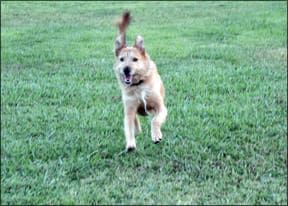
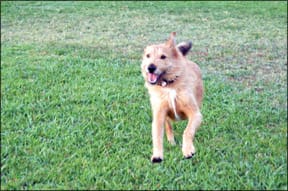
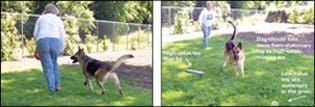
It wasn’t so bad, really, as behavior slips go. My dog Otto woofed at a kid at close range. The kid thought Otto was playing; I knew that Otto was scared, and I mentally smacked myself for being inattentive. I was taking pictures at a dog park, and Otto had been happily playing with the other dogs as I worked. I hadn’t noticed that a small boy – perhaps five years old? – had entered the park and had started chasing the dogs around.
288
We can certainly debate the wisdom of having small children in dog parks (I hate to see them there; it’s much too easy for them to get knocked over or even attacked in a moment of arousal). But the fact is, I wasn’t paying enough attention to my dog – and frankly, it’s because I sometimes take it for granted that he’s generally so well-behaved. He’s not perfect, though; no dog is. (No people are, either.) And so I should have been – should always be – more vigilant.
I’ve mentioned before that Otto is a little spooked by kids. He’s also afraid of cars, garbage trucks, and the gardeners who service some of the yards in our neighborhood. My husband and I joke about a scenario in which Otto was kidnapped as a puppy by a garbageman and then abused by gardeners and their kids before being tossed out of a moving car. It’s a joke because I know that it’s more likely that a young dog who is fearful of certain things is more likely to lack experience and exposure to these things than to have been abused by them. People always say, “Oh, he must have been abused by a man in a hat!” I say, “He probably never saw, and met, and was given treats from a man in a hat!”
Back to the kids, though. I take every opportunity possible to expose Otto to kids. I carry treats on every walk we take, and if we so much as see a kid at a distance, I practically make it rain hot dogs. “Oh, Otto! Look, kids! Good boy! We love kids, don’t we?”
If the kids are interested and (most importantly) under control, I ask them if they would like to give Otto some treats; I ask Otto to sit and offer a paw first, and then he takes the treats very gently. If the kids look impulsive or twitchy, however, I’m quick to keep Otto at a distance, and feed him some treats myself.
Unfortunately, my own son is 18 years old, and my closest niece (only one year old) is an hour away; I don’t have the resources for practicing that I used to, in terms of kids I know and can trust to behave around a wary dog. It was so easy when my son was little, and his friends were always over, and we were always going to soccer and baseball games and practice! Kids galore! Now I need to hire some. Or something!
Never get complacent about training The thing is, Otto has been doing so well for so long. He’s got a rock-star, rock-solid recall: fast, enthusiastic, completely trusting that coming to me right away is the most fun thing ever. It practically brings tears to my eyes, it’s so pretty. I can (and have) called him away from a running feral cat, a skunk (eating a bowl of cat food left out for said feral cats), and even a loose dog that started chasing us. (Otto started to hold his ground, but the dog looked scary, and I thought we’d be better off farther from what appeared to be the dog’s home. And sure enough, he stopped chasing us after half a block.)
Yes, in each of the cases where his recall was tested, I was walking with Otto off-leash. We can do that in our tiny town in the off-hours; we rarely see anyone else on the streets or trails before 7 a.m. and after about 8 p.m. It’s quiet, there is no traffic, but mostly we can do this because we practiced, practiced, practiced that whole first year we were together. We practiced recalls in the yard, we added distractions (another person bouncing a ball, say), and then we moved to a neighborhood park on a long-line. When Otto’s recall was solid on a long-line in the park (and no one was around) I’d take off the long-line and practice some more. Then we started the process on trails. We’ve built that recall brick by brick.
288
He failed – that is, I failed – only twice that I remember. In each case, I raised the criteria too soon; I expected him to resist temptations that he hadn’t had much practice resisting, and I didn’t have a long-line on him to prevent him from being rewarded by the fun of his misadventure. (Both times, he was off-leash and spotted a feral cat alongside the trail. The cats were safe; they dive into a blackberry bramble that only tiny animals can get in and out of.)
After each failure, we had to do a lot of remedial work on that section of trail. At first we worked on a short leash, and I gave him an “Off!” cue, to get him to look away from the cats (or the places where the cats usually hang out) and look at me. I marked (with a clicker or a verbal “Yes!”) and gave him delicious treats each time he looked at me. Soon, I no longer had to cue the “Off!” He would glance toward the cats, and then look at me, knowing he had earned a treat. He really liked chasing the cats the two times that he was able to, so he’s never going to be a dog who will pass by the cats while staring at me fixedly, like a dog in an obedience show ring. But he just glances, and then looks at me for his treat. And I think that as long as it continues to be more rewarding for him to pass the cats than it is to chase them, he’ll resist.
We walk a lot – if not daily, then at least several times a week. So it’s no wonder that his on-leash and off-leash walking skills are so good. But kids! We need more work with kids. I’m not sure what we’re going to do about that. I do my best to take advantage of the chance meetings we have with kids in public, but I just don’t have regular access to some reliable kid volunteers.
Whiffed the woof Back to the woof. As I said, I wasn’t looking at Otto when I heard him bark at something at the dog park; I turned around to see him trotting away from a young boy. His tail was wagging, but he looked a little alarmed. The boy, too, looked uncertain for about a second, and then he ran off in pursuit of another dog. Although Otto was already coming toward me, I called him and gave him a treat, then snapped his leash on and asked him to sit. Then I looked to see who was with the boy. It wasn’t that hard; his dad was retrieving the boy from chasing another dog.
I approached them to a distance of about 10 feet, and said, “I’m sorry, I didn’t see what happened when my dog barked at your son. Is he okay?” I could see that he was okay, but I was curious to get some information about what exactly had transpired. The dad said, “He’s fine. He was just running up to your dog and it looked like your dog got scared.”
I said, this time to the boy, “Yeah, buddy, sometimes dogs are scared of kids! Next time, maybe you should hold still and let the dog come up to you! That way you won’t scare him. You know, sometimes scared dogs bite!” And then, because I could see that the boy was already losing interest in this conversation, I said, “Do you want to see Otto do some tricks? And you can throw him some cookies when he does his tricks?”
I asked Otto to sit and stay, and approached the boy, handing him a few cookies. Then I stepped back over to Otto and told him, “Down.” “Okay, throw him a cookie!” The cookie didn’t land all that close, but Otto got it. Then I said, “Point your finger at him and say ‘Bang!’” Otto really enjoys this “playing dead” trick. The only problem is getting the “dead” dog to stop wagging his tail and rolling his eyes mischievously. It still delighted the boy, though, and he was happy to toss a few more cookies before we took our leave.
I did what I could to salvage the situation, but really, it was another “fail” for me. I wasn’t watching my dog closely enough to protect him from a situation that had the potential for leading up to a dog bite. I allowed my dog to be approached by something he is afraid of, in a scary way, and to actually become scared enough to give a warning woof. Talk about “past threshold!”
So, like I did after my off-leash training failures, I’m going to have to find some kids and that I can instruct so I can set up some remedial socialization sessions for Otto.
Does this sound like I’m taking all this too seriously? When I was a kid, nobody talked about “socializing” their dogs, and most of the dogs we knew were just fine with kids. What’s the big deal? At risk of sounding old, when I was a kid, it was a different world. The only dogs I knew who weren’t free to run around my rural neighborhood were either hunting dogs or watchdogs; kids knew not to fool around with any of those dogs. And all the ones running loose in the neighborhood (the ones that weren’t hit by cars!) were extremely “good with kids.” That’s because they were constantly exposed to kids!
I want my dog to be as rock-solid with kids – and every other type of person – as he is at resisting the urge to chase cats. So we’re going to have to practice.
Nancy Kerns is Editor of WDJ. She adopted Otto from a shelter on June 13, 2008.
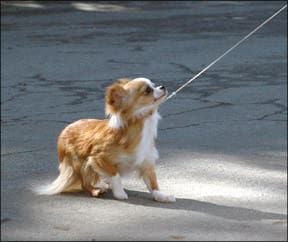
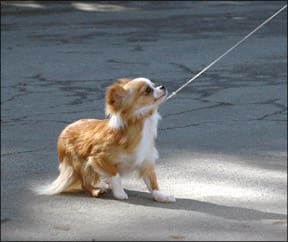
It’s frustrating and embarrassing when your dog puts on the brakes and refuses to move. If he’s small you can pick him up and carry him; although that might not be the best training solution, at least it gets you out of there and you can save face. But what if it’s a Great Dane, a Newfoundland, or any breed – or combination of breeds – that’s too big to be portable? Whether your dog is giant or tiny, here are five things to do when your dog gets stuck in neutral:
288
1) Evaluate possible medical problems: Your dog may be in pain or otherwise not feeling up to par, and the last thing she wants is a jaunt around the block. If your dog refuses to move routinely, or even occasionally – not just once – it’s time for a trip to the dog doctor to look for a physical reason. You don’t want to force her to walk if she’s hurting.
2) Look for environmental aversives: Pavement gets painfully hot on warm sunny days – enough to cause considerable discomfort. Prickly weed seeds, sharp stones, sometimes even tall or wet grass can be aversive. (Dog boots can protect paws from surfaces that cause discomfort.) Maybe your dog is just hot and trying to stay in a shady spot! Be sensitive to aversive environments you can avoid; walk your dog morning and evening on very hot days. Conversely, maybe he needs a down jacket or more indoor exercise on frigidly cold winter days.
3) Consider fear issues: A temporary environmental aversive can create a negative association with the location where it occurs. Maybe your dog stepped on a bee and got stung, or a loud scary noise happened at his sticking spot. If his body language tells you he’s worried or fearful (head down, looking away, ears back, leaning back, perhaps even showing a whale eye and trembling), you’ll need to counter-condition at the place (or places) where he shows fear. (For in-depth information on counter-conditioning, see “Reducing Your Dog’s Anxieties,” WDJ April 2007.) Even better, identify specifically what causes his fear, and counter-condition that stimulus in a safer environment first, before trying it on a walk.
If he puts on the brakes as you approach the car, something about the car may be aversive. Counter-condition! Perhaps there’s a reactive dog behind a fence. If your dog gets sticky as you approach a barking, growling, berserk dog behind a fence, he may not be comfortable being barked and snarled at as you walk past. Cross the street, and then counter-condition to convince him that a snarling dog makes chicken fall from the sky, and/or arrange with your neighbors to have their dog indoors when you’re going to walk your dog.
4) Reinforce movement: If you always click and treat your dog for sitting when you stop, she may decide that stopping gets reinforced. Spend lots more time clicking for movement. If she does get stuck, avoid luring to get her unstuck, so she doesn’t learn to put the brakes on in order to get you to bring out the treats.
5) Do stuff she loves: These four tips are good for prevention and diagnosis. But what do you do in the moment, when your dog won’t move?
Do something that she loves, to get her mind off being stuck and get happy about moving. If she gets happy about targeting, play-target in a direction she is willing to move (usually back the way you came from). When she’s acting playful, target forward in the direction you want to go. Play a simple “Find it!” game, by tossing treats on the ground in the direction she’s willing to go, and then repeat the game in the other direction. Play with a ball, play tug, play any games that get her happy and moving. If it’s safe to do so, put her on a long line and run past her, fast, to the end of the line to see if she’ll chase happily after you. (Don’t use your “come” cue; do use random happy chatter).
If she gets stuck going home on walks because she’d rather stay out and have fun with you, backchain going home (start close to your front door and gradually move farther and farther away). Each time you arrive home, have a fantastic play party with her favorite toys and games so she eagerly looks forward to going home and having fun.
Pat Miller, CPDT-KA, cdbc, of Fairplay, Maryland, is WDJ’s Training Editor.
1. Keep accurate records of your dog’s vaccination and titer history.
2. Arm yourself with accurate, credibly sourced information when having a discussion with your veterinarian about vaccine protocols.
3. Consider using antibody titer tests to accurately detemine whether your dog needs to be re-vaccinated.
4. Commit to taking your dog to your veterinarian for annual checkups; consider twice-annual visits for dogs seven years of age and older.
Should you vaccinate your dog? Should your dog receive all the recommended vaccines at once? How important are common shots, like the DHPP vaccine, or rabies vaccine? Over-vaccinating dogs is a definite problem in the veterinary world, but immunizing your pet is nonetheless a necessary part of having one.
You check your mailbox and there it is: a reminder postcard from your dog’s veterinarian. If you’re like many of us dog owners, you groan and toss the card aside.
If you’ve not yet found an enlightened, up-to-date veterinarian, the postcard is likely to say, “It’s time for your dog’s annual vaccinations! Call us today for an appointment!”
We hope, however, that you’ve done your homework and found a veterinary practice whose postcards say something more like, “It’s time for your dog’s wellness examination! Call us today for an appointment!”
What’s the difference? In 2003, the American Animal Hospital Association (AAHA) revised its vaccination guidelines, recommending that vets vaccinate adult dogs only every three years – not annually. Many enlightened veterinarians changed their canine healthcare protocols to reflect the guidelines, and now suggest annual wellness examinations with vaccinations only every three years.
In WDJ’s opinion (and that of the experts we consult), annual vaccination for most canine diseases is unnecessary and potentially harmful. Dog owners should avoid employing those old-fashioned veterinarians who recommend annual vaccines. Owners should also avoid those veterinary service providers who provide inexpensive vaccines and other routine care without the benefit of a relationship with you and your dog beyond a brief transaction in a parking lot or pet supply store. While the financial cost of vaccine clinics may be appealing, the fact is, your dog’s health may pay the price of unnecessary or inappropriate vaccines.
Vaccines for Dogs: The Basics
Core vaccines protect animals from severe, life-threatening diseases that have global distribution. According to the AAHA, core vaccines that every dog should receive initially as a puppy (a series of three vaccines given between 8-16 weeks of age) are:
The core vaccines should be administered one year later, and every three years thereafter, unless antibody titer test results indicate that the dog possesses antibody levels that have been determined to be protective. (For more about titer tests, see
“Dog Vaccination Information“.)
The rabies vaccine is also considered a core vaccine, but should be given once at age 12 to 16 weeks (or as late as local law allows), then again one year later, followed by every three years. (Unfortunately, some locales require rabies vaccination more frequently than every three years, so check your local laws.)
Non-core vaccinations should be administered only to dogs whose geographical location, local environment, or lifestyle place them at risk of contracting each of the specific infections. These vaccines are:
Vaccines not recommended, per 2006 AAHA Guidelines are:
– coronavirus (CCV)
– giardia
Note: The above recommendations are per the AAHA. Dr. Dodds no longer recommends the CAV vaccine, and advocates administration ofthe initial rabies vaccine after 20 weeks of age (if allowable by local law).
Be Prepared with Your Dog’s Vaccination History
That said, don’t think for a minute that you need to take your dog to the vet only every three years. It’s imperative that you take your canine companions in for yearly checkups. Rather than throw that postcard in the trash, pick up the phone and call for an appointment. Yearly wellness examinations help our veterinarians develop a good baseline on our dog’s health, be better able to take notice of subtle changes in his health over time, and develop a relationship with our dog and us.
While these annual trips to the vet might now be called “wellness checks” rather than “vaccine visits,” the odds are good that the topic of vaccines will come up. And despite our good intentions, many of us head in with our dog for his annual exam and feel blindsided as the vet suggests an array of vaccines for our dogs. Often, we nod in agreement, get that “deer in the headlights” look and agree with her recommendations (she is the expert after all), then go home with regrets.
Remember the Scout motto and “Be prepared” as you get ready for your dog’s next veterinary appointment. Being prepared means more than remembering to take your dog’s leash, collar with ID, treats, and showing up on time, on the right day, with the right dog. How to best prepare for your dog’s annual veterinary visit and be ready for a discussion on the most appropriate vaccine strategy for him?
Bring veterinary records and/or a list with you of your dog’s vaccination history; do not assume the veterinary clinic will have all the most recent information, especially if you’ve changed clinics. Other test dates and results to bring include most recent heartworm test, antibody titer test results, and blood and/or urinalysis test results. Ideally, you’ll collect all the data ahead of time and enter into a table so that you have a timeline of the pet’s life.
My dogs’ veterinarian, Susan Wynn, DVM, recommends creating a table with vaccines/yearly wellness test along the vertical axis, with dates along the top. If visiting a new clinic, chances are they’ll want proof that your summary is accurate, so request copies of any previous vet records for your dog’s new file.
Have a clear idea in your mind whether you want/need your dog to receive any vaccinations (and for which diseases), an antibody titer test, or none of the above. If you are unsure, cultivate a good understanding of the vaccines available. And ask your veterinarian if any particular vaccines are warranted due to conditions in the area in which you live.
Educate yourself using reputable sources so that you can have an intelligent conversation with your veterinarian on the pros and cons of vaccination for your dog; a good place to start are the AAHA Guidelines. Writings and research by Ronald Schultz, PhD, DACVIM, and Jean Dodds, DVM, are also excellent references.
Know the status of your dog’s health, and whether he has any health or behavioral issues that your veterinarian should be aware of.
Bring a list of your dog’s current medications and supplements, including dose, strength, and frequency.
Have an idea of what the visit will cost, including any tests, to avoid sticker shock or making hasty (bad) decisions based solely on price. Call ahead.
Be prepared to take your dog and go home if you are uncomfortable with your veterinarian’s recommendations. There’s no need to get nasty or defensive. We suggest something along the lines of, “I’m not sure I’m comfortable with those recommendations. I’d like to go home and think about them.”
If you are going to see a veterinarian who is new to you and your dog, consider making an appointment with the veterinarian, without your dog, to discuss her philosophy toward vaccinations and antibody titer tests.
Educate Yourself About Vaccines
Michelle Kitzrow, of Sugar Hill, Georgia, had a change in thinking regarding vaccine protocols after hearing immunology expert Dr. Schultz speak on the topic (see “Vaccinations 101,” WDJ August 2008). Armed with a new understanding of vaccine protocols, Kitzrow took her then-four-year-old Bouvier, Casey, in to see her longtime veterinarian for Casey’s annual exam.
She admits that it “wasn’t very easy” to convince her veterinarian that, in lieu of vaccinations, Casey should receive an antibody titer test to determine whether she had what vaccination experts regard as a “protective level” of circulating antibodies from past vaccinations. But in the end, Kitzrow’s veterinarian relented, and agreed to take and send a blood sample off to a lab for the titer test.
Kitzrow believes that it was the relationship she already had established with Casey’s veterinarian, along with a new and accurate understanding of vaccines, that helped her veterinarian to support her decision. “He knows that I bring in my dogs regularly for veterinary care, and he trusts me to do the right thing. He also appreciated that I had taken the time to educate myself about vaccine protocols and titers.”
An acquaintance of mine, Diane (name changed at her request), had a bit harder time at the annual exam convincing her veterinarian to check her dog’s antibody titers instead of reflexively vaccinating – despite an 18-year relationship with her dogs’ veterinary clinic and the fact that she takes in her dogs twice a year for checkups. Diane’s 16-month-old Bouvier had received a puppy vaccine series, with the final boosters given after she was 16 weeks of age. The series included distemper, hepatitis (adenovirus), parvovirus, parainfluenza (shorthand for this combination of four vaccinations is DHPP), rabies, Leptospirosis, and Bordetella.
“At my dog’s most recent vet checkup, I requested that only the rabies vaccine be given. I asked that titers be checked for distemper and parvovirus, and I requested a SNAP 4Dx test, which checks for heartworm disease, as well as the most prevalent tick-borne diseases: ehrlichiosis, Lyme disease, and anaplasmosis.
“I declined the combo, ‘all-in-one’ vaccine for distemper, hepatitis, parvovirus, and parainfluenza, as well as the Leptospirosis and Bordetella vaccines. I did not want all of those vaccines given at the same time and hoped that the titer results would show adequate immunity. I was adamant that my dog receive only the rabies vaccine at that time. The vet marked ‘refused’ on my dog’s chart next to the other vaccines she wanted my dog to receive that day.”
Diane understands that Lepto and Bordetella need to be given at least yearly to be effective, but has made the decision not to re-vaccinate her dog for those diseases at this time and understands the risk. Dr. Wynn notes that while we as clients might consider a notation of “refused” on our dog’s chart to be judgmental on the veterinarian’s part, the reason that the vet must note in the file that the client declined vaccination is to limit liability in case the animal is infected with that disease and subsequently blames the vet. (Dr. Wynn assures me that this has happened.)
“In this particular situation, it turns out that my decision to decline all of the ‘recommended’ vaccines, except for the rabies booster, was a good choice as the SNAP 4Dx (checked in-house afterward) indicated that my dog has Lyme disease. A follow-up Lyme Quantitative C6 Antibody Test confirmed an active Lyme disease infection, which means that her immune system was already compromised at the time of the exam. The distemper and parvo vaccine titers showed adequate immunologic response, indicating that my dog was still protected against these diseases, most likely from her previous round of vaccinations.”
In fact, vaccinating a dog who has an active Lyme infection might have been harmful. “It is never wise to vaccinate a dog whose immune system is preoccupied with something else,” asserts internal medicine specialist Nancy Kay, DVM, DACVIM, author of Speaking for Spot: Be the Advocate Your Dog Needs to Live a Happy, Healthy, Longer Life. “The vaccine might ‘distract’ the immune system from the more important task at hand. Also, in theory and for the same reason, the vaccine might not be as likely to create protective immunity.”
Similar to Kitzrow, Diane finds that “Although my dogs’ veterinarian gets exasperated by the decisions I make that are counter to her recommendations, she knows that I appreciate and respect her knowledge and experience. I always ask for her advice regarding my pets’ well-being and do not hesitate to bring my pets to the hospital whenever I have concerns about their health, above and beyond checkups twice a year. She is also aware that I obtain information from a variety of other sources and that I become concerned and wary when there is a real discrepancy or controversy.
“Although she stresses the importance of following her recommendations, she has come to understand that I feel a strong sense of personal responsibility in the decisions made and their effect on the long-term well-being of my pets. If I have serious doubts about a stand that she takes, I will seek a second opinion, elsewhere. On this day, I guess you could say that we agreed to disagree.”
Diane is a little saddened that she and the veterinarian were unable to reach common ground, or at least have a more comfortable dialogue, noting, “It’s important for me to have a good rapport with the vets who care for my beloved pets. It’s important to me that they consider themselves an essential part of a team working for the well-being of the animals. Open communication and teamwork between pet owners and their veterinarians is essential.”
How Antibody Titer Tests May Affect Your Decisions
Antigens are any substance that the immune system identifies as an invader and responds to by producing a chemical defense: antibodies. When everything is working as it should, your dog’s immune system will recognize disease antigens that were introduced to his system via a vaccine (weakened or killed) or by natural exposure to the antigen that causes the disease (viral or bacterial).
A “titer” is a measurement of how much antibody to a certain antigen is circulating in the blood at that moment. The result is usually expressed in a ratio. A positive titer test result is strongly correlated with a good antibody response to either a recent infection or vaccination. A dog who has received “core” vaccines and who displays a positive antibody titer test result should be considered protected from the diseases for which he was vaccinated (meaning, he doesn’t need vaccines at that time). See WDJ blog entry, “Vaccine Titer Tests,” for more insight.
Your dog must undergo a blood draw in order to have an antibody titer test. Labs such as Antech, IDEXX, and most veterinary college laboratories offer these tests. Antibody titer testing is typically run for parvovirus and distemper, since the dog’s antibody response to these two antigens is highly predictive as to the dog’s immunologic competence in dealing with any other antigen to which he has been exposed.
Rarely, there are exceptions. When an antibody titer test is negative, the owner and veterinarian should consider revaccinating and then testing the titers again. It may turn out that the animal simply needed another exposure to the antigen in order to stimulate a stronger immune response. Or, it may develop that the dog lacks the ability to respond normally to vaccines, that is, by mounting a proper immune response. In this case, the owner and veterinarian have gained very valuable information about the dog’s compromised immune status – information they never would have gained by simply vaccinating and assuming the dog was “protected,” as is usually the case with healthy dogs.
Dr. Kay comments, “There are several reasons I can think of why a vet might be loathe to run titers, but of these, I consider only a couple of them to be ‘honorable.'” Two examples she gives are:
Some veterinarians question the accuracy of titers in terms of accurately assessing immunity.
If a dog is truly at a high risk of infectious disease, revaccination might be a safer bet than relying on the results of an antibody titer test. She adds, “Very few dogs are truly in this situation, such as those who live in the midst of lots of completely unvaccinated dogs and in a lower socioeconomic setting.”
When I pressed Dr. Kay on the first point, asking what information “Dr. Doe” would have that trumps information provided by someone such as Dr. Schultz, she replied, “You will get no argument from me on this. I suppose that if Dr. Doe professes that titer tests are not accurate, one could ask to see the data that leads him (or her) to this conclusion.”
Although Dr. Wynn adds, “If a distemper or parvo titer is positive, we know that the dog is protected. If it is negative, the dog might be protected, but we have no practical further test to know whether or not it is. Hence, some veterinarians have said the titer isn’t accurate to point out that we don’t know what a negative titer means.” In the case of negative titers, Dr. Schultz recommends revaccination, even though the dog could already be protected.
If You Choose to Vaccinate Your Dog
If you determine that your dog is in need of vaccination, consider the following:
Ask the veterinarian to perform the health exam and other tests first; you might even wait to vaccinate until those results are in, and schedule a follow-up vaccine visit once you know your dog is in the clear, health-wise.
Avoid a combination vaccine (five-in-one-type vaccinations) that offers multiple vaccines in only one shot. Note: some veterinary clinics only carry this type of vaccine. We recommend that you look elsewhere for care.
Do not vaccinate your adult dog more frequently than every three years (unless local conditions suggest a heightened need for Lepto, Bordetella, or Lyme vaccines; these each last a year or less).
At a minimum, try to schedule the rabies vaccine for a different visit than the other vaccines, if your dog needs them. The rabies vaccine should be administered by itself at a later date, apart from the other three “core” vaccines (distemper, parvo-virus, and adenovirus), and in another part of the dog’s body.
If you’re considering vaccinating simply for financial reasons (because vaccines cost less than running a titer test) a well-planned vaccine/titer strategy might have you coming out ahead in the long run if you scale back on vaccines and run titers on a strategically planned schedule.
Veterinary medicine today has advanced to the point of acknowledging that there is no single “perfect” vaccine program; vaccine programs must be tailored to the specific needs of each animal. Although there is a tendency to want to treat all dogs the same, the program should be designed for the individual, not the masses. The dog’s health, age, environment, activities, lifestyle, and whether he has previously had any adverse vaccine reactions all need to figure in to the equation.
If you encounter a veterinarian who continues to advocate yearly vaccination, schedule a sit-down talk with her, or take your business elsewhere. In Dr. Kay’s book, she notes that a “deal breaker” when choosing a veterinarian is when the clinician “vaccinates dogs for everything, every year.”
It’s Up to You to Make Vaccination Decisions
Don’t expect your veterinarian to ask you broadly what you want to do when you take your dog in for an annual exam. Most veterinarians, unless prompted by the client, will assume that you’re there for “the usual” and will go ahead and recommend annual vaccinations. It is up to you to educate yourself and advocate for your dog and know what vaccines and tests might benefit him, and to know the laws concerning how frequently the rabies vaccine must be administered.
If you and your veterinarian are not on the same page, try having a rational, objective discussion. Put yourself in her position and try to understand her concerns. Take a step back to be sure that what you propose is reasonable. Keep in mind that taking your dog in regularly for annual checkups will help your veterinarian to develop further trust in you and your intentions. If you’ve got a good relationship and you’re armed with the facts, you just might be able to reach common ground.
Lisa Rodier is a frequent contributor to WDJ. She lives in Alpharetta, Georgia, with her husband and two Bouviers, and volunteers with the American Bouvier Rescue League.
1. Shop for a dog cone alternative before your dog’s surgery, when he’s still feeling well.
2. Have your dog “try on” several different products. Have him wear them around the store for as much time as you can afford, to see how he deals with each product’s challenges.
3. When choosing a product, take your dog’s anatomy and size into account.
4. If your dog may have to wear one of these products for an extended period of time, consider buying a couple or three, so you can find the one that works best for him.
My mother once phoned me to tell me that one of our family dogs, an oversized German Shepherd, had required surgery for an embedded foxtail in one of his back paws. She told me that the vet sent her home with a gigantic plastic disc that she understood was to be put on the dog, to prevent him from licking or chewing his bandage or paw. Giggling, my mother told me, “Your father put it together…but how do I put it on the dog? I mean, is he supposed to look like a tulip or a prince?”
I could understand her confusion. The dog was so leggy that he actually could wear the Elizabethan collar either way; wearing a conventional “cone” like a “prince” would render dogs with shorter legs immobile. In contrast, most dogs have to wear these protective cones the way in which they were designed to be worn – like a dejected, bumbling tulip. Most dogs are miserable while wearing a classic, veterinary-supplied cone. Lacking peripheral visibility, they crash into furniture and doorways. With the wide, flaring cone, they get stuck in tight spots in the house.
Every dog owner should be aware that, today, there are a number of dog cone alternatives to the classic Elizabethan collars to prevent a dog from licking a wound, aggravating a hot spot, tearing out his surgical stitches, or removing a bandage. The alternatives offer a dog greater comfort, better mobility, and improved visibility.
Cons of Classic Cones
Are the classic plastic cones really all that bad? It depends on which dog you ask. Some dogs seem to accept the weight of the heavy plastic, the restricted visibility imposed by the opaque material, the need for increased clearances around the house, and even being gouged by the thick plastic tabs that are supposed to be belted by the dog’s collar at the base of the cone.
But many dogs seem to suffer more from the cones than from whatever necessitated their use! I’ve known many dogs who wouldn’t eat or drink with a cone on. I’ve seen some dogs who, after bashing into doorways and furniture, became extremely reluctant to move – or even lift their bodies or heads from the floor – as long as the cone was on.
Very recently, this very thing happened to a friend’s Shetland Sheepdog, Rickey, who had to undergo a long and complicated surgery. His surgeon removed a large (but fortunately benign) tumor that had surrounded the poor little dog’s esophagus, stomach, and other areas in his abdominal cavity, leaving a surgical scar almost the entire length of Rickey’s tummy. After a day or two of recovery in the hospital, the veterinarian sent Rickey home with a classic, heavy, opaque cone to keep him from fussing at his stitches.
Rickey’s family was delighted to have him home. But the usually spunky Sheltie seemed depressed, deflated by difficulties with his Elizabethan collar.
And so his owner called me; we had communicated about Rickey all through his long illness, diagnosis, and even the surgery. “He may be in pain from the operation,” she told me. “But honestly, I think he’s far more upset about the cone!” She asked me if I knew of anything she could do to keep Rickey from bothering his stitches . . . but without making him as miserable as he was with the cone.
If you and your dog were ever in a similar position, and you called your vet for advice, you were probably told that being quiet was good for the dog, and that it was just as well that the cone reduced his activity. There is a certain value to the advice; you certainly don’t want a post-surgical dog to race around the house. But what if he won’t even eat or drink, or fails to walk around enough to eliminate urine and feces as frequently as he should?
I knew there were dog cone alternatives to the classic cones – and that all of them are more comfortable for dogs. I also knew that WDJ hadn’t reviewed those alternatives for quite some time. So I made a list of other products designed for the same purpose as classic cones, and told my friend to buy every one that fit Rickey and give them all a try. WDJ would repay her – and take them off her hands when she was done. You know, in exchange for a little product feedback?
Glad to have something to do to help Rickey, my friend’s husband raced all over the Bay Area, picking up products in a variety of pet supply stores. The good news: While Rickey was unable to lick or chew at his sutures while wearing any of the products, he was happier (and hungrier) in every single alternative product than he was when wearing the classic veterinary-supplied cone. His legendary appetite quickly returned, as did his spunk and spark (and bark!).
Not long after Rickey had his stitches removed, he modeled all the products for my camera. I can attest that the dreaded white classic cone literally depressed the underweight (but gaining!) Sheltie. In contrast, he appeared considerably brighter with the alternatives.
Rickey seemed to be most comfortable wearing a product that his owners guessed he’d hate; so much for being able to tell what might work best while in the store. You really should take your dog to the store and try various models on him.
The doughnut-shaped ProCollar, distributed by G&B Marketing, of Vista, California, features an inflatable core with a durable cover. (The cover feels like vinyl – not our favorite material – but doesn’t have the distinctive “stink” of vinyl. The package doesn’t say what the material is.) A Velcro strap secures the outer perimeter of the collar; the dog’s collar is run through loops on the inside ring of the product. (One must have a collar that can be unsnapped or unbuckled; collars that slip over the dog’s head won’t work with this design.)
The ProCollar is available in five sizes (X Small to X Large). That sounds like plenty, maybe, except that 25-pound Rickey required the “large” size. Truly large dogs would not be able to use this product.
Rickey was easily able to navigate his home while wearing the ProCollar. He seemed to understand his limitations and cope with them without getting upset. Unlike his peeved response to crashing into the furniture with the stiff vet-supplied cone, Rickey barely seemed to notice when the cushioned ProCollar knocked into something. He also seemed to appreciate that when he lay down, the cushion provided him with a little pillow. Seriously! His owner thought he missed sleeping with his chin on something after his need for the ProCollar was past.
We were able to find the ProCollar in a number of chain pet supply stores (Petco and Petsmart) and catalogs, from $15 to $25, depending on size.
Jorgensen Laboratories, Inc., of Loveland, Colorado, offers the Soft-E-collar. It’s another cushioned collar, but this product is shaped more like a life-saving ring than a doughnut: wider and flatter. The outer material appears to be a nylon blend. A flap of material on the inner perimeter of the product is tightened by tying a cord (which runs through some grommets on the material flap) to secure the collar on the dog’s neck (see photo below).
The width (and perhaps weight) of this product made navigation a bit more difficult for Rickey; lying down was also more difficult in this collar. A larger dog may not find it as difficult as Rickey did.
The Soft-E-Collar comes in nine sizes (yay!), from XX Small (0 to 5 pounds) to XX Large (95 pounds and up). (Rickey wore a Medium, for dogs 30 to 55 pounds.) We found this product in an independent pet supply store; we also found it offered in many pet supply catalogs. As but one example: we found it for $19 to $49 (depending on its size) from BellasPainRelief.com. (By the way; this site is a great source for products for disabled dogs of all types.)
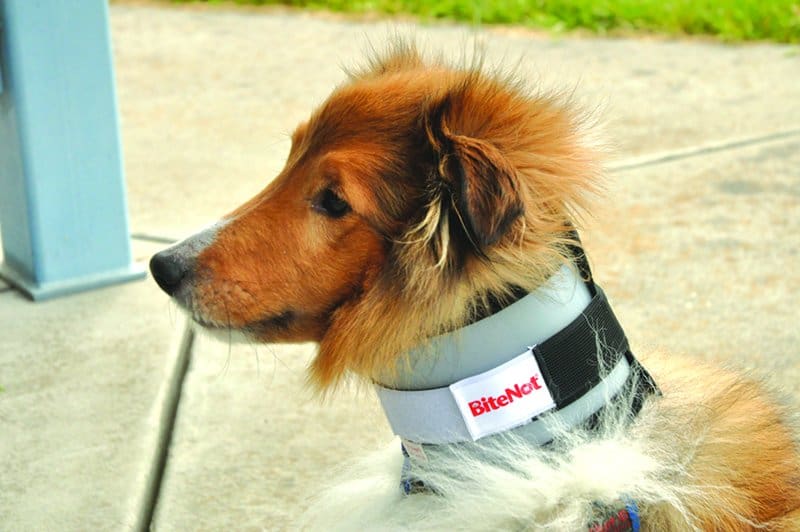
Here’s a dog cone alternative product with a very different design. The BiteNot collar, distributed by Bite Not Products, Inc., of San Francisco, California, resembles a neck brace for humans – the kind people have to wear after they get whiplash. The interior surface is a thinly padded foam rubber material; the outer surface is a stiff plastic shell. Velcro fasteners – and a nylon strap that wraps around the dog’s shoulders and under his armpits – hold the product very securely in place.
The BiteNot collar is available in seven sizes. In this case, the required size is determined by the length of the dog’s neck, from the back of his ears to the top of his shoulder. (It’s meant to prevent him from bending his neck enough to lick himself.) The smallest size is 3.5 inches wide; the largest is 8 inches wide.
This would be my top choice for a dog who had succeeded in removing all other products; as long as the dog has a discernible neck, it fits really securely. What if the dog is one of the (nearly) neckless breeds, like a Pug? Probably not the best pick. This worked fine on Rickey (although fastening the Velcro with all his ruff hair was a challenge), but dogs with extraordinarily long necks or wounds on their front feet might not benefit at all from the collar.
This product ranges in price from about $20 (smallest size) to $45 (largest) and is sold at several online retailers.
The final two dog cone alternatives that Rickey tried most resemble the classic cone; each offers improvements to the concept, however.
As suggested by its name, The Comfy Cone is a cone, but instead of being stiff and unyielding, it’s cushioned and bendable. The inner material seems to be foam rubber; the outer material is a tough nylon. Numerous strips of Velcro fasteners and a ring of elastic “belt loops” (meant to be laced through by the dog’s collar) hold the cone in place.
As also suggested by its name, the product was perfectly comfortable for Rickey. He seemed unperturbed when the cushioned collar crashed into things – and it did crash, since it affords its wearer with just as little visibility as a classic cone.
The Comfy Cone is available in five sizes, from Extra Small to Extra Large. Rickey wore a Large, which was probably larger than necessary; there is a lot of overlap built in (as you can see in the photo, left), so the sizing need not be precise in order for the product to be secure.
All that is good news. The bad news? While Rickey, like most post-surgical patients, was easily deterred from licking his sutures be this product, a very determined dog (such as one who suffers from chronic hot spots), could probably turn his head with enough force to bend the walls of the cone and reach parts of his body.
We found The Comfy Cone in many online and brick-and-mortar stores, from about $10 for the Extra Small to $30 for the Extra Large.
Distributed by All Four Paws, Los Angeles, California. See allfourpaws.com for a list of retailers, or call (866) 454-7768.
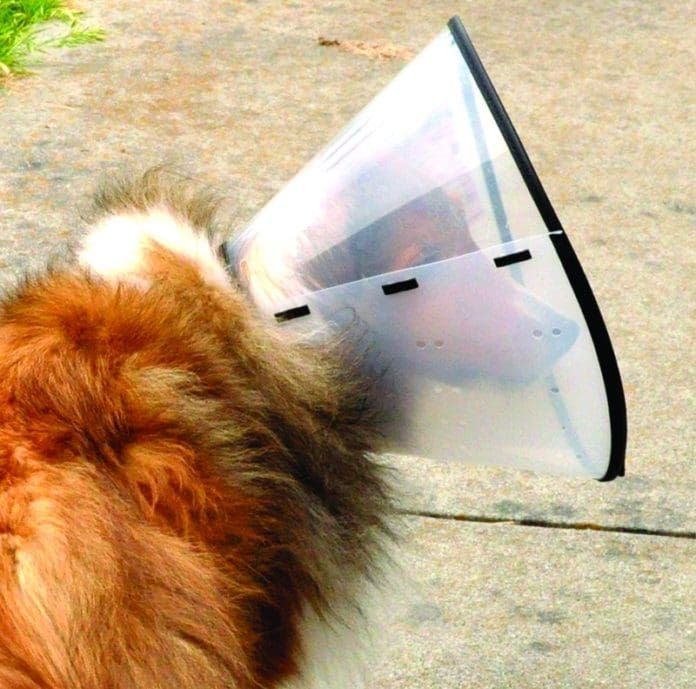
This product is another plastic cone. So what makes it an alternative? First, the plastic it’s made of is transparent; the dog can see through it! Brilliant! This one tiny thing makes a huge difference to the dog. It’s also much lighter in weight than the vet-supplied conventional cones, though not so light that its protective rigidity is compromised. And finally, both its inner and outer edges are lined with a material that feels like vinyl. This means no stiff edges cut into the dog’s neck, and when the dog does bump into something solid, the impact is a bit blunted.
The Kong EZ Collar is distributed by the Kong Company, of Golden, Colorado, and is available in five sizes, from Small to XXL. Rickey’s owner bought the Extra Large, which was also larger than required and has a lot of size overlap built in.)
We found the Kong E-Collar in numerous online and independent pet supply stores. For example, Pet Street Mall carries them for $8 to 16; petstreetmall.com or (800) 957-5753.
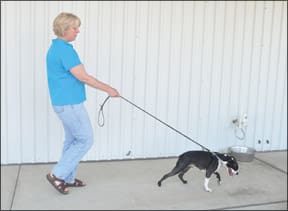
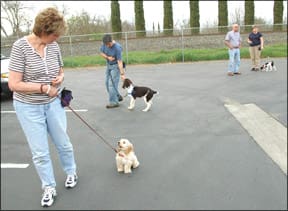
One of the more frustrating experiences for positive dog trainers is watching their clients being dragged by their dogs across the parking lot toward their cars, just moments after training class is dismissed. “Dang,” we sometimes think, “Will they ever teach their dogs to walk politely on-leash? What part of ‘Don’t reinforce your dog for pulling!’ didn’t they hear?”
Of course, it’s equally frustrating for dog owners when their dogs drag them. And the training solution – stopping every time the dog pulls – gets tiresome. Owners often wonder if they will ever be able to go anywhere without handfuls of dog treats in their pockets. In some cases, owners are actually injured when their dogs yank on their arms, or even pull them off their feet. Many dogs have their social outings severely restricted, simply because their owners have difficulty controlling them on-leash.
288
If none of us want dogs to pull, then why is it that so many dogs do pull? There are several reasons:
Their humans haven’t managed to reinforce polite leash walking strongly enough to overcome the high-value competing reinforcers in their dogs’ environments.
Pulling is sometimes reinforced (by allowing the dog to go where he wants when he pulls) and behaviors that are intermittently reinforced become very durable/resistant to extinction (it’s hard to make then go away).
Dogs are confused by owners who sometimes want their dogs to walk in perfect heel position, and sometimes let their dogs wander, sniff, and yes, pull.
It’s just not a natural behavior. Unlike sit, down, touch, jump, and many of the other behaviors we put on cue, dogs rarely plod sedately along in a straight line of their own accord. Since it’s not a behavior that comes naturally to them, we have to work hard to make it reinforcing and convince them it’s a behavior worth offering.
Avoidance behavior Training your dog to walk politely on-leash used to be so simple, some folks say. When he stepped out of position you simply yanked, hard, on his choke or prong collar. He learned to march lock-step next to you to avoid being garroted, and all was well.
Only it wasn’t that simple. I used to train the “old” way, and we still had plenty of owners dragged across the parking lot by their dogs after class. Besides, dogs get hurt that way.
Some of the same owners who are inconsistent about reinforcement now were just as inconsistent about punishment then. Others were (rightfully) horrified at the prospect of yanking on their dogs’ necks hard enough to suppress natural sniffing and pulling behaviors, and they just ignored our instructions to “jerk harder!”
At any rate, many dogs who were “trained” to walk politely on-leash were really only trained to avoid the punishment of the collar, which is why dogs still wore their choke chains in the obedience competition ring (many still do) as a not-so-subtle reminder of what could happen if they stepped out of line. This, despite the American Kennel Club’s odd pretense that you’re not allowed to use “training equipment” in the ring. What is a choke chain if not training equipment? And we all know dog owners who still walk their dogs in prong collars months – even years – after completing old-fashioned training classes. The dog didn’t really learn how to walk politely on-leash; it’s just avoidance behavior; he doesn’t want those prongs to dig into his neck!
288
A partnership Trainers and owners who subscribe to a positive approach to training are committed to making the process a partnership, with the dog willingly and happily participating in the behaviors asked of him. The exact opposite of the avoidance model, positive training asks the dog to voluntarily choose to offer the behavior so we can reinforce him for his choice.
The less natural and more complicated the behavior, the more practice – and reinforcement – the dog needs, to make the behavior a well-conditioned habit. Failures of leash training are most often a function of insufficient amount and value of reinforcement, lack of commitment to the necessary amount of practice, and impatience (increasing distraction and decreasing reinforcement too quickly).
Attention! Realize that attention and focus behaviors are a hugely important piece of polite leash walking, and ones that you can practice with your dog separately from the actual leash-walking part. (See “Look at Me,” February 2004.) If your dog is paying attention to you, he’s not trying to sniff the bush you’re passing. You can practice attention exercises with your dog any place, any time, simply by reinforcing him with treats, attention, or a favorite toy any time he voluntarily glances your way. Shape for longer duration of attention by very gradually (a second or two increase at a time) waiting a little longer before you reinforce him for looking at you.
To get your dog’s attention when he hasn’t offered it voluntarily, teach him that a “Look at me!” cue is followed by a high value reinforcer. Say “Watch!” or whatever you want your cue to be, and feed a piece of something very tasty. When he has made a strong classical association with the cue (“Watch!” makes chicken happen!) you will be able to use your “Watch” cue to get his attention, even if he’s on-leash and distracted by a scent, a scampering squirrel, or the sight of another dog.
Age differences Of course, polite walking lessons are best taught in puppyhood, before your baby dog has the opportunity to be repeatedly reinforced for pulling. Most young puppies naturally cling to the heels of their humans because they’re not confident enough to explore the world on their own. Start reinforcing this wonderful behavior early and often, and you build a foundation of a polite walking behavior that will make future leash training much easier for you. Your pup doesn’t even have to be on-leash for you to reinforce him for walking with you; just convince him from day one that being close to you while you walk makes very good things happen.
Once again, this proves the value of enrolling your puppy in a good, positive puppy training class as soon as possible. Sometime between the age of eight weeks and 16 weeks your pup will likely get bolder, and more willing to leave you to investigate his surroundings. A well-run positive puppy class is the ideal controlled environment in which to be able to reinforce him for walking with you even when there’s really interesting stuff nearby – like other puppies and humans.
When choke chains were de rigueur, training classes didn’t take puppies until the age of early adolescence, at six months, in part due to the potential for damage to tender puppy tracheas from enthusiastic jerks on the leash. With the advent of gentler training methods it has become perfectly safe – and appropriate – to start puppies in class at the age of eight weeks, as long as they are kept current on vaccinations throughout the class.
If it’s too late to start early, it’s still not too late to teach your dog polite leash-walking. It just means you’ll need more diligence and commitment to the training process to convince your adult dog that pulling on the leash no longer pays off. You will likely experience more and stronger pulling; you may need higher-value reinforcers and a higher rate of reinforcement; and you will probably find your dog reverting to pulling behavior more easily around novel or highly rewarding stimuli.
When you replace an existing unwanted behavior (pulling) with an incompatible one (walking politely) the original behavior never completely goes away (extinguishes). It lurks silently in the background, waiting for an opportunity to be triggered again (what’s called a “spontaneous recovery”). If that happens, you have to do the work, again, to prevent reinforcement for the pulling, and to reinforce the incompatible behavior that you prefer in its place.
375
If you’re prompt and consistent about it, pulling should extinguish again with relative ease. If you’re inconsistent – if you sometimes reinforce pulling by allowing the dog to move forward with a tight leash – it’s even harder to extinguish pulling behavior. Trainers actually put some behaviors on an “intermittent schedule of reinforcement” in order to make them very “durable” (resistant to extinction). On an intermittent schedule, your dog learns if he just does the behavior often enough, like playing a slot machine, eventually the reinforcement will come.
Separate but equal Does this mean your dog always has to walk in step by your side, never looking to the right or left? Not at all. You can teach your dog two different leash-walking behaviors; you just have to use two different cues, being clear about which behavior you reinforce at any given time, and making sure neither one involves reinforcing your dog for pulling.
For my dogs, “Heel!” means, “Do that pretty obedience walking where you prance by my left side, gaze adoringly into my eyes and sit with your shoulder by my left knee when I stop.” “Let’s walk!” means “We’re heading in the same direction and you can wander and sniff a little as long as you don’t pull.” That way, we can go on some walks in tune with my agenda: get from Point A to Point B in the most efficient manner; and some that are in tune with my dog’s agenda: taking time to stop and smell the pee-mail.
How do you teach your dog to walk politely? First, have a clear mental image of the behavior you want. Second, prevent your dog from being reinforced for behavior you don’t want. Next, generously reinforce approximations of the behavior you do want; it’s a shaping process. I teach my dogs two leash-walking behaviors:
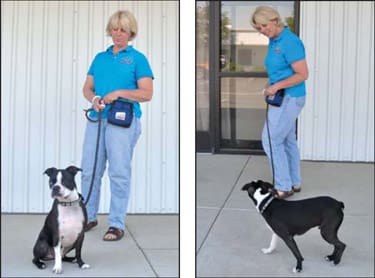
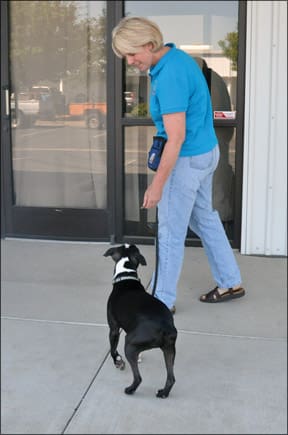
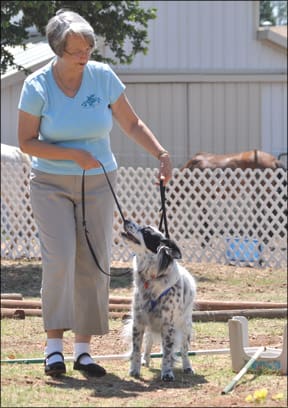
How to heel My mental image of “Heel” is my dog walking at my left side with her shoulder in line with my knee. She watches me closely so she can read my body language and anticipate my movements. She turns when I turn, changes speed when I go faster or slower, and stops and sits when I stop.
288
I prevent her from being reinforced for pulling by stopping or even backing up when she tightens the leash. I try to prevent her from reaching the end of the leash by using a high rate of reinforcement when she’s within the bounds of the leash-length. As training progresses, I reinforce (with a click! or another marker such as the word “Yes!” and a treat) ony for closer and closer approximations to actual heel position.
Initially, I may reinforce (click and treat) her any time she’s close to the position I’d like her to be in, on my left side, as we walk. I also click and treat for any attention (direct eye contact) she gives me. I’ll add the “Heel” cue when she’s staying reasonably close to my left leg.
I talk to her in a cheerful tone to keep her happy and attentive. I also change speed and direction frequently to keep the exercise interesting for her. I want her to think that “Heel!” is a fun game, not a boring trudge in a circle.
As she tends to stay closer and closer to my left side (because that’s where I deliver the treats) I gradually raise the criteria for her to earn a reward (click and treat), by looking for (and clicking and treating) increasingly closer approximations of a perfect heel, until she eventually is walking in perfect heel position, her shoulder at my left knee. I also reinforce (click and treat) her for sitting when we halt, and gradually shape the sit so she learns that to sit in a perfect heel position as well.
Let’s walk This is the behavior most dog owners (at least those who aren’t into rally and obedience competitions) want from their dogs: a nice, leisurely stroll around the block with canine as compatible companion – not glued to the leg, but also not dragging the owner down the sidewalk.
Here’s my mental image: my dog ranges within 5.5 feet of me on her 6-foot leash, on my left side. She stops and sniffs if she wants, but also responds if I ask for her attention. If I give her the “Let’s walk” cue, she moves forward with me again.
I prevent her from being reinforced for pulling by stopping or even backing up when she tightens the leash. I try to prevent her from reaching the end of the leash by using a high rate of reinforcement when she’s within the leash-length.
As training progresses I reduce the rate of reinforcement so that, eventually, my dog needs only very occasional clicks and treats on our walks. Of course, I always increase rate of reinforcement if I think circumstances demand it – such as the appearance of very exciting distractions.
Since this is a less precise behavior than “Heel,” I don’t have to spend time shaping to a very specific position. I do like my dogs to stay on one side rather than criss-crossing back-and-forth or worse, wrapping around me, so I shape for a left-side “Let’s walk” by gradually raising criteria until I’m reinforcing only loose-leash walking on my left side.
385
Technique I’ll leave you with a final word or three on technique:
Remember to click for behavior (Click! That behavior just earned you a treat!) and feed for position. If, for example, you’re shaping “Heel” in the early stages, you may click for a behavior that’s still far from perfect heel position, but if you feed the treat at the side of your left knee, you’ll encourage your dog to stay closer to that perfect spot.
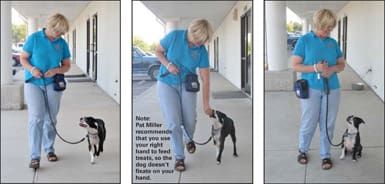
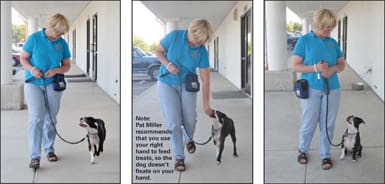
Many trainers carry their treat in the left hand to encourage left-side walking. This is actually a bit of luring, and makes it harder to eventually fade out the presence of the treat. I prefer to hold treats in my right hand (leash in my left) with my hand out of sight behind my right hip, and deliver across my front to the side of my left knee after I click. This way your dog has to think about where he needs to be to earn the click, not just follow the tempting scent of the treat in your left hand.
I don’t generally wear a treat bag; I prefer to wear loose clothing where I can stash bags of treats in pockets. A treat bag is a flashing neon sign to your dog that now he has the opportunity to earn treats. I’d rather my dogs know they may be reinforced at any time, not just when I’m wearing the bag.
Vary your reinforcers. As the late positive trainer Patty Ruzzo frequently said, be variable and unpredictable. Don’t always make it about food treats. If your dog never knows when, where, or how you might reinforce him, he has to stay attentive to you; he won’t want to miss anything! My personal choice is this: If I click my dog gets a food treat; if I use some other reinforcer I use my verbal “Yes!” marker. Now, go walk your dog!
Thanks to Sarah Richardson, CPDT-KA, CDBC, of The Canine Connection, in Chico, California, for modeling the techniques discussed in this article.
Pat Miller, CPDT-KA, CDBC, is WDJ’s Training Editor. Miller lives in Fairplay, Maryland, site of her Peaceable Paws training center. Pat is also author of The Power of Positive Dog Training; Positive Perspectives: Love Your Dog, Train Your Dog; Positive Perspectives II: Know Your Dog, Train Your Dog; and Play with Your Dog.
For many years, I was curious about Tellington TTouch (pronounced TEE-touch) Method, a training system that uses bodywork and non-habitual movement to influence behavior and health. But I was skeptical that the hallmark circular touches with fanciful names like “Clouded Leopard” and “Tarantulas Pulling the Plow” would have much impact beyond helping an animal relax; wasn’t this just another form of petting and massage? It wasn’t until I witnessed a TTouch practitioner work with my young dog, Chance, that I realized there was more to TTouch than I had imagined.
photo by Donna Zetterquist
At that time, trust did not come to Chance easily. Her background as a feral dog meant that she was often overwhelmed during social interactions with humans. Her lack of trust manifested in hyper-social behavior. And, even though she had learned to sit when greeting people and she behaved well when asked, she was often on the verge of an eruption of nervous hyperactivity when interacting with people.
As I watched Jodi Frediani, a TTouch practitioner who holds workshops in the Santa Cruz Mountains (near the central coast of California), I saw a subtle change in Chance’s demeanor. It wasn’t that Chance immediately calmed down, though we did see a mild shift in her hyper behavior. It was the way that Chance and Frediani were communicating through the touches that was so impressive. When using TTouch, Frediani entered into a mutually respectful relationship with Chance, a noninvasive and nonconfrontational give and take. TTouch helped to create a dialogue between the dog and practitioner. Chance’s body language shifted from stiff and tense, to softer and more relaxed. The growing trust was evident.
What is TTouch?
The TTouch method was developed by Linda Tellington-Jones. The Canadian horsewoman had a long background in horse training and massage, but in 1970s, she began studying with Dr. Moshe Feldenkrais, an Israeli physicist. Feldenkrais had developed a method of gentle manipulation of the human body, designed to improve pain and movement. He believed that by engaging non-habitual movement, you might be able to activate unused neural pathways to the brain and expand the potential to learn. Tellington-Jones’ study of the Feldenkrais method of “Awareness Through Movement” sparked a shift in her thinking about touch and movement in animals.
Tellington-Jones began to experiment with non-threatening manipulations with horses. Her experimentation lead to her development of the Tellington Touch Equine Awareness Method (TTEAM), a training system for horses that included a circular touching technique, ground work, and riding exercises. The approach seemed to help horses relax and move beyond instinctive responses into a more grounded and thinking state. Tellington-Jones found the method to be very effective and in the 1980s began adapting it for working with other animals, including dogs, and TTouch was born.
Tellington-Jones writes that the goal of TTouch is to “stimulate the function and vitality of the cells in an animal’s body, and to activate unused neural pathways to the brain.”
TTouch likely engages the parasympathetic nervous system, relaxing muscle tension and allowing heart rate, blood pressure and circulation to slow, in effect bringing stress levels down. Bringing the stress level down may allow a dog (or person or horse) to have more body awareness, which can help if the body is compensating because of a past fear or pain, says Frediani. “The touches, in some fashion, help to release that memory and bring about healthy function in the cells.”
One study, done at the Biofeedback Institute in Boulder, Colorado, showed that TTouch can create changes in certain brain waves. During the study, the brain wave patterns that emerged during TTouch were different from those that emerged from simple petting, stroking, or massage. The results suggest that TTouch may relax the body and brain while simultaneously encouraging an alert, thinking state.
Tellington-Jones describes the effect of TTouches as “turning on the electric lights of the body,” but she acknowledges that no one really knows how or why TTouch works and that the secret may simply be the mindfulness of the method.
“TTouch is based on a mindful approach to working with the animals,” says Frediani. “Everything we do is mindful and thoughtful. I constantly read the dog’s body language, staying attuned to his emotional state as best I can. I pay attention to both the dog’s response to my touch, body language, and movement, and also the messages that my fingers are giving me. Is what I am feeling hard to the touch? Cold? Trembling? All of this is information that helps adapt what I do and how I do it.”
TTouch is Cooperation-Based
Perhaps the biggest influence of TTouch is that it promotes a philosophy of cooperation and respect in all of our interactions. “TTouch is about partnership,” says Frediani. “It’s about working in a collaborative fashion.”
Frediani trained with Tellington-Jones, and says, “It was an experience that transformed how I live my life.” Frediani continues to practice and teach TTouch, including working with a variety of animals throughout the world, teaching others to lead classes, and offering workshops for dog owners at her home in California.
“In the TTouch philosophy,” says Frediani, “most behavior problems arise because of fear or pain, or because the animal doesn’t understand what we want.” The TTouch method strives to alleviate these issues with three primary techniques: circular touches, body wraps, and movement exercises. These elements work together to bring about a relaxed, calm state that enables the animal to learn. TTouch can function as its own behavior modification program, but it is also often used to complement other reward-based training and behavior programs.
TTouch can be particularly helpful with anxiety-based behavior issues such as social fears or sound sensitivity. With these types of problems, the results of TTouch are often dramatic.
“The intention is to bring awareness, to get the dog to use his thinking mind and not his reactive, primitive brain,” says Frediani. “The touches get the dog to slow down and respond.”
I witnessed a stressed Border Collie fall into a deeply relaxed state in a matter of minutes during a TTouch demonstration. During my research for this article, numerous people related accounts of tail work, ear slides, and body wraps providing miracle-like results for sound sensitivity. For example, Dr. Evelyn Sharp of My Personal Vet in Santa Cruz, California, says she remembers using the TTouch “tail work” with her first dog, Cray, for his fear of thunderstorms.
“Cray would flip out, digging to try and escape, pacing, panting, ears back,” says Dr. Sharp, who had learned about the tail pulls during a TTouch course for horses in the 1980s. “For the first two or three pulls he was worried. But after five tail pulls, he just lay down and went to sleep.”
TTouch is also useful in highly arousing situations. Because it both calms a dog and seems to open him to learning, TTouch may be particularly helpful with performance dogs, for example, as a way to encourage focus before going into the competition ring. It may also be helpful with activities such as vet visits or training classes.
“I use TTouch to get my classes settled down,” says Sandi Pensinger of Living with Dogs in Capitola, California. “If something disrupts the class or dogs get aroused by motion or eye contact, we sit down and do relaxation with TTouch and breathing. The dogs settle down and often fall asleep. It’s amazing!”
But the results of TTouch are often more subtle, as with Chance and her hyper-social behavior. Chance is still often on the verge of a mini-over-excitement-explosion when interacting with people, but TTouch has helped shift her energy from nervous panic to simply excited.
TTouch can also be helpful as an adjunct therapy for hip dysplasia, lameness, and recovery from surgery or other illnesses. “It is not going to cure a dog of cancer or other ailments,” says Frediani, giving an example of the limitations of TTouch. “But it could help make the dog more comfortable and help with the bond between animal and person while the dog is going through the illness.”
TTouches in Action
There are over a dozen different touches used in TTouch. Probably the best way to learn about the touches is to find a practitioner in your area. But you may be able to learn about them from the books or videos available as well.
Many of TTouches employ the hallmark circular motion, but several are more akin to a stroke or lift. Some of the touches are done using only the fingertips, others the flat of the fingers and palm, still others use the whole hand against the dog’s skin. The circle movement is generally done clockwise, starting at the 6 o’clock position and moving around for a one and a quarter circle. The touch is generally light rather than deep like a massage and the goal is to gently move the skin under the fingertips.
Pressure is another aspect of the touches. The pressure scale ranges from one to six, with one being the lightest, and six being the heaviest. The pressure of the touches is much lighter than you might imagine. To get an idea of the pressure of the touches, try moving the skin around on your eyelid using the lightest possible pressure. This would be a number one. A number three is the pressure it takes to move the skin around on your eyelid as firmly as is comfortable. A number six is twice the pressure of a number three (too much pressure to use on your eyelid and with most dogs, and is generally used with larger animals). Each dog prefers a different pressure, and it helps to experiment to find the right pressure for the individual.
The circles are complete within themselves, but they are done in succession moving around on the body. As soon as you are finished with one circle, connect it to the next one by sliding along the fur to your next position, moving parallel to the spine or down the legs. The circular touches can be done anywhere on the body.
Here are examples of a few of the different touches and how they are used:
“The Clouded Leopard” – This is the basic touch and all of the other circular touches are variations of the Clouded Leopard. With the Clouded Leopard, your fingers are slightly curved and you use the pads of your fingers to create the circles. The Clouded Leopard is particularly useful for anxious dogs and regular work with Clouded Leopard may help develop trust. One variation of the Clouded Leopard is the Abalone touch, which uses a completely flat hand against the skin.
Ear slides – Using TTouch on the ears is an important technique and can help calm a stressed or hyperactive dog. The ear slide is done by stroking the ears horizontally from base to tip, or by making small circles starting at the base and working toward the tip.
“Ear work can also be a very helpful tool if you have a hurt or injured animal or an animal in shock. You can use an ear slide while going to the vet.” says Frediani. “There are acupressure points in the ear that are connected to the whole body, and without having to know specific points, one can activate them and stabilize pulse and respiration.”
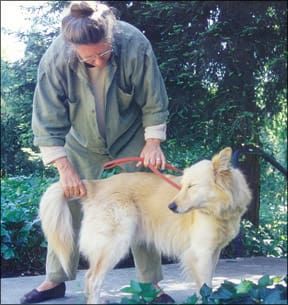
Tail work – One of the most interesting TTouch techniques is a simple tail pull. With your dog standing or lying down, you hold her tail near its base with one hand, while supporting her body with the other, then gently pull, holding the tension for a few seconds and then slowly, gently releasing. You can also move the tail in a circular motion, or do “Raccoon touches” on the tail, a method that uses just the very tips of your fingers and a circular motion.
“Tarantulas Pulling the Plow” – This is my favorite slide type of touch. You walk your fingers gently up the back (like a spider) while letting the thumbs drag behind (like a plow). It can help stimulate circulation and may be helpful for dogs with touch sensitivity.
Beyond the Touches
There are several other techniques that are part of the Tellington TTouch Method. These techniques are all designed to help a dog gain a calm confidence. “It is hard to be emotionally confident when you are not physically confident. With physical confidence, the tail comes up, the posture changes, the dog feels good about himself,” says Frediani. “It is easier to feel good about the rest of the environment, other animals, and even people when you feel good about yourself.”
Leading exercises – TTouch employs a range of exercises designed to help a dog work in cooperation with the handler. The goal is to teach a dog to understand what is expected, and for the dog to move without pulling or straining on the leash. Some of the leading exercises use a double clip leash with the ends clipped to two different points on the dog; for example, one end might be clipped to the collar and the other to a front clip harness.
Confidence course – The confidence course, as the name suggests, is designed to build a dog’s overall confidence. It may include obstacles similar to those used when introducing a dog to agility equipment – a ladder, a low dog walk or A-frame, a tippy board or low teeter-totter, tires and cones. A simple labyrinth made from six poles on the ground is a common feature of the TTouch confidence course. “The confidence course can help a dog solve problems and learn physical balance, which is connected to mental and emotional balance,” says Frediani.
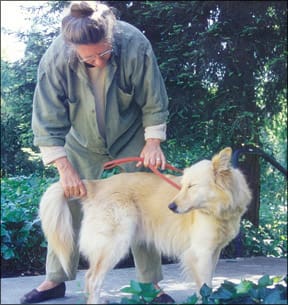
Body wraps – Traditionally in TTouch, the body wrap is done with an ace bandage wrapped in a pattern around the dog’s body, but I’ve also heard of people using scarves, tight t-shirts, and more recently a commercially designed product called a Thundershirt. Body wraps can be so effective in helping a nervous dog settle that when I was looking for examples of how TTouch had benefited dogs, the response was overwhelmingly related to great effects of body wraps for things like thunderstorm and firework fears. The idea of the body wrap is that a gentle pressure on a dog’s body can help calm the nervous system. One person I talked with said the body wrap was like giving your dog a nice reassuring hug.
Therapy for Dog Handlers, Too!
One of the aspects of TTouch that I like is that it is easy to do, and it feels good doing it. Perhaps it is the mindfulness approach, or the simplicity of the touches and movements, or the fact that it doesn’t have to be done perfectly to have a positive effect. It’s very forgiving and can be adapted to fit an individual dog’s needs.
“With TTouch, we allow the dog to lead the way,” says Frediani, “and mistakes are part of the process. If what you do doesn’t work, try something different. Set goals, but remain unattached and know that you can change what you are doing.”
Practicing the TTouch techniques is also a great way to connect with your dog. To help strengthen her connection with her dog, Chloe, Lori Rubin took a workshop with Frediani. Rubin says, “I rely on the circle touches when I think something might be stressful for my dog, like when I take her to the vet. It gives me something to do that I know is nurturing to the dog.”
Putting TTouch to Work
TTouch can have a dramatic effect on dogs. Sometimes the help offered through TTouch is subtle. And sometimes, like with all behavior methods, it might not help with a particular behavior or problem. But even that fits in with the TTouch philosophy.
“As with all systems there are times that the methods won’t be as effective and there are some animals that won’t respond,” says Frediani. “If I’m working on an animal, and the animal expresses concern, I might do the touches on a different part of the body, I may change the pressure, the speed, or which touch I use to make it easier for the animal to participate in the process.”
Frediani stresses that in TTouch, you always work for success, which, in this case, means moving forward together and allowing the animal to participate in the process. “I want the animal to be able to express how she feels. I don’t want to inhibit that,” says Frediani. “I don’t want a dog to go ballistic, but I also don’t want her to suppress her communication.”
In TTouch, communication and cooperation remain key to the process. TTouch improved how my dog Chance communicates with me, as well as how she relates to other people. She will often back herself into a person as if to say, “Would you like to communicate with me through those funny circle touches?”
Mardi Richmond, MA, CPDT-KA is a training enthusiast and writer who lives in Santa Cruz, CA with her partner and her heeler-mix, Chance.
Special thanks to Jodi Frediani of Transformational Training, for her assistance with this article.
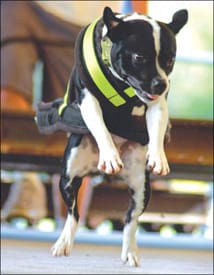
What is this sport? In weight pulling, a dog‘s strength and stamina are tested by his ability to pull weights.
Prior training required? Moderate.
Physical demands? On the dog: Moderate to high. On the handler: Minimal.
Best-suited structure? Dogs of all sizes and shapes can compete, although the bully breeds do best.
Best-suited temperament? Dogs who enjoy working with their owners.
Cost? Minimal.
Training complexity? Minimal.
Mental stimulation? Moderate.
Physical stimulation? High.
Recreational opportunities? Low.
Competition opportunities and venues? Moderate.
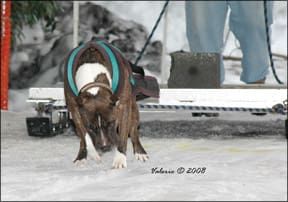
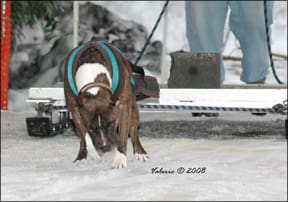
Work it! Work it! Work it! Leaning into the padded harness, muscles bulging with effort, eyes dark with determination, inch-by-inch, the American Staffordshire Terrier pulls the cart loaded with 60-pound pieces of railroad track toward her owner. This is Duvall’s Sureshot Kamakazi, “Banzai,” a striking 43-pound, 17-inch brindle girl. Her owner, Karyn Dawes, smiles wide as she realizes that Banzai is going to record a new “personal best.” It’s official: 3,900 pounds and 90.7 times her body weight. What a gal! Banzai wiggles in delight at Karyn’s hug and effusive praise for a job well done.
In 2003 when Dawes discovered the sport of weight pulling, she had no idea she and her dogs would enjoy it so much. She was an experienced dog sport aficionado, having competed in obedience, Schutzhund, flyball, agility, and carting. It was only at the insistence of a good friend that she capitulated and gave pulling a try. Like many neophytes to a sport, she made a lot of mistakes at the beginning, and then went on to put titles on 11 dogs.
“My first time was cold turkey,” Dawes recalls. “No training, no practice. I borrowed a harness just for fun to see what the dog would do. You’d think by now I would know better! My dog pulled a qualifying pull the first day. The second day she ‘told’ me that if I want to do this sport, she would like me to invest some time in training and conditioning. In other words, I got the ‘paw.'”
Weight Pull History
Dogs have pulled sleds and carts for humans throughout history. In small towns around the world, owners proudly boasted of how strong their dogs were, how much they could pull and how far. “Yeah? You wanna bet? My dog can pull more than your dog!” That’s probably how the sport of weight pulling started. Now there are several organizations that have established rules and regulations for formal competition.
Although any breed can enjoy this sport, it is one that commonly attracts more “bully” breeds (such as American Staffordshire Terriers, Bulldogs, Mastiffs, Boxers, etc.) than any other breed. Some of the sanctioning organizations limit their competitions to purebred dogs while others are open to all dogs.
The United Kennel Club (UKC) rules of competition reflect the goals of most weight pulling competitions, which is to demonstrate a dog’s stamina and strength. In brief, each dog is given 60 seconds to pull the most weight that he can in a 16-foot “chute.” Dogs are separated into “classes” based on their body weight. Dogs who pull a larger percentage of their body weight earn the most points.
The dog wears a padded harness, which is attached to a “trace,” which connects to a “weighted vehicle” that is loaded with sand bags or other easily weighed objects. There are three different types of vehicles.
Sleds are pulled on natural or artificial snow and must be able to carry a minimum of 3,000 pounds.
Double-axel wheeled carts are pulled on carpet and must be able to carry at least 5,000 pounds.
Rail carts are pulled along a rail system and must be able to carry at least 6,000 pounds (the dogs’ path is carpeted so they can achieve traction when pulling).
The chute that contains the pulling system is 35 feet long and between 10 and 20 feet wide.
Canine Weight Pull Titles
There are several titles available in the UKC system. These are just some of them:
United Weight Puller (UWP): Three qualifying pulls are required. These can be all using the same type of weight vehicle or a combination of the three different vehicles. Each of the different vehicles has a different weight requirement. For example, a dog pulling a sled must pull 3 times his body weight; a dog on rails must pull 10 times his body weight; and a dog pulling a cart must pull 8 times his body weight. You must have the UWP title before pursuing the various championship titles.
United Weight Pull Champion (UWPCH): Once this level of competition is reached, the competitor starts earning points toward the UWPCH title. 100 points are required for the UWPCH.
United Weight Pull Champion Excellent (UWPCHX): 250 points are required for this title.
United Grand Weight Pull Champion (UGWPCH): The dog must have completed the UWPCHX title before earning the additional 200 points for this title.
United Grand Weight Pull Champion 1 (UGWPC1): The dog must have completed the UGWPCH before earning the additional 200 points for this title.
The somewhat complicated point system is described in detail on the UKC website. Generally, points are earned for the higher levels of competition based on placements (first through fourth place) and the type of vehicle pulled. For example, dogs pulling on wheels earn 20 points for pulling 35 times their body weight, 15 points for 25 times their body weight, 10 points for 15 times their body weight, and 5 points for 10 times their body weight. There are also bonus points awarded for dogs who pull the most weight and the most weight per body weight at each competition. Additional titles require a dog to pull a combination of different vehicles.
There are annual “All Star” rankings based on points earned throughout the year. The rankings are broken into three classes: 1) American Pit Bull Terrier; 2) American Bulldog; and 3) Multi-breed (all other breeds). For dogs who show in conformation as well as weight pulling, there is also a Total Dog Award that can be earned at individual shows by qualifying in a performance sport and taking one of the “winners” awards in conformation on the same day.
Training
Basic pet manners training provides a good foundation for the sport of weight pulling. Your dog needs to be under control and to have been adequately socialized with people and other dogs in order to be comfortable in a competitive environment. That said, weight pulling does not require extensive training. What it does require is the human on the other end of the leash to very gradually physically condition her dog before asking him to pull larger and larger percentages of his body weight.
Dawes, who has trained and titled 11 dogs in the sport, starts by introducing the harness first. “I put the harness on and do short walks with plenty of treats and encouragement. I make sure to hold the spreader bar at the back of the harness so it does not bang the back of the dog’s legs. ‘Drag training’ starts with a plastic bottle filled with small rocks. This is not heavy. Its main purpose is to get the dog used to something noisy following behind. Next I introduce an empty sled. This weighs about 15 pounds. We do lots of praise and rewarding – not luring – but rewards for short distances.”
Experienced handlers know that luring or “baiting” a dog to pull might cause the dog to pull more than he is physically or mentally prepared for. Under the rules of most sanctioning organizations (there are exceptions), handlers are not allowed to use lures or bait during a competition. Although treats are used, they are used to reward the dog for short-distance pulls and gradually increasing weight loads.
“As the dog becomes familiar with the job, I increase the amount of weight and vary the training,” says Dawes. “For example, I might use a heavier weight for short distances and a lighter weight for longer distances. Most of the actual training is done with a sled as few people own their own wheel or rail systems. Occasionally, club members will get together to work their dogs on the actual competition pulling equipment.”
Many people join clubs and train and practice together. Dawes joined her friend’s club, Rip Curl Weight Pullers, and got a lot of help from other members over the years. She now helps newcomers and provides private instruction, as do some of the other club members. The club occasionally offers seminars, but members feel that the real benefits of the club are the camaraderie and support they get from one another.
“We are all enthusiastic about the sport and are always willing to answer questions and give people tips to help them start. When we hold pulls, we encourage people to come without their dog and observe. Once you understand the basics, it’s pretty much a matter of training and conditioning on your own. Just remember: be patient and never forget that the dog did not sign on for the job. You chose the sport; the dog did not. Dogs have good and bad days. Keep your training positive and respect your dog.”
To find a club in your area, go to the UKC website.
Canine Weight Pull Team Attributes
Many who are attracted to dog sports cite the strong relationship that results from the time training and playing together. Weight pulling is no different. “Like any of the dog sports when I ask ‘what’s in it for the dog,’ I have to first point to the quality and quantity of time we spend together,” says Dawes. “Training for anything builds a strong relationship. Some dogs really love the sport. Most work to please their owner. Unfortunately, there are a few people who still use aversive training methods (something that our group does not endorse). You can tell which dogs are trained this way as they walk onto the track.
“Weight pull is work! So, unlike agility or flyball, where the dog barks, jumps, and runs (all things most dogs inherently enjoy), the dog must want to work for the owner or rewards at the end of the pull. There are some dogs who really love pulling, but I would say that most pull to please their handlers.”
The sport attracts many of the “bully” breeds, but Dawes has seen, among others, Great Danes, Rat Terriers, Cattle Dogs, Black and Tan Coonhounds, Basenjis, Patterdale Terriers, Boston Terriers, Shelties, and even an Italian Greyhound. “This sport is mental as much as it is physical. If you capture the dog’s mind, their doggy body will follow. It’s a bit like ‘The Little Engine That Could’ – if they think they can, dogs can do some amazing things.”
People who love this sport come from all walks of life. In the Rip Curl Weight Pullers Club there is a veterinary technician, a groomer, a paramedic, retirees, a heavy equipment operator, and Dawes, who is currently a booking agent for a pet transport company. Prior to finding satisfaction making sure pets arrive safely, she was an advertising sales and layout designer for an aviation newspaper.
Club members may participate in a variety of dog sports although some concentrate all their efforts on this one. “There is the element I refer to as the ‘heavy hitters’ whose only sport is weight pull. These folks parallel the obedience folks who are after the 200 score or the agility people who are aiming for the World Team.”
Equipment and Expenses
Equipment costs are minimal for basic training and conditioning, but you’ll need to join a club unless you want to assume the cost of and find the space for a pulling system. As a member of a weight pulling club, this sport is pretty inexpensive. When you can find someone to instruct you on a private basis, expect to pay around $40 per session. A custom harness for your dog will cost around $75. Entry fees for competition cost about $25.
Get Started!
You might be surprised when you learn that your dog enjoys a sport that results in so much hard work for him. But, with the right animal magnetism, you just might convince him that you’re worth it.
Terry Long, CPDT-KA, is a writer, agility instructor, and behavior counselor in Long Beach, CA. She lives with four dogs and a cat and is addicted to agility and animal behavior.
On December 1, 2009, Merial published an open letter to veterinarians, announcing a shortage of Immiticide (melarsomine dihydrochloride), the only drug licensed for use in treating heartworm infestations in dogs. The shortage is due to a manufacturing site transfer. The company expressed hope that the shortage will not persist beyond the first quarter of this year.
An apparently unrelated problem is responsible for Merial’s announced shortage of Heartgard (ivermectin) tablets, which may be unavailable until 2011. Heartgard prevents canine heartworm disease by eliminating the “tissue stage” of heartworm larvae for a month after infection.
Fortunately, Heartgard chewables and other ivermectin products (including products made by other manufacturers) remain available, so a shortage of the tablets is not cause for concern. The Immiticide shortage, however, has alarmed veterinarians and shelters (who see a lot of heartworm-positive dogs) across the country.
To repeat: Immiticide is the only drug licensed or used to treat adult heartworms in dogs, and Merial is the only company who makes this product. Because of the shortage, veterinarians can no longer order Immiticide from distributors, in order to prevent stockpiling.
Instead, veterinarians who have a heartworm-positive patient must contact Merial directly and provide details of their patient’s case. For now, Merial is selling the drug on a case-by-case basis, providing the drug only to the more severe cases, those dogs with clinical signs of heartworm disease. Dogs who test positive but have no clinical sign of disease will have to wait.
Safe, effective alternative
Fortunately, there is an alternative treatment for heartworm. As we discussed in “Update on Doxycycline and Heartworm Disease” (Whole Dog Journal August 2009), a combination of ivermectin (the active ingredient in Heartgard) and doxycycline (an antibiotic), weakens and sterilizes adult heartworms, eventually killing them. The time this takes depends on the age of the worms; the older the worms, the longer they take to die.
In addition, giving doxycycline and ivermectin prior to treatment with Immiticide lowers the risk of adverse reaction to worm death, making the treatment much safer. It also lessens the negative effects of the worms themselves, primarily due to doxycycline’s effect on Wolbachia, a parasite of heartworms (see “Parasites within Parasites,” Whole Dog Journal August 2006).
The American Heartworm Society (AHS) recently updated its guidelines for treatment of heartworm infection in dogs. It says, “Studies have shown that heartworm-positive dogs pretreated with ivermectin and doxycycline prior to receiving melarsomine (Immiticide) injections had less pulmonary pathology associated with the death of the heartworms. If doxycycline is incorporated into a heartworm treatment protocol it should be given before administration of melarsomine so the Wolbachia organisms and their metabolites are reduced or absent when the worms die and fragment. Doxycycline administered at 10mg/kg BID for four weeks has been shown to eliminate more than 90 percent of the Wolbachia organisms and the levels remain low for three to four months.”
For dogs who are not treated with Immiticide, the guidelines say, “the use of a monthly ivermectin-based heartworm preventive along with doxycycline could be considered. It has been reported that ivermectin and doxycycline administered periodically over 36 weeks resulted in a 78 percent reduction in adult worm numbers. Moreover, microfilariae from dogs treated with doxycycline that were ingested by mosquitoes developed into third-stage larvae that appeared to be normal in appearance and motility, but these larvae were not able to develop into adult worms, thus negating the risk of selecting for resistant strains. The administration of doxycycline at 10 mg/kg BID for a four-week period every three to four months should eliminate most Wolbachia organisms and not allow them to repopulate.”
While the AHS still recommends monthly use of heartworm preventatives in combination with doxycycline during treatment for heartworms, the studies reported above used standard heartworm preventative doses of ivermectin given weekly during the 36-week treatment period. They also pulsed doxycycline throughout the treatment period rather than just giving it every three to four months.
Based on the above, it may be best to give Heartgard (not Heartgard Plus) weekly until treatment with Immiticide is begun, or until the dog no longer tests positive for heartworms, if Immiticide treatment is not used. Giving Heartgard weekly (rather than monthly or every two weeks) is less important for dogs who will be treated with Immiticide than those relying on ivermectin and doxycycline alone to get rid of heartworms. (Note that weekly Heartgard is not recommended for dogs with the MDR1 gene mutation that causes sensitivity to ivermectin.)
Doxycycline should be given at the dosage level listed above for four weeks prior to starting Immiticide treatment. If treatment has not been completed within three to four months, doxycycline should be given again for four weeks. If Immiticide treatment is not done, treatment with doxycycline should be repeated every three to four months until the dog no longer tests positive for heartworms.
Ivermectin and doxycycline may seem a safer (though slower) alternative to Immiticide, even when the shortage is over. But heartworms cause damage as long as they are in the dog’s body, and the danger from the dying worms, while reduced by the use of doxycycline, exists as long as the worms are present. Immiticide following one month of treatment with doxycycline and ivermectin is still the treatment of choice for most dogs with heartworm disease. If Immiticide treatment is not available, or if you have a dog with early-stage heartworm disease, then long-term use of ivermectin with doxycycline is a reasonable alternative. – Mary Straus
For more information:
Merial Customer Service, merial.com, (888) 637-4251 (option 1)
heartwormsociety.org/veterinary-resources/guidelines-Can-HW-Disease.pdf
I remember a day when I was waiting in the vet’s office for my dog’s appointment. The man sitting next to us started telling me, with beaming pride, about how his little white Westie had caught seven barn rats in the past week.
I couldn’t help but admire this cute, fluffy dog’s superior hunting skills. Predatory behavior in dogs is something I respect. From following a scent trail, to stalking a bird, chasing a ball, or herding sheep, I am intrigued with the many forms predatory behavior manifests in our dogs; it is part of what makes dogs so amazing!
288
But, predatory behavior is not so admirable (and much less socially acceptable), when, instead of it being a country terrier ridding a barn of rats or an Aussie herding sheep, it is your city dog chasing a skateboarder or the neighbor’s cat.
Predatory behavior in our dogs can be admirable, but it’s also something to understand, respect, and channel into appropriate activities.
What is predatory behavior?
This may seem obvious. Predatory behavior, commonly called “prey drive” in our pet dogs, is an instinctive or natural desire to chase, capture, and kill prey. It is, in the most fundamental sense, about acquiring food.
Predatory behaviors are generally triggered by something in the environment (for example, an animal running or a ball flying through the air) and happen as a reflexive or automatic response. When an object moves or an animal runs, a puppy or dog may reflexively chase. Because predatory behavior is instinctive, a dog does not need to be taught how to do this; it comes naturally.
Predatory behavior takes many forms, including searching, stalking, chasing, catching, killing, carrying, dissecting, and eating behaviors. Wild canids, like wolves and coyotes, need and use all behaviors in the sequence to hunt and survive. Our domestic dogs no longer need to hunt for food, yet they still have active predatory behaviors.
All dogs are born with different levels of prey drive. Some enjoy chasing a ball or even a cat, but would never hurt the kitty (or the ball). Others are literally fixated on movement. Still others will seek out and kill mice, rats, gophers, or squirrels.
Breed type is a major predictor of a dog’s predatory behavior. Because of selective breeding, certain predatory behaviors have remained strong in certain breeds, while other behaviors may be diminished. For example, retrievers may have the search and carry pieces of the predatory sequence, but the dissecting piece may be suppressed. Border Collies are famous for their eye-stalk and chase skills, but the bite and kill aspects are often absent. Many terriers have been bred so that all aspects of the predatory sequence remain strong.
Experience and opportunity are other factors that determine how predatory a dog will be. From scenting to chasing to catching and killing, predatory actions can be extremely rewarding for dogs. If a dog has the opportunity to chase or hunt, she is much more likely to do it again in the future.
When is predatory behavior a problem? Because the extent and intensity of a dog’s predatory behavior can vary dramatically, there is no single answer to when it may be a problem. “Some dogs are meant for critter control,” said Daphne Robert-Hamilton, a certified trainer and aggression specialist in Morgan Hill, California. As long as the dog is focused on her critter control job, and doing that job doesn’t hurt the dog, then the predatory behavior may not be a problem at all.
Predatory behavior is most often a problem when a dog focuses it on an unacceptable target. For example:
Chasing cars, bicyclists, or skateboarders or “herding” running children
Nipping people in the heels, calves, or thighs as they run or move away
Chasing cats or other small animals (including small dogs)
In addition, predatory behavior can be problematic if a dog puts himself in danger, or is so obsessed that she cannot focus on other things. Robert-Hamilton also emphasizes that intense or aroused chase – especially toward humans, cats, or things that can hurt the dog – is almost always a serious problem.
288
Can predatory behavior be eliminated?
As someone who has shared my home with dogs who exhibit very strong predatory behaviors, I know they can be some of the most difficult behaviors for people to live with. And problematic predatory behaviors can be some of the hardest to modify. Even the most wonderful treats in the world are not likely to compete with the reward of predatory behavior.
You may ask at this point, “Why not try to stop a dog from chasing or hunting altogether? Isn’t this one of the rare times to use punishment?” I’ve learned through experience that when a dog’s instinctive behavior kicks in, punishment may not work – at least not with any consistency. I have known dogs who would run right through the shock of an electric collar in hot pursuit of a rabbit.
I do not believe you can reliably “control” predatory behavior by suppressing it or correcting it. But I know you can channel your dog’s predatory behavior, and that with a combination of management, providing appropriate outlets, and training, even dogs with the strongest predatory inclinations can be well-behaved.
Manage first
Management is a useful tool for controlling or modifying most of your dog’s behaviors, but it may be even more critical with predatory behaviors. Why? Because predatory behavior is extremely self-rewarding. If your dog is inclined to hunt and given the opportunity to hunt, he’ll do it!
Consider this: Dogs will chase squirrels even if they’ve never caught one. They don’t need to actually get the reward of catching the squirrel; the act of chasing is its own reward. Predatory chasing causes the release of certain feel-good chemicals in his body. Going after the squirrel is more than just fun. It creates a sort of natural high that makes a dog want to do it more and more.
If your dog enjoys chasing squirrels on a regular basis, it may be much harder to stop her from chasing squirrels when you’d rather she was focusing on other things, such as running agility or coming when called. When you limit access to undesired hunting or chasing, you prevent the dog from practicing the behavior, and from getting the self-reward.
Channel it!
But while limiting a dog’s opportunity to practice predatory behaviors is an important first step, and may curb the dog’s desire to chase one particular target, it will not squelch the dog’s need to chase something. That is why channeling the drive is so important. It may be difficult (or impossible!) to teach a dog to stop wanting to scent, stalk, or chase, but you can easily teach him what to scent, stalk, or chase.
315
For example, dogs who love to chase things can be taught to chase a certain object, like a ball or a Frisbee. Dogs who need to stalk may be good candidates for herding. Scenting activities can provide an outlet for dogs for whom sniffing and finding is extremely rewarding. Dog sports like flyball and agility engage aspects of predatory behavior and can provide an excellent channel for active and athletic dogs. Games like tug and playing with food toys such as stuffed Kongs can be part of focusing a dog’s desire to dissect.
For many dogs, a little management and providing appropriate outlets will be enough to stop them from problematic predatory behavior. But for some dogs, those who are truly driven to search, chase, and catch, these steps will be only the beginning.
Harnessing the drive
Harnessing predatory behaviors and using them in training can have a big payoff. By using the need to chase, grab, and bite as a reward, you can develop reliable responses in dogs with even the strongest predatory instincts. In fact, strong predatory inclination is one the most sought-after features in many types of working dogs and those who participate in dog sports. The stronger the search, chase, and grab behaviors, the better the dog may be at agility, flyball, search and rescue, and drug scenting. And predatory behavior is the obvious force behind every great herding dog, pointer, and retriever.
The key to harnessing predatory behavior is to teach your dog to fixate on something that is within your control (like a toy or tug item), instead of something that is not within your control (such as squirrels, bunnies, or cats). Basically, you can teach a dog that a tug toy or a retrieve item is their “prey” and that you are in control of the prey. Developing a strong interest in playing a game that provides an outlet for her predatory behavior can redirect her formerly problematic predatory behavior into a dog focused on working with you.
The more you succeed at getting your dog to focus on working with you for her play/prey object, the more important you are in the game and the less significant the environment around you becomes. Focusing a dog with strong predatory instincts is easiest to do with a puppy or young dog who hasn’t already enjoyed hunting, but it is possible to refocus a dog who has had practice fixating on the wrong target, too.
Teach self-control Self-control is another critical skill for dogs with a high prey drive. One of the best ways to help dogs learn self-control is by teaching a sort of on/off switch. Help your dog learn to switch between being in an excited state (like when playing tug) to a thinking, focused state (like when heeling calmly beside you). Frequently interrupting tug or other exciting games by asking for calm behaviors like sit, down, or heel can help a dog learn to quickly move from excited to calm.
While it may seem that playing tug and chasing squirrels have little in common, the ability to switch from an excited state to a calmer state will improve a dog’s ability to think, instead of simply react, when predatory instincts kick in.
Another critical behavior for developing self-control in dogs is teaching a strong “leave it” or “off.” Teaching “leave it” helps a dog learn to disengage from whatever he is interested in, whether it is an interesting smell on the ground or a squirrel in a tree above.
315
When teaching “leave it” with predatory dogs, the reward must be proportional to what you are asking the dog to leave. For example, a dog who is asked to leave a running squirrel will not be satisfied with a bland biscuit for a reward. A super high-value food item might work, but an intense game of chase and tug is likely to work better.
The third self-control exercise that I find particularly helpful with predatory dogs is a strong “wait.” Different than a stay exercise, I use “wait” to mean “Hold on, you will get to go do what you want, but you must pause a minute first.” For dogs who are excited to run or chase, waiting a moment can help them learn that good things come when you listen to and hear what your person is saying. Practicing “wait” before being allowed to chase a ball, running off-leash with dog pals, or going to a food bowl for dinner can be great self-control exercises.
Teaching a “call off” Teaching a dog with a strong predatory instinct to quit or leave a predatory chase is a difficult training challenge, but you can be successful. Perhaps you’ve had the experience of calling your dog when he is in the midst of chasing something; did he seem to not even hear your call? Dogs who are mid-chase may be so intensely focused that they really cannot hear anything else.
Keep in mind that every dog is different; the strategy described here may need to be tweaked to fit your dog or your unique set of circumstances. It’s okay to experiment and find the approach that works best for you and your dog.
The foundation: Developing a valuable reward. First, you’ll need to identify and/or develop a reward or reinforcement that your dog is passionate about. For dogs who are obsessive about retrieving, a chance to retrieve will work well as a reward because you will reward a “call off” of chasing with an equally exciting game of fetch. (Most dogs who do predatory chasing enjoy chasing any moving object!) An obsessive retrieve means your dog will chase and bring back a ball, Frisbee, tug toy, Kong, or other item enthusiastically and every time.
It may take a few weeks or months to build that intense toy drive in dogs who are less obsessive about retrieving. But the results – getting a dog really passionate about retrieving – will be worth the effort. Start slowly and enthusiastically and always stop the game while your dog still wants to play. I’ve found that short, exciting tosses (rather than long throws) get a dog super-excited and eager to continue the game. In addition, combining the retrieve with a rousing game of tug can increase the value of the game for many dogs.
Choose a word or sound for your “call off” signal or cue. Make it different than your usual cue for coming when called. It should be something that you can say fast and loud in an emergency, so pick something that will roll off of your tongue naturally. It could be a whistle or something like “Hey!” or “Ready?”
Teach your dog that your sound or word means a retrieving game is about to begin. Give your signal (“Ready?”); throw his favorite toy; and when your dog brings it back, play a great game (for example, throw it again quickly or play tug). You will know your dog understands the signal when you say it and your dog starts looking for the toy before it is tossed. You are conditioning your dog to know that the “Ready?” signal is a powerful indicator that a chase game is about to begin.
First part of the “call off” exercise: an easy choice. Ask your dog to wait (if he’s familiar with that behavior) or have a friend hold his collar while you place (not toss) a low-value toy about 20 feet from your dog. Then release your dog to get the toy. If you usually release him from a “wait” behavior with a cue – such as “Okay!” or “Free!” – you can use that word; if you had a friend holding his collar, she can simply release it.
315
Before he takes even a step, say “Ready?” and throw your dog’s favorite retrieve toy right in front of him. If your dog is faced with a low-value toy not moving in the grass, and a high-value toy flying through the air, he’ll likely chase the exciting, flying toy and ignore the low-value toy.
Timing is everything; you will need to be fast enough to throw the exciting toy before your dog gets to the less-interesting toy. Don’t worry if your dog doesn’t bring back the exciting toy, or stops to investigate the low-value toy. At first, all you want is for your dog to orient to the moving toy instead of the stationary toy.
Gradually make the game harder by having the less-interesting toy move slowly, then faster, until you can release your dog while the less-exciting toy is in motion. For example, roll the low-value toy slowly away, wait for it to almost stop, and then release your dog. Once your dog can easily resist going toward a moving low-value toy and opt for chasing the exciting toy, you can start to change your criteria even more.
Change your criteria in several ways. First, teach your dog to turn away from the less-interesting toy. Start again with the less-interesting toy in a stationary position, release your dog, say “Ready?”, and then throw the exciting toy in a different direction, so your dog has to turn away from the less interesting toy toward the more exciting toy to engage in the chase.
Another way to increase criteria is to change the less-interesting toy, and gradually make it more interesting until your dog will call off of toys of equal value.
Take your time. Your goal is to be able to throw a high-value toy for your dog, say “Ready?” (or your own unique signal) when your dog is an mid-chase, so that he will whip around and run toward you to chase a different high-value toy that you throw in the opposite direction. Eventually you may be able to ask your dog for a quick “sit” in front of you before the second throw.
Getting to this point takes a lot of practice. It may take some dogs a few weeks, and others many months to get to this level of response.
Note: I prefer to train all of the previous steps totally off-leash and raise the criteria very slowly to ensure success. I feel this will best translate to off-leash work later on. But if you need to practice in places where you are not sure of your dog’s safety, use a long line. In addition, if you are having trouble at any step along the way, you can use a long line to help you over the problems at that stage.
“Proof” your dog on “call offs” by making the game varied and more realistic. Call him off of increasingly interesting (and increasingly prey-like) things, such as a remote control toy or car (with a plastic bag attached to the antenna to simulate a tail), a fuzzy toy attached to a stick with a string (like a fishing pole), or other props that you can move in random ways. (Be careful though, not to set him up to fail, by making the item too irresistible.) This will help your dog learn that the game is the same no matter what moving object is used.
Real-life exercises. Once you are able to call off your dog from a variety of moving objects, you will need to help your dog learn to call off of whatever your dog is usually hot to pursue. Start by going near a place with squirrels or bunnies or bicycles or whatever usually triggers your dog’s predatory behavior. Don’t go too close to the actual animals or objects; you want to set up your dog for success. At this point, you do want to have your dog on a long line so if you make a mistake, he cannot chase that bunny or squirrel. Use the previous exercises to practice the call off. Your dog will be able to smell and sense the animals, and will be learning that the game is the same, even when his former “prey” are nearby.
288
What happens if your dog does take off and chase? Your dog is on the long line, so you can stop the chase, but you will end your session for the day and try again another day. Review the previous exercises in a low-distraction environment. And when you try to return to the area where your dog failed, start much farther away from the “prey.”
If you’ve practiced a lot, and all your work has gone well, you may be able to work up to doing these exercises in the same area as the prey, with your dog off-leash. Please be careful. Some dogs may never get to the point where they can be off-leash around the animals or activities that stimulate their predatory behavior. Your call off work will help if ever, by accident, he gets into a chase, but a truly prey-obsessed dog or one with a long history of predatory chasing may always have to be kept on a long line.
Things to remember
While you are teaching the call off, you need to control access to whatever your dog chases; you are essentially redirecting your dog’s desire to chase into a more acceptable target. This will not work as well if your dog can chase those squirrels at will.
Make sure you work on regular obedience and self-control exercises, too. The more responsive to you that your dog is, the better he will respond in arousing situations.
Have your dog practice coming when called in lots of less-exciting situations. It will help strengthen your ability to control your dog. But don’t expect him to come out of a chase using your everyday recall.
Make sure your dog has plenty of access to predatory games (like your retrieve game) that do not involve actually hunting. This will give your dog an outlet for the need to chase.
How successful can you expect to be?
For most dogs, developing a new “chase” obsession in the form of a retrieve and teaching a call off can be extremely successful. For a few dogs, especially those who have a history of chasing and/or killing other animals, you may never be able to fully trust your dog to resist the opportunity to chase.
Be aware that when you call will also have a big impact on the odds that he will respond to you. Think about what happens when a dog chases an animal (such as a rabbit or squirrel):
He notices the animal. You may have the best success of calling your dog away at this point.
He “locks on” – intently focusing on the animal. You may be able break his focus at this point, but it will be more difficult.
He starts to chase. This will be very difficult to call a dog out of; remember, he may not even hear you call. However, even in mid-chase there are moments when a dog’s focus is broken and a call off will have a higher likelihood of success. For example, if the object of the chase goes out of sight, or up a tree, or gets a good distance away, you may have a better shot at a call off.
Mardi Richmond, MA, CPDT-KA, is a writer and training enthusiast, and completely enthralled with everything “wild” about dogs. She lives in Santa Cruz, CA, with her partner and a young, highly predatory, heeler-mix.
Thanks to Daphne Robert-Hamilton, CPDT-KA, of K-9 Partnership in Morgan Hill, CA, for her contributions to this article; see k9partnership.com. Thanks to members of the Santa Cruz Monday Night Training Club for sharing their experiences with their dogs’ predatory behavior. And thanks for Sarah Richardson of The Canine Connection, Chico, CA, for modeling for this article; see thecanineconnection.com.
Delta Society is one of the largest and best-known organizations that registers and insures “pet therapy” volunteers and their companion animals. Pet/handler teams – known as Pet Partners – brighten lives in hospitals, nursing homes, group homes, schools, pre-kindergarten programs, libraries, jails, women’s shelters, homeless shelters, senior centers, adult day programs, and a host of other facilities.
But on May 19, Delta Society triggered a firestorm of controversy, complete with conspiracy theories, angry denunciations, frustration, and confusion, when it announced that effective June 30, “any dog or cat from a household where raw protein food is fed is not eligible to be a Delta Society Pet Partner.”
Delta’s Raw Protein Diet Policy raises serious questions about the safety of feeding raw food regardless of an animal’s pet-therapy status. Are raw-protein diets truly dangerous for dogs and the people who touch them? We think not. Should responsible owners reconsider their feeding plans? We say no. Here’s why.
288
Delta suggests that even a dog or cat who eats a conventional commercial diet and shares a household with a raw-fed dog or cat may be ineligible to be a Pet Partner. “If a Pet Partner has access to the food or bowl used, it would be best to NOT feed any of the other pets raw meats. Inadvertent eating of raw meat or cross-contamination is very real.”
Delta’s board of directors believes that raw-fed animals pose a serious risk of infecting clients with zoonotic pathogens. Its new policy statement concerning raw-fed Pet Partners asserts, “It is well known that animals fed raw diets (BARF or other) shed significant amounts of pathogenic bacteria, which studies have indicated may put some people at risk, as compared to pets being fed commercially prepared or cooked, home-made diets . . .
“Even healthy animals can shed pathogenic bacteria that can affect the human companion team member and others. Certain individuals are at increased risk of disease if they encounter various pathogens, particularly people that are immune-compromised, very young, or elderly. This basically describes most of the individuals Delta Society Pet Partners visit: Patients in hospitals, senior centers, nursing facilities, hospice care, rehabilitation facilities, and schools involving young children, among others.”
Delta acknowledges that dogs fed commercial or home-cooked diets can shed pathogenic bacteria, but believes these dogs pose a lower risk of bacterial shedding. Delta Society volunteers who feed commercial pet food or a home-cooked diet are unaffected by the organization’s new policy – but those who feed their animal companions raw protein must either change those diets or leave their Delta Society-sponsored volunteer work. If a Pet Partner does switch to a cooked or commerical diet, Delta suggests suspending therapeutic visits for a minimum of four weeks, because dogs can shed pathogenic bacteria for a variable amount of time.
The new policy Delta’s policy change caught its many raw-feeding volunteers by surprise. How did Delta Society decide that raw-fed animals pose a health risk to the clients served by its program?
On its website, Delta Society explains the rationale for its policy change: “Over the past few years, the increasing use of raw protein diets and the health concerns and controversy generated have grown, not only between the public and veterinarians, but often within the veterinary profession itself. After careful consideration of all of the known scientific facts, and on the unanimous advice of the Delta Society Medical Advisory Board, made up of internal medicine and public health experts from North America, the board of directors voted to preclude animals eating raw protein foods from participating in Delta Society Pet Partners program.”
Some raw feeders see an ominous connection between the development of the policy and the fact that Delta Society receives financial support from Purina. One of its Medical Advisory Group members, Deborah S. Greco, DVM, PhD, DACVIM, works for Nestle Purina Petcare in St. Louis, Missouri. Delta acknowledges Purina on its website, displaying the Purina logo under the statement, “Thank you to our incredible partner, the passionate pet lovers at Purina!”
Apparently anticipating that some would blame Delta’s link to Purina as the cause of its ban on raw-fed animal partners, Delta clarified:
What was the role of pet food manufacturers in the adoption of the Raw Protein Diet Policy? No pet food manufacturer representatives contacted, encouraged, lobbied, or influenced the Delta Society Medical Advisory Group in recommending to the board that they approve a Raw Protein Diet Policy. . . . As board members learned of medical professionals’ concerns about the increased risk of the spread of pathogenic bacteria to humans by animals fed raw protein diets, it was determined that this was an issue that needed review. . . . As many of our Pet Partners visit in hospitals, assisted-living centers, and other places where people’s immune systems are compromised, it was decided that implementing this new policy was the responsible action.
A look at the pathogens Delta Society’s Raw Protein Diet Policy explains, “Since many studies have shown pets fed such diets shed a significantly higher number of pathogenic bacteria, the risk is too great for inadvertent, but avoidable infection.” Here’s a look at the bacteria of concern.
According to the Centers for Disease Control (CDC) in Atlanta, Georgia, foodborne diseases cause approximately 76 million illnesses, 325,000 hospitalizations, and 5,000 deaths in the U.S. each year.
Salmonella, which causes nausea, vomiting, diarrhea, abdominal pain, fever, chills, headache, and blood in the stools, is the most common bacterial cause of foodborne outbreaks.
About half of all Salmonella infections occur in restaurant settings. According to the CDC, 1.4 million Americans contract Salmonella each year, but because mild cases are often dismissed as “stomach flu” and go unreported, the U.S. Food and Drug Administration (FDA) estimates that the annual number is more likely 2 to 4 million. About 1,000 people in the U.S. die of Salmonella infections each year.
In a series of articles published in 2008 about Salmonella outbreaks, the Journal of Food Protection reported that infections traced to specific restaurants are often linked to carriers (people who are infected but not symptomatic) who prepare food. No one knows how many Americans are asymptomatic carriers at any given time, but the number discovered by fecal testing is significant.
“Contamination most frequently occurs via the fecal-oral route when pathogens are present in the feces of ill, convalescent, or otherwise colonized persons,” says report author E.C. Todd. “It is difficult for managers of food operations to identify food workers who may be excreting pathogens, even when these workers report their illnesses, because workers can shed pathogens during the prodrome phase of illness or can be long-term excretors or asymptomatic carriers. Some convalescing individuals excreted Salmonella for 102 days. . . Regardless of the origin of the contamination, pathogens are most likely to be transmitted through the hands touching a variety of surfaces, highlighting the need for effective hand hygiene and the use of barriers [such as plastic gloves] throughout the work shift.”
Salmonella can contaminate meat, poultry, eggs, and milk, but it can also occur in fruits and vegetables, especially those that grow close to the ground or fall from trees to the ground (like nuts). Contaminated food manufacturing plants can spread the bacteria to all types of processed foods. Major Salmonella-related food recalls during the past six years involved almonds, Hershey and Cadbury chocolate bars, serrano peppers from Mexico, pistachio nuts, peanuts, peanut butter, Italian salami, and numerous products containing hydrolized vegetable protein (a flavor enhancer).
288
Some pets are notorious carriers of Salmonella, especially snakes, turtles, and other reptiles.
Salmonella-contaminated pet food has also sickened humans who handled the food. In 2006, 79 human cases of Salmonella in 21 states, most involving very young children, were traced to a Mars Petcare plant in Pennsylvania. Mars recalled 23,109 tons of Salmonella-contaminated dry dog and cat food, sold under 105 brand names. Other recent pet food recalls involved Salmonella in pig ears, cow hooves, beef treats, and dog treats made with peanut butter.
In 2008, when eight additional human cases of Salmonella were traced to dry pet foods, Dr. Pascal James Imperato, dean and distinguished service professor of the graduate program in public health at State University of New York Downstate Medical Center in Brooklyn, told reporters, “There is greater industrialization of the production of food products, both for humans and animals, and these are complex processing systems. Therefore, there is greater opportunity for contamination. We are likely to see many more of these problems in the future.”
To help prevent infection, Dr. Imperato recommends regular washing of pet food bowls to prevent bacterial growth; the thorough washing of hands with soap and warm water for at least 20 seconds after handling dry pet foods, including pet treats; and scrupulously avoiding contact between dry pet foods and foods consumed by humans as well as food preparation surfaces and utensils. Keep infants away from pet feeding areas and prevent children younger than age five from touching or eating pet foods, treats, or supplements.
Escherichia coli (E. coli) bacteria cause severe cramps and are a leading cause of bloody diarrhea. Most E. coli infections come from ingesting contaminated meat, water, or dairy products, or working with cattle, but dangerous strains of E. coli can be present in fruits, vegetables, nuts, and processed foods. In 2006, E. coli in packaged fresh spinach killed three people and hospitalized more than 100. More recently, Consumers Union (publisher of Consumer Reports) announced that nearly half of the water and soda dispensers it tested at fast-food restaurants and 39 percent of the pre-washed, packaged salad greens it examined contained “unacceptable levels” of coliform (fecal) bacteria, which were likely to include both Salmonella and E. coli. Clostridium difficile, often called C. difficile or “C. diff,” causes watery diarrhea, fever, loss of appetite, nausea, and abdominal pain or tenderness. Severe cases produce life-threatening inflammation of the colon. This bacterial infection commonly affects older adults in health care facilities and typically occurs after the use of antibiotics. In recent years, its infections have become more frequent, more severe, and more difficult to treat, making C. difficile a bane of hospitals and nursing homes.
Staphylococcus aureus, a common bacterium found on the skin and in the nasal cavities of up to 30 percent of healthy people and animals, can produce toxins that cause gastrointestinal food poisoning. Sliced meat, puddings, pastries, sandwiches, and other foods have caused Staphylococcal food poisoning. The most famous member of this bacterial family, methicillin-resistant Staphylococcus aureus (MRSA, pronounced MER-sa), is not considered a foodborne pathogen. This life-threatening “supergerm” is usually acquired in a hospital setting, though “community-acquired” MRSA is the more dangerous strain. (See “Defeating the Resistance,” WDJ January 2008.)
Bacterial shedding According to the University of Wisconsin’s School of Veterinary Medicine’s website, “Salmonella spp. can be isolated from healthy dogs and cats at rates of up to 36 and 18 percent, respectively. Dogs and especially cats can shed Salmonella organisms in both their feces and saliva, meaning that transmission can occur via licking. Dogs and cats may suffer salmonellosis as a ‘reverse zoonosis,’ with infection transmitted from human-to-dog and subsequently back to other humans. Similarly, outbreaks of Salmonella infections in large animal teaching hospitals have been linked to the introduction of bacteria from infected human personnel, with subsequent spread to animals and then back to other human workers.” Although dogs can contract salmonellosis, healthy dogs usually remain free from symptoms of infection even when they ingest Salmonella bacteria.
In a study reported in the Canadian Veterinary Journal in 2007, 7 of 16 research dogs given Salmonella-contaminated raw food shed salmonellae in their feces the following week. The remaining nine did not shed salmonellae, and none of the dogs exposed to the bacteria exhibited any symptoms of illness. Although the study’s size was very small, it suggests that most healthy dogs effectively neutralize Salmonella without colonizing or shedding the bacteria.
Delta Society Medical Advisory Board member J. Scott Weese, DVM, DVSc, DACVIM, of the Ontario Veterinary College at the University of Guelph in Canada, has co-authored several studies of zoonotic agents in Ontario-area dogs.
A 2006 cross-sectional study of 102 healthy visitation dogs tested their stool samples, hair brushings, and rectal, aural, nasal, oral, and pharyngeal swabs for 18 specific pathogens. Zoonotic agents were isolated from 80 of the dogs (80 percent), the primary agent being Clostridium difficile, which was present in 58 percent of the tested dogs.
Two studies published in 2009 tested therapy dogs for MRSA and C. difficile. In one, both MRSA and C. difficile may have been transferred to the fur and paws of canine visitors through patients handling and kissing the dogs, or through exposure to a contaminated healthcare environment. In the other, the rates of acquisition of MRSA and C. difficle were 4.7 and 2.4 times as high, respectively, among dogs who visited human healthcare facilities compared with rates among dogs involved in other animal-assisted interventions. Among dogs who visited human healthcare facilities, those who licked patients or accepted treats during visits were more likely to be positive for MRSA and C. difficile than were dogs who did not lick patients or accept treats.
Another study, co-authored by Dr. Weese and published in 2008, examined stool samples collected every two months for one year from 40 raw-fed therapy dogs and 156 therapy dogs who were not fed raw food. The study showed these positive test results:
■ Vanomycin-resistant enterococci: 0 raw-fed dogs (0 percent) and 1 cooked-food dog (0.6 percent)
■ MRSA: 1 raw-fed dog (2.5 percent) and 8 cooked-food dogs (5.1 percent)
■ E. coli: 31 raw-fed dogs (77.5 percent) and 32 cooked-food dogs (20.1 percent)
Are these statistics significant? The studies’ samples are small and regional. They don’t differentiate between dogs fed ingredients from factory-farmed and pasture-fed animals (pasture-fed meat, poultry, and eggs have been shown to have significantly lower Salmonella and E. coli bacteria counts than the same ingredients from animals raised in confinement). Neither do the studies consider infection control measures that are easily implemented in animal-assisted therapy programs or by therapy dog handlers at home. And rather than proving that raw-fed dogs are dangerous, the studies suggest that all dogs, regardless of diet, may be agents of infection.
Many dog lovers counter with questions about human visitors to health care facilities. Have they been screened for bacteria? Might their clothing or handshakes and kisses spread pathogens in all directions?
Another variable to consider is the human immune system. While it certainly makes sense to reduce the exposure of medically fragile patients to potentially harmful bacteria, the germ theory of disease does not explain every illness, and not all immune-compromised patients who are exposed to pathogens become infected.
In fact, some studies, such as “Effect of Petting a Dog on Immune System Function” by C. Charnetski, et al, in the medical journal Psychological Reports (December 2004), show that petting a dog boosts immunity. For more than 30 years, Delta Society has documented the health benefits of pet visits, and its website and published reports provide a wealth of information on this subject.
Legal liability Until it announced its new policy, Delta Society deferred to its members’ veterinarians regarding diet, vaccinations, parasite control, and other health matters. The new policy links its decision to override the dietary recommendations of its Pet Partners’ veterinarians to the organization’s legal responsibility for the animals it insures.
But according to attorney Ray Mundy of New Hempstead, New York, who has served as president of the Hudson Valley Humane Society for more than 15 years and is well acquainted with lawsuits involving animals, the likelihood of anyone suing an organization like Delta Society for infecting someone with Salmonella, E. coli, or any other pathogen is negligible – and the likelihood of such a suit succeeding is, he says, “beyond imagination.”
While it’s true that in the United States, anyone can sue anyone about anything, contingency fees are the standard in personal injury cases. In contingency cases, attorneys who file a lawsuit aren’t paid until and unless the case is decided in the plaintiff’s favor.
288
“This system filters out frivolous suits,” says Mundy, “along with cases that aren’t likely to succeed. For someone to sue a therapy dog organization for infecting a client or patient, they would have to prove that the infectious agent, whatever it was, came directly from the animal and nowhere else. Considering how ubiquitous infectious pathogens have become in our society, how many facilities allow visits from unscreened dogs belonging to friends or family members, and how many human visitors carry bacteria on their hands and clothes, that burden of proof is for all practical purposes impossible.”
This is especially so, he says, when pet handlers with special training visit with screened, healthy, clean animals, and when handlers and facility staff encourage clients to wash their hands or use a hand sanitizer after petting therapy animals.
Other strategies that help reduce infection when visiting at-risk patients include preventing therapy dogs from licking the people they visit; using barrier protection, such as placing an extra sheet on the bed and another on the patient before a visiting dog sits or lies next to the patient; working with a staff or volunteer escort who can watch for hazards and assist clients or patients with hand cleaning; and not visiting patients with open wounds or those who are in isolation for infection control.
Infection control options According to Mary G. Enig, PhD, an expert on fats and oils, coconut oil’s medium-chain fatty acids inhibit the growth of many pathogenic microorganisms, including Staph bacteria. Coconut oil’s capryllic acid significantly reduces Salmonella and Campylobacter jejuni (another serious foodbourne pathogen) when fed to chickens and other animals. Dr. Enig cites research on two strains of S. aureus showing that monolaurin from coconut oil combined with the essential oil of oregano (itself a powerful disinfectant), worked better than the most potent antibiotic.
She writes, “This research showed that these safe antimicrobial agents could be useful for prevention and therapy of Staphylococcus aureus and numerous other infections. It is now clear and scientifically validated that the inclusion of coconut oil in the diet could and should be utilized for its preventive and healing properties.”
The recommended amount for dogs is 1 teaspoon per 10 pounds of body weight per day. Start with small amounts and increase gradually. (See “Crazy about Coconut Oil,” WDJ October 2005, for more information about coconut oil’s benefits to dogs.)
Oregano essential oil can be given to dogs by placing drops in an empty two-part gel cap (available at health food stores), closing the cap, and placing it in a small amount of food so that the dog swallows it whole. Dogs do not like the taste! When buying, be sure the label says Origanum vulgaris, preferably wildcrafted or organic. Use 1 drop of oregano oil per 50 pounds body weight once or twice per day. For small dogs, dilute 1 drop essential oil in ½ teaspoon vegetable oil and give ⅛ teaspoon per 10 to 15 pounds of the dog’s body weight.
Clorox bleach effectively kills Salmonella, E. coli, MRSA, and other harmful bacteria. Meat, poultry, fish, and eggs can be disinfected by soaking them in a solution of 1 teaspoon regular unscented Clorox in 1 gallon of water. Soak eggs for 20 to 30 minutes; soak meat, poultry, or fish for 10 minutes per pound if fresh and 15 to 20 minutes per pound if frozen. Immediately place food in a fresh water rinse for 10 minutes.
To disinfect counters and work surfaces, add 1 tablespoon Clorox to a gallon of water. Spray or wipe and let air dry. To disinfect sponges and dish cloths, prewash, then soak in ¾ cup Clorox diluted in 1 gallon water for 5 minutes; rinse, and dry.
Alternatively, portable steam cleaners have become popular becuse they’re easy to use and effective sanitizers of kitchen counters, sinks, floors, pet bedding, and other surfaces.
Your microwave is a powerful germ killer, too. A study published in 2007 in the Journal of Environmental Health showed that zapping wet sponges, plastic scrubbing pads, and dishcloths in the microwave for two minutes at full power killed or inactivated more than 99 percent of the living germs and bacterial spores that contaminated them, including E. coli.
One of the easiest ways to help keep dogs clean is with microfiber cleaning cloths. These rough-textured polyester-polyamide cloths were originally developed for “clean room” applications in the semi-conductor industry. Used wet or dry, they attract and trap dust, dander, loose hair, and other particles. Microfiber fabric does not disinfect, but it picks up and removes bacteria. Dogs can be wiped with clean microfiber cloths during therapy visits to minimize the transfer of potentially harmful bacteria from hands that pet them. The cloths can be microwaved or washed in hot water with bleach and dried in a hot dryer. Don’t use fabric softeners or dryer sheets, which reduce the cloths’ effectiveness.
In addition, several brands of disinfecting pet wipes or sprays can be applied to a dog’s coat or paws.
The future of pet visits Delta Society’s abrupt announcement of its new policy has sent shock waves through both raw-feeding and pet-therapy communities. Many advocates of raw feeding as well as concerned Delta Pet Partners have sent letters and emails asking the organization to reconsider.
The American Humane Association’s (AHA) Animal-Assisted Therapy program, headquartered in Englewood, Colorado, is one of the largest Delta affiliates in the nation. AHA President and CEO George C. Casey and Senior Vice-president of Human-Animal Interactions Marie McCabe, DVM, wrote in a June 2 letter to Delta Society, “We invite Delta Society to share additional details [that led to the new policy] and consider an inclusive process of both reviewing the science behind the decision and revisiting the decision itself. The new policy has a tremendous impact, not only on Delta Society volunteers, but on all the clients they serve. Additional background and facts regarding the basis for this sudden and drastic decision would allow our staff and volunteers to evaluate it for themselves. Without such information, we are concerned that many members, and even affiliates, may elect to withdraw from the Delta Society Pet Partners program.” The AHA’s questions to Delta Society include:
■ What prompted this decision and short compliance deadline which provides virtually no opportunity to phase in changes in therapy-animal diets?
■ Has there been a recent incident involving one or more persons contracting Salmonella or E. coli from a therapy animal on a raw protein diet?
■ Have the Centers for Disease Control and the Joint Commission (an accrediting agency of health-care organizations) been consulted and, if so, do they concur with Delta Society’s position?
■ Has Delta Society determined the number of therapy animals and clients potentially be impacted by the decision?
Delta Society has invited members to submit questions about the new policy to its Medical Advisory Group, which will answer them through a FAQ page at the Delta website. We submitted the following questions:
■ How does Delta Society plan to enforce its new policy?
■ Can dogs continue as Pet Partners if they eat raw cheese sold for human consumption (a protein food) as a snack, training treat, or as part of their dinner?
■ Does the restriction apply to freeze-dried raw treats or foods, such as Wysong’s, or a dehydrated raw diet, such as Honest Kitchen?
■ Are dogs who are fed a commercial diet but occasionally eat cat droppings, manure, or dead animals prevented from making visits as part of this new policy?
■ What about commercially fed dogs with coprophagia?
■ What about commercially fed dogs who live in messy houses? Or with reptiles? Or with people who are themselves spreading Salmonella or other infections?
As this article goes to press, no members’ questions or answers have been posted at the Delta website, nor has the organization announced any change or review of the new policy.
Considering the many documented social and health benefits of pet visits – animals have a calming effect on people; petting a dog lowers blood pressure and calms heart rates; pet visits boost morale and provide important social stimulation and interesting activities; pet visits encourage cooperation among clients or patients as well as cooperation with health care practitioners; and contact with pets can significantly improve quality of life – it’s no wonder therapy dogs are popular. Some Delta-affiliated groups with raw-feeding members plan to continue as independent organizations with their own liability insurance. Others may turn to regional organizations or to Therapy Dogs Incorporated, Therapy Dogs International, the Foundation for Pet Provided Therapy (Love on a Leash), or Paws for Friendship, Inc., all of which are national/international therapy dog registries and none of which ban the participation of animals fed raw protein.
As researchers Sarah Brodie, Francis Biley, and Michael Shewring concluded in their 2002 report “Exploration of the potential risks associated with using pet therapy in healthcare settings” in the Journal of Clinical Nursing, “A search of the literature has assessed potential and actual risk and concludes that the hazards are minimal. The potential to suffer harm does exist but it can be minimized by taking simple measures, including careful selection of animal and client, thorough planning and allocation of responsibility, rigorous health care of the animal, and informed practices by all involved.”
CJ Puotinen was, until June 30, a Delta Society Pet Partners training instructor, and, with her Labrador Retriever, a Delta Pet Partner. She is also a prolific author of books on holistic health.
To provide the best experiences, we use technologies like cookies to store and/or access device information. Consenting to these technologies will allow us to process data such as browsing behavior or unique IDs on this site. Not consenting or withdrawing consent, may adversely affect certain features and functions.
Functional
Always active
The technical storage or access is strictly necessary for the legitimate purpose of enabling the use of a specific service explicitly requested by the subscriber or user, or for the sole purpose of carrying out the transmission of a communication over an electronic communications network.
Preferences
The technical storage or access is necessary for the legitimate purpose of storing preferences that are not requested by the subscriber or user.
Statistics
The technical storage or access that is used exclusively for statistical purposes.The technical storage or access that is used exclusively for anonymous statistical purposes. Without a subpoena, voluntary compliance on the part of your Internet Service Provider, or additional records from a third party, information stored or retrieved for this purpose alone cannot usually be used to identify you.
Marketing
The technical storage or access is required to create user profiles to send advertising, or to track the user on a website or across several websites for similar marketing purposes.
This website uses cookies and other tracking technologies to offer you a better experience, personalize content and ads, and analyze our site traffic. Before proceeding, you agree to our Terms and that you’ve read our Privacy Policy. Update Settings
Functional
Always active
The technical storage or access is strictly necessary for the legitimate purpose of enabling the use of a specific service explicitly requested by the subscriber or user, or for the sole purpose of carrying out the transmission of a communication over an electronic communications network.
Preferences
The technical storage or access is necessary for the legitimate purpose of storing preferences that are not requested by the subscriber or user.
Statistics
The technical storage or access that is used exclusively for statistical purposes.The technical storage or access that is used exclusively for anonymous statistical purposes. Without a subpoena, voluntary compliance on the part of your Internet Service Provider, or additional records from a third party, information stored or retrieved for this purpose alone cannot usually be used to identify you.
Marketing
The technical storage or access is required to create user profiles to send advertising, or to track the user on a website or across several websites for similar marketing purposes.