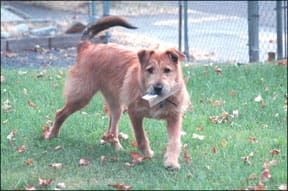
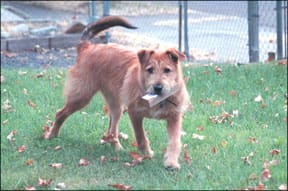
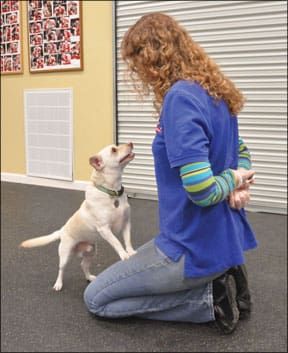
Your dog grabs your stuff and runs away either because she knows you’re going to take it from her and she doesn’t want you to, or she’s inviting you to join in her a fun game of “Catch me if you can.” In either case, chasing after her is usually the least effective way to get your stuff back. Besides the obvious “management, to prevent her access to your stuff,” and “exercise (mental and physical) to keep her happily otherwise occupied,” here are five suggestions that will maximize your chances of getting your precious thing(s) back quickly, relatively unscathed.
When your dog steals something, try these tricks:
1. Run the other way
Really. Chasing after your dog almost guarantees she will run away. If her motivation for stuff-grabbing is to get you to play, she may be just as happy to chase you. Let her chase you into a reasonably small space, close the door, and then employ Suggestion #3, 4, or 5 to convince her to give you your stuff back. (If her motivation is to get and keep stuff rather than get you to chase after her to play, this one probably won’t work. Go on to Suggestion #2.)
2. Quietly follow your dog
If your dog wants to keep your stuff rather than play with you, any noise and fury on your part will cement her intentions and make it infinitely harder to get the thing away from her. You risk triggering aggression in a dog who already guards, or teaching it to one who doesn’t yet. Be calm and cheerful. I know; it’s hard to be calm and cheerful when your dog has your valuable heirloom keepsake. Do it anyway. When the opportunity presents itself, engage in Suggestion #3 or 5, but carefully. Suggestion #4 may work, but is less successful when your dog’s motivation is keeping rather than playing. Because the dog in this scenario is likely to be guardy, any pressure on your part may cause her to hold onto the item more intensely, or even bite you. Don’t corner or trap her; that could increase the risk of aggression. If she takes the item into her crate, do not reach in to get it until you have successfully negotiated her out of her crate.
3. Trade for treats
Now that she’s not running away, your best chance at getting your thing back unshredded is to have your dog give it up willingly. If you try to grab it you’re likely to end up in a game of tug, and your stuff will suffer. To trade, simply convince your dog to drop your thing in exchange for something irresistible. Every room in my house has a container full of “something wonderfuls” just in case I need them. My favorites (and my dogs’) is Canz “Real Meat Treats.” I get them from dogcatsupply.com. They are top quality ingredients, moist and meaty, and need not be refrigerated.
If your dog won’t trade for a treat in your hand, drop some treats on the ground. When your things are safely back in your own possession, vow to train your dog to give up objects happily on cue.
4. Throw a toy for your dog fetch
If your dog is more into tennis balls or plush toys than treats, engage her in play with her toy to get her to let go of yours. Keep at least one very favorite toy on a shelf in every room. The sound of her squeaky toy, or the mere sight of her beloved ball or tug rope, is usually enough for a toy-fanatic to drop your possession so she can go after hers. After all, she just wanted to play in the first place. Be sure to play for a while, so she doesn’t get wise to your scheme.
5. Use diversion tactics
What else does your dog love to do? Go for a walk? Ride in the car? Eat dinner? Get the squirrel? If you have stock phrases you use with your dog that will trigger an immediate, wildly enthusiastic response, try one of those (you have to sound genuine!) to see if you can get her brain to switch gears. At the sound of an excited “Get in the car!” she may well drop your thing and head for the door. Of course, then you are obligated to take her for a ride. If you lie to your dog, sooner or later your karma will come back to bite you!
Pat Miller, CPDT-KA, CDBC, is WDJ’s Training Editor. Miller lives in Fairplay, Maryland, site of her Peaceable Paws training center. Pat is also author of several books on positive training.
A few months ago, I wrote about the British Kennel Club’s registration of two special Dalmatians over the objections of the breed clubs there (WDJ June 2010). These two dogs were the result of a breeding project begun in 1973, in which a single outcross to a Pointer was made in order to reintroduce the normal gene for uric acid back into the Dalmatian bloodline.
288
Fourteen generations later, more than 99.98 percent of the offspring’s genes are identical to those of a purebred Dalmatian. The one critical exception is that, unlike every other dog registered by both the British and American Kennel Clubs, these dogs are no longer at risk of forming urate bladder stones, a painful and potentially deadly condition caused by a genetic mutation carried by all Dalmatians.
Since that article was written, there have been some new developments. First, an update on what has been happening in Britain: Fiona (Fiacre First and Foremost), the first low uric acid (LUA) Dalmatian registered with the Kennel Club, has been winning at shows. While naysayers claimed her first win was “fixed,” Fiona’s group win the following week proved that these dogs are indistinguishable from other Dalmatians, and worthy of inclusion in breeding programs.
Meanwhile, back here in the States, theAmerican Kennel Club (AKC) Health & Welfare Advisory Committee submitted a report with the following recommendation:
“Because the introduction of the low uric acid dogs into the AKC registry gives Dalmatian breeders a scientifically sound method of voluntarily reducing the incidence of the condition, this committee strongly recommends some controlled program of acceptance of these dogs. Where the strict health and welfare of the breed is the over-riding concern, no other argument can be made.”
Despite these findings from its own committee, the AKC board voted in November to defer a decision until after June 2011, when a vote of the Dalmatian Club of America’s membership would be held. Since the breed clubs in both Britain and the U.S. have remained staunchly opposed to registration of LUA dogs, it seems unlikely that this vote will show them putting the welfare of their breed above their concerns of genetic purity. While AKC says it will “consider this vote, along with other factors in reaching its final decision,” don’t hold your breath in hopes that they will do the right thing.
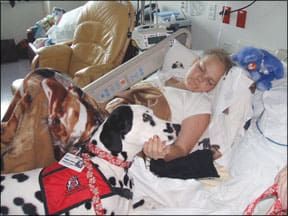
In the meantime, another dog has paid the ultimate price for the breeders’ shortsightedness. Armstrong, a seven-year-old Dalmatian who worked as a therapy dog at the children’s cancer unit at the Primary Children’s Medical Center in Salt Lake City, Utah, was put to sleep due to uncontrollable urate stones.
Armstrong had previously undergone multiple surgeries to remove stones, followed by a urethrostomy, where the dog’s urethra is rerouted away from the penis to a new, surgically created opening. Even after such a drastic measure, Armstrong continued to form stones, requiring two more surgeries just five months apart.
His owner, Shelley Gallagher of Sandy, Utah, had been feeding Armstrong a low-purine diet, giving him extra fluids to help dilute his urine, letting him out to urinate every few hours (including every night at 2 am), and obsessively monitoring him – all, ultimately, to no avail.
If you’d like to let the Dalmatian Club of America know how you feel about this, email its president, Meg Hennessey, at president@thedca.org. For those interested in LUA Dalmatians, they are currently registered in the U.S. only with the United Kennel Club (UKC). – Mary Straus
There’s a new dog coming into your life who needs to learn her name. A puppy perhaps? Or maybe an adult rescue “do-over” dog? You might even have a dog who’s been with you for a while, but just doesn’t respond to her name as promptly as you’d like. If you’re eagerly anticipating the arrival of a new canine family member, be sure to put “teaching the name response” on top of your dog to-do list. And if you’re frustrated that your current dog doesn’t appear to know who she is, don’t fret; it’s never too late to teach this very important behavior.
How to Name Your Dog
We humans develop a personal attachment to our own names at a very early age. I am Pat Miller. Your WDJ editor is Nancy Kerns. Even a young child, when he hears his name, registers a “that’s me!” response. Our dogs, probably not so much. Although we can’t know for sure unless and until some day we can actually get inside their heads, it’s likely that a dog just learns to associate the sound of her name with (we hope) “good stuff” in the same way she associates other things (a ball, a leash, the car keys, the clicker) with good stuff.
Looks can be deceiving. When I say “Lucy!” only our Corgi gets excited. If I call “Scooter!” our Pomeranian does the happy dance. Our Scottie comes running if I call “Dubhy!” while we’re doing barn chores, while the rest of our dogs continue about their business. It sure seems that they know who they are! However, the simplest and most likely explanation, is that each of them, over time, has learned that good stuff happens for them when they hear their name sound, but not the other name sounds. That doesn’t mean they grasp the “I am my name” concept that we humans seem to instinctively understand.
Here is the key to teaching your dog to respond to her name: Name = good stuff. It’s almost as simple as that. While teaching your dog that her name means good stuff, you also need to be careful not to send her a mixed message. If you sometimes use her name to yell at her in anger, she’s likely to stop and weigh her options. “Let’s see… I wonder if a good thing will happen this time, or if a bad thing will happen. Hmmmmm.”
If she has to stop and think about it, it’s too slow. You want that unpoisoned, instantaneous, automatic “Yay! Good stuff!” response when she hears her name-sound. So, as you go forward teaching your new dog her name, be sure to keep it always positive. If you must yell at your dog, do it without using her name. If you think your dog’s name is already poisoned, consider giving her a new one, and then teach her that the new name is the best sound in the world.
Choosing a Good Name Can Improve Your Dog’s Training!
As a child, I was enchanted by TS. Eliot’s The Book of Practical Cats, especially his poem, The Naming of Cats. I had the whole thing memorized at one time, and can still recite parts of it, starting with, “The naming of cats is a difficult matter — it’s not just one of your everyday games And you may think I’m as mad as a hatter when I tell you a cat must have three different names.”
Eliot may have thought naming cats was difficult, but I think naming dogs is infinitely harder. The wrong name can be a self-fulfilling prophecy of doom, while the right one can steer a dog onto the road to success. “Killer” and “Stupid” are obviously poor name choices, while “Champ” and “Hero” are clear winners. Dogster.com breaks down dog naming nicely here.
But it’s not always as clear cut as that. The owner who gets a new puppy at Christmas and names her “Noel” or “Snowbird” may realize too late that the unfortunate inclusion of the sound “No” in her dog’s name can create a strong negative name-association rather than the positive one we strive for — especially if it’s an owner who hasn’t fully bought into positive training and uses a strong aversive “No!” reprimand. Check your prospective dog name choices for any negative sounds and toss out any that might have a bad association.
In a multi-dog household, it’s best to avoid redundant name sounds. We made the mistake of naming our Scotty “Dubhy” (pronounced “Duffy”) while Dusty, our aging Pomeranian, was still with us. Although we vowed never to do that again because of the confusion it caused, we currently have a “Missy” and a “Lucy” – close enough that it can also create “mistaken identity” incidents between the two.
Multi-syllabic names are usually shortened to nicknames, so that’s not a problem: “Footloose and Fancy Free” becomes “Lucy,” and “Bonnie Wee Lass” is just Bonnie. Even nicknames are fine – a dog has no problem with happy associations with many different name-sounds. “Lucy” is also “Lulu”; “Dubhy” is “Doodles”; “Bonnie” can be “Bon-Bons”; and “Scooter” is also quite happy to respond to “Scootie Man.”
Clients often ask me about changing a dog’s name. Of course, many shelter and rescue dogs arrive without names. They may be given temporary names by staff and volunteers, but adopters often choose a different name once they get their dogs home – and dogs do just fine with that. Some people spend hours trying out different names to see if the dog responds to any of them, but that’s not necessary. In fact. if you have reason to suspect your new dog may have any kind of negative association with the name he came with – abuse, neglect, or harsh training methods – you are better off changing it.
Like many dog owners, we like to select names for each of our four-legged family members that have some special significance. We had a cat for 18 years named “Gewurztraminer” because that’s the kind of wine we were drinking when we found him. “Dubhy” means “dark” in Gaelic – appropriate for our Scottish dog. My husband, Paul, wanted to name our current Pomeranian “Harley,” because we have great times together on our motorcycle. “But,” I said, “He’s too little to be a Harley. He’s more the size of a scooter.” So “Scooter” he is.
Teaching Dogs the Name Response
Remember that your dog’s name does not mean come. It simply means “Look at me and wait for further instructions.” It’s important to make this distinction. There will be times when you want your dog’s attention but you don’t necessarily want her to come running to you. If she’s on the other side of the room and you want her to lie down there, you might say, “Lucy,” and when she looks at you, say “Down.” The more you aspire to advanced levels of communication and training with your dog, the more important it is that each cue has a very clear and specific meaning.
In order to train your dog you must be able to capture and retain her attention. Teach your dog to respond to her name by associating it with a click (or a verbal marker such as “Yes!”) and a food reward. At first, when your dog is already looking at you, say her name, click, and offer her a treat. Do this several times to create an association between the sound of her name and the resulting click-and-treat.
Teach her to continue to focus on you by clicking and giving her a reward several times, for time periods that gradually increase in length, as she continues to look at you.
You’ll have the most success with this if you start off with a high-value treat. If I wanted you to look at me instantly when I say “Fribbit,” I might say “Fribbit” and hand you a one hundred dollar bill. That would get your attention! If I give you a one hundred dollar bill every time you hear me say “Fribbit,” you’ll probably become pretty consistent about looking at me for “Fribbit.” In time, even if you don’t get a hundred dollars for every “Fribbit,” you’re still going to look, in hopes that this”Fribbit” might be a winner.
Now think about your response if, instead of a hundred dollar bill, I gave you a penny every time I said “Fribbit.” You probably wouldn’t care much, if at all. You’d quickly get bored with pennies and look for something more rewarding and interesting to do. Find your dog’s equivalent of a one hundred dollar bill. It might be dried liver, cheese, anchovies, bits of canned chicken . . . try a variety of foods to find the one that immediately captures your dog’s rapt attention.
You can also use life rewards for teaching the name response. If your dog is a tennis ball nut, say her name, and when she looks, toss her the ball. Life rewards tend to slow down the repetition process (it usually takes longer to deliver repeated life rewards – you have to get the ball back before you can do it again), but if it’s something your dog really loves you can make up for lost repetition time with the enthusiasm of the response and the faster positive-association time.
When you think the association has been established between your dog’s name and the high-value treat, wait until she glances away, then say her name. (You might have to hide the treats behind your back, stop making eye contact, and wait a while to get her to look away.) If she looks back at you right away when you say her name, click and give her a treat.
If she doesn’t look at you immediately, don’t say her name again; instead, make a “kissy noise” (very technical dog training term) to get her to look at you; then click and treat. If you have to make the kissy noise several times in a row as you repeat the exercise, back up and spend more time creating a stronger association between the name and the click-treat while she’s looking at you, before trying again when she looks away.
Adding Distractions to Name Training
When you’re getting a very prompt and consistent “snap” of your dog’s head back to you at the sound of her name, you’re ready to start adding distractions. Start with small distractions at first; you want to set up your dog to succeed, not flunk the first test. Ask a family member to make a small noise on the other side of the room. When your dog glances in that direction, say her name, and when her head snaps back, click and give her a treat.
If she doesn’t look back at you immediately, use your kissy noise to get her to look. When she looks, click and treat. If you have to “kiss” to get her to look several times in a row, go back to working without distractions again for a while, and/or find a higher-value reinforcer.
When you’re getting a reliable snap-back name response with low-level distractions, gradually increase the amount of environmental interference. First, increase distractions in your own home environment with more sound and/or movement of other family members, including four-legged ones, then up the ante by taking the show on the road. Play the name-response game when you’re taking your dog for a walk around the block, hanging out at your son’s soccer game, and playing at the dog park.
If you lose your dog’s response at any step of the process, back up to your last level of success, spend some more time working at that level, then move forward again, perhaps in smaller steps. Eventually you’ll have a rock-solid name response from your dog that, along with reinforcement for increasing length of attention, will serve you both well as you live and learn together for many years to come.
NAMING YOUR DOG: OVERVIEW
1. Consider carefully and choose wisely if you are naming (or renaming) your dog.
2. Commit to giving your dog a very consistent, very positive association with the name you choose. Name = good stuff. Always.
3. Protect that positive association for the rest of your dog’s life so her name never becomes “poisoned” by you or by anyone else who comes in contact with your dog.
Pat Miller, CBCC-KA, CPDT-KA, is WDJ’s Training Editor. Miller lives in Fairplay, Maryland, site of her Peaceable Paws training center. Pat is also author of several books on positive training, including her latest: Do Over Dogs: Give Your Dog a Second Chance for a First Class Life.
Interest in homemade diets has never been greater, especially since the huge pet food recall of 2007. Last month, I reviewed books that explained how to feed a homemade canine diet based on raw meaty bones (RMBs). This month, I’ll look at books about boneless diets – by far the largest category of books.
288
Unfortunately, I found a lot of bad books out there. Many of the recipes provided in the books are nutritionally inadequate! There’s no harm in using them from time to time, or to replace a small portion (up to 25 percent) of a commercial food diet, but anyone who relies on these books to feed their dogs a homemade diet is likely to end up with issues that could range from dry skin to crippling orthopedic conditions.
Calcium, in particular, is often mentioned only in passing or left out of recipes entirely. As just one example of the problems this can cause, I heard from one person who relied on four popular homemade diet books, none of which stressed the importance of added calcium, to create a diet for her puppy. As a result, her pup developed nutritional secondary hyperparathyroidism, a metabolic disorder caused by lack of calcium that can lead to bone deformities and spontaneous fractures. At one point, her puppy’s bones were so soft that when an X-ray was being taken, the technicians actually bent the leg bone. I’m happy to say that the pup appears to have made a full recovery once she began adding calcium to his diet, but this could have resulted in irreparable damage.
In contrast with the RMB books, the books reviewed here provide recipes rather than just diet guidelines. Most of the food is cooked; only two books suggest using raw meat (and only one requires it). Some recipes are simple, consisting of a few, basic ingredients, while others are indistinguishable from human recipes, with multiple ingredients, seasonings, and preparation steps. All diets include grains, though the percentages of meat, grains, and vegetables varies considerably.
Whichever one you choose, please read the whole book, not just the recipes. All of the books I recommend contain essential information in the text about substitutions, supplements, and more. Using the recipes without reading the rest could lead to critical errors in the overall diet.
Unless a book says specifically that the recipes are approved for puppies or for all life stages, assume that they are meant for adult dogs only. Puppies and pregnant or nursing females have special nutritional requirements; if you want to feed them a homemade diet, you must make sure it will meet their needs.
Except where noted, all of the books listed below are available from Amazon.com and other bookstores. Many are also available from Dogwise (dogwise.com; 800-776-2665).
These reviews are directed at homemade diets only. Many of the books contain additional chapters on such topics as herbs, homeopathy, grooming, and more. My recommendation of a book’s diet does not mean that I endorse anything else that the book may say.
I’m saving the best for last: three books that have analyzed all recipes to ensure that they meet the latest NRC guidelines. Each of these books offers recipes for diets with and without raw meaty bones, so whichever type of diet you want to feed is covered. Two of the books focus on raw, grain-free diets approved for all life stages (cooking is permitted), while the third offers cooked and raw recipes, with and without grains, designed for adult dogs only. This review will be published in an upcoming issue.
Home-prepared pioneer Dr. Pitcairn was an early advocate for homemade diets for dogs, publishing the first edition of Dr. Pitcairn’s Complete Guide to Natural Health for Dogs & Cats way back in 1981.
The latest edition (2005) offers several improvements. The recipes have been revamped; most are moderately higher in both protein and fat and lower in carbs than before. For example, the Doggie Oats recipe increased the amount of meat from two to three pounds and decreased the amount of oats from eight to five cups. The amount of bone meal to add to each recipe has been clarified, as different products vary in how much calcium they contain.
A wide variety of foods are recom-mended, including various meats, liver, eggs, dairy products, grains, legumes, vegetables, and fruit, along with garlic, yeast, and flavorings as soy sauce. Some ingredients, such as liver and fish oil, are discussed in the text but are not included in the recipes. Supplements include vegetable oil; bone meal; vitamins A, D, and E; and Healthy Powder (a mixture of yeast, lecithin, kelp, vitamin C, and bone meal).
Pitcairn stresses the need for variety and suggests substitutions for meats and grains in his recipes. Four of the recipes are vegetarian, but they use eggs and dairy products for protein, which is acceptable. While his recipes are higher in carbs than I prefer, with 36 to 61 percent in the regular meals, they have an adequate amount of protein, ranging from 23 to 33 percent. According to Pitcairn, “You may also feed any of the basic cat recipes to dogs,” a good choice if you want to feed meals that are higher in protein and lower in carbs. Special recipes are provided for dogs with kidney disease, allergies, and weight loss; the latter are high in carbohydrates (not ideal).
Despite the high carbs, this is still one of the better homemade diet books around. You can rely on these recipes to provide complete nutrition for your dog.
Another updated classic The 2000 edition of Holistic Guide for a Healthy Dog has been completely reorganized, but the diet presented in the book is virtually identical to the original version. A single recipe is provided, split into two meals: a cereal meal that makes up 25 percent and a meat meal that makes up 75 percent of the diet. Cottage cheese is substituted for meat one day a week, and there is a half-day fast (modified cereal meal only) one day each week. The diet is 35 percent protein, 17 to 20 percent fat, and 34 to 39 percent carbs on a dry matter basis.
Much information is unclear in this book, including the amount of bone meal to use, which appears to be too high. The problem is that bone meal can vary greatly in how much calcium it contains. I finally found the brand of bone meal used buried in Appendix 2. I looked it up online and discovered this particular brand has just 720 mg calcium per teaspoon, half the amount found in many products. With no guidance in the text, however, I’m sure many people would get this wrong.
Volhard recommends feeding only beef meat, as she says “testing thousands of dogs through kinesiology for over 20 years has shown me that the majority of dogs prefer beef.” Variations are provided only for dogs who cannot tolerate or will not eat the regular meals. There’s simply no reason to avoid variety, and many reasons not to.
There are other errors and ambiguities in the text, such as the statement that corn oil “contains only a tiny amount of linoleic acid.” You are advised to use blood tests to monitor the diet, but blood tests will not show nutritional deficiencies or excesses unless they are extreme (and often not even then). Many people have had success with this diet, but some dogs don’t like the cereal portion, and the supplements are complicated.
A tad complicated Better Food for Dogs is one of the better books that use human-style recipes, though that says more about the quality of the competition than about this book itself. Recipes average 40 percent protein, 45 percent carbohydrates, and 15 percent fat on a dry matter basis, which is acceptable.
Variety is stressed, with variations for some recipes provided, but I have a number of reservations about the recipes. Neither liver nor heart is included. Canola oil is added but no omega-3 fatty acids. Some recipes are overly complex.
I like the fact that tables are provided showing the average nutritional analysis for each set of recipes compared to NRC minimum requirements. However, they expect you to use these tables to calculate the amount of bone meal and other vitamin and mineral supplements to add.
As with many books co-authored by veterinarians, you are frequently urged to consult with a professional. I find many of these recommendations unnecessary or impractical, such as, “Giving your dog omega-3 fatty acid supplements should only be undertaken with the guidance of your veterinarian.” and “When purchasing [a daily multivitamin-and-mineral supplement intended for humans], use the charts in Chapter 7 and consult with your pharmacist to ensure that you are adding the proper supplementation without reaching toxic levels.”
All in all, I think this is a better book than those whose diets are higher in carbs and omit calcium, but the recipes and supplements may be more complicated than some people want to deal with.
Eat with a friend I first read Carol Boyle’s book, Natural Food Recipes for Healthy Dogs, in 2007, when she participated in the sample cooked diets portion of my series of homemade diet articles (“Reality Cooks,” WDJ July 2007). I liked Boyle’s approach to sharing your own meals with your dogs so much that I began incorporating some of her ideas into the diet I feed my own dogs.
Rereading the book now, I’m still impressed. Boyle has a practical, common sense style that makes home feeding seem simple. She calls it “the scatter-shot theory” of good nutrition, using variety, moderation, and balance over time to ensure that her dogs’ nutritional needs are met. She recommends feeding a diet that is two parts protein to one part carbohydrates by volume, with added servings of sweet potato, dairy, and eggs. She recommends feeding two to three meals a month of liver, and the same for canned fish.
It’s important to read Boyle’s text and not just look at the recipes, which are for individual foods rather than for meals. Boyle gives guidelines as to how to combine these foods into meals to create a complete diet. She also stresses the need to add calcium at the rate of 1,000 mg per pound of meat, and gives instructions on using ground eggshells to supply calcium. Note that some recipes include onions, which Boyle advises be removed before serving to dogs.
Boyle suggests feeding a percentage of your dog’s body weight daily. She provides little guidance on supplements, advising that you add vitamins C and E, fish oil, and possibly a multi-vitamin and mineral supplement.
Boyle’s book is a good choice for those who enjoy cooking. You may find it even helps you improve your own nutrition!
Fifty recipes My name is on the cover (as a contributor) of The Healthy Dog Cookbook. Isn’t there just the tiniest conflict of interest having me review my own book? Fair point – except it’s not really “my” book.
In 2007, I heard from an editor in England who had been contracted by TFH Publications to produce a homemade diet book for dogs. The editor asked if I would be willing to provide recipes for the book. I declined, as I prefer to give diet guidelines rather than recipes. The editor asked if I would write the introduction, and I agreed, provided that the recipes met my criteria: at least half animal products (meat, eggs, fish, dairy); organ meat (particularly liver) included in small amounts; no vegan recipes; and an appropriate amount of added calcium. To my surprise, they agreed.
In the end, I wrote not only the introduction, but also the information presented with each recipe, which included portion sizes (which I now feel are too high) and the amount of calcium to add. My introduction includes sections on the need to provide calcium, variety, and balance over time; protein, fat, and carbohydrates in the diet; food preparation; amount to feed; and supplements. I was paid a fee for my contributions; I do not receive royalties from its sale. I was not aware that they called me a “canine nutritionist” until after the book was published or I would have asked them to change it.
The recipes in this book use what I consider to be appropriate proportions, include a variety of foods, and aren’t complicated to make. Ingredients include various types of meat and fish, liver, heart, eggs, yogurt, cottage cheese, cheese, pasta, oatmeal, barley, quinoa, brown rice, potatoes, sweet potatoes, yams, pumpkin, spinach, carrots, green beans, peas, asparagus, beets, tomatoes, peanuts, and fruit, plus herbs (parsley, dill, mint, thyme).
While this is not the book I would create myself, I think it’s better than many of the recipe books available, particularly those that do not include calcium.
Do as she does, not says I found myself intrigued by the diet that Joan Weiskopf, author of Pet Food Nation, feeds her own dogs. In her introduction, she describes breakfast five days a week of chicken liver, heart, and gizzards, sautéed in coconut oil. She adds string beans, zucchini, yogurt, and a fish oil gelcap, plus grains in winter. Two mornings a week, she feeds eggs for breakfast. Lunch consists of a raw chicken neck. Dinner is meat, including fish two days a week, plus seasonal vegetables, and sometimes rice or grains as well. So far, so good.
Unfortunately, it was downhill from there. Weiskopf’s book is disorganized, with similar but not always consistent information scattered among different chapters. Weiskopf recommends a diet that is 65 percent protein and 35 percent grains, vegetables, and fruits. Recipes are designed for dogs weighing 20 pounds; she gives no other guidance on portion sizes. While she recommends variety, she does not offer any substitutions in her recipes.
Calcium guidelines are jumbled, and only five of the nine breakfast and dinner recipes include calcium. Note that chicken necks are listed as “Dog Snack/Lunch” that she indulges her dogs in only if they are “particularly active (and insistent).” Supplement recommendations are similarly unclear. She includes “⅛ tsp. probiotic liquid” and “1 fish oil capsule” in her Monday-Friday breakfast recipe and “multivitamin/mineral for dogs” in three of her dinner recipes.
Recipes for dogs with kidney disease are overly restricted in protein. All of the recipes for dogs with health issues are high in fat.
Joan Weiskopf is listed as “MS, Veterinary Clinical Nutritionist,” but she is not a veterinarian. While this book is better than some, due to using appropriate ratios of protein and carbohydrates and including proper amounts of calcium, it is disorganized, sometimes contradictory, does not stress variety, and gives very little guidance regarding supplements. This diet won’t harm your dog, but you can do better.
Could have been simpler All of the information in Simple Cooking for Dogs 101 is acceptable, but even more details would have been helpful. Human-style recipes are designed to last a few days to a week. All recipes state how many cups they make, and a table gives portion sizes for dogs in eight weight categories. Calcium is not included in the recipes, but is described in the text with appropriate guidelines. Recommended supplements include Missing Link, garlic, canned pumpkin, fish oil, ground flaxseed meal, yogurt, probiotics, digestive enzymes, and various herbs. Guidance may not be specific enough for a beginner.
Mary Straus does research on canine health and nutrition topics as an avocation. She is the owner of the DogAware.com website. She lives with her Norwich Terrier, Ella, in the San Francisco Bay Area.
1. When doing early crate-training, don’t let your dog out of the crate when he’s whining or barking. Even if you’re certain he really needs to go potty, try to wait for a few moments of silence before opening the door.
2. Use the crate as a rewarding place, not a punishing one! If you use it consistently for “time-outs” rather than “time in with a Kong,” your dog will start to resent and avoid it.
I am a huge fan of crate training for dogs. I think the ability to spend an extended amount of time in an enclosed space quietly and calmly is a valuable life skill for dogs. And it certainly has dozens of benefits for us, too.
1. Dog has safe space where he can’t be bothered by other dogs or household pets or people.
2. Dog has a safe place to enjoy a bone or food-stuffed Kong, without worrying about having it taken away from him.
3. Dog has a comfortable, enclosed place to nap or sleep – somehow reminiscent of the canine’s evolutionary den.
4. In an emergency or in the case of an injury that requires the dog to be kept quiet, the dog can be safely contained, keeping him out of harm’s way in a familiar, comforting environment. This point is really important to me. In California, I’ve lived in areas that suffered week-long floods and fires that burned tens of thousands of acres. I was living in San Francisco when the Loma Prieta earthquake struck in 1989, sparking fires that destroyed dozens of homes. I have friends in the Bay Area who had to evacuate their neighborhood after a gas pipeline explosion a few months ago. I haven’t yet needed to evacuate my pets, but I could if I had to – and I wouldn’t have to worry that my dog was traumatized and freaking out because he was put into a crate. I also feel much better knowing that if he’s ever confined to a crate for a hospitalization or recovery from an injury, he’ll be absolutely content and comfortable.
5. If the dog is boarded or has to stay overnight or for an extended stay at a veterinary hospital, he’ll be much less anxious if he’s well habituated to his crate. My friend and trainer Sarah Richardson, of The Canine Connection in Chico, California, puts it this way: “It’s like eating at McDonalds in a foreign country – a familiar place where they can relax and know what to expect.”
Richardson also operates a daycare and boarding facility. She says there is a striking difference between dogs who are crate-trained and those who are not. “Daycare and boarding can be exciting for a dog, but they can also be stressful. Crate-trained dogs always seem grateful for some rest and relaxation in the midst of a stimulating stay here, and they come out of the crate refreshed and ready to play again. The crate has become their cue for relaxation. It’s much more difficult for dogs who aren’t crate-trained to fully relax and sleep well when they are in unfamiliar surroundings.”
Benefits to an Owner of Crate Training:
1. Peace of mind in an emergency (again, fires, flood, etc.).
2. Peace of mind that a comfortably crated dog can’t destroy one’s house or car.
3. As a testament for all the reasons to train your dog to perform a rock-solid sit, trainer Ian Dunbar often cites a list of things that a dog can’t do when it is sitting, such as jumping up, humping your leg, getting in a fight, etc. The list of things a dog can’t do while crated is even longer, and includes chewing through electrical cords, stealing your socks, getting into the garbage, tormenting the cat, and peeing behind the sofa. Also, I was caring for a friend’s dog once, and left him in my car for a short time while occupied with something else. When I came back, I found that he had chewed through every seat belt in the car. I don’t leave dogs uncrated in my car any more!
4. Crates are a valuable tool for house-training a dog. Few dogs will soil their crates if they can help it. After each stint in a crate, take them directly outdoors to potty. If they don’t go, bring them back inside and pop them right back into the crate. If they do potty, reward them lavishly, and allow them to be free in the house for a while – but only about as much time as it might take for them to need to go potty again. At that point (and it depends on their age, when and how much they eat and drink, and other factors that you will know best), take them back outdoors. If they go potty, reward them again. If they don’t, back into the crate they go.
See “How to Potty Train A Dog” for more information on a potty training program for puppies, or remedial training for adults.
5. A crate and crate-trained dog ensure that you and your dog will be welcome at most friends’ and relatives’ homes. I recently stayed at a friend’s house over the holidays, with my foster dog! She doesn’t have enough training or self-control to abstain from chasing a strange cat, eating the cat’s food, chewing on the furniture, or stealing food off the table, but none of these things happened, because she was happy to spend all of her unsupervised time in their home in her crate. My friend commented, “We’re crate-training our next dog, for sure!”
6. Crates enable me (and others) to foster dogs from the shelter. I can say in all confidence that at least five dogs have found really great homes because I took the time to house and train them, and find just the right family to adopt them. If I didn’t have a safe place to put an untrained dog at night, or even just while I run to the grocery store, I wouldn’t be able to provide this service.
Prepare for Crating
You’ll need a few things to get started on the crate-training project.
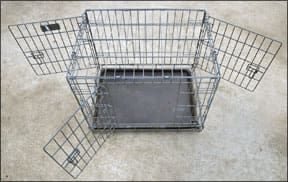
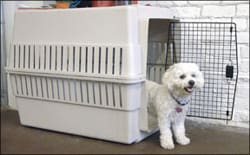
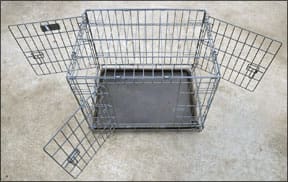
First and foremost, you need the right crate. There are three major types that are appropriate for training: plastic (or aluminum) airline-style crates; wire crates (they look like cages); and “furniture” style or “fashion” crates that are disguised to blend in with your decorating motif. Most dog owners choose a utilitarian (and affordable) plastic or wire crate; the aluminum and fashion models cost upwards of $500. (There are also “soft” fabric crates; these are appropriate only for dogs whose crate-training is rock-solid, since a determined or panicked dog can very easily chew or scratch his way through the mesh and escape.)
Each of the two most popular types offer one major benefit. Plastic crates seem to evoke the “den” feeling for the dog; many dogs accept being in a solid-seeming structure more readily than being in an airy cage. Wire cages offer more flexibility in where you can put them; most have at least two doors and some have three. This helps you position the crate in just about any corner or cranny in your home. Dogs will generally accept either type of crate, if you introduce the dog to the crate properly and don’t abuse or overuse crating.
The crate you buy needs to be large enough to permit your dog to comfortably enter, stand, turn around, and sleep in his favorite position. If he can’t get comfortable, the odds of his acceptance of the crate are poor! Measure your dog’s height and length; don’t rely on your memory and estimation of his size when ordering. If you’re in doubt, get the next size up. More room is always better, with the following exception: buying a crate for your medium- to large-breed puppy.
Knowing that your pup is going to stand 26 inches or so at the shoulder, and weigh 80 or more pounds, you select a very large crate. It’s good to plan ahead, right? Yes, but in the here and now, instead of providing a snug little studio apartment, we’ve supplied that puppy with a vast loft, complete with what he may perceive as a backyard bathroom. In other words, if he has just enough space to feel comfortable, he’ll make an effort to “hold it” in order to keep his bed clean. If he has too much real estate, he’ll probably start using some of it for going potty.
Most wire crates can be ordered with a divider panel that allows you to “fence off” some of that extra space while the puppy is little, and gradually expand the room he needs. I’ve never seen a plastic airline crate that offers this feature, although I’ve known owners who actually bought a small crate for the pup, and a larger one when he was older, larger, and already reliably crate-trained.
Next, find a good place for your dog’s crate. It should situated in a place that is neither too hot (next to a heater vent or in direct sun from a window), nor too cold (on a concrete floor in a chilly room or in a breezy, unheated hall). Remember that the dog will be stuck in that one temperature zone; you are depriving him of the ability to get up and move to a more temperate location, so the spot should be pretty comfortable.
Consider, also, your dog’s temperament and the traffic flow in your home. If your dog gets overstimulated by the sight and sounds of your kids’ playing and running with their friends, put the crate somewhere out of the flow of traffic. But if your dog gets a little anxious when he’s left alone, put his crate close to the center of action in your home, so he can be reassured as much as possible by the sounds of someone cooking in the kitchen or the television.
Note that if your dog displays serious anxiety when separated from the family, and hurts himself, destroys the crate, eliminates in the crate, and/or vocalizes nonstop, you’ll need the services of an experienced animal behavior professional to help properly diagnose and treat the behavior. See “Serious Separation Anxiety Calls for a Different Approach,” below.
The next thing you need to do is make sure that the crate is an incredibly cozy and inviting space for your dog. It should be equipped with a thick, comfortable bed or pad – not a thin little towel. The only exception to this would be for dogs who chew, eat, or otherwise destroy their beds; then you might have to experiment to find something that is comfortable but resistant to chewing. My dog is attracted to chewing up foam-filled beds, so I bought two of the thick, fuzzy “EcoNap” mats (not one of the many thin imitations) from West Paw Design. Otto is comfortable and the washable beds are still intact and attractive after two whole years.
The only acceptable reason (from my view) for not providing your dog with a thick bed in his crate? Very young puppies and a few adult dogs sometimes prefer peeing on a soft surface; you might have to eliminate padding for them, which means you have to keep the crate somewhere warm (in cold weather). You also should shorten the time you leave these individuals in a crate so they don’t feel the need to eliminate in their dens.
The last things you need for successful crate-training are a good supply of safe and attractive chew items and/or food-stuffed toys, such as Kongs or one of the stuffable “Busy Buddy” toys from Premier Pet Products.
Don’t Crate Dogs With Severe Anxiety
It’s a dilemma: A dog with severe separation anxiety may destroy their homes in a desperate effort to distract and console themselves when he is in the midst of an attack of separation anxiety. He may eat couch cushions, claw his way through drywall, attempt to crash through windows, and/or urinate and defecate all over the house. Sound like a dog you’d like to put in a crate? Actually, probably not.
Some dogs actually suffer worse symptoms when they are not only left alone, but also, when locked in a crate, are deprived of the things that might make them feel a bit better, like lying on your bed or sofa, or being able to look out the living room window from time to time. Most trainers have heard at least one sad story from a desperate owner whose dog mutilated himself — with bloody paws or even broken teeth — in an all-out panic to escape a crate.
“Crating is completely inappropriate for many, if not most, dogs who have true separation anxiety,” warns WDJ’s Training Editor Pat Miller. “Those with lesser levels of stress behavior about being left alone may be able to tolerate the close confinement of a crate, but for dogs who are truly panicked about being by themselves, crates seem to intensify their anxiety. Crating can worsen the separation anxiety behavior, and the dog can injure himself seriously, or even be killed, in his desperate attempts to escape his prison.”
A dog whose symptoms of separation distress are this severe will require some professional help, perhaps in the form of anxiety-reducing medication and the help of an experienced veterinary behaviorist.
Start the crate-training program by giving your dog some really over-the-top, delicious treats in the crate. Or, if he won’t go in, feed him the treats at the crate’s entrance. Slowly lure him into the crate with these treats, reinforcing each approach with praise – but don’t close the door! In his first dozen or so experiences with the crate, he should be free to enter and exit at will. If you slam the door on him before he even knows what it’s all about, he’ll be double-wary of approaching again. There is no hurry.
As soon as your dog is enthusiastically entering the crate in anticipation of goodies, ask him for a sit or down before you give him the treat. After a few repetitions of this, ask for a sit or down, swing the door closed for a few seconds, and then open it and pop that treat into his mouth. Good dog!
Your goal is to reward him for increasingly longer stays in the crate, but don’t increase the length of every visit to the crate. Keep the duration unpredictable, and the rewards variable.
At this point – but in a whole new session, not when he’s already stuffed with treats – prepare a really special food-stuffed Kong or other toy. Layer it with several yummy, stinky foods, such as anchovies, cream cheese, and bacon. Show this wonderful concoction to your dog, and then make a show of carrying it to the crate. Place it in the crate, far enough inside that your dog can’t snatch it and run out.
If your dog enters in a relaxed manner and picks up the toy and starts chewing, go ahead and close the crate door. Stay close, though; it’s too soon to leave him all alone in there, even if he’s absorbed by the food in the toy at the moment.
If he doesn’t go right in, close the door to the crate, locking him out of the crate and preventing him from eating the delicious food that you stuffed into the toy. In the best case scenario, he walks around the crate, trying to figure out how he can get in and get that treat. If he goes in the next time you open the door (and pick up the toy, and maybe even let him to lick it before putting it back in the crate), great. Close the door and proceed as above. If he still doesn’t go in, go back to the high-value treats and the shorter trips in and out of the crate. At no time should you forcibly drag, pull, or push your dog into the crate.
Depending on your dog’s comfort in the crate, have him go in the crate to enjoy a special treat (such as a big meaty bone, his favorite bully stick, or a food-stuffed toy) for increasingly longer sessions, several times a day. At first, stay close by while he’s locked in. Enter and exit the room, but gradually increase the amount of time that he’s in the crate in a room alone. Build the sessions to the point where you can actually leave your home for short, and then longer errands. As long as he seems happy to enter the crate and comfortable once in there, keep building on these sessions. If he’s reluctant to enter, or gets so preoccupied by his captivity that he starts whining or pawing at the gate, keep the sessions shorter, the treats high-value, and stay closer.
Here’s an important point: When you let your dog out of the crate, don’t make a big deal out of it. If you treat him like the three-month survivor of a raft at sea, he’s going to look forward to getting out of the crate so he can be the star of that particular newsreel. Instead, don’t make eye contact as you approach the crate, casually open the door, and ignore him for a few minutes when he comes out. You might even find that he doesn’t come out; that means you are really on the right track with the whole “comfortable in the crate” project.
What about the dog who barks, whines, or paws at the door during his longer sessions in the crate? You have to use your best judgment. Does he seem completely panicked or just a bit upset? Does he have to go potty immediately, or not at all? If you ascertain that he’s putting on a big act – he’s not panicked, just not happy, and he doesn’t have to go potty – then you will have to steel yourself for listening to a bit of fussing (or even some unpleasant barking). If you let him out in the middle of a frustrated tantrum, you will have just reinforced tantrums, and the next one may well be louder and longer.
Instead, lurk close by so that you can leap to release your dog when his whining or barking stopped for a few moments. Try your hardest to reinforce him for longer and longer periods of silence.
Crate Safety Considerations
I don’t want to scare you away from crating. But if you are going to employ this valuable management tool, you need to do so in a responsible manner. Take steps to avoid whatever hazards that crating may present to your dog.
Use an ID tag pouch, or an alternative to conventional, dangling ID tags — but don‘t forego identification.
lf I hadn’t seen it with my own eyes, I would have been skeptical that it could even happen, but my most recent foster dog caught her lD tag in the slats of a plastic crate. It’s a testament to her acceptance of the crate that she neither panicked, fought, nor even whined. I opened the crate the other evening and realized she was sitting with an odd, hunched posture. I thought, “Uh oh,” but I was thinking about bloat. l patted my leg to encourage her to come out of the crate. She wriggled, but maintained her odd posture. I got down on my knees to take a closer look — and that’s when I saw that her ID tag was stuck, wedged in one of the crate vents; she was being tightly held there against the wall. I’m a huge advocate of having ID on a dog at all times, but now I feel that it’s best if the dog wears a breakaway collar, or that some sort of alternative to a dangling tag is used.
Maintain safe temperatures for your dog.
It’s your job to make sure that your dog doesn’t roast or freeze in his crate, because there is precious little he will be able to do to help himself get cooler or warmer when he’s locked into a small space.
Provide water.
There are only a few reasons to withhold water from a dog in a crate – and no valid reason to keep him
without water for more than a couple of hours. Often, people who are trying to housetrain a puppy don’t want the pup to be able to “tank up” and later urinate in their crates. It’s safer to set your alarm to let the puppy go outside and pee once in the middle of the night than to prevent him from drinking for eight or more hours in one stretch — especially in hot weather.
If you’re concerned about the water spilling and making a mess, try one of those hamster-style water bottles that dogs have to lick to get a drink (available at pet supply stores) — or better yet, give the non-spilling Buddy Bowl a try. Your dog can flip this bowl completely upside down and still the water won’t pour out. The Buddy Bowl is widely available at pet supply stores and Internet sites.
One last point: Don’t overcrate your dog. Crates are a great tool, but they can be overused. When you walk toward the crate and your dog suddenly runs the other way, you need to increase the fun of crating, and decrease the time he spends in it. Also, keep in mind that puppies can’t “hold it” for all that long. A rule of thumb for pups during the day for up to one hour longer than they are months old. (A three-month old puppy should be able to hold it for four hours.)
I said at the beginning of this article that the ability to calmly spend time in a crate is a valuable life skill. And yet, in an average month, my own dog doesn’t spend much time (if any) in a closed crate. Why? Because he spends so much time in his open, well-padded crate that I rarely need to close its door!
When someone becomes interested in feeding their dog a homemade diet, I always advise them to read at least one book on the subject before getting started. But which one should you choose? Guidelines run the gamut from diets that have been analyzed to ensure they are complete and balanced, to those that are dangerously inadequate. How do you tell the difference?
288
I decided to check out the homemade diet books that are currently available. Some of them I’d read before, but wanted to take a fresh look at; others were new to me. It’s been an eye-opening experience.
I found some books that I’d liked a lot when I first read them didn’t hold up well now that I know more about canine nutrition, and in comparison with others that have been published since. A few new books and improved new editions were pleasant surprises, but I found that other popular books lacked any credible guidance on important topics such as dietary calcium, an omission that will lead to serious harm over time.
Whichever book you choose, it’s important that you read the whole book, or at least all of the sections pertaining to diet, rather than just looking at recipes. All of the books I recommend contain critical information about the diet in the text that you need to know before using their recipes or guidelines. If you just follow the recipes, you may miss essential details such as allowable substitutions, optional ingredients, and recommended supplements.
You may ask why I recommend reading books in the Internet age. Books offer a more complete and organized view of the author’s approach to diet, while even good websites often compress the information too much, leaving out important details, or scattering it onto different pages, making it easy to miss essential components. E-mail lists can be a good resource for beginners when they run into questions, but they’re not organized in a way that lets you learn everything you need to know.
Also, some e-mail lists are dominated by people with a single point of view, who will attack, ridicule, and remove anyone who disagrees, ensuring that you see only one side. Others allow anyone to say anything, meaning the advice you receive may be very good or completely misguided.
288
Books allow you to see the big picture, refer back to relevant details, and (one would hope) gain a clear understanding of the whole diet before you start. You can read reviews, check references, and decide whether the information seems reliable. If you take the time to read a book thoroughly, you’ll be better able to distinguish the good from the bad when it comes to advice found on websites and e-mail lists.
I’ll start this month by looking at books that focus on diets based on raw meaty bones (RMBs). Next month, I’ll review some excellent new books that offer guidelines for diets where RMBs are optional. Last, I’ll discuss books that have only boneless recipes, either raw or cooked.
Most of the books reviewed are available from Amazon.com and bookstores. A few can be purchased only from pet book specialists (such as Dogwise.com), holistic pet supply stores, or from the author.
Some books contain additional chapters on such topics as herbs, health issues, the evolution of the dog, and more. I have ignored those parts and focused my reviews solely on dietary guidelines and recipes. My recommendation of a book’s diet does not mean that I endorse anything else that the book may include.
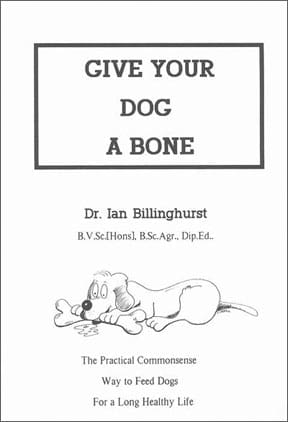
The origins of RMB diets When I first became interested in feeding my dogs a homemade diet based on raw meaty bones back in 1997, the choice of books was easy, as only one book on the subject existed. Australian veterinarian Ian Billinghurst published Give Your Dog a Bone in 1993. At least six more books that focus on RMB diets were published later, including two more from Dr. Billinghurst, as the popularity of the diets grew. Most offer variations on his original diet, though another Australian veterinarian, Tom Lonsdale, introduced a distinct style of feeding based on whole prey.
288
Proponents of raw meaty bones diets believe that this style of feeding most closely mimics the evolutionary diet of the dog. Raw meaty bones are those that can be fully consumed by dogs, as opposed to “recreational” bones, such as marrow and knuckle bones. Typical RMBs used by raw feeders include chicken necks, backs, wings, and leg quarters; turkey, lamb, pork, and beef necks; and lamb and pork breasts (riblets). RMBs provide a perfect balance of calcium and phosphorus, along with other nutrients.
It’s vital to realize that these diets consist of much more than just RMBs, which is why reading a book on the topic is strongly advised. Again, it’s important to choose the right book.
One of the biggest variations between books on RMB diets is the amount of bone included in the diet. Some books recommend feeding diets that are two-thirds or more RMBs. Too much bone provides excess calcium that can contribute to skeletal disease in large-breed puppies, such as hip dysplasia, hypertrophic osteodystrophy (HOD), and osteochondritis dissecans (OCD). Because calcium binds other nutrients, I believe that even adult dogs do better if the diet contains no more than 50 percent RMBs.
With that in mind, let’s take a look at the available books on feeding your dog a RMB-based diet.
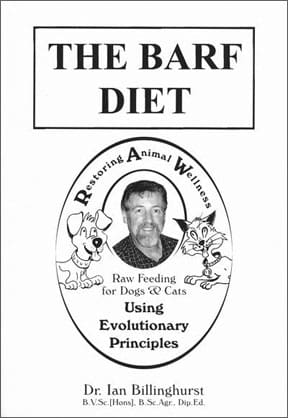
Dr. Billinghurst’s books Australian veterinarian Ian Billinghurst wrote the first popular book on diets that include RMBs, which he called BARF diets, for “bones and raw food” or “biologically appropriate raw food.” His diet is based on the natural diet of wolves and wild dogs. He later wrote two more books, Grow Your Pup with Bones, on feeding puppies and dogs used for breeding; and The BARF Diet, an updated and condensed version of his first book.
I have a soft spot in my heart for Billinghurst’s first book, as it’s the one that I relied on when I started feeding a raw diet in 1998. The book has a tremendous amount of detail about the various ingredients that go into the diet, and helped me grasp the concepts of balance over time; feeding raw meaty bones; and that if we can feed our children without resorting to “complete and balanced” meals from a bag or can, we can do the same for our dogs.
Billinghurst’s books can be frustrating, though. The information is disorganized. None of the books contains an index. If you want recipes or simple, clear instructions, you will not like Billinghurst’s books. Even those who appreciate the details on the nutritional benefits of each type of food may find it difficult to extract the specific elements needed to formulate a diet and determine how much to feed.
The foods and ratios used in all three books are similar. Billinghurst recommends feeding a diet that is approximately 60 percent RMBs, 15 to 20 percent vegetables and fruits, 10 to 15 percent organs, and the rest a variety of “additives,” including eggs, fish, muscle meat, oils, table scraps, grains, legumes, yogurt, and raw milk.
288
Billinghurst also adds whole food supplements: cod liver oil, apple cider vinegar, brewer’s yeast, honey, kelp, alfalfa, and garlic. He suggests supplementing with vitamins A, B-complex, C, D, and E, and offering the dog larger (recreational) bones.
Billinghurst stresses the need for variety in all three books, but he’s not consistent. In his first book, for example, he says that puppies can be fed up to 80 percent RMBs, stating, “We have found that we can get away with feeding puppies almost one hundred percent chicken wings, chicken necks, lamb ‘off cuts,’ and very little of anything else.” This advice is irresponsible, as it could lead to serious nutritional inadequacies and excesses that may cause lasting harm.
Feeding methodology varies between the three books. In the first, Billinghurst suggests feeding different foods at different meals. Over three weeks, you would feed 10 meals of RMBs, 4 vegetable, 1 starch, 1 grain/legume, 1 meat, 2 milk, and 1 or 2 organ meat meals.
The second book introduces the “patty,” a mix of all foods except RMBs (though those can be included in small amounts). Billinghurst suggests alternating between RMB and patty meals.
The third book offers two feeding choices: alternating RMB meals with a combination of other foods, such as meat (some including bone), organs, vegetables, fruit, and additives; or feeding “multi-mix patties,” consisting of all foods, including RMBs, ground together. The latter ties in with the introduction of “Dr. Billinghurst’s Meat and Bone Minces” from a company, BARF World, that he helped found (he is no longer affiliated with the company). The third book also places more emphasis on variety rather than feeding primarily chicken necks, wings, and carcasses.
The first two books are both quite long. While they are filled with valuable details and concepts, they unfortunately also contain misinformation about such things as the amount of protein, calcium, and phosphorus in commercial diets, and problems caused by too much protein that have since been disproved. The third book is shorter, making it easier to follow, and leaves out most of the earlier incorrect claims.
288
None of the three books provides good guidelines for how much to feed. All contain at least a few recommendations outside the scope of the general diet that I consider dangerous, such as feeding too much bone to puppies, frequent or prolonged fasting, and starving dogs who are overweight and puppies with skeletal problems by feeding them almost entirely vegetables.
A large portion of the second book is devoted to topics (health issues, breeding, and history) that are beyond the scope of this review.
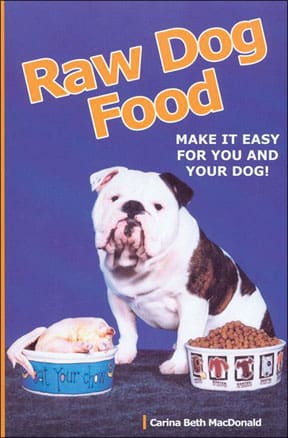
Good starter book Carina Beth MacDonald uses a lighthearted approach to cover the basics of a RMB diet without making things too complicated. Recommended proportions are 50 percent RMBs, 20 percent boneless meat, 5 to 10 percent organs, and 20 to 25 percent veggies, eggs, and fruit. In my opinion, this is a better ratio than other books that recommend a higher proportion of RMBs. Optional ingredients include dairy products, grains, apple cider vinegar, blackstrap molasses, garlic, ginger, nuts, legumes, and leftovers.
MacDonald’s book covers all the basics that a beginning raw feeder needs to know: what bony parts to feed, other foods to include in the diet, preparation, and how much to feed (as a percentage of ideal body weight). Note that the amounts given for puppies and small dogs (up to 10 percent of body weight daily) are too high. Recommended nutritional supplements include fish oil and vitamins C and E. Additional chapters go over customizing the diet based on age and size, problem solving, and answers to common questions.
I think this is one of the better “getting started” books for raw feeders, as it covers all the basics in a manner that is clear and easy to follow. The index is also helpful when you want to refer back to specific details as you put your diet together.
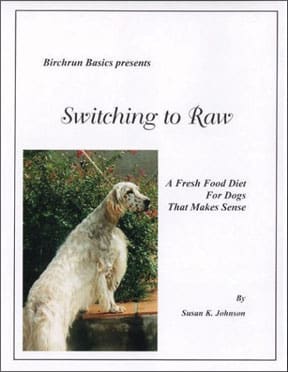
Billinghurst devotee Switching to Raw is a very simple and easy-to-follow translation of the first Billinghurst book. Both recommend feeding at least 60 percent RMBs; Susan K. Johnson’s sample menu suggests feeding two RMB meals every other day, with one meal of RMBs and one meal of other foods on alternate days. This comes to 75 percent RMBs in the overall diet, which I believe is too much.
288
Instead, I would advise feeding just one RMB meal and rotating between the other foods Johnson recommends for the second meal each day.
In addition to RMBs, Johnson’s diet includes fish, eggs, organ meats (15 percent of the total diet), muscle (boneless) meat, and vegetables, with grains being optional. She gives guidelines for how much to feed dogs that weigh 20, 50, and 80 pounds, broken into meals of RMBs; vegetables with fish and egg; muscle meat with egg; and organ meat with egg.
Recommended supplements include fish oil and flaxseed or hemp oil; kelp and alfalfa; vitamins B-complex, C, and E; cod liver oil; digestive enzymes and probiotics; and molasses (although the recipes in the “Amounts to Feed” section leave out vitamin E).
Note that the recommendation to feed puppies up to 10 percent of their body weight daily is too high.
Other sections include information on treats and recreational bones; making the switch; what to expect; and shopping and preparation. The book does not address possible problems with RMBs for dogs who gulp their food.
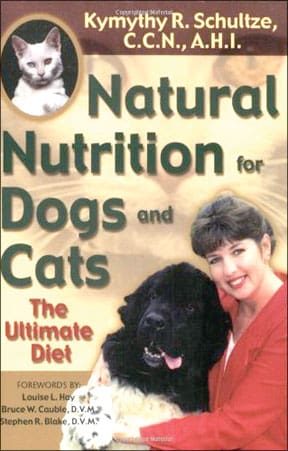
Not recommended Schultze wrote one of the early books on RMB diets. Her diet consists of muscle and organ meat, RMBs, eggs, and a very small amount of vegetables. Recommended supplements include kelp, alfalfa, cod liver oil, “EFAs,” and vitamin C.
Schultze’s book is filled with absolutes. She tells you to feed just one meal a day, and fast your dog one day a week. You’re not allowed to use aluminum foil for storage. She avoids both grains and dairy products, inferring without evidence that dietary guidelines for dogs with cancer will also help to prevent cancer. She makes other unsupported claims, such as that most pets cannot tolerate yeast. Other statements are just odd, such as advising not to feed raw salmon “unless it has tested free of salmon poisoning.” Testing for the parasite that causes salmon poisoning is not a viable option for dog owners.
The kind of details that would enable a dog owner to feed this diet are lacking here. A few examples: Schultze recommends feeding fish, but offers no suggestions as to the type of fish. Instructions for adding oils are vague. Food ratios are never given and feeding guidelines are unclear. She provides sample amounts to feed dogs weighing 10, 50, and 100 pounds, but ratios cannot be calculated because amounts are in different units. To illustrate, this is what she says to feed a 50-pound dog: “3/4-1 cup muscle meat (plus organ meat or egg), 1 turkey neck or 6 chicken necks, and 3 Tbl veggies, pulped.” Supplement amounts are also given: “2 tsp kelp/alfalfa, 1 tsp cod liver oil, 2 tsp EFAs, and up to 3,000-6,000 mg vitamin C.”
288
This book is too limited to be of much use, and doesn’t allow for variation in a dog’s needs. It also fails to address potential problems caused by bones.
I am even more unimpressed with Schultze’s newer book, The Natural Nutrition No-Cook Book (Hay House, 2005). In this book, Schultze offers human-style recipes, divided into sections such as Beverages (10 recipes); Dressings, Dips, Sauces, and Salsas (10); Fruit (15); and Vegetables (17). No attempt has been made to make these recipes complete; the book has no value to those who want to feed a complete and balanced homemade diet to their dogs.
Alternate paradigm: The “whole prey” diet Tom Lonsdale, another Australian vet, advocates a raw diet based on whole prey. I am not a fan of this style of feeding, as I feel it is impractical. It’s also restrictive; just because foods such as vegetables were not part of the evolutionary diet of wolves does not mean they provide no nutritional benefits. This book is the best guide available, however, for people who choose this feeding method. I’ll describe the distinguishing features of the diet and let you decide whether it appeals to you.
Lonsdale’s recommended diet consists of 70 percent RMBs, plus offal and table scraps. Lonsdale asserts that RMBs should come preferably from whole carcasses, such as rats, mice, and quail for small dogs; calf, goat, pig, kangaroo, and lamb for larger dogs; and rabbit, fish, and chicken for all dogs. Other recommended RMBs include chicken and turkey backs and frames (meat removed); poultry heads, feet, necks, and wings (small dogs only); sheep, deer, pig, and fish heads; lamb and pork necks; ox and kangaroo tails; sides of lamb; slabs of beef; and ox brisket. Table scraps and fruit are also allowed.
Large meals of liver are fed once every two weeks. Other offal deemed suitable by Lonsdale include lung, trachea, heart, omasum (part of the stomach of ruminants), tripe, tongue, pancreas, and spleen. Lonsdale says that if you can’t get offal, it’s acceptable to feed 100 percent of the diet as RMBs; he states, “Many of my clients fed almost exclusively chicken backs and frames – whether to adult dogs or litters of puppies – and their animals showed excellent health.” I do not recommend this!
Ground RMBs are not allowed by Lonsdale except for dogs with no teeth or health issues such as megaesophagus or pyloric stenosis; ground food can also be fed to sick dogs for short periods only. Problems with RMBs such as choking are blamed on feeding pieces that are too small. Foods to be avoided include excessive meat off the bone, excessive vegetables, small pieces of bone, garlic, and milk.
Lonsdale is opposed to adding supplements such as glucosamine, chondroitin, flaxseed oil, and kelp. He advises against using vitamin and mineral supplements for any dog, including pregnant bitches and puppies, saying they can be harmful.
Lonsdale suggests feeding dogs once a day, and fasting healthy, adult dogs one or two days a week; he also suggests fasting “fat dogs” for “lengthy periods . . . even several weeks” (which I consider abusive). One feeding method is to feed several days’ supply of food in one large piece, returning what is left to the refrigerator after the dog has eaten his share. Part-eaten bones can also be left outside “for further gnawing over ensuing days.”
Lonsdale and his followers are adamant that there is only one right way to feed dogs; no deviation is permitted.
Lonsdale has another book, Raw Meaty Bones: Promote Health (Rivetco P/L, 2001), which is not a how-to book; it’s mostly a history of Londsdale’s war with the pet food industry.
Mary Straus investigates canine health and nutrition topics as an avocation. She is the owner of the DogAware.com website. She and her Norwich Terrier, Ella, live in the San Francisco Bay Area.
Making a fresh look at the things we take for granted can be wonderfully enlightening. Sometimes, the little light bulb overhead begins to sizzle and sparkle, illuminating a new and better way of doing things. Consider this example: When some savvy veterinarians took a fresh look at performing spays, a surgery we’ve been doing the exact same way for decades, they came up with a revised technique that accomplishes all of the objectives of the spay surgery with fewer complications. How cool is that?
Spay is the term used for neutering a female dog. As I was taught in veterinary school, the medical jargon for spaying is ovariohysterectomy (OVH). “Ovario” refers to ovaries, “hyster” refers to uterus, and “ectomy” means removal of. In other words, spaying the traditional way involves surgical removal of the uterus and both ovaries. The objectives of the spay surgery are to render the dog infertile, eliminate the mess and behavioral issues associated with a female dog in heat, and prevent diseases that may afflict the uterus and ovaries later in life.
Thanks to some innovative veterinarians, we now know that ovariectomy (OVE) – removal of just the ovaries, leaving the uterus in place – accomplishes these objectives just as effectively as does the OVH. And, here’s the icing on the cake: removal of the ovaries alone results in fewer complications when compared to removal of the ovaries and uterus combined.
Female Canine Anatomy
Here’s a simple short course in canine female reproductive anatomy and physiology that will help explain why leaving the uterus behind makes sense. The shape of the uterus resembles the capital letter “Y.” The body of the uterus is the stem and the two uterine horns represent the top bars of the “Y.” An ovary is connected to the free end of each uterine horn by a delicate structure called a fallopian tube (transports the egg from the ovary into the uterus).
While the uterus has only one purpose (housing developing fetuses), the ovaries are multitaskers. They are the source of eggs of course and, in conjunction with hormones released by the pituitary gland, ovarian hormones dictate when the female comes into heat and becomes receptive to the male, when she goes out of heat, when she ovulates, and when her uterus is amenable to relaxing and stretching to house developing fetuses.
After the ovaries (and the hormones they produce) have been removed from the body, the uterus remains inert. The dog no longer shows symptoms of heat, nor can she conceive. Additionally, any chance of developing ovarian cystic disease or cancer is eliminated.
Better Outcomes with OVE
What happens when we leave the uterus behind? Isn’t it subject to becoming diseased later in life? Actually, the incidence of uterine disease in dogs whose ovaries have been removed is exceptionally low. Pyometra (pus within the uterus), is the most common uterine disorder in unspayed dogs, and typically necessitates emergency surgery to remove the uterus.
Without the influence of progesterone, a hormone produced by the ovaries, pyometra does not naturally occur. The incidence of uterine cancer is extremely low in dogs (0.4 percent of all canine tumors) – hardly a worry, and studies have shown that the frequency of adult onset urinary incontinence (urine leakage) is the same whether or not the uterus is removed during the spay procedure.
If you are not already convinced that the “new spay is the better way,” consider the following complications that can be mitigated or avoided all together when the uterus remains unscathed:
Compared to an OVH, an OVE requires less time in the operating room. This translates into decreased likelihood of anesthetic complications.
Removal of the uterus requires that the surgeon perform more difficult ligations (tying off of large blood vessels and surrounding tissues with suture material before making cuts to release the organs from the body). A uterine body ligation that isn’t tied quite tightly enough can result in excessive bleeding into the abdominal cavity and may necessitate blood transfusions and/or a second surgery to stop the bleeding.
The ureters (thin delicate tubes that transport urine from each kidney to the bladder) run adjacent to the body of the uterus. If a surgeon is not being extremely careful, it is possible to ligate and obstruct a ureter in the course of removing the uterus. This devastating complication requires a second corrective surgery; however, damage to the affected ureter and adjoining kidney may be irreversible.
Removal of the uterus occasionally results in the development of a “stump granuloma” – a localized inflammatory process that develops within the small portion of uterus that is left behind. When this occurs a second “clean up surgery” is typically required.
We know that the degree of post-operative patient discomfort correlates with the degree of surgical trauma. No question, of the two surgical options the OVH creates more trauma.
European veterinarians have been performing OVEs rather than OVHs for years. In fact, the bulk of the research supporting the benefits of leaving the uterus behind has been conducted in Europe.
Slowly, veterinarians in the United States are catching on, and some veterinary schools are now preferentially teaching OVE rather than OVH techniques to their students.
What should you do if you are planning to have your dog spayed? Talk with your veterinarian about this article. Perhaps OVE surgery is already his or her first choice. If not, perhaps your vet will be willing to take a fresh look at performing this old-fashioned surgery.
Nancy Kay, DVM, is a Diplomate of the American College of Veterinary Internal Medicine (ACVIM) and recipient of the American Animal Hospital Association 2009 Animal Welfare and Humane Ethics Award. She is also author of Speaking for Spot: Be the Advocate Your Dog Needs to Live a Happy, Healthy, Longer Life, and a staff internist at VCA Animal Care Center in Rohnert Park, California.
Teaching is the best way to learn. I know I’m not the first person to realize this, but it feels profound every time I remember it.
I’ve been working with volunteers at my local shelter, trying to teach everybody a little basic positive dog training, so that all the people who take dogs out of their indoor kennels for exercise, recreation, and socialization are on the same page.
We have several goals. Of course we want to make the dogs more comfortable, with a chance to eliminate outdoors, to breathe some fresh air, and have some room to run around or time to just lie in the sun and decompress from the stress of the loud indoor kennels.
We also want to help the dogs become more appealing to potential adopters. People are much more likely to consider a dog who knows even one or two basic good manners behaviors, such as “sit if you want me to open the gate” and “when in doubt, sit.”
I’ve noticed that as soon as you mention “training” to a motivated group of inexperienced dog lovers, however, almost immediately they start jerking dog leashes, kneeing jumping dogs in the chest, and saying “NO!” a lot. So my orientation speech to each potential volunteer starts out as a blatant sales pitch for positive training.
Otto is My Model
I have my dog Otto constantly in mind as I’m working with the volunteers. I adopted Otto from these very kennels on June 13, 2008. He was absolutely no different from most of the dogs in the kennels today. He was an adolescent, about seven to nine months old. (There are more adolescent dogs than dogs of any other age in shelters everywhere. It’s not hard to know why. They are neither cute puppies nor calmer adults.) He was frightened of humans and most things in the human world. He didn’t know the most basic good manners behavior, not even “sit.” His cage card indicated that he had a “rap sheet” for murder – chicken murder, that is. He had been in the shelter for almost two months.
Today, though, he’s the best-behaved, most reliable, and fun dog I’ve ever owned. Not coincidentally, he’s the first dog I’ve ever trained from day one with positive methods only – and I can’t believe what a difference it has made.
Me and my last dog, a Border Collie named Rupert, were also very bonded, but this is different. Otto’s actions and expressions convey a deeper trust in me than Rupert had. Otto is also far more motivated to try to figure out what I want, and unafraid to offer one behavior after another in an effort to puzzle out what might earn him my attention, praise, or a treat.
I owned Rupe for a number of years before I was asked to serve as the founding editor of Whole Dog Journal. I had never before been exposed to positive training for dogs – although I had been exposed to many different types of force-free horse training. Somehow, it never occurred to me to seek out similar methods for training my dog.
As a result, I used a certain amount of force-based training in Rupert’s early years. He was a classic sensitive, “soft” Border Collie, so all that was usually needed to “correct” his behavior was a stern verbal reprimand or an occasional leash correction. Not a big deal, right? Wrong! These seemingly minor transgressions on Rupe’s sensitive psyche meant that he developed into a dog who, when in doubt, would become very still. “I’m not sure what to do, but I don’t want to make a mistake and get yelled at . . . so I’ll just sit here and not look at her and hope she forgets about me.” And because I didn’t know any better, I took this for good training; because I had a dog who wasn’t being bad, I thought I had a well-behaved dog.
I suppose some people would say he was a “calm, submissive” dog.
I now know that what I really had was a cautious dog – one who knew me as someone who might scare or hurt him if he did the wrong thing.
Otto, by nature or nurture, is cautious, too. He can get frightened by new things, unfamiliar places, and loud sounds. However, he’s not afraid of me. He is not afraid or reluctant to come to me, ever. When I ask him to do something he’s not sure about, he’s like a kid whose hand shoots up every time the teacher asks a question, whether he knows the answer of not. He tries something, anything, because the odds are really good that he’ll win a prize just for trying, and there is no chance whatsoever that there will be a scary consequence if he gets the answer wrong. He likes learning; he can’t wait for a chance to “play” the training “game.”
Do No Harm to Your Dog
Neither I nor the other volunteers are there to form deep relationships with the shelter dogs. Nor is our goal to truly train the dogs. We’re there to help the dogs get adopted. The best way to accomplish this is to increase the dogs’ initial appeal; realistically, we don’t have the resources to accomplish much more than that.
But I’m adamant that we should also do no harm whatsoever. The animals in the shelter have already had enough misfortune for a lifetime; they really don’t need to learn any more about man’s potential for abuse. We’re not doing them any favors if they learn to trust humans even less, or to associate strangers with being smacked, reprimanded, yanked on the neck, or kneed in the chest – no matter their own behavior.
This is a tough concept for most people to grasp. I’m no anthropologist, but humans seem to be natural punishers. It’s not instinctive to turn the other cheek – butt cheek, that is! – when a large rowdy dog jumps on you; most people almost automatically swat at the dog. And it’s difficult to train inexperienced handlers to quickly respond to any more desirable behavior from the dog (such as standing, sitting, lying down, or walking away) with something the dog finds rewarding (food, petting, verbal praise, eye contact). It’s hard enough to even get people to recognize behaviors like standing, sitting, lying down, and walking away as “a big improvement” or “very good!” And yet, compared to jumping up, they are!
Proud Accomplishment
I know it’s instinctive for most people to attempt to “correct” obnoxious – and typical – shelter dog behavior such as barking, jumping up, and pulling on the leash. But instead of “correcting” them (the volunteers), I try to show them how well it works to simply ignore the undesired behaviors and quickly reinforce good (or better) ones. Fortunately, it works. It works in the short term – I can almost always demonstrate how well it works within minutes, with even the rowdiest, most frustrated, and most physically restless dogs in the shelter. And it works over the long term; Otto is exhibit A.
Best of all, these methods can be taught quickly enough for the volunteers to make obvious progress with the shelter dogs in just a single session. You can see them experiencing the joy of accomplishment when they see fast, positive results. It helps them enjoy working with the dogs so much more. So they come back more often. And the dogs get out more, and get more training. Win-win-win, to infinity. I love this stuff. Nancy Kerns is Editor of WDJ.
Our Corgi, Lucy, barks at the television. Not only does she bark at dogs, she may also bark at horses, giraffes, cartoon hippopotami, and any other animal or ersatz animal, as well as menacing human figures. It’s at least a little annoying, if not irritating. Given her herding-dog Type-A control-freak personality she may always be somewhat prone to respond to television stimuli, but we’ve made a lot of progress using several of these tactics:
1. Put your dog in a covered crate or in another room.
If your dog’s TV triggers are specific and visual-only, just blocking his view of the television can keep him calm and allow you to watch Victoria Stillwell’s “It’s Me or the Dog” training show without interruption from your canine pal.
Note: If you watch a lot of Animal Planet and National Geographic and your dog alerts to lions and tigers and bears (oh my!) as well as other canines, this might be too much separation during a prime bonding time of the day.
2. Lower the volume.
Simply lowering the volume to a level where you – and no doubt your dog – can still hear it but it’s not as overwhelming to him, can sometimes forestall a bark-fest. As long as you can keep the volume below your dog’s reaction threshold and still hear the television yourself, you can watch in peace.
3. Plug in your ears.
If it’s mostly auditory stimuli that get your dog going, you can use headphones to listen to your favorite dog-arousing shows.
If you have a large family, you’ll have to be more electronically adept than me to figure out how to get everyone plugged in. If your dog is also visually aroused, just tuning out the sound won’t be enough.
4. Cover your dog’s eyes and ears.
I’m not joking! If we’re watching a show and an animal comes on briefly that starts to set Lucy off, I can gently place my hand over her eyes until the offender is off-screen. She doesn’t object, and it keeps the peace.
Another option for more thorough ear covering is Mutt Muffs. Yes, these are ear muffs for dogs! They were originally designed to protect the hearing of dogs flying in small planes. They are available here.
Doggles (sunglasses for dogs) can be used to help reduce your dog’s visual stimuli. Find a local retailer by checking doggles.com or calling (866) 364-4537.
5. Implement a behavior modification protocol.
Television reactivity is a golden opportunity crying out for counter-conditioning and desensitization, to give your dog a new association with and response to the stimuli on your big screen. It’s a simple training procedure that still allows you to be a couch potato yourself!
Just arm yourself with a Tupperware container of high-value treats cut into pea-sized pieces and turn on your favorite dog program or doggie DVD. Try this first with the television set at normal volume, but be prepared to turn it down if necessary.
Sit on the sofa with your dog on leash at your feet, or on the cushion next to you, if that’s his normal hang-out spot. The instant he notices Dogzilla (or some other threatening on-screen entity) begin feeding him tidbits, one after the other, using the treat to draw his head toward you. Ideally, begin feeding before he has a chance to bark. If you miss that moment and he barks, feed him anyway. If he’s too aroused to eat your high value treats, decrease the intensity of stimulus by reducing volume or moving farther away from the television, or by using one of the tools in tactic #4.
After feeding a few treats, pause, let your dog look back at the screen, then feed him again. Continue doing this until the bark-inducing figure has left the screen. Then sit back and wait for the next opportunity. (Don’t forget to subtract calories from his dinner bowl roughly equivalent to the calories you feed during TV training.)
If you do this consistently, you’ll see your dog begin to glance at you for treats when a dog comes on the screen rather than going into arousal mode. When your dog consistently associates the dogs on TV with “Yay, treats!” you can gradually wean him off the high-value, high-rate delivery and move to an occasional bit of cookie to keep the association strong.
Pat Miller, CBCC-KA, CPDT-KA, lives in Fairplay, Maryland, site of her Peaceable Paws training center.
Occasionally I’ll get a call from a client who is having trouble getting their dog to go up or down stairs – a frustrating dilemma when you want your canine companion to be able to accompany you wherever you go. First, be sure your stairs are covered with a traction-providing surface, so he doesn’t slip and scare himself if he tries to use them. Next, here are some tips for overcoming this challenge:
288
1. Get a veterinary/chiropractic check-up. If your dog is hurting or otherwise physically challenged, it may be too painful or difficult for him to negotiate stairs. A chiropractic adjustment and/or pain-relief medications may have him scampering up and down in no time. If the condition cannot be alleviated enough to make him able to do stairs, you’ll know it’s time to stop trying, and find another alternative.
2. Carry him. Some small dogs (like our Pomeranian, Scooter) just aren’t big enough to handle a full flight of stairs. Scooter can manage the two steps at the back door into the house, but not the full flight of stairs up to our bedroom, so I carry him up at night, and back down in the morning. If you have a small dog who doesn’t like to be carried, you can teach him to go into a carrier, and tote the carrier up and down the stairs. You can also carry or use a carrier for a medium-sized dog who, for whatever reason, doesn’t like stairs, but it’s not a good option for a dog who is too large for easy lifting!
3. Provide an alternative. When we added a sunroom and new deck to the back of our house, my husband had the foresight to ask the contractor to build a ramp in addition to stairs, in anticipation of aging canines who might have difficulty with stairs. A few months later we adopted Scooter, who delights in using the ramp to the deck rather than the stairs. If your geriatric guy is having trouble and a ramp isn’t an option, you can use a towel as a sling under his abdomen to assist his back end up the stairs. This one’s a stretch, but if you happen to live in a home that has a stair-elevator chair for a disabled person, teach him to use that!
4. Shape it. Your dog may simply be afraid to go up and down stairs, and the more you pressure him to do it, the scarier it feels to him. Shaping allows the dog to make his own decisions and reinforces him for tiny pieces of “stair behavior” so he gains confidence. Just start at one end of the stairway – top or bottom, wherever he’s more comfortable – and click (or use a verbal marker) and give him a treat for any small movement toward the stairs. No coaxing, no luring, just let him make all the decisions and all the moves. In time – faster for some dogs, slower for others, your dog will take one step up (or down) then another, then another, and finally be happily willing to do the entire flight. If you’ve done other shaping games with your dog this may go faster; if you and your canine pal are new to shaping this can take longer. (See “The Shape of Things to Come,” WDJ March 2006.)
5. Back chain it. This is another solution for tiny to medium dogs – not practical for large dogs, but it can work like a charm with smaller ones.
Instead of starting at the bottom step and working your way up (or vice-versa), carry your dog up the stairs and set him down one step from the top. He sees safety just one step up and makes the attempt – one step is manageable for him, even if he’s afraid of stairs – and goes for the top. Phew! He made it! Feed him yummy treats too, as added reinforcement for his superb effort.
Repeat that process just one step from safety until he does that happily and easily, then set him two steps from the top. Emboldened by his repeated success with one step, he’s able to make the effort for two steps, then three, then four, until he can easily go up and down the entire flight without concern. Happy stair climbing!
Pat Miller, CPDT-KA, CDBC, is WDJ’s Training Editor. Miller lives in Fairplay, Maryland, site of her Peaceable Paws training center. Pat is also author of several books on positive training, including her latest: Do Over Dogs: Give Your Dog a Second Chance for a First Class Life.
To provide the best experiences, we use technologies like cookies to store and/or access device information. Consenting to these technologies will allow us to process data such as browsing behavior or unique IDs on this site. Not consenting or withdrawing consent, may adversely affect certain features and functions.
Functional
Always active
The technical storage or access is strictly necessary for the legitimate purpose of enabling the use of a specific service explicitly requested by the subscriber or user, or for the sole purpose of carrying out the transmission of a communication over an electronic communications network.
Preferences
The technical storage or access is necessary for the legitimate purpose of storing preferences that are not requested by the subscriber or user.
Statistics
The technical storage or access that is used exclusively for statistical purposes.The technical storage or access that is used exclusively for anonymous statistical purposes. Without a subpoena, voluntary compliance on the part of your Internet Service Provider, or additional records from a third party, information stored or retrieved for this purpose alone cannot usually be used to identify you.
Marketing
The technical storage or access is required to create user profiles to send advertising, or to track the user on a website or across several websites for similar marketing purposes.
This website uses cookies and other tracking technologies to offer you a better experience, personalize content and ads, and analyze our site traffic. Before proceeding, you agree to our Terms and that you’ve read our Privacy Policy. Update Settings
Functional
Always active
The technical storage or access is strictly necessary for the legitimate purpose of enabling the use of a specific service explicitly requested by the subscriber or user, or for the sole purpose of carrying out the transmission of a communication over an electronic communications network.
Preferences
The technical storage or access is necessary for the legitimate purpose of storing preferences that are not requested by the subscriber or user.
Statistics
The technical storage or access that is used exclusively for statistical purposes.The technical storage or access that is used exclusively for anonymous statistical purposes. Without a subpoena, voluntary compliance on the part of your Internet Service Provider, or additional records from a third party, information stored or retrieved for this purpose alone cannot usually be used to identify you.
Marketing
The technical storage or access is required to create user profiles to send advertising, or to track the user on a website or across several websites for similar marketing purposes.