Subscribe

The best in health, wellness, and positive training from America’s leading dog experts

Home Blog Page 268

Understanding Your Dog’s Body Language

Otto has gotten short shrift lately, poor guy. My husband and I had the brilliant idea of undertaking a minor home remodeling project over the holidays – just the bathroom! As is often the case with all-consuming home improvement projects, the dog was left to his own devices more than he should have been for a number of weeks.

Months ago, that would have been a recipe for disaster; Otto would have excavated half the yard and chewed up everything he could have gotten his mouth on. But he must be growing up; even after a few weeks of minor neglect, the only thing he chewed up was one of my husband’s high-top leather work boots. Amazing, considering the number of tools and wood and paintbrushes left lying around.

Dog Behavior and Body Language

288

He amused himself largely with a new obsession: running along our back fence with our neighbor’s two-year-old German Shepherd Dog, Schotzie. Our lot is about 80 feet wide, and both dogs share a mostly unimpeded path along that entire boundary, with just an ivy-covered five-foot-high chain-link fence between them. They are both young, active, and bored (the neighbors have a new baby). So, up and down they go, thundering through the mud, whining with frustration and excitement. It could be worse; they could be fence-fighting and barking (and maybe, if we remodeled the entire house, it would advance to this). But they seem to enjoy each other. And at least they are both getting exercise!

I’ve tried to talk Schotzie’s owners into letting her come over to play with Otto – and I was successful exactly twice – but they are worried about her “hurting” him. Apparently, on the few occasions when they have taken her someplace where there were other dogs, she “attacked” another dog. She played wonderfully with Otto. But I believe their stories; from what I can observe as a work-at-home neighbor, they hardly ever take her anywhere and she is getting less and less socialized.

It’s frustrating, because I’ve seen this phenomenon several times; in fact, it seems like every time I’ve seen a busy family get a young, big, active dog who hardly ever gets out, the dog’s behavior with other dogs gets worse and worse until they feel they can’t safely take the dog anywhere.

I’ve tried to tactfully describe this syndrome and its possible solutions to Schotzie’s people. They are a young educated couple, and very nice. The mom listens, but the dad appears to have his own strong ideas about dogs and dog training, and I can tell he has to put some effort into politely not-hearing what I have offered.

I get it. Few of us enjoy being subjected to unsolicited advice about our dogs – it’s like having some stranger tell you how you should deal with your toddler when he’s acting out in the supermarket. How likely is it that you could say something like, “Oh, okay! Thanks! I never thought of that!” On the other hand, I can clearly see the impending train wreck that often – usually – results from the social isolation of a large, high-drive dog. So, I’m trying to strike just the right note – respectful, friendly – while casually giving them information to consider.

Dog Behavior and Body Language

288

Could be the start of a beautiful friendship
A few months ago, Otto and I were just coming in from a bike ride when we saw the neighbors walking Schotzie. The mom had the baby in a front pack; the dad had his hands full with Schotzie, who had recognized her friend (Otto) and was pulling hard to get to him, despite her prong collar. I raced to put Otto and my bike through my front gate, and called to them. “Oh! Hi! Hi Schotzie! Can she come and play? Please?” As the dad looked sort of unconvinced (and Schotzie was going crazy), I pressed on, exaggerating, “Gosh, Otto has been so full of beans, and I’ve tried getting him tired with a bike ride, but he’s just such a handful!” He relented, though he worried out loud, as he was leading Schotzie in the gate as I held Otto back, “I just hope she’s okay. She can be pretty rough!”

“I’m not worried about Otto at all,” I reassured him. And I wasn’t. Otto has really terrific canine language and play skills; I’ve never seen him lose his cool with other dogs. If he gets overwhelmed or bullied, he’ll defend himself with a momentary growl and a snap, but immediately shakes it off and looks for someone else to play with. I’m not taking credit for this; he came equipped with a strong play drive! (Although I do work actively to preserve and protect this trait, by giving him lots of social time with other nice dogs.)

The second the dogs were turned loose, they took off across the yard like meteors. Otto loves being chased, and he had the home field advantage, knowing his yard intimately. Schotzie’s owners and I laughed and thoroughly enjoyed watching the two big dogs joyfully race and leap and wrestle. “Oh, we’ve got to do this again!” I enthused. “This is so great! Look at how happy they are! And they will both really sleep tonight! Thanks so much!”

Dog Behavior and Body Language

288

A few days later, I heard the mom calling to Schotzie, as our two dogs once again ran the fenceline. “Hi there!” I called over the fence. “Hey! Can Schotzie come over and play again?” “Sure!” she called back. “That would be great! I’ll bring her over.” The two dogs had even more fun playing this time. I opened my side gates, so they could race from the front yard to the back, and run loops around the house, which they did with delight. I took dozens of pictures of them as they played. They spent about an hour running and wrestling and playing with Otto’s toys.

I was just putting Schotzie’s leash on to take her home when the mom walked up to the front gate to get her. “They had so much fun!” I told her. “Any time you want to tire her out, give me a call; they are really great together! And, oh! Here is an article about why dog play is so good for them.” And I gave her a copy of an issue of WDJ that contains Pat Miller’s brilliant article on the importance of purposeful socialization (“Plays Well With Others,” March 2000).

Was that too pushy? I didn’t think so, but they haven’t taken me up on any further “play date” invitations. Once, while talking to the mom about neighborhood stuff, I asked again if Schotzie could come over and play, and she said, “I’ll have to ask my husband first. We took Schotzie to a picnic recently, and she bit this other dog really badly, and now he’s really concerned about taking her places.”

Argh! I don’t know why it’s so hard to understand that dogs will only get worse without opportunities to socialize, whether they are truly aggressive or, more likely, fear-aggressive. Looking through all the pictures of our two dogs playing, Schotzie’s body language looks anything but aggressive. I suspect she’s had so little experience socializing that she gets scared and overwhelmed and “attacks” out of fear. She didn’t “attack” Otto, perhaps, because she was familiar with him (albeit through the fence) and because he puts out such clearly playful signals; he seems to lack any tendency to bully other dogs.

Dog Behavior and Body Language

288

Well, at least they have the fenceline. Which, as I said, does actually help tire Otto out, especially when he’s not getting enough walks and hikes.

A trip to town
At the height of the holiday season, we took a few days off from our remodeling project and spent some time with relatives back in the Bay Area. Brian really wanted to leave Otto in Oroville, and have a pet sitter watch over him. But I couldn’t wait for the opportunity to bring Otto to some of my favorite Bay Area doggie hot spots, like the trails in the East Bay Regional Parks, and the dog parks in Alameda and at Point Isabel in Albany. And I really wanted some of my Bay Area friends to get to meet him!

We had a blast! Otto and I took one or two long walks every day, and he got to enjoy some of the best the Bay Area offers a dog, including visits to pet supply stores that offer cookies to canine visitors.

The only part of his “Christmas vacation” that he didn’t really enjoy was the very first part – where I took our often-outdoors dog to a do-it-yourself dog wash, to get him ready for a week of apartment living. He forgave me when I let him pick out a new stuffed squeaky toy to carry out of the store. I also bought him some rawhide chews; I found a place that sells the nicest rawhide chews I’ve ever seen: a roll made from a single “sheet” of extremely thick hide, made by Wholesome Hide. (I’ll be reviewing rawhide chews in the next issue; look for more on what makes a chew “the best rawhide I’ve ever seen” in April.) I didn’t want him chewing up my friends’ and relatives’ stuff while a guest in their homes.

Dog Behavior and Body Language

288

As it turned out, he behaved himself like a prince. He was probably too tired to get into too much trouble! He did rearrange many of the shoes in the house where we were staying, when we left him for the longest time. It was Christmas day, and we had dinner at the home of my pet-allergic brother-in-law and his pet-allergic wife. When we came home, we found 12 or 13 shoes, belonging to every member of the household, piled neatly by the front door along with a rawhide.

It was so neat, in fact, that I actually didn’t notice it at first; lots of people leave shoes by their front doors. But when I found one of my sneakers on the pillow of the bed that I had been sleeping in, I investigated further. That’s when I found the other sneaker by the front door, along with lots of other shoes, in pairs and singles. Fortunately, he didn’t chew a single one of them, just carried them about. Given the lack of damage, it was sort of fun, returning everyone’s shoes to their proper places.

The only thing about having Otto “in town” that disappointed me was discovering that we really need to practice walking on-leash more. In Oroville, I only have his leash on for the few blocks that it takes to get to the trailhead where I can walk him off-leash. We work on his leash-walking manners on the way to the trail. On the way home, tired, he’s always perfect on the leash, and though I reward him for this, it’s hardly necessary!

During our stay in the Bay Area, with the exception of his time in a dog park or on our two East Bay Regional Park hikes, he had to be on leash. Whether it was due to anxiety over a new setting, a lack of daily free time in a backyard, or just the sheer number of miles we walked on-leash, he pulled a lot more than he does at home. I carried treats with me, and tried to pay attention and reinforce him when he was walking quietly by my side. But I was walking with friends I hadn’t seen for a while, and talking, and not focusing exclusively on Otto. It’s time to go back to class, I guess.

Socializing with city dogs
At least once a week, I take Otto to a dog-park-like setting in the nearby town of Chico, California. It’s actually a genetic resource and conservation center for the Mendocino National Forest; it’s where they grow trees that produce the seeds used to replant forests. The best part is that it’s 200 fenced acres where people are allowed to walk their dogs off-leash. There is even a creek that runs through the middle of it, and dogs are welcome to splash through and swim in it. It’s awesome.

Many area dog owners take their dogs there for exercise and socialization, but it lacks the insular, intense feel that some crowded, urban dog parks can have. Mostly, dog owners walk a trail on the perimeter of the property. When you encounter dogs and people going the other way, or you pass somebody, it’s customary to allow the dogs to greet and play for a few minutes, and then walk on. Every so often, you meet another dog with the exact same play style and interest in playing that your dog does, and you might linger with them a good bit longer, or even walk the perimeter with them. It’s very relaxed and spacious – and I’ve noticed that the environment really promotes relaxed and happy dogs. I’ve never seen a dog fight there, or heard a dog owner screaming at another dog owner.

Dog Behavior and Body Language

288

I wish I could say the same for urban dog parks. I’ve been there and seen that before; Otto hadn’t, and he was a bit overwhelmed. On his first day at a two-acre park, a huge black dog (a Puli-mix, maybe?) repeatedly rushed him in a fairly intense manner, barking loudly, and he wouldn’t stop even when Otto dodged and bowed playfully. He only stopped when Otto ran 30 yards away or so.

Otto looked a bit mystified, but shook it off to find other playmates. In five trips to that park, though, he only found one dog that he really got into playing with, a young Husky female who was just as into chasing and bouncing games as he was. Many of the dogs were obsessed with fetching and couldn’t be bothered, or were older and grumpy. And a few were bullies! Like the big black dog, they seemed intent on rushing over to new dogs and inflicting their stamp of dominance on them. Otto would kind of hold his ground, neither rolling over submissively nor giving back any resistance, but as soon as he was “released,” or another dog approached to distract the bully, he’d hightail it for someplace else.

He had the same reaction at another, larger (but if anything, even more densely populated) dog park, when he heard a dog owner screaming at another dog owner after a bit of a scuffle involving half a dozen dogs. He had rushed toward the scuffle, getting there just as it broke up, and then looked plain astonished when the people started yelling at each other. Whoa! He gave them the same look he had given the big black dog and ran back toward me. I probably had the same expression on my face! Yikes! Let’s get out of here!

Seriously, I kept these urban dog park trips short; I could see they were a bit overstimulating after 20 minutes or so. Otto’s eyes would get a glazed look, and his tongue would look pasty and dry, even after drinking. He’d still be running around, but not in a joyous, bouncy way; he looked kind of hunted and distracted, even if no dog was chasing him. That was my signal to call him back and leave the park.

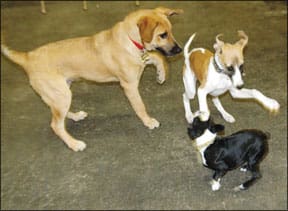
The most fun Otto had “on vacation” was during the two off-leash hikes we took with my friend Sandi Thompson (a Berkeley-based trainer who often models for our training articles) and her dog, Turtle (that’s them on pages 3-5). Turtle looks like a Mini-Me of Otto, a smaller, blonder, nimbler terrier-mix with an oversized ego and sense of humor. Otto found her fascinating, if a bit challenging. I’ll leave you with photos of their playtime together. His dismayed expression in the last one makes me laugh out loud every time I see it!

Nancy Kerns is Editor of WDJ. She and her husband adopted Otto from a shelter on June 13, 2008.

Exocrine Pancreatic Insufficiency in Dogs

EPI IN DOGS: OVERVIEW

1. When you see or hear about an apparently starved (or extremely thin) dog, please let the owner know about EPI. Few people know that it can affect any breed.

2. If your dog’s digestion is poor, with frequent diarrhea, consider having him tested for EPI. Visible symptoms of the disease may not appear until 80 to 95 percent of the pancreas has atrophied. Early diagnosis and treatment improve his prospects.


Kanis Fitzhugh, a member of the Almost Home organization, knew she had to rescue Pandy, an extremely thin and seemingly vicious four-year-old Dachshund. Pandy had been relinquished to a shelter in Orange County (California), who turned her over to Southern California Dachshund Rescue. Deemed people- and animal-aggressive, Pandy appeared to have been starved, and weighed just 13 pounds. Fitzhugh thought the dog deserved a break, and brought Pandy home in May 2007.

During the first couple of weeks in her new home, Pandy managed to pull a chicken down from the counter and proceeded to eat the entire bird, including bones, plastic tray, and grocery bag, in less than the 10 minutes that Fitzhugh was out of the room. Pandy was rushed to the vet and emergency surgery was performed, as the bones had ruptured her stomach lining in three places. Luckily, she survived.

Exocrine Pancreatic Insufficiency

Pandy’s voracious appetite, large voluminous stools, and aggressive disposition were all caused by a medical condition called exocrine pancreatic insufficiency (EPI). With Fitzhugh’s loving care, including enzyme supplements and a change of diet, Pandy stabilized. Within a year, Pandy had transformed into a beautiful, funny, 26-pound Dachshund who gets along great with all the human and animal members in the Fitzhugh household.

What is Exocrine Pancreatic Insufficiency?

Exocrine Pancreatic Insufficiency, or EPI, also referred to as Pancreatic Hypoplasia or Pancreatic Acinar Atrophy (PAA), is a disease of maldigestion and malabsorption, which when left untreated eventually leads to starvation. One of the major difficulties with this disease is in the prompt and accurate diagnosis. Astonishingly, visible symptoms may not appear until 80 to 95 percent of the pancreas has atrophied.

There are two primary functions of the pancreas:

(1) Endocrine cells produce and secrete hormones, insulin, and glucagons.

(2) Exocrine cells produce and secrete digestive enzymes.

EPI is the inability of the pancreas to secrete digestive enzymes: amylase to digest starches, lipases to digest fats, and proteases to digest protein. Without a steady supply of these enzymes to help break down and absorb nutrients, the body starves. When EPI is undiagnosed and left untreated, the entire body is deprived of the nutrients needed for growth, renewal, and maintenance. In time, the body becomes so compromised that the dog either starves to death or dies of inevitable organ failure.

Incomplete digestion causes the continual presence of copious amounts of fermenting food in the small intestine. This can lead to a secondary condition that is common in many EPI dogs, called SIBO (small intestinal bacterial overgrowth). If an EPI dog has a lot of belly grumbling/noises, gas, diarrhea, and sometimes vomiting, she most likely has SIBO.

The condition occurs when the “bad” bacteria that is feeding on the fermenting food overpopulates the tissue lining the small intestine, further impairing the proper absorption of vital nutrients and depleting the body’s store of vitamin B12. Treatment of SIBO includes a course of antibiotics, to eliminate the bad bacteria. Treatment may also include supplemental cobalamin (B12) injections that help reestablish friendly bacteria colonies, which in turn helps inhibit the malabsorption.

Severity of the disease may vary, making it even more difficult to diagnose. EPI can be subclinical (no recognizable symptoms) for many months, sometimes even years, before it worsens and becomes noticeable. The symptoms can be exacerbated by physical or emotional stress, change of food or routine, and/or environmental factors. The most common symptoms include:

– Gradual wasting away despite a voracious appetite.

– Eliminating more frequently with voluminous yellowish or grayish soft “cow patty” stools.

– Coprophagia (dog eats his own stools) and/or pica (dog eats other inappropriate substances).

– Increased rumbling sounds from the abdomen, and passing increased amounts of gas.

– Intermittent watery diarrhea or vomiting.

Due to the lack of absorbed nutrients, the body starves: muscle mass wastes away, and bones may also be affected. An EPI dog’s teeth may be slightly smaller, and older EPI dogs appear to have a higher incidence of hip dysplasia. Every part of the body is at risk, even the nervous system (including the brain), which in turn wreaks havoc with the dog’s temperament. Some EPI dogs exhibit increased anxiety, becoming fearful of other dogs, people, and strange objects.

With hunger as an overwhelming force, many dogs act almost feral. Desperately seeking vital nutrition, many ingest inappropriate items, but nothing gets absorbed. As the disease progresses, the deterioration becomes quite rapid. Some dogs lose interest in any activities, preferring to just lie down or hide somewhere. Many owners of EPI dogs become increasingly frustrated, as they feed more than normal amounts and yet their dogs continue to waste away before their eyes.

Since chronic loose stools are usually the first visible symptom in an EPI dog, most vets will prescribe an antibiotic to destroy what they suspect to be harmful intestinal bacteria. Owners are happy because the problem appears to go away, at least for a while. No one has any reason to investigate further, until the loose stools return or the dog starts losing weight, and then the merry-go-round cycle begins. Vet visits become numerous and costly, and one possible diagnosis after another is suggested. Expenses may include testing (and retesting) for giardia, coccidiosis, and other parasitic diseases; x-rays; ultrasound; MRI; antibiotics; and even surgery.

EPI Testing for Dogs

Until recently, EPI was most prevalent in German Shepherd Dogs. For this reason, a vet may fail to consider EPI as a possible diagnosis in other breeds and not pursue EPI testing: a trypsin-like immunoreactivity (TLI) blood test. TLI measures the dog’s ability to produce digestive enzymes. The test is done following a fast of 12 to 15 hours, and costs about $100.

Although other laboratories can run the TLI test, most blood samples are analyzed at Texas A&M University. The lab recently revised its reference ranges: values below 2.5 are now considered diagnostic for EPI. Results between 3.5 and 5.7 may reflect subclinical pancreatic disease that may ultimately lead to EPI. When values are between 2.5 and 3.5 µg/L, Texas A&M recommends repeating the TLI test after one month, paying particular attention to the fast before the blood sample is collected.

Even when a dog tests positive for EPI, it is important to retest TLI after the dog stabilizes following treatment. For example, chronic inflammation can put such a strain on the pancreas that the production of digestive enzymes ceases or is greatly reduced. Consequently, when the TLI blood test is analyzed, it accurately depicts lack of enzyme production, even though the dog may not actually have EPI. In this case, it is important for the dog to be treated with pancreatic enzymes until his condition is stable. Enzyme treatment breaks down the food, allowing the stressed albeit non-EPI pancreas to recuperate and, in time, start producing the enzymes needed to digest foods.

Dorsie Kovacs, DVM, of Monson Small Animal Clinic in Monson, Massachusetts, has seen some young dogs with false-positive EPI readings. Even when they display the lighter-colored “cow patty” stools, something other than EPI may be the cause. Sometimes a food allergy or an overabundance of bad bacteria has irritated or inflamed the pancreas, temporarily inhibiting enzyme production. In these situations, says Dr. Kovacs, it’s important to put the dog on a pancreatic enzyme supplement for two months, allowing the stressed pancreas to heal. The dog should then be retested to either confirm or rule out EPI.

In addition, Dr. Kovacs says, “It is also important to introduce good gut flora (bacteria) by adding yogurt, green tripe, or supplements such as Digest-All Plus (a blend of plant enzymes and probiotics). Good gut flora should continue to be maintained with supplements even after the inflamed or irritated pancreas has healed.” Dr. Kovacs has also noticed that some dogs with food allergies (especially dogs who are fed kibble) show rapid improvement when their diets are switched to raw or canned food. Raw meats contain natural enzymes, and fresh vegetables support the growth of good bacteria in the dog’s gut.

Managing a Dog’s EPI

Most dogs with EPI can be successfully treated and regulated, although customizing the dog’s diet and supplements may involve much trial and error.

Enzyme supplementation is the first step in managing EPI. The dog will need pancreatic enzymes incubated on every piece of food ingested for the remainder of his or her life. The best results are usually obtained with freeze-dried, powdered porcine enzymes rather than plant enzymes or enzyme pills. Plant enzymes and enzymes in a pill form do work for some, though with enzyme supplements, as with diet, much is dependent on the individual EPI dog. Some of the most widely used prescription enzyme supplements are Viokase, Epizyme, Panakare Plus, Pancrease-V, and Pancrezyme. Bio Case V is a non-prescription generic equivalent.

Enzyme potency is measured in USP units. Prescription enzyme powders range from 56,800 to 71,400 units of lipase; 280,000 to 434,000 units of protease; and 280,000 to 495,000 units of amylase per teaspoon.

Pancreatic enzymes are also available as generic pancreatin. Strengths of 6×10, 8×10, etc., indicate that the dosage is concentrated. Thus, a level teaspoon of pancreatin 6×10 contains 33,600 units of lipase and 420,000 units of protease and amylase, comparable to prescription enzyme products.

Some EPI dogs have allergies and cannot tolerate the ingredients in the most common enzyme supplements. Those owners learn to develop alternative methods such as using plant enzymes, or a different source of pancreatic enzymes such as beef-based (rather than porcine-based). Raw beef, pork, or lamb pancreas can also be used. One to three ounces of raw chopped pancreas can replace one teaspoon of pancreatic extract.

The starting dosage of prescription enzymes is usually one level teaspoon of powdered enzymes per cup of food. As time goes on and a dog stabilizes, many owners find that they can reduce the amount of enzymes administered with each meal, sometimes to just ½ teaspoon, although some EPI dogs require an increased dosage of enzymes in their senior years.

Enzymes need to be incubated, meaning that you add them to moistened food prior to feeding, letting them sit on the food at room temperature for at least 20 minutes. Some owners find that incubation up to an hour or more works even better. Too often, EPI owners are instructed that enzyme incubation is not necessary; however, some dogs will develop blisters or sores in their mouths from the enzymes when they are not first incubated on the food.

How do you judge what works best for your dog? When dealing with EPI, everything is gauged by the dog’s stool quality. EPI dog owners are always on “poop-patrol.” The goal is to obtain normal looking, chocolate brown, well-formed stools. When your dog produces something other than normal poop, it indicates she is not properly digesting her food. Sometimes longer enzyme incubation helps. Other times using more or less enzymes (since too little or too much enzymes can both cause diarrhea), changing the diet, treating a flare-up of SIBO, or starting a regimen of B12 shots solves the problem. Make only one change at a time. It is advisable to keep a daily journal as it may help you to identify the cause of a flare up or setback.

Prescription enzyme supplements can be very expensive. A $5,000 per year price tag for enzymes is not uncommon for a large dog – but don’t panic! There are several ways to reduce this cost. My 40-pound Spanish Water Dog has the dubious honor of being the first of her breed ever to be positively diagnosed with EPI. When the TLI results came in, I felt like my world came crashing down. Izzy is my once-in-a-lifetime companion, and was very sick. Using information my vet gave me, I estimated that the enzymes she needed were going to cost me $1,200 a year. She was just over a year old at the time, with an expected life span of 13 to 15 years. Eeek!

Today those enzymes cost me a mere $200 a year. How? I joined an EPI support group and learned what others do to better manage the ongoing care of their EPI dogs. I buy enzymes from an EPI enzyme co-op that purchases enzymes in bulk and passes the savings on to owners who have a veterinarian-confirmed EPI dog. The savings from these bulk purchases can be quite substantial. (For both groups, see “Resources for Products Mentioned in this Article,” page 22.) Today, Izzy is a plump, active, happy dog who gives me more joy than any dog I’ve had in my 55 years. I would have paid whatever it cost to help her, but not everyone has this option.

Another solution that can dramatically save money is to obtain raw beef, pork, or lamb pancreas. Ask your butcher if he can get fresh pancreas, or check with meat inspectors in your state to find out if and where you can obtain fresh pancreas. A letter from your vet explaining why you need fresh pancreas may allow you to purchase it from a slaughterhouse. Fresh beef pancreas can also be ordered from suppliers such as Hare Today and Greentripe.com.

The suggested dosage of raw pancreas is 3 to 4 ounces per 44 pounds of the dog’s weight daily. The pancreas can be blended or finely chopped, then frozen into either cubes in an ice tray or “calculated by the dog’s weight” single meal amounts in Ziploc bags. Raw pancreas can be frozen for several months without losing potency. When ready to use, thaw and serve the raw pancreas with the dog’s food.

A very important factor about enzymes – whether using raw pancreas, powdered pancreatic enzymes, or pills – is that all digestive enzymes work best at body temperature. Cold inhibits the enzymatic action while heat destroys it. Never cook, mix with very hot water, or microwave raw pancreas or supplemental enzymes.

Antibiotics are the next line of defense, in order to combat SIBO (bad bacteria growth that overtakes the growth of good bacteria), the secondary condition that frequently accompanies EPI. Tylosin (Tylan) or metronidazole (Flagyl) are the most commonly prescribed antibiotics, and they are usually given for 30 days. Some dogs have trouble with metronidazole due to possible side effects; in that case, Tylan is given. Be warned: Tylan is bitter-tasting, and many dogs refuse to eat their meals when it’s added. There are tricks to deal with this. Some put the Tylan powder in gelatin capsules; I camouflage it for my dog by inserting the required dose in a small chunk of cream cheese. Not all EPI dogs can tolerate dairy, so the camouflage method should depend on the individual dog’s tolerance.

B12 (cobalamin) injections are needed if the dog has very low serum cobalamin. A blood test is required to determine this, costs about $31, and is best done simultaneously with the TLI test. Many EPI dogs cannot replenish B12 levels on their own, so B12 injections are used. B12-complex formulas are not recommended since they contain much lower concentrations of cobalamin and appear to cause pain at the injection sites. Generic formulations of cobalamin (B12) are acceptable.

The recommended cobalamin dosage is calculated according to the dog’s weight and may be found on Texas A&M University website (see page 22). Your vet can show you how to give your dog subcutaneous (beneath the skin) B12 injections. What seems to work best are weekly injections for the first six weeks, then biweekly (every other week) injections for the next six weeks, and finally monthly B12 injections.

Feeding Dogs with EPI

A common saying among those whose dogs have EPI is, “If you’ve met one EPI dog, then you have met just one EPI dog.” Even with pancreatic enzyme supplements, much of the health and well-being of each EPI dog depends on his diet. Sometimes all that’s needed are supplemental enzymes and the standard recommended dietary modifications: no more that 4 percent fiber and no more than 12 percent fat (on a dry matter basis).

Sometimes it’s much more complicated! Some dogs can tolerate much more fat. My dog, Izzy, for example, does extremely well on grain-free kibble with 22 percent fat content, well above the 12 percent range. Other dogs cannot tolerate even as little as 12 percent fat. The same applies to the fiber content. Some EPI dogs have unrelated food allergies, further limiting their diet.

Many dogs with EPI thrive on raw diets and some owners find that a raw diet is the only one that works for their dogs. Conversely, other EPI dogs cannot tolerate raw diets. Some owners successfully feed grain-free kibble, some make home-cooked meals for their dog, while others feed a combination of commercial and homemade. When adding to or adjusting a diet, feed the dog tiny chunks of raw carrot with the diet. These carrot pieces will present themselves in the stools (for better or worse) of that meal’s elimination. This helps you understand which foods/vitamins, etc., work well together and which don’t.

Recommendations keep evolving and changing with new research, as well as the feedback from networks of owners of EPI dogs. A recent change in feeding recommendations concerns dietary fat. Multiple studies from the past decade indicated that a fat-restricted diet is of no benefit whatsoever to the EPI dog. A 2003 paper by Edward J. Hall, of the University of Bristol in England, states that there is experimental evidence to show that the percentage fat absorption increases with the percentage of fat that is fed. This may explain why some EPI dogs can tolerate higher concentrations of fat. For those dogs who cannot tolerate more than 12 percent fat, this may mean that the fat content needs to be increased very gradually, or perhaps that certain types of fat may be tolerated better than others. Much more research is needed to answer these questions.

Veterinarians usually recommend an initial diet of a prescription or veterinary food, such as Hill’s Prescription Diet w/d, i/d, or z/d Ultra Allergen-Free; Royal Canin’s Veterinary Diet Canine Hypoallergenic Diet or Digestive Low Fat Diet.

Prescription diets that are made with hydrolized ingredients (carbohydrates and proteins that have been chemically broken down into minute particles for better absorption in the small intestine, leading to more complete digestion, better/faster weight gain, and firmer stools) appear to work for many EPI dogs.

However, these diets are usually starch-based (often almost 60 percent carbohydrates on a dry matter basis); the digestive system of a dog is designed more for fats and protein than for starches, which may be why many EPI dog owners achieve better results by reserving prescription diets for short-term use and feeding other diets over the long haul.

The best results for managing EPI requires combining veterinarian advice with the experience of actual EPI dog owners. Too many times, managing EPI can be a real roller coaster ride! For example, initial research studies showed that supplemental enzyme powders needed to incubate on the food. Additional research studies then suggested that food incubation with enzymes was no longer necessary. Consequently, some EPI dogs developed mouth sores, so owners are again being advised to let the enzymes incubate to prevent this side effect. Until the causes and effects of this disease are better understood, it will continue to be managed via trial and error.

Canine Pancreatic Insufficiency Feeding Guidelines

Enzymes should be mixed with about one to two ounces of room-temperature water per teaspoon of enzymes, then added to the food and allowed to incubate for 20 minutes or more. A couple of tablespoons of room temperature kefir or yogurt (or some other “sauce”) may be used instead of water to mix the enzymes. Once an EPI dog is stable, some owners find that they can “cheat” and give their dog a smidgeon of a treat without any enzymes on it. Others find the least little crumb ingested without enzymes will cause a flare-up.

If possible, feed two to four meals a day, taking into consideration whether the dog’s condition has stabilized and whether the family’s schedule can accommodate multiple feedings. Feeding smaller, more frequent meals puts less stress on the EPI dog’s digestive system.

At first calculation, many owners of EPI dogs wonder if they can sustain the added expense of all these “special foods” in addition to the enzymes. It may take many attempts to find just the right diet for a dog with EPI that is also affordable by the owner, but it can be done. Following are some suggestions and techniques that EPI dog owners have successfully used.

– Kibble or canned: Many EPI owners who feed commercial kibble or canned dog food have found more success when feeding a grain-free product. Much depends on the individual dog.

When feeding kibble, many owners let the food and enzymes incubate until the food has an oatmeal-like consistency. Some even grind the kibble to allow for more surface contact with the enzymes. Some also add a teaspoon of pumpkin or sweet potato, which may help firm stools and reduce coprophagia; plus, both ingredients are packed with vitamins C and D. Sweet potato is also an excellent source of vitamin B6.

– Combination kibble and homemade: Many owners feed a combination of commercial food and raw or home-cooked. EPI owners generally mix foods at a ratio of 20 to 80 percent. As always with an EPI dog, enzyme supplements should be mixed in with the wet portion of the food at room temperature and allowed to incubate. Depending on each individual dog’s tolerance, any variety of meats and fish may be used. Sources of proteins can include beef, chicken, turkey, pork, venison, rabbit, lamb, canned or cooked salmon, and jack mackerel, as well as eggs, yogurt, and cottage cheese. Organ meats, such as liver, kidney, and heart should also be included in the diet. Green tripe is another good option. Variety is key! Again, incubate the food with the enzymes and feed two to four times daily, depending on your individual dog’s needs and your own schedule.

– Raw and home-cooked: Over the past few years, many owners have been able to stabilize their EPI dogs by feeding a raw diet. Raw food has the innate advantage of maintaining natural food enzyme activity that aids digestion. Many vets disapprove of feeding a raw food diet, especially to compromised dogs (possibly exposing them to further complications), while other vets suggest that raw is best for an EPI dog. There have been many anecdotal cases of dramatic improvement when the owners feed their EPI dog a raw diet, especially when all else fails.

Most EPI dogs cannot handle the 20 to 25 percent raw bone content in the diet that is commonly fed to normal dogs. With EPI dogs, it’s smart to start with only 10 to 12 percent of bone. Some dogs still have difficulty digesting this amount of the bone and the ratio will need to be reduced even further, to 3 to 5 percent bone. Note we are talking about the amount of actual bone, not the amount of raw meaty bones, which are usually at least half meat.

Vegetables may be a large or small portion of the diet, or not included at all, depending on the individual dog’s tolerance. If included, they should always be mashed. Organ meats are usually recommended at 10 to 15 percent of the EPI diet, but again, not all dogs can tolerate this.

Supplements for an EPI Diet

Whether you feed dry, canned, home-cooked, raw, or any combination, there are many other ingredients that may be added to provide additional benefits for EPI dogs.

Most EPI dog owners add coconut oil and/or wild salmon oil to their dogs’ diet. Many EPI dogs cannot digest other fats and develop dry, itchy skin or dry, brittle coats. Coconut oil contains medium-chain triglycerides (MCTs). Most vegetable oils have longer chain triglycerides, called LCTs. MCTs are utilized faster and burned more quickly for energy, raising the body’s metabolism, while LCTs are utilized more slowly. Also, coconut oil is one of the richest sources of lauric acid. Its benefits have recently been touted to aid in destroying various bacteria and viruses such as listeria, giardia, herpes simplex virus-1, and maybe even yeast infections such as candida.

Wild Alaskan salmon oil is an excellent source of omega-3 fatty acids, which help reduce inflammation.

Probiotics are another important addition to the EPI diet, especially since most EPI dogs are or have been treated with antibiotics because of SIBO. Antibiotics wipe out not only bad bacteria, but also good bacteria. Probiotics help maintain good gut flora. One popular brand of probiotics that has been successfully used by EPI owners is Primal Defense, but there are many quality probiotics available.

Zinc deficiency is another consideration with EPI dogs. It is difficult to accurately measure zinc absorption. Human EPI patients often develop a zinc deficiency, and though no studies have confirmed this to be true of dogs with EPI, many vets suggest a zinc supplement for EPI dogs.

Vitamin E (tocopherol) levels may also be low in an EPI dog due to malabsorption. Vitamin E is a fat-soluble vitamin that is an antioxidant and helps in the formation of cell membranes, cell respiration, and with the metabolism of fats. Vitamin E deficiency may cause cell damage in the skeletal muscle, heart, testes, liver, and nerves; supplementation with vitamin E can help prevent these problems.

Other natural nutrient sources that are often included in an EPI diet are kelp, green tripe, slippery elm, and alfalfa.

Controlling EPI

Texas A&M and Clemson University are currently embarking on Phase II of an EPI research project to try to identify the genetic markers for the disease. “This disease is characterized by a complex pattern of inheritance,” says Dr. Keith E. Murphy, Professor and Chair of Genetics and Biochemistry at Clemson University in South Carolina. “Thus, we have been limited in how we can attack this in order to identify the gene or genes, that contribute to this horrible disease. However, we are encouraged by the success that we and others have had using SNP technology [unique DNA tests] to identify genetic markers associated with various traits and we will be employing this approach to EPI.”

It is important that this research continues. EPI is rapidly spreading across all breeds. It is no longer just a GSD disease, or a working dog disease. Dogs of all breeds, including crossbreeds, are being diagnosed with EPI. It is happening in family lines too often to be coincidence without a genetic component. Yet, not every family member or generation in affected lines has EPI. For now, until we can actually test for the genetic markers, the best possible control is to remove positively confirmed EPI dogs from breeding programs. Once genetic markers are identified in GSDs, the markers in other breeds will be more easily detected.

Although there are many success stories, there are also heart-wrenching tales of dogs who cannot thrive, families who cannot afford the treatment, and throughout it all, the painful suffering the dog endures unless successfully treated. EPI can no longer be a “hush-hush” disease. My hope is that this article will make a difference by helping raise awareness of EPI to the level of other major canine diseases.

Many EPI Dogs Flourish

Kara surfaced as a stray in a shelter and was subsequently turned over to the Long Island Shetland Sheepdog Rescue group. When they received her, they did not expect her to survive the night, she was so sick and emaciated. They guessed that she was probably one to two years old, but she weighed barely seven pounds – half her ideal weight.

Kara was lucky; she was diagnosed promptly with EPI. While in foster care for four months, Audrey Blake met Kara twice during training classes and the frail little dog with the outgoing personality captured her heart. Although she understood that Kara would need pancreatic enzymes for every meal and a special diet, Blake took Kara home. Today, Kara is known as “U-CD Twenty Four Karat Gold, UD, TDI, CGC (Kara), Rescue Sheltie,” and happily resides with Blake on Long Island, New York.

Sadly, Some Dogs Perish

At five years old, Wayde was taken in by German Shepherd Rescue of New England. Wayde was found to have EPI, an all-too-common problem with GSDs. He also had the secondary bacterial infection, SIBO. Even with enzymes added to his diet, Wayde continued to drop weight until he was only 54 pounds and seemed sad and listless all the time.

Wayde was in the kennel for many months. Finally, a couple who was familiar with EPI, Pamela and Peter Burghardt from Wilmot, New Hampshire, decided to foster Wayde. In their home, his whole demeanor changed; he became happy and gained more than
two pounds the first week. Wayde soon settled in with his foster family and became a sweet “Velcro” dog. He became best friends with his foster sister, another white GSD.

Sadly, Wayde was diagnosed with cancer a few weeks after going into foster care and passed away four months later. Despite the cancer, he had gained 14 pounds and was active and happy to the end.

Olesia Kennedy, a retired research analyst, and previously involved in Canine Search & Rescue, currently devotes her skills and time to EPI research. She resides with her husband and three Spanish Water Dogs in Georgetown, Indiana.

Download The Full February 2009 Issue PDF

...
To continue reading this article or issue you must be a paid member.

Join Whole Dog Journal

Get full access to Whole-Dog-Journal.com – more than 4,000 articles – for just $20.
Join today and save 30% off our full price.
Already a member?
| Forgot your password? | Activate Web Access

Your Children Should Help Train the Dog

[Updated February 27, 2018]

For many kids, getting a family dog is one of the happiest experiences imaginable. However, disturbing dog bite statistics from the Centers for Disease Control (CDC) suggest that all is not well in the kid-dog kingdom. According to the CDC, each year, 800,000 Americans seek medical attention for dog bites. Half of these are children.

Training Your Dog

Your best insurance against your family being part of these statistics is a puppy-raising program that incorporates proper management and supervision and tons of carefully orchestrated, positive social experiences for your new dog. (For more about how to carry out an ideal socialization program, see “How to Socialize A New Puppy“.)

Your child’s active participation in the family dog’s training, however, will do a lot to cement your dog’s place in your family. The training of the family dog will always be most successful if the whole family is involved. Kids are great natural trainers, and tend to have more time than the adults do to spend with the dog. Also, when they learn positive training techniques, kids learn how to interact with and influence the behavior of other sentient beings without using force, fear, pain, or intimidation. These are skills that may serve them well in their interactions with their friends, classmates, and perhaps even their siblings!

Teaching Kids to Train Your Dog

One of the best investments you can make for training the family dog is a clicker; they cost between $1 and $3. Even if you prefer not to use one when training, buy a clicker for your children to use when they train the dog. Kids love clickers, and are often sold on the gadget from the very first “click!” They can’t wait to get their hands on that little plastic box and start clicking. You just have to convince them that the clicker is a dog training tool, not a toy – that every time they click the clicker they must give the dog a treat. With young children (ages three to six) you can “team click”: one of you clicks, the other feeds a treat to the dog. Older kids usually get the hang of doing both pretty quickly. In fact, their timing with the clicker will probably put you to shame.

You’ll also need a steady supply of tasty treats to use as training rewards. Use something delicious, not just some of the dog’s regular food. It’s also helpful if you choose a food item that is easy to cut up and feed in tiny pieces (no larger than a pea), such as cheese, canned chicken, or hot dogs.

Your child’s first assignment is to “charge the clicker” – or in scientific terms, condition the reward marker. This simply means to teach the dog that the “click” sound means he’s earned a treat. It couldn’t be easier.

Start with the clicker in your pocket or your child’s pocket to muffle the sound; the sharp “click” initially startles some dogs. If your dog seems to be afraid of the clicking sound, stop using it immediately and switch to a different reward marker. You can say “Click!” or “Yes!”, use the softer click of a ballpoint pen, or make a “click” sound with your mouth. Kids are great at mouth clicks!

You’ll be “team-clicking” at first: one of you clicks, the other feeds a tiny, tasty treat. Tiny is important because you’ll feed a lot of them. Tasty is important because you want your dog to love the sound of the clicker, so he learns to love training.

Click (or say “Yes!”), pause, and feed the dog a treat a half-dozen times, so your dog starts to realize the click means a treat is coming. At first, he doesn’t have to do anything to make you click – but be sure not to click when he’s doing a behavior you don’t want, such as jumping up. If you click by accident, however, he still gets a treat; every click means a treat is on its way.

You’ll know when your dog has made the connection: You’ll see his eyes light up when he hears the click, and he’ll look for the treat with eager anticipation. Ask your child to tell you when she thinks the marker is “charged” – that the dog understands that a click means a treat is coming; it’s a great opportunity to have her start to observe and understand her pup’s body language.

Your dog may start to sit while you’re charging the clicker, especially if you hold the treat up to your chest before you click, because it’s easier for him to keep his eye on the treat if he’s sitting. Encourage your young trainer to hold the treat to her chest and click the instant your dog’s bottom touches the ground. If the two of you consistently click-and-treat when the dog sits, he’ll think that sitting makes the click happen, and he’ll start sitting on purpose.

Now you’re going to teach your dog his name. It helps to have two clickers for this – or more, if more family members want to play the name game. One of you say his name, and if he looks at you, click and treat. If he doesn’t look, make a kissing sound to get his attention, then click and treat. Now the other says his name, and when he looks, click and treat. He’ll soon learn that the sound of his name makes the click and treat happen, and he’ll think his name is a very wonderful thing. This will be important to help you get his attention when you need it.

When he understands that click means treat and he responds quickly to the sound of his name, you’re ready to teach him to sit. Well, sort of. He really already knows how to sit; you’re just going to teach him to do the behavior when you ask for it. This is called putting a behavior on cue. The fact is, your dog already knows how to do all the behaviors you want him to learn; you’re just teaching him your words, and convincing him that it’s worth his while to offer the behaviors when you ask for them.

You’re going to teach him that the word “Sit!” means “put your bottom on the ground.” Since you and your junior trainer have already been clicking and treating him for sitting, this should be easy. Do a few more repetitions of “treat to chest,” sit, and click, just to be sure he’s got it. Now, have your child say “Sit!” – once – just before she holds the treat to her chest. When your dog’s bottom touches the ground, click and treat! If your child can deliver the treat directly to your pup’s nose before he gets up, you’re doubling the power of the reinforcement. If the dog tries to jump up to grab the treat, have your child hold it in her closed fist, wait for him to sit again, and then feed it from the open palm of her hand, the way you’d feed a treat to a horse.

Be sure to praise your dog after he gets his click and treat. Tell him what a wonderful, smart dog he is! If you associate praise with the click and treat process, your praise will be very reinforcing to him later in training, and you can use it to reward him for performing well even when you don’t click and treat.

If your dog does not offer sits for the “treat to the chest” maneuver, lure a sit by moving the treat over his head. When he sits, click and treat. When you know he’ll sit for the lure, add the word before you move the treat, then click and treat when his furry bottom touches the floor.

Notice that you don’t add the verbal cue (“Sit!”) until you know you can get your dog to do the behavior. This is a very important concept to teach your kids. They need to understand that your dog doesn’t know what the words mean until you teach him, and that using them before he knows them is fruitless – and may actually teach him that they mean something else!

When your dog will sit easily, it’s time to fade the lure. Your kids won’t always have treats in their pockets, and you want your dog to sit for you whether you have treats or not. Without a treat in her hand, have your child ask the dog to sit, and wait several seconds. If he sits, click and feed him a treat from a bowl on the table. If he doesn’t sit, have your child make the “treat to chest” motion with her hand, clicking and feeding a treat from the bowl on the table when the dog does sit. Soon he’ll be able to sit on just the verbal “Sit!” cue, without the lure.

When he can sit on cue without the lure, skip the click and treat occasionally, and just praise his sit performance. This is called putting the behavior on a schedule of variable reinforcement. It teaches him to keep working for you even if you don’t click and treat every time. At first, skip the click and treat every once in a great while – but remember to praise! Over time you can skip the click and treat more frequently. Remember that if you click, you must treat. If you’re going to skip the reward, you skip the click as well as the treat, and just praise him. This teaches him that if he keeps working, the click and treat will come eventually. Like putting quarters in a slot machine, it might not pay off this time, but eventually it will.

Finally, you and your young trainer need to help your dog generalize the behavior. This means teaching your dog that the click and treat game works wherever you go. If you’ve been practicing in the comfort of your own living room, try it in your backyard. You may have to go back to using the lure at first, until he understands that the game is the same everywhere.

Your child can also teach your dog that “Sit” means “Sit by my side, sit when my back is toward you, sit when I am sitting on a chair, and sit when I am lying on the floor.” Pal also needs to learn that “Sit!” means “Sit when there are visitors in the house, sit when I am walking around the block, sit when I see another dog, and sit even if a cat runs by.” Then the two of you will know that your dog really understands the word “Sit!”

Clicker and Treats

Five-Step Dog Training Formula for Kids

This is the five-step formula that you used for your child’s training sessions with your family dog for “Sit.” Use this formula for every behavior you want to teach him.

1. Get your dog to do the behavior, using the treat to show him what you want, if necessary. Click (or use another reward marker, such as the word “Yes!”) and give him a treat when he does it.

2. Repeat Step 1 until he does the behavior easily. Then add the word for the behavior just before he does the behavior and lure him with the treat, if necessary. Click and treat.

3. As soon he has made the connection between the word and the behavior, fade the lure so he will offer the behavior even if you don’t have a treat in your hand.

4. When he will perform the behavior for you without a lure in your hand (you’re still clicking and treating!), put it on a schedule of variable reinforcement.

5. Finally, help him generalize the behavior to other locations, by taking your child and dog to practice at parks, on walks around the block, in parking lots, and in stores that allow dogs. A good positive training class is another great place for your child to practice working with your dog around distractions.

Teaching “Down” Using the Formula

So let’s see how the formula works with another important good manners behavior; the “Down.” This behavior can be more challenging than the sit – you may have to help your budding trainer with this one.

Step 1: Get the behavior. While your dog is sitting, one of you holds a treat in front of the dog’s nose and starts slowly moving it straight down, using the treat to show him that you want him to move toward the floor. The other clicks the clicker as the dog lowers his head to follow the treat. Each time the click happens, give the dog a small nibble of treat.

Do not wait to click until he is all the way down! Because this is a more difficult behavior, you need to click and reward him just for heading in the right direction, or he may give up. If he stands up, have him sit, and start over again. The two of you will gradually shape him into a down – clicking and rewarding for small bits of the desired behavior until you finally get the whole thing. If your child is unsuccessful in luring your dog into a down, she can lure him under your knee, a low stool, or coffee table, so the dog has to lie down and crawl to follow the treat. Click and reward. Repeat this until he lies down easily, then try shaping the down again.

Step 2: Add the cue. When your dog lies down easily, have your child add the word “Down” just before she lures the dog into the down position, to give him a chance to associate the word with the behavior.

Note: Your dog can only learn one meaning for a word. If you use “down” to mean “lie down” you must use a different word, such as “off!” to mean “don’t jump on me.” If “down” already has a different meaning for your dog, use a different word for “lie down,” such as “drop.”

Step 3: Fade the lure. After a couple of dozen repetitions, have your young trainer stand in front of the dog with her treat hand at her side or behind her back (so she isn’t giving him the “Sit!” cue by holding it at her chest) and tell her to say “Down.” Give your dog a second or two to process the word, and if he doesn’t lie down (he probably won’t), have her put the treat in front of his nose and lure him into a down. Click and treat.

If he doesn’t seem to be getting it after a couple of sessions, try luring less and less. Have your child move the treat three-quarters of the way to the floor, then whisk it behind her leg and let your dog finish the down on his own. You’re trying to jump-start his brain into figuring out what you want rather than waiting for you to show him. When he’ll lie down for a three-quarters lure, try luring just halfway, then less and less, until your child doesn’t have to lure at all. Keep repeating this exercise until he lies down on just the verbal cue, then click and jackpot! – feed the dog a small handful of treats, one at a time, as a special reward for doing this challenging exercise. Then take your child out for ice cream; she deserves a jackpot, too!

Step 4: Put it on a variable schedule. When your dog will lie down easily for the verbal cue without any luring, start skipping an occasional click and treat, just reinforcing with praise. Very gradually increase the frequency of skipped ones, so your dog learns to keep working even if he doesn’t get a click and treat every time.

Step 5: Generalize. Now it’s time to take the show on the road. Have your child start practicing your dog’s “Down” exercise when the two of you take him for walks around the block, trips to the park or the pet food store, or visits to your veterinarian.

Use the same formula to teach your dog the other important good manners behaviors, such as “come,” “wait,” “stay,” and “walk politely on leash.” Don’t forget to sign up for that good manners class!

The Importance of Play to Successful Dog Training

If you make sure to make it fun, your child and your dog will both think of training as play, not work. But your children can also play games with your dog just for the sake of playing; it doesn’t have to all be about training. Remember that all kid-dog play for young children must be directly supervised by an adult. Here are some good games for kids and dogs to play together:

• Find It: Start with a dozen yummy treats and your dog in front of you. Say “Find it!” in an excited voice and toss one treat off to the side. Let him run after it and get it. As soon as he eats that one, toss another in the opposite direction and say “Find it!” Continue until the treats are gone. Older kids can play this part of the game. Young children should just watch.

Now tell your dog to “Wait!” and hold him on-leash while your child places a treat on the ground 10 to 15 feet away, then returns and tells the dog to “Find it!” Let go of the leash so your dog can run to get the treat. Repeat several times, with your child gradually “hiding” the treat in harder places as the dog watches: behind a table leg, on a chair seat, under a paper bag. Each time your child hides a treat, have her return, pause, and release the dog with a “Find it!” cue to go get the treat. Your child can also hide a valued toy – as long as you can easily get the toy back from the dog for the next round of “Find It.”

• Find Susie: When your dog has learned the “Find it” cue for treats, turn it into a game to find hidden humans. Your child hides, and you tell the dog to “Find Susie!” (insert your child’s name here). If your dog needs help, your child can call him or make noises, until he discovers her hiding place. When he does, your child feeds him treats and praises him. Teach him to find different family members by name!

• Fetch: If your dog likes to fetch, this game can keep dog and child entertained for a long time. The rules are simple: Your dog sits. Your child throws the ball. Your dog runs after it, gets it, and brings it back. If your dog doesn’t drop the ball easily, have your child throw a second ball – but only after your dog sits. He must sit each time before your child throws the ball. Most dogs will drop the first one to chase the second. If necessary, get a whole basket of balls. As part of the game, your child can collect all the balls, put them back in the basket, and start again.

The possibilities are endless for you and your child to have fun training your dog. Teach him tricks; kids love to show off their dogs’ tricks. Find more games the whole family can play – Round Robin Recall, for example, where each family member calls the dog and runs away, clicks and treats as he arrives, and then waits for the next person to call him.

Once you’ve completed his basic good manners class, have your trainer help you determine what kind of additional training might suit him and your child – perhaps he’s a candidate for rally style obedience, or your kids might like to try agility, flyball, or musical freestyle. Your children may not live in the White House, but they can have every bit as much fun with their first dog as Malia and Sasha are going to have with theirs.

Selection, Socialization, and Management

If you don’t already have your dog or puppy, choose wisely. Unless you’re confident about your ability to select a good child’s pet, find a knowledgeable dog person to help you find the right companion. Some trainers offer puppy-selection services. You want a healthy, well-socialized, friendly dog or puppy who is clearly delighted to play with your children. Dogs who live with children should not just tolerate kids, they should adore them. Do not lose your heart to the shy canine hiding in the comer; he will not make a good pet for your children.

Once you adopt your puppy or adult dog, put as much time as you can into his socialization. We recommend exposing a puppy to 100 new and positive social experiences in his first 100 days. He should have the opportunity to greet people of different sizes, sexes, and races, and see people in many different settings and activities, such as biking, skateboarding, riding horses, in a pet supply store, veterinarian’s office, at the park, and so on. For more information about a proper socialization program, see “How to Socialize Your Puppy“.

Let your children help you create a management and care plan for your new pup; they should at least be aware of how much is involved with having a dog, even if they are not capable of shouldering all the responsibilities. Have a family meeting to discuss and establish rules. Is the dog allowed on the sofa? Where will he sleep? Who feeds the dog? Who takes him out to potty, and when? Who takes him for walks and plays with him? Who trains? Who does pooper scooper duty?

Draw up schedules, post them on the refrigerator, and award a gold star every time your child does her assigned job on time without being reminded or nagged. Ten gold stars win a small prize, 25 earn a medium prize, and 50 is a grand prize – a trip to the movies, or a new computer game. Positive reinforcement works for humans too! (Note:All the rules of positive training apply, so your children should not be punished by the withdrawal of stars for lapses in responsibility!)

Supervision Is Essential

At risk of sounding alarmist or discouraging a family who is considering getting a dog, we have to be quite serious when we warn owners against leaving children (especially babies and toddlers) alone with dogs. According to the Centers for Disease Control (CDC), the rate of dog bite-related injuries is highest for children under the age of nine. Dog-related fatalities are highest for newborns to children under the age of seven.

Recent statistics back up these statements. Fifteen of the victims in the 25 dog-related fatalities in the United States in 2008 were children under the age of seven. Of those 15, at least seven of the tragic incidents occurred when the children were left alone with the dog (or dogs) responsible for their deaths. Note that no one breed or type of dog was responsible for the following child fatalities in 2008.

January 18: A six-week-old infant was asleep in a bedroom in Lexington, Kentucky, when he was killed by the family’s Jack Russell Terrier.

April 28: An 18-year-old mother in Greer, South Carolina, found her five-week-old baby dead after she left the infant sleeping in a full-size bed with the dog sleeping next her.

July 22: A three-year-old Jackson, Mississippi, boy was killed while playing alone in his backyard when he approached the family’s chained Pit Bull Terrier.

July 24: An Erie, Pennsylvania, mother left her one-year-old daughter in the living room for “just a moment” as she stepped into the kitchen. Her daughter was attacked and killed by the family’s Sheepdog-mix.

July 28: A two-month-old boy was killed in his bed by a young Labrador in Tulsa, Oklahoma. His mother and grandmother were home but neither was in the room.

September 22: A newborn baby died in Warren, Ohio, after being mauled by the family’s Husky in her bassinet. The father had “left the room briefly” when the dog attacked.

October 3: A two-month-old boy was killed by the family’s mixed-breed dog. The child’s aunt said she left the baby on her bed, asleep, and had gone to the kitchen for a drink of water.

Of the eight remaining dog-related fatalities of children less than seven years of age, two involved free-roaming dogs, and two of the victims were attacked despite the immediate presence of adults. Four of the news reports did not provide enough information to determine if the child had been left alone with the dog.

Young children should always be directly supervised when they are with a dog. “Always” is an absolute term; you can’t so much as duck into the bathroom while your toddler is in the same room as your dog. Take the dog with you, or crate him until you return. Crates, baby gates, exercise pens, doors, tethers, and leashes are all useful management tools for keeping dog and children safely separated when they can’t be directly supervised. Use them. Always.

DOG TRAINING FOR KIDS: OVERVIEW

1. Choose a healthy, outgoing, well-socialized pup for your child’s pet, or an adult dog who clearly adores children. Use professional services if you’re not confident about your own dog—selection abilities.

2. Encourage your child to be a full participant in your dog’s management and training. Kids make great dog trainers!

3. Remember that small children must always be under direct supervision anytime they are with a dog. Always.

Pat Miller, CPDT-KA, CBCC-KA, is Whole Dog Journal‘s Training Editor. She lives in Hagerstown, Maryland, site of her Peaceable Paws training center. Pat is also author of four books on positive dog training.

Jogging With Your Dog Improves Overall Fitness and Health

Running with your dog off-leash can be the height of joy, but save the experience – like this pair – for a fenced area or off-leash dog park. Even the best-trained dog can sometimes be tempted to chase an animal and become lost or hurt.

There are several words that will instantly rouse our three Rhodesian Ridgebacks from even the deepest of sleeps. “Breakfast,” “cookie,” “dinner,” and “out” all result in Aero, Opus, and Amber running enthusiastically toward the kitchen for food or toward the door to be let out in the yard.

But there is one magic word that far exceeds the impact of all others: RUN. Saying the “r” word in the Sarubin household results in sheer pandemonium with three big brown dogs frantically campaigning themselves to be “the chosen one” that day. Forget actually saying a word about going running! These dogs know the difference between running shorts and regular shorts, running tights and pantyhose, or running shoes and hiking boots. Simply putting on a headband sends them into a frenzy.

Jogging With Your Dog
The shorter your dog’s legs, the faster he’ll have to move them to keep up, meaning he’s working harder than a taller dog would have to at the same speed. Limit your mileage and keep your speed slower when running with small dogs.

My running partners for 14 of my 18 years of running have been dogs. In my experience, dogs are, by far, the best running partners. They will run any distance, anywhere at any time, and are always happy about running. They never complain about the weather, let me choose the route, allow me to set the pace and distance, and motivate me to run on an almost-daily basis – more than any human running partner ever could.

If you own an athletic dog and are a runner already, or are considering beginning a running program, you have the best of all running partners already living with you.

Why run with your dog?

Dogs love to run. They were born to run. Running will help maintain your dog’s weight, improve muscle tone, maintain a strong cardiovascular system, and build endurance. Running uphill develops rear drive. If you compete in any sort of showing or sport with your dog, he will undoubtedly be better conditioned from running than his “weekend warrior” competitors. Running is also beneficial to your dog’s mental health.

Running makes dogs happy. It allows them to explore the world through sights, sounds, and smells. They get to spend more time with you doing something fun. It allows them to release energy, making it less likely that they will vent their energy in destructive ways. This will make you happy.

Before you get started

Our dogs usually visit the vet far more often than we visit our doctor. Your dog should be examined by your veterinarian and cleared to start a running program before you subject him to many miles. If you are just beginning running yourself, it is advisable to also have a physical examination by your doctor.

How old should your dog be before it is physically safe to begin running together? One rule of thumb is that the dog’s bone growth plates should be closed before the dog takes part in any sort of rigorous activity. Some breeds and types mature more slowly than others. Owners of large dogs such as Great Danes and Scottish Deerhounds, for example, may be well advised to wait until their dogs reach the age of 1 ½ to 2 years. Lighter-boned dogs such as Miniature Pinschers and Whippets may be ready at 8 months to a year. Most dogs should be in the 1- to 1½-year range; check with your veterinarian for information on when your dog’s bone growth plates should be expected to close.

For puppies younger than these recommended ages, free play with other dogs or people is the safest form of exercise. Puppy bones and muscles need sufficient time to develop fully and may be injured by beginning a structured running program too early.

Before you begin running with your dog, it is necessary he understands and responds to basic training cues. Your dog should already be trained to walk on-leash without forging ahead and pulling you off balance, and should sit by your side when you stop at busy intersections. Teaching simple behaviors such as “slow” or “back” when your dog pulls, or “no” when he spots a squirrel or rabbit, are imperative for your safety when running. Remember, unlike walking, only one of your feet is in contact with the ground when you are running, making your dog’s sudden pulls especially dangerous.

While you will need to invest in some properly fitting, quality running shoes, and perhaps some specific running attire for yourself, running gear for your dog is simple and inexpensive. All you need is a four-foot to six-foot leather or cotton web lead and a snugly fitting flat collar to keep your dog safely by your side. A flat collar, martingale collar, or head halter are all choices to consider. A harness is also an option, but may cause chafing on longer runs. Retractable leads are not recommended.

Ready, set, go!

Many of the same principles that apply to beginning a running program for humans apply to our dogs as well. Owners and dogs should ease gradually into a running program, beginning with alternating walking and running for brief periods (no more than 20 minutes), three times a week, gradually increasing the running. Humans and dogs new to running might begin with two minutes of running at a comfortable pace followed by two minutes of walking, for a week or two. Progress to four minutes of running, two minutes walking, then to six minutes running, two walking, until you and your dog are able to run continuously for 20 minutes comfortably, three times a week.

Begin all workouts with a warm-up period of brisk walking or easy jogging before running as well as a similar cool-down after your workout.

Rest and recovery are essential to improve the fitness of both you and your dog. When just starting out, run with your dog every other day, rather than on successive days, allowing time for muscle recovery and to avoid injury while building endurance.

After four to six weeks of training three times a week for 20 minutes, both you and your dog will have built up your strength and endurance to begin to increase your mileage. The generally accepted guideline on increasing running mileage is not to exceed a 10 percent increase (in either time or mileage) a week. As you increase your mileage, your dog’s pads will gradually toughen to handle the longer distances.

How far, long, and often?

As your dog’s strength and stamina increase, he will undoubtedly delight in accompanying you on longer training runs. The number of miles, minutes, or hours you eventually run with him is largely determined by the dog. Many breeds are capable of running 25 to 35 miles a week, but perhaps individual dogs within the breed are not. It is important for you to determine your dog’s limits when running. The dog’s age, size, body density, coat thickness, and temperament may affect how far your dog can safely run. Dogs, like humans, have physical and mental differences that influence performance. By observing your dog’s behavior it is simple to figure out your dog’s comfortable running distance.

Most dogs are eager and excited at the beginning of a run with their owner, bouncing and running slightly ahead. A mile or two into the run, the dog settles into a pace with his human partner, running easily and comfortably by her side. A couple of more miles and the dog may begin to run a few paces behind the owner, and lacks his initial enthusiasm. Certainly if the dog is panting excessively, breathing fast and hard, lagging behind the length of the lead, or showing signs of lameness, it is time to abandon your training run. The signs that your dog is tiring are often subtle, and his devotion to you may cause him to run longer or farther than he would on his own. It is up to you to recognize these subtle signs and to stop your run as soon as you become aware of them.

Be particularly aware of the behavior of the older dog when running. These veterans have not lost their enthusiasm, but just as older human athletes, they need to slow down a bit and need more time for rest and recovery.

You also may look to your dog for clues to how often to schedule your training runs. Once you and your dog have been training together three times a week for several months, you may want to add another day or two (or three) to your schedule.

Running on consecutive days is not a problem for younger, healthy, athletic dogs, as long as the workouts are not successively intense. If you run a hard, fast, five-mile run on Tuesday, an easy four-mile recovery run would be perfect on Wednesday. A longer run, say 10+ miles, on Saturday, should be followed by a slow, comfortable three-mile run on Sunday. If your dog shows any signs of muscle soreness after longer or faster training runs, or lacks his usual enthusiasm for going out running, it is time to take a day off or to go for an easy walk.

What if you have a well-conditioned coursing hound, who competes on the coursing field every weekend? The goal here is to maintain his fitness, without working him to the point of injury or fatigue. Consider the following schedule: Monday: 3 mile recovery run (easy pace); Tuesday: off (or walk); Wednesday: 5 to 10 mile tempo run (a bit faster); Thursday: off (or walk); Friday: 3 to 5 mile easy run. If you like to run more than three days a week, you may just want to leave that canine athlete at home. Although he will undoubtedly be distraught when you lace up your running shoes and head out the door without him, rest and recovery are as important in a conditioning program as is the activity itself.

Running conditions

“Real” runners are not deterred by a little heat and humidity, blistering sun, cold, rain, sleet, or snow. But even if you can physically tolerate any of these conditions, your dog may not fare as well.

Heat and humidity: Some breeds tolerate high temperatures better than others, but caution should be taken with all breeds when the mercury rises. Dogs do not tolerate heat and humidity as well as humans and can easily suffer from heatstroke when running during the summer months.

Schedule your runs early in the morning or later in the evening, avoiding the highest temperature and strongest sun of the day. Choose shaded routes on warm days, avoiding direct sunlight and hot pavement that can burn your dog’s pads. Both you and your dog need to stay hydrated on your runs, especially in warmer, more humid conditions; carry a water bottle (thirsty dogs are easily trained to drink from bottles), or plan a route that includes several water stops.

Most importantly, be aware of the signs that your dog may be overheating to avoid heatstroke. Some days are simply too hot and humid for your dog to run; taking a few days off during a heat wave will not result in a loss of conditioning, and may very well save your dog’s life.

How to Identify and Prevent Heatstroke

Dogs do not have sweat glands and regulate their body temperature primarily by panting. In an overheated dog, panting proves insufficient to lower body temperature. Prolonged heatstroke can lead to coma, brain damage, or even death. Take extra care running with your dog on warm days, and be aware of the signs and treatment of heatstroke.

Signs of canine heatstroke:

  • High temperature (105º F to 110º F)
  • Fast pulse
  • Excessive panting
  • Deep red or blue tongue and gums
  • Distressed, agitated
  • Loss of consciousness

Treatment of canine heatstroke:

  • Move the dog to a cool, shady area.
  • Wet thoroughly with cool water to lower body temperature.
  • Apply ice packs to head and between the thighs until temperature drops below 102˚F (measure with a rectal thermometer).
  • Give small amounts of water or crushed ice to replace fluids.
  • If the dog does not respond after 10 minutes, seek veterinary attention

Cold and wintry precipitation: Longer coats offer some protection against the cold, but short-coated breeds need some added protection when running in colder temperatures, especially when the wind-chill temperature is low. A fleece-lined coat with a waterproof outer layer will shield your dog from the cold and wind, as well as freezing rain, sleet, and snow.

Prolonged exposure to frigid temperatures may lead to frostbite of unprotected areas (ears, paws, scrotum, and tail are particularly vulnerable), so make your runs short during the extreme cold. Be careful of ice on the road; “black ice,” an invisible thin layer of ice on pavement, is especially dangerous. Ice balls may form between your dog’s toes in icy, slushy areas, so check his paws often. And the chemicals, salt, and sand used to melt snow and ice on streets and sidewalks may irritate your dog’s feet. Always inspect your dog’s paws at the end of a run and wash off his feet, legs, and underside to remove any chemicals or salt that could be harmful to your dog if swallowed.

Running surfaces may vary depending on where you run. Running in the city guarantees lots of miles on paved roads that will toughen your dog’s pads. Living in the country, you may have access to dirt roads that are kinder on the feet and joints of both you and your dog. State forests (ones that allow dogs), parks, and watershed properties around reservoirs often have more rugged hiking or mountain biking trails that offer more of a physical challenge. “Rails to Trails” linear parks may offer paved, hard-packed, or wood chip trails.

Try to vary the surfaces you run on. Even if you live in an urban or suburban area, you can get your dog off the asphalt for portions of every run. Empty school, office building, or shopping mall parking lots usually have grass around the perimeters; run around the edge of the lot as your dog runs on the grass. Incorporate city parks and cemeteries (if they don’t prohibit dogs) into your running route, so your dog can run on grass while you’re on the road. Teach your dog to hop up on the curb and run along the grass that borders some streets. Or run on the sidewalk while your dog runs along the bordering yards. Be careful, however, not to do too much running on concrete sidewalks; it is an even harder surface to run on than asphalt and will take its toll on your legs.

Considering running with your dog off-lead? Don’t, with perhaps one exception. Running a dog off-lead in anywhere but the most remote locations, far from any motor vehicles, is an invitation to disaster. No matter how well-trained your dog is, or how reliable you believe his recall to be, it only takes one squirrel, rabbit, or deer, and one car, on even the remotest of country roads, to tragically prove to you that your dog will sometimes behave on instinct. If you have access to trails in wooded areas that allow unleashed dogs, far from any roads, running with your dog off-lead is a fun and liberating experience for you both. It is not without risks, however. A dog who does not remain in eyesight of his human runner or cannot be called off prey is not a good candidate for even a remote off-lead run.

Warning: It’s fun

Running with a dog may be highly addictive. Most dogs love to run with their humans, and their joy of running is often infectious. Even when you may not feel motivated to exercise, the guilt of depriving your dog of a favorite activity is usually enough to spur you on. All three of my Ridgebacks adore running, but they show it in different running styles. Opus, nearly 12 years of age, has slowed down considerably in recent years, but still loves a short run. He’s the hunter, always alert, looking for the slightest movement in his surroundings. Amber, 4, has days when she is the perfect pacing partner, completely focused in training, and others when she simply refuses to run at all!

But it is Aero, at 9 years old, who overtly displays his happiness on every run. While running with a joyous bounce, he occasionally looks up at me with a smile and jumps up on my side as if to say, “This is so much fun! I love running with you, Mom!” I love running with you, too, Aero. 

Dog Training With Hand Signals

[Updated June 29, 2018]

When I was a young girl, my parents dropped me off at the Milwaukee Coliseum every January, on the last day of the big benched dog show. I spent most of the day in the stands overlooking the obedience rings, mesmerized by the magic of well-trained dogs working in close partnership with their humans. I was particularly impressed with the hand signal exercises in the advanced obedience classes. Amazing, I thought, that you can communicate with your dog without even talking!

Teaching Hand Signals to Your Dog
Berkeley, CA, trainer Sandi Thompson tells Milo to “stay” using a hand signal. Some trainers use unique signals; others use standard signs taught by their trainers. It doesn’t matter what signs you use, as long as you are consistent.


What I didn’t realize then but I know now, is that hand signals are actually quite simple to teach to dogs – much easier than getting behavior on verbal cue. And hand signals can be used in many situations where a verbal cue just won’t work.

Dogs Are Good At Reading Body Language

The general dog-owning population today is much more aware of the fact that dogs are, first and foremost, body language communicators, thanks to the work of people like Patricia McConnell, Ph.D., and Turid Rugaas. Dogs need to make sense of our movements in order to survive. They depend on reading us to make their world work for them. As Dr. McConnell writes in The Other End of the Leash, “All dogs are brilliant at perceiving the slightest movement that we make, and they assume that each tiny movement has meaning.”

This makes teaching hand signals incredibly easy. Our dogs already assume our movements have meaning; we just have to make sure they’re attaching the meaning we want them to have for our particular signals. You’ll realize how truly brilliant your dog is when you see how quickly she comes to understand the meaning – and offer the requested behavior – for your body language cues for sit, down, come, and anything else you want to put on a nonverbal cue.

In fact, many dog folks think their dogs have learned verbal cues, only to find out that their dogs are actually keying off non-verbal communications the owner doesn’t even realize she’s making, such as a tiny bend forward at the waist with the “down” cue, or a slight movement of the hand toward the chest that accompanies the word “sit.” Owners do these things so consistently that they become an important part of the picture for the dog, and the human doesn’t realize that the verbal cue is actually secondary. This is bad news for putting behaviors completely on verbal cue, but good news for putting behaviors on a hand signal cue.

Teaching Hand Signals to Your Dog

This is the gesture I use for cuing “Down!” It’s a large signal that can be seen by a dog who is far away. 

Advantages of Training Dogs with Hand Signals

There are several advantages to teaching hand signals, even if you have no intention of competing in the obedience ring:

• They’re easy to teach.

• You can use them when you don’t want to speak – to avoid waking a sleeping baby, when you’re having a conversation on the phone, when you have laryngitis.

• They come in handy when your senior dog begins losing her hearing.

• They are the only way to train a hearing-impaired dog.

• They are useful if you have dreams of doing TV or movie work with your dog.

• It’s gratifying to show off to your friends how well your dog responds to the silent signals.

How to Teach Your Dog Hand Signals

So, how do you deliberately teach a hand signal? Here’s how I do it:

1. Start with a behavior you’re already taught your dog perform on verbal cue, such as “down.”

2. With your dog sitting in front of you, fully extend your right hand straight up in the air and hold it there. Hold a small treat between your thumb and the palm of your hand.

3. Pause for two seconds, then say “Down!”

4. If he lies down, click (or use another reward marker, such as the word “Yes!”) and give him a treat. And praise him!

If he doesn’t lie down, use the treat in your hand to lure him down, then click and treat. Even though he “knows” the verbal cue, chances are your hand raised in the air (different body language!) will throw him off his game at first and he won’t respond to it. “Down!” with your arms at your sides is different from “down” with one hand raised in the air.

5. Repeat until your dog lies down when you raise your hand. You might sometimes wait a few seconds longer before you say “down” or use a lure, to see if his brain just needs a bit more time to process the information.

6. Repeat until he lies down consistently (at least 8 out of 10 times) when you raise your hand, without having to use your verbal cure or lure.

7. Celebrate!

Use Big Gestures as Dog Training Cues

It’s as simple as that. Dogs can learn several cues for one behavior; they just can’t learn several behaviors for the same cue. Anytime you’re teaching a new cue for an already-trained behavior, use the new cue first, followed by the old one. It’s as if you’re saying, “Dog, this cue (hand raised high in the air) means the same thing as this other cue (the word “down”).” Your dog will quickly figure out that the new cue is always followed by the one he knows, and he’ll anticipate the second cue, offering the behavior sooner in order to get his click and treat faster.

Dogs are really good at anticipating. Remember that figuring us out is how they make our world work for them. As soon as your dog realizes the new cue is always followed by the old cue, he’ll jump the gun – which is exactly what you want. Why wait around for the second cue? He knows what he has to do to make you click the clicker and earn the treat.

Often in class when I introduce the raised-hand signal for down, a student will say, “But my dog already knows a signal for down.” She points to the ground, and sure enough, her dog promptly drops to the ground at her feet.

“That’s great!” I say. “And here’s the deal. Pointing to the floor works perfectly when your dog is right in front of you. But if he’s on the opposite side of the room – or a field, or, heaven forbid, a busy road, he may not be able to see that small signal. If he’s mildly distracted, a small signal will escape his notice, while a big one might grab his attention. A large signal that’s silhouetted against the background is easier for your dog to see, and more likely to work for you in all conditions.”

So use big movements for all your basic hand signals. You want your dog to have the best chance of seeing them from afar, even with distractions. Of course you can still use the smaller signal when he’s close if you want; dogs can learn many cues for one behavior.

This is the gesture I use for cuing “Sit!” I start with my arms at my sides, and, keeping my elbow by my side, I exuberantly swing my left hand in a large sweeping gesture up and in toward my body, up toward my face, and then out to the side.

Teaching “Sit” with Hand Signals

Here’s another useful hand signal: Sit. You can use the same signal to ask your dog to sit either from a stand or a down position. You can use any big gesture that makes sense to you. The gesture I use for cuing “Sit” is an upward sweeping motion with my left hand, bringing it up the left side of my chest, and then out to the side with a flourish, as if I was saying, “Ta da!”

When asking a dog to sit from a down position, make the new gesture, then pause with your arm parallel to the ground (tasty treat hidden under your thumb), and then say “Sit!” If he doesn’t respond to the verbal cue, lower your left hand with the treat and lure him up into the sit. Click and treat. Repeat until he sits for the signal, without the verbal cue or lure. It helps to pause after the first signal to give him time to think!

When he’ll sit for the hand signal from the down position, do the same thing from the stand. Start with him standing, facing you. Make the sweeping “ta da” flourish with your left hand, pause with your arm parallel to the ground and, if necessary, prompt with the verbal cue, then the lure. When he sits, click and treat.

“Come” is even easier. Leave your dog on a “Wait” cue, or have someone hold him on leash. Back up until you’re about 10 feet away and stand still. When your dog is looking at you, bring your right hand up to your chest, and then swing it away from you in an arc parallel to the ground, as if you want to thump someone in the stomach who is standing off to your side and slightly behind you. When your arm is stretched straight out, parallel to the ground, pause for two seconds, then say “Come!” in a cheery tone of voice and run backward a couple of steps.

As your dog runs toward you, click, bring your hand back to your chest (so your dog comes to your center instead of your side), and when he gets to you, feed him the treat you had hidden under your thumb. Or better yet, wait for his automatic default sit and then feed him the treat. Note: If your dog doesn’t yet offer an automatic sit, work on that separately and treat him just for coming.

This is the gesture I use for cuing “Come!” I start with my arms at my sides. I bring my right hand up to my chest, and then swing it forward and outward, as if I wanted to thump someone who was standing next to me in the stomach.

The Subtle Signals You Give While Training

There are times when subtle signals might be more useful than big ones – and they don’t have to be hand signals. Musical freestyle for dogs (also known as “dancing with your dog”) incorporates subtle signals designed to look like dance moves, as well as big signals that are dance moves. Well-trained agility and rally dogs can key off slight changes in their handlers’ body positions; the smart handler purposefully trains and makes use of this ability. If you’re working on a trick routine with your dog, subtle signals might be just the ticket. A friend of mine can ask her Jack Russell Terrier to lie flat on one side or the other just by tipping her head to one side or the other.

The process is the same whether you use big signals or small ones. Decide what non-verbal communication you want to use; figure out how to get your dog to do the behavior; then give the signal followed by a pause, and whatever prompt is needed to get him to do it. Repeat until he performs the behavior on just the body language cue.

I haven’t been to a big benched show in decades, and the dog training and showing world has changed a lot. But some things don’t change. I’m still enthralled by the magic of well-trained dogs working in close partnership with their humans.

Pat Miller, CBCC-KA, CPDT-KA, is Whole Dog Journal‘s Training Editor. Miller lives in Hagerstown, Maryland, site of her Peaceable Paws training center. Pat is also author of The Power of Positive Dog Training; Positive Perspectives: Love Your Dog, Train Your Dog; Positive Perspectives II: Know Your Dog, Train Your Dog; and Play with Your Dog.

What You Should Know About Animal Shelters

[Updated August 24, 2018]

ANIMAL SHELTERS: OVERVIEW

1. Investigate your local dog shelters to determine their organizational structure and identify what services they offer.

2. Visit the shelters to determine the quality of services they offer and animal care they provide.

3. Support and help the shelters that support your patronage.

4. Take steps to improve the ones where humans and non-human clients receive less-than-optimal care.


Say the words “animal shelter” to 10 different people and you’re likely to get 10 different reactions – from a warm, happy smile to sadness and tears to anger. Why the disparity? Because shelters take the “no two alike” approach to service providing, and those 10 people likely had 10 very different shelter experiences. When you’ve had one experience with a shelter, good or bad, you might think all shelters are the same. You couldn’t be more wrong.

Many people think that shelters must all come under some national governing body that regulates what they do, a universal “mother club” like Red Cross, Boy Scouts, and Girl Scouts. In fact, the exact opposite is true – with a few rare exceptions, every shelter is its own entity, complete within itself, with its own policies and procedures, its own governing body, and its own list of services offered – or not offered.

A dog with wide open sad eyes looks through the bars of an animal shelter kennel
Many dog lovers are reluctant to visit their local animal shelters, to protect themselves from getting upset about all the needy animals. But the animals are there and will appreciate your help, whether you see them or not.

Various Services Offered by Animal Shelters

There is a wide variety of services that may be offered by your local shelter, depending on their mission and vision as well as available resources. We provide a partial list of possible services below. If you see services on the list that you’d like your local shelter to provide, talk to your shelter’s administrators about the possibility. Be prepared to help find ways to fund the programs if funding isn’t already available!

– Housing of unwanted/homeless animals
– Rescuing animals in distress: trapped in chimneys or trees; victims of natural disasters; fallen off cliffs…
– Animal cruelty investigations
– Animal “nuisance” complaints
– In-house adoption program
– Adoption outreach programs
– Post-adoption follow-up and counseling
– Volunteer programs
– Education programs
– Spay/neuter assistance programs for animals belonging to the public
– Spay/neuter clinic
– Well-pet assistance: subsidizing routine preventative care such as vaccines, worming, etc.
– Veterinary care assistance
– Low-fee/affordable veterinary clinic
– Low-cost vaccinations, microchips, tattooing
-Off-leash dog park
-Special events
– Food bank/pet meals on wheels
– Companion animal training and behavior modification programs
– Animal-assisted therapy
– Reading programs (children reading to pets)
– Prison dog programs
– Euthanasia services

With a sole exception, national groups like the Humane Society of the United States (HSUS), the American Humane Association (AHA), Red Rover (formerly known as United Animal Nations), and the American Society for the Prevention of Cruelty to Animals (ASPCA) do little to dispel the confusion. None of these organizations has anything to do with the management of shelters around the country; they are primarily educational organizations, offering training, materials, and conferences at a price to local shelters, and issue-based information to the public. (The exception? The ASPCA does have a single shelter, in New York City.)

Some of these organizations have offices around the United States and sometimes the world; many are heavily involved in lawmaking, sometimes pursuing legislation whether local agencies support it or not. The organizations have no direct role in how shelters across the country are structured or run.

All of these groups offer paid memberships. Well-meaning animal lovers often join and support these national organizations, believing that donation dollars sent to those groups somehow find their way back to help animals in shelters in their own communities. They may be dumbfounded to discover that this is rarely the case. Oh, once in a great while, during a disaster or a high-profile cruelty case perhaps, but not to assist with the day-to-day costs of feeding and caring for sheltered animals. Rarely a penny.

Types of Animal Shelters

Although every shelter is unique, you can group them into similar types according to how they are structured:

Municipal Shelter

This type of shelter is owned and run by your government – city, county, township, parish – and is completely supported by tax dollars. It usually has a name like “Chattanooga Animal Services,” “San Francisco Animal Care and Control,” or “Multnomah County Animal Control.”

The shelter is part of the municipal “animal control” program, charged with protecting citizens from animals. They are usually responsible for enforcing city or county laws and regulations regarding animals; they may also investigate cases of animal cruelty, and sometimes offer education programs. Their enforcement staff may be called “animal control officers,” “animal services officers,” “dog wardens,” or some other such regulatory-sounding name.

“Animal Control” may be its own department in local government, or can function under the umbrella of the police department, department of public works, health department, department of parks and recreation, or some other division. Priority of services often depends on what department oversees its work. If it falls under the health department’s control, a high priority is placed on “rabies control” efforts; if it is under the control of the police department, enforcement of animal control laws may take center stage.

If you travel up the organizational tree you eventually reach a board of supervisors, a mayor, or whatever office is at the top of your particular governmental hierarchy.

Full-Service Private Nonprofit Shelter

As the name implies, this is a 501(c)3 not-for-profit organization with a Board of Directors and by-laws that govern the mission and policies of the group. Its mission is to protect animals from people, which often includes a strong educational component. When applying for nonprofit status, in most states these agencies are incorporated for the “prevention of cruelty to animals.” They may have members, and members may or may not have voting privileges.

These groups have names like “Marin Humane Society,” “Houston SPCA,” “Chicago Anti-Cruelty Society,” “Denver Dumb Friends League.” Same type of organization – different names. Just to emphasize the point, understand that “SPCAs” across the country have no affiliation with the ASPCA.

Full-service shelters, also called “open door” shelters, usually accept most if not all animals that owners bring to them, and may (or may not) also accept stray animals of all kinds. These shelters usually keep animals as long as they can. They have active adoption, education, and spay/neuter programs, and strive for low euthanasia rates, but can’t always succeed.

While the most diligent of these may be able to achieve a sometimes tenuous “low-kill” status, by choosing to accept all animals that are brought to them, most are compelled to regularly euthanize animals for a number of reasons. These reasons may include poor health or behavior, and space (at least some of the time, if not on a daily basis).

Full-service nonprofit shelters may also be involved in humane investigations, rescues, and cruelty case prosecutions. Cruelty enforcement workers are often given titles such as “humane officer” or “cruelty investigator.”

At the top of the nonprofit organizational chart is the president of the board, chair of the board, or other such title.

Full-Service Nonprofit Shelter with Animal Control Contract

Some full-service shelters contract with local community governments to perform the function of animal control alongside their humane society mission. Under this arrangement, the shelter is still governed by its board of directors, but must respond to the contracting government over issues related to the contracted services.

The contract may be only to house stray animals for a municipal animal control agency, or it may be to perform field enforcement services as well as sheltering. Law enforcement services involve issues such as animals running at large, barking, and other “nuisance” complaints, enforcement of licensing and “sanitation” (pooper scooper) laws, etc.

Nonprofit shelters sometimes take on government contracts for financial reasons; some rely on government dollars to survive. Others contract with a local government agency for humanitarian reasons, in the belief that a nonprofit shelter can do a better job of caring for the animals.

Some have dual motivations: they need financial support from local government and believe they can do a better job than government. But because the two missions can conflict – one emphasizes the protection of humans, the other emphasizes the protection of animals – this arrangement can have a deleterious effect on community support for the shelter. Actions such as issuing citations for leash-law violations, charging a fee for people to reclaim their impounded dogs, and declaring dogs “dangerous or potentially dangerous” don’t endear the organization to potential supporters. The issues are often no-win for the shelter; regardless of the action taken, someone will be unhappy.

An Animal Control Officer poses with a puppy in front of his animal control truck
Animal control officers are sometimes maligned by the public due to their role as enforcers of local animal-related laws and codes. The fact is, their jobs are emotionally difficult and physically taxing, but they do it so they can help animals.

Nonprofit shelters with government contracts usually euthanize greater numbers of animals, since they are compelled to accept all stray animals as defined by the contract. This group of animals is likely to include some of the least potentially adoptable animals in the community.

Limited Admission Nonprofit Shelter

Also a 501(c)3 tax-deductible organization with a “protect animals from people” mission, this type of shelter is sometimes called “selective intake,” “guaranteed adoption,” “low-kill,” or “no-kill.” Note: Animal lovers should never assume that so-called “no-kill” shelters are the most praiseworthy, or provide the kindest care to their wards. Please see “What’s Wrong With No-Kill?” from this issue.

Also governed by a board of directors, this shelter limits the number of animals selected, usually with some kind of screening test for potential adoptability. There may be a long waiting list to place a dog or cat in one of these shelters, as the responsible ones only accept a new animal when kennel space opens up. Their low-kill or no-kill policies may mean that some animal companions occupy kennel space for many months – or even years.

Animal Rescue Groups

These may or may not be 501(c)3 not-for-profit organizations, and they may or may not be so-called “no-kill.” Some rescue groups have an actual shelter; some house their dogs in foster homes and at boarding kennels.

Breed rescue groups that operate under the auspices of their breed clubs are usually not-for-profit with a governing board of directors. They are often realistic about euthanizing dogs who aren’t good adoption prospects – although not always. They tend to use scarce resources wisely, and make thoughtful and difficult decisions about how to help the most number of dogs with those limited resources.

Non-breed-affiliated rescues and mixed-breed rescues can run the gamut from 501(c)3 legitimate nonprofit rescues to private adoption agencies to hoarders that pass as rescues.

Measuring Your Local Dog Shelter Up to Size

Within each category, there are outstanding shelters and horrible ones. Quality of animal care doesn’t depend on a big budget – the basics of feeding animals, cleaning the cages and kennels, and keeping a shelter grounds uncluttered and tidy are within the budget of any legitimate shelter. Do you know how the shelter(s) in your community measure up? Here’s how to find out:

Identify the type of organization. This information will help you understand how and why they do what they do, and how to best interact with them.

Go to its website. Many shelters these days have a comprehensive Internet presence, and you can find a lot about an organization – or at least what it says about itself, by visiting its site.

Visit each shelter. Keep your eyes, nose, and ears wide open. Do you see dirt, clutter, and lots of hazardous conditions, or are the facilities clean, reasonably odor-free, and well-maintained? Deferred maintenance could be a function of budgetary shortfalls but cleaning should not be short-changed.

Watch customer service interactions. Are the staff members polite and helpful, even in emotionally charged situations and with overwrought clients? Or are they abrupt, rude, and disrespectful? Courtesy costs nothing, and there’s no excuse for rude shelter staff.

Observe the animals in the kennels. Do they seem reasonably well-adjusted in the admittedly stressful environment of any shelter, even the best ones? Do they enjoy environmental enrichment, such as having beds in kennels, stuffed Kongs, toys, outside play areas, and opportunities to go for walks? Or do you see barrier aggression, obsessive/compulsive spinning, depression, and self-mutilation?

Evaluate the population density. Are there one or two dogs per kennel, or 15? Do puppies and kittens have appropriate playmates? Do kennel-mates get along well, or are some intimidated by others?

Find out what services they offer, then utilize their services. Walk through their adoption process. (Heck, you could even adopt a shelter dog!) Call for help with a stray dog, an animal in distress, or a neighborhood animal dispute.

Become a volunteer. You’ll learn more about the behind-the-scenes operation of the shelter if you’re part of the scene. If you can’t handle being in the shelter frequently, volunteer in some other area, such as public relations, fundraising, education, or putting on special events. Suspend judgment for at least the first six months. If you come in like gangbusters, telling everyone how to improve, you’ll lose trust and credibility. Walk many miles in their shoes first.

Ride along with an officer. Spending time with an officer in the field is a major eye-opener, guaranteed to give you a whole new perspective on the challenges of the animal protection profession.

Watch the news and search the archives. Does your shelter regularly appear in the media or in your local newspaper’s letters to the editor? Are the stories and letters positive or negative? Go back in recent history (five to 10 years) to see what issues and challenges the shelter has faced in the not-too distant past, and how well they handled them.

You Can Make a Difference

When you’ve completed your investigation, you have several options. You can focus on the best shelter in your area and give it your support. Make an appointment to meet with the top administrator (executive director, not board president or city administrator) or her designee, and discuss your findings. Be positive! Start by praising all the great things you found out about the shelter. Then express your understanding and empathy for the difficult challenges almost every shelter faces: funding shortages, staff turnover, community conflicts . . . and ask how you can help. Then do.

As you gain the respect and trust of shelter staff and administrators, you can truly be effective in making the good shelter even better. Be sure to express your support with your checkbook as well, or even in your will.

Another option is to turn your attentions to one or more of the less well-run shelters and do the same. If they’re open to your interest and desire to help, work with them. If they’re not receptive to your advances, move up the organizational ladder until you find someone who is, and work from there. You can help draw community attention to the problems in a positive way, and aid in finding solutions.

If your advances are met with stone walls and silence, you may need to take stronger action, particularly if animals are suffering as a result. Document your concerns by writing letters – and keep copies for your own files. Perhaps more stridency with the powers-that-be can shake something loose. If necessary, promise to go to the media – and then do – and gather community support to pressure for change. If the shelter is a municipal shelter, remember that your elected officials are ultimately responsible for seeing that the right thing gets done – and you are a voter.

If you discover a hoarder posing as a rescuer, insist on enforcement action. Your research should have already informed you as to which agency in your community does cruelty investigations. Go to the head of the investigations department and present any evidence you have regarding the situation. Know that you may be called upon to testify in court if the agency isn’t able to resolve the situation more gently.

Don’t be swayed by the tears or protests of the hoarder/rescuer who professes to “love” her animals. They all say that. And she probably does love them. That doesn’t change the fact that animals suffer and die under her loving care – or lack thereof.

If the agency is reluctant to diligently pursue an investigation, climb the ladder to the top of the organization and the media, if necessary. The animals are counting on those who care, and who are brave enough and strong enough to take action.

What’s Wrong With No-Kill Animal Shelters?

Imagine a world where no dog is ever euthanized for being homeless. Where there are more homes than dogs, and lists of potential adopters are maintained at every possible dog-adoption-source, with families and individuals anxiously awaiting the next available canine. Where every dog is treasured, and the thought of “rehoming” one of these wonderful, valuable creatures is totally preposterous. Wouldn’t we all be delighted to see that?

That’s a lovely vision. But today, in the United States, it is just that – a vision. Despite the growing ranks of shelters that claim to be “no-kill” and the proponents who claim that it’s possible to turn every shelter into a “no-kill” facility, in reality, we are far from being a “no-kill nation.” The Humane Society of the United States (HSUS) estimates that 3 to 4 million homeless dogs and cats are euthanized at animal shelters in this country every year. Thirty years ago, that number was 17 to 18 million. Taken in perspective, that looks like a huge improvement, and indeed it is – but 3 to 4 million per year is still a lot of dead dogs and cats. So, if more and more shelters are adopting “no-kill” policies, where are all these deaths coming from?

“No-Kill” Does NOT Mean “No Death Row” for Difficult Dogs

Given the number of euthanized animals, it’s clear that “no-kill” is a misnomer. The animal protection profession has generally accepted the definition of “no-kill” as “no euthanasia of animals who are adoptable, or who will be adoptable after medical or behavioral treatment or rehabilitation.”

This means that even shelters that call themselves “no-kill” may, in fact, euthanize animals that they deem to be unadoptable. One “no-kill” shelter may decide that a dog with mild resource-guarding can’t be rehabilitated because it doesn’t have staff to work with dogs who need behavior modification, or because its organization regards all aggression-related behaviors as legally risky. Another “no-kill” shelter may have an entire department of behavior experts who work with the shelter dogs, and commit significant resources to behavior modification. At the first shelter the dog dies. At the second, he lives. But they’re both “no-kill” by industry definition.

The same is true with physical ailments. One shelter may be able to isolate and treat a dog with upper respiratory infection, or one with a broken leg, while another might euthanize that same dog due to lack of resources, or different priorities for finite resources. Both call themselves “no-kill.”

Some limited admission shelters disingenuously call themselves “no-kill” by hiding behind the industry definition, even though their supporters probably don’t understand the distinction. Some also claim the “no-kill” designation because when an animal must be euthanized they don’t do it themselves – they send it to a full-service shelter.

In my opinion, even legitimate, well-run limited admission shelters that rarely euthanize should avoid describing themselves as “no-kill.” The best ones are frank with their supporters about what they do, why, and how. These shelters honestly admit that try as they might, there are times when their humane choice is to euthanize an animal that’s not thriving under their care. Or they at least acknowledge their debt to the other shelters in the community that do take on the responsibility for caring for – and euthanizing -the animals that they can’t or won’t.

Not Enough Resources to Go Around

Here is one serious problem with the recent popularity of the “no-kill shelter” appellation: Competition for donor dollars for animal protection can be fierce, and the appeal of the “no-kill” designation – whether it’s accurate or misleading- tends to attract more support from the limited donor pool. Full-service shelters are just as needy, if not more so, than no-kill shelters, and for many, it’s a huge struggle to convince their donors not to jump ship for organizations with a happier-sounding mission. And few donors are aware that their donations to “no-kill” facilities may actually help fewer animals than contributions to full-service shelters.

Full-Service Shelter

Perhaps the most tragic result of a poorly conceived no-kill policy, however, is that many “no-kill” facilities quickly become overwhelmed with unwanted animals, who, too often, are then subjected to overcrowded, sub-par living conditions for indefinite (sometimes years-long) periods. Quality of life takes a distant back seat for dogs in an overcrowded facility, and many dogs who are housed for life in a kennel suffer severe psychological distress resulting in depression, aggression, and/or obsessive/compulsive behaviors. Refusal to euthanize these dogs not only results in their mental and/or physical suffering, but also severely restricts the number of additional healthy, adoptable dogs these facilities could help.

Dedicated animal protection professionals made significant progress in their efforts to reduce euthanasia numbers well before the “no-kill” movement became widely popular a decade ago. Unfortunately, despite all of those efforts, as well as those of the “no-kill” proponents, euthanasia numbers have remained static in the past 10 years. (And, sadly, there has been a quantum rise in the investigation and prosecution of animal hoarders who have represented themselves as legitimate rescue groups. In many cases, they were the recipients of dogs from “low-kill” and “no-kill” shelters.)

Usually when something seems too good to be true, it is. Such is the case with the as-yet empty promise of “no-kill.” I do believe that someday, all animals who have potential to be adopted will find lifelong loving homes. That day hasn’t arrived, but I think it will. The achievement will require the continued hard work of dedicated and realistic animal protection professionals who continue public education, spay/neuter campaigns, and science-based animal behavior and training programs. It will take many more years. But yes, the day will come.

Download The Full January 2009 Issue PDF

...
To continue reading this article or issue you must be a paid member.

Join Whole Dog Journal

Get full access to Whole-Dog-Journal.com – more than 4,000 articles – for just $20.
Join today and save 30% off our full price.
Already a member?
| Forgot your password? | Activate Web Access

Homemade Low-Fat Dog Food Diets

27

There are many health conditions in dogs that are best controlled with a low-fat diet, especially hyperlipidemia (high levels of triglycerides in the blood, even after fasting for at least 12 hours), which can lead to pancreatitis. Other conditions that may respond favorably to a low-fat diet include chronic pancreatitis, EPI (exocrine pancreatic insufficiency), IBD (inflammatory bowel disease), and lymphangiectasia. In some cases, owners may choose to reduce dietary fat as a preventive measure for dogs who may be predisposed to pancreatitis, including those with diabetes or Cushing’s disease, or who are given anti-seizure drugs.

In “Healthy Low-Fat Diets” (December 2008), we described how to calculate the amount of fat in various foods, and offered guidelines for preparing a homemade low-fat diet. This month, owners who feed their dogs home-prepared low-fat meals will share their diet plans with us.

Low-Fat Dog Food Recipes

Steve Brown is the creator of See Spot Live Longer Homemade Dinner Mixes, and co-author of See Spot Live Longer. (Brown was also the creator of Steve’s Real Food for Dogs, though he is no longer associated with the company.) Brown gave me a sneak preview of his upcoming book, The ABC Way to Healthier and Happier Dogs. This fascinating book focuses on the various forms of fats and how a proper balance between them is needed
for optimal health.

Brown’s book includes information for both veterinarians and dog owners. He offers guidelines on what he calls an “ABC Day” for those who feed commercial foods to give their dogs just one day a week to improve the balance of fats in the diet. He also gives detailed instructions for how to balance the fats in various homemade recipes, both cooked and raw.

Homemade Low-Fat Dog Food Diets

For example, meat from poultry is high in linoleic acid (an essential omega-6 fatty acid), while meat from ruminants, such as beef, lamb, and venison, is high in saturated fats and low in linoleic acid. Too much or too little linoleic acid can lead to skin problems that may be diagnosed as a food allergy, but are really caused by fat imbalance. Rotating poultry and ruminant meals daily or weekly helps to balance the fats. If only one type of meat is fed due to food allergies or intolerance, or if variety is limited because of cost or difficulty accessing other types of meat, it’s more important to balance the fats by adding other ingredients.

I asked Brown if he could modify his balanced fat guidelines for dogs who need a low-fat diet, and he responded with four recipes, all of which meet or exceed AAFCO recommendations for adult dog maintenance (puppies and females that are pregnant or nursing have different requirements).

“These recipes start with very lean meats, and then we add specific fats to ensure an excellent fat balance,” says Brown. “Domesticated feed animals do not have a healthy balance of fats, unlike wild prey animals.”

You may be surprised to see salt in some of the recipes, but iodized salt supplies iodine that is sparse and unreliable in most foods. Kelp is another good source of iodine, though the amount it contains can vary considerably.

Recipe #1: Chicken (no bones)

14 oz chicken thighs, skin and separable fat removed
1 lb sweet potato, baked in skin
1/2 lb broccoli stalks
2 oz chicken liver
1 oz chicken heart (or use 3 oz of liver and no heart)
1 level tsp eggshell powder
1/4 tsp iodized salt
40 to 120 IUs (2 to 6 drops) vitamin E

This recipe yields 1,007 kcal (31 kcal/oz) and has 22 grams of fat per 1,000 kcal. Omega 6:Omega 3 ratio is 7: 1.

Recipe #2: Beef

12 oz ground beef, 95% lean
12 oz white rice, cooked
6 oz red leaf lettuce
1 oz beef liver
1 oz beef heart
1.5 tsp bone meal
3/4 tsp hemp oil (or substitute 3/4 tsp walnut oil or 1.5 tsp canola oil)
1/4 tsp cod liver oil
1/4 tsp kelp
20 to 100 IUs (l to 5 drops) vitamin E

This recipe yields 1,015 kcal (24 kcal/oz) and has 24 grams of fat per 1,000 kcal. Omega 6:Omega 3 ratio is 4: l.

Recipe #3: Mixed

3 lbs whole wheat macaroni, cooked
2 lbs chicken thighs, skin and separable fat removed
1 lb ground beef, 95% lean
1 lb broccoli stalks
1 lb red leaf lettuce
1/2 lb chicken liver
1/2 lb beef heart
1 can (3.5 oz) sardines
egg white from 1 large egg
4 tsp eggshell powder (or 6,000 mg calcium from other sources)
1 tsp kelp meal
200+ lUs (10+ drops) vitamin E

This recipe yields 4,206 kcal (28 kcal/oz) and has 24 grams of fat per 1,000 kcal. Omega 6:Omega 3 ratio is 5:1.

Recipe #4: Chicken with bones (raw)

6 oz chicken necks, skin and separable fat removed
1/2 lb chicken thighs, skin and separable fat removed
1 lb sweet potato, baked in skin
1/2 lb broccoli stalks
3 oz chicken liver
1/4 tsp iodized salt
40 to 100 IUs (2 to 5 drops) vitamin E

This recipe yields 995 kcal (24 kcal/oz) and has 24 grams of fat per 1,000 kcal. Omega 6:Omega 3 ratio is 7:1.

Preparation of These Recipes

The meat without bones can be fed either cooked or raw (meat with bone must always be fed raw). Green vegetables should be either lightly cooked 0r pureed in a food processor, juicer, or blender. Starchy carbs should always be cooked.

Homemade Dog Food Portions

A moderately active 50-pound dog will consume around 1,000 kcal daily. A 25-pound dog will need a little more than half as much (around 600 kcal), and a 100-pound dog a little less than twice as much (around 1,700 kcal). Really tiny dogs require more energy for their weight; a 5-pound dog will need around 175 kcal daily. The amount to feed will vary considerably depending your dog’s activity level and metabolism.

Substitutions

Brown says, “I use chicken thigh meat instead of breast meat because thigh meats are higher in the long chain omega-3s. That’s why, for the chicken recipe, I don’t need to add a specific DHA source. Breast meat cannot be substituted for the thigh meat in these recipes without upsetting the fat balance.” With chicken thighs and necks, remove the skin and separable fat, but don’t remove the fat within the muscle, which is high in omega-3s.

Beef heart can be substituted for lean ground beef, which is fine as far as fats are concerned, but the recipe would then be low in zinc. It would be okay to use beef heart one day a week, but if fed more often than that, a zinc supplement should be added.

Almost any green vegetables can be substituted for the ones listed.

Any form of calcium can be substituted for eggshell powder at the rate of 1,500 mg calcium per level tsp of eggshell powder. You can also interchange bone meal and eggshell, but you need to use more bone meal than eggshell because of the phosphorus in bone meal. Substitute 1.5 to 2 tsp bone meal (6 to 8 grams) per 1 tsp of eggshell powder, and vice versa.

A Simple Acute Pancreatitis Dog Food Diet

Spenser is a six-year-old Cardigan Welsh Corgi with a history of digestive problems. His owner is Diana Thompson of Fulton, California. Following Spenser’s attack of acute pancreatitis last December, Thompson’s veterinarian tried feeding Spenser Hill’s prescription canned i/d, but Spenser would not even try the food, and the vet didn’t know what else to offer him. Here is Thompson’s account of what she found worked for her dog:

While Spenser was hospitalized, with my vet’s approval, I offered him homemade dilute chicken broth, followed by slushy steamed potatoes mixed with a broth made from lean ground sirloin beef. Next I gave him some low-fat yogurt, then bits of boiled chicken breast. I fed him a couple of tablespoons of food several times a day.

Once Spenser came home from the hospital, he ate five or six small meals a day. Meals consisted of slushy potatoes, boiled chicken breast, and yogurt, a little less than 1/2 of a cup at a time. I also offered him 1/2 cup of diluted homemade chicken broth (25 percent broth, 75 percent water) every hour, as he wouldn’t drink plain water. The broth was made from the water I used to boil his chicken breast, with fat skimmed off.

I continued to feed small, frequent meals for the next few weeks, slowly increasing the size and decreasing the number of meals, until he was eating three meals a day. Five weeks after the attack, his blood tests were back to normal.

Today, Spenser continues to get three meals a day (even prior to the pancreatitis, he did better with more than two meals a day). For breakfast, I usually feed him 1 cup (4 oz) of cooked rice mixed with 1/2 cup (2 oz) ground round beef, cooked in a skillet. About one meal in five I will either substitute baked potato with skin removed for the rice, or combine rice or potato with two small scrambled eggs (21/4 oz) in place of the beef.

For dinner, Spenser usually eats two raw, skinless chicken necks (3 oz). If we are out of these, I’ll give him the same mixture he gets for breakfast. At bedtime, he gets a half meal consisting of 1/2 cup rice or potato with 1/4 cup cooked ground beef or one scrambled egg.

Spenser gets slices of raw carrots to chew, and a small beef marrow bone once every couple of weeks. He also mooches from my husband’s plate, getting small amounts of just about anything that is not high in fat. I use Liver Biscotti and a few tiny kibbles of dry cat food for training rewards.

Spenser’s coat and energy are great on this diet, and he’s back to his normal weight of 30 pounds. I think feeding a simple, home-cooked diet with only a few ingredients at a time helps him stay healthy. If his stools become loose, I know that potato helps to firm them up. Now that he’s been healthy for a year, I’m planning on reintroducing The Honest Kitchen’s Verve soon to give him more variety.

Mary Straus comments on this diet:
At first glance, this diet looks like it might be high in fat due to the chicken necks and eggs, but both are fed in small amounts so that all of Spenser’s breakfast and dinner meals have a similar amount of fat, ranging from 6 to 8 grams of fat per meal. The overall diet is 25 percent meat and eggs, 25 percent raw meaty bones, and 50 percent carbs, and averages out to 32 grams of fat per 1,000 kcal (GFK).

Homemade Low-Fat Dog Food Diets

I agree that adding more variety would be an improvement, particularly since Spenser is not getting any organ meat, nor a good multi-vitamin and mineral supplement. Note that there’s no need to add calcium to this diet, because it’s provided by the raw chicken necks that include bone.

A Cooked Exocrine Pancreatic Insufficiency Diet for Dogs

Marilyn Wilson of the northern Adirondack Mountains of New York has a seven-year-old German Shepherd Dog, Annie, who was diagnosed with EPI (exocrine pancreatic insufficiency) two years ago. Wilson feeds a home-cooked diet that works well for Annie, though many dogs with EPI do not do well with fiber or grains. Following is Wilson’s description of what she feeds Annie per meal, twice a day:

I start with 1/2 pound of cooked meat, rotating between chicken, pork, beef, venison, rabbit, turkey, and fish (canned salmon, jack mackerel, and sardines packed in water). I’ve recently begun using chicken and beef heart along with muscle meat. I usually feed one protein for a week, then switch to another, with canned fish fed once a week. I grind the cooked meat in a food processor for easier digestibility because of Annie’s EPI.

I add 3/4 cup of starchy carbohydrates, rotating between brown rice, sweet potato, quinoa, spelt, and whole-grain pasta. I overcook the grains for better digestibility. Sweet potatoes are baked and fed with the skins. I also include 1/8 cup of fresh, raw veggies, herbs, and fruits, such as celery, spinach, parsley, cilantro, carrots, green beans, other dark leafy greens, and berries. These are pureed in a food processor. Occasionally I include nuts (such as walnuts, but never macadamias, which are poisonous to dogs), or canned clams or oysters.

I add 1 teaspoon of oil, rotating among fish oil, olive oil, safflower oil, and butter, with the emphasis on fish oil. I feed about half a pound of raw, organic liver a week, spread out over multiple meals, as too much at one time leads to loose stools. Annie doesn’t do well with eggs or cottage cheese, so I leave those out of her diet, but I often add some plain, low-fat yogurt to meals. I also give her appropriate human leftovers. Each meal is mixed with a cup of warm, filtered water, along with Annie’s prescription digestive enzymes.

I use bone meal for calcium, and give a human multi-vitamin and mineral supplement. I also give cod liver oil that provides 130 IU vitamin D twice a day during the winter when there is little sunshine.

Once a day, I add 1 tsp psyllium for fiber, human probiotics, and a sublingual (under her tongue) vitamin B12, as dogs with EPI have trouble absorbing this vitamin from their intestines. Annie was dealing with SIBO (small intestinal bacterial overgrowth, which is common in dogs with EPI) for a long time, and using these supplements helped her to recover.

I cook food once every two weeks. I remove the separable fat from all meat, and skin from chicken, then boil the meat. I’ll cook a 40-lb case of chicken breasts in batches, using the same water each time. I put that water in the refrigerator overnight, then skim the fat off and use the liquid to cook the grains and pasta. I also bake sweet potatoes in large batches, buying 40-lb crates when they are on sale. I freeze the cooked meat in meal-sized portions, and the carbs in gallon-sized freezer bags.

I watch for sales and stock up on foods when I can. I sometimes buy whole shoulders and rump roasts. These come cryopacked, easy to freeze until I have time to defrost and cook them. When the hunting season starts, I ask hunters for any leftover venison from last year. I make training treats out of beef liver, boiling thin slices for ten minutes, then cutting into tiny pieces and microwaving for 10 minutes or drying in the oven for an hour at 150 F. I refrigerate a week’s worth and freeze the rest. I do Annie’s training right after she eats so she will still have the digestive enzymes in her system.

Homemade Low-Fat Dog Food Diets

Both of my dogs look gorgeous and have great energy on this diet. Annie weighs around 70 pounds now, up from 50 pounds when she was at her worst. When I first started home cooking I was overwhelmed, but I actually enjoy cooking for my dogs now that I have the process streamlined.

Mary’s comments:
This diet has lots of variety and good proportions of meat and carbohydrates. When using bone meal, give an amount that provides 1,000 to 1,200 mg calcium per pound of food.

A Diet for Dogs with Hyperlipidemia

Keely, a five-year-old Miniature Schnauzer, is owned by Gail Roper, of Tucson, Arizona. A year ago, Keely’s right eye turned white. Her ophthalmologist diagnosed her with corneal fat deposits due to hyperlipidemia, which is common in Miniature Schnauzers, and advised putting Keely on a low-fat diet. Within a month, the deposits were gone. Here is Roper’s report of what she feeds her dog now:

Keely is an agility dog who weighs 19 pounds. She gets a lot of her food during training, so her meals are small. For training, I use chicken breast and London broil (both cooked), and non-fat feta cheese, which she loves. I boil the beef, then cut it up into quarter-inch squares and freeze it. I’ve had trouble finding heart, but my grocery store said they could order it for me, so I will be using that as well.

Breakfast foods include non-fat yogurt and cottage cheese, hard-boiled eggs, sardines, 93 percent lean turkey bacon (microwaved), and chicken wingettes with as much skin removed as possible. She gets 1/3 of a strip of bacon once or twice a week, one sardine twice a week, 1/2 hard-boiled egg three times a week, a tablespoon of cottage cheese and yogurt three times a week, and chicken wingettes once a week.

Dinner foods include skinless chicken breast, 93 percent lean ground turkey, salmon, and just a little bit of liver three days a week. I boil the chicken and liver, but feed the turkey raw. The salmon is left over from our meals once a week. I make 1-lb packages by mixing 9 to 10 ounces of raw turkey with 5 to 6 ounces of cooked and shredded chicken, plus a little yogurt to help with the mixing, then add 1/2 tsp ground eggshell per pound of meat for calcium. I add an ounce or two of liver to every other package. I then freeze each package in quart-sized freezer bags, which lasts my two dogs a couple of days. I add warm water at mealtime to make a stew.

Daily supplements include 1,000 mg fish oil, 200 IU vitamin E, 1,000 mg vitamin C, and Animal Essentials’ Multi-Vitamin Herbal Supplement. Three times a week I give a vitamin B-50 complex, and twice a week she gets 30 mg CoQ10. I hide some supplements in her food, but use a little bit of canned food for the rest.

Treats are EVO grain-free dog treats, Merrick’s dried beef lung, and homemade chicken, beef, and turkey jerky. To make jerky, I boil the meat, then cut it into thin strips and bake on a cookie sheet at 250 F until dehydrated. For recreation, I give Keely raw beef bones with marrow removed.

Homemade Low-Fat Dog Food Diets

Mary’s comments:
Even a diet without carbs can be relatively low in fat, if you’re careful about what foods you use. The dinner meal has about 36 grams of fat per 1,000 kcal.

A Raw Dog Food Diet for Acute Pancreatitis

Rowdy is a Rhodesian Ridgeback who was hospitalized with acute pancreatitis for 10 days at age 12. His owner, Jerri Langlais of Brentwood, California, was afraid to return Rowdy to a raw diet after almost losing him. Instead, she fed him Royal Canin canned low-fat prescription food.

Rowdy was troubled by borborygmi (loud intestinal rumbling noises) after eating this food and seemed uncomfortable, switching positions frequently. After three weeks, he started rejecting the prescription diet, even with added fat-free organic chicken broth or low-fat cottage cheese. Langlais decided to switch back to a homemade diet, hoping it would help Rowdy return to normal. Here is her story:

I started with grilled skinless chicken breasts, combining half a breast with a cup of white rice that was cooked with lots of extra water and fat-free, low-sodium chicken broth. When he did well with that, I began feeding him Verve from The Honest Kitchen for one meal a day, then 1/2 cup green tripe every other day.

Next, I added beef heart, then beef kidney, and then raw chicken breast to his diet. I rotated between white rice, quinoa, and oatmeal, feeding these as half his diet. I then began feeding the chicken breast raw, with the bone, and giving one chicken wing. Each time I started something new, I would wait at least three days, watching for any signs of discomfort, before making any further changes.

Rowdy’s stomach noises and discomfort after eating gradually diminished, especially after I began feeding raw food. I gave him slippery elm tincture and chamomile tincture when this happened, which quieted them down within 10 minutes. Adding Primal Defense soil-based probiotics also really seemed to help.

Two months after his pancreatitis attack, Rowdy had emergency surgery for gastric dilatation-volvulus (GDV, also known as bloat). Fortunately, it was caught in time and the surgery was successful. The good news was that the surgeon said Rowdy’s pancreas looked normal. I fed him chicken soup, using chicken breasts boiled with white rice and grated vegetables, for five days following surgery, but he was able to resume his regular diet once his incision healed.

Rowdy dropped from 82 to 71 pounds after his stay at the hospital, and he looked emaciated. He had difficulty gaining weight until I began feeding him 5 to 6 ounces of raw pancreas every day. I had tried giving digestive enzymes with pancreatin, but they made him gassy. As soon as I added the pancreas, his energy level increased markedly and he started gaining weight and strength. It took about four months for him to return to his normal weight.

Rowdy’s current diet consists of a large meal in the morning, usually around ¨ lb raw meaty bones. He does best with raw turkey necks. I also feed whole chicken parts with skin and fat removed, or Verve from The Honest Kitchen.

His evening meal is smaller so that he gets a total of about a pound of food a day. I rotate among green tripe, raw pancreas (once a week), beef kidney, and I’m starting to try ground beef. I no longer feed lamb, which is high in fat. Beef heart makes his stools loose if I feed too much, so I just give a small piece with his meal. Raw liver also gives him loose stool, so I feed small amounts of cooked liver as treats. If he acts hungry in the afternoon, I give him 1/4 cup of nonfat yogurt. I use commercial dog cookies that are 5 percent fat.

For supplements, he gets wild salmon oil, probiotics, and algae/spirulina. Rowdy’s energy level improved dramatically when I began adding salmon oil. He gets one tablespoon three times a week, though I started with just 1/2 teaspoon and increased gradually once I saw that it wasn’t causing him any problems. I was alternating salmon oil with 1 tablespoon of coconut oil, but I’ve discontinued the coconut oil now that he’s back to his normal weight.

Rowdy turned 13 years old in October, and is doing really well. No more stomach sounds at all, and he plays more regularly now. The longer he is on raw, the better he seems to feel.

Mary’s comments:
There’s no reason that dogs can’t return to a raw diet after recovering from acute pancreatitis, as long as you’re careful not to feed too much fat. Most raw meaty bones are high in fat, though turkey necks have less than any other kind. Rowdy’s diet is high in bone, but that’s what works best for him.

A Mixed Diet for a Dog Who Wouldn’t Eat

Rocky is a 31/2-year-old Yorkie-Poodle mix who has had digestive problems all of his life. From puppyhod, he was a picky eater and had frequent diarrhea. His owner, Danielle Flood, who lives in Crofton, Maryland, tried feeding all kinds of foods, but nothing seemed to work, and within a few days, he would stop eating again.

One of the vets Flood consulted believes that Rocky has both IBD and chronic pancreatitis, and suggested feeding a home-cooked diet, but Rocky wasn’t interested in a mixture of chicken and rice. Rocky was down to 13 pounds of skin and bones when Flood, desperate to find a food that Rocky would eat and that wouldn’t make him sick, came across the dehydrated foods made by The Honest Kitchen. Flood’s first success was with Preference, its low-fat incomplete mix meant to be combined with meat and other fresh foods:

I mixed just under 1/4 cup of Preference with hot water and added half of a boiled chicken breast. To my surprise Rocky devoured his entire plate and for the first time was begging for more food! Better yet, he didn’t start refusing the food after a few days, as he has with everything else we’ve tried.

A few weeks later, Rocky is still happily eating Preference mixed with chicken. We have also tried cooked chicken livers and very lean beef sirloin, and he loves those as well. He likes it best when there is a little more meat than mix.

We continue to give Rocky 1/8 tsp acidophilus with each meal. He also gets a multi-vitamin and mineral supplement.

Treat options are very limited for Rocky, but he does very well with “chicken breast wraps” made by Free Range Dog Chews, which we cut into tiny pieces. With our vet’s approval, we have also started giving him tiny pieces of lean raw meat (beef sirloin), which I was shocked to find he loves.

This is the longest I have ever been able to get Rocky to eat consistently. He is so excited at meal times, which is a first, actually diving into his plate to eat, and finishing completely on his own instead of my having to coax him.

We have discontinued giving Pepcid, as he no longer has an upset tummy. His stools are now normal, which they have never been before. He has gained weight, over a pound in the first two weeks, and is now up to 16 pounds and looks wonderful. Our vet, my husband, and I are delighted and relieved to see Rocky healthy, happy, eating, playing, and in no pain.

Mary’s comments:
This is a good example of perseverance paying off. There are many different types of foods available; if kibble and canned don’t work for your dog, try something else. Pre-mixes are a great way to feed fresh foods, without having to worry about balancing a homemade diet.

HOMEMADE LOW-FAT DOG FOOD: OVERVIEW

1. Feed a low-fat diet if your dog has hyperlipidemia or digestive problems that improve when fed lower-fat foods.

2. Experiment with different types of diets, including dehydrated, refrigerated, and frozen commercial diets, if your dog doesn’t do well on kibble or canned foods.

3. Don’t be afraid to feed a homemade diet, either raw or cooked, as long as you use appropriate ingredients and proportions.

4. Use a commercial pre-mix to make feeding fresh foods easier, without worry about calcium and balance.

Mary Straus does research on canine health and nutrition topics as an avocation. She is the owner of the DogAware.com website. She lives in the Bay Area.

Teaching a Reliable Recall

Lucy, come!” I call, as I walk across our front lawn toward the old barn to feed the ponies housed there. Our Corgi beelines across the driveway, low to the ground, ears flat against her head, as she speeds to join me. My heart warms. There is nothing more gratifying to a dog owner than a canine companion who comes flying as fast as her paws can carry her in response to the recall cue. The recall response seems to come naturally to some dogs. For others, it’s a hard-won behavior. The Miller pack has some of both.

A solid recall is a valuable behavior for dogs of all sorts, including dogs who compete in sports, do therapy or assistance work, or provide the valuable service of being someone’s beloved companion. The better the recall, the safer he is when off-leash, and the more he can enjoy off-leash freedom with his human. One good off-leash hike is worth at least 10 on-leash walks around the block!

Teaching a Reliable Recall

I’ve been blessed throughout much of my life with dogs who have had naturally solid recalls. Maybe it’s due to my predilection for herding breeds, who seem to have a genetically programmed tendency to stick close to their humans. But then there was Josie, the best dog ever, a terrier-mix who never once entertained a “run away” notion during her 15 years as a beloved member of our family.

Still, I don’t think it’s a coincidence that on our farm, Lucy the Corgi and Missy the Australian Shepherd can be off-leash at will, while Dubhy the Scottie and Bonnie the Scottie-mix require closer monitoring. The two terriers have outstanding “situational recalls.” They will both come beautifully sometimes, in some places – not surprisingly, the places we’ve practiced the most – but not with the generalized reliability that Missy and Lucy demonstrate.

I used to teach “Come” the old-fashioned way, in which you put your dog on a sit-stay, walk to the end of the leash, turn, face him, call him, and jerk on the leash. I look back on those days and wonder that we were able to teach recalls that way at all! What a negative association those dogs must have had with the come cue: “Come means run to my owner fast so I don’t get hurt.” Not to mention that to a dog, the body language of a direct frontal position is assertive and intimidating, a position that threatens, “You may be risking bodily harm if you approach.” Yikes! Now I know why Marty, my tricolor obedience competition Collie, always trotted to me with his head down when I called him. He always came, but he wasn’t happy about it. “Workmanlike,” I think the judges called it then.

My Bull Terrier took it one step further. As long as Caper was within the 30-40 foot distance that we practiced for show-ring recalls, her “Come” response was faster than a speeding bullet. But if she was beyond range of my normal leash or long-line correction distance, my “Come!” cue caused her to run as fast, or faster – in the opposite direction.

Teaching happy recalls
We’ve raised the standard since those obedience days some 30-plus years ago. Nowadays we want recalls that are not just reliable, but that are happy and fast as well. We want dogs who come because they want to and love it, not because they have to.

The good news is it’s not as hard as you might think. It just takes a commitment to regular practice, keeping it fun and happy.

• Start by “charging” your “Come” cue. This will be a word that will always mean to your dog: “Absolutely wonderful stuff is about to happen and you better get over here fast or you’re going to miss out!” Say “Come!” in a loud, cheerful voice and feed your dog a very high-value treat – chicken, steak, whatever he thinks is totally wonderful. Repeat many times, until your dog’s eyes light up when he hears the cue. Remember, he doesn’t have to “come” for this part – he’s just hanging out with you, eating treats.

Note: If you’ve already taught your dog that “Come!” sometimes means “bad stuff” then you’ve “poisoned” your cue, and you need to pick a different word. See “The Poisoned Cue” on the next page.

• Now, with your dog walking by your side on leash, say “Come!” loudly, in a cheerful tone of voice, and run away fast. You and your dog are running together, in the same direction. Run 10-15 feet. Reward him with a treat when you stop, or even better, a toy – play a quick game of “Tug” or toss a ball for him to catch. If you keep your rewards high-value and unpredictable, your dog will find your recalls irresistible. “I wonder what exciting thing she’s going to do next!”

Teaching a Reliable Recall

By the way, “fast” is relevant. If you have a Labrador Retriever, “fast” is probably “fast as you can.” If you have a Yorkshire Terrier, “fast” is considerably slower. “Fast” should only be as fast as your dog can comfortably run.

• After several days of practicing the previous steps, try this: Wait until your dog is a few feet away from you (still on leash). Say “Come!” (cheerful and loud!) and run away fast. Run 10-15 feet and reward her at the end. Exciting and unpredictable! If your dog stays very close to you, drop a few yummy treats on the ground, walk to the end of the leash, wait until she’s eating the last one, then say “Come!” and run away. Practice this step for a week or more.

• When your dog consistently runs to you and with you when you say “Come!” and run, start a little off-leash work in a safely enclosed, low-distraction area, such as a hallway in your house, or large den. When he’s not right next to you and not deeply engrossed in some highly rewarding activity (such as gnawing on a bone), say “Come” (loud and cheerful) and run away. Remember to reinforce with an exciting, unpredictable toy or several treats when he comes.

• Avoid calling your dog when he’s not likely to come! At best, you’ll teach him “learned irrelevance” – that your recall cue is meaningless. At worst, you’ll get angrier and more insistent with your recall cue and poison it. Then you’ll have to pick a new cue and start over again. Make sure you have his attention before you call him. Say his name first and wait for him to look at you. If you call him and he doesn’t come, do something else: make a kissy noise or squeak a squeaky toy, and make sure you have his undivided attention before you call him again.

Teaching a Reliable Recall

• You can practice longer distance recalls outside with your dog on a long line – a leash that is 20 to 50 feet long (not a retractable leash!). The long line keeps him safe and prevents him from leaving, but do not use it to pull him to you. Remember to turn and run away fast – at least at first. If he’s now flying to you happily every time, you can face him to greet him and reward him when he gets to you.

• When he reliably comes to you on the long-line in a safely enclosed location, start working on off-leash recalls – still in your safely enclosed location. Repeat the two previous steps. Take care not to call him if he’s involved in some highly rewarding activity such as eating deer poop in the garden. Always call him in a loud, cheerful tone, and use a high-value (and unpredictable) reward when he comes.

• When your dog will run happily to you even when you take only one or two running steps, you can add an automatic sit. This parks him when he gets to you.

If you’ve already done a good job of installing a “default sit” by reinforcing “sit” so much that he offers it easily and automatically, this part is easy. As he runs toward you, turn to face him, and when he gets to you pull your shoulders back, lift your chest and, if necessary, raise your hands to your chest. This body language will often elicit a sit. If he sits, reward him. If he doesn’t sit, reward him anyway for coming, and then ask for a sit.

• When your dog’s recall-sits happen easily and automatically, occasionally reach for his collar, gently, under the chin. Give him a yummy treat, and then toss a ball or toy for him to chase. This teaches him to happily accept you reaching for him after a recall for those occasions when you need to restrain him. We’ve all seen those dogs who dance just out of reach when their owners are trying to capture them. Don’t let that be your dog!

• Now you can add Round Robin Recalls with other family members and friends. Supply each player with a stock of toys and yummy treats. Take turns calling your dog and running away fast, with each person rewarding him each time they call him, with a high value (unpredictable and exciting) treat or fun game with a toy.

• As long as your friends and family are around to help with your training, ask them to create distractions while you call your dog. Small ones at first – standing between you and your dog; walking across his recall path; talking to him as he runs by – and then bigger ones: sitting on the ground between you and your dog; holding treats in their hands (but not letting him have them); holding a toy, eventually tossing it in the air and catching it as you call your dog – and finally, huge ones: running across his recall path; throwing a ball on the ground as he runs past; or walking across the yard with another dog on-leash.

What should you do if your dog fails to resist the temptation to investigate one of the distractions? First, try to stop him from engaging with the distraction (the other dog, a ball, another person with treats), put your dog back on-leash, and make a note to yourself: your dog is not yet ready for that level of distraction off-leash!

With your dog back on-leash, go back to work, but with a less-challenging distraction. Ask your distraction volunteers to stand farther away, or to be much less exuberant in their efforts to distract your dog. Also, increase the value of your reinforcer. Bring out the very top-level treats you possess, or the toy that your dog loves so much that it will overcome almost any distraction.

Your goals, as always, are to prevent the dog from being reinforced for behaviors you don’t want (failing to come to you); and to reinforce the behavior you do want (coming when called) with rewards that are very meaningful to your dog (not just kibble).

• If you and your dog have been successful at the previous steps, you can start working on generalizing your dog’s recalls in new locations. Each time you go to a new place, practice recalls on the long line until you’re sure he’s really reliable, even in the presence of big distractions. When you’re confident he’ll come every time you call, and as long as it’s legal and safe, you’re ready for long off-leash hikes in the hills – the best adventure and exercise any dog could ask for.

You may be surprised!
Sometimes our dogs are better than we think they are. While Dubhy’s and Bonnie’s recalls aren’t as solid as Lucy’s and Missy’s, I am sometimes reminded that they’re pretty decent after all. When we hike on the farm, I do let Bonnie off-leash. She bolts off after a flock of crows and I watch her disappear into a hayfield. Since our house in the middle of 80 acres surrounded by neighbors’ woods, I’m not too concerned that I can’t stop her in her tracks and that she ranges a little farther than I’m truly comfortable with. I give her several minutes of running time, then call her. Sure enough, her happy panting face soon peeks out from the tall grass, and we hike on.

Dubhy the Scottie stays on his long-line for our hikes and we practice safe recalls a lot. I know from experience that his recall is great unless he’s halfway down a groundhog hole where he might choose to stay for quite some time.

However, his recall worked like a charm this past July when he discovered a gate he could pry open in the backyard and he escaped into the darkness. When I called the dogs in from their final evening potty-break, Dubhy was nowhere to be found. I grabbed a flashlight and headed out to hunt for him in the woods, knowing how futile it would be to look for a small black dog in the dark, especially if he was down a groundhog hole. I anticipated sitting up all night, going out every 15 minutes to call him, hoping he’d stay out of trouble.

To my surprise and delight, I hadn’t even gotten to the woods when I heard doggie paws rustling through the horse pasture. It was Dubhy, speeding happily back to me in response to his “Come!” cue. Our long-line practice recalls on all our hikes paid off. I’m half-tempted to let him off-leash on our next farm-hike!

Thanks to Sandi Thompson, CPDT, owner of BravoPup! of Berkeley, California, for demonstrating these techniques. See “Resources,” page 24, for contact information.

Pat Miller, CPDT, is Whole Dog Journal’s Training Editor. Miller lives in Hagerstown, Maryland, site of her Peaceable Paws training center. Pat is also author of The Power of Positive Dog Training; Positive Perspectives: Love Your Dog, Train Your Dog; Positive Perspectives II: Know Your Dog, Train Your Dog; and the brand-new Play with Your Dog. See “Resources,” page 24, for more information.

Cognitive Dysfunction Syndrome in Senior Dogs

0

[Updated March 28, 2018]

COGNITIVE DECLINE IN SENIOR DOGS: OVERVIEW

1. Help your senior dog at home by following a predictable daily routine.

2. Make gradual, rather than sudden, changes in the household or routine.

3. Use tactile (rugs, runners), and audible (TV, radio) cues to help pets maintain orientation and help with navigation around the house.

Each of us has, at some point, wandered into a room and realized that we’ve forgotten why we’ve gone there. When that happens, chances are we are momentarily perturbed with ourselves, but typically we chalk it up to too much on the brain, remember why we’re there, then move on. Should our dogs wander in the same fashion, it could well be a sign of cognitive dysfunction syndrome (CDS), a condition quite similar to Alzheimer’s in humans. CDS happens when the aging process affects brain pathology, resulting in behavioral changes, including cognitive decline (memory and learning). One of the biggest culprits is the damage done to mitochondria caused by oxidative damage over time. Researchers also believe that a decline in cerebral vascular circulation contributes to the changes we see in our aging dogs.

How to Care For an Older Dog

Testing dogs’ cognitive abilities in a laboratory setting has shown that signs of CDS can be seen as early as seven years of age, yet we, as pet owners, often don’t realize a change in our canine companions until they reach 10 years of age or older. However, dogs trained to a higher level – such as service or guide dogs, agility, and other competition dogs – are those whose cognitive decline might be noticed sooner than that in “just” a pet dog because of a subsequent drop off in the highly trained dog’s performance.

Symptoms of Cognitive Decline in Old Dogs

The gold standard for testing for CDS is in the laboratory. In aged dogs tested in a laboratory setting, researchers observed poor performances on cognitive tasks using a “three component delayed non-matched to position task” (3-DNMP) that tested discrimination learning (ability to select one object over another), reversal learning (after training to select an object, criteria are reversed), and spatial memory (memory of places).

Unfortunately, such laboratory testing is not readily available to us mere mortals. So what should you do? Watch and observe your dog, looking for changes in his or her behavior that might be symptoms of CDS. Traditional “DISHA” categories include:

  • Disorientation, including appearing lost or confused in the house or yard; wandering aimlessly; pacing; staring into space or at walls
  • Altered Interactions with people or other pets, including not seeking attention or petting or failing to greet family members
  • Sleep-wake cycle alterations, including sleeping more in the day, less at night
  • House-soiling “accidents”
  • Altered activity level

Gary Landsberg, DVM, DACVB, in his paper “Therapeutic Agents for the Treatment of Cognitive Dysfunction Syndrome in Senior Dogs,” published in Progress in Neuro-Psychopharmacology and Biological Psychiatry, notes that we might also see:

  • increase in anxiety
  • decrease in hygiene/self-grooming
  • altered appetite
  • decreased responsiveness to stimuli
  • deficits in learning and memory

At the same time, it’s important not to jump to conclusions and self-diagnose our dogs if we see any of these signs. These changes can also be due to a variety of medical problems, so it’s important to first rule out environmental factors, physical health, and drug-induced behavior side effects with a visit to your dog’s veterinarian.

I had that very experience with my 12-year-old Bouvier, Axel. When I queried his veterinarian, Susan Wynn, DVM, as to whether his standing very still for periods of time when out in the backyard with me was a sign of CDS, her observation, after further querying me, was that she just wasn’t seeing it. Her hunch was that the behavior was most likely a result of pain from arthritis.

How to Care For an Older Dog

She further explains, “I think CDS is very difficult to differentiate from pain and this is a mistake that is made often. I do see CDS occasionally, but I treat for pain first, and as an acupuncturist, I often find pain that is missed on the conventional exam. If signs of compulsive walking and disorientation remain after two weeks, I’ll usually initiate a trial for cognitive dysfunction.”

What You Can Do for Your Old Dog

If you’re concerned that your canine companion might be showing signs of CDS, don’t panic, cry, or devour a box of bon-bons just yet. The good news is that there are traditional and alternative interventions that can both treat the symptoms and also possibly halt further progression of the condition.

Most exciting of all have been ground-breaking studies examining the positive impact of dietary supplementation and behavioral enrichment that includes social, cognitive enrichment (learning problems), and physical exercise components. Check with your veterinarian to discuss the following alternatives.

Dietary Intervention

A variety of clinical studies have revealed that dietary intervention in the form of an antioxidant-enriched diet improved the learning ability of older dogs, and a resulted in a subsequent decrease in CDS symptoms. Primary supplementation included:

• Vitamin E: Acts to protect cell membranes from oxidative damage

• Vitamin C: Essential in maintaining oxidative protection for the soluble phase of cells as well as preventing Vitamin E from propagating free radical production

• L-Carnitine: Mitochondrial co-factor

• Alpha-lipoic acid: Mitochondrial co-factor

• Other antioxidants from fruits and vegetables (i.e., spinach flakes, tomato pomace, grape pomace, carrot granules, and citrus pulp) that are also rich in flavonoids and carotenoids

Dr. Landsberg notes that it has been suggested that high intakes of fruits and vegetables might decrease the risk for age related cognitive decline through their antioxidant and anti-inflammatory properties, and the addition of omega-3 fatty acids can promote cell membrane health and provide a possible anti-inflammatory effect. Although available in a commercial prescription dog food, the diet can be mimicked by those pet owners who prefer to feed home-prepared, or another type of food by feeding an antioxidant rich diet and supplementing.

Dr. Wynn, who practices alternative and complementary medicine and is the nutritionist at Georgia Veterinary Specialists in Sandy Springs, Georgia, says that antioxidants are the single most important treatment for her clients diagnosed with CDS, adding that “any older dog with clinical signs” is a good candidate. In addition to antioxidants, she uses acetyl-l-carnitine and alpha-lipoic acid. She also recommends herbs, preferring to treat with lemon balm, gingko, bacopa, and gotu cola. In her experience, she expects to see results “usually within two weeks.”

Dr. Wynn agrees, too, that for those people so inclined, “Use the diet you want, plus antioxidants and alpha-lipoic acid and acetyl-l-carnitine supplements.”

Behavioral Enrichment

Just as exciting is the research reported in Neurobiology of Learning and Memory, “Enhanced Spatial Ability in Aged Dogs Following Dietary and Behavioural Enrichment” (P.M.D. Nippak, J. Mendelson, B. Muggenburg, N.W. Milgram). This study tested aged dogs on a 3-DNMP test, and followed the results of dietary intervention and behavioral enrichment on the cognitive abilities of aged (and control) dogs in the trial for three years. As has been found in previous studies, dietary intervention in this study ” . . . led to rapid improvements in learning and within two weeks, significant improvements in spatial attention.” Over time, learning ability improved as well, while untreated dogs showed progressive decline.

In their test of the effect of behavioral enrichment on cognitive abilities, researchers reported that the dogs showed similar improvements to those receiving dietary intervention. Behavioral enrichment included increased exercise, environmental enrichment (kennel mate, toys alternated weekly), and a program of cognitive enrichment. Why? We can only guess, based on data from human studies that tell us:

• Physical activity is associated with improved cognitive function and lower risks of cognitive impairment and dementia.

• Enriched environments improve learning ability and ” can be sufficiently robust to reduce or eliminate age-dependent cognitive decline, particularly if intervention is instituted early in development.”

• Cognitive experience is linked to the absence of cognitive dysfunction, with an inverse relationship between educational level and rate of cognitive decline later in life; studies also show that patients with dementia demonstrated an improvement in cognitive performance following the implementation of special cognitive training protocols.”

Jonna Kanable, Certified Canine Rehab Practitioner (CCRP) with Atlanta Animal Rehab and Fitness in Roswell, Georgia, is a firm proponent of the exercise piece of the puzzle. “If you look at it from the common sense standpoint, if you increase blood flow to a particular organ, you’ll see more nerves firing and more synaptic involvement, and you should definitely increase cognitive ability at that point, too.

How to Care For an Older Dog

“In my own experience, I’ve had a lot of elderly canine clients for exercise (underwater treadmill) who were arthritic but also showed symptoms of CDS. They were prescribed exercise to help out with the arthritis, but we also saw their cognitive ability improve.”

Kanable also reported seeing dogs with “more peppiness, not that listless stare; they’re looking around more, and definitely seem to be more energetic afterward.” The more weekly sessions the dogs attended, the longer they “held” their treatments and demonstrated more voluntary movement at home instead of just lying or standing in one spot. Plus, she adds, “All the owners, every single one of them, said with exercise during the day they saw improvements (a decrease) in their dogs’ pacing behavior (a classic CDS symptom) at night.” Kanable believes daily exercise is the key. Even if it’s short periods of exercise – 10 to 15 minutes at a time, two to three times daily, for an elderly pet, depending on their level of conditioning – owners should expect to see better quality of sleep for their pets and better cognitive ability.

In addition to exercise, enriching your dog’s environment could include short outings to meet people and take in new sights and sounds; visits with other dog-friendly pets; mini-daily training sessions; a low key training class; and a weekly rotation of toys. Whole Dog Journal‘s Training Editor, Pat Miller, lists the following activities as a few of her favorites to keep your dog’s brain engaged:

• Shaping games, including “101 Things to Do With a Prop,” or directed shaping of a specific task; great because these can be played no matter how much a dog may be physically limited.

• Playing with interactive puzzle games.

Targeting games such as touch an object, go outs, and object discrimination.

Learning to spell.

• Playing “find it!” (hide a toy or treat).

• Playing with interactive stuffed toys with “parts” the dog pulls out or apart.

Diet + Behavioral Enrichment = Best Formula

All these things are helpful for dogs with CDS, but what researchers discovered was that the combination treatment group – the one that received both dietary and behavioral interventions – consistently demonstrated greater benefit than groups receiving a sole treatment. Prior reports indicated that the “3-DNMP” task was too difficult for aged animals, yet this study showed aged dogs making fewer errors and responding more slowly (actually a good sign!) on these complex tasks.

While Dr. Wynn likes to start dogs on antioxidants at roughly nine years of age as “prevention,” she, too, is a big believer in the power of behavioral enrichment in combination with dietary intervention.

“I think that, as in humans, if you don’t use it, you lose it,” says Dr. Wynn. “Some older dogs are left at home with nothing to do but dwell on their anxieties – the gradual loss of hearing and sight, increasing stiffness and pain. I really think they dwell on these changes unless they are given other things to do and to think about, and are provided with adequate pain control. So we should manage their pain very aggressively with acupuncture, massage, herbs, chiropractic, physical therapy, and drugs, and provide them with small projects, or if possible, keep them in training. Training and exercise should never stop.”

Nutraceuticals

A variety of nutraceuticals intended to boost brain power are available. Studies that indicate that Juvenon®, available for dogs as “Vigorate,” is effective for canine CDS. Other available nutraceuticals include Memoractiv™, Geriactive®, Proneurozone™, and Senior Moment®. At this time, the efficacy of these products has not been proven through clinical trials or cognitive studies, although some users report seeing improvements in their dogs.

Pharmaceuticals

Currently, the only veterinary pharmaceutical approved by the FDA for treatment of CDS is Anipryl® (selegiline hydrochloride, L-deprenyl hydrochloride). This drug has also been used in the treatment of Alzheimer’s in humans.

Like any drug, Anipryl can cause adverse reactions and side effects, and should not be used in combination with drugs that include, but not limited to, phenylpropanolamine, ephedrine, other tricyclic antidepressants (Clomicalm), amitraz (Mitaban dips or Preventic collars), fluoxetine, mirtazapine ( a tetracyclic antidepressant used as an antiemetic and appetite stimulant, often in cancer patients), and tramadol. A thorough review of current medications and an in-depth discussion with your veterinarian are in order should you decide to take this route.

Other pharmaceuticals being studied, according to Dr. Landsberg, are those that enhance cerebral vascular circulation and drugs that increase alertness and regulate sleep-wake cycles. Antidepressants might also help (i.e., clomipramine), as might anti-inflammatory drugs and hormone replacement therapy, although clinical trials have yet to be run specifically for treatment of CDS with these interventions.

Prepare While Your Dog is Sharp!

Think your friend is not quite ready for the senior center? Well then, now is the perfect time to get serious about updating his diet and engaging him in an active lifestyle. Human epidemiologic studies suggest that maintaining an active lifestyle can protect against pathological aging. Participation in cognitively stimulating or physical activities that lead to improved function reduce the risk of developing Alzheimer’s. Reduced intellectual or physical activity in middle age has been shown to lead to a higher risk of Alzheimer’s later in life.

Since some treatments might actually slow the progression of disease rather than simply treat symptoms, it’s best to start treatment of senior dogs prior to onset of clinical signs. At the end of the day, it’s a win-win situation, with both of you benefitting from a change in lifestyle that incorporates an antioxidant-rich diet, exercise, and cognitive stimulation.

Lisa Rodier lives in Alpharetta, Georgia, with her husband and two Bouviers.