In the August 1999 issue, we published an article on the trend toward reduced vaccination schedules. We also published a chart that compared one sample of a more traditional vaccination schedule with a reduced schedule designed by holistic veterinarian and leading veterinary immunologist W. Jean Dodds. Due to an error in layout, the reduced schedule appeared to recommend as many as, rather than far fewer, vaccinations than the traditional schedule. We are printing the correct version of this schedule to clarify Dr. Dodds’ schedule.
Also, please note that the traditional vaccination schedule is somewhat more minimal than those used by some veterinarians. There are still veterinarians who suggest administering the six-antigen DHLPPC vaccine (see below) every TWO weeks to puppies from the age of six weeks through the age of 16 weeks.
The following are Dr. Dodds’ comments on her suggested vaccination protocol:
This schedule is the one I recommend, and it should not be interpreted to mean that other protocols recommended by a veterinarian would be less satisfactory. It’s a matter of professional judgment and choice. The following protocol is particularly recommended for breeds or families of dogs susceptible to or affected with immune dysfunction, immune-mediated disease, immune-reactions associated with vaccinations, or autoimmune endocrine disease.
• An annual booster using distemper, hepatitis, parainfluenza, killed or modified-live virus parvovirus is given at one year of age. Thereafter, boosters are given every three years until old age. Beyond 10 years of age, booster vaccinations are generally not needed, and may be unwise if aging or other diseases are present. For animals at high exposure risk to parvovirus disease, an additional parvovirus vaccination can be given at the six-month point, if killed parvovirus is used. This extra booster is typically not needed if MLV parvovirus is used.
• I use only killed 3-year rabies vaccine for adults and give it separated from other vaccines by at least two and preferably three to four weeks. A booster at one year of age is usually required, followed by every three years thereafter.
• I do not use Bordetella, corona virus, leptospirosis, or Lyme vaccines unless these diseases are endemic in the local area or specific kennel. Furthermore, the currently licensed leptospira bacteria do not contain the serovars causing the majority of clinical leptospirosis today.
• I do not recommend vaccinating bitches during estrus, pregnancy, or lactation.
• I recommend that distemper-measles vaccine be given without hepatitis between six to eight weeks, because of the reported suppression of lymphocyte responsiveness induced by polyvalent canine distemper and adenovirus vaccines (Phillips et al., Can J Vet Res 1989; 53: 154-160).
• For animals previously experiencing adverse reactions or breeds at higher risk for such reactions (e.g. Weimaraner, Akita, American Eskimo, Great Dane), alternatives to booster vaccinations should be considered. These include avoiding boosters except rabies vaccine as required by law; annually measuring serum antibody titers against specific canine infectious agents such as distemper and parvovirus; and homeopathic nosodes.
Please note: This last option is considered an unconventional treatment that has not been scientifically proven to be efficacious. One controlled parvovirus nosode study did not adequately protect puppies under challenge conditions. However, data from Europe and clinical experience in North America support its use. If veterinarians choose to use homeopathic nosodes, their clients should be provided with an appropriate disclaimer and written informed consent should be obtained.
We always knew that Josie, our mixed-breed terrier, was an exceptional dog. We just didn’t realize how exceptional she was until the day Fred went missing.
Fred was a 14-inch, 15-pound, South American yellow-foot tortoise who lived in our yard along with his same-species companion, Barney. Every evening when I got home from my long work day at the Marin Humane Society, Josie would accompany me to the back yard as I collected the turtles and stashed them under the heat lamp in their basement pen for the night.
One summer evening I couldn’t find Fred. With Josie by my side, I looked in all his favorite hiding spots. He wasn’t hiding beneath the blackberry branches or tucked under any of the boards we had provided as hiding places. He wasn’t wedged under the deck stairs, or nestled behind the artichoke plant in the garden. I started to worry, and as I tend to do when I’m worried, I talked to Josie.
“Where’s the turtle, Josie?” I asked rhetorically – or so I thought – using the same question that I often posed as we rounded up the turtles each night.
Josie darted away from my side and stood next to the fence, wagging her tail. I thought nothing of it, and resumed my turtle search, to no avail. Several minutes later I paused again, and voiced the same question. Once again, Josie ran to the exact same spot in the fence, sniffed the ground and wagged her tail.
I may be slow, but I’m not stupid. This time I got Josie’s message. I walked over to where Josie was standing and looked. Sure enough, there was Fred. He had fallen in a crevice and was trapped between the chain link fence and a retaining wall. If not for Josie, he would have died there.
Lest you think this was an accident, Josie has since found missing turtles on numerous occasions, most notably when Jammer, our African hingeback tortoise, discovered a loose board on the fence and decided to explore the neighborhood. Josie tracked him straight to a neighbor’s yard and found him buried six feet deep in a lush patch of ivy. Recently, Josie’s turtle-finding talent was called into service every night for several weeks when weed-whacking fell to low priority on the chores list and the grass in the turtle yard grew waist-high. Using a terrier nose to find tortoises each evening was much more efficient than searching through the deep grass for them.
Untapped skills
All of our dogs are capable of far more than we ever ask of them. Their senses, especially their hearing and ability to smell, are so highly developed that they can perform feats that appear miraculous to us. Their physical abilities can cause us to gape in awe, as demonstrated by the prowess of highly-skilled Frisbee and Agility dogs. And they have all kinds of talents that, unless we look for them, we may never notice; hidden talents that reveal their versatility and breadth of their potential to think, reason and learn.
We asked members of the Association of Pet Dog Trainers (APDT) from around the country to tell us about their dogs’ hidden talents. The APDT promotes positive training methods which tend to encourage our dogs’ willingness to develop and demonstrate spontaneous behaviors. The following are some of their stories. We hope that they will inspire you to study your own dog for behaviors that could be channeled and encouraged for the purpose of helping and entertaining you and your friends and families.
A dog retriever
We all know dogs who can retrieve tennis balls, Frisbees, ducks, and even sheep, but a dog who retrieves other dogs? Barbara Esenberg, of Happy Tails Dog Training in Riverside, California, was working with a client’s Siberian Husky in a large (625 acres) fenced property. The exercise for the day was “Come,” and the Husky was having none of it. For a lark, Barbara told her own dog, Bandit, to “Go get her!”
Bandit took off like a shot, body-slammed the Husky, then ran back toward Esenberg. When the Husky didn’t follow, Bandit figured more extreme measures were called for. He ran back, grabbed the other dog’s neck and growled, then headed back toward Esenberg. This time the recalcitrant Husky came along. Esenberg says she has made use of this talent of Bandit’s on a number of occasions since, and Bandit has yet to fail to convince the other dog to return.
Will hunt for food
Every wild mushroom hunter knows that Chanterelles are one of nature’s true gifts in life. Betsy Cambareri of San Bruno, California, reports that her dad always searches for Chanterelles when he takes Maggie for hikes in the foothills. Maggie has caught on to the game, and on at least two occasions has found the luscious golden mushrooms and brought them to Dad without being asked. At a retail price of $15 to $20 per pound for this earthy delicacy, Maggie may have found herself a lucrative career akin to that of the truffle-hunting pigs in France!
Food is a powerful motivator. We take advantage of that fact in positive reinforcement training to get our dogs to offer behaviors that we can reward and thereby reinforce. Food sometimes reinforces behaviors of its own accord and without our blessing, whether we like it or not.
Carol Clark’s Border Collie, Duke, of Kansas City, Missouri, took the art of food hunting to a higher plane. (After all, Border Collies are over-achievers!) He learned how to open the refrigerator and help himself, and he even shared with his friends. One day Carol came home to find her Siberian Husky devouring a block of cheese in the living room, while Duke munched on the kitchen floor with a bottle of white wine and a bucket of Popeye’s chicken. Needless to say, Carol was motivated to find a way to shut Duke out of the food source, first with Bungee cords, finally with a Velcro strap.
Serious service dog
Wheelchair-wielding Debi Davis, of Tucson, Arizona, clicker-trains Papillons as her service dogs. She notes that the problem-solving ability of dogs trained with positive reinforcement, rather than through the use of force, is nothing short of astounding. One day, her wheelchair rolled away from her. Her service Papillon immediately tried to bring it back but a front wheel got stuck behind a table leg. His several attempts to unstick the wheel were unsuccessful. The creative little dog looked at Davis, sniffed the air, and caught a whiff of the garlic chicken treats in her bait bag.
Turning and facing the chair with renewed determination, he backed up ten feet, took a running jump, and landed in the seat of the chair, the weight of his small body effectively dislodging the wheel from the table leg. He proudly brought the chair the rest of the way to Davis and received his Click! and garlic chicken jackpot.
Bedside manners
Teoti Pulli, of Thoughtful Paws Dog Training in Lexington, Kentucky, is one of those “early to bed” people. One day her husband mentioned to her that it would be really nice if she would leave a light on for him, since he always came to bed later than she did. “But I do leave the light on!” she insisted. They proceeded to have one of those marital “discussions” that ends with no satisfying conclusion for either party.
The next night, just as Pulli was drifting off to sleep, she felt Merlin, her loyal Sheltie, rise from his sleeping spot at the foot of the bed. Peeking through half-closed eyelids, she watched him tiptoe over to hubby’s side of the bed and plant his black button-nose on the lamp. Since the bedside light was a “touch-on, touch-off” lamp, the light blinked off. With the pesky light no longer in his eyes, Merlin ambled back to the foot of the bed for a good night’s sleep.
Later, it was ridiculously easy to put this behavior on cue, so neither Pulli nor her husband has to so much as reach to turn the light on or off; they just ask Merlin to do it!
A different finish
Sometimes when we think we are teaching our dog one thing, we are actually teaching him something else entirely.
In obedience competitions there are two ways to get a dog to do a “finish” (where the dog goes back to heel position after sitting directly in front of you following a recall). For the first, known as “back” or “swing,” the dog goes to your left, makes a half-circle toward you and sits at your left side facing forward. For the second, known as “get around,” the dog goes to your right, circles behind you, comes up on your left side and sits, facing forward. Either one is allowed in the show ring. Small and athletic dogs are generally taught the left-hand finish, and may even execute it with a stylish leap and spin in mid-air. Some large dogs find the tight turn required for the left-hand finish to difficult, and are more frequently taught the right-hand finish.
Lynn Richards, of Manchester, New Hampshire, tells of spending months working diligently to teach her nine-month-old Great Dane to do the right hand finish, patiently luring him behind her with a treat, day after day after day. One day, fed up with his lack of progress, she just looked at him and said, “Apollo, Heel!” To her surprise he leaped in the air (all 140 pounds of him), spun, and did a perfect left-hand finish. Richards figures he must have been watching her other dogs do the “swing” finish all those months.
Puppy etiquette instructor
Mandy Book, of Oz Training in San Jose, California, adopted a puppy when her mixed breed female, Tonka, was two years old. Tonka, who never played with toys on her own, learned that if she squeaked a squeaky toy, the pup would run over to investigate and then play with the toy for a while, leaving all the human attention for Tonka!
Tonka also took it upon herself to teach food manners to every visiting pup. Tonka would stand in front of her food bowl and deliberately take out one piece of kibble and drop it on the floor. When the pup (naturally) went for it Tonka would promptly administer an effective canine correction. The visitors quickly learned to leave Tonka’s food alone.
Talents or troubles?
Some hidden talents are useful, like finding lost turtles, fetching other dogs, and retrieving stuck wheelchairs. Other talents, like raiding the refrigerator, are behaviors we could live without.
Every dog has hidden talents. Maybe your dog has already revealed his to you. If he hasn’t, start watching him more carefully. If you are observant, and encourage your dog’s creativity by rewarding spontaneous behaviors, you will discover what they are. Reinforce the behavior you find entertaining or helpful with a marker signal (a Click! of a clicker or an enthusiastic “Yes!”) and a treat. In time, perhaps you, too, could have Chanterelle mushrooms on your dinner table tonight!
Most animal lovers know that dogs need high quality protein, fat, and a complete complement of vitamins and minerals in their diet to remain healthy. We know that the foods our canine companions eat should come from clean, wholesome sources, and that a good diet must be combined with ample exercise and a healthy living environment. But when planning a diet for a companion animal, many of us overlook some very important aspects of what constitutes complete nutrition for an animal. In fact, some important nutritional elements are omitted from the diets of millions of dogs, contributing to chronic disease and perhaps even premature death.
Selecting the proper type and quality of food for our dogs is just a start. We also must be assured that the foods we select actually contain the nutritional values that are needed, and that these values are delivered to the body in a form that can be readily absorbed and properly metabolized.
There are many factors that interfere with nutritional quality of pet foods. First, we must consider that many pet foods are comprised of ingredients that are of a much lower quality than humans demand, and lower quality foods are more difficult for an animal to digest and assimilate.
Second, we must consider that even the best brands of commercial pet foods (and many home-prepared diets) are prepared at high temperatures, meaning that many of the nutritional components they once contained are destroyed before they reach the food bowl. Third, we have to consider the effects of oxidation in commercially-prepared pet foods – especially kibble.
Many important nutritional components of dried kibble begin to degrade shortly after the food is manufactured, and often the food will sit in a warehouse for months before even reaching the retailer. Because of this, the discriminating animal guardian should never assume that everything on a pet food label still exists in the bag at the time of purchase.
Essential Fatty Acids Are Important to Dogs
At the top of the list of things commonly missing from the companion animal diet are essential fatty acids (EFAs). EFAs are fat-carried nutrients that every mammal needs to maintain healthy function and structure of smooth muscle organs (i.e. heart, reproductive system), to protect and build liver cells, and to maintain healthy skin, coat, and strong joint tissues. They have also been linked to retinal development and antioxidant activities, and they are responsible for the synthesis and modulation of various prostaglandins – chemicals that serve as mediators of various physiologic processes in the body. Most notably, prostaglandins act upon smooth muscle contractions of the heart and digestive tract, the initiation and regulation of inflammatory responses, and serve to inhibit excessive clotting of the blood.
In other words, if a body (animal or human) does not receive sufficient amounts of EFAs, critical body functions can be severely disrupted. Dogs and cats that are deficient of EFAs typically develop chronic skin and coat disorders, digestive problems, cardiovascular disease, degenerative eye disease, and allergies. Even animals who show no obvious signs of chronic disease will usually display dramatic benefits of an EFA-enriched diet very quickly. A shinier and softer coat, less shedding, healthier skin, fewer fleas, and better tolerance to flea bites and other allergens can be seen within just a few weeks of first feeding a top-quality EFA supplement. With all of this in mind, it’s easy to understand why EFAs should not be regarded as supplemental measures of nutrition, but as fundamental components of good health.
Omega-3 and Omega-6 for Dogs
Scientists categorize EFAs into two general groups. The first (alpha-linolenic acid) comprises the Omega-3 fatty acids, which are derived mostly from animal fats but also from flax seed oil (the richest source) and a few other vegetable oils. The second (linoleic acid) comprises Omega-6 fatty acids, which are available from many vegetable sources, most notably the seed oils of borage, evening primrose, and black current.
It’s just as important for the ratio of Omega-6 to Omega-3 EFAs to be correct as it is for dogs to have them in their diets. A ratio of about 4-1 Omega-6 to Omega-3 is considered optimum for dogs. Many commercial dog foods contain EFAs in ratios of 20-1; ratios of 50-1 or more (often seen in foods that contain lots of corn, which contains high levels of Omega-6 EFAs) will result in an Omega-3 deficiency.
All sources of EFAs are very unstable, meaning they tend to oxidize and break down very quickly, and are destroyed by heat, light, and oxygen. This is where our pet food problem begins.
The cooking of food (or canned food sterilizing) destroys the critical EFAs our animals need, and exposure to air breaks them down and renders them useless very quickly. Fish oils (an excellent source of Omega 3 fatty acids) are the fastest to go rancid. The oxidation and subsequent EFA degradation of flax seed, borage seed, evening primrose seed, or black current seed oil occurs more slowly, but nevertheless, these oils cannot be expected to remain viable for more than a few months – especially if the oil is exposed to oxygen (which, in a bottled or powdered supplement, can happen every evening at the dog’s meal time).
EFA supplements are often provided in the form of a bottled oil mixture that is added to the dog’s food daily in small amounts. But in the few weeks or months it can take to use a bottle of oil, the EFA content will progressively diminish. By the time half of a four- to eight-ounce bottle is gone, we will only be able to guess how much essential fatty acid is actually left.
While they sound like a great idea, EFA-fortified commercial foods are not a reliable source of EFAs. Not only are most prepared with heat (which can destroy naturally-occurring EFAs), they are also subject to oxidation. Even vacuum-packaged dry foods contain oxygen within each kibble, and there is no way of telling how much EFA remains in the food at the time of purchase, much less after the substance sits in an opened bag for several days.
The bottom line is this: the only way you can assure that your canine companion is getting sufficient amounts of EFAs is to add an EFA supplement to your dog’s diet yourself, using a guaranteed-fresh source packaged in an oxygen-free container.
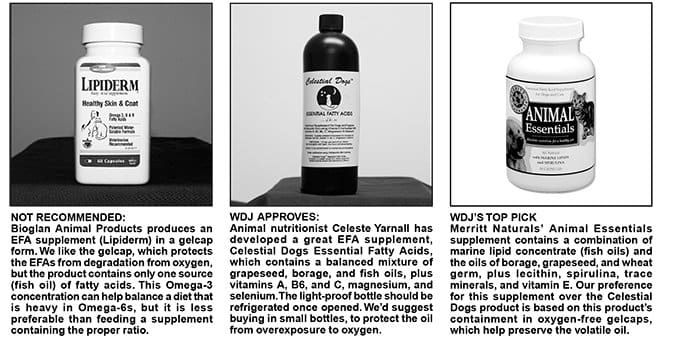
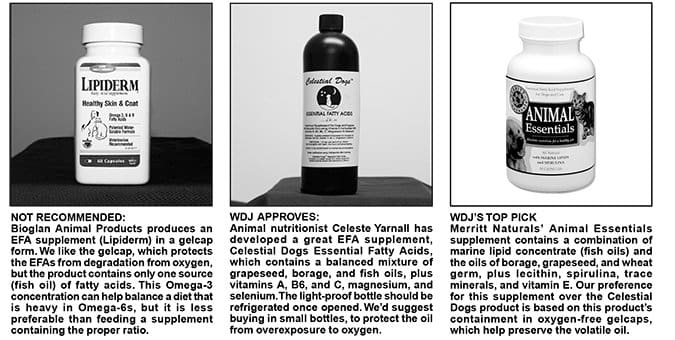
I personally like the Animal Essentials Essential Fatty Acid Supplement that is produced by Merritt Naturals. This formula provides a diverse and balanced complement of EFAs as well as additional nutritional factors that promote healthy blood and skin structure. Best of all, they have contained the oils in convenient, easy-to-open soft gel capsules that prohibit air from contacting the formula until the feeding time. This optimizes shelf life of the product and helps assure that your companion actually receives the essential fatty acids he needs.
EFA Requirements and Dog Dosages
No exact requirements of these supplements have been established as yet. Exactly how of much of each type of essential fatty acid a particular animal needs remains questionable, but most experts agree that dogs need a balance of both Omega-3 and Omega-6 acids in their diets. Some EFAs are synthesized within an animal’s body, while others must be derived exclusively from dietary sources. EFA requirements may also vary according to animal type. For example, dogs can produce arachidonic acid (an important EFA component) whereas cats cannot. Instead, cats must receive arachidonic acid directly from their diets. Animal fats, evening primrose oil, and borage seed oil are all good sources of arachidonic acid.
Because the dietary needs and metabolic rates of EFA absorption vary between the type of oil and the systemic variations of each individual animal, it is best to feed EFAs from a variety of fish and vegetable seed oil sources. A commonly accepted dosage is about 400-600 mg. of the combined oils, fed daily for each 20 pounds of a dog’s body weight (e.g., a 60-pound dog would require 1200-1800 mg.).
Gregory Tilford is an herbalist and co-owner of Animals Apawthecary, of Conner, Montana, a source of herbal supplements for dogs and cats. He is also founding president of the Natural Pet Products Association and author of several books on wild medicinal plants.
On April Fool’s Day 1996, my soon-to-be-husband took me to get a puppy. We already had one dog, Ladybird, but she was getting older and we felt a young friend would encourage her to be more playful. We also hoped Ladybird would pass on some of her fine qualities to the puppy.
We drove out of town to a place where people play paintball. There were more than a dozen young dogs running around, and the owner told us to take our pick. One young female seemed to want my attention more than any of the others, and I fell in love with her pretty face. We took her home and named her Cheyenne.
We knew very little about Cheyenne’s lineage, but she appeared to be part Lab, with a little hound and quite a but of “who knows” thrown in. She was sweet, afraid of anything new, and very anxious to please. I took her to the veterinarian’s office for a complete checkup the next day and started her on vaccinations, flea pills, and heartworm pills.
Cheyenne seemed happy and healthy. Having been little better than a stray she had fleas and worms, but both conditions were quickly taken care of. The vet guessed she was about three to four months old. She quickly settled into our home and became part of the family.
Initial Problems
About three months after we adopted Cheyenne she had her first seizure. We had hardwood floors, and I heard her skittering across them. I went to see what she was up to and found her laying on the floor, absolutely rigid. Her toes were curled in, she was drooling uncontrollably, and only her eyes were moving.
Those eyes followed me as I approached and watched me in confusion and fear as I examined her and realized I couldn’t move any part of her. I immediately grasped what was happening, but was helpless to do anything except sit with her and stroke her head.
The incident lasted more than 15 minutes. Finally, she started to come out of it. Her tail started to wag, and she could move her head. It took a few more minutes for her to completely regain motor control over her legs, but once it was all over she seemed to be fine. She got up, drank some water, and went outside to play. It was as though nothing had happened.
I called the vet, of course. He advised me to keep an eye on her and see if it happened again before we took any corrective action.
Over the next year Cheyenne had a seizure every three to four months. She came to recognize the signs of an impending seizure and would do her best to get to a place she felt safe (either next to me or in her bed) while she could still move. Since I work at home, I was usually there and would sit with her, often putting her head in my lap, stroking her until it was over. That seemed to help her get through it with less fear, but each incident was terrifying to me.
The seizures continued to last 15 to 20 minutes, with total rigidity. Our vet examined her and we discussed possible causes and treatments. Labradors are often prone to seizures, and he suggested that we might put her on anti-seizure medication if they became more frequent. Their length concerned him, since most neurological reactions last just a few minutes, at most.
From Bad to Worse
In the early summer of 1998 Cheyenne had three seizure episodes just 10 days apart. She also started to convulse during the episodes, whereas before she had been completely rigid. My vet and I decided to do some very extensive and expensive blood work to try to diagnose her problem.
When the blood work results came back I was told she had a liver shunt. This meant that one of the veins that carry blood to her liver was “incomplete” or not properly connected. Depending on where the shunt was it might or might not be operable.
The next step would be to take her to Texas A&M where they have an excellent veterinary college and hospital. One of my friends was about to enter her second year of vet school there, and my husband and I decided to wait until the school year began so that Sue could keep an eye on Cheyenne during the week when we left her for testing. We also needed to save some money since the tests and surgery would cost a minimum of $1,500, if there were no complications. In the meantime, we watched Cheyenne carefully, hoping she’d hold her own until we could get her help.
Seizures + Hot Spots
As though the seizures weren’t bad enough, Cheyenne had also developed some bad “hot spots.” These were places she would lick continuously until they became red and raw. Ladybird was also licking herself, especially her paws, for hours at a time.
Our vet asked what we were feeding the dogs. I had started Cheyenne on Science Diet as a puppy, but Ladybird would eat all the puppy food while Cheyenne would eat the generic brand food my husband bought for Ladybird. By this time I had them both on Pedigree Lamb and Rice, which I thought was a good dry dog food.
The vet suggested we try giving them a Eukaneuba prescription formula for allergies. The food was expensive – $42 for a 35-pound bag – and they were going through two bags a month. It did help the “hot spots” clear up, however, and made their coats smoother and softer.
About a week after starting on the new food, Cheyenne had a seizure; happily, it seems to have been her last. Months went by, summer became fall, and still no seizure. We were definitely on to something with the food. I postponed the trip to A&M.
When I started them on the new food, I had also stopped giving the dogs commercial dog treats, like Milk Bones and Beggin’ Strips. After several months with no hot spots, the vet suggested I could reintroduce these treats, so I did.
Ladybird was thrilled to have her treats back. So was Cheyenne, but 24 hours after her first treats, she was licking brand-new “hot spots.” The treats went into the trash.
Following this last incident, I put all the pieces together; finally it was obvious to me that Cheyenne had a serious food allergy!
Food Switching
Toward the end of 1998, I subscribed to this publication. One of my first issues carried a review of better quality dry dog foods. One, California Natural, sounded like it was tailor made for my sensitive dog. With just four ingredients – all whole, real foods – it would be nutritious and digestible, with much less risk of setting off Cheyenne’s allergies.
I called the manufacturer and tracked down a distributor in my area. Now for the acid test – would my fussy dogs eat it?
They loved it. There was never a problem at meal time, yet I noticed that I filled their bowls less often (my dogs just eat when they’re hungry; if they’re not hungry they leave the food until they’re ready for it).
A 36-pound bag was about $35, slightly less expensive that the prescription food, but it lasted longer since my dogs ate less of it. Best of all, Cheyenne continued to be seizure-free, her coat had never felt better, and she had loads of energy.
Quality Food Benefits All Dogs
Meanwhile, Ladybird seems to be benefiting from the improved diet as well. She even slimmed down a bit, going from 81 pounds to 76 pounds, while showing more energy.
Ladybird is now 12 years old, and, prior to our food switch, was starting to have trouble getting up steps or even out of bed. She had been my husband’s dog for most of her life, during which time he gave her the most inexpensive dog foods because he thought all dog food was the same. I started giving her vitamin C, which definitely helped her feel better. With the introduction of the California Natural food, she is running and chasing rabbits with Cheyenne, and you’d never know that just two years ago she needed steroid shots to get around.
There is no doubt in my mind that changing Cheyenne’s diet put an end to her seizures and her hot spots. It save her from a surgery she didn’t need, and saved me a lot of angst and money.
California Natural also makes treats from the same ingredients as the dry food, and both my dogs love them. I still have to be very careful about giving Cheyenne anything else, however. Recently I started Ladybird on a supplement with glucosamine, yeast, biotin, bee pollen, and bovine cartilage to help her aging joints. I gave them to Cheyenne, too, and within a week she had “hot spots” again. It was probably the yeast that did it. So even “good” things may be bad for her. But now that I know how sensitive she is to what she eats, I can quickly alter her diet to keep her healthy.
Rona Distenfeld is a freelance writer from Florence, Texas.
Gastric dilatation-volvulus, or “bloat” for short, is a feared disease among many dog owners. I have worked as an emergency veterinarian and have observed first-hand the horrible effects of this condition on a number of my patients, and I can certainly attest to its devastating effects.
Knowing what bloat is, and learning to recognize its clinical signs early is important for all dog owners so you can ensure prompt treatment before simple bloat progresses to irreversible and fatal whole body shock. Certain dogs are more likely to become a victim of this horrible stomach disorder, so it helps to know what those breeds are in case your dog is one of the more statistically likely candidates for the illness. And finally, it also helps to know how it is treated, and whether there are any preventive measures that can be taken to keep your dog from ever becoming a victim of bloat.
What is Bloat in Dogs?
The technical term for bloat is gastric dilatation. Simply put, this means the stomach dilates and enlarges. The main constituent of this dilation is air, although food and water are usually present in the stomach as well. This makes bloat quite different from a simple case of over-eating, where the pet engorges on food and the stomach fills rapidly with the last meal eaten.
Why does the stomach fill rapidly with air? The main cause seems to be aerophagia, where the pet literally swallows a large amount of air. Most commonly this is from eating too quickly. Unfortunately, for some reason, the air is not passed into the intestines or belched back out the esophagus. No one knows what causes the stomach to retain air.
Another theory is that after eating, some pets swallow air as they exercise, causing the stomach to bloat. While many doctors advise clients not to allow their dogs to exercise immediately after eating, I do not know of any controlled studies that show conclusive proof that exercise restriction prevents bloat. In many of my patients there was no history of exercise immediately after eating that contributed to the bloating. And since wild dogs and their ancestors (wolves) may need to be on the move after a meal (although, given the chance they usually rest to digest their food and recover from the recent kill), I doubt that exercise is a major factor in bloating. Still, until evidence proves otherwise, many veterinarians discourage exercise for 30-60 minutes after eating.
One of the myths regarding bloat is that only large dogs can develop bloat. It is true that bloat is more commonly found in large and giant breed dogs and deep chested dogs, usually two to 10 years old. The most commonly affected dogs include Great Danes, German Shepherds, Saint Bernards, Labrador Retrievers, Irish Wolfhounds, Great Pyrenees, Boxers, Weimaraners, Old English Sheepdogs, Irsih Setters, Bloodhounds, and Standard Poodles. However, any dog can develop bloat.
Another myth involves feeding your dog from a raised bowl as a way to prevent bloat. Feeding from a raised bowl can be very helpful in some dogs with a disorder called megaesophagus (where the dog repeatedly vomits up his food because the food has difficulty passing into the stomach). However, I have not seen anything in the veterinary literature that confirms that a high feeding table can prevent bloat (although, as you’ll see, there are some things you can do to minimize the chance of your dog bloating).
Some owners feel that feeding only cereal-based foods will cause bloat, or that dogs eating raw diets will not bloat. It is true that cereal-based foods ferment more in the gastrointestinal tract, which can cause excess gas, but this occurs further along in the intestinal tract (mainly the large intestine.) The only thing I have seen repeatedly suggested in the literature is that excess calcium in the diet, and excess air being ingested with the diet, may contribute to bloating in some dogs. Dogs can develop bloat no matter what diet is fed.
Bloating is a Life-Threatening Condition
Regardless of the actual cause, bloating in dogs is one of the few true emergencies in veterinary medicine. Dogs can and do die if not treated promptly. As I’ve mentioned, with bloat the stomach fills with air that it cannot expel. The bloated stomach compresses blood vessels in the stomach wall and abdominal cavity, causing hypovolemic shock. In severe cases, this bloated stomach can actually twist on its longitudinal axis. This twisting or torsion is called volvulus. As the stomach twists, it may pull the spleen with it, causing torsion of the spleen. If not treated promptly, both the spleen and stomach will die as the twisting cuts off the blood supply to these organs. Treatment involves decompression of the air-filled stomach and surgery to reposition the stomach if rotation occurs.
In an emergency case of bloat, pressure may be quickly relieved by inserting a large gauge needle (14-18 gauge) through the skin and right into the bloated stomach. This is only temporary treatment, but it does buy time and give the dog quite a bit of relief. After this temporary needle decompression, the dog is lightly anesthetized with an intravenous anesthetic (due to the shocky condition of most patients, less than half of a normal dose of anesthetic is usually all that is necessary to cause anesthesia).
Then two tubes are passed into the dog’s mouth: one goes into the trachea (windpipe) and one goes down the esophagus into the stomach. The stomach tube will be used to “pump the stomach,” removing food, water, and any remaining air. The tracheal tube is used to protect the airway so that no food or water accidentally enters the lungs. Other conventional therapies that may be used include IV fluids and corticosteroids (for shock) and antibiotics to prevent secondary infections. Homeopathic therapies such as Arnica can be used in the post-operative period to assist healing, and acupuncture can be used for pain control.
Surgery for Bloated Dogs
Dogs with volvulus will require surgery. Surgery has two objectives: to assess the damage done to the stomach, spleen, and other organs, and to reposition the stomach into the proper position. Stomachs that sustain severe damage cannot be repaired, and these patients must be euthanized. Stomachs with mild damage can usually heal after repositioning. Veterinarians hope that the surgery prevents future occurrences, as well.
The techniques to reposition the stomach is called a gastropexy, and involves literally sewing the stomach to some part of the body. Most commonly a circumcostal gastropexy is performed. In this technique, the stomach is sewn to the rib cage. The surgery is quite effective in preventing future episodes of volvulus, but no surgery can prevent bloating.
Owners of larger breed dogs (who might be prone to bloat and volvulus) have asked me about the feasibility of performing a gastropexy to prevent any episodes of bloating. I advise against this for several reasons:
• We can’t prevent bloat with this surgery, only the torsion (volvulus) that can accompany episodes of bloat.
• While nothing is guaranteed, following certain prevention tips can help reduce the incidence of bloat.
• I prefer not to subject pets to the inherent risk of unnecessary surgeries.
• I have seen no evidence that this prophylactic approach is worthwhile since gastric dilatation volvulus may never occur in any given pet.
If you are considering such a prophylactic surgery, I would advise you to talk with your veterinarian and carefully consider all options first.
Preventing Dogs from Bloat
This is one of those conditions where prevention is much preferred to treatment. While there is no 100 percent effective prevention, here are the guidelines I use in my practice.
• Avoid feeding your dog too much calcium. Many supplements contain calcium. If you are feeding your dog more than one type of supplement, check the labels carefully and “do the math” the determine how much calcium he receives from his diet and supplements.
• Feed small, frequent meals (2-4 meals per day). It’s a hassle, but the payoff is worth it. (There are some trainers who never feed their dogs out of a bowl, but who feed their dog its food as rewards for doing certain requested behaviors!)
• No exercise for 30-60 minutes after a meal, and nothing hard (no hard running or playing.)
Because bloat is a true emergency, I encourage owners to be prepared at home. Ask your doctor for several large gauge needles to add to your first aid kit, and have the doctor show you how to properly perform needle decompression. This technique could save your pet’s life!
Dr. Shawn Messonnier is a holistic veterinarian in Plano, Texas.
I don’t want to admit that I am lazy – but I am very busy – and dog baths sometimes have a way of slipping toward the bottom of the priority list. I have occasionally picked up one or more of the several “dry shampoo” or “waterless bath” products on the shelves of my local pet supply store and contemplated trying them out. I always told myself that they had to be too good to be true, and placed them back on the shelves.
So when Whole Dog Journal decided to test these dog cleaning and coat conditioner products, I leaped at the chance, only to confirm what I had suspected all along. The tempting lure of successfully cleansing your dog without good ol’ soap, water, and elbow grease is, indeed, too good to be true. The vast majority of dry shampoo and coat conditioner products contain chemical ingredients that we simply refuse to use on our dogs. Those few products that do contain natural, non-toxic ingredients may temporarily make your dog smell better, but fail to produce the soft, silky, shiny coat and pink skin of a truly clean dog.
We checked with holistic veterinarian Terry Spencer, DVM, of the Animal Health Center in Salinas, California. She said, “I have never used a dry shampoo. I just don’t see the point. They certainly can’t take the place of a real bath. Well, maybe if someone’s dog has just had surgery and can’t have a bath and has an odor problem . . . but then we should figure out why there’s an odor problem, shouldn’t we, and treat that?”
The list of acceptable products is dismally short. If nothing else, our research reminded us that just because a product calls itself “natural” doesn’t necessarily mean that it is! Always remember to check labels for ingredients. If they aren’t listed, call the manufacturer. If they won’t tell you what’s in the product, pass it up, no matter how tempting it appears. In our experience, companies that produce truly safe and natural products are more than happy to advertise their ingredients.
Just in case you still think you want to try a waterless shampoo anyway, here are our results.
WDJ’s Top Picks
Sorry, there isn’t one. We don’t feel that any of the products live up to the promise of a truly clean, deodorized dog. Some are better than others, but none of the products we checked out come anywhere close to the results of a real bath.
My 2-1/2 year old spayed female Akita is showing a pattern of recurring bladder infections. An ultrasound showed scar tissue from a long-term infection before I adopted her from a rescue group. When she gets an infection, there is blood in her urine and the pH is 9.0.
I understand there is a chicken and egg argument about the high pH and infections. Is there anything that will help lower the pH of her urine and make her less prone to infection, or is the high pH more likely just a result of the infection?
-Jim Price
Raleigh, NC
We turned over this question to Dr. Nancy Scanlan, a veterinarian for 28 years, who has integrated holistic medicine into her practice for 11 years. Dr. Scanlan is also a prolific writer, authoring a column for Natural Pet for two years as well as a book, “Stop That Itch!” Dr. Scanlan’s practice is located in Sherman Oaks, California.
Let’s define some terms before I address your specific questions. You sound well versed in the terminology of urinary tract infections, but for the benefit of others who may be earlier in their education about this multi-faceted problem, allow me to review.
Urine is formed by the kidneys, and stored in the bladder before being excreted. Urine is 95 percent water, and it’s function is carrying the waste products of metabolism out of the body. Those waste products make up the other five percent of the urine, which is normally composed of dissolved urea, uric acid, mineral salts, toxins, and other waste products. Urine that contains red or white blood cells, protein, a large number of crystals, bacteria, yeast cells, or parasites, indicates an infection or other health problem.
The normal pH for dog urine is around 6 to 6.5. A pH of 7.0 is neutral (neither acid nor alkaline). A “high pH” refers to something above 7.0 and is considered alkaline. A “low pH” is something under 7.0 and is considered acid. Some people consider 7.0, which is neutral, to be normal for dogs, though, as I’ll explain in a moment, I prefer the urine to be a little lower (more acidic). If it is already at a pH 6 to 6.5, I’d leave it alone. You don’t want it more acid than that.
The classic sign of a urinary tract infection is frequent urination of small amounts. However, this can also be a sign of chronic bladder inflammation without infection; many people aren’t aware that these are two separate issues. If your dog has to urinate frequently, but only passes tiny amounts of urine each time, you must take him to a veterinarian for a urinalysis. This will determine whether you are really dealing with a chronic bladder infection, as opposed to chronic bladder inflammation without infection. This can be accomplished only with a sterile urine culture obtained with a bladder tap; you can’t just catch some urine and take it in. This is important, because the treatment for each condition will be different.
Next, the pH of the urine must be tested. As you suggested, a high pH can make a dog more prone to urinary tract infections, but the high pH can also be the result of an infection. Some dogs chronically produce alkaline (high pH) urine, and it has been my experience that these animals are more prone to chronic infections – but not all of them are. On the other hand, dogs with chronically low pH urine (too acidic) are prone to oxalate crystals.
Crystals and stones can hurt
The urine should also be checked for the presence of any crystals, which are simply minerals that have bonded together. When enough crystals bond, they can completely or partially block the excretion of urine, which is painful and very dangerous for the dog; they can also form stones, an advanced form of the crystals.
There are a number of different types of urinary crystals. The most common are struvite or struvite/apatite “infection stones,” which are actually caused by the presence of certain bacteria in the urinary tract. Dogs who have neutral or alkaline urine tend to get struvite crystals, but fortunately, a diet that helps acidify the urine can help dissolve these crystals. In contrast, oxalate crystals are more common in dogs with acidic urine. Unfortunately, they are not easily dissolved with dietary and pH adjustments.
Finally, you need to determine whether their urine is concentrated or dilute. If it is very concentrated, it will help everything to make it more dilute. You can accomplish this by adding a pinch of salt to their diet or finding ways to add water to the diet. Some people make all their dogs’ meals soupy to force greater intake of fluids. Make sure she always has fresh, clean, water wherever she is.
Chronic infections
I’m assuming that a proper urinalysis was performed on your dog, and the presence of blood or pus indicated that the dog did in fact have an infection. If the problem is truly a recurring infection, the goal is to treat the infection, and then concentrate on boosting the dog’s entire immune system so that he or she can better battle the bacteria in the future.
It’s critical to give the animal antibiotics as soon as possible when they have an infection. This will help prevent the formation of struvite crystals, as well as reduce the odds of the dog developing scar tissue in the urinary tract. Scar tissue does leave a dog more susceptible to more infections, for two reasons. One is that if there is a lot of scar tissue then often they cannot fully contract the bladder, so it will not empty all the way, and leftover urine in the bladder gives bacteria a perfect medium for growth. Also, scar tissue creates little nooks and crannies where bacteria can grow.
Cranberry extract has been proven to be very helpful in preventing infections in dogs that are prone to them. Cranberry helps prevent bacteria from attaching to the wall of the bladder, and it also slightly acidifies the urine. It’s also good because its action is not extreme; it doesn’t make the urine excessively acid. However, I wouldn’t give cranberry to a dog whose urine had a high acidity (a number lower than 6.0); you don’t want to make the urine more acid than that.
I suggest that people use cranberry extract capsules, the kind they can get from the health food store. Cranberry juice is inadequate for this job; you couldn’t feed a dog enough juice to get the job done.
The strength of the capsules vary, so check the label, but generally, the standardized capsules provide 300 mg. of cranberry extract. For little dogs, under 35 pounds, I’d suggest a half a capsule twice a day until the urine is more acid; the bigger guys can get a whole capsule twice a day. If the dog has an infection, keep the dose relatively high until the infection is gone, then reduce it to a maintenance dose.
Some animals, once you get things under control, only need the cranberry right at the very signs of the beginning of infection. Other dogs do better if they receive a low dose all the time. A low dose would be a quarter capsule twice a day for animals up to about 25 pounds, a half capsule twice a day for 25 pounds to 60 pounds, and the really big guys could get a whole capsule twice a day. In cases of extreme infection, they may need three doses a day. At the beginning of an infection, you’d want to give your big dog a relatively high dose; she’s such a big dog, she could have two capsules three times a day at the beginning.
An immune-boosting campaign should include herbal and nutritional supplements – especially some antioxidants like Vitamin C and E. You also have to take a long, hard look at the dog’s diet, and determine whether it is contributing to the dog’s overall health and vitality or not. You might also consider some herbal support. Echinacea supports immune function and kills bacteria. Plus, it doesn’t affect the urine pH – which is good, because then it can be given to a dog with any pH.
When it’s not an infection
There are a lot of dogs who show symptoms of infection – such as urinating tiny amounts very frequently, and whining or yelping in pain when they urinate – without having an infection; no bacteria, blood, or pus can be found in their urine. Usually, I find that animals with chronic irritation (without infection) have neutral to alkaline urine. Increasing the acidity of the urine usually helps the problem. However, if oxalate crystals are present, you don’t want to increase the acidity very much. You can take it up to the neutral point, but you shouldn’t go past that.
Again, cranberry extract is very helpful for slightly increasing the acidity of the urine. Apple cider vinegar is also great for acidifying the urine (you can give one teaspoon to one tablespoon twice a day for a 50-pound dog). So is methionine, which is an amino acid. Generally, the dosage for methionine would be about 100 mg, twice a day for animals up to 20 pounds; 200 mg. twice a day for dogs up to 60 pounds or even larger. Many large or giant dogs do well on 200 mg. twice a day, others may need as much as 500 mg. twice a day. You want to try to use the smallest dose at which you get the results you want, and you need to use the urine tests to determine the optimum dosage.
You will hear the claim that Hills CD diet is the only thing that will help her, because Hills CD acidifies the urine. If the dog has neutral or alkaline urine, acidifying the urine can help, whether you do it with Hills CD or a specially formulated homemade diet. Meat products also acidify the urine. (Curiously, a diet high in citrus fruits, vegetables, or dairy products will increase the alkalinity of the urine.)
Also, you should make these changes only assisted by urine tests. Doing it blindly will get you into trouble, because supplements that can make an animal a teensy bit more acid or a teensy bit more alkaline will cause extreme changes for the next animal.
These changes should definitely be done with the help of a veterinarian, and the regular use of home pH testing kits. And be aware that there are a few animals that won’t respond – either with a more acid pH or a more dilute urine – no matter what you do; it’s just how their bodies work.
Inflammation and stones
One final caution: I have also seen chronic inflammation and stones in animals that were being given too many mineral supplements. In one case I saw, a woman was using a commercially prepared natural diet, which had calcium in it, but she was also gave the dog supplemental calcium and a trace mineral supplement – which happened to be mostly calcium.
Of course, the dog developed stones. She took the dog to a veterinarian who prescribed medication to make the urine more acid. But then the dog developed stones from the urine being too acid. It didn’t matter what they did, it kept getting stones and inflammation both. Incidentally, they are much more likely to get stones if they have chronic inflammation.
Finally the woman brought the dog to me, and I asked to see the diet. I also asked her what other supplements she was giving the dog, and the long list came out. The point is, you shouldn’t over-supplement with minerals.
In the October 1999 issue, Dr. Ian Dunbar discussed some training options to deal with female dogs that squabbled constantly. One of his first questions to an owner in this situation, he said, is “Have you ever had to take one to the vet for stitches after a fight?” The answer in the situation he addressed in that issue was “No.” However, we’ve had a number of questions from people whose answer to that question was, “YES!” In this issue, Dr. Dunbar offers his suggestions for dealing with dogs (in a multi-dog household) who fight to the point of injury and bloodshed.
In the last issue, I limited my advice to cases where dogs that live together are fighting, but they don’t do any real damage to each other. This month, I’ll deal with an entirely different question.
If your dogs are fighting, and are causing severe damage to each other – or one dog is causing severe damage to another – I’m sorry to say that you are dealing with the most difficult of all canine behavior problems, the one with the worst possible prognosis. Your options are extremely limited, because the treatment really should have happened when the dog was 4 1/2 months old, which is when dogs normally learn bite inhibition.
Short window of opportunity Bite inhibition is without a doubt the single most important thing that dogs learn. It is even more important than learning to become socialized to people and other dogs, which is the second most important thing that young puppies should learn, generally before they are three months old and reinforced throughout their lives.
Bite inhibition is a learned response whereby the dog consciously and strongly inhibits the full force of his biting power. Most dogs display bite inhibition when they are playing together, but also when they fight; if a dog does not have bite inhibition, he could easily hurt or even kill another dog in a fight. You’ll notice that even when most dogs fight, it looks and sounds perfectly awful, but neither dog walks away bloody. This is due to bite inhibition.
Dogs who are given the opportunity to be properly socialized by other dogs and people learn bite inhibition in the process of playing and roughhousing as puppies. When a puppy bites another dog in play, the other dog tends to either YELP! loudly and/or leaps up and knocks the puppy over with a loud bark or growl; a bitten dog also tends to leave the game. This teaches the puppy that all the fun ends when he bites too hard.
By the way, this is the single most important reason that puppies should go to puppy class. If they are like most puppies, their veterinarians have suggested that they stay in social isolation from strange dogs for a month (giving their vaccinations time to establish protection from disease), and the puppy class is the best thing to get them play fighting and mouthing and biting each other again. Here they learn that gentle bites prolong the play session, and they’re a lot of fun, and that hard bites stop the play session because the “bitee” wants some time out to lick its wounds.
People can use the same tack to teach their puppies bite inhibition. If a pup bites you too hard, yelp loudly and walk away from the puppy; it’s a very effective method. What you don’t want to do is to try to get the puppy to stop biting altogether. The first goal should be to teach the dog to inhibit the force of its bite, then reduce the frequency. If you teach the puppy never to put its jaws on you at all, when it does happen (say, an accident where the dog’s paw gets stepped on), the dog will react with an over-strong bite because it never learned that a softer bite will suffice.
The reason why bite inhibition is more important than socialization is because no matter how hard you try to socialize a dog to people or other dogs, there are going to be times when it is not sufficient. For example, someone shuts the dog’s tail in the car door, or your socialized dog is attacked, very painfully, by another dog. In these incidents, your dog will normally respond by biting, whether it’s out of provocation or self-defense. Whether or not your dog does damage is pretty much pre-ordained by the level of bite inhibition that was established before it was 4 1/2 months old.
Without a doubt, the dog’s level of bite inhibition is the single most important prognostic factor which determines whether or not a fighting problem is easily resolved, or extremely difficult and potentially dangerous to even consider resolving. And a dog who has a record of attacking and actually hurting another dog clearly has a very low level of inhibition. It’s really a shame; his life is going to be much less pleasant than other dogs’ lives.
Put a muzzle on it Bite inhibition can be taught to a dog later in life, but it’s one of the most time-consuming, difficult, and potentially dangerous things to teach an adult dog. It is much easier to teach bite inhibition toward people, because it is very easy for a trainer to pad himself up in a full body suit with a Kevlar sleeve and let the dog mouth and bite him, in order to teach it that gentle biting is appropriate, and harder bites are not appropriate. However, it is next to impossible, and certainly not fair, to do this with other dogs. Knowing that your dog mutilates other dogs, how can you set your dog up with another dog? You can’t.
Basically, your options are limited to controlling the problem, using hefty amounts of common sense.
The first rule should be walk the dog on public property only when the dog is wearing a muzzle. It is just simply not fair to other dog owners to take an unmuzzled dog out knowing that it does not have sufficient bite inhibition to protect other dogs. I’ve heard people say, “Well, he doesn’t attack other dogs; I can control him.” The fault with that line of thinking is that another dog might attack him, and get grievously injured, and I would consider that YOUR fault, even though the other dog started it. Dogs with good bite inhibition can get in scuffles and no harm is done. Of course, you’d hope that the owners of other dogs could control their dogs, but you can’t count on it. Muzzle your dog when in public to protect all concerned.
Muzzle technology has improved quite a bit in recent years. I like the open-ended muzzles like the one on the dog in the photo above; several companies make very similar models. These are soft but strong fabric (usually nylon) muzzles that control the dog’s biting, but are open in the very front to allow the dog to drink, lick his lips, and accept a treat. Since the goal is to train the dog to enjoy the company of other dogs, and to behave appropriately (sit, settle down, and be calm), wearing a muzzle that allows him to take treats (while keeping him from biting, of course) is critically important.
Learning to get along You can live with these dogs permanently separated, juggling them around from room to room, but it’s a fairly difficult thing to do in most houses! But with the muzzle, you can now consider bringing the dogs together at times. However, I would insist on muzzling both dogs; it’s only fair. If you allow the good dog to bite your muzzled dog, you will only reinforce in his mind that the other dog should be bitten.
Now, with the dogs muzzled, you can start some very simple exercises to begin to condition the biting dog to begin associating the presence of the other dog with good things, not bad things. Put the (muzzled) biter on a leash, and sit down on the sofa, petting the dog. Have someone else enter the room with the other (also muzzled) dog, and then leave after a few moments. Have the other dog and person repeatedly enter and leave the room.
You are going to give the biting dog two types of feedback. When the other dog leaves, you totally ignore it. When the other dog comes in, you praise your dog and offer it pieces of kibble and maybe treats, even if he’s growling and putting his hair up.
But wait, you say! Isn’t that going to train the dog to growl and put its hair up? According to the laws of operant conditioning (the dog growls and it gets a treat), the growling is likely to increase in frequency. However, the growling doesn’t exist on its own; the dog is growling for a reason. If you give the dog a piece of kibble when the other dog comes in, you are classically conditioning the dog to form a positive association with the other dog’s entry and presence. Whenever you are training a dog in these two ways, the operant conditioning is temporary; the classical conditioning will win out. Eventually, the dog will form a positive association about the other dog, at which point he will cease to growl, because he has no reason to. So, I wouldn’t be too concerned with the fact that the dog is growling or has his hackles raised. The main thing you want the one dog to think is, “I don’t particularly like that dog, but I love it when he comes into the room, because my owner talks to me, pets me, and gives me kibble.”
For the next step, do the same exercise, but with the positions reversed. The other dog is in the room, and you enter and exit with the biting dog, giving him treats when you enter the room, and ignoring him when you leave.
Do not punish! I should mention that the worst possible thing you can do – even if the dog growls and threatens the other dog – is to yank on the dog’s leash or spank it or yell at it. If you constantly reprimand the dog whenever another dog is present, you will reinforce your dog’s negative feelings for other dogs! Think about it! I suspect that this is 90 percent of the reason why dogs fight. Initially a dog fights because he meets another dog that he doesn’t like. But then he quickly learns that when other dogs approach, his owner gets upset, sweats, her heart rate goes up, and she shouts and jerks the leash. So the dog learns to try to keep other dogs away. He sees another dog and he says, “Get away, get away, don’t come close! My owner is unreliable around other dogs!”
I would like to add that in my video about training dogs that fight, at one point, I actually do raise my voice and reprimand a dog. This is one of those unfortunate things that can happen when you are trying to make a television program and working with two very difficult dogs and the producer is saying, “Hurry up and get something done!”
I fully regret departing from my usual training methods in order to accommodate the television crew; I would never do it again, no matter what the production crew wants. If they don’t have the patience to wait around for the result, then they won’t get it on film.
-By Dr. Ian Dunbar
Dr. Dunbar’s newest instructional videos, “Dog Aggression: Biting,” and “Dog Aggression: Fighting,” discuss all aspects of dealing with aggressive dogs.
I think my four-year old Chesapeake Bay Retriever is developing an incontinence problem. She only seems to have a problem while she’s sleeping. She often leaves a puddle behind when she gets up. However, when she’s awake, we haven’t had any problems. She’s on a natural diet, gets plenty of exercise, and is not overweight. Why do dogs develop incontinence? Are there any natural remedies that I might try?
-Brenda Dinne
via email
We directed this question to Carolyn Blakey, DVM, of the Westside Animal Clinic in Richmond, Indiana. Dr. Blakey has been practicing veterinary medicine for 32 years, the last four in an all-holistic practice. She especially enjoys serving as a holistic veterinary consultant to clients all over the country.
Incontinence in spayed females is fairly common. The problem is caused by a lack of estrogen, which, of course, was brought about by the spay surgery. Many people assume that when females are spayed, the veterinarian simply “ties the tubes,” that is, cuts and ties off the fallopian tubes so that the ovum can not travel from the ovaries, down the fallopian tubes, and become fertilized. Actually, the veterinarian removes the ovaries and usually, the uterus, too. The reason for this is that you not only want the female to become incapable of becoming pregnant, but also, you want her not to exhibit symptoms of heat. The ovaries are where the majority of estrogen is produced. If you simply tie the fallopian tubes, the dog is still subject to the behavioral changes caused by the cyclic changes in estrogen levels. If you remove the ovaries, the center of estrogen production, the dog stops coming into heat.
But estrogen plays a significant role in maintaining the tonal quality of the urethra, the neck of the bladder. Without the estrogen, some dogs lose enough tonal quality that they can’t quite keep themselves from leaking. (This same phenomenon is why some elderly women suffer incontinence, post menopause; without estrogen, the tissues become inelastic.) The adrenal glands also produce a small amount of estrogen, and I would venture a guess that in the dogs who suffer incontinence, the adrenals produce a lower than usual amount of estrogen.
It used to be that the recommended treatment for incontinence in spayed females was to initiate hormone replacement therapy. However, this approach has the potential for causing more untoward symptoms that it solves. Namely, the dogs come back into heat; they exhibit all the signs we’re so not fond of! If you wanted to use the hormone replacement therapy, I would suggest enlisting the aid of a really good endocrinologist to help you dial in the dosage as precisely as possible.
I wish I could say that natural medicine has a great solution for the problem, but if it does, I haven’t found it yet. I’ve heard about all kinds of approaches, and sometimes I get lucky, and one of the approaches works, but it seems to be a very individual thing.
Sometimes, a glandular supplement seems to play a role in solving the problem. I happen to like the Standard Process line of supplements, and I have had some success with some dogs with their “Cataplex F,” a female glandular supplement. I have also had some clients report success with acupuncture on some of the acupuncture points that affect the reproductive system. One always thinks of Bladder 23, which is an association point for the kidneys and the whole reproductive system.
My favorite remedy is not from the holistic world, but then, it doesn’t cause as many side effects as the hormone replacement therapy. I use a drug called phenylpropanolamine, a decongestant. It stimulates the part of the nervous system that controls the smooth muscles and glands. It affects the alpha receptors within the mucosa of the respiratory tract, and the mucosa of the vaginal tract as well, helping the dog tighten and control the bladder muscles better.
You can purchase this drug inexpensively over the counter, and it doesn’t cause any significant side effects that I’ve seen. Ask your vet about the dosage for your dog, and good luck.
It’s been a little more than a year since we last examined dog treats, but, oh, what a year! It’s amazing (and fortunate for our dogs) how quickly the “healthy dog foods” consciousness is rising, and how many more healthy treats are available than there were last year. For example, we’re seeing far fewer treats that contain propylene glycol, or artificial preservatives and colors, and far more treats containing nothing but healthy, whole foods. “A rising tide raises all boats,” goes the old saying.
But the “rising tide of health awareness” doesn’t seem to have raised the consciousness of the titanic mainstream dog food industry much. We checked a few of the “grocery store” treats and got an iceberg-sized chill. Well-known brands such as Beggin’ Strips (made by Purina) are still formulated with ingredients on our “forbidden” list – things like glycerin (an artificial sweetener) AND sugar, artificial colors, and artificial preservatives. (We were amused by the eighth ingredient on the Beggin’ Strips label, euphemistically dubbed “meat.”)
Other well-known brands, such as Milk Bones and Bonz, seem to be slowly improving, for instance, replacing animal fat, a low quality ingredient of mysterious origins, with beef tallow. However, they still lack the kind of wholesome ingredients and simple formulas you’ll find in our picks.
On the next pages, we’ve listed our favorite treats alphabetically and grouped in one of two categories: WDJ’s Top Picks and Very Good Treats. For education’s sake, we’ve also included a few that narrowly missed our list, and we explain why. Due to space limitations, we can discuss only a sampling of the treats that are available, but you can learn a lot from comparing your dog’s favorite treat to our selections.
Our general suggestions? Stay away from “big-name” commercial treats found in grocery stores, look for products that meet our selection criteria, and let your dog’s health and appetite be your guide.
Most people respond with a warm fuzzy “Awwww” reaction when they see a litter of puppies. After all, nothing could possibly be cuter than a bunch of roly-poly baby dogs tumbling and tussling together on the floor. Or could it?
Anyone who works or volunteers at an animal shelter for any length of time soon finds his “Awwww” reaction tempered by the sobering knowledge that millions of unwanted dogs and puppies are euthanized in shelters around this country every year. I know. I worked at a humane society for 20 years. While I love dogs at least as much as the next person, to this day I cannot look at a puppy without also seeing syringes filled with blue euthanasia solution, needles inserted into furry legs, and canine bodies piled up on gurneys outside the euthanasia room door.
For those who regularly deal with the hapless victims of our throwaway society, spay/neuter is a mantra. Rarely, in the shelter worker’s opinion, is there a sufficiently valid reason for not surgically rendering a dog incapable of reproducing.
The average dog owner, however, is more concerned with his own individual rights or the dog’s well-being than with the state of animal welfare in general. There is a whole host of commonly offered arguments against spaying and neutering. How valid are they?
1. Surgery isn’t natural. I would rather be responsible by keeping my dog home or on a leash than take the risks of surgery and alter my dog unnaturally.
There is some truth to this argument. Surgery certainly isn’t natural. Neither are collars and leashes, prepared dog foods, fences, veterinary care, or the daily killing of healthy “surplus” dogs and puppies. Dogs haven’t lived truly natural lives for centuries. If we are picking and choosing which parts of “natural” we want to recreate for our canine companions, we are better off not choosing this one. If we truly wanted to be natural it follows that we would then let our female dog get pregnant and have puppies every six months, and no responsible dog owner advocates that.
It’s true that every surgery carries risks, but the risks of spay/neuter surgery are minuscule compared to the dangers of overpopulation. Far more dogs die from lack of homes, from mammary tumors, prostate, testicular and ovarian cancers, and hormone-related behavior-problems, than ever die from spay/neuter surgery.
2. Sterilization will change my dog’s personality; she/he will get fat and lazy.
This concern seems valid. We have all seen spayed and neutered dogs who were, indeed, fat and lazy. But let’s think about this for a moment.
Dogs, like humans, get fat if their caloric intake is greater than the calories burned off by exercise and other physical demands. It is true that sterilized dogs often get less exercise. Male dogs who are neutered no longer escape their yards and run for miles in pursuit of females in season, or nervously pace the fence in sexual frustration trying to find a way to escape.
Spayed females dogs no longer experience the immense drain on their systems caused by growing puppies in their bodies for 63 days and feeding them for another six to eight weeks. Nor do their bodies go through the stress of reproductive-related hormonal changes that result in an expenditure of nervous energy. It’s true that sterilized dogs of both sexes are calmer and more content to stay home, but that doesn’t mean they have to be fat and lazy. It does mean they are better companions.
It’s simple: If your dog gains too much weight, cut back on food and increase exercise! I have owned a dozen sterilized dogs over the last 20 years, and not one was fat or lazy. If I noticed that one was starting to put on weight, I cut back on the kibble. Here are several tips for a simple weight-control program:
No free feeding. Your dog should get meals, not all-day snacks. In a natural environment a wild dog makes a kill (along with the rest of the pack), gorges himself, and then doesn’t eat again until the next kill. Dogs’ systems are not designed for grazing. Besides, controlled feeding increases your dog’s dependence on you, which can make your training more successful.
Measure the food. Use a measuring cup and dole out a specific amount. Eyeballing it isn’t accurate enough; we tend toward generous. “He looks a tad hungry today . . . what’s a few extra kibbles?” If we are measuring a specific amount we can instruct all family members to stick with the feeding program. A measuring cup also gives us an accurate gauge if Rover is looking a little too prosperous and we decide we need to cut back from, say, one cup, twice a day, to three-quarters of a cup, twice a day.
Weigh your dog. Pick her up and stand on the bathroom scales, then weigh yourself alone, and subtract. Weigh her once a week so you will notice sooner, rather than later, if she starts to put on pounds. If she is gaining, cut back the kibble and/or the treats.
Use the feeding instructions printed on the dog food bag as a guide, not gospel. Dog food companies seem to lean toward the generous side of meal rations. Perhaps they like you to use more of their product? I have never fed my dogs as much as it says on the bag. If I did, they would all be fat!
If you train with treats, be sure to count those treats as part of your dog’s meal ration. If he is sufficiently food-motivated you can even use his kibble as training rewards.
Give your dog plenty of exercise. Since he is no longer burning off calories in his frustrated attempts to find females (or she’s no longer making puppies), it’s your job to make sure he works out. Throw the tennis ball, a stick or the Frisbee for him for 20 minutes a day. Take her jogging or swimming. Find a doggie play-group or a local dog park (if there are none in your area, start one!) and let her work out by romping with her canine buddies. If you are a portly couch potato, your dog will likely be one too!
3. I want my (male) dog to have fun; I want my (female) dog to experience the joy of motherhood.
This is anthropomorphism at its finest. It is usually a male human who insists on leaving his dog intact, perhaps in order not to deprive his four-footed friend of the joy of sex, or maybe out of the owner’s own embarrassment at having a male dog without a full complement of male equipment. When you mention neutering, the human’s eyes may glaze over as his hands move to protect a highly valued part of his own anatomy.
Stop and think, men! If you have ever watched dogs breeding, you’ll notice that they don’t particularly appear to be having fun. They are simply driven by a powerful, undeniable, biological urge to reproduce. They rarely relax and have a cigarette afterward! Unneutered male dogs are far more likely to escape their yards, run free, risk getting shot or hit by cars, get picked up by animal control officers, and get in fights with other male dogs. If the lack of visible equipment is your concern, ask your veterinarian about “Neuticles,” artificial implants that are now available to help owners feel better about neutering their dogs.
On the other hand, if we are responsible dog owners, we don’t allow our dogs to run free and satisfy those mighty biological urges. Our choices are to neuter, and reap the benefits of having a calm, contented canine companion who stays home (and who no longer risks prostate or testicular cancer), or to keep our unneutered male strictly, safely and unhappily confined to lead a life of constant sexual frustration as he senses females in season for miles around.
The female dog, too, benefits from spaying. While many females do seem to enjoy motherhood, at least at first, by the time their babies reach the age of six weeks most momdogs are eager to escape their persistently pushy pups. There are far more life-threatening complications from gestation and birthing than there are from spay surgery. The maternal instinct can also trigger behavior problems; a significant number of dogs develop protective maternal aggression during motherhood. For some dogs this behavior goes away when the puppies are weaned and placed in new homes. Others continue to display aggressive behavior even after the puppies are long gone.
4. My dog is purebred/has papers. I can make money selling puppies. I want another one just like her. All my friends want one of her pups. I already have homes lined up for the puppies.
Certainly, if we are to continue enjoying purebred dogs, someone has to breed them. Why shouldn’t that someone be you? Maybe because there is a lot more involved in responsible breeding than just putting two registered dogs of the same breed in the same room together.
For starters, AKC papers are not an assurance of quality. Papers simply mean that both of your dog’s parents were registered. Ostensibly. Every month, the AKC Gazette publishes names of breeders who have falsified records, or at least kept records poorly enough that the organization revokes their registration privileges. Even if your papers are accurate and your dog’s parents were both champions, that doesn’t mean your dog is breeding material.
The responsibilities of breeding should not be taken lightly. If done properly, it is an expensive, time-consuming activity. Prospective canine parents must be checked for hip dysplasia, eye problems (progressive retinal atrophy), and any other genetic health problems specific to your breed. Dogs intended for breeding should be outstanding representatives of their breed. If you plan to breed, you need to be willing to campaign your dog on the show circuit and have experts in the breed (judges and other breeders) confirm that your Labrador Retriever is one of the best around. Then you will need to do the research to find the “right” male to breed her to; one who complements her strengths and doesn’t underscore her weaknesses.
Once you have gone to all the expense and trouble to be a responsible breeder, chances are your friends aren’t going to want to pay the prices that you will ask for your well-bred puppies. Labs can have huge litters – as many as 12-15 at a time. You may not have all the homes for them that you thought you did. Many of these will be pet, not show quality puppies. They will sell for less than the show quality pups, and a responsible breeder will have them spayed and neutered before they are sold to ensure that they are not used for future breeding.
Don’t forget to consider the additional vet bills; you want to be sure your female is in optimum health, and that the puppies get veterinary examinations before they are sold. A responsible breeder will also take back any of the puppies he has bred, at any time during the dogs’ lives if the owner can no longer keep them. Not only may you be left with more puppies to place than you had planned, you may also end up with more adult dogs than you intended to own. Chances are excellent that this hobby will cost you a hefty sum of money rather than make you rich.
Finally, consider that every friend or family member who takes a puppy from you could have provided a home for a puppy at an animal shelter or rescue group. Breed rescue groups exist for virtually every recognized breed, so if your friends have their hearts set on purebred dogs they can contact breed rescue groups or go on the breed request waiting lists that are now maintained by many animal shelters. Regardless of how many homes you have lined up for your pups, you are contributing to the pet overpopulation problem.
I want my kids to experience the miracle of birth. Understandable. When I was a kid I loved watching my dogs and cats have kittens and puppies. (Yes, we were an irresponsible pet-owning family.) But if you think this is reason enough to let your dog breed, knowing that “surplus” dogs and puppies are killed every day, then you have a harder heart than I. Your kids can watch videos that document the birth process. If you want to let them experience the joy (and hard work!) of raising a litter of puppies, sign up with your local shelter or rescue group as a volunteer foster home.
For many reasons, most shelters cannot feasibly raise litters of puppies in their kennels, and must often euthanize underage pups. Shelters are desperate for foster homes who can give tender-aged baby dogs a chance to grow up and return to the shelter for adoption when they are eight weeks old and able to withstand the rigors of shelter life. You can even solicit your friends to apply to adopt your foster pups once they have returned to the shelter. You get the joy of puppy-raising and the satisfaction of providing a community service without contributing to pet overpopulation. Win-win!
5. I live in a “no-kill city. We have solved the pet overpopulation problem so it’s OK to breed again.
“No-Kill” is a myth; it actually means “Someone Kills Them Somewhere Else.” In San Francisco, often touted as the first “no-kill” city, more than 4,000 animals are still euthanized every year at San Francisco Animal Care & Control, one short block away from the “no-kill” San Francisco SPCA. While the SPCA labels these 4,000-plus animals as “unadoptable” in order to justify the deaths and claim their “no-kill city” title, it is simply a matter of semantics, public relations, and allocation of resources.
In some jurisdictions, an upper respiratory infection (canine equivalent of the common cold) or a broken leg, both treatable, qualify a dog as unadoptable. Even if San Francisco’s 4,000 animals were truly not redeemable, surrounding communities in the San Francisco Bay Area continue to euthanize unwanted animals by the tens of thousands. Don’t kid yourself; we are far from solving the pet overpopulation problem.
6. My dog is old and my veterinarian says spay/neuter surgery is too risky.
OK, you win. This is truly a valid excuse. At some point in a dog’s life the benefits of spay/neuter are outweighed by the risks of surgery. There is no magic age when this happens; it depends on the individual dog. Follow your veterinarian’s recommendation if she tells you that sterilization is not indicated due to your dog’s age and/or condition.
My Bias Around Spay/Neuter
I am very biased about spay and neuter because of my background both as an animal protection professional and a dog trainer. You don’t have to watch very many homeless puppies and kittens die to get strident about birth control for companion animals. After working with a few dozen dogs with hormone-related problem behavior, you “get” the value of spaying and neutering.
The pet overpopulation problem is so bad that even state governments are being forced to deal with it. A new state law in California actually defines puppies under the age of eight weeks as “unadoptable,” (thereby legitimizing the “no-kill” approach of population control through word games). Another new California law requires all dogs adopted from animal shelters to be spayed or neutered before they go to their new homes – even puppies. The advent of pediatric spay/neuter – the safe sterilization of puppies as young as eight weeks – allows a law like this to be passed, and gives animal protection workers a powerful new weapon in the pet overpopulation battle.
I love dogs as much as the next person. I love them enough to believe that each one has a right to a lifelong, loving home. Pitifully few dogs get that in today’s world. If we spay and neuter, encourage others to do the same, and take the time to teach our dogs to be well-behaved family members, maybe we will all see the day when their lives are valued enough that they all end up in lifelong responsible homes, rather than dead by the side of the road or on the euthanasia room floor.
Pat Miller, a dog trainer from Salinas, California, is a regular contributor to WDJ.
What images do you see in your mind when you hear the word “monastery”? Most people envision rustic wooden buildings, with gentle, somber, bearded men in flowing brown robes and leather sandals quietly treading gravel pathways that wind through peaceful forests.
This could be an accurate description of the New Skete Monastery in Cambridge, New York, with just one glaring omission. At New Skete, the monks are accompanied by dogs. For more than 30 years, the monks of New Skete have bred, trained and sold German Shepherds as part of their monastic life.
This may sound like a strange marriage, but it’s not as odd as it seems. The Lhasa Apso breed was developed by a group of Tibetan monks, who raised them in their monasteries and gave them as gifts to nobles. St. Bernards originally served as companions to the monks of the Hospice at the St. Bernard Pass in the Swiss Alps as early as the 1600s, only later developing their talent for finding lost travelers. Many Zen monasteries also keep dogs.
And, as Job Michael Evans wrote in the Monks of New Skete’s first book, How to be Your Dog’s Best Friend, “Dogs, because of their association with humans . . . are in a unique position to offer man a mirror of himself.” Given the monastic quest to self-awareness, a community of monks and dogs makes perfectly good sense.
One dog leads to more
Accordingly, the New Skete community was created in the 1960s. Originally the brothers managed a full-scale farm, with goats, cows, chickens, pigs, pheasants, and sheep. When they moved to a new, mountaintop location that wasn’t suitable for farming, they had to give up all of their animals except “Kyr,” their first German Shepherd.
Valuing the connection with animals that they had developed through their farming experiences, the community of brothers began studying the sciences of breeding and training dogs. Brother Thomas Dobush led the Monks’ training and breeding program. Initially, the purpose was simply to train the dogs to live as a group in the monastery and maintain the quiet and order that is vital to monastic life. Brother Thomas emphasized “listening” to the animals and “reading the dog’s reactions” rather than just training by rote protocols.
As word of the New Skete Shepherds spread, dog owners began asking the brothers to train their dogs as well, and the demand for information on the Monks’ training methods and breeding programs (and their puppies) grew. Their first book, How to be Your Dog’s Best Friend, was published in 1978, and the Monks of New Skete became a household word, at least in doggy circles.
Talkin’ ‘bout a revolution
At the time, the Monks’ methods were revolutionary. In the 1960s and 70s, people like William Koehler and Blanche Saunders were the foremost authorities on dog training. The Koehler method, still defended by far too many trainers today, is a no-holds-barred punishment-based training method that ridicules the use of treats, mocks those who protest harsh punishments, and promotes a perception of dogs as resentful, revengeful, deceitful, and deliberately defiant.
For modifying problem behaviors, Koehler’s books advocate the use of exceedingly harsh methods such as shock collars, slingshots (with BBs as pellets), hanging and helicoptering (lifting a dog off the ground by the choke chain and holding him there or swinging him around until he ceases resisting or goes unconscious), a wooden dowel inside a length of rubber hose (with which to hit the dog who is too heavy to hang or helicopter), and drowning (filling a hole with water and submerging the dog’s head until he is near unconsciousness, to teach him not to dig). Saunders was somewhat less extreme than Koehler, but still advocated routinely jerking, kicking and “cuffing” dogs.
In contrast, the Monks talked about “listening to a dog until you discover what is needed, instead of imposing yourself in the name of training.” They emphasized the importance of relationship, not just obedience, and promoted training as a way of relating to your dog. Making a distinction between training and educating the dog, they quote J. Allen Boone from Kinship With All Life: “Trained dogs are relatively easy to turn out. All that is required is a book of instructions, a certain amount of bluff and bluster, something to use for threatening and punishing purposes, and of course, the animal. Educating an animal, on the other hand, demands keen intelligence, integrity, imagination, and the gentle touch, mentally, vocally, and physically.”
One trainer’s evolution
I discovered the Monks in 1983. I had just acquired Keli, a 12-week-old Australian Kelpie puppy who was one of the first two “Canine Field Agents” for the Marin Humane Society in Novato, California. My partner, Humane Officer Donna Bosso (she had Keli’s sister, Darby), gave me a copy of the Monks’ book, and I devoured it. I loved what they had to say. Their methods were ever so much kinder than those that I had read before, yet still familiar enough to feel right. I nodded as I read their justification for scruff shakes and alpha rolls. It made sense, and, as they said, it was just mimicking what the mother dog would do to reprimand her pups when they were out of line.
The Monks’ training philosophies were cutting edge, a breath of fresh air, consistent with my own thoughts on dog training and behavior. I forged ahead with my sensitive, independent, reactive, high-energy herding dog, jerking on her leash and doing an occasional scruff shake or alpha roll when she had the audacity to challenge my corrections.
I realize now that Keli, although she was a wonderful dog who learned to herd sheep, earned a Companion Dog degree and was my constant and beloved companion for 14 years, never truly reached her full potential. There was something missing from our relationship – a level of trust and understanding that I have with my current dogs, who have never been alpha-rolled or scruff-shaken. (I am mortified to admit that I turned my back on the opportunity to do positive puppy training with Dr. Ian Dunbar when Keli was a pup, convinced – as were so many other trainers, including the Monks – that training with treats was heresy. That’s a different story . . .). But as I learned more about the advances in positive training methods over the past decade, I relegated the Monks to the same category as Koehler – outdated and unnecessarily harsh and punitive.
Longevity on the charts
Despite my own (and many other positive-based trainers’) opinion that the Monks’ training techniques were outdated, their books continue to rank near the top of dog training best seller lists of companies like Amazon.com and Barnes and Noble. Was I missing something?
I decided to reread their original book and also to check out their newer The Art of Raising a Puppy, published in 1991. Perhaps their 1978 book had been revised. Maybe their puppy book now incorporated the more positive reward-based methods that have proven so successful in training dogs and puppies.
I read the books. I had forgotten how much of the first book was good. Yes, the scruff-shake, alpha-roll, and “cuff under the chin” are still there (the book has not been revised). But so is the basic philosophy of respect for life that I found so compelling in the first read.
Problems with the puppy training book
The newer book about puppy training is more of a disappointment. I truly hoped that the Monks had modified their perspectives on punishment by 1991. They hadn’t. Not only does this book continue to denigrate the use of treats as rewards in training, it still strongly promotes scruff-shaking, alpha-rolls, and cuffing, even for puppies. Although it counsels their use primarily in older puppies only, the methods are still harsh. For example, in regards to the cuffing, the book says, “The discipline should be firm enough to elicit a short yelp.”
The puppy book also contains several serious misstatements. At one point, perhaps a little defensively, the author reminds the reader that “a correction is not punishment.” Behaviorally, punishment is defined as something that decreases the likelihood of a behavior being repeated. Clearly a correction is punishment, since that is exactly what it is intended to do. The fact that it is not done in anger makes it no less a punishment.
Selection questions
I had a few other objections to The Art of Raising a Puppy. In one section, the Monks describe how to choose a puppy. While they show a clear bias for purchasing purebreds, I was delighted that they are quick to stress that whether you purchase a puppy, adopt from a shelter, or find one on the street, the commitment and responsibility is exactly the same. A life is a life. In defending their argument for purebreds, however, they offer the justification that there is greater reliability and certainty of a purebred dog’s behavior and capacities (based on breed generalities) than with a mixed breed.
While this may be true to some degree, there is wide variety in behavior, temperament and potential for performance in any given breed, and it is a false reassurance to lead people to believe that behavior is predictable based solely on breed. Professional dog trainers frequently share stories of Labrador retrievers who won’t retrieve or swim, submissive Rottweilers, and pit bulls who don’t fight with other dogs (thank goodness!). In addition, an experienced dog handler can be pretty skilled at determining the breed components of cross-bred and mixed breed dogs, and to the extent that breed assumptions are useful, apply those same assumptions to the mixed breed dog.
The Monks also defend their position on purebreds by saying that “. . . service and working organizations involved in Seeing Eye, support for the handicapped, search-and-rescue, protection, and so on, all use purebred dogs.” This is simply not the case. Mixed breed dogs are commonly used as service dogs, and there is no reason that mixed-breed dogs who are physically and mentally suited and properly trained cannot perform any task that a purebred dog can.
It is true that some organizations, such as Guide Dogs for the Blind, stubbornly cling to their old assumptions that they must produce their own purebred dogs in order to have reliable workers. But since another service dog organization, Canine Companions For Independence recently (in the past year) began to explore the use of positive training instead of the compulsion training previously believed to be a necessity for service dogs, perhaps Guide Dogs’ purebred assumption will someday be open for discussion as well.
Revisionist? Not!
It has been eight years since the Monks’ puppy book was written. Not one to give up easily, I wondered whether there had been a paradigm shift at the monastery in the last eight years. After all, my own conversion only occurred in the last decade. But in an interview with Brother Marc from the New Skete Monastery, I was disappointed to find that this is not the case. Along with all of the good things that the Monks do with and for their dogs, they still follow some disturbing practices.
The Monks’ Shepherd puppies have to be some of the most well-socialized dogs on the planet. One or more of the brothers are present at the birth of each litter, and they begin handling the pups at an early age. The puppies are temperament tested and re-tested, and notes on their personalities and development carefully recorded.
The Monks are supremely aware of the benefits (to canine and human both) of fully integrating their dogs into the daily routine, and young dogs quickly learn good manners, lying quietly with the rest of the group in the dining room during mealtime. The monastery is often frequented by visitors of all ages, shapes and sizes, who are encouraged to meet and greet the dogs. Brother Marc dispels the image of the monastery as a place of constant solitude and silence when he describes some of the activity.
“Right now we are having some work done on one of the buildings,” he says, “so the dogs are exposed to all kinds of construction noises. There’s also the weekly lawn mowing right next to their kennels, and we play the radio so they hear talking and music. They go for rides in cars, and the monastery is near a road, so they do hear traffic pass by regularly.”
The puppies are sold after age eight weeks, according to Brother Marc, after the fear period but well before the optimum socialization period is over, so they have ample opportunity to learn about scary stimuli in the rest of the world. One would assume that the breeding dogs in the Monks’ program live out their entire lives at the monastery, so, for them, a lack of exposure to the outside world shouldn’t be a problem. One would assume incorrectly, however.
Lifetime commitment/responsible breeding?
I was stunned to discover that when a dog was no longer useful to the breeding program, she was “retired” and sent to live outside the monastery. With all of the Monks’ emphasis on relationship, responsibility and commitment, this was hard to understand. Didn’t the brothers have strong feelings for the dogs they had lived with for 10 years? How could they give them up?
“It’s hard to give them up,” admitted Brother Marc. “But when you meet the dog’s new family you can see the love that they lavish on her and you know the dog will do fine. They are so well-trained and people-oriented that they don’t seem to show any stress in their new homes.”
It was also surprising to find out that the New Skete dogs may be bred more than once a year. Most responsible breeders agree that breeding twice a year is a significant strain on a dog’s physical health.
“It usually works out to one litter every year to 18 months,” says Brother Marc, “but if a dog is healthy and ready to breed we may breed twice in one year. We never have more than 10 litters in a year. There is a two-year waiting list for puppies right now. The puppies sell for around $1,000 each. As any good breeder will tell you, we don’t make money on puppy sales – the cost of the program more than eats up any revenue from sales. We do it because we love it, and the dogs help us do our work, which is helping people.”
Punishment revisited
Other issues aside, the Monks’ willingness to use punishment still strikes the greatest dissonant chord within me. That dissonance wasn’t dispelled by the interview with Brother Marc. He said he’d read Koehler’s books, and thought they made a lot of sense, although conceding that you can’t use the methods for every dog in every situation.
“Sometimes a dog needs a good boot in the rear to get its attention,” Brother Marc insisted. “The scruff shake, if used indiscriminately as a substitute for basic understanding and training of the dog, is not right. But it certainly is appropriate if it is integrated into a whole, balanced training program.”
If Brother Job Michael Evans, the Monk who wrote the New Skete books, were still alive, he might disagree. Kaye Hargreaves, a member of the Association of Pet Dog Trainers (APDT) from Wagging School in Melbourne, Australia, recalls Brother Job’s keynote speech at the 1993 APDT conference in Toronto, Canada.
“As I recall,” Hargreaves says, “Brother Job said that he no longer taught the scruff-shake and alpha-roll because too many dog owners had been bitten attempting to follow that advice. I remember him saying that he had wanted to revise what he had said in the Monks’ books but could not do so because the Monks held the copyright. Brother Job had not totally rejected the use of correction in training, but was still loved and respected for the many qualities he brought to dog training.”
Dominance is unnecessary
The modern view, held by prominent trainers and canine behaviorists Dr. Ian Dunbar, William Campbell, Jean Donaldson and many others, is that physical dominance techniques are not necessary or appropriate for a long list of reasons:
• Many people have been seriously bitten as a result of using physical dominance methods. The struggle between a dominant dog and owner or trainer can escalate, with a corresponding escalation in the levels of violence, until owner, dog, or both, are injured. Many dogs who could have been successfully trained are euthanized unnecessarily for biting because of this escalation of violence. With the vast majority of dogs, leadership can be established by using non-confrontational methods.
• People have a tendency, when given permission to use physical force by a book or trainer, to use it inappropriately, to punish the dog when he has never been taught what to do in the first place.
• Even if very skilled trainers can use the techniques successfully, most dog owners can’t, so it is not an appropriate technique to teach students. A trainer who dominates a dog through force can increase the dog’s disrespect for the owner who can’t, possibly even provoking the dog to attack the owner in the trainer’s absence.
• The natural occurrence of scruff-shakes and alpha-rolls has been widely misunderstood and misinterpreted. Its primary use is by mother dogs, to discipline puppies and adolescent dogs, to teach them to respect and respond to subtle body language cues by other dogs. It is arrogant and faulty to think that we can accurately mimic that maternal subtlety. To physically challenge an already dominant adult dog – the most common application in dog training – is a different matter entirely, and a very risky one at that.
Updating the Monks
I respect the Monks of New Skete for the good things that they have accomplished. There are probably lots of dogs who have escaped hanging, helicoptering, and drowning thanks to their work. Their approach to training was an important step across the bridge from very abusive methods to the positive ones that are becoming more and more widely accepted every day.
But the Monks are still standing on the bridge. Let’s hope they keep moving forward and someday join those of us who have crossed it and are continuing along the path to more humane and effective methods of training our canine companions.
To provide the best experiences, we use technologies like cookies to store and/or access device information. Consenting to these technologies will allow us to process data such as browsing behavior or unique IDs on this site. Not consenting or withdrawing consent, may adversely affect certain features and functions.
Functional
Always active
The technical storage or access is strictly necessary for the legitimate purpose of enabling the use of a specific service explicitly requested by the subscriber or user, or for the sole purpose of carrying out the transmission of a communication over an electronic communications network.
Preferences
The technical storage or access is necessary for the legitimate purpose of storing preferences that are not requested by the subscriber or user.
Statistics
The technical storage or access that is used exclusively for statistical purposes.The technical storage or access that is used exclusively for anonymous statistical purposes. Without a subpoena, voluntary compliance on the part of your Internet Service Provider, or additional records from a third party, information stored or retrieved for this purpose alone cannot usually be used to identify you.
Marketing
The technical storage or access is required to create user profiles to send advertising, or to track the user on a website or across several websites for similar marketing purposes.
This website uses cookies and other tracking technologies to offer you a better experience, personalize content and ads, and analyze our site traffic. Before proceeding, you agree to our Terms and that you’ve read our Privacy Policy. Update Settings
Functional
Always active
The technical storage or access is strictly necessary for the legitimate purpose of enabling the use of a specific service explicitly requested by the subscriber or user, or for the sole purpose of carrying out the transmission of a communication over an electronic communications network.
Preferences
The technical storage or access is necessary for the legitimate purpose of storing preferences that are not requested by the subscriber or user.
Statistics
The technical storage or access that is used exclusively for statistical purposes.The technical storage or access that is used exclusively for anonymous statistical purposes. Without a subpoena, voluntary compliance on the part of your Internet Service Provider, or additional records from a third party, information stored or retrieved for this purpose alone cannot usually be used to identify you.
Marketing
The technical storage or access is required to create user profiles to send advertising, or to track the user on a website or across several websites for similar marketing purposes.