Home Blog Page 266

Alternatives to Surgery for Ligament Injuries in Dogs

18
ligament injuries in dogs

LAMENESS IN DOGS: OVERVIEW

1. If your dog is limping, bring him to your veterinarian to determine the cause. Chances are your dog has a cruciate injury.

2. Keep a dog with a ligament injury quiet and confined.

3. Understand the risks and benefits of knee surgery for dogs so you can make an informed decision about which direction to take.

4. Explore physical therapy and other treatments that strengthen joints.

5. No matter the treatment, speed your dog’s recovery with nutrition, physical therapy, and other support.


Why is My Dog Limping?

Dogs go lame for all kinds of reasons. Arthritis, Lyme disease, paw injuries, muscle sprains, bee stings, interdigital dermatitis, and dislocated kneecaps can make any dog limp. But when an active dog suddenly can’t put weight on a hind leg, the most common diagnosis – for more than a million American dogs every year – is a torn cruciate ligament. In 2003, according to the Journal of the American Veterinary Medical Association, cruciate ligament dog surgery costs exceeded $1.32 billion, and the price tag keeps rising.

The most common prescription for dog knee injuries is surgery. Unfortunately, operations don’t always work and some patients, because of age or other conditions, are not good candidates. In recent years a nonsurgical approach called “conservative management” has helped thousands of dogs recover from ligament injuries, and it is growing in popularity. At the same time, conservative management is not a cure-all. It doesn’t always prevent the need for surgery, it is not necessarily less expensive, and it can require as much time and effort as post-surgical rehabilitation. At its best, conservative management improves the outcome of whatever treatment is needed for full recovery.

“Conservative management consists of any nonsurgical treatment of injuries,” says Faith Rubenstein, who founded an online forum devoted to the subject in 2004, “including physical therapy, chiropractic adjustments, acupuncture, massage, nutrition, the use of a leg brace, nonsteroidal anti-inflammatory drugs, medicinal herbs, prolotherapy, weight loss for overweight dogs, and other noninvasive treatments.”

Rubenstein, who now lives in Austin, Texas, first encountered dog CCL injuries when her 100-pound Briard, Dakota, then six years old, experienced a partial tear of his cranial (anterior) cruciate ligament. “When our veterinarian recommended that we see an orthopedic surgeon,” she says, “I went looking for answers.” An academic researcher who is now a private investigator, Rubenstein discovered the term “conservative management” in a veterinary textbook.
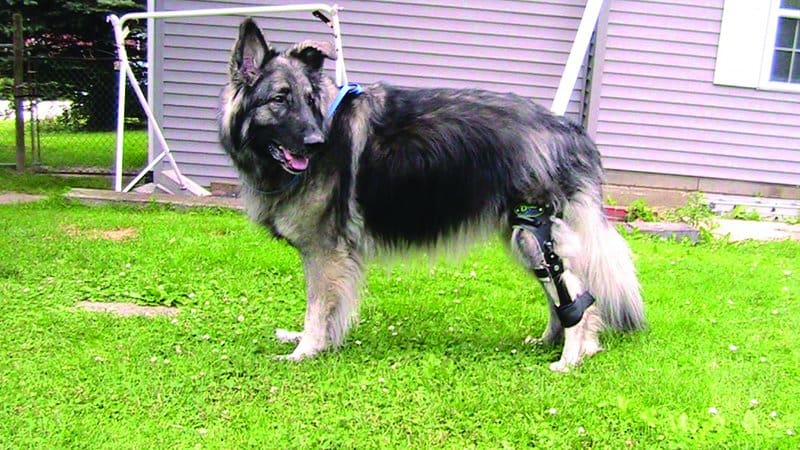
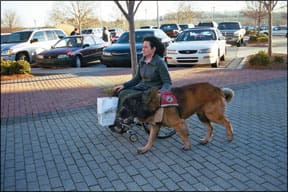
a shiloh shepherd with torn acl

The orthopedic surgeon diagnosed a partial tear in both of Dakota’s knees and recommended immediate TPLO (tibial plateau leveling osteotomy) surgery. In this procedure, the tibia is cut, then rotated and held in place with a metal plate and screws so that after the broken bone heals, weight-bearing exercise stabilizes the knee joint.

“I had misgivings about this method,” she says, “especially because surgeons at the School of Veterinary Medicine at the University of Pennsylvania don’t use it. I spoke with Gail Smith, the head of the University’s department of clinical research, and with Amy Kapatkin, a board-certified orthopedic surgeon who was then at Penn. What Dr. Kapatkin said made perfect sense to me. She asked, ‘Why break a bone to fix a ligament?’ My whole interest in conservative management was triggered by my fear of the TPLO.”

The University referred Rubenstein to an orthopedic surgeon who used other methods. He found Dakota to have so few symptoms that he agreed to write a prescription for physical therapy in hopes that it might make surgery of any kind unnecessary.

“Physical therapy and exercise made all the difference,” she says. “Dakota never needed surgery, and neither did his littermate, Aubrey, who tore his cruciate ligament a few months later. Many veterinarians believe that the only effective treatment for these injuries is surgery – either TPLO or another surgery – but that simply isn’t true. Conservative management is a TPLO surgery alternative that can help most patients, including those who eventually have surgery, and then recover to lead active, happy lives.”

Understanding Ligament Injuries in Dogs

The stifle (knee) connects the femur (thigh bone) and tibia (leg bone) with a patella (kneecap) in front and fabella (a small bean-shaped bone) behind. Cartilage (the medial meniscus and lateral meniscus) cushions the bones, and ligaments hold everything in position.

Two key ligaments, the anterior (front) and posterior (back) cruciate ligaments, cross inside the knee joint. In animals, these ligaments are called cranial and caudal, respectively. The anterior or cranial cruciate ligament prevents the tibia from slipping out of position.

Veterinarians see most ligament patients immediately after their injuries, when symptoms are acute, or weeks or months later, after symptoms become chronic. If not immediately treated, most ligament injuries appear to improve but the knee remains swollen and abnormal wear between bones and meniscal cartilage creates degenerative changes that result in osteophytes (bone spurs), chronic pain, loss of motion, and arthritis. In some patients, osteophytes appear within one to three weeks of a ligament injury. Swelling on the inside of the knee, called a “medial buttress,” indicates the development of arthritis in patients with old injuries.

The main diagnostic tools for ligament injuries are X-rays, which can rule out bone cancer as a cause of leg pain, and a procedure called the “drawer test,” in which the veterinarian holds the femur with one hand and manipulates the tibia with the other. If the tibia can be moved forward, resembling a drawer being opened, the cruciate ligament has been torn or ruptured.

The drawer test is not necessarily conclusive because the tense muscles of a frightened or apprehensive dog can stabilize the knee temporarily. To produce more accurate results in such cases, patients may be sedated before being tested.

In the tibial compression test, which is another way to check for ligament damage, the femur is held steady with one hand while the other flexes the dog’s ankle. A ruptured ligament allows the tibia to move abnormally forward.

“A completely torn CCL in dogs is always a surgical case,” says Stacey Hershman, DVM, of Hastings-on-Hudson, New York, “since otherwise the knee cannot function as a hinge joint.” Advocates of conservative management recommend that whenever the tear is partial, nonsurgical techniques be given an eight-week try. If symptoms improve during that time, they say, the odds favor ACL recovery without surgery. If symptoms don’t improve, conservative management techniques can be used as pre- and post-operative conditioning and therapy.

Which Dogs Are at Highest Risk for Leg Injury?

Any dog can injure a cruciate ligament, but large breeds are most susceptible. According to one study, Neapolitan Mastiffs, Newfoundlands, Akitas, Saint Bernards, Rottweilers, Chesapeake Bay Retrievers, and American Staffordshire Terriers lead the list. Most veterinary clinics have seen ligament injuries in Labrador Retrievers, Golden Retrievers, German Shepherd Dogs, and other popular large breeds.

Young, athletic dogs playing hard can turn or step the wrong way and suddenly not be able to walk. Cruciate ligament injuries are unfortunately common in dogs who compete in agility, obedience, field trials, and other active sports.

Some veterinarians report progressive lameness in young Labrador Retrievers, Rottweilers, and other large-breed dogs resulting from a partial rupture of the cranial cruciate ligament. This may not be associated with a specific injury but may instead result from poor stifle biomechanics combined with a yet-to-be-defined conformation abnormality.

Older large-breed dogs can develop weakened ligaments that eventually tear, especially in dogs who are overweight. When a weakened ligament is stressed, its rupture can be triggered by activities that are otherwise insignificant, like sitting on cue, stepping over a curb, or jumping off a sofa.

A small dog’s size may not prevent a ligament injury, but smaller dogs usually recover faster. One study that compared dogs six months after their cruciate ligament ruptures found that 85 percent of those weighing less than 30 pounds had regained near normal or improved function while only 19 percent of those weighing more than 30 pounds had regained near normal function. Dogs in both groups needed at least six months to show maximum improvement.

Helping Your Dog After An Injury

If your dog is injured, visit your vet as soon as possible, but be an informed consumer. Many veterinarians consider cruciate ligament surgery necessary, routine, fast, easy, highly effective, and the only treatment that will help. For many dogs this has been the case, but some veterinary research places the cruciate ligament surgery for dogs success rate at well below 50 percent. If surgery is necessary, your investment in conservative management may pay dividends in faster recovery and better overall health.

Canine health and nutrition researcher Mary Straus recommends simple first-aid strategies for dogs with knee injuries. Straus learned about the benefits of such an approach when her dog, Piglet, had surgery for dysplasia on both elbows before her second birthday, followed by surgery for a ruptured cruciate at age three. “First and most importantly,” she says, “exercise must be restricted. No running, no jumping (including on and off furniture), and no stairs. Walk your dog on-leash when going outside to potty. The dog doesn’t necessarily have to be crated, which can restrict movement so much that it increases stiffness and limits flexibility, but should be confined to a small room or ex-pen, or kept on-leash while with the owner. Exercise restriction must be continued for at least six to eight weeks.”

Second, inflammation needs to be controlled. “I would use nonsteroidal anti-inflammatories (NSAIDs),” she says. “Inflammation contributes to cartilage degeneration and accelerates the development of arthritis. Don’t avoid NSAIDs in the hope that pain will keep your dog from overusing the leg. There are natural anti-inflammatories like bromelain, boswellia, quercitin, and turmeric, and I would use those as well, but they may not be strong enough alone. You could use white willow bark, which is comparable to aspirin, but it should not be combined with other NSAIDs. In addition to anti-inflammatories, I would give glucosamine-type supplements to try to protect the cartilage and slow arthritic changes. It’s questionable how much these help with cruciate injuries, but they do no harm and I would include them.”

Dr. Hershman prescribes Glycoflex, a nutritional supplement that contains freeze-dried Perna canaliculus or New Zealand Green Lipped Mussel. This product is recommended for joint and connective tissue support, for geriatric and working dogs, and as a follow-up to orthopedic surgery.

In addition, she gives subcutaneous Adequan® injections or teaches the owners to do so at home. Adequan Canine (polysulfated glycosaminoglycan) is a prescription, water-based, intramuscular, polysulfated glycosaminoglycan that helps prevent cartilage in the dog’s joint from wearing away. “I give injections twice a week for two weeks,” says Dr. Hershman, “then once a week for maintenance.”

She also recommends Wholistic Canine Complete Joint Mobility, which is a powder containing organic vitamins, minerals, digestive enzymes, hydrolized whitefish, immune-support ingredients, and pharmaceutical-grade glucosamine, chondroitin and MSM (methyl sulfonyl methane), all of which support healing, speed tissue repair, or help alleviate pain and inflammation.
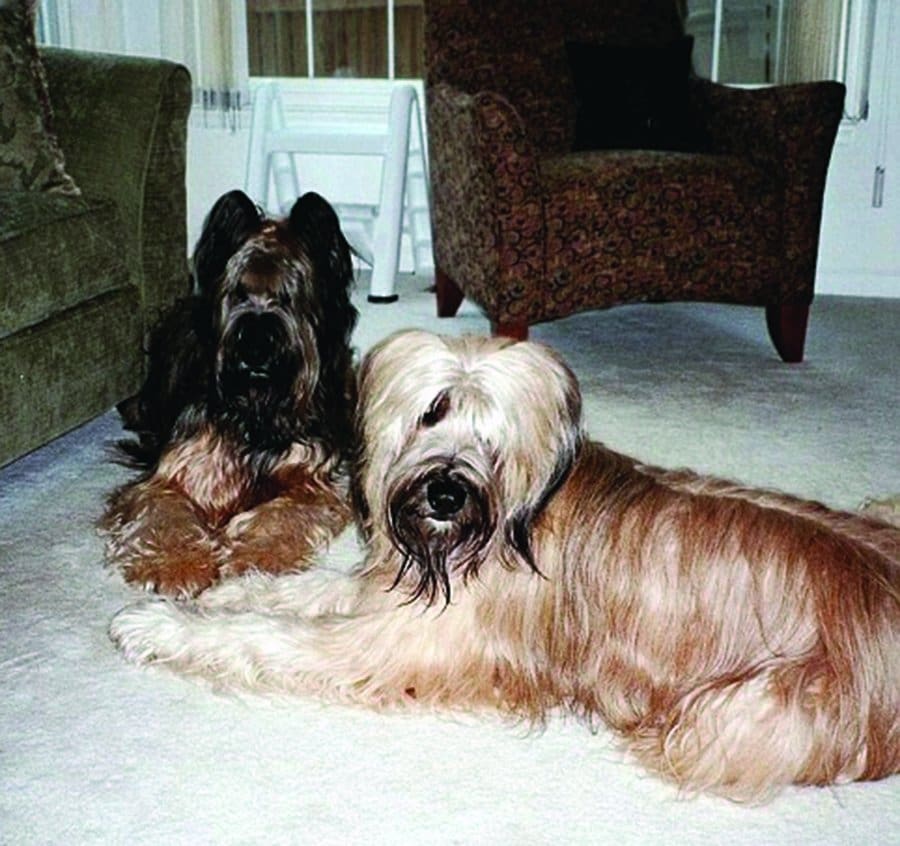
Briard dogs

Standard Process products for improved ligament health include Ligaplex, which contains organic raw bone, herbs, and minerals, and the veterinary product Canine Musculoskeletal Support, which contains anti-inflammatory herbs, Perna canaliculus, and whole-food ingredients that enhance tissue regeneration and improve joint health.

It is important to keep injured dogs from gaining weight, which can easily happen when their exercise routine is interrupted. “Overweight dogs have a harder time recovering from a cruciate ligament injury,” says Straus, “and they are more at risk for injuring the other knee. I would feed a high-protein, low-carbohydrate, reduced-fat diet. Fat is high in calories and so should be limited, but too little fat will leave the dog feeling hungry all the time. Protein helps with wound healing and also to create and preserve lean muscle, while carbs are more likely to be stored as fat. For those who feed kibble, I would cut back on the amount fed and add fresh, high-protein foods such as eggs, meat, and dairy. For seriously overweight dogs, this is one situation where I might consider using the drug Slentrol to help speed weight loss.”

Physical Therapy for Injured Dogs

Faith Rubenstein’s Dakota received physical therapy from Carol Wasmucky, PT, a licensed physical therapist for humans in Herndon, Virginia, who founded Pet Rehab Inc. and works full-time with animals by referral from veterinarians throughout Northern Virginia.

She began Dakota’s treatment by measuring his hind legs, one of which had atrophied and was smaller than the other. “Our goal,” says Rubenstein, “was to have both legs measure the same. Dakota and I worked with a holistic veterinarian, who put him on nutritional and herbal supplements, and we did acupuncture as well. I restricted his activity so he was not allowed to run off-leash for six months, and during that time he had regular physical therapy. Dakota wasn’t a swimming dog but he became one, for swimming was the perfect exercise for him. After six months, both hind legs were the same 17 inches in girth. He was in great shape, his drawer test results improved to nearly normal, and he didn’t need surgery.”

Dogs who are intermittently lame with a partial tear of the cruciate ligament are ideal physical therapy patients, says Wasmucky. In addition to providing weekly or twice-a-week ultrasound, laser, and electrical stimulation treatments, she puts patients on a home strengthening program with range-of-motion and stretching exercises. “Every program is different depending on the dog’s condition,” she says. “The owners are involved every day; I show them what to do. It’s just like working with human injuries; if you want the best results, you have to do your homework.”

Wasmucky, who has worked with thousands of canine patients over the past 10 years, encourages anyone whose dog has a partial tear to use physical therapy to build muscle so that even if surgery has to be performed, the dog goes in and comes out in better shape. “This means shorter rehab time,” she says, “and a faster recovery.”

Swimming is such effective exercise for injured dogs that many veterinary clinics have installed swimming pools. “Dogs who can’t yet do weight-bearing exercises can start in a pool,” she says, “and as they get stronger, they’re able to progress through the exercise program. I check their progress in weekly appointments and make adjustments as needed. It takes time to heal from ligament injuries and I like to be sure that dogs are completely well before they resume agility or other demanding sports.”

She requires a major commitment from owners. “It’s usually an hour or so every day in twice-a-day sessions,” she says, “and this can go on for months. It’s a big investment of time and energy, and it requires a motivated dog as well as a motivated owner, but it can make a world of difference in mobility and overall health.” For more about canine rehabilitation, see “The Benefits of Canine Rehab & Conditioning,” September 2009.

Prolotherapy for Dogs

Although most veterinary experts agree that there is no way to repair a damaged ligament, one alternative therapy claims to do exactly that. Prolotherapy, also known as proliferative or sclerosing therapy, has been used for over 30 years to treat musculoskeletal pain in humans, including arthritis, sports injuries, and damaged or partially torn ligaments, tendons, and cartilage.

The term “prolo” is short for proliferation, as this treatment is said to cause the proliferation (growth or formation) of new tissue in weakened areas. Ligaments have a limited blood supply, which slows healing, but in prolotherapy, injections of dextrose (sugar water) or other benign substances cause localized inflammation that increases the supply of blood and nutrients, stimulating tissue repair.

Health columnist Jane E. Brody described prolotherapy as “injections to kick-start tissue repair” in the August 7, 2007 New York Times, where she wrote that most scientifically designed controlled studies of prolotherapy have shown “a significant improvement in the patients’ level of pain and ability to move the painful joint.” In studies of human knee injuries, she said, patients with ligament laxity and instability experienced a tightening of those ligaments, including the anterior cruciate ligament (also known as the ACL). Other studies showed a significant improvement in the symptoms of arthritis in the knee one to three years after prolotherapy injections.

In Royal Oak, Michigan, John Simon, DVM, uses prolotherapy to repair damaged cruciate ligaments in dogs. He explains, “Prolotherapy is a way of tightening up loose, unstable, hyper-mobile joints by injecting a ‘sclerosing’ agent in and around the joint. The resulting thickening of the joint capsule and the ligaments surrounding it act like scar tissue and eventually contract with time. The thickening and contraction of the ligaments and joint capsule increase joint stability and relieve joint pain.”

Most canine cruciate ligament patients receive five sessions at three-week intervals. “Although I tell caregivers not to expect any positive results until at least the third treatment,” he says, “I am occasionally surprised to see improvement after just one. Other modalities that I often recommend in conjunction with prolotherapy are soft laser therapy and pulse magnetic therapy. These treatments reduce pain and help the joint recuperate.”

According to Dr. Simon, the best candidates for prolotherapy ligament repair are dogs whose injuries do not involve torn meniscal cartilage in the joint. During the past three years, he has treated 35 dogs for cruciate ligament problems and estimates that 80 percent experienced significant improvement.

Getting Your Dog A Leg Brace

Debbie Kazsimer, who lives in Pennsylvania, knows a lot about cruciate ligaments. Trouble, her Shepherd/Husky mix, had TPLO surgeries at ages six and seven, and her Shepherd/Malamute mix, Fly, had a TPLO when she was two.

In 2005, the Journal of the American Veterinary Medical Association published the case of a German Shepherd Dog who developed bone cancer after her implant corroded. Two years later, Trouble was diagnosed with osteosarcoma, and when his leg was amputated, its metal implant was found to be corroded. The biopsy report linked the cancer to his 2004 TPLO surgery.

As a precaution, Kazsimer had Fly’s implant removed. “But by then five years had passed and it was too late,” she says. “The damage was already done.” Within months, both dogs died of osteosarcoma.

Four weeks after Fly’s death, Kazsimer’s six-year-old 100-pound Shiloh Shepherd, Kimber, tore a cruciate ligament. By then, Kazsimer had learned about conservative management and knew she didn’t want to put another dog through a TPLO surgery. Because of her experiences with Fly and Trouble, she was familiar with range-of-motion and physical therapy exercises, and she studied massage with her husband, Ken, an Integrated Touch Therapy canine massage therapist. She spent an hour or two daily on Kimber’s rehabilitation.

“I thought a leg brace would be a big help to her,” she says, “but my veterinarian refused to fit her for one because he was convinced it wouldn’t work. So my husband and son helped me to cast her leg with a casting kit from Orthopets. The brace supports the knee externally, just as surgery supports it internally.”

Kimber went from walking on three legs to walking on four, then swimming, then finally bearing full weight on her leg. Eight months after her injury, Kimber’s regimen of supplements, physical therapy, massage, swimming, and wearing the brace have enabled her to recover well without surgery. “She runs around like a wild girl!” says Kazsimer, who has posted videos of Kimber online, where you can see her running, swimming, and playing with and without her brace on. “It’s wonderful,” she says. “Kimber is able to do everything she did before she got hurt.”

Holistic Therapies and Home Treatment for a Dog’s Torn ACL

The most popular “hands-on” treatments for injured dogs include acupuncture, acupressure, chiropractic, and massage.

Dr. Hershman, a certified veterinary acupuncturist, treats patients with acupuncture to alleviate pain and enhance healing of the torn ligament. “I do this once or twice per week for the first two weeks,” she says, “depending on the dog’s level of pain, then once a week for five to six weeks, then once every two weeks, and finally once a month. When the dog is weight-bearing and in less pain, I stop.” Dr. Hershman is also a certified veterinary homeopath who prescribes homeopathic remedies according to the patient’s symptoms.

In the article “Post-op Acupressure” (August 2006), Nancy Zidonis and Amy Snow describe how stimulating specific acupressure points with a thumb or fingertip can help with pain management, clear the effects of anesthesia, minimize the building of scar tissue, and reduce swelling. Acupressure can be learned at home and applied whenever needed.

Veterinary chiropractors help speed the healing of injuries and surgeries by making adjustments that improve skeletal alignment and musculoskeletal function. (See “Chiropractors for Canines,” March 2008.) Chiropractic adjustments help restore normal nerve activity by gently moving bones, ligaments, and tendons back into alignment, and when ligaments are injured, adjustments help realign the body to improve balance and speed healing.

Canine massage therapists used to be unusual, but now they play an important role in maintaining and improving our dogs’ health. Efflurage, passive touch, kneading techniques, and stroking increase circulation, release muscle tension, reduce pain and soreness, relieve stress, and accelerate the repair process. Massage books and how-to videos make it easy for caregivers to apply these same techniques at home.

Online Support for Injured Dogs

Thanks to the Internet, anyone whose dog suffers a cruciate ligament injury can find a wealth of information about canine anatomy, surgical options, and alternatives to cruciate ligament dog surgery online.

The conservative management forum that Faith Rubenstein founded five years ago now has more than 2,000 members around the world. Paola Ferraris, who lives in Italy, is one of its moderators. “What I would like to stress is that conservative management is not an easy (and often not cheap) alternative to surgery,” says Ferraris. “Successful conservative management requires just as much commitment as post-op care. It’s tough love and careful management. Your work is basically the same as rehabbing a dog who has had surgery; in fact, a number of our members have had surgery done on their dogs and use the list for pre-op and post-op support.”

When her own dog suffered an ACL injury, Ferraris had to make decisions with little information. “The best way to discuss treatment with your veterinarian is when you understand the available options and their pros and cons,” she says. “I had to educate myself by spending nights doing research online, after the fact. I would have appreciated having more available information, which is what we now offer.”

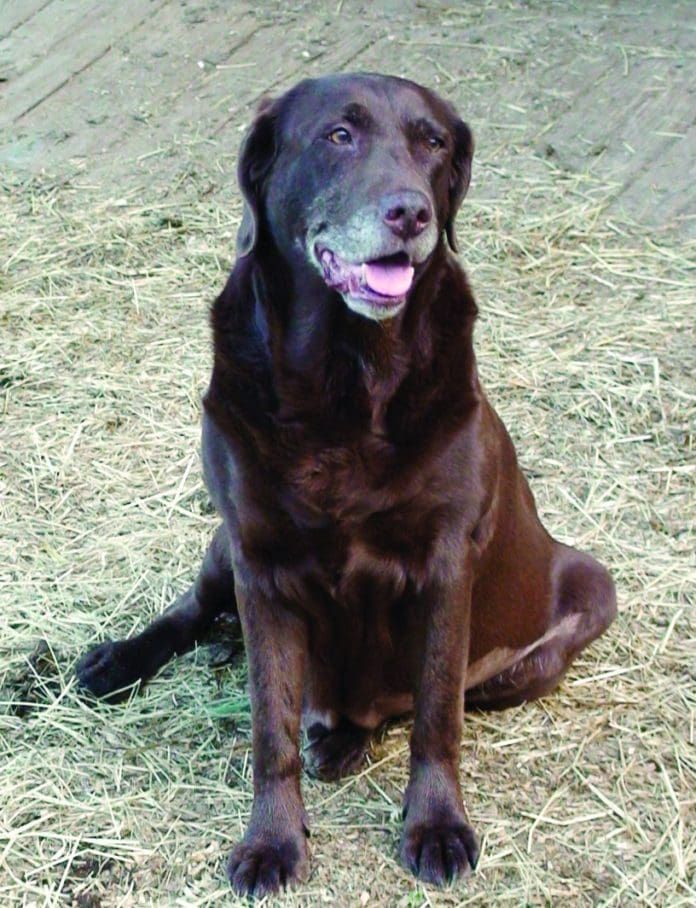
Co-moderator Ansley Newton of Pownal, Maine, became interested in conservative management when her chocolate Lab, Dooley, injured his second knee. “The first knee had TPLO surgery,” she says, “so I was excited to try conservative management with the second knee.

Unfortunately after four months he did not get better and I chose to have a traditional surgery, which was very successful for this 90-pound dog. Then one day my large chocolate Lab, Nutmeg, came inside with that familiar limp. I again decided to try conservative management along with a knee brace, acupuncture, massage, swimming, and some other supportive techniques. Within six months she was back to normal with very little arthritis.

“After three ligament injuries, I thought I was done. But no, two years later Nutmeg came in limping again. I again went the conservative management route and things were going fine until the second month when Nutmeg had an oops moment. She was limping again, so I decided to do surgery but had to postpone it for a couple of months because I tore my own anterior cruciate ligament and damaged my meniscus at the same time!

“So here I was running a farm by myself on crutches and wearing a knee brace with a dog in a knee brace. What a sight we both were. I wish I had taken a picture. We were forced to stay with conservative management because there was no one to take care of the farm and I couldn’t drive Nutmeg to get her surgery. We limped through several months together and lo and behold, we both healed. Nutmeg was good to go in six months and it took me closer to 10. Nutmeg recently passed away from lymphoma. She was 14 years old and despite those two ligament injuries, her legs were still fine.”

The Surgical Options for Torn ACLs in Dogs

While it is not possible to repair canine ligaments surgically, lateral suture stabilization, or LSS techniques, can stabilize knee joints so that they function well.

In the extracapsular repair procedure, tom or partially torn ligament tissue and bone spurs are removed along with the damaged portion of the meniscus. Through a hole drilled in the front of the tibia, a large, strong suture is passed around the fabella behind the knee, which tightens the joint and replaces the cruciate ligament.

The intracapsular repair method, which is no longer popular in the United States but still widely used in the United Kingdom, replaces the cruciate ligament with a strip of connective tissue after the damaged meniscus and ligament fragments are removed. This “new ligament” is sewn into place or attached to an implant.

A ligament repair technique called the Tightrope procedure utilizes a fiber tape suture material developed for human ankle and shoulder reconstruction. This material
replaces the damaged cruciate ligament and stabilizes the stifle joint.

Tibial Plateau Leveling Osteotomy, or TPLO surgery, involves breaking and resetting the tibia. The meniscus cartilage is removed and, if badly damaged, the remains of the cruciate ligament may be removed as well. The repositioned bone is held in place with a metal plate and screws. This procedure treats an estimated 50 percent of all cruciate ligament injuries in the US. and its popularity helped double the number of American veterinary surgeons in a single decade (1995-2005). TPLO surgery requires a specialist and typically costs twice as much as extracapsular repair.

Tibial Tuberosity Advancement, or TTA, which was developed in 2002 at the University of Zurich, repositions the top of the tibia by separating and then anchoring it with titanium or steel implants. Like TPLO surgery, TTA requires special equipment and expertise.

None of these procedures work for every patient and all carry risks associated with the use of general anesthetics, post-operative infections, and other complications. The TPLO and TTA are most expensive and most invasive.

Which surgical method is best? Every procedure has its advocates and many veterinary surgeons claim high success rates, but the results of research studies can be sobering. In
2005, the Journal of the American Veterinary Medical Association published a study* comparing the results of lateral suture stabilization (LSS), intracapsular stabilization (ICS),
and TPLO surgery on 131 Labrador Retrievers with ruptured cranial cruciate ligaments and injury to the medial meniscus. Limb function was measured before surgery and again two and six months after. Treated dogs were also compared to 17 clinically normal Labrador Retrievers. Compared with the clinically normal dogs, only 14.9 percent of the LSS-treated dogs, 15 percent of ICS-treated dogs, and 10.9 percent of TPLO-treated dogs had normal limb function. Overall improvement was seen in only 15 percent of dogs treated with ICS, 34 percent of those treated with TPLO, and 40 percent of those treated with LSS.

* “Effect of surgical technique on limb function after surgery for rupture of the cranial cruciate ligament in dogs,” by Michael G. Conzemius, DVM, PhD, DVACS, et al. Journal of
the American Veterinary Medical Association, January 15, 2005, Vol. 226, No. 2, p. 232-236.

CJ Puotinen is a long-time contributor to WDJ and author of The Encyclopedia of Natural Pet Care and Natural Remedies for Dogs and Cats.

Disc Dog Competitions

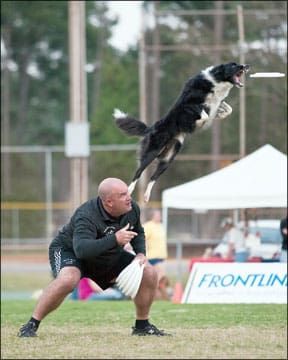
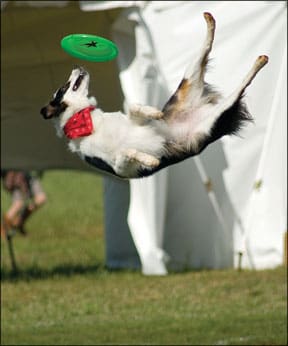
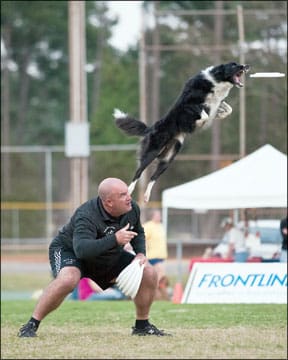
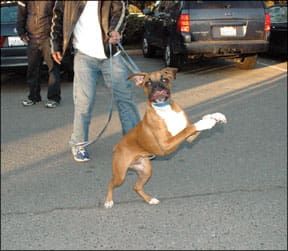
The cattle dog-mix races across the turf, his claws digging into the ground, pushing hard into his next stride, building momentum, faster, faster, faster. With a final turbo blast powered by his rear legs, he pushes off the ground and vaults into the air, seemingly weightless as he stretches his neck into the sky. A sudden twist of shoulders propels his torso and hips 180 degrees as he changes direction midair and snatches the prize from the air – a simple, round plastic disc.

Disc Dog Competitions

Photo by Jen Gregg

Eyes alight with the thrill of the chase and the kill (catch), he lands nimbly and races back to his handler. Can we do it again? Can we, can we? Yeah, we can.

This is the sport of disc dog. It’s been around since Frisbees became popular in the early 1970s and the players’ dogs chased the players’ errant tosses. When a bad toss resulted in a disc rolling on its side, that was fine by Fido. When a disc skimmed the ground, that was fine, too. And when the disc floated, tantalizing in the air, that was simply perfect, allowing Fido to analyze velocity and drift and match his body’s physical prowess to the job at hand. If he got a little too excited at the prospect of a toss and jumped up at his person and ricocheted off his body as the disc sailed away, how cool was that? All of these (and more) eventually made their way into disc dog training and competition.

History of Disc Dog

The first disc dog exhibition to grab the public’s attention was in 1974 in Los Angeles at a baseball game between the Dodgers and the Cincinnati Reds. Alex Stein, a 19-year-old college student from Ohio, crashed the game with his Whippet, Ashley. In the eight minutes before he was escorted from the field and arrested, Stein and Ashley Whippet wowed the crowd with 35-mph runs and breathtaking vaults and catches. Interest in the sport skyrocketed.

Since then, a multitude of official sanctioning organizations have been created to promote competition and the sport in general. Local and regional clubs sprouted everywhere and in some locales formal group classes are offered to help people and dogs prepare for competition. Some top-flight competitors even turned their hobby into livelihoods, offering exhibitions for hire for public demonstrations to draw crowds to a variety of events.

Disc Dog Competitions

As with many of the other sports we have featured in this series, not everyone who trains for a particular sport chooses to compete. This is especially true with disc dogs. Many people love the challenge of training a particular routine, but get as much enjoyment from going to the local park and playing with their dogs as some get from competing. Playing in the park, however, can entice some into the competition ring.

That’s what happened to Chris Sexton, who got his first dog (Laika, a Border Collie) in 1995. Chris had been playing “disc golf” since 1990 and had a friend whose dog loved to fetch. “This crazy Lab-mix would fetch for hours. We discovered we could wear him out faster with a disc. When we saw an ad in the paper for a local Frisbee contest, we entered him. It was a lot of fun! Then we found out about another, bigger event coming up. I entered Laika in that one, and I was hooked.”

Sexton founded a disc dog club in Fort Collins, Colorado, called the Northern Colorado Disc Dogs, which later merged with the Front Range Flyers to form Colorado Disc Dogs. Then, in 2000, he and a few friends started the UFO World Cup Series, an international competition series organized like NASCAR or World Cup Skiing, where teams accumulate points to qualify for the final “World Cup Final” championship event. So, be forewarned: like many dog sports, this one can be addictive!

There are several different events for which teams train and compete. Points are accumulated for titles as well as to qualify for larger, national events.

• Toss and fetch: This is the bread and butter of the sport and the event that most people start with. This short-distance event goes by a variety of names such as “mini distance,” “throw and catch,” and “distance/accuracy,” but the goal is the same: You have a set amount of time – as little as 60 seconds – to throw a disc as many times as you can, with your dog retrieving it before it is thrown again. The field is marked with increasingly longer distances and you are judged on the distance and the number of tosses and catches. The average distance is about 40 to 45 yards.

Dogs are scored on their ability to catch the most discs, but can earn extra points for catching the discs while completely airborne (where the dog’s body leaves the ground). Thus, if the handler is good at throwing the disc predictably longer and higher, the team has a better chance of scoring higher than teams whose throws are shorter and lower.

• Freestyle: This event is where some of the most amazing acrobatics happen. Jumping off handler’s bodies, vaulting and twisting high in the air, and racing around and/or through the handler’s legs are common pieces of increasingly elaborate and complex routines. Each routine is between 30 seconds and 3 minutes long and individually choreographed by the handler. Each piece of the routine (e.g., leg weaving) is trained individually and then linked together into the final routine performed to music selected by the handler.

Teams are judged for creativity, athleticism, difficulty, showmanship, etc. As the sport has matured, routines have become more and more spectacular and have become the most popular event at public exhibitions.

• Long distance: This event is rarer than the two above. It pits teams against each other in an elimination-style event, with the winning teams successfully throwing the longest distances. This event has separate classes for women and for men. Women in this long-distance event typically throw 50 to 60 yards, although some have thrown in excess of 65 yards. For long-distance men, 70 to 80 yards is considered competitive, although throws of 90-plus yards have been recorded.

Some clubs and sanctioning organizations promote a variety of other events in addition to the ones listed above. As with many of the dog sports, dogs should be in good physical condition and be at least 12 to 18 months of age before competing.

Disc Training

Not all dogs hit the ground running, chasing, and leaping after plastic discs. If yours does, you are one of the lucky ones. Most dogs – and handlers – still need training to perfect the individual pieces of a routine, or to catch a disc in midair instead of waiting for it to hit the ground. Most people learn and train on their own or with local clubs since formal classes are quite rare.

“I learned primarily on my own,” remembers Chris Sexton. “There wasn’t very much in the way of videos or books, so the way that I learned new throws and tricks was to go to contests and watch, and then go home and try to replicate what I saw.

“Today, with the Internet, people can watch videos, read training articles, and ask anyone any question. This access to information means that people can get up to speed even if they are isolated. I saw this in action in 2009 on a trip to China. Chinese disc dog people have been watching people in Japan, Europe, and the U.S. on the Internet for years. They copy the moves and read the articles, so the level of talent there is respectable.

Disc Dog Competitions

“One other aspect that has helped the sport a lot is the proliferation of clubs. The disc dog clubs started in the mid 80s, but took off really big in the mid to late 90s. Having a group of people to practice with and participate with is a really big help. I think the clubs are the source of most ingenuity in the sport, and bring the most people in.”

Most training starts with straight tosses to the dog at very short distances. Once the dog catches those with a high degree of success, distances are increased and the height of the toss is increased. Eventually, discs are tossed just over the dog’s head and the dog leaps a bit to catch it. The handler has to work hard to ensure that the timing of the disc toss is well timed with his dog’s speed.

The websites of disc dog sanctioning organizations and clubs often provide training information and/or links to other sites; see the next page for contact information and Web addresses.

Disc Dog Team Attributes

Owners are often motivated by seeing their active dog have a fun outlet for his energy and talents. Although some people search for dogs with the energy for the sport, some gravitate to the sport because they ended up with a dog with too much energy to be expended by walks around the block.

Dave Rosell, a competitor from Huntington Beach, California, remembers when he got his first dog, Hook. “I wanted to get a dog to take on walks, go hiking with, and such. What I ended up with was a high-drive Australian Shepherd. He was full of energy and never seemed to tire even after having him fetch tennis balls or play tug for hours -well, it seemed like hours! So I started looking on the Internet for training and different activities I could do with him. I found Dog Services Unlimited, which offered not only obedience training, but also basic agility, flyball, and disc dog. I took all the classes.”

Energetic dogs who live to chase and retrieve love this sport. Sexton, who competes with two herding dogs, says a variety of dogs do well in disc dog events. “Herding breeds and retrievers are usually naturals. Their instinctive behaviors lend themselves very easily to disc play. Most smart dogs will enjoy the game and the challenge and interaction of the training as well. Border Collies, Aussies, Labs, Poodles, shepherds, some terriers, all do well. But, if there is one group that stands out, it would have to be the mutt! These dogs often have several aspects of those desirable qualities. Many mix-breeds excel in the sport.”

People who love this sport tend to love competition and share a love of seeing their dogs thrill at being in action and learn new physical tricks. Some competitors incorporate very physically demanding handler maneuvers, while others do very little, leaving the acrobatics to their dogs.

This sport is physically demanding on the dogs, but Sexton believes that, with care, you can safeguard your dog from injury. “It really depends on the dog and the handler, but in general, it’s no harder on dogs than playing outside and running around like a normal dog. The method to keep it safe is to start low and simple and build up to the more difficult tricks over time. This allows the dog to gradually learn the harder tricks and the body control required, which will make the tricks safer.

“Thankfully, injuries are not common in this sport! But you do see occasional tweaks and twists to legs that might cause a dog to come up lame for a bit. These are usually mild and rare. Another injury is in the form of cumulative damage from excessive height. In addition to normal aging-dog symptoms, I have seen a few dogs that had unusually stiff or arthritic joints when they were older. This can be partly genetic, but I think that the style of play can also be a factor. Excessive height in jumping is not only unnecessary, but even if the dog seems to land clean, he might accumulate long-term damage that could make for a less-pleasant retirement. Like many things, a little common sense goes a long way.”

Steven Donahue is a professional photographer who has taken photos for Purina Incredible Dog Challenge events for a number of years. When people see his photos of disc dog aerial superstars twisting through the air, or even fully upside down in mid-catch, they frequently comment, “Wow! I’ll bet those dogs get hurt a lot!” He replies, “I’ve been following the disc dog sport closely for about five years. I have seen hundreds of dogs who have been in the sport for years. During that time, I only know of a few minor injuries, and one career- (not life-) ending injury.

“With all that said, I would strongly discourage novice handlers from attempting advanced moves. First and foremost, know your breed, know your dog, and perform safe maneuvers with those limitations in mind. Secondly, know how to place/throw the disc for a safe flip or small vault before you ever even think about attempting it with a dog. Dogs with high drive will put themselves in danger attempting to catch poorly thrown discs.

“A personal example on knowing the limitations of your breed/dog. I have a Flat-Coated Retriever who is insane for the Frisbee. He would try to do this kind of stuff if I let him. However, he is awkward in the air compared to these Border Collies and Aussies. He doesn’t land safely on all fours if I do anything other than simple toss-and-fetch throws for him. So, that’s all we do.”

Easy to Start, Difficult to Perfect

Dave Rosell of Huntington Beach, California, trains and competes in three sports with two of his three dogs. When put on the spot and asked to compare his three chosen sports — agility, flyball, and disc dog — he does a good job of highlighting the attraction of each. But he has a soft spot for disc dog.

“Disc dog is great because you can start competing once you are good enough to throw a disc and your dog can catch it. But it also takes a tremendous amount of work and skill to be good enough to compete at the pro freestyle level. You probably have to spend as much time without your dog to learn your throws and routines as you do with your dog.

“I love the excitement that my dogs have when we play discs, but also the camaraderie that you have with the other disc doggers out there. They’re always there to congratulate you, give you advice, or help in any way. Another neat thing about disc dogs is you only need a couple of discs for your dogs to play, whereas with the other sports you usually have to have all kinds of equipment laid out before you can start practicing,

“Disc dog clubs help a lot. If you join a club, you get a lot of help and camaraderie i in addition to discounts on entry fees! Disc Dogs in southern California puts on most of the competition events in that area as well as joint ventures with other clubs. Its website has some training aids, a calendar of events, results of competitions, links, and information about the sport. Periodically it puts on ‘play days’ where the members and prospective members get together and the more experienced members help with some throws, with routines, and maybe even have a mini competition. But the big thing is that the people in the club are just a great bunch of people. We are a bunch of friends who get together with one thing in common: we are all disc dog crazy.”

Disc Dog Activity Expenses

The beauty of this sport is that all you need is your dog and a plastic disc and some space to throw it. Many of the websites listed in Resources will direct you to find the best discs (the hardest ones are not good on your dog’s mouth) as well as training materials. Entry fees and travel will be your biggest expenses, and these are still modest compared to many of the other dog sports.

If you can find a class, costs are usually modest – from $35 for classes and seminars to $80 per hour for private lessons. Competition fees run anywhere from completely free to $30 per class. Gas and lodging might be your next biggest expense, but the popularity of disc dogs has made competitions and exhibitions more plentiful than ever so you might not have to travel too far.

How to Get Started

Even if you don’t want to compete, joining a local club will be the fastest way to get up to speed. Club members are typically very helpful to newcomers and have a lot of experience to share. You and your dog can gain competition ring experience by first participating in public demonstrations with the club. Then, just take your dog and disc, smile, and toss!

Terry Long, CPDT, is a writer, agility instructor, and behavior counselor in Long Beach, CA. She lives with four dogs and a cat and is addicted to agility and animal behavior. 

Download The Full February 2010 Issue PDF

...
To continue reading this article or issue you must be a paid member.

Join Whole Dog Journal

Get full access to Whole-Dog-Journal.com – more than 4,000 articles – for just $20.
Join today and save 30% off our full price.
Already a member?
| Forgot your password? | Activate Web Access

Best Options for Boarding Your Dog

There are many things to consider when choosing to share your life with a dog. Knowing who will care for your dog or dogs when you have to be away from home is just as important as knowing how you’ll provide for their everyday needs. Even if overnight travel isn’t part of your regular routine, it’s wise to think ahead and have a plan for overnight care – just in case it’s ever needed. You never know when a family or local emergency may force you and your pets to spend a night or two apart.

Fortunately, today’s dog owners have several choices for pet care, ranging from in-home care provided by visiting pet sitters, to a wide range of commercial kenneling options. Each comes with its own unique list of pros and cons and no one choice is right for every dog. It’s important to do your homework when considering boarding. After all, you are literally putting your dog’s life in the hands of another.

In-home care
Providing care for your dog in your own home is one option, by either recruiting a trusted friend or family member or contracting with a professional pet sitter or sitting service.

You may never find a boarding facility that will make your dog feel this comfortable when you have to leave him behind for a vacation or business trip. But it would be nice if the staff members tried!

Some people choose to have a pet sitter visit several times each day, while others prefer hiring someone to temporarily take up residence in their home. Unless the visiting sitter will make multiple visits throughout the day, this option provides the least amount of supervision for your pet.

In this scenario, your dog is left alone and unsupervised for an unusually long period of time, and for that reason, this option is generally considered to be the most risky.

In contrast, arranging for someone to live in your home while you are gone can provide a greater amount of supervision of your dog with the least amount of disruption to your dog’s daily routine. In-home service providers can bring in the mail, water plants, and give your home a lived-in appearance.

When choosing an in-home pet care provider, it’s important to consider the unique needs of your dog and the experience level of the sitter. While a friend or family member may opt to help care for your dog at no charge, and may have a personal history with your pet, they may not be as educated in the fine details of dog care, particularly in things such as recognizing the early signs of stress or distress, or the myriad ways a determined escape artist can find to Houdini his way out of a seemingly secured area.

With a reputable pet sitting service, employees should be screened, professionally trained, bonded, and insured, and pet sitters should be well-versed in all aspects of domestic animal care. As an added bonus, large pet sitting companies generally employ enough personnel to be able to accommodate last-minute bookings, something not often possible when calling on the aid of a friend, family member, or single-sitter service. This professional training and flexibility comes at a price, however.

Similar to recruiting someone to temporarily reside in your home, you may opt to have your dogs stay overnight at the home of a trusted friend, family member, or professional pet sitter. This is slightly more disruptive for your dog than staying in her familiar environment, but it works well for many pet owners, especially when the pet knows the person with whom he’ll be staying and/or when the pet is older and not as apt to adjust well to a busy kennel.

Before packing your pup’s overnight bag and dropping him off at Aunt Betty’s, it’s important to be aware of environmental differences that could impact your pet. Does the host have dogs of her own? If so, how do your dogs get along? If they haven’t met, be sure to arrange a meet-and-greet prior to travelling so that personality conflicts can surface and be dealt with in advance. Double-check to make sure your pet cannot slip through fencing or other enclosures. Be sure to educate your pet’s host on any behavioral quirks that may impact his safety, such as a tendency to door-dart or ingest stray socks! If your host has a swimming pool and your dog has not been taught how to safely swim to the steps, ask that your dog not be left outside unsupervised.

Commercial options
A variety of options exist for owners who prefer to professionally board their dogs. Pet owners can choose from conventional kennel environments to upscale “resort- style” facilities that offer extra services such as group playtime, interactive food puzzles, training time, or grooming and spa services. Many facilities offer “cage-free” boarding where the dogs spend their time roaming with fellow guests and bedding down for the night on dog beds in a common area, while others have dogs confined to their kennels throughout the day except while being exercised by kennel staff.

Keep in mind that what works best for one dog might quickly spell disaster for another. Regardless of the type of service or facility you choose, it’s imperative to get to know the ins and outs of the service provider. The following considerations can be helpful in making an educated decision:

Compliance with state and local regulations and adherence to professional standards and practices. The kenneling industry is unregulated at the Federal level, leaving individual cities and states to implement regulations as they see fit. According to Pet Care Services Association (PCSA), a non-profit organization dedicated to assuring standards of quality and professional care, only about 20 states have adopted any formal regulatory standards for boarding kennels.

As such, many kennel owners operate with little more than a standard business license. When regulations do exist at the city or state level, they are usually minimal and simply address things such as preventing animal cruelty and requiring that adequate food, water, and shelter be available – not exactly standards that put your mind at ease when leaving your pet for the weekend.

“The pet-owning public has expectations when it comes to boarding,” says Charlotte Biggs, CKO and board president of PCSA and co-owner of Stay N Play Pet Ranch®, Inc., in Dripping Springs, Texas. “There are so few regulations available. Our mission is to fill that void.”

For a fee, membership in PCSA is open to any individual or legally operating business that is actively engaged in the non-veterinary care of pets as a primary service. All active members must agree to adhere to the organization’s Code of Ethics and Pet Owner’s Bill of Rights, both of which are available for review online at petcareservices.org. Member facilities may also opt to pursue volunteer PCSA accreditation though the Voluntary Facilities Accreditation (VFA) program.

In order to be considered for accreditation, facilities must be in business for a minimum of six months, must submit a detailed binder of information documenting all of their business and pet care practices and demonstrating that they meet the standards set forth by PCSA, and must pass an on-site inspection. It’s a comprehensive process that takes an average of six months to complete. Facilities are subject to random inspections throughout the year and must repeat the accreditation process every three years.

In addition to professional trade organizations, pet owners are wise to look for membership in local Chambers of Commerce and the Better Business Bureau. The more ways in which a professional’s reputation may be on the line, the greater the chance he will do everything in his power to ensure a successful boarding experience for his clients.

While professional and civic memberships demonstrate a certain level of professionalism on the part of the business owner, pet owners should not rely on memberships alone. Once you’ve verified that your prospective pet sitter or boarding kennel is in compliance with local regulations and adheres to a set of professional ethics and practice standards, there’s still much research to be done!

Staff requirements and training. In any business, a well-trained, competent staff is critical to success. In the kennel industry, a well-trained and competent staff is what ensures the health and safety of your pet. A love of dogs or distaste for retail work isn’t an adequate job qualification! Kindness, patience, compassion, and an ability to keep one’s own emotions in check are all important traits that must be combined with a solid understanding of dog behavior and a natural ability with dogs. This is critical in facilities that allow dog-to-dog interaction among guests.

Ask how employees are trained and how much (if any) continuing education is required. Laurie Zurborg, owner of Wags and Wiggles in Tustin, California, requires that all new employees undergo comprehensive in-house training and that all employees participate in retraining every six months. Wags and Wiggles is a daycare facility that provides boarding for clients, so it’s imperative that facility staff be especially skilled in the often subtle nuances of dog body language – such as facial expressions and body posture; how to recognize, prevent, and interrupt bullying; and how to safely break up a dog fight.

Wags and Wiggles also requires that any staff member who interacts with a dog in a training capacity (often available in boarding kennels as an add-on service) should be certified by the Certification Council for Professional Dog Trainers. Unless you board your dog at your usual, familiar trainer’s facility, we suggest that you not authorize training during boarding, unless you have taken the time to thoroughly screen the trainer and her methods.

Where are dogs housed? When it comes to professional boarding kennels, accommodations come, literally, in all shapes and sizes. Kennels range from high-volume, no-frills facilities with the ability to house upward of 150 dogs to smaller, boutique-style kennels housing a very limited number of dogs – and everything in between!

When choosing a kennel, be sure to make arrangements to visit far in advance. Don’t be surprised if the facility requires that you schedule your visit or only visit during certain hours rather than simply popping in unannounced. Barb Gibson, owner of The Pawmer House Pet Hotel in Wilton Center, Illinois, explains that for her, preventing random visitors is all about reducing stress and ensuring the safety of the dogs in her care. Guests at The Pawmer House participate in mandatory “quiet time” from 11:30 am to 2:00 pm and for at least one hour after each meal.

Unless there’s an emergency, no one is allowed inside the kennel area during quiet time. The arrival of a human in the kennel area – especially a new human – sets off a cacophony of barking. Limiting such outbursts is an important part of managing the overall stress level of the dogs. Gibson also advises visitors to be prepared to wait if arriving unannounced because staff may be busy tending to the needs of the dogs, and the needs of the dogs come first.

When visiting a facility, pay attention to the area where your dog will be housed. Is it secure? How tall is the fencing? Are at least some of the kennels enclosed on the top to prevent jumpers and climbers from escaping? Is it clean? How is it sanitized? Does it smell? If housed in kennel runs, can the dogs directly see other dogs on either side and across from them?

If the enclosure has no direct access to an outdoor potty area, ask how frequently dogs are taken outside or if they’re expected to eliminate in the enclosure. If the latter, how quickly are messes cleaned up and where is the dog during the process? What, if any, “comforts” are provided (such as beds, blankets, toys, and chews) and how are they sanitized between dogs? What personal items are allowed from home? Does the kennel require that all guests eat a facility-provided kibble, or can owners bring their pet’s food from home? Will the kennel accommodate special diets such as home-cooked meals or raw food?

It’s also important to know in advance what vaccinations are required, how they need to be documented and what, if any, exceptions exist. As thoughts regarding vaccination evolve, many kennels now accept titers or statements of vaccine exclusion from a veterinarian in lieu of following a strict vaccination protocol.

Well-managed dog play groups. Many kennels offer the option of recreational play groups. When considering this option, find out how guests are screened to determine their eligibility for play groups. As with day care and cage-free facilities, play groups must be closely supervised at all times by well-trained staff.

How large are the play groups? How are play pals selected? How much time do dogs spend engaged in off-leash play? What is the procedure for breaking up a dog fight and how are dogs handled immediately following, as well as for the duration of their stay? Are owners notified? If you don’t wish for your dog to participate in a play group, how will your dog be exercised?

Emergency plans. Accidents happen and an emergency can strike at any time. Make sure the facility has detailed emergency plans in place. Can they safely evacuate guests in the event of a natural disaster? Where are the animals evacuated to? Are client records backed up off-site so that owners can be notified of an evacuation should the facility be compromised? Seventeen dogs were killed when a propane tank exploded at a boarding facility in Pennsylvania in March 2009 (including Martha Stewart’s Chow Chow), and several others were injured or temporarily lost after fleeing in a panic. Many client files were destroyed in the fire, making it difficult to notify owners about the emergency.

Every kennel should maintain excellent working relationships with local veterinarians and 24-hour care facilities. Find out how emergencies or potential emergencies are handled. When vet care is needed, are owners contacted ahead of time? For minor issues, how is the need for vet care decided and by whom? You should feel comfortable knowing that medical issues will be promptly addressed without sending your dog to an after-hours emergency facility at the first sign of soft stool.

Go with your gut
Once you’ve done your homework and thoroughly checked out your list of potential facilities, often the best way to make a selection is to go with your gut instinct. If deciding between two different facilities that seem equal in terms of experience and standards of care, ask yourself if one just simply feels better? On the other hand, if for any reason you feel uncomfortable with a facility, regardless of its memberships or glowing recommendations, trust yourself and your ability to know what’s best for your pet.

Download The Full January 2010 Issue PDF

...
To continue reading this article or issue you must be a paid member.

Join Whole Dog Journal

Get full access to Whole-Dog-Journal.com – more than 4,000 articles – for just $20.
Join today and save 30% off our full price.
Already a member?
| Forgot your password? | Activate Web Access

House Training a Dog in Cold Weather

[Updated July 6, 2018]

Nasty, cold, blowing, snowing, sleeting, rainy day out and your dog won’t go out to potty? I can relate; I don’t much like to go out in bad weather either – even if I don’t have to poop and pee out there. Help is on the way. Here are five things you can do to help improve your dog’s winter “eliminate outside” outlook:


1. Go out with her.

She may be much more willing to brave the elements if her beloved human is with her. If you go with her you can keep her mind on her business, use her potty cue, get her to eliminate more quickly, and you will know if she’s empty or not. Don’t whine; if she has to go out, you can go out too!

2. Condition her to wear a coat and boots.

Watch this excellent video of Jean Donaldson conditioning her Chow, Buffy, to wear a head halter. Then use the same procedure with your dog’s coat and boots.

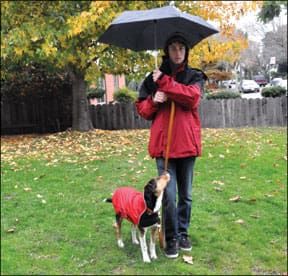
If she’s a short-coated, easily frozen kind of dog (think Chihuahua), you can hardly blame her for not wanting to go out on those wet, windy, or freezing days. When she’s happy to wear a coat, select the appropriate one for her from her ample wardrobe – a sweater for cool, blustery, fall days; a raincoat for wet ones; and a comfy down vest over the sweater for the days with real hypothermia potential.

3. Carry a large umbrella.

A big golf umbrella can completely protect a small-to-medium-sized dog from rain and snow, and partially protect a large one. While your thick-coated Great Pyrenees and water-resistant Labradors ought to be able to tolerate a little inclement weather, your thin-coated Great Dane might object. Remember to condition your dog to love your umbrella before you actually use it for weather purposes.

4. Build a covered potty area outside, and shovel a path to it.

Your dog will be happier to do her stuff outside if she has a spot that’s sheltered from wind and blowing snow or rain. Make it as close to the house as possible, so she doesn’t have to go far to get to it, and you don’t have to shovel as much snow. Be sure to build the shelter tall enough that you can stand under it, too!

5. Teach her to use an indoor litter box.

See “Indoor and Patio Litter Boxes for Home-Alone Dogs,” for directions on teaching your dog to use a litter box. Or at least put a litter box in your garage, or on your covered porch. The cold-aversive part of me thinks this is the best solution of all. If your dog has been really well trained not to go indoors you may need to start with teaching her to use her litter box outside, and when she’ll use it there, bring it indoors. At least you can do the training on warm sunny days, and use one or more of the other options to protect her outside on nasty days, until you’re ready to move the box indoors.

Purina makes small litter boxes and “secondnature,” a litter especially for dogs (although many dog owners use cat litter in their dog litter boxes). Some pet owners find puppy “pee pads” to be an adequate replacement for a litter box. But there are also a number of products on the market that simulate a bit of lawn for your dog’s indoor elimination. The “Porch Potty” is a box that accommodates the use of either real or artificial grass turf and contain any liquid runoff. The Ugodog is a similar system that employs the use of a mesh grating instead of a grass or grass-like surface for the dog to eliminate on. These products are fairly expensive, but may be just the thing for your fair-weather dog. Happy winter. Stay warm!

Pat Miller, CPDT, is Whole Dog Journal‘s Training Editor. Miller lives in Fairplay, Maryland, site of her Peaceable Paws training center. Pat is also author of The Power of Positive Dog Training; Positive Perspectives: Love Your Dog, Train Your Dog; Positive Perspectives II: Know Your Dog, Train Your Dog; and Play with Your Dog.

Caring for an Elderly Dog

0
Cathy Maher

Aaron Epstein’s 14-year-old Australian Shepherd-mix, Sam, was losing weight and his appetite wasn’t the same. “I just thought he was getting old because in addition to not eating with the same vigor, he was slowing down a bit, wasn’t able to walk as far, and sleeping a little too much,” Epstein recalls. The once 45-pound dog had shed close to 15 pounds -30 percent of his body weight -before concerned friends could convince a reluctant Epstein to get Sam to the veterinarian for an exam and blood work, both long overdue.

At the clinic, Sam was found to have an enormous mass growing on his spleen. The pressure from the mass made eating physically uncomfortable for Sam. Epstein followed the veterinarian’s recommendation and opted to have Sam’s spleen removed, as well as a number of other small tumors around his pancreas. Sadly, the veterinarian also discovered that the cancer was malignant. Although the prognosis for Sam was limited, he was home a few days later, eating like a horse and acting more like his formerly happy-go-lucky self.

From roughly age seven years on, a dog is considered senior, or geriatric, and it’s important that owners realize that old age is not a disease! If your elderly dog is losing weight, drinking and urinating more than he used to, can’t walk as far as he once did, or is exhibiting other changes in behavior, he’s not “just getting old” -he’s not well! Changes in our elderly dog friends are usually indicators of early chronic disease.

Elderly Dog
Aaron Epstein

Aging is a natural process that is the result of the net effect of negative changes in physiology over time. In a chapter of Geriatrics and Gerontology of the Dog and Cat, William Fortney, DVM, writes, “A common characteristic of aging body systems is progressive and irreversible change. The effects of disease, stress, malnutrition, lack of exercise, genetics, and environment may hasten this change.”

There are common metabolic and physical effects of aging, but these should not be confused with chronic disease. Older dogs can be expected to experience a decreased metabolic rate, decreased immune competence and greater susceptibility to infection, and reduced thermoregulation. In addition, each organ system undergoes changes as dogs age.

Natural physical changes to dogs that occur with age include:

Digestive system: Gastric mucosa atrophies, hepatocyte (liver cell) numbers decrease.

Endocrine system: Pancreatic enzyme secretion decreases, hyperplasia of pituitary or adrenal glands.

Integument: Skin becomes inelastic, footpads hyperkeratinize (get thicker), claws become brittle, muzzle grays.

Cardiovascular system: Lungs lose elasticity, vital capacity (volume) decreases, cough reflex and expiratory capacity decrease, cardiac output decreases.

Genitourinary system: Kidney weight decreases, prostate gland enlarges, testes atrophy (intact dogs), prepuce becomes pendulous.

Musculoskeletal system: percent of body weight represented by fat increases; muscle, bone, and cartilage mass are lost; bones become brittle; bone marrow becomes fatty and hypoplastic.

Nervous system: number of cells decreases; reduced reaction to stimuli; altered memory; diminished visual acuity, hearing, taste perception, and smell.

Although it is possible that one of these effects might lead to deterioration in body function, each alone is simply a result of the natural aging process. It’s when one or more of these changes progresses that we begin to see chronic disease. If even one of these changes occurs in your dog, it’s worth mentioning to your dog’s veterinarian to confirm whether it’s a normal aging change, or a preliminary sign of disease.

You are Your Dog’s Sole Caretaker

“It’s easy to list the common signs that indicate a potential problem, such as loss of appetite, increased drinking or urination, unusual bumps or discharges, vomiting or diarrhea, constipation, and lethargy/depression,” says holistic veterinarian Susan Wynn, DVM, CVA, CVCH, RH, of Georgia Veterinary Specialists in Atlanta. “But I find that owners frequently miss two of the more common problems. A ‘loss of appetite’ can be total or partial, but if it’s a partial loss, most owners tend to think their dogs have become ‘picky.’ Many people will try to get their ‘picky’ dogs to eat better for months while the disease process that caused the appetite change goes on unabated. This is an important message: If your dog has eaten well all of his life and suddenly becomes picky, this is a danger sign.

“The other thing that many owners miss is weight loss. If you think your dog has inadvertently lost weight, make a veterinary appointment now, because it means something went awry weeks to months ago.”

We need to do our part at home to notice changes in our canine friends. But don’t discount the expertise that your dog’s veterinarian can offer. Even when we don’t suspect a problem, geriatric wellness exams once (or even better, twice a year) are important. Start this practice (if you haven’t already) when your dog is about age seven. Regular senior wellness checks, complete with full blood work and urinalysis, and examination of your dog’s liver and kidney values, can be helpful in catching disease early.

“Because people see their dogs every day, sometimes they don’t see changes in those dogs. Getting a dog in for an exam twice -or even once -a year can uncover problems,” says Nick Berryessa, DVM, DACVIM, who also practices at Georgia Veterinary Specialists in Atlanta. “Put the dog on the scale, for example, and maybe we’ll see that he’s lost 10 pounds since last year. That’s a significant amount, even if it’s a 100-pound dog. If a person lost 10 percent of his body weight without changing his diet or exercise, it would be a red flag.”

What Goes Wrong with Elderly Dogs

The geriatric dog can develop multi-factorial problems; with an exam, you might be able to see why your dog is eating less, for example. Perhaps his teeth hurt and he has arthritis, both issues that should be individually investigated.

Dr. Berryessa outlined a few of the more common diseases that might be found in our geriatric dogs. Please note that each one, however, can be caused by a number of different disease processes.

Osteoarthritis

Leading the pack is osteoarthritis, especially in larger dogs and dogs who are overweight. One of the most important things we can do to ward off joint problems is to keep our dogs on the thin side; doing so has been proven to extend life expectancy. Nevertheless, with age can come signs such as lameness or slowing down that tell us that joint trouble is setting in. Ask your veterinarian to evaluate your dog and feel his joints, looking for pain in the joints, and consider x-rays to definitively pinpoint the problem.

From there, come up with a holistic plan to add the proper supplements, modalities such as massage and acupuncture, and, if necessary, prescription pain medication to give your dog relief. Dr. Wynn’s hierarchy of interventions for dealing with arthritis pain, and problems secondary to arthritis pain, starts with the basics such as glucosamine/chondroitin and fish oil. Then she suggests advancing, step by step, to include a more powerful glucosamine-type supplement (such as Thorne Research’s Arthroplex); massage; acupuncture; chiropractic; anti-inflammatory and analgesic herbs; shockwave, laser, or stem cell therapy; and non-steroidal anti-inflammatories (NSAIDs) or other prescription pain medications.

Chronic Kidney Disease

The cause of chronic kidney disease is not always known. Over time, the kidneys lose their ability to do their job, which is to eliminate waste from the body. Left unchecked, kidney disease can lead to other problems. One of the first signs of impaired kidney function is increased water intake and output of urine. At the point that the dog becomes unable to concentrate his urine, about two-thirds of his kidney function has already been lost. It’s important to provide a dog with kidney disease with ample fresh water and keep him hydrated. Diet also plays a role in managing this condition.

Urinalysis and blood tests conducted during an annual exam for Cathy Maher’s 14-year-old Lhasa Apso-mix, Dakota, in May 2007 indicated chronic kidney disease. Only a month earlier, Dakota had been diagnosed with mitral regurgitation (chronic mitral valve disease) after experiencing bouts of reverse sneezing, decreased appetite, increased lethargy, and a heart murmur. When the kidney disease was discovered, Dakota had no obvious symptoms other than some periodic decreased appetite and lethargy; these signs would have been easy to attribute to the mitral valve disease, had Cathy and her vet not been paying attention.

Dakota’s veterinarian felt that the chronic kidney disease was the bigger of the two issues for Dakota, and if they were able to get it under control, Dakota could have a quality life for two or three more years. Cathy was disheartened because she knew the condition, although treatable, was not curable. But she and her husband were committed to ensuring that they did everything they could to support Dakota’s quality of life.

They changed Dakota’s food, began fluid administration as needed at the vet, Calcitriol therapy, and a Vetri-Science Renal Essentials supplement in addition to continuing other supplements that he was already taking. With the intervention, careful treatment plan, and what Cathy describes as a fantastic veterinary team, Dakota did go on to live a high quality life for two more years, nearly reaching the 17 year mark.

Hypothyroidism

An underactive thyroid might reveal itself in a dog who has average, or even decreased, appetite, but in spite of that, is gaining weight. Weight gain despite level feeding is often the primary sign of hypothyroidism, but a poor hair coat or loss of energy may also be seen. A full thyroid panel can identify the disorder, and with the proper level of thyroid supplementation and periodic re-testing, your pal should be back on track in no time. Because the thyroid gland regulates metabolism of all body cellular functions, left untreated, hypothyroidism can lead to a significantly decreased quality of life for your pet. In most cases, the untreated condition will progress over months and years to result eventually in end-stage disease.

Diabetes Mellitus

Classic signs of diabetes mellitus include weight loss despite having a good appetite, and increased water intake and urination. In dogs, diabetes is associated with a dysfunction in insulin production. Because the dog cannot utilize the glucose in his bloodstream, it spills over into his urine; the disease is detected via urinalysis.

Dr. Berryessa explains what is going on in the dog, physiologically: “The dog loses weight because insulin is required to drive glucose into the cells. Without insulin, very few of the cells use glucose and as a result, those cells starve. That’s why an undiagnosed diabetic dog eats a lot and still loses weight; he can’t use the breakdown product of carbohydrates, which is glucose. He’s trying to use other things, like fats and other sources of energy, and so he loses protein and fat stores. It’s as if the dog were starving.” Typical treatment is administration of insulin injections and proper diet.

Cushing’s Disease

Another endocrine disease is Cushing’s (hyperadrenocorticism), which is overproduction of the hormone cortisol. Dogs with Cushing’s often experience increased thirst and water intake, increased urination, increased appetite, and lethargy. (Note that these symptoms are similar to those typically seen in a dog who has been subjected to a course of prednisone, a therapeutic corticosteroid).

Cushing’s disease is usually due to a tumor on the adrenal glands or a problem with the pituitary gland. A standard blood test might yield unusual results, but usually special endocrine testing is necessary to diagnose Cushing’s. Without treatment, the dog’s life span might be affected and his quality of life will dramatically worsen. Treatment consists of medication to control the overproduction of cortisol by the adrenal gland or surgery to remove the abnormal adrenal gland. Which treatment is chosen depends on whether the pituitary or adrenal gland is responsible.

Liver Disease

Typically liver disease in dogs is a chronic condition, caused by autoimmune or inflammatory disease. Few dogs will display clinical signs early in the disease process, or they’ll have very non-specific signs: they’re not eating very well, losing weight, slowing down, or (sometimes) will have increased water intake.

The only way to detect liver disease early is through blood tests -making another case for testing once or twice a year -in which elevated liver enzymes are revealed. There are other conditions that can cause an increase in liver enzymes, so further diagnostics such as ultrasound might be necessary for a proper diagnosis.

Cancer

According to Alice Villalobos, DVM, author of Canine and Feline Geriatric Oncology: Honoring the Human-Animal Bond, and a well-known pioneer in the field of cancer care for companion animals, more than half of our senior pets will be diagnosed with cancer. She points out that aging and cancer are closely correlated; as our pets lose their immune ability to fix all the mutations that happen in their bodies every day, they become more susceptible to cancer.

Appetite and weight loss can be caused by cancer. Most of the time, cancer is not detected through blood test results. According to Dr. Berryessa, blood tests won’t always indicate whether an animal has cancer, but are valuable for monitoring the dog’s overall health.

“People think of canine cancer in terms of lymphomas and leukemia in people. Although we see a lot of lymphoma in dogs, I wouldn’t say that a lot of them have cancer cells in their bloodstream. They usually have cancer in lymph nodes or organs, which we wouldn’t have any idea of from just a blood panel. A lot of times we have to look a little harder to find those things.”

Dr. Wynn adds, “When blood work is normal, and the dog clearly has a problem, that’s when we start suspecting cancer.” Detection is typically via palpation and imaging (x-rays, ultrasound) of the chest and abdomen to look for any masses or abnormalities in organs. “The dog might have other symptoms, such as losing weight or maybe drinking or urinating more than normal, or maybe they look distended,” Dr. Berryessa says, “but some of these tumors we might find incidentally. Somebody does an x-ray, for example, and finds a mass. The dog might not even be symptomatic for it.”

Johnny Hoskins, DVM, PhD, DACVIM, an expert in geriatrics and gerontology of the dog and cat, warns, “The early detection of cancer in geriatric animals is complicated by the presence of concurrent illnesses that mask early clinical signs of neoplastic disease; signs that could draw immediate attention and concern in a young animal are often accepted in an older animal as a consequence of aging.” That this disease is one that can be masked in our elderly dogs presents another case for twice-yearly veterinary exams.

Treatable vs. Terminal Conditions in Dogs

We might want to blame “old age” for any disease in our senior dogs and look the other way for fear of what lies ahead. But keep in mind that not all conditions that can afflict senior dogs are terminal; with early intervention and proper care, your dog might well have a normal life expectancy. Hypothyroidism, for example, need not ever affect lifespan.

Expected survival from any chronic illness depends on the animal’s general medical status as well as the stage of the primary disease. “It depends on the caregiver’s ability to manage the illness,” says Dr. Wynn. “Chronic kidney disease diagnosed at stage 1 can be managed for three to seven years in my experience, if the owner is really willing to do everything it takes. Osteoarthritis can be managed until death occurs from other causes, but if an owner is unwilling or unable to institute weight loss in an obese animal and administer supplements and drugs, it is conceivable that osteoarthritis could be a cause of euthanasia as pain prevents a pet from functioning.”

Detection vs. Prevention for Common Dog Diseases

For Aaron Epstein, it was hard to see Sam -his companion of 13 years, who’d been with him through thick and thin -grow old. But Sam lived another three months after his surgery, and Epstein felt that Sam lived a good and happy last few months, “eating really good food and being spoiled.” Did Epstein have any regrets? “I am glad that we did the surgery because the vet said that the tumor could have easily burst and that would have been a very bad end for him. In hindsight, I should have taken him to the vet a few months earlier as the tumor was likely causing the lack of appetite.”

Although we continue to do what we can to mitigate the effects of aging through diet, management of our dog’s environment, and a holistic veterinary approach, most of the above conditions cannot be prevented. The structural and metabolic changes associated with age, coupled with genetics and environmental stressors, make it possible that any of our canine companions are susceptible to disease.

That said, if we are assiduous about getting our senior dogs to the vet at least once, and preferably twice a year, we may be able to detect these conditions in their earliest stages. And early detection might be almost as good as prevention.

CARING FOR SENIOR DOGS: OVERVIEW

1. When your dog turns seven years old, consider instituting a schedule of biannual veterinary wellness exams.

2. Pay attention to subtle changes in your dog’s appetite; eating less is not a normal behavior for dogs. They are not good self-regulators! Feed separate meals, rather than free feeding. This will allow you to notice changes in his eating habits more easily, including subtle changes in appetite.

3. Keep your dog lean, offer mental stimulation, and physical exercise, keep stress levels low, and offer lots of “feel good” care.

4. Take your dog to the veterinarian sooner rather than later should you notice any changes in her.

Lisa Rodier lives in Alpharetta, Georgia. She is also a volunteer with the American Bouvier Rescue League.

Problems With Adopting Two Puppies Simultaneously

Adopting two puppies at once can lead to many issues

ADOPTING DOGS TWO-AT-A-TIME: OVERVIEW

1. Think long and hard about getting two new puppies at the same time. Make sure you’ll be able to give both dogs everything they need.

2. If you do get two puppies, make a firm commitment to spend social time and training time with them separately, to avoid having them super-bond with each other.

3. Consider instead adopting one puppy now and another later, or better yet, one puppy now and an adult dog later.


There’s no denying it: a new puppy is one of the world’s most wonderful things. It’s a cold, hard heart that doesn’t get all mushy over puppy breath, soft pink puppy pads, and the fun of helping a baby dog discover his new world. So, if one new puppy is wonderful, two puppies must be twice as wonderful, right? Well, not usually.

Most training professionals strongly recommend against adopting two pups at the same time. The biggest challenge of adopting two new puppies is their tendency to bond very closely with each other, often to the exclusion of a meaningful relationship with their humans. They can become inseparable. Also, owners often underestimate the time commitment required to properly care for and train two puppies; as a result the pups often end up untrained and undersocialized.

Adopting two puppies at once can lead to troubles socializing them.

Don’t Get Two New Puppies at Once!

I’m the last person on earth to argue against getting a second dog, or even a third; my husband and I have five. However, there are very good reasons to think long and hard about not getting two new puppies at once, whether they are siblings or not.

While the majority of new puppy owners seem to recognize that one puppy is enough of a responsibility for them, a certain number fall prey to one of a few common arguments about why two puppies might be better than one. I can rebut every one of them!

Let’s take a look at the most common reasons that people say they want to adopt two puppies at the same time – and why they shouldn’t be considered.

Two-pup rationale #1: “I want to get two puppies so they will have someone to play with while I’m gone all day at work.”

It’s a good thing to recognize that your pup could use companionship during the day. However, if you think one puppy can get into trouble when you’re not there, just think what kinds of mischief two pups can cook up when left to their own devices. Better solutions might include:

• Adopt your new pup at a time when someone in your family can take a week (or several) off work to stay home and help the puppy adjust gradually to being left alone. A couple of weeks vacation time? Kids home for the summer? Just be sure to use the time wisely, so your pup can learn to happily accept being alone when it’s time to go back to work or school.

• Find a friend, neighbor, or relative who is home much of the time and who is willing to provide daycare for your pup – and experience the joys of having a puppy to play with during the day, without the long-term responsibilities and costs of having a dog for 15-plus years.

• Ask your vet if she has another client with a similar-age puppy, and see if the two of you can mingle your pups at one of your puppy-proofed homes for puppy daycare, and send the second baby dog back home after work. Note the emphasis on “puppy-proofed.” Two pups can still get into a heap of trouble, even if one of them isn’t yours.

Two-pup rationale #2: “I have two children and they each want their own puppy.”

What a sweet idea. Just say no. Since when do the kids get to make the rules? Seriously, most families I know have enough trouble getting their kids to fulfill their promise to feed, walk, and clean up after one family dog. Mom ends up doing most of it anyway. So now Mom gets to do double-puppy-duty? If there’s a compelling reason for them each to have a dog, consider adopting one puppy now, and an adult dog from a shelter or rescue group. Even then, I’d adopt one first and give her at least a month to settle in, if not longer, before adopting the second.

If you must adopt two puppies at the same time for the kids, see the second half of this article.

Two-pup rationale #3: “We want to have two dogs eventually anyway, so we might as well get them at the same time so they can grow up together as best friends.”

Well, that’s what you might well get! When you raise two puppies together they usually do grow up to be inseparable best friends, often to the detriment of the dog-human relationship. Inevitably they spend far more time together than they do individually with you, with a likely result that they become very tightly bonded to each other and you are only secondary in their lives. Many owners of adopted-at-the-same-time puppies ultimately find themselves disappointed in their relationships with their dogs, even when they are committed to keeping them for life.

This super-bonding also causes tremendous stress (and stress-related behavior problems) on those occasions when the dogs do have to be separated – and sooner or later, something will come up that requires them to be separated: one goes to training class and the other doesn’t, you want to walk one but not both, or a health-related problem requires one to be hospitalized or otherwise kept separate.

When adopting two puppies at once it may lead to them being under socialized later in life.

Two-pup rationale #4: “A second puppy will play with the first and keep her occupied when I’m too busy to spend time with her.”

Nice thought, but here’s a heads-up. If you’re too busy to give one puppy the time she needs, you’re definitely too busy for two puppies!

There are great interactive dog toys on the market that can help occupy your pup when you can’t play with her – and don’t think that either another puppy or a pen full of toys can substitute for social time with you. Puppies do take time, and it’s important you give that some serious thought before adding a baby dog to the family. It’s fine to give her playmate-time via arranged play dates with a friend’s healthy and compatible puppy, but don’t think adopting a second pup is an acceptable substitute for your own interaction with your puppy.

Two-pup rationale #5: “If we adopt a second puppy, that’s one fewer that might be euthanized.”

I won’t argue with this, except to say that in many shelters around the country today, puppies aren’t the problem. Of course there are exceptions, but I’d say the majority of shelters in the United States now have no problems placing most if not all the puppies they get. It’s the adult dogs who are most likely to die because of homelessness. If you really want to save a life, adopt a grown-up dog instead of a puppy, or at least adopt your puppy now, and come back for an adult dog in a few months.

Two-pup rationale #6: “The breeder we are buying our puppy from thinks it’s best if we take two.”

If you’re buying from a breeder who encourages you to purchase two puppies at once, run away fast. A truly responsible breeder will, in most cases, refuse to sell two puppies to one home, except on the rare occasion that a prospective buyer can prove she has the skill, knowledge, time, ability, and monetary resources to provide an excellent environment for two pups at once. Someone who tries to push two puppies on a buyer isn’t a very responsible breeder, and isn’t doing her puppies, or the new owner, any favors.

What to Do If You Adopt Two New Puppies

Perhaps you’ve already adopted two new puppies and are ruefully regretting your error. Or maybe you don’t regret it, but you realize you’ve taken on far more of a responsibility than you realized. Perhaps you’re determined to go ahead and do it anyway, despite my advice above. If you do take the bait and find yourself in double trouble, there are things you can do to minimize problems and maximize your success as the owner of a puppy pair:

1. Crate them separately. Your pups are going to have plenty of together time; they don’t need to sleep together too. You can certainly leave them together in their puppy-proofed space when you’re gone all day, but they should be crated separately at night. You can crate them near each other, but this is the perfect time to start habituating them to not always being in close contact with their sibling. (See “Crating Woes,” Whole Dog Journal May 2005.) When they are comfortable in their crates close to each other, you can gradually increase distance between crates until they can be crated out of sight of each other, perhaps even in another room.

You can also do the “separate crating” thing cold turkey. If your children are old enough to be responsible for taking their pups out in the middle of the night, start from day one with a pup crated in each kid’s room.

In any case, the puppies’ separate crates should be in someone’s bedroom. This is vitally important so someone hears them when they wake at night and have to go out. The pups also benefit from the eight hours of close contact with you, even though you’re all sleeping. And by the way, you can bet if one puppy wakes up to go out, the other puppy in her nearby crate will wake up, too.

2. Train them separately. Your training programs will be much more successful if you take the time to work with your pups individually. If you are using clicker training (and I hope you are!), you’ll probably find that it’s confusing and difficult to try to click and reward one pup for doing a desired behavior when the other pup is doing an unwanted behavior. When this happens, both pups think they got clicked, which means you’re reinforcing the unwanted behavior as well as the desired one. Oops! Not to mention that it’s much more difficult to get and keep any semblance of attention from either puppy if the other is present as a distraction.

Two dogs adopted at the same time may look to each other rather than their owner for social cues.

Training time is a perfect opportunity to give your pups a positive association with being separated. One gets to play (train) with you and get attention, clicks, and yummy treats, while the other gets to hang out in her crate in another room, preferably far enough away she can’t hear you clicking, and empty her deliciously stuffed Kong.

If there’s a second trainer in your family, that person can work with the second pup in another room at the same time. Eventually you can each work with them at the same time in the same room, and sometime in the future one person can have fun working with them both at the same time. But that’s down the road somewhere, after they’ve both learned their good manners lessons very well.

3. Play with them separately. It’s common in puppy pairs for one pup to be more assertive than the other, and take the lead in puppy activities. It’s fine to play with them together some of the time, and it’s also important to play with them separately, so the more assertive pup doesn’t always get to make the rules for the other.

For example, if you always play “fetch” with the two together, you’re likely to see that one pup repeatedly gets the toy and brings it back, while the other runs happily along behind. If you watch closely, you may even see the more assertive one do a little body language warning if the other tries to get the toy – a hard stare and stiffened body, perhaps. The less assertive one defers to her sibling by letting go of the toy and looking away. That’s a fine and normal puppy interaction, but it can suppress the “softer” pup’s retrieving behavior. Unless you make the effort to give her positive reinforcement for fetching toys when you play with her alone, you might find it difficult to get her to retrieve later on in her training.

4. Walk and socialize them separately. Just as with your training sessions, you’ll need to walk one pup while leaving the other behind with something wonderful, or while someone else walks the other one in the opposite direction around the block. Walking them together with different handlers doesn’t work; the less confident pup will come to rely on the presence of the more confident one to be brave in the real world. Then, when the more confident one isn’t there, the shyer pup is more likely to be fearful. All the activities you would normally do with one pup, you need to do with each pup individually.

Signing up for puppy training class? Set aside two nights, not one, and take them to separate classes. Going to the groomer? It’s two trips, not one. Time for that next set of puppy shots? Make two appointments, not one. Oh okay, I’ll give you a break – it doesn’t have to be every time, but they should go somewhere by themselves at least as often as they go together.

So, are you getting the idea of the “separate but equal” program? Everything you would do with one puppy you need to do with each puppy separately. This is to be sure they’re both getting the attention, training, and socialization experiences they need, without the interference of the other pup, and so they’re not dependent on the presence of other pup. Of course you can also do things with them together, but you must be sure they are completely relaxed and comfortable about being apart.

For super-bonded dogs, separation becomes a world-class crisis, fraught with life-threatening behaviors such as anorexia (refusal to eat in the other’s absence), separation anxiety (barking, destructive behavior, relentless pacing, and howling), and other stress-related behaviors, including aggression.

Inevitably, at some time in their lives super-bonded dogs will have to be separated. One will get sick, or need surgery, when the other doesn’t. Most of the time, one will die before the other. I know of cases where the surviving dog of a super-bonded pair has had to be euthanized after the partner died, as he was too stressed by himself to be able to function. This is not a situation any loving dog owner wants to face.

Other Factors Involved in Adopting Two Puppies

Behavioral considerations are the reason that most trainers recommend against adopting two puppies at once. But there are other reasons that have nothing to do with the dogs’ behavior.

1. Cost. Not surprisingly, it costs twice as much for routine feeding and care for two puppies as it does for one. But don’t forget the catastrophic care costs! If one pup contracts a deadly disease such as parvovirus, you’re on your way to the emergency clinic with two pups, not one. Sure, if one gets injured the other’s not likely to have sympathy injuries, but with two pups the chances of one getting injured in some manner double.

2. Clean up. Let’s not forget puppy pee and poo. One pup produces more than enough waste for any sane human to deal with, and with two pups you naturally double the production.

If that isn’t enough, consider this: You leave your pups in an exercise pen when you’re not home. One pup is likely to learn to eliminate in a corner of the pen reasonably quickly, and will hopefully avoid tromping through it. Two puppies may select two different corners of the pen as designated bathroom spots, which doubles the chances of poop tromping. On top of that, if the two pups get to wrestling, as pups do, there’s a much greater likelihood of them rolling around in poo than there is if one pup is playing by herself.

Picture yourself coming home from a long, hard day at work, tired, looking forward to a little loving puppy cuddling, to find a pair of poo-covered pups in a pen plastered with the stuff from one side to the other. I’m just sayin’. . .

3. Housetraining. Of course, when you’re home, the puppies come out of the pen to be with you. We normally recommend the umbilical cord approach to housetraining: at first keeping your pup on a leash or tether, or with you, under your eagle eye, all the time, and going out to the designated potty spot every hour on the hour.

Now you’re tied to two puppies who want to wrestle with each other under your feet – or one’s tied to you and one to another family member. As the pups mature you lengthen the time between potty breaks and start relaxing supervision, when the pups demonstrate their ability to “hold it.”

Oops! There’s a puddle. Which pup did it? Oh look, there’s a wee puppy pile of poo under the dining room table. Oh no! I see teeth marks on the corner of the antique loveseat! If you have one puppy and you’re having a persistent problem, you clearly know who needs more supervision, or a quick trip to the vet to rule out a possible medical issue. With two pups, you have to increase management and supervision on both of them, and may never know for sure which one is having accidents. Or maybe it’s both!

4. Gender. Some people say if you’re going to have two puppies, get a boy and a girl. Others say get two boys. Some might specifically warn against getting two girls, stating that two female adult dogs in the same family will fight. Others will tell you they’ve had two girl dogs at the same time, no problem.

Here’s my take: Plenty of same-sex puppy pairs get along just fine throughout their lives. Plenty of mixed-sex pairs do the same. There are same sex pairs that end up with conflicts, and there are mixed-sex pairs that end up fighting with each other (despite super-bonding). It does seem to be true (and there are some studies that indicate) that intra-pack conflicts involving two females tend to be more intense than intra-pack issues between two males, or opposite sex pairs. That doesn’t mean there will be conflict if you adopt two girl puppies, only that if there is, it may be more difficult to resolve than differences of opinions between two boys, or a boy and a girl.

Think About It

Is the extra fun of having two puppies at one time worth all the extra time, energy, cost, and headaches? I’m warning you not to do it. I’m recommending you adopt one now, and another in six months to a year, when the first has bonded with you, and at least completed her basic good manners training.

But if you decide to do it anyway, and are ready to do all it takes to make it work, then you have my sincere blessings and best wishes. But please, be honest and realistic about whether you and your other human family members really have the resources and commitment to give both pups what they need to ensure their lifelong loving home with you. Go find your two wonderful puppies and have an absolutely great life with them.

Dog Carting and Draft Training

What do you envision when someone says “draft work“? What probably comes to mind are horses, mules, oxen, and other large “beasts of burden.” Think again. Since the 18th and 19th centuries, dogs have assisted humans by hauling wagons and carts across fields and through towns. Dogs have delivered milk and mail, hauled the day’s catch of fish from boat to town, and even hauled lumber in lumber camps.

This heritage forms the basis upon which the sport of carting was built by a variety of breed clubs. Between the 1970s and 1990s interest in the sport grew; the St. Bernard folks offered their first competition in 1988, and Bernese Mountain Dog fans added theirs in 1991.

Dog Carting and Draft Training

Photo by Jurgen Vogt

288

The natural inclination of dogs to pull has been literally harnessed by a variety of people through the years. Put backward pressure on a leash and collar, and most dogs will pull forward. Take that “opposition reflex” and a nice, padded harness, and you can see where this is going. Forward, of course!

Sledding. Weight pulling. Sulky driving. Skijoring. Carting. Some of these activities are still used to help humans with important tasks. Sled dogs have delivered critical medicines in the dead of winter. Service dogs pull wheelchairs. And some dogs show off their carting skills during public demonstrations and therapy dog visits. This sport has a very practical aspect to it. If you are creative, I’m sure there are tasks around home that you can find for your carting dog.

In this article, we will focus on “carting,” which involves a dog pulling a cart (a two-wheeled vehicle) or a wagon (a four-wheeled vehicle) with a person walking alongside.

Training
If this sport piques your interest, look at your dog. Is she a large or giant breed who has the size and strength to pull a wagon loaded with 50 to 100 percent of her body weight? Or is she a Pomeranian who has the smarts to learn something new that will be fun to show off to friends and residents at nursing homes? Or does the pure utility of the sport attract you?

Samantha Fogg, a professional dog trainer from Georgia, describes her interest in dog-related activities as “tending toward the practical rather than the competitive.” Fogg, disabled for 15 years, trained two of her service-dog Leonbergers, Fergus (now 12 years old) and Milo (now 8), to pull her wheelchair.

“My interest in carting stemmed from my interest in wheelchair pulling,” she says. “When I started doing wheelchair-pulling training, there was not a ton of information available on wheelchair pulling, but there was a significant amount available on carting. There are some major differences between wheelchair pulling and carting, but there are also a lot of similarities. Wheelchair pulling and carting differ fundamentally in that wheelchair-pulling dogs most often pull from the side, where carting dogs pull from the front. Pulling from the side is much more physically demanding, and thus the dog needs better structure.”

The training for these tasks is similar whether you expect your dog to pull a lot of weight or none. Although there are many opinions about training for this sport (what’s new?), here’s a broad overview of the progression of training.

Harness acclimation: Get your dog used to wearing the harness. This might take a fair amount of time, depending on how your dog reacts to the sight and feel of a drafting harness. They are quite different from standard dog harnesses.

Verbal cues: Your dog will need to respond to verbal cues to go forward, speed up, slow down, turn right, turn left, back up, and stop. Teach these before you ever attach your dog to a cart. Train these cues on-leash, then off-leash, and eventually, with a barrier between you and your dog so that you can simulate being a couple of feet away from your dog (out of the way of the cart). For example, you and your dog could walk on opposite sides of a short retaining wall, or with a row of buckets between you.

Traces: These are two straps that run from the dog’s harness to the wagon. You can simulate traces by attaching two leashes to your dog’s harness (or even to his regular collar). Walk alongside your dog while a friend follows behind holding the traces (as if she was holding the train of a long bridal dress).

Gradually, your friend can exert slight pressure on the traces while you reward your dog for moving forward. When your dog is comfortable with that, attach something light to each trace, such as a small water bottle or a plastic milk jug with a bit of sand in it. For safety, have your friend follow along to pick up the traces should your dog become frightened of something dragging behind him. Gradually, your dog will become more and more confident pulling weighted objects behind him.

Cart or wagon: There are many ways to train your dog to get in position and pull the cart, including shaping with a clicker or luring your dog into position. Dogs who love this sport are known to run over to their carts and back into position, waiting to be hitched up! When you’re ready to hook your dog to the cart for the first time, ask a friend to help, for safety. Should something scare your dog, you’ll appreciate an extra set of hands to control the cart. While you walk alongside your dog cueing slow, faster, stop, etc., your friend walks alongside or behind the cart, ready to help when needed.

Dog Carting and Draft Training

2005

288

Georgia resident Lisa Rodier started carting training with Axel (her Bouvier) in 1999, when he was three years old. Axel had already received a fair amount of training before Rodier tried teaching him to pull a cart. Axel had his CGC and was a registered therapy dog in Atlanta-based Happy Tails Pet Therapy, and they had dabbled in agility as well.

There are several exercises that people find challenging to train, says Rodier. “The most difficult include training a straight ‘eback,’ especially with the cart; negotiating the narrows (in which the dog must pull the cart through a narrow path); pace changes (fast/slow); and, in general, having the dog able to know and respond to cues in a distracting environment. An out-of-control dog with a cart can be dangerous to himself and others.”

Carting training is best accomplished using positive reinforcement techniques. Rodier says that her dog, Axel, reflects the power of positive training in his working attitude: “It’s important to keep it fun and positive. This shows in the dog’s attitude and willingness to work. Watching a dog who enjoys carting can bring tears to my eyes! But it’s very painful to watch a dog who has his head down, is confused and not enjoying himself, while his handler is tense, gesturing wildly, has unclear cues, and gets frustrated. If the dog doesn’t enjoy it, don’t do it!

“Clicker training can allow you to get really creative in teaching skills to use while carting. Standing for hitching is scored in most tests. People often put their dog on a stand-stay and then maneuver the cart around and behind the dog. I taught Axel to ‘ego in’ between the shafts of his cart, turn around, and stand for hitching. Axel’s ‘ego in’ behavior was a show-stopper, because he loved doing it and thought it was fun.”

Team attributes
Your dog should be physically fit and enjoy working. On the human end of the leash is usually someone who enjoys the non-conventional nature of this sport, has a working dog whose heritage involved carting, or someone who simply enjoys the utilitarian nature of the sport.

Equipment
You will need a harness and a cart or wagon in addition to the standard training tools such as treats and a clicker.

There are three types of harnesses:

Parade harness: This harness has a padded strap across the shoulders that also encircles the chest and another padded strap that crosses the front of the dog’s chest.

Draft harness: This model has a padded circle, or collar that goes around the dog’s neck, which allows free motion of the shoulders and legs. A belly strap connects to the shaft of the wagon or cart, while the collar is what attaches to the “traces” that run to the wagon.

Siwash harness: Similar in look to a sled dog harness, this harness has a series of straps on the dog’s back. There is a padded chest strap that runs along the breastbone and through the front legs.

Select a harness that is comfortable for your dog and, most importantly, does not restrict the free motion of his shoulders and legs. There are many knowledgeable people who can help you choose the best one for your dog and your purpose.

There are an infinite variety of carts and wagons depending upon personal preference, desire to compete, and/or practical use. The most common are carts or wagons with slatted wood sides.

Expenses
The most expensive part of this sport is the initial investment in a well-made harness ($60 to $300 or more) and your cart or wagon (starting at around $350 and going up and up and up). Some people make their own carts for as little as $100, and many people will let newcomers to the sport borrow a cart until they get their own.

Gas and lodging will probably be your next biggest expense. Competition fees run about $25 per entry.

Most people practice with other people they have met through local or regional breed clubs. Formal classes are very rare so this is not something you have to budget for!

Levels of competition
Each organization that sponsors a competition has its own rules, including whether they allow mixed-breed dogs. For example, the New England Drafting & Driving Club (NEDDC) opens its competition to any dog.

Titles and classes also vary among organizations. The Bernese Mountain Dog Club, for example, has a Novice Draft Dog (NDD) title in which all exercises are performed on-leash and, in addition to other basic control exercises, the dog is required to perform a half-mile freight haul of 20 pounds. The next level up, Draft Dog (DD), is off-leash and, in addition to the other control exercises, performs a half-mile freight haul of its own weight rounded down to the nearest 10 pounds.

There is also a class for two dogs to pull a wagon. This is called Brace Novice Draft Dog (BNDD), and is on-leash. The half-mile freight haul exercise requires a 40-pound load. The Brace Draft Dog (BDD) title is off-leash and the load is based on the combined weight of the dogs.

Beyond these classes, there are additional, higher-level titles.

How to get started
Contact one of the breed or working dog clubs near you and find out where people practice. Go and watch without your dog. Talk to the people about how you might get started.

Check out the books and DVDs listed in “Snapshot of the Sport: Carting” (page 19) to learn about the nuances of carting and how to train for it. Someone will be more likely to mentor you if you’ve done some homework and know some of the equipment and training challenges.

Fogg did a lot of independent homework when she got started. “I had a solid foundation in clicker training, went to a Judi Adler seminar at the Leonberger Club of America National Specialty, read everything I could get my hands on, asked questions of people I knew on-line, and worked with my training partner to teach this. I think that it would have been a lot easier to have started with someone experienced and to have done classes, but if you can’t get to classes in your area, don’t rule out carting!”

Some of the breed clubs will also know about, or sponsor, workshops in your area or you might need to travel to attend one. Workshops can provide a wealth of information because you will be able to see a variety of people and dogs working and be able to talk to people at all levels of the sport.

Carting is a sport with many practical applications. If you think your big dog needs a job, check out this sport! If you would like to perform demonstrations for public audiences, this sport will delight them. And if you need a help around the house, carting is definitely the ticket!

Terry Long, CPDT, is a writer, agility instructor, and behavior counselor in Long Beach, CA. She lives with four dogs and a cat and is addicted to agility and animal behavior. See “Resources,” page 24, for contact information.

Download the Full December 2009 Issue PDF

...
To continue reading this article or issue you must be a paid member.

Join Whole Dog Journal

Get full access to Whole-Dog-Journal.com – more than 4,000 articles – for just $20.
Join today and save 30% off our full price.
Already a member?
| Forgot your password? | Activate Web Access

Training Your Dog Not to Jump Up

There’s a common misconception that dogs jump on people to establish dominance. Balderdash! Dogs jump on people because there’s something about jumping that is reinforcing for the dog – usually the human attention that results from the jumping. If you want your dog to stop jumping on people, you have to be sure he doesn’t get reinforced for it. Here are five things to do when your dog jumps on people:

1. Interrupt. Minimize the reinforcement your dog gets from jumping on someone by cheerfully removing him from the situation as soon as possible. To that end, you may want to leave a “tab” attached to your dog’s collar when he’s around people – a short (4 to 6 inch) leash that makes it easy for you to lead him away. These are available from Premier Pet Products (premier.com; 800-933-5595); or just cut off an old leash. Don’t leave the tab on your dog when he’s alone; he could get it caught on something.

Training Your Dog Not to Jump Up

2. Manage. When you know your dog is likely to have trouble controlling himself, put his leash on before he can jump on someone. When you see the jumping-up gleam in his eye, restrain him to prevent the reinforcement he gets from the initial contact. Other useful management tools to prevent reinforcement include strategically located tethers, baby gates, doors, exercise pens, and crates.

3. Educate. Tell friends, family and even temporary acquaintances what you want them to do if your dog starts to jump up. Insist they not reinforce jumping up behavior – even those friends who claim they don’t mind! Educational options include telling them to:

• Greet your dog before he jumps, perhaps even kneeling to greet a small dog.

• Turn and step away from your dog until he sits, or at least has four feet on the floor, then turn back to greet the dog.

• Ask your dog to sit and reinforce by petting him if/when he does.

• Back away from your dog (if you have your dog on leash) and wait for him to sit before greeting or petting him. If he jumps up while you are petting him, simply stop the petting and take a step backward. Resume petting only if he sits.

• Toss a toy conveniently provided by you to redirect the dog’s behavior before the jump happens.

• Walk away from your dog through a gate or door and close it behind them to keep the dog on the other side.

4. Train. Of course you need to practice polite greetings in the absence of the exciting stimulus of guests and strangers by reinforcing your dog’s appropriate greeting with you and other family members. (See “Keeping Four on the Floor,” Whole Dog Journal May 2008). Be sure to take advantage of the presence of guests and strangers to reinforce your dog’s polite greeting behaviors while you’re managing with leashes and tethers.

5. Apologize/take responsibility. It’s your job to prevent your dog from jumping on people, even when they say they don’t mind. If your management efforts fail and your dog does jump up, apologize.

If in the process of jumping up he puts muddy pawprints on a business suit, snags a pair of nylons, knocks down a small child, or otherwise does some kind of property damage – even if the damage is minor – be responsible and make amends: pay for the cleaning bill, purchase a new pair of nylons, buy the child an ice cream cone, or do whatever you need to do to repair the damage. Then redouble your training and management efforts.

Constructional Aggression Treatment (CAT) Can Improve Behavior

On the last day of CAT Camp, the “campers” and “neutral dogs” mix quite nicely – success!

CONSTRUCTIONAL AGGRESSION TREATMENT OVERVIEW

What you can do…

– Read and watch videos about the CAT procedure and counter-conditioning to determine which approach is more appropriate for you and your dog.

– Talk to other dog owners and trainers (in person and online) to expand your knowledge base about the procedures.

– Look for a behavior professional experienced with the procedure to help you with it.

Aggressive behavior in their beloved companions is an incredibly challenging and upsetting problem for most dog owners to deal with. The problem is painfully public -and the public is equally free with accusations and advice for the hapless owner of a reactive dog. Many training “solutions” that people try are inhumane, ineffective, or both. Some owners respond by sequestering their dogs to their home “quarters” -sometimes for life.

Constructional Aggression Treatment
Many reactive dogs have learned that fearsome behavior succeeds in driving others away. CAT teaches them to use calm behavior to achieve the same goal. ©Noah Stone

In early 2008, I was excited to learn about a very new behavior modification approach for dealing with aggressive behavior in dogs. I described the technique, known as Constructional Aggression Treatment (CAT), in Whole Dog Journal’s May 2008 issue. “Modifying Aggressive Dog Behavior” explained the CAT program, and described my first experience (and positive results) using the technique. The subject was Juni, an eight-year-old Pit Bull-mix belonging to my friend and colleague, Jolanta Benal.

CAT was developed and tested by graduate student Kellie Snider for her master’s thesis, under the direction of Dr. Jose Rosales-Ruiz at the University of North Texas. The pair made quite a splash when they introduced CAT to the dog-training world, since CAT utilizes operant conditioning (negative reinforcement) to modify the subject’s behavior, rather than the more commonly used classical conditioning. (In classical conditioning, a positive stimulus is paired with an aversive one to deliberately improve the dog’s association with, and response to, the negative stimulus).

Since then I’ve had the opportunity to use CAT a number of times, with varying degrees of success. I’ve also participated in the ongoing behavior and training industry discussion about the technique. To say it’s a controversial approach to behavior modification is an understatement. But I still think it’s a valuable tool for use in some behavior cases.

The Principles of Operant Conditioning

Operant conditioning is a basic element of the science of behavior and learning. It says that all living things repeat behaviors that are rewarding to them, and avoid behaviors that make bad things happen. The four principles of Operant conditioning are:

1. Positive reinforcement (written in behavioral shorthand as “R+”): The dog’s behavior makes a good thing happen, so the behavior increases. He sits, and you give him a treat. He likes getting treats, so he sits more.

2. Positive punishment (P+): The dog’s behavior makes a bad thing happen, so the behavior decreases. He jumps up and you knee him in the chest (not recommended!) He doesn’t like a knee in the chest, so he jumps up less.

3. Negative punishment (P-): The dog’s behavior makes a good thing go away, so the behavior decreases. When he jumps up to grab the ball from your hand you hide the ball behind your back. He doesn’t want the ball to go away, so he jumps up less. (Negative punishment works best if you follow it with positive reinforcement for the behavior you want instead. When he sits you throw the ball [R+] so he sits more and jumps up less.)

4. Negative reinforcement (R-): The dog’s behavior makes a bad thing go away. Your puppy struggles when restrained, so you hold him until he becomes calm, and then let him go. Calm behavior makes restraint go away. He doesn’t want to be restrained, so he learns to be calm in order to make restraint go away (not recommended).

Because training methods that involve intimidation, coercion, and physical force can cause undesirable side effects, including fear and aggression, positive trainers use primarily positive reinforcement and secondarily negative punishment; they generally avoid the use of negative reinforcement, and especially avoid positive punishment. 0n those occasions where negative reinforcement may seem appropriate, it should be applied as gently as possible, avoiding a strong response from the dog. In the case of CAT, “gently” means presenting the aversive stimulus at sub-threshold intensity (otten this is “distance”) and being careful to increase intensity (decrease distance) only as the subject dog is can handle it.

CAT Controversy

The CAT approach is controversial among positive trainers for several reasons. The foremost is that the technique utilizes negative reinforcement.

To use negative reinforcement, something that is aversive to the dog is applied, and not withdrawn until the moment the dog changes his behavior in the desired way. For example, a dog pulls on the leash; this is a behavior the handler wants to stop. The handler increases the tightness of the leash, in a way that is uncomfortable for the dog; the tight leash is aversive. The dog moves back toward the handler (displays the behavior the handler wants), and the and the leash slackens, relieving the pressure and the dog’s discomfort.

Constructional Aggression Treatment
On the last day of the CAT workshop, Bliss calmly accepts treats from strangers at the mall. Tension is still evident in her face, though, and her cocked-back ears.

Positive trainers try to avoid the deliberate use of aversives, for many reasons. To name just a few, the application of aversives can make many dogs “shut down” or lose interest in working with their handlers. They can increase a dog’s anxiety and fear. They can damage the relationship between the dog and his handler. In fact, in the past, I have been one of the louder voices in opposition to the use of negative reinforcement in “dog-friendly” training programs.

However, there are some sound reasons for using a certain type of negative reinforcement in a CAT program. Here’s how negative reinforcement works in the CAT procedure:

Most dogs who display aggressive behavior toward other dogs are trying to scare the dogs away; they are threatened or stressed by other dogs. In most cases, the behavior works; growling, barking, lunging, and snapping often makes the other dog leave -or at least, makes the owners depart with their dogs! From the “aggressive” dog’s point of view, the aggressive behaviors (growling, barking, lunging, snapping) have been reinforced: they worked, and the other dogs went away. And because behaviors that are reinforced get stronger, the dog is more likely to growl or snap at the next dog, and the next, etc.

Constructional Aggression Treatment
Bliss is quite comfortable walking when surrounded by humans, as long as they don’t reach to pet her. If they did, she would likely snap at them.

In a CAT procedure for a dog-aggressive dog, the presence of the “other” dog is considered the aversive. The “subject dog” is deliberately exposed to another dog (the aversive is applied) in carefully controlled, low-intensity conditions, until the subject dog offers the desired behavior: some small decrease in his level of stress or tension. Then the aversive (other dog) is immediately whisked away. The idea is that the subject dog will realize that he can reliably make the aversive “other dog” leave if he exhibits calm behavior; each time he does this, he is rewarded -reinforced -by the quick exit of the other dog. His calm behavior around other dogs increases.

Most positive trainers (including myself) are opposed to the use of aversives, which by definition inflict pain, discomfort, fear, and anxiety on the dog. In CAT, however, you present the subject dog with an aversive stimulus that he is often exposed to anyway. For anyone who lives in a populated neighborhood and wants to take their dog out of the house, other dogs are not avoidable. Consider the dog-reactive dog who sees numerous other dogs daily on his walks around the block, or even from his own backyard, as dogs and their humans pass by on the sidewalk. People who walk their dogs in urban neighborhoods where dogs are popular may encounter more than 100 dogs each week.

Constructional Aggression Treatment
Even at a distance of 50 feet, Harley (farthest dog) turns his back on Lucy and prepares to lie down. His “shutting down” response should not be confused with “calm behavior.”

Some positive trainers argue that counter-conditioning and desensitization (CC&D) are less-stressful tools that can be used to change how a dog-aggressive dog feels about other dogs -and it’s true, these are great tools that help many dogs. In a CC&D program, you present the aversive stimulus (another dog) while rapid-fire feeding high-value treats to the subject dog in an effort to change her association with the other dog. The idea is that she learns to associate the presence of other dogs with good things happening; she starts to feel better about other dogs. Eventually, one hopes, her behavior will improve as well.

CAT takes a different tack. The goal with CAT is to help the dog learn that a new behavior now works to make the neutral dog go away. In both methods, you present the aversive stimulus to the subject (reactive) dog, and in both methods, ideally, you present the stimulus sub-threshold -meaning the “other” dog is presented closely enough to the subject dog for him to notice the other dog, but far enough away so that he doesn’t respond with the reactive (growling, barking, lunging) behaviors. The “sub-threshold” presentation is an important part that sometimes gets missed in both CAT and counter-conditioning.

Constructional Aggression Treatment
Progress! At a distance of about 12 feet, Harley looks at Lucy. His raised tail and intense expression indicate some tension, but at least he’s looking and engaged, rather than shut down!

I may have fueled some of the opposition to CAT with my description of my first use of the CAT procedure with Juni in the May 2008 issue, and my subsequent release of the video footage of our sessions with him.

As I said, the goal in both a CC&D program and CAT is to present the aversive stimulus at a sub-threshold level, where the subject dog notices and shows some signs of stress, but isn’t barking and lunging or demonstrating other over-threshold (extreme) behaviors. But with Juni there was no sub-threshold; if he saw another dog at any distance, he barked and lunged.

Jolanta had done years of counter-conditioning with Juni, and was able to manage his behavior by feeding him in the presence of other dogs, but had reached an impasse in terms of actually modifying his reactivity. After watching Juni’s video, CAT co-developer Kellie Snider commented that Juni was one of the most difficult cases she had seen. We did get a lot of extreme behavior, and it made us all uncomfortable. And it should not be considered as representative of how CAT should look.

And yet, it worked. Jolanta reports that Juni’s behavior has continued to improve, and the quality of their lives together is greatly enhanced as a result of their CAT experience. Nevertheless, ideally, in a CAT program, the dog is not pressured by the aversive stimulus (other dogs) to the point that he erupts with over-threshold behaviors.

Other Critiques of CAT

Some CAT opponents argue that CAT is flooding, a behavior modification technique generally regarded as inhumane. Flooding is performed by introducing an aversive stimulus at full intensity and maintaining it until the subject achieves learned helplessness -he simply shuts down and gives up. That’s not what happens in CAT.

While a subject dog may try shutting down as a behavioral strategy, when CAT is properly carried out, the “shutting down” behavior is recognized as such by the handlers and isn’t reinforced. Signs of shutting down include lying down, consistently looking away from the neutral dog, and stopping all behavior. Reinforcement in the case of a dog-reactive dog comes when the neutral dog goes away.

When the subject dog tries shutting down, the handler of the neutral dog remains in place -still sub-threshold. The neutral dog is moved away only when the subject dog offers a small piece of a calm behavior that isn’t shutting down, such as opening his mouth, blinking, or glancing toward the neutral dog. “Look, dog,” the procedure says, “you can make the neutral dog go away by offering a new behavior. You don’t have to shut down; you are not helpless here.”

Others suggest that CAT, when it succeeds, is merely habituation -the subject dog gets used to the presence of the sub-threshold presentation of the neutral dog and stops reacting. There’s nothing wrong with habituation, and it probably does play at least a partial role as the subject dog comes to realize the neutral dog is not a threat. However, mere habituation doesn’t explain the remarkable switchover that occurs in some CAT procedures, when the subject dog begins demonstrating clear affiliative behavior (“Come closer, I’d like to get to know you!”) and is able to interact in a friendly manner with multiple dogs in fairly rapid succession, without habituating to each one.

Additional arguments against CAT include the high cost, the considerable block of time required for the initial procedure and follow-up training, and the difficulty owners may have in generalizing their dogs’ new behavior when they no longer have their CAT coach working with them. I acknowledge the reality of these concerns.

For private CAT sessions, I schedule three hours a day, three days in a row. I certainly don’t have clients flocking to my training center eager to pay the fee for nine hours of my time. For the relatively small pool of clients I have done CAT with, even many of the ones who have had great success have found it very challenging to generalize the behavior with their dogs back at home.

While Snider strongly recommends doing the procedure in the dogs’ own environment to avoid some of the generalization challenges, many of my clients travel long distances and stay here for the three days, and it’s not financially feasible for them to transport me to their homes and pay for three full days of my time. So we do it at the training center, and help clients identify ways to practice when they get home.

CAT Is All About Manipulating Reinforcers

The key to a successful CAT procedure is being able to identify, and manipulate, whatever it is that’s reinforcing the dog’s unwanted behavior, in order to be able to reinforce a different, more desirable behavior. It’s clearly reinforcing to fearful dogs to have the scary thing -dog, human, or whatever -go away. But that’s not always the case. If a CAT procedure isn’t working, you may have to re-evaluate your assumption of how the dog is being reinforced, and alter the procedure accordingly.

Some of the easiest CAT procedures I’ve done have involved dogs who were reactive because they wanted to be social with the approaching dog, and their frustration with being denied that pleasure turned into barking and lunging on-leash behavior. With those dogs, we do a “reverse” CAT procedure. They are reinforced when the neutral dog comes closer, because they desperately want to greet the other dog. In that case, calm behavior makes the neutral dog-and-handler come closer, while reactive behavior makes the neutral dog leave.

CAT Camp

My most recent CAT encounter was a four-day workshop held in early October 2009, at my Peaceable Paws training center in Fairplay, Maryland. The group turned out to be a perfect microcosm of my experiences with CAT in the past 18 months.

I had three dog/human teams registered for the workshop, and four auditors, as follows:

  • Melanie and Adam Kornides, of Alexandria, Virginia, with their Beagle, Charlie. The Kornides had worked with Charlie at All About Dogs in Woodbridge, Virginia, doing counter-conditioning and desensitization in a Reactive Rover-style class for Charlie’s dog-dog reactive behavior. They felt they were stuck in their modification program; Charlie would still bark and lunge at most dogs in his neighborhood when he first spotted them. They were looking for a new approach.
  • Katie Ervin of Hagerstown, Maryland, with her four-year-old Dobie/Hound mix, Harley. Katie is a Peaceable Paws trainer and owner of 4-Legged Friends pet-care service. Katie had done a great deal of counter-conditioning with Harley for his dog reactivity, and while she excelled at managing Harley’s behavior in the presence of other dogs (he has several rally titles), he could still be explosive if dogs got too close.
  • Pam Courtleigh of Rockport, Massachusetts, with Bliss, a Chow-mix street-dog from Puerto Rico. When Bliss was found and rescued as a four-month-old pup, she had a deep laceration running the length of her back. Bliss was reactive to humans, not other dogs. Given the abuse she probably suffered as a street puppy, her mistrust of strangers wasn’t surprising. Pam had done an excellent job of helping Bliss learn to tolerate people, but the strikingly beautiful black dog was still uncomfortable and would sometimes snap if someone she didn’t know well reached over her head to pet her. Pam was worried her dog might one day bite someone.

My auditor/helpers were Judy Archer-Dick, of Spencerville, Indiana; Anne Gouiller-Moore, of Blackburg, Virginia; Connie Snavely, of Madison Heights, Virginia; and Silke Wittig, of Orangeville, Pennsylvania. All are trainers in their own right, eager to increase their education and experience with the CAT procedure.

Like others who have used, observed, or heard about the procedure, they had many questions and comments, and wanted more experience with CAT to help them sort through the controversial issues for themselves. Their observations added value for the working participants -multiple eyes, brains, and mouths can see, process, and share more information, and contribute to the sometimes-lively discussions. We also made good use of our auditors by drafting them as neutral dog handlers and photographers during the procedures. It was a highly educational experience for all.

Each CAT dog worked for one three-hour session for each of the four days, with a 15-minute break for canines and humans after about 45 minutes of work. Given the finite number of hours in a day, we worked two dogs simultaneously in one time slot each day (in separate locations), and one dog alone. Auditors chose which dog(s) they wanted to observe.

  • Bliss: This medium-sized black dog first showed signs of discomfort at my approach when I was about six feet away. We started our work there, retreating when she showed some sign of relaxing, waiting for a 15-second recovery period, and then returning. Although she seemed to quickly accept my presence, I wasn’t sure she found my departure particularly reinforcing, and the auditors reported the same observation. Her affect was very flat -a common persona for Chows -and we all sensed we’d wait for a long time, if ever, to see affiliative behavior from Bliss in a CAT procedure.

We decided to experiment with a squeaky toy, which Bliss liked. I began squeaking it once and tossing it to her as I left, to make my departure more reinforcing to her. In essence, we were adding a positive association with my presence, and positively reinforcing my departure by providing something she liked. We were no longer doing CAT, but in very short order Bliss decided she liked me. When I sat in a nearby chair she came and rested her head on my knee. This, according to owner Judy, was her sign that she had accepted me, and indeed, from that day forward, I was her friend and could pet her anywhere without caution, including over her head.

If Bliss was that easy with positive reinforcement, it made little sense to me to painstakingly pursue the CAT procedure. Her owner agreed, as did the rest of the group, and for the remaining days of the workshop we gave Bliss positive associations with humans, and positively reinforced her for appropriate human-related behaviors. She quickly befriended the other workshop attendees, and on Day 4 accepted treats from several strangers at a nearby shopping mall. Judy also did counter-conditioning with her at the mall as shoppers who showed no interest in the dogs passed by.

In a follow-up report shortly after the workshop, Judy assured us that Bliss was doing well back at home with her ongoing counter-conditioning and positive reinforcement work.

  • Harley: Like Juni, Harley had years of counter-conditioning and desensitization work under his collar. He had selected avoidance behavior as his primary line of defense in the presence of other dogs; if they got too close, he looked away. This behavior had been reinforced by Katie’s high rate of treat reinforcement as she passed by other dogs in close quarters at training classes, Rally trials, and other doggie events. Harley became reactive only if dogs invaded the space a foot around him. Katie was hoping to extinguish even that reactivity with the CAT procedure.

This was a challenge. Misreading his avoidance behavior for calmness, we approached to a distance of 20 feet with my Cardigan Corgi, Lucy, and waited for a sign. Nothing. Harley looked anywhere but at Lucy, but didn’t appear unduly stressed. We worked our way closer, still without any behavior that felt like progress. Finally Harley started lying down, a sure sign of shut-down. Katie tried to jolly him up in between sessions, but he would quickly lie down again, and it was clear we were making no headway. Time to regroup.

Constructional Aggression Treatment
We reinforce Charlie the Beagle’s calm, relaxed behavior – ears forward and relaxed, tail low – by taking Scooter away.

Putting our heads together, we realized that Harley did glance at Lucy when she was at the opposite end of the 80-foot room. We need to work with Lucy farther away, not closer. Just because he wasn’t exploding didn’t mean Harley wasn’t over-threshold. Avoidance was his “extreme” over threshold behavior. “Duh,” we said as we collectively slapped our foreheads at this epiphany.

We started over with Harley on Day 2, with Lucy 80 feet away, reinforcing him by increasing distance when he looked at her. We were able to reduce the distance fairly quickly initially, to about 40 feet, and then more slowly, to about 20 feet. We started seeing more active interest from Harley as Lucy approached, and tail wags as she departed. It was working!

Katie still had to do a lot of jollying in between approaches to keep Harley engaged, but he wasn’t trying nearly as often to lie down. Harley continued to make slow progress over the final two days of the workshop, but he never showed strong affiliative behavior to any of the neutral dogs. Katie reports that she hasn’t had much opportunity to practice CAT with him since the workshop; she continues to manage his behavior with treats when near other dogs.

  • Charlie: This little Beagle was the star of the CAT workshop, and a textbook subject. It was as if he had read the research paper. On Day 1, my associate, Shirley Greenlief, did approaches with Bonnie -my very friendly, 35-pound Scottie/Corgi/Poodle. They quickly reduced distance and ended the day about 10 feet apart. By Day 2, Charlie was doing parallel walking with Bonnie, and on Day 3 he interacted with Bonnie and Missy, my bouncy Australian Shepherd.

When we tried doing approaches with Bliss, we discovered that Charlie was more uneasy with her. Perhaps it was her more serious demeanor, her sharply-pricked upright ears, the tail that curled over her back, or a combination of these, but Charlie was clearly tense with her, and we were able to approach within only about 20 feet.

Constructional Aggression Treatment
The CAT protocol worked very well with Charlie. After he gained learned that he could “make” Scooter leave by demonstrating calm behavior, he began to seek out friendly interaction with the Pomeranian!

On Day 4, at the mall, Charlie delighted us all, interacting easily with the dogs he had met previously at the training center. He was still tense about approaches from Bliss, as well as from Myah, Shirley’s Siberian Husky, who, while demonstrably more relaxed and friendly than Bliss, also had sharply pricked ears and a curled-over-the-back tail. Charlie immediately accepted Lucy, whom he hadn’t previously met; she has sharp-pricked ears and a curled tail, but is half the size of Bliss and Myah. By the close of the final session, he was able to relax on the grass with all six dogs (Bonnie, Scooter, Missy, Lucy, Bliss, and Myah, and didn’t react to a couple of random dogs whose owners were walking them at the mall. Success!

Charlie’s owners have continued to work with CAT in their Washington, DC, neighborhood, under the guidance of CAT-experienced trainer Penelope Brown, owner of Phi Beta K9 School for Dogs, who has assisted me with several CAT procedures, including Juni’s. They report continued progress and success with Charlie’s CAT program at home.

When to Use CAT

Like much of what we do with our dogs, CAT is useful in some cases, but not others. It’s a useful tool to have and consider when appropriate, but I’d never say it should be used with every dog who has aggressive or fearful behaviors.

I’m often asked how I decide when to do counter-conditioning with a client and when to choose CAT. While Kellie Snider suggests that CAT works better if you haven’t tried other modification approaches first, I tend to use it with dogs for whom counter-conditioning hasn’t modified their dog’s behavior as much as they’d hoped. I freely admit I’m still heavily biased toward counter-conditioning, as evidenced by the fact that I’ve done maybe as many as a dozen CAT procedures in the last 18 months, while I do counter-conditioning programs with several new clients each week. I almost always try counter-conditioning first, and if we don’t see the improvement we hoped for, perhaps suggest CAT as an alternative somewhere down the road.

I think CAT is a helpful technique for dealing with some issues, but an especially valuable procedure for introducing a reactive dog to one specific dog. If your dog is reactive toward other dogs and you want to bring home a new canine family member, CAT can facilitate the introduction and new living arrangement. No worries about generalization -your dog only has to come to like the one new dog you’re bringing home.

In fact, when we adopted our new Pomeranian, Scooter, last spring, I was going to use CAT to introduce him to Dubhy, our dog-reactive Scottie. But Dubhy took one look at Scooter, got all soft and mushy, and welcomed Scooter into the Miller family with open paws. Dubhy had lived with a Pomeranian previously and the two had been good friends. I think Dubhy remembered.

Pat Miller, CPDT, is Whole Dog Journal’s Training Editor. Miller lives in Fairplay, Maryland, site of her Peaceable Paws training center. Pat is also author of The Power of Positive Dog Training; Positive Perspectives: Love Your Dog, Train Your Dog; Positive Perspectives II: Know Your Dog, Train Your Dog; and Play with Your Dog.