It’s the stuff nightmares are made of. You’re relaxing on the sofa after a long day of work. The dogs have been walked, fed, and played with, and as you reach for the remote or your favorite book, out of the corner of your eye you spot one of your dog’s innocently dragging his bum across your bearskin rug! You have just been sacked by anal sacs.
Anal sacs are located on either side of your dog’s anus, between the external and internal sphincter muscles. Depending on the dog, they range in size from that of pea to a lima bean. Sebaceous glands within the lining secrete a foul-smelling liquid.
288
Under normal circumstances, the sacs empty on their own during bowel movements via a pair of ducts. This natural, routine emptying serves as a means of olfactory communication and establishing territory. Each dog possesses his own unique scent, which is why ritualized dog-to-dog greetings include copious rear-end sniffing. When a dog presents his rear for information gathering, the muscle movements involved in raising the tail apply pressure to the sac, prompting the release of additional scent.
Anal sac scent marking is also what makes dogs so interested in each others’ feces. A good whiff of anal sac intel can reveal a lot about the name, rank, and serial number of the depositor. Under normal circumstances, dogs successfully manage their anal sacs all on their own to the extent that many owners never even realize they exist. When problems develop, however, they are difficult, if not impossible to ignore (did we mention the strong smell?), and can quickly go from bad to worse, so it’s important to know what to look for and how best to respond to signs of trouble.
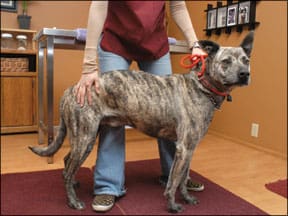
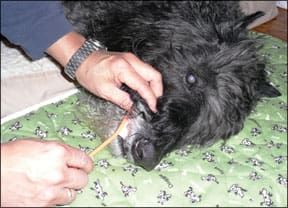
Location, location, location! Knowing where to look is the first step in identifying potential trouble. It’s more challenging to examine the “business end” of a long-coated breed, but don’t let the added difficulty deter you. Raise the dog’s tail and examine the anal area. If the anus was a clock, the sacs would be located just below the opening at the five and seven o’ clock positions.
Not seeing anything suspicious is a good sign. You generally won’t see the sacs of healthy, problem-free dogs. In contrast, redness, irritation, heat, or obvious signs that the dog has been chewing at his backside are all signs of trouble. In extreme cases of anal sac abscess, the swollen, infected gland may be visible underneath the skin and is prone to rupturing. When signs of trouble exist, a trip to the vet is in order.
As with all routine pet care, it’s a good idea to practice often and reward with calm praise and a tasty tidbit. Routinely handling all parts of your dog will help make necessary inspections like this one less stressful for all involved.
Scooting When good glands go bad, anal sac problems generally present as impaction, infection, or abscess. Impaction is the most common problem and is the result of an accumulation of secretions in the anal sac that the dog is unable to express on his own. This is typically caused by a thickening of the secretions or because the ducts from which the secretions exit the body have become temporarily clogged.
The most noticeable symptom of impacted anal glands is the “scooting” behavior where the dog drags his rear-end along the ground in an attempt to facilitate relief. Once they are impacted to the point that you see signs of your dog’s discomfort, the sacs need to be manually expressed by the skilled hands of a veterinarian, groomer, or brave dog owner who has been properly taught how to correctly do the deed.
Impacted glands are most often caused by consistently soft stool or after a short bout with diarrhea. When the stool is too soft, the sphincter muscle doesn’t apply enough pressure to empty the sacs as the dog expels feces.
Lack of proper exercise, excess body fat, poor muscle tone, and diet-related allergies are also contributing factors, according to Dody Tyneway, DVM, of Holistic Veterinary Center in Calabasas, California. Dr. Tyneway sees a high number of dogs who suffer from ear and skin issues along with repeated anal gland problems and says that, in the case of “itchy ears and rears,” it’s a good idea to look at a potential food allergy as the underlying source of trouble.
Diet is considered by many to play a critical role in managing and treating impacted anal glands. Once the problem sacs have been manually emptied, you can help your dog maintain her comfort by adding fiber to her diet; this will help bulk up the stool enough for muscle contractions to naturally move secretions along as the dog defecates.
You can add fiber to a dog’s diet via a bulk-forming laxative. Suggested sources of fiber include unprocessed wheat bran (1 to 5 tablespoons per day, depending on the size of your dog), Metamucil (1 to 5 teaspoons per day) or plain canned pumpkin (1 teaspoon to ½ cup). Your veterinarian may also recommend a high fiber prescription diet.
Dried fruit such as apricots, prunes, or figs; raw flax seeds; wheat cereal; fresh vegetables such as green beans, peas, or carrots; shredded coconut; wheat bran, and powdered psyllium husks have all been anecdotally linked to better anal sac management in dogs. When experimenting with food additives, start small. It’s recommended that fiber additives be soaked in water prior to consumption to help prevent possible intestinal blockage. Keep in mind that adding bulk-forming laxatives not only will increase the size of your dog’s stool, but also will promote more frequent elimination, so be sure to provide plenty of bathroom breaks.
Additionally, Dr. Tyneway recommends adding a solid source of probiotics; she likes those in the supplements offered by RX Vitamins (rxvitamins.com) or Sedona Labs (sedonalabs.com). Probiotics help maintain normal levels of healthy intestinal micro-flora and can be beneficial in normalizing bowl functions. She adds that while probiotics are also found in yogurt, they don’t exist in a quantity thought to be beneficial, so it’s best to use a supplement that has been independently tested to assure potency.
Additional dietary fiber to bulk up the stool and increased exercise to promote good gastrointestinal motility is all that’s needed to help most dogs regain the ability to “express themselves” on a regular basis. Nobody knows for sure why some dogs develop problems while others don’t.
“There seems to be an individual predisposition to develop anal sac problems or not,” says Lore I. Haug, DVM, DACVB, CPDT-KA, CABC, of Texas Veterinary Behavior Sciences in Sugar Land, Texas. Some dogs may always require a periodic assist. According to Dr. Haug, an occasional need (3-4 times per year) to have the sacs expressed is considered normal; if the dog requires this procedure monthly, it’s a sign of a bigger problem and the dog should be seen by the vet for a thorough rectal exam.
Prevention is really the name of the game, because when impactions worsen, the sacs can become infected. Anal saculitis is recognized by the presence of blood or pus in the secretions; and/or inflammation, swelling, and heat around the anal area. The dog may continue to scoot, lick, and bite at his rear; be reluctant to let you investigate the area; and display signs of discomfort when sitting or attempting to defecate. Depending on the severity of the infection, treatments can range from herbal and homeopathic remedies to antibiotics, given orally and/or injected directly into the sacs.
In extreme cases, the sacs can abscess, resulting in the signs of anal sac infection, along with fever, extreme swelling, and discoloration that usually transitions from red to a deep purple. Once the sacs have abscessed, they cannot be manually drained in an effort to produce relief and the abscess must rupture through the adjacent skin to create a drainage tract. If the abscess does not rupture naturally, it must be lanced by a veterinarian. Often, infected or abscessed sacs are so painful that the dog must be anesthetized in order to be treated.
Recipes for relief When problems first present themselves, there are several at-home remedies owners can try, keeping in mind that signs of infection indicate the need for professional veterinary care. Richard Pitcairn, DVM, author of The Complete Guide to Natural Health for Dogs and Cats, recommends treating impacted anal glands with a hot fomentation of either marigold flower (Calendula officinalis) or red clover (Trifolium pratense) blossoms, to soften the contents of the sacs.
Stir a heaping tablespoon of the herbs into a quart of boiling water. Soak a washcloth in the solution until it’s just cool enough to handle. Apply the wet washcloth to the affected area, re-warming as necessary. Warming the area increases blood flow, softens the tissue, and can make expressing impacted sacs much easier.
Owners wishing to try a ready-to-use product might consider Anal Glandz by Native Remedies. This concentrated tincture is an herbal remedy consisting of annual nettle, dandelion, German chamomile, yarrow, and silica and is applied as a warm compress. The product is said to ease expression of impacted anal sacs while cleansing the anal area and helping prevent abscess.
Veterinarians who use homeopathy regard that modality as effective for anal sac abscesses. Dr. Tyneway adds that acupuncture or chiropractic treatments put an end to recurrent anal sac problems. In any case, a thorough rectal exam performed by a veterinarian is needed to rule out other problems such as tumors.
Hit the road, sac! In extreme cases, vets sometimes recommend that the anal sacs be surgically removed. The decision to have your dog undergo this surgery should not be taken lightly, as it is not without risks, mainly that of trauma to the sphincter muscle resulting in poor muscle tone and fecal incontinence. Still, for some dogs and their owners, it can be the most humane, efficient, and cost-effective option available.
For the Ruhr family of Moorpark, California, choosing to have their Golden Retriever/Lab-mix’s anal sacs removed was a decision that came after nearly a full year of battling exceptionally problematic anal sacs. The scooting began when Hailey was six months old. Suspecting, as many dog owners do, that Hailey might have parasites, Wendi Ruhr took the dog to the vet, who discovered that the dog’s sacs were impacted. The sacs were expressed and Ruhr thought the problem was solved.
For the next year, if Ruhr didn’t take Hailey to the vet to have her sacs expressed every three to four weeks, she’d come home to discover that the dog had, in her words, “exploded” inside her crate. While normal anal sac secretions are minimal, Hailey produced and secreted far too much fluid. At her vet’s suggestion, Ruhr tried adding pumpkin to Hailey’s diet, changing kibble brands, and adding dietary supplements, all to no avail. Although there were never any signs of infection or abscess, they even tried a round of antibiotics injected directly into the sacs.
When nothing seemed to work, Ruhr met with a veterinary surgeon to discuss having the anal sacs removed and the decision was made. The surgery went well. Recovery required a difficult two weeks of antibiotics, stool softener, and pain medication, and required a great deal of effort to encourage Hailey to defecate, a behavior that was obviously painful in the days immediately following surgery.
Today, six months following the procedure, the family is pleased. Hailey has fully recovered, leads a normal life, and the only side effect seen by the Ruhr family is that she dislikes other dogs sniffing at her backside, a behavioral issue they are addressing with the help of a trainer.
Despite the potential for unpleasant complications, anal sacs are a normal part of your dog’s anatomy and should be treated as such. In most dogs, problems can be prevented by implementing general good health practices such as providing a healthy diet and regular exercise; maintaining your dog’s recommended body weight; making sure your dog always has a source of fresh, clean drinking water; and providing adequate opportunities and space for proper elimination.
Experts agree with the adage, “If it ain’t broke, don’t fix it,” advising against routine manual expression of otherwise healthy, problem-free anal sacs. At the same time, knowing what to look for can help you provide your dog with relief and proper medical care if and when problems present themselves in the (rear) end!
See “Resources,” page 24, for information on products and experts mentioned above.
Stephanie Colman is a writer and dog trainer in Los Angeles. She also provides twice-weekly training tips for the local NBC affiliate’s morning show, “Today in L.A.” She shares her life with two dogs and actively competes in obedience and agility. See page 24 for contact information.
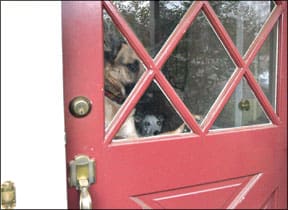
You contemplate taking your dog for a walk with mixed emotions. You love the idea of going for a companionable stroll through the neighborhood together, but it’s a major hassle to get out the door. When you pick up his leash he becomes the Tasmanian Devil – body slamming you, racing around the foyer, and bouncing off the plate glass door with such intensity you’re afraid he’ll crash right through it. Here are five suggestions for turning this potential disaster into the enjoyable outing you dream of.
1. Exercise before your walk.
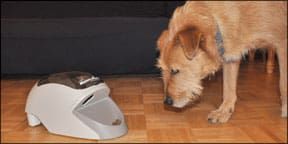
Spend 15-20 minutes tossing a ball for your dog in the backyard, playing “Run upstairs to get a treat from the Manners Minder,” or providing intense mental exercise with a heavy duty shaping session (see “Fun Dog Training Techniques Using Shaping!,” March 2006). You’ll take the edge off his excitement, reduce his energy level, and make leashing-up and walking more relaxed and enjoyable for both of you.
2. Teach your dog to “Say please.”
Reinforce your dog’s “sit” behavior so thoroughly that “sit” becomes his default behavior – the behavior he chooses to offer when he doesn’t know what else to do. Then wait for him to sit (say “please”) to make all good things happen: sit for his dinner bowl; sit to be petted; sit for you to throw his ball; sit to have his leash put on; and sit to make the door open.
3. Pick up his leash throughout the day.
He gets amped up when you touch his leash because it always means the two of you are going for a walk. Of course he gets excited! If you pick up his leash numerous times throughout the day, sometimes draping it over your neck and wearing it for a while, sometimes carrying it from room to room, sometimes picking it up and putting it back down, sometimes clipping it on his collar and then unclipping it, the leash will no longer be a reliable predictor of walks, and he won’t have any reason to get all excited about it. Note: This will take a while. Hope springs eternal in the canine heart.
4. Use negative punishment.
No, that’s not a bonk on the head. It means setting up the situation so that doing the behavior you don’t want causes a good thing to go away. Here’s how it would work in this case: If, when you pick up the leash, he goes bonkers (the behavior you don’t want), say “Oops!” in a cheerful tone of voice (what’s known as a “no reward marker,” it simply tells him no reward is forthcoming), set the leash down, and walk away. When he settles down, pick the leash up again. If he sits (say please!), proceed with attaching the leash and going for a walk. If he winds up again, do another “Oops!” and set the leash down. You’re teaching him that getting excited makes the opportunity for a walk go away; staying calm makes walks happen.
5. Reduce the significance of other “walk cues.”
Other things you do as part of your walk preparation routine can also feed his energy – getting out treats, putting on your jacket, grabbing your cell phone and keys . . . The more you randomize your ritual, the less these steps contribute to his growing excitement over the pending event, and the calmer he’ll stay as you leash him and walk out the door. For example, put your keys and cell phone in your jacket pocket before you eat breakfast. Happy walking!
Pat Miller, CBCC-KA, CPDT-KA, is Whole Dog Journal’s Training Editor.
Editor’s Note: Twenty years ago, people freely used the term “aggressive dog” to describe what, today, we would call a “dog with aggressive behaviors.” The problem with the term “aggressive dog” is that very few dogs are aggressive all the time – and if they are, they are unlikely to be in anyone’s home. Most dogs who display aggression in some situations are loving and loved dogs in other circumstances; calling them “aggressive dogs” overlooks the fact that they are terrific dogs most of the time. Throughout this article, we may use the older, more familiar term, and we will add the modern term that more accurately describes a dog who sometimes displays aggressive behaviors.
DOGS FIGHTING IN YOUR HOUSEHOLD: WHAT TO DO
Manage your dogs’ environment so they don’t have the opportunity to antagonize each other.
Identify your dogs’ stressors and eliminate as many as possible to keep them further below their bite threshold while you modify behavior.
Seek help from a qualified positive behavior professional if you are in over your head. An aggressive dog (a dog who displays aggression at other dogs) is a serious matter!
Knowledgeable dog people are quite aware that not all dogs get along with each other, despite the fact that canis lupus familiaris (domestic dog) is a social species. Hey, we humans are a social species, and we certainly don’t all get along! Two dogs fighting within the same household is unhappily common in our world. As a professional behavior consultant who works with aggressive dogs (dogs with challenging aggressive behaviors), I probably see more than my fair share of it. By far the most difficult and most distressing presentations of tension between dogs are interdog aggression cases: dogs in the same family who aren’t getting along with each other.
Sarah Richardson
I’ve had a spate of these clients in recent weeks. Even our own Lucy and Missy, a Cardigan Corgi and Australian Shepherd who don’t always get along seamlessly, seem to have experienced an increase in relationship tensions this winter. I can’t give you a tidy explanation as to why, but I’m beginning to put more stock in the explanation jokingly offered by my dog-trainer colleague, Jennifer Swiggart, CPDT-KA, PMCT, when she called it “snow aggression.”
Why Do Dogs Fight?
Why do dogs attack other dogs in the house? Far from a case of dog sibling rivalry, when one dog attacks the other in the house, the reason is stress. With the very rare exception of idiopathic aggression – at one time called “rage syndrome,” “Cocker rage,” or “Springer rage” and grossly over-diagnosed in the 1960s and ’70s – aggression is the result of a stress load that pushes a dog over his bite threshold.
You can compare it to incidents of “road rage” in humans. When you read about the man who pulls out his .38 revolver because someone cut him off on the freeway and blows away the unfortunate offending driver, you can bet there was more going on for him than just a simple traffic violation. This is the guy who was likely laid off his job, lost his retirement investments, had his wife tell him this morning that she was leaving him, and just got notice in the mail that the bank is foreclosing on his home. Getting cut off on the freeway is simply the last straw – the final stressor that pushes him over his “bite threshold.”
So it is for dogs. When tensions increase between Missy and Lucy, I need to look for possible added stressors in their environment that are pushing them closer to, and yes, sometimes over, their bite threshold. From that perspective, “snow aggression” is a real possibility: With recent record snowfalls reaching a total of 50 inches here, the resulting decrease in exercise opportunities, as well as higher stress levels of human family members who aren’t fond of snow (guilty!), can be stressors for the canine family members.
To resolve aggression issues between your own dogs, you’ll want to identify not only the immediate trigger for the aggression – fighting over a meaty bone, for example – but also everything in your dog’s life that may be stressful to him. The more stressors you can remove from his world, the less likely it is that he will use his teeth – the canine equivalent of pulling out a .38 revolver.
Common Stressors for Dogs
Stress in dogs can happen anytime and be anywhere. Remember that it’s the sum total of a dog’s stress that pushes him over his bite threshold, so the more of his stressors you can identify and get rid of, the more you’ll ease tensions between your canine family members.
When I sit down with a client for an interdog aggression consult we create a list of all the stressors we can think of for the dogs in question.
After identifying stressors, we discuss possible strategies, assigning one or more strategies to each of the listed stressors. These strategies are:
– Change the dog’s opinion of the stressor through the use of counter-conditioning and desensitization.
– Teach the dog a new behavioral response using operant conditioning.
– Manage the dog’s environment to minimize exposure to the stressor.
– Get rid of the stressor.
– Live with it (most appropriate for low-level stressors). Next, I help the client make a management plan that will go into place immediately, to help defuse the tension until she is able to start work on behavior modification. Then we create action plans for two or three of the stressors on the list, starting with the one the client is most concerned about – in this case, the dog-on-dog aggression.
Here is a sample list of stressors we’ve put together:
STRESSOR
STRATEGY
The other dog
Change the aggressive dog’s opinion of the stressor through the use of counter-conditioning and desensitization (CC&D).
Passers-by outside the living room window
Change dog’s opinion of the stressor through CC&D; manage dog’s environment to minimize exposure to the stressor (i.e. close blinds, close off dog’s access to that window)
Threats to resources (food/toys)
Change dog’s opinion of the stressor through CC&D; use operant conditioning to teach dog a new behavioral response
Doorbell ringing
Change dog’s opinion of the stressor through CC&D; use operant conditioning to teach dog a new behavioral response
Car rides
Change dog’s opinion of the stressor through CC&D; live with it (most appropriate for low-level stressors)
Trips to the vet
Change dog’s opinion of the stressor through CC&D; live with it (most appropriate for low-level stressors)
Nail trimming
Change dog’s opinion of the stressor through CC&D; use operant conditioning to teach dog a new behavioral response; teach dog to scrape his nails on an abrasive surface
Thunder
Change dog’s opinion of the stressor through CC&D; manage dog’s environment to minimize exposure to the stressor; live with it (most appropriate for low-level stressors); possible use of an appropriate anti-anxiety medication
Fireworks
Change dog’s opinion of the stressor through CC&D; manage dog’s environment to minimize exposure to the stressor; live with it (most appropriate for low-level stressors); possible use of an appropriate anti-anxiety medication
Arthritis
Manage dog’s environment to minimize exposure to the stressor; ask your vet whether pain-reducing medication is appropriate
Recurring ear infections
Get rid of the stressor: explore medical treatment and your dog’s diet (ear infections can result from dietary allergies)
Underground shock fence
Get rid of the stressor
Prong collar
Get rid of the stressor
Use of physical and harsh verbal punishments
Get rid of the stressor
Owner’s stress
Manage dog’s environment to minimize exposure to the stressor; get rid of the stressor
There are many other possibilities. My clients usually list 10 and 20 identified stressors. Be sure to include things that may cause even mild stress. The more stressors you can eliminate, the better.
Food Aggression in Dogs and Other Stress Triggers
It’s often relatively easy to identify the immediate trigger for your dogs’ mutual aggression. It’s usually whatever happened just before the appearance of the hard stare, posturing, growls, and sometimes the actual fight.
Tension over resources is a common trigger. Dog #1 is lying on his bed, happily chewing his deer antler, when Dog #2 approaches. Dog #1 tenses, signaling to #2 Dog, “This is mine and I’m not sharing.”
In the best of worlds, #2 defers by looking away, saying in canine speak, “Oh sorry, no worries, I was just passing through.” When things go wrong, however, a fight breaks out. Dog #2’s approach was the trigger for #1, even if #2 had no interest in the chew item. Perhaps Dog #2 failed to notice or failed to heed #1’s warning. Remember that resources include more than just food; a guardable resource can also be a high-value human, a coveted spot on the sofa, or access to a doorway. The stressor in these cases is obvious: the dog is anxious over the possibility of losing or having to share his treasured possession.
Other triggers may be less obvious. If a dog is in pain, but not showing it, the mere proximity of a packmate who has inadvertently bumped her in the past could be a trigger. Dogs can be notoriously stoic about pain, especially slowly developing arthritis, or unilateral pain (where you may not see a limp). The undiagnosed arthritic dog may become defensively aggressive in anticipation of being hurt by a livelier canine pal, trying to forestall painful contact in what looks to the owner like “unprovoked” aggression.
“ Social aggression” can result when neither of two dogs in the same family is willing to defer to the other. Note that this type of aggression is about deference (or lack thereof) not dominance. In behavior science, “dominance” is simply about access to a mutually desired resource. The dog who gains access in one encounter is dominant *in that encounter*. In the next encounter, the other dog might gain access to the resource and be dominant in *that* encounter. When you have identified your dogs’ triggers, you can manage their environment to reduce trigger incidents and minimize outright conflict. This is critically important to a successful modification program. The more often the dogs fight, the more tension there is between them; the more practiced they become at the undesirable behaviors, the better they get at fighting and the harder it will be to make it go away. And this is to say nothing of the increased likelihood that sooner or later someone – dog or human – will be badly injured.
CC&D for intra-pack aggression involves changing your dogs’ association with each other from negative to positive. The easiest way to give most dogs a positive association is with very high-value, really yummy treats. I like to use chicken – thawed out pre-cooked frozen chicken strips (no breading or spices) canned, baked, or boiled, since most dogs love chicken and it’s a low-fat, low-calorie food.
Counter-Conditioning Your Dogs to Get Along:
a)Determine the distance at which your dogs can be in each other’s presence and be alert or cautious but not fearful or aroused. This is called the threshold distance. If one dog has a greater threshold hold distance than the other (often the case), work at the greater distance.
b)With you holding Dog A on a leash, have your helper appear with Dog B at threshold distance “X.” The instant your dog sees the other, start feeding bits of chicken, non-stop. Your helper will feed chicken to her dog, too, the instant he notices your dog.
c)After several seconds, have the helper step out of sight with Dog B, and you both stop feeding the chicken.
d)Keep repeating steps 1-3 until the sight of the other dog at distance “X” consistently causes both dogs to look at their handlers with a happy smile and a “Yay! Where’s my chicken?” expression. This is the physical presentation of the dogs’ conditioned emotional response (CER); each dog’s association with the other at threshold distance “X” is now positive, so they can deliberately look at you to get their chicken, rather than staying intensely focused on each other.
e)Now you need to increase the intensity of the stimulus by increasing the length of time Dog B stays in sight. Continue to feed chicken when they are in view of each, occasionally pausing to let them look at each other again, and immediately feeding chicken when they do.
f)When length of time seems to make no difference to either dog – you’re getting a consistent “Yay, where’s my chicken?” response regardless of how long Dog B stays in view, increase the intensity again, this time by increasing Dog B’s movement. Have the handler walk back and forth with her dog, still at distance “X,” slowly at first, then with more energy, even adding in some other behaviors such as sit, down, and roll over.
g)Now you’re ready to start decreasing distance by moving Dog A a little closer to the location where the Dog B will appear. When you obtain consistent CERs from both dogs at each new distance you can decrease the distance a little more, until both dogs are happy to be very near each other.
h)Then return to your original threshold distance and increase intensity stimulus by having Dog B move around more and more, as you gradually decrease distance and obtain CERs from both dogs along the way, until they are delighted to be near each other.
i)Now go back to your starting distance and increase intensity again, by having both dogs move more naturally as the distance decreases, offering CERs at each new distance before you come any closer, until they can be within six feet of each other, moving around, still relaxed and happy about chicken.
j)Finally, find ways for your dogs to engage separately in mutually enjoyable activities together. If they both enjoy car rides, take them for a drive, but be sure they are seat-belted or crated far enough apart to avoid any tension. If they love hiking, take them on “parallel” walks, one with you, one with your training partner, with humans between them at first, and eventually with dogs between humans when you’re sure their emotions are appropriate. Parallel swims, for dogs who love the water, can work well too.
When you feel the dogs are ready to finally interact with each other again, be careful not to undo all your hard work. You might first let them greet through a barrier, such as a baby gate or exercise pen.
It’s useful to desensitize both dogs to a muzzle over the period you’re desensitizing them to each other (in separate sessions), so the first time you’re ready for them to actually interact together you can muzzle them and be confident they can’t hurt each other.
The more intense the relationship between the two dogs, the more challenging it is to modify their behavior. The more negative interactions they’ve had, the more injuries, the longer the tension has been going on, and the stronger their emotions, the longer it will take to reprogram their responses to each other. If they were good friends at one time, it’s likely to be easier than if your dogs have always tried to fight each other.
Remember to seek the help of a qualified positive behavior professional if you don’t feel competent and confident about working with your dogs on your own.
Operant Strategies to Combat Dog Fights
The second option is to teach your dogs a new operant behavior in response to each other, using the “Constructional Aggression Treatment” (CAT) procedure developed by Dr. Jesus Rosales-Ruiz and Kellie Snider at the University of North Texas. (See “Modifying Aggressive Behavior,” and “Constructional Aggression Treatment“.)
In daily life, dogs learn to offer aggressive “distance-increasing” signals in order to make other dogs go away. Every time this works, the “go away” behavior is reinforced. The CAT procedure teaches the dog that calm behavior can make the other dog go away, and as a result, the aggressive dog can ultimately become friendly and happy about the other dog’s presence.
A variation on the operant approach is the “Behavioral Adjustment Training” procedure (BAT) created by Oregon trainer Grisha Stewart, MA, CPDT-KA, CPT. BAT is similar to CAT, but uses a variety of environmental reinforcers rather than the location and movement of the other dog exclusively.
As in CAT, the BAT procedure reinforces behaviors other than aggression in the presence of the other dog. In this case, however, your repertoire of reinforcers is larger, including the use of food reinforcers and having the “subject” dog (the aggressive one) move away instead of the other dog.
If one or both of the dogs are ready to do battle on sight, they must be strictly managed and kept separate from each other except when you’re doing your controlled modification procedure with them. If the aggression is more predictable and situational, the dogs can be together as long as you can manage and prevent the trigger(s) from causing conflict.
Stress Trigger Management for Aggressive Dogs (Dogs Who Display Aggressive Behavior)
What does it mean to “manage your dogs’ environment to minimize exposure to his stressors”? Simply put, it means making changes to your dog’s environment in order to keep your dogs away from the stimuli that stress them.
If the dogs are stressed by each other, of course, the first task is to keep them separated, through the assiduous use of doors, fences, baby gates, crates, and tethers. Smart positioning can help; locate each dog’s crates or tethering area out of the other dog’s sightline. Take them outdoors to potty separately, and separate them well before feeding time, to reduce tensions that arise when everyone is jostling to be fed first.
Next, try to minimize your dogs’ exposure to other stressful stimuli. For example: Say one of your dogs goes over threshold when she sees the mailman approaching your house through the living room window, and her barking display of aggression seems to agitate your other dog. Installing shutters on the window might work (to block your dogs’ view), but closing the door to the front room (to keep the dogs as far away from the sight and sound of the mailman) would be even better. Or you could move your mailbox to toward the sidewalk, instead of next to the front door – the farther from the house, the better. Or get a post office box and do away with the mail carrier altogether. Be creative!
More Management Tools: Stress-Reducing Strategies for Dogs
There are a host of other things you can do to lower general stress in your dogs’ environment.
Exercise can be immensely helpful in minimizing overall tension. Physical activity uses up excess energy that might otherwise feed your dogs’ aggressive behaviors, (a tired dog is a well-behaved dog – and a happy owner!). Exercise also causes your dog’s body to release various chemicals, including endorphins and norepinephrine, helping to generate a feeling of well-being; an exercised dog is a happy dog! Happy dogs are simply less likely to fight.
Even the food you feed your dog can have an impact on his behavior. Poor quality protein can interfere with a dog’s ability to make use of the serotonin that occurs naturally in his system. Serotonin is a neurotransmitter that helps regulate mood and sleep, and also affects memory and learning. Foods containing high-quality protein can contribute to your dogs’ behavioral health and physical health.
Basic training enables you and your dog to communicate more easily with each other (which is less stressful for both of you), and helps your dog understand how his world works, which reduces his stress. A good training program emphasizes structure and consistency, both of which make a dog’s world more predictable. Predictability equals less stress; unpredictability is stressful.
If you’ve ever had a massage, you know how calming touch can be. Dogs aren’t that different from us; you can calm and soothe your dog with physical touch, both through canine massage and TTouch. Combine your calming touch sessions with aromatherapy, by using a therapeutic-quality lavender essential oil in an electric nebulizing diffuser in the room while you massage your dog. Then you can build your dog’s “ahhh” association with the lavender scent to help him be calm in more stressful environments, by putting a few drops of essential oil on a bandana that you tie around his neck or on the bedding in his crate.
Other environmental stress reducers include: Adaptil (also known as Comfort Zone, Dog Appeasing Pheromone, or DAP). This is a synthetic substance that is reputedly mimics the pheromones emitted by a mother dog when she’s nursing puppies. Available through pet supply stores and catalogs.
– Through a Dog’s Ear. This set of audio CDs consists of bio-acoustically engineered soothing classical piano music, which has been shown to reduce dogs’ heart rates.
– Anxiety Wrap. This product helps dogs (and cats) overcome their fears and anxieties using the gentle technique of “maintained pressure” – similar to the effect of swaddling for a human infant.
Remove Your Dog’s Stress Triggers
Sometimes you’re lucky: it’s easy to either get rid of your dogs’ stressors or just live with them. Stressors you could get rid of easily include choke, prong, or shock collars (even those used for electronic containment systems); physical or harsh verbal corrections (punishment), and treatable medical conditions. Without these present in their environment, the dogs’ stress level will decrease.
We all have some stress in our lives, and it’s pretty near impossible to get rid of all of it. Just because you’ve identified a stressor for your dog doesn’t mean you have to make it go away. You probably don’t have enough time in your schedule to address every single thing on your list. As you look at your dogs’ list of stressors, the ones they can probably live with are those that don’t happen frequently, that cause only a mild stress response, and don’t appear to escalate over time. You can also refrain from eliminating your dog’s “fun” stressors, such as squirrel-chasing sessions. If you make your way through the rest of your list and still have time on your hands, you can always address the “live with it” items later.
Veterinary Checkup Required
A complete medical work-up, including a full thyroid panel, is indicated for any significant behavior problem, especially aggression.
Any medical condition that causes your dog to behave out of sorts is a massive contributor to stress. Trying to modify aggression while your dog suffers from an untreated medical condition is akin to pushing a behavioral boulder uphill.
You must rule out or identify and treat any medical contributors to your dogs’ behavior in order for your dogs to fully benefit from your modification efforts.
Last Resorts for Training Aggressive Dogs (Dogs Who Display Aggressive Behavior)
Dog-on-dog aggression in the home can feel overwhelming. In fact, it can be dangerous if fights erupt regularly and you try to intervene. Many times a caretaker has been bitten trying to break up fights between her own dogs. The stress that the constant tension generates can damage the quality of your own life, as well as your dogs’ lives.
When a situation feels beyond your ability to cope, your first best option is to find a qualified positive behavior consultant in your area who can help you implement appropriate management and modification procedures, to keep everyone safe and to start making change happen in your dogs’ mutual relationships.
A consultation with a veterinarian who is well-educated in behavior or even a veterinary behaviorist should also be on your list, not only for that all-important medical workup, but also for the consideration of psychotropic behavior modification drugs, if and when appropriate, to help your dog’s brain be more receptive to your modification efforts.
If you feel you’re done your best and peace isn’t in the cards for your pack, it’s okay to admit that some dogs will never get along, and you have had the misfortune to adopt two who don’t. If that’s the case, your options are:
– A lifetime (not just a temporary measure) of scrupulous management
– Rehoming one of the dogs
– Euthanasia
Some trainers say, “Management always fails.” In truth, management does have a high risk of failure, perhaps with potentially dire consequences. The risk is even higher if there are children in the home – not only because they’re more likely to forget to close doors and latch gates, but also because they are at greater risk of injury themselves if they are in the vicinity when a fight happens. Still, I know of several dog owners who have successfully implemented lifetime management protocols for dogs who didn’t get along, and felt that their own quality of life, as well as that of their dogs, was above reproach.
Rehoming can be a reasonable option, especially if the dog being considered for placement has no other significant inappropriate behaviors, and if he can be rehomed to an “only dog” home, or one with dogs he’s known to get along well with. Of course, it can be challenging to find an experienced, appropriate home for a dog with a known aggression behavior challenge, but it may be possible, particularly if he’s an otherwise wonderful companion.
No one wants to think of euthanizing an otherwise healthy member of their canine family. Still, if you’ve done all you can reasonably do given the limits of your abilities and resources, and you’ve not been able to create a safe environment for your family and one of the dogs can’t be rehomed, then euthanasia is not an inappropriate decision. It will be terribly painful for you, and you may always feel guilt and regret about not finding the solution to the problem, although perhaps not as much guilt and regret as you would if one of your dogs badly injured or killed the other, or worse, a person. There is a wonderful Facebook support group called “Losing Lulu” for people who have had to make the impossibly difficult “behavioral euthanasia” decision. If you are one of these, it’s worth checking out.
It’s now 43 degrees outside, and for the first time in many weeks the snow has melted enough I can actually take my dogs for a long hike around the farm. I’d best finish this sentence, turn off my computer, and take our dogs out to stretch their legs so we can all enjoy a very peaceful, aggression-free evening.
1. Become familiar with the symptoms of dog bladder stones and respond quickly if you see them.
2. Request a urine culture and sensitivity test to check for infection even if your veterinarian doesn’t think it’s necessary.
3. Encourage your dog to drink extra water and give her frequent opportunities to urinate.
4. Don’t expect a low-protein diet to cure or prevent struvite stones.
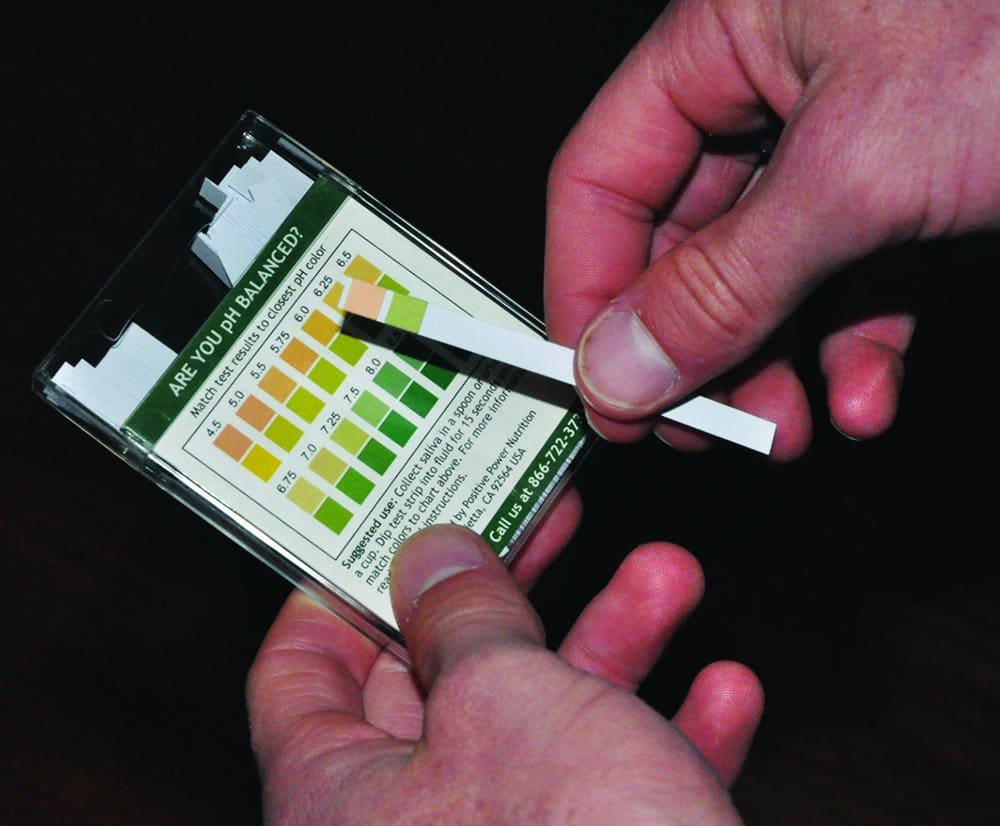
5. Learn how to test your dog’s pH to check for recurring urinary tract infections.
Humans aren’t the only ones who get kidney and bladder stones. Our dogs develop these painful and dangerous conditions, too. But much of what is said and done about canine urinary tract stone disease (also known as bladder stones, urolithiasis, urinary stones, ureteral stones, urinary calculi, ureteral calculi, or urinary calculus disease), including its causes and treatment, is either incorrect, ineffective, or potentially harmful. Here’s the information you need in order to make informed decisions regarding dog bladder stones on behalf of your best friend.
Most canine uroliths, or bladder stones, fall into six categories, depending on their mineral composition:
• Magnesium ammonium phosphate (also called struvites)
• Calcium oxalate
• Ammonium urate or uric acid
• Cystine
• Calcium phosphate
• Silica
There are also compound or mixed stones consisting of a core mineral surrounded by smaller amounts of another mineral, most commonly a struvite core surrounded by calcium phosphate. In veterinary reports, the terms stone, urolith, and calculus (its plural is calculi) are used synonymously.
Because different stones require entirely different treatment -and often completely opposite treatment -it’s critical to identify the type of stone accurately. Without removing a stone there is no way to know for sure, but a good guess can be made based on urinary pH; the dog’s age, breed, and sex; type of crystals, if present; radiographic density (how well the stones can be seen on x-ray); whether infection is present; and certain blood test abnormalities.
Between 1981 and 2007, the Minnesota Urolith Center at the University of Minnesota’s College of Veterinary Medicine analyzed 350,803 canine uroliths. The highest percentage came from mixed breeds (25 percent), Miniature Schnauzers (12 percent), Shih Tzus (9 percent), Bichons Frises (7 percent), Cocker Spaniels (5 percent), and Lhasa Apsos (4 percent). The remaining 38 percent were collected from 154 different breeds.
Veterinary studies conducted around the world on millions of urinary stones show similar demographics. Although kidney and bladder stones can afflict dogs of both sexes, all breeds, and all ages, those at greatest risk are small, female, between the ages of 4 and 8, and prone to bladder infections. Although male dogs develop fewer stones, the condition is more dangerous to them because of their anatomy. Stones are more likely to cause blockages in the male’s longer, narrower urethra.
In 1981, 78 percent of all uroliths tested at the Minnesota Urolith Center were struvites and only 5 percent were calcium oxalate stones, but by 2006 the struvite occurrence had fallen to 39 percent while the incidence of calcium oxalate stones rose to 41 percent. Researchers investigating the trend have not discovered a reason for the change but are exploring demographic risk factors such as breed, age, gender anatomy, and genetic predisposition along with environmental risk factors such as sources of food, water, exposure to certain drugs, and living conditions.
Bladder Stones in Dogs
When bladder stones form, their minerals precipitate out in the urine as microscopic crystals. If the crystals unite, they form small grains of sand-like material. Once grains develop, additional precipitation can lead the crystals to adhere together, creating stones. Some stones measure up to 3 or 4 inches in diameter. Problems develop when stones interfere with urination.
Some dogs with stones never develop symptoms and their stones are never diagnosed or are discovered during routine physical exams when the abdomen is palpated. X-rays, which can be used to confirm the diagnosis, reveal stones as obvious white circles unless they are radiolucent (invisible to X-rays), in which case a dye injected into the bladder makes them visible.
Symptoms of stones can include blood in the urine (hematuria), the frequent passing of small amounts of urine, straining to produce urine while holding the position much longer than usual, licking the genital area more than usual, painful urination (the dog yelps from discomfort), cloudy and foul-smelling urine that may contain blood or pus, tenderness in the bladder area, pain in the lower back, fever, and lethargy. If a stone blocks the flow of urine, its complications can be fatal.
When surgery is necessary, uroliths are removed by a cystotomy, a procedure that opens the bladder. Stones lodged in the urethra can be flushed into the bladder and removed. Stones that are small enough to pass in the urine can be removed in a nonsurgical procedure called urohydropropulsion. A catheter is used to fill the sedated dog’s bladder with a saline solution and the bladder is squeezed to expel the stones through the urethra. Other procedures are used for more complicated cases.
All dogs who have formed a urolith are considered at increased risk for a recurrence. According to Dennis J. Chew, in a paper delivered at the 2004 Small Animal Proceedings Symposium of the American College of Veterinary Surgeons, “Water may be the most important nutrient to prevent recurrence of uroliths. Increased water intake is the cornerstone of therapy for urolithiasis in both human and veterinary medicine. Increasing water intake to dilute urine and increase frequency of urination is an important part of treatment. Decreasing the concentration of potential stone-forming minerals in urine and increasing the frequency of voiding are the key elements of therapy to reduce the risk of formation of a new urolith.”
It’s easy to interest most dogs in drinking more fluids by making sure that plain water is available at all times, adding broth and other flavor enhancers to water in an additional bowl, and adding water or broth to food. Just as important is the opportunity to urinate several times a day. Stones and crystals form in supersaturated urine, which can occur when dogs have to hold their urine for long periods.
This month, we’ll discuss struvite uroliths. Calcium oxalate uroliths will be discussed in the next issue.
Struvite Stones in Dogs
Struvite uroliths belong to the magnesium ammonium phosphate (MAP) category. Struvites are also known as triple phosphate uroliths, a term dating from an old, incorrect assumption that the struvite crystal’s phosphate ion was bound to three positive ions instead of just magnesium and ammonium. Although struvites can develop in the kidneys, where they are called nephroliths, the vast majority are bladder stones. About 85 percent of all struvite stones are found in female dogs and only 15 percent are found in males.
Struvite stones usually form when large amounts of crystals are present in combination with a urinary tract infection from urease-producing bacteria such as Staphylococcus or Proteus. Urease is an enzyme that catalyzes the hydrolysis of urea, forming ammonia and carbon dioxide. It contributes to struvite stone formation as well as alkaline (high-pH) urine.
Caregivers and veterinarians obviously want to prevent and treat struvites as effectively as possible. But what works and what doesn’t is a topic of confusion.
Struvite Stone Facts or Fiction?
All of the following statements are believed by many veterinarians and their clients. Yet none of them are true. Which have you heard before?
1. Urinary struvite crystals represent disease and require treatment.
2. Struvite crystals require a change in diet, usually to a prescription diet like c/d, u/d, or s/d.
3. Dogs prone to forming struvite stones should be kept on a special diet for life.
4. The most important treatment for dogs with a history of struvite stones is a low-protein diet.
Here’s why these common beliefs are misconceptions:
1. The presence of urinary struvite crystals alone does not represent disease and does not require treatment. These crystals can be found in the urine of an estimated 40 to 44 percent of all healthy dogs and are not a cause for concern unless accompanied by signs of a urinary tract infection. According to the Merck Veterinary Manual (2005), “Struvite crystals are commonly observed in canine and feline urine. Struvite crystalluria in dogs is not a problem unless there is a concurrent bacterial urinary tract infection with a urease-producing microbe. Without an infection, struvite crystals in dogs will not be associated with struvite urolith formation.”(Our emphasis.)
Whether your struvite-crystal dog has a urinary tract infection is the key question. Researchers estimate that more than 98 percent of all struvite stones are associated with infection. Failing to eradicate the original infection and prevent new bacterial infections is the main reason struvite uroliths recur. A recurrence rate of 21 percent was recorded in one study, but the risk can be significantly reduced through increased surveillance and appropriate antimicrobial treatment. In one study, dogs were infected with an experimental Staphylococcal urinary tract infection, and their infection-induced struvites grew large enough to be seen on X-rays within two to eight weeks.
2. Struvite crystals do not require a change in diet. Because struvite crystals do not pose a problem unless the dog has a urinary tract infection, there is no required treatment for crystals, including dietary changes. If the dog does have a urinary tract infection, a prescription dog food will not cure it.
If your veterinarian finds struvite crystals in the urine and suggests a diet change, you’d be well advised to find a new vet. You have to wonder how many other things he or she is misinformed about. It isn’t just a case of not keeping up with newer research; this recommendation is just plain wrong.
3. Dogs prone to forming struvite stones should not be kept on a special diet for life. Struvites almost always form because of infections, for which dogs with a history of stones should be closely monitored and properly treated. No long-term dietary change is required, nor will a special diet prevent the formation of infection-induced struvites. However, short-term changes may help speed the dissolution of stones.
4. Low-protein diets do not prevent stone formation. A low-protein diet can speed the dissolution of struvite stones -when accompanied by appropriate antibiotic treatment -but it is not necessary for the prevention of struvite formation in dogs who are prone to this problem. For almost all dogs, controlling infections will prevent more stones from forming.
“Sterile Struvites”
Not all struvite stones are caused by Staphylococcus, Proteus, or other bacteria. Between 1 and 2 percent of struvites are called sterile because they do not involve an infection. They are also known as metabolic struvites.
These stones are treated in much the same way as infection-induced struvites, and they tend to dissolve more quickly. Urinary acidifiers can be used to help dissolve sterile struvites, and feeding a low-protein diet may help speed their dissolution.
Several reports in the veterinary literature describe the spontaneous dissolution of sterile struvite uroliths within two to five months in dogs fed a maintenance diet, demonstrating that these stones can disappear within a short time without the use of a calculolytic diet.
To prevent the formation of future sterile struvites, the most effective methods appear to be urinary acidification and increased fluid intake. The amino acid dl-methionine, which is available in tablet form, is commonly used when needed to keep the urine acidic. It will not help and should not be given to dogs who form infection-induced struvites.
The conventional recommendation for treatment and prevention of sterile struvites is to feed a diet with reduced phosphorus and magnesium content, but it’s questionable whether that’s needed as long as the urine is kept slightly acidic (at a pH below 7.0) and the dog is encouraged to drink more and has ample opportunity to eliminate in order to avoid supersaturated urine.
Even though a meat-based diet is high in phosphorus, meat has an acidifying effect on the urine and may therefore be beneficial for the prevention of sterile struvites as well as providing more complete nutrition in a form that the dog most enjoys.
Dietary starch and fiber potentially stimulate the formation of struvite crystals, so reducing dietary carbohydrates helps prevent struvite urolith formation.
The Low-Down on Low-Protein Diets for Dogs
Several prescription dog foods are marketed as a treatment for struvite crystals and struvite stones. These are called calculolytic foods or diets, and nearly all of them are severely protein-restricted, phosphate-restricted, magnesium-restricted, highly acidifying, and supplemented with salt to increase the patient’s thirst and fluid consumption.
While a low-protein diet is not required to dissolve struvite stones, it can speed their dissolution (when accompanied by appropriate antibiotic treatment). Protein provides urea, which bacteria convert or “hydrolyze”into ammonia, one of the struvite building blocks. However, this approach is not a long-term solution and will not prevent the formation of infection-induced stones. Feeding a low-protein diet to an adult dog to help dissolve stones is acceptable for short periods. Because they are not nutritionally complete, however, low-protein foods are harmful to adult dogs if used for more than a few months, and they should never be fed to puppies.
If stones are not present, there is no reason to feed a low-protein diet. According to Dr. Chew, “No studies exist to show that a specific diet is helpful for the prevention of infection-related stone development.”
In general, the benefits of a meat-based diet far outweigh the risks posed by protein’s ammonia generation. Plus, by feeding your dog a home-prepared diet of fresh ingredients, you can provide food that is higher in quality and much more to your dog’s liking than diets that come out of cans or packages.
Other prescription pet food strategies -such as keeping the diet low in fiber so that fluids are not lost through the intestines, using highly digestible ingredients for the same reason, and increasing the dog’s fluid intake by adding salt to the diet -can be better accomplished with a home-prepared diet and management techniques that encourage the dog to drink more water. The more concentrated the urine, the more saturated it becomes with minerals that can precipitate out, so extra fluids, which dilute the urine, reduce the risk.
Urinary acidifiers are not used to dissolve or prevent stones caused by urinary tract infections, since acidification does not help while an infection is present.
The Importance of Urinary Culture and Sensitivity Tests
It’s important to know that urinalysis can’t always detect a bladder infection; urinalysis may appear normal as frequently as 20 percent of the time when a urinary tract infection is present.
For this reason, if your dog shows possible signs of infection, you need to request a “urinary culture and sensitivity test.”This will verify the diagnosis (in some cases the problem is something other than an infection) and, if it is an infection, it will reveal which antibiotic will be most effective for treatment. Using an ineffective antibiotic not only harms the patient by delaying proper treatment, but also contributes to the spread of drug-resistant bacteria. Antibiotic therapy must be continued as long as struvite stones are present, since the stones harbor bacteria that are released as the stones dissolve.
Dogs who are prone to frequent infections may need longer antibiotic therapy -of at least four to six weeks -to completely eradicate the infection. Some dogs need continuous or “pulsed”antibiotic therapy to prevent recurring infections. A few may need surgery to correct structural defects that make them prone to infection, such as a recessed vulva. This condition usually corrects itself following first heat but may continue to cause problems for females who are spayed prior to their first heat.
Ureaplasma bacteria, which can cause struvite stones, will not show up on a regular urine culture, but you can request a special culture to look for this type of bacteria. This should be done before one assumes that the patient’s struvites are sterile (see “Sterile Struvites,”page 13) rather than infection-induced.
Follow-up tests will show whether the therapy your dog received, such as antibiotics from a conventional veterinarian or an alternative infection-fighting treatment from a holistic vet, was effective. You want to be sure that the treatment worked and that the infection isn’t coming back. For dogs with a history of forming struvite stones, or who suffer from multiple urinary tract infections, cultures should be repeated a few days after treatment ends and then periodically, such as monthly for a while and then at longer intervals, to be sure the infection is completely cleared.
At-Home Urinary Tract Infection Prevention
To keep your dog healthy, it’s important to prevent the conditions -especially, urinary tract infections -that can lead to stone formation.
Monitoring your dog’s urinary pH at home will alert you to any recurring bladder infection. The numbers refer to acidity and alkalinity, with 7 considered neutral (neither acid nor alkaline). Numbers less than 7 indicate acidity, and the lower the number, the more acid the substance. Numbers greater than 7 indicate alkalinity, and the higher the number, the more alkaline the substance. Most healthy dogs have a neutral to slightly acid urinary pH between 5.5 and 7.0.
Because urinary pH varies throughout the day, test your dog’s urine at the same time each day to determine her “normal”pH. The best time to do this is first thing in the morning, before she eats. Urine should be tested before it hits the ground. You can collect some in a paper cup or simply hold a pH test strip in the stream. An advantage to paper cup collection is that you can also check the urine for blood, cloudiness, and other indications of infection.
The urinary tract infections that cause struvite crystals to become uroliths have an alkalizing effect, raising urinary pH to as much as 8.0 or 8.5. If your dog’s urinary pH jumps from acid to alkaline, contact your veterinarian.
Cranberry doesn’t cure existing infections, but it mechanically prevents bacteria from adhering to the tissue that lines the bladder and urinary tract. Because they are continuously washed out of the system, bacteria don’t have an opportunity to create new infections. Cranberry capsules are easier to use and more effective than juice, since they are far more concentrated. On product labels, the terms cranberry, cranberry juice, cranberry extract, and cranberry concentrate tend to be used interchangeably.
If your cranberry capsules are a veterinary product, follow label directions. If they’re designed for humans, adjust the dosage for your dog’s weight by assuming that the label dose applies to a human weighing 100-120 pounds. Giving cranberry in divided doses, such as twice or three times during the day, will make this preventive treatment more effective.
Probiotics are the body’s first line of defense against infection, and the more beneficial bacteria in your dog’s digestive tract, the better. Probiotics are routinely used by a growing number of medical doctors and veterinarians to treat urinary tract and vaginal infections in women and pets.
Several brands of probiotics are made especially for dogs. Because antibiotics destroy beneficial as well as harmful bacteria, the use of probiotic supplements after treatment with antibiotics helps restore the body’s population of beneficial bacteria. (See “Probing Probiotics,” WDJ, August 2006 for more information.) Many veterinarians recommend vitamin C for dogs who are prone to bladder infections and struvite stones because of its anti-inflammatory effects. Dogs (unlike humans) manufacture their own vitamin C, but the amount they produce may not meet their needs if they are under stress or fighting infection.
The ascorbate form of vitamin C is most often recommended for dogs, as it may be better absorbed and is less prone to causing gastrointestinal upset. Calcium ascorbate and sodium ascorbate are available in generic forms as a powder, but the most popular form is a product called Ester-C, which contains calcium ascorbate and vitamin C metabolites.
Veterinary recommendations range from 250 mg twice per day for every 15 to 30 pounds of body weight up to a maximum of 1,000 mg twice a day for large dogs. Because vitamin C can cause diarrhea, start with small doses and increase gradually. The maximum amount your dog can tolerate without the diarrhea side effect is called her “bowel tolerance”dose.
The herb uva ursi (Arctostaphylos uva-ursi) is used in many herbal blends for bladder infections because of its antibacterial properties. Uva ursi is best used for short periods rather than for months at a time as it can irritate the kidneys. The dosage for this herb depends on the individual blend and how it was prepared. Follow label directions for products formulated for dogs; adjust the dosage of products meant for humans by weight, assuming the human’s weight at 100 to 120 pounds.
While adding salt to your dog’s food is an effective way to encourage drinking more fluids for dogs who don’t tend to drink enough, consider switching from refined table salt to unrefined sea salt, which is sold in natural food markets and contains dozens of minerals and trace elements that are not present in refined salt.
Since most homemade diets are low in salt compared to commercial foods, the amount of salt to add will depend on the diet you feed. Start by adding a pinch of salt (small for a small dog, larger for a large dog) to your dog’s food and watch to see if it makes her more thirsty. Increase the amount by a pinch at a time until she is drinking more than usual.
Traditional broth or stock is easy to make at home by simmering chicken, beef, or other bones in water overnight or for 24 to 36 hours. If desired, add carrots and other vegetables. Replace evaporating water as needed. The longer the simmer, the more nutritionally dense the broth and the more interesting it is likely to be to your dog. Broth can be used as a flavor enhancer when strained and added to food or given in addition to water. Be sure to provide plain drinking water at all times.
Struvite stones can make any dog miserable, but by understanding how and why they occur and by taking the preventive measures described here, you can be sure that your dog lives a happy, stone-free life.
CJ Puotinenis the author of The Encyclopedia of Natural Pet Care and other holistic health books. She lives in Montana, and is a frequent contributor to WDJ.
San Francisco Bay Area resident Mary Straus has spent more than a decade investigating and writing about canine health and nutrition topics for her website, DogAware.com.
We’ve gotten a lot of positive feedback about two newer features in Whole Dog Journal. The first is “Action Plan” – the column that appears opposite this page, which features five things that an owner can do to solve any given dog behavior problem. The second is “Canine News You Can Use.” Our annual dry dog food review, published each February, is such a monster that it ate the space for these two columns in last month’s issue, but they have reappeared this month. We did give the “Good Sports” column this month off, but author/trainer Terry Long will be back in the next issue with an installment on the sport of competitive herding.
The feature articles in this issue include:
• Regular contributor Lisa Rodier interviews veterinarian Sophia Yin about her new book (which comes with three hours of video on a DVD), Low Stress Handling, Restraint, and Behavior Modification of Dogs and Cats. Anyone whose dog has been handled poorly or roughly at a veterinarian’s office will appreciate Dr. Yin’s suggestions.
• Training Editor Pat Miller discusses the issue of where dogs sleep at night. Most owners have a strong preference about this, with some embracing their dogs’ presence on their own beds at night, and others preferring that dogs sleep only on a dog bed, perhaps in another room or part of the house. As Pat makes clear, there is no wrong answer; sleeping arrangements are up to you! What’s more, she offers support for any problems you may have in convincing your dog to sleep in his or her designated snooze spot.
• Lisa Rodier does double-duty in this issue, with the second in a series of articles about caring for dogs at the end of their lives. In “Moving From Cure to Care,” she describes the challenges of providing hospice care for a dying dog. In the article, she shares advice from (among others) veterinarian Nancy Kay, who hosts a support group for grieving owners at her practice in Rohnert Park, California, and who, coincidentally, has contributed . . .
• . . . this issue’s final feature article, which offers information about finding reliable canine health-related information on the Internet. Dr. Kay also shares strategies for then discussing the information you find with your veterinarian -an often-tricky proposition.
Speaking of the Internet, if you’re on Facebook, search for the Whole Dog Journal. “Fans” of Whole Dog Journal can enjoy previews of upcoming articles, links to (free!) articles from our past, and occasional discounts for trial and gift subscriptions. And, of course, interaction with other Whole Dog Journal fans!
Resource guarding may be a natural, normal dog behavior, but it’s alarming when your own dog growls – or worse, snaps – at you over his resource. Resist your first impulse to snap back at your dog. Instead, do this:
1) Stop. Whatever you did that caused your dog to growl, stop doing it. Immediately. If you were walking toward him, stand still. If you were reaching toward him, stop reaching. If you were trying to take the toy or bone away from him, stop trying.
2) Analyze. Your next action depends on your lightning-fast analysis of the situation. If your dog is about to bite you, retreat. Quickly. If you’re confident he won’t escalate, stay still. If you aren’t sure, retreat. Err on the side of caution. Complete your analysis by identifying what resource he had that was valuable enough to guard, and what you were doing that caused him to guard.
3) Retreat. If you already retreated because you feared a bite, go on to #4. If you stayed still, wait for some lessening of his tension and then retreat. Here’s the dilemma: dogs give off guarding signals – a freeze, a hard stare, stiffening of the body, a growl, snarl, snap, or bite – to make you go away and leave them alone with their valuable objects.
Your safety is the number one priority, so if a bite is imminent, it’s appropriate to skedaddle. However, by doing so you reinforce the guarding behavior. “Yes!” says Dog. “That freeze worked; it made my human go away.” Reinforced behaviors are likely to repeat or increase, so you can expect more guarding next time.
If, instead, you are safe to stay still and wait for some relaxation of tension and then leave, you reinforce calmer behavior. “Hmmmmm,” says Dog. “Relaxing made my human go away.” If you can do this safely, you increase his relaxation when you are near him and decrease his guarding behavior.
4) Manage. Give your dog guardable things only when you won’t have to take them away. Crates are good places for a resource guarder to enjoy his valuable objects. When he’s crated with good stuff, don’t mess with him, and don’t let anyone else mess with him. When small children are around, put him away – for his sake and theirs – since you may not always know what he’ll decide to guard, especially when kids bring their own toys to play with.
5) Train. Work with a good, positive behavior professional to modify your dog’s guarding behavior so he no longer feels stressed when humans are around his good stuff. Teach him to “trade” on verbal cue for a high value treat such as chicken, starting with low value objects and working up to high value, so he’ll happily give you his things on cue when you need him to. (See “On Guard,” WDJ October 2007.) Out-think your dog. Resource guarding behavior is not a good place for a battle of wills.
Pat Miller, CPDT, is WDJ’s Training Editor. Miller lives in Fairplay, Maryland, site of her Peaceable Paws training center. Pat is also author of The Power of Positive Dog Training; Positive Perspectives: Love Your Dog, Train Your Dog; Positive Perspectives II: Know Your Dog, Train Your Dog; and Play with Your Dog. See page 24 for more information.
A training friend suggested that I read Low Stress Handling, Restraint, and Behavior Modification of Dogs and Cats, by applied animal behaviorist Sophia Yin, DVM, MS. As an owner whose dogs have taken their fair share of visits to vet clinics, I really liked what I read. Dr. Yin’s text takes a critical look at how our pets are often handled in veterinary clinics – and it’s not pretty, as you may have seen yourself. Fortunately, she also offers common sense advice on approaching veterinary care so as to make it as stress-free as possible for our pets.
Popular myths abound that force is needed to get animals to behave. Instead, Dr. Yin focuses on how to modify behavior quickly in a veterinary setting using a systematic and positive approach. Her methods involve classical conditioning to change the pet’s emotional state; setting up the veterinary environment to ensure the pet’s comfort; teaching us how to handle animals with appropriate, rather than stronger, restraint; and how to behave around animals so as to avoid creating problems. The book is the result of over a thousand hours of work and features more than 1,600 photos and three hours of video. A copy belongs in every veterinarian’s hands; proactive pet owners can benefit as well (the text is pricey, however).
I interviewed Yin in late 2009 to hear more about her latest book and how we, as pet owners, can help our dogs have less stressful veterinary visits. The vet office does not have to be a nasty place, and Yin, as a veterinarian herself, wants to help us, our veterinarians, and their staff make the clinic experience a better one for all of us, especially our beloved dogs! Although lots of her ideas are common sense, if you’re like me, you’d welcome seeing them adopted by your dog’s veterinary hospital sooner rather than later.
Rodier: The book is a great resource, but very different from any behavior and training books that are out there. Who is the intended audience?
YIN: The book is for anybody who deals with many different dogs and cats or who just wants to know how to better handle their pet for everyday husbandry procedures.
Initially, I wrote it for veterinarians, as a complete guide to handling and dealing with animals. But really, it is for anybody who works with a lot of dogs and cats. That includes shelter workers, shelter volunteers, groomers, and even kennel workers. The book is not just about handling animals, it’s also about how to set up the environment so the animal is more comfortable, as well as how to act around animals so that you don’t introduce a problem that previously didn’t exist, how to read your pet’s body language, and how to gauge whether your techniques are having the intended effect. The book also has a lot of techniques that pet owners can use at home to better prepare their pet for a veterinary visit.
It was a huge undertaking. Why do it?
A number of veterinary behaviorists were recommending new techniques for handling animals – techniques that were very different from what vets have been taught for decades. For instance, they said that we shouldn’t be “scruffing” cats anymore. That’s one of the first things we learn in veterinary school, how to scruff a cat! It made me wonder: Which techniques should we use and how do we know which ones will work?
I started by observing what technicians and veterinarians were doing. I took a lot of video so that I could analyze why some people and techniques were successful and why others were not. At first, I thought the book might be quite thin; but the more I saw, I realized there was lots of room for significant improvements in handling. In fact, I found that most veterinary professionals do not handle animals well; they just get lucky! This finding includes first-rate veterinary technicians who have years of experience. It’s surprising, but no matter how long people have worked with animals, maybe 10, 20, or even 30 years, they might have been making the same handling mistakes the entire time!
That’s because we handle dogs the way we’ve been taught, or the way we think works. But people often aren’t very mindful of what the animal needs or if the technique they use is the best way. Does the animal feel comfortable the entire time, or are we doing things that make him feel the need to struggle? Or are we causing him to show signs of fear, or to be a little tense?
What I found is that handling is like a sport requiring skill and finesse. If you don’t know exactly where to have your hands and body in relation to the dog, you won’t be able to restrain him appropriately. This holds true even when doing something as simple as keeping a dog from pacing, lifting him on a table, or putting him onto his side.
On the DVD (that comes with the book) I included video footage of a technician flopping a dog on his side, something that happens at every veterinary hospital. The dog is standing and all of a sudden he’s on his side and hits his head during the transition! Can you imagine if you went to a physical therapist and she yanked your feet out from under you and you hit your head? Techniques like this should not be in use.
One bad veterinary experience can cause a dog to aggress on future visits. Why is this?
Many dogs are already fearful before even getting to the clinic. For example, the dog who usually behaves, but stands still and trembles due to fear. Because she doesn’t try to bite or struggle, everyone thinks she’s okay. The problem is that with each visit she’s likely to get worse, because each visit is frightening for her from start to finish. And if something that she perceives to be really bad happens to her, she can easily switch from being frozen or wanting to hide in fear, to feeling that she needs to defend herself by growling or biting for the first time.
Some dogs are able to take things like having blood drawn or being restrained for X-rays in stride; the fearful dog blows these experiences out of proportion.
So my dog’s had a bad experience at the vet. Now what? Can I fix it?
You can fix it. Depending what the experience was, we can do things to train the dog to associate the animal hospital with good things. You want to get help when you do this, somebody – a positive trainer or behaviorist who understands principles of behavior modification – to guide you through it, so you can do it efficiently and positively. The goal is to pair the clinic with good things, and handling with good things. The person you work with should be somebody who can list for you all the signs of fear and anxiety in a dog so that you would know how to recognize them. They should be able to use a number of different types of reward-based techniques, versus the “Let’s show ’em who’s boss” approach.
I don’t recommend using a choke chain or a pinch collar; this indicates a desire to give corrections. Choke chains and pinch collars are sort of a vague punishment of something you didn’t like; the information they send to the dog is not very good. They work by causing pain or fear of pain. The problem – a fear of veterinary experiences – is fear-based! We definitely don’t want to have pain or fear involved.
Head halters can be aversive to a dog, too, because the dog can’t move his head where he wants. However, they at least guide him into position, so you can more precisely give the dog information about what you want him to do.
You also want to avoid any trainer who says, “We don’t use food!” I gave a lecture on using desensitization and classical conditioning for veterinary procedures and showed video of dogs getting better using all these techniques. A fellow behaviorist heard a person from the sponsoring group say “Oh, her methods don’t work.” Then, publicly, the sponsoring representative said, “We do just what Dr. Yin does, but with less food.” The audience practically sighed out loud. They recognized that when training a dog to like having her toenails trimmed or getting injections, praise and petting were probably not going to cut it in most cases.
Food is a strong motivator for dogs. The food is being used to create a positive emotional state. You can use other things, too, but you don’t want to take away one of your strongest motivators! The person who helps you needs to understand that your goal is to change the emotional state of the dog from scared to calm, comfortable, relaxed, and happy.
I recommend that people bring their pets to the hospital hungry; withhold the previous meal and bring it along with tastier treats to the visit. Treats should be bite-sized so that the dog can consume a single treat in 1 to 2 seconds. Giving 5 to 15 small treats in rapid succession is better than giving one large treat because the sequence of treats can be used to extend the period of time in which the dog is in a positive emotional state.
In general, soft treats such as tiny pieces of hot dog, diced chicken, or chopped Natural Balance food roll work better than dry treats, although many dogs are fans of freeze dried liver or Liver Biscotti. Even consider using canned spray cheese or peanut butter spread thin on a spoon. Don’t worry about overfeeding or imbalancing the diet. A positive veterinary experience is more important than having a balanced diet on one particular day.
Is there a relationship between force-based training methods and the type of handling that has typically been used by animal professionals?
The traditional view is that if we want to get an animal to do something, we force it to do so. Face it, the easiest way for people to do things is without thinking, and force requires less thought. There’s also the attitude of “I’m just going to do what I did before, or what somebody showed me, and I’m not going to evaluate whether it’s working or consider whether there’s a better way.”
People don’t necessarily consider what works best for the dog. Take, for example, trying to guide a dog to sit. Many times a veterinary professional will guide the dog in a way that’s stressful for the dog. To get the dog to sit, he puts pressure on the dog’s body, but the dog doesn’t know what he wants. The handlers should notice any time the dog struggles to get away, or her ears go back; these things should make them question whether they’re handling the dog correctly.
If the dog struggles multiple times, more than two seconds, then you need to do something else. Coming from a traditional training background, there are times when I thought “I need to show this dog!” and those are the times I’ve gotten into trouble. I’ve been bitten only when I was doing that! It is hard to get rid of that mentality, but it doesn’t serve a good purpose. The “must win” attitude is about your ego, really.
Another problem with that “put him in his place” attitude is that once you’ve got the dog aroused, he’s more likely to react to a smaller trigger the next time. Once he’s excited, his epinephrine and corticosteroid levels have shot up. They’ll go down, but maybe not before another potentially high arousal event. It’s just like when you have a frightening experience like a near car accident, and then later in the day you see a spider. Although you usually can handle being near a small spider, when you’ve already had one scary incident earlier in the day, your threshold for other heart-pounding events is much lower and you’re more likely to freak out.
With dogs, that’s when we get the stories of people telling us that the dog bit or lunged “without warning.” Really, the person most likely just didn’t see the warnings, or because the dog is already aroused, his trigger was much smaller. Also, many times our dogs do something a little earlier that indicates they are fearful and an event is stressful for them, and when we fail to back off or help them, we push them to respond aggressively.
Will animal professionals really want to use new, gentle techniques even if they require time to learn and to use, margins are tight, and volume is the key to making money?
It’s actually way faster when you use “low stress” techniques; they can save time, manpower, and lost work days due to bite-related injuries. If the animal hospital staff can’t put their hands on the animal correctly every single time, then they’re going to make the animal worse. Once it gets worse, it takes a lot more time to make it better than if you do it right the first time.
Look, it doesn’t take long to offer a couple of treats to a dog in the clinic. When you classically condition a dog, you train him to like certain procedures; as a result, each visit gets better and the clients are happier. It’s rarely the case that dogs “just get better,” behaviorally, at the hospital, without some work.
But making it less stressful for the dog doesn’t just involve giving treats. It involves knowing how to set up the exam room, and even teaching the owners how to prepare their dogs beforehand. Maybe you need to get your dog into the exam room before he gets amped up from being in the waiting room with dogs and cats he’s afraid of. And then, in the exam room, the veterinarian needs to approach the right way, instead of scaring the dog by approaching head on, like a big scary ogre.
Every time the vet or technician interacts with the dog, they need to realize that the dog is learning something from them. How they place their hands on the dog, how they hold the dog’s collar, where they’re standing in relation to the dog; all of this is noticed by the dog. Even little things that people do can ruin the exam.
Can you give an example?
I worked with an excitable dog who belonged to a friend. She said, “How did you control her?! At our veterinary hospital, he was horrible.” It’s because the veterinarian there was letting the dog pace around. Instead of just quietly asking the dog to sit and then grasping the collar with one hand and perhaps placing the other hand on her hip so that the dog understood that he wanted her to hold still, the veterinarian just got down to her level and she climbed all over him. Good handling may involve something as simple as shortening the leash and keeping it short, but loose.
Here’s another example: If you want to guide the dog to sit, one thing is sure: his back legs need to bend in order for him to sit! And his weight needs to be off his front end and toward the rear end. If you’re unable to appropriately guide the dog into a posture that makes it easy for him to sit, he might become anxious and defensive, and even aggressive.
How do I convince my dog’s veterinarian to use these techniques?
I’ve heard from several trainers that their veterinarians have implemented the techniques, and the staff is so much better at handling. Let your veterinarian know that good handling is important to you, and let her know there is a credible textbook from which she can learn. Approached in this way, she’ll very likely take it into consideration. It’s about clearly communicating your expectations to the veterinarian.
Might this be offensive?
It’s your pet you’re talking about! If the veterinarian or her staff handles your dog poorly, and your dog becomes increasingly anxious or defensive, you might not be able to get continued medical care for him. Treatments are less successful if they are delivered under duress to a stressed dog. The worse our dogs’ experiences are over time, the worse they will become at the hospital. What if your dog has to stay at the veterinary clinic for a medical procedure? And how is he going to feel during that medical procedure if he knows he’s going to be handled poorly?
Consider what’s going on, physiologically: The higher the dog’s stress level, the more hormonal changes he’ll suffer, with a decrease in his immune function. If he’s staying in the hospital and he’s sick and scared about poor handling, it will be harder for him to recover. You are responsible for your pet. You shouldn’t be rude to the doctor or his staff, but you should let them know that your dog does better when he’s handled a certain way. The more you know, the more suggestions you can offer. It’s important to know your dog. If you don’t know how he’s going to respond or how to handle him, then leave it up to the veterinarian. But if you’ve used some of the techniques, worked through some of your dog’s issues, and know what your dog is well-behaved and trained, you need to share that information.
I have a client whose dog was really well behaved and well trained. The veterinarian took the dog away to perform a procedure and the dog was yelping and screaming. Well, all the veterinarian wanted the dog to do was lay on his side. So the owner said, “Bang!” to the dog, and the dog lay flat on his side, as he’d been trained to do on that cue. The more you can show that you have good control of your dog, the more authority you can have with how you want your dog handled. But, if you don’t actually have good control over your dog, it’s safer for the vet to be in charge of the handling.
How about vets who don’t perform procedures such as blood draws in front of us; how do we know how they’re handling our dogs?
I would see how the dog is when he comes back. Does he look more anxious or is he relaxed? If he was handled well, he should get better. He shouldn’t look worse than when he left you.
If our vets won’t follow these protocols, should we vote with our feet?
Some people are not going to be open to change, no matter what, so you might need to go to a different hospital. Or maybe it’s just one technician and you need to talk to the doctor.
If you tell them “I want you to handle my animal better,” they may not know what you want. But if you say, “Have you seen this book about proper handling techniques for veterinary practices?” They should be aware there is a credible source of pertinent, useful information. I’ve gotten feedback from trainers who are happy to have this resource for their vets.
How do you convince dog owners that it’s worth taking the time to follow some of the tips you offer?
Many people think that dogs are supposed to be afraid of the veterinarian; some people think that’s normal. And really, it’s not! Most veterinarians’ dogs are fine at the clinic, because their dogs visit often and at times other than for procedures. So I think, number one, the idea of the veterinary clinic being scary needs to change.
At home, we as pet owners can train our dogs to lie down on their sides, and to get in the different positions that the veterinary staff will require of them. We can teach them to enjoy taking pills, receiving shots, or having their nails trimmed. If you can show the veterinarian that you can do these things with your dog, he will be more likely to go along with what you say. Not every dog owner is going to be an ace at handling, but if he think that the handling is rough at the veterinary clinic he uses, and he at least knows that there are alternatives, he can inform the staff about those alternatives.
But it does come back to the veterinarians. They need to make their hospitals happier and more comfortable, with treats and toys, washable throw rugs, and a calm, not hectic, environment. Hospitals need to be an environment the animals experience as somewhat fun – especially for puppies! Pups haven’t had a chance for anything bad to happen yet, and they shouldn’t!
Contrary to the strongly held opinion of some training and behavior professionals, I’m generally pretty comfortable with allowing canine family members on their humans’ beds. In our family, two of our five dogs sleep with my husband and me. Scooter, a Pomeranian, routinely sleeps with us; Dubhy, our Scottish Terrier, graces us with the privilege of his presence on our bed only from time to time.
Trainers who adamantly oppose dogs on the bed mostly fall into the old-fashioned training camp, and often, they also buy into all the dominance stuff that’s been pretty much discredited by behavioral scientists. Chances are good I would differ with them on many dog training and philosophical issues, not just this one. The dog who wants to sleep on your bed isn’t trying to take over the world. He just wants to be close to his humans -and comfortable!
That said, there are times when I agree that allowing your dog on your bed may be inappropriate. Three of our dogs sleep elsewhere, for various reasons. Our Cardigan Corgi, Lucy, sleeps shut in her crate in our bedroom to forestall her predilection for midnight cat-chasing forays. Scorgidoodle Bonnie is also crated at night; she can’t seem to reliably hold her bladder until morning when given house freedom overnight. Her intense snuggling and licking behaviors can also be annoying in the wee hours of the morning. Missy, our 11-year-old Aussie, sleeps on a magnetic dog bed next to ours; she has weak hindquarters due to a formerly broken pelvis (acquired long before joining our family) and can’t jump on and off of the bed.
So how do you decide if bed privileges are the right choice for your canine pal? There are a number of things to take into consideration.
Letting Your Dog on the Bed is YOUR Choice!
All other issues notwithstanding, if you prefer that your dog not sleep on the bed with you, the case is closed. It’s your choice, pure and simple, and not one you should have to defend to anyone. There may be a rare exception, but I can’t think of any reason why a dog should have to sleep on your bed.
Of course, if he’s accustomed to sleeping on his human’s bed and you abruptly evict him, he’s likely to tell you how he feels about it in no uncertain terms. You may have to do some behavior modification to convince him that other bedtime arrangements are acceptable alternatives, but that’s doable. If you want your dogs off the bed, the only real issue might be a human bed partner who prefers them on. I’m a dog behavior professional; I’ll leave this human conflict for you to sort out with your marriage counselor!
Should Your Dog Be in the Bedroom At All?
Some humans restrict their dogs’ presence from the bedroom altogether, citing reasons such as allergies, and being disturbed by nighttime scratching, licking, and other typical canine behavior.
Some dogs are perfectly comfortable and confident when sleeping in other parts of the house; others benefit greatly from the six to eight hours of social proximity to their humans, even though there’s not much actual interaction going on. Sleeping in the same room is a nice, usually easy way for your dog to be with you, especially if you are gone at work eight or more hours a day. A white noise machine can cover up a lot of minor nighttime dog noises.
There are actually some behavior problems that can be resolved by bringing your dog into someone’s bedroom, whether yours or that of a responsible child. I heard from an owner recently whose 8-year-old dog, who had always slept downstairs, started barking in the middle of the night for no apparent reason. Efforts to determine the reason for the dog’s barking were fruitless.
I suggested that the owner have the dog sleep in her bedroom at night. The dog now sleeps quietly all night on a dog bed next to the owner’s. Problem solved—and the owner tells me it delights her to be able to look over the edge of her bed and see her beloved dog sleeping peacefully there. She can’t for the life of her remember why her canine pal had to sleep downstairs for eight years.
Non-Aggressive Bed Behaviors You Want to Prevent
There are many non-aggressive yet annoying, disruptive, dangerous, or otherwise inappropriate behaviors your uncrated and unsupervised dog can do at night. Lucy’s cat-chasing and Bonnie’s peeing are just two examples. Others include chewing on electrical cords and other potentially hazardous materials, destroying treasured possessions, romping on and off the bed, and getting into cupboards—behaviors that are disruptive and dangerous enough to demand nighttime confinement. For this reason, I recommend crating dogs who haven’t yet learned house manners (and especially young pups) at night.
Aggressive Bed Behaviors
This is the big one. What do you do when your dog offers aggressive behaviors on the bed? Does it mean instant eviction? Not necessarily.
This is where trainers who strongly believe that most unwanted dog behaviors are related to dominance (I’ve heard them dubbed “alpha-holics”) are likely to tell you that your dog is trying to take over the world. They will say that allowing the dog on the bed gives him status and a physical height advantage, reinforcing his sense of being in control. This may contain some grains of truth, but by no means can it explain what is always going on.
There is a legitimate classification of aggression now often referred to as “status-related aggression,” in which a dog behaves in an aggressive manner rather than deferring appropriately to his human. Bed-related aggression is sometimes one manifestation of this.
If a client of mine has a dog with aggressive bed behaviors, I may suggest revoking his bed privileges, but I may not. If I do, it has nothing to do with forcefully establishing a social hierarchy, and far more to do with managing an unwanted behavior to prevent it from being reinforced while we work, non-aggressively, to modify it.
Which tactic I take depends on the dog, the level of aggression, and what’s motivating it. If it’s a classic case of owner-guarding—wife is in the bed, dog growls at husband when he tries to get in bed—then yes, bed privileges need to be revoked. (The dog’s, not the husband’s!) If the spouse being guarded is reluctant to remove the potential threat to the spouse trying to enter the bed, it’s time for another trip to that marriage counselor! I take the same approach if the dog is guarding his or her territory; the dog needs to be evicted unless and until the behavior can be modified.
Keep in mind that removing the dog from the bed doesn’t modify the bed-guarding behavior; it only prevents the dog from having an opportunity to practice the behavior. Some owners are fine with management alone, while others are committed to modifying the behavior in the hopes of reinstating the dog’s bed privileges.
Modifying your dog’s aggressive behavior is not a bad idea; there’s a good chance that the dog who guards the bed may also guard the sofa and other prime pieces of household real estate. Help him become more comfortable with humans, and work to reduce or eliminate his perceived need to behave in an aggressive manner. This will help keep you and any other humans he comes in contact with safe, and increases the odds that he’ll stay in your home—and that your relationship with your significant other will last! (See Modifying Bed/Owner Guarding, below.)
Years ago, a client in Santa Cruz, California, asked me to come to her home to address a bed-guarding problem with her Yorkshire Terrier. Once there, I realized that bed-guarding was the tip of the problem-behavior iceberg. The Yorkie and the husband had a seriously adversarial relationship; simply banning the dog from the bed wasn’t going to resolve it. The little dog growled at the husband if the man approached him on the sofa, and even if he was sitting on the man’s lap. To make matters worse, the husband refused to understand or accept that he needed to change his behavior in order to help the dog change his. The man seemed to enjoy taunting the dog.
The icing on the cake, however, was that the wife obviously took satisfaction in the fact that the Yorkie wouldn’t let the husband in the bed. This was clearly one for the marriage counselor. The little dog was eventually rehomed to a more suitable environment.
If the bed-aggressive behavior is not about guarding or protecting humans or territory, the prognosis is not so bleak. What’s driving the behavior? Can the cause—the antecedent of the behavior—be managed without booting the dog off the bed?
Fixing a Dog’s Behavioral Problem While Maintaining Bed Privileges
When we adopted our Pomeranian bed-buddy, Scooter, he brought along a lot of behavioral baggage. He had failed his shelter assessment when he fiercely guarded a pig ear, so we knew about that one. We would quickly discover several more challenging behaviors.
We tried crating him the first night and he screamed his furry little head off, despite the fact that he had happily entered and stayed in his crate earlier for part of the day. House freedom was out of the question; we didn’t know him well enough yet, we didn’t trust our bigger dogs with him without supervision, and although at age seven he was a mature adult dog, he had already demonstrated his inability to hold his bladder more than a couple of hours. (The quarter-sized bladder stone our vet removed a month later explained this phenomenon.) So we put Scooter on the bed.
One of Scooter’s early behavior challenges was stress-licking. Our new pint-sized pooch woke me up in the middle of the night, constantly licking his front paws. Sleepily, I reached down to gently push his face away from his feet and BAM! In an instant he snarled ferociously and bit my hand three times in rapid succession.
There was no blood. In fact, I never even felt the pressure of his teeth on my skin. Despite his ferocious threat display, the little guy had admirable bite inhibition. He didn’t want to hurt me, he just wanted me not to push on him. So I obliged; I’m a fast learner! And yes, he stayed on the bed.
Over the months since we adopted him almost a year ago we’ve worked to get him more comfortable with being touched, nudged, and picked up, using counter-conditioning to give him a positive association with those interactions. And we use management. If we need to move him from one spot to another or interrupt his licking (which has greatly decreased as his stress has diminished), rather than push, we simply lift the covers to slide him to a new spot.
If you are experiencing bed-related aggression, take the time to analyze what’s going on. If it’s a non-guarding behavior that can be managed, you can manage and live with it, or manage and modify. If it’s guarding, or some other aggression trigger that’s not easily managed, then “off the bed” is a wise step, at least until the behavior can be modified.
How to Revoke Your Dog’s Bed Privileges
Of course, moving your dog from your bed to his crate can present its own challenges, especially if he isn’t already crate-trained or if he already has a negative association with crating (see “Dog Crating Difficulties,”May 2005). If your dog doesn’t already love his crate, you’ll need to transition your dog to nighttime crating gradually. Alternatively, you could put him in an exercise pen or use a baby gate to keep him in a safe area as an interim solution—or even a long-term sleeping arrangement if you prefer not to crate.
Get him accustomed to his soon-to-be new sleeping location as a daytime game, by using treats, stuffed Kongs, and other delectables to convince him that wonderful things happen in the designated area.
Meanwhile, add a blanket to your own bed for him to sleep on while awaiting the transition to his new quarters. When you’re ready to make the move, transfer his blanket to his new sleeping spot as well, so he has the familiar sleeping association in his bedroom.
When he’s happy to hop into his new quarters and stay in for an hour or more without a fuss during the day, start sending him there at bedtime. The first time you do, be sure he’s had a very full day with lots of exercise, so he’s ready for a good night’s sleep.
Our dogs seem content with their sleeping arrangements. Oh sure, the three dogs who sleep elsewhere would probably rather be on the bed with us! But even without their nighttime behavior challenges, three is company, four is a small crowd. If you count the two or three cats who occasionally join us on the bed, several more dogs on the bed are simply out of the question.
Modifying a Dog’s Bed- or Owner-Guarding
So you have a dog who guards the bed, or guards you on the bed. What next? You don’t necessarily have to prohibit him from ever getting on the bed (or other furniture), but you do need a way to peacefully remove him from furniture when you need him to get off. And ultimately you’d like him to peacefully accept people approaching the bed.
Note: Canine aggression is not something to play with. If the level of your dog’s growling or other bed-related aggression is intense; if you are trying to work with it and not making progress; or if someone is getting bitten, please seek the assistance of a qualified positive behavior professional. If you’re afraid of your dog’s behavior, don’t attempt any of the following without professional assistance.
• Teach “Off”
To start, you can teach an operant cue to ask the dog to happily hop off the bed when asked. This is pretty simple. Say “Up!” to invite him on the bed. Lure him up if necessary. When he’s up, click and treat. Then say “Off!” and toss a tasty treat on the floor. When he jumps off to get it, click; he’ll get the treat off the floor himself, thank you very much. After several repetitions of this, start fading the lure, by giving the “Up” or “Off” cue and then waiting a few seconds to see if he does the requested behavior.
If he doesn’t, motion suggestively but don’t toss the treat on the floor or lure him on the bed. When he responds, click and treat. Gradually reduce the suggestive movement until he’s doing the “Up” and “Off” behavior on verbal cue only. Then you can start alternating other forms of reinforcement. If you click you must feed the treat, but occasionally you can skip the click and treat, just praising instead, or giving him a scratch behind the ear, or inviting him outside for a game of fetch.
• Institute a “Say Please” program
“Say please” simply means teaching your dog to “ask” for all the good things by sitting first. “Sit” is a deference behavior, and when your dog learns to sit for the first time, he learns to be more deferent. “Want a cookie?” Sit first. “Want to go outside?” Sit first. “Want your dinner bowl?” Sit first. “Want me to throw the ball?” Sit first. You get the idea.
If status is part of what’s motivating your dog’s aggression when he’s on your bed, convincing him to be voluntarily more deferent to you by sitting for good stuff can help modify his bed behavior. Of course, that alone won’t likely fix it; you’ll still need to do some modification work.
Your dog growls at someone approaching the bed because something about that approach is stressful for him. If you can change his association with and his emotional response to the person approaching, he will change his behavior.
If he’s growling at you when he’s on the bed, arm yourself with a pouch full of very tasty treats. Canned chicken, rinsed and drained, is my preferred treat for counter-conditioning. With your dog on the bed, walk casually past and toss a few bits of chicken to him on the bed. You’re not asking him to get off in this exercise.
If he growls at you anyway, walk past at a greater distance, and toss chicken. Do not make eye contact with him. Continue to walk back and forth past the bed, tossing chicken each time you pass, until your dog is happily anticipating your pass-bys because he knows chicken is coming. Then gradually decrease the distance between you and the bed.
Assuming he’s still making happy faces as you pass, start making your approaches more direct, until you can walk right up to him and get a happy “Where’s my chicken?” response. You have eliminated his negative stress association to your approach, and replaced his aggression with eager anticipation, as he has come to realize that your approach makes chicken appear.
If he’s growling at someone else approaching you in the bed, again, arm yourself with chicken. Ask your partner to stand at a distance where the dog sees him but isn’t growling. That may mean totally out of the bedroom! Have your partner take one step toward you, and immediately start feeding chicken to your dog; don’t wait for a growl.
After tossing several bits of chicken, have your partner step back, and simultaneously stop feeding the chicken to your dog. Repeat this process until your dog looks happy -and looks to you for chicken -every time your partner takes one step forward. Then, with your partner at the same starting spot, have him take two steps forward. Repeat until your partner can approach the bed without any sign of tension from your dog. Then have your partner do the walk-by chicken-tossing procedure described above.
• Consider using operant conditioning
Another option is to use operant conditioning to teach your dog a new behavior when someone approaches the bed; the goal of changing his emotional response will follow his behavior change. This procedure has been dubbed “Constructional Aggression Treatment,” or CAT (see “Modifying Aggressive Dog Behavior,” May 2008, and “Constructional Aggression Treatment,” December 2009). If you decide you want to try this approach, I urge you to work with someone who is skilled at reading dog body language and understands the CAT procedure; its success depends on the observer’s ability to identify very small changes in your dog’s body language.
In this process, you move toward your dog on the bed. As soon as you see any small sign of tension in your dog, stop and just stand still. Wait there until you see any small sign of relaxation, then move away. As you repeat the procedure, your dog learns that being relaxed makes you go away, so he becomes more and more relaxed. As his behavior changes and he becomes deliberately relaxed, the change in his emotional response follows.
It can work, but it can be a little tricky to see the changes in your dog’s body language. You definitely need an accomplished helper for this one.
Meanwhile, what do you do when your dog, ensconced on your bed, growls at you or your bed partner? Calmly stop, stand still, wait until he relaxes a little, and then stop doing whatever it was that elicited the growl. If you were touching him, stop touching him, and make a mental note to start counter-conditioning him to love being touched. If you were approaching the bed, invite him off with his “Off!” cue to defuse the current situation, and then start putting together a management and behavior modification plan.
There’s absolutely nothing to be gained by aggressing back at your dog with verbal or physical punishment when he growls at you. That’s so important I’ll say it again: Do not punish your dog for growling. Punishment is likely to make his behavior worse, because your aggression will add to his stress. It’s your job, as the one with the bigger brain, to figure out how to remove the stress from the situation for him. (See “Understand Why Your Dog Growls,” WDJ October 2005.)
2. If not, help your dog learn to love his alternate sleeping arrangements.
3. If you want your dog on the bed but he has “issues,” take appropriate management and modification steps to help him become a good bed buddy (described below).
4. Refrain from “fighting fire with fire.” If your dog growls at you for trying to remove him from the bed, calmly defuse the situation without verbal or physical punishment.
Night, night. Sleep tight. Don’t let the bed dogs bite.
Pat Miller, CBCC-KA, CPDT-KA, is WDJ’s Training Editor. Miller lives in Fairplay, Maryland, site of her Peaceable Paws training center. Pat is also author of The Power of Positive Dog Training; Positive Perspectives: Love Your Dog, Train Your Dog; Positive Perspectives II: Know Your Dog, Train Your Dog; and Play with Your Dog.
1. Educate yourself about your dog’s condition to facilitate more productive conversations with your veterinarian.
2. Ask your veterinarian if he is comfortable helping guide you through hospice care or if he can refer you to other options and resources in your area.
3. Focus on your dog’s quality of life; continue to engage him in daily life while keeping him comfortable and pain-free.
4. Take care of yourself! Talk with dog friends, read books, utilize Internet resources, and seek out a pet support counselor or group to help you cope with transitions.
When we first adopt that pudgy puppy, or spring that delinquent adolescent canine out of a shelter, our new dog’s senior years and final days are far from our thoughts. But if we’re lucky enough to enjoy a long life together, eventually, we’ll spend a number of months or years caring for him as a senior dog – and sometimes, a challenging and emotionally difficult time seeing him through to a peaceful death.
Fortunately, there are many resources available to help us support our beloved canine companions – even those who have been diagnosed with chronic or terminal illness – in maintaining the best possible quality of life before they die.
Hospice care, or “pawspice,” the term coined by Alice Villalobos, DVM, former President of the American Association of Human Animal Bond Veterinarians (AAHABV) and founding member of the Veterinary Cancer Society, is supportive assistance in evaluating and managing our pets’ quality of life as they near the end of their days, a time period that can span from days to months.
“In-home ‘pawspice’ care is a wonderful next step,” says Dr. Villalobos, who has a practice in Hermosa Beach, California. “It should be introduced as an interval between the thought and the final act of euthanasia, if the owner really feels that their pet still has a quality of life.”
Another veterinarian, Nancy Kay, DVM, DACVIM, of Rohnert Park, California, and author of Speaking for Spot: Be the Advocate Your Dog Needs to Live a Happy, Healthy, Longer Life, commonly recommends hospice when clients simply want a bit more time for closure with their terminally or chronically ill pet. “They recognize the disease is not treatable (or they have chosen not to treat), but their dog or cat continues to have enough of a ‘sparkle in their eyes’ suggesting that it is not quite time to proceed with euthanasia.” Occasionally Dr. Kay has a client who, for moral, philosophical, or religious reasons, is opposed to euthanasia. She offers hospice as an option, but qualifies this decision.
“If I am concerned that a patient is suffering and we don’t have the means to either make the animal well or euthanize, I make sure that a medical professional is keeping close tabs on the patient and appropriate medications and supportive care are being administered to keep the patient as comfortable as possible. Once someone opts for hospice care at home, I try to connect them with a house call practitioner – someone who can then keep tabs on how the patient is within their home environment and administer appropriate medications.”
Pet hospice programs range from those in which clients are given guidance by veterinarians for managing their pets at home, to more formal programs such as that offered by Colorado State University’s Argus Institute, which goes so far as to offer in-home hospice care by trained veterinary staff and volunteers. For purposes of this article, we use the term “hospice” to describe veterinary end of life care for our pets who are chronically or terminally ill, and whose passing comes either unassisted or via euthanasia. The terms “natural” and “unassisted” death are used in the context of an animal dying on its own time, while under care.
Hospice for Dogs
As Cathy and Jim Maher of Dahlonega, Georgia, were dealing with the challenges of kidney and heart disease in their 14½-year-old Lhasa Apso-mix, Dakota, he began to develop additional medical issues. He was diagnosed with hypothyroidism. Three months after that, Dakota suffered a scary bout of acute pancreatitis, and three months after that, he developed pulmonary hypertension, requiring additional medications to help his heart work more efficiently and open vessels and airways in his lungs. In addition to a number of conventional medications and regular appointments with his veterinarian, Susan Wynn, DVM, CVA, CVCH, RH, of Georgia Veterinary Specialists in Atlanta, Dakota received an assortment of complementary treatments, including frequent acupuncture, monthly chiropractic adjustments, and massage and acupressure at home.
A year and a half after Dakota’s initial diagnosis, Cathy recognized that the little dog had entered a new phase of failing health. With a heavy heart, she and Jim made the mental adjustment from trying to “cure” Dakota to providing hospice care. Their team of veterinarians continued to work on providing the right combination of treatments to ensure Dakota’s quality of life.
Most important to the Mahers was that Dakota, a retired long-time therapy dog, was comfortable. They also focused, more than ever before, on cherishing and documenting the memories, particularly the good ones, that they had with him. Under the guidance of their veterinary team, they administered medications, supplements, and fluids at home, sometimes prioritizing them when it became difficult to administer all of the recommended medications.
“We took walks every evening, just not as far as we used to,” says Cathy. “When he was tired, we carried him. When he had to urinate more frequently because he was receiving fluids subcutaneously twice daily (which we administered at home), we outfitted him with diapers so that he could be more confident and comfortable. But the most important part was taking time to just sit in the sun together, take naps – I spent a lot of time sleeping on the floor with him! – and just enjoying each moment. I took time off when I needed to be at home. It also meant preserving memories and having family photos made with him.”
If you’ve just been handed a big dose of reality and learned that your senior dog has a chronic or terminal illness and perhaps six months or less to live, you might ask now what? According to Dr. Wynn, founder of the newly formed dog hospice program at Georgia Veterinary Specialists, the journey begins with first having the best possible understanding of your pet’s condition.
Do as much research as you can about your dog’s condition, gathering information from the best sources you can. Some of Dr. Wynn’s favorite resources include VeterinaryPartner.com, particularly for their great drug monographs; American Animal Hospital Association’s (AAHA) pet care articles, FAQs, and practice guidelines; and Morris Animal Foundation’s Resources for Pet Owners with Cancer Patients.
“Once you comprehend your pet’s illness and the goals of his treatment plan, you will be able to have a better conversation with your veterinarian,” says Dr. Wynn. “In hospice, patients generally have chronic or terminal conditions, but the goal is to manage the disease as well as possible to increase quality of life. The primary objective of palliative care is relief from pain or discomfort and emotional support for the owner.”
Utilizing the team approach common to human hospice care, emotional support is more typically available from outside sources – ideally recommended by the veterinarian, rather than being provided directly by the veterinarian. Inspired by a presentation given by Dr. Villalobos, Dr. Wynn shares with her own clients information gleaned from Villalobos’ work and provides us the following as critical issues that need to be addressed when our senior dogs reach the hospice stage of their lives:
Jim Maher
Critical Factors of End of Life Care for Dogs in Hospice:
1. Recognizing When Our Dog is in Pain
We, as pet owners and even veterinarians, are terrible at recognizing pain in our dogs, yet pain management is critical to quality of life. “Pain can be very detrimental to a pet,” says James Gaynor, DVM, MS, and author of Handbook of Veterinary Pain Management. “Physiologically, pain can be so detrimental that it can decrease healing and can actually cause problems with other organ systems.” But, he points out, it’s natural for dogs to hide pain. He cites research performed by investigators at the North Carolina State University College of Veterinary Medicine in which dogs were videoed for 24 hours continuously after routine spay surgery. Throughout the monitoring period, researchers would enter the kennel and interact with the dogs. During the time of interaction, the dogs would hide their pain, greeting the researchers at the cage door and wagging their tails. When the researchers left the dogs alone, they were restless and showed signs of discomfort.
Although a physical exam and radiographs can help a veterinarian detect pain (or potentially painful conditions), owners would be wise to look for subtle changes in their dogs – often the most significant indicator of a problem, and one that needs to be communicated to the dog’s veterinarian. If your dog is lethargic, reluctant to rise or walk, grumpy, or displays other behavioral changes, you should suspect that he’s in pain.
Dr. Kay adds, “I am the first to admit that reading pain can be extremely difficult in dogs and cats. Scientifically speaking, blood pressure measurements seem to be the most reliable indicator of pain status (blood pressure increases when pain is present). Needless to say, continuous blood pressure monitoring isn’t feasible outside of the hospital environment. Animals are so variable in terms of how they outwardly manifest pain. Many people expect to hear whimpering or whining. My sense is that only the minority of dogs and cats vocalize when in pain. Inappetence and reclusive behavior are likely more reliable outward indicators.”
At home, the most objective measure we can use is the dog’s pulse and respiration, and before a crisis strikes is a good time to get a baseline, says Dr. Wynn. An increase in either pulse or respiration can be an indicator of pain.
What’s normal? For small dogs and medium dogs, 70 to 100 beats per minute (bpm), and 60 to 90 bpm for large/giant dogs. Your dog’s pulse should be easily palpated, strong, and regular, and a relaxed dog might have a slower pulse. Normal respiration for dogs is 10 to 30 breaths per minute. Ask your veterinarian to show you how to read both on your dog.
2. Managing a Dog’s Pain
Dr. Wynn reports that, “In practice, veterinarians now tend to give the animal the benefit of the doubt, and administer analgesics if there is any possibility of pain. An improvement in behavior or activity proves the principle.”
Pain can be managed with both conventional and complementary methods. Anti-inflammatory drugs (Rimadyl, Deramaxx, Metacam, Previcoxx, Etogesic) and analgesic drugs (tramadol, buprenorphine, and others) most likely will be necessary to keep the hospice patient comfortable. Anti-inflammatory and analgesic herbs can be used in concert with prescription pain medications, as can acupuncture, which has been shown to release serotonin.
Dr. Wynn also recommends massage, saying, “We should all be thinking about using massage a lot more; it is known to help relieve pain and depression. In humans, it is one of the most proven effective alternative therapies in cancer patients to relieve pain, nausea, and especially fatigue.” Find a massage therapist who is trained and certified (Certified Massage Therapist or CMT) in massage for dogs.
3. Keeping the Dog Hydrated
In human medicine, dehydration is suspected to increase sensitivity to pain. Dehydration can cause discomfort in the canine hospice patient, too; he might feel sluggish, lose his appetite, and experience constipation. Humans can suffer from headaches when dehydrated, and some vets speculate that this is possible in dogs, as well. When an individual is close to death, however, one must observe the dog closely to determine whether fluid administration seems to brighten the dog’s demeanor or make him feel worse; for example, fluid administration in dogs with certain conditions can cause edema, which can induce breathing difficulties.
A well-hydrated dog’s skin should snap back immediately; if it takes two or three seconds, typically you’re seeing dehydration. Note that older dogs typically have some loss of skin elasticity, so this test can be variable depending on the dog. You might also find that your dog has dryer, tackier mucous membranes, to the point that when you open your dog’s mouth, the saliva will be sticky; normally, the mouth and gums should be wet.
You can hydrate your dog orally and subcutaneously, but trying to use a syringe to do so is typically a tough job: An average dog requires approximately 60 milliliters (2 ounces) of water per kilogram of body weight per day just to maintain normal function. In a dog experiencing increased water loss due to frequent urination, vomiting, or diarrhea, you’ve got an even bigger job. It’s important for you to learn, from your dog’s veterinarian, the maintenance amount that you need to administer to keep your dog hydrated. Subcutaneous fluid administration is easy to do; your veterinarian can teach you how to give fluids at home.
4. Happiness/Responsiveness to the Dog’s Environment
What gives your pet joy? Happiness and responsiveness to his environment are both big parts of quality of life. Dogs can get “down,” especially in periods of change. If our dogs can’t do many of the things they used to enjoy, why wouldn’t they become depressed?
At a minimum, Dr. Wynn says, we know that dogs experience boredom. “Dogs are intelligent animals. It’s important to think of ways to get them engaged in their environment. For example, obedience dogs and other dogs who have had ‘jobs,’ are used to thinking through problems and being rewarded; it’s important to get creative and think of other problems for them to solve. Like putting kibble under a cup, and letting them find the right cup.” For the dog who has been accustomed to grooming, bring out the brushes. If your dog has always enjoyed going for rides in the car, that’s a great way to get her out, and to help her to engage with her environment.
Lisa Rodier
“We know for sure that anxiety occurs in dogs,” Dr. Wynn adds. “If your dog is confined to an area like a crate or a bed, move the bed closer to where the family spends time. Dogs are smart, and they certainly know if their environment has changed, or worse, if the attitude of their caregivers has changed. Your dog has been losing senses of sight, hearing, smell, and now you’re away from them? You need to be proactive about preventing that.”
5. Your Dog’s Mobility
Keeping your hospice patient mobile increases her circulation. It’s also critical to minimizing anxiety and problems with hygiene by helping the dog to maintain her normal elimination habits. Getting your dog up also keeps her engaged in her environment and reduces the incidence of pressure sores.
It’s our job to keep our pets moving, particularly if they can’t do so on their own. Early on, in the stages when the dog can still walk, ramps are useful for maintaining a level of independence, and body harnesses allow for a little extra assistance when needed. In later stages when the dog has more trouble getting around, consider rear end slings, whole body slings, and properly fitted carts.
6. Dog’s Hygiene and Grooming
Maintaining your dog’s grooming routine and keeping her clean is critical to her well being. If the dog is incontinent, she can easily get urine and feces on her skin, making her more prone to infection, so use diapers and special beds to manage that issue. Keep the dog comfortable by keeping her hair groomed, clipped, and free of mats.
Don’t neglect her eyes, nose, and mouth; wipe with a damp cloth, squirt water in her mouth, and even brush her teeth. Dr. Villalobos favors the comforting “mother tongue technique,” in which the dog is wiped with a warm damp cloth, using long strokes to mimic the grooming of a mother dog.
7. Nutrition of Dog in Hospice
For many pet owners, this is a very emotional topic; we tend to get upset when our dogs won’t eat! Dr. Wynn explains, “Our main goal is to identify treatable reasons that the pet is not eating, such as pain or nausea. While nutrition is a concern for hospice patients, we must realize sick animals may no longer feel hunger, and since the body is unable to store nutrients for future use anyway, force feeding would lead to deterioration in quality of life.”
This explains why a feeding tube is often not recommended; the primary purpose to use one is to more easily administer medication. “We don’t want them to starve,” she says, “but we don’t want to force food on them. What we can do is tempt them. Warm their food so they can smell it better – aging pets have diminished senses of smell and taste – and present small amounts of novel and smelly foods, such as baby food, cheddar cheese soup, pizza, Alfredo pasta, fast food hamburgers, bacon, braunschweiger, or add a drop of smoked flavoring to other foods.”
Appetite stimulants such as mirtazapine and prednisone can be used, although Dr. Wynn particularly likes to utilize acupuncture because it is an anti-depressant, good for pain, releases serotonin, and can quell nausea. It’s also recommended that you identify the daily caloric goal for your dog (about 100-130 kcal/pound of bodyweight per day), and compare it to the amount the dog consumes to better regulate food intake and know whether your dog is taking in enough calories.
Your Dog’s Quality of Life During Hospice Care
Ask anyone, “What is quality of life?” and you’re certain to engage in a lively philosophical discussion. While researching this article, I came upon a definition that made lots of sense to me, particularly because it was discussed in the context of hospice care for pets. (The book is Geriatrics and Gerontology of the Dog and Cat, a veterinary textbook; the quote was from “Owner Services and Hospice Care,” a chapter written by veterinarians Guy Hancock, Franklin D. McMillan, and Tina R. Ellenbogen.) Quality of life, the authors contend, is driven by feelings. “Feelings appear to play such a central role in quality of life that feeling states can be regarded as the single common denominator for all factors that influence quality of life . . . . Any factor that does not have an influence on feelings is not a factor in quality of life.”
Feelings contribute pleasantness or unpleasantness on a continual basis and can be of emotional or physical origin. Physically unpleasant feelings include weakness, nausea, pain, pruritus, hypoxia, thirst, hunger, constipation, and temperature extremes, while physically pleasant feelings come from physical contact and gustatory (taste) pleasures. Emotionally unpleasant feelings include fear, anxiety, boredom, frustration, loneliness, separation distress, depression, hopelessness, and helplessness; emotionally pleasant feelings are evoked by social companionship, play, and mental stimulation.
The authors use removal of a lipoma, a toe amputation, or loss of hearing in one ear as examples of factors that are unlikely to affect the dog’s feelings and therefore his quality of life. In contrast, factors that would induce negative feelings include osteoarthritis, glaucoma, and social deprivation.
“A pet does not need to be in pain in order to be suffering,” comments Dr. Kay. “I suggest that an owner thinks about how she feels when she has a bad case of the flu; she may not be in pain, but she may certainly suffer!”
Quality of life is a balance between pleasant and unpleasant feelings, and one way to think of quality of life is via a scale with pleasant feelings on one side and unpleasant on the other; the goal for our pets is to achieve a balance. But if even a single unpleasant feeling is strong enough, it can tip the scale and alone make quality of life very low.
Various quality of life scales are becoming increasingly utilized in veterinary hospice care. As you begin the journey with your pet, ask your vet whether she has a quality of life scale that the two of you can utilize to more objectively assess changes in your dog’s condition.
Dr. Villalobos utilizes a scale called “HHHHHMM” (Hurt, Hunger, Hydration, Hygiene, Happiness, Mobility, More Good Days than Bad Days). Patients are scored in each category on a scale of 0-10, with 10 being best. In general, a total score of 35 or higher is indicative of a continuing “good” hospice experience but use your dog’s veterinarian as a sounding board. It’s important to have an ongoing dialog with your her about what you’re seeing, so don’t try to go it alone.
Lisa Rodier
Knowing When It’s Time
In some cases, owners use hospice care for their pets in the same way that it’s used in human medicine: to maintain the patient until her natural death. Others use hospice until they feel that allowing the animal to continue to die at his own pace is cruel, and they have the patient humanely euthanized.
According to Dr. Wynn, “End of life changes signal that it’s time to consider whether we will choose euthanasia or for our pet to die at home. Changes can include starvation due to prolonged anorexia, changes in behavior, decreased urine production, changes in breathing, temperature changes, loss of bowel or bladder control, lung congestion, restlessness, confusion, and decreased responsiveness.” When the signs indicate that our pet is in a transition stage, she recommends that we shift our focus from quality of life, to quality of death. We need to ask ourselves the following difficult, but necessary, questions:
– What would a quality death be like?
– How would I prefer to say goodbye: during an episode of suffering or a calm doze?
– When I look back, what would be important to me about how my pet’s death was handled?
– What is the worst thing that could happen regarding my pet’s death?
Most of us yearn for a peaceful death for our pets, typically one that involves them passing away in their sleep. Unfortunately, this is not very common.
Dr. Kay says, “Certainly most of my colleagues would guess that more than 90 percent of pet caregivers will need to make the decision to euthanize their pets. When someone tells me their pet passed away on its own, I let them know how incredibly lucky they are. Hospice care, in my experience, does not always translate into death by natural causes. Most of the time it is implemented to maintain comfort until it is clear to the decision makers that euthanasia is indicated. In my mind, end-of-life care is all inclusive. Hospice until death occurs naturally is just one version of end-of-life care, as is hospice until the family opts for euthanasia.”
Dr. Wynn gently reminds us that dying is part of the experience of owning a senior pet. She suggests we consider the following: Will euthanasia be easier later than now? Is the proportion of good days to bad days “right”? Will there ever be another day or hour of good quality life that is better than right now? What regrets would you have if euthanasia occurs too soon or too late? What is the bottom line for you: invasiveness or cost?
Holistic veterinarian Ella Bittel, DVM, of Los Alamos, California, supports pet owners who wish to allow their pets to die on their own time (while under care), reserving euthanasia for when the animal’s pain or comfort level cannot be managed by the “best care that we can provide.” Pet caregivers who strive for this type of death for their animals, she says, optimally would follow the hospice model of care (palliative and comfort care sufficient to keep the dying and their family comfortable) and ideally have 24/7 access to a veterinary professional should a crisis arise.
Dr. Bittel qualifies this by saying that we need to be aware that there can be situations when euthanasia is warranted, despite our wishes, given the animal’s condition. She believes that many veterinarians lack education about hospice, and as a result, sometimes advise their clients to choose euthanasia too quickly.
“Because hospice care is not yet a part of the curriculum in veterinary schools, many veterinarians lack information about what true hospice care entails, are uncomfortable supporting owners seeking hospice for their animal, and often think that the dying process as it unfolds without euthanasia equals unbearable suffering,” she says. Dr. Bittel also takes issue with the use of the term “hospice” when describing end-of-life care services for our pets that culminate in death via euthanasia close to 100 percent of the time, maintaining that the term hospice comes from the human hospice model that supports individuals in dying peacefully in their own time.
Whose Decision Is It?
While it would be so much easier to allow someone else to make the heart-wrenching decision to euthanize our pets, it’s almost always in our best interest to decide ourselves. While Dr. Kay will guide a client through the decision-making process, she says it must be the client who makes the final call. “If I believe a situation is hopeless, I will tell her. I make sure she is staying ‘real’ rather than floating on the river in Egypt (denial). But I always want the decision to be the client’s, not mine. The very best way to ensure the client’s long-term peace of mind is when she has made the end-of-life decision for her pet.”
Dr. Kay hosts a support group for grieving owners at her practice, and observes, “Those who end up stuck in various stages of guilt (some have been in the support group I facilitate for more than a year) tend to be people who feel that the decision-making was taken out of their hands – a relative made the decision or an intimidating veterinarian said, ‘You should…’ I coach people who are reluctant to euthanize by acknowledging their desire to avoid making the decision too soon. I then let them know how some people experience long-term suffering when they recognize they’ve waited too long.”
I asked Cathy Maher, who was extremely bonded to Dakota, how she knew that it was time to say good-bye to him. With tears in her eyes she recalls, “Dakota refused all food beginning on a Thursday in June 2009. His last meal was homemade pizza (approved by Dr. Wynn) the night before. I came home during lunch on that Thursday, and he was walking around, but still refused food. That evening, he continued to refuse food and spent a majority of time lying in his bed or in my arms. He had difficulty drinking from his water bowl, so I gave him water through a syringe. We made an appointment to see his internist, Todd Green, DVM, the next morning so that he could assess Dakota.
“When we saw Dr. Green, we asked that he administer pain management medication, and we took Dakota home. It was our intention to allow Dakota to pass peacefully at home in his bed, and we planned for euthanasia as a back-up if Dakota was in pain and distress.
“However, within an hour, Dakota began to whimper and cry. I knew in my heart that he was actively dying and in distress, and continuing to support a natural death was no longer an option to us. We lived within 10 minutes of the veterinary hospital, so we called to let them know we were returning. On the way, Dakota’s eyes became glassy and distant and his cries and screams intensified. Dr. Green met us on the back porch of the clinic and Dakota was euthanized under a tree in the nature preserve.”
Although it’s still difficult today (think waterworks!) for Cathy and me to discuss this, she is confident that Dakota’s hospice journey, despite it being overwhelming at times, was a good one, and the right decision for their family. She is also quick to point out that the role of your dog’s veterinarian in the success of your plan cannot be underestimated. Dakota’s veterinarians, particularly Dr. Wynn, were an integral part of helping them to help Dakota enjoy the rest of his life.
“Dr. Wynn’s will to help him be comfortable and his will to live were amazing,” says Cathy. Dakota Maher passed away on June 12, 2009. Because of the Mahers’ journey with Dakota, Cathy was inspired to create “Pawprints,” a pet caregiver support network, whose mission will be to honor the human-animal bond by providing compassionate support, resources, information, and educational opportunities to individuals and families caring for their aging, chronically or terminally ill companion animals.
“Anticipatory Grief” During End of Life Care for Dogs
A term that I encountered while researching this altogether was “anticipatory grief.” For an explanation of the term, particularly in relationship to pets, I queried Sandra B. Barker, Ph.D., NCC, LPC, who is a professor of psychiatry and director for the Center for Human-Animal Interaction at the VCU – Medical Campus, and also founded the pet support hotline at the Virginia-Maryland Regional College of Veterinary Medicine. She describes anticipatory grief as a normal process for individuals facing the death of a person or pet.
“Anticipatory grief occurs when pet owners begin grieving for a pet who is still living, but often terminally ill or declining in health such as occurs with older pets. Owners may experience sadness, loneliness, and other symptoms of grief as they think about life without their pet.
“In my experience working with pet owners, anticipatory grief has been helpful for pet owners, in that it begins to prepare them for the death of their pets and often helps them accept the loss with less difficulty after the actual death. Some owners will consider what they want to do for their pet now, knowng that they won’t be around for much longer. It might be a last trip to the beach, special treats, or a celebration of the pet with those who loved the pet. Owners may also begin to consider how they want to treat their pet’s remains after death, how they want to commemorate their pets, or whether to obtain another pet. These types of anticipatory expressions are generally helpful for the owner.”
Drs. Barker and Kay both recommend that joining a pet support group prior to your pet’s death can be helpful. Dr. Kay facilitates a group at her clinic that is open to the community and is comprised equally with individuals who have lost a pet and those with pets who are terminally ill.
Lisa Rodier lives in Alpharetta, Georgia, with her husband and two Bouviers, and volunteers with the American Bouvier Rescue League.
By every measure, the “natural and holistic” segment of the U.S. pet food market has enjoyed spectacular growth over the past decade – far greater than that of the pet food market as a whole. As one example, figures supplied to Petfood Industry magazine by industry analyst Packaged Facts show that the U.S. pet food market as a whole grew at a rate of 5.3 percent from 2003 to 2007, but the “natural foods” segment of that market grew 24.6 percent in the same span. And the “organic” segment experienced an astounding 48.1 percent growth rate.
288
A rising tide lifts all boats. And the success of the “natural and holistic” niche has been lifting the quality of offerings from the pet food industry as a whole. What pet food company owner or wouldn’t look at those numbers and immediately ask his employees to run out and concoct a product to compete in the “natural foods” niche?
The answer is, apparently, none, because just about every pet food maker has rolled out products claiming to be natural and/or holistic, containing organic and/or “wild” ingredients. That should be a good thing, right? Well, yes. And no!
It’s good because there are more and more better-quality foods available to dog owners. Today, the medium-quality foods have gotten better, and what we would consider true “premium” foods are much more widely available than they used to. They now appear regularly in most independent pet supply stores (historically the leaders in finding and promoting the healthiest products) but also in chain retail stores. In 1998, the year Whole Dog Journal was launched, the “big box” pet supply stores had little to offer owners who were looking for the very best-quality dog foods; today, they carry a wide variety of good foods. A few premium foods even appear in higher-end supermarkets!
On the other hand, so do what I’d call “posers” – the catch-up products churned out by the pet food industry giants in an effort to grab some of that “natural and holistic” market share. These products beg the question: Can corporate titans produce foods of the same quality as the little “boutique” companies that were founded on the concept of producing only the very best, healthiest dog foods?
I’d like to quickly dismiss the idea that any of the giants – Iams and Eukanuba, Purina, Science Diet, et. al. – could possibly make dry dog foods that are as good as the foods that have a regular presence on Whole Dog Journal’s “approved foods” list. The fact is, though, of course they could; they have all the resources needed to do so. They could bury most of the competition in the “natural and holistic” niche . . . if they followed through and used only the same high-quality ingredients typically used by the smaller, boutique brands. But they generally stop short – perhaps because they are unaccustomed to paying a lot for their raw materials, or marketing the products at a correspondingly high sales price?
Advantages and disadvantages of scale The sheer size of a company doesn’t disqualify it from making truly premium foods (although we’ve been accused, falsely, we think, of promoting that idea). The corporate giants have some amazing advantages over the boutique food producers; they really shine at some aspects of food production – not incidentally, the very tasks that the smaller companies don’t always do very well.
As an important example, economies of scale enable the giants to conduct more frequent and more thorough quality and safety tests, to produce larger batches with greater consistency (fewer production glitches), retain better-paid and more highly trained employees – in short, to do a better job of producing safe, consistent products.
The giants also employ legions of brilliant food scientists, who are able to conduct incredible research into animal nutrition and health. Their products are better-researched and more thoroughly tested than their small competitors’ products – some of which were dreamed up by people with very little education or experience in animal nutrition.
But for all that, what the giants can’t seem to do – yet – is to formulate foods using the high-quality ingredients that the “little guys” are using. Many of the companies whose products are on our “approved foods” list buy their ingredients from local farms, ranches, and fishermen. Most source their ingredients themselves; they don’t leave procurement to their co-manufacturing partners or ingredient brokers, so they can be absolutely certain of the origin and quality of every ingredient used in their products. We think that the recalls of 2007 proved the critical nature of this sort of rigor.
It’s the ingredients Nutrition experts don’t agree on everything, but one thing they generally concede to be true is that all animals enjoy the best health when given a balanced and varying diet of fresh, species-appropriate foods. They also generally agree that highly processed foods are not as healthy as lightly processed foods; some of nature’s value is always lost to oxidation, heat, pressure, and chemical interactions. Dry food (kibble) is the most processed type of food available to dog owners – but foods that are made with already highly processed (and sometimes, as a result, rather aged) ingredients are at a big disadvantage, compared to those that are made with fresh, whole ingredients.
It’s bad enough that most pet foods are made with meats and fats that are far inferior in quality to what’s known as “edible” (“human quality”) meats and fats. I’m talking about the things that may go into pet food that cannot go into human-edible products, like meats that don’t pass inspection and meat from animals that are dead before they can be slaughtered. Also, the handling and storage of ingredients that are diverted at the processing plant for “non-edible use” – in other words, for pet food – is far inferior to the processes used for “edible” ingredients. (In short, edible ingredients are kept clean and cold all the way through the food production chain; pet food ingredients are not.)
We’d certainly like to identify and promote only those products that contain “edible” meat sources. Unfortunately for consumers, there is no reliable way to do this. A company can say they use only edible ingredients, but few (none?) can legally prove it; according to Federal law, any ingredient that is present at a pet food plant is, by definition, “inedible.” So, if a truckload of fresh, refrigerated, wholesome chicken headed to your local supermarket pulls over at a pet food plant, and opens the back door of the truck, the contents of the truck are now “inedible” by law. It’s perfectly fine food, but the food maker is not legally permitted to say that it’s edible.
Only human-food plants – inspected by the USDA – can legally claim they use edible meats, and this is only if not one single inedible ingredient is on the premises.
Barring the ability to identify the companies that use edible ingredients, we suggest that you look for other evidence of quality. Will – or can – the company identify the sources of its ingredients? Are the ingredients unprocessed, or lightly processed? Or are they a waste product from the production of human food?
We don’t have studies to prove it, but we regard it as a founding principle of holistic healthcare: A diet made with fresh, whole, species-appropriate ingredients (think animal proteins, rather than plant proteins) is far healthier than one made with cheap fats discarded from restaurants, inexpensive carbohydrates produced as waste from the brewing industry, and plant proteins such as corn gluten meal.
Not that many years ago, the pet food industry became a convenient place for the human food industry to dispose of its waste products, without paying landfill fees. Pet food makers were pleased to have ready supplies of inexpensive ingredients. Owners were happy to buy something to feed their dogs that was so convenient to store and feed. Dogs, as they have been for centuries, were thrilled to get whatever their humans would share with them. The ingredients panel on a bag of dog food was rarely considered.
But today, we’re putting the pieces together: diet affects health. Consumers are responding to the positive changes they’ve seen in their dogs on improved diets, and many companies are responding to consumers’ feedback. But the only way to distinguish the passionate, committed, knowledgeable food makers from the posers is to start looking at, and understanding, the ingredients panel.
Representative “top foods” Here is our “approved dry foods” list for 2010. All these products meet our selection criteria – including our newest criterion, that the company discloses the name and location of its manufacturers. It’s by no means a list of the only good foods on the market; it’s meant as a fair representation of the good-quality foods that are available. Rest assured that any food that you find that meets our selection criteria is just as good as any of the foods on our list.
What if your favorite dog foods don’t meet our selection criteria? It’s up to you. If you have been feeding what we would consider to be low-quality foods to your dog, and she looks and appears to feel great, good for you! She’s one of those genetically lucky animals who can spin straw into gold, digestively speaking. But if she has allergies, chronic diarrhea, recurrent ear infections, or a poor coat, we’d recommend that you upgrade.
Note that we’ve listed the foods alphabetically, by the name of their manufacturers. Some companies make several product lines. We’ve listed each product line that meets our selection criteria from each manufacturer. We’ve also highlighted one product from each company as a representative, to show what sort of ingredients and macro-nutrient levels (protein, fat, fiber, and moisture) are typically found in that maker’s foods. Be aware that some companies offer dozens of different products with varying nutrient levels and ingredients. Check the company’s website or call its toll-free phone number to get information about its other varieties.
Unexpected visitors have pulled into your driveway, exited their car, and are walking up the steps to your front door. You brace yourself. You know what’s coming next. “Ding-Dong,” goes your cheerful doorbell, and your dog charges to the door, unleashing a frenzy of ferocious barking. Frustrated and angry, you yell at her to be quiet – to no avail – while you try to grab onto her collar and open the door to greet your guests. Her doorbell display is so embarrassing that you’re becoming more and more reclusive, meeting friends at restaurants rather than inviting anyone to your home for social events.
Don’t despair; you’re not alone. In fact, doorbell arousal behavior is pretty common. And there is hope.
Why Do Dogs Hate Doorbells?
Thousands of dog owners around the country have canine family members who present similar distressing doorbell behaviors. These dogs may be naturally somewhat protective, and quickly come to associate the ringing doorbell with the presence of an intruder on their property. Barking at the bell may send a serious “Go away or I’ll eat you” message. Even when there’s no aggressive intent, the excessive vocal display serves to announce an event they want the rest of the family to be aware of. “Someone’s here! Someone’s here!” If a doorbell-aroused dog is very social, his frenetic barking may also signify an excited, “Hurry, hurry, hurry and let ‘em in so I can jump all over them and say hi!”
From early puppyhood, dogs realize that the ringing of the doorbell itself is an event – it gets you excited. Really. What happens when the doorbell rings? One or more humans in the home jump up and move quickly to the door, usually with human body language arousal signals, including fast movement, alert or excited facial expression, tension in the muscles, and loud vocalization (“I’ll get it!” or “Be right there!”). It’s no wonder our dogs learn to get excited right alongside us as we dash to the door, “barking” our heads off.
It doesn’t even have to be the doorbell. Some dogs are equally aroused by a knock at the door, or the sound of footsteps up the walkway, or even a car pulling in the driveway. These are all things they’ve come to associate with the excitement of the event – someone coming to, and often coming in, the door.
Manage, Modify and Train Your Dog’s Doorbell Behavior
A good doorbell manners program is a combination of management, classical conditioning, and operant conditioning. Ideally, you implement the program before your dog learns inappropriate door behavior. If it’s too late for that, it’s never too late to start changing behavior.
If you start by programming appropriate classical and operant responses to door arrivals from day one, your dog will quickly learn incompatible operant behaviors in response to the environmental cues that someone is approaching his home. He will also make a different association with the arrival of guests, and as a result his emotional response will be relaxed and positive. If you’re having to undo previously programmed inappropriate behaviors, your training and modification program will take longer, but you can still accomplish your goal of calm instead of chaos when visitors arrive on your doorstep. Here are several options for achieving doorbell calm:
Mostly Classical
Classical conditioning means giving your dog an association between two stimuli. In the case of the doorbell or other “arrival” stimuli, you’re going to convince the part of your dog’s brain that controls emotion (the amygdala) that someone ringing the doorbell, knocking on the door, or walking up your front steps makes absolutely wonderful stuff happen. For our classical conditioning purposes, “wonderful stuff” likely means very high-value food, such as canned chicken (rinsed and drained), or some other moist, meaty, tasty treat that she doesn’t get in the normal course of events.
1. Have your dog on leash, preferably some distance from the door, and a large supply of very high-value treats.
2. Instruct another family member to ring the doorbell. Immediately feed your dog a high-value treat. Or ring the doorbell yourself and feed a treat, if a helper isn’t available. Look for a remote battery-powered doorbell at the hardware store or on the Web – one that sounds like your existing doorbell. Alternatively, you could record the doorbell ringing, and play the recording. Or download a recording of a ringing doorbell from the Internet and play that. (You can find doorbells, knocking, and just about any other sounds you can imagine online at findsounds.com/ISAPI/search.dll.) Practice at least twice a day, five minutes per session (more is better) until your dog looks happily to you for a treat when she hears the doorbell ring.
This is called a “conditioned emotional response” or CER. Note: If your dog already goes from zero to 100 the instant she hears the bell, you can reduce the intensity of stimulus to keep her below threshold by starting as far away from the chime box as possible, by reducing the volume of your chime box if you have that feature, or by using the recorded doorbell sound and turning the volume down low enough that she doesn’t go “over threshold” immediately upon hearing it. Part of your program will then also include gradually increasing the volume of the bell, before you move on to Step 4.
3. When you are getting consistent CERs from your dog at the sound of the doorbell, repeat the exercise with your dog off-leash, a short distance away from you. When she looks at you with her “Where’s my chicken?” CER and walks the few steps to you, feed her treats. You are adding operant pieces to her behavior now: she has the classical association between doorbell and chicken, but she’s choosing to come to you. That’s operant behavior.
4. When she’ll hustle to you from any point in the same room, build in a sit before you feed the chicken – more operant behavior. You may need to cue it at first, but your goal is to create an automatic sit, so that when the doorbell rings she runs to you and sits politely every time. You can encourage your dog to sit with your body language – stand up straight, and move your hand toward your chest if necessary – and eventually fade those cues by minimizing your movements, until she offers sits automatically.
5. Gradually increase the distance between you and your dog, until she comes running to you from any room in the house when she hears the doorbell, and offers a sit.
6. Now practice Steps 1 through 4 with real visitors coming to the house. You may have to bribe your friends with the promise of food; schedule a dinner party but ask your guests to arrive at 5- to 10-minute intervals so you get several practice sessions in a short time. If your friendships are strong you can even ask them to leave and come back a few times during the evening so you get more chances to practice.
When your dog is solid on the Step 5 behavior, you can slowly begin to diminish the frequency of your treat delivery. Make it random; don’t just suddenly stop treating, but skip one here and there, and use some other form of reinforcement that your dog loves, such as happy praise, a scratch in her itchy spot, or her favorite toy. Eventually you can phase out treats altogether, but be ready for remedial practice sessions if her door manners start to deteriorate.
Utilize the same process for door knocks, for people coming up the walk to your door, and for cars pulling in the driveway. Associate the stimulus with good stuff in order to give your dog a different behavioral response to the various sounds of visitors arriving.
Mostly Operant
Alternatively, you can choose a training approach that focuses on operant behavior from the start, by simply teaching your dog that the doorbell (or knock) is her cue to do a specific behavior, such as lie down on a dog bed you’ve strategically placed in your foyer, or run to her crate in the living room.
For best results, use backchaining for this exercise, meaning you’ll teach the last piece of the behavior first, and build backward until you’ve completed the entire behavior chain. If you’re going to teach your dog to lie down on a dog bed in your foyer, it would look like this:
1. Stand a foot from the bed and either lure or shape your dog to lie on the bed. To lure, say “Go to bed!” or “Doorbell!” or whatever cue you want to use, put a tasty treat in front of her nose and lure her onto the bed, then cue her to lie down. Click and give her a treat.
To shape the behavior, wait for any micro-movement toward the bed: even just a glance or a lean toward it. Then click and toss a treat behind your dog so she has to get up to eat it. When she comes back toward you (and the bed) take advantage of the “reset” to click while she’s moving, and toss the treat to reset her again – giving her another opportunity to move toward you (and the bed) and get clicked. When you have shaped her to go to the bed and lie down on it, then add your cue. (See “The Shape of Things to Come,” March 2006.)
2. When your dog will lie down on her bed on cue when you are a foot away, move another foot away from the bed and repeat the exercise (this part should go quickly).
3. Gradually move farther and farther away from the bed, making sure she does the “go to bed” behavior reliably at each new location before increasing distance. Practice from all different directions, until she will go to her bed on cue from anywhere in the foyer.
4. Now add the doorbell as a new “go to bed” cue. Whenever you add a new cue, you put it in front of the known cue, so you will ring the doorbell, then say “Go to bed,” and click and treat when she complies. You are saying to her, “Dog, this ‘ding-dong’ sound means the same thing as your ‘go to bed’ cue.”
5. With repetitions, you will see her start to move to her bed when she hears the doorbell, even before you give the verbal cue. This means she’s made the connection between the new doorbell cue and the old verbal cue. Click and jackpot with several treats one after the other when she lies down on her bed. You may need to remind her with the verbal cue few more times, but she’s there.
6. Now increase distance until she’ll go to her bed upon hearing the doorbell cue from anywhere in the foyer, and then generalize to anywhere in the house. Now when your dog hears the doorbell she’ll automatically run to her bed from anywhere in the house, and lie down.
If you prefer the crate in the living room scenario, just substitute “crate” for “dog bed” and follow the same steps. Note that while you were focusing on operant behavior in this training approach, your dog was also getting a positive classical association with the doorbell, because she was getting treats in close proximity to the sound of the chimes. Classical and operant conditioning are always both in play, even when we’re focusing on one or the other.
Management
As you work to create associations, modify behavior, and train new operant responses to the doorbell and other “visitors arriving” cues, you’ll want to include the always useful management piece of your behavior program.
When your dog has successfully arrived on her bed – either in response to your “in-progress” verbal cue, or to the doorbell itself – you can tether her there to prevent an after-the-fact aroused rush to greet your guests. To reinforce polite greeting as well as appropriate doorbell manners, offer your visitors treats and ask them to walk over to your dog and feed her treats as long as she is sitting or lying down. Tell them that if she stands up, jumps up, or barks, they should step back, wait for her to sit again, then feed her the treat and give her a scratch under the chin. (See “Greetings and Salutations,” April 2005.)
Note: If your dog barks aggressively at guests as they approach her on her tether, you’ll need a separate behavior modification program for the aggression. Please consult with a qualified positive behavior professional for assistance with this behavior challenge. Meanwhile, teaching your dog to run to her crate may be a better option for her than running to her bed in the foyer.
If you’ve chosen the crate instead of the dog bed, management is as simple as closing the crate door. When your guests have been greeted and made comfortable, barring aggressive behavior you can let your dog out, on-leash if necessary, for introductions. Depending on the degree of your dog’s doorbell arousal, baby gates and closed doors, or even a leash, can also effectively dampen or divert intense guest-arrival behavior.
Other Options for Changing Doorbell Responses
There are many other creative options for programming or modifying doorbell behavior. Here are two.
• Try changing your doorbell sound. If your dog has a very strong emotional response to the existing doorbell, it will be easier to give him a new association with a new sound. Don’t actually use it as your new doorbell until you’ve conditioned a very positive response for your dog (or trained him to perform an appropriate operant behavior in response to the new chime). When your training is completed, then substitute the new doorbell in place of the current one.
• Get a toy: You can teach your dog that the doorbell is her cue to run to fetch a toy. You can toss the toy for her to fetch (have her offer a sit first!), and thus focus her energies on the toy instead of the doorbell or your guests. You can also teach her to take the toy to your visitors, and construct a polite greeting behavior that includes sitting until they toss the toy for her.
• Manners Minder: This unique remote treat-delivery gadget was developed by veterinary behaviorist Sophia Yin for a variety of training and behavior applications, including door manners! The concept is simple. When you push a button, the unit beeps and delivers a treat. Your dog makes the classical association between the “beep” and treat, and quickly learns (operantly) to run to the machine when she hears the beep. The beep becomes the cue to run to the machine.
Then add the doorbell as the new cue to run to the machine, as in Step 4 of the “mostly operant” approach, above. Ring the doorbell, beep the beep, and the machine delivers. When the doorbell alone sends your dog to the machine, fade the beep cue by utilizing the “mute” feature of the remote: you press the button to deliver a treat but no beep occurs; the doorbell alone sends your dog to the machine for her treat. Gradually increase your dog’s distance from the machine so the doorbell sends her running to her Manners Minder from anywhere in the house.
It Takes Work, But It Works!
So there you have it: lots of ways to install appropriate doorbell manners in your dog. They work. One of my early clients had an Australian Shepherd with inappropriate doorbell behavior; she would run to the door barking fiercely when the doorbell rang. In a matter of just three weeks, Sasha learned to run to her bed and lie down calmly at the sound of the doorbell. Her owner was amazed and delighted. So was I.
DOORBELL BARKERS: OVERVIEW
1. Determine which approach to teaching good doorbell manners appeals to you and is most appropriate for your dog.
2. Make sure all family members are on board with the program; enlist friends, too, to help with implementation.
3. Remember to have fun with training. You and your dog will be most successful if you enjoy yourselves while you’re training!
To provide the best experiences, we use technologies like cookies to store and/or access device information. Consenting to these technologies will allow us to process data such as browsing behavior or unique IDs on this site. Not consenting or withdrawing consent, may adversely affect certain features and functions.
Functional
Always active
The technical storage or access is strictly necessary for the legitimate purpose of enabling the use of a specific service explicitly requested by the subscriber or user, or for the sole purpose of carrying out the transmission of a communication over an electronic communications network.
Preferences
The technical storage or access is necessary for the legitimate purpose of storing preferences that are not requested by the subscriber or user.
Statistics
The technical storage or access that is used exclusively for statistical purposes.The technical storage or access that is used exclusively for anonymous statistical purposes. Without a subpoena, voluntary compliance on the part of your Internet Service Provider, or additional records from a third party, information stored or retrieved for this purpose alone cannot usually be used to identify you.
Marketing
The technical storage or access is required to create user profiles to send advertising, or to track the user on a website or across several websites for similar marketing purposes.
This website uses cookies and other tracking technologies to offer you a better experience, personalize content and ads, and analyze our site traffic. Before proceeding, you agree to our Terms and that you’ve read our Privacy Policy. Update Settings
Functional
Always active
The technical storage or access is strictly necessary for the legitimate purpose of enabling the use of a specific service explicitly requested by the subscriber or user, or for the sole purpose of carrying out the transmission of a communication over an electronic communications network.
Preferences
The technical storage or access is necessary for the legitimate purpose of storing preferences that are not requested by the subscriber or user.
Statistics
The technical storage or access that is used exclusively for statistical purposes.The technical storage or access that is used exclusively for anonymous statistical purposes. Without a subpoena, voluntary compliance on the part of your Internet Service Provider, or additional records from a third party, information stored or retrieved for this purpose alone cannot usually be used to identify you.
Marketing
The technical storage or access is required to create user profiles to send advertising, or to track the user on a website or across several websites for similar marketing purposes.