Home Blog Page 152

Maintaining and Protecting Your Dog’s Paws During Winter

2
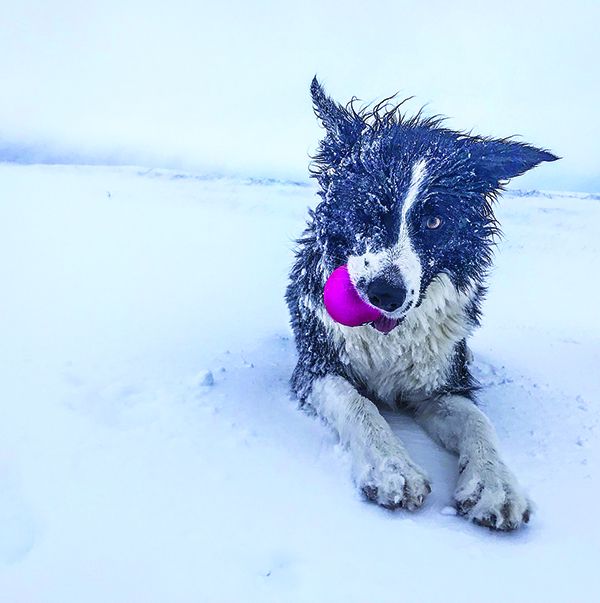
Montana author Kathryn Dunning enjoys winter adventures with her dogs, who are also game to explore and play - even in sub-zero temperatures. But precautions must be taken to protect the dogs' paws.

The sky was a brilliant blue, with glimmers of sparkling snow flashing  across the path ahead as a light breeze blew it into the air, adding a pinch of magic to the scene. The temp hovered around a lovely 25°F (-3°C), and the only sound heard for miles was the swish of my skis combined with the heavy breathing of happy dogs with tongues lolling. We were running out of light, so I peeled off our scheduled route and zipped up a hill, a quicker, albeit steeper, way home. 

As we climbed, I noticed my Border Collie pause briefly and look at his feet, but he kept going. I made a mental note to check his paws when we got home. We turned the corner, began our descent, and joyfully charged downhill. 

Then, he stopped – suddenly – and started frantically biting at his feet. I kicked my way out of my ski bindings so I could reach him and help him with what I (correctly) guessed was bedeviling him: Snow had stuck to the hair between his paw pads, and icy balls had formed and expanded between his pads, causing his toes to splay uncomfortably. I felt terrible. In my enthusiasm to get out into this beautiful day, I failed to check the length of the fur on his feet before we left and he paid the price for my oversight. 

Had I attended to this winter dog husbandry chore before we hit the trail, our outing would have been near perfect; the snowy, cold, but clear conditions were perfect for my athletic canine sidekick, who is well habituated to our chilly Montana winters.

THE BASICS OF WINTER PAW MAINTENANCE
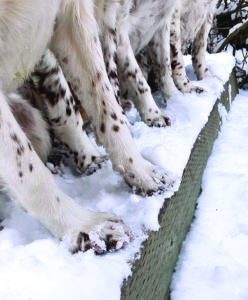
John Wright raises and trains Springer Spaniels in Bozeman, Montana – and also takes beautiful photos of his dogs. Frequent nail-trimming, he says, is key to healthy paws in winter. Nails split and break more readily in winter – especially if they are too long.

But snow, ice, and cold aren’t the only foes our canine companions’ paws have to contend with in winter. In other parts of the world, there are other hazards that wreak havoc on the four-footed – including salt and other de-icing agents and persistently wet and/or muddy conditions – and a little regular maintenance goes a long way to keeping our friends up and running. Literally. 

* Nail trimming. While many dog owners long to believe that time running on hard surfaces is sufficient to wear canine nails to an appropriate length, it’s just not so. No matter where you live, no matter what weather or surfaces your dogs are exposed to, regular nail trimming is vital to healthy paws. 

John Wright, a trainer of champion Springer Spaniels in Bozeman, Montana, logs serious miles daily year-round with his dogs and knows all too well the importance of nail trimming. “Long, neglected nails are more likely to break or split in winter conditions with frozen ground or hard, slippery ice. A broken nail is a lame dog for a week or two,” he explains.

 “Clip those nails! It’s quick and easy once you get the hang of it, it’s a 90-second gig for four paws,” Wright adds. Easy for someone with a lot of experience, perhaps less so for others. Nail trimming can be an anxious endeavor, which raises the anxiety for our canine companion receiving that care. Have you ever had your hair cut by someone who was unsure of what they were doing – or who actually nicked your ear with her scissors? That’s a chair everybody’s quick to jump out of!

An article in WDJ’s October issue (“Rotary Club”) discussed nail trimming techniques and tools. It may be additionally helpful to get an in-person tutorial on nail trimming from your favorite groomer or vet tech or whomever has the skills that instill ease and confidence in your dog. If you are like me, once you have the know-how you’ll wonder what you were so worried over in the first place! 

I turn nail trimming into bonding time. At least once a month, my dogs get a relaxing turn at the (home) spa, complete with a pedi-pedi and a paw pad massage (more on this below). 

* Hair trimming between pads and toes. As my experience on that otherwise perfect day illustrates, medium and long-haired dogs need to have the hair between their paw pads and toes kept short. This prevents the formation of snow and ice balls that can cause painful bruising and injury to tendons.

 I prefer to do this myself, rather than go to a groomer, because it’s a quick and easy job with the right clippers. The best clippers for paws (around faces and ears too) are small, quiet, and cordless. 

Many years and several pairs of clippers later, I discovered Cyrico cordless professional pet clippers and swear by them. Forget about trying to find an outlet in a spot where hair can conveniently fly; cordless trimmers allow you and your dog to be wherever you are most comfortable. And they hold their charge surprisingly well! (Here is a link to my favorites:  tinyurl.com/WDJ-cordless-clippers.)

Whatever clippers you choose, it’s helpful if they are relatively quiet, helping to reduce noise and vibration, which can trigger anxiety in some dogs. Of course, even the quietest clippers still make noise, so I found it helpful to teach my dogs to associate a tasty treat (they highly recommend bacon-flavored Cheez Whiz) with the sound of clippers before they even touch the dog’s fur. It’s a tiny bit of effort that allows for a lifetime of calm clipping. 

If the snow doesn’t fly where you live, but the rain is frequent, keeping the hair trimmed on your dog’s paws will reduce mud and crud that can accumulate between the dog’s toes (and track onto your floors), and it helps paws to dry properly. Excess water can create bacterial buildup between the toes, leading to itchiness, sores, and infections. 

* Protect with paw balm. Salt and chemical deicers on sidewalks are great for reducing slips, but can cause paws to become irritated, and some can be dangerous if ingested. Applying a balm to paws prior to heading outdoors provides a nice buffer between the paw pads and the treated walkways. 

The reigning standard balm for paw protection in winter (and summer!) is Musher’s Secret. It’s made from a blend of food-grade, organic waxes that form a semi-permeable shield on the pads, allowing perspiration to escape through the toes. It’s also non-toxic and non-allergenic. 

While I find it to be a very useful product, its maker claims that Musher’s Secret will prevent balls of ice and snow from forming on a dog’s paws and in between their toes. In test after test on a variety of dogs, all medium and long-haired, Musher’s Secret has never prevented paw-snowballs for my dogs. Ever. This is not a deal-breaker, just a bit of an over-sell. 

You will still have to keep paw hair trimmed. (If this just prompted groans, I assure you trimming is not that bad. In a winter season in Montana that lasts six months or more, I trim paw-fur three or four times and it takes five minutes or less per dog. It’s really not that bad!)

Here’s another winter hazard for our dogs’ paws: those huge swings in temperature and humidity as you travel indoors and out. These are absolutely fabulous conditions for drying out and cracking paw pads  – your hands likely suffer the same fate in winter! I personally want one balm to rule them all, protecting and treating dog paws and mine too, so I make my own (see my recipe on page 15). I add essential oils to enhance the spa experience! 

Ruffwear’s Polar Trex Winter Dog Boots

* Boots. There comes a time when winter conditions will make boots your best friend’s best friends. 

Dogs have varying sensitivity to cold, but by -10°F (-23°C), you start to see all dogs holding up paws, sometimes trying to simultaneously lift three or four paws off the cold surface – it’s quite a sight to behold! 

Older dogs, especially, don’t thermoregulate as well and their feet become increasingly sensitive to cold. Boots can make a huge difference for them, allowing them to comfortably get out and enjoy winter. Dogs with short or thin coats need extra protection, too. 

However, if your dog has never worn boots and you suddenly toss them on, prepare for a high-stepping protest march complete with bucking and kicking. Boots take some getting used to.

You’ll have to spend some time introducing them to your dog. Putting them on and then doing something fun right away distracts them from this new, very awkward accessory. Several short sessions will start to ease a dog toward boot-happiness. 

A good fit is critical for your dog’s comfort, although it can be challenging to find just the right size; every manufacturer’s sizing varies slightly. When in doubt, order products in the two closest sizes and try them on indoors at home. Don’t try to “make do” with a close fit; you’ll just end up hurting your dog and souring him to future attempts with better-fitting boots. 

How should you identify good boot candidates? Look for:

• Durability. Look for quality material without excessive bulk.

• Flexibility and comfort. Dog boots need to be supple and flexible, especially at the dogs’ wrists and ankles. Dismiss the ones that are stiff throughout, rising high on the leg, with a lot of straps to keep the boot in place, which can hinder movement and do more damage to a foot than the elements! 

• Good workmanship. Seams, zippers, and patches of hook-and-loop material (such as Velcro) should be minimal, and nothing should feel rough on the inside of the boot. Anything that protrudes on the inside of the boot can cause sores on the dog’s foot or leg.

• Visibility. The brighter the boots, the more likely you will find them after your dog manages to lose one or more. 

I’ve tried many models from a number of companies, but I find myself going back to the same two companies again and again. 

Ruffwear (ruffwear.com) is great about helping dog owners find the right boot and fit for their dogs’ needs. Most of their boots are a bit technical; figuring out how to get them on and worn comfortably can take some work, but they’re worth it. 

Hurtta (hurtta.com) also makes great boots. Their products are easier to put on the dogs and tend to be comfortable straight out of the box with minimal fuss. 

Once your dog is accustomed to his boots, don’t tune out; you need to stay alert to any sign of discomfort. If a boot slips or twists, it won’t take long for an errant seam to rub a paw raw. Check the fit periodically when you’re out to prevent these sorts of unfortunate boot-mishaps. Few things can ruin an outing faster than a boot rubbing the wrong way. 

Homemade Paw Balm

Yields six 1-oz jars

You’ll need:

• Small pot and glass bowl or double broiler

• 2 oz olive oil

• 2 oz coconut oil

• 1 oz shea butter 

• 4 tsp beeswax

• Optional scent: Use only therapeutic-quality essential oils to meet your personal scent preference. My favorite combination is 3 drops each of  lavender, mandarin, and chamomile essential oils.

• Also optional: 1⁄4 tsp vitamin E oil as a preservative

1. Pour an inch or two of water into the bottom of a double boiler, or set a glass measuring cup into a pot of water so that the glass bottom is submerged and the top is exposed. Bring the water to a simmer.

2. Add coconut oil, olive oil, and shea butter to the glass cup or the top of the double boiler.

3. As the mixture warms and melts together, add the beeswax. When the beeswax begins to float to the top, stir the mixture continuously.

5. Set out six 1-oz jars and add the essential oils (and optional vitamin E for increased shelf life) to each jar.

6. Pour the melted base into the jars. Stir lightly (a chopstick works well for this) to mix the essential oil and vitamin E into the base. 

7. Cover with breathable material (e.g., cheese cloth) and cool until they harden.

Enjoy for one long, cold winter (longer if you add the vitamin E).

Related Article

The 4 Best Winter Dog Boots Out There

Kathryn Socie-Dunning lives in Montana with her husband, toddler son, and two snow-loving dogs.

Tethered for Success: The Do’s and Don’ts of Dog Tethers

2
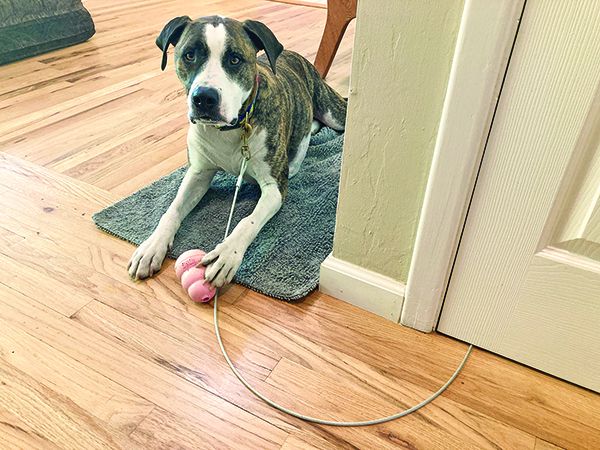
A dog tether used only for short term restraints can offer greater flexibility in training.
Tether your dog in locations where he is safely out of household traffic and can't get tangled in anything. Give him a comfy mat or bed and a food-stuffed toy or chewy.

I’ve long been a proponent of the appropriate, judicious use of tethers for dog training and management. This doesn’t mean tying up your dog in the yard all day while you’re at work, or for hours while you’re grocery shopping; it means short-term restraint under the direct supervision of a responsible human. Proper use of tethers can be a lifesaver in your dog’s training and management program.

You can purchase ready-made tethers (my favorites are from pettethers.com) or make them yourself out of sturdy, good-quality materials. While some people just tether with their dog’s leash, I don’t recommend this (except for short-term emergency tethering), as your dog can chew through a leash. A nylon-coated cable tether with sturdy clips on both ends can be attached to an eye-bolt screwed into a solid wall beam. 

We recommend tethering only with a plastic-coated cable, which resists tangling and can’t be chewed.

 Alternatively, if you clip the tether to an eye-bolt screwed into a block of wood, you can then slide the tether under a door and close it; the door will hold the tether in place (as seen in the photo above). 

You can also use the Pet n’ Place anchoring system to set up a portable tether outdoors and/or when you are traveling. This product is suggested for dogs who are less than 60 pounds; if your dog weighs more, use two! 

APPLICATIONS

There are a multitude of ways a tether can enhance your life with your dog, including:

* Housetraining. Reduce your not-yet-housetrained dog’s crate confinement by tethering instead of crating. It’s easy keep him with you as you move around the house, and he will still be inhibited from soiling his immediate tether space.

* Chewing. Rather than crating to supervise his puppy/adolescent predilection to chew everything he can get his teeth on, tether in chew-proofed locations so he can still accompany you around the house.

* Polite greeting. Tether your dog while you repeatedly approach to teach him to sit politely to greet people. You can also tether him while you greet visitors to your home, and then instruct your guests on how to greet him in order to reinforce polite greetings. For example, “When all four of the dog’s feet are on the floor, you can pet him. But if he jumps up, just step back out of range.”

* Present yet managed. Your dog may be social – perhaps too social. If he’s inclined to sit in everyone’s lap and not all your guests appreciate close encounters of the canine kind, you can tether him, rather than shut him away in a back room. He still gets to enjoy the company but can’t pester people. Again, coach your visitors that if they want to approach him, he needs to offer a polite sit in order to be greeted.

* Counter-surfing. In the kitchen, this is a must-do while you work to modify his counter-surfing behavior! (See “Useful Matters/Mat Training Tips,” WDJ January 2020 and “Counter Productive,” July 2020.) 

*Training. Use a tether when you need your dog to stay in one place during a training or behavior modification session, but his stay is not yet solid, for example, while playing “Nose Games,” etc. (see “Everyone Nose That/Understanding Your Dog’s Nose,” September 2019). 

* Other animal companions. If your dog is an attention hog, and every time your other dog comes up for some petting, he pushes her away and demands that you pet him instead, use his tether to ensure that she gets equal petting time. If your dog chases the cat out of the living room every time she tries to come in for a lap-visit, tether him and do counter-conditioning for the presence of the cat while also giving your feline family member some safe living room time.

* Restricted activity. If your dog is on the dreaded “restricted activity,” and if he will stay calm on a tether, tethering can be an alternative to crating.

* Feeding. Perhaps one of your dogs tends to gobble his food so he can go scavenge your other dogs’ bowls before they are done. You can tether your gobbler at his feeding station so you don’t have to constantly play traffic cop.

* Human mealtime. If your dog has learned the fine art of begging at the table, you can enhance your own dining experience by tethering him nearby, far enough away to prevent him from bugging you. He gets to be part of the family at mealtime but learns to mind his manners. 

The tether can be a great tool when used properly and can be instrumental in helping your dog stay in your lifelong loving home rather than be rehomed, or even euthanized. Value it, and use it with care. 

Tether Do's & Don'ts

The tether isn’t for every dog, nor every restraint situation. Here are some things to keep in mind if you use a tether with your dog:

Do these things when tethering:

✓ Take the time to introduce your dog to his tether gradually, with treats, so he has a positive association with it. This is especially important if he is sound-sensitive, as the tether clips can make a clanking noise, or if he has prior negative experiences with being chained or tethered.

✓ If your dog has any tendency to pull hard/yank on his tether, attach the tether to the back clip of a harness to avoid potential damage to his neck.

✓ Instruct your guests on how to greet your dog properly when he’s tethered, and provide them with treats so they can reinforce him properly when he sits.

✓ Provide constant supervision for your tethered dog so he can’t become tangled and injure himself.

✓ Provide your dog with a food-stuffed toy or other chewie when appropriate (i.e., if you are tethering during your meals) to help him settle and relax on his tether. (You can tether a stuffed Kong to his tether attachment so it doesn’t roll out of his reach.) 

Don’t do these things when tethering:

✓ Don’t use a tether if your dog is even mildly frightened or wary of it, unless you do ample conditioning first to convince him that it is wonderful.

✓ Don’t use the tether as punishment. It’s okay to use it as a calming time-out, but it should not be associated with any reprimands or coercive handling.

✓ Don’t leave your dog tethered and unattended. He can become tangled and injure himself.

✓ Don’t tether your dog where he can be harassed by other dogs or humans.

✓ Don’t tether your dog with a flat collar if he tends to pull hard on his tether, and never tether your dog on a choke chain or other collar that tightens. (They are called “choke chains” for a reason!)

✓ Don’t tether your timid dog where unfamiliar humans can approach him. If he must be tethered when humans are present, tether him at a distance where he can feel safer and you can still keep an eye on him, and surround him with exercise pens so no one can approach past his threshold distance. If he’s significantly fearful, do not tether him, ever, where unfamiliar humans might approach. Instead, put him in a safe room away from the action, inaccessible to visitors.

Add-On Wellness Plans

1
Wellness visits are not covered by most "major medical" pet insurance plans. If you'd like an entire year to spread out the cost of routine care (a well-pet checkup with a blood test and perhaps a vaccination, heart worm test, and a prescription for a heart worm preventative), adding a wellness rider to your dog's major medical plan might work well for you.

At the close of 2019, 2.82 million pets had health insurance, according to the North American Pet Health Insurance Association. Over the past five years, the industry has grown 22.1% annually on average. That outstanding growth rate is big news. 

But pet insurance isn’t news to our readers. We’ve discussed the topic in depth twice over the past five years, in the September 2015 and March 2018 issues. And little has changed since those articles were published except for one thing: the increased number of companies offering wellness riders – optional insurance policy provisions that add benefits to or amend the terms of a basic policy.

“WELLNESS PLANS” ARE NOT HEALTH INSURANCE

Traditional pet health insurance plans help owners pay for the costs of diagnosis and treatment of unexpected and/or catastrophic injuries or illnesses; they don’t usually cover the cost of routine well-pet exams. 

Historically, pet insurance companies have offered “wellness” or “preventive” coverage as an add-on to a traditional pet health insurance policy. These are often marketed as incentive programs that will motivate us to make annual or semi-annual well-pet visits. If you’ve paid for a well-pet visit already in the form of a wellness rider that will reimburse you for that visit, you are more likely to follow through and get your dog in to see the vet! The twist is: If you don’t go, you don’t get reimbursed!

We’re all for well-pet visits. Dogs who are seen by their veterinarians regularly are most likely to have any problems with their health detected in the earliest stages, when treatments are most effective. Any tool that encourages owners to schedule these visits can literally save dogs’ lives. There’s a big catch, though: Despite the fact that the insurance companies market wellness riders as a way that owners can reduce and plan for the cost of routine veterinary care, these plans won’t necessarily save you money. They can do so – but you have to be extremely organized and knowledgeable about what routine care your dog will benefit from in the year ahead in order to realize savings from their purchase.

HELPING KEEP YOUR DOG’S HEALTHCARE ON TRACK

To repeat: Classic wellness plans essentially act like a financial incentive program that encourages the pursuit of routine veterinary examinations by reimbursing the insured pet’s owner for a set of pre-selected benefits, such as a well-pet visit, a screening blood test, vaccinations, heartworm testing, etc. 

For example, a wellness rider may cover the cost of an annual heartworm test and reduce the cost of monthly heartworm preventative medications. The routine administration of the preventative keeps your dog free of heartworms – and reduces the chance you will file a claim for a dog who needs treatment for heartworm disease. 

As another example, some companies’ wellness plans reimburse owners for a significant part of the cost of an annual dental cleaning. In small dogs, many of whom suffer periodontal problems that result in tooth loss, annual cleanings can help a little dog avoid losing 20 teeth in a $3,000 surgery – a win for everyone involved.

WHAT’S THE CATCH?

Again, these wellness riders are offered as adjunct to, not replacements for, your dog’s health insurance, which is what does help cover the cost of unexpected trips to the vet for injury or illness. Think of wellness plans, instead, as a pro-rated trip or two to the vet, where the cost is spread across an entire year, which can help ensure it’s in your monthly budget. 

As such, the potential reimbursements offered by the wellness plans are strictly limited in value. A plan that costs you $30 per month, for a total cost to you of $360 per year, might have an annual allowance of $400. Yes, the potential savings for that year is only $40 – and you will save that money only if you use every penny of the annual allowance by booking all of those wellness benefits. You could actually lose money on the plan if you fail to schedule and bring your dog in to your vet for the services you’ve paid for.

Honestly, it’s a bit like a casino: Unless you are a very savvy consumer, the odds favor the insurance company. It’s far more likely that the average dog owner will pay more for a wellness “plan” than they will receive as reimbursements for services their dogs enjoyed. You can get more value out of a wellness plan that you pay for in a monthly premium, but again, you have to be organized. You have to thoroughly research the plan ahead of time, making sure it will pay for (or significantly reduce the cost of) all the routine healthcare you plan to obtain for your dog – and then make sure you get that care. If you aren’t that disciplined, you may well lose money on these plans.

Comparing Wellness Plans Offered by Health Insurers

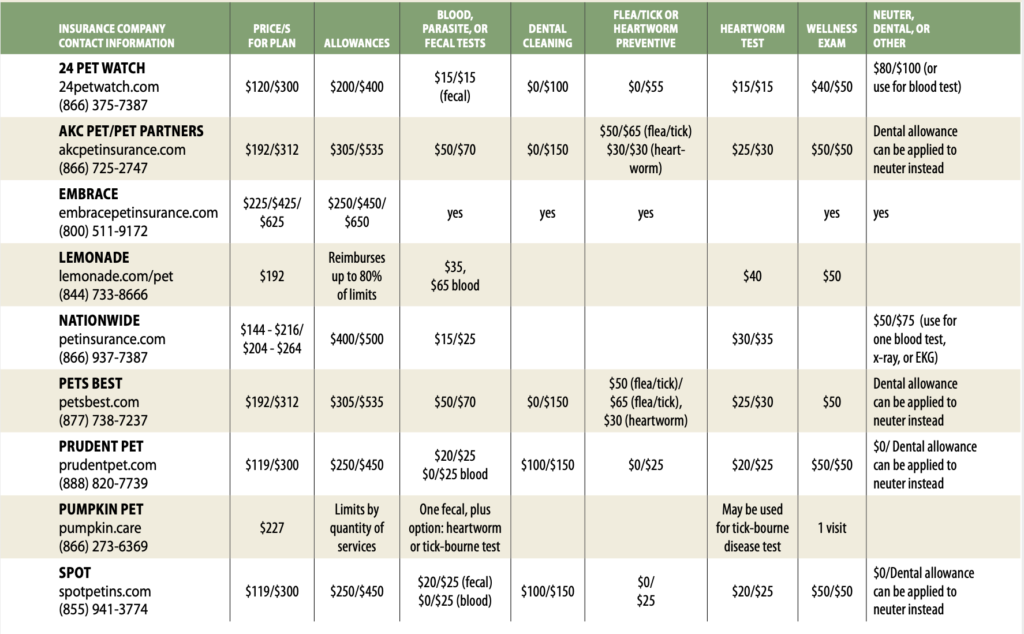
The table below lists only some of the many companies offering wellness riders to their health insurance plans and only some of the benefits the plans include. The health insurance companies don’t make it easy to compare their products with those of their competitors, but we’ve tried to simply illustrate how different the available plans are. 

The prices listed here are the amounts we found for wellness plans for a 2-year-old, small, mixed breed dog. As we built this table, we noticed that prices and allowances change frequently; these are accurate as of 10/1/20. 

Some companies offer more than one benefit level; we’ve used a slash symbol ( / ) to indicate the prices, allowances, and benefit levels of each tier of the plans offered. 

The largest benefit offered by many companies in their wellness plans is a reimbursement that can be used either for a spay/neuter surgery, dental cleaning, or other major expense. Our guess is that this is done because a dog may need spay/neuter surgery as a younger dog or a dental as an older dog, but rarely both in the same year. We showed those major benefits in the last column. 

COVERAGE WILL VARY

The wellness plans offered by pet health insurance companies vary widely. Some give you a ton of options; some lock you into a specific and limited set of veterinary services that qualify for reimbursement.

Some of the plans offer an extensive list of preventive options that you can use in their wellness plans. Embrace Pet Insurance, for example, includes Reiki, massage therapy, anal gland expressing, wearable pet activity monitors, acupuncture, and even medicated shampoos in the list of services that the plan will reimburse you for. Other plans, like Pumpkin Pet Insurance’s “Preventive Essentials Package,” focus on preventive basics with one well-pet veterinary visit, one fecal test, one test for a vector-borne illness test (such as Lyme disease), and two vaccinations. 

The difference is reflected in the cost. A wellness rider from Embrace for a small 2-year-old dog would cost $35 a month (a total cost of $420 for the year) with a $450 allowance. It offers the widest range of coverage choices we found and doesn’t dictate how much you can spend on each item. You could choose to spend the entire $450 allowance on acupuncture therapy, if you wanted – and you could do it all the first month of coverage, if you wished, but you still would be required to pay the monthly premiums for both wellness and health insurance for the full year.

Most riders we examined used monetary limits for their wellness coverage by individual items. For example, AKC/Pet Partners will reimburse you for a maximum of $50 or $65 (depending upon the level you choose) for flea and tick prevention. The actual the cost of a year’s worth of spot-on flea treatment for a small dog is more than that – depending on the product used, it may cost as much as $120. In cases such as this, the plan simply helps defray the cost of caring for your dog; it won’t cover the entire cost. 

Other plans cover a set quantity of specific services, such as the Pumpkin Pet package described above. The cost for this package for our hypothetical 2-year-old small dog would be $19 per month, for a total cost of $228. 

That sounds great – mostly because, at many clinics, the cost of all that likely exceeds $228, so Pumpkin Pet’s reimbursement to you for all that should mean that you saved money. But you need to read the insurer’s customer agreement carefully to see if they have limits on how much they will reimburse you for that one veterinary wellness visit.

Another Option: Wellness Packages Offered By Veterinary Practices

Many veterinarians and veterinary companies, like the 1,000-clinic Banfield Pet Hospital, have designed “wellness packages” for their clients. The benefit to you, as with any wellness coverage, is that it helps to defray the cost of the preventive measures your dog needs to be healthy. The benefit to them is that it pretty much binds you to their veterinary clinic for the year. 

These plans are prepaid preventive options that don’t require you to also purchase an accident/illness policy. They can be extremely helpful to those on a budget because, when working directly with your own clinic, you usually don’t have to pay the money up front and then be reimbursed. You just pay your monthly premium, and your dog gets the preventive care he needs.

THE RIGHT RIDER

Not all screening tests and preventive procedures are necessary. Ask your veterinarian for recommendations regarding preventive care and health screens, based on your dog’s age, activity, and predominant breed. 

Keep in mind that most of these riders are offered in combination with your accident/illness coverage. Because that part of your policy is your primary concern, the first thing you need to do is decide which insurer offers what you need for your dog. For more information about choosing a major medical policy, see “Rest Insured,” WDJ March 2018. To recap that article briefly: We advise that you choose an accident/illness policy without monetary or treatment policy limits and that you make sure that the actual fees on your veterinary invoice are used to determine reimbursement (as opposed to a “fee schedule”). 

Also important: Read the policy in full to ensure that any exclusions will not be a problem for you – and there are usually a lot of exclusions. For example, if you have a German Shepherd Dog, you’ll want to be sure hip dysplasia is covered. If you have a Papillon, look carefully at the dental coverage. Your veterinarian can offer an expert opinion to help you choose. 

After you’ve chosen your dog’s “health” insurance, read the wellness rider in full before you sign. Sometimes, the broad-strokes description of a wellness plan leaves owners with a more generous impression of what they will get for their money than what is described in fine detail in the customer agreement.

And, finally, remember that you need to exhaust the available benefits of a wellness plan over the course of the policy year to make the policy worth having; the funds do not roll over from year to year. If you have a $450 allowance and you used only $300 of it, you will have lost $150 when the policy renews. 

Cynthia Foley is a freelance writer and dog agility competitor in Warners, New York.

Slow Down!

0

I’ve always been sort of a wuss about my dogs, but just typing the headline above made tears spring into my eyes. Otto is fine, but he also just turned 13 years old and has a few health conditions my veterinarians and I are watching carefully. (Yes, of course I have more than one veterinarian on Otto’s healthcare team!) Thank dog for good insurance, which has been paying for semi-annual abdominal ultrasound examinations (keeping tabs on some growths on his liver) and blood and urine tests. I may not be able to keep him from getting older, but I am not going to be surprised by some long-developing condition, by golly. 

 But I have to say, it pains me to see him struggle ever so slightly to get up from a nap sometimes. Or to start panting suddenly, even when it’s not hot and we are just laying around. Or to feel yet another lump under his skin when I’m massaging his neck (his favorite) or rubbing his tummy – he’s already got a dozen or so lipomas hidden under that scruffy coat.

I just can’t even believe it’s already November – and in a way, the November of my life with Otto. 

Speaking of slowing down: On page 20, we have a review of products that are designed to slow your canine speed-eater down. Long-time contributor and dog trainer Stephanie Colman actually timed all of her poor dog’s meals, looking for the tools we could all use to help our dogs eat more slowly – perhaps even tasting the food before it goes down the hatch! I think I’m going to have to exert editorial privilege and ask Stephanie to ship the winning products to me; I’m always inventing ways to try to make meals last longer for my younger dog, Woody.

Woody got to model for a different article in this issue: On page 6, that’s him enjoying a little down-time with a food-stuffed Kong (just one of the tools I already employ to make him work for his calories). He’s demonstrating another one of my favorite dog-care tools, the tether, a short bit of plastic-coated cable with snaps on either end, which can be used to secure your dog in a safe, supervised, comfortable spot for a short time. The author of the article, WDJ Training Editor Pat Miller, is another long-time fan of tethers; she’ll tell you why she loves them so much in the article. 

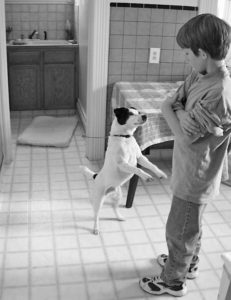
I couldn’t resist using another photo in the article, one that I took to accompany the first article Pat Miller wrote about tethers for WDJ – way back in 2001. The photos is of a young boy standing just out of the jumping-up range of a jumping Jack Russell Terrier. That boy is my son, and he’s 28 years old now.

See what I mean? Time flies. Don’t waste it. Go give your oldest dog an extra hug and a kiss, right now!

An Update on Foster Puppy Coco

23
I couldn't take video and swim with Coco at the same time, but I was able to document her enjoyment of riding on paddleboard while Woody and Otto swam and ran along the shore.

If only it was summer. I have been so eager for the end of the hot, dry weather that characterizes every summer in my area – but now that I’m fostering a dog who would really benefit from swimming, I’m reneging on all my wishes for rain and lower temperatures. 

Coco is the little dog I first wrote about here. She’s an estimated six months old (this has been revised upward, given better exams of her teeth, which we can now examine at will). She can’t walk or trot like a normal dog, due to an as-yet undiagnosed problem with her hind legs, which only move together like a bunny or a kangaroo. (Speaking of kangaroos, a friend who is a regular volunteer at a zoo tells me that kangaroos can’t use their hind legs individually, either; they, too, apparently can *only * hop. Huh!)

For the past two weeks, I’ve been waiting for an appointment with a veterinarian who could actually see Coco move, to get a better idea of what’s going on with her. In the meantime, I’ve been working with Coco daily, doing some physical therapy exercises I found online for dogs who are recovering from injuries or surgery (this site has great descriptions and videos; here’s another video that shows a hind leg range-of-motion exercise I’ve been doing with her).

Based on my understanding of physical therapy, I’ve been speculating that whatever the cause of Coco’s condition may be, her brain is unaccustomed to exercising the nerves that trigger a normal movement pattern, so any exercise that send signals to the brain regarding new, better (more normal) movement options would be beneficial. To that end, swimming is often considered as one of the best therapies for issues like Coco’s. It’s non-weight-bearing and completely novel, which may be enough to help initiate the brain’s signals to kick her legs in the normal way for a swimming dog.

There is a river and several large lake-like reservoirs locally where I can take Coco and my other dogs to swim – but the water is FREEZING cold. I know that seems weird, given the hot weather. But the river and the reservoirs where I can take the dogs are downstream from the Oroville Dam – the tallest earthen dam in North America. This means that the water that comes out of the bottom of that dam is coming from a very deep, cold place. The water is super cold, which is a delight in super hot weather – but not great when the ambient temperatures drop, and not great for physical therapy-type swimming (which is typically conducted in warm pools, which keep the muscles loose and relaxed).

The lake behind the dam is warmer, at least at the kind of shallow depths that dogs swim in. But it’s been accessible only for the past week or so; miles and miles of its shoreline and tens of thousands of acres around it were burning until very recently. But finally, the other day, the planets lined up and I had a day off when it was hot and I got to take the dogs swimming.

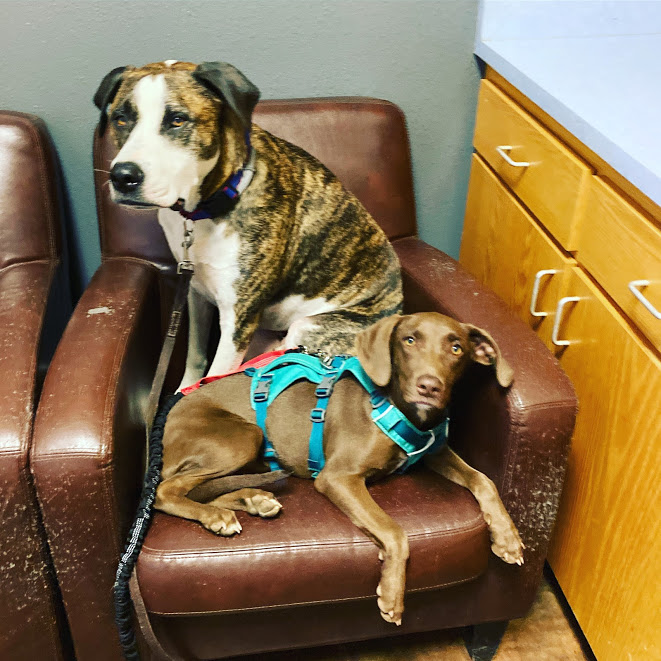
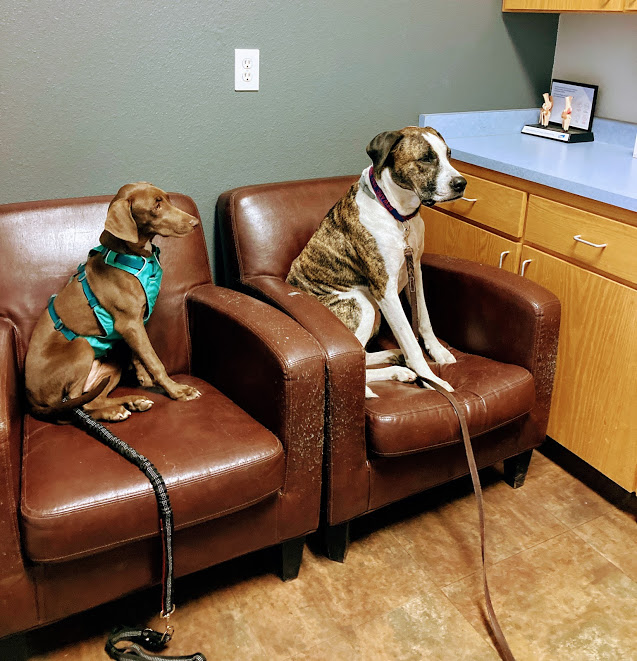
Woody came along to the vet with us; his friendly, steady bulk makes Coco feel more confident in every new situation. When we first entered the vet’s exam room, Woody went right for one of the client chairs – and Coco jumped right up to sit with him. (Yes, the hospital has several “clinic cats”.)

Alas, we swam enough that I could see that Coco quickly started swimming in the same way that she runs: “dog paddling” with both front legs normally, and stroking both hind legs at the same time – essentially bunny-hopping in the water, too. It wasn’t a wasted trip by any means, though; Coco had fun in the water and running (hopping) along the shore with Woody, and the extra swimming time (and a life jacket) made her that much more comfortable in the water than she had been the first time I took her swimming. At the very least, I’m hoping that when I am able to find a pool or underwater treadmill for more therapy, she’ll be more comfortable and happy in the water. If this warm weather persists, we’ll go back to the lake for more non-weight-bearing exercise. It absolutely can’t hurt. 

Until today (as I write this) Coco hadn’t been seen by a veterinarian who had seen her move; she was still frozen with fear of people and the novel situations she had been thrust into when the North Complex Fire prompted area-wide evacuations. Today was a breakthrough for several reasons: A veterinarian finally saw her move! The clinic I took her to, in order to see this specific veterinarian, is back to allowing clients to come inside the clinic again – so I was able to go inside and discuss Coco’s history with the veterinarian, in person! We waited for our appointment outside, we wore masks, we paid for the visit and scheduled another while in the exam room, among other COVID-era accommodations – but at least I could go inside with Coco! And the vet was able to touch Coco without any party experiencing any fear – Coco is now experienced enough with humans that she allowed the vet to pet and massage her body and flex her joints, and the vet was without fear that Coco might bite her in fear! I could have cried!

After the vet examined Coco, the little dog felt comfortable enough to sit in her own chair in the exam room.

I was, at a minimum, hoping for a referral to a veterinary neurologist at the Veterinary Medical Teaching Hospital (VMTH) at the University of California – Davis. But the vet who examined Coco thinks that her issues are not necessarily the result of some exotic neurological condition; she thinks that it’s likely that Coco was injured as a very tiny puppy, possibly even as she was born, and that the neurological “wiring” for a normal gait might still be sparked into action through physical therapy and exercises targeted to build her hind-limb muscles. In addition to practicing conventional veterinary medicine, this veterinarian also uses complementary therapies including acupuncture and chiropractic, and she suggested that Coco could really benefit from both continued physical therapy exercises and some acupuncture and laser therapy treatments. Excellent! We made another appointment for next week.

My most dog-crazy friend, Leonora, lives about a mile away from me. She is the owner of Samson, Woody’s tiny little buddy since they were puppies. Like me, Leonora fosters for our local shelter, and she was fostering a litter of six tiny puppies who were the exact same age as the litter of nine big puppies I was fostering five years ago. We both, without consulting the other, ended up keeping a puppy from our respective foster litters. She kept the tiniest pup, Samson; I kept the largest pup, Woody. We (all four of us) attended the same “puppy kindergarten” classes (Puppy 1 and 2) and Samson and Woody often play and hang out with each other, best of buddies in spite of their 65-pound size difference.

Despite the 65-pound difference in size, these two have been best friends forever.

Anyway, Leonora recently had to say goodbye to her senior dog, and no doubt because her house seems empty with just one tiny dog in it, she volunteered to have Coco stay at her house when I’ve had to pull a volunteer shift or even just go to town for errands. Having Coco spend time (and some nights) at Leonora’s house has given Coco experience with more humans and dogs, Samson someone to play with, and Woody gets a break from the constant attention he gets from Coco otherwise. (She’s sort of smitten with him, and who could blame her!) Leonora also helps with Coco’s PT exercises and she’s falling for the goofy little dog, I can tell.

That said, we’re not talking about permanent placement anywhere yet. We won’t be looking for a permanent home for Coco until we know that we’ve done everything we can to get her to move more comfortably and confidently through the world, so those wonky back legs have the best chance of remaining problem-free and arthritis-free as long as possible.

Which Dogs Should Not Receive CBD?

6
Photo: aydinmutlu/Getty Images

Cannabidiol (CBD) is one of over 90 cannabinoids produced by the Cannabis sativa plant and has great potential for therapeutic application in veterinary medicine. The 2018 Farm Bill legalized the regulated production and use of hemp and hemp products that contain less than 0.3% tetrahydrocannabinol (THC) in the United States, and since then, CBD products have become widely available and interest in using CBD to treat our pets is increasing. This is due to not only anecdotal reports, but also scientific evidence of beneficial behavioral and health effects, especially for such conditions as pain (particularly with arthritis), inflammation, anxiety, seizures, and immune system modulation in companion animals.

Overall, CBD use in dogs appears to have a good safety profile and is at low risk for side effects. “Appears” is the key word here, however. Because cannabidiol and other hemp products were federally illegal until 2018, we are only now beginning to see the results of recent scientific studies conducted on these products.

It is known that dogs, like humans, have an endocannabinoid system (a complex cell signaling system); however, experts haven’t yet determined how it all works. Because we are in only the very early stages of understanding just how cannabinoid-based medications affect the canine body, we need to be cautious in administering CBD to our dogs. While we wait for the results of new and ongoing research, here are some key points to be aware of when considering CBD:

  • Currently, there are no veterinary drugs containing CBD that are approved by the United States Food & Drug Administration (FDA). CBD products are currently sold as nutritional supplements and “drug claims” about their use are strictly illegal.
  • There is little documented research, control, or regulation over CBD products. This can result in highly varying compositions, concentrations, and quality, even from one batch to the other of the same product. Because of this, consumers may not know what any individual product contains.
  • A recent study (“Cannabinoid, Terpene, and Heavy Metal Analysis of 29 Over-the-Counter Commercial Veterinary Hemp Supplements”, Vet Med (Auckl). 2020;11:45-55) by Cornell College of Veterinary Medicine and ElleVet Sciences, a manufacturer of pet CBD products, tested 29 CBD pet products. Label guarantees to the cannabinoid concentration contained in the supplement were present on 27 of the 29 products, however, only 10 of the 27 “were within 10% of the total cannabinoid concentrations of their label claim.” Several tested below their label claims of cannabinoid concentration, and two products were found not to contain any CBD at all. Heavy metal contamination was found in four of the products, with lead being the most prevalent contaminant (three products).
  • Owners and veterinarians considering the use of CBD need to be aware of the prevalence of low concentration products. Obtaining a certificate of analysis (COA) from a third party laboratory will enable correct calculation of dosage.
  • There is not yet any data available as to the effects of long-term administration of CBD to dogs. It is also not known if there is any cumulative effect.
  • Of particular concern is any potential interaction between CBD and other medications. Because CBD is metabolized by the cytochrome P450 family of enzymes, it can affect the metabolizing of the other medications in the system. In turn, this can alter the efficacy of these other drugs, either by enhancing their activity or inhibiting the desired activity. Studies with humans have demonstrated that this interaction has impacted drug concentrations in the blood. It has been determined that there is the potential for interaction in humans with the drugs warfarin, tacrolimus, theophylline, ketoconazole, and zonisamide. As these drugs are also used in dogs, it is possible that that there may be interactions in the canine body as well. Other medications that CBD may interfere with include antibiotics, antipsychotics, antidepressants, blood thinners, and any other drugs metabolized by P450 enzymes.
  • Scientific studies have shown that CBD can cause an increase in the liver enzyme alkaline phosphatase (ALP), but the significance of this is not yet known. CBD is thought to be able to enhance the effects of certain drugs. This may present an opportunity or need to reduce the dose of certain medications that are administered to a patient who is also being given CBD.
  • As NSAIDs, Tramadol, Gabapentin, and anti-anxiety drugs rely on P450 enzymes for metabolizing, approach the addition of CBD carefully.
  • When given with trazadone, CBD was found to inhibit the ability of trazodone to lower blood cortisol in a recent study by Morris et al (The Impact of Feeding Cannabidiol [CBD] Containing Treats on Canine Response to a Noise-Induced Fear Response Test, Front. Vet. Sci., 22 September 2020). This highlights the potential drug interactions associated with CBD and may support previous work that shows CBD to be a potent inhibitor of the cytochrome P450 family of enzymes.

Continued research is essential to furthering our understanding of how CBD affects the canine body. As with any medication, consult your veterinarian before treating your dog with CBD.

Featured photo: aydinmutlu/Getty Images

Read Next: Know Your CBDs

Haunted by a Mystery Hero Dog

37

Have you ever read a short little news piece – a bit of journalistic fluff – that you nevertheless couldn’t stop thinking about? Maybe there’s something that just doesn’t make sense, or there’s a loose end in the story – for some reason, it’s just keeping you up at night. Most of the ones that haunt me, as you might imagine, have a dog in them somewhere.

I’ve got one such story in my head. Let’s see if it bothers you as much as it does me.

This piece, headlined “Missing Boy Found Wandering St. Louis Streets With Protective Stray Pit Bull by His Side,” was being circulated on Facebook, and many of my friends were sharing it. The People magazine story was generated by a story aired on the 6:00 pm television news on October 1 by a Fox affiliate in St. Louis.

According to the Fox news piece, a two-year-old boy was spotted wandering on a St. Louis sidewalk by a woman who was walking her dogs early in the morning of October 1. The boy was wearing pajamas, but no shoes, and he was unaccompanied – at least, unaccompanied by any humans. He was toddling around in the company of a large pit bull-type dog.

The woman, who wished to be anonymous, was interviewed on camera (with her face obscured) by the Fox news crew. She said she knocked on doors all up and down the street, keeping the toddler and his pit bull friend in view, hoping to find someone who recognized or was missing the child. She also posted an alert to a neighborhood social media web site – and somehow, it was there that the father of the child recognized his son, and ran to meet the anonymous Samaritan and recover his son.

It’s unclear from the story whether the father knew his son was missing from the home before he saw the post. This is but one of the missing details of this story that are bothering me.

In the news clip, police officers are seen holding the toddler and speaking to the boy’s father, but the news piece doesn’t mention whether the anonymous woman, the boy’s father, or someone else had called the police, or what other role the police may have played in the story. That’s also a mystery.

But the biggest mystery of all is the dog. Despite the dog’s major presence in all the headlines of all the iterations of the article, which was picked up by dozens and dozens of news sources across the globe, the fact that the dog who stayed by the toddler’s side, reportedly for hours, was a stray dog – not the family’s own protective dog, but a dog who was unknown to the family – got very little attention. Hero of the story, presumably kept the boy safe – a stray dog. Wow!

And then this, a couple of suspicious little throwaway lines at the end of the piece. One of the news anchors who introduced the taped segment says at the very end of the segment, over film of a policeman putting the pit bull, now on a leash, into a police car, “By the way, the little guy there, Taylor, says he really liked the pit bull who was like a guard for him; he kept saying, ‘Puppy!’ while he was being reunited. We’re told St. Louis city police might be adopting that guy.” Awww! A double happy ending?

Well, after a day of that little news piece just driving me nuts, I wanted to know: Who was that hero dog? And is some St. Louis policeman really going to adopt him?

So I reached out to the St Louis Metropolitan Police Department; they actually have a Facebook page that is monitored by media relations people. I sent them a link to the People magazine story and asked, “Do you have more information about this story, or the dog, that I could share with my readership?” The answer came in just a couple of hours. “The dog ran from the officers and animal regulation was notified.”

So, despite the filmed footage of the leashed dog cooperatively hopping into the back of a police cruiser . . . we’re to believe he “ran from the officers.” I’ll never stop wondering about that dog.

The Stubborn Dog

Photo: Christine McCann/Getty Images

I cringe whenever I hear someone refer to a dog as “stubborn.” It is patently unfair to label a dog as stubborn. Dogs do what works for them (as we all do), and when they aren’t doing what we ask, they have a good reason. When your dog doesn’t respond to your cue, perhaps he’s come to associate it with something aversive, perhaps he doesn’t understand what you’re asking, or perhaps he’s too distracted or stressed and your request doesn’t even register in his brain. In any case, it’s our job, as the supposedly more intelligent species, to figure out how to get our dogs to want to do what we want them to do.

Some humans believe dogs should do what they are told, simply because we tell them to. “Because I said so!” hearkens back to childhood, when parental directives were often accompanied by the implied “Do it, or else!” In these days of a more enlightened dog training philosophy, this coercive approach isn’t what many of us want with our dogs. We prefer relationships based on a cooperative partnership.

If your dog isn’t doing what you ask, consider these questions:

Are you training competently? Remember, dogs shouldn’t have to do what we say just because we tell them to – or just because they love us. We want them to want to do it. Make sure your reinforcers are valuable enough that your dog will eagerly offer the behaviors you ask for, and that you are marking and/or delivering the reinforcer with good timing so your dog associates the reinforcer with the desired behavior.

Is there something aversive about the behavior? Years ago, my first Pomeranian, Dusty, started refusing jumps when we were training for the Open Division of obedience competition. I didn’t punish him for not jumping – I took him to my veterinarian and discovered he had bad hips. It hurt him to jump. A behavior can also be emotionally aversive. If a car ride always means a trip to the vet, your dog could become very reluctant to jump into the car. Your challenge is to make car rides consistently predict “good stuff” – a hike in the woods, a trip his favorite canine pal for a play session, or? If he’s refusing to enter his crate because he has mild separation distress and associates crating with you leaving, alleviate the separation distress through behavior modification (and possibly appropriate medications), and then convince him that crating is wonderful.

Does he not understand? You may have taught him to respond to a cue for the desired behavior, but perhaps you’ve used body language prompts in the past without realizing it, and now, absent the prompt, he doesn’t understand what you’re asking of him. Fade all prompts if you want him to respond reliably to verbal cues. Perhaps you’ve always trained in the kitchen in front of the refrigerator, and so he thinks “Sit” means “Sit in the kitchen.” When you ask him to sit in the living room, he doesn’t sit because it’s not the kitchen. He’s not being stubborn – he needs you to help him generalize his behavior so he understands that “Sit” means to put his tail on the ground wherever you ask him to do it. Even your tone of voice can matter. If you usually give cues with a happy voice but your own emotional state causes your voice to sound different, he may not understand.

Is he distracted? If you haven’t generalized your dog’s behavior to distracting environments, his attention will naturally be drawn to the multitude of exciting things happening around him. He’s not ignoring you; he probably isn’t even hearing you because he’s so focused on the fascinating world around him. Help him hear and respond to your behavior requests by training in various environments with gradually increasing distractions.

Is he stressed? “Stressed” is an even bigger challenge than “distracted.” When stress happens, the thinking part of the brain (the cortex) shuts down and the emotional part of the brain (the amygdala) takes over. We even have phrases in the English language to describe this phenomenon: “I was so scared I couldn’t think straight.” “I was out of my mind with worry.” When your dog is so stressed he can’t think straight, it’s unfair to blame him for not doing what you ask. Relieve his stress (remove him from the stressor, and/or do behavior modification to change his association with the stressor) and try again.

Your relationship with your dog will be so much happier when you stop characterizing him as stubborn and realize how you can help him be more responsive to your behavior requests. Now get busy helping him want to do what you want him to do.

Featured photo: Christine McCann/Getty Images

Read Next: The Right Way to Feed Treats to Your Dog

My Latest Foster Dog Is Something of a Mystery

35
A dog's breed and background can be a mystery that can only be riddled out by a DNA test.
She's pretty, and sweet. I've ordered a DNA test for her.

There’s an old Chinese parable that goes something like this:

A farmer gets a horse, which soon runs away. A neighbor says, “Oh, so sorry for the bad news.” The farmer replies, “Good news, bad news, who can say?”

The horse comes back and brings another horse with him. Good news, perhaps.

The farmer gives the second horse to his son, who rides it, then is thrown and badly breaks his leg. Ack! Bad news! “Well,” says the farmer. “Who can say?”

A few days later, the emperor’s men come and take every able-bodied young man to fight in a war. The farmer’s son is spared. So, good news!

The message of the story: “Good news, bad news, who can say?” We can never know ahead of time how things that may appear to be good or bad will turn out.

I’m thinking about this at the moment, because I am fostering a puppy with a “Good news, bad news, who can say?” sort of back story.

(Yes, I said I am going to stop fostering, for my old dog Otto’s sake. Soon. And I mean it. But not yet.)

How I came across my latest foster pup

As I’ve written about before, I’ve been volunteering at the emergency shelter being provided to evacuees of the North Complex Fire, one of many that erupted in California following a dry lightning storm on August 17. My local animal rescue group, the North Valley Animal Disaster Group, opened the shelter on September 8, when a windstorm pushed the North Complex fire 30 miles overnight and right into our backyard (10 miles from my literal backyard). And an army of volunteers have been caring for hundreds of dogs, cats, birds, rabbits, horses, sheep, goats, pigs, llamas, donkeys, chickens, ducks, you name it ever since.

I was evacuated for a few days, myself. When my husband and I (and our dogs, of course) were allowed to go home, the first thing I did was report for duty at the shelter to walk and feed dogs.

The emergency shelter is a temporary facility; dogs are kept in crates, so they HAVE to be walked multiple times a day. Not an easy task, when they are in close quarters, the air is full of smoke, there are dozens of strangers walking among them, their crates are packed close together next to those of other stressed dogs … It’s a very tough situation.

On my first day of volunteering, I was assigned to work in two rooms at the shelter – which is located in a series of rooms in the bowels of a former county hospital. (One of the rooms used to be the county morgue! The building stopped being a hospital sometime in the early 1970s.) One of the rooms I was overseeing was the “isolation” room, where puppies who were likely to be as-yet unvaccinated were being kept. Among them were three pups who appeared to be siblings, about 5 months old. (Hey! Good news! Their owner evacuated the fire zone and brought them to an appropriate place for care!)

All three of these puppies were terrified of people and of being held in the crates. One, who appeared to be the runt of the litter, would shyly wag his tail at people, but the other two didn’t want to make eye contact and avoided touch. And one, the only female, appeared to have something very wrong with her back end; she was limping or crippled or something. (Yikes, bad news, right?) Hard to tell in the crate. They were going to be especially challenging to care for.

A day later, I learned that the female pup had been placed under a 10-day quarantine. She had bitten one of the volunteers who was trying to get her out of her crate for a walk. Terrible news, right?

A mystery condition: what’s wrong with her back legs?

The county animal control officer overseeing the shelter contacted her owner, informing him of both the bite and quarantine, and also informing him that the pup needed to be transported to a veterinarian for medical care; what was going on with her rear legs? Citing the difficulties of his situation (I believe his home was burned in the fire), the owner relinquished her to the county. (Bad news? No, actually, good news! The county can pay for her to be seen by a veterinarian!)

“Coco,” as she is now known to be named, was transported to a local veterinarian. She was so incredibly scared, the examination was rather perfunctory. A soft-tissue injury was suspected, pain meds were prescribed to see if they help, and she was sent to the local permanent shelter to serve out the rest of her quarantine. Hard time! Bad news?

Well, no: Upon intake to the permanent shelter, she was vaccinated, like all “stray” dogs and dogs who are relinquished to the city or county by their owners. A week later, at the emergency shelter, it was reported that seven owned dogs who were being cared for at the emergency shelter had developed parvovirus. Oh my gosh, this is terrible news for those dogs – and I didn’t yet know whether it was Coco’s brothers who were infected, or some other dogs, because I hadn’t been to the shelter in the past week (busy getting the November issue of WDJ to the printer) – but being sent to the permanent shelter was great news for Coco, who got to miss being exposed to parvo, and who received the benefit of what may have even been her first vaccination.

I was keeping track of Coco’s incarceration, because I made it known that I would be happy to foster her when she was released from her quarantine; I knew she needed further medical care, to see what was going on with her back end, and was afraid she’d get lost in the shuffle. It just seemed to me that she had gotten a really poor hand of cards so far in life. Following her last day in quarantine, I started pushing the animal control officer in charge of her case for information about her vet care, and asked if I could foster her. Happily, the officer agreed that we couldn’t know for sure what was ailing the puppy unless she had x-rays taken, so he made an appointment to go back to the vet and I volunteered to transport her.

Coco on her way home from the shelter and the vet’s office.

After 10 days in a kennel at the shelter, she was both more habituated to loud, barky surroundings and seeing people. She still looked tense and scared, but the shelter vet tech was able to pick her up and carry her to my car without having to put a muzzle on her. At the vet’s office, of course, they did put a muzzle on her, so they could safely sedate her for x-rays.

The radiographs came back without offering a single clue as to the source of her problem: Spine fine, hips fine, pelvis fine, knees fine. Good news?

At this point, it must be said, nobody had been able to see Coco move about freely, to really study exactly what was wrong with her. As she moved around in a crate or kennel, always trying to avoid contact with humans, all you could tell was that she couldn’t really stand up or walk properly.

Woody to the rescue once again

So, I brought her home! In the car, I put a soft, padded harness on her – carefully, gently –and attached a long line to it. I own two fenced acres and two dogs who are experienced with foster puppies and strange dogs.

It took about an hour for my five-year-old “fun uncle” dog, Woody, to convince her that no one was going to try to murder her at our house. It took only another hour and many Stella and Chewy’s freeze dried chicken Meal Mixers (my dog training secret weapon) to convince her that I was safe, she didn’t want to go anywhere (I could take off the harness), and that Woody was her absolute crush. I mean, honestly. It’s a little embarrassing.

“I might survive if I can be near you, Woody!”

Over this past week, while I’ve been tied to my home office and computer, Coco has gone from terrified to terrific – at least as far as being comfortable with humans is concerned. (She likely was fine with her original human family, but the abrupt move under emergency conditions into a crate in a crowded facility just blew her little mind.)

And all this week, I’ve been taking pictures and video of Coco on the move. Good news, bad news, who knows? It’s a mystery.

She certainly can move; she can run and jump and go up and down stairs – but her rear end doesn’t move right – I mean, properly. She hops like a bunny behind; both hind legs move as one: hop, hop, hop. She does not – can not? – move her back legs independently of each other. If you hold a treat in front of her nose and try to get her to move forward just one leg at a time, she will step, step with her front feet, and streeeeettttchhh with her back feet, and then hop with both. If you hold one of those back legs (gently) to see if she will step with the other one, she just falls down.

I really, really wanted to see what Coco would do in water. Would the non-weight-bearing environment make her comfortable enough to move her legs in a normal movement pattern? Would her brain be “reset” by the need to swim into paddling her back legs independently? A friend and I took her to a local reservoir that has a shallow, soft bottom. I carried her out to a depth where her feet could just barely brush the ground, supporting her with one hand under her chest and feeling with the other hand under water to see what her hind legs would do.

They paddled independently.

This made me so happy. There is hope! She is happy, she is able, she is not in pain … She is not right, but there is hope for her.

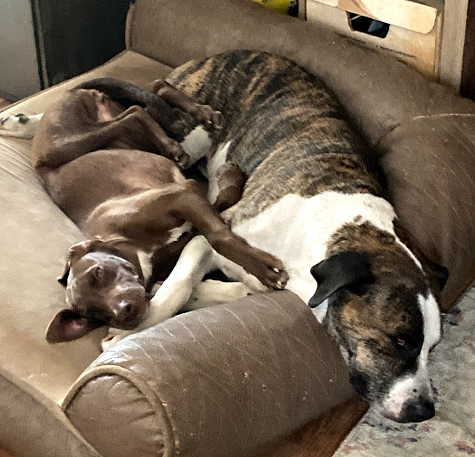
They sleep like this daily.

I got an unofficial consult from a friend who is also a NVADG volunteer (except she’s a BEAST on the animal evacuation team, who goes into the fire zone rescuing animals) and an equine massage therapist when our county is not on fire. Tamara came to my house and met Coco, watching her hop and run and play with Woody. She also massaged and stretched the little dog, and she agrees: Coco’s condition is weird, but there’s hope. We both think Coco needs more swimming time, and time on an underwater treadmill. Acupuncture? Massage? Stretching? Physical therapy? We think she needs all of it.

So, sorry, Otto, we’ve got one more project puppy we need to help. Though, frankly, if I can find an underwater treadmill and a PT specialist to help me with Coco, I will sign up Otto for therapy, too! At 13 years old, he would benefit from this sort of care just as much as I think Coco will.

Wish us luck! And I’ll keep you posted.

Keeping Your Dogs At a Healthy Weight Can Be Tricky

28
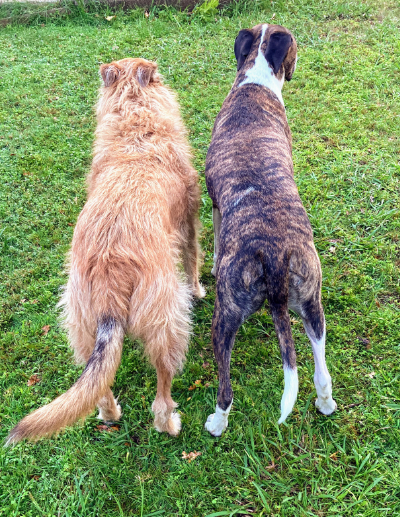
Now 13 years old, Otto’s body looks thicker than it did when he was younger, but he’s lost muscle mass, especially in his hind legs and shoulders. His fuzzy coat makes him look stocky, but his ribs and spine are actually more prominent than in years past.

Over the past two years, my senior dog, Otto, has started having trouble maintaining his body mass at a healthy weight. He has had a few health issues that his veterinarians and I are monitoring, but one symptom of his issues has caused him to suffer from a bit of gastric reflux. We have been able to keep his stomach acid in check with a daily medication, but there was a period of months when he just didn’t feel like eating. During that time, I had to tempt his appetite with all sorts of foods, split into many small meals a day, to get him to eat at all. At his lowest, his weight, normally about 70 pounds, dipped all the way down to 63 pounds.  He felt ribby and definitely lost muscle mass.

Eventually, the tide turned and Otto started eating again, although it was a challenge to get him back up to his “college” weight of 70 pounds. I can’t give him huge meals – he won’t eat a ton in one sitting – so I often give him three meals a day. He also gets canned food mixed into his dry food at each meal, and eats more than a can a day.  I also mix some warm water into his food and stir the canned food in, so he doesn’t pick out the canned food and leave any kibble behind.

One unfortunate side effect of the campaign to get Otto to gain and hold his weight: My younger dog Woody has gained too much weight! Because when he sees the canned food come out, he (quite understandably) wants some, too. I don’t have to, of course, but I stir about a teaspoonful of the canned food into Woody’s kibble, and add warm water to it, so he feels like he’s getting special treatment, too. So, of course, I’ve had to cut back the amount of kibble he gets, just a little bit, to make up for the addition of the fattier canned food.


At age 5, Woody is in the prime of his life. He is carrying a few more pounds than I would like, even though it is hard to see given his deep chest and narrow waist. But his ribs are more padded than what is ideal. He is such an active dog that carrying extra weight stresses his joints more than is good for him.

It’s nuts: Both dogs used to weigh the same amount. To get and keep Otto at 70 pounds,  I’ve added nearly an entire can of food to what he gets each day, and have had to reduce Woody’s portion of dry food to make up for the addition of only a teaspoon of canned food, and yet Woody is up to about 73 or 74 pounds.


It’s hard to get two dogs to stand with their backs to you while you hover over them, but I did my best. As you can see, both dogs look okay – but Otto’s waist is a bit more pronounced, and Woody’s is less defined than ever before.

I know it’s silly to feel as though Woody would judge me for failing to add anything “nice” to his kibble at each meal, and yet, I absolutely see him watching me carefully when I prepare both dogs’ meals. I actually fork the wet food from the cans into the dogs’ bowls with my back blocking his view, so he can’t see how much of the delicious pâté goes  into each bowl, and I deliver the food to them separately. Otto eats outside, with his bowl on a stair that’s one step higher than the deck; Woody eats in the house.

Another wrinkle: Since Coronavirus has changed the world, we definitely have been going out less. The lack of walks has likely contributed both to Otto’s loss of muscle mass and Woody’s weight gain.

Also, I give Otto a pill each day hidden in a piece of cheese. Woody, too, lines up and sits politely, looking for his cheese.  Those extra calories, too, aren’t helping me maintain his figure!

Have you had this problem before? Trying to keep one dog thin and helping another dog gain weight? Do you have any tips for us?

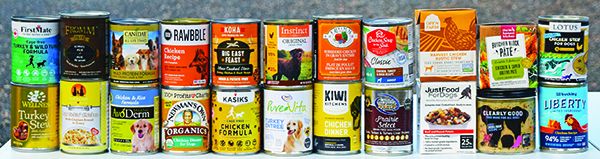
Whole Dog Journal’s 2020 Approved Wet Dog Foods

    12
    There are so many food choices available to dog owners today; it's easy to get overwhelmed. But whatever you do, don't just feed the same thing month in and month out; rotating foods from different manufacturers helps provide your dog with nutritional balance over time. It also reduces the potential danger of any pet food company's formulation error or production problem.

    Were you aware that dogs don’t have a biological requirement for carbohydrates? The fact that this bit of trivia sounds so crazy is a testament to how thoroughly we all take carbohydrate-laden kibble for granted. But it’s true: Dogs require protein and fat, but they can live and thrive quite well without any carbs at all. 

    Perhaps you’ve seen canned foods with labels indicating that meat makes up 93% or 95% (or sometimes even 96%!) of the product. This is possible because nearly all of a dog’s nutritional requirements can be met in a diet mainly comprised of meat; add some vitamins and minerals, and he’s all set! 

    But dogs can eat and benefit from carbohydrates – and the foods that provide carbs are much less costly than the foods that provide just protein and fat, so pet food makers can provide adequate nutrition to dogs for a lower price by using a certain amount of carbohydrate-based ingredients in their food. Generally, the more carbs there are in the can, the less the food will cost.

    Cost isn’t the only reason to add a non-meat ingredient to a diet for dogs, however. Some ingredients provide non-nutritive functions that benefit the dog. For example, some fruits, vegetables, grains, and legumes provide fiber that can modify or improve the dog’s intestinal microflora, so he can better digest his food. Some foods can reduce inflammation or provide antioxidant action. Certain herbs and spices have been shown to improve mobility or cognition. 

    All of the “complete and balanced” foods you can buy for your dog will meet his requirements – whether his requirements are just for the basic maintenance of life or the higher nutritional needs of a growing puppy. But, as you’ll see, each pet food maker will approach the task of meeting those needs in any number of ways, with any number of ingredients. 

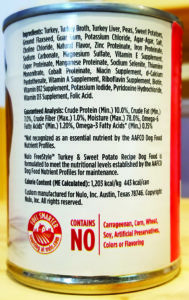
    Test Your Label Reading Skills!

    What’s important on the label – and what’s inconsequential? 

    Pay attention to:

    • Name of pet food company

    • What dogs the food is formulated for (note that this is not the complete, legal nutritional adequacy statement, but it is nice to have the information up front)  

    Disregard entirely:

    • Pretty pictures of fresh vegetables

    • Ingredients called out on the front of the can (they are just there to tempt your own appetite; the position on the legal ingredient list may be very different) 

    Pay attention to:

    • Ingredient list, at least to the 10th or so ingredient. Once you reach the salt on a label, the amounts of the ingredients are vanishingly small
    (so don’t get too excited about foods, herbs, or nutraceuticals that appear low on the ingredient list)

    • Guaranteed analysis: There are consequences for pet food makers if the product does not deliver these the  amounts of any nutrients that are present here. The minimum amount of protein and fat, and maximum amount of fiber and moisture must appear here. Anything else included here is optional. 

    • Calorie content. Helpful if you are not as familiar with the fat and protein content.

    • Location information for the manufacturer must appear on the label. A phone number is not required by law but c’mon! One should be present.

    Disregard entirely:

    • Verbiage about what the food does NOT contain.  

    YOU CAN DO THIS

    Your task is to find foods that “perform well” in your dog – that improve or maintain his digestion (helping build a nice stool, not too hard and not too soft, and reducing or eliminating excessive gas); maintain or improve his health, appetite, and energy; and, if he’s a puppy, provide for an appropriate rate of growth (not too fast, not too slow). 

    How the heck are you supposed to find the foods that perform like this in your dog? Well, like everything: It takes a little bit of economics (buy what’s in your budget), a little bit of science (keep track of what you are feeding and observe and record the results) – and more than a little luck. 

    Does this sound daunting? C’mon, you can do this. You’re already doing it – you’re currently feeding your dog something, right? 

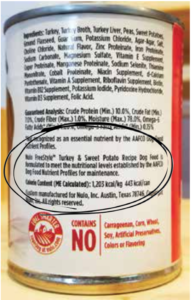
    The nutritional adequacy statement is also known as the “AAFCO Statement” AAFCO (The Association of American Feed Control Officials) is the nongovernmental group that develops and changes the model regulations for pet food that are adopted by the states. This statement tells the consumer which set of nutritional standards the product has been formulated to meet.

    1. Check the “nutritional adequacy statement.” Some foods are not complete and balanced! If they are not, they must indicate that they are “for intermittent or supplemental use only.” These products are fine for short-term use, but they will not provide everything your dog needs over time.

    Growing puppies have higher requirements for a number of nutrients than adult dogs. Complete and balanced dog foods must state whether they have been formulated to meet the nutritional standards for “growth” (puppies) or “adult maintenance.” If the label says the food is for “all life stages,” it has met the “growth” standards. 

    If you are feeding a dog who is still growing, you must check to see if the nutritional adequacy statement indicates the food is meant for dogs who are expected to mature to more than 70 pounds or less. For more information about these statements and feeding puppies, see “Puppy Needs New Food,” WDJ September 2020.

    2  Note the amount of protein and fat in the food. You should have an idea of how much protein and fat you are already feeding your dog and whether that’s too much (is he overweight?), too little (is he underweight?), or about right. Look for products with protein and fat levels that are appropriate for your dog. 

    Be aware that these values range very widely in pet food; one can of food might contain three times as much protein or fat as another. Check the “guaranteed analysis” on the label of the food you have at home, and check it on any food you are considering. 

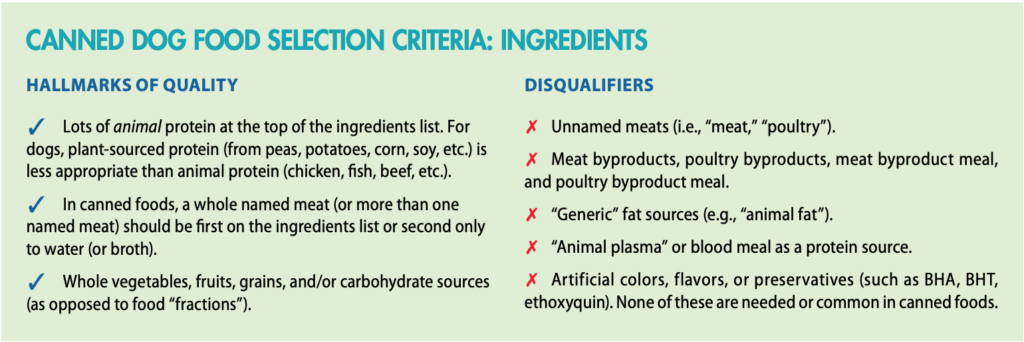
    3. Now look at the ingredient list for hallmarks of quality. Look for things you can readily identify as food – real food. Chicken is chicken, but do you know what poultry by-product meal is? No? Then don’t buy it for your dog. (This sounds simplistic, but it’s a good guide when it comes to sorting out the higher-quality ingredients from the highly processed and not scrupulously managed waste products from the human food industry.)

    For more guidance on what ingredients are acceptable and appropriate, see “Dog Food Selection Criteria: Ingredients” below.

    4. Look at the ingredient list for what suits your dog – and what disagrees with him. If your dog is allergic to beef, don’t trust that a food manufacturer hasn’t changed its formula and added beef to that stew; check the ingredients every time you buy a food. 

    If you have observed that grains exacerbate your dog’s gas production, look for grain-free – or perhaps even carbohydrate-free foods. (Many grain-free foods are chock-full of alternative carbohydrate sources, such as peas, lentils, chickpeas, and other legumes; pumpkin; sweet potatoes, potatoes, and various byproducts of these ingredients (i.e., pea flour, pumpkin powder, etc.).

    5. Any time your dog displays a change in his health, energy, appetite, or elimination habits, write it down somewhere. Note what you were feeding him. Keep track of when you change foods. Look for patterns in his response to various ingredients, protein or fat levels, or even different manufacturers’ products. Change accordingly!

    COVID-19 Being Unfairly Blamed for Poor Customer Service

    Reaching the pet food manufacturers with questions or concerns
    right now is difficult – and that’s ridiculous. 

    Time to update the technology!

    We’ve long advised readers to reach out to the makers of their dogs’ food if they have questions or concerns about the products – and to decline to buy food from companies who are not attentive to consumers or who can’t seem to provide basic information about the company’s products, such as a complete nutritional profile for any of its foods.

    That advice stands today, even with the pandemic going on. Many people are working from home today; there is a wealth of technology available that should enable any customer service team to continue to communicate with consumers. But in the course of compiling information about the products featured on our “Approved Canned Foods” list, we had to call quite a few companies for information – and we heard an unprecedented number of recordings that stated no one was available to take our calls. 

    We understand that having someone available to provide knowledgeable support to consumers can be costly and difficult at times. But given the fact that our dogs’ lives depend on these foods, it seems like the least a pet food company can do is to equip some employee or the owner of the company with a cell phone so they can respond to consumer inquiries.

    If you can’t reach anyone at a pet food company to ask a question about their products, our advice would be to avoid buying that company’s food. Period. 

    Mind Your Peas and Legumes

    No correlation between DCM and these ingredients has been proven.
    We’d advise limiting how much you feed to your dog anyway. 

    In recent years, there have been a plethora of headlines about a possible connection between certain canine diets and a potentially fatal health condition called dilated cardiomyopathy (DCM). Early reports blamed grain-free diets for causing DCM in dogs of breeds that were not usually predisposed to the disease. As more data were collected, the blame started to shift toward foods with a preponderance of peas, lentils, and other legumes. 

    In the past decade, these ingredients have become increasingly common in all dog foods, but especially so in grain-free foods, where they are used as both a carbohydrate substitute for grain and as a low-cost source of additional protein for the diet.

    In reports that were part warning to pet owners, part fishing for news of previously unknown cases, the U.S. Food and Drug Administration (FDA) has published a series of announcements on the topic. 

    We published our own analysis of the FDA reports in “Diet, Dogs, and DCM,” in the November 2019 issue. We agree that there is reason to be concerned about feeding dogs diets that contain significant amounts of peas and/or lentils. As the article stated, “The FDA reported that 93% of all products involved in the reports they were investigating contained peas and/or lentils. Our analysis confirmed that 89% of the reported foods appeared to contain significant amounts of these ingredients (generally appearing before the first fat or in multiple combinations, sometimes with other legumes).”

    Peas are a relatively new ingredient whose popularity has exploded in the last 10 years. The fact that so many foods today contain significant amounts of peas (and other legumes) and the increase in the number of dogs that are reportedly developing DCM (especially those in categories not typically associated with this disease) seems significant. Remember, however, that correlation does not equal causation; again, we are speculating, as
    no one knows the cause at this time.

    We recommend avoiding diets with legumes listed high in the ingredient list (before the first fat or oil) or that include several legumes, even if they appear lower in the ingredient list. Alternatively, it’s advisable to feed such diets on a short-term basis only, or as one of a number of legume-free foods in a rotation. In the table of “Approved Canned Foods”, we’ve noted which manufacturers offer products that have peas and other legumes appearing in moderate concentrations. 

    For more information about canine DCM and possible links to diet, please see the November 2019 issue. 

    APPROVED FOODS

    Below, you’ll find a list of pet food companies that make the kind of foods that meet our selection criteria. You should notice that even among these better- and best-quality products, there is quite a wide price range. All of the products made by these companies are better than most of the products on the market. But some companies take food production to an art form, with certified humanely raised meats, organic ingredients, functional ingredients such as glucosamine, prebiotics, and probiotics, etc. Some of these products – more all the time! – are actually made in human food manufacturing facilities, which means they contain only human-edible ingredients. Wow!

    But what’s most important is that you find products at the price point that you can afford and that suit your dog. So, to that end, we’ve included the price range of each manufacturer’s offerings, expressed by “price per ounce” (since can/carton/tub sizes are all different). 

    Using the steps described above, choose some foods that are new to you and your dog and give them a try! If your local pet supply store doesn’t carry them, try online. If the products really work for your dog, ask your local store manager if she can carry them for you. 

    And don’t forget: One-size-fits-all recommendations don’t work when it comes to diet. You have to feed the individual what works for him. It’s wonderful when you have more than one dog and they can both digest and thrive on the same variety of food, but we wouldn’t take it for granted that any two dogs can. 

    Whole Dog Journal’s Approved Canned Dog Foods for 2020

    Products appear alphabetically by best-known name. In some cases this is the name of the company that makes the food; in others, it’s the name of the food line.
    PRODUCT NAME/COMPANY INFORMATION# OF VARIETIESRANGE OF PROTEIN (as fed)
    RANGE OF FAT (as fed)
    PRICE PER OUNCENOTES
    ARTEMIS OSOPURE
    La Habra, CA
    (800) 282-5876
    artemiscompany.com
    58%
    4% - 6%
    $0.28 - $0.34All five varieties grain-free, and formulated for dogs in all life stages. Pea protein used in all varieties, @ 7th-8th on ingredients list.
    AVODERM
    (Breeder’s Choice, a division of Central Garden & Pet)
    Walnut Creek, CA
    (866) 500-6286
    avodermnatural.com
    135% - 9%
    3% - 8.5%
    $0.19 - $0.27About half of the offerings are grain-free. All but two (weight control, vegetarian) are for all life stages. Peas appear @ 4th-8th on ingredients list.
    AZMIRA
    Tucson, AZ
    (520) 886-8548
    azmira.com
    210%
    5%
    0.19Both products formulated for dogs of all life stages. Lamb formula contains peas (7th on ingredients list). Whole brown rice used as carb source/thickener: Nice.
    BIXBI RAWBBLE
    Boulder, CO
    (303) 666-1070
    bixbipet.com
    48.5% - 9%
    8.5%
    $0.28 - $0.34All Rawbble canned foods are formulated for all life stages, and contain no grain, potato, tapioca, meals, or gums. (Pumpkin used as a carb/thickener, 4th-5th.)
    BLACKWOOD
    Lisbon, OH
    (888) 843-1738
    blackwoodpetfood.com
    49.5%
    8.5% - 9%
    $0.23 - $0.27All varieties are formulated for all life stages and are grain-free. Each contains pumpkin (@ 4th), peas (@ 5th-6th), and green-lipped mussels (@13th).
    BUCKLEY LIBERTY
    Boulder, CO
    (720) 726-3193
    buckleypet.com
    38.5% - 9%
    7.5% - 8.5%
    0.26Each variety is formulated for all life stages and is free of grain, corn, and soy. Each contains a single animal protein source but also peas (@ 3rd!). Sweet potato is used as carb/thickener (@5th-9th).
    CLOUDSTAR WELLMADE
    St. Louis, MO
    (800) 361-9079
    cloudstar.com
    57%
    3% - 4%
    0.24Each variety is formulated for all life stages and is free of grain, corn, soy, and potato. Pea protein appears in each (@4th). Sweet potato, pumpkin, tapioca starch, and/or chickpeas used as carb/thickeners (@ 5th-7th). Company says “made in a human grade facility.”
    CORE (See WELLNESS)
    DAVE’S PET FOOD
    Agawam, MA
    (888) 763-2738
    davespetfood.com
    297% - 10%
    4% - 9%
    $0.14 - $0.20Dave’s offers five lines: 95% meats, grain-free, “naturally healthy” (with rice), “restricted diet” (each addresses a medical issue and most are not complete & balanced), and “stewlicious.” Not thrilled with company’s incomplete AAFCO “nutritional adequacy” statements on website.
    EAGLE PACK
    (Wellpet) Tewksbury, MA
    (800) 225-0904
    eaglepack.com
    49%
    6%
    $0.17 - $0.18All varieties are formulated for dogs of all life stages. Each food contains brown rice (@ 4th) and some also contain barley (@ 5th). No peas or other legumes.
    FIRSTMATE, KASIKS
    North Vancouver, Canada
    (800) 658-1166
    firstmate.com
    148% - 12%
    3% - 8%
    $0.27 - $0.40Made in Canada. Company says chicken and turkey used in all varieties are cage-free, salmon and tuna are wild-caught. Many varieties are grain-free and extremely low-carb. Many varieties use a single animal protein source. All varieties are formulated for dogs of all life stages. Firstmate owns and operates its own cannery.
    FROMM
    Mequon, WI
    (800) 325-6331
    frommfamily.com
    327% - 10%
    2% - 8.5%
    $0.20 - $0.39Fromm offers three lines: Shredded meats, vegetables, and legumes in gravy; pâtés contain meat, legumes, potatoes, and vegetables; “Frommbalya” stews contain potatoes, rice, and peas. All varieties are formulated for dogs of all life stages. Fromm owns and operates its own cannery.
    GO!
    (Petcurean) Chilliwack, British Columbia
    (866) 864-6112
    petcurean.com
    147.5% - 10%
    2.5% - 8%
    $0.30 - $0.32All varieties are formulated for dogs of all life stages. Some varieties are packaged in Tetra Pak cartons. Some varieties contain grain and other carbs, others are grain-free. Always read the ingredients list: A few varieties include porcine plasma (we’re not fans of this ingredient).
    HALO
    Tampa, FL
    (800) 426-4256
    halopets.com
    95.75% - 11%
    3.5% - 9%
    $0.32 - $0.44All varieties formulated for adult maintenance except one: the “Puppy” variety. Peas, pea flour, and/or pea fiber appear in many varieties. Three varieties are grain-free.
    HEALTH EXTENSION
    Melville, NY
    (800) 992-9738
    healthextension.com
    157% - 9.5%
    2% - 9%
    $0.20-$0.21All varieties formulated for adult maintenance only. Most varieties are grain-free; three are 95% meat. Company offers a few novel protein varieties (quail, rabbit, venison).
    HOLISTIC SELECT
    (Wellpet) Tewksbury, MA
    (800) 225-0904
    holisticselect.com
    611% - 12%
    6% - 7%
    $0.25 - $0.28All varieties are formulated for all life stages, all are grain-free pâtés. Ground dried peas appear (@ 4th-6th) in each formula, as does potato protein (@ 5th-8th).
    HOUND & GATOS
    (Gott Pet Products) St. Francis, WI
    (888) 896-2951
    houndgatos.com
    1110% - 13%
    3.5% - 10%
    $0.29 - $0.60All varieties are grain-free, 98% meat. Are products formulated for all life stages or adult maintenance? Website doesn’t say; label suggests ALS but isn’t explicit. In our opinion, this is irresponsible.
    INSTINCT
    (Nature’s Variety) St. Louis, MO
    (888) 519-7387
    instinctpetfood.com
    138.5% - 11.5%
    3% - 8.5%
    $0.23 - $0.60All except the three “limited ingredient” varieties are formulated for all life stages. No grain, potatoes, corn, wheat, or soy. Peas appear @6th-9th on ingredients of most varieties, higher (@4th-5th) in limited-ingredient varieties.
    JUST FOOD FOR DOGS
    Irvine, CA
    (866) 726-9509
    justfoodfordogs.com
    46% - 10%
    4% - 7%
    $0.40 - $0.48Foods packaged in Tetra Paks; company says foods are made in a USDA kitchen with 100% human-grade ingredients. All varieties except Chicken & Rice are formulated for adult maintenance only. One (Beef & Potato) contains peas.
    KASIKS (See FIRSTMATE)
    KIWI KITCHENS
    Christchurch, New Zealand
    (64) 21 706621
    kiwikitchens.nz
    117% - 10.7%
    1% - 7.5%
    $0.30 - $0.42All varieties formulated for dogs of all life stages. All contain 93% meat from a single animal protein source. Two varieties are made with green tripe (lamb tripe, venison tripe). Made in New Zealand.
    KOHA
    Delray Beach, FL
    (800) 478-7713
    kohapet.com
    208% - 12%
    2% - 11%
    $0.24 - $0.54Koha offers two lines: limited or minimal ingredients, and “homestyle stews.” All “limited ingredient” varieties save one (Venison) are formulated for adult maintenance only. Each contains 90% meat from a single animal protein source. All but one of the stews (Beef & Salmon) are formulated for all life stages. Koha is made in three locations (U.S., Canada, Thailand).
    LOTUS
    Torrance, CA
    (888) 995-6887
    lotuspetfoods.com
    168% - 14%
    4% - 10%
    $0.29 - $0.48All varieties are grain-free and formulated for all life stages. There are three types: loafs, stews, and “just juicy” (95% meat) varieties. Loaf varieties use pea flour (@3rd-5th) and sweet potatoes as carb source. Stews contain no peas or other legumes. Lotus owns and operates its own cannery.
    MERRICK
    (Nestlé Purina) Amarillo, TX
    806-364-0002
    merrickpetcare.com
    577% - 10%
    2% - 7%
    $0.23 - $0.51Fifty-seven varieties? Oy. Some are sold only seasonally. All are grain-free. Some are for adult maintenance, some are for all life stages; some contain peas; some are legume-free; some are 96% meat or limited ingredient varieties. Always read the ingredients list!
    NATURAL BALANCE
    (J.M. Smucker) Burbank, CA
    (800) 829-4493
    naturalbalanceinc.com
    185% - 9.5%
    3% - 8%
    $0.19 - $0.23Only about half of these are formulated for all life stages; check the label. Most do not contain legumes, instead using rice, potatoes, and/or sweet potatoes as carbs; some also contain meat and meat meal (unusual for canned foods).
    NEWMAN’S OWN
    Westport, CT
    (203) 222-0136
    newmansown.com
    88% - 10%
    5% - 12.5%
    $0.19 - $0.24Half of the company’s offerings are 95% organic; the rest are made with a preponderance of organic ingredients: Nice! All are formulated for adult maintenance only.
    NULO
    Austin, TX
    (512) 476-6856
    nulo.com
    307% - 10.5%
    3% - 12%
    $0.21 - $0.39Most of these foods are formulated for adult maintenance only; all are grain-free. Company says the varieties packed in cartons (Tetra Paks) are made in a human food facility (all “human grade” ingredients). Products in conventional cans all contain legumes and/or sweet potatoes.
    NUTRISOURCE, PUREVITA
    (KLN Family Brands) Perham, MN
    (800) 525-9155
    nutrisourcepetfoods.com
    208% -12%
    4.5% - 9%
    $0.14 - $0.24All varieties are formulated for all life stages. About half of the Nutrisource varieties are grain-free and contain legumes (the grain-inclusive ones use rice or barley). PureVita formulas are all grain-free and 96% meat.
    OPEN FARM
    Toronto, Ontario
    (833) 399-3403
    openfarmpet.com
    48%
    5% - 6%
    0.64Company says all meat sources used are certified humane and 100% of the ingredients are “human grade.” Products packaged in Tetra Paks. All varieties except one (Harvest Chicken Rustic Stew) are formulated for all life stages.
    PARTY ANIMAL
    West Hollywood, CA
    (855) 727-8926
    partyanimalpetfood.com
    89% - 11%
    5% - 12%
    $0.29 - $0.31All varieties are grain-free, limited-ingredient, and formulated for adult maintenance only. Cocolicious line uses one animal protein source and coconut.
    PETGUARD
    Sewickley, PA
    (929)-515-1436
    petguard.com
    87.5% - 9.5%
    4.5% - 8%
    $0.24 - $0.30All varieties but two (Turkey/Sweet Potato, Chicken/Brown Rice) are formulated for adult maintenance only. Two varieties (Chicken/Vegetable and Vegan) are organic.
    PET-TAO
    Franklin, TN
    (615) 934-3832
    pettao.com
    28%
    6%
    0.32PetTao’s foods are formulated for all life stages, according to the principles of Traditional Chinese Veterinary Medicine’s food therapy.
    PUREVITA (See NUTRISOURCE)
    RAWZ
    York, ME
    (844) 480-8672
    rawznaturalpetfood.com
    149% - 11%
    1% - 9%
    $0.27 - $0.3796% meat formulas are formulated for all life stages; shredded meat and “hunks” varieties are for adult maintenance only. None of the products contain grain or gums, using tapioca starch and pumpkin for a carb source/thickener.
    REDBARN
    Long Beach, CA
    (800) 775-3849
    redbarn.com
    138% - 15%
    4% - 9%
    $0.20 - $0.25All varieties are grain-free and formulated for all life stages. Most of the pâté varieties contain peas (@ 4th-5th). All but one of the stew varieties (Beef) contain peas (@4th-9th).
    SIMPLE (See WELLNESS)
    SOLID GOLD
    Chesterfield, MO
    (800) 364-4863
    solidgoldpet.com
    147.5% - 9.5%
    3% - 8.5%
    $0.20 - $0.69Five of the 14 varieties are formulated for adult maintenance only (Fit & Fabulous, Green Cow, Leaping Waters, Sunday Sunrise, Hund-N-Flocken). Twelve varieties are grain-free. Mighty Mini varieties are packed in tubs, not cans.
    STELLA & CHEWY'S
    Oak Creek, WI
    (888) 477-8977
    stellaandchewys.com
    69% -10%
    2% - 3%
    0.36All six varieties are formulated for adult maintenance only. Beef, chicken, lamb, turkey varieties use a single animal protein source; two “medley” varieties mix animal protein sources. Packaged in Tetra Pak cartons. All are free of grains, legumes, and gums – and company says the products are 100% human-grade. Sold only in independent “neighborhood pet supply stores,” not online or in chain pet supply stores.
    TASTE OF THE WILD
    (Diamond Pet Products) Meta, MO
    (800) 342-4808
    tasteofthewildpetfood.com
    57.5% - 9%
    3.5% - 4.5%
    0.17All varieties are formulated for all life stages. Each contains peas (@7th-9th), potatoes, and/or potato starch. Creative “ingredient splitting” with the water sources in the ingredients lists (to avoid having water appear first): For example, in the Southwest Canyon variety, ingredients are “beef, beef broth, lamb broth, vegetable broth, beef liver...” Aw, c’mon!
    THE HONEST KITCHEN
    San Diego, CA
    (866) 437-9729
    thehonestkitchen.com
    68% - 12.5%
    2% - 8%
    0.33All varieties are grain-free and formulated for all life stages. Peas appear in just one variety (Salmon/Chicken Stew). Products are packaged in Tetra Pak cartons. Company says products are 100% human edible and made in a human food facility. Company includes a full nutrient analysis of each product on its website; we’re in love.
    TIKI DOG
    Chesterfield, MO
    (866) 821-8562
    tikipets.com
    277% - 17.1%
    2% - 12%
    $0.24 - $0.66Some TikiDog foods are formulated for all life stages; others are for adult maintenance. Some are packaged in large cans, some in small cans, some in plastic tubs. Some are manufactured in Thailand, some in the U.S. Read the labels!
    ULTRA
    (Nutro, a div. of Mars) Franklin, TN
    (800) 833-5330
    nutro.com
    148% - 9%
    3% - 7%
    $0.51 - $0.57We prefer the Ultra line over the rest of the Nutro foods. All of these foods are formulated for adult maintenance only and seem to be offered only in small tubs now. Porcine plasma shows up in a few varieties; read the ingredient list!
    VERUS
    Abingdon, MD
    (888) 828-3787
    veruspetfoods.com
    127% - 8%
    4% - 5%
    $0.30 - $0.40All varieties are formulated for all life stages; all are free of carrageenan. Five varieties are grain-free, seven contain grain. About half contain peas (@5th - 7th).
    WALK ABOUT
    New Holland, PA
    717-519-7622
    walkaboutpetproducts.com
    57.5% - 8%
    2%
    $0.15 - $0.33All varieties are grain-free, contain peas (@5th), are formulated for adult maintenance, and contain a single novel animal protein source (boar, duck, kangaroo, rabbit, quail), and contain peas (@5th). We advise saving these for dogs with proven allergies to common proteins.
    WELLNESS COMPLETE HEALTH, CORE, SIMPLE
    (Wellpet) Tewksbury, MA
    (800) 225-0904
    wellnesspetfood.com
    466% - 12%
    2% - 9%
    $0.19 - $0.56We like this company, but as with Merrick’s foods, we don’t get the need for so many varieties: pâtés, stews, cans, plastic tubs, limited ingredient, grain, grain-free, 95% meat: You name it, they make it. About half are formulated for adult maintenance only, so check the label. Note that “growth and maintenance” is the same thing as all life stages.
    WELLMADE (See CLOUDSTAR)
    WERUVA
    Natick, MA
    (800) 776-5262
    weruva.com
    206% - 10%
    1.2% - 6%
    $0.29 - $0.35All products are formulated for adult maintenance and free of grain and carrageenan. Peas, potato starch, pumpkin, and sweet potato are used in various combinations as carb sources/thickeners. Products are manufactured in Thailand in a human food facility.
    WET NOSES
    Monroe, WA
    (866) 938-6673
    wet-noses.com
    810% - 14%
    4.5% - 7%
    1Gorgeous, crazy expensive food packed in glass jars. Website fails to state this, but all foods are formulated for adult maintenance. No legumes included; some varieties contain rice or barley, others are just meat and veggies.
    WHOLE EARTH FARMS
    (Merrick) Amarillo, TX
    (800) 323-3353
    feedgoodness.com
    158% - 10%
    3% - 6.5%
    $0.20 - $0.40All foods are formulated for dogs in all life stages. All varieties are grain-free, start their ingredient lists with a whole, named meat, and all contain peas (@4th - 6th).
    ZIGNATURE
    (Pets Global) Valencia, CA
    (888) 897-7207
    zignature.com
    138% - 11.5%
    4% - 7%
    $0.25 - $0.32All foods are formulated for all life stages; all but one contain a single animal protein source (the outlier is Zssential, which uses several animal proteins). None contain grain; all contain legumes including peas (@3rd - 7th) and chickpeas. Many varieties use novel protein sources (catfish, duck, goat, guinea fowl, kangaroo); we advise saving these for dogs with proven allergies to common proteins.

    Download The Full October 2020 Issue PDF

    18
    • Rotary Club
    • Learning to Love It
    • Family Planning
    • Are Two Pups Better Than One?
    • A Can/Do Attitude
    • 2020 Approved Canned Foods
    To continue reading this article or issue you must be a paid member.

    Join Whole Dog Journal

    Get full access to Whole-Dog-Journal.com – more than 4,000 articles – for just $20.
    Join today and save 30% off our full price.
    Already a member?
    | Forgot your password? | Activate Web Access