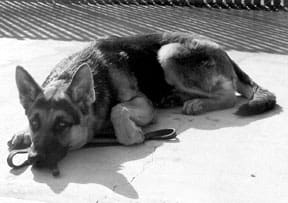
In the relationship between cancer and nutrition, there are few conclusive answers. The modalities of both are complex, and neither is completely understood.
However, enhanced nutrition is of unquestionable benefit to any dog with cancer, and to any dog with an increased risk of developing cancer. And of the many known factors leading to canine cancer, proper nutrition is the one which dog owners can best control, enhancing a dog’s overall health, and improving the body’s natural defense against cancer. Plus, when cancer strikes, there are sensible nutritional guidelines (based on the best available evidence) that seem to help many dogs, improving the response to both radiation and chemotherapy, lessening the side-effects, and giving dogs the strength to extend their lives.
Caution Needed
Those positive words must be followed with some cautions. Cancer diets often emphasize or restrict certain nutrients, in order to promote certain biochemical actions or to thwart others. But nutrition is a whole-body dynamic. A diet can be effective, ineffective, or, worst of all, actually harmful for a dog based on the type and progression of cancer, the dog’s overall health, and almost certainly, nutritional variables which have not yet even been identified.
In short, anyone contemplating a nutritional response to cancer – in particular, an all-or-nothing response, in lieu of conventional treatment – needs professional advice of the highest order available.
So, while we will discuss the best-understood and most promising advances in the science and art of treating or preventing cancer through nutrition, we must stress that the following information should not be regarded as a prescription for any individual dog. Rather, we intend for people who have dogs with cancer, or dogs which are genetically predisposed to cancer, to use this article as the basis for a detailed and individualized conversation with their veterinarians, who will have to conduct lab tests to help tailor a diet to any individual’s needs.
We’ll warn you now: It might be difficult to find qualified veterinarians who offer hands-on nutritional consultations. Lacking immediate access to such experts, and facing a beloved dog suffering from cancer, dog owners are often tempted to embark on a crash course in canine nutrition, and start supplementing their dogs with anything they’ve heard good things about; this can be more dangerous to the dog’s health than cancer. Nutritional intervention can help cancer-stricken dogs, but we can never know the complete clinical picture without the help of a veterinarian and access to chemistry profiles.
To be blunt: In the hands of an expert, nutrition can save your dog’s life. In the hands of an amateur, nutrition could end it.
Of course, we’re being deliberately cautious. To be truthful, if you altered a dog’s diet strictly through the use or restriction of commonly used foods, never supplementing the diet with any oils, powders, vitamins, minerals, herbs, or other additives, you probably couldn’t do any harm. But experienced veterinary experts all have a tale or two to relate regarding someone who supplemented their dog’s diet with several things they had heard good things about, never realizing that the dog’s basic diet already contained sufficient amounts of the same nutritional components, and ended up giving their dog a toxic overdose of those nutrients.
Theories Behind Nutritional Treatments for Cancer
Food consists of macro-nutrients (protein, carbohydrates and fat) and micro-nutrients (vitamins and trace minerals). A dog’s immune status, at any given time, reflects the overall quality of those nutrients; the two ebb and flow in a complex biochemical partnership. While the specific parameters of that partnership are not yet completely understood, in general, when their relationship is optimum, they work effectively to support a healthy immune system. A properly functioning immune system, in turn, is what stops cancer even as it starts.
Poor nutrition, on the other hand, can lead to compromised immunity, in turn resulting in a diminished physical state in which a cancer can take hold, overwhelming a dog’s natural defenses.
It should be noted at the outset that the recommended cancer-fighting diets differ significantly from diets formulated to prevent cancer. While the components of the two diets are largely the same, the proportions change as a result of the way that cancer acquires the energy to survive.
Cancer-fighting diets take advantage of the fact that cancer cells thrive on simple carbohydrates like sugars, starches and grains, and cannot easily utilize fats. The premise of current theory, then, restricts carbohydrates – depriving the cancer cells of easy sources of energy and slowing their growth – while supplementing the fats found in meat with unique molecular structures known as omega-3 fatty acids, which support the dog’s overall energy needs. This is crucial inasmuch as cancer hijacks much of the energy provided by carbohydrates and proteins. Because cancer diverts energy from metabolized protein and carbohydrates, the cancer-stricken dog must subsist to an abnormal degree on stored fat or fat introduced into the diet.
Feed the Dog, Starve the Cancer
Cancer thrives on simple carbohydrates, particularly in the form of glucose, to the extent that metabolized dietary carbohydrates can represent a net energy loss to the dog – the cancer, not the dog, derives the greatest share of nutritional benefit from carbohydrates.
Similarly, the way that cancerous dogs metabolize protein causes amino acid imbalances which benefit cancer more than the canine host. The resulting progressive loss of strength and energy can be a critical factor in survival. Protein, at the most visible level, supports muscle mass, and its depletion saps crucial strength.
While carbohydrates can safely be limited in the short term (the cancer-arresting time frame) protein cannot be restricted for any amount of time, but should be provided in the highest available quality. Research suggests that early correction of cancer-caused amino acid imbalances (in particular arginine and glutamine) leaves dogs better able to survive.
Cancer and Wasting
Weight loss is a serious complication in the majority of canine malignancies. Energy acquisitive by nature, cancer alters many of the processes of a dog’s metabolism, resulting in what is called cachexia, a wasting syndrome occurring in spite of what would otherwise be a nutritionally adequate diet. Cachexia plays a critical role in dog’s ability to survive, not only in robbing the body of nutrients, but also because a malnourished dog cannot fully process many cancer-fighting medications, hence suffering both a diminished quality of life and diminished life expectancy.
It is now known that cancer significantly alters the dog’s normal metabolism at the outset of cancer growth, long before the disease may be detected through visible symptoms. This is emphasized by Dr. Gregory K. Ogilvie, a leading veterinary oncologist who bases his research and practice at Colorado State University. “Our research shows that these abnormalities exist regardless of the type of cancer a dog has, and whether a tumor is one centimeter in size or twenty centimeters,” he says. “We need to train veterinarians and dog owners that nutritional intervention should begin before cachexia becomes evident. The earlier the intervention, the better the outcome. If you wait until phase 3 (the final stage of cachexia, in which weight and strength begin to plummet) you’re in trouble.”
Other Considerations
In addition to the factors mentioned above, the following should be taken into account when planning a diet for a dog with cancer:
• Macro-nutrient ratio: Protein and fat are the mainstays of the cancer diet. The typical ratio suggested by most veterinary oncologists, is roughly 50 percent fat, 40 percent protein, 10 percent carbohydrates. However, these figures will vary depending on individual circumstances, and are likely to need ongoing adjustment, as a dog responds or fails to respond to the diet, and/or other clinical interventions underway.
• Individualization: Each dog is unique. Digestive and glandular patterns are known to vary. Diets should take into account such variables as size, breed, bone structure, reproductive status, energy level, type of coat, local climate, and current cancer status. What is nutritionally sound for one cancer patient may be inadequate, or even harmful, for another. “Each patient needs to be accessed by a veterinarian,” says Dr. Ogilvie. “There are often other concurrent diseases playing a nutritional role.”
• Monitoring weight: There is likely to be a fine nutritional line between cancer control and overall nutritional needs. While weight loss is almost certain (for obese dogs, controlled weight loss can be beneficial), a steady downward trend means the diet is inadequate and needs adjustment. It is important to realize that, for any given dog, there is a point where weight loss alone can be the immediate critical factor in survival, and extremely difficult to reverse.
• Keeping the Cancer Dog Eating: The most sophisticated cancer diet in the world is worthless if a dog won’t eat it. New diets should be introduced gradually, modulated by the dog’s ongoing reaction to the change. Owners of finicky eaters will already know what works in terms of canine “manipulation” (adding small treats, adjusting the presentation, smell, temperature, etc.), but, fortunately, the presence of fresh meat in the diet is likely to be a convincing factor for most dogs. Dr. Ogilvie suggests feeding fresh, aromatic foods that have been warmed to the dog’s body temperature.
Improved nutrition has long been a mainstay of holistic cancer practice. If your dog has cancer, a fresh-food diet, carefully formulated with the help of an experienced veterinary nutrition expert, is the best option. When providing this diet isn’t possible, using the Hill’s Prescription n/d food appears to be an excellent second choice. Either way, your dog will have a diet which supports him in his battle with cancer, instead of helping the disease progress.
Roger Govier, a freelance writer and a frequent contributor to WDJ, lives in San Francisco.
Training chickens? What an odd idea! Yet all across the country, animal owners and trainers are flocking to workshops put on by a legendary husband-and-wife team, learning how to train chickens . . . so that they may better train their dogs. Here’s my account of one such workshop, held recently in Monterey, California.
In the presence of legends
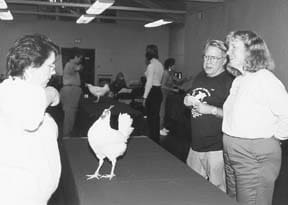
It was 9 a.m., on a cool, cloudy morning in late September. Twenty-two dog trainers, hailing from all over California (and one from Illinois), were perched on the edges of our chairs, waiting with nervous anticipation for the workshop to begin. Bob and Marian Bailey, legendary animal trainers, had towed their little yellow trailer and 16 educated chickens all the way from Hot Springs, Arkansas to Monterey, California, and were now poised at the front of the room, ready to begin the two-day workshop that would unveil the finer points of clicker training to us.
Each of us, over the past several weeks and months, had survived the sheer disbelief, ridicule, giggles and guffaws of our families and dog-loving friends when we told them about the workshop.
“Why chickens?” was the universal reaction.
Training chickens, the Baileys had promised, would allow us to hone our skills on a species of animal that was especially food-focused, and that reacted with lightning speed. This would improve our timing and sharpen our powers of observation, so that we could then go home and apply our newly learned skills to training dogs – or virtually any other species of animal. We could learn from our mistakes with the Baileys’ chickens without jeopardizing our own dogs’ training programs.
I had offered to host the Chicken Clickin’ workshop back in April when the Baileys announced their West Coast tour on the Internet. When they later announced in August that they were retiring their road show in 1999 and this summer tour would be their last appearance in the West, I was triply grateful to be offering and experiencing the opportunity to see and learn clicker training from the Baileys in person.
A positive click
Clicker training is an informal term used by many trainers to mean “applied operant conditioning,” that is, training with positive reinforcement. (For more information about the variety of training philosophies utilized by trainers, see “There’s More Than One Way,” WDJ July 1998.)
The clicker trainer uses treats to reward the animal for a desired behavior. The Click! sound serves as a marker signal, or bridge, that gives the animal instant feedback about what behavior is desired. The animal quickly learns to figure out what behavior produced the treat, and to reproduce that behavior for additional treats. This method of training is easy for the average dog owner to use, because it does not require a lot of practice and skill; it only requires an open mind.
Marian and her first husband, Keller Breland, were the first trainers to use operant conditioning for practical applications, back in the 1940s. The couple founded Animal Behavior Enterprises (ABE) in 1943, and proved that the then-new scientific principles of operant conditioning developed by B.F. Skinner could be used to train virtually any kind of animal, exclusively by reward, without punishment. They worked with Skinner training pigeons to guide missiles during World War II, and created training programs and manuals for dolphin trainers, teaching the methods that are still in use today at places like Marine World and Sea World.
It was during this phase the couple began working with Bob Bailey, who, in 1964, was the first person to make a successful release and recovery at sea of a trained dolphin. Following Breland’s death in 1965, Marie and Bob continued to work together, and eventually married. All told, over the past 55 years, the three trainers have trained more than 140 different species of animals using Skinner’s principles of operant conditioning, and the techniques that they developed and applied over the years.
After Karen Pryor introduced clicker training to the dog training world in 1984 through her exceptional book, Don’t Shoot The Dog, the demand by dog trainers and owners for the Bailey’s knowledge increased exponentially. Their two-day chicken workshops grew in popularity, as did their five-day Chicken Camps, held at their expansive training facility in Hot Springs.
When word spread that the Baileys were retiring from the road, dog owners and trainers rushed to fill the limited openings in my workshop. I had elected to observe the workshop rather than be an active participant. I felt I could better apply the workshop experience to my profession of training people to train their dogs if I could watch the reactions of humans as well as the chickens.
Now, participants and observers alike waited with a sense of awe and historical appreciation for the Baileys to begin. We were in the presence of living legends.
Prerequisites of good trainers
Bob immediately put us at ease with his comfortable manner, easy charm, and sense of humor. He opened with a discussion of what it takes to be a good trainer – quick reflexes, strong powers of observation, and an understanding of the species you are working with, as well as the eccentricities of the individual animal.
Bailey got down to the nuts and bolts of chicken wrangling with the first hands-on exercise, designed to teach participants the finer points of chickenship: how to pick one up (quickly), hold it (wings pinned to prevent flapping), and carry it around (tucked under the arm). We were already learning to understand the species, as well as the eccentricities of the individual chickens we had been assigned.
The first several exercises involved learning the mechanics of delivering the Click! and food reward to the chicken in a precise and timely manner when they demonstrated the behavior we wanted. In the first exercise, the goal was to reward the chicken for pecking a target, to begin with, a large black circle.
“One peck only!” Bob reminded us again and again. “Get the food there faster! Avoid falling into a rhythm or the chicken will learn the rhythm rather than the behavior! Don’t let your body language telegraph your intentions to your chicken!”
The students practiced the mechanics of Click! and reward with varying degrees of coordination and success. Some were adept and followed Bob’s instructions to the letter. Some immediately fell into a rhythmic pattern of reward delivery despite Bob’s and their partner’s reminders.
I recognized that dog owners face similar challenges when marking and rewarding their dogs in a training class. I made a mental note to add a mechanics exercise to my first class, rather than assuming that owners know how to time the Click! and reward their dogs properly just by watching me do it.
If something goes wrong, grab your chicken!
Some participants were quite comfortable handling their chickens, while others were decidedly intimidated. Bob’s suggestion that the more confidently you handled your bird, the less likely you were to get pecked, seemed to do little to ease fears. Only the constant repetition of chicken-handling exercises convinced the less-confident handlers that they could safely handle the birds. Bob also talked about what to do if your chicken got loose on the floor. (“Don’t everybody chase it! Offer the food cup.”) And if you spilled your food cup on the table in front of your bird?
“If something goes wrong,” Bob advised, “grab your chicken.”
These observations also had applications to dog training, where there are also wide variations in confidence levels with dog owners in training classes. Perhaps if I incorporated similar handling exercises the first week of class I could increase some owners’ levels of confidence and competence with their dogs. Certainly it is true that if your dog gets loose, chasing it only encourages it to run away from you – just like the chickens. And just as the workshop chickens were attracted to the food cups, so, too, are dogs that have been trained with positive reinforcement attracted to the reward cues – the rustling of a plastic bag, or a Click! for an instant of rewardable behavior, such as a pause or a glance over the shoulder as the errant dog moves away from you.
Principles of operant conditioning
While we gave the chickens rest breaks in between exercises, Marian Bailey took center stage, teaching us proper training vocabulary and lecturing us on the principles of operant conditioning. A stimulus, she reminded us, is any change to the environment to which an animal can respond or react. Reinforcement means strengthening a response to a stimulus. Extinction is the weakening of a response to a stimulus through non-reinforcement. When we train through positive reinforcement, we reinforce behaviors by marking (clicking) the ones we want, and extinguish the behaviors we don’t want by ignoring them (non-reinforcement) rather than punishing them.
For example, a dog that tries to get attention or food by barking will quickly learn that barking is counterproductive if you turn your back when the barking starts. If you are consistent in your response, the barking will eventually extinguish. He will learn this lesson even more quickly if you Click! and reward him as soon as he is quiet, and gradually extend the length of time you expect him to stay quiet before clicking and rewarding. Most owners inadvertently do the exact opposite, by ignoring the dog when he is quiet and paying attention – “shushing” the dog – when he barks, thus teaching the dog that barking gets him the attention he craves.
Defining basic terms
We also learned the “ABCs of Behavior” – Antecedents, Behavior, and Consequences. Antecedents are events that occur before the behavior. We can increase the dog’s response to the antecedent if we make it more salient – that is, we make it stand out from the other stimuli that are present in the environment by giving it meaning. A cue, or signal, for a dog to do something is given meaning when we show him that the appropriate response to the cue will be reinforced (with a treat).
“Behavior” means anything that the dog does, such as sit, lie down, come, bark, jump up, run away, eating, breathing. A response is a particular piece of behavior we have selected to work with. Consequences are events that happen after a behavior or response takes place.
For example, if your dog sits when you say “Sit!,” you give him a piece of hot dog. The word “Sit!” is the antecedent, the dog’s sit is the behavior, or response, and the piece of hot dog is the consequence. The kind of training you have employed is called operant conditioning because the dog’s response (sit) operates on the environment – that is, it has an effect on and at least to some degree controls the consequence.
Talented chickens
Over the course of the two days we taught the chickens increasingly complex behaviors. While at first we rewarded them for a pecking at a large target, we progressed to a small black circle, and then to a tiny red dot from a laser beam. We discovered that a chicken can be taught to distinguish between several different-colored but similarly shaped pieces of paper and to peck the correct one. (This is called discrimination. An example of its use in dog training is the scent discrimination exercise in Utility obedience classes where a dog must select the article with his owner’s scent on it from among a number of other times that are identical in appearance.)
We also taught our birds to pick up and stretch a rubber band (we held one end, they pulled on the other), and then did “chaining,” which means teaching the animal to perform a series of behaviors. We taught our chickens a simple two-behavior chain – to stretch the rubber band and then peck a target before getting the Click! and reward.
While we trained the chickens, we were learning important concepts for dog training. The timing of the reinforcement is critical. You must know and visualize exactly what kinds of behaviors you will Click! and reward, or you will be late. When your reinforcement is late, you are actually rewarding the wrong behavior.
For instance, if you are trying to teach your Chihuahua to retrieve, you might begin by clicking and rewarding him for touching his nose to a ball. You must Click! the instant his nose touches the ball, and follow the click with a treat. If you are late with the Click! you will be reinforcing him for moving away from the ball rather than for touching it. While an occasional late Click! is not critical, routinely clicking too late can prevent Sam from learning to fetch the ball.
It is also important, we learned, to break down a complex behavior into tiny increments, making sure the animal thoroughly grasps each step before proceeding to the next. According to the Baileys, the biggest mistake most trainers make is trying to go too fast.
For example, when your dog suddenly seems to lose the concept of the behavior you are trying to train, it is a sign that you may have taken too big a step forward. Step back to the last place the dog was doing well, reinforce the behavior there, and figure out how to break the next step down into smaller increments.
Making slow, steady progress
To carry forward my last example, let’s say you have succeeded in getting your Chihuahua to reliably pick up the ball on cue. In your excitement over your success, you now toss the ball across the yard and give the dog the cue to pick it up. The Chihuahua, not being a natural retriever, stands and looks at you uncomprehendingly. You have taken too big a step.
If the dog has been picking up the ball from the ground directly in front of him, go back and repeat and reinforce this response a few times. Now you might try moving the ball just a foot away and giving the cue. If that is too much, you might try six inches, or three, until he gets it, and then continue increasing the distance in small increments, until he will fetch the ball from across the yard.
In order to avoid making the mistake of going too fast, according to Bob, you should analyze the topography, or shape, of the behavior before you begin to train a new behavior. Then you should create a written training plan, and lay out the goals for each session. While you may have a goal in mind for each session, you must also be flexible and be prepared to revise the plan if it isn’t working, by re-analyzing the behavior and looking for different ways to approach the training, perhaps breaking down the steps into even smaller increments.
Reinforce, reinforce!
Another key concept presented by the Baileys was the importance of giving lots of reinforcement. Many dog owners and trainers are too stingy with the Click! and reward. If you don’t give enough reinforcement, you lose your dog’s attention. Our chickens were quick to hit the floor and look for stray bits of food if the rewards were coming too slowly up on the table. Similarly, our dogs are easily distracted in the very stimulating environment of a dog training class if we don’t give them a good reason – plenty of Clicks! and treats – to stay focused on us.
Students also tend to stop giving rewards too soon. My dogs, although they are well-trained and will respond without food rewards, still gets lots of reinforcement, including praise, petting and treats, for doing what I ask. Responding to my requests for behavior is their job, so I make sure I pay them for doing it. Most people wouldn’t continue working at their jobs with enthusiasm unless they got paid occasionally. Why should we expect our dogs to work for free?
Inspiration
As the workshop drew to a close, I listened to the excited chatter of the participants. Inspired, we discussed our plans for going home and training our human and animal students. We were armed with new approaches to resolving stubborn training challenges (visualize the topography of the behavior and break it down into smaller steps). We had new ideas for teaching new behaviors. As one person departed, she announced her intention to go home and train her pigeon, while I entertained thoughts of trying to test my training skills by teaching my desert tortoise to “run” an obstacle course.
Training chickens had improved our dog training abilities by improving our understanding of this powerful, positive method of training, sharpening our behavior-observation skills, and honing our reflexes and timing for rewards. Of course, most of us were already aware that clicker-trained dogs are now winning obedience titles, agility competitions, and joyfully dancing with their owners in musical freestyle events. Yet, training those plain white chickens to perform complex behaviors on cue reminded us of the endless possibilities of positive-reinforcement animal training.
Most dogs are used to our touching them with randomly placed pats on the head or back. If you think about it, however, the primary result of this brief contact is communication. Petting your dog is one way we thank them for a job well done and convey our love or appreciation for them.
Massage and other forms of touch are also ways to communicate with your dog, but in a very different manner than petting. When carried out consciously with quiet intention, the methods I will show you in this article will convey your affection AND communicate in a deep manner with the physical structures of the dog’s body. These methods have the potential to increase blood flow and stimulate healthy function of the nerves, muscles, and joints of the dog’s back and spine.
I made a number of suggestions for setting up a successful massage session in the March issue of The Whole Dog Journal. You’ll want to be sure to approach your dog during a quiet time of day(evenings are good), in a location where both you and your dog are comfortable (in or near his bed, on the floor where she likes to sleep, sitting with you on the couch or bed). You also need to touch very slowly and gently and be sensitive to her sore areas. Each of the following methods can be performed with the dog sitting, standing, or lying, as she prefers.
1. Flat Hand Massage
This flat-hand massage stroke is a relaxing method which I use to get the dog mentally settled down and comfortable with a style of touch which is different from petting. These long, gentle strokes also warm and gently stretch the skin and muscles, readying them for the more specific massage methods which follow. This method slows you down and sensitizes your hand so you can become aware of any odd areas in your dog’s body that may signal deeper problems. Feel and watch for areas that are warmer or colder than normal body temperature, areas that twitch or sag as you apply pressure, and patches of dry hair or skin.
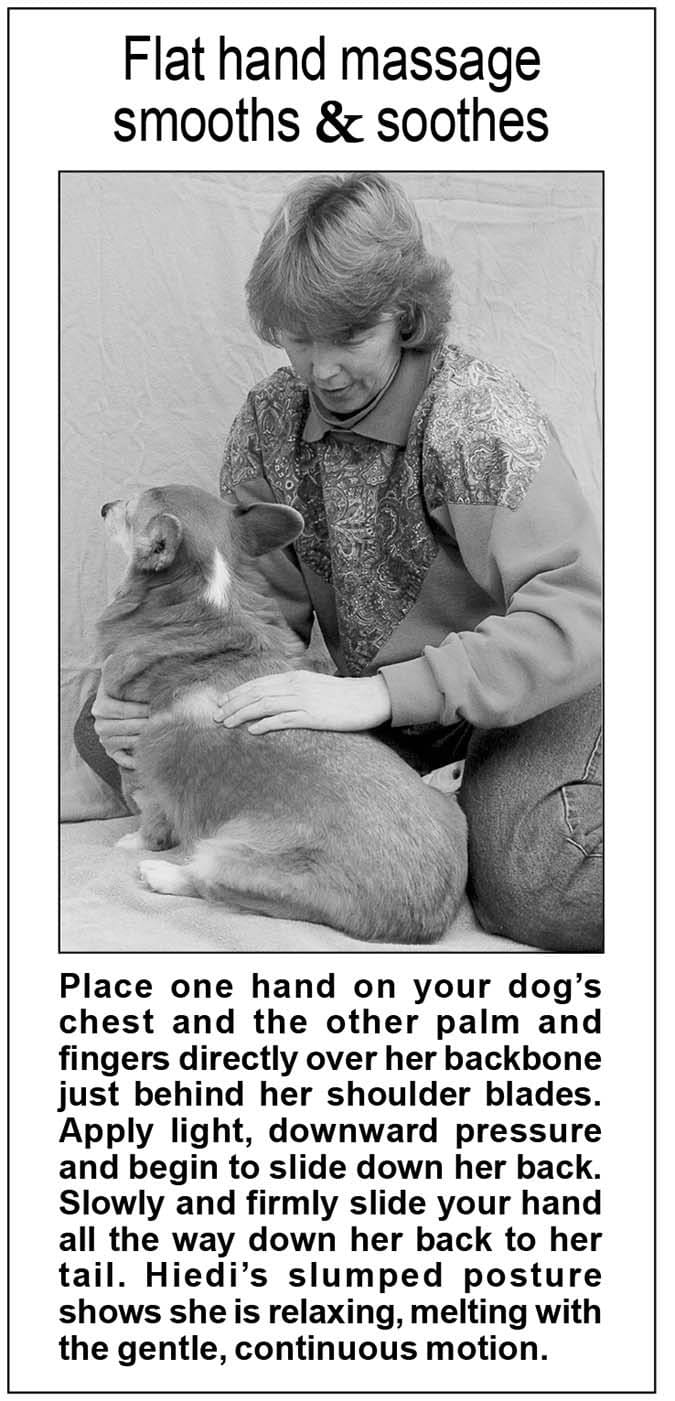
This method is simple. Put one hand on the dog’s chest, both to comfort and to stabilize her. Shape the broad surface of the palm and fingers of your other hand into a flat, mitten-like form. Place this hand over your dog’s backbone just behind her shoulder blades. Leave your thumb separate from your fingers on one side of the spine.
Press down into her body with uniform pressure throughout your hand and fingers. Use gentle pressure at first – once your dog learns to relax with the method you can increase the weight of your hand. Now, slowly slide your hand all the way down your dog’s back to the tail. Use the downward pressure to smooth the hair, skin and underlying muscles in a steady continuous motion. Always stroke from head to tail, moving in the same direction the hair grows.
Repeat the flat hand stroke directly down the spine and nearby muscles at least three to five times. Note areas which have temperature and texture differences. If your dog flinches and does not like this method no matter how lightly you apply it, contact your veterinarian for investigation of deeper muscular or skeletal problems.
Once you have finished these strokes, move on to the other methods mentioned below or apply similar, flat strokes to other areas of the body. Depending on the size of your dog, you could apply flat hand or flat finger strokes to the neck and shoulder and down the foreleg, lower back, hip and hind leg. Be sure to stabilize your dog with one hand while you stroke in the direction of the hair growth with the other. Pay attention to your dog’s reactions. Adjust the pressure of your hand to bring comfort and relaxation.
2. Cross-Fiber Massage
Another helpful massage technique uses a back-and-forth rolling motion of the fingertips to increase circulation and unlock contracted muscle fibers. It looks similar to the probing motion I demonstrated last month which is useful in detecting muscle and joint soreness along the spine. In human massage circles, this method belongs in a group of “cross-fiber” techniques because it applies pressure across the muscle fibers.
This method applies pressure to a small amount of tissue and gently forces it to move. Due to this direct pressure down into the tissue, areas which are already sore may flinch or contract. If your dog reacts with pain or surprise when you apply this method be sure to lighten your pressure or move to a nearby area.
Start this method one inch behind your dog’s shoulder blades. Locate the center of her backbone, lengthen your fingers and place the fingerpads on the firm area of muscle approximately one inch to the side (see photo A in link below) Press lightly down into the muscle, then curl your fingers, moving the underlying hair, skin and tissue back toward your palm (photo B). Once you have slowly rolled the muscle in toward the spine, slowly uncurl your fingerpads and move it back to your starting position.
Push your fingerpads down into the tissue with just enough pressure so it moves when you move your fingers. If you are not pressing hard enough you will slide over the hair. Repeat this back-and-forth movement at least two to three times but no more than five times in a row in the same site. Once you have finished in one area move your hand down to the next section and repeat. When you finish one side of your dog’s back, turn the dog (or move your body) so you can reach the muscles on the other side of the backbone and repeat the sequence. Go slowly and adjust your pressure to your dog’s comfort level.
As you practice, tune in to the quality of the tissue under your fingertips. Healthy relaxed muscles are firm but pliable. Tight, tense muscles are harder and may be pulled into rope or string-like bundles. The tight rope-like areas may be sore, but if you move slowly, the cross-fiber movement softens and unlocks the knotted tissues.
3. Spine Like a Chain
This technique is not actually a massage method, but rather a movement exercise I adapted for dogs from the Feldenkrais® Method of human movement education. The Feldenkrais Method uses gentle, tiny motions to improve movement ability and eliminate painful restrictions. I have experienced both private one-on-one sessions with a Feldenkrais practitioner and several years of practitioner schooling to eliminate chronic back pain and overcome the debilitating effects of a serious car accident.
During my private sessions, I benefited tremendously from a particular movement which involved slowly touching each vertebrae of my back. This segment-by-segment touch seems to relax and reprogram the tiny muscles, tendons, and ligaments which link each bone of the spine. After the session, I would get up off of the table and, in addition to being relatively pain-free, I would actually stand measurably taller! Considering I was in my mid-twenties at the time, imagine my surprise at “growing” over an inch in height as my study continued.
The method which follows for your dog’s spine is an adaptation of that touch. It is a good one to apply to the healthy active dog in order to maintain proper function of the muscles and joints of the spine. This method is particularly useful for dogs who experience weakness in the hindquarters due to age, calcification of the spine, or injury. In the latter case, I find it especially effective because regular massage methods can cause pain or scare a dog with a sore back.
If your dog has an area along the spine that really hurts, and you press hard on that site, he may bite you or leave. But with this non-invasive spine touch method, you can go into a tender, previously injured area and start the release without triggering pain or fear. That way, the tissues relax and the animal regains confidence about moving the area once again.
Its miraculous results requires one difficulty, however. In order for it to work properly, you, the toucher, need to be quiet, focused, and willing to patiently hold your fingers very lightly in one spot for at least 15 to 30 seconds if not longer. Some clients call this method boring because it moves so slowly. The dog may enjoy it, but the giver gets impatient. Actually, once you learn how to “get quiet” and tune in, there are a lot of fascinating sensations within the tissues you can “listen” to with your fingertips.
During a normal movement sequence, a muscle contracts as needed and then completely relaxes. Following an injury or prolonged hard work, the tissue can become contracted and become unable to completely relax and lengthen. After a period of time, it seems like the body just accepts this as a normal state and forgets about it. The associated joints and nearby muscles are hindered in their function often causing inflammation and pain. The spine becomes like a stiff stick instead of the flexible chain of multi-faceted joints it is designed to be.
By touching the dog in non-habitual or unusual, non-threatening ways like this spine touch, you can get the brain and body to wake up and reconsider the holding pattern of the tissues. Long-term restrictions can open up with just one session, returning the spine’s normally flexible link-by-link character. Even when permanent damage has been done to the body, this type of touch can result in profound changes.
Picture the information which moves between the body’s structures and the brain like traffic moving back and forth on a highway. If the highway gets blocked (by muscle contraction or injury), you can use this simple touch to either remove the block or open up little bypass roads to get the traffic (information) moving once again. This can stimulate circulation and improve nerve and muscle function even in damaged areas.
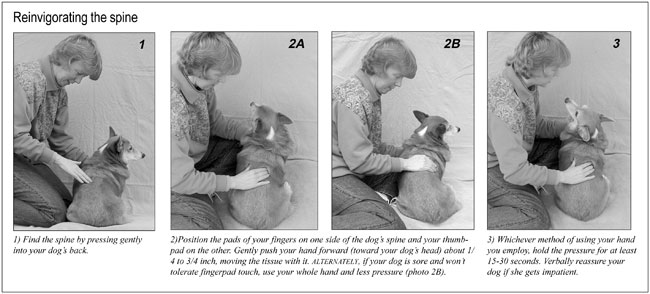
In these photos, I start in the middle of Hiedi’s back. Once you get the feel of the method you can start lower down on the back, clear down to the dog’s hips or up on the dog’s neck. Wherever you begin, skip over the anatomically complex area directly over dog’s shoulder blades.
4. Link By Link
Place one hand on your dog’s chest, to both hold and stabilize her. Run your free hand down the middle of her back, locating the knobs of the spine. Once your dog is comfortable, position your body close to her so you don’t lean and strain your back.
Put the pads of your fingers on one side of the spine and the pad of your thumb on the other side. You want your pads to be about a half-inch to an inch on either side of the backbone, though on a big dog the distance might be greater. You’re seeking the spongy muscle area.
Next, press down into the tissue lightly so that when you push, you move the skin and a small amount of underlying muscle tissue forward with your fingers. Gently push your hand up toward your dog’s head, about 1/4- to 3/4-inch (see popup image to the right). Use as little downward pressure as possible to move the tissue forward. Some dogs will have loose skin and muscle that will slide easily; other dogs’ skin is so tight that you can barely move it. Either way, you only need 1/4 to 3/4 of an inch of slide.
If your pressure is too slight, your fingers will just slide over or rumple the dog’s fur. Hold the tissue in the forward position for at least 15 to 30 seconds if not longer. The most common mistake people make when doing this for the first time is to get impatient and skip this waiting period. I recommend taking three deep, slow breaths before you slowly take the tension out of your fingers and let the tissue ooze back to your starting position. Then move your hand further forward, choosing a new spot 1/2 to one inch up the dog’s back and repeat.
If your dog gets impatient while you are holding the tissue forward, talk to her or give her a little chest scratch with your supporting hand to distract her. If she is very sensitive, forgo “pushing” the tissue forward. Simply place your fingers on either side of the spine and press into the tissue lightly, holding the pressure for 15 to 30 seconds.
Dogs with very sore backs might be unable to sit still for even this light pressure. If this is the case, I rest my flat open palm over the spine, relax my arm and shoulder and just breathe with the dog (photo 2B). Once this contact is accepted, I will attempt to slowly hug the tissue forward 1/4 to 1/2 inch with the flat hand rather than my finger tips. Hold this position for at least 15 seconds before slowly releasing the tissue.
Remember, the goal is to get the brain and body to focus on each link of the back separately from the entire backbone structure. You’ll see the best results if you move in small increments with as little pressure as possible and – the real key – hold the movement for at least 15 to 30 seconds.
In conventional veterinary medicine, cancer treatment for dogs consist primarily of surgery, chemotherapy, and radiation. While research in these areas has brought significant advances, the overall picture is discouraging; cancer death rates are largely unchanged. While many canine cancers are treated successfully when diagnosed early, more often the therapies, conventional or holistic, simply buy some additional time for the animal. In standard canine treatment protocols, a 12-month remission is considered a “cure.” While a year of dog’s life is a relatively long time, one should read between the lines of such semantics.
In recent years, however, researchers are increasingly looking at the probable underlying causes of cancer, and utilizing alternative treatments such as Chinese medicine, cancer-fighting diets and nutritional supplements. Evidence suggests that these are valuable, and sometimes highly effective, tools.
“Veterinary medicine, like all professions, is undergoing changes with increasing rapidity. Additional modalities of diagnosis and therapy are emerging in veterinary and human medicine. These guidelines reflect . . . a comprehensive approach to the healthcare of non-human animals.”
In other words, mainstream veterinarians are coming to appreciate the holistic model, if not necessarily all of the holistic therapies themselves. At the same time, legitimate alternative veterinarians do not possess a reliable, systematic cure for any type of cancer, and responsible practitioners should inform you about all treatments – conventional and otherwise – having the highest rates of success. They should also inform you about the rates of failure, and about the side effects of the treatments.
If your dog has a life-threatening cancer, there are basically only three outcomes: an acceptance that little can be done beyond maximizing quality of life for the time remaining (palliation), extending the dog’s quality life beyond what would normally be expected with a given course of treatment, or eliminating clinical symptoms for an extended period, up to and including the natural end of a dog’s life. The first two scenarios, unfortunately, are far more common than the third.
Conventional veterinary medicine tends to focus on treatments meant to eliminate the dog’s tumors. Alternative veterinary practitioners focus more on the underlying disease triggers, prescribing natural treatments that help optimize immune function (because this enhances a dog’s chance of keeping cancer under control), and, at the same time, maintaining a better quality of life than is otherwise possible.
There is a big difference in philosophy between these two camps, but one similarity is striking: The treatment protocols of each are most successful in the earliest stages of the disease, and with young dogs with otherwise vigorous immune systems. All veterinarians, holistic and otherwise, get worn down by the professional challenge of treating dogs with advanced cancers that they could, and should, have treated earlier.
There is no perfect answer to the question of “What do you do next?” Will you try to “cure” the dog of cancer? Or is “quality of life” the goal? Treatment decisions involve a complex and emotional set of options, which may be limited by where you live, the range of veterinary resources available, the age of the dog, and the money you are willing or able to spend.
Conventional Cancer Treatment for Dogs
What follows is a brief overview of the standard protocols, as well as the most promising areas of research, in conventional medicine; and a review of holistic veterinary philosophy, which in many cases is probably as effective, and certainly less invasive than conventional treatments.
Surgery
When it comes to canine cancer, a tumor that can be cleanly excised is the best possible news. For certain malignant tumors, caught early, it provides what is still the best hope for a lasting cure. Unfortunately, it is often difficult or impossible to remove tumors completely.
Radiation Therapy
In these treatments, a series of directed bursts of radiation, more powerful than x-rays, neutralize the cancer cells at which they are directed. This treatment can be highly effective in controlling localized tumors. It is also used as an adjunct to surgery in which tumors evade total removal, and is sometimes prescribed prior to other treatments to reduce a tumor’s size. Radiation therapy is a valuable, if limited tool, given the long-term risks and side-effects of the treatments. It destroys normal cells in addition to the cancerous cells, so for any given dog, the ability of surrounding tissue to heal may be seriously impacted. In addition, it requires a major commitment in terms of time and expense. A typical program entails 12 treatments over four weeks.
Chemotherapy
In general, chemotherapy (treatment with drugs) has not yet lived up to its early promise. This is because, in the simplest terms, it is an unfocused strategy which attacks all fast-growing cells, including those of the immune system. Also, as a tumor grows and spreads, there exists a high probability of concomitant cell growth resistant to whatever chemotherapy is applied to it – and, meanwhile, the patient is often left vulnerable to other diseases.
But chemotherapy is anything but a dead-end science. There is an enormous amount of research underway, particularly in the field of immuno-targeted drugs, designed to specifically seek out only cancerous cells, reducing or eliminating chemo’s signature compromise of a patient’s immune system. These drugs, at the research and development testing stage, might soon play an important role in comprehensive cancer treatments. In current clinical usage, however, canine chemotherapy has a limited value; it works great when it works, and fails spectacularly when it fails. Some ultimately fatal cancers, like lymphoma, respond particularly well to current chemotherapy protocols, often adding many worthwhile months to a dog’s life.
On the other hand, for many types of cancer, this invasive and toxic protocol simply doesn’t work very well. Many dog owners call a halt to aggressive chemotherapy treatments simply because – with little chance of remission – they can’t stand seeing their dog suffer though the common side effects: nausea, lethargy, diarrhea, loss of appetite, and disinterest in former pastimes, among others. Thus, unless a cure is believed highly likely, veterinarians tend to prescribe far lower proportional doses and fewer drug combinations than would be considered maximally effective.
To complicate matters, sometimes, as we’ll see below, standard chemotherapy functions at direct cross-purpose to some of today’s most promising research.
Cancer Research
A partial list of this research includes work on genetic triggers, heredity, hormones, protein synthesis, virology, tumor markers, suppressor genes, as well as more conventional research in nutrition, environmental toxins, photodynamic therapy, and cryotherapy (freezing tumors with liquid nitrogen).
In the future, this work seems likely to bring about revolutionary advances to all phases of cancer research: Prevention, detection, diagnosis, and treatment. There will be more vaccines against certain cancers (witness the feline leukemia vaccine), protection for those at hereditary risk of cancer, genetic engineering that will predict and control those factors causing cells to mutate, and the ability to identify and screen microscopic cancerous growths, allowing far earlier intervention.
Below are a few of the latest therapies either in use or under development. Keep in mind that much of this research is likely to benefit our dogs only in the future:
Photodynamic therapy
Laser therapy shows promise in a number of surgical procedures requiring very precise application. Just as targeted gene therapy is likely to supersede standard chemotherapy in the coming years as the treatment of choice for systemic cancers, more sophisticated laser therapy might replace radiation in treating some localized tumors. In photodynamic therapy, or PDT, the patient is injected with a light-sensitive agent which precisely marks the tumor. It is then possible to apply the laser with minimal damage to surrounding tissue. Among the advantages over radiation, it is often a one-time treatment, less expensive, less intrusive for the patient, and less time-consuming for the pet owner.
Bone transport
Osteosarcoma accounts for some 80 percent of the primary bone tumors found in dogs. Nicole Ehrhart, a veterinarian and surgical oncologist at the University of Illinois, is researching techniques that might eventually eliminate amputation as the treatment of choice in some early-stage bone cancer patients. This technique, known as bone transport, allows the dog’s own body to mediate repair.
In this procedure, after the surgical removal of the cancerous part of the limb, a cross-sectional piece of the patient’s normal bone is moved into place, held by what is called an Ilizarov brace (named for the scientist who invented it). Because it is the patient’s own bone, and with a blood supply in place, the body responds as if to a fracture. The brace is moved as the bone heals naturally behind it; when the new bone structure is complete, the brace is removed.
While this technology has been used for some time in human accident victims, a two-year study has shown that the technique can be used in conjunction with chemotherapy, a major concern in whether the procedure could be effective for cancer patients.
“Chemotherapy attacks all fast-growing cells,” Dr. Ehrhart said, “and our concern was that this might slow or even prevent new bone growth. We found that chemotherapy initially slows the healing process, but bone growth catches up.” It should be emphasized that, while promising, this technique remains experimental. Ehrhart believes the procedure might move into the surgical mainstream in three to four years. While the healing process takes time, on a practical level, perhaps the best news is that the brace does not prevent most normal canine activities.
Immunotherapy
This treatment is familiar to anyone who’s ever had an allergy shot. Basically, it manipulates, or “tricks” the immune system into protecting against specific infectious agents. There is a great deal of research underway in this field, and reason to hope that in the not-too-distant future, veterinarians will be able to regulate our dogs’ immune system to attack the specific characteristics of specific cancers.
One area of this research involves genetically engineered vaccines for melanoma and several other types of cancer. Cancer begins when the immune system is unable to identify or destroy cancerous cells. Vaccines might effectively utilize the fact that melanoma, for example, carries unique antigens (shorthand for antibody-generating) on the surface of its cells. In current experiments, these antigens are altered and re-injected into the tumor, triggering the body’s own T-cells to attack it. In addition these are true (though still experimental) vaccines in that they “train” the body’s existing immune “memory” cells to imprint the identity of the cancerous cells and continue to attack them. Results are promising enough that large-scale trials are planned.
In a related strategy, researchers at the University of Michigan have genetically engineered monoclonal antibodies (normal cancer-fighting lymphocytes fused to cancer cells) to attack non-Hodgkin’s lymphoma, a cancer similar to the lymphosarcoma common in dogs. Another class of these bio-therapeutic drugs seeks to block the production of cancer-causing proteins. This involves a strand of laboratory-engineered DNA bound to a strand of messenger RNA (which triggers production of the proteins) found in solid cancerous tumors, thus slowing growth of the protein-dependent malignancy.
Yet another class, called anti-angiogenesis drugs, recently caused a media frenzy when it was reported in the New York Times that the drugs had caused tumors in mice to disappear. While researchers were quick to point out that animal testing often fails to translate into human results, the drugs, called angiostatin and endostatin, attack cancer by blocking the growth of blood vessels that allows it to grow.
Finally, there is gene-therapy itself, which is the actual correction of genetic errors. Cancer is a disease of defective or inoperative genes; in cancer patients, those genes which block cancerous cell replication cease to function effectively. In one branch of research, the body’s own immune cells are altered for specific results. In another, the engineered tumor-suppressing genes are injected into a tumor, and begin to multiply, stopping the unregulated cell growth that makes cancer lethal.
While researchers believe that true cancer cures will eventually come from these areas of research, these experimental strategies remain only that.
Holistic Cancer Therapies
Research into high-tech cures for cancer is promising, but equally exciting is the world of holistic treatments, a broad, humane and promising world of veterinary practice. It could be argued that conventional medicine has been more informed by a holistic vision of the cancer patient than in any other type of disease treatment. In cancer research, there are a number of interrelationships at work, the most powerful of which is the fact that one quarter of the chemotherapeutic drugs currently in use are plant-derived; what is called natural chemotherapy is one of the hottest areas of cancer research.
According to the World Health Organization, the plants used in most modern plant-derived medicines have a history of use in so-called folk remedies. Drug companies are now searching this natural worldwide pharmacy for possible medical and commercial uses. (Indeed, there is even a scientific sub-discipline called zoopharmacognosy – the study of those plants which animals instinctively search for when they are sick.) In short, the holy grail of medicine – a cure for cancer – could be growing in some remnant forest, unknown to science.
But while holistic medicine may be able to cure your cancer-stricken dog, the treatment responsible for the cure may be impossible to replicate. Holistic medicine is based on the sum of a pet’s individual circumstances. Given 10 dogs with the same type of cancer, a holistic veterinarian might prescribe 10 different courses of treatment. Such methods do not fit well into scientific, double-blind, randomized studies.
When a dog owner asks, “What is the best possible outcome for my dog – in the context of my individual circumstances – and how will my dog and I get there?,” informed veterinarians can only offer the following options for the owner to consider:
Nutrition
The subject of nutrition – specifically, cancer-fighting diets – confronts the dog owner with bewildering choices. As we all know, nutrition is a staple of the canine press, yet the science behind nutrition is so complex as to be incomprehensible to most veterinarians, let alone ordinary dog owners.
Nutrition is a field where “facts” rise and subside like so many mayflies. Nutritional factors (megavitamins, for example) might benefit one dog, but, in certain circumstances, be harmful for others; yet precisely how nutrients affect cancer, in the crucial context of maintaining general health, is a frontier of science.
But meanwhile, if your dog has cancer, “improved nutrition” is the theme of every holistic cancer therapy, and increasingly an integral part of mainstream protocols.
Due to the extensive research available on the subject of diet and neutraceutical therapies for cancer, next month, WDJ will devote an entire article to the subject, along with several “anti-cancer” diets recommended by canine nutrition experts and veterinary oncologists.
Homeopathy
In homeopathy, external symptoms are considered indicative of a deep systemic “energy imbalance” in need of correction. The discipline employs an array of natural substances, in often vanishingly minute doses, which mimic disease symptoms, thus triggering an immune response. The perennial question of how such extreme dilutions could possibly retain any disease-fighting force might well have an answer in quantum physics.
But while the number of veterinarians practicing homeopathic medicine is on the increase, and every homeopath can offer anecdotal evidence of cancer cures due to homeopathy, double-blind, scientific studies have not demonstrated homeopathy’s benefit to canine cancer patients.
Traditional Chinese Medicine
Along with acupuncture, traditional Chinese Medicine, or TCM, is the Western world’s most widely used and widely respected alternative medicine; the Harvard Medical School, for example, has long had an exchange program with the national Chinese medical academy.
Chinese medicine considers cancer to be the ultimate expression of immune imbalance. In TCM, disease is understood to be caused by disturbances in a complex systemic energy flow called qi, which courses through the body on a network of meridians, each of which is associated with a major organ and with highly receptive acupuncture points. All of which merely hints at a complex terminology relating to a sick individual’s physical and psychological state, which TCM practitioners call a “pattern of disharmony.”
Chinese medical practitioners do not claim any extraordinary ability to cure cancer, canine or otherwise, although many of their herbal therapies have proven cancer-fighting properties. TCM stresses prevention – that diet, exercise, and positive mental health can prevent cancer by correcting these imbalances before they cause disease.
Acupuncture neither prevents nor cures cancer, but it is now widely used – among many other benefits – to relieve the side effects of chemotherapeutic drugs, and to boost immune function. In Western terminology, acupuncture (in which needles and/or targeted heat, suction, electrical impulses, lasers, and other techniques, may be employed) achieves its effects by altering chemical neurotransmitters in the body, triggering the release of pain-killing hormones, natural steroids, and endorphins.
At Colorado State University’s School of Veterinary Medicine, acupuncture is well-accepted and often used in the cancer wards.
Unconventional therapies
There are any number of other unconventional cancer therapies whose proponents claim some level of cancer-fighting efficacy. However, all are clinically unproven treatments, which tend to be sought by those for whom conventional medicine offers no further hope. To name just a few, these therapies include shark cartilage, chelation therapy, blood and urine derivatives called antineoplastons, Iscador (a fatty extract of the mistletoe plant), laetrile, vitamin C, and hydrazine sulphate.
It is worth repeating that what cures (or seems to cure) cancer in one dog might not cure another; of course, this is true of conventional medicine, too. However, if there were in fact a highly-effective, systematic cure – for any type of cancer – among these unconventional treatments, it is safe to say that you would already know about it.
Chiropractic and massage
Chiropractic is a valuable healing tool, but has not proven to be useful for treating cancer. Dr. Gregory Ogilvie, a veterinary oncologist and professor at Colorado State University, characterizes the modality this way: “While good data exist concerning the efficacy of this treatment discipline, few data exist involving the cancer patient. . . Chiropractic care for the veterinary cancer patient revolves primarily around improving function and reducing pain, especially in areas of orthopedic or neurologic disorders.”
The report on massage therapy for cancer patients looks similar. While the treatments have been shown to be useful for relieving some of the side effects of cancer (and the cancer treatments) such as pain, inflammation, soft tissue dysfunction, epileptic seizures, anxiety, and depression, there is no evidence that massage can slow cancer growth. And in fact, for certain cancers, increasing the patient’s blood flow may assist the cancer’s spread. Discuss this concern with your veterinarian before using this modality on a dog with cancer.
The Bottom Line
One of the principles that the caregiver for any cancer patient should be aware of is that there is an often-rancorous battle between conventional and alternative veterinary practitioners when it comes to cancer. Your veterinarian may choose not to take a side in the fight, or he may be a strident advocate for his side. But your own cancer strategy can best be directed from neutral ground. Simply put, the best veterinarian for your cancer-stricken dog is one who looks for treatments that work, one who sees beyond the conventional, linear cancer-treatment model – whether that be the straight “alternative” approach or the straight conventional approach. The most successful practitioners work from a “whole dog” perspective.
In addition, it seems clear that any cancer-stricken dog is likely to benefit from therapies such as acupuncture, enhanced dietary programs, herbal medicine, not to mention simple love and affection; as a healing tool, of course, love is considered an “alternative” notion by many scientists. Perhaps it is. But beyond love, there are no definitive answers, only calibrated options and informed hope.
Roger Govier, a freelance writer and frequent contributor to WDJ, lives in San Francisco, California.
Warmth relaxes humans and dogs alike, for physical and emotional reasons. Heat on the skin causes an increase in circulation. Blood flows to the area and tense muscles under the skin begin to relax. A warm touch might also recall the lazy enjoyment of a nap in the sun, or the comfort of a companion on a cold winter night.
Reusable heating pads are a wonderful way to bring the benefits of gentle heat to a dog. The pads I use are portable, liquid-filled plastic envelopes that, with just a push of my thumb, radiate soothing warmth for a few minutes or a few hours.
The pads can be used to soothe the dog during grooming, a hands-on evaluation, and other physical therapies such as chiropractic, stretching, or massage. I often use heat pads at the beginning of a massage, especially in cold weather. I also find them helpful with a dog who anticipates discomfort rather than enjoyment from new body sensations. The pads also seem to enhance the effects of acupressure relating to muscle, joint, and nerve function.
When the pads are first activated they can be quite hot. At this stage, move them over the dog’s body in slow, flowing strokes. When the pads cool, place them on the dog’s lower or middle back and let them continue to work while you massage other areas.
I always let the dog see and sniff the pad after it’s activated. Once the wonderful heat pad slides smoothly over her skin, however, even the most cautious or distracted dog is likely to dissolve into a cooperative partner.
A Warm TTOUCH
Some dog massage practitioners and trainers use the pads frequently, in a variety of applications. Robyn Hood, a Tellington Touch Equine Awareness Method (TTEAM) instructor from Vernon, British Columbia, who has years of experience with the reusable heat pads. In fact, Hood’s family owns the patent rights for Canada, having brought the concept to this continent from Australia.
TTEAM practitioners use a system developed by Linda Tellington Jones, touching and working with companion animals and horses to enhance their mental and physical well-being. Hood has found that incorporating the use of the heat pads into her regular TTEAM exercises is very valuable.
“I use the heat pads to maximize the effects of massage strokes,” says Hood. She finds them particularly useful during grooming to warm and relax the taut, often painful back muscles of a competitive show dog or canine athlete such as a hunting dog. She also uses them to soothe and bring focus to a nervous dog, by stroking him with a heat pad in her hand.
The pads are also helpful in emergencies. Hood uses them along with massage to raise a dog’s body temperature when it has dropped too low due to shock or stress.
Hood also finds them useful for keeping puppies and older, arthritic dogs warm. “The advantage of the pads is that when they cool, they will remain at the body temperature of the dog, rather than getting cold and wicking the dog’s warmth away,” she says.
WDJ’s Favorite
By far the best and most unique heat pad is made up of non-toxic sodium acetate, stored in a liquid state and activated by pressing a metal disc floating inside the pad. When the disc is pressed, the cool, clear liquid immediately transforms into warm white crystals. The pads remain malleable for about 20 minutes, the length of time it is warm enough to be useful for massage. The pads remain warm for about 40 minutes total, but they stiffen and grow hard in the last 20 minutes, and that final stage of heat is not quite warm enough to feel good.
Once the pads cool, you can easily recharge them by placing them in boiling water (or microwaving them, though this method takes more vigilance, so as not to overheat them and cause them to burst) for about 10 minutes. The manufacture suggests letting them cool all the way before re-activating them. To recharge, just bend the metal tab that floats inside.
With reasonable care, these pads can be used over and over. WDJ has activated and recharged our samples at least 30 times since they arrived, and the effectiveness has not diminished one iota. Hood claims to regularly use a pad that she first purchased and used in 1988.
In the U.S. this pad is manufactured by Prism Technologies and sold under several names, most commonly, “The Heat Solution.” We’ve seen the exact same product in one sporting goods chain with a Coleman brand label. In Canada, they are marketed by TTEAM as “Thermopads.”
Insulation can make the heat last longer. Some manufacturers sell insulated covers for the pads to make the temperature more comfortable and longer-lasting. The covers are unnecessary to protect long-haired dogs from excessive heat, but could help keep the pad from being too hot for an extremely short-haired dog. We found that a sock works almost as well a cover.
Other options
Other reusable heat pads are available, but they do not have the portable, consistent-heat features which come with our first choice. Gel- and water-filled pads are less inconvenient; they must be boiled or microwaved immediately before use. Moreover, depending on the temperature used to warm them, the heat from the pads varies. I’ve found that it’s easy to get them too hot.
The sizes that each type of pad come in also limit their usefulness somewhat. Both the “Heat Comfort” pad (AKA the “Nexcare” pad), manufactured by 3M, and the “Aqua-Relief” pad, manufactured by the Aqua-Cel Corporation, are too big to stroke a dog with easily. Both would be better used in a situation where you were trying to warm a large area of the dog’s anatomy or to treat arthritis, sprains, pulled muscles, and other injuries. These pads also work well if cold therapy is beneficial; simply chill in the refrigerator for an hour or more prior to use.
The powder-filled, disposable heat pads that are activated by shaking, such as the “Sports Heat,” manufactured by Two A Degree, come in the right size, but their temperatures tend to be inconsistent, and never become quite as warm as you’d like. Plus, the single-use, throw-away feature isn’t economical nor in keeping with ecological “whole dog” practices.
Nothing is more wonderful for your dog in the winter time than a nice petting session with a hand-sized heat pad tucked into your palm. I recommend you get together with several other people and purchase a case of the sodium acetate portable heat packs. This way, you’ll be able to delight your favorite canine – or human! – friends all winter long.
-By Barbara Chasteen
Barbara Chasteen usually works with horses, offering equine massage, acupressure, and therapeutic in-hand techniques through her practice, the Balanced Horse, in Sonoma County, California.
Alternatives for Epileptics
I have read that epilepsy can be caused by (or at least aggravated by) certain nutrient deficiencies. Are there any supplements you can recommend for dogs for prevention of epileptic seizures? I’m looking for alternatives to Phenobarbital.
-Name withheld by request
San Mateo, California
My five-year-old Cocker Spaniel, Casey, has been getting convulsions/ seizures since she was three years and four months old. She has been on Phenobarbital (30 milligrams twice a day) for almost two years. I understand that after a certain time Phenobarbital can damage organs in the body. Is there an alternative to Phenobarbital that is safer and has fewer or no side effects that will control her seizures?
-Sandra L. Neuheimer
Fleetwood, PA
A Veterinarian’s Opinion
We posed these questions to two experts: a holistic veterinarian and an herbalist. The first view on the subject of epilepsy comes from Dr. Charles Loops, a well-known holistic veterinarian in Pittsboro, North Carolina. Dr. Loops practices homeopathy exclusively, and consults with many of his clients over the telephone. He has a special interest in cancer treatment.
Epilepsy is a common problem for every veterinary practitioner. There are so many variations in symptoms, frequency of occurrence, intensity of seizures and age of onset, that any combination can be found between the numerous animals afflicted with this condition.
This is an old disease that seems to have always affected a small percentage of animals, however, vaccinations are a stress factor that can bring out this problem. Many animals begin seizure syndromes following a vaccination. Some can be cured of this imbalance with homeopathic treatment and others can only be controlled.
Occasionally a diet change or addition of supplements will correct a seizure problem but not often. B-vitamins are very important in neurological functional maintenance and should be supplemented when a seizure problem exists. I feel it is best to use a B-complex supplement, one containing all the known Bs, rather than choose certain ones. This avoids imbalances which might occur if individual ones such as choline are given in high doses.
Most epileptic dogs can be treated homeopathically without using Phenobarbital or other seizure medications. The more resistant cases will benefit from homeopathic and diet improvement as an adjunct to chemical therapy and generally require lower medicinal doses. As with most conditions, utilizing holistic treatments before starting on chemical medications enhances the odds that a cure will be possible. The use of suppressive treatments can take the curable case to the incurable level.
An Herbalist’s View
The next answer is from Gregory L. Tilford, co-owner and formulating herbalist of Animal’s Apawthecary. He is also the founding president of the Natural Pet Products Association, and the author of two books on wild medicinal plants: The EcoHerbalist’s Fieldbook (Mountain Weed Publishing, 1993) and Edible & Medicinal Plants of the West (Mountain Weed Publishing, 1997). Greg and his wife, Mary Wulff-Tilford, a professional member of the American Herbalist’s Guild, are completing a comprehensive guide book on herbs for animals.
There are several herbs that can be used to reduce the severity and frequency of epileptic fits. However, like Phenobarbital, herbs will only treat the symptoms of epilepsy (seizures); they won’t stop the disease.
Whichever approach you take, I’d also suggest taking a critical look at the dogs diet; nutrition is so important. I recommend that people improve the dogs diet before they use herbs or medications. Make sure the animal is getting the essential fatty acids, especially if he has any kind of nervous system disorder, because the Omega 3s and 6s are critical to proper nerve function. Also, you’ve got to have the amino acids taurine for cats and carnitine for dogs in order for the nervous system to work appropriately. Without those in place, herbs wont have any foundation from which to work. It’s like send fire engine to a fire without water; they have nothing to work with.
There are several herbal remedies commonly recommended by herbalists for epilepsy, and some holistic veterinarians are using them as alternatives to Phenobarbital.
One of the ones I recommend contains some amount of choline, the nutrient that the first writer alluded to. However, the herbs are not generally used for their nutritive content, but rather, for their abilities as nervines. This is a term used for herbs which moderates or adjusts nervous function. They are not necessarily sedatives, but they can have a sedative effect.
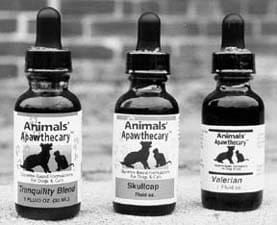
The first herb I’d suggest using is skullcap, or Scutellaria. Skullcap is a nervine that is especially helpful for any kind of nervous jitteryness. It’s indicated for dogs with the kind of nervous anxiety associated with having the shakes or muscle tremors, or for dogs that have hyperactive excitability.
Research has shown that skullcap can affect the higher brain center; thats the area of the brain where epileptic fits are triggered. We have had many positive reports from pet owners and veterinarians who have given it to pets who experience frequent seizures. Commonly, dogs that receive a regular dose of skullcap exhibit a reduction of the frequency and the severity of the seizures.
The second herb I’d try is valerian, or Valeriana officinalis. It has also been shown to work in the higher brain centers. It is indicated more for general anxiety like the animal that paces all night, or the animal that just cant relax when you are traveling not necessarily the nervous jitteriness or insomnia. Valerian can work more quickly and be more effective than skullcap, but in some animals it can cause a groggy irritability. If the dog is predisposed to being cranky in the first place, or has mood swings, I wouldn’t give him valerian; it might cause him to even more grumpy.
The third herb I’d suggest, oatstraw or Avena sativa, is a really good general nervine tonic. Oatstraw can have a profound effect toward nourishing the myelin sheath of nerves; it’s nourishing to the entire nervous system. It does contain choline, which is a large part of the nerve signal carrier. Oatstraw can help regulate and qualify nerve impulses, helping the nervous system work more efficiently. It can also be fed every day and is very safe; it’s a neutraceutical, as much a food as a medicine.
A dog owner could try any one of these herbs, or any combination of them. I like using all three in equal parts. Some companies, mine included, offer blends of these herbs. These herbs can be fed directly, in fresh or dried form, but few dogs like the taste of skullcap or valerian. They might be more readily accepted in tea form. My personal favorite method of administering herbs, however, is in tincture form.
Tinctures are the strongest, most versatile, and readily usable forms of herb preparation. Either alcohol or glycerin is used as solvents to break the plant material down and release the active constituents into a concentrated liquid base. This allows pet owners to give a small but powerful dose that allows for quick and complete absorption into the body. In my experience, pets tend to object to the taste of alcohol-based tinctures, which is why my company makes only glycerin tinctures, which are sweet and palatable. Both forms are equally effective.
Tinctures are best fed on an empty stomach, without interference from digestive action. It’s also best to split the daily dose into at least two or three feedings, to maintain a small but constant amount in the dog’s system. I’d recommend giving a medium-sized dog one-half to one milliliter of the tincture (or 12-20 drops for every 20 pounds of the dogs body weight) three times a day. You can dilute alcohol tinctures if the dog wont accept them, or put it in the dogs food or water as a last resort.
A caution: I would strongly recommend that if your dog is already receiving Phenobarbital, you see a holistic veterinarian before administering any herbal remedy. The herbs are capable of amplifying the effects of Phenobarbital.
Commonly, holistic veterinarians suggest slowly reducing the dog’s dose of Phenobarbital, and progressively replacing it with an herbal formula. But if the animal has been on a relatively high dose of Phenobarbital for a long time, he is likely to be highly dependent on it at that point, so a veterinarian’s supervision is critical.
———-
Crazy Around Cars
After reading the article What a Drag (WDJ July 1998), I decided that the Halti head collar was just what my 15-month-old Beagle needed. However, even though the device made sense to me, unfortunately it didn’t work for my dog, who freaks out every time a car passes by.
Ive been walking my dog since he was four months old, but over time he has become increasingly worse in his behavior with cars that go by. My biggest problem is controlling him as hes barking and trying to get to the cars in the street. I normally use a nylon cord choke collar on him, but I figured Id give his neck a break (no pun intended) and use a head collar. However, the Halti didn’t stop the behavior; he even managed to shake his head out of it!
I’ve tried making him do a sit/stay, or a turn around, to distract him while the car passes, but nothing seems to work. Eventually I stopped walking him as it was becoming less enjoyable for both of us.Would a harness help? It seems to me that a change in the collar device is not going to help with this particular problem.
-Pearl White
Melrose Park, IL
We sent this question to Bill Stavers, a dog trainer and animal behavior specialist from Beverly Hills, CA. Stavers assists veterinarians as the staff trainer/behaviorist at the Wilshire Animal Hospital, is the behavior consultant for the Huntington Hospital pet assisted therapy program, and is a certified animal evaluator for the Delta Society. He teaches training in classes and private lessons (using only positive reinforcement) and solves problems via telephone consultations.
I agree that a change in collar device won’t help. A harness, like a head collar, is just another restraint; it won’t stop the behavior. By using nothing but a restraint device, as you have noticed, over time, the barking becomes more intense and begins earlier, when the car is farther away. When introduced and used properly, a head collar can be an effective and relatively pain-free tool, but in this instance, the solution does not lie in the type of restraint used.
You were on the right track when you tried a sit/stay, but the training process to completely and reliably distract him with other tasks will require several steps. The first steps should be taught before you go out even before you put his collar on.
First, teach your dog look at me and sit on command, so that he will respond, even when he’s not looking at you, when you say the command inside and outside. Use highly desirable treats as reinforcers.
Next, go to the edge of the area where the problem occurs. You must be far enough away from any cars that your dog is not nervous or aroused. Do a couple of look at me commands and some sit commands and reinforce. Then, jog away from the area happily calling your dog. Slow to a stop, kneel down, and playfully reinforce him with lots of treats, petting, and praise.
Go home. Return and repeat this sequence until your dog is anticipating your actions. Reinforce his expectation that you will ask him to look at you, ask for sit and jog away to play with him each time you approach the area. You are now changing from classical to operant conditioning. (For a thorough discussion of learning theories, see Excel-Erated Learning: Explaining how dogs learn and how best to teach them, by Pam Reid. Its published by James & Kenneth and available from Direct Books, 800-776-2665).
The next step is to do the look at me and sit commands the instant your dog detects the presence of a car in the distance. At the moment you see that he perceives a car, you give him the look at me cue, run happily away while calling him, give the sit cue, kneel down, and playfully reinforce. At this juncture, you could even throw a couple of treats on the ground and allow him to do what he does best: sniff, sniff, sniff. After he finds the goodies, go home.
The process from here is to gradually, and you have to use some judgment here, alternate look at me, sit, and jogging away cues with the car closer and closer, until you are able to keep his attention on you even as the car gets to you. Be ready to fall back to a previously successful session if he begins to bark or lunge for a car, which will most likely happen at the moment the car crosses an imaginary line that signifies it is no longer approaching but departing.
The head collar will be helpful in about six weeks when all seems to be going well, but there is still a residual, small amount of arousal when the car gets to you. You may then be able to use the head collar to interrupt your dog and turn him toward you, then give the cues without jogging away. The advantages of this approach are that you solidify trust in your dog and continually strengthen his positive behavior through reinforcement. You also teach him that you are a good owner, that it pays to follow your lead, and, last but not least, that you will get him out of a stressful situation (if it all becomes too much) by leaving instead of yelling at him and pulling on him.This might take six weeks or more, but you have the rest of his life to enjoy his progress.
Boredom kills. That’s putting it dramatically, but consider all the dogs who are abandoned or brought to animal shelters because of incessant barking or because they tear up sofas when bored.
Dogs, like people, do better when they have something to do. It might be play or it might be work – I’m not sure dogs differentiate between those things. An Australian Shepherd catches a flying Frisbee, and a German Shepherd police dog catches a crook. Both exude a sense of satisfaction for doing their “jobs” well, and both are pleased with the loving pat and hearty, “Good dog!” they receive.
This brings me to trainer/author Pat Miller’s report, “Beyond Basic Obedience,” which describes a wealth of activities, all of which require advanced training, that you can do with your dog. Some of them are intended to give your dog an occupation, such as herding sheep or tracking lost children. Some of them are strictly for fun, like musical freestyle, a sport also known as “dancing with dogs.” If you are looking for activities to improve your communication, strengthen your bond, and provide you with unlimited recreation with your dog, check out Miller’s list.
As you peruse the possibilities, consider the specific strengths and interests of your dog. Not all dogs are cut out for certain occupations; a buoyant, friendly Golden Retriever may not be the best candidate for the solitary trials of tracking, and a stately and independent Husky may be mortified at the prospect of performing tricks of agility in an arena.
This is not to say that the dog’s breed should determine its ideal career path. In the course of rounding up photos to accompany Miller’s story, I heard about a Chihuahua who tracks and a Poodle who herds. The subject of this month’s Case History, in fact, is a Great Dane therapy dog. The delight this gentle giant brings to the elderly clients she regularly visits is wonderful to see.
It’s also wonderful when you hear about a good dog landing just the right job. A recent wire story about Jackie, a three-year-old Border Collie is a perfect example.
Jackie was “hired” a year ago by the United States Navy to keep Canada geese and other birds off the runways of the Willow Grove Naval Air Station/Joint Reserve Base in Pennsylvania. Airplanes that hit a Canada goose can be seriously damaged, and even crash. In 1995, geese were sucked into two engines of a four-engine plane taking off from an Air Force Base near Anchorage, Alaska. The resulting plane crash killed 24 crew members.
Airports attract all kinds of birds with their broad expanses of grass and their generally common waterfront locations, which provide food and nesting materials. In recent years, Canada geese have refused to migrate in ever-increasing numbers, making the danger of collisions a year-round problem. At Willow Grove, authorities tried scaring the geese away with sirens, fireworks, and water cannons. The birds returned as soon as the diversions stopped. But now Jackie’s on the job.
Whenever birds are spotted by control tower personnel, the eager little dog is dispatched to find and chase the geese away. Sometimes she has to threaten them a dozen times before they leave, but Border Collies are relentless.
So far, there have been no bird strikes since Jackie came aboard. Richard Kimmel, the base’s natural resources manager, bought Jackie and had her specially trained for her job, for a total cost of $5,000 – a small investment compared to the price of aircraft repairs and the potential loss of human life.
Best of all, Jackie is happy. She lives on the base, with four airbase personnel trained to handle and look after her. Can you say your dog likes his “job” as much as Jackie likes hers? The athletic dog even “volunteers” for extra duties whenever she gets the chance.
“She’ll herd anything. I’ve seen her herd bugs,” laughs Kimmel.
Diet became hip in the 1990s. People began studying health food and supplements like never before. One nutrient after another was held up as the latest “miracle” herb or vitamin. This one was supposed to give you energy like never before; that one gave you a photographic memory; and then there was the one that practically melted fat off of your bones. Companies sprang up overnight to meet the demand for these “vital” substances.
In almost every case, the initial wave of interest in the products quietly slipped out to sea within a short time. People tried the powders and pills, and, when they failed to effect a dramatic change within a couple or weeks or months, threw away the half-empty bottles.
It was inevitable that a similar movement would come to the canine kingdom. Look in the dog magazines – the ones with ads. You’ll see page after page of advertisements for dietary supplements of all kinds. Without fail, all of the ads promise to improve your dog’s health. Nine out of ten guarantee to eliminate the single most common complaint of dog owners the world over – itchy, irritated skin. At least half assure the buyer that they will improve the dog’s digestion.
Sometimes, the supplements do actually accomplish these things. When a specific dietary supplement is given to an individual (canine or human) who previously lacked the nutrients or chemicals offered by the supplement, or whose body required a higher dose than was previously available, miraculous improvements in health, appearance, and attitude can indeed take place. But most people have no idea whether they are lacking something before they add it to their own or their dog’s diet!
You’ve gotta have a reason
There are only two legitimate reasons for supplementing your dog’s diet. The first and most common need for supplements is to correct a deficiency which has resulted in poor or compromised health, or low vitality or energy.
That said, it should be added that most holistic veterinary nutrition experts agree that many commercially prepared dog foods offer only low-quality sources of nutrients, and that sometimes, the bio-availability of the nutrients is questionable. This in itself is enough to make many holistic veterinarians recommend the daily administration of a basic multi-vitamin and mineral supplement to any dog who receives nothing but commercial dog food.
Some holistic veterinarians (and human doctors) believe that much of the world’s human food supply is also deficient in vital nutrients, due to intensive modern farming practices. Those people will also recommend the addition of multi-vitamin/mineral combinations to the diet of dogs that are fed an otherwise holistic diet of raw meat and vegetables. This is a philosophic issue debated by scientists and nutritionists the world over; you’ll have to decide for yourself (and your dog) whether the nutrients in most traditionally farmed and manufactured foods are adequate. The best test of the issue is adding a basic multi vitamin and mineral supplement to your (and your dog’s) diet, and taking note of any improvements.
The second good reason to add certain supplements to your dog’s diet is to strengthen his defenses against an anticipated challenge, such as a stressful long-distance move, competition, lactation, or exposure to infectious disease. For instance, vitamin C is widely recognized for its ability to bolster the immune response, and act as an anti-viral agent.
When a dog with a certain deficiency is given the appropriate nutritional supplement, it can quite literally save his life. The correct supplement can also give a sickly or weak dog increased vigor and a new outlook on life. The difficulty lies in determining what the dog needs.
No one can make an intelligent decision about what supplement his or her dog needs based on the products’ label, advertisements, or web site. If you believe each product’s claims, your dog will benefit from each and every supplement on the market. But only a thorough health history intake and examination by a veterinarian, potentially aided by lab tests, can identify nutrient deficiencies. And only the recommendations of an experienced nutrition expert, tailored for your dog, can be considered completely safe and useful.
Obviously, the final decision regarding whether and how you will supplement your dog’s diet rests in your hands. Consider the following common-sense rules of supplementation and choose the simplest, good quality supplements you can find (we recommend a few on the next page). Most importantly, pay attention to your dog! Note all improvements or declines in his appearance and vitality and immediately adjust your ministrations accordingly.
Vitamin/Mineral Supplements
Vitamins are complex substances, essential for normal functioning of the body. There are two types: Fat soluble (A, D, E, and K), are stored in fatty tissue and the liver, and water soluble (B and C), which are eliminated daily through the urine. The body can manufacture its own supply of certain vitamins; others need to be supplied by food and other sources. Veterinary nutritionists more or less agree on the amounts of vitamins needed by dogs to stay healthy.
The latter statement cannot be made for minerals. There is widespread disagreement in the veterinary community regarding what minerals, and in what dosages, are needed for canine health. Scientists only agree that further study is needed, especially regarding dosages for dogs of various breeds and in varying life stages.
Minerals cannot be manufactured by the body. Most people are surprised to learn that mineral deficiencies are more common than vitamin deficiencies. They assist the body in its most critical work, such as energy production, maintenance of electrolytes and fluid balances, and nerve transmission. Trace minerals, including zinc, iron, copper, manganese, cobalt, and iodine, are required by the body only in minute amounts.
WDJ’s pick:
Maximum Protection Vitamins & Minerals
(Dr. Goodpet Laboratories, 8 oz. for about $2.50; 800-222-9932.)
Multi-vitamin and mineral supplementation is generally accepted more readily than supplementation with other nutrients, so it makes sense that there are more brands of multi-vitamin/mineral products on the market than all the other types of supplements put together. Numerous products in this category fit our criteria, but Dr. Goodpet’s product stood out from the crowd for a few reasons.
First, it comes in a powdered form, enabling you to give your dog an amount tailored to his size; the dosage is one teaspoon per 10 pounds of body weight. The powder also makes it easy to sprinkle on and stir into your dog’s food. It includes vitamin C, which is uncommon in the multi-vitamin mixes for dogs. Many veterinarians dispute the idea that dogs need added vitamin C, since their bodies manufacture a certain amount. Most holistic practitioners, however, acknowledge vitamin C’s ability to help the body fight infection and speed healing.
Another good thing about Dr. Goodpet’s formula is what is NOT in it: no preservatives, fillers, anti-caking agents, colors, artificial flavors, or sweeteners.
Not recommended:
Vita Tabs
(Pet Gold Products)
Let’s start with the first ingredient: Dextrose – another word for corn syrup, a sweetener. Considering that the fourth ingredient is molasses, this product is fairly high in sugar, not a supplement that’s high on our wish list, but one that certainly contributes to the product’s palatability. The need for four different artificial colors in a dog vitamin is a mystery.
———-
Probiotics
AKA “friendly bacteria,” these substances help the body digest food, and prohibit growth of harmful fungi and microbes in the gut. The most common probiotic supplement is lactobacillus acidophilus, which can actually help the body overcome the yeast and fungal infections that often occur following a treatment of antibiotics.
WDJ’s pick:
Canine Digestive Enzymes
(Dr. Goodpet Laboratories, 7 oz. bottle, about $15; 800-222-9932)
We had a hard time meeting the simplicity requirement on this one. This product is actually a mix of the four major digestive enzymes and lactobacillus. However, we rejected other brands with more expansive “kitchen sink” approaches. PetGuard, for instance, added alfalfa juice powder to their acidophilus product; Pet Authority added yucca, vitamin C, and papaya to theirs. There’s no harm in any of those, just complexity.
Not recommended:
Bene-Bac Pet Gel
(Pet-Ag, Inc.)
While this product does contain lactobacillus acidophilus and other probiotics, it also contains polysorbate 80, an emulsifier that has been associated with a contaminant that is known to cause cancer in animals; TBHQ, a dangerous antioxidant; and is preserved with ethoxyquin, an antioxidant that has been associated with numerous health problems in dogs.
———-
Fatty Acids
This term refers collectively to the three substances in fat – linoleic acid, linolenic acid, and arachidonic acid – that contribute the most to the quality of a dog’s skin and hair coat. Fatty acids also help prevent cholesterol buildup and heart disease.
WDJ’s pick:
Lipiderm
(Bioglan Animal Products; 60 capsules, about $8; 800-454-0040)
This is a simple formula, comprised largely of fish oil, and focused on a single purpose. ‘Nuf said.
Not recommended:
Linatone
(Lambert Kay)
This product has been around a long time, and it has its fans, but WDJ would like to see it eliminate the polysorbate 80, a questionable emulsifier (see Bene-Bac Pet Gel, above).
———-
Digestive Enzymes
An enzyme, in its general definition, is any one of several different proteins that catalyze a biochemical reaction. Each type of enzyme catalyzes only one substance. For instance, protease is an enzyme used by the body to break down protein; amylase works on carbohydrates, lipase on fats, and cellulase on fiber.
These enzymes are present in raw, fresh foods, but are destroyed by the high temperatures needed to manufacture most commercial dog foods. The body produces its own supply of the chemicals, but many nutritionists believe that giving the body additional enzymes (whether in fresh food or in a supplement form) reduces the need for the body to produce the chemicals, lightening the body’s workload and speeding the digestive process.
WDJ’s pick:
Prozyme
(Prozyme Products, Inc.; 200 gm bottle, about $17; 800-522-5537)
Sometimes, what you want is what you get. Pro-zyme contains only the four most important enzymes: lipase, amylase, protease, and cellulase.
———-
Unique-Source Products
Now we come to a mixed bag of supplements. The products offer vital nutrients, but their makers place more stock in the peculiarity of the nutrient sources than in the nutrients themselves.
Barley Dog, made by Green Foods Corporation, is a good example. The product is not a complete multi-vitamin/mineral supplement; it supplies vitamins A, C, E, B1, B2, and B6, and a few minerals. More significant, say the makers, are the unique qualities of the main ingredient (barley grass), which provide an advantage – a providential synergy – that can’t be explained in terms of recommended daily values.
Super Blue Green Algae (SBGA) takes the cake in the “unique substance” category. We like the product, which is made by Cell Tech, of Klamath Falls, Oregon. SBGA is completely composed of a certain aquatic plant that grows in an Oregon Lake; the algae is collected, freeze dried, and crushed into a fine powder. It contains an array of trace minerals, vitamins B1, B6, B12, C, and D, beta carotene, a number of amino acids, chlorophyll, and nucleic acids, and it’s affordable. We’ve heard great things about the product (see “a Blue-Green Miracle.”), but the way the product is marketed is annoying, to put it mildly.
Cell Tech functions as a “multi-level marketing” system (see “Multi-Level Marketing Mysteries), meaning you can buy it – and get information about it – only from the company’s independent salespeople. The system not only motivates its salespeople to pursue potential clients with fervor, but pits the salespeople against each other in order to win clients. This seems to be why you hear different versions of why and to what extent the product is successful. Critics call the product “glorified pond scum,” but to hear it from the converted, SBGA contains almost mystical powers to heal.
You won’t know until you try
Dog owners also get exposed to a number of supplements that contain substances that do not appear on any list of required nutrients. Most are intended as treatments for specific medical disorders. For example, shark cartilage is said (by the makers of a shark cartilage product) to strengthen weak bone and improve joint mobility.
It’s easy to dismiss these unusual substances as fads – unless you know a dog that has been helped by one. Who knows? Experimentation with these or other supplements, with the knowledge and support of your holistic veterinarian, just might put a sparkle in your dog’s eye and a strut into his step.
So, you’re leaving town for a few days. What ARE you going to do with Fido? Experts agree that the best situation for your dog’s health and happiness would be to have someone stay in your home, maintaining the dog’s regular diet and exercise, and preserving his comfort and sense of security, but this is not always possible. And while we know people who haven’t taken a dog-less vacation for the life of their dogs, we think this is a little extreme.
Only parents who have had to find safe, stimulating daycare for their small children will fully understand what is so difficult about finding a safe, enjoyable boarding kennel for your dog. You worry about abuse, poor hygiene and threat of transmittable disease, and the general stress of the whole situation. If your dog is something like ours – without “current” vaccinations, on a partly or wholly fresh foods diet, and accustomed to a lot of personal attention and exercise – your requirements for a suitable boarding facility may eliminate most kennels from your list of candidates!
Good news: Boarding kennels that feature enlightened dog care are on the rise. They may be expensive, and fully booked weeks in advance, but they exist. The trick is in weeding out the inferior facilities.
We asked several operators of top-quality facilities to tell us how they would choose a boarding kennel. Each emphasized the importance of taking a complete tour, visiting the facility more than once before your dog’s proposed stay, and asking a LOT of questions. We’ll discuss each of their suggested questions individually.
Questions to Ask Prospective Boarding Kennels
1. How do you keep the place clean?
Good basic hygiene is the first and foremost requirement of any kind of kennel. The operators simply must have a good system and adequate personnel to guarantee that feces is picked up promptly and urine is absorbed or washed away. Also, while it is critical that the facilities look and smell fresh, it’s also important that the chemicals used to clean the kennels, crates, or runs are nontoxic. Ask the operators how the facility is kept so clean, and specifically ask about their disinfectants. Look for the use of safe, natural disinfectants, like citrus-based products.
Also, the facility should have a method of disposing the dogs’ feces on a daily basis, whether it is a well-built and maintained composting system, a septic system, or access to a sewer system. Storage of feces on the property invites flies and other pests.
2. How safe and secure is the facility?
Every kennel should have a fencing and cross-fencing system, so that a dog who slips out of one enclosure can’t escape directly to a busy street or a wide-open prairie. The fences should be in good repair.
3. What accommodations are available?
Kennels vary widely, and you have to choose a place that has the sort of accommodations that your dog will be comfortable in. Some dogs can spend a weekend in a cage, with occasional potty breaks, without much stress or discomfort, while the same environment could practically kill other dogs. Some dogs can cheerfully handle life in a run, while others would have a nervous breakdown in any situation that didn’t resemble a home. You have to know your dog, and allow him to sample some different environments, before you commit him to a weekend stay.
Some facilities offer boarding in their own homes. Bart Emken, owner of DogBoy’s Positive Power Kennels, located in Pflugerville, Texas, has kennels with indoor beds for 30 or so “outside” dogs, but also offers “in-house” boarding for a small, select type of dog: “Elderly, small in stature, calm, and completely house-trained.”
4. How many people are on staff? Are the dogs checked after hours?
Some facilities are open only from 9 am until 5 p.m., after which the employees turn out the lights and go home for the night. As every pet “parent” knows, dogs can get sick at night, and the promptness of medical attention can make the difference between life and death. Choosing a facility that has caretakers within hearing range of the dogs at night is recommended, and a place that provides all night supervision (a caretaker who is awake and who occasionally checks on the dogs) is ideal.
5. How are your staffers qualified? What sort of training do they have in canine behavior or veterinary care?
It’s critical that all the people who have the opportunity to handle your dog be experienced and trained in proper dog handling. Jill Breitner, co-owner of Kindred Tails Bed & Biscuit, a boarding facility located in Valley Ford, California, and her partner are both licensed veterinary technicians, and both have studied with canine behaviorists; Breitner suggests that all kennel operators have these credentials as a minimum.
“Your dog can be traumatized by a single incident with an inexperienced person,” she warns. “Say a cleaner goes into a cage with a pooper-scooper, and the dog has never seen that sort of implement before. He gets scared and nips at the cleaner, who gets scared and shouts and hits the dog. I guarantee you that your dog will now be afraid of anyone with a long stick. The simplest things can cause major problems with dogs that have never been kenneled before.”
It’s also important that all the staff members be trained in gentle dog handling techniques, which is one of the primary attractions at DogBoy’s Positive Power Kennels. “We don’t believe in using choke chains, pinch collars, or even the word ‘NO’ in our training,” says owner Bart Emken. For this reason, “boarding and training” is a popular option among his clients.
When you set an appointment to inspect the facility, ask how many people they have on staff, and ask if you can meet several of them. If you don’t like the staff members, go somewhere else!
It’s also helpful if the facility has a veterinary health technician on staff, or at least, someone who is experienced enough to recognize early signs of illness in your dog.
Some veterinarians offer boarding, and there is one giant advantage and several disadvantages to this. Obviously, a vet’s staff is best suited to providing extensive medical care and supervision, if your dog needs that. But few veterinarians have overnight supervision; if your dog has a health crisis in the middle of the night, they might not know until it’s too late. Few vets’ offices have runs; often, the dogs stay in cages. And, finally, vets’ kennels also house sick dogs, potentially exposing your dog to disease.
6. How much exercise do the dogs get? How are they exercised?
Ask how long each dog gets out for, and whether anyone plays with the dog to ensure that it runs around and gets some exercise. At some facilities, the dogs are walked on leash, rather than turned out. This makes the handlers’ training even more important. You don’t want your dog being yanked around while you’re gone.
At The Common Dog, a daycare and vacation boarding facility located in Everett, Massachusetts, about 10 minutes from Boston Commons, the “daycare supervisors” are always present and interacting with the dogs out on the 5,000 square-foot dog play yard, giving tummy rubs, throwing a ball, and playing tug-of-war.
7. Do you offer any socializing? How is this accomplished?
Few boarding kennels offer or allow much socializing; many operators are afraid the dogs will hurt themselves or each other. However, if your dog regularly enjoys playtime with other dogs, socializing at the kennel can transform your dog’s stay from a sad endurance event into a fun-filled dog party. But the staff overseeing the socializing needs experience.
Breitner says all staffers at a socialized boarding facility should have some training in canine behavior. “The employees must be educated about canine behavior – individual dog behavior and pack behavior. Look for supervisors who have worked with a behavioral specialist,” she suggests.
Also, all dogs should be “interviewed” before they are permitted to board at a socialized kennel. Most managers of socialized boarding facilities first “pre-qualify” a candidate in a phone interview with the owner, asking whether the dog jumps fences, digs, or exhibits any other kind of escape behavior. They also ask whether the owner takes the dog to dog parks or other social situations, and whether the dog is used to playing with lots of other strange dogs. “Just because their dog regularly plays with one or two other dogs doesn’t necessarily mean that it is a friendly dog,” Breitner comments.
If all answers on the phone check out, the managers then invite the owner to bring the dog to the facility for an in-person interview. During the interview, Breitner uses her own well-socialized, “assertive, but not aggressive” dogs to test the candidates “getting along skills.” If the dog shows aggression, tries to escape the facility, or runs in terror from the other dogs, Breitner lets the owner know the animal is not a good candidate for socialized boarding facility.
8. What vaccinations do you require?
The only vaccination that is legally required of all dogs is rabies. However, many facilities require that a dog be current on every possible disease (and some even offer to vaccinate your dogs for a fee – a “favor” most of us would rather avoid). If you are trying to reduce the vaccinations your dog receives, or using titer tests to monitor your dog’s level of protection from disease, look for like-minded facilities.
9. Will you feed my dog the way I do?
Keeping any dog on the same diet as he is accustomed to is very important, especially while he is under stress. However, some kennel operators may be unwilling to prepare raw and/or fresh food diets. Discuss your dog’s diet in detail with the managers, and make sure they understand all the ramifications of feeding such a diet; don’t assume they know they must wash the dog’s bowls out with soap and hot water after each feeding of raw meat, for instance.
10. What sort of flea-control do you use?
Most kennels require dogs to be flea-free when they arrive, and many insist on giving a dog (and charging its owner) a flea bath if it arrives with so much as a single flea on it. Other facilities require the use of Advantage or some other topical toxins. If your dog is sensitive to these chemicals, or if you are simply trying to keep his exposure to them to a minimum (as WDJ recommends) discuss this with the kennel manager. Ask what sort of insecticides they use at the kennel.
11. What are your rates? What do you charge extra for?
These questions are important if your dog requires daily supplements, medication, acupressure, or other treatment. Prices for care may vary from as little as $12 per day to $40 a day or more, especially if your dog requires extra care for his coat or diet. But most facilities will be very specific about these charges, if you know to ask. For instance, at Best Friends Bed & Biscuit, a boarding facility located in Greensboro, North Carolina, each dog receives one daily playtime or a relaxing massage at no additional charge, with additional sessions available at a very reasonable $3.50 per session.
12. Can I see your boarding agreement?
Again, it’s best to see what sorts of requirements and expectations the operators have before you are due at the airport. While your line of questioning should be fairly exhaustive, you don’t want to be surprised by some odd requirement at the last moment.
As you have seen, it is difficult to make sure that you have satisfied yourself about every detail of your dog’s care. But remember, the goal is for you and your dog to go and have separate, but equally enjoyable vacations.
In September 1998, our female Bernese Mountain Dog, Annie, became lame with painfully swollen and inflamed joints that were noticeably warm to the touch. She was just over four years old at the time. The sudden initial onset of symptoms occurred about three weeks after her annual vaccinations and a three-year rabies vaccine.
We took her to the vet, of course, who conducted tests and more tests. A thorough blood work-up showed unusual and elevated antibody levels. All tests for Lyme disease, lupus, and rheumatoid arthritis were negative. A complete set of radiographs revealed an amount of arthritis in both elbows that was alarming for a dog Annie’s age, and her right knee was inflamed and full of fluid. Her right carpal joint was also visibly swollen and extremely painful when touched. She licked it incessantly.
After consultations with specialists, we received a diagnosis of nonspecific genetically-based or autoimmune polyarthritis (inflammation occuring simultaneously in multiple joints) as well as confirmed autoimmune thyroiditis (inflammation of the thyroid gland).
Within a month, Annie was limping terribly from the right shoulder and was unable to use her hind legs to jump at all. One night in early October, we realized that Annie could no longer hop onto our bed, but rather just laid beside it and pawed at the dust ruffle. We had to lift her onto beds, sofas, and the car; only a few weeks earlier, these situations were effortlessly negotiated. Now, Annie was unable to hop down to the floor, either; she would try to drag herself off of the furniture with her front legs if we didn’t assist.
Hitting rock bottom
Per our veterinarian’s recommendation, we administered two 75 mg. tablets of Rimadyl each day to ease the pain and control the swelling, but after some initial relief its effectiveness decreased and Annie’s limping and inflammation steadily grew worse. She became depressed and dispirited, and her body was soft and “squishy” from apparent fluid accumulation and lack of muscle tone.
In December, our veterinarian began administering weekly acupuncture treatments, and this did seem to provide temporary pain relief for Annie. However, it didn’t afford a long-term improvement in Annie’s health. After five months of conventional therapy, Annie’s vitality continued to slowly decline. We feared that if she continued on this course we may eventually have to make the difficult decision to end her suffering. Our veterinarian wisely considered it too risky at that time to prescribe steroidal treatments given Annie’s weakened immune system.
Taking a holistic tack
In late January, we located H. Jonathan Wright, a veterinarian in Spokane, Washington, who uses a specialized version of homeopathic medicine called sequential homeopathic treatment (see sidebar, next page). He also specializes in autoimmune disorders.
Dr. Wright took a very proactive, multi-pronged approach to Annie’s care. He immediately made some adjustments to Annie’s diet. We were already feeding Flint River Ranch, which he highly recommended, but he modified it by adding one of Dr. Richard Pitcairn’s all-natural raw diets for half of her daily rations (Pitcairn is the author of Natural Health for Dogs and Cats, one of the earliest books on the subject). Dr. Wright also recommended several supplements to give her body the strength to begin the healing process: antioxidants (grape seed extract) plus omega-3 fish oil capsules, Ester C, Glycoflex, and MSM in initially high dosages.
In order to keep her pain at a minimum, we also temporarily continued Annie’s doses of Rimadyl in conjunction with the new plan, just until we could get the inflammation under control. Annie had also been receiving two 0.4 mg tablets of Soloxine per day since October to elevate her T4 level to within normal range. Dr. Wright added two thytrophin tablets to her daily thyroid replacement therapy. Thytrophin is a natural bovine thyroid PMG extract with no thyroxine It acts as an antibody “decoy,” thus sparing the thyroid gland the autoantibody assault that was compromising her thyroid hormone production.
Homeopathic analysis
At Dr. Wright’s request, I prepared a detailed history of Annie’s medical treatments and conditions for his review and analysis.
The detailed timeline revealed a life-long reaction to her annual vaccines. While Annie had been, by all appearances, a healthy, normally robust and active dog with a beautiful shiny coat, she also suffered from several mysterious maladies throughout her lifetime that were inconsistent with her otherwise vital nature. She suffered from chronic conjunctivitis which had been attributed to undetermined allergies, miscellaneous annual infections, a ravenous eating disorder and subsequent weight problem, and a small lump close to a vaccine site which had to be surgically excised due to the suspicious nature of the tissue cells.
Eventually, Dr. Wright concluded that Annie had perhaps been suffering from lesser but more chronic manifestations of the very diseases that she had been vaccinated against, such as distemper.
After Dr. Wright analyzed Annie’s medical and personality profile, he administered a dose of the homeopathic remedy Thuja to help detoxify the negative effects of the vaccinations. Thuja is not administered in all cases of vaccinosis, but it was the appropriate remedy for Annie’s profile.
Within three days of treatment she became feverish to the touch, especially on the top of her head. After a week she experienced intensely acute arthritic symptoms with increased lameness and distressed panting that lasted about 3-4 days. Although this was a painful time for her, it was the reaction we were told to expect. These symptoms signaled that the healing process was beginning to take place; we had opened a pathway for the body’s natural healing response to begin. After two such episodes the inflammation subsided almost entirely and she started to improve dramatically within two weeks. We began replacing the Rimadyl with homeopathic remedies such as Aconitum for relief of her acute symptoms.
Better than ever?
One of the tell-tale symptoms of Annie’s illness was a chronic inflammation of the eyes, and they became even more inflamed when her joints seemed to be causing her pain. But following the first homeopathic treatment, for the first time in her life, Annie’s eyes were clear. As the swelling in her joints eased, her spirits elevated, and she soon began exhibiting a normal energy level. Within one month, her overall body tone tightened up. While it appeared at the time that she had lost a good deal of weight, in truth her weight remained stable. The inflammation that had invaded her body tissues appeared to have been arrested and she was no longer “squishy.”
Although Annie had vastly improved within a month, Dr. Wright and I agreed it would be beneficial to continue an aggressive sequential homeopathic therapy for Annie to rid her body of any residual toxins and neutralize the lingering effects of previous traumas, such as earlier vaccines, harmful effects of radiographs and surgical procedures. He began administering the homeopathic remedy Sulphur, which was a remedy appropriate to her specific constitutional profile. She has, to date, received specifically timed and formulated single- and multiple-dose homeopathic remedies as needed.
Additionally, we have been able to steadily reduce her thyroid replacement therapy as her overall condition improved. Her latest T4 level, which had ultimately elevated to an above normal rate, has now stabilized to almost within normal range on 0.2 mg of Soloxine daily compared to 0.8 mg, before the homeopathic treatment. It is our hope that as time goes on, we will have successfully corrected the imbalances that precipitated the hypothyroidism and she will no longer be dependent on synthetic hormone replacement.
Both of Annie’s veterinarians agree that her immune system cannot withstand the stress caused by annual vaccinations, and therefore we do not plan to vaccinate her again. To comply with state regulations requiring rabies vaccination, we will run a titer test when necessary. Hopefully, her level of immunity will be sufficient, and our local veterinary college will issue a certificate of adequate immunity.
After six months of sequential therapy with homeopathic remedies, Annie has had no recurrence of joint pain or inflammation, and has been normally active for the past five months. Each night she enjoys a free run in the fields around our home, pain-free. The same dog who could not tolerate mild joint manipulation last winter shows no pain response at all when examined these days. We still have work to do on her treatment schedule, and we fully anticipate the possibility of a brief reappearance of some earlier symptoms as we make the journey backward through her timeline. Still, her progress to this date, almost the one-year anniversary of her initial crisis, has been nothing short of amazing.
During the early morning hours, the lions brought down a large giraffe. Enjoying their good fortune, the several lionesses, their cubs and the two handsome males ate their fill. As the day advanced and the heat became oppressive, they stretched out in the shade keeping a watchful eye on the remains of their meal.
Nearby, a jackal, cousin to the wolf and the domestic dog, sat patiently eyeing the pride and the carcass, hoping for a snack. The jackal looked at the lions, then turned his head and looked away. Again he looked back and this time he yawned.
Was the jackal merely tired from waiting? No, he was using calming signals, the universal canine language of peace, to avoid raising the ire of the lions. The wild canids of Africa and our companion dogs here at home share the same complex language of gesture designed to keep things mellow. In the turn of a head, the blink of an eye, a lick of the nose or a yawn, a whole story unfolds in the canine lexicon.
Turid Rugaas, an inquisitive Norwegian dog trainer and patient observer of canine behavior, has identified 27 different gestures dogs use to communicate with each other, signs she has labeled calming signals. Dogs and other canines use such signals to send messages of non-aggression to other dogs and animals of all species including us. The calming signals are thought to help relax the communicators themselves, at the same time.
Dogs Communicate in Order to Cooperate
The earliest wolf researchers focused largely on the aggressive tendencies in their subjects. Terms like “alpha female” and “dominance and submission” quickly entered our vocabulary when speaking about the behavior of dogs. Those researchers also spoke of cut-off signals in wolves, body language designed to cut off signs of aggression. But Rugaas says calming signals do more than stop aggression; they are proactive communications to help foster cooperation.
Rugaas acknowledges that wolves are a communal species. They live in packs and therefore must have a complex language and social structure designed to foster group dynamics. Think of the skills we must develop to get along with just a single partner, never mind a complex extended family.
For wolves, the pack is necessary for survival. Food is essential and so is the hunt. To bring down a large prey animal takes tremendous cooperation among pack members. Developing and maintaining a language to keep the peace is as essential for wolf survival as is getting the next meal. Wolves and dogs have a strong instinct for conflict solving, communication and cooperation, all a necessary part of pack behavior. They must get along to survive.
Our domestic dogs share much of the same DNA as wolves. According to Rugaas, the most frightening thing for a dog is to be alone. While we can teach them to accept aloneness, we must remember that by nature they, too, need a pack to feel safe. Without other dogs in the home, we become their pack. Learning their language can foster maximum respect and cooperation; when in Rome, speak Italian!
How Dogs Learn Their Language
Pups who are raised in a litter for the first eight weeks of their lives (and in the presence of older dogs) have the advantage of learning skills from their siblings and elders. They learn to accept the leadership of a just leader. They learn simple, but crucially important lessons such as bite inhibition. They come to understand when play is too rough or inappropriate. And they have the opportunity to learn the language skills that will enable them to be peaceful pack members.
According to Rugaas, dogs inherited the calming signals from their wolf forbears. All the different breeds all over the world – no matter what size, color, or shape they are – display these signals. “It is a truly universal language and a wonderful one because it means we can communicate with dogs wherever we meet them,” says Rugaas.
“Canine language in general consists of a large variety of signals using body, face, ears, tail, sounds, movement, and expression. The dogs’ innate ability to signal is easily lost or reinforced through life’s experience,” she says. “When we remove pups from their litters too early, or when we keep them from other dogs, even to prevent early puppyhood diseases, we may be doing them a great disservice by depriving them of the chance to practice their own language.”
Dogs Use Calming Signals on YOU!
The most obvious signals used by dogs are the threat signals: Barking, hardening the eyes, and showing teeth are fairly easy to notice. Charging and snapping gets anyone’s attention. Biting is pretty tough to miss. But we usually overlook the equally important calming signals. Our dogs are always trying to communicate with us, but are we listening, or should I say looking? Say you have come home late from work, frustrated that you have to go out again to a meeting. Or maybe you just want to catch a movie to relax, but you only have 20 minutes to change clothes and leave again! You greet Sparky at the door. He, of course, showers you with affection and enthusiasm by jumping in your face, while telling you vocally how happy he is to see you. You let him out in the yard to do his business. He runs this way and that, checking up on the news of the day by sniffing the lawn and bushes. When he is done relieving himself, you call him to come in. You’ve checked your watch and you are now running late. There is a bit of urgency in your voice. “Sparky, come!”
But Sparky starts sniffing again, and annoyed, you call him once more. This time Sparky looks up at you, then turns his head to the side, licks his nose and starts coming toward the back door in what appears to be a roundabout way, a curved route if you ever saw one. And he slows down.
You may be sure he’s just trying to make you late, but you are mistaken. Sparky has just made five attempts to calm you down: sniffing, turning his head, licking his nose, advancing in a curved line, and moving slowly. He has heard your irritation and knows something is amiss. He’s offering his best attempt to help you stay cool.
Let’s look at a few of the calming signals and expand our vocabulary.
• Sniffing
Of course, dogs sniff to sniff smells. But your dog may do it when another dog is approaching her, when someone is walking straight at her, or when a sudden situation occurs – for instance two dogs are suddenly too close. Or if you call your dog to you in a harsh voice or from a full front position. Face-to-face, eye-to-eye posture to a dog can be construed as somewhat aggressive or dangerous, so some calming down may be in order.
A very dog-aggressive Rottweiler I once worked with would root like a pig, sniffing furiously, when she first saw a dog approaching from a distance. Without understanding her need to send a calming message to the intruder, her owner, tugging on the leash, would deprive the dog of her “peace-maker’s voice.” Fearful of other dogs, the Rottie would then lunge like a barking fury to tell the perceived adversary to stay away.
• Turning the head
All signals may be quick movements or, as here, the head can be held to the side for some time. It may be as small as a looking away of the eyes or may involve turning the whole body away.
Your dog may turn her head to the side when a stranger approaches or a child offers an inappropriate hug. When two dogs meet, they may both look away for a second, and then greet each other happily. A self-assured dog may approach your dog very directly, but averting his eyes from side to side, sending the message that he is a friendly fellow. Your dog may lick her nose, turn her head to the side and be ready for a big hello.
This is a signal we can use to help greet scared, shy, or aggressive-behaving dogs. By approaching a new dog at an oblique angle and looking away, we can send the message that we are friend, not foe.
• Licking the nose
This can be a very quick movement of the tongue that is difficult to see, or it may be a clean swipe of the nose. Your dog may use it when being approached by another dog, or when you bend over your dog or make him uncomfortable in some way. Black dogs, whose facial features are not as easy to see from a distance, may use the licking signal more often.
Rugaas says it is a difficult one for people to use, but I use it having assumed that by licking my lips, though not actually getting to my nose, I’m “speaking” an understandable dialect.
• Yawning
This is a signal easily used by humans. It was the one chosen by our jackal to speak to lions. Your dog may yawn when at the veterinarian’s office or when being approached by a stranger. You may use it when your dog is a bit stressed, worried, scared, or when you want him to calm down. I have watched dogs look up at me in apparent amazement when they see me yawn and realize I am speaking their language.
Other signals include walking slowly or using slow movements, sitting down, lying down or using a stretch-in-place or the play bow. Walking in a curved line, lifting the paw, twirling around each other and blinking the eyes are also calming signals.
Teaching Your Dog Calming Signals
Rugaas employs her knowledge of these signals when introducing two dog-aggressive or shy dogs. With each dog on leash, she has their handlers approach from a distance allowing each animal to sniff, look away, lick or yawn as it chooses. By monitoring their reactions, she orchestrates the meeting, keeping the anxiety level low.
She does the same when introducing a shy dog to a new person. She may have the person approach in a curve, walking slowly, looking away and even sitting on the ground. By gauging the dog’s reaction she knows when it’s safe to let the dog come over to greet the person. Sometimes it may take more than one session.
By sharpening our powers of observation, we can begin our own adventure of exploration with our canine companions and assist them at the same time.
Boosting Interspecies Communication
I recently helped introduce a cat and dog who had to share a new house with each other. The cat was very self-assured and knew how to hold her own. The dog had lived and even slept with a cat before. The dog had great communication skills. My role became that of mediator. We handled the introductions slowly, observing the dialogue that took place between our two charges.
The cat was placed on the people bed in the dog’s room, while the dog was out of sight on the porch. As Elise, the cat, became comfortable, we brought Tucker, the dog, to the glass door. He cautiously looked away and licked his nose. The cat took the opportunity to study the dog, then she looked away, blinking her eyes. The dog now looked at the cat and looked away again.
Next, we brought Tucker into the room at a distance, and the dialogue continued. As they seemed to get more comfortable with each other, the dog yawned, then looked away once more. If Tucker looked a little too long at Elise, I called his name getting him to look at me and away from her. I had him sit, lie down and come to me, offering him food treats as incentive and reward, giving Elise the chance to see him in action.
By the end of the hour session, Tucker and Elise had both had a chance to observe each other in close proximity while feeling safe. The cat’s person had petted the dog, and the dog’s person had held the cat on his lap. The animals could see that each wanted to cooperate. We ended by allowing Elise to leave in her own good time. She hopped off the bed looking away from Tucker and slowly walked out the open door. Outside she licked herself, apparently pleased by the outcome. Tucker was equally happy and relaxed.
The next time you go to the dog park bring along your understanding of calming signals and check out the action. As you sharpen your observation skills, a whole new world will open before your eyes, and soon you, too, can get on talking terms with dogs. And while you’re at it, pay attention to your response when people make eye contact with you. Do you avert your eyes, walk across the street or flicker a brief smile? Maybe you already know more about calming signals than you think.
Author Jodi Frediani has spent a lifetime working with animals of all kinds. She is a Certified TTOUCH Companion Animal Instructor and TTEAM Horse Practitioner. She attended her first dog obedience classes at age 12, has been involved with TTEAM/TTOUCH since 1985 and currently teaches clinics in the United States and Africa.
We adopted our rescue dog about a year ago. She had been a stray, and at the time we adopted her the vet thought she was about ten months old. Ever since we’ve had her she has had the same symptoms – she doesn’t seem to be able to properly digest her food. She is ravenously hungry all the time. She will eat unlimited amounts of anything – fruits, vegetables, yogurt, bread, anything she can get her paws on. And her stools are not normal; she has about four bowel movements per day, and they get progressively softer throughout the day.
She has been dewormed several times, had blood tests (for pancreatic enzymes, vitamin absorption, etc.), stool tests, had an endoscopy and a biopsy (they found a thickened abnormal intestine lining, but nothing else), she has been treated with various antibiotics, steroids, pepcid, we have tried different foods. Nothing seems to make a difference. She has seen two vets, one an internal medicine specialist.
The good news is she is a beautiful dog, she has a healthy coat, she is playful and never seems to be uncomfortable.
-Amy Mall Los Angeles, CA
We directed this question to Carolyn Blakey, DVM, of the Westside Animal Clinic in Richmond, Indiana. Dr. Blakey has been practicing veterinary medicine for 32 years, the last four in an all-holistic practice. She especially enjoys serving as a holistic veterinary consultant to clients all over the country.
First, the reason the dog is so hungry is because she is starving – not starving for lack of food, of course, but she is starving for a lack of nutrients.
This dog sounds like she has a disorder called pancreatic enzyme insufficiency, which is characterized by a ravenous appetite, voluminous stool, and failure to gain weight. It is caused by a loss of function of the portion of the pancreas that produces the digestive enzymes, and generally, this can be determined by measuring the pancreatic enzymes in the blood. Digestive enzymes help the dog move food to the molecular level, and are critical to proper digestion. Even though you mentioned that the vets had checked the dog’s pancreatic enzymes, and presumably found her enzymes to be in the “normal” range, I would suspect that she’s not getting the pancreatic enzymes she needs to properly digest and benefit from her food.
In my experience, if you give these “hungry” dogs a simple digestive enzyme supplement, the problem will resolve itself. There are many digestive enzyme supplements available (see “Resources,” page 24, for a some suggested products). I might also suggest putting the dog on a really good vitamin-mineral supplement. Wysong makes a product called C-Biotic that contains digestive enzymes, vitamins, and minerals, and it seems to make a tremendous difference. I’d give this supplement to a dog that is always hungry, or always having loose stools, or any dog with symptoms of maldigestion. Even if blood tests show that the pancreas is allegedly kicking out “enough” enzymes, supplementation with additional enzymes can reduce the burden that a stressed pancreas has to carry.
Some veterinarians have theorized that some of these hungry dogs don’t have enough stomach acidity to digest their food properly. I’ve also had great results with giving the dog one of Standard Process’ supplements for this – their product called “Betaine Hydrochloride” helps acidify the entire gastrointestinal tract; making the stomach a little more acid makes it do its job better. One experiment that might be worth trying is adding raw apple cider vinegar (a tablespoon for medium to large dogs, a teaspoon for small to medium dogs) to the dog’s food, to see if that improves her digestion and decreases her appetite.
And of course, you have to be thinking about a real food, natural diet for this animal. And particularly, consider finding food that the dog has to chew up; the digestive enzymes in dog saliva are very important for their digestion, much more so than ours. Dogs tend to just snarf their kibble and canned foods; there is very little chewing involved, which eliminates a very important digestive aid. So, if you can find a way to get that saliva going and mixing with the dog’s food before it gets down the dog’s throat, they have got a better crack at digestion. The best way to do this is feeding the dog raw bones that have chunks of meat all over them. The dog who has to chew and pull and wrestle to get his food off the bone gets the most digestive enzyme action.
Improving the quality of the dog’s food would help, but so might a simple change of the dog’s food. I have found dogs that can’t handle certain brands of foods. Often, it’s not even a matter of one or two ingredients that causes a problem, it’s just something about the formulation. You can sometimes feed a dog a different food with all the same ingredients, but made by a different manufacturer, and the dog starts improving. You mentioned that you’ve tried a few foods; if you can’t feed a “real food” diet, at least consider trying another food manufacturer or two. Good luck!
To provide the best experiences, we use technologies like cookies to store and/or access device information. Consenting to these technologies will allow us to process data such as browsing behavior or unique IDs on this site. Not consenting or withdrawing consent, may adversely affect certain features and functions.
Functional
Always active
The technical storage or access is strictly necessary for the legitimate purpose of enabling the use of a specific service explicitly requested by the subscriber or user, or for the sole purpose of carrying out the transmission of a communication over an electronic communications network.
Preferences
The technical storage or access is necessary for the legitimate purpose of storing preferences that are not requested by the subscriber or user.
Statistics
The technical storage or access that is used exclusively for statistical purposes.The technical storage or access that is used exclusively for anonymous statistical purposes. Without a subpoena, voluntary compliance on the part of your Internet Service Provider, or additional records from a third party, information stored or retrieved for this purpose alone cannot usually be used to identify you.
Marketing
The technical storage or access is required to create user profiles to send advertising, or to track the user on a website or across several websites for similar marketing purposes.
This website uses cookies and other tracking technologies to offer you a better experience, personalize content and ads, and analyze our site traffic. Before proceeding, you agree to our Terms and that you’ve read our Privacy Policy. Update Settings
Functional
Always active
The technical storage or access is strictly necessary for the legitimate purpose of enabling the use of a specific service explicitly requested by the subscriber or user, or for the sole purpose of carrying out the transmission of a communication over an electronic communications network.
Preferences
The technical storage or access is necessary for the legitimate purpose of storing preferences that are not requested by the subscriber or user.
Statistics
The technical storage or access that is used exclusively for statistical purposes.The technical storage or access that is used exclusively for anonymous statistical purposes. Without a subpoena, voluntary compliance on the part of your Internet Service Provider, or additional records from a third party, information stored or retrieved for this purpose alone cannot usually be used to identify you.
Marketing
The technical storage or access is required to create user profiles to send advertising, or to track the user on a website or across several websites for similar marketing purposes.