Do you know this expression, “foster failure”? It’s meant as a humorous term, meaning someone who was fostering a dog – one who was being prepared for adoption by a shelter or rescue group – but who fell in love with the dog and decided to adopt the dog herself.
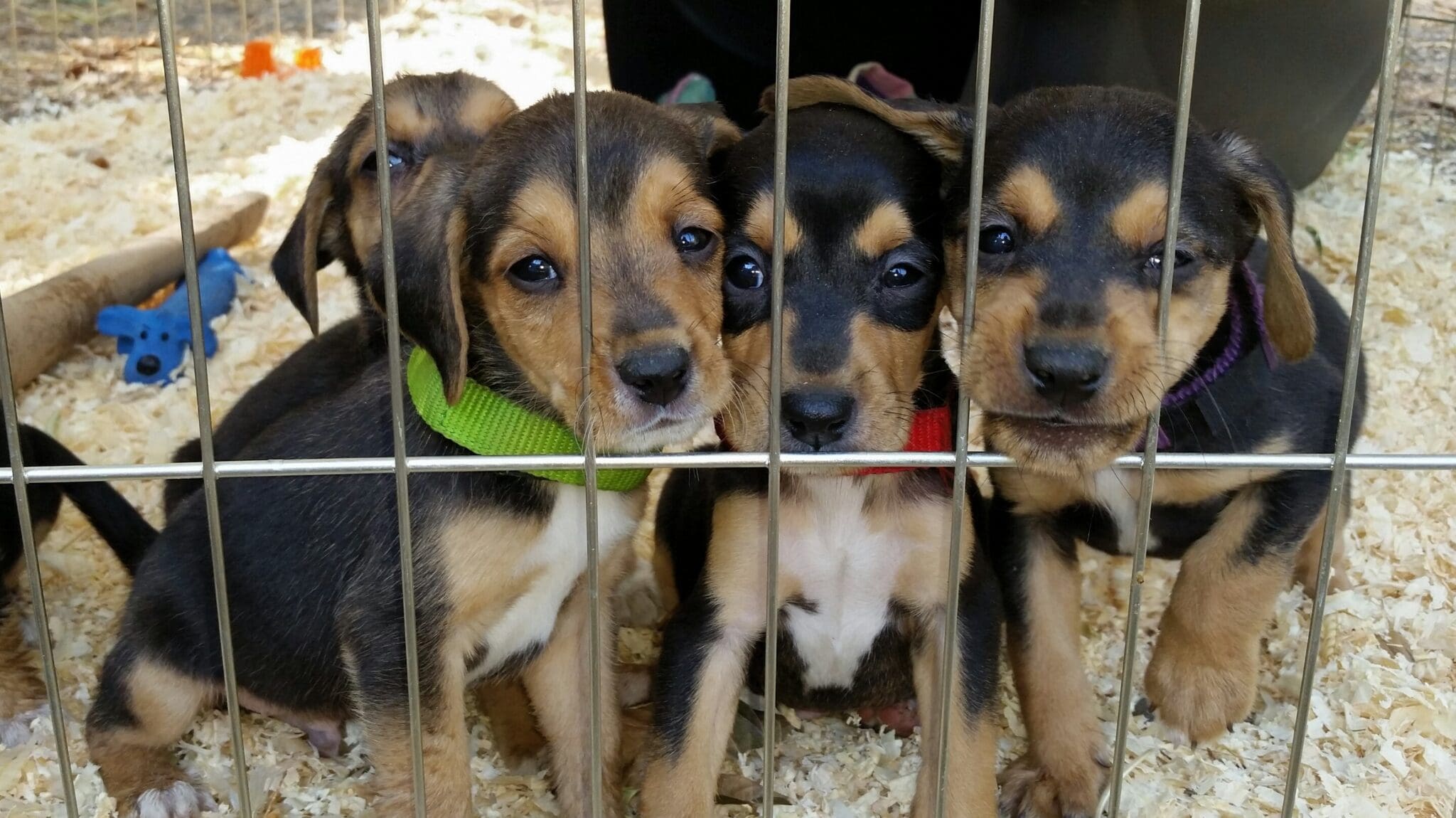
And no, I’m not yet a foster failure, though many of my friends think it’s about to happen, because I’ve been fostering a litter of the most adorable puppies for almost a month. I tell them all, “Blech! I hate puppies! Who in their right mind would want a puppy?” – another joke.
I’m a member of several online groups that rescue various types of dogs, and I see the “foster failure” term bandied about quite frequently. Many people sheepishly announce themselves as foster failures, and other people congratulate them for finding a great dog. And of course, they should be congratulated; it’s terrific when a dog finds a forever home – it’s the goal of every good shelter and rescue group, to find good homes for dogs. But people like myself who foster regularly probably also experience a twinge: crap, another good foster family lost to the group!
Ask any shelter or rescue: It’s really hard to find people who have homes with solid, dog-proofed homes and yards, and who possess enough experience with dogs to improve just about any dog’s behavior, confidence, and emotional connection to humans. It doesn’t do the rescue group much good to foster dogs in homes with people who don’t know how to properly help a dog learn to sleep in a crate, or who panic if their foster ward starts resource-guarding high-value items, chases their cat, or growls at their guests. Good foster guardians need to have enough experience to be able to deal with these behaviors calmly and guide the dog to better behavior in a positive manner. It helps if they already have well socialized, well-behaved, friendly dogs, as well as reasonably secure fences and homes and yards that can take some exuberant (or anxious) dog play.
It’s the same thing I tell people I meet when I volunteer at my local shelter: Yes, it’s hard to see all these dogs here, but no, I don’t want to take them all home; I want to SEND them all home! The most dogs I can legally have living in my home (as per my town’s codes) is three; but honestly, that’s also the number I can properly afford, when you take everything (routine and emergency costs) into account. I have two dogs already; if I had just one more, I probably wouldn’t be able to afford to ever foster. But if I limit myself to owning two dogs, I can foster and (I hope) place five or six well-behaved dogs per year in homes with family members, friends, and friends of friends. And this year, perhaps even more (given the fact that I hope to be able to place all six of my foster puppies in homes with friends or friends of friends. (Friends, you’ve been warned!)
So while I can’t say I won’t ever fall in love with a dog I foster and become a “failure” myself, I hope it won’t be soon!
Before I became a mother, when I met difficult children, I imagined their unpleasant behavior was a result of how they had been parented. In other words, I usually blamed the parents and credited parents with doing a great job when I met kids I liked.
Then I became a parent, and through close observation of my son and his closest friends, gradually realized that actually, kids are largely who they are when they are born. Sure, you can mold them to a certain extent, and teach them good manners (or bad). But many aspects of their personalities transcend basic behavior modification.
For example, even as a toddler, my son was careful – he had a highly developed self-preservation instinct – and even though today he’s a world-class athlete, and no stranger to physically demanding (and sometimes pain-inducing) feats of athleticism, he’s still danger-averse. I think he’s always has been and always will be a careful person; I’ve never worried about his driving recklessly or diving into shallow rivers or drinking too much alcohol. And I had nothing to do with encouraging or discouraging this trait.
I’ve spent almost four weeks with a fostered litter of six puppies, and the experience has confirmed what I’ve long suspected: that the same phenomenon is true of dogs, too. These pups all have different “personalities” – a controversial word in animal behavior circles, but the only word that seems apt to describe the individual quirks and traits that the pups display.
I can now tell my puppies apart, but when I first got them, I ordered a set of Velcro-fastened color-coded collars, so I could keep the pups straight. The collars were also a useful tool for the shelter vet tech, so she could keep of the individual puppies weights and medication (they have been receiving antibiotics for a respiratory infection). This is what I know about the puppies now:
Red-collared puppy: Highly confident and curious. Pays more attention to what humans are doing than to what his brothers are doing, and if he has to choose, will follow the human. Always wants to be in your lap, or on your shoe, or touching you somehow, and he’ll kick up a fuss for the longest when all the puppies are locked in their pen. (By the way, this is the puppy who I accidentally kicked a week ago, and thank goodness, after three days of holding up his right back leg, he started putting more and more weight on it, and now he seems perfectly fine again.) I think this puppy is going to do best if he’s placed with people who want a close relationship with their dog.
Blue: Another very confident dog, but less curious about humans than Red. He dives into any game of tug-of-war, grabs for any toy that any other puppy has. He isn’t one to dive into your lap, but if you pick him up, he cuddles and seems to really enjoy attention and petting. He quickly accepts his situation, whatever it is: confinement in the puppy pen, immersion in a bath, the end of a meal. He seems like he’s going to thrive in any type of home.
Teal: The most independent puppy, and perhaps the smartest but not necessarily in a way that is likely to result in being well-trained. He was the first to figure out that if he followed humans or the other puppies to the puppy pen, he was going to get locked up, so he stopped following anyone to the pen. When I call all the puppies, he never just runs to me like the others do; he watches to see why I’m calling. He totally gets the concept of the potential for not-fun consequences. He’s also the bravest, though, and perhaps the toughest. He is super mouthy, and if I feel a puppy latched onto my shoe or pants leg a puppy who won’t let go I don’t even have to look to know it’s him. I think he’d make a heck of a military or law enforcement dog.
Purple: This puppy is into absolutely everything. If he hears a novel noise, he drops what he’s doing to immediately seek out the source of the noise. If he hears a squabble between the other puppies, he runs to jump into the fray. If he sees another puppy with an interesting-looking item, he grabs it to investigate it with his mouth. Usually, his brothers seem to be more interesting to him than humans are, but he’s not averse to being picked up and held and cuddled, for a minute or two, anyway. Then he’s off to the next adventure. He’d thrive in an environment that was active and stimulating; his owners are going to need to be interesting if they hope to capture and hold his attention.
Green: Absolutely the most affectionate, human-centered puppy. He actively seeks out eye contact with people, and wags his tail with happiness when a humans gaze falls on him. He watches humans constantly and will always choose human attention over a game with his brothers. He’s just so, so sweet with humans. If I watch him out the window, however, I see that he plays nicely with the other pups, unlike the next puppy, and the one that most resembles him: Pink.
Pink: This puppy is almost always off doing his own thing. Like Teal, he’s independent, but not in a bold, brave way, more in a ”Leave me alone, I’m happy by myself” way. He’s shorter and fatter than the other pups, and not as physically rough-and-tumble. He will play tug or wrestle with another puppy, unless the other gets too intense; at the first bit of pain or discomfort, he abruptly quits and waddles off to find something else to do. He neither seeks out nor avoids human cuddling and petting; he’s sort of indifferent about us, except at meal times. I wouldn’t worry about this puppy developing separation anxiety if his people worked long hours; I think he’s a content kind of guy who can find things to fill his time.
Maybe this is all hopeless anthropomorphizing – but I don’t think so. And I think that good breeders are highly aware of the differences in their puppies’ personalities, and take pains to match puppies to families or individuals where the pups’ traits will be appreciated and perhaps even well-utilized, as opposed to resented or punished; they don’t send just any puppy to any person with a check for the purchase amount. Although I’m not a dog breeder, I hope to do the same! Although each of these pups will be officially adopted from my local shelter, I hope to find adopters first, without having to actually send the pups to the shelter kennels. If you know someone in Northern California who is looking for some sort of hound/perhaps Beagle-mix, let me know! I’ll do my best to match them with a puppy that would best suit them.
I assume that most Whole Dog Journal readers are as upset as I am when I see someone treating a dog badly. What should you do when you see someone being rough with their dog? Hard as it may be, I urge you to be calm and take several deep breaths before you act. Then . . .
1. Assess the situation.
Calmly take a good hard look at what’s going on. Does the human appear to be someone who is simply trying to train his dog using outdated methods and who might be receptive to your assistance? If the person is applying hard yanks on a choke chain or prong collar, or blithely pressing the remote button for a shock collar, they are probably simply following the instructions of an outdated dog training professional and may not know that there is a far superior way to communicate with their dog. If, however, you see someone who has lost his temper and is deliberately abusing his dog, hanging, punching, smacking the dog repeatedly, or worse, this person probably won’t take kindly to your intervention and might just as easily redirect his anger onto you. If this is the case, you need to use extreme caution. The action you take will depend on your careful assessment.
2. Evaluate your options.
If it appears that the dog handler may be amendable to your suggestions, you might approach in your best helpful, non-threatening manner as a fellow dog lover, and offer to assist. If, on the other hand, the handler appears emotionally aroused and dangerous, I wouldn’t recommend approaching or confronting him. If the dog abuser appears violent or unsafe, a better option is to call the authorities.
3. Look for backup.
Regardless of how you proceed, look around for another person who can watch out for you when you step forward. It never hurts to have support; there is safety in numbers. Let your back up person or people know what you intend to do, and agree on a signal you will give if you want them to step up in a show of support or call 9-1-1. Ask them to otherwise stay quiet unless you ask for help; catcalls from the peanut gallery won’t help keep the situation calm and positive.
4. Carefully Intervene.
Approach the dog handler with a low key introduction; something like, “Excuse me, but I have a dog myself (or “I’m a dog trainer”), and if you’re willing, I would love to show you a different way to do that, a way that worked really well for my dog (or “works really well for my clients”).” If the person is receptive, you can coach him through a simple positive reinforcement exercise (you may have to provide the treats, if you have them – another good reason to always have dog cookies in your pockets!), and then explain how the exercise applies to what he was trying to get his dog to do.
Or, if the dog is friendly, you are confident in your abilities and the person is willing, you can take the leash and demonstrate one or more positive behaviors. Then leave the person with some good resources – local positive trainers, books, Facebook pages, Yahoo groups – so he will be more likely to pursue more dog-friendly training with his dog. (Consider keeping a one-page handout of dog-friendly training resources for times like this.)
5. Stay out of it and call the authorities.
If you think the treatment of the dog rises to the level of prosecutable or near-prosecutable abuse, or the person seems dangerously angry, don’t even think of attempting to intervene. If the handler is hanging, punching, slapping, kicking the dog – or worse – step back and call for help. Don’t worry about looking up the number for animal control, just call 9-1-1 and let them take it from there.
If you are carrying a cell phone with video capabilities, and you are at a safe distance, record as much as you can. Unless your support group consists of several large, strong guys who eat animal abusers for breakfast, you don’t want to risk getting yourself beat up in your humanitarian crusade. Do know that if the case is prosecuted, you may be called to testify in court against the abuse. Be willing to bear witness.
Arresting animal abusers was one of the most satisfying aspects of my 20-year career as an animal protection professional/humane officer. I have to say that, notwithstanding my own advice above, I might be hard-pressed to stop myself from physically intervening if I saw someone violently abusing an animal. I’m not saying you should, mind you, but I would understand if you did!
Pat Miller, CBCC-KA, CPDT-KA, is WDJ’s Training Editor. Pat is also the author of many books on positive training.
Deworming agents are present in any number of prescription and over-the-counter treatments for dogs and puppies. If your dog shows signs of a gastrointestinal worm infestation, there are all sorts of products available that are made exclusively to rid dogs of various types of worms. But there are also deworming agents included – whether they are needed or not – in many flea and tick treatments and in most heartworm preventive drugs; in fact, it’s sometimes hard to find a minimalist flea treatment or heartworm preventive drug that does not contain dewormers. The question is, is this really necessary? Are intestinal parasites that much of an ongoing threat to most dogs – and their owners?
Yes, many of the worms that can infect dogs are zoonotic – that is, they can infect humans, too. (See “Which Worms Can Infect You or Your Human Family?” on page 10.) Now that we have your full attention, let’s start with a description of the most common gastrointestinal parasites that can infect dogs.
Roundworms
Ascarids, more commonly known as roundworms, are the most frequently detected parasite in dogs. The most common species is Toxocara canis, probably because it has the most strategies for infecting dogs of any of the internal parasites, and because the females are such prolific egg-layers (a single worm can lay 100,000 to 200,000 eggs in a day). Toxascaris leonina, another ascarid species, is found less commonly.
Typically, roundworms live in the small intestine, though their larvae may migrate and “encyst” – become walled off and inactive, sometimes for months or even years! Adult worms are usually 3 to 4 inches long, although some T. canis roundworms can be up to 7 inches. Seen in cross-section, they are indeed round and resemble thin spaghetti noodles. Occasionally, adult worms will be expelled in the feces (and more rarely in vomit), but it’s generally the eggs and larvae that are expelled and pose an infection threat to other canine hosts.
Roundworm eggs can exist in soil for years, making them a persistent threat. The parasite is found in every part of North America.
Roundworms can steal much of the beneficial content of what you feed to your dog, absorbing nutrients in the dog’s small intestine and interfering with digestion. Dogs who host only a couple of roundworms may display no symptoms at all, but dogs (and especially puppies) who are more heavily infested may be thin, with prominent shoulder, spinal, and hip bones framing their found, swollen bellies. Their coats are usually quite dull and their energy levels are low and lethargic. They may suffer from diarrhea or constipation, gas, and/or vomiting. Very severe infestations can actually block the intestines and cause the death of their host.
Almost all of the anthelmintic (worm-killing) agents that treat roundworms are effective against only the adult worms living in the dog’s digestive tract; encysted or migrating larvae won’t be harmed by deworming preparations. This makes a good case for occasional treatment with an appropriate deworming agent.
Hookworms
There are actually three species of this nasty parasite commonly infecting dogs in North America: Ancylostoma caninum (canine hookworm), Ancylostoma braziliense (canine and feline hookworm), and Uncinaria stenocephala (Northern canine hookworm). They have notably different geographical concentrations, however; A. braziliense is found in the southeastern part of the U.S. in twice the prevalence it is found elsewhere, and U. stenocephala is found more commonly in northern climates.
Despite their small size (adults are just 1/2 to 3/4 of an inch long), hookworms are highly destructive parasites. Their name comes from a description of the mouth-parts they use to attach themselves to the wall of the dog’s small intestine and feed on his blood. Their aggressive feeding habits can cause obvious evidence of disease in a fairly short time, including anemia and serious diarrhea.
Hookworms produce an anti-coagulant that prevents their feeding sites from clotting and healing, so their hosts lose more and more blood as the infection progresses. The chronic bleeding causes the severely infested dog to produce black, tarry stools and grow weak. His coat will become rough. Puppies’ growth will be stunted. Without treatment, dogs with heavy infestations may become emaciated and die.
Hookworm eggs are expelled in the dog’s feces, and develop into infectious larvae in two to 10 days. Hookworm larvae are extremely aggressive survivors; they can travel in any moist environment (rain-wet or dewy vegetation) and swim in water.
This parasite also uses a variety of methods for entering its host. Dogs can become infected by ingesting larvae-contaminated food, water, vegetation, insects (including cockroaches!) or rodents; or by coming into skin contact with larvae (the larvae can burrow through the skin and migrate through the dog’s tissues). Puppies can become infected in utero (as larvae migrate through the mother’s tissues into the developing fetuses) or through an infected mother’s milk. Larvae that migrate through the dog’s body sometimes become encysted in muscles, fat, or other tissues and this can cause pain and discomfort.
Hookworms pose a special diagnostic problem; infections are generally detected via examination of a fecal sample from the dog for the presence of worm eggs. But hookworms can cause serious disease in puppies before the worms are old enough to produce any eggs. A diagnosis of hookworm infestation may have to be made from the observation of disease, rather than a fecal examination.
Whipworms
Canine whipworms (Trichuris vulpis) are found all over the world, and though their infections are much less likely to cause observable symptoms of ill health in a dog, a really severe infestation can cause bloody diarrhea and weight loss. They are not nearly as prolific reproducers as roundworms, with the adult females producing a much smaller number of eggs and much more intermittently. However, these eggs are extremely resistant to dessication (being dried out), extremes in temperature, and ultraviolet radiation; they can remain viable in soil for years.
Dogs are infected by eating whipworm eggs that are present in feces or in soil, or on plants that came in contact with contaminated feces. Larvae hatch from eggs in the small intestine and move into the cecum (the first part of the dog’s large intestine) as they mature into adult worms. The adults are rarely expelled into the dog’s stool, so the worms are seldom seen, making it more difficult to diagnose a whipworm infestation.
Adult whipworms are much smaller than roundworms, only about 11/2 to 3 inches long. The “head” end of the worm is threadlike and thin and the tail end is thicker; so the sum effect is that of a long-lashed whip with a sturdy handle.
The adults consume blood, tissue fluids, and tissue from the cecum’s mucosal epithelium; their feeding habits can trigger inflammation in the cecum, resulting in the overproduction of intestinal mucus, which can be observed in the feces of their host.
Tapeworms
There are two major types and at least 10 species of tapeworms that infect dogs in North America – so many that we won’t bore you with all the names of them. They are considered ubiquitous wherever there are flea-infested dogs, but their prevalence isn’t calculated like the other intestinal parasites, because they can’t be reliably detected (and their incidence quantified) through fecal examination or fecal floatation tests.
Adult tapeworms live in the dog’s small intestine, where they hook onto the walls of the intestine. Unlike hookworms, however, they do not feed on the dog’s blood; they absorb nutrients through their skins (robbing the dog of nutrients in its diet) like roundworms. They can be 6 inches or longer, but few ever see them in this long form, because they grow in “segments” that emerge from the worm’s “neck” area, with older and older segments being pushed toward the worm’s tail. Each segment is about the size of a grain of rice and contains a complete set of organs, but as the segments mature, all but the reproductive organs deteriorate. These older segments at the end of the worm eventually transform into a sac of eggs and then separate from the body of the worm; they then are expelled from the dog in its feces.
While these worms cause the least harm to the dog of any of the parasites mentioned here, they often alarm dog owners the most, due to one simple fact: most owners will be able to see (and be horrified by) tapeworm segments that have emerged from their infested dog. The segments often stick to the hair and skin around the dog’s anus, and upon close examination, can be observed to be moving! Many a startled owner has called her veterinarian to report that her dog has “maggots” on its bottom, only to learn these are tapeworm segments.
Tapeworms can infect the dog in one (weird) way only: they require an intermediate host. Fleas are the usual intermediary, but lice can be, too. Larval fleas (or larval lice) consume the eggs that emerge from tapeworm segments (remember that they are nothing but egg sacs by the time they are expelled from the dog), and the eggs start to develop into tapeworm larvae inside the developing flea or louse.
The tapeworm larvae uses the flea like a Trojan horse; it gets into the dog inside a flea! Dogs accidentally (or incidentally) consume fleas when they groom themselves (or chew themselves to relieve an itchy flea bite). Long story short: your dog can’t become infected with tapeworms unless he’s exposed to infected fleas.
Tapeworm eggs don’t often show up on a fecal flotation test, even if a dog is heavily infested with adult tapeworms, because the eggs generally stay contained in the segments until those egg sacs break open, which may take days after the segments passed out of the dog and his feces. But the presence of a tapeworm segment on or around a dog’s anus is a clear sign that he needs anthelmintic treatment.
Taking Action
Now that you know the players, how do you stop the game?
Thirty years ago, the prevalence of these intestinal parasites was two to three times what it is today. In decades past, dogs were routinely dewormed only as puppies, or if they developed obvious signs of an infestation and their owners sought veterinary attention. Today, with anthelmintic agents included in so many products that are administered for control of other parasites (such as flea, tick, and heartworm preventives), the overall incidence of intestinal worms is much lower in the overall population of North American dogs.
That said, many dogs originate from or are raised in circumstances where little veterinary care is given. Dogs who are rescued or purchased from crowded and/or neglectful homes, shelters, hoarders, or puppy mills will almost certainly be infested with every known variety of intestinal parasite. Puppies who were born to dogs from those circumstances will also be infested and require several treatments to be rid of worms.
There are a lots of anthelmintic products available to dogs owners; there are products that you can buy over the counter, and drugs that require a veterinary prescription. There are products that are targeted to treat intestinal worms only, and combination products that also control external parasites and/or prevent heartworm. (For more information about heartworm prevention, see “Sick at Heart,” WDJ July 2011.)
What kind of treatment you use should depend on your dog’s age and health. Treatment will need to be repeated at certain intervals, depending on the parasite. Most anthelmintics affect only the adult stage of worms; repeated doses (usually in about three weeks, and again in two to three months) will be needed to eliminate any worms that were present in the dog in larval stages and unaffected by earlier treatments.
If specific intestinal parasites have been identified in your dog, it’s wise to use agents that are specifically indicated for those worms, rather than relying on broad-spectrum treatments.
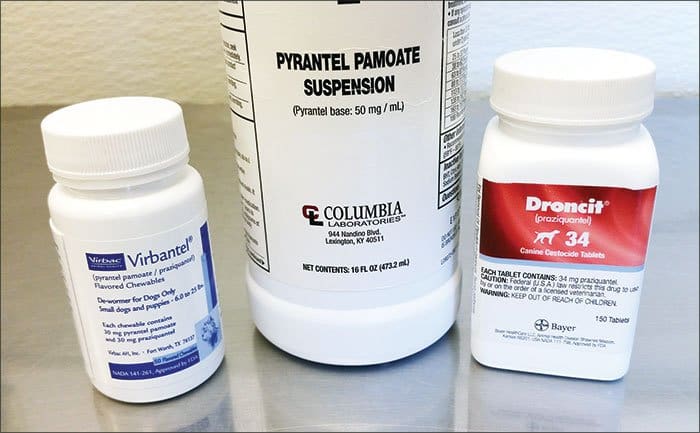
As just a few examples, milbemycin oxime and moxidectin are included in a number of heartworm preventive drugs, and are also credited with effectiveness against roundworms, hookworms, and whipworms; pyrantel pamoate (the “plus” in Heartgard Plus) is effective against roundworms and hookworms only. But we’ve heard of dogs who have routinely received these heartworm preventive drugs and still were diagnosed with severe intestinal parasite infections.
There’s also the issue of the dog getting reinfected, especially if your dog eats feces, frequents areas where the soil has been heavily contaminated (such as dog parks), and/or if your yard was previously contaminated by neglected dogs. Environmental decontamination can be difficult, and the eggs of some of these parasites can persist for months or even years in the ground. Regular fecal exams (and treatment) for dogs in these situations are recommended.
Natural Deworming Remedies?
People who strictly adhere to “natural” dog-raising practices often eschew veterinary deworming agents in favor of traditional remedies such as wormwood (artemisia), black walnut hulls, ground pumpkin seeds, food-grade diatomaceous earth, and others. In the view of many experienced holistic veterinary practitioners, however, some of these remedies turn out to be more toxic – more dangerous to dogs! – than conventional veterinary treatments. They may be ineffective as well, especially if non-toxic doses are used.
And while it’s true that a healthy dog, fed a superior diet and living in a clean, healthy environment, should have the benefit of a robust immune system response to help combat parasitic invaders, parasites, too, are capable of being quite robust. In our opinion (and that of many holistic practitioners) counting on the unverifiable “strength” of your dog’s immune system to prevent intestinal parasites is asking for trouble.
The natural approach may seem to prevent worm infestations in healthy, well-cared-for adult dogs who were produced by well-cared-for mothers, but the truth is, the incidence of worms in that lucky (and minority) population is bound to be low no matter what. Treatment of existing infections and prevention of reinfections in vulnerable dogs and puppies should be undertaken by more reliable, conventional anthelmintic agents.
“Fecal Float” Tests
Most intestinal parasite infestations are diagnosed by examining a fecal sample from the dog. Sometimes, adult worms (or in the case of tapeworms, worm segments) can be readily identified in the poop itself. More frequently, however, veterinarians perform what is called a “fecal flotation” test. The feces is mixed with a solution that causes any worm eggs present in the sample to float to the top; sometimes, the mixture is also spun in a centrifuge, to concentrate any eggs present. A sample of the floating material is then examined under a microscope.
If any eggs of any intestinal parasites are present in the sample, they are readily identifiable in a microscopic view. However, a dog may be heavily infested with worms that are not yet old enough to produce eggs (this is especially true in young puppies), or the sample may have been taken on a day when the worms did not produce eggs. Some worms produce only small numbers of eggs and only infrequently. For these reasons, many veterinarians recommend periodic “fecal float” tests – more frequently when a dog is young, and especially if the dog shows signs of a heavy worm burden upon physical exam (including a thin, pot-bellied body condition; poor coat; or persistent lethargy).
Which Parasites Can Infect Humans?
Roundworms: Humans can become infected by unwittingly ingesting infective eggs. Roundworm eggs can build up in the soil where infected dogs eliminate. Infection can result if you get these microscopic eggs on your hands (say, by getting dirt on your hands in the process of doing yard work), and then eating something with your hands.
If you become infected with roundworm larvae, you can develop a condition called “visceral larva migrans” – severe inflammation caused by the migration of the larvae through your tissues. Signs of this disease include an enlarged liver, intermittent fever, loss of weight and appetite, and a persistent cough. Asthma or pneumonia may also develop. “Ocular larva migrans” is a condition caused by roundworm larvae migrating through a human’s eye, causing partial or complete loss of vision.
Hookworms: Humans can much more easily become infected with hookworms than roundworms, due to the hookworm larvae’s ability to migrate through skin (such as bare feet or hands) into tissues. As with roundworms, the migration of hookworm larvae through human tissue can cause a serious inflammatory condition known as cutaneous larva migrans.
Tapeworms: Humans can become infected by tapeworms, but it takes some doing; just as with dogs, a human has to ingest a flea that is infected with tapeworm larvae in order to become infected himself.
Preventing these infections is relatively simple:
Periodically treat your dog for intestinal parasites. If your dog eats dog and/or cat poop, treat him for parasites regularly.
Pick up dog feces in your yard frequently. It would be ideal if you could pick up and dispose of your dog’s poop immediately after he eliminated; this would minimize the chances of any worm eggs or larvae lurking in your yard.
Wash your hands. A lot! And especially after being in any environment where lots of strange dogs have eliminated. And before eating, any time you’ve been around soil where dogs have been. Don’t ever eat food with your unwashed hands in a dog park, for example.
Avoid bare skin contact with ground where dogs eliminate. We’ve been to plenty of dog parks and off-leash areas and witnessed people (worse, small children) walking barefoot – yikes! Remember, hookworm larvae need only skin contact in order to migrate into your body.
Protect your dog from fleas. And treat him for tapeworms (and fleas) immediately if you see tapeworm segments on him or in his feces.
We currently have three dogs. We lost our Scottie a few months ago to cancer, and our Australian Shepherd last year to old age and failing health. This is the fewest number of dogs we’ve had in our family for as far back as I care to remember, and while I grieve Missy and Dubhy’s absence every day, a part of me feels some guilty relief that the canine chaos and caretaking load has lightened somewhat. Still, while I know it won’t be for a while yet, another part of me contemplates the next potential pup-addition to the Miller pack . . . which leads me to contemplate the complexities and challenges of bringing home a new dog.
However, as much as you would like to run out and go look in shelters and at online photos of candidates being fostered by rescue groups, you should consider some other individuals – namely, the dog (or dogs) you may already have at home, and your human family or housemates.
A dog for the dog?
Lots of dog owners are convinced they are getting another dog, at least in part, as a companion for the current dog – or dogs. Don’t kid yourself on this one. While some dogs do enjoy the company of their own kind, many would just as soon not share their beds, bones, and humans’ attention with another canine resident. Be clear that if you are getting another dog, you are getting it for yourself (or for other human family members), and it’s an added bonus if your current dog and the new one end up becoming bosom buddies.
A couple of years ago, Scooter, our now-13-year-old Pomeranian, made it quite clear he wasn’t in favor of adding any more dogs to our family; the presence of our most recent foster, a high-energy young Terrier mix, elicited a bout of hemorrhagic gastroenteritis (yes, it’s as bad as it sounds) in the older dog. Cricket wasn’t even living in the house – he was kenneled in the training center and joined us for barn chores and hikes around the farm, but even that was enough to cause Scooter’s severe stress-induced gastrointestinal disaster. Cricket had to be dismissed from barn duty, while Scooter opted out of the hikes. Scooter now also suffers from a collapsing trachea, another life-threatening condition (common in small dogs) that is exacerbated by stress, so a new Miller dog is definitely out of the question for the time being.
Scooter aside, our 11-year-old Lucy (Cardigan Welsh Corgi) and 10-year-old Bonnie (Scorgidoodle) might tolerate a canine addition, but neither one is begging for a puppy for Christmas. They are tolerant of doggie visitors to the farm, but are happier keeping to themselves if given the choice. Lucy has never been one for sharing with other dogs anyway, and her well-managed resource-guarding tendencies don’t need the stress of a new canine competitor.
Evaluate your own home dogs before blithely adopting another. Do they welcome canine visitors with open paws? In that case, your wise selection of a new furry family member should go relatively smoothly, especially if you do careful introductions. If, however, they are less than enthusiastic about entertaining visiting dogs, know that if you chose to increase your hound numbers, at best it may take some skillful orchestration to create a harmonious household, and at worst you could be creating a nightmare.
The people’s choice
You also need to make sure all your human family members are in favor of adding another dog to the group. It’s not fair to your dogs to put them in the center of controversy if one or more family members are opposed to the idea. You will need the enthusiastic support of all household members to ensure you won’t be pushed by inter-family drama to return the new dog to the shelter. That’s not fair to anyone, least of all the dog.
Think It Through
If you decide that your dog (or dogs) and family are all ready to bring another dog into the mix, consider these additional factors as you start your adoption search:
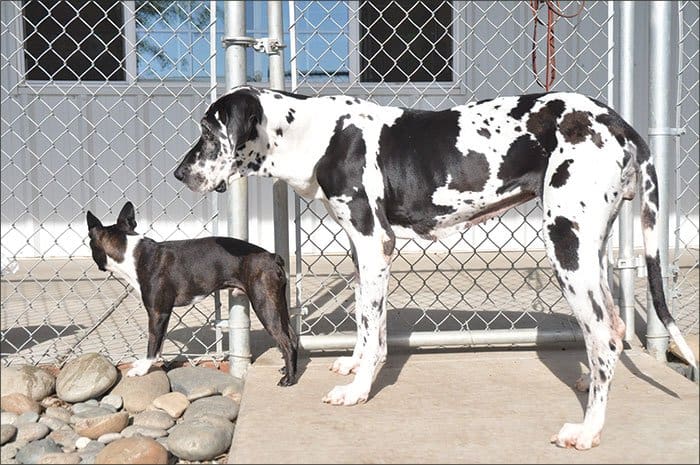
Size of the new dog – This is not an absolute, but think carefully before setting up a multi-dog family made up on individuals with a significant size or substance disparity. Scooter, at 12 pounds, lived happily with 45-pound Missy – but Missy was eight years old when we adopted her, well past those puppy or adolescent bursts of energy that might have stressed or injured the smaller dog. The greater the size difference, the greater the possibility that the smaller dog might get hurt, either during too-rough play, a dog-on-dog altercation, or even in a tragic moment of predatory drift (in which the larger dog suddenly perceives the smaller running dog as a prey animal such as a rabbit or a cat and chases or grabs it).
Age – It’s true that a mature dog can be rejuvenated by the addition of young-dog energy. It’s also true that a high-energy youngster can make life miserable for the senior dog who just wants to lie on his rug in the sun and enjoy his golden years in peace and quiet. There are lots of homeless adult dogs in shelters and rescue groups, so if you have older dogs already at home, consider adopting another senior or at least middle-aged dog, rather than subjecting your old-timer dogs to puppy biting and body-slamming.
If you do opt for a younger dog, then you owe it to your seniors to protect them from the unwanted attentions of a pesky puppy. Also, if required to defend themselves from unwanted puppy persistence, older dogs can become defensively aggressive, and teach the puppy to become aggressive in return. So, find an appropriate playmate for the youngster, one who appreciates endless games of high-speed-chase-around-the-yard, and manage your home environment with closed doors, tethers, crates, exercise pens, and baby gates to maintain the domestic tranquility.
Personality –Take your dog’s (or dogs’) personality quirks and traits into account, and try to adopt a new dog with a personality that will mesh well. Our Lucy is a very assertive, possessive herding dog, while Bonnie is super soft and appeasing. They do well together. Bringing another assertive dog into the mix could spell trouble; there would likely be serious clashes with Lucy.
And don’t discount your own personality! If you have a Bonnie-style soft and deferent home-dog, bringing a bossy Lucy-type dog into the family could be upsetting to you – as you see your sweetheart getting pushed around by the newcomer (even if the sweetie doesn’t seem to mind). If you already have one dog who is a real attention hog, you might take pains to adopt one who isn’t so needy, so they aren’t trying to push each other off the sofa to snuggle with you. If you have a dog who is sound-sensitive, avoid adopting a dog with a strong propensity to bark. You get the idea!
Play Styles – Energy levels aside, different dogs have different play styles. Some like to play chase, some like to wrestle and do “chew-face.” Some are body slammers, while others eschew physical contact. Some like to dance around the action and cheerlead, while others are “fun police,” trying to break up the action if two or more dogs are playing roughly. Your prospects for pack harmony are much greater if you look for a new addition with a play style that is compatible with one or more of your current dogs.
Gender –This can get tricky. The world over, there are male dogs who get along with males and females, sterilized or not, and females who get along with both genders, sterilized or not. Yet many rescues and shelters flat out refuse to adopt a female to a home where there is another female, on the supposition that female dogs can’t get along.
Hogwash! . . . to a point. For the past 30-plus years, my husband and I have had three to five dogs at a time, all combinations of genders (albeit all spayed and neutered), and for the most part they’ve gotten along beautifully. That said, when there are problems, conflicts between females tend to be more intense, longer-lasting, and harder to manage and or modify than male-male or male-female problems. Even in our own household, the most challenging relationship we’ve had was between Lucy and Missy. Still, this seems like a poor reason to rule out all female-female adoptions. If you have a difficult female at home, then, yes, a male is probably a better choice. Absent that, take it on a case-by-case basis and look for a dog who is compatible with your dog(s), regardless of gender.
Breed –Breed doesn’t matter much, other than taking breed propensities into consideration as you consider the previously listed factors (Labs tend to be high-energy body-slammers; the herding breeds tend to dislike other dogs getting in their space; St. Bernards are large; Chihuahuas are small, etc.). The individual’s personality is more relevant than the breed propensity, because there are Labradors who are soft and gentle, and you can find Border Collies who are happy to share their space. You may have breed or breed-mix preferences yourself, and that’s just fine – by all means, indulge. But don’t rule out a dog on the basis of breed norm alone; sometimes, the candidate in question is the outlier.
Careful Introductions
So you’re taking the plunge. You really want another dog and you’ve decided your current dog-loving canine pal(s) really would appreciate a companion – or will at least tolerate an addition with reasonable good graces. You’ve picked out a dog at your local shelter and done initial introductions there that went well. You’re ready to bring the new family member home. The way you do so can make or break future relations between the newcomer and your home dogs.
First, make sure all dogs are well exercised before they meet. Take your current dogs for a good hike in the woods, or a run at the dog park, or at least play a good solid round of tennis ball or Frisbee before you go to fetch the newbie. If you live in the city and don’t have access to woods, dog parks, or fenced yards, do whatever serves for exercise for your dog(s): jogging on the treadmill, chasing a toy down the hallway, or jumping over broomsticks in the living room.
Next, arrange to do introductions one at a time. Allowing multiple dogs to mob the new one can literally scare the pee out of him, and the trauma can damage his future relationships with the group. My preference is a neutral fenced yard, but absent that, your own yard will serve the purpose.
It’s is hugely helpful to do introductions outdoors; indoors, your new dog can feel trapped, and your home dogs are more likely to feel possessive or territorial. If you don’t have a yard, find a friend who does, or arrange to borrow some other neutral space. You may be able to set up the meet and greet at your favorite dog professional’s training facility – and get some expert guidance as well.
Dog Introduction Scenario #1 – All Goes Smoothly
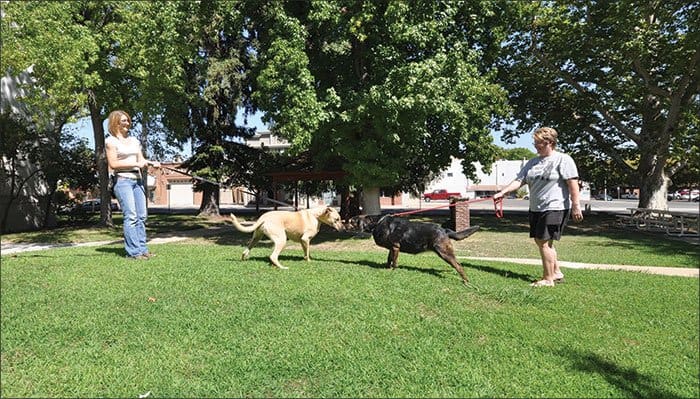
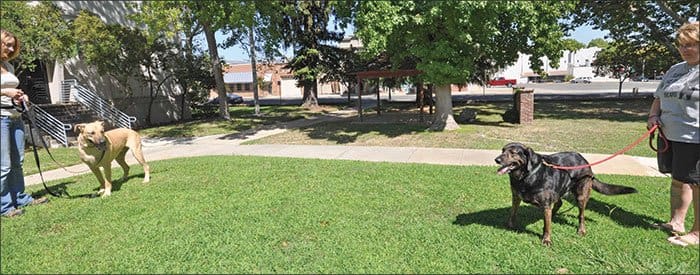
Position one of your current dogs at the far side of the yard, on leash, with the leash held by a reasonably knowledgeable dog person, and your other dogs where they can’t see/won’t get aroused by the sight of a new dog. I like to start with the dog whom I think will be the easiest and friendliest, to build confidence in all participants.
Bring the new dog into the gate, on leash. Let the dogs see each other, and calmly approach. If one or both get aroused, stop and encourage them to settle and relax before coming closer. You may need to use high-value treats to get them to think about something other than the exciting presence of the other dog.
As long as their body language looks affiliative (i.e., friendly, “I’d like to get to know you!”) and the dogs are reasonably calm, continue closing the distance between them until they are eight to ten feet apart.
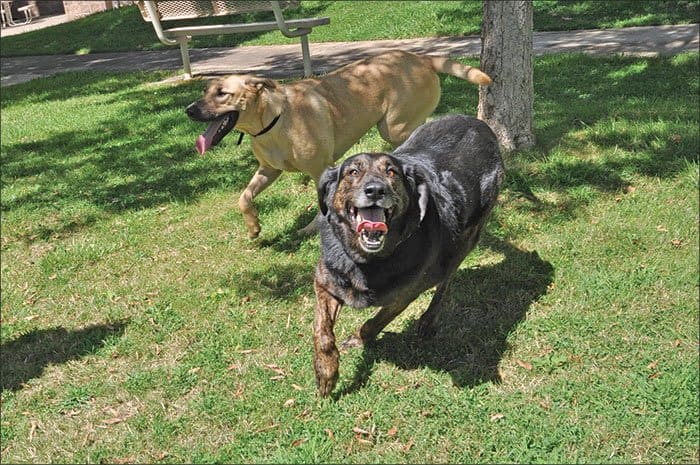
Assuming both dogs still look friendly and happy, drop both leashes and let them meet. Dropping the leashes allows the dogs to meet and interact naturally, increasing the likelihood of a positive interaction. Leashes held by humans interfere with normal canine social signals, and may cause one or both dogs to send tension signals they don’t intend. Leaving the leashes attached for the first few moments (but not held by a human) allows you to separate the dogs more easily and safely if things don’t go as well as you had hoped.
After the dogs interact appropriately for a moment or two, gather them up, remove the leashes, and let the two dogs interact for another five to 10 minutes. Then remove home-dog #1 and leash the new dog. Repeat the process with your next home-dog, until all of them have met. Then start over in groups of threes: two of your current dogs (again, include the two who are most likely to interact well) and the new dog.
Depending on your household, you may be able to integrate all the dogs on the first meeting, or you may decide that discretion is wisdom, and spread the introduction process over several days. If you do this, you will need steadfast management systems in place to avoid accidental introductions in less-than-optimal conditions. Once everyone has met and all are getting along you can take a deep breath, relax, sit back, and get on with life.
Dog Introduction Scenario #2: More Tension Than You Would Like
If at any time during the approach-on-leash part of your introductions you see a level of tension or arousal that makes you uncomfortable, slow down the process. Increase the distance between the two dogs and do some parallel walking, with both dogs and handlers walking in the same direction. Maintain the increased distance, with handlers on the inside, dogs on the outside, so the humans act as a buffer between the dogs. If tensions seem to subside, you can gradually decrease the distance between the dogs. It may be necessary to take several lengthy parallel walks over a period of several days before the dogs are ready to meet off leash. Meanwhile, you may be able to proceed with greetings with the rest of your dogs. If, however, the new dog seems too upset by the unsuccessful introduction, you may need to go more slowly with the others as well.
Scenario #3 – a Turn for the Worse
The majority of the time, canine introductions do work out, even if they require a little tincture of time to smooth out the wrinkles. Dogs are, after all, a social species. That said, we humans are also a social species, and we certainly don’t all get along! If you see tensions that aren’t resolving, issues that are escalating, or worse, if at any time in the process you experience knock-down, drag-out battles, you may have misjudged the dogs’ compatibility, and you may need to rethink your family expansion plan. Dog fights are no fun for anyone, and can cause injury to dogs and humans. (For information on what to do if a fight breaks out, see “Break It Up,” WDJ April 2012.)
Before you get to that point, before tensions erupt into fights, you are wise to seek the counsel of a qualified force-free behavior professional. (For more about decoding the letters following a trainer’s name, see “Training Titles,” February 2014.) A pair of educated eyes can give you a realistic opinion on the advisability of continuing with your efforts, and can help with whatever behavior modification and management might be necessary to make things work.
Chances are, with some good assistance and your commitment to the process, you can still make it work. There are times, however, when it’s only fair to all concerned – the dogs who are at risk, and the other human family members who will have to live with the stress of ever present canine tensions – to face the reality of rehoming. It will be a sad day for all if you have to accept that you cannot provide your new dog with the lifelong loving home you promised him, but quality of life for all your family members is a vitally important consideration. As you dry your tears, know that you have done the very best you could. (For more about the best way to go about finding your dog a new home, see “Rehoming Responsibly,” August 2013.)
Next Miller Dog?
It’s been more than 30 years since we’ve actively gone looking for a dog, and I promise we’re not about to start now. Our dogs for the most part seem to “just happen” – and I have a hunch that sooner or later, I’ll be sharing with you the news of our latest “happening.” In fact, although after we lost Dubhy, my husband suggested that perhaps we not adopt any more dogs because it hurts too much to lose them, he confessed to me just yesterday that he had gone online to look at the Australian Kelpie Rescue website. If a Kelpie or Cattle Dog just happened to show up on our doorstep, I suspect we’d be hard pressed to turn him – or her – away. Stay tuned for our own next introduction experience.
Pat Miller, CBCC-KA, CPDT-KA, is WDJ’s Training Editor. She lives in Fairplay, Maryland, site of her Peaceable Paws training center, where she offers dog-training classes and courses for trainers.
Ive been fostering a litter of six puppies, who are probably only about five weeks old. And I think I have lost my mind. Im tired, my sleep schedule is all off, I havent walked myself or my own dogs for a week, Ive been eating at weird times (and not with my husband), and I feel alternately so full of love for and weepy about these little guys (they are all boys!) . . . and its only been a week. Talk about that new-mom feeling!
How did this happen? I wrote an article for the October issue about intestinal parasites worms and I called my local shelter to see if they had any wormy puppies I could photograph. Most puppies have at least one type of worms (roundworms, which they get from their mothers in utero and in the milk! Ack!) and some of our shelter puppies have every type of worm in the book. The shelter vet tech told me she had a young litter with the typically round, bloated look of wormy puppies, which was perfect for my photo.
But when I asked about the puppies Where was their mom? How old are they? Where are our usual puppy foster people? I learned that, basically, we dont know about the mom, they really are way too young to be without her, and our puppy foster people are unavailable. Well, I couldnt just exploit them and leave them there; puppies that small dont always make it at this shelter. So I had to take them home, right?
But it took a few days to figure out how to manage them. Or, more specifically, their poop. They had received a dose of dewormer, and they were all suffering from upset tummies most likely a combination of a too-rapid transition from their mothers milk to wet food and the worms dying. So they were pooping machines! And of course, too young to know to poop away from their food or to try to avoid walking through the gooey, sticky poop. Ive been employing newspaper (useful), shredded paper (less useful), puppy pads (expensive), old towels and sheets (absorbent but makes for a lot of laundry), and wood shavings (my favorite substrate so far), and lots of paper towels for wiping up random messes made when I let them charge around the kitchen floor (super fun) and for wiping off faces and paws after meals, and puppy butts whenever needed.
Im feeding them four times a day, and will probably be moving that back to three times in another week or so. For the first five days, there was always at least one or two puppies who wouldnt eat one meal or another, and who was looking a tad depressed and lethargic. I gave those puppies straight milk replacer (fortunately, no one got too sick to be interested in lapping that up) and they bounced right back. But each time one sunk a little, ah, my heart!
I dont know how people raise puppies on a regular basis. Oh wait, right, the puppies usually have mothers who clean and feed them. Then I dont know how people foster puppies on a regular basis. Well, actually, if I was to do this regularly, I would invest in more infrastructure, and now I would know how to better manage the puppies daily demands. But I still dont know how someone would manage emotionally . . . for all my complaints, I think its going to really hurt to send them back to the shelter when they are big enough and old enough to be placed. For now, Im just trying to enjoy them, and be happy about the fact that it looks like they are all going to make it.
The point of this training session which should last no longer than five minutes is to get your dog used to walking on the leash the way you want him to. I recommend that you use a six-foot leash and come prepared with lots of treats.
1. FOCUS FIRST. Before you take your first steps together, make sure that your dog is focused on you. Then hold a treat in your left hand and lure your dog in the direction you want to walk. If you have a small dog, get ready to bend down a lot. Start walking forward, allowing a lot of slack in the leash.
2. BE A TREE. When your dog starts to pull, stop walking, hold the leash tight to your chest, and stand still and firm, like a tree.
3. MARK AND REWARD. The moment he looks at you, say good and lure him toward you with the treat as you take two steps backward. Praise him, touch his collar, and reward him with the treat. Your timing needs to be precise, so watch for that moment when he looks at you, even if only an instant at first, because thats when his attention is returning to you.
If your dog doesnt look at you, break down the lesson and reward his tiny improvements. If he continues to lean forward against the leash without trying to take a step, look for the moment when he slackens the leash and praise that. If he still doesnt give you attention, make a slight sound to attract him. If that still doesnt work, silently reel yourself in to your dog (dont pull him toward you, but go hand-over-hand up the leash as if you were pulling yourself up a rope), and then lure him to start walking in the opposite direction. If he looks at you as you reel yourself in, praise, stop reeling, and lure. Remember that this isnt a walk for distance or heeling; its a five-minute walking exercise to teach you how to hold a leash and to manage pulling. Be patient.
Occasionally we are asked to rate the various options that owners have for feeding their dogs, based on the relative “healthiness” of each major type of food: home-prepared (raw or cooked); commercial raw, frozen diets and freeze-dried or dehydrated dog food raw diets; canned food, and kibble. Actually, in our opinion, that list of food types is ranked accurately right there, from best to worst, in terms of their potential for improving or supporting a dog’s peak health.
On what do we base that ranking? While it’s difficult to get nutritionists to agree on just about anything, it’s likely that most would agree on the following general idea: that a diet that was formulated to be “complete and balanced” and comprised of fresh, lightly processed or unprocessed species-appropriate ingredients is healthier than a “complete and balanced” diet containing highly processed ingredients that are uncommonly consumed by a given species in nature. That general theory explains our high esteem for the dehydrated and freeze-dried diets that we’ve listed in the attached 2014 Dehydrated Dog Food Review
We’ve lumped a lot of disparate diets into this category. Even though they vary widely in terms of ingredients, “rawness,” manufacturing process, finished form, and protein and fat levels, what all of these diets share is their high inclusion of high-quality animal protein and fats, and a method of preservation that only lightly alters or damages the nutrients in the food: drying. The idea is to remove moisture from the food; the less moisture that is contained in a food, the longer its nutrients will remain unspoiled and available to the consumer (your dog).
Drying can be accomplished at low temperatures, but it takes longer and leaves meats and fats vulnerable to oxidation (spoilage); most dried foods are prepared with temperatures of 140ºF to 180ºF. (Food can rot when kept in temperatures between 140ºF to 32ºF; If it’s held in temperatures colder than 30ºF, it freezes; if it’s exposed to temperatures higher than 180ºF, it will start to cook.) Dehydrators actually lightly cook the food as it dries, altering the cellular structure of meats, fruits, and vegetables. In contrast, proper freeze-drying doesn’t affect the appearance or taste of foods as much.
Freeze-dryers expose foods to low temperatures, freezing them relatively quickly, and then to high air pressure (freeze-drying machines resemble large pressurized gas tanks). When the pressure inside the chamber is high enough, small heating units are turned on, heating the trays that the food sits on, and causing the frozen water (a solid at that point) in the foods to transform into a gas (water vapor). Pumps pull the vapor out of the chamber while keeping the internal air pressure high. The term for freeze-drying is sublimation: the act of a solid shifting directly into a gas.
It sounds radical, but the process actually leaves most foods less damaged than dehydration. Freeze-drying doesn’t shrink or toughen most food ingredients, and it leaves most aromas and flavors in the food intact. There are some food compounds that don’t freeze-dry well; those that contain vinegar or alcohol don’t sublimate nicely, but these are not common ingredients in canine diets!
Some owners seek out these diets specifically for their rawness; they believe feeding raw meat is natural and beneficial to their dogs. If a raw diet is your chief motivation for considering these diets, avoid the products that contain dehydrated ingredients in favor of the ones that contain freeze-dried ingredients.
In addition to being (mostly) raw and lightly processed, dehydrated diets offer a number of other benefits to dogs – and their owners.
Very low-moisture foods can be stored longer at room temperature (in unopened packages) without spoiling or rancidity than conventional kibble. Most dehydrated diets contain less moisture than conventional kibble, which generally contains about 10 percent moisture. The less moisture there is in a food, the less biological activity can occur.
Dehydrated foods weigh less and are more compact than foods containing more moisture. This makes them especially well suited for travel. It also means they cost less to ship.
When rehydrated, these foods are highly palatable to most dogs. It may be due to the concentration of flavor in dehydrated food ingredients or their light processing.
As a generalization, the makers of these products are targeting the top end of the market, and have an extraordinary commitment to sourcing top-quality ingredients. In many cases, “human-quality” (“edible”) ingredients are used, though only one company can legally make this claim (The Honest Kitchen, because every single ingredient in the product is human-quality (the legal term is “edible”) and the products are made at a human food manufacturing plant.
The Different Kinds of Dehydrated Dog Food
As we mentioned earlier, the dried foods discussed here are diverse in content, appearance, and form. Some contain grains and some don’t. Some include lots of vegetables, fruits, and herbs, and some are almost all meat. Some utilize organic ingredients, and some don’t. And some manufacturers utilize pasteurization of some kind, and some don’t. (For more on this, see “Safety Issues,” below.)
Most of these products are meant to be rehydrated with water, though most can be fed without rehydration.
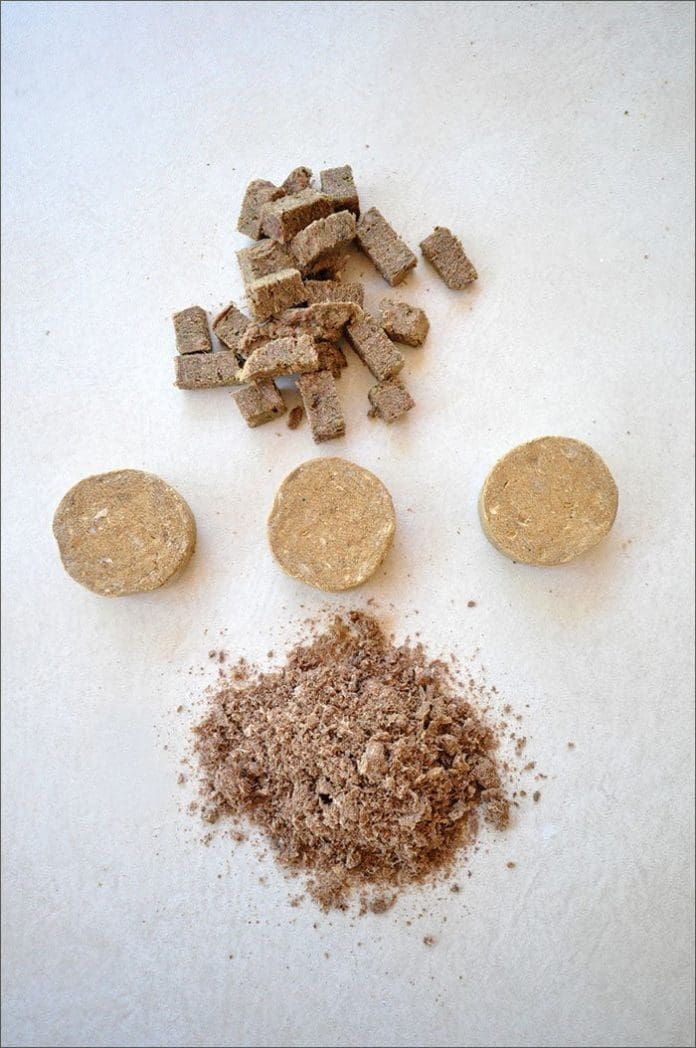
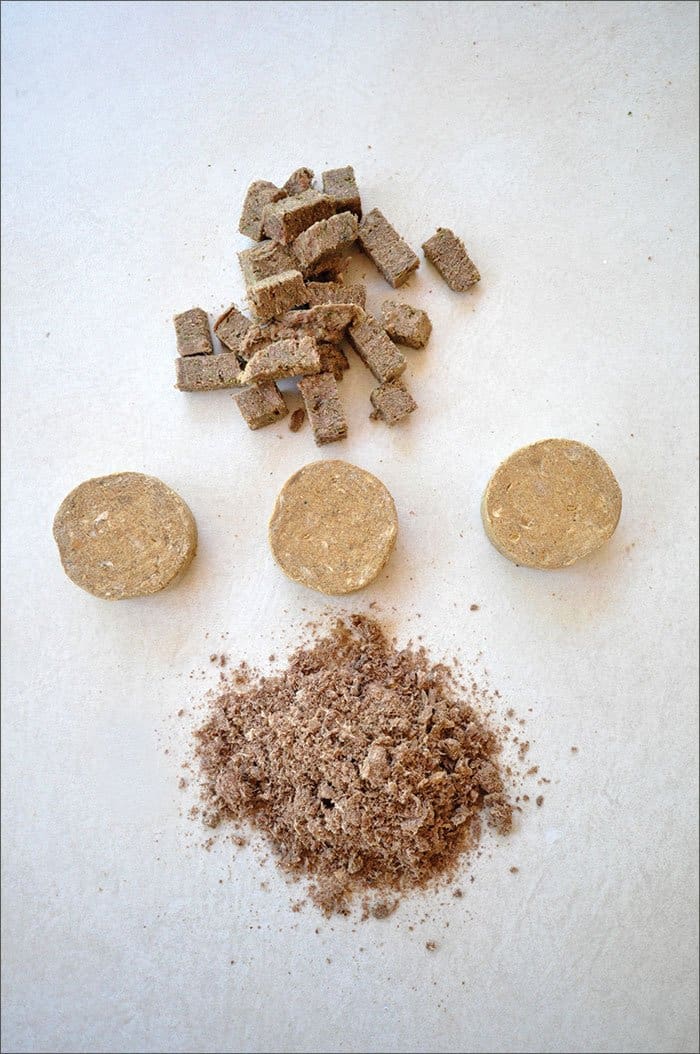
Some of these products are presented in a dried “patty” or “medallion” form; others have been dried into nuggets or dried and then sliced into cubes. Others are very powdery, which makes them turn into a sort of mush or gruel, depending on how much water you add. Still others have relatively large chunks of identifiable dehydrated meats, fruit, and/or vegetables mixed into a powdery meat base. This can be either an advantage (if your dog enjoys the contrast in taste and mouth-feel) or a disadvantage (if your dog seeks out only the chunks or mush and eschews the other).
The most significant difference between these foods and more conventional commercial products, though, is the high fat and, to a slightly lesser extent, high protein levels that most contain. Some are very high in fat and protein; others compare in these respects to conventional kibble. Always check the guaranteed analysis when switching to a product in this category; they are so nutrient-dense that you may have to significantly reduce the volume of food that you feed your dog in order to prevent him from gaining too much weight.
The Cost of Dehydrated Dog Food
The cost of feeding this sort of diet may be prohibitive for many dog owners. These products are pricey. In general, the freeze-dried products cost the most, because freeze-drying is an energy-intensive process. (For what it’s worth, however, shipping costs of these light-weight foods are minimal!) My guess is that they are fed mostly under the following conditions:
– Cost is not a factor (wealthy owner).
– Owner has one dog, or very small dogs (and so won’t need to buy large amounts).
Products are used as “complete and balanced” training treats, rather than sole diet.
Owner usually feeds a raw diet (home-prepared or otherwise) but is traveling, so one of these diets is used short-term replacement.
– Dog is extremely picky (and thin), but will eat these foods with relish. (We frequently hear about this with the freeze-dried foods, which seem to retain their palatability very well.)
– Dog’s health is generally precipitous, but currently well-managed thanks to one of these diets, so it makes the most sense to “pay for the food, rather than the vet.”
– Dog’s health is poor, and these highly palatable products are being used as a short-term tactic to keep him eating.
Safety Issues with Raw Dog Food
Raw diets aren’t for every dog or owner. These foods will be especially attractive to owners who already feed a raw diet to their dogs, or who have researched raw diets and who are ready to take responsibility for feeding their dog a raw diet (and perhaps, have the support already of a veterinarian who is comfortable with and knowledgeable about raw diets).
If you are fearful about the potential for exposing your dog to pathogenic bacteria such as Salmonella or Listeria, or you have an immune-compromised dog, you may want to either skip these diets, or seek out the ones who pasteurize their products and utilize a vigorous “test before releasing” program, such as Stella & Chewys.
Understand that experienced raw feeders, as they are known, are not afraid of these bacteria. They frequently point out that there have been far more recalls of conventional kibble that is “contaminated” with Salmonella than raw food products, and very few dogs have gotten ill as a result of eating these foods. Dogs have much sturdier digestive tracts than humans, and only very rarely have a problem eating food that is contaminated with these bacteria. (Dogs with compromised immune systems, like humans with similar conditions, would be most at risk.)
Some companies use high pressure processing (HPP, also known as high pressure pasteurization or Pascalization) to kill any pathogenic bacteria that might be present in the food; others use HPP only on products that contain poultry (the most likely meat to be contaminated with bacteria); and still others rely entirely on buying the best possible meats, handling them with care, and using superior sanitation throughout the manufacturing process. Ask the maker of the food you are considering what they do (or don’t do) to pasteurize their products.
The companies we’ve highlighted on the following pages make extremely good dog foods, but as always, only you can determine which ones are right for your dog and your budget. As a comparison tool, we selected one variety from each manufacturer and listed its ingredients and guaranteed analysis. To help directly compare the unique formulation approaches taken by each company, we selected the “beef” formula whenever that variety was available.
I love incorporating play and training, especially when training recalls. The recall is a really important behavior – one that can mean the difference between your dog having to stay on leash or having leash-free romp time. It is also a life-saving skill – like when a dog is running toward a busy road, and you need him to respond to your cue to return to you, quickly! But teaching the recall behavior to your dog can be challenging – and sometimes a little overwhelming.
Take some pressure off by turning your recall practice into fun and games. This can help you and your dog enjoy the training and take it to the next level. Some of these games focus on a specific element of “Come,” while others help build enthusiasm for the recall.
The Keep Away Game
One of the most important elements of coming when called is what your dog does when he gets to you. Dog trainers call this the “finish” or end behavior. To play the “Keep Away” game, first think about what you want your dog’s end behavior to look like. Get a really clear picture in your head. Here is my picture: My dog runs up to me, flies into a sit, and makes eye contact. Some people want their dogs to run up and stand, touch a hand target, or run to their side into the heel position. All are great choices.
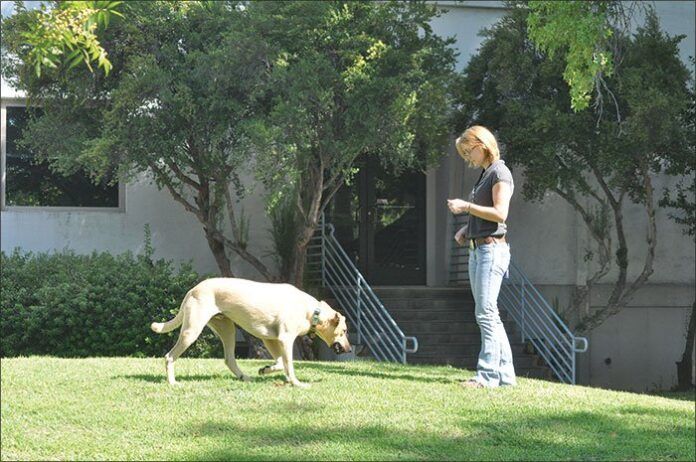
Now that you have a picture in your head, help your dog understand what you would like her to do. For a sit-in-front finish, back one step away from your dog, say “Come!” (or whatever your recall cue is) and encourage her to follow. As she comes up to you, ask for a sit, and when she does it, click – or use another marker, such as the word “Yes!” – and reward your dog with a tasty high-value treat. Practice your finish behavior in a low-distraction environment until your dog understands what to do when he hears “Come.” (Dogs usually get it in a few short sessions.) This is where the real fun begins!
Now that your dog knows that “Come” means move toward you and sit in front of you, you can make it more exciting and interesting by adding in the “keep away” piece. Complete the exercise as described above, and then, immediately after rewarding your dog, turn 90 degrees, and say “Come!” while moving a few steps away.
Click (or “Yes!”) and treat when your dog catches up and does the finish behavior. Repeat with the excited attitude of “You can’t catch me!” and then celebrate when your dog does! Gradually make this more fun and more difficult. For example, once your dog is finding your front easily, say “Come” and then turn and run in the other direction for a few steps before you stop. Your dog will enjoy the chase and have fun practicing the finish.
Tips: Be exciting. Use high-value rewards, such as great food treats, tug games, or chase games to build enthusiasm. If you can’t move quickly or run, try tossing your treat rewards a short distance away so that your dog has to run back to you to play again.
Whiplash Head Turn
Where the “keep away” game trains the end behavior of a recall, the “whiplash head turn” exercise trains the beginning – when your dog turns his head quickly away from something interesting and re-orients to you. There are tons of versions of this game. Here is one of my favorites.
Start with tossing a treat a few feet away from you so that your dog moves away to get the treat. I like to say, “Get it!” as I toss so she knows she has permission to eat it. As your dog is finishing the treat (but before she looks back at you), say her name. As her head turns in your direction, click or “Yes!” and give him a really awesome reward – something super special. Then repeat, gradually tossing the treats a little farther away as your dog’s confidence in the game grows.
A fun variation on this game is to toss a treat in one direction, tell your dog to “Get it,” and then, as he grabs that treat, say his name and toss another treat in another direction. Repeat until your dog is racing back and forth. For energetic dogs this is a great way to build excitement for the head turn.
Tips: Timing is important with this game. Be sure to click or “Yes!” when your dog’s head is turning back to you to encourage the speedy whiplash turn. If your dog loves to run, gradually toss the treats farther away so she gets to run more.
Hide and Seek
Hide and seek is a fun game to play in the house, in your garden, or on off-leash walks. It can be played with your dog knowing the game is afoot or as a surprise game, played at unexpected times throughout the day. It helps your dog learn to look for you when she hears your recall word and, when played randomly, it also helps your dog learn to come when she is otherwise engaged.
To get started with the basic game, have your dog wait in one place or one room. If your dog doesn’t know how to wait, you can also have someone restrain or distract her. Go into another room, behind a tree or around a corner and hide. Ask your dog to “COME find me” (emphasize your cue for the recall). When your dog finds you, give a great big happy reward: a game, happy petting, or a special treat. Repeat few times (stop while your dog is really engaged).
Once your dog understands the basics of this game, you can play the surprise version at various points during your day. For example:
When walking at the beach, when your dog is sniffing something, hide behind a nearby rock. Call her “Come find me” and when she finds you, get crazy happy and play one of your favorite beach games such as tossing the ball or running into the water together. Note: If your dog doesn’t head in your direction pretty quickly, pop up from behind the rock and wave your arms so she can get to you.
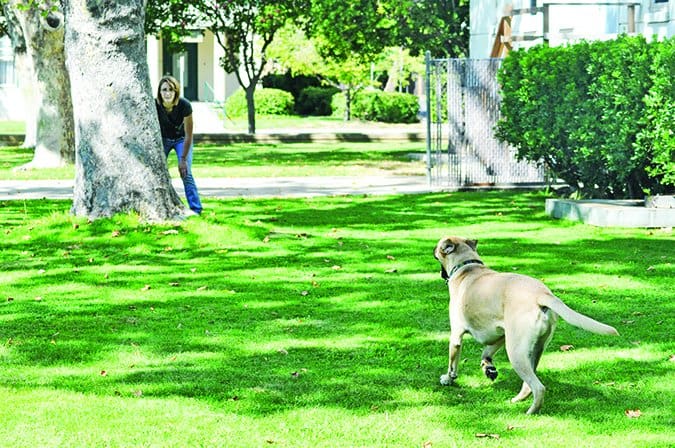
In the woods, duck behind a tree when your dog is just a little way in front. Call her enthusiastically and when she gets to you, reward her with a small handful of great treats.
When your dog is hanging out at home or cruising the backyard, hide and call, “Come find me!” Reward her with a great game of tug when she finds you.
Tips: When you are away from home, do not make the hiding place too difficult. This may cause too much stress for your dog, which will not be fun. In addition, time your calls so that you know your dog will disengage from his exploring easily. I do not recommend hide and seek as a way to frighten your dog into thinking you’ve abandoned him because he was not paying attention. Make this game fun, upbeat, and full of happy reconnections.
Round Robin Recalls
This is a great recall game that involves two or more people. It is also a great game to play after you’ve played “keep away” and “whiplash head turn.” “Round robin recalls” build on your dog’s ability to turn away from something she likes (a person who has just given her a treat) and run to the person calling her.
To get started, you and your game partners will stand about 10 to 12 feet away from each other. If you have two people, you will face each other. With three or more people, create a circle with all of you facing the center. Your dog is with one of the people or in the center of the circle.
One person calls the dog by saying the dog’s name and then “Come!” For example: “Jessie, come!” As the dog looks for the caller, the caller can encourage the dog to come by clapping, opening his or her arms, getting low, cheering, or running a few steps away; encourage your dog in any way except by saying her name or giving the recall cue again.
Once your dog gets to the caller, the caller will click or “Yes!” and reward the dog generously. Each person calls the dog randomly and in no particular order. At first, make it super easy for the dog by keeping the distance close, providing encouragement, and rewarding generously and with enthusiasm. As your dog gets the hang of the game, encourage her to do the “finish” behavior when she gets to the caller.
To make this game more exciting, increase the size of the circle so your dog really gets running. After a few play sessions, try having people move randomly in the area to new spots. This helps your dog start to look for and find the caller. (After dozens of play sessions, my dog will now run across the park to get to us when we play this game. We also move from place to place in the park so that she has to figure out where we are; it’s tons of fun and great exercise for us all.) Do remember that your dog runs a lot in this game; stop while she is enjoying it and before she gets too tired.
Tips: At first, have everyone who is calling the dog use the same treats. But after the dog learns the game, you can vary the types of treats between each person. Just make sure they are all things the dog really loves (silly play, great food treats, or a game of tug).
A Few More Games to Show Your Dog
Here are three more quick games:
Dinnertime recalls. Have your dog sit or down and stay while you prepare his dinner. When his meal is ready, move a few feet away and say, “Come!” When your dog gets to you, put his dinner bowl down. Once your dog is really good at this game, continue to have your dog stay while you take the food bowl into another room. Call your dog to you; getting to eat his yummy meal is the reward.
“You’re the most wonderful dog” recall. Call your dog to you. When your dog comes, get down on the ground and play, play, play for at least three solid minutes. (I love this game because my dog’s reward is also my reward!)
Get the Ball Recall. Have two balls ready. Call your dog to you, and as she comes to you, click or “Yes! for the sit or finish, and then instantly throw the ball. When your dog gets the ball and has turned back toward you, say, “Come!” – yes, even though your dog is already running your way! Click or “Yes!” when your dog gets to you, and throw a second ball in the other direction as the reward. This game can be fast and furious; it’s great fun for ball-crazed dogs.
Be careful to wait and call your dog back to you after she has the ball (so she doesn’t learn that getting the ball is part of the coming when called).
Recall Practice Makes Recall Perfect
Remember, just as when we play any new game with our dogs, it will take a few play sessions for your dog to learn the rules and goals of these “coming when called” games. But once your dog understands and enjoys them, you can get creative, adding challenges to the games, switching rewards, and building up by incorporating more distractions. In addition, make up new games to play and incorporate the things your dog loves into your recall practice. Practicing with games can motivate both you and your dog to train and play your way to a fantastic, impressive recall.
Author/trainer Mardi Richmond, MA, CPDT-KA, lives and works in Santa Cruz, California. She shares her life with her wife and a wonderful heeler-mix. She is the owner of Good Dog Santa Cruz, where one of her specialties is helping people work through recall issues.
Most people are familiar with the concept of a “placebo effect,” the perception that a subject’s health improved after the subject unknowingly received an inert treatment that should have had no effect on the subject whatsoever. The assumption is that because we believe that we have received an actual treatment, our mind tells us that we should feel a bit better. Then, amazingly, we do feel better. We notice a reduction in symptoms and ultimately conclude that the “medicine” must be working. The irony is that placebos actually can be powerful medicine (or something), at least for some people, for some diseases, some of the time.
The effects of placebos in human medicine are well documented. The highest level of placebo effect is seen with diseases that have subjective symptoms that are patient-reported, difficult to measure directly, tend to fluctuate in severity, and occur over long periods (i.e., are chronic). Examples include depression, anxiety-related disorders, gastric ulcer, asthma, and chronic pain. In medical research, an average placebo response rate of 35 percent is reported, with rates as high as 90 percent for some health conditions. By any standard, that is a powerful effect!
Although the reasons that we respond to placebos are not completely understood, medical researchers universally accept the importance of considering them when studying new treatments. Studies of new drugs or medical interventions include placebos as control groups to allow unbiased comparisons with the treatment or intervention under evaluation. Any effect that the placebo group shows is subtracted from the effect measured in subjects who receive the actual medication. The difference between the two is considered to be the degree of response attributable to the treatment. If a placebo control group was not included, it would be impossible to differentiate between a perceived response (placebo) and a real response to the treatment.
Today, double-blind, placebo-controlled clinical trials are considered to be the gold standard of study designs by medical researchers. (The “double-blind” part refers to the fact that in addition to having both a placebo group and a treatment group, neither the researchers nor the subjects know which subjects receive the treatment and which receive the placebo until the trial is concluded.)
Placebos and Our Dogs
So, what about dogs? Can a placebo effect occur with dogs? Possibly, but things work a bit differently where our dogs are concerned.
The first major difference is that dogs are basically always blinded to treatments. Although they may understand that something different is being done to them (or that there is a strange pill buried in that piece of cheese), most people will agree that dogs do not understand that they are being medicated for a particular health problem or are on the receiving end of a new behavior modification approach. As a result, unlike human patients, dogs will lack the specific expectations and beliefs about health interventions that are necessary for a placebo effect to occur directly.
However, in cases where owners or caregivers are required to observe and report symptoms and changes in health regarding the dog’s response to a given treatment, a different type of placebo effect may occur – a “caregiver placebo effect.” As with human maladies, the conditions for which this type of placebo effect has been described in dogs are those that involve subjective measures of health (pain, activity level, appetite) and that have a tendency to fluctuate in severity.
When evaluating a drug for its effect on something that can be measured with objective tools, such as blood pressure, blood sugar, or hormone levels, our subjective opinion of the dog’s response is not relevant. But when the treatment is aimed at something like pain – something that can’t be easily measured with medical tests – our vulnerability to the placebo effect arises again, as recorders and reporters of our dogs’ health and symptoms. While highly communicative in many ways, dogs cannot specifically tell us what part of their body hurts, how intense the pain is, whether it is abating, or by how much. We use our knowledge of a dog’s behavior and body language for clues about how he feels – but how we feel about his situation, symptoms, and treatment may color what we “see.”
Let’s look at two situations where the caregiver placebo effect in dogs has been well observed: osteoarthritis and epilepsy.
Caregiver Placebo Effect Studied
The most common form of arthritis, osteoarthritis occurs when the protective cartilage on the ends of bones wears down over time. It’s a painful and progressive health problem that can seriously impact a dog’s quality of life. Fortunately, a variety of medical and nutritional treatments are available for afflicted dogs, including nonsteroidal anti-inflammatory drugs (NSAIDS, such as deracoxib and meloxicam), nutrient supplements (e.g., glucosamine and chondroitin sulfate), and complementary or alternative medicine approaches (such as acupuncture or cold laser therapy).
Researchers who have studied these treatments often use subjective measures of lameness in which dogs’ owners and veterinarians numerically rate their dog’s degree of pain, mobility, and interest in daily activities in response to treatment.
Some studies also include objective measurements of arthritis symptoms – such as recordings of the weight distribution of each leg while standing or the amount of force that is exerted by each limb during movement. In a “static weight bearing” test, the dog is positioned with each limb on a separate scale; dogs with joint pain usually distribute their weight in such a way as to reduce weight bearing on the limbs that are most painful and increase it on the other limbs. In a “force plate” or “force platform” gait analysis, instruments measure the force of the strike of each limb as the dog moves.
In virtually all placebo-controlled studies of osteoarthritis treatments, a substantial proportion of owners (and veterinarians!) have reported improvement in the placebo-treated dogs. However, when measured using weight-bearing techniques, far fewer dogs show actual improvement.
The study: Caregiver placebo effect osteoarthritis1 – Two researchers, Michael Conzemius and Richard Evans at the University of Minnesota’s College of Veterinary Medicine, analyzed data from the placebo control group of another study – a large clinical trial that was testing the effectiveness of a new NSAID.
All of the enrolled dogs in the NSAID study had been diagnosed with osteo-arthritis and had clinical signs of pain and changes in gait and mobility. This was a multi-centered design, which means that each dog’s own veterinarian conducted the biweekly evaluations of gait and lameness. Both owners and veterinarians completed questionnaires that asked whether the dog showed improvement, no change, or worsening signs of arthritis over a six-week period. Neither the owners nor the veterinarians knew if their dog/patient was receiving the placebo or the new drug.
Keep in mind that Conzemius and Evans had nothing to do with the NSAID study; they simply examined data from the study’s placebo control group.
Results: The ground reaction force (GRF) tests remained largely unchanged for the dogs who were given placebos during “treatment.” Of 58 dogs, five (8.6%) had GRFs that worsened over the course of treatment; seven (12%) had GRFs that improved; and 46 (79.3%) had GRFs that remained unchanged.
However, half (50 percent) of the owners whose dogs received placebos stated that their dog’s lameness was improved during the study. Forty percent reported no change, and 10 percent said that their dog’s pain had worsened.
When these owner reports were compared with actual change as measured by the force platform, the caregiver placebo effect occurred in 39.7 percent of owners.
The dogs’ own veterinarians performed no better. A placebo effect occurred 40 to 45 percent of the time when veterinarians evaluated the dogs for changes in gait or pain.
This means that not only were the owners strongly invested in seeing a positive outcome, so too were their veterinarians. This effect occurred despite the fact that all of the human participants were aware of the 50 percent chance that their dog was in the placebo group not the drug group, and that there was no way to be certain which group their dog was in.
The study: caregiver placebo effect and canine epilepsy2 – Veterinarians from North Carolina State University College of Veterinary Medicine and the University of Minnesota used an approach called a “meta-analysis,” which means that the researchers pooled and then reexamined data collected from several previous clinical trials. They reviewed three placebo-controlled clinical trials that examined the use of novel, adjunct treatments for canine epilepsy.
During the treatment periods in each of the epilepsy studies, owners were asked to record all seizure activity, including the length of the dogs’ seizures, the intensity of the seizures, and the dogs’ behavior before and immediately following seizures.
Results: The majority of owners (79%) of dogs who were (unbeknownst to the owners) receiving a placebo reported a reduction in seizure frequency in their dogs over the six-week study period. What’s more, almost a third of the owners (29%) said that the seizure activity decreased more than 50 percent, the level that was classified in the study protocols as indicative of a positive response to treatment.
Why Do Placebos Work So Well?
What’s going on? Well, several things, it appears. The most obvious explanation of the caregiver placebo effect in dogs is that owners expect a positive response when they assume an actual treatment is being administered to the dog.
Whenever we introduce a new medication, diet, or training method and anticipate seeing an improvement in our dog’s health or behavior, we naturally tilt toward seeing positive results and away from seeing no change (or worse, a negative effect). This is a form of “confirmation bias” – seeing what we expect to see and that confirms our preexisting beliefs.
In fact, an early study3 of the caregiver placebo effect in dogs found that when owners were asked to guess which group their dog was in, the owners whose dogs were actually in the placebo group but said that they were certain that their dogs were in the treatment group demonstrated the strongest positive (placebo) response.
Such expectations may be an especially strong motivator when we are dealing with maladies that have affected our dogs for a long time, conditions that infringe upon our dogs’ ability to enjoy life, and for which we feel that we are running out of options.
Osteoarthritis and seizure disorders were the conditions studied in these papers, but I can think of several other common canine health problems for which we caregivers may easily succumb to the power of the placebo effect. These include chronic allergies, adverse reactions to food ingredients, anxiety-related behavior problems, and even cancer.
Another factor that may contribute to the caregiver placebo effect is finding oneself in a state of contradiction. When we invest time and money (and hope) into a new treatment for our dogs, it follows that we will naturally have high expectations that the treatment will work. If it does not, we may experience cognitive dissonance, the uncomfortable feeling caused by holding two contradicting beliefs in one’s mind at the same time. For example, “I was told that giving my dog dried gooseberry rinds would cure his chronic itching; these rinds are expensive and hard to find. He doesn’t seem any better . . . This isn’t a good feeling.”
Psychologists tell us that our brain reduces this discomfort for us – without our conscious awareness – by simply changing our perceptions. In this case, convincing oneself that the dog does seem a bit less itchy, her coat is a bit healthier, and overall, she does really seem to be feeling better, immediately solves this problem for the brain and for our comfort level.
Finally, a related phenomenon that is common enough to have earned its own name is the Hawthorne Effect, also called observation bias. This is the tendency to change one’s behavior (or in our case, how we might report our dog’s behavior) simply as a result of being observed. The Hawthorne Effect suggests that people whose dogs are enrolled in an experimental trial may behave differently with their dogs because they know they are enrolled in a trial that is measuring many aspects of the dog’s life.
In the case of the arthritis studies, owners may have altered how regularly they exercised their dogs, began to avoid behaviors that worsened the dog’s arthritic pain, or began to pay more attention to the dog’s diet and weight.
The point is that when people are enrolled in a research trial or are starting a new medical treatment, or diet, or training program and are being monitored, they will be inclined to change other aspects of how they live with and care for the dog as well. These changes could be as important (or more important) than the actual treatment (or placebo). This is not necessarily a bad thing, mind you, but is another reason why we always need control groups. It’s important to be aware that the thing that we think is working for our dog may not actually be what’s doing the trick.
Take Away Points for Dog Owners
When trying something new with our dogs, might we, at least some of the time, in some situations, be inclined to see improvement when it does not truly exist? When interpreting our dog’s response to a novel therapy or supplement or training technique, are we susceptible to falling for the sugar pill.
It seems probable, given the science. It is reasonable to at least consider the possibility that a placebo effect may influence our perceptions of our dog’s response to a new or novel food, supplement, training technique, or treatment. This is especially true if the approach being tried has not been thoroughly vetted by research through double-blind, placebo-controlled trials.
While the development of new medications, foods, supplements, and training methods is exciting and important, we must avoid the tendency to see improvement from something that is novel simply because we expect and desire it to be so.
Cited References:
1. Conzemium MG, Evans RB. Journal of the American Veterinary Medical Association 2012; 241:1314-1319.
2. Munana KR, Zhang D, Patterson EE. Placebo effect in canine epilepsy trials. Journal of Veterinary Internal Medicine 2010; 24:166-170.
3. Jaeger GT, Larsen S, Moe L. Stratification, blinding and placebo effect in a randomized, double blind placebo-controlled clinical trial of gold bead implantation in dogs with hip dysplasia. Acta Veterinaria Scandinavica 2005; 46:57-68.
Linda P. Case, MS, is the owner of AutumnGold Consulting and Dog Training Center in Mahomet, Illinois, where she lives with her four dogs and husband Mike. She is the author of anew book, Dog Food Logic, and many other books and numerous publications on nutrition for dogs and cats. Her blog can be read at thesciencedog.wordpress.com.
If eyes are the windows to the soul, then the ears are its curtains: Whether they are minimalist Roman shades or fringed swags that would make Scarlett O’Hara blush, a dog’s ears frame her face and set off her expression. In other words, while they have a utilitarian function (and an important one at that) they have a cosmetic one, too. So imagine my dismay when I noticed that my handsome old Rhodesian Ridgeback, Blitz – he of the two gorgeously symmetrical triangles held crisply and smartly against his graying face – had what appeared to be a frankfurter growing on the edge of his right ear.
The purplish, sausage-like lump turned out to be an aural hematoma. An accumulation of blood in the ear flap resulting from a broken blood vessel, hematomas are common in drop-eared breeds like mine, though they occur in dogs of all ear types. They are believed to be caused by trauma to the relatively thin tissue of the ear flap, or pinna, often as a result of head-shaking.
The good news about hematomas is that, if left untreated, they are eventually reabsorbed. They will not burst – even though by all appearance they look ready to pop – and the dog is left no worse for wear, except for having to endure the discomfort of a large blood blister weighing down her ear. (There is a great diversity of opinion about just how painful ear hematomas are for dogs, and the only ones who know for sure aren’t talking.)
The bad news is that allowing nature to take its course can have aesthetic implications: As the blood-filled ear flap heals and contracts, scar tissue often develops, causing thickening and wrinkling that make it often noticeably different from its non-clotted counterpart. It’s sort of the doggie version of “cauliflower ear” in boxers (the pugilists, not the canines), whose battered outer ears can become swollen and misshapen, resembling the texture of the vegetable that lent its name to the condition.
In Blitz’s case, I took him to a veterinarian whose expertise in traditional Chinese medicine I greatly admire. But acupuncture and herbs were not options in this case. “Chinese medicine is good for a lot of things,” the vet said with a smile. “But not everything.” His preferred treatment for aural hematomas was to insert a small drain into the ear, which we did. Blitz’s hematoma eventually resolved, and his ear was slightly smaller and a little thicker than it had been before. Not an ideal outcome, but not a terrible one, either.
That seems to be the general theme when it comes to aural hematomas: There are many different methods for treating them, and none is perfect. The overriding challenge is that the hematoma separates the skin from the ear cartilage – sort of like a calzone, to use another food comparison. The inability to get those layers to reattach is what causes the ear to shrivel and become misshapen.
Below are some methods for treating hematomas. Some are mainstays that most veterinarians will recognize; others are relatively new approaches that try to maximize the effort to get the skin and cartilage to start talking to each other again, and one has been used as far back as the time of the Pharaohs – on humans, at least. Remember, though, that taking action is a choice, not a necessity: If you’re okay with that frankfurter shriveling up into a cauliflower, then you can do nothing. Your dog probably couldn’t care less.
Early Intervention
For those who like to incorporate alterative modalities into their dog’s health care, holistic medicine offers maddeningly few options for quickly clearing up hematomas to avoid scarring. Shawn Messonnier, DVM, of Paws & Claws Animal Hospital in Plano, Texas, says he has had “pretty good success” using the homeopathic remedies hypernicum and arnica on smaller hematomas – those that take up one-fourth or less of the ear. “Very often those remedies will help resolve hematomas when they are really small,” he says. But as time progresses, and the hematoma begins to clot and harden, homeopathy can be less effective.
Because eosinophils (a type of white blood cell), and mast cell infiltrations have been found in hematomas, some experts speculate that the blood blister may be a component of an allergic reaction. Veterinarians who use only conventional medicine sometimes prescribe steroids such as prednisone to reduce inflammation, though a 2011 review of treatments for aural hematomas in dogs for the Evidence-Based Veterinary Medical Association found the effectiveness of steroids in resolving hematomas and preventing their recurrence to be inconclusive. Some practitioners use cold-laser treatments to help shrink the hematoma and destroy inflammatory cells.
Ways to Treat a Dog’s Ear Hematoma
Dr. Leni Kaplan, a faculty member in the Community Practice Service of Cornell University College of Veterinary Medicine in Ithaca, New York, says if she does decide to treat a hematoma, she will insert a small sterile tube to help the ear drain. (Some vets use a specific draining tube called a cannula; Dr. Kaplan prefers a bovine teat cannula, used to treat mastitis in cows, or just sterile IV tubing sewn inside the ear.)
More important than the kind of drain used is the follow-up care that the dog receives. “The main thing is that the owners have to gently massage the ear” to keep the hematoma draining, Dr. Kaplan explains. “If the owner the doesn’t do any home care, it’s a bloody mess.”
The purpose of a drain or cannula is to keep fluid moving out of the hematoma so that it reduces in size, but a downside is that this method doesn’t do much to compress the skin and cartilage together.
A new surgical approach by Rachel Seibert, DVM, and Karen M. Tobias, DVM, DACVS, at the University of Tennessee, takes the idea of having an active drain a step further by creating negative pressure to constantly suck out liquid even as it brings the separated layers together. With their technique, a large needle is inserted into the hematoma to empty it, then a vacutainer (a sterile tube that creates a vacuum so blood can be drawn out easily) is attached to the ear using a butterfly catheter.
“We started using this technique because it is less invasive than surgery, does not require general anesthesia, and has a similar success rate to surgery without the risks,” Dr. Seibert explains. “The reason this technique works is that it is successful at maintaining contact between the skin and cartilage with constant negative suction.”
Dr. Seibert says the success rate with the negative-pressure drain is similar to treatment with drainage followed by steroid injections, with a recurrence rate of 22 percent. “The pinna is typically minimally distorted or wrinkled using this technique,” she says, “and most cases should resolve within seven to 10 days.”
Though the technique is fairly straightforward, challenges include successfully bandaging the whole affair so that it stays on but doesn’t restrict the dog’s breathing; and making sure the owner replaces the tube at regular intervals, because once it fills to a certain point, suction is impaired.
Surgical Removal of Ear Hematomas
In the quest to get the skin and cartilage of the ear to reattach, many (if not most) veterinarians opt for surgery. The drawback to any kind of surgery is that the dog must undergo anesthesia, and post-operative recovery is relatively more painful.
The procedure involves opening the hematoma surgically with an incision on the inner flap of the ear running in a wavy line; the incision drains the hematoma. Then the incision is stitched up, and more stitches are used in what looks just like a “quilting” technique, with knots on both sides of the ear flap, preventing any part of the ear flap from puffing up with fluid again. Many small stitches are used so there are no large unstitched areas where the blood can accumulate again. (Some vets actually stitch shirt buttons to both sides of the ear to exert more and wider pressure on the flap, literally pressing it together!)
Tina Wolfe, DVM, of Poland Veterinary Centre in Poland, Ohio, prefers the incisional method for a hematoma that is chronic – when it has become firm as a result of clotting and is beginning to be reabsorbed.
“The incisional technique allows for a more complete evacuation of the hematoma once a significant clot has formed, which can help decrease the rate of recurrence,” she explains, noting that the sutures help to promote scar tissue and decrease the space for an additional hematoma to form.
For acute hematomas, where a significant clot hasn’t yet developed, Dr. Wolfe opts for a different surgical technique. With a small skin-biopsy punch – which is traditionally used to extract small circles of tissue to be sent to a laboratory for analysis – she makes a series of small staggered holes along the hematoma on the inner surface of the ear flap. After the hematoma has drained, she places a single stitch through each of the small hole punches, tacking the exposed cartilage to the skin without closing the hole.
Newly formed acute hematomas “are more soft and fluid in nature and will drain readily though the biopsy sites, which allows for continued drainage of the hematoma,” she explains. “The punch-biopsy method also tends to have a high success rate, is quickly and easily performed, and has a good cosmetic result.”
As with the quilting technique, no bandages are necessary, though an Elizabethan collar or other protective device is recommended to make sure the dog does not scratch or shake the ear.
“I prefer either of these techniques to drainage alone or cannulas due to higher rates of success and cosmetic outcomes,” Dr. Wolfe concludes. “Both the incisional and punch-biopsy methods have a lower rate of recurrence than cannulas and needle drainage because the sutures help to promote scar tissue and decrease the space for an additional hematoma to form.”
In a paper published in July, Drs. András Gyorffry and Attila Szijártó of Semmelweis University in Budapest, Hungary, outlined still another operative technique for aural hematomas. With this approach, the hematoma is opened with an incision on the inner flap of the ear running perpendicular to the ear tip. Absorbable sutures that run parallel to the wound are then placed inside the ear tissue, binding together the cartilage and subcutaneous tissue, but not penetrating the skin. After all the stitching is done, the two edges of the incision do not meet, but rather are left a millimeter or two apart, permitting fluid to continue to drain as the ear heals from the inside out.
In a retrospective study of 23 dogs with aural hematomas that were treated with this technique between 2006 and 2012, the authors reported that all but two – or more than 90 percent – healed without any deformity to the ear, and none required additional surgery or had a recurrence. The two cases of misshapen ears were due to a bacterial infection in one and misaligned stitches that permitted wrinkling in the other.
“The new method offers a minor risk of postoperative complications while accomplishing high healing rates,” the authors concluded in their paper.
Leeches for Ear Hematomas
We’ve saved the best – or at least, the most unconventional – for last. In a word: leeches.
These slithery, blood-sucking worms have been used for centuries, dating back to ancient Egypt. Even today in human medicine, leeches are used to drain pooled blood after a digit has been surgically reattached, to treat varicose veins and blocked arteries, and to lessen pain from osteoarthritis. And in dogs, they are most commonly used to treat ear hematomas.
Shelley R. Epstein, VMD, CVH, of Wilmington Animal Hospital in Delaware, has blogged about her experience with leech therapy, formally called hirudotherapy. “No anesthesia is needed; the leeches inject a numbing chemical into the site,” she writes. “It may take a month for the hematoma to fully heal, but the ear is usually normal in appearance afterward.”
According to Biopharm in Hendy, South Wales (“suppliers of leeches since 1812”), ear hematomas in dogs usually call for two to three leeches, and the sooner they are applied, the better. “Leeches can still be used on hematomas that are slightly older and firmer, but in these cases two leech treatments may be required in order to best decongest the blood,” the company explains on its web site. After the leeches are removed, the wound can continue to bleed steadily for as many as 10 hours – ideal in the case of hematomas, where active drainage is needed.
Biopharm describes leeches as “perfectly designed” sucking machines. Leeches have three sets of jaws containing approximately 100 teeth each, and leave a bite mark that resembles the Mercedes-Benz emblem. Along with the natural anesthetic that helps dull the pain of their initial chomp, leeches release several compounds when feeding, including hirudin, an anti-coagulant that maintains blood flow during feeding; and calin, which inhibits clotting for a period afterward. Biopharm acknowledges that as with any treatment, there is a risk of allergic reaction or infection, but notes that it is rare.
In the United States, medicinally farmed leeches are considered a “medical device” by the Food and Drug Administration (FDA), and their use is regulated by federal law. “Vets have ordered from us,” a terse-sounding spokesperson from Leeches U.S.A. in Westbury, New York, told us; she did not know for what purpose the leeches had been ordered.
Leeches are used for only one treatment, and most meet their demise thereafter. In Dr. Epstein’s practice, they are “retired, and kept in a bowl to swim around.”
The Bottom Line
In the end, it can seem there are as many ways to treat hematomas as there are dogs who develop them. And, depending on whom you talk to, the end results can vary dramatically.
Even though surgery is said to be the best method to avoid scarring and malformation, “I’ve see the ones that have gone to surgery and half of those are as scarred down as those that haven’t,” Dr. Kaplan observes. “And I’ve seen ones where the owners did nothing and their ears look great.”
Still, there are a few constants when it comes to caring for a dog with a hematoma:
If you opt for veterinary intervention, seek it out sooner rather than later, before the hematoma hardens and becomes more difficult to treat.
After the insertion of a device or procedure to drain the hematoma, be meticulous about after care, following your vet’s instructions to keep the hematoma draining and stop fluid build-up.
Avoiding further concussion to the ear is vitally important if it is to stabilize and heal. As annoying or awkward as it is, be sure your dog wears some type of Elizabethan collar to deter scratching and minimize the effects of shaking.
Treat the underlying cause of the head-shaking that produced the hematoma. Otherwise, you are only addressing the symptom and not the cause.
If Blitz were around today, and I had another shot at treating his hematoma, I’d likely pursue some of the newer treatments outlined in this article. Heck, I might even give leeches a try. I’d like nothing better than to find an approach that actually works for this infuriating ear condition – and to keep that head “drapery” as handsome as ever.
Don’t Shake Your Head!
Though the cause of hematomas hasn’t been definitely identified, most veterinarians point to head shaking as the likely culprit. Vigorous or repeated head-shaking can cause a blood vessel in the ear flap to burst and cause acute swelling – but we’ve also seen dogs whose own ID tags have injured their ear flaps during head shaking, initiating the hematoma spiral. So, to keep hematomas from recurring – and to avert their formation in the first place – it’s important to get to the root cause of head shaking and resolve it.
Ear infections are a prime cause of head shaking, and can be persistent and difficult to treat. But once the infection has been brought under control, your work is not done: You need to find out of the source of the imbalance that produced the infection to begin with. Pay attention to whether there has been a change in the dog’s food, supplements, or probiotics; I noticed that even changing my dogs’ diet from raw to home-cooked resulted in an uptick in occasional ear infections.
Another, less obvious cause of head shaking – and the likely cause in Blitz’s case – is a lack of household humidity. Especially in wintertime, household air tends to dry out, and with it the dogs’ skin. An increase in dander makes them itchier, which in turn makes them shake more.
Running a humidifier, boiling a kettle of water, or simply leaving a bowl of the wet stuff out atop a radiator and regularly refilling it can restore much-needed moisture to the household – and stop Fido from flapping.
Denise Flaim of Revodana Ridgebacks in Long Island, New York, shares her home with three Ridgebacks, 10-year-old triplets, and a very patient husband.
To provide the best experiences, we use technologies like cookies to store and/or access device information. Consenting to these technologies will allow us to process data such as browsing behavior or unique IDs on this site. Not consenting or withdrawing consent, may adversely affect certain features and functions.
Functional
Always active
The technical storage or access is strictly necessary for the legitimate purpose of enabling the use of a specific service explicitly requested by the subscriber or user, or for the sole purpose of carrying out the transmission of a communication over an electronic communications network.
Preferences
The technical storage or access is necessary for the legitimate purpose of storing preferences that are not requested by the subscriber or user.
Statistics
The technical storage or access that is used exclusively for statistical purposes.The technical storage or access that is used exclusively for anonymous statistical purposes. Without a subpoena, voluntary compliance on the part of your Internet Service Provider, or additional records from a third party, information stored or retrieved for this purpose alone cannot usually be used to identify you.
Marketing
The technical storage or access is required to create user profiles to send advertising, or to track the user on a website or across several websites for similar marketing purposes.
This website uses cookies and other tracking technologies to offer you a better experience, personalize content and ads, and analyze our site traffic. Before proceeding, you agree to our Terms and that you’ve read our Privacy Policy. Update Settings
Functional
Always active
The technical storage or access is strictly necessary for the legitimate purpose of enabling the use of a specific service explicitly requested by the subscriber or user, or for the sole purpose of carrying out the transmission of a communication over an electronic communications network.
Preferences
The technical storage or access is necessary for the legitimate purpose of storing preferences that are not requested by the subscriber or user.
Statistics
The technical storage or access that is used exclusively for statistical purposes.The technical storage or access that is used exclusively for anonymous statistical purposes. Without a subpoena, voluntary compliance on the part of your Internet Service Provider, or additional records from a third party, information stored or retrieved for this purpose alone cannot usually be used to identify you.
Marketing
The technical storage or access is required to create user profiles to send advertising, or to track the user on a website or across several websites for similar marketing purposes.