

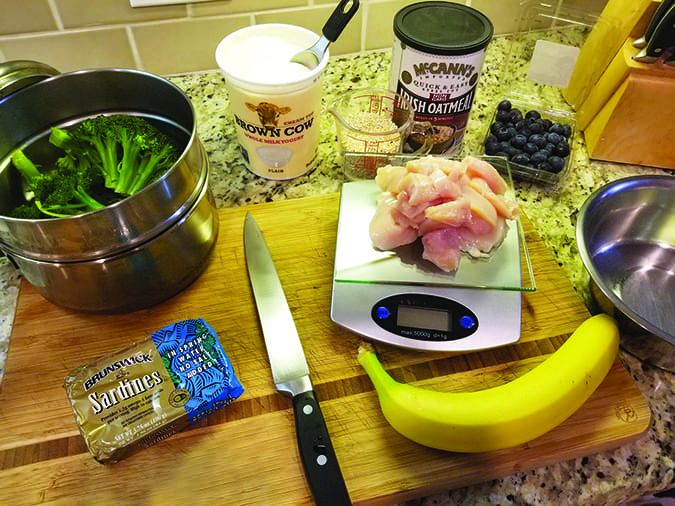
If asked the most common mistake people make when feeding their dogs a homemade diet, I’d have to say that it’s not adding calcium. This error is not only common, it’s also dangerous, especially for puppies, but for adult dogs as well when too little calcium is given long term. Giving an inappropriate amount of calcium (either too much or too little) can cause orthopedic problems in growing puppies, especially large-breed puppies during the first six months when they are growing the fastest. But giving too little calcium can lead to bone disease and more in adult dogs, too.
It’s not surprising to me that many people do not realize the importance of adding calcium when feeding a homemade diet. Most of the homemade diet recipes I’ve seen online make no mention of added calcium. I reviewed more than 30 books on homemade diets for WDJ some years ago.1 Of the 24 books I reviewed that were not exclusively about feeding a raw diet that includes bones, only 10 included adequate calcium guidelines!
Why Calcium is Important in Dog Nutrition
I’m aware that some people who feed home-prepared diets rely on annual blood tests to indicate whether their dogs are receiving enough calcium; they think that if their dogs’ blood calcium levels are normal, the dogs must be getting the right amount of calcium in their diet. Unfortunately, this is not true.
For both dogs and humans, the body must keep calcium levels in the blood within a specific range to prevent serious health issues, including loss of muscle control, seizures, and even death. Adult dogs are able to control their blood calcium levels by absorbing a greater or lesser percentage of dietary calcium, depending on the amount fed, though this can be impacted by the amount of vitamin D in the diet as well, as vitamin D promotes calcium absorption. Note that puppies do not have the ability to control their absorption of calcium before puberty, and thus can suffer the negative effects of too little or too much calcium and vitamin D very quickly.

Dogs (and humans) also control their blood calcium levels by storing calcium in bones, then drawing it back out when needed – when they aren’t getting enough calcium in their diet. When adult dogs are given too little calcium for long periods (like months), they develop a condition called nutritional secondary hyperparathyroidism. In this situation, the body produces excess parathyroid hormone to draw needed calcium from their bones, which can also result in elevated levels of phosphorus in the blood.
Parathyroid hormone is completely different from thyroid hormones; the name is given because the parathyroid glands are located adjacent to the thyroid glands. Parathyroid hormones are responsible for regulating calcium and phosphorus levels in the blood. Hyperparathyroidism (too much parathyroid hormone) can also be caused by a tumor on one of the parathyroid glands (primary hyperparathyroidism) or by advanced kidney disease (renal secondary hyperparathyroidism). Nutritional secondary hyperparathyroidism is usually linked to a deficiency of calcium, sometimes combined with too little vitamin D.
When the body produces too much parathyroid hormone, it causes demineralization of the bones, which may result in lameness, bone pain, swelling, stiffness or limping, not wanting to move, and even spontaneous fractures. Adult dogs may develop spinal deformities, loose teeth, or neurological signs. Puppies are more likely to develop deformities in their legs and joints that may leave them unable to walk normally. If the condition is not corrected quickly, it could lead to long-term orthopedic disorders.
Now that I have scared the pants off you about providing the right amount of calcium in your dog’s homemade diet – at least, I hope I did! – what kind of calcium should you add, and how much is the right amount?
When You DON’T Need to Add Calcium to Your Dog’s Food
Never add calcium to commercial diets that are “complete and balanced” – these already contain the right amount of calcium! Adding calcium to a “complete and balanced” diet would be particularly dangerous for large-breed puppies.
However, most homemade diets require added calcium with a few notable exceptions. DO NOT add calcium to a home-prepared diet if:
- You feed a raw diet that includes raw meaty bones (RMBs) — parts such as chicken and turkey necks where the bone is fully consumed. Bones are high in calcium and phosphorus; there’s no need to add calcium to a diet that includes at least 25 to 30 percent RMBs.
- You use a supplement that is especially designed to complete and balance a homemade diet, such as those made by Balance IT and Just Food For Dogs.
- You use a dog food “base mix,” such as those made by The Honest Kitchen and Sojo’s, that you combine with your own added protein source according to the product directions.
When using supplements or base mixes that promise to complete a homemade diet, make certain that the product includes a complete nutritional analysis showing appropriate amounts of calcium. Don’t accept the verbal assurances of the company’s owners or representatives, or those of pet food store employees; if they can’t or won’t provide you with complete nutritional analyses of their products, we would not rely on those products for anything more than an occasional meal.
Following Calcium Guidelines
With very few exceptions (see “When You Don’t Need to Add Calcium,” above), you need to add calcium to your dog’s homemade diet.
Calcium guidelines can be determined in several different ways, including the body weight of the dog, the dry matter percentage of the food, and the calories that the dog needs. Each has its own complications:
- Small dogs eat more and have higher nutritional needs for their weight than large dogs do, so you can’t use linear guidelines such as “give x amount per 10 pounds of body weight.” Any time you see linear feeding instructions, it’s a red flag that whoever is giving the instructions does not understand nutrition.
- The amount of moisture (water) in food can vary from about 10 percent or less in dry foods (kibble, dehydrated, freeze-dried) to 80 per percent or more in wet foods (canned, fresh, frozen, raw, cooked). You must convert the “as fed” food weight to dry matter (DM) in order to give guidelines based on how much food is fed. Dry matter percentages won’t change much when you convert from “as fed” for dry foods, but are usually three to five times as much as the “as fed” percentage for wet foods. Also, because we feed dogs less of high-fat, calorie-dense foods, adjustments need to be made for foods with more than 4,000 kcal/kg DM.
- Calculating nutritional requirements based on the number of calories your dog needs is the simplest method, but comes with some warnings as well. Caloric needs will vary based on your dog’s activity level, metabolism, and more. The right amount to feed will also be affected by how many calories your dog gets from treats, chews, leftovers, and other sources. In particular, inactive dogs who eat less food for their weight than would be expected should get most of their calories from a balanced diet in order to avoid nutritional deficiencies.
The National Research Council (NRC) issued updated nutritional guidelines for dogs in 2006. They recommend feeding adult dogs at least 1 mg of calcium per Calorie (kcal), which is the same as 1 gram (1,000 mg) per 1,000 kcal (Mcal).
The nutritional guidelines published by the Association of American Feed Control Officials (AAFCO), which were finally modified in 2016 to reflect the latest NRC recommendations, increased this to 1.25 mg calcium/kcal (1.25 grams/Mcal).
On a dry matter basis, that’s 4 to 5 grams of calcium per kilogram of food on a dry matter basis, or 0.4 to 0.5 percent DM.
One other factor affects how much calcium your dog needs: phosphorus. There should always be at least as much calcium as phosphorus in the diet, up to twice as much for healthy dogs (or three times as much for dogs with kidney disease).
Most homemade diets that I’ve looked at have between 0.5 and 1.25 mg phosphorus per kcal, so giving 1.25 mg calcium per kcal will provide most dogs with an appropriate amount of calcium and a proper calcium:phosphorus ratio.
You will need to know how many calories your dog is likely to need, based on his ideal weight – not his actual weight. See Table I on the next page for the approximate amounts of calcium to add to homemade diets for dogs of various sizes and various activity levels in order to provide 1.25 mg of calcium per kcal. While nutrient needs don’t vary by activity level, dogs who eat more food need more calcium in order to balance out the amount of phosphorus in the diet.
At minimum, give the lowest amount of calcium shown for your dog’s ideal weight, even if you find that you need to feed fewer calories than shown to keep your dog at a proper, lean weight. If you must feed a lot less to help your dog lose weight or prevent your dog from gaining unwanted weight, it’s time to cut back on the number of calories your dog gets from other sources.
The amount of calcium you give does not need to be exact. It’s fine to give a little less or a little more calcium than shown. Most commercial diets for adult dogs that I’ve looked at have between 2 and 3 mg of calcium per kcal (diets designed for puppies or for “all life stages” will have even more). These diets also have an equivalently higher amount of phosphorus.
If you feed a diet that is part commercial, part homemade, adjust the calcium amounts shown in Table I appropriately. For example, if you feed half homemade, give half the amount of calcium shown.
Calcium for Puppies is Trickier
All of these guidelines are for adult dogs only. Puppies are trickier. NRC and AAFCO agree that puppies need at least 3 mg of calcium per Calorie (three times the amount of calcium that adult dogs need on a caloric basis).
The maximum amount of calcium that puppies should get is 4.5 mg per kcal (4.5 g/Mcal). It’s especially important not to give too much calcium to large-breed puppies during their first six months, as they are the group most likely to develop bone and joint abnormalities when given the wrong amount of calcium and phosphorus.
Puppies also need more phosphorus than adult dogs do. Never add plain calcium to a puppy’s homemade diet. Puppies need bone meal or some other type of supplement that provides both calcium and phosphorus, in order to provide the correct amount and ratio of calcium to phosphorus.

What Form of Calcium Should You Give Your Dog?
There are many forms of calcium that can be added to your home-prepared diet to meet your dog’s requirements. Any form of plain calcium, without other ingredients such as vitamin D, is fine. Dogs do need vitamin D, but since dogs need more calcium but not more vitamin D than people do, the amount of vitamin D that you would end up giving when using a combination product would be too high.
Calcium carbonate is usually the cheapest and the easiest to give, as it has more elemental calcium than most other calcium compounds, so you will need to add less powder to the food.
One easy way to provide calcium is to use eggshells that have been washed, dried, and ground to powder in a clean coffee grinder or blender. One large eggshell will make about one level teaspoon of eggshell powder weighing 5.5 grams; this will provide approximately 2,000 mg calcium:
1/8 teaspoon eggshell powder provides about 250 mg calcium
1/4 tsp = 500 mg
3⁄8 tsp = 750 mg
1/2 tsp = 1,000 mg
5/8 tsp = 1,250 mg
3/4 tsp = 1,500 mg
7⁄8 tsp = 1,750 mg
1 tsp = 2,000 mg
Some people like to give their dogs whole eggs with the shell, but I don’t think that’s a good way to ensure that your dog gets the right amount of calcium. The calcium in eggshells that have not been ground to powder may not be absorbed, particularly if you notice any bits of shell in your dog’s stool. If it is absorbed, you may end up giving too much calcium, especially to smaller dogs.
It’s okay to give a dog a whole egg, including the shell, as a treat on occasion, but when using eggshells to provide dietary calcium needed to balance out a homemade diet, it’s safest to grind the shells to a powder.
If you use a calcium supplement that also includes phosphorus, such as bone meal powder or dicalcium phosphate, you will have to give more calcium than if you use a plain calcium supplement in order to keep the calcium:phosphorus ratio in the proper range. To determine how much to give, you must first subtract the amount of phosphorus from the amount of calcium, then use the remaining amount of “extra” calcium to calculate how much to give based on Table I.
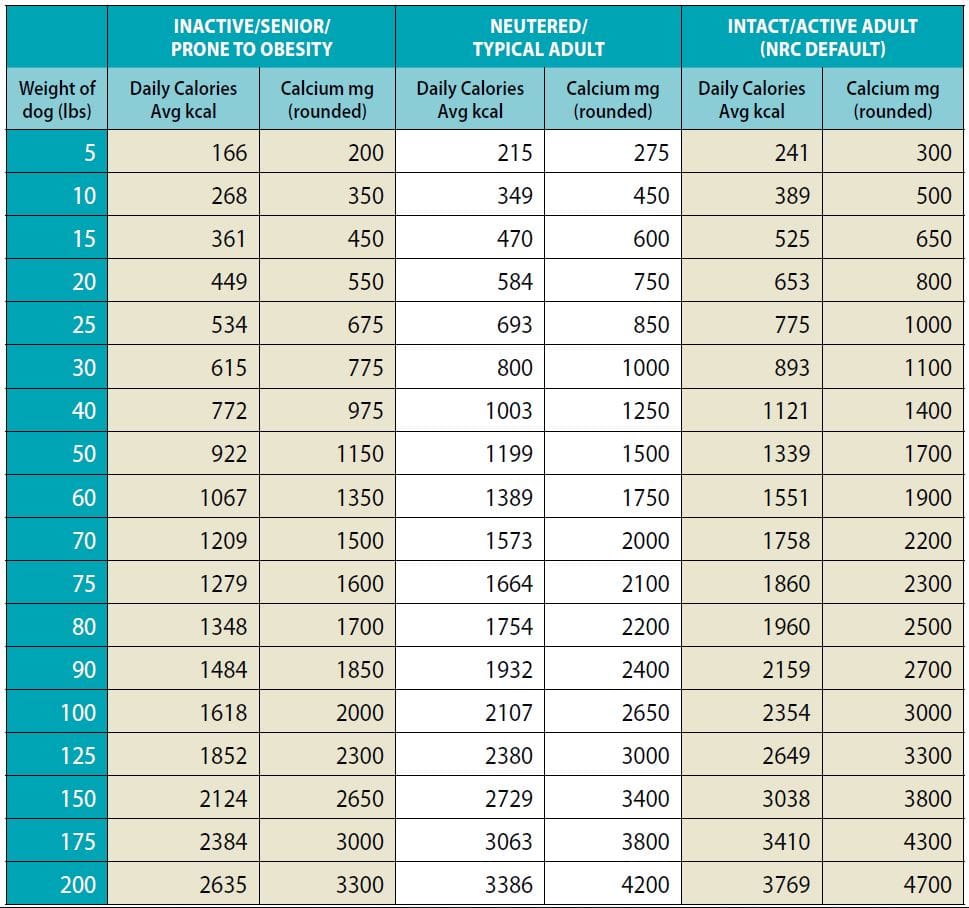
For example, if the bone meal supplement you’re using has 800 mg calcium and 300 mg phosphorus per teaspoon, there’s 500 mg “extra” calcium to use to calculate how much to give. If your dog needs 1,000 mg calcium added to his diet based on Table I, you would need to give two teaspoons of bone meal powder (500 mg extra calcium per teaspoon) in order to provide an appropriate amount of calcium while ensuring that the calcium:phosphorus ratio remains in the proper range.
Note that bone meal products designed for humans may not tell you the actual amount of calcium and phosphorus they provide, but will instead give you percentages of daily recommended values for adults.
For example, NOW Foods Bone Meal Powder says that 1 level teaspoon provides 80 percent of the recommended daily amount (RDA) for calcium, and 30 percent of the RDA for phosphorus. The RDA for both calcium and phosphorus for humans has been 1,000 mg (1 gram), so 80 percent would be 800 mg and 30 percent would be 300 mg.
This calculation will soon become more complicated, however, as the FDA recently increased these recommended amounts to 1,300 mg calcium and 1,250 mg phosphorus. New labels must reflect this change by July 2020. If NOW Foods does not change their formulation, the same product would now show that it provides 62 percent RDA for calcium and 24 percent RDA for phosphorus.
Many bone meal products provide about twice as much calcium as phosphorus. In this case, you can just double the calcium recommendations shown in Table I to determine how much to give.
If you use bone meal powder to provide calcium, look for brands that have been tested to show that they contain low levels of lead. Never use bone meal products intended for fertilizer.
Dolomite is another type of calcium supplement that may contain unacceptably high levels of lead.
Plant-based calcium supplements show considerable variety in the amount of lead they may contain; contact the company to ask for test results before using one of these supplements on a daily basis.
Again, these guidelines are only for dogs who are fed a homemade diet that lacks an adequate source of calcium, such as raw meaty bones or a supplement designed to balance a homemade diet. There’s a lot more to feeding a homemade diet that we’ll try to address in future articles, but getting the calcium right is a big step in the right direction of feeding a complete and balanced diet.
Mary Straus is the owner of DogAware.com. She and her mixed-breed, Willow, live in the San Francisco Bay Area.




I’m grinding whole chickens, removing all the skin, and adding heart, liver, and gizzards. Is the calcium level to high?
Tom, it’s unlikely that feeding whole chickens would provide too much calcium, but whole chickens alone are far from providing a complete diet.
The best homemade diets include red meat, poultry, fish, liver, eggs, dairy, vegetables, and fruits, with grains and legumes optional. The simpler the diet, the more supplements will be needed. All homemade diets require added calcium (unless the diet includes raw meaty bones that are fully consumed) and vitamin E. Other supplements may be needed if any of these food groups are left out of the diet. See this article for some information about the nutrients provided by these foods:
http://dogaware.com/articles/newsdiet.html#recipestudy
Hi Mary,
I was in touch with you last year about my dog, Leroy, who’d been diagnosed with idiopathic vestibular disease in September, followed by early stage kidney disease and then pancreatitis within a month of those. You were wonderfully helpful with going over his blood work for me. His original vet recommended euthanasia in October but I ignored that advice and he’s still with me.
I’ve been home cooking and worried about adding too much calcium as he had borderline high calcium the last time it was tested. I know he could still have a deficit though. I’m planning on getting his ionized calcium checked next month.
I learned something about calcium carbonate the other day, it reduces/neutralizes stomach acid which is needed for digestion. I’m trying to optimize Leroy’s digestion. Now I’m wondering if I should use calcium citrate or if all that I do to help Leroy digest his food better will overcome the gastric acid reducing effect of calcium carbonate?
Thanks,
Jodie
Jodie, there’s no concern about calcium carbonate interfering with digestion. It’s commonly used in dog food products. I doubt that using a different form of calcium would make any difference.
You cannot use blood calcium measurements to determine whether you’re giving the right amount of dietary calcium or not. The body keeps blood calcium in stasis by adding it to or removing it from bones. High blood calcium is often linked to high blood albumin (there is something called “corrected calcium” that takes this into account). Very high blood calcium can be linked to endocrine disorders, or to cancer.
In general, I advise using Balance IT recipes and supplements if you want to feed a homemade diet — that way you’ll know you’re giving the right amount. You can get low-fat recipes afrom Balance IT. Their Nutrient Profile shows “Amount per Mcal” for various nutrients — look at the row titled “[204] Total lipid (fat).” This value is the same as what I called GFK (grams of fat per thousand calories) in my article on low-fat diets (http://dogaware.com/articles/wdjlowfatdiets.html). You can adjust the amount of fat in the recipes downward, within reason. If necessary, you can request an even lower fat veterinary diet with your vet’s approval (which they make easy to get).
https://secure.balanceit.com/recipegenerator_ver4/index.php?rotator=EZ
Hi Mary. I have a question about the amount of Ca/P in bone meal. On the label of Grau Knochenmehl (bonmeal) 400mg -the only available in my country, it says crude protein 0.6 %, fats-0.3%, moisture 20.9%, ash- 72.8%, fibre 0.3%, Ca 22.6%, Phos 17.7%, Na-0.03%. Then it says to give appx. 0.5g/day for puppies up to 10kg ; young dogs and dogs up to 25kg – max 2.0 g/day.
I read carefully your article and realized there is no the amount of Ca (milligrams) in 1 teaspoon. Are these feeding recommendations accurate, can we rely on them? Is it possible to calculate the amount of Ca in a tablespoon based on these percentages? I believe this is on DM? I want to calculate the amount of Ca I need to add per daily calories intake.
I would really appreciate your help. Thank you!
Kristina, I’m having trouble telling what the 400 mg means — if it is the serving size, such as the amount per teaspoon, then you can calculate the amount of calcium based on the percentage. However, I would expect a teaspoon to weigh more than 400 mg.
If this product is 22.6% Calcium and 17.7% Phosphorus, then a 400-mg serving would have 90 mg calcium and 71 mg phosphorus.
The directions on the product are unreliable, especially for puppies. I found a website that sells this product but no mention of 400 mg. They say that the product includes a 0.5g measuring spoon — 0.5g (500 mg) would provide 113 mg calcium and 88 mg phosphorus.
It is not possible to calculate the amount per tablespoon, unless you measure how many 0.5g spoonfuls make up one tablespoon and then multiply the amounts per 0.5g by the number of spoonfuls per tablespoon, or you weigh how much one tablespoon of the product weighs, then calculate how much calcium and phosphorus that equates to by multiplying the weight in grams by the percentages of calcium and phosphorus.
Hi Mary,thanks a lot for the detailed answer! Much appreciated. It is my mistake, I meant that the product’s weight is 400g, not mg. So in the 0.5g spoon provided in the box, based on these percentages there is 113mg Ca and 88mg Phos. And based on puppies article, I have to add appx 1000mg Ca per pound of food (around 9-10 spoons of 0.5g).Am I correct? Could you please clarify if this 1 pound is the full meal (meat, veggies, etc) or it only corresponds to the meat in the meal?
Kristina, I’m very uncomfortable trying to offer guidelines for feeding puppies, since there is so much to doing it right and puppies are easily harmed by an improper diet (especially large-breed puppies, and especially in the first six months of life).
The general guideline of 1,000 mg calcium per pound of food is for adult dogs. Puppies may need up to three times as much. Guidelines based on weight of food can vary widely depending on what you feed, so it’s not a reliable way to determine how much calcium your pup needs. That’s why I offer guidelines based on calories instead.
AAFCO guidelines say that puppies need 3 grams of calcium per 1,000 kcal, up to a maximum of 4.5g/1,000 kcal for large-breed puppies. That compares to 1.25 grams/1,000 kcal for adult dogs.
It says to give 10grams per 250grams of wet food
Hi, I have been feeding my puppy a barf mix that contains 70% Protein, 10% Bone, 10% Veg, 5% Liver 5% Offal… does she still need more calcium ? I keep getting mixed opinions from different people… she’s a Labrador x labradoodle and is currently just over 5 months old and is 16kg
Thanks in advance!!!
Chantelle, I would need to know the brand and variety of food you’re feeding in order to look into it, but I can pretty much guarantee that this diet does not meet AAFCO guidelines and may be dangerous for a puppy. Note that too much calcium can be more dangerous than too little, especially for large-breed puppies. If the company that makes the food you’re feeding can’t provide you with a nutritional analysis that shows the amount of calcium, and doesn’t have an AAFCO statement that says specifically that this food meets the guidelines for puppies expected to weigh 70 lbs or more as an adult, then you are not feeding an appropriate diet.
More info about problems with commercial raw diets, especially for puppies:
https://www.whole-dog-journal.com/food/the-state-of-the-commercial-raw-diet-industry/
https://www.whole-dog-journal.com/food/why-all-dog-diets-should-meet-aafco-nutrient-guidelines/
Thanks for replying! It’s made by a local pet food supplier, he doesn’t have the specific info as I don’t think it’s a legal requirement in Australia for pet food, I know it doesn’t have any preservatives or fillers just the raw ingredients… he told me he has fed all his dogs the same thing and never had an issue but I have bought a supplement powder anyway that my vet recommended, it’s called vets all natural health booster. It has a bunch of vitamins and minerals as well as 12,400mg of calcium. Do you think this will suffice?
No, I don’t think this will suffice, and it could make the situation worse. It’s more likely that the food you’re feeding has too much calcium than too little. Adding more calcium will make that worse.
Too much calcium? My vet seems to think she’s lacking because she broke her leg when she did an awkward jump ( I thought she just landed wrong and the ground was uneven ) but now because of that I’m worried she is lacking… I think I might jut have to get a blood test done and switch to a high quality kibble for now to take the guess work out 🙁 thanks so much for your help thus far though I really appreciate it
Chantelle, a blood test can’t tell you whether you’re giving adequate calcium or not, as the body has to keep blood calcium levels steady and does so by taking calcium from bones if needed. An x-ray of your dog’s leg should have told your vet if the bone showed adequate mineralization or not, though I don’t know how much detail is revealed.
I agree that your best bet would be to feed your puppy a food that you know is complete and balanced until she is full grown. If you feel you have to feed raw (not something I agree with), then feed a Raw Bistro product that is designed to meet puppy requirements (they’re the only raw company that I know actually meets AAFCO guidelines for puppies). Note there are other options than just kibble, including dehydrated foods (not freeze-dried raw, which has all the same problems as frozen raw). Canned and cooked foods would likely be too expensive to feed a large dog. Make sure that whatever you feed follows AAFCO guidelines for puppies expected to weigh 70 lbs or more as an adult (the AAFCO statement on the label should state this).
Question. We feed Titan RAW (AAFCO) approved to a Lab puppy (4 months). Vet said to add calcium. I know Titan is balanced but I don’t think the bone content is 25-30%. Should he be getting a supplement?
Erin, I found the Titan raw foods website:, but there’s no information about their products:
http://www.titandogfood.com/site/
This site has a bit more info, but no nutritional analysis:
https://rahraw.com/product/titan-red-pack-60lbs/
There are very few companies that offer commercial raw diets that are approved for puppies, and even an AAFCO statement doesn’t guarantee that they are really appropriate. More info about problems with commercial raw diets, particularly for puppies, in these articles:
https://www.whole-dog-journal.com/food/the-state-of-the-commercial-raw-diet-industry/
https://www.whole-dog-journal.com/food/why-all-dog-diets-should-meet-aafco-nutrient-guidelines/
It is dangerous to give too much calcium to a large-breed puppy (can lead to bone and joint abnormalities). Please do not add calcium if the diet you are feeding includes bone. If the company whose products you’re using cannot provide you with a complete nutritional analysis showing the amount of calcium, then assume the food is not appropriate and possibly dangerous for your pup.
The only commercial raw product that I know meets AAFCO guidelines for puppies is made by Raw Bistro.
We just started our 13 year old 11 lb dog on a homemade diet after raw frozen Stella & Chewy for years because he was diagnosed with early Stage One kidney disease. So far he’s been eating raw green tripe, with eggs whites, Omega-3 oil, steamed vegetables and muscle meat. I added ground eggshells for a few days to balance the phosphorus (all calculated on an excellent spreadsheet my sister made for us) after I read Mary Strauss’s website. Then I stopped because I started reading elsewhere that calcium citrate is better, about the dangers of calcium deposits and more. I was afraid I would cause more harm than good. It also seemed like the added calcium made him sick but maybe it was too much spinach b/c of the oxalates. I’m really stressed and confused about what to do. Our dog’s blood calcium is in range but on the high side. Help!
Kaylord, I can’t really give you guidance without seeing test results, but if you don’t already know how to create a complete and balanced homemade diet, your best bet would be to use recipes and supplements from Balance IT. That way, you won’t have to worry about trying to sort out misinformation (such as needing to use calcium citrate). There’s so much more to it than just balancing the calcium and phosphorus! Egg whites are not appropriate at this stage. Calcium won’t make a dog sick, and you cannot learn anything about dietary calcium from a dog’s blood calcium levels.
If your dog’s creatinine is normal, you can use regular recipes and supplements.
https://secure.balanceit.com/recipegenerator_ver4/index.php?rotator=EZ
If creatinine reaches 2.0, you can switch to veterinary recipes that use their Heatable Canine K Plus supplement. These recipes require your vet’s approval, but they make that easy to get. Choose Kidney Disease, then select “Early Kidney – Lower Phosphorus Using Heatable Canine K Plus (Dogs Only)” (only use their Canine K Plus, never their original Canine K, which includes phosphorus):
https://secure.balanceit.com/tools/ez2/
Also see the newer sections added to my website for more info on early-stage kidney disease:
http://dogaware.com/health/kidney.html
Sometimes, mainly due to pandemic induced lock downs I run out of bones or my supplier lack it.
So how much calcium should I add in his diet when I dont have any bones to give him?
I have calcium carbonate in tablet form. Each containing 600mg of calcium carbonate.(Without D3 ofcourse)
Some are suggesting 2(1200mg) and some says 1.5 (around 1000mg).
I Am not sure about this, so anybody knows range or weight to calcium ratio or anything that would give me idea how much should I give him would be helpful.
Dog is German shepherd – 1 year old
His weight is around – 60 pounds (28 kgs) and gaining more weight.
Nick, you shouldn’t use human calcium products that also contain other ingredients such as vitamin D. Dogs need more calcium than people do, and the amount of vitamin D that you’d be giving might not be a good idea. You can use plain calcium products, such as calcium carbonate powder, or eggshell powder (1 tsp = 2,000 mg), I would give around 2,000 mg of plain calcium (no vitamin D) daily to your young dog.
Your homemade diet may well be lacking in other nutrients. Please see this article for more about the problems with commercial raw diets, especially for puppies:
https://www.whole-dog-journal.com/food/the-state-of-the-commercial-raw-diet-industry/
And this article that talks about problems with recipes and such found on the web:
http://dogaware.com/articles/newsdiet.html#recipestudy
Hey thanks for replying, but I alredy mentioned I’m using the calcium carbonate which is having NO D3 in it.
So is 1500mg to 2000mg of plane calcium will be good if I’m not adding any bones?
Nick, I apologize for misreading what you wrote — my fault, I was in a hurry, saw D3 and just didn’t pay close attention.
Yes, 1500-2,000 mg plain calcium should be good if you’re not adding any bones. That would be three of the tablets you currently have daily, preferably split between meals (2 at one meal and 1 at the other would be fine).
Thanks for your response, if you don’t mind i would like to clear one small doubt.
I researched little bit and found that D3 is required for calcium to be utilized or to be able to use.
So for a 66lbs(30kg) dog I’m adding calcium in the range of 1500-2000.
What should be range of D3??
I found on some website 250 IU to 1500 IU according to my dog’s weight.
I have D3 supplement with 400 IU. Should add to be on safe side or it is higher than my dog requires as he is getting from his diet as well???
Thank you…I really appreciate your work.
Nick, the easy answer is that NRC recommends that a 66-lb dog get around 250 mg vitamin D daily. AAFCO guidelines require a minimum of 125 mg vitamin D per 1,000 kcal.
I say that’s the easy answer, because there are a lot of other vitamins and minerals to be concerned about in a homemade diet.
Darn it, I said mg, when I meant IU — 250 IU (NRC) and 125 IU/1,000 kcal (AAFCO). Definitely not mg.
Just wanted to add that giving 400 IU daily is safe.
Great article, Mary. My puppy is 5 months old mini poodle, refuses to eat kibble and has digestive problems from the majority of canned food. I buy him steam cooked and frozen food from local dog kitchen, every 2 weeks :), he eats it with appetite and has no digestive problems. It contains 60-70% beef/pork/turkey meat and organs, 10% veggies( green beans/broccoli, carrots etc), eggs, brown rice, omega 3, kelp and olive oil. No added Ca and Phos. Now, he is eating 400g daily which contains 800kcal, protein 9%, fat 6%, fibre max2%( per the label) I want and have time to cook the same and I need of advice how much bone meal should I add to the daily amount of food. I can cook a big amount and to split it into packages for 1 week. Now he is 5kg, very active, at least 1 hour walks daily. I am concerned that the food I buy does not contain any Ca/P added also I am not sure if it is good for a growing puppy. Thank you in advance!
Kristina, does this food have a brand name? If you’re talking about products from JustFoodForDogs, then it already has the right amount of calcium, but I can’t tell you if it’s appropriate for a puppy without knowing which varieties you’re feeding. If it’s another brand, look for an AAFCO statement that says it meets guidelines for puppies/growth or for all life stages. If there is no AAFCO statement, then it does not meet their guidelines, and may be deficient in other areas in addition to calcium and phosphorus. Can you switch to a brand that meets AAFCO guidelines? That would be the safest option. I list many of the cooked diet companies I know about on my website here:
http://dogaware.com/diet/cannedfood.html#cooked
Hello Mary,
Thank you for the wonderful, thoughtful, intelligent, informed, all-around excellent and helpful article. I have a question and please forgive me if you find it stupid: prior to your article, the only information on calcium supplementation in homemade diets for dogs with calcium oxalate stones (and possible kidney issues) I was able to find, the calculations as to how much calcium to add were based on the phosphorus content of the diet being fed, which was determined from information in the nutritiondata.com calculator. The advice was to balance the phosphorus with a 1-1.2 ration of calcium, ideally in the form of calcium citrate. Would you say your recommendations for calcium supplementation, based on the weight (& ‘category’) of the dog, correspond with the recommendations based on phosphorus content? Or would you recommend to ignore phosphorus content calculations and rely solely on weight, etc., of your pup? Many thanks for any insight you might provide!
I have an article on calcium oxalate stones. Basically, it recommends using calcium citrate as your calcium source, and avoiding high-oxalate foods, among other things.
http://dogaware.com/articles/wdjcalciumoxalates.html
The ratio of calcium to phosphorus in the diet should always fall within the AAFCO guidelines, which range between 1:1 and 2:1 (dogs with advanced kidney disease need reduced phosphorus, which can lead to a ratio of up to 3:1). I would probably stick to the lower end of the range for a dog prone to forming calcium oxalate stones, unless creatinine goes above 2.0, in which case reducing phosphorus might lead to a higher ratio without actually increasing the amount of calcium.
Calcium recommendations based on the weight of the dog use amounts suggested by NRC and/or AAFCO, but should not ignore the calcium:phosphorus ratio. Guidelines based on the dog’s weight assume you have an active, healthy dog. If the weight guidelines for calcium lead to a high calcium:phosphorus ratio, it might be because the diet contains too little phosphorus, or because you have an older dog who doesn’t eat as much. In the first case, I would probably increase the amount of phosphorus in the diet (as long as your dog doesn’t have elevated blood creatinine), since too little phosphorus would probably point to other deficiencies as well. In the latter case, I wouldn’t worry about it, as it’s comparable to a dog eating less of a commercial diet.