

If asked the most common mistake people make when feeding their dogs a homemade diet, I’d have to say that it’s not adding calcium. This error is not only common, it’s also dangerous, especially for puppies, but for adult dogs as well when too little calcium is given long term. Giving an inappropriate amount of calcium (either too much or too little) can cause orthopedic problems in growing puppies, especially large-breed puppies during the first six months when they are growing the fastest. But giving too little calcium can lead to bone disease and more in adult dogs, too.
It’s not surprising to me that many people do not realize the importance of adding calcium when feeding a homemade diet. Most of the homemade diet recipes I’ve seen online make no mention of added calcium. I reviewed more than 30 books on homemade diets for WDJ some years ago.1 Of the 24 books I reviewed that were not exclusively about feeding a raw diet that includes bones, only 10 included adequate calcium guidelines!
Why Calcium is Important in Dog Nutrition
I’m aware that some people who feed home-prepared diets rely on annual blood tests to indicate whether their dogs are receiving enough calcium; they think that if their dogs’ blood calcium levels are normal, the dogs must be getting the right amount of calcium in their diet. Unfortunately, this is not true.
For both dogs and humans, the body must keep calcium levels in the blood within a specific range to prevent serious health issues, including loss of muscle control, seizures, and even death. Adult dogs are able to control their blood calcium levels by absorbing a greater or lesser percentage of dietary calcium, depending on the amount fed, though this can be impacted by the amount of vitamin D in the diet as well, as vitamin D promotes calcium absorption. Note that puppies do not have the ability to control their absorption of calcium before puberty, and thus can suffer the negative effects of too little or too much calcium and vitamin D very quickly.

Dogs (and humans) also control their blood calcium levels by storing calcium in bones, then drawing it back out when needed – when they aren’t getting enough calcium in their diet. When adult dogs are given too little calcium for long periods (like months), they develop a condition called nutritional secondary hyperparathyroidism. In this situation, the body produces excess parathyroid hormone to draw needed calcium from their bones, which can also result in elevated levels of phosphorus in the blood.
Parathyroid hormone is completely different from thyroid hormones; the name is given because the parathyroid glands are located adjacent to the thyroid glands. Parathyroid hormones are responsible for regulating calcium and phosphorus levels in the blood. Hyperparathyroidism (too much parathyroid hormone) can also be caused by a tumor on one of the parathyroid glands (primary hyperparathyroidism) or by advanced kidney disease (renal secondary hyperparathyroidism). Nutritional secondary hyperparathyroidism is usually linked to a deficiency of calcium, sometimes combined with too little vitamin D.
When the body produces too much parathyroid hormone, it causes demineralization of the bones, which may result in lameness, bone pain, swelling, stiffness or limping, not wanting to move, and even spontaneous fractures. Adult dogs may develop spinal deformities, loose teeth, or neurological signs. Puppies are more likely to develop deformities in their legs and joints that may leave them unable to walk normally. If the condition is not corrected quickly, it could lead to long-term orthopedic disorders.
Now that I have scared the pants off you about providing the right amount of calcium in your dog’s homemade diet – at least, I hope I did! – what kind of calcium should you add, and how much is the right amount?
When You DON’T Need to Add Calcium to Your Dog’s Food
Never add calcium to commercial diets that are “complete and balanced” – these already contain the right amount of calcium! Adding calcium to a “complete and balanced” diet would be particularly dangerous for large-breed puppies.
However, most homemade diets require added calcium with a few notable exceptions. DO NOT add calcium to a home-prepared diet if:
- You feed a raw diet that includes raw meaty bones (RMBs) — parts such as chicken and turkey necks where the bone is fully consumed. Bones are high in calcium and phosphorus; there’s no need to add calcium to a diet that includes at least 25 to 30 percent RMBs.
- You use a supplement that is especially designed to complete and balance a homemade diet, such as those made by Balance IT and Just Food For Dogs.
- You use a dog food “base mix,” such as those made by The Honest Kitchen and Sojo’s, that you combine with your own added protein source according to the product directions.
When using supplements or base mixes that promise to complete a homemade diet, make certain that the product includes a complete nutritional analysis showing appropriate amounts of calcium. Don’t accept the verbal assurances of the company’s owners or representatives, or those of pet food store employees; if they can’t or won’t provide you with complete nutritional analyses of their products, we would not rely on those products for anything more than an occasional meal.
Following Calcium Guidelines
With very few exceptions (see “When You Don’t Need to Add Calcium,” above), you need to add calcium to your dog’s homemade diet.
Calcium guidelines can be determined in several different ways, including the body weight of the dog, the dry matter percentage of the food, and the calories that the dog needs. Each has its own complications:
- Small dogs eat more and have higher nutritional needs for their weight than large dogs do, so you can’t use linear guidelines such as “give x amount per 10 pounds of body weight.” Any time you see linear feeding instructions, it’s a red flag that whoever is giving the instructions does not understand nutrition.
- The amount of moisture (water) in food can vary from about 10 percent or less in dry foods (kibble, dehydrated, freeze-dried) to 80 per percent or more in wet foods (canned, fresh, frozen, raw, cooked). You must convert the “as fed” food weight to dry matter (DM) in order to give guidelines based on how much food is fed. Dry matter percentages won’t change much when you convert from “as fed” for dry foods, but are usually three to five times as much as the “as fed” percentage for wet foods. Also, because we feed dogs less of high-fat, calorie-dense foods, adjustments need to be made for foods with more than 4,000 kcal/kg DM.
- Calculating nutritional requirements based on the number of calories your dog needs is the simplest method, but comes with some warnings as well. Caloric needs will vary based on your dog’s activity level, metabolism, and more. The right amount to feed will also be affected by how many calories your dog gets from treats, chews, leftovers, and other sources. In particular, inactive dogs who eat less food for their weight than would be expected should get most of their calories from a balanced diet in order to avoid nutritional deficiencies.
The National Research Council (NRC) issued updated nutritional guidelines for dogs in 2006. They recommend feeding adult dogs at least 1 mg of calcium per Calorie (kcal), which is the same as 1 gram (1,000 mg) per 1,000 kcal (Mcal).
The nutritional guidelines published by the Association of American Feed Control Officials (AAFCO), which were finally modified in 2016 to reflect the latest NRC recommendations, increased this to 1.25 mg calcium/kcal (1.25 grams/Mcal).
On a dry matter basis, that’s 4 to 5 grams of calcium per kilogram of food on a dry matter basis, or 0.4 to 0.5 percent DM.
One other factor affects how much calcium your dog needs: phosphorus. There should always be at least as much calcium as phosphorus in the diet, up to twice as much for healthy dogs (or three times as much for dogs with kidney disease).
Most homemade diets that I’ve looked at have between 0.5 and 1.25 mg phosphorus per kcal, so giving 1.25 mg calcium per kcal will provide most dogs with an appropriate amount of calcium and a proper calcium:phosphorus ratio.
You will need to know how many calories your dog is likely to need, based on his ideal weight – not his actual weight. See Table I on the next page for the approximate amounts of calcium to add to homemade diets for dogs of various sizes and various activity levels in order to provide 1.25 mg of calcium per kcal. While nutrient needs don’t vary by activity level, dogs who eat more food need more calcium in order to balance out the amount of phosphorus in the diet.
At minimum, give the lowest amount of calcium shown for your dog’s ideal weight, even if you find that you need to feed fewer calories than shown to keep your dog at a proper, lean weight. If you must feed a lot less to help your dog lose weight or prevent your dog from gaining unwanted weight, it’s time to cut back on the number of calories your dog gets from other sources.
The amount of calcium you give does not need to be exact. It’s fine to give a little less or a little more calcium than shown. Most commercial diets for adult dogs that I’ve looked at have between 2 and 3 mg of calcium per kcal (diets designed for puppies or for “all life stages” will have even more). These diets also have an equivalently higher amount of phosphorus.
If you feed a diet that is part commercial, part homemade, adjust the calcium amounts shown in Table I appropriately. For example, if you feed half homemade, give half the amount of calcium shown.
Calcium for Puppies is Trickier
All of these guidelines are for adult dogs only. Puppies are trickier. NRC and AAFCO agree that puppies need at least 3 mg of calcium per Calorie (three times the amount of calcium that adult dogs need on a caloric basis).
The maximum amount of calcium that puppies should get is 4.5 mg per kcal (4.5 g/Mcal). It’s especially important not to give too much calcium to large-breed puppies during their first six months, as they are the group most likely to develop bone and joint abnormalities when given the wrong amount of calcium and phosphorus.
Puppies also need more phosphorus than adult dogs do. Never add plain calcium to a puppy’s homemade diet. Puppies need bone meal or some other type of supplement that provides both calcium and phosphorus, in order to provide the correct amount and ratio of calcium to phosphorus.

What Form of Calcium Should You Give Your Dog?
There are many forms of calcium that can be added to your home-prepared diet to meet your dog’s requirements. Any form of plain calcium, without other ingredients such as vitamin D, is fine. Dogs do need vitamin D, but since dogs need more calcium but not more vitamin D than people do, the amount of vitamin D that you would end up giving when using a combination product would be too high.
Calcium carbonate is usually the cheapest and the easiest to give, as it has more elemental calcium than most other calcium compounds, so you will need to add less powder to the food.
One easy way to provide calcium is to use eggshells that have been washed, dried, and ground to powder in a clean coffee grinder or blender. One large eggshell will make about one level teaspoon of eggshell powder weighing 5.5 grams; this will provide approximately 2,000 mg calcium:
1/8 teaspoon eggshell powder provides about 250 mg calcium
1/4 tsp = 500 mg
3⁄8 tsp = 750 mg
1/2 tsp = 1,000 mg
5/8 tsp = 1,250 mg
3/4 tsp = 1,500 mg
7⁄8 tsp = 1,750 mg
1 tsp = 2,000 mg
Some people like to give their dogs whole eggs with the shell, but I don’t think that’s a good way to ensure that your dog gets the right amount of calcium. The calcium in eggshells that have not been ground to powder may not be absorbed, particularly if you notice any bits of shell in your dog’s stool. If it is absorbed, you may end up giving too much calcium, especially to smaller dogs.
It’s okay to give a dog a whole egg, including the shell, as a treat on occasion, but when using eggshells to provide dietary calcium needed to balance out a homemade diet, it’s safest to grind the shells to a powder.
If you use a calcium supplement that also includes phosphorus, such as bone meal powder or dicalcium phosphate, you will have to give more calcium than if you use a plain calcium supplement in order to keep the calcium:phosphorus ratio in the proper range. To determine how much to give, you must first subtract the amount of phosphorus from the amount of calcium, then use the remaining amount of “extra” calcium to calculate how much to give based on Table I.
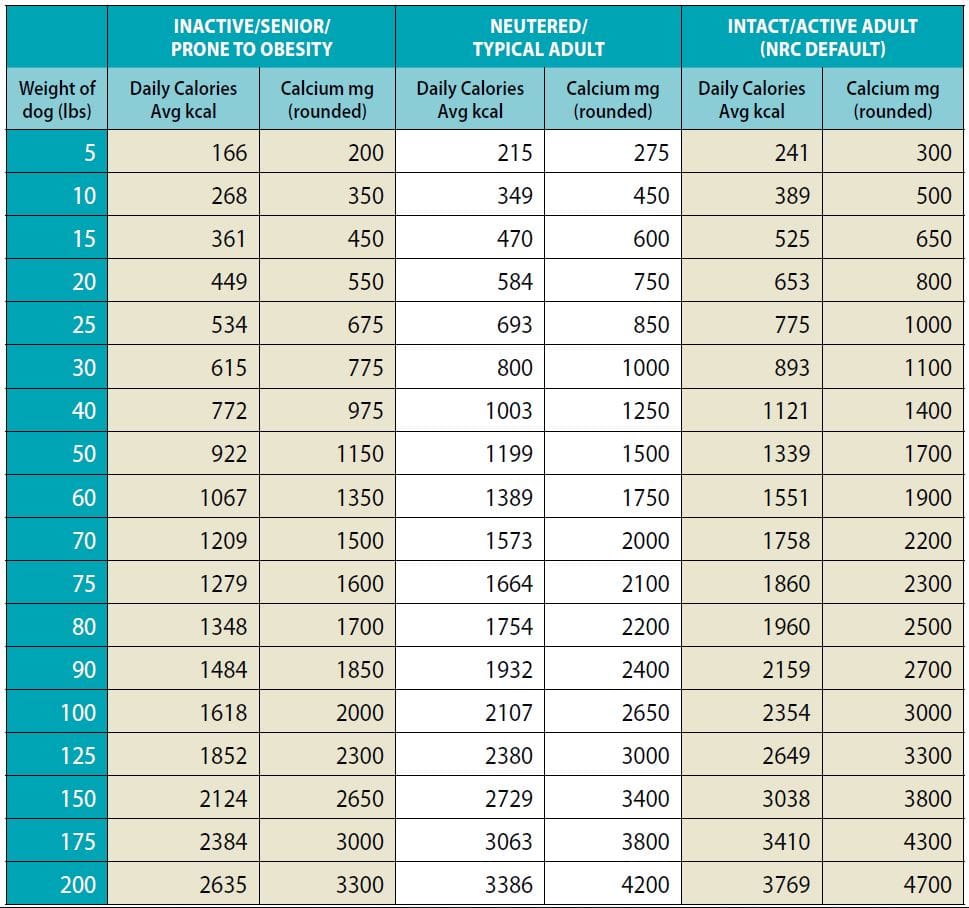
For example, if the bone meal supplement you’re using has 800 mg calcium and 300 mg phosphorus per teaspoon, there’s 500 mg “extra” calcium to use to calculate how much to give. If your dog needs 1,000 mg calcium added to his diet based on Table I, you would need to give two teaspoons of bone meal powder (500 mg extra calcium per teaspoon) in order to provide an appropriate amount of calcium while ensuring that the calcium:phosphorus ratio remains in the proper range.
Note that bone meal products designed for humans may not tell you the actual amount of calcium and phosphorus they provide, but will instead give you percentages of daily recommended values for adults.
For example, NOW Foods Bone Meal Powder says that 1 level teaspoon provides 80 percent of the recommended daily amount (RDA) for calcium, and 30 percent of the RDA for phosphorus. The RDA for both calcium and phosphorus for humans has been 1,000 mg (1 gram), so 80 percent would be 800 mg and 30 percent would be 300 mg.
This calculation will soon become more complicated, however, as the FDA recently increased these recommended amounts to 1,300 mg calcium and 1,250 mg phosphorus. New labels must reflect this change by July 2020. If NOW Foods does not change their formulation, the same product would now show that it provides 62 percent RDA for calcium and 24 percent RDA for phosphorus.
Many bone meal products provide about twice as much calcium as phosphorus. In this case, you can just double the calcium recommendations shown in Table I to determine how much to give.
If you use bone meal powder to provide calcium, look for brands that have been tested to show that they contain low levels of lead. Never use bone meal products intended for fertilizer.
Dolomite is another type of calcium supplement that may contain unacceptably high levels of lead.
Plant-based calcium supplements show considerable variety in the amount of lead they may contain; contact the company to ask for test results before using one of these supplements on a daily basis.
Again, these guidelines are only for dogs who are fed a homemade diet that lacks an adequate source of calcium, such as raw meaty bones or a supplement designed to balance a homemade diet. There’s a lot more to feeding a homemade diet that we’ll try to address in future articles, but getting the calcium right is a big step in the right direction of feeding a complete and balanced diet.
Mary Straus is the owner of DogAware.com. She and her mixed-breed, Willow, live in the San Francisco Bay Area.




GREAT info thanks!! If I use bone broth for dogs ….now I was going to use a bone broth for dogs that comes in a powder form the liquid in my dog food …is this adding enough needed calcium / minerals?
Den, unless the product you’re using specifies how much calcium it contains, you cannot use it to provide calcium to balance a homemade diet. Bone broth will not be enough to meet your dog’s nutritional needs.
https://nourishedkitchen.com/bone-broth-minerals/
Added to last comment. My mix is 17lbs, and vet says she should lose a few pounds. Also the daily feeding directions of the supplement according to weight is 1tsp daily up to 30lbs.
Hi Mary, my dogs are a 6 y/o Daschund who weighs about 15 pounds, and my other dog is a 7 y/o Daschund rat terrier mix. I make homemade dog food for them and give them half a cup each twice a day. I have them on NaturVet all in one supplement powder, the calcium analysis in this supplement is 68mg per 2tsps. I give them 1/2 tsp of this supplement at each meal. Just want to know if this is an adequate amount of calcium for them. I have eggshell powder and was planning on using that to supplement. Any suggestions would be greatly appreciated. Thank you
Robin, you should be able to answer this question from the information in my article.
According to the table above, a 15-lb dog should get between 450 and 650 mg calcium daily.
According to the information you provided, you are giving 34 mg calcium daily via the NaturVet supplement.
So the answer is no, this is not an adequate amount of calcium!
No supplement made for dogs will have enough calcium to balance a homemade diet unless it’s made expressly for that purpose. Otherwise, the supplement would not be appropriate to give to dogs who eat a commercial diet that already has the right amount of calcium.
This information has literally been. a life saver! I started giving my dog a raw diet and it cleared up his chronic reverse cough type allergy (no vet had answers regarding what it was or what is was all about). Anyway, I made the mistake of not supplimenting calcium for months, thinking it was in the meat grind he ate but only organs were no bone. I believe it has welcomed vision problems/ cataracts for my fur baby. He does have digestive issues but raw goat milk kefir & enzymes has made him regular. What calcium supplement is recommended? I made one using eggshells & ACV but I rather be more calculated about it, realizing how badly he needs it right now. He is 15 pounds and 13 years old 🙂
Thank you so much for reading
Monica, I would give your dog 1,000 mg calcium daily — that’s higher than the minimum, but will help make up for what has been missing, and your dog may need higher than the minimum if you’re feeding a high-meat (high-phosphorus) diet. You can use any form of plain calcium, as described in my article. No ACV is needed, and should not be used to replace grinding eggshells to powder, if that’s what you choose to use (1/2 tsp eggshell powder provides approximately 1,000 mg calcium). You can reduce the amount of calcium down to 500-600 mg/day after a few months.
What about using powdered cuttlebone for a dogs calcium? It’s pure calcium isn’t it?
Cuttlebone (cuttlefish bone) is crystalized calcium carbonite, so it would provide calcium, but it would likely be far more expensive than just buying calcium carbonate powder or using eggshells ground to powder (95% calcium carbonite). You’d also have to grind it to powder, since dogs wouldn’t just eat chunks of it. It’s best used for animals like birds and reptiles that will nibble from the bone as needed.
Thanks for all the great info and your attention to detail in the comments. I have a question: Is there a correlation between calcium intake and formation of calcium oxalate crystals in urine? Also, what foods are reliable sources of phosphorus? Thanks.
Becky, you can read about calcium oxalate stones here: http://dogaware.com/articles/wdjcalciumoxalates.html
Your question on phosphorus is too broad for me to answer — why are you asking? You can see the amount of phosphorus in some foods in this table on my website: http://dogaware.com/health/kidneytable.html
Thanks for the articles. I am monitoring my 6 year old Westie’s calcium closely because during her annual checkup, they detected calcium oxalate crystals in her urine sample. (This was before I started feeding fresh.) However, when I asked them to repeat the test, it came up negative for crystals. Twice. So we are assuming that the first sample sat too long before being checked. Nonetheless, I am trying to be precise on the calcium matter and the balance with phosphorus. I have read that, with humans, taking too much calcium can lead to kidney stones. So, trying to learn what I can and be smart about this. She is 17.5 pounds and I supplement with 1/4 tsp eggshell daily as she currently gets 2 ounces of commercial kibble with her fresh food. Thanks for your feedback.
Becky, the amount of calcium to add would depend on what percentage of calories your dog is getting from homemade food versus commercial food that is already complete and balanced. Assuming 4,000 kcal/kg for the kibble, 2 ounces would provide around 225 calories. A typical pet dog that is at an appropriate weight at 17.5 lbs might eat anywhere from about 400-500 kcal/day and need at least 600 mg calcium daily, so if you figure half her calories come from homemade food, you’d add around 300 mg calcium daily. 1/4 tsp eggshell powder provides about 500 mg calcium, which is in the right range.
I’m also very curious about the assertion that feeding amounts should not be based upon the weight (ideal weight) of the dog. I’ve never heard or read this before, and every single food bases feeding amounts on the weight of the dog. I’d love to read more, do you have any sources you can provide for more information and details?
Thanks!
Sharon, feeding amounts are based on the weight of the dog, but it’s a complicated formula, not as simple as feeding a dog twice as much if it weighs twice as much (linear). See item 6 in this article for a more detailed explanation:
https://www.whole-dog-journal.com/food/the-state-of-the-commercial-raw-diet-industry/
Also see this site for more info:
https://vet.osu.edu/vmc/companion/our-services/nutrition-support-service/basic-calorie-calculator
Nice article. I believe there are resources out there that give information on the amount of bone per different raw meaty bones. That’s also helpful. We have switched our dogs from a commercial raw to home prepared. We have also consulted a vet nutritionist that specializes in raw diets.
My concern with bone meal is the processing. I’ve read very nasty things about it, so hesitate.
Our dog ages are 2.5 years; 2.5 years; 1 year and 1 year. All American Field labs.
One thing people often forget is that variety is important, and liver is not the only organ the dogs should be fed. (my criticism of Primal is only liver, no other organs). Dogs need sweet bread, liver, kidney, etc. etc. for a good solid diet. Also, a variety of different muscle meats is important in my humble opinion.
Still worried about the calcium amounts. I know a calcium phosphorus ration of 1.2:1 is about the level you should go for in a large breed puppy especially. Many commercial diets/raw diets are way too high in the calcium (meaning they probably have too much bone). Nobody should ever feed a large breed puppy puppy food. Slow and steady growth is the key.
Thanks for the information and concern about our canine loves.
Hi Mary,
Thank you for the informative article! I feed my 1year and 8 months old minigoldendoodle a raw premade diet from Carnivora.ca. It’s not as expensive like other raw premades in my area. Each 0.5 lb patty as per company description should contain 7% bone. The nutritional label shows each patty has 0.45% calcium and 0.35% phosphorus. Should I add extra calcium ? Sometimes I give him rmb (turkey necks or pork ribs) but I’m concerned that he’s not chewing them properly and I’m not comfortable . Often pieces of bone come out un digested…thank you for your help.
Magdalena, Carnivora does not make complete diets, so what you’re feeding is undoubtedly unbalanced and deficient in many nutrients. The percentage of calcium shown is likely “as fed” and would have to be converted to dry matter in order to determine if it’s appropriate or not, but you should not add calcium, as diets that include bone are more likely to be high in calcium than low. I would not give RMBs if they are not chewed properly and not fully digested, as bone shards in the digestive tract can be dangerous (and turkey necks appear to cause the most problems from choking of any RMB for large dogs).
You can read more about the issues with commercial raw diets in this article, but note that Carnivora doesn’t even claim to meet AAFCO guidelines and so would have more issues than those talked about here:
https://www.whole-dog-journal.com/food/the-state-of-the-commercial-raw-diet-industry/
Also see this section for more info on what is missing in these types of incomplete blends:
http://dogaware.com/diet/homemade.html#incomplete
Thanks for your response. I guess I won’t be adding any other calcium source if you think that Carnivora has enough bone in the grind I feed. I’m aware that they are not meeting Aafco but their patties are good quality and my dog likes them. I do add sardines or herring alternating at least twice a week. I add seal oil on rest of the days and sometimes tripe. He does get egg and yogurt, pumpkin, sweet potato and green veggies in small quantities because he is an yeasty prone dog. So by adding those I’m aiming to give him other stuff that Carnivora patty is not including.
Dear Mary,
I need to reread your article in detail but at the moment I am freaked out that I am not feeding my 12 week old Australian Shepherd puppy correctly re calcium. I am feeding raw with a variety of proteins and some chicken necks, wings (mostly snacks here) and occasional lamb neck and beef rib as meal replacement. For the proteins without bones I was adding calcium from egg shells (pulverized) to the tune of 1500 mg per 1 lb meat (muscle + organs). I also add about 10% steamed veggies.
I am feeding quantity based on current weight * 8% (avg of 6-10% recommended by raw retailer‘s website). I anticipate his adult weight will be about 50-55 lbs. Today, at twelve weeks he weighed in at 14.6 lbs, which means I am feeding him ~ 530 gr or 1.15 lbs. I thought calcium to phosphorous ratio was to be 1:1…and I thought I was adding calcium, which counterbalanced the phosphorous content of the proteins without bone. This is why I am now very confused…as you say I should not use eggshell but bone meal. I would so appreciate understanding what I am missing here. Many thanks for any additional information you are able to supply.
Ylva, this is a difficult question for me to answer, because there are many problems with the diet that you’re feeding, not just the amount of calcium (and phosphorus). The nutritional deficiencies, excesses and imbalances can definitely harm a young puppy, still growing rapidly, though the danger is not as great as it is for larger-breed dogs. You are also likely feeding too much food, from the sounds of it, though it’s always hard to know for sure how many calories you’re giving, but the advice on the raw retailer’s website is not valid. Please see this article for more about the problems with commercial raw diets, especially for puppies:
https://www.whole-dog-journal.com/food/the-state-of-the-commercial-raw-diet-industry/
And this article that talks about problems with recipes and such found on the web:
http://dogaware.com/articles/newsdiet.html#recipestudy
For puppies, I suggest following recipes from either Steve Brown’s or Karen Becker’s books, as described in my book reviews here:
http://dogaware.com/diet/bookreviews.html
A little more about amounts to feed puppies:
http://dogaware.com/articles/wdjhomemade3.html#puppies