

If asked the most common mistake people make when feeding their dogs a homemade diet, I’d have to say that it’s not adding calcium. This error is not only common, it’s also dangerous, especially for puppies, but for adult dogs as well when too little calcium is given long term. Giving an inappropriate amount of calcium (either too much or too little) can cause orthopedic problems in growing puppies, especially large-breed puppies during the first six months when they are growing the fastest. But giving too little calcium can lead to bone disease and more in adult dogs, too.
It’s not surprising to me that many people do not realize the importance of adding calcium when feeding a homemade diet. Most of the homemade diet recipes I’ve seen online make no mention of added calcium. I reviewed more than 30 books on homemade diets for WDJ some years ago.1 Of the 24 books I reviewed that were not exclusively about feeding a raw diet that includes bones, only 10 included adequate calcium guidelines!
Why Calcium is Important in Dog Nutrition
I’m aware that some people who feed home-prepared diets rely on annual blood tests to indicate whether their dogs are receiving enough calcium; they think that if their dogs’ blood calcium levels are normal, the dogs must be getting the right amount of calcium in their diet. Unfortunately, this is not true.
For both dogs and humans, the body must keep calcium levels in the blood within a specific range to prevent serious health issues, including loss of muscle control, seizures, and even death. Adult dogs are able to control their blood calcium levels by absorbing a greater or lesser percentage of dietary calcium, depending on the amount fed, though this can be impacted by the amount of vitamin D in the diet as well, as vitamin D promotes calcium absorption. Note that puppies do not have the ability to control their absorption of calcium before puberty, and thus can suffer the negative effects of too little or too much calcium and vitamin D very quickly.

Dogs (and humans) also control their blood calcium levels by storing calcium in bones, then drawing it back out when needed – when they aren’t getting enough calcium in their diet. When adult dogs are given too little calcium for long periods (like months), they develop a condition called nutritional secondary hyperparathyroidism. In this situation, the body produces excess parathyroid hormone to draw needed calcium from their bones, which can also result in elevated levels of phosphorus in the blood.
Parathyroid hormone is completely different from thyroid hormones; the name is given because the parathyroid glands are located adjacent to the thyroid glands. Parathyroid hormones are responsible for regulating calcium and phosphorus levels in the blood. Hyperparathyroidism (too much parathyroid hormone) can also be caused by a tumor on one of the parathyroid glands (primary hyperparathyroidism) or by advanced kidney disease (renal secondary hyperparathyroidism). Nutritional secondary hyperparathyroidism is usually linked to a deficiency of calcium, sometimes combined with too little vitamin D.
When the body produces too much parathyroid hormone, it causes demineralization of the bones, which may result in lameness, bone pain, swelling, stiffness or limping, not wanting to move, and even spontaneous fractures. Adult dogs may develop spinal deformities, loose teeth, or neurological signs. Puppies are more likely to develop deformities in their legs and joints that may leave them unable to walk normally. If the condition is not corrected quickly, it could lead to long-term orthopedic disorders.
Now that I have scared the pants off you about providing the right amount of calcium in your dog’s homemade diet – at least, I hope I did! – what kind of calcium should you add, and how much is the right amount?
When You DON’T Need to Add Calcium to Your Dog’s Food
Never add calcium to commercial diets that are “complete and balanced” – these already contain the right amount of calcium! Adding calcium to a “complete and balanced” diet would be particularly dangerous for large-breed puppies.
However, most homemade diets require added calcium with a few notable exceptions. DO NOT add calcium to a home-prepared diet if:
- You feed a raw diet that includes raw meaty bones (RMBs) — parts such as chicken and turkey necks where the bone is fully consumed. Bones are high in calcium and phosphorus; there’s no need to add calcium to a diet that includes at least 25 to 30 percent RMBs.
- You use a supplement that is especially designed to complete and balance a homemade diet, such as those made by Balance IT and Just Food For Dogs.
- You use a dog food “base mix,” such as those made by The Honest Kitchen and Sojo’s, that you combine with your own added protein source according to the product directions.
When using supplements or base mixes that promise to complete a homemade diet, make certain that the product includes a complete nutritional analysis showing appropriate amounts of calcium. Don’t accept the verbal assurances of the company’s owners or representatives, or those of pet food store employees; if they can’t or won’t provide you with complete nutritional analyses of their products, we would not rely on those products for anything more than an occasional meal.
Following Calcium Guidelines
With very few exceptions (see “When You Don’t Need to Add Calcium,” above), you need to add calcium to your dog’s homemade diet.
Calcium guidelines can be determined in several different ways, including the body weight of the dog, the dry matter percentage of the food, and the calories that the dog needs. Each has its own complications:
- Small dogs eat more and have higher nutritional needs for their weight than large dogs do, so you can’t use linear guidelines such as “give x amount per 10 pounds of body weight.” Any time you see linear feeding instructions, it’s a red flag that whoever is giving the instructions does not understand nutrition.
- The amount of moisture (water) in food can vary from about 10 percent or less in dry foods (kibble, dehydrated, freeze-dried) to 80 per percent or more in wet foods (canned, fresh, frozen, raw, cooked). You must convert the “as fed” food weight to dry matter (DM) in order to give guidelines based on how much food is fed. Dry matter percentages won’t change much when you convert from “as fed” for dry foods, but are usually three to five times as much as the “as fed” percentage for wet foods. Also, because we feed dogs less of high-fat, calorie-dense foods, adjustments need to be made for foods with more than 4,000 kcal/kg DM.
- Calculating nutritional requirements based on the number of calories your dog needs is the simplest method, but comes with some warnings as well. Caloric needs will vary based on your dog’s activity level, metabolism, and more. The right amount to feed will also be affected by how many calories your dog gets from treats, chews, leftovers, and other sources. In particular, inactive dogs who eat less food for their weight than would be expected should get most of their calories from a balanced diet in order to avoid nutritional deficiencies.
The National Research Council (NRC) issued updated nutritional guidelines for dogs in 2006. They recommend feeding adult dogs at least 1 mg of calcium per Calorie (kcal), which is the same as 1 gram (1,000 mg) per 1,000 kcal (Mcal).
The nutritional guidelines published by the Association of American Feed Control Officials (AAFCO), which were finally modified in 2016 to reflect the latest NRC recommendations, increased this to 1.25 mg calcium/kcal (1.25 grams/Mcal).
On a dry matter basis, that’s 4 to 5 grams of calcium per kilogram of food on a dry matter basis, or 0.4 to 0.5 percent DM.
One other factor affects how much calcium your dog needs: phosphorus. There should always be at least as much calcium as phosphorus in the diet, up to twice as much for healthy dogs (or three times as much for dogs with kidney disease).
Most homemade diets that I’ve looked at have between 0.5 and 1.25 mg phosphorus per kcal, so giving 1.25 mg calcium per kcal will provide most dogs with an appropriate amount of calcium and a proper calcium:phosphorus ratio.
You will need to know how many calories your dog is likely to need, based on his ideal weight – not his actual weight. See Table I on the next page for the approximate amounts of calcium to add to homemade diets for dogs of various sizes and various activity levels in order to provide 1.25 mg of calcium per kcal. While nutrient needs don’t vary by activity level, dogs who eat more food need more calcium in order to balance out the amount of phosphorus in the diet.
At minimum, give the lowest amount of calcium shown for your dog’s ideal weight, even if you find that you need to feed fewer calories than shown to keep your dog at a proper, lean weight. If you must feed a lot less to help your dog lose weight or prevent your dog from gaining unwanted weight, it’s time to cut back on the number of calories your dog gets from other sources.
The amount of calcium you give does not need to be exact. It’s fine to give a little less or a little more calcium than shown. Most commercial diets for adult dogs that I’ve looked at have between 2 and 3 mg of calcium per kcal (diets designed for puppies or for “all life stages” will have even more). These diets also have an equivalently higher amount of phosphorus.
If you feed a diet that is part commercial, part homemade, adjust the calcium amounts shown in Table I appropriately. For example, if you feed half homemade, give half the amount of calcium shown.
Calcium for Puppies is Trickier
All of these guidelines are for adult dogs only. Puppies are trickier. NRC and AAFCO agree that puppies need at least 3 mg of calcium per Calorie (three times the amount of calcium that adult dogs need on a caloric basis).
The maximum amount of calcium that puppies should get is 4.5 mg per kcal (4.5 g/Mcal). It’s especially important not to give too much calcium to large-breed puppies during their first six months, as they are the group most likely to develop bone and joint abnormalities when given the wrong amount of calcium and phosphorus.
Puppies also need more phosphorus than adult dogs do. Never add plain calcium to a puppy’s homemade diet. Puppies need bone meal or some other type of supplement that provides both calcium and phosphorus, in order to provide the correct amount and ratio of calcium to phosphorus.

What Form of Calcium Should You Give Your Dog?
There are many forms of calcium that can be added to your home-prepared diet to meet your dog’s requirements. Any form of plain calcium, without other ingredients such as vitamin D, is fine. Dogs do need vitamin D, but since dogs need more calcium but not more vitamin D than people do, the amount of vitamin D that you would end up giving when using a combination product would be too high.
Calcium carbonate is usually the cheapest and the easiest to give, as it has more elemental calcium than most other calcium compounds, so you will need to add less powder to the food.
One easy way to provide calcium is to use eggshells that have been washed, dried, and ground to powder in a clean coffee grinder or blender. One large eggshell will make about one level teaspoon of eggshell powder weighing 5.5 grams; this will provide approximately 2,000 mg calcium:
1/8 teaspoon eggshell powder provides about 250 mg calcium
1/4 tsp = 500 mg
3⁄8 tsp = 750 mg
1/2 tsp = 1,000 mg
5/8 tsp = 1,250 mg
3/4 tsp = 1,500 mg
7⁄8 tsp = 1,750 mg
1 tsp = 2,000 mg
Some people like to give their dogs whole eggs with the shell, but I don’t think that’s a good way to ensure that your dog gets the right amount of calcium. The calcium in eggshells that have not been ground to powder may not be absorbed, particularly if you notice any bits of shell in your dog’s stool. If it is absorbed, you may end up giving too much calcium, especially to smaller dogs.
It’s okay to give a dog a whole egg, including the shell, as a treat on occasion, but when using eggshells to provide dietary calcium needed to balance out a homemade diet, it’s safest to grind the shells to a powder.
If you use a calcium supplement that also includes phosphorus, such as bone meal powder or dicalcium phosphate, you will have to give more calcium than if you use a plain calcium supplement in order to keep the calcium:phosphorus ratio in the proper range. To determine how much to give, you must first subtract the amount of phosphorus from the amount of calcium, then use the remaining amount of “extra” calcium to calculate how much to give based on Table I.
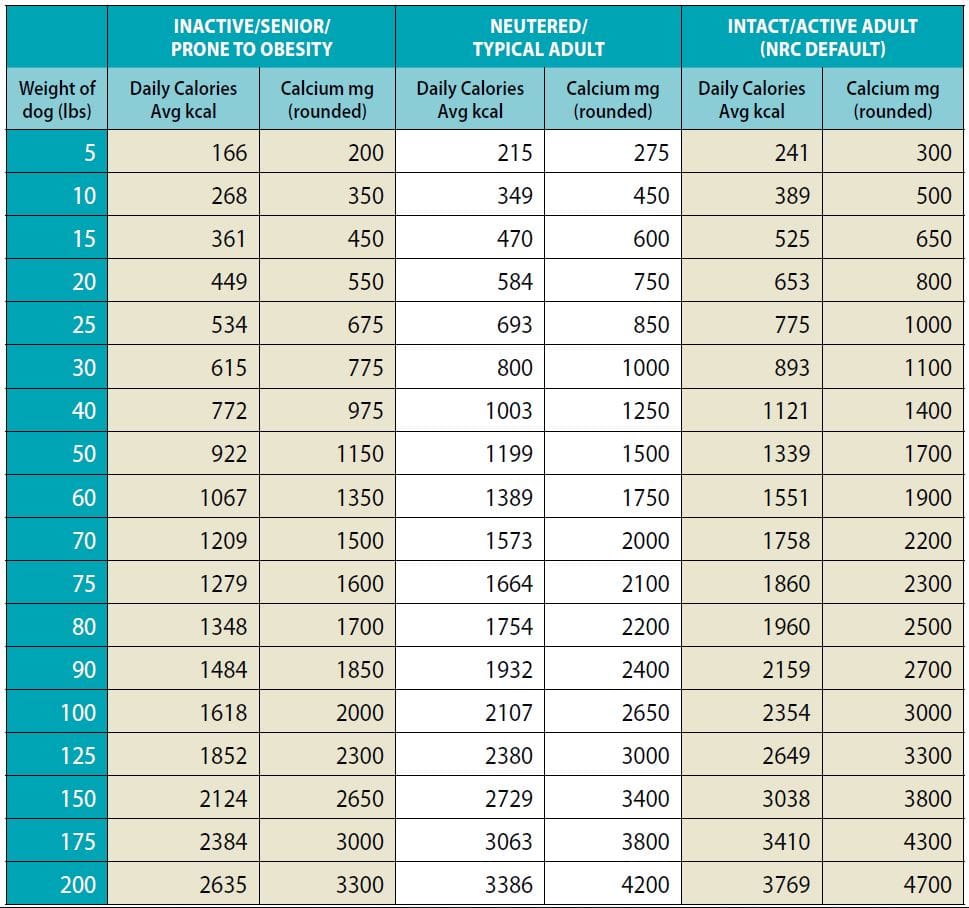
For example, if the bone meal supplement you’re using has 800 mg calcium and 300 mg phosphorus per teaspoon, there’s 500 mg “extra” calcium to use to calculate how much to give. If your dog needs 1,000 mg calcium added to his diet based on Table I, you would need to give two teaspoons of bone meal powder (500 mg extra calcium per teaspoon) in order to provide an appropriate amount of calcium while ensuring that the calcium:phosphorus ratio remains in the proper range.
Note that bone meal products designed for humans may not tell you the actual amount of calcium and phosphorus they provide, but will instead give you percentages of daily recommended values for adults.
For example, NOW Foods Bone Meal Powder says that 1 level teaspoon provides 80 percent of the recommended daily amount (RDA) for calcium, and 30 percent of the RDA for phosphorus. The RDA for both calcium and phosphorus for humans has been 1,000 mg (1 gram), so 80 percent would be 800 mg and 30 percent would be 300 mg.
This calculation will soon become more complicated, however, as the FDA recently increased these recommended amounts to 1,300 mg calcium and 1,250 mg phosphorus. New labels must reflect this change by July 2020. If NOW Foods does not change their formulation, the same product would now show that it provides 62 percent RDA for calcium and 24 percent RDA for phosphorus.
Many bone meal products provide about twice as much calcium as phosphorus. In this case, you can just double the calcium recommendations shown in Table I to determine how much to give.
If you use bone meal powder to provide calcium, look for brands that have been tested to show that they contain low levels of lead. Never use bone meal products intended for fertilizer.
Dolomite is another type of calcium supplement that may contain unacceptably high levels of lead.
Plant-based calcium supplements show considerable variety in the amount of lead they may contain; contact the company to ask for test results before using one of these supplements on a daily basis.
Again, these guidelines are only for dogs who are fed a homemade diet that lacks an adequate source of calcium, such as raw meaty bones or a supplement designed to balance a homemade diet. There’s a lot more to feeding a homemade diet that we’ll try to address in future articles, but getting the calcium right is a big step in the right direction of feeding a complete and balanced diet.
Mary Straus is the owner of DogAware.com. She and her mixed-breed, Willow, live in the San Francisco Bay Area.




Thank you for this in depth explanation. I started feeding my two dogs (12lb dachshund and 13lb shipoo) a cooked diet mixed with their dry food (royal canin GI low fat).
After much research and much confusion, I landed on giving:
1/4 cup dry food + a small handful of freeze dried chicken for breakfast
1/8 cup dry food + 1 oz cooked protein (ground turkey, ground chicken, ground sirloin) + 1oz vegetables for lunch
And then repeat that for dinner.
(for veggies I use a mix of cooked zucchini, green beans, carrots, sometimes a little bit of sweet potato)
I was giving 1/8 teaspoon of eggshell powder with lunch and 1/16the with dinner but I’m not sure that is the best dosage so I kept the dry food on board hoping it would supplement the calcium/phosphorous requirement and stopped with the eggshell powder (they didn’t seem to like the powder). In this scenario can I just add a multivitamin to their diet?
Any recommendations you have would be GREATLY appreciated! Thank you.
Ariel, do you know how many calories your dogs are each getting from their commercial food? The Royal Canin website says that their GI Low Fat diet contains about 250 kcal/cup:
https://www.royalcanin.com/us/dogs/products/vet-products/canine-gastrointestinal-low-fat-dry-dog
If you’re using a measuring cup, it appears that each dog is getting 3/8 cup dry food twice a day, or 3/4 cup a day, which would provide a little less than 200 kcal/day. Depending on age and activity level, your dogs likely need at least 300-350 kcal daily, so they may be getting anywhere from 1/2 to 2/3 of their diet from the commercial food.
Assuming they’re both adult dogs, you could probably get away without adding calcium, but it would be safest to add maybe 1/8 tsp (250 mg calcium) eggshell powder daily, split between meals. They likely won’t notice the powder if it’s combined with something wet (have you tried yogurt?).
You could use a multivitamin, but it can be difficult to get the right dosage for small dogs. Supplements made for pets assume you are feeding a complete commercial diet and so will not provide what is missing in a limited homemade diet. And most multis have very little calcium.
Is there a reason you’re using such an extremely low-fat prescription diet? It’s really only appropriate for dogs with severe fat intolerance, usually leading to bouts of pancreatitis. If it’s just for weight loss, see my article for better ideas:
http://dogaware.com/articles/wdjweightloss.html
I am trying to do the calculations over and over to understand if I am wrong! My 7 mo Great Pyrenees weights 31 kg and based on nutritional requirements she should get 2,600 kcal per day that means 7,800 mg of calcium per day…..the bone meal I use has 720 mg per tsp so, that means I have to give my puppy 11 tsp of bone meal Per day. It seems crazy to me but I have been doing the calculations from different sources and it all comes the same. Can someone help me to understand if it’s correct or not, please?
Gabriella, I think your calculations may be a little high. A puppy that weighs 31 kg (68 lbs) should probably get around 2,000-2,300 kcal/day, though it partly depends on how much she is expected to weigh as an adult dog. If you’ve been feeding 2,600 kcal/day and your pup is staying lean, then that would be the right amount to feed, but if she is at all pudgy, I would reduce the amount that you’re feeding so that she stays lean, which is much healthier for her growing joints.
If you pup eats 2,600 kcal daily, then you are correct that she should get 7,800 mg calcium. If 2,000-2,300 kcal/day, she should get 6,000-6,900 mg calcium. Your calculations as to teaspoons are correct.
You may want to consider a different brand of bone meal. Upco bone meal does not state that it has been tested for lead. Other brands may also have more calcium per teaspoon.
NOW Bone Meal Powder has 840 mg calcium per level tsp (2.8 grams) and “is tested for heavy metals such as lead and aluminum to assure the lowest levels possible (though it doesn’t show the actual amount found).
https://www.nowfoods.com/supplements/bone-meal-powder
KAL Bone Meal Powder has 1300 mg calcium per rounded tsp (6 grams), but also makes no mention of testing for lead. You could contact the company to ask if it has been tested, but don’t accept verbal assurances, ask to see the report.
https://www.kalvitamins.com/collections/calcium/products/bone-meal-powder
You might also consider dicalcium phosphate powder, which doesn’t have the risk of lead contamination. Just be sure the ratio of calcium:phosphorus in the overall product is no higher than 2:1 (so your pup also gets the phosphorus she needs). I found one product that provides 1414 mg per tsp (5.4 grams):
https://freedahealth.com/products/calcium-phosphate-powder-16-ounces
Hi I Had a question I have two Chow chows and have now read two articles stating that chows need more carbohydrates and less protein. That seems strange to me do you have any opinions on that?
Hi Melanie,
I don’t believe there is any evidence to support the idea that Chows need more carbs and less protein than other breeds. Since most dog foods have less protein and more carbs than I think is ideal for any dog, deliberately choosing a food that is high in carbs and low in protein would make the situation even worse. BTW, I owned Chinese Shar-Pei for 25 years, a breed that is closely related to Chows, and they did extremely well on a very high-protein, low-carb homemade diet.
Hello, I am a dog. It might be hard to believe, but I assure you it is true. I would prefer not to take the time right now to explain my communication abilities, but instead use this space to express my gratitude. Mary Straus, on behalf of my species and all breeds within, we can’t thank you enough for raising awareness to the importance of properly balancing our diets. Most of us can’t speak for ourselves and the ones of us that can don’t know what’s best anyway.
Nazli, it’s not clear if you’re feeding 100% homemade, but I will assume that’s the case.
A dog that weighs 26 lbs should get 830 mg calcium daily, according to NRC. If your dog eats less than most dogs his size, then he might need less calcium, but I wouldn’t go as low as 500 mg in any case.
You can’t really go by the weight of the food, since this can vary significantly depending on what is in the diet, particularly how much fat and how much moisture it contains. But if you did follow the guidelines that you names, 250 grams is 0.55 pounds, so you would give 550-825 mg calcium based on 1000-1500 mg per pound of food. If you’re also feeding some commercial food that includes calcium, then the lower amount might be correct, but otherwise I’d try to give around 800 mg daily.
Mary ,
I really appreciate that you took the time to read , and answer my question . I have a very good boy (aren’t them all ? ) , and I try to provide him with the best care possible . You assumed right , he is fed 100% home made . I increased the amount of calcium in his diet as soon as I read your article .I hope I didn’t cause him any harm by feeding less calcium than needed ( I used to add 500 mg ) in previous years 🙁
Thank you for providing us with the valuable information to keep our fur babies healthy !
Best regards,
Nazli
Nazli, I’m sure your dog is okay. Adult dogs have some ability to regulate their uptake of calcium, absorbing more when there is less in the diet. While you may not have been giving the optimal amount of calcium, at least you were adding it in significant amounts, enough to prevent a deficiency. Adult dogs can handle a wider variation than puppies can.
Mary , I have been cooking for my baby boy for 5 years now , and according to what I had found out I have to feed 500 mg calcium to my 26 lb Bichon/shiz tzu mix, because he gets 250 gr of homemade food.I was under the impression that I had to give him 1000- to1500 mg per pound of food . Now, looking at the table you have kindly included in this article , I realized I have been giving him less than needed . Would you please help me figure this out ? He is a 10 year young dog , with moderate activity .
Best regards,
Nazli
My 5 year old 6.5kg jack Russell had anal gland issues. lot of Pain when they need to be emptied. I had been raw feeding DAF completes. However the vet has told me to feed boneless as bones will aggravate her issues.
Would I be right in thinking 500mg of crushed egg shell daily would compensate for the lack of RMBs that she now doesn’t get?
Paula, I don’t know anyone who measures eggshell powder by weight rather than by volume, but based on my article, here’s what your 500 mg would provide:
One large eggshell will make about one level teaspoon of eggshell powder weighing 5.5 grams; this will provide approximately 2,000 mg calcium:
If 5.5 grams of eggshell powder provides 2,000 mg calcium, than 500 mg (0.5 grams) would provide about 181 mg calcium.
Your 6.5-kg (14.3-lb) dog needs at least 550 mg calcium daily, or about 1.5 grams (1500 mg), or three times what you propose.
Note that eggshells should be ground to powder in a clean coffee grinder or blender rather than just crushed in order to ensure that the calcium can be absorbed.
Because raw diets are generally extremely high in fat and low in fiber, you might want to try feeding a completely different type of diet to see if that helps with your dog’s anal gland issues. If so, you’ll know that it’s diet related (whereas just removing bone from the diet won’t necessarily tell you the opposite if your dog does not improve). Once you know that a different type of diet helps your dog’s anal glands, you can work on figuring out whether the issue is related to bone, too much fat, lack of fiber, or issues with specific ingredients.
I make a mix using bone broth (I slow cook the bones first thing), veges such as carrots and broccoli, blueberries or apples. I cook chicken legs in the slow cooker, then cook the bones some more. I add rice or oatmeal to the liquid remaining from the chicken, then add in the chicken legs (and hearts/gizzards, cooked and chopped). I add more oats as needed to make it a thick mash, then freeze it in 1/2 cup balls. One ball is added to a good kibble twice daily and my 12-15 lb dogs get 1/2 cup twice daily. Before I added the chicken mix, they might or might not eat the kibble, but all except my 16 yr old finish every piece now. He sometimes doesn’t eat, but will eat later. Should I be adding eggshells? I plan to add some eggs in next time.
Pat, it’s impossible to know how much calcium is in the bone broth that you are making. It’s less important in your case because it sounds like your dogs are adults and are getting the majority of their calories from a complete commercial diet that is providing calcium. You could try adding some apple cider vinegar when you make the bone broth, as that will increase the amount of calcium that is leached from the bones, but as long as what you are adding is not a substantial portion of the diet, and you’re not feeding it to puppies, you should be okay without adding eggshells. If your 1/2 cup balls weigh about four ounces; you could add about 250 mg calcium (1/8 teaspoon eggshell powder) per ball. Another option might be to add fish oil that includes vitamin D, which can help with the uptake of calcium, and fish oil is good for many other things as well.
http://dogaware.com/articles/suppsoils.html#fishoil
I’m considering using this Dicalcium phosphate supplement to my home cooked dog food recipes. It says it has 466mg Calcium to 360mg phosphate mixture which seems on the mark by all the suggested calcium/phosphate mix ratio recommendations. I like the price and the fact that’s it’s available on Amazon. Anyone see any red flags?
https://www.amazon.com/dp/B00ENPADPA/?coliid=I3RT8Q71KV6EQJ&colid=3FSFSIINEAM26&ref_=lv_ov_lig_dp_it&th=1
I’m no longer comfortable answering questions in this format. If you want to ask me a question, please contact me via email from my website (see bottom of page at http://www.dogaware.com). That allows me to provide more details and ask questions when needed. Apparently my answers don’t come across the way that I intend them to here. Please note this is not my website nor do I have any control over it. As I state on my website, I don’t have a lot of time for responding to questions, so it may be a couple of weeks, occasionally longer, before you hear back from me, but I do respond to everyone who emails me with questions about their dogs.