
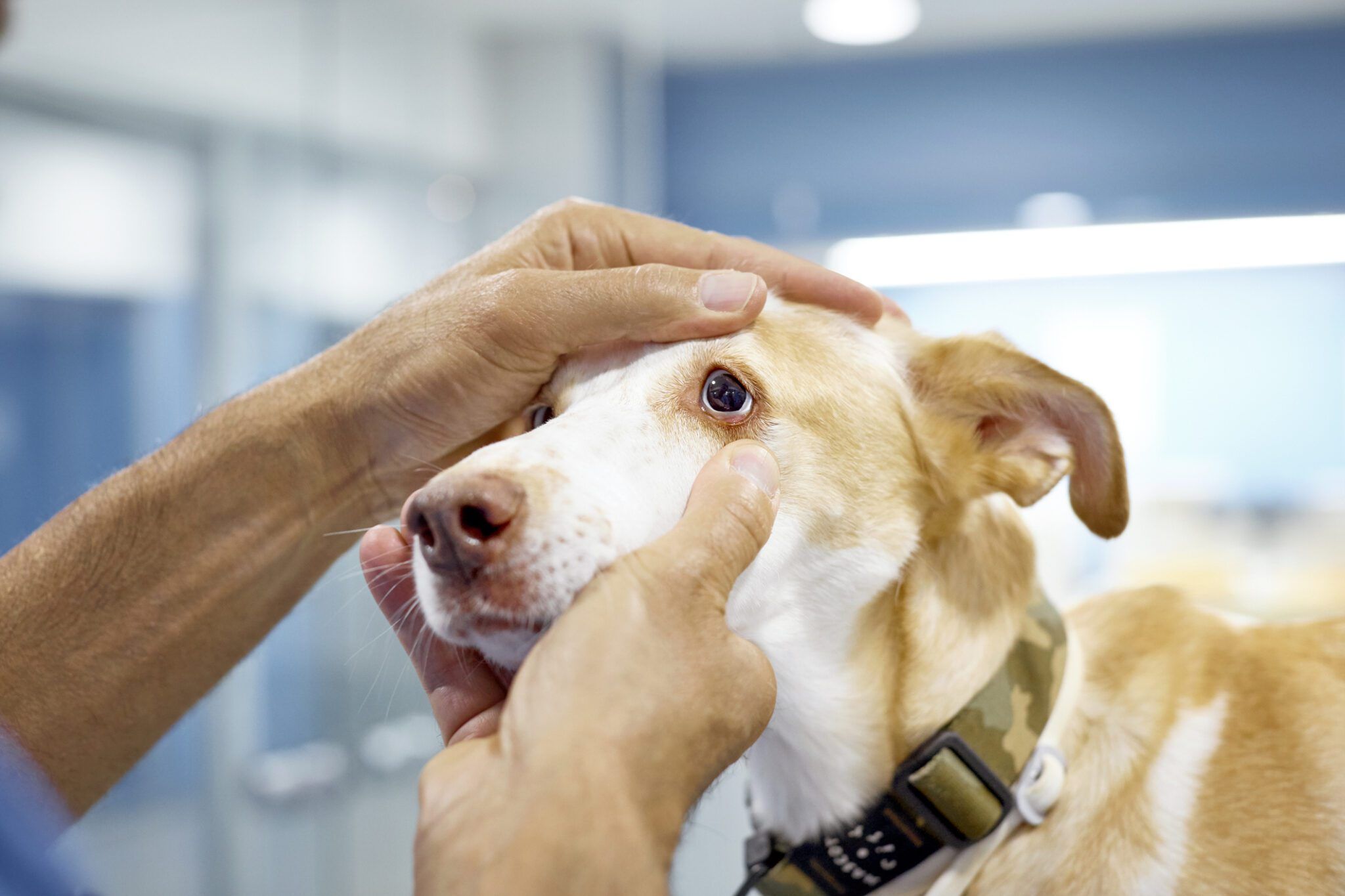
Even the idea that your dog may have melanoma is upsetting. Symptoms of melanoma in your dog’s eye may begin like any eye problem with signs of pain, like squinting, tearing, or rubbing the face. You may notice redness in your dog’s eye or suspect vision loss.
If you also see discoloration in your dog’s iris, a growth along the scleral/corneal junction, or a dark spot near his eye, it could be early-stage dog melanoma. If so, don’t wait. See your veterinarian for a diagnosis to determine if it’s malignant or benign.
Melanoma in a Dog’s Eye
Melanomas result from tumors of the melanocytes, the cells that produce pigment. In the eye, that means cells from the uvea (the iris, ciliary body, and choroid) or cells from the limbus (border between the cornea and the sclera). Much less common are small melanomas on the eyelid or the conjunctiva. Uveal melanomas are the most common eye tumor in dogs.
Fortunately, over 80% of these ocular melanomas are benign, and that designation means few will metastasize to other locations in your dog’s body. Unfortunately, these tumors, especially the uveal ones, even though benign, can expand locally and cause visual problems, including secondary glaucoma or blindness.
What Does Melanoma Look Like in a Dog’s Eye?
Early on, uveal tumors are flat, black or brown masses on the iris. They can be difficult to distinguish from iris nevi or freckles on the iris at this early stage. (Eventually, these become slightly raised if they are melanomas.)
A veterinary ophthalmologist using transillumination (a diagnostic test that involves shining a bright light through the tissues) can usually tell them apart at this early stage. Your veterinarian can track these discolorations. If there is growth, it is a uveal melanoma. Taking photos to track changes is ideal. That is the best way to catch malignant melanomas early on.
What Dogs Are at Increased Risk for Melanoma?
Labrador Retrievers, Golden Retrievers, and German Shepherd Dogs have increased risk for uveal melanomas, but these tumors can appear in any breed and either sex. Most dogs are older, with 9 years being the median age. Cocker Spaniels, Poodle mixes, and Poodles have an increased risk of eyelid melanomas.
How Is Dog Eye Melanoma Diagnosed?
A diagnosis of ocular melanomas depends primarily on observation. Examination by a veterinary ophthalmologist can often give you a definitive diagnosis. A slit lamp and/or gonioscope provide more accuracy on location and stage than a simple ophthalmoscope. Lymph node aspirates may be recommended to look for any metastasis as well as X-rays of the chest. Intraocular pressure will be measured to check for glaucoma. Ocular ultrasound can be helpful.
Some melanomas may cause uveitis (a serious inflammation) of the eye or even glaucoma. Those situations become emergencies. Glaucoma is a serious side effect that often shows up even from the benign version of this cancer. The eye will often be red, though the cornea may be opaque. Glaucoma is extremely painful. It can sometimes be managed medically if caught early, but if it is secondary to cancer, the ideal option is enucleation (removal of the eye).
Treatment for Melanoma in a Dog’s Eye
Treatment varies with the extent of the melanoma and whether it appears to be malignant. The goal of treatment is to preserve as much vision as possible and relieve pain.
Laser is often the first treatment of choice. This can be used on all the various ocular melanomas from eyelids to iris. This should only be done by an experienced veterinarian to prevent any side effects and preserve as much vision as possible. Cryotherapy may also be used for small or external melanomas such as eyelid growths.
The melanoma vaccine (approved for oral melanomas) has not been tested or shown to be effective for ocular melanomas at this time.
The primary method of treatment currently is surgery. With the possible exception of eyelid growths, intraocular surgery should be done by a veterinary ophthalmologist. Surgery most often means removal of the eye itself. Enucleation can often be done by your regular veterinarian. Obviously, this means total loss of vision, but dogs tend to adapt to loss of an eye quickly, especially if the other eye is normal.
A friend’s Australian Shepherd had to have an eye removed. She felt much better afterward, presumably because the pain was gone. She became more active, her appetite improved, and she was happy to participate in her favorite dog sports. She continues to participate in performance events, including Barn Hunt, scent work, and Rally.
A study out of Iran offers a new potential treatment and hope for dogs with malignant ocular melanomas. This was only one case, but the results are positive. Electrochemotherapy was done following surgical removal of a malignant mass. It can be difficult to get clear margins with the limited space in the ocular orbit. Electrochemotherapy uses electronic fields with chemotherapy drugs to increase the effectiveness of the chemotherapy. Again, only one dog, but as of seven months post op, the dog was doing great and had no signs of recurrence. This study also fits the One Health aspect of veterinary medicine as this technique may offer a new treatment plan for people with ocular melanomas.
Can Melanoma Be Prevented in a Dog?
Can you prevent this cancer? Not really. For the breeds that appear to have a genetic predisposition, avoiding using any dog with an ocular melanoma for breeding would be ideal, or at a minimum, don’t double up on dogs with the problem. With a tumor that shows up later in life, many dogs will have already been bred before the tumor becomes obvious.
A genetic test may one day be possible. Fourteen genes have been identified in people that can differentiate between benign and malignant ocular melanomas. Out of those 14, four have been noted in a limited canine study. These could be genetic markers for the future. If studies bear this out, genetic testing might be recommended for dogs at risk, both as pets and as potential breeding dogs.
While there does not seem to be a connection between UV light exposure and ocular melanomas at this time, keeping your dog out of bright sunlight makes sense for other potential ocular health problems such as pannus.