Home Blog Page 248

Dog Training Questions Answered by the Experts!

We can’t possibly answer every question we receive about dog training or behavior. But we’ll try to answer some of the questions sent to us by subscribers, some of the time. The following are a few letters regarding issues that are common to many dogs and dog owners. If you’d like to submit a question about dog training or behavior, send it to WDJEditor@gmail.com.

I love Whole Dog Journal and have implemented many of your techniques and suggestions with our dog, Izzy. I hope that you may be able to further help us with her issue.
288

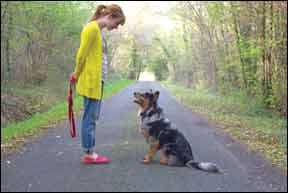
Izzy is a wonderful 31/2-year-old Australian Shepherd/Border Collie-mix. She’s super smart and well-trained, with lots of energy and a constant need for learning and exercise. In the last couple years, however, her aggressive moments have gotten to be a problem (I’m guessing it’s a protective instinct). She barks (like a yell) and confronts people in the following situations, ranked from most common to least:

1. Knock at the door of our house.

2. Someone gets close to our car (while parked).

3. If someone tries to pet her if she’s tied up (outside a store for instance, but we don’t do this at all anymore).

4. If someone appears after there has  been an absence of other humans (at night or on a trail with few people).

I would chalk it up to the breed, protecting her herd (us), but I also need to do something about it.

We have started to ask her to “go to bed” when someone is at the door. It helps, but once she’s released she goes straight for the guest, barking and air-nipping (no contact) if they turn around. It’s embarrassing and uncomfortable; you don’t want to yell at your dog when friends come over and you also want to greet them face-to-face!
– Alan Stuart, Los Angeles

Pat Miller responds:

You are right to be concerned about Izzy’s behavior, especially the nipping at people. In these days of heightened sensitivity to canine behavior, it doesn’t take much for a dog to be designated as “potentially dangerous” or “dangerous” by your local animal control agency.

In some jurisdictions, a person must merely feel threatened in order for a dog to receive the unhappy label – which greatly restricts your freedom as a dog owner to take your canine family member places and do things with her. And that’s not to mention the impact it may have on your homeowner’s insurance, and your liability, if she should actually bite someone or otherwise cause injury.

What happens if someone injures himself when attempting to avoid a dog they feel threatened by? That, too, can earn your dog the unwanted title, even if she never even came close to biting anyone. Heaven knows some people feel threatened by even the most harmless of dogs who are doing absolutely nothing that comes close to being threatening, so that leaves the door pretty wide open.

Herding breeds are ultra-conscious of space, and are usually type-A workaholic control-freaks. I’m guessing Izzy’s behavior is less protective and more defensive, especially given that she snaps while tied up outside a store (who is she protecting there?). It’s not a good idea to tie a dog up in public and leave them unattended anyway – as you’ve discovered. They are trapped, very vulnerable in that situation, and quite likely to bite. Also, dogs who are engaging in protection aggression don’t usually wait for the potential victims to turn their backs – that’s more often the behavior of a dog who is defensively aggressive and lacks the confidence to confront a threat face-to-face – or simply one who is engaging in herding behavior.
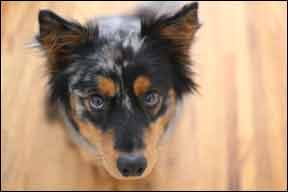
Photo by Alan Stuart

288

The first thing I’d suggest is a complete veterinary workup, including a full thyroid panel, with a blood sample sent to Dr. Jean Dodds’ lab in California. (For more information about Dr. Dodds’ lab, see hemopet.org or call the Hemopet office at 714-891-2022. For more information about the link between thyroid levels and aggression, see “Help for Hypothyroidism,” WDJ June 2005, and in the next issue of WDJ.) You want to rule out – or treat – any medical issues that may contribute to her aggression. With a clean bill of health in Izzy’s file, here are my suggestions:

1. Keep doing the “go to your bed” exercise when people come to the door, but don’t release her from the bed when visitors enter. Rather, walk over to her, clip on a leash, and use the occasion to do some counter-conditioning and desensitization (CC&D). (See “Trials of the Timid,” August 2008, for more about this exercise.) Turn this into a party! Invite a dog-friendly friend or two for wine,  appetizers, and CC&D! If they are especially cooperative, you can ask them to leave, take a walk around the block, and then knock on the door and come in again as if they had not been there earlier.

When you want to stop the counter-conditioning, put Izzy away so you and your guests can relax, and so she won’t have the opportunity to practice her inappropriate behavior.

2. Have her crated in the car, and cover the crate when you leave her parked (cool weather only, I presume!). Again, she likely feels trapped in the car, and people peering into car windows are pretty threatening and intrusive, from the dog’s perspective. Or – leave her at home. Protect her, so she doesn’t feel the need to defend herself.

3. Use a leash or long line when hiking on trails frequented by other people, until you perfect her recall. It’s not fair to subject unsuspecting hikers to a canine confrontation, and you don’t want to be on the receiving end of that dangerous dog designation!

4. Utilize a variety of management and training suggestions to help Izzy gain confidence, such as asking her for an incompatible behavior (something she loves to do). When you see her gearing up to bark, for example, engage her in a favored activity, which will also change her emotional state (she can’t be happy about doing her favorite thing and fearful of or angry at a passerby at the same time.) “Find it!” – tossing a high-value treat on the ground and cueing her to look for it – is one of many possible incompatible behaviors.

5. Consider teaching an “emergency down” and try that to stop her forward movement in a crisis rather than calling her back to you. Many dogs (especially herding dogs) find it easier to “down-stay” than turn around and come back to you. Once her motion is stopped, you can go get her, or perhaps then call her to you.

One of the primary reasons that behaviors such as Izzy’s frequently escalate as the dog matures is that they work. Izzy wants to keep people away (or make them go away), and ferocious barking does that. Izzy’s barking behavior is reinforced by the result (people go away/leave her alone) and behaviors that are reinforced increase. If the above suggestions don’t help, then I urge you to find a nearby training and behavior professional who is committed to positive reinforcement methods to help you manage and modify Izzy’s behavior.
288

A few years ago I attended one of Pat Miller’s seminars on behavior here in the Twin Cities. I particularly enjoyed the lengthy section on interpreting behavioral cues. I pay a lot more attention now to the finer details, not only in my own dogs, but in things that I see on the Internet. There is a video making the rounds of dog owners that I find intriguing (tinyurl.com/appeasinghusky).

Basically, there is a Husky riding in the front seat of a car (doubtful wisdom of that to begin with) who keeps putting her paw out for the owner to hold. Aw! What intrigues me more than the probably learned behavior itself is the deeper behavioral clues the dog displays. Her ears are back and frequent yawning is present, suggesting stress (which a lot of the commenters on the video have keyed in on); but her facial muscles are completely relaxed as best I can tell, her body seems loose, and the dog doesn’t seem to be trying to avoid the situation. No doubt, there is some anxiety at work here, but I have a reason for finding the video particularly intriguing.

I have a male Husky who exhibits the same sort of behavioral signals (ears back, lots of yawning, submissive paw out) when in totally non-stressful situations,  like sitting comfortably at home.

With the lack of any other symptoms of stress, I’ve always just chalked up the yawning to part of a general submissive posture for him (he yawns a lot in a variety of situations), and the overall package of behaviors as “I am perfectly happy for you to keep right on scratching my chest just like you are doing now; don’t stop please.” (The paw out is usually done almost as a “A little lower, please!” or “Why did you stop?” behavior.) But I admit the ears back and yawning has always kind of puzzled me. (He is an exceptionally soft and biddable boy for the breed. His foster sister is a pushy, spazzy little spitfire, which is more typical.)
– J. Eddy, Saint Paul, MN

Pat Miller responds:

Thanks for this interesting video. While the yawning and lip-licking displayed by the Husky in the video are commonly perceived as stress signals, they sometimes are – and they sometimes aren’t. Dogs sometimes yawn because they are tired, and sometimes lick their lips because the last treat tasted good and the flavor still lingers. And while a paw-lift is considered an appeasement gesture, the pawing motion demonstrated in the video is more of an attention-seeking (Hey! Pet me!) or demand behavior – a sort of canine equivalent of a “keep going signal.”

That said, I believe the Husky in the video does look somewhat stressed, and the pawing is attention-seeking, because the dog finds it reassuring and stress-relieving for the owner to touch her (hold her paw). Maybe she is stressed because she knows how unsafe it is to have a dog in the car and not crated or wearing a canine seat belt! That was tongue-in-cheek; of course the dog doesn’t know how dangerous it is be loose in the car, especially in the front seat. But the human should know!

In the case you describe of your dog offering what appear to be stress signals in totally non-stress situations, here’s one possible explanation:

Your dog has simply learned, as you suggest, that these behaviors work to get your attention and the desired human behavior of “Scratch my chest, thank you!” Dogs, like humans, are capable of engaging in superstitious behavior. His pawing is the behavior that most likely gets your attention and cues the desired scratching, but his mind may have linked the yawning and flattened ears into the chain of behaviors he believes may be necessary to make the scratching happen.

Appeasement gestures don’t necessarily indicate stress. They are simply one dog’s way of communicating a message of “I’m not challenging you” to another being. You describe your dog as being generally soft and appeasing, so the “ears back” appeasement signal probably happens a lot for him. Yawning, however, is usually not classified as an appeasement gesture.
288

It could be that he yawns a lot because his yawning has been unconsciously reinforced by you when you think he might be stressed: “Hey, fella, what’s wrong?” Behaviors that are reinforced repeat/increase!

I wonder if you all have heard of SimpleLEASH, which is being marketed as a solution for dogs who pull on leash? Someone from my trainer’s group gave us a heads-up about this. I’m writing about it in my newsletter to alert my clients about it. I could see the average dog owner being very enthused about something like this, as leash pulling is a very common problem, but without thinking about the full consequences. 
– Shannon Finch, AnimalKind Training, Seattle

Pat Miller responds:

I had not heard of the SimpleLEASH until you sent this letter and the link to its website (simpleleash.com). Thank you for bringing it to our attention.

I must say, I am saddened and appalled. Though the company tries to mask the truth with reassuring language, this is, plain and simple, a collar that delivers a shock to the dog when he pulls on the leash. Note that nowhere on the website is it called a shock collar. Instead, the text compares the beep of the leash and the resulting “harmless correction stimulus” to the beep that predicted to Pavlov’s dog that food was arriving. How disingenuous! True, both scenarios employ classical conditioning, but Pavlov’s dogs were getting a positive classical association with the beep – “Yay, food is coming!” – while the shock of the SimpleLEASH creates a very negative classical association – “Yikes, I am about to be hurt.”

The really sad part is that the website also says this: “Here at the SimpleLEASH company we firmly believe in positive reinforcement training.” The simple fact is this: No one who truly believes in positive reinforcement training would ever consider using – much less marketing – a collar-and-leash that shocks a dog simply for pulling.

The company claims that training can be as short as a few minutes. I don’t doubt that. A shock is a highly aversive stimulus, and one that is capable of shutting down a dog’s behavior quite rapidly. It can also deliver a whole lot of negative side effects, not the least of which is aggression.

In the case of this shock-leash, the harder the dog pulls, the greater the intensity of the shock – and the greater the likelihood of significant negative side effects. Imagine the 100-pound dog who spots another dog, takes off full-speed to offer a friendly greeting, and hits the end of the leash with his full weight. The strong shock that he receives has the very real potential for instantly causing this dog to be aggressive toward other dogs through this incredibly unfortunate one-time learning experience. Repeat that experience for him a few more times, and his negative association with other dogs becomes quite strong.

People often fall for the “he only hears the beep” reassurance by shock collar advocates. But if you follow the Pavlov comparison, the whole point of classical conditioning is that the stimulus that was originally neutral (in this case, the beep) takes on the same meaning as the stimulus that follows – the shock. Pavlov’s dogs salivated when they heard the bell because to their brains it was as if food was delivered. A dog stops pulling when he hears the beep because it’s the same as if he just got shocked.

A dog can be traumatized, shut down completely, and/or become aggressive if he associates the shock or the beep that predicts the shock with some other stimulus that happens to be in the environment at the same time – such as the dog or child he was pulling toward. He may also become traumatized and shut down when he hears the beep of other electronics, such as a microwave oven, or a wristwatch alarm, because they sound like the shock collar beep.

We make no bones about our opposition to the use of electric shock when training dogs for any purpose. (See “Simply Shocking,” February 2003 and “Shock or Awe?” February 2006). A walk on leash is the best part of the day for many dogs. How tragic to ruin it for the dog by shocking him.
288

I appreciated Pat Miller’s article on leash reactivity (“Mean on Leash?” May 2012). I have taken one of my dogs through a “Reactive Rover” class, which helped me learn techniques for managing the situation (playing “look at that,” for example). Mister Whiskers is now fine when I walk him by himself, but when my female dog, Sooner, is along, they both become reactive (even though the female is not reactive when by herself). It doesn’t matter if each dog has his or her own person or I am walking both dogs. What are some of the reasons for this behavior, and what are some solutions? 
–Pat Emmerson, Portland, Oregon

Pat Miller responds:

Reactive dogs can be a real challenge. I know (I have one), and I give three Reactive Rover workshops every year. Mister Whiskers is probably more stressed and/or aroused by the presence of Sooner. That’s why he now reacts in situations he has learned to cope with when Sooner is absent. Sooner then reacts in response to MW’s reactive behavior; they feed off each other’s energy and signals. Basically, Sooner’s presence “changes the picture” for MW, and the methods you learned to help him control his tendency to become over aroused don’t generalize to the new picture (with Sooner present).

The best solution is to do practice “set-ups” – the kind of training you already did in your Reactive Rover class – but with both dogs present and a second handler for the second dog.

You’ll need the assistance of a third, “neutral” dog. Keep this dog at a good below-threshold distance at first, so you can succeed in generalizing your “Look at that” behaviors with MW with Sooner present. As MW succeeds, gradually decrease the distance between your dogs and the neutral dog. Then, help MW generalize even more by bringing in other neutral dogs.

If Sooner continues to be reactive even when MW is not, you’ll need to do the same procedures with her that you did with MW. Perhaps you can sign them up to take a Reactive Rover class together!

You might also consider using one or more stress-reducing tools, such as Comfort Zone (available in pet supply stores and on-line), the Thundershirt (from thundershirt.com, or by calling 866-892-2078), or the Calming Cap (now available from the Thundershirt people).

With luck, eventually you will get to the place where you can walk both dogs yourself. For now, you definitely need two handlers when walking both dogs together. Ideally, you’ll want to avoid walking both dogs and encountering reactivity-causing stimuli, until you have had the opportunity to resolve this in controlled set-ups.

I know that can be easier said than done, especially if your time is limited, and reactivity-causing stimuli abound. Good luck with your dogs!

Pat Miller, CBCC-KA, CPDT-KA, CDBC, is WDJ’s Training Editor. She lives in Fairplay, Maryland, site of her Peaceable Paws training center, where she offers dog training classes and courses for trainers. Pat is also author of many books on positive training, including her newest, Do Over Dogs: Give Your Dog a Second Chance at a First-Class Life.

How to Photograph Your Dog Like A Pro!

A picture is worth a thousand words, and when it comes to our beloved canine companions, we can never have too many memories preserved in perpetuity. Like people, dogs have unique personalities. Learning to capture your dog’s attitude, spirit and charm can make the difference between a so-so photo and a memory you just have to blow up and frame. The following tips will help you take your best shot.

288

When you want jaw-dropping photos, it never hurts to let the true professionals work their magic by scheduling a professional photo shoot for your pet. Not only do professionals have the know-how and the equipment to achieve stunning images, working with a professional gives you the opportunity to be photographed with your pet.

While we strongly believe and have  seen ample evidence that it’s worth the cost to arrange for some once-in-a-lifetime professional photographs of your dog, we’ve also learned that, with just a little knowledge and a lot of practice any dog owner can learn to take terrific, memorable pictures of their dogs. One of the advantages you have, after all, is your familiarity with your dog; no one else will have as many opportunities to capture his unique personality. 

And that is the key to a great portrait. Ask professional photographers and dog lovers Rachele Valadez and Amy VandenBerg of Artis Photography in Snohomish, Washington, the difference between a good photo and a great one, and their answer is emphatic: Personality.

“I think a lot of times people don’t take the time; they get a beautiful dog portrait, but it’s not their dog. It’s a dog. It’s a beautiful portrait of a Dalmatian, but it’s not ‘Echo,’” says VandenBerg.

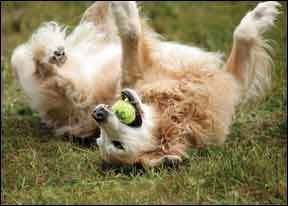
Whether shooting pets or people, capturing a subject’s unique personality is the team’s main goal. To help achieve this with pets, they often ask owners to engage their dogs in a favorite game in order to capture the joy of being a dog: running full tilt after a ball, jumping for a Frisbee, rolling in the grass, or chewing sticks.

288

Similarly, Seth Casteel of Little Friends Photo in Los Angeles and Chicago (and who frequently tours the country taking portraits), specializes in lifestyle pet photography “embracing the at-ease mentality of pets on-location in their natural settings.”

“Each photo shoot I do is a unique challenge,” he says. “My goal is to showcase the dog’s personality through an image or series of images. Once I meet the little friend I am photographing, I find inspiration and ideas start to generate. I let the little friends tell me what kind of pictures best represent them.”

While posed pictures are nice, Casteel says a little creativity goes a long way to help unleash your pet’s inner rock star. Sometimes simply observing your dog in action (or in a state of inaction!) can help identify photographable moments. “Try something different,” says Casteel. “Play hide-and-seek with your dog. Ask him to sit and go hide in the house. Bring your camera and wait to be discovered.”

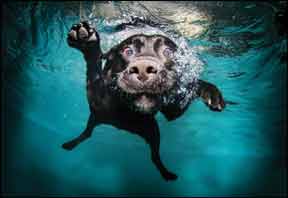
The last time Casteel tried something different, he was underwater photographing a diving dog. His underwater diving photos have since become a media sensation, going viral on the Internet and becoming the subject of his forthcoming book and 2013 calendar, both titled, Underwater Dogs.

Casteel dove into underwater photography quite by accident while shooting an on-land photo shoot with “Buster,” a Cavalier King Charles Spaniel who wanted to spend his time chasing his ball into the backyard pool.

“I thought, ‘I wonder what he looks like in there,’” recalls Casteel, who was so curious, he ran out and bought a waterproof point-and-shoot camera to capture Buster’s antics. Liking what he saw, and sensing he was on to something creatively, he decided to save up for a waterproof housing to protect his professional gear.

“It was a happy accident,” he says.

Enjoy the Great Outdoors
Shooting outdoors offers the benefit of myriad backdrops and the advantage of natural lighting, which pros favor at certain times of day. When planning an outdoor photo adventure, consider shooting during what photographers call “the golden hour,” the hour or so just as the sun is rising or setting. The light during this period is softer and offers warm, flattering hues. Also, because the sun is lower in the sky, it reduces the degree of overhead shadow.

288

Avoid shooting midday when the sun is directly overhead, as it creates harsh shadows that distort the image. If your dog decides to be a perfect poser in the park at high noon, look for a well-shaded area to help filter overhead sun.

Even cloudy days offer certain advantages, according to Los Angeles photographers Kim Rodgers and Sarah Sypniewski, authors of Dog Photography for Dummies. “Don’t write off a cloudy day,” they write. “Thinking that you can’t get good photos on a cloudy or overcast day is a misconception. In fact, this is sometimes the best light you can hope for, especially if you’re photographing a black dog. Clouds can act as a giant softbox that filters the sun to an even and dispersed state, so take advantage of those clouds and forget about the ‘high noon rule’ on a cloudy day.”

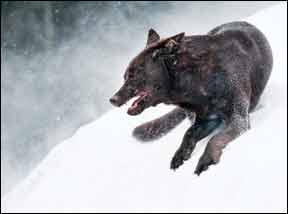
Dog photographer Ida Kucera of Lerum, Sweden, takes the “cloudy day effect” one step further and frequently photographs pets in inclement weather for a naturally dramatic effect. Her dynamic photos have also been seen making the rounds on Facebook.

“Don’t be scared of doubtful weather,” says Kucera. “Even a good blizzard or sand storm creates great effects in lighting and casts dramatic shadows. I enjoy a good, extreme weather situation – it brings natural drama and takes the pet ‘back to nature’ a bit.”

Photography Basics
Whether using a simple point-and-shoot camera, or a more complex DSLR (digital single lens reflex) camera, understanding a few basic concepts can help improve your at-home photo shoots.

Rule of thirds – This is a basic composition principle that splits the frame into a tic-tac-toe board with two vertical and two horizontal lines. Rather than position your subject directly in the center, place his face at one set of intersecting lines. Whether you use the top or bottom set depends on what you want to highlight. To highlight something in the background, place your subject on one of the lower intersecting points; to highlight the subject in the foreground, use the upper intersecting points. The rule of thirds is a subtle, but powerful way to make images more interesting.

Choosing a background – To help make your pet the star of the shot, watch out for distractions in the background. Pick up unnecessary items that don’t contribute to the story you’re trying to tell, and watch out for unsightly objects (for example, a dirty dumpster). Pay attention to items that appear to be “growing” from the subject, such as a light pole directly behind his head.

When photographing dogs outdoors, Casteel recommends looking for the “wall of magic,” a bank of attractive green bushes that can be especially flattering when the sun is shining through, yet the bushes create a shady spot for the dog. You can also look for colors that complement your dog, or patterns that are interesting, but not overly distracting (such as the repeating pattern of a brick wall or wood fence).

A new angle – For most pet portraits, shooting at eye-level produces the most flattering image. Get down on the ground and experience the world from your dog’s point of view. Extreme angles, such as shooting down on your dog from up high, or shooting up from ground-level offer fun, creative results, so don’t be afraid to experiment; it’s one of the biggest benefits of digital photography (you don’t have to pay for film and processing!). Also, don’t be afraid to rotate the camera from the traditional horizontal position to a vertical orientation to add additional variety to your pictures.

Flash – Most pros agree that using a camera’s built-in flash leaves a lot to be desired when it comes to pet photography. The burst of light reflects off the subject’s retinas, and creates an alien-like image of dogs with red and green laser beams as eyes. If your camera has a fixed flash, it’s best to avoid using it. If using a DSLR, consider investing in an external flash unit or a lightscoop. Both attach to the camera’s “hot shoe” (the square port on the top of the camera) and allow you to bounce light off the ceiling so it falls back on your subject from a softer angle.

Fill the frame – Don’t be afraid to get close to your subject. Filling the frame with your subject, either by physically getting closer or using the lens to zoom in, creates stronger composition by highlighting the subject and helping to eliminate the possibility of clutter. For an artistic effect, you can even try filling the frame with one part of your dog – like the pads on his foot or his snout.

288

Black and white dogs – Predominately black or white dogs pose a special challenge for your camera’s automatic mode because the light meter attempts to adjust the exposure to a setting that represents the middle tone of a particular scene. As a result, details are often lost on dark dogs, and white dogs appear washed out.

When using a point-and-shoot camera or the automatic setting on a DSLR, the best bet is to avoid direct, midday sunlight in favor of an evenly lit shady spot or a cloudy day. Direct sunlight will cast shadows that destroy detail. If shooting indoors, daytime shots often work better because you can fill the room with natural light. For both black and white dogs, an external flash or lightscoop can be used to bounce light off the ceiling to help light the subject. Many photographers also use an external flash when shooting outside, especially in brighter sunlight, because the additional light can help “fill” areas lost visually to shadow.

Even with the help of an external flash, it often takes some tinkering with the exposure compensation feature to produce a properly exposed photo of a black or white dog.

Exposure compensation is a sliding scale, usually represented by -2.0 on the left and +2.0 on the right. When set at “0,” the camera is exposing the photo without any input from the photographer. Adjusting to the left (negative) makes the next photo you take darker; adjusting to the right (positive) makes the next image lighter. Exposure is a great tool to experiment with; a solid understanding of how exposure affects images can help you create far better photos – especially of dark or light dogs.

Understanding Your Equipment
The better you understand your equipment, the more creative muscle you can flex in your photographs. Manuals can be daunting, but it can help if you investigate just one issue at a time.

For example, if your photos are always a little bit blurry, look in your camera’s manual for more information about shutter speed – the length of time that your camera exposes its digital sensors (or film!) to the subject that you are photographing. The faster your dog is moving, the faster your shutter speed will need to be to capture him in a nice, sharp image. If you are using a point-and-shoot, look for a “sports” or “kids and pets” mode, often depicted by a running stick figure or a child and an animal. These modes automatically selects a faster shutter speed, which will help freeze the action of your subject.

Or perhaps you’d like an artistically (and purposely) blurred photo of your dog running or jumping? Then you need to know how to slow the exposure. Check your manual to learn how to override your camera’s automatic features.

As another example, if you want an image where your dog is in focus, but the background is no more than an attractive blur, you will need to learn a bit about “depth of field,” which is the range of components in a scene that remain sharp, and how to adjust it using different apertures (the size of the hole in the lens, which, when combined with shutter speed, controls how much light gets into the camera) on the camera’s lens. In general, the larger the opening on the lens, the shallower the depth of field in the photo. On a point-and-shoot, this effect can be accomplished by switching from the fully automatic mode to “portrait” mode (usually marked with the image of a face or head). A shallow depth of field is great for photographing stationary subjects you want to stand out against the background.

Recruit a Friend
Having a second person to help you handle your dog goes along way toward creating a successful photo shoot. Dogs move quickly and their facial expressions can change in the blink of an eye. You’re much more likely to catch the moment you’re looking for if you keep your eye behind the camera and your shutter-finger at-the-ready. Ideally the helper is someone your dog already knows and is comfortable with, but if not, let them get to know each other (treats and toys can work well to shorten introductions) first. During the photo shoot, the helper’s job can range from guiding a dog into position to displaying an array of antics to help elicit a bright expression.

Humans are drawn to photos where the subject is looking directly into the camera – and to those where the subject is looking completely sideways to the camera. The problem with taking photos in which the dog is making eye contact with the camera is that many dogs, like my Whippet, are uncomfortable looking into the camera – or looking at you when you have a camera obscuring your face! Have your helper perform her squeaky noises or toy-waving right behind your head, so it looks as much like your dog is looking into the camera as possible. Alternatively, position your dog, yourself, and your helper so that you get a beautiful profile, with your dog looking toward the sun, so that her eyes fill with light and sparkle.

Have Fun With It
When it comes to getting the right “look” from your canine companion, don’t be afraid to look or behave ridiculously – and be creative! Come to the shoot prepared with lots of props. Some dogs light up at the sound of a squeaky toy. Some dogs prefer toys that rattle or grunt. Some dogs are easily captivated by the crinkle of a plastic wrapper – the sure sound that a treat is nearby. With many dogs, tossing the treat or toy in the air and catching it piques their interest. Others light up if you playfully pretend to stalk them or ask the ever-popular questions, “Where’s the kitty?” or “Wanna go for a walk?”

Photo by Artis Photography.

288

Whatever techniques you use, remember to reward your dog for his participation, don’t forget to take frequent breaks, and watch for signs that your dog is becoming stressed. Frequent lip-licking, yawning, panting, or averting his gaze and refusing to look at the camera are all signs that your dog is becoming stressed by the situation. Rather than try harder to get his attention, it’s time to take a break.

Train, Don’t Complain
Photo shoots, whether at home or in a professional studio, go a lot more smoothly when everyone is relaxed. In your quest to preserve precious memories, don’t forget your responsibility to keep your dog physically and emotionally safe. If he’s generally nervous in new places, consider building his confidence before expecting him to sit calmly in a photo studio full of strange people pointing strange equipment in his direction.

Similarly, consider brushing up on his basic skills before a photo session.

“If people want good pictures of their dogs sitting still and looking at the camera, a good ‘sit’ and ‘stay’ goes a million miles,” says VandenBerg. “It starts with training, for sure.”

Whether you plan to shoot at home or in a studio, make sure you practice any skill or behavior you know you want from your dog in the weeks and days before the shoot.

“Do not stress, do not yell, do not get frustrated,” says professional photographer Julie Poole, of Julie Poole Photography in Knoxville, Tennessee. “That will only torque up the dog.”

Poole, who breeds and shows Whippets, has been photographing pets since 2006. “I started in animal photography because I was showing horses and enjoyed photographing them even when I wasn’t showing,” she says. “Being a competitor, I knew more of what people wanted to see in their shots, and what not to shoot.”

A love of and familiarity with the subject is a huge advantage of working with a professional photographer who specializes in animal photography. Not only are they more likely to be patient with and attuned to the special needs of non-human subjects, they understand how to bring out the best in the animal.

“There’s something good about every subject that’s put in front of you. It’s up to you to bring it out in them,” says Poole.

Just Do It
“People take photos for many reasons,” Poole says. “The most important one is to preserve memories. At some point, the dog will be gone and memories are all that is left. It doesn’t have to be a Picasso or a Pulitzer to mean the world to you.”

VandenBerg agrees. “Document your dog throughout his life. Don’t wait,” she says. “I can’t count how many clients who have called and said, ‘I’m so glad you photographed my dog because we lost him the next day, or next week.’ Whether you choose to use a professional photographer or not, you just can’t have enough pictures.”
 
Stephanie Colman is a writer and dog trainer in Los Angeles. She shares her life with two dogs (whom she enjoys photographing), and actively competes in obedience and agility. 

Foxtails are a West Coast Danger to Dogs

1

A friend called one day to complain about his dog’s latest vet bill: $300 to remove a foxtail that the dog sniffed up his nose on that morning’s walk.

288

If you live on the west coast, you are likely cringing with recognition of the problem. If you live on the east coast, chances are you have no idea of what I’m talking about.

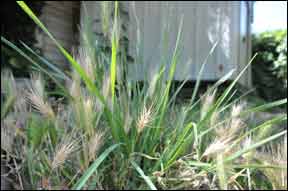
Hordeum jubatum (informally called “foxtail barley” but infamous as “foxtail grass”) is a perennial plant species in the grass family Poaceae. It grows like, well, a pestilent, abundant weed all over California. When the grass is green in the spring, it’s pretty; it produces these lush heads that resemble a finer version or wheat or barley. But the moment the plants start to dry in the later part of the spring, the heads start to fall apart – and each tiny segment of the luxuriant heads becomes a danger to any dog who goes near it.

If you dissect just one of those heads, it falls apart into hundreds of individual arrows, each tipped with a hard seed and trailed by several long tails. Each thread of those tails are constructed like a file; they are covered with tiny fibers are aligned in one direction. If you run your fingers along the fiber one way, it’s smooth, but you can’t run your finger (or anything else) along the fiber in the other direction; it snags. These microscopic, one-way fibers make the awns practically walk on their own, always in one direction. A breeze and the slightest contact with anything makes them move in the direction of the seed head.

288

So when your dog snuffles in the dirt or grass that is loaded with foxtails (or mown foxtail grass), and one foxtail seed (known simply as a foxtail) makes contact with his nose, it’s like to get sniffed into his nasal cavity, where its irritating barbs cause him to sneeze and rub his face on the grown and paw at his nose. He may cough, vomit, gag, and sneeze some more. All of those actions simply make the foxtail move farther and farther into the dog’s body – into his sinuses, throat, brain, or stomach (if you’ve lucky). Dogs also get them lodged between their toes, in their ears, in their genitalia, or, if they are unlucky enough to have a thick or curly coat, anywhere on their body. It can cause an infection anywhere it lodges. I’d bet that a full quarter of veterinary visits in Northern California in the summer are related to foxtails. Practically every stray and neglected dog and cat who comes to the shelter in the summer has foxtails embedded in some parts of their bodies. Owners like me, who have foxtails in their yards and trails, check their dogs daily for the horrid stickers. And we dread the sound of our dogs sneezing.

288

If you have foxtails on your property, you doubtlessly try to eradicate them. Good luck. If you mow your yard or use a weed-whipper, you are doing foxtails a huge favor, busting up the seed heads and helping them break up and disperse themselves. Pretty much the only thing that works to eradicate foxtails is pulling up the entire plant before they produce the seed heads, or, if you’re too late, pulling them up while carefully holding the seed heads in your hands (to keep them from falling apart) and transporting them straight into your green recycling bin or compost pile. I lived in the same house in the Bay Area for 12 years, and by the 7th year of doing this to the entire overgrown backyard annually, I finally eradicated the pest. Now I have a new backyard, one where the foxtails have a several-decade head start on me. I feel like taking a flamethrower to the whole lot.

And of course, they are all over the wild outdoors. There are several trails I just don’t take with my dogs for several months in the summer, until the rains come and the foxtails aren’t a threat.

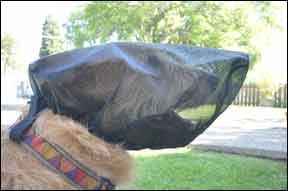
One company has come up with a partial solution – which is better than anyone else has done. It’s a California-based company, of course. The Outfox Field Guard is sort of like a beekeeper’s bonnet for dogs who are going to work or walk outside in a foxtail-rich environment. It protects the dog’s nose and ears (and mouth – often dogs swallow the stickers). Of course, it does nothing for the dog’s paws, which still have to be checked after each walk around the infamous stickers. I bought one for my friend to try on his dog, after his $300 vet visit (removing a foxtail from a dog’s nose or ears almost always requires full anesthesia). He reported that Bucky didn’t seem to mind the bonnet much, although he thought it made Bucky pant more on their morning walks on warmer days; whether because the mesh is black or restricts the flow of air every so slightly, he imagined it might be hotter inside the bonnet than out of it. The Field Guard should not be left on an unattended dog; it’s just for walking or working with the dog outdoors with supervision. Bucky hasn’t gotten another foxtail yet, and he walks frequently on the trails I’ve given up for the summer. Check it out: www.outfoxfieldguard.com.

(Cushing’s Disease #1) Cushing’s Disease

0

Clinical signs of Cushing’s, no matter its primary cause, may include one or most of the following:

• Polyuria (increased frequency of urination), polydipsia (increased thirst), and polyphagia (increased, ravenous hunger).

• Weakening and atrophy of the muscles of the extremities and abdomen, resulting in gradual abdominal enlargement, lordosis (sway back), muscle trembling, and weakness.

• Weight loss. While most dogs appear fat, they may actually lose weight due to the loss of muscle mass.

• Fat deposits in the liver, resulting in diminished liver function.

• Skin lesions are common and are often the most recognizable symptoms of the disease. The skin may thin, or mineral deposits may occur within the skin, especially along the dorsal midline. The dog may also exhibit hair loss in a non-itchy “hormonal pattern” (bilateral and symmetrical hair loss, not patchy as typically seen with allergies, and often associated with thinning of hair and poor regrowth, rather than a complete loss of hair). This hair loss may be concentrated over the body, groin, and flanks, and spare the head and extremities. In chronic hormonal conditions the hair thinning may be associated with a thickening and a black discoloration of the abdominal skin called acanthosis.

• Behavior changes: lethargy, sleep-wake cycle disturbances, panting, and decreased interaction with owners.

A tentative diagnosis may be inferred from the clinical signs, but positive diagnosis requires laboratory confirmation. Differentiating pituitary-dependent from primary-adrenal Cushing’s is impossible without lab tests.

For more detailed information on the diagnosis and treatment of Cushing’s Disease, purchase Whole Dog Journal’s ebook Cushing’s Disease.

Download the Full June 2012 Issue PDF

...
To continue reading this article or issue you must be a paid member.

Join Whole Dog Journal

Get full access to Whole-Dog-Journal.com – more than 4,000 articles – for just $20.
Join today and save 30% off our full price.
Already a member?
| Forgot your password? | Activate Web Access

Calculating a Dog Food Diet’s Protein, Fat, Carbs, and Fiber

6

[Updated July 19, 2017]

It is not easy to figure out how much fat and other nutrients are really in the food you feed, whether it’s kibble, canned food, or a home-prepared raw or cooked diet. Here are some tips that can help.

Methods of Nutrition Measurement

There are three different ways of measuring amounts of protein, fat, carbohydrates, and fiber in foods:

1. Percentage of dry matter

2. Percentage of calories (does not apply to fiber)

3. Grams per 1,000 calories

Dry matter percentages are easiest to use for commercial foods. Grams per 1,000 calories or percentage of calories are simpler ways to measure nutrients in a homemade diet.

When Feeding Your Dog Commercial Foods:

Pet food labels give you some, but not all, of the information you need in order to really know the nutritional composition of your dog’s diet. 

-The percentages of protein, fat, and fiber shown on dog food labels are guaranteed minimums and maximums, NOT actual amounts. The real amount of fat in particular may be much higher than what is shown on the label of some canned and raw diets. If your dog needs a low-fat diet, look for products that are lower in calories than similar foods.

For more accurate information, contact the company that makes the food you’re interested in and ask them for a nutritional analysis showing the actual amount of protein, fat, fiber, ash, and moisture, as well as the number of calories in the food. Editor’s note: Some pet food makers (particularly small companies) may not have a complete nutritional analysis of their products. In our opinion, this reflects a lack of adequate research and investment in the product. When feeding a special needs dog, we’d look to a company who has this current information on hand.

-The percentage of carbohydrates is not included on most labels or nutritional analyses. To calculate the percentage of carbohydrates in a commercial diet, subtract the percentages of protein, fat, moisture, crude fiber (an indigestible part of carbohydrates), and ash from 100. This percentage may be shown as “nitgrogen-free extract (NFE)” on a nutritional analysis.

-Total dietary fiber is likely much higher than the crude fiber shown on the label. If dietary (soluble plus insoluble) fiber is not shown on a complete nutritional analysis, there is no way to calculate it.

When Feeding Fresh Foods:

When feeding a home-prepared diet comprised of fresh food ingredients, it can be a bit more challenging to calculate some of the nutrient values that you’d like to know when feeding a diabetic dog.

-To calculate the caloric content of the food, look up the ingredients or enter a recipe on NutritionData.com. The number of calories from protein, fat, and carbohydrates, along with the total calories, are given in the “calorie information” section, and the calorie percentages are shown in the “caloric ratio pyramid.”

-To calculate the grams of protein, fat, etc., per 1,000 calories, divide grams of any nutrient by total number of calories, then multiply by 1,000 to get grams per 1,000 kcal. For example, raw skinless chicken breast contains 6.5 grams of protein, 0.3 grams of fat, and 30.8 calories per ounce:

6.5 ÷ 30.8 x 1,000 = 211 grams of protein per 1,000 kcal
0.3 ÷ 30.8 x 1,000 = 9.7 grams of fat per 1,000 kcal (GFK)

“As Fed” versus “Dry Matter”

The percentages of protein, fat, etc., shown on a pet food label are expressed “as fed” – meaning, as the food is delivered in its package. Some percentage of the food is comprised of moisture (water), which of course contains no protein, fat, fiber, or other nutrients. Kibble generally contains about 10 percent moisture; wet foods (canned, frozen, or fresh)  contain as much as 80 percent or more moisture.

So, think about it: When a label says that a food contains (for example) 4 percent fat, in order to really understand how much fat you are about to feed your dog, you also have to know how much moisture is in the food. What you really want to know is how much fat (in this example) is in the food part of the food  – the “dry matter.” Any serious discussion of nutrition, or comparison of dry and wet diets, then, requires the conversion of the nutrient values from “as fed” to  “dry matter.” Don’t worry; it sounds technical, but it’s easy to do.

-To calculate dry matter (DM) percentages, first determine the amount of dry matter by subtracting the percentage of moisture from 100. Then divide the “as fed” percentage by the amount of dry matter to get the dry matter percentage. For example, if a canned food has 75 percent moisture and 4 percent fat:

100 – 75 = 25 percent dry matter
4 ÷ 25 = 16 percent fat on a dry matter basis

What Sort of Pet Food “Research” Are We Talking About?

0

Pet food companies that are the size of Hill’s Pet Nutrition (a subsidiary of Colgate-Palmolive Company) and Iams and Eukanuba (both owned by Procter & Gamble Pet Care) can afford to conduct a variety of research and development studies, as well as conduct their own feeding trials to meet regulatory requirements for nutritional adequacy. The following are the types of studies that large pet food companies typically conduct.

288

AAFCO Feeding Trial. The protocols for these tests were developed by the Association of American Feed Control Officials, an advisory (not regulatory) body comprised of state feed control officials (the voting members) as well as representatives from the pet food industry, the Food and Drug Administration (FDA), the United States Department of Agriculture (USDA), and other interested groups and individuals. There are specific protocols for trials that confirm the nutritional adequacy of foods for adult maintenance, gestation/lactation, growth (puppy or kitten food), and “all life stages.” The trials range in duration from 10 weeks (growth) to 26 weeks (adult maintenance). A food intended for “all life stages” needs to pass the gestation/lactation trial (about 13 weeks) followed by the growth trial, back to back.

In all of these trials, a number of dogs are fed the test diet (and nothing but the test diet) and a certain percentage of them must finish the trial in a condition such that they pass some basic tests: not too much weight loss, no significant illness, adequate blood test results (hemoglobin, packed cell volume, serum albumin, and alkaline phosphatase, a liver enzyme). For more information about AAFCO feeding trials, see “On Trial,” WDJ April 2005.

Many people consider AAFCO feeding trials as the “gold standard” for confirming the nutritional adequacy of a canine or feline diet. However, because the products that met the “feeding trial” test of nutritional adequacy do not have to meet the “nutrient levels” criteria, there is the possibility that these products may contain excessive, deficient, or unbalanced nutrient levels that may contribute to the development of health problems if fed as a sole diet for periods that are in excess of the testing period. An ideal test would encompass both a feeding trial and meeting the AAFCO nutrient profiles, but no such standard currently exists.

AAFCO Metabolizable Energy Protocol (also known as “metabolic study”). In these tests, a dog (or cat) is maintained on a specific diet for a period of 10 days, and the amount of food the animal consumes is precisely recorded. During the final five days, every bit of urine and feces eliminated from the animal is collected, so the amount of energy lost through elimination can be calculated (subtracted from the gross energy consumed) and thus, the total energy in the diet that was utilized by the animal can be determined. It used to be routine that these studies required the test subject to be housed for the final five days in a cage with a slatted floor – uncomfortable for any animal. However, in recent years, alternatives have been developed to help researchers collect urine and feces from an individual in a comfortable environment. For example, with cats, Hill’s fills the cat’s litter box with tiny, unabsorbent plastic beads; urine and feces can be collected from this material with little loss.

Palatability or “taste preference” studies.
Pet food makers know that owners repeatedly buy products that their pets prefer and eat quickly and enthusiastically, so they use a tremendous amount of their resources on these studies – more so for cat food than dog food (cats are notoriously finicky about food flavor, odor, and even the “mouth feel” of kibble). The animals used in these tests are given special training to teach them how to assess their options and make a “real” choice – not just fill up on the food they happened to select first, or always eat from the left-hand bowl. Animals that appear to reliably consider their options and make clear, consistent choices are prized, and may be delegated to a lifelong career in these studies.

Digestibility studies. How well a food is digested, and the resulting quality of a dog’s stool, are of utmost importance to most dog owners – and, of course, to the health and comfort of the dog. Pet food makers are always tweaking their formulations, based on ingredient availability, price, and popularity; they use these studies to ensure the resulting innovations are digestible.

Bioassay studies. These studies are conducted in search of diets that target and improve the function or health of a given body system or ability. Bioassays could include mobility, skin and coat, immunology, GI health, or nutritional requirements based on life-stage or lifestyle. Diets that address certain health conditions, whether “prescription” or over-the-counter, have become increasingly popular with pet owners – and as a result, they are popular with the large pet food companies, too.

Help Manage Your Dog’s Diabetes Through Proper Diet

As discussed in “Canine Diabetes,” WDJ May 2012,  dogs with this disease require blood sugar monitoring, daily insulin injections, carefully planned meals, and scheduled exercise. Fortunately, most cases can be managed at home, and once their medication and diet are stabilized, affected dogs live just as long and actively as other dogs. The most important factor in choosing a diet for a dog with diabetes is that he likes the food and eats it willingly every day.

We’ll say it again: There is no single “best” diet for dogs with diabetes. Most diabetic dogs do fine on a diet formulated for adult maintenance. And most do not require a high-fiber prescription diet. However, it is important to maintain consistent carbohydrate levels, and a diet moderately low in fat may be safest. The nutritional needs of any concurrent disease should take precedence.

Manage Your Dog’s Diabetes Through Proper Diet

Dogs with diabetes can thrive on diets that are dry or canned, prescription, frozen raw, home-prepared (cooked or raw), and combinations of any of these. See the samples below (starting with “Prescription Diets”) for a variety of diets that have worked well for diabetic dogs and their caregivers.

To help determine your diabetic dog’s best diet, consider the following guidelines. (See “Calculating a Diet’s Protein, Fat, Carbs, and Fiber,” to learn how to figure out how much of each macronutrient you’re feeding.)

Fat – Because undiagnosed pancreatitis is common in diabetes patients, many veterinarians recommend feeding diabetic dogs less than 30 percent of their calories from fat. This is equivalent to about 14 percent fat on a dry matter (DM) basis, or 35 grams of fat per 1,000 calories (GFK). These guidelines are appropriate for dogs with Cushing’s disease, or whose blood tends to be lipemic (fatty), or who are prone to digestive upset.

For some dogs with chronic pancreatitis or persistent fasting hyperlipidemia (high blood triglycerides or cholesterol), fat may need to be reduced to less than 20 percent of calories (about 9 percent fat DM, or 23 GFK).

Underweight dogs usually need more fat. Higher fat foods also reduce postprandial glycemia (rises in blood sugar after meals), probably because they slow gastric emptying. Diabetic dogs without concurrent illness requiring limited fat may be fed up to 20 percent fat DM (40 percent of calories from fat; 47 GFK).

Since dogs love the taste of fat, it’s often added to food to improve palatability, but for dogs with diabetes, flavoring agents like low-fat chicken or beef broth are better choices.

If your dog requires a low-fat diet, see “Healthy Low-Fat Diets,” WDJ December 2008, for more details.

Protein – It is important to feed enough highly digestible, high-quality protein – at least 18 to 25 percent on a dry matter basis – to reduce muscle catabolism (breakdown). Such diets do not appear to increase the risk of diabetic nephropathy (kidney disease). There are no negative effects associated with providing at least 30 to 45 percent of calories from protein (about 35 to 50 percent protein DM).

Manage Your Dog’s Diabetes Through Proper Diet

288

Carbohydrates – Carbs are key ingredients in any diabetic dog’s diet. The amount of carbohydrate should remain consistent so that the dog’s insulin needs remain stable. Complex carbs, especially barley and sorghum, are recommended, while simple carbs such as white rice and corn syrup should be avoided.

Starch (the digestible portion of carbohydrates) is best limited to less than 50 percent of calories (about 55 percent DM), and diabetic dogs may do better when starch is less than 30 percent of calories (about 33 percent DM). If the amount of starch in the diet changes, the amount of insulin will need to be adjusted as well.

Fiber – There are two types of fiber, soluble and insoluble. Both types slow gastric emptying and carbohydrate digestion, reducing postprandial glucose spikes. Soluble fiber feeds the body’s beneficial bacteria and supports the immune system, but it can also cause gas and loose stools. Insoluble fiber (roughage) increases stool volume, regulates intestinal transit time, is generally well tolerated, and may help with glucose control.

Whole grains are decent sources of both soluble and insoluble fiber. Barley, bulgur wheat, long-grain brown rice, whole wheat pasta, rolled oats, quinoa, beans, and peas are good choices for providing starch and fiber. The flesh of vegetables and fruit also supply soluble fiber, while the skins are a good source of insoluble fiber. Sweet potatoes with skin offer a particularly high nutrition and fiber content without sending blood sugar soaring.

If you are feeding a maintenance (non-prescription) diet and having poor glycemic control, try feeding more insoluble or mixed fiber. Many dogs have improved glucose control with more fiber, while some do better with less. Too much fiber can lead to gas, diarrhea or constipation, weight loss, poor coat, and an unwillingness to eat. Recommendations vary, but generally 8 to 15 percent DM, or 25 to 35 grams of fiber per 1,000 calories, would be considered a moderate amount of fiber.

Note that dietary fiber is not the same as crude fiber shown on dog food labels, which is not a useful measure. Most foods contain a lot more fiber than the labels indicate. Unfortunately, there is usually no way to know how much dietary fiber non-prescription foods contain. You can only look for ingredients known to supply fiber.

Bran, cellulose, pea fiber, tomato pomace, and hulls of any kind (including “soybean mill run”) supply mostly insoluble fiber.

Fructo-olicosaccharides (FOS), guar gum, and pectin provide soluble fiber.

Beet pulp has both types of fiber.

Fiber supplements can be used to add fiber if needed. Benefiber (wheat dextrin) and Hydrocil (psyllium) contain mostly soluble fiber, while Citrucel contains insoluble fiber (methylcellulose).

Manage Your Dog’s Diabetes Through Proper Diet

Customizing the Diet
Preparing your dog’s food at home is the easiest way to feed a customized diet, but many owners obtain good results by mixing wet and dry foods or by combining fresh foods with commercially prepared diets.

For example, many low-fat commercial diets are also low in protein, with high levels of carbohydrates. Ingredients such as lean meat, skinless poultry, fish, eggs, and yogurt can be used to replace a portion of the commercial diet to increase protein and reduce carbohydrates in the overall diet. If you’re feeding a high-protein, low-carb, low-fiber commercial diet, adding high-fiber fresh foods or fiber supplements may help with glycemic control.

Dry food decreases hyperglycemia (high blood sugar) after eating because it takes longer to digest, while wet food may encourage the dog to eat well and increase fluid intake. Do not feed commercial moist or semi-moist foods or treats, as they almost always contain added sugars (e.g., propylene glycol).

In some patients, dry food takes too long to digest, so that its assimilation does not coincide with the insulin’s peak effect. In that case, presoaking the food or grinding it to a powder before feeding, or reducing the amount of fiber in the diet, will speed digestion.

If a too-thin dog fails to gain weight, you may need to feed more food, increase the amount of fat, or decrease the amount of fiber in the diet.
If the patient suddenly refuses food, see your veterinarian to check for a concurrent illness. Do not continue to give insulin to a dog who is not eating.

Textbook Recipes
Two sample recipes provided in the Encyclopedia of Canine Clinical Nutrition (Pibot et al., 2006) each provide about 1,700 calories, the amount needed for a typical active 70-pound dog. Each 1,000-gram (2.2-pound) recipe uses:

500 to 600 grams of low-fat meat and dairy (fish, skinless turkey breast, creamed cottage cheese)

250 to 270 grams (dry measure) of starchy carbs (whole wheat pasta, rolled oats)

60 to 150 grams of cooked carrots

50 to 60 grams of wheat bran (insoluble fiber)

10 grams pectin (soluble fiber)

10 to 15 grams canola oil

plus a multivitamin and mineral supplement (including about 2,500 mg calcium)

These recipes are 33-34 percent protein, 10-11 percent fat, 38-41 percent starch, and 12-14 percent fiber on a dry matter basis.

Prescription Diets
Commerical prescription diets meant for dogs with diabetes work for some dogs, with or without added foods. These diets are generally low in protein and fat, and high in fiber and carbohydrates. They are unsuitable for dogs who need to gain weight, but the high fiber can help some dogs whose diabetes is difficult to regulate. These diets can be combined with other foods to increase protein and fat.

Manage Your Dog’s Diabetes Through Proper Diet

Genny and Buster are two diabetic dogs who eat prescription diets.

Genny, a 10-year-old Bichon Frise, has lived with Cathy Briody in Jewett City, Connecticut, since Genny was given up for adoption at age 15 months because of diabetes. “She spent her first few days with me at Tufts Veterinary Hospital getting regulated,” says Briody. “Her vet recommended Hill’s Prescription Diet w/d canned food twice a day, 12 hours apart, followed by an insulin shot 30 minutes later. I did a glucose curve on her at home every two weeks, then faxed the results to her vet at Tufts, and he would call to let me know what changes to make in her amounts of food and insulin.”

Regulating Genny’s condition took two months, at the end of which Briody, a rescue volunteer, realized she couldn’t let the pup go to anyone else. Genny’s foster home became her permanent residence.

“She celebrated her tenth birthday last November,” says Briody. “She still eats w/d, only now she gets three meals a day because her glucose tends to get low in the afternoon, and she won’t eat breakfast unless Parmesan cheese is sprinkled on her food. Genny has had two hypoglycemic crashes. The first was in 2005, when she had a seizure. She got lots of Karo syrup and food before going to her regular vet and spending the rest of the weekend back at Tufts. Her second crash happened last August, and her recovery was a long process, but she has been fine since October.”

Genny is a Delta Society Pet Partners therapy dog who visits a hospital and two group homes every month, as well as a Reading Education Assistance Dog (R.E.A.D.) who is read to by first-graders once a week. “Although I would like to feed her a better food,” says Briody, “the w/d works fine for Genny, and she eats it willingly. She does not take any supplements and seems to be doing well.”

Buster, a 13-year-old, seven-pound Maltese (pictured taking agility jumps in last month’s article on diabetes), also eats a prescription diet, with some raw food added to it. Buster lives with Mary Butler in Northern California. “As soon as he was diagnosed three years ago,” says Butler, “I consulted a nutrition specialist at the University of California, Davis, veterinary school, who took a detailed history and calculated Buster’s nutritional needs. In addition to including my little guy’s favorite snack (Nature’s Variety Instinct raw beef medallions), he recommended a diet of high-fiber Hill’s Prescription Diet w/d.” Like most commercial raw diets, Instinct raw foods are high in protein and fat and low in carbs, a good complement to w/d’s low protein and fat and high carbs.

Butler feeds Buster the same thing every morning and evening. “He gets less than ¼ cup of dry w/d chicken plus half of a beef medallion,” she says. “The vet told me the most important thing is to be consistent with his diet, and I have been. Buster has been stable ever since his diagnosis. He gets insulin twice a day, and the dose has remained the same as the day he was diagnosed. It has never had to be adjusted.”

Buster loves his meals and always eats every bite, says Butler. “He hops and spins when I say, ‘Supper!’ I will not change a thing I’m doing as he is so stable and healthy.”

Non-Prescription Dry and Canned Foods
Diabetic dogs don’t require a prescription diet. Adult maintenance diets with moderate amounts of fiber work well for most dogs with diabetes. Penny and Silkie are great examples of dogs who thrive on high-quality commercial diets.

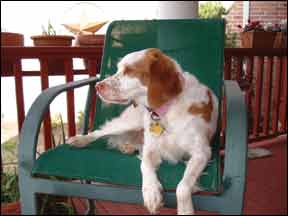
Penny, a 35-pound, 6-year-old Brittany belonging to Melba and Curtiss Lanham of Fulshear, Texas, is a diabetes success story. “We took Penny in as a foster when she was six months old,” says Melba. “She was the most full-of-energy Brittany we had ever fostered and was also the smartest little girl. It wasn’t long before she was a permanent member of our family.”

But at nine months, Penny’s personality changed. “She did not like to be around the other dogs and kept them away from her. Normally a very playful puppy, she would often hide under a desk or wrap herself tightly in a little ball. Her trips outside to void urine increased but with no noticeable increase in water intake. Off to our favorite veterinarian she went.”

Penny was diagnosed with a urinary tract infection, but antibiotics didn’t change her behavior or symptoms. Back she went for more tests, only this time Penny wasn’t allowed to leave until her very high blood sugar stabilized. She had diabetes.

“Curtiss and I were both licensed Texas paramedics,” says Melba, “so drawing blood, using a glucometer, giving injections, and even understanding the disease were the easy parts of the journey. Managing Penny’s diet became the biggest challenge.”

Manage Your Dog’s Diabetes Through Proper Diet

After experimenting with different diets, the Lanhams found that Penny had most consistent results with Nature’s Logic Chicken dry kibble, which has 38 percent protein and 18 percent fat DM according to the analysis posted on the company’s website. “We have over four years of blood draws and glucometer readings for Penny to show the consistency this food has provided. We add 1 tablespoon of canned Nature’s Variety Instinct Venison to her moistened kibble each feeding.” Instinct grain-free canned foods are 95 percent meat and liver, high in protein and fat, and very low in carbs.

Penny’s insulin dose may need adjusting if her meals are served later than usual or if she hasn’t gotten her normal exercise because of inclement weather. “Heaven forbid if we have company and it’s someone who doesn’t understand that Penny is not allowed snacks, as she is just too darned cute not to feed!” says Melba. “But because we monitor so closely and know all of her pre-crisis signs, we are able to avoid the most drastic swings in her blood sugar level.

“This little juvenile diabetic is now almost six years old. She is a very fit Brittany, still full of energy and extremely active. She is bright-eyed, plays hard with our other three dogs, runs the ¼ acre we have fenced in the back, and watches squirrels with a passion. She is still the smartest Brittany we have ever had.”

Silkie, a 14-year-old, 18-pound Silky Terrier belonging to Meri Binette of Delray Beach, Florida, has lived with diabetes since November 2010. He was also diagnosed with hypothyroidism. Cataract surgery with lens implants followed in April 2011 and, because of demodectic mange, he had to be treated with high doses of ivermectin.

“Silkie also has on-and-off colitis,” says Binette, “so we consulted with a holistic nutritionist for animals. We try to keep Silkie’s protein levels high, with carbs lower, and keep treats to a minimum. We give him fish oil and digestive enzymes. We do home blood glucose tests because his insulin dose requirement always changes.” Silkie was switched from Humulin to long-acting Levemir because he has been difficult to regulate.

Silkie eats Natural Balance “limited ingredient” venison, bison, or fish (canned and dry), plus Stella and Chewy’s freeze-dried duck or lean ground beef or turkey as a treat. Natural Balance limited-ingredient diets are formulated for dogs with food allergies. They are mostly grain-free, low in fat, with limited protein, and high carbs. As with most commercial foods, the canned versions have more protein and fat than the dry. Stella & Chewy’s frozen and freeze-dried foods are high in protein, high in fat, and low in carbs.

All of Silkie’s foods are low in fiber, so Binette recently began adding 2 tablespoons of Hill’s r/d high-fiber canned food. “It makes his poops more solid, and more frequent, so less gas,” says Binette, “His glucose levels have also been more stable. At age 14, we just want his quality of life to be good. So far, it is. We take it day by day.”

Combining Homemade and Commercial Diets
Commercial diets can be improved with the addition of raw or cooked foods, while feeding part kibble or canned in addition to home-prepared can make preparation easier. Scout, Henry, Buddy, and Kodi each receive a customized diet containing all kinds of foods – a diet that was found by trial and error to work well for each individual.

Scout, an eight-year-old Bichon/Shih Tzu mix, who lives with Diane Di Salvo of Madison, Wisconsin, was diagnosed with diabetes two years ago.

“That’s when I joined the Yahoo ‘DiabetesPet’ group (groups.yahoo.com/group/diabetespet),” says Di Salvo. “The great people there have a wealth of knowledge gained over many years of trial and error. The basic recommendation for homemade food is 1/3 protein (lean chicken breasts, lean ground beef, lean turkey), 1/3 veggies (green beans, cauliflower, summer squash), and 1/3 complex carbohydrates (brown rice, barley, quinoa, oatmeal). In addition, a multivitamin, calcium, and fish oil are recommended.”

After six months, Di Salvo found the food preparation too time-consuming, so she replaced the diet’s complex carbs with Wellness CORE Reduced Fat dog food, which is popular among group members. “I used equal parts kibble and our original chicken/veggie mix. This worked very well for Scout, and I had no difficulty controlling her blood glucose. But after a month, she decided she didn’t like the CORE food and would only eat her chicken and veggies. So we made another switch, this time to Orijen Senior, which we fed half-and-half with her chicken and veggies. Scout needed a higher dose of insulin with this mix, but she was soon under control once again.”

Manage Your Dog’s Diabetes Through Proper Diet

Di Salvo continues, “Scout gets very hungry and can’t wait the full 12 hours between meals, so she gets a heaping teaspoon of canned pumpkin topped with a small piece of sardine about halfway through the day. The pumpkin helps increase the fiber in her diet.” Scout also gets low-carb treats as a reward each time her blood glucose levels are checked.

Late in 2011, Scout developed a serious urinary tract infection and struvite urinary stones. “At this point we knew that once again we were going to have to change her diet,” says Di Salvo, “but neither I nor our vet had any idea what to feed her. The Hill’s prescription diet meant for dissolving struvite stones was way too high in fat for a diabetic dog.”

Di Salvo contacted the School of Veterinary Medicine at Tufts University in Massachusetts and worked with a veterinarian who specializes in dietary nutrition for dogs and cats. “Her recommendation was Royal Canin Veterinary Diet Urinary SO Moderate Calorie kibble, a new low-fat option. Although I wasn’t thrilled with this, I knew it was best for Scout. She has been on this diet for two months, and it works very well with her diabetes, plus she loves it. She actually needs less insulin on this diet, and her blood glucose readings have been wonderful. The specialist said that once her stones are gone along with her urinary tract infection, we’ll be able to go back to a more economical diet, as the prescription food is expensive.” (See “Is Your Dog Stoned?” WDJ April 2010 for information on struvite bladder stones.)

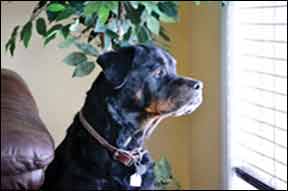
Buddy, a Rottweiler living in Winnipeg, Manitoba, Canada, with Glenda Furkalo, was diagnosed with diabetes just before his ninth birthday in February 2011. Buddy also had hypothyroidism, many allergies, and at the time of his diagnosis was recovering from pancreatitis. Because of his allergies, he was on prednisone for many years, which may have contributed to his diabetes. “These complications made his treatment more of a challenge,” says Furkalo. “We had many ups and downs.”

At first Buddy was prescribed Royal Canin Veterinary Diet Gastrointestinal Fiber Response HF dry food. “The food part was a roller coaster because of his allergies,” she says. “We had tried raw food a few years ago, and he was finally transitioned back to a home-prepared diet in April 2011.”

Buddy thrived on twice-a-day meals of 12 ounces of Spring Meadows whole ground raw chicken (including skin, organs, and bone), ½ cup cooked buckwheat or lentils, ½ cup rehydrated Sojo’s Grain-Free dog food mix, plus ½ cup Orijen 6 Fish kibble.

“We wanted to keep him grain-free,” says Furkalo, “but we needed carbohydrates to help regulate his blood sugar, thus the buckwheat and lentil choices.” These also provided fiber and low-fat calories, to help balance out the very high fat in the ground chicken. Buddy’s supplements included high doses of chromium, which Furkalo feels helped with his glucose levels, plus fish oils and vitamins B-complex, C, D, and E.

As his condition improved, Buddy’s weight, which had fallen to 75 pounds, increased to 89 pounds. “I was excited because he was doing so well,” says Furkalo, “but then we got devastating news. In January 2012, a week before the one-year anniversary of his diabetes, Buddy was diagnosed with bone cancer. We lost him to that disease in February, four days after his tenth birthday. He was a special soul, so full of love, and a joker up until the day before he passed away.”

Henry, an eight-year-old Cardigan Welsh Corgi belonging to Carol Albert of Kensington, Maryland, was diagnosed with diabetes four years ago.

“He was very draggy for a while,” she says. “About a year ago I switched his food to Blue Buffalo kibble and soon after that started combining it half-and-half with Pawgevity, a commercial raw diet (the company is owned by my sister-in-law). His energy has increased tremendously and he recently started herding the other dogs at the park again. He gets Pet Botanic Training Reward Treats after his shot and occasional Charlie Bear Treats. He also loves carrots. Since his diet was changed, Henry’s insulin requirement has gone down slightly.” (Pet Botanic treats contain glycerol, which is not ideal for a diabetic dog.)
Henry is large at 50 pounds and would be healthier at 45, Albert says. “Unfortunately, I have MS and can’t take him for long walks like I used to. We usually hit the park at the end of the street for canine companionship and for the fascinating smells.”

Manage Your Dog’s Diabetes Through Proper Diet

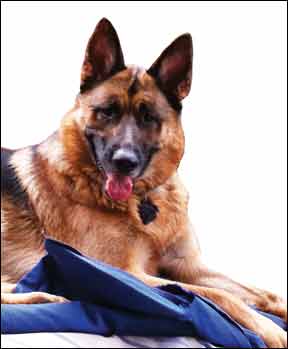
Kodi, a German Shepherd Dog belonging to Judy White in San Antonio, Texas, was diagnosed as a young pup. “I tried everything my vet told me to do,” says White, “until I took it into my own hands and researched everything I could get my hands on. I am a registered nurse and was determined to manage his disease. Kodi was a challenge to raise due to his large breed, ever-changing metabolism, and youth. The dry foods my vet gave us and the amount of insulin prescribed did not serve his growing body and instead forced him into diabetic crises.”

White found a product containing  raw chopped bison, elk, and venison (including bone) with vegetables (from LoveYourPetBakery.com) and began feeding Kodi 1 pound of these mixtures plus 1 cup Merrick B.G. (Before Grain) salmon kibble divided into morning and evening meals. The dry food helped keep him stable and prevent hypoglycemic episodes. Kodi also eats a raw egg twice a week and gets organic chicken strips as treats. “He was fed a larger quantity while he was growing,” she says, “Now, at four years old, he is a stable, 130-pound gorgeous, shiny, muscled GSD.”

As White explains, “All of the time and effort we have spent with Kodi has been well worth it. And he’s smart. One day he actually grabbed a fork off the table and tossed it at me. As I tried to figure out what that was about I thought he looked a little funny, so I checked his blood sugar, and sure enough, it was dangerously low. Now I can look at him and guess what his blood glucose is, and I’m usually pretty close.

“In my opinion, the key to managing a diabetic dog lies mostly in a clean raw diet, knowledge of the disease’s pathology, and commitment to your animal.”

Low-Carb Raw Diets
Homemade diets allow you to control all the variables, but be aware that most raw diets, whether commercial or homemade, are high in fat. While some diabetic dogs do fine with these diets, they could cause serious problems for dogs who suffer from pancreatitis, hyperlipidemia, or Cushing’s disease. Gryffin, Sunny, and Zachary are perfect examples of how well raw diets can support diabetic dogs.

Gryffin, a Cavalier King Charles Spaniel, was four years old – and obese at 30 pounds – when he was diagnosed with diabetes and given up for adoption. “We were his foster family,” says Alise Shatoff of San Diego, California, “and he wormed his way into permanent family member status.”

Now nine years old and a healthy 23 pounds, Gryffin eats Nature’s Variety raw frozen patties (95 percent meat, bone, and organs, and 5 percent vegetables and fruits) with digestive enzymes, salmon oil, and milk thistle extract to support his liver. Nature’s Variety, like most commercial raw diets, is quite high in fat.

Shatoff checks Gryffin’s blood sugar twice a day with an Aviva human test monitor and writes the result in his notebook. “After experimenting with other brands, we found that Gryffin does best on Humulin N for his insulin. He gets it twice a day after meals. He has been stable for four years now.”

As she learned to care for a dog with diabetes, Shatoff turned to an online forum (groups.yahoo.com/group/Oscars_animaldiabetes_support) for support. “They were the ones who suggested Humulin N for him, based on his raw diet,” she says. “I also learned how to check his blood glucose with the meter on his lip, and how to translate human glucose numbers into the dog equivalent, which saved us a ton of money by not having to buy the pet meter test strips.

“Other than his diabetes and hypothyroidism,” she says, “he is very healthy and his lab tests always come out well. He has no trouble keeping up with our Cavalier puppy and 95-pound German Shepherd. He still has his eyesight, which is uncommon after five years. I give him Natural Ophthalmics’ homeopathic Cineraria Eye Drops once a day, which I think in combination with the low carb raw diet has really helped save his vision. He has a partial cataract in one eye and the other is fine. Fortunately, cataract surgery is very successful, and we have a fund saved up for Gryffin in case he ever needs it.”

Every night after dinner, Gryffin and his canine companions chew on Leo and Mike toys stuffed with grain-free treats like Merrick dehydrated lamb lung, PureBites dehydrated cheese or beef liver, or Kong Stuff’N IQ baked salmon treats.

Sunny, a 12-year-old Greyhound, like many dogs these days, was adversely affected by the economy. “In April of 2011, I picked up this very sick dog to foster from loving owners who could no longer care for him,” says Cynthia Wilber of Catonsville, Maryland. “He was 15 pounds underweight and could barely stand. Because Greyhounds rarely get diabetes, I thought his symptoms stemmed from kidney disease, but his glucose levels were off the charts, and he responded well to fluids and insulin.”

Wilber left Sunny at her veterinarian’s clinic for three days to stabilize his condition, and he was well-regulated within six weeks.

“Initially I had him on Orijen 6 Fish and he did very well and put some weight on,” she says. “Then one day he and my Greyhound Hope ate each other’s dinners – Sunny ate Hope’s raw food and Hope ate Sunny’s kibble. I had a rough night thinking both would be sick from the mix-up, but they were fine! A month later I took the plunge and switched Sunny to raw. He went from ‘doing fine’ to ‘doing great,’ and his insulin dose decreased two full units. But that change required that I be more conscientious about giving snacks at regular times (midday, evening before his walk, and bedtime). If I fall asleep on the couch and he doesn’t get his bedtime snack, he can be confused or weak with low blood sugar in the morning.” Snacks include bully sticks, beef tendons, and dehydrated, fresh, or frozen chicken/duck feet, liver leather, and sometimes dehydrated sweet potatoes.

Manage Your Dog’s Diabetes Through Proper Diet

Wilber feeds a home-prepared raw diet that includes a wide variety of low-fat raw meaty bones, meat, and organs, plus vegetables, eggs, and dairy. Starchy vegetables, including sweet potato and winter squash, are cooked.

Because diabetic dogs can be prone to urinary tract infections, Wilber gives Sunny cranberry capsules. She also gives him a glucosamine/chondroitin supplement, salmon oil, ester C, vitamin E, and selenium. Wilber adds carrot juice or kefir to one meal a day.

“His cataracts have not gotten significantly worse since diagnosis,” she says. “He’s gained muscle, but because our walks are never more than a mile at a time, he’s not as fit as he should be. But exercise burns glucose, so even though I carry carbs on walks, I don’t push things with him because he’s too big to carry home, and I really just want him to be as happy and comfortable as possible. Despite his diabetes, Sunny is living a good life. And yes, he landed in the right home. I decided to adopt him.”

Zachary, a Lab/Shepherd mix belonging to Sheila Laing of Lansing, Michigan, lived with diabetes for four years after being diagnosed at age 11.
For the first six months, Laing followed her vet’s advice and fed Zachary Hill’s Prescription Diet w/d food. “It wasn’t helping Zachy, so I stopped the kibble and switched to a home-cooked diet for six months. Then I switched to a completely raw diet for the remainder of his life.”

Zachary’s meat selections included beef, chicken, turkey, and pork, with beef or pork hearts and beef tongue twice a week, plus kidney, liver, spleen, or tripe, and slightly cooked green beans or sweet potatoes. Liang also added bitter melon (an herbal supplement that may lower blood glucose), fish oil, parsley, eggs, and occasionally coconut oil to his food, and gave small amounts of colloidal silver periodically, which she feels helped Zachary avoid urinary tract infections.

“We have a 10-acre yard for our dogs, so Zachy had lots of exercise,” says Laing. “My husband mows a path around the inside perimeter, so in addition to all the running around he did in his big yard, I would walk him regularly on the path.”

Laing created a chart that she kept on the refrigerator door for easy access. “I’d keep a month of charts – one page held a week of activity – and file the rest where I could easily get to them,” she says. “I noted the time and his blood glucose level, the time his insulin shot was given each morning and evening, whatever supplements I gave him, and anything that was abnormal, such as diarrhea, vomiting, low activity, etc. I highly recommend charting for anyone with a dog or cat that has diabetes. Not only does it help with remembering what you do in a day, but it’s handy to refer to when needed.

“Zachy was a healthy, happy dog for most of the four years that he had diabetes. He was 15 when he passed away. I feel blessed that I was able to help him lead a healthy normal life in his senior years despite the diabetes.”

CJ Puotinen lives in Montana. She is the author of The Encyclopedia of Natural Pet Care and other books and a frequent contributor to WDJ.

Mary Straus is the owner of DogAware.com. She lives with her Norwich Terrier, Ella, in the San Francisco Bay Area.

Pet Food Companies and Animal Research: What Do They Do?

2

[Updated March 4, 2016]

Nine years ago, PETA launched a campaign against the Iams brand. The campaign alleged that the pet food company contracted with an independent, contract laboratory, to conduct unnecessary research on dogs and cats in cruel and unsanitary conditions. PETA released 26 video clips, filmed by an undercover investigator at the lab, showing distressed dogs in small cages, recovering from surgery, anesthetized dogs, and a bag said to contain the body of a dog who died following surgery in an Iams-related test. Thousands of people boycotted Iams pet food to express their outrage at these allegations, and some still associate the Iams brand with cruel animal research.

Iams’ parent company, Procter & Gamble, issued denials about some of the claims made in the PETA campaign – but it also acknowledged that the conditions shown in some of the video clips represented violations of its animal welfare policies. P&G severed its relationship with the lab shown in the videos and with all other contract labs. The company moved all the animals it owned to its pet food research facility in Ohio, and greatly expanded that facility, so that all animals used for P&G research would be under their own supervision and care.

But in some ways, the damage was done. Whether due to exposure to the PETA campaign or to people who learned something (accurate or not) about it secondhand, many pet owners now possess a mental association between “pet food research” and substandard living conditions (if not actual cruelty) for animals involved in pet food research.

This is unfortunate for several reasons. Foremost is that the incident confirmed the instincts of most pet food executives that they should hide (or at least never discuss) any research they do in support of their products, lest they inadvertently expose their companies to criticism (fair or not) or activism. For years, the pet food companies that had the most extensive animal nutrition research programs routinely denied requests for tours of their facilities or detailed information about their research, citing either concerns about the potential for pathogenic infection for the research animals or the need for security from infiltration of animal activists.

The “top secret” status of most corporate pet food research results in obscurity for many nutritional studies that may be of interest or value to pet owners. And people with genuine concerns about or interest in the welfare of the research animals have been largely unable to gather reliable, independently verified information about conditions for the animals in research labs. Is Iams cruel? Pet owners had to decide for themselves which public relations campaign to believe: PETA’s or P&G’s. Some of us were frustrated that those were the only two options!

Transparency is the New Black

In recent years, however, the pet food industry has discovered the benefits of sharing more information about its products, manufacturing, research, and development with consumers. In a highly competitive market, it’s advantageous to project a confident image of full transparency – as long as the company is doing everything they say they are doing.

There are two companies that have embarked on relatively high-profile public relations campaigns to inform consumers about their pet nutrition research. One is P&G. It would be understandable from just a PR standpoint that the company is motivated to improve its image on this front. But after making considerable investments in a total makeover of its research goals and facilities, P&G found itself with a good story to tell. The company began reaching out to pet industry journalists and inviting them to tour its research facility in Lewisburg, Ohio; I accepted its invitation and was a sole tourist, with a half a dozen or so guides, in June 2009.

More recently, Hill’s Pet Nutrition began taking a similar tack, inviting pet-related journalists and bloggers to tour its research facility in Topeka, Kansas. I toured the Hill’s Pet Nutrition Center in March with a group of a dozen or so other dog- and cat-related writers.

I was curious. What sort of research, exactly, are they doing at these facilities? Where do they get their animals? What is the quality of life for the animals? Here’s what I observed and learned.

Procter & Gamble’s Pet Health & Nutrition Center (PHNC)

A public relations person for Eukanuba contacted me for the first time in May 2009, saying that she and a Eukanuba brand manager would like the opportunity to meet with me and tell me about Eukanuba’s pet foods and the direction the company (P&G Pet Care) is taking with its product development. We exchanged a number of emails, and shortly, they invited me to visit the P&G Pet Care corporate offices in Dayton, Ohio, as well as the PHNC in Lewisburg, an hour away.

I was excited. I had failed to wangle an invitation to see the facility in 2005, when I was writing an article about feeding trials, which included a long sidebar about the PETA/Iams dustup (“On Trial,” April 2005). At that time, I had tried to make the case to a PR person for Iams that if the company was confident that the PHNC and living conditions for the resident research animals were as they described, they should welcome the opportunity to prove it. No dice.

Four years later, however, P&G Pet Care offered to pay for my airfare and hotel and provide transportation to its Ohio facilities. WDJ’s publisher, Belvoir Media Group, disallows any such gifts or “sponsorship” – though it will allow me to accept a free meal or two. With my publisher footing the bill, I combined the travel to the P&G sites in Ohio with some other WDJ research-related travel (a tour of a duck processing plant and the WellPet dry pet food manufacturing plant in Indiana).

I arrived in Dayton, Ohio, in the late afternoon. I met the corporate PR person who had first contacted me about Eukanuba, and she drove me to a nearby restaurant for dinner with, oh, 10 or so people from the P&G Pet Care division. There were people who were involved with the animal nutrition research, people who worked with the P&G customer service/technical support staff, and of course, marketing and PR people. Everyone seemed very familiar with WDJ and our dog food selection criteria – including the fact that we’ve never been particularly kind to P&G’s Iams or Eukanuba foods – but they all seemed sincere in wanting to learn more about our readers’ interests and the development of our food selection criteria.

The next morning, I again met the PR person in the hotel lobby and she drove us to one of P&G Pet Care’s corporate buildings in Dayton. (P&G relocated these offices and employees to a larger facility encompassing other P&G divisions in Mason, Ohio, in October 2009.) There, I was introduced to some of the brand managers and marketing staff for Iams and Eukanuba products, and was able to speak at greater length with the clinical veterinarian who oversaw the healthcare provided to the dogs and cats involved in developing many of the Iams and Eukanuba products.

Iams and Eukanuba dog and cat food products are formulated, tested, and promoted by the same people. It’s up to the P&G marketing teams to decide whether new products that are developed will roll out under the Iams or Eukanuba label. Each brand has a slightly different identity in the marketplace, so as new products are conceived, at some point, they are pointed toward one brand or the other.

I also got to talk to some of the customer service/technical support people who answer the toll-free numbers for both consumers and veterinarians who have questions about Iams or Eukanuba pet foods.

One thing I noticed right away about this multi-story office building: there were a lot of dogs accompanying employees to work (I lost count after meeting 15 or so), and it clearly wasn’t a setup on my behalf; there were baby gates and tethers permanently installed in cubicles and office doors, and the carpets showed signs of a pet-friendly history (hey, they were moving out of the building soon). Best yet was the fact that almost every dog I met turned out to have been adopted from the P&G PHNC after he or she was retired from research duties. Cool.

Finally, we got back into cars and drove for a little under an hour to the PHNC. The 250-acre site where the research animals are kept is tucked behind a P&G extrusion (dry pet food) manufacturing plant. The facility has capacity for roughly 350 dogs and 350 cats.

Let’s See the Animals

One of the charges made by PETA about dogs at a contract laboratory in Missouri (which Iams hired for some research) was that there were dogs who were surgically de-barked (had their vocal cords severed) to make them less noisy. You have to read PETA’s website very carefully to ascertain that PETA did not allege that these debarked animals were Iams research animals. Nevertheless, I was immediately suspicious when the first group of Beagles we passed by in their outdoor runs failed to start barking at our little tour group. When I realized they were neither barking nor making the hoarse sound produced by debarked dogs, I actually stopped in my tracks and squinted hard (they were 100 feet or so away); were they wearing antibark shock collars? A colony of 20 or so Beagles, with only one or two barking? Something is wrong!

My guide for the tour, the manager of the PHNC, was patient. “Those are young dogs, who are still in training to enter the actual research program,” he explained. “Also, they are thoroughly habituated to the sight of people passing by their runs. They also receive lots of exercise, individual attention from staff, and enrichment in their environments, so they aren’t desperate for stimulation or interaction.”

The PHNC is laid out a bit like a cross between a commercial farm and a university veterinary school campus, with a dozen or so buildings connected by paved paths and separated by grassy paddocks. The aroma of pet food is in the air, thanks to the nearby extrusion plant. Dogs are in view nearly everywhere, passing through dog doors into their outdoor runs, disappearing back into their indoor kennels, playing under the watchful eyes of attendants in one of several fenced “playgrounds,” or being walked on-leash by “animal welfare specialists,” as the staff members who care for the dogs and cats are called.

We passed through at least half of the buildings on the campus, viewing the indoor housing areas for dogs and cats, the clinical care rooms (where animals are taken for routine veterinary exams, blood draws, dental cleaning, and so on), as well as facilities where advanced veterinary research tools are located – things like strikeplate treadmills and high-speed cameras (to analyze changes in stride length, for example, in the maturing or aging dog) and body composition densitometers (an xray-like machine that can analyze an animal’s bone density as well as determine his percentages of body fat and muscle mass).

I was genuinely impressed with the thought and care taken with the housing for the animals. The indoor runs for the dogs are climate-controlled. When staff members noticed that a number of the long-term canine residents had neck or shoulder pain, P&G started researching dog doors that would swing open in such a way that the dogs didn’t have to muscle the doors aside with their necks or use a strained posture to pass through; they finally settled on doors that are split vertically down the center, like saloon doors in old Western movies. Dogs essentially pass straight through these doors, and the incidence of neck injuries dropped.

For the most part, the dogs are pair-housed with a compatible same-sex partner (though they have a daily opportunity to play in a larger social group). Each dog has a name (not just a number), and the front of each run has a whiteboard with notes about the dogs’ individual preferences or challenges. I saw notes like, “Cherry is blind, so talk to her before you touch her so she doesn’t get startled,” and “Pardner does not get along with Jake! Make sure they do not go to the playground together!”

The runs and indoor kennels were spotlessly clean, with staff members in constant attendance to clean up any poop or pee. The air-conditioning kept the indoor temperature comfortable, and I didn’t wrinkle my nose once; I never noticed an odoriferous room. All the dogs had raised beds and toys were present in every kennel. I didn’t see a single dog or cat pace with stereotypic distress or leap at its kennel or cage door for attention. All the animals seemed calm and well adjusted. And the handlers who were walking dogs outside all had clickers, and were using play with toys as rewards.

I know this is a dog magazine, but the cat housing facilities were equally impressive. The cats are kept in larger social groups in large, airy rooms with a ton of places to hide, climb, perch, and nap. All the cats have access to sun porches, a wealth of toys, and clean litter boxes.

Career Planning

Here is what I found most impressive of all: P&G plans each animal’s career from the time it is born to the time it will be retired from research; each animal is then admitted to an adoption program dedicated to placing retired research animals with P&G employees. (With about 2,300 P&G employees in nearby Mason, Ohio, and many thousands more in P&G’s Cincinnati headquarters, there is said to be a waiting list for the well trained, well socialized retired research dogs and cats.)

Dogs are typically retired at age 6, and cats at age 8, although a small senior population in support of research into P&G life-stage diets. In addition, “There are a few dogs and cats who will retire with us for their natural lives, as they aren’t suitable for adoption due to either behavioral or medical conditions,” explains Jason Taylor, manager of external relations for P&G Pet Care. These animals will also continue to test (consume!) senior diets – a sort of working retirement.

Puppies and kittens born into the P&G research program are extensively handled and socialized in preparation for their emergent careers. “We begin preparing our dogs and cats for adoption the moment they come to us,” says Taylor. “We do this by working with them at an early age – in puppy and kittenhood – to acclimate them to both home and kennel environments. New puppies are initially introduced to cars and vans, a variety of off-campus home environments, selected parks, and many new people, in order to support early cognitive development. Our training team and staff work hard at familiarizing every animal to common household items in our spacious Home Environment Room and by continuing their training in general obedience and manners throughout their lives. Dedicated ‘animal welfare specialists’ socialize, exercise, and groom them daily.”

P&G breeds some of the animals currently used in its research program and buys some from commercial breeders. I saw a variety of dog breeds, including the ubiquitous laboratory Beagles, as well as Golden Retrievers and Greyhounds.

P&G also conducts “in-home” palatability, taste preference, and clinical studies through the recruitment of dog owners via their veterinarians. According to Taylor, “More than 70 percent of the animals participating in our studies are pets living in private homes or pets from organizations where animals already live (such as service dog organizations).” And of course, all of the animal nutrition research conducted or overseen by P&G adheres to the company’s animal study policy.

P&G maintains a facility in Cincinnati, called the Winton Hill Discovery Center, as a “headquarters” for pet owners and pets participating in in-home studies. The Center offers pet owners the ability to drop off biological samples, pick up food, and discuss concerns with the animal care technicians and veterinarians. P&G Pet Care also hosts consumer research studies with pet owners at the Winton Center.

P&G’s Other Facilities

When P&G acquired Natura Pet Products in early 2010, a small-scale animal nutrition research facility in Fremont, Nebraska, adjacent to the Natura dry food production plant, was part of the package. I toured the production plant and research facility years before the P&G purchase, in November 2005. At that time, the research facility housed maybe 30 or so mixed-breed dogs (I didn’t look at the cat facilities), who were used in informal palatability and taste preference studies.

Today, the facility is known as the Fremont Health & Nutrition Center, and has the capacity to serve 30 dog and 30 cat residents. According to Taylor, “The Center is an extension of the PHNC, and follows the same P&G Pet Care animal studies policies. Studies taking place at the Center include palatability, digestibility, and bioassay studies. Every detail at the Nebraska Center is focused on the pets who live there, including oversized indoor and outdoor runs with large outside play yards, substantial ventilation systems for climate control, home-like environment settings with social rooms, regular and frequent daily exercise with animal care technicians and routine top-notch veterinary care.”

P&G does not conduct studies involving dogs and cats in any locations other than the three (Ohio, Nebraska, and in-home studies) mentioned above.

Hill’s Pet Nutrition

Even as I toured the P&G PHNC campus three years ago, I wondered how it compared with other pet food research facilities. I was particularly curious about Hill’s Pet Nutrition; nutritional research is the signature characteristic of the company that makes Science Diet and Prescription Diet pet foods.

So I was particularly pleased when I was contacted by a public relations person for Hill’s just a couple of months ago, and invited (along with a bunch of other journalists and bloggers with an interest in pet food) to tour the facility where Hill’s Pet Nutrition conducts its dog and cat food research and development work, the Hill’s Pet Nutrition Center in Topeka, Kansas. I negotiated a bit and pressed to see whether I could also tour some of Hill’s pet food production facilities in the area, and this was soon arranged.

Like P&G, Hill’s offered to pay for all of the invited journalists’ airfare and hotel accommodations and arrange for meals and transportation. As always, WDJ’s publisher paid my way instead.

A shuttle bus took us to the 170-acre Hill’s Pet Nutrition Center (PNC). We reorganized ourselves in a conference room, and were introduced to a number of Hill’s executives, including Kostas Kontopanos, the President of Hill’s USA since 2011; and Neil Thompson, President and CEO of Hill’s Pet Nutrition since 2009.

Hill’s is a $2.2 billion, global subsidiary of Colgate-Palmolive, and is headquartered in Topeka. The Hill’s product line includes more than 80 Prescription Diet brand pet foods and more than 90 Science Diet brand pet foods, which are sold in more than 90 countries. Hill’s employs more than 150 veterinarians, nutritionists, and food scientists to collaborate on its pet food product development and research.

Hill’s History

It wasn’t always so . . . global. Hill’s was founded by a veterinarian in New Jersey, Mark L. Morris, Sr., who developed his first canine diet in 1939 for a client, a blind man named Morris Frank, whose guide dog, Buddy, was suffering from kidney failure. Dr. Morris speculated that manipulating the dog’s diet could slow the progression of the kidney disease, and he began formulating and testing diets, with the help of his wife, in their home kitchen. They canned the food the old-fashioned way, in Ball jars. Mr. Frank and Buddy were touring the country, promoting and demonstrating Seeing Eye dogs, so Dr. Morris mailed the jars of food to Mr. Frank on his tour. After seeing some success with the diet, and having the jars break in transit, Dr. Morris bought a hand-operated canning machine and his staff canned the food.

Dr. Morris began studying various canine and feline diseases and formulating diets that would complement disease treatment. Throughout the 1940s, he developed diets for canine gastrointestinal disorders and obesity (it’s not new!). Eventually, Dr. Morris contracted a commercial cannery, the Hill Packing Company in Topeka, and licensed the company to produce his pet food formulas. He also gave the diet that he formulated for Buddy a formal name, Canine k/d.

In 1948, Dr. Morris established a charity for small animals that would later become known as the Morris Animal Foundation. The Foundation funds independent research into small animal disease to this day. Dr. Morris also established a research laboratory in Topeka in 1951.

In the 1950s, Hill Packing Company established canneries in six more states, and Dr. Morris continued to develop diets for treating sick animals. Eventually, Dr. Morris was joined in veterinary practice and then veterinary nutrition research and diet development by his son, Dr. Mark Morris, Jr. Their products were marketed under the name Hill’s Pet Nutrition. In 1968, Dr. Morris Jr. created the Science Diet line of pet foods for healthy pets. Dr. Morris Jr. also coauthored the first publication of Small Animal Nutrition, a clinical nutrition textbook, in 1983. The text has been updated many times and is used in veterinary colleges worldwide.

The Colgate-Palmolive Company bought Hill’s Pet Nutrition in 1976. Dr. Morris Sr. passed away in 1993 at the age of 92. Hill’s Pet Nutrition reached $1 billion in net sales in 2000. When Dr. Morris Jr. passed away in 2007 at the age of 72, he was still actively involved with Hill’s, and his presence is still strongly felt at the Hill’s Pet Nutrition Center.

Get to the Animals

Our tour guide of the Hill’s PNC was Scott Mickelsen, DVM, a Diplomate of the American College of Laboratory Animal Medicine, and Manager of Pet Nutrition Resources for this campus (meaning he manages the animal colony). Four hundred and two dogs and 485 cats were reported to be living on the Hill’s PNC campus on the day of our tour – all of them kept according to the conditions laid out in Hill’s animal welfare policy (excerpted below and available in its entirety at tinyurl.com/hillspolicy).

The buildings that house the animals are all connected, with a total of 80,000 square feet of housing and treatment rooms, as well as kitchens and food preparation rooms. A 3,000 square foot veterinary hospital, where prophylactic care and urgent care (if needed) is provided, features everything you’d see in any modern veterinary hospital, including surgical suites and xray and ultrasound rooms. There are multiple rooms containing laboratory analysis equipment for blood and urine tests.

Unlike the P&G program, where the majority of research animals are retired from studies and adopted into homes, the animals at Hill’s typically live their entire natural lives on the Hill’s campus. They are adopted out of the program (almost always by a Hill’s employee) only if they develop a behavioral incapacity for the campus lifestyle. If they develop medical conditions, they are treated as thoroughly as any pet dog or cat at home as long as they have a good quality of life; if they need to be retired from participating in any studies as a result of treatment, they are – though they are likely to continue to be fed a Hill’s diet appropriate for their condition, and will continue to be monitored via blood and urine tests and physical examinations.

While dog lovers might be expected to admire the P&G model of retiring most of its research animals (at age 6 for dogs), and perhaps be critical of Hill’s for keeping almost all of its “pet partners” throughout their lifetimes, Hill’s points out that studying life-stage nutrition is critically important to the company. “A 13-year-old dog or cat may have different nutritional requirements than a 7-year-old dog or cat,” explains Dr. Mickelsen. “Disease frequency increases with age. If we adopted them out at 7 or 8 years, many of our foods designed to benefit older dogs and cats may not have been developed.”

The housing for the animals is provided in a series of wings, which are laid out in a repeating pattern; we could see all of the outdoor recreation areas for the dogs extending away from us into the distance. We were able to view the interior of one wing, representing one third of the total canine housing facility; we were told that the parts we didn’t see were identical to the parts we did view.

As one might guess in a nutritional research center, the feeding rooms function as the nerve centers of each wing. In the dog wings, four housing areas, each with a capacity of 20 dogs, are attached to each feeding room; a mirrored arrangement is located across a central hall that connects each of these wings.

The total capacity of the dog housing area is 480, but the actual numbers are usually less than that. The dogs eat their meals in a sort of stanchion; their food (including the amount they eat or decline to eat) is precisely recorded by scales that are built into the food bowl platform. (Entire conferences could probably be held to explain all the technology that has gone into the way the animals’ food is presented to them and recorded.) For the most part, they sleep in pairs in cubicles that line a large playroom; each group of 20 is released during the day into a large group room, outfitted with a plethora of toys.

Swinging dog doors keep the climate indoors comfortable, and allow the dogs to pass outside and recreate or snooze in a large outdoor play area.

The outdoor play areas are carpeted in artificial turf; a pergola shelters part of the area from weather and heat, although an uncovered area is available to them, if they prefer. Toys abound outside, too, and handlers are constantly present, playing with and petting the dogs – and cleaning up after the dogs – as you’d see in any good dog daycare facility. On the day of our tour, the animal care staff (for the dogs and cats) was said to consist of 55 employees.

The toys are rotated as a set a couple of times a week, both so they can be cleaned and to provide novelty when they are reintroduced. To prevent disputes over “favorite” toys, all the toys that are put out at any given time are the same kind.

All of the outdoor runs are connected by gates to much larger dog park-type facilities. Each group of dogs is allowed out for play in one of these large areas at different times of day.

Most of the dogs we saw were Beagles; historically, the dog of choice for laboratory research (because Beagles are almost always content when living in a pack). However, Hill’s is slowly integrating other breeds (including mixed-breeds) into its research colonies, but only at the rate that the senior animals pass away, so it might take a decade or more to see a non-Beagle majority on campus.

Each animal is microchipped, and computers located in the lobby area of the feeding rooms can identify each animal, show photographs of him or her for identification purposes (for new employees, mostly), and display his or her complete health history, information on the dog’s participation in studies, and of course, current diet.

All of the dogs we saw looked comfortable and well adjusted. As at the P&G site, I was surprised when groups of dogs playing in the Hill’s “Bark Parks” or in their outdoor runs failed to react in any way to the sight of our group passing by. I observed none of the stereotypic stress behaviors that are so common in shelter dogs or commercial breeding operations -although I did see one Beagle make a large, gloppy poop, and another immediately start to consume the poop (but that can happen anywhere with any breed, though most of us dog journalist witnesses remarked, “Ugh! Beagles!”).

The group housing rooms for cats are appointed like cat palaces – so many scratching posts, beds, hammocks, platforms, skywalks, toys, and tunnels. The cats in each group room have access to “sun porches” via tunnels – and the tunnels all have openings into alternate tunnels, in case a cat wants to get to the porch and another cat is blocking the way. (Look, that’s how cats are.)

We saw the entire cat housing area, encompassing some 60 separate rooms. The majority of the cats are housed in groups of 8 to 12 cats per room, although we saw some cats in individual housing units – referred to as “kitty condos.” These individual spaces are about 150 cubic feet of space (a little bigger than 5 feet by 5 feet by 5 feet) with multiple climbing perches and windows, including a bay window that allows the cats a panoramic view of their environment. These spaces are also individually ventilated.

According to Dr. Mickelsen, cats are housed individually for one of three reasons: “First, we have about 7 or 8 cats who are not behaviorally comfortable in a group housing setting, period. So they get their own housing. Second, in some studies, we need to collect biological samples, such as stool or urine, for a short period of time, so those cats will be individually housed for short periods. Third, cats with medical conditions, such as inflammatory bowel disease, might be individually housed so we can monitor every occurrence of elimination.”

Dr. Mickelsen pointed out that all the individually housed cats have the opportunity daily to enjoy themselves in large playrooms, and have daily access to the sun porches, just not 24/7 like the group housed cats.

We also saw one room that was decorated with several comfortable couches, chairs, and desks and contained no cats; we were told that it was a lounge that can be used by Hill’s employees from anywhere on the campus. The lounge is equipped with Wi-Fi, and cats can be “checked out” by the employees who need a cat break. (Employees can also check out a dog and take him or her for a walk or jog around the Hill’s campus.)

One of the innovations used by Hill’s to conduct metabolic studies (in which all urine and stool needs to be collected) or any study that requires the collection of all the animal’s urine, is the use of nonabsorbent beads in litter boxes, and other innovations for collecting dog urine (in old-fashioned labs, the test animal is required to live for a short time in a cage with a slatted floor, so that all the urine and feces can be collected in a pan underneath the cage. “We haven’t used cages with slatted floors for years,” says Dr. Mickelsen. “We devise things as needed. We found once that we had a hard plastic ball in the kennels that the dogs never played with, but were always urinating on. So we put that ball in the middle of a tray, like a lunch tray, and found that the dogs would urinate on the ball and we could capture all the urine in the tray.”

Types of Tests

According to Dr. Mickelsen, at any given time, about 50 percent of the dogs on the Hill’s PNC campus are participating in palatability or taste preference studies of some kind. In these studies, the dogs are given two or four foods to choose from, and allowed to make a choice of which to eat. A lot of technology goes into preventing them from overeating, however; the food bowls are on scales in a sort of little cubby. After the scales detect that an appropriate amount of food is consumed, the dog is warned (with an automated tone) to stop eating so that the bowls can be removed. Though most dogs heed the warning tone, if one doesn’t, a puff of air is blown into his face until he backs up, at which point the apparatus detects that he is safely out of the way and the doors to the cubby close.

The next largest group of dogs – about 30 to 40 percent of the population – are participating in “ad hoc” studies, typically designed to gather data or research an issue in support of the development of new products or formula changes.

Dogs participating in some sort of AAFCO feeding trial make up the smallest percentage of the canine research population at any given time, perhaps just 10 percent.

Which dogs go into which studies? Dr. Mickelsen describes this as an ever-changing puzzle. “We try to be as efficient as we can be, given the population. Some dogs are generalists, but we’ve trained some for specific tasks, such as urinating in a special setting or picking out different aromas, and those dogs  tend to get assigned repeatedly to studies that require those skills. It takes several months to train dogs to detect certain aromas, for example, and to validate their abilities; it doesn’t make sense to pull that dog away from that work.”

Dogs who develop disease are treated for their conditions, and might be assigned to a study of diets that address their condition. For example, if a dog develops kidney disease, he would likely be placed on a diet of k/d, and his blood and urine samples used in tests in support of the ongoing refinement of kidney diets.

However, the bulk of Hill’s research on diets for animals with medical conditions does not happen at the Hill’s PNC; it happens in people’s homes. The company partners with veterinarians in practice and with vet schools all over North America, “recruiting” a pool of patients through their vets. “For example, when we developed j/d, we had some dogs with arthritis on our campus, but not in large enough numbers to do a big clinical study. By partnering with veterinarians, we can find many more patients to participate in these studies.”

Hill’s declines to state exactly how many pets might be participating in Hill’s clinical trials of diets at any given time (this is considered proprietary information), but Dr. Mickelsen would say that “the number of pets we touch outside of our facility is far larger than the number we have here.” In a trial of this kind, typically the owner and veterinarian both are “blinded” to the food, which is sent to them in a plain wrapper. The veterinarian takes any biologic samples needed (blood, urine, stool) and sends them to Hill’s labs, and also performs whatever physical exams and evaluations Hill’s asks for.

Ordinary dogs and owners also participate in palatability studies conducted by Hill’s. Of course, neither these dogs nor their handlers are specially trained for these tests, but the data they provide (in terms of their preferences) are used to validate and cross-check the Hill’s PNC findings in “real world” environments.

I asked Dr. Mickelsen if he had anything else he wanted WDJ to know about the Hill’s animal research. He said, “I would like people to know that we are genuinely passionate about the health and welfare of our animals, and we treat them like we would treat our own pets at home. When an old dog or cat gets sick, and we have to make a decision about his quality of life – that’s always a tough day for the people who have been caring for that animal for a long time. Those are the challenging days. And we are lucky to work for a company that shares the passion for animal health and welfare that our customers possess.”

In Contrast

There are a few other large pet food companies that conduct research on this sort of scale – Purina and Royal Canin, for example – but it has to be noted that few, if any, of the manufacturers of the foods on WDJ’s “approved foods” lists invest this much in either feeding trials or nutritional research.

Most (if not all) small-scale pet food companies conduct informal palatability and digestibility studies, on small numbers of dogs belonging to employees, local shelters, or breeders. Others may employ the services of a contract laboratory to feed the product to a population of dogs and record the results. The latter is an expensive step, and a tad risky from a public relations standpoint – remember that undercover video footage? In today’s competitive market – and with the white-hot, blazing speed of social networks – an undercover video of mistreatment of dogs or cats in a research lab could really damage a pet food company’s reputation and sales. A company executive better have solid faith and evidence that the contract lab takes the provision of animal welfare as seriously as a funeral.

While we’re sure that a pet food company executive could gain access to a contract lab to verify conditions and the quality of life for the resident test dogs and cats, it’s pretty difficult for anyone else to do so. Summit Ridge Farms, located in Susquehanna, Pennsylvania, is perhaps the highest profile and largest contract lab in operation in the U.S. that does feeding trials for pet food companies. The company routinely takes out full page ads in pet food industry magazines, describing its animal welfare and enrichment programs and picturing its “puppy parks” and “feline community living.” But the company strictly restricts access to the facility, and though I haven’t bothered in recent years, when I did try to contact the lab to discuss the possibility of a tour, my calls and emails went unreturned.

If it’s so expensive (and a potential  public relations risk) to use contract labs to conduct a feeding trial, why not just skip this step? Even well manufactured products made of good ingredients and formulated to meet the AAFCO nutrient levels for a “complete and balanced” designation can turn out to cause digestive issues when fed to real dogs! You’d hate for your new product to hit the market and hear about dogs with killer gas or dangerous diarrhea. Feeding trials are a valuable source of critical information for pet food companies. It would be nice if the entire industry was doing them as thoughtfully and with as much attention paid to the quality of the animal subjects’ lives as Hill’s and P&G. 

Puppy Vaccinations and Socialization

A veterinarian’s first priority is the physical health of her clients. As a result, sadly, some veterinarians still issue the out-of-date edict to their puppy owners to not take their baby dog anywhere until he is fully vaccinated – age 4 to 6 months. This, of course, totally overlooks the very real concern for a pup’s mental health, and the vital need for proper socialization to occur well before the pup is fully vaccinated. As mentioned in the accompanying article, the primary socialization period is early and short – when the pup is 3 to 14 weeks of age. At 4 months, the earliest age a pup will have received all his first-year shots, the undersocialization damage is done, and the owner must now modify the fearful behavior that could have been avoided had her veterinarian given her better advice.

Puppy Vaccinations and Socializtion

In fact, the need for the “puppy series” of vaccinations is widely misunderstood by many puppy owners. It’s not that your pup needs a series of shots to boost his immune system to a protective level. What actually happens is this:

When a puppy is born and begins to nurse, he drinks colostrum – milk produced during the first day or two after birth, that contains a high antibody count. By drinking colostrum, the pup gains an early level of immunities from his mother, which protects him until his own system can produce immunities.

At some point between the age of 8 and 16 weeks, the mother’s immunities start to fade. If given too soon, a vaccine is ineffective, because mom’s immunities are still at work. If vaccinated too late, the pup is unprotected for a while, because mom’s immunities are gone and the pup’s haven’t yet been triggered by the tardy vaccination. However, as long as a pup is vaccinated in a timely manner during the puppy series, he should be adequately protected, especially if the owner doesn’t foolishly expose him to very high risk environments such as dog parks, dogs or puppies known to be sick, or places sick canines are known to frequent.

The American Veterinary Society of Animal Behavior’s “Position Statement on Puppy Socialization” says: “In general, puppies can start puppy socialization classes as early as 7 to 8 weeks of age. Puppies should receive a minimum of one set of vaccines at least 7 days prior to the first class and a first deworming. They should be kept up-to-date on vaccines throughout the class.” It goes on to say, “In fact, behavioral problems are the number one cause of relinquishment to shelters. Behavioral issues, not infectious diseases, are the number one cause of death for dogs under three years of age.”

In other words, a pup is more likely to die from behavior problems – including fear and aggression often related to lack of socialization – than he is from getting sick at a puppy socialization or training class.

Counter-Conditioning and Desensitization (CC&D)

Counter conditioning for dogs helps dogs manage fear responses.
Here's a simulated CC&D session – but if this were a real session, we'd change some things. The woman with the calm, non-reactive dog is the "stimulus" for this session (but the dog should not be on a retractable leash). The stimulus should be presented to the reactive dog (right) at a greater distance, so he sees and notices the stimulus, but is well under his reactive threshold. His handler should strive to keep the leash loose, and should be dropping the treats on the ground, rather than risking getting nipped as his stressed dog grabs at the treats. Photo by Nancy Kerns

Counter conditioning and desensitization (CC&D) involves changing your dog’s association with a scary stimulus from negative to positive. The easiest way to give most dogs a positive association is with very high-value, really yummy treats. I like to use chicken – canned, baked, or boiled.

Here’s how CC&D works:

1. Determine the distance at which your dog can be in the presence of the stimulus and be alert or wary but not extremely fearful. This is called the threshold distance.

2. While holding your dog on leash, have a helper present the stimulus at this threshold distance. The instant your dog sees the stimulus, start feeding bits of chicken, non-stop.

3. After several seconds, have the helper remove the stimulus, and stop feeding chicken.

4. Keep repeating steps 1-3 until the presentation of the stimulus at that distance consistently causes your dog to look at you with a happy smile and a “Yay! Where’s my chicken?” expression. This is a conditioned emotional response (CER) – your dog’s association with the stimulus at threshold distance is now positive instead of negative.

5. Now increase the intensity of the stimulus. You can do that by decreasing the distance slightly; by increasing movement of the stimulus at the same distance (a child walking, skipping, or swinging her arms); by increasing the number of stimuli (two or three children, instead of one); increasing the visual “threat” (a tall man instead of a short one, or a man with a beard instead of a clean-shaven one); or by increasing volume (if it’s a stimulus that makes noise, such as a vacuum cleaner). I prefer to decrease distance first, in small increments, by moving the dog closer to the location where the stimulus will appear, achieving your CER at each new distance, until your dog is happy to be very near to the non-moving stimulus, perhaps even sniffing or targeting to it.

6. Then return to your original threshold distance and increase the intensity of your stimulus (move the vacuum a little; have two children instead of one; have the man put on a hat or a backpack), gradually decreasing distance and attaining CERs along the way, until your dog is delighted to have the moderately intense stimulus in close proximity.

7. Now, back to your original threshold distance, increase intensity again, by having your helper turn the vacuum on briefly, feed treats the instant it’s on, then turn it off and stop the treats. (Or turn up the volume, or add more children, etc.)

8. Repeat until you have the CER, then gradually increase the length of time you have your dog in the presence of the increased-intensity stimulus, until he’s happy (but not aroused) to have it present continuously.

9. Begin decreasing distance in small increments, moving the dog closer to the stimulus (or the stimulus closer to your dog), obtaining your CER consistently at each new distance.

10. When your  dog is happy to have the higher intensity stimulus close to him, you’re ready for the final phase. Return to the original distance and obtain your CER there with a full intensity stimulus – a running, moving vacuum; multiple children laughing and playing; a tall man with a beard wearing a hat, sunglasses, and a backpack. Then gradually decrease the distance until your dog is happy to be in the presence of your full-intensity stimulus. He now thinks the stimulus is a very good thing, as a reliable predictor of very yummy treats. In the case of a human stimulus, you can gradually work up to actual interaction with the human(s) at this stage, by having the person(s) drop treats as they walk by, then letting him take treats from their fingers – without direct eye contact, and eventually working up to normal interaction.

Get Back on the Horse

The more complex the stimulus, the more intense the fear or arousal response; the longer the dog has had a fear response to the object, the more challenging the behavior is to modify. Studies show that when rats are exposed to a fear-causing stimulus, they recover from that fear much more easily and quickly if rehabilitative efforts happen sooner (within 24 hours) rather than later (days, weeks, or months down the road). For this very reason, fans of horseback riding have long heard the admonition to get back on the horse after falling off; getting back on immediately and having a good experience will diminish the likelihood of a deep-seated lifetime fear of horses.

The same is true for dogs who have fear-causing encounters. The sooner they are re-exposed to the scary thing at sub-threshold intensity, and counter-conditioning is effectively done to give them a new, positive association to the stimulus, the easier it is to accomplish, and the less likely the dog will suffer from a longtime – or lifetime – negative association with it.

Strenuously avoid making the mistake of flooding. Flooding is exposing your dog to the full intensity of a scary stimulus and making your dog endure it until he loses all hope of escape and gives up. Proper behavior modification strives to keep the exposure sub-threshold.

Flooding is considered to be very inhumane, and is not a recommended behavior modification technique for dogs. Although it is sometimes used in behavior modification with humans, it is always with the consent of the human subject, and the human has access to a “shut-off” signal of some kind, so she can turn off the stimulus if it becomes unbearable. A dog forced to undergo flooding isn’t asked for consent and has no relief switch to turn it off.

Eliminating Your Puppy’s Fear-Related Behaviors

The intent of puppy socialization is to convince the part of the puppy’s brain that reacts emotionally to his world (the amygdala) that, in general, the best/most appropriate emotional responses are calm, relaxed, and happy. These days, the importance of puppy socialization is well-known and widely accepted. Interesting, then, that some behavior professionals (myself included) report seeing an increasing number of canine clients with fear-related behaviors.

Fear Related Behaviors

288

There are several reasons for the apparent increase in fear-related behaviors in dogs, including:

Less “natural socialization,” as responsible owners keep their puppies safely at home, rather than allowing them to roam the neighborhood.

The availability of more behavior professionals who are willing and able to work with dogs who display fear-related behaviors, and the awareness of more dog owners that behaviors can be modified.

A lack of understanding among dog owners who recognize that socialization is important, but don’t realize that key to good socialization is positive exposures to the world. A pup who has negative experiences during the primary (3 to 14 weeks) socialization period is very likely to grow up fearful, unless prompt remedial action is taken.

A lack of awareness of the existence of secondary fear periods which, according to various information sources, can occur for a dog anywhere between the age of 4 to 11 months, or perhaps as late as 2 years of age. A fear-causing event any time during this period, when a dog is more sensitive to aversive stimuli, can also have far-reaching fear behavior implications.

The emergence of puppy mills over the last 30 years. Puppy milling only began to boom in the late 1970s and later. Puppy mill puppies do not receive adequate socialization – if any. They are also likely to be shipped to retail outlets during the very significant early fear period (8 to 10, maybe 12, weeks)

The emergence of the so-called “no-kill” movement, which promotes the placement of behaviorally questionable dogs who, in the past, would more likely have been euthanized.

A growing number of hoarder case investigations by animal protection agencies that result in the seizure of hundreds of undersocialized/fearful dogs who are then rehomed.

Genetics v. Environment
An often-asked question is, “Is my dog’s fearful behavior genetic, or did someone or something cause it?” The answer is always “both.” Genetics as well as life experiences always have a combined influence on behavior.

In the case of genetics, what is actually heritable is a dog’s propensity to be reinforced by (or to find aversive) a particular behavior. Border Collies are genetically programmed to find running after things to be very reinforcing – so they are good at herding; while Labradors Retrievers have a propensity to be reinforced by putting things in their mouths – hence they are good at retrieving. Conversely, a dog who has a genetic propensity to find new and/or unusual stimuli aversive might be said to be genetically fearful – a common problem for dogs produced by breeders (including puppy mills) who don’t deliberately make an effort to breed for sound temperament.

If you take two puppies of similar age and expose them to a novel stimulus, given equal amounts of proper socialization, the puppy who is of genetically sound temperament will likely be calm and/or curious, while the genetically less-stable pup is more likely to exhibit a fear response. Genetically less-stable pups need much more socialization if they are to develop into normal, stable dogs – but since it’s virtually impossible to tell how genetically stable a pup may be, the solution is to super-socialize all pups. The stable ones can only benefit from the extra experience as well.

Environmental impact can begin very early. For example, if a pup is genetically sound for temperament but his mother exhibits fearful behavior toward people approaching the whelping box, the pup can learn from this to be fearful of people at a very young age – as young as 3 weeks. Additionally, fear-causing events during sensitive periods, as well as significantly traumatic events at any time, can cause environmentally induced long-lasting fearful behavior.

Preventing Fear
Fear is one of the primary causes of aggression. It also badly degrades a dog’s quality of life, as well as the lives of the humans who love him. Therefore, it’s in everyone’s best interests for you to take steps to prevent your puppy/young dog from becoming fearful. One might think that would mean keeping him safe at home where no bad things can happen to him, but the opposite it true. Undersocialization is likely the leading cause of fear-related behaviors. (See “Vaccinations and Socialization”.)

When you are socializing your pup, take care to fill his environment with happy experiences. When you do this, you are giving him a positive classical association with his environment; you are programming his brain to see the world as a fun and happy place. Be extra sensitive to your pup’s perspective on the world, and watch closely for low-level signs of stress that will tell you he’s not enjoying himself. These might including avoidance (trying to move away from something), lip licking, yawning, shutting down (absence of behavior) and more. (For more information about identifying these behaviors, see “Stress Signals,” June 2006.)

If you see any of these signs, identify what is worrying him and increase his distance from that stimulus. Then carefully work to give him a positive association with that thing, using counter-conditioning to pair the stimulus with something wonderful, like chicken – baked, broiled, or canned. (See “Counter-Conditioning and Desensitization,”).

Puppy Socials
With a little (okay – a lot) of luck and a good socialization program, you may never need a counter-conditioning program for your pup; he’ll grow up mentally stable and free of fear, and be exactly the happy canine companion you’re hoping for.

Recognizing the importance of early socialization, more and more positive reinforcement trainers are offering puppy socialization classes. In these classes,  rather than (or in addition to) the routine teaching of basic good manners, pups are gently exposed to a variety of stimuli, below threshold, in a safe environment, where any early fears can be identified and tended to. Pups encounter a variety of people wearing strange costumes, listen to odd noises from “sound desensitization” CDs, walk on and through a variety of surfaces and obstacles, see a vacuum cleaner at a distance, and more. My own puppy social class recently got to meet Olivia, our miniature horse!

With efforts such as these from trainers and owners who understand the vital importance of early socialization, along with an increasing awareness of how to effectively help dogs who do have fear-related issues, we can hope to see the trend reverse, and start seeing fewer dogs in our practices – and our society – with fearful behavior.

Pat Miller, CBCC-KA, CPDT-KA, CDBC, is WDJ’s Training Editor. She lives in Fairplay, Maryland, site of her Peaceable Paws training center, where she offers dog training classes and courses for trainers. Pat is also author of many books on positive training, including her newest, Do Over Dogs: Give Your Dog a Second Chance at a First-Class Life.