

HOMEMADE DOG FOOD: OVERVIEW
1. Feed your dog a wide variety of foods from different food groups.
2. Make sure you supplement your dog’s homemade diet with calcium unless you feed raw meaty bones.
3. Stick to lean meats and remove skin from the poultry you feed unless your dog is highly active.
4. Keep in mind that the less variety of foods you feed, the more important supplements become.
5. Review your homemade dog food diet plan with a veterinarian for approval.
In the past few issues of Whole Dog Journal, I have offered critiques on homemade dog food diets in order to address the dog’s health concerns – or simply to optimize the dog’s diet plan. To do this, I analyzed the cooked and raw homemade dog food diets and compared them to the National Research Council’s guidelines for canine nutrition. I want to be clear, though: I don’t believe this is a requirement for feeding home-cooked dog food. Just as with the diet you feed yourself and your family, feeding a wide variety of healthy foods in appropriate proportions should meet the needs of most healthy dogs. The best diet for dogs, in effect, is a diverse diet.
Problems arise with how healthy dog food is interpreted. Too often, people think that they’re feeding healthy homemade dog food, when key ingredients may be missing or are fed in excess. Here’s how to make dog food at home, and specific guidelines to help ensure that the dog food diet you feed meets your individual dog’s requirements. You do not want just one dog food recipe to follow – you need several, and need to be comfortable mixing and matching ingredients, for reasons explained below.
Complete and Balanced Dog Food Diets
It’s important homemade dog food is “complete and balanced,” meaning it meets all of the dog’s nutritional needs. It is not important, however, that every meal be complete and balanced, unless you feed the same meal every day with little or no variation.
Home-prepared dog diets that include a wide variety of foods fed at different meals rely on balance over time, not at every meal. Similar to the way humans eat, as long as your dog gets everything he needs spread out over each week or two, his diet will be complete and balanced.
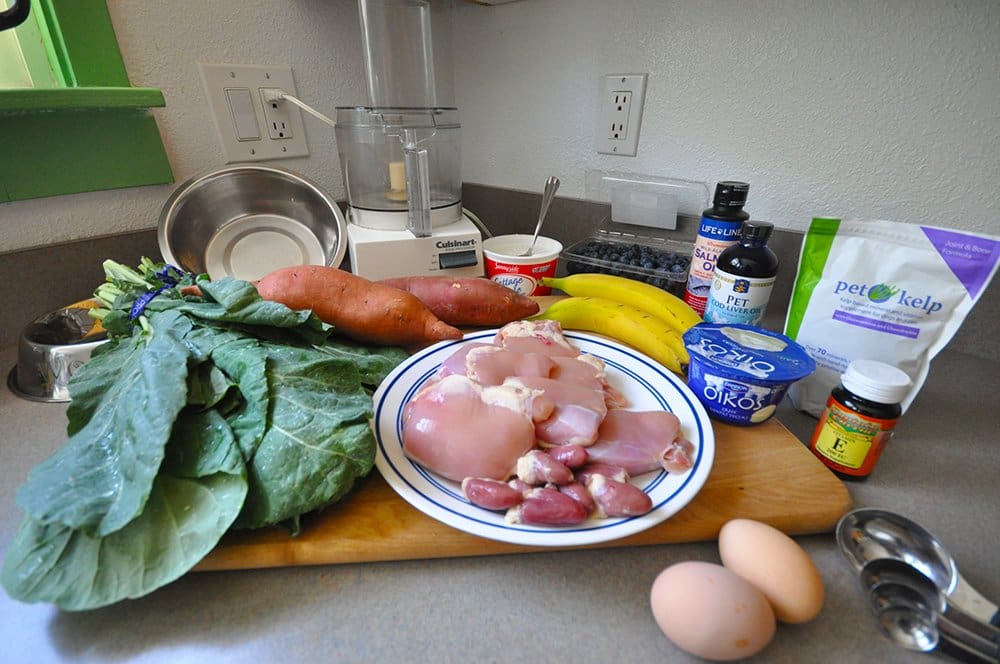
A human nutritionist would never expect someone to follow a single recipe with no variation, as veterinary nutritionists routinely do. Instead, a human would be given guidelines in terms of food groups and portion sizes. As long as your dog doesn’t have a health problem that requires a very specific diet, homemade dog food should be the same way.
For more on homemade dog treats, see “DIY Gifts for Dogs: Homemade Dog Treats & Healthy Recipes.”
Keep in mind that puppies are more susceptible to problems caused by nutritional deficiencies or excesses than adult dogs are. Large-breed puppies are particularly at risk from too much calcium prior to puberty. See “Puppy Food: Nutritional Guidelines to Maximize Health,” for more on puppy nutrition.
GUIDELINES TO CREATING BALANCED HOMEMADE DOG FOOD RECIPES
Following are guidelines for feeding a raw or cooked home-prepared diet to healthy dogs. No single type of food, such as chicken, should ever make up more than half the diet.
Except where specified, homemade food for dogs can be fed either raw or cooked. Leftovers from your table can be included as long as they’re foods you would eat yourself, not fatty scraps.
Meat and Other Animal Products: Should always make up at least half of the diet. A raw diet for dogs can be excessively high in fat, which can lead to obesity. Another potential hazard of diets containing too much fat: If an owner restricts the amount fed (in order to control the dog’s weight) too much, the dog may suffer deficiencies of other required nutrients.
Unless your dog gets regular, intense exercise, use lean meats (no more than 10 percent fat), remove skin from poultry, and cut off separable fat. It’s better to feed dark meat poultry than breast, however, unless your dog requires a very low-fat diet.
Raw Meaty Bones (optional): If you choose to feed them, RMBs should make up one third to one half of the total diet. Use the lower end of the range if you feed bony parts such as chicken necks and backs, but you can feed more if you’re using primarily meatier parts such as chicken thighs. Never feed cooked bones. Read a full report on raw meaty bones here.
Boneless Meat: Include both poultry and red meat. Heart is a good choice, as it is lean and often less expensive than other muscle meats.
Fish: Provides vitamin D, which otherwise should be supplemented. Canned fish with bones, such as sardines (packed in water, not oil), jack mackerel, and pink salmon, are good choices. Remove bones from fish you cook yourself, and never feed raw Pacific salmon, trout, or related species. You can feed small amounts of fish daily, or larger amounts once or twice a week. The total amount should be about one ounce of fish per pound of other meats (including RMBs).
Organs: Liver should make up roughly 5 percent of this category, or about one ounce of liver per pound of other animal products. Beef liver is especially nutritious, but include chicken or other types of liver at least occasionally as well. Feeding small amounts of liver daily or every other day is preferable to feeding larger amounts less often.
Eggs: Highly nutritious addition to any diet. Dogs weighing about 20 pounds can have a whole egg every day, but give less to smaller dogs.
Dairy: Plain yogurt and kefir are well tolerated by most dogs (try goat’s milk products if you see problems). Cottage and ricotta cheese are also good options. Limit other forms of cheese, as most are high in fat.
Fruits and Vegetables: While not a significant part of the evolutionary diet of the dog and wolf, fruits and vegetables provide fiber that supports digestive health, as well as antioxidants and other beneficial nutrients that contribute to health and longevity. Deeply colored vegetables and fruits are the most nutritious.
Starchy Vegetables: Veggies such as potatoes, sweet potatoes, and winter squashes (including pumpkin), as well as legumes (beans), provide carbohydrate calories that can be helpful in reducing food costs and keeping weight on skinny and very active dogs. Quantities should be limited for overweight dogs. Starchy foods must be cooked in order to be digestible.
Leafy Green and Other Non-Starchy Vegetables: These are low in calories and can be fed in any quantity desired. Too much can cause gas, and raw, cruciferous veggies such as broccoli and cauliflower can suppress thyroid function (cook them if you feed large amounts). Raw vegetables must be pureed in a food processor, blender, or juicer in order to be digested properly by dogs, though whole raw veggies are not harmful and can be used as treats.
And while you’re preparing these nutritious foods for your dog, consider boosting your own health by adding more veggies to your diet too!
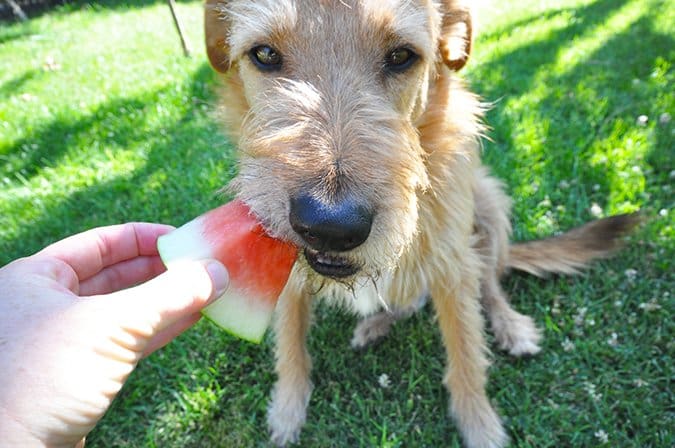
Fruits: Bananas, apples, berries, melon, and papaya are good choices. Avoid grapes and raisins, which can cause kidney failure in dogs.
Grains: Controversial, as they may contribute to inflammation caused by allergies, arthritis, or inflammatory bowel disease (IBD); as well as seizures and other problems (it’s not clear whether starchy vegetables do the same). Some grains contain gluten that may cause digestive problems for certain dogs. Many dogs do fine with grains, however, and they can be used to reduce the overall cost of feeding a homemade diet.
Grains and starchy veggies should make up no more than half the diet. Good choices include oatmeal, brown rice, quinoa, barley, and pasta. White rice can be used to settle an upset stomach, particularly if overcooked with extra water, but it’s low in nutrition and should not make up a large part of the diet. All grains must be well cooked.
DIETARY SUPPLEMENTS FOR HOME-FED DOGS
Some supplements are required in addition to natural food for dogs. Others may be needed if you are not able to feed a variety of foods, or if you leave out one or more of the food groups above. In addition, the longer food is cooked or frozen, the more nutrients are lost. Here are some dog supplements to consider:
Calcium
Unless you feed RMBs, all homemade diets must be supplemented with calcium. The amount found in multivitamin and mineral supplements is not enough. Give 800 to 1,000 mg calcium per pound of food (excluding non-starchy vegetables). You can use any form of plain calcium, including eggshells ground to powder in a clean coffee grinder (1/2 teaspoon eggshell powder provides about 1,000 mg calcium). Animal Essentials‘ Seaweed Calcium provides additional minerals, as well. And here is a good list of calcium-rich foods your dog may like. Just please note this list is for humans and includes orange juice, which is not a good thing to give your dog as the acidity can cause stomach upset.
Oils
Most homemade diets require added oils for fat, calories, and to supply particular nutrients. It’s important to use the right types of oils, as each supplies different nutrients.
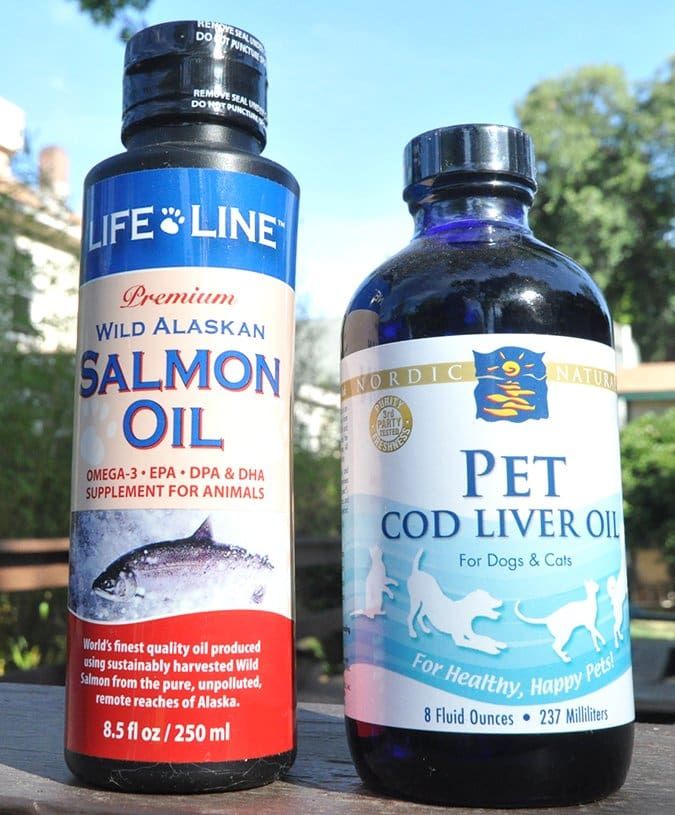
Fish Oil: Fish oil for dogs provides EPA and DHA, omega-3 fatty acids that help to regulate the immune system and reduce inflammation. Give an amount that provides about 300 mg EPA and DHA combined per 20 to 30 pounds of body weight on days you don’t feed fish. Note that liquid fish oil supplements often tell you to give much more than this, which can result in too many calories from fat.
Cod Liver Oil: Provides vitamins A and D as well as EPA and DHA. If you don’t feed much fish, give cod liver oil in an amount that provides about 400 IUs vitamin D daily for a 100-pound dog (proportionately less for smaller dogs). Can be combined with other fish oil to increase the amount of EPA and DHA if desired.
Plant Oils: If you don’t feed much poultry fat, found in dark meat and skin, linoleic acid, an essential omega-6 fatty acid, may be insufficient. You can use walnut, hempseed, corn, vegetable (soybean), or high-linoleic safflower oil to supply linoleic acid if needed. Add about one teaspoon of oil per pound of meat and other animal products, or twice that amount if using canola or sunflower oil. Olive oil and high-oleic safflower oil are low in omega-6 and cannot be used as a substitute, although small amounts can be added to supply fat if needed. Coconut oil provides mostly saturated fats, and can be used in addition to but not as a replacement for other oils.
Other Vitamins and Minerals
In addition to vitamin D discussed above, certain vitamins and minerals may be short in some homemade diets, particularly those that don’t include organ meats or vegetables. The more limited the diet that you feed, the more important supplements become, but even highly varied diets are likely to be light in a few areas.
Vitamin E: All homemade diets I’ve analyzed have been short on vitamin E, and the need for vitamin E increases when you supplement with oils. Too much vitamin E, however, may be counterproductive. Give 1 to 2 IUs per pound of body weight daily.
Iodine: Too much or too little iodine can suppress thyroid function, and it’s hard to know how much is in the diet. A 50-pound dog needs about 300 mcg (micrograms) of iodine daily. Kelp is high in iodine, though the amount varies considerably among supplements.
Multivitamin and mineral supplements: A multivitamin and mineral supplement will help to meet most requirements, including iodine and vitamins D and E, but it’s important not to over supplement minerals. If using the one-a-day type of human supplements, such as Centrum for Adults under 50, give one per 40 to 50 pounds of body weight daily. Note that most supplements made for dogs provide a reasonable amount of vitamins but are low in minerals, and so won’t make up for deficiencies in the diet. Be cautious with small dogs; I’ve seen some supplements that recommend the same dosage for 10-pound dogs as for those weighing 50 or even 100 pounds. In those cases, the dosage is usually too high for the small dogs and should be reduced. Products made for humans are also inappropriate for small dogs.
Green Blends: Often containing alfalfa and various herbs, green blends may be especially helpful if you don’t include many green vegetables in your dog’s diet. You can also use a pre-mix that includes alfalfa and vegetables, such as The Honest Kitchen‘s Preference. Note most pre-mixes also supply calcium, so you should reduce or eliminate calcium supplements, depending on how much of the pre-mix you use.
Mary Straus is the owner of DogAware.com. Contact her via her website if you would like to submit a diet to be critiqued.




Thank you so much for your article. It is the first one I have found that isn’t overwhelming and very informative. I have a 90# 2o month old Gerberian Shepsky that is highly allergic to poultry and slightly allergic to beef. He does very well with salmon, though. My question is this: Why do you say to limit fish consumption? This concerns me because it is one of the very few proteins he can tolerate. Thank you so much for all of your research!
Hi Cara,
I think it’s best to always feed variety if at all possible. If you feed just one protein, you risk your dog becoming allergic to that protein as well. Have you tried lamb? pork? bison? eggs? There are also a number of exotic proteins you could try, such as venison, kangaroo, beaver, rabbit, duck, pheasant, ostrich, and more, but I try to reserve the majority of those in case your dog reaches a point where he can’t handle anything else.
Different protein sources provide different nutrients. If you’re not feeding poultry, you’ll need to add plant oils in order to provide linoleic acid (omega-6 essential fatty acid). If you’re not feeding red meat, your diet will be low in iron and zinc. If you’re not feeding organs, it may be low in other nutrients as well.
Some fish has the potential to be contaminated with toxins, especially very large fish such as tuna, and freshwater fish from polluted lakes and rivers. Salmon is a pretty healthy fish to feed, but by feeding only a single protein source, you are limiting the nutrition your dog is getting, and by always feeding the same thing you’re making it more likely that he will eventually develop allergies to that protein.
I would try introducing new proteins one at a time, starting with small amounts to see how your dog does, and increasing only if you don’t see any reaction. If you can find at least one and preferably two more proteins that your dog can handle, and rotate between them, it will improve the quality of the diet. Be sure to give appropriate supplements to make up for what is missing when you feed such a limited diet.
Thank you so, so much! You are a wealth of knowledge and I appreciate you responding so quickly!
My Jack Russle Whippet mix weighs 23 pounds. He eats twice a day. Using recipes created from the Balance IT website, can you tell me how much to feed him per meal. Currently he eats 1/2 cup of dry dog food twice a day. He is not very active, and puts on weight easily.
Barbara, only your dog can tell you how much food he needs, by watching his weight closely and adjusting the amount you feed as needed to keep him lean. I weigh my dogs weekly (they’re small, so I use a box on top of a postal scale to get an accurate weight), and I weigh all their food.
Balance IT tells you how many calories their recipes provide. You should be able to determine how many calories your dog is getting from his dry dog food, if you’re using half a measuring cup, not just any cup. Contact the company and ask for the calories per cup in the food that you’re feeding, and then you will know how many calories your dog has been getting from his diet.
In general, I can tell you that NRC assumes a 23-lb dog needs about 750 calories/day, but that’s for active adults. An inactive dog that puts on weight easily is more likely to need about 450-550 calories/day. Note this doesn’t take into account calories from other sources (treats, chews, leftovers, supplements, etc.). If your dog is eating less than 450 calories a day, you should probably cut back on some of those.
If you tell Balance IT that you want a recipe for a 15-lb dog, the recipe should have about 550 calories, or use 12 lbs to get a recipe with closer to 450 calories.
I think hands on is the best way to gauge weight on any dog. You should be able to feel their ribs with a li thin layer of fat over the ribs. If you can’t feel the ribs, then their fat. If you feel ribs with-out I a light layer of fat their on the thin side. Weighing your dog is o.k. But most dogs very in bone size length and height.
Love your article! Trying make sense of how to achieve a balanced diet for my pup is a bit confusing but its so nice to have a good reference like this article.
I appreciate it! Would you be able to share a recipe by chance?
I know everyone wants recipes, but I’ve always been reluctant to use them because they encourage people to feed the same thing all the time. That requires each recipe to be complete and balanced, rather than achieving balance over time using a variety of different ingredients, which I prefer. If you want recipes, I recommend using the Balance IT website, as it now allows you to choose different ingredients and different types of recipes (high protein, for example). That way, you’ll know that the diet you’re feeding is complete, though I still recommend feeding a variety of different foods (just get multiple recipes and rotate between them). The recipes are free, you just have to pay for the supplements.
What about like a weekly schedule for ideas
As the author of this article, I wanted to point out that the link to calcium-rich foods was not part of my article. You cannot use calcium-rich foods in place of calcium supplements, and many of the foods listed are inappropriate for dogs.
I wandered upon the article after switching my miniature schnauzer boys to vet recommended Royal Canin at twice the price of Kirkland. Money isn’t a concern, but the itching is keeping them up all night. I’ve eliminated any pest possibilities spraying the yard, bathing and spraying the boys.
Love to cook, so I’m going to see if Da Boys will eat home cooking. Wonder if they will like hamburger omelettes, ham & green beans, cheese & zucchini, grilled salmon & potatoes,… This has got to be better for them than the Bag-o-Crap that I’ve been feeding them.
Mini Schnauzers are the breed most prone to fat intolerance, so you need to be very cautious not to feed your dogs too much fat, which could lead to digestive upset and even pancreatitis. Hamburger, ham, and cheese are all usually quite high in fat, and could be dangerous for your dogs. If you want to feed a homemade diet, you may want to try getting low-fat recipes from Balance IT. With Mini Schnauzers, I’d probably aim for recipes with about 30 grams of fat per Mcal (thousand calories), as shown on the Balance IT recipe’s nutritional analysis.
Royal canin is one of the worst foods and is recommended by the vets because they get huge kickbacks from the company that makes it just chk the ingredients…. horrifying!
Of course they will eat real food.. kibble is poison. Even the wrong human food is better than kibble. Just do alot of research and make sure u add calcium.. that’s the biggest mistake people make of all things… calcium without D3 .. D3 is very bad.
Dave when you say add calcium and you can buy it at the store. I do not want to sound stupid but exactly where and what do you buy
Just look for calcium powder. NOW Foods makes one such product for people, or you can use something like Animal Essentials Seaweed Calcium. Or you can use eggshells that have been ground to powder in a clean coffee grinder or blender.
My dogs go to a holistic vet and we get our recipes from this site, hope this helps 🙂
http://www.hilarysblend.ca/RecipeBuilder-Step1.aspx
Hi MU, I went to the site you recommended and got a note saying they could not find this site. Any suggestions, as I really wanted to read the information. Thanks for any assistance you can give me! Rhonda (osnap517@gmail.com) Appreciate you help.
Do a google search for Hillary’s blend for dogs it comes right up. Good luck
Possibly the spray you are using in the yard is affecting your boys? My dog went undiagnosed with mast cell cancer tumors for few years… i was told they were harmless lypomas:(. These tumors can put out histamines from the mast cells, causing itching, runny nose, itchy ears….
That was so confusing to me I’m back to label reading on canned dog food. My boy has skin allergies because of where we live in the country but my house is for sale and we’re moving closer in toward town. I was hoping for a recipe that while giving me choices to vary his diet would be a basic I could work from instead of a list of do’s and dont’s.
All you need to do is just do research, dont use kibble and canned food.. dont use dog food at all. When u go shopping for your dog food you should be at the grocery store . My 4 year old pitbull is ripped and all muscle and is very healthy.. I stopped the dog food almost a year now and I wish I did research along time ago.. I now feed him chicken, ground beef, steak, pork chops, lamb chops, he loves sardines, cafe liver, and always add calcium , I use the seaweed calcium that’s on amazon.. but u can buy regular calcium from the store but it can NOT have D3. And most of them have D3. So find the right one.. D3 will mess your animal up bad.. also I add turmeric, black pepper. And veggies they dont need alot of, I use spinach and peas and kale.. but not alot at all. You can use oats but my dog is allergic to oats… just do research and just do it. It’s not hard. I cook 2 times a day for my dog.
I’m confused about your “don’t incl. D3″…they need vit D to help synthesize calcium.
This site has a good article on Vit D, and difference between D2 + D3.
Dave, do you have a recipe you’d be willing to share (I’m about to be the proud owner of an 8 week old golden doodle in a couple of weeks and want to start her out on the right diet). I’m open to making my own at home, just want to make sure I’m including what I need in that recipe.
Can we use Bone Meal Powder?
Yes. See my article on calcium for more info: https://www.whole-dog-journal.com/food/calcium-in-homemade-dog-food/
This all sounds great! I would love to be able to feed my dog healthy things i cook from home but i just dont have the money or the time. 🙁
Hi Dave,
I just tried looking up the calcium you recommend on Amazon… is it Nature’s best? Also, is there any specific vitamin E brand you recommend or any other vitamins?
Thanks !
I am looking to start cooking for my senior boxer/pit mix. He is getting heavier as he is getting older and due to pain and limping I don’t exercise him hard. I only feed him 1x day but he is still gaining weight. I would be interested in any recipes you would be willing to share.
Thank you
If you want simple recipes, I suggest you go to the Balance IT website and use their recipes and supplements: https://secure.balanceit.com/recipegenerator_ver4/index.php?rotator=EZ
I add coconut oil to my dogs food it helps with the itching of dry skin, you might want to try it.
Yes i appreciate how crazy making it can be! As i tell myself, Relax:) variety in what you feed with paying attention to the basics dogs need will work it out; a multivitamin and mineral supplement to cover the bases; personally i cook my dog’s food: bones from sardines and egg shellpowder to supplement calcium;
Go to BalanceIT.com. You put in the food choices you want to use and it gives you a balanced recipe. You still need to add supplements tho, primarily calcium.
Susan, the Balance IT supplements include calcium; it should not be added separately (and the Balance IT recipes should not be used without their supplements).
You make it easy, but still, I think it’s tough to make your dog food at your own the reason is the balance of nutrients and calories which is very important to keep your dog healthy. I believe that the commercial food producers have in house laboratories which they use for testing and when you make food at your own, that may invite some unseen risk.
I see your piece of advice as an advantage like the ingredients you discuss here I can add one in the commercial food as per my need to boot nutrient in my dog feed but to a very limited extent.
Kibble has cooked bone in it.. cooked bone is a irritant to your dog … kibble is poison and filled with fillers like carbs and dogs dont need carbs..
The biggest problem with homemade food is people dont put calcium and wonder why the animal has diarrhea.. the calcium will get pulled from ur animals bones if you dont add calcium.. that’s why raw chicken quarters are perfect.. but if your not doing raw then u need to add the calcium.. I dont know why it’s so hard for people to understand this.. also you should never mix kibble and raw bones because kibble has cooked bone and cooked bone is a irritant and moves faster so it will push out UNDIGESTED raw bone out of your animal .. disagree and talk all the shit u want. All I have to say is LOOK IT UP .. prove me wrong..
Ppl could just add eggshells
Pulverized to their meals.
Bam! Problem solved.
The book “Home-Prepared Dog and Cat Diets” by Patricia A. Schenck also mentions using Baking Soda as a source of Calcium where that seems like an simpler task of not having to dry out and grind egg shells. At least that’s what I’m using for now.
Rednroll, that book’s suggestion is very dangerous. The author claims that baking soda comes in the form of calcium carbonate, but that is not true (only baking soda substitutes use that form). If you gave your dog the amount of sodium bicarbonate (baking soda) in place of calcium need to balance the recipes, you would probably kill your dog. Please do not rely on this book that was updated by a vet who clearly does not care about animal welfare (Schenck was charged with felony animal neglect and pleaded no contest to a lesser charge).
You can buy powdered calcium carbonate from many sources, such as NOW Foods and others, that will be just as easy to use. If you have been feeding your dog baking soda, I would have blood work done by your vet to see if they need treatment for metabolic alkalosis, hypokalemia, hypernatremia, or other issues that could be caused by ingestion of baking soda.
Mary, Thank you for the warning. I made one batch of food with the baking Soda. My dogs turned their noses up to it, where it seemed to give the food a strong amonia kind of smell. Anyways, they only had about 2 servings and I stopped feeding it to them since they didn’t like it and it didn’t smell right to me. Glad I stopped.
Omg some people are so lost about nutrition… btw cooked bone isn’t bad cause it irritates , it is bad cause it splinters and can hurt the dogs intestines.
I’ve read about the awful things that go into some commercial dog foods. Chemicals including barbiturates; poisons; bacteria found in road kill. Horrible stuff. There is some government oversight but not nearly as much as most people think. I did research on this before starting to make my own dog food last year.
Good point!!
Have you seen the Netflix documentary… “Pet FOOleD”?
A MUST for every dog owner feeding kibble!
Dogs started getting cancer when they started eating commercial dog kibbles. Most are not good for them regardless how healthy they say they are for one reason or another.
Same as with human food! Cancer became prominent with processed foods! And preservatives… and food dyes!
Aaah the days when diet wasn’t a religion to defend and rally your troops around. Paleo and Keto don’t prove carbs make u fat. Eat 10 tubs of lard a day and u may just become fat. Carbs in the right amount provide an easy fuel for your brain to use. But who cares about whether fat makes u fat or not. Too few or too many of fats and especially certain fats is not good.
You lost me at #3: lean meats and skinless poultry. Dogs, like humans, need fats and the paleo and keto diets have proven fat does not make you fat. Carbs do.
My article does not mention skinless poultry. Diets that derive more than 50-60 percent of their calories from fat can cause weight gain from too many calories, regardless of where those calories come from, and can lead to nutritional deficiencies because there is just too little other food to provide needed nutrients. High-fat diets can also trigger pancreatitis in susceptible dogs and are not appropriate for the typical, rather sedentary, pet dog. See The State of the Commercial Raw Diet Industry in the September 2015 issue for more details.
It’s your article and #3 clearly says to remove the skin from poultry.
Please either re-read or edit so the article says what you want it to say.
Thanks
You’re right, it does say to remove the skin from poultry (sorry, I was looking at a different place in the article that was talking about fats). In general, for normal pet dogs (not that active). I recommend feeding dark meat with skin removed. If feeding breast, the skin should be included unless you need an ultra-low-fat diet for some reason. Very active dogs (dogs who eat more than would be expected for their size) who don’t have any problems tolerating fat in the diet can eat dark meat chicken with fat included.
Dear Carmen,
If Mary makes these changes will you stop being so rude? And make a donation since you are receiving this advice free of charge.
Thanks
Right on the money 😉 @Jennifer
Thank you for this article Mary. I came to the comment section to see if there were additional tips
Right on.
Maybe miss Carmen smarty paints should write the article! And what pubmed journals are you reading that state Leto and paleo are safe long term diets?
Pants
I do not have the ability to update articles on the WDJ site (the “updated” date at the top refers to changes made by the publisher, not by me). I do update articles on my website: http://dogaware.com/articles/dietcritique4.html
Very informative article, thanks for this! Having recipes is nice but understanding the mechanics allows me to better spot deficiencies in the ones I choose.
“fat does not make you fat”… Every diet, including keto, is a method of calorie restriction. Over eat approved keto foods and you will gain weight.
Too much fat can lead to issues like pancreatitis so making sure the data they get are high quality
Wolves got fruit and vegetables from their kills.
Incorrect. https://www.cambridge.org/core/journals/british-journal-of-nutrition/article/dietary-nutrient-profiles-of-wild-wolves-insights-for-optimal-dog-nutrition/6698A301900EEDF10E49B062A2BD9ED8