

[Updated June 29, 2018]
TARGET TRAINING FOR DOGS: OVERVIEW
1. Teach your dog to target as a way to help him focus his attention on you. This can be useful when trying to get him safely and calmly past something that scares or arouses his aggression.
2. Start by teaching your dog to target to your hand; use a target stick (homemade or commercially made) later to extend the range of the target.
3. Even old or nonambulatory dogs can be taught to target with their noses; use this sort of behavior to keep your dog engaged and his mind sharp.
During the two-plus decades that I trained my dogs in old-fashioned obedience classes, I never learned the pervasively useful and versatile behavior of targeting. The closest I came was the narrow application to “go-outs” in advanced level competition classes – not really the same thing at all. Even today, despite its usefulness, targeting is not a widely known behavior outside positive professional training and competition circles. When I introduce the concept in my basic good manners classes I get a sea of blank stares in response, as if each human client is thinking, “Why on earth would I want to teach my dog to do that?”
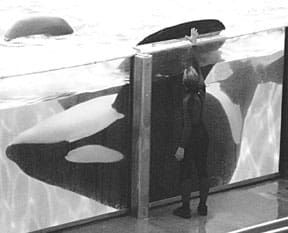
Targeting means teaching your dog to touch a designated body part to a designated location. Nose targeting is most commonly taught, but it can also be trained with a front or hind paw, a hip or shoulder, even an ear or tail! The designated target can also be anything imaginable, including the palm of your hand or your closed fist, a finger, target stick, spot on the wall or door, or just about any object you choose to ask your dog to target to.
The question is, why would you want to teach your dog to touch his nose (or other body part) to a designated spot on cue? The reasons are legion. For example:
• Targeting can be used to boost the confidence level of a timid dog.
• It can prompt a dog to offer a new behavior without a food lure.
• You can use it to keep a dog’s attention focused on you instead of on distractions.
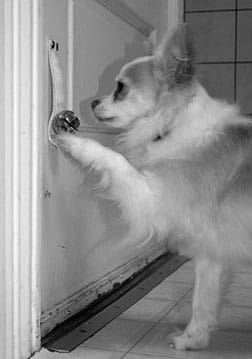
• Your dog can turn appliances on and off, close doors, ring bells.
• Target as an “emergency recall” cue.
• Targeting is used to teach dogs to locate the contact zones in agility.
• Your dog can learn to play the piano!
• It’s useful for teaching lateral movement for Canine Freestyle (dancing with your dog) and APDT Rally.
• It’s easy to train, it’s just plain fun, and dogs love it!
Target Practice is Easy for Dogs!
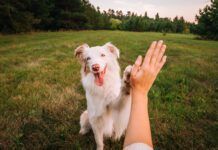
It’s ridiculously easy to teach. We start in our classes by having the dog target to his owner’s hand, since that doesn’t require yet another piece of equipment to juggle along with clicker, treats, and leash. Hold out your open hand at your dog’s nose level, palm facing him, fingers pointed toward the ground. When he sniffs or licks your hand, click! your clicker and give him a treat from your other hand. Make sure his nose actually touches your skin – “close” only counts in horseshoes. Be sure to click! the instant his nose makes contact with your skin. If you consistently click! too soon, you might teach him to stop before he touches you. If you consistently click! too late, you’ll teach him that moving his nose away from you is the way to earn a reward.
When you’ve clicked and rewarded your dog’s first touch, remove your target hand, then offer it again, in the same position. When he sniffs, click! and treat. Do it again. And again. Notice you have not used a verbal cue yet!
Most dogs will do the initial sniff easily, due to a behavior phenomenon known as novelty of stimulus. “What’s this?!” your dog says, and sniffs to check it out. Be sure you’re ready to catch that first curious sniff with your click! and treat, and you’re well on your way.
If your dog doesn’t sniff your offered palm, rub some hot dog or other moist treat on your skin to make your hand more enticing. When he sniffs or licks, click! and treat.
Your dog may sniff your newly offered hand a few times and then ignore it, looking directly at your treat hand. Novelty of stimulus has worn off, and he’s going directly to the source of the treat. You can almost hear him say, “Why am I looking at this hand? The GOOD STUFF comes from over there!” When this happens, hide your treat hand behind your back, offer him the target hand, and wait. He should soon sniff the offered hand. If he doesn’t, rub a treat on it and offer it again. If that doesn’t do it for him, take a step or two backward and offer him the target as he moves toward you. When he touches, click! and treat.
Repeat this step over and over, until he deliberately bumps your hand with his nose. This is the heart-stopping “Aha!” moment that positive trainers love – when you can see that your dog knows that the way to make the click! happen is to touch your hand.
Some dogs “get it” very quickly. Louis, a Border Collie client of mine in Santa Cruz, California, got it in three repetitions. Others take longer for the light bulb to go on, depending on variables such as the owner’s skill and timing, the dog’s interest in the training game, the desirability of the treat reward, and the level of distractions in the surrounding environment.
You can enhance your dog’s learning speed by working in a quiet location, using very delicious treats, and paying close attention to your click! timing.
Teach Your Dog to Touch Moving Targets
As soon as your dog is deliberately and consistently bumping your hand with his nose you can add the verbal cue. Say “Touch!” just before his nose touches your skin. Click! and reward. Gradually offer the verbal cue earlier and earlier, until he associates the verbal cue with the targeting behavior, and is responding to the cue.
Now you can raise the bar. So far, your dog understands that he’s supposed to touch his nose to your hand when he’s sitting in front of you and the target is presented to him at nose level. It’s time to change the criteria.
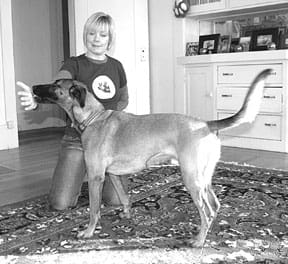
Now you want him to touch the target wherever it is, even if it’s moving. Back away from him, offer the target and say “Touch.” As he gets up to follow you, keep moving slowly backward. When he catches up to you and touches the moving target, click! and treat. Move your hand off to one side and ask him to touch it. Click! and treat. Move it to the other side. Move it lower, toward the floor. Move it higher, so he has to jump up to touch it. Put it above a chair seat, so he has to place his front feet on the chair to reach up and touch it.
When he’s really confident about touching the target, put the behavior on a schedule of “random reinforcement” – ask him to touch two times before you click! and treat. Then three times. Then once.
Then once. Then four times. Then two times. Vary the number of times you ask him to touch before he gets clicked; don’t always make it harder and harder, or he may get frustrated and give up.
Introducing New Targets
Now you can teach him to touch other targets. A target stick can be a small branch off a tree, a dowel from the hardware store, a pencil or Tinker toy (for small dogs), or an “official” target stick purchased from a pet supply source. If your target is homemade, put an eraser topper on one end to designate the actual target. You will accept touches near the topper at first, but you’ll ultimately shape the touches to the actual target by clicking only those touches that get closer and closer to the topper.
Hold your target stick perpendicular to the ground with the target end near your dog’s nose. Some dogs will sniff the end of the target stick the first time you offer it. Click! and treat. Others may need a bit of hotdog rubbed on the topper to motivate them to touch this new object. Still others may be afraid of the stick. If your dog is afraid, hold the stick so most of it is hidden under your arm with only an inch of the tip protruding from your hand.
When your dog will touch the tip, extend the stick a little at a time, until he’s touching it at full-length. “A little at a time” varies from one dog to the next. Some dogs will accept a six-inch increase, others will tolerate only half-inch increments. Start small to avoid frightening your dog, and work up to larger increases if he seems to be tolerating them well. As soon as he’s readily touching the tip of the stick start using the verbal “Touch” cue.
When he’s proficient at touching the target stick, use it to extend your reach. With three feet of arm length and three feet of target stick you can get him to touch things a full six feet away from you. Place the tip of the target stick against a door, wall, or other object to teach him to touch other things, including people. This is a useful tool for encouraging a timid dog to be brave. When he’s very confident about touching his target stick you can place the target closer and closer to a scary object; your dog will become braver about approaching the scary object because of his very positive association with targeting.
You can also teach your dog to touch things by holding the target object in your hand. Hold a bell tied to a string in the palm of your hand and say “Touch!” He tries to touch your hand, but the bell is in the way so he touches it instead. Perfect! Click! and treat. Repeat several times, then add the word “bell” to your verbal cue. Say “Bell, touch!” He’ll respond to the familiar “Touch!” part of the cue. Click! and reward. When he’s associated the word “bell” with touching that particular object, you can drop the “touch” part of the cue. Gradually pay out string so the bell hangs below your hand.
Using just the “Bell!” cue, do several repetitions of click! and treat at each new length of string, until the bell is hanging full length below your hand.
You may need to shape for touches that are strong enough to actually make the bell ring. If he touches it too softly, start shaping by clicking only the harder touches, until he is consistently bumping the ball hard enough to make it ring.
Now his “Bell” behavior can alert you to whatever you desire. Many people hang the bell on a door and teach the dog to ring the bell when he has to go out.
How to Teach Your Dog to Target with New Body Parts
Front paws are the second most frequently used body part for targeting. If your dog is “naturally pawsy” you can capture the behavior with a click! and treat when he’s pawing at something – something it’s okay for him to paw at. Or elicit the behavior by punching holes in the top of a baby food jar and putting something scrumptiously delicious inside. When he paws to get at it, click! and treat. Repeat this until you can predict the paw behavior, then add the cue. Be sure to use a different cue. If you want “Touch” to mean “touch with your nose,” then you might use “Foot” to mean “touch with a paw.
If your dog won’t paw at a desirable object, use a treat lure over his head to get him to lift a paw off the ground slightly. Move the treat slightly to the right (his left) to put him a bit off balance and get him to lift his right front paw. Click! and treat. Repeat until he’s offering to lift his paw, then hold that baby jar or other target object where his foot will touch it as he lowers it. Then add the cue.
When he’ll touch the jar on cue, you can use your “Foot” cue to teach him to touch different objects. This behavior is often used as a signal in scent work, so the dog can tell his person that he’s found the designated scent, object, person, or animal.
Dogs naturally use front paws and noses to do things, so it’s easy to teach them to use those body parts to target. Other body parts – hind paws, hips, shoulder, ears, tend to just go along for the ride. It can be more of a challenge to teach the dogs to be aware of these parts, and to use them deliberately.
A hip touch can be useful for getting lateral movements often utilized in Canine Freestyle and for the side-step in APDT Rally obedience. Desensitize your dog to a hip target such as a Ping Pong paddle by touching him on his hips and hindquarters with the object until he doesn’t react. If he’s quite worried about it, feed treats as you touch him until he’s no longer worried.
Now put the target aside, and just work on getting a side-step by holding a treat in front of your dog’s nose as you stand by his right side. Move the treat slowly in an arc toward his left hip. As he steps to follow the treat, his right hip will move toward you. Click! and treat. Repeat until he does this easily, then practice on the other side as well so his left hip moves toward you.
Build up to several steps on each side, and then you’re ready to pick up your target again. Hold your target next to your dog’s hip and use a treat to get him to side-step. When his hip bumps the target, click! and treat. Gradually increase distance until he will move his hip six inches to the target. Be sure to click! and treat each time.
When he’s doing this easily, add your verbal cue. Remember to use a new cue for the new body part – you might select “Bump” as your Hip Touch cue. Gradually fade the use of your treat lure following your “Bump” cue, until he will touch his hip to the target on cue without the lure.
Endless Applications for Targeting in Dog Training
Need more ideas? You can utilize the nose-touch behavior to move your dog into heel position and keep him there by using your hand as a target next to your leg, or a target stick, for a small dog. You can teach him to close cupboard doors by having him target to a spot on the door. (Nose-touch is a better choice than a paw for this, unless you want him to scratch at doors!) You can teach him to turn lights on and off by pushing up on a stick attached to a light switch or by touching a “Touch Lamp” with his nose or paw. He can do object discrimination by learning to identify and use nose or paw to touch various objects (or people) by name. A hind foot touch can be useful for “stacking” a dog in the confirmation ring.
As you can see, the opportunities for application of the touch behavior are virtually endless – limited only by your creativity.
Pat Miller, CBCC-KA, CPDT-KA, is Whole Dog Journal’s Training Editor. Miller lives in Fairplay, Maryland, site of her Peaceable Paws training center.


My 4 month old Golden Retriever puppy consistently bites my hand when I try to teach him to target. I might get a nose touch the first time, but then it’s on to the biting. I try not to react….BUT IT STARTS TO REALLY HURT. I reward him from my target hand so it smells of treats. Not sure what to do.