
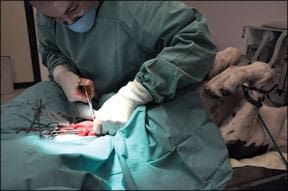
Making a fresh look at the things we take for granted can be wonderfully enlightening. Sometimes, the little light bulb overhead begins to sizzle and sparkle, illuminating a new and better way of doing things. Consider this example: When some savvy veterinarians took a fresh look at performing spays, a surgery we’ve been doing the exact same way for decades, they came up with a revised technique that accomplishes all of the objectives of the spay surgery with fewer complications. How cool is that?
Spay is the term used for neutering a female dog. As I was taught in veterinary school, the medical jargon for spaying is ovariohysterectomy (OVH). “Ovario” refers to ovaries, “hyster” refers to uterus, and “ectomy” means removal of. In other words, spaying the traditional way involves surgical removal of the uterus and both ovaries. The objectives of the spay surgery are to render the dog infertile, eliminate the mess and behavioral issues associated with a female dog in heat, and prevent diseases that may afflict the uterus and ovaries later in life.
Thanks to some innovative veterinarians, we now know that ovariectomy (OVE) – removal of just the ovaries, leaving the uterus in place – accomplishes these objectives just as effectively as does the OVH. And, here’s the icing on the cake: removal of the ovaries alone results in fewer complications when compared to removal of the ovaries and uterus combined.
Female Canine Anatomy
Here’s a simple short course in canine female reproductive anatomy and physiology that will help explain why leaving the uterus behind makes sense. The shape of the uterus resembles the capital letter “Y.” The body of the uterus is the stem and the two uterine horns represent the top bars of the “Y.” An ovary is connected to the free end of each uterine horn by a delicate structure called a fallopian tube (transports the egg from the ovary into the uterus).
While the uterus has only one purpose (housing developing fetuses), the ovaries are multitaskers. They are the source of eggs of course and, in conjunction with hormones released by the pituitary gland, ovarian hormones dictate when the female comes into heat and becomes receptive to the male, when she goes out of heat, when she ovulates, and when her uterus is amenable to relaxing and stretching to house developing fetuses.
After the ovaries (and the hormones they produce) have been removed from the body, the uterus remains inert. The dog no longer shows symptoms of heat, nor can she conceive. Additionally, any chance of developing ovarian cystic disease or cancer is eliminated.
Better Outcomes with OVE
What happens when we leave the uterus behind? Isn’t it subject to becoming diseased later in life? Actually, the incidence of uterine disease in dogs whose ovaries have been removed is exceptionally low. Pyometra (pus within the uterus), is the most common uterine disorder in unspayed dogs, and typically necessitates emergency surgery to remove the uterus.
Without the influence of progesterone, a hormone produced by the ovaries, pyometra does not naturally occur. The incidence of uterine cancer is extremely low in dogs (0.4 percent of all canine tumors) – hardly a worry, and studies have shown that the frequency of adult onset urinary incontinence (urine leakage) is the same whether or not the uterus is removed during the spay procedure.
If you are not already convinced that the “new spay is the better way,” consider the following complications that can be mitigated or avoided all together when the uterus remains unscathed:
- Compared to an OVH, an OVE requires less time in the operating room. This translates into decreased likelihood of anesthetic complications.
- Removal of the uterus requires that the surgeon perform more difficult ligations (tying off of large blood vessels and surrounding tissues with suture material before making cuts to release the organs from the body). A uterine body ligation that isn’t tied quite tightly enough can result in excessive bleeding into the abdominal cavity and may necessitate blood transfusions and/or a second surgery to stop the bleeding.
- The ureters (thin delicate tubes that transport urine from each kidney to the bladder) run adjacent to the body of the uterus. If a surgeon is not being extremely careful, it is possible to ligate and obstruct a ureter in the course of removing the uterus. This devastating complication requires a second corrective surgery; however, damage to the affected ureter and adjoining kidney may be irreversible.
- Removal of the uterus occasionally results in the development of a “stump granuloma” – a localized inflammatory process that develops within the small portion of uterus that is left behind. When this occurs a second “clean up surgery” is typically required.
- We know that the degree of post-operative patient discomfort correlates with the degree of surgical trauma. No question, of the two surgical options the OVH creates more trauma.
European veterinarians have been performing OVEs rather than OVHs for years. In fact, the bulk of the research supporting the benefits of leaving the uterus behind has been conducted in Europe.
Slowly, veterinarians in the United States are catching on, and some veterinary schools are now preferentially teaching OVE rather than OVH techniques to their students.
What should you do if you are planning to have your dog spayed? Talk with your veterinarian about this article. Perhaps OVE surgery is already his or her first choice. If not, perhaps your vet will be willing to take a fresh look at performing this old-fashioned surgery.
Nancy Kay, DVM, is a Diplomate of the American College of Veterinary Internal Medicine (ACVIM) and recipient of the American Animal Hospital Association 2009 Animal Welfare and Humane Ethics Award. She is also author of Speaking for Spot: Be the Advocate Your Dog Needs to Live a Happy, Healthy, Longer Life, and a staff internist at VCA Animal Care Center in Rohnert Park, California.