

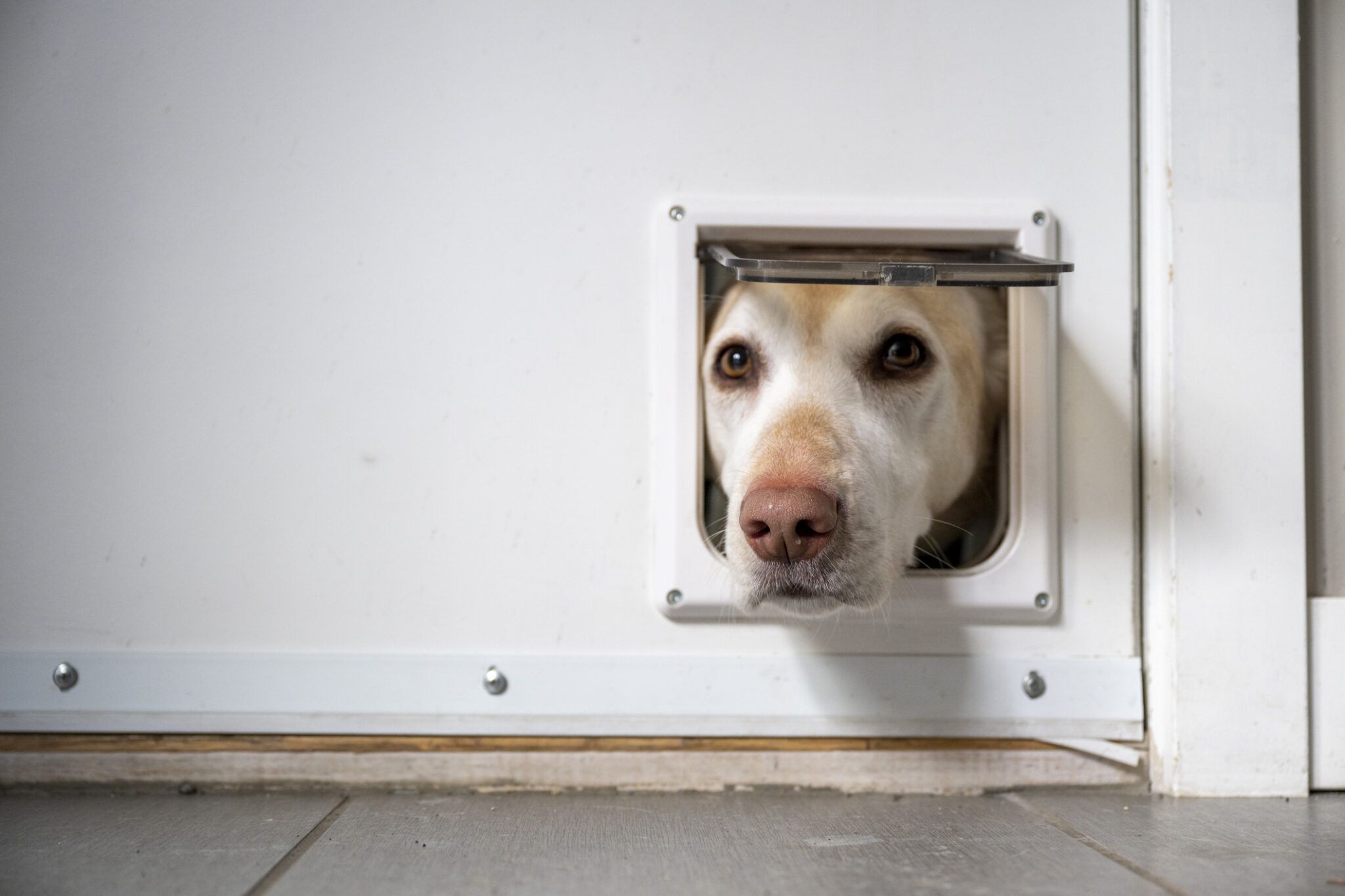
As our homes have become smarter, so has the humble push dog door. Today’s smart dog doors are no longer simple holes in a wall or a door covered with thick rubber. Rather, they are sophisticated access-control systems that combine advanced home security and safety. They can stop neighbor’s dogs, raccoons, and determined thieves from entering your home via your doggie smart door. They can be aesthetically pleasing to your home’s environment as well. But there’s not a one-size-fits-all option.
Your choice depends heavily on what type of electronic access you want and where you’re going to install the doggy door. The RFID collar Electronic Door from PlexiDor is our favorite because you can install it in the wall (the easiest place to install), and it operates by reading a tag on your dog’s collar. Easy-peasy, but expensive (comparatively). However, if your outside access point is a sliding glass door, keep looking.
If you’re not into electronics, a magnet door like the Endura Flap Thermo Planel 3e is simple, provided you install it in a sliding glass door.
Start your search by determining the size you need (your dog’s size), the location (door, wall, glass door), and the access type you’re most comfortable with (manual, app-based, push-open rubber, etc.). This purchase requires some self-education, especially with premium models running $2,800 or more.
With this short course on smart doors for doggy access, you’ll be well-equipped to pick the best smart dog door for your home.
What Is a “Smart” Dog Door?
Credit: RockK Photography } Getty Images
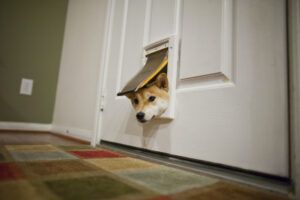
Smart doors rely on technologies such as microchips embedded in our dogs for identification purposes. These ISO-standard microchips are small, electronic chips enclosed in a glass cylinder that is about the same size as a grain of rice. according to the American Veterinary Medical Foundation (AVMF). Teamed with smart dog doors, the chips eliminate the need for extra collars and ensure the door remains locked for neighborhood cats or curious raccoons, possums, and other creatures of the night.
If your dog isn’t chipped, Bluetooth or radio frequency identification (RFID) tags used for retail and supply-chain tracking attach to a collar to provide an external solution. These are designed to provide a more consistent range, allowing the door to unlatch as the dog approaches rather than waiting for them to press their nose against the flap.
Some doors feature sensors on both sides of the door, allowing you to set specific curfews or exit-only modes useful if you want your dog to come in for the night but stay inside once they’ve entered.
Types of Smart Dog Doors
Here’s a rundown on the type of smart dog doors:
RFID collar: A radio-frequency identification tag unlocks the door when it detects digitally paired tag within close range. (See PlexiDor Electronic Door.)
Manual 3-flap: A nonelectronic design that uses three sequential flaps designed to create an insulating air pocket that your dog must push through. (No models included in this review.)
Manual Fle: A traditional, low-tech option that has a single flexible plastic flap that relies on gravity and magnets to keep the door shut after a dog passes. (See Endura Flap Thermo Panel 3e and Solo Pet Doors Automatic Door.)
Microchip/app: Leverages your dog’s permanent vet-implanted identification chip to grant access, often paired with an app for remote monitoring and scheduling. (See Sure Petcare Microchip Connect.)
Automatic: A motorized system that detects a signal and physically lifts or slides the door open so the dog can walk through without pushing. (See High Tech Pet Power Pet Patio.)
Apps
- Ultrasonic: Uses high-frequency sound waves emitted from a collar tag to trigger the door. (See High Tech Pet Power Pet WiFi.)
- Motion: Uses infrared or microwave sensors to detect movement near the door, combined with app-based timers to toggle the sensors on or off. (See Wayzn Smart Door 2.)
- UWB tag: Uses ultra-wideband technology for accurate spatial tracking to ensure the door opens only when your dog is facing it and within inches. (see Pawport Smart Pet Door.)
- Bluetooth: Combines Bluetooth connectivity with smartphone app or digital fob to allow for proximity entry and guest access management. (See PetSafe SmartDoor Connected.)
Safety First for Doggie Doors
While your temptation may be to replace an existing door with a new intelligent model, placement is a critical factor in both home efficiency and security.
Security experts suggest installing a smart door in a transitional space like a laundry room or a mudroom, which provides an extra layer of insulation and security. This keeps muddy paws (and potential security risks) contained in a secondary area of the home.
Key Decisions Before You Buy a Smart Dog Door
The first decision you need to make is whether to go with an in-door or in-wall unit. In-door models are generally easier for do-it-yourself (DIY) installation but can potentially compromise the structural integrity.
In-wall installations typically require a bit more effort—specifically framing and sealing—but offer a cleaner aesthetic and allow for more flexible placement away from main traffic areas.
Smart doors require a nearby outlet to power the motorized bolts and sensors. While battery backups are standard for power outages, planning for a dedicated power source is a step often overlooked in the planning phase.
Here’s a rundown on installation types:
Door or Wall
- Standard: A unit framed into a standard exterior door or cut directly into a wall using an optional tunnel extension.
- Specialized: These units often include specialized mounting hardware or telescoping tunnels to ensure a flush, weather-tight fit across varying material thicknesses.
- Integrated: Designed to become a permanent part of house’s structure, often requiring professional framing and siding work for a seamless finish.
- Self-framing: A DIY-friendly design that includes its own internal frame to hide rough cuts in your door or drywall without needing additional trim.
Sliding Glass
- Panel insert: A vertical, pre-glassed insert that fits into your existing sliding door track, requiring no cutting but reducing the width of your human walkway.
- Sash: A specialized insert designed specifically for the height and track depth of sliding glass systems to provide a semi-permanent entry point.
- Spring-loaded: A tool-free installation that uses a spring-loaded top to pop into the sliding door track for easy removal and portability.
- Dual-pane insert: A premium track insert featuring tempered dual-pane glass to match the thermal efficiency and aesthetic of high-end patio doors.
- Automatic rail: Attaches to the top of a sliding door rail to automate the heavy glass door itself rather than adding a smaller flap.
- Door/Wall/Glass: An adaptable system designed with modular mounting kits that allow for installation in nearly any flat surface, including custom glass-cut applications.
- Retrofit/Wall: A conversion kit that replaces a specific component of your existing home structure or utilizes a dedicated wall-entry tunnel for maximum security and insulation.
Security for a Dog Automatic Door
For many homeowners, the primary hesitation to installing a pet door isn’t the construction. It’s the security risk. A traditional plastic flap is, essentially, an unlocked window at ground level. However, modern smart doors are designed to close the vulnerability gap.
“Unlike a basic plastic flap, smart dog doors use motorized bolts that lock as soon as the door closes,” says Laura Finson, director of strategy at Brinks Home. “Some also have selective access, opening only for your pet’s specific microchip or collar tag.”
She adds that while these doors are often constructed from reinforced acrylic or metal—making them difficult to kick in—they should still be viewed as a strategic entry point. “The reality is that while these doors are strong, a hole in the wall is never as secure as a solid wall or a deadbolted door. Therefore, it’s smart to install them in a mudroom or laundry room, rather than a main entry point to keep your home secure.” This creates an internal buffer zone.
Doggie Door Security to Symptom Tracking
Smart dog door technology is also evolving from simple access to sophisticated health monitoring. Most high-end smart doors log each entry and exit on a smartphone app, which means they also collect data on a dog’s daily habits.
This data could soon become a tool for preventative care. “While these systems don’t yet interpret that data for patterns that would signal potential health issues, the technology is not far off,” Finson says.
Smart Doors Give Older Dogs an Assist
While security and convenience are the primary drivers for most smart door purchases, they also offer a quality-of-life benefit for aging pets. Traditional heavy flaps require a certain amount of physical strength and push from the dog’s neck and shoulders to open.
For a senior dog with arthritis, for example, that resistance can be a barrier to regular relief. “Older or infirm pets may not have the strength to open a regular pet door and will appreciate an electronic door that opens automatically by reading a microchip,” according to VCA Animal Hospitals.
Because electronic doors unlatch and open automatically via the microchip sensor, they provide a “frictionless” exit. This allows older dogs to maintain their independence and manage their own potty breaks without needing a human to assist with a heavy door, which is a crucial component of maintaining a senior dog’s dignity and muscle tone.
Sizing and Installing Your New Dog Door
Once you’ve selected a door, the installation process is typically an intermediate-level DIY project. According to installation experts at Lowe’s, the process generally takes a few hours and requires a standard toolkit including a jigsaw, drill, and sandpaper.
A key takeaway for homeowners is the importance of the 3-inch rule: The template for the door should be placed at least 3 inches above the bottom edge of the door to maintain structural integrity. If you have steel-clad exterior doors, Lowe’s recommends using metal-cutting blades and drill bits to ensure a clean finish. Finally, to prevent your smart home from becoming a drafty home, add weatherproof caulk around the exterior frame, according to Lowe’s.
Hiring Help for Installing a Dog Door
If you’re not the DIY type, many smart dog door vendors offer option to have professionals handle installation. You can also, of course, arrange the installation yourself.
Based on 2026 from service and labor aggregator, Angi, cost for using a third-party to install your dog door typically starts around $100 for a basic model. More complex doors usually range from $400 to $1,600 because of framing and potentially dealing with electrical or plumbing lines.
However, a top-of-the-line electronic system integrated into a concrete wall can exceed $3,500 based labor and costs, according to Angi data.
Bottom Line on Smart Dog Doors
With so many variables in what you need for your house—and your dog—it’s impossible to give you a “this is the best choice for everyone recommendation.” You need to select a door that’s made for your desired placement, meets your electronic needs, and fits your budget.
| Product Name | Manufacturer | Access Type | Install Style | Standout Features | Price Range |
|---|---|---|---|---|---|
| Automatic Door | Solo Pet Doors | Magnetic tag | Door or wall | Gravity-closed motorized door; ultra-quiet. | $450 – $650 |
| Electronic Door | PlexiDor | RFID collar | Door or wall | Heavy-duty; bulletproof-style composite. | $2,400 – $2,800 |
| Power Pet WiFi | High Tech Pet | App / ultrasonic | Door or wall | Fully motorized vertical lift; safety retract. | $580 – $770 |
| SmartDoor Connected | PetSafe | App , Bluetooth key | Door or wall | Remote locking andusage logs via app. | $350 – $450 |
| Microchip Connect | Sure Petcare | Microchip, app | Door, wall or glass | Monitors behavior trends & activity levels. | $280 – $320 |
| Smart Pet Door | Pawport | App / UWB tag | Retrofit wall | Fits over existing flaps; UWB range control. | $699 – $850 |
| Power Pet Patio | High Tech Pet | Automatic | Sliding glass | Motorized lift for sliding glass tracks. | $770 – $1,250 |
| Smart Door 2 | Wayzn | App / motion | Sliding glass | Converts your existing door to automatic. | $550 – $600 |
| Thermo Panel 3e | Endura Flap | Manual (Magnet) | Sliding glass | High-wind resistance; best manual seal. | $580 – $750 |




this article might help me find something I have about given up on. A few years ago we had a sliding glass door installed that has a built in doggie door. It’s been wonderful but now the flap needs replacing and I don’t know where to go. The ones you can buy at places like Amazon or Petsmart do not work the fasteners are not changeable. Any suggestions?