


If you decide to delay spaying or neutering your dog, for whatever length of time or whatever reason, here is something else to consider- Some people just may not be cut out to deal with an intact male or female dog in their household. Here are some caveats and considerations:
1. Female dogs bleed when they come into heat.
Female dogs do not get menstrual periods like humans, as some people mistakenly believe; they come into “heat,” or “season,” once or twice a year – the three to four days in their cycle when their unfertilized eggs ripen. (Though both biological processes involve bleeding, it’s inaccurate to compare a woman’s monthly cycle, which is an infertile time, to the heat in the female dog, which is quite the opposite. Dogs get pregnant while bleeding.) Some dogs cycle every six months; more primitive breeds, such as Basenjis or Tibetan Mastiffs, come into heat only once a year.
Get more facts on dogs in heat at Dogster.com.
2. Female dogs can only get pregnant when they’re in heat.
A dog will begin her heat cycle after about 6 months of age. Some females will show physical signs of readiness – their discharge will lighten in color, and they will “flag,” or lift their tail up and to the side. Others will show no behavioral changes; still others will “stand” and accept a suitor at any time in their cycle, even days before or after they are fertile. If you cannot be absolutely certain of identifying the signs of heat in your female, and securing her during this time, spay her. Intact males are frighteningly persistent in reaching the object of their desires; they will hurl themselves through glass windows, and might even attempt (and succeed) at breeding a female through the wires of a crate.

3. Unneutered male dogs can get forceful.
You cannot leave a female in heat unattended for one moment outside, not even in a fenced yard. Whether or not she is in that narrow window of time when she can get pregnant, she might attract a male, and they might breed anyway. There is no way to predict how a male dog will act when a nearby female is in heat. Though dogs have been mating for millennia, it is not a process that is without risk of physical harm to one or both dogs.
4. Unspayed female dogs will attract stray males – from miles away.
If there are stray dogs where you live, walking a female in heat is asking for trouble. Ideally, have a secure, fenced area where your female can do her business, always supervised by you. If you must take her out in public to walk her, carry an umbrella that you can open to ward off unwelcome males, but know that you still might not be able to keep them apart.
5. Unspayed females need to wear sanitary pads while in heat.
Dogs stay in heat about three weeks, but the female will neither bleed heavily nor bleed every day. Nonetheless, to protect your carpets and furniture, it is smart to invest in “bitch’s britches,” which are dog-proportioned panties that can be fitted with a disposable sanitary napkin.
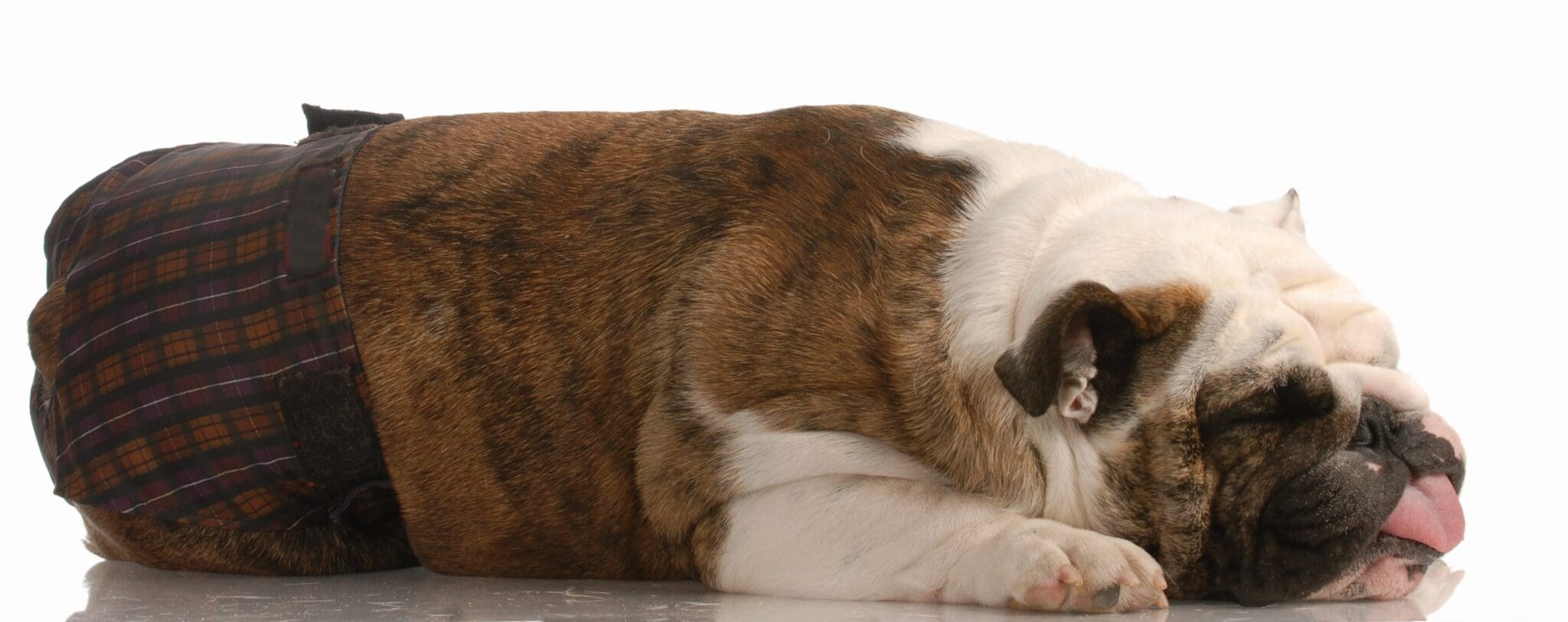
6. You cannot keep intact males and females in the same house.
If you have an unneutered male dog in your household, and you want to let your female go through one or more heat cycles before spaying her, the smartest and safest thing is to remove one of them for the duration of the female’s heat. It is difficult to describe the stress, restlessness, and sheer loss of sanity that a male dog can exhibit in the face of a female in standing season. It will be close to unbearable for you, to say nothing of him. Plan a vacation for one of them, ideally the male. (And if you plan to use a boarding kennel, females in heat will be too big a disruption there in the event other unneutered dogs are there, too.)
7. You cannot spay a dog while she is in heat.
Once your female has started her heat, don’t change course. Many veterinarians are reluctant to spay females in the middle of estrus; the uterus, preparing for pregnancy, is very vascular, and the risk of internal bleeding is higher. Instead, schedule spay surgery at a hormonally “quiet” time, ideally midway between heats. Depending on the individual dog, unneutered males can be trained through consistency and positive reinforcement not to urine-mark in the house. Ditto for discouraging “humping.” Do not tolerate these behaviors at any time.
8. Unneutered male dogs are always fertile.
As with unspayed females, unneutered male dog behavior must be under your control and supervision at all times. It is the height of irresponsibility to allow them to wander. Unlike females, unneutered males can procreate all the time, and they can create a neighborhood population explosion in no time at all.
9. Intact dogs are less welcomed in public.
Remember that in the larger world outside your door, intact dogs are the minority. By choosing to have an unneutered male (in particular, because he is visually easy to identify), you restrict your options and access to different environments, including dog runs and doggie day care. You will likely be required to explain and defend your decision not to neuter your dog; be prepared, be polite, and have a very thick skin.




I had a long talk with my vet on this subject recently. She’s very experienced and always on top of the latest studies. She shared that testicular cancer is very slow growing and that in the case of a dog that sees their veterinarian regularly, that it can be detected early and the solution is to then neuter. In the case of my dog, she recommended that he remain intact as increasingly there is evidence that it is helpful in terms of their development and as they age. In fact, she mentioned that at a recent gathering of specialists, a veterinary surgeon that specialized in ortho surgery shared that he could always tell when this particular breed of dog had been neutered under age one, as it was almost a guarantee that he’d be performing ortho surgery on it later. It’s extra work in some ways to have an intact male and other dogs often are understandably unwelcome. To each their own but FYI for anyone interested.
I just had my female at the vet 4 months ago for a very expensive Emergency surgery for a Pyomitra. Also to have cancerous tumors removed from her mammary glands. She just turned 9 years old yesterday. The vet said females have a 95% chance of getting cancer if not spayed. All I know is that my dog is 1 of the 95%! He then told me there was no rush to neuter my male until he’s older but that Males are at high risk for cancer at around age 10-11 if left intact. But he said many large breed dogs don’t live that long anyway. So I’d say educate yourself, use your best judgement and do what you think is best for your pet. That IS our right as pet owners after all.
I have a rescue, let not spay and neuter and have more unwanted and abandoned pups and dog in the world.
all of you need to talk a walk and look t all the strays and starving puppies. But lets not spay and neuter and don’t tell me you find good homes for them. You are part of the problem and helping. Yous ay your dog never has bred. That is a lie
It is interesting that female dogs begin their heat cycle after 6 months of age. My wife and I are considering adopting my mom’s dog if she moves into assisted living home. We may consider getting her spayed so we don’t have to worry about caring for any of that.
Depends on the breed, larger breeds have heat a little later than smaller one. Some large breeds have their heat around 10-12 months.
Thank you Lemon!! You took the words right out of my mouth. Vasectomies are the best of both worlds. Keeping the dogs hormones intact for health purposes, yet preventing unwanted pregnancies. Bravo.
It is possible for a male dog to have a vasectomy and an ovary sparing spay for a female. This way they continue to have all of their hormones for bone growth etc and they are unable to reproduce. With a vet certificate they are still welcome at doggy daycare, dog parks and boarding facilities. We have a three year old lab who had a vasectomy as a puppy. The breeder insisted on this for the pups health guarantee. He doesn’t have any behavioural issues. Seems like a good option and down the road if he does have problems we can always opt to have him neutered, in the mean time he’s getting all of the hormones he needs to build good bone density and he seems to be thriving.
My dog had puppies on Monday and i have a Male dog too i don’t want her pregnant again so just want to know how long to keep them apart so she doesn’t get pregnant again im getting her fixed but not till the puppies are 6 weeks
im not here to argue either way. but i have seen firsthand how full shelters and pounds are. and how unequipped they are to deal with dogs left that people don’t want to take care of, but obviously want to breed. spay/neuter is saving a lot more dogs than choosing not too in my humble opinion. each to their own tho!
I’m confused why people keep comparing spay/neuter dogs to humans. There are many, many, MANY things that we do with pets that would be insane to do to humans.
is it necessary to the male and the female dog will knot after mating? I have a dogs after mating they knot but not to long, can a female dog will get pregnant even if they knot not to long?