

HOMEMADE DOG FOOD: OVERVIEW
1. Feed your dog a wide variety of foods from different food groups.
2. Make sure you supplement your dog’s homemade diet with calcium unless you feed raw meaty bones.
3. Stick to lean meats and remove skin from the poultry you feed unless your dog is highly active.
4. Keep in mind that the less variety of foods you feed, the more important supplements become.
5. Review your homemade dog food diet plan with a veterinarian for approval.
In the past few issues of Whole Dog Journal, I have offered critiques on homemade dog food diets in order to address the dog’s health concerns – or simply to optimize the dog’s diet plan. To do this, I analyzed the cooked and raw homemade dog food diets and compared them to the National Research Council’s guidelines for canine nutrition. I want to be clear, though: I don’t believe this is a requirement for feeding home-cooked dog food. Just as with the diet you feed yourself and your family, feeding a wide variety of healthy foods in appropriate proportions should meet the needs of most healthy dogs. The best diet for dogs, in effect, is a diverse diet.
Problems arise with how healthy dog food is interpreted. Too often, people think that they’re feeding healthy homemade dog food, when key ingredients may be missing or are fed in excess. Here’s how to make dog food at home, and specific guidelines to help ensure that the dog food diet you feed meets your individual dog’s requirements. You do not want just one dog food recipe to follow – you need several, and need to be comfortable mixing and matching ingredients, for reasons explained below.
Complete and Balanced Dog Food Diets
It’s important homemade dog food is “complete and balanced,” meaning it meets all of the dog’s nutritional needs. It is not important, however, that every meal be complete and balanced, unless you feed the same meal every day with little or no variation.
Home-prepared dog diets that include a wide variety of foods fed at different meals rely on balance over time, not at every meal. Similar to the way humans eat, as long as your dog gets everything he needs spread out over each week or two, his diet will be complete and balanced.
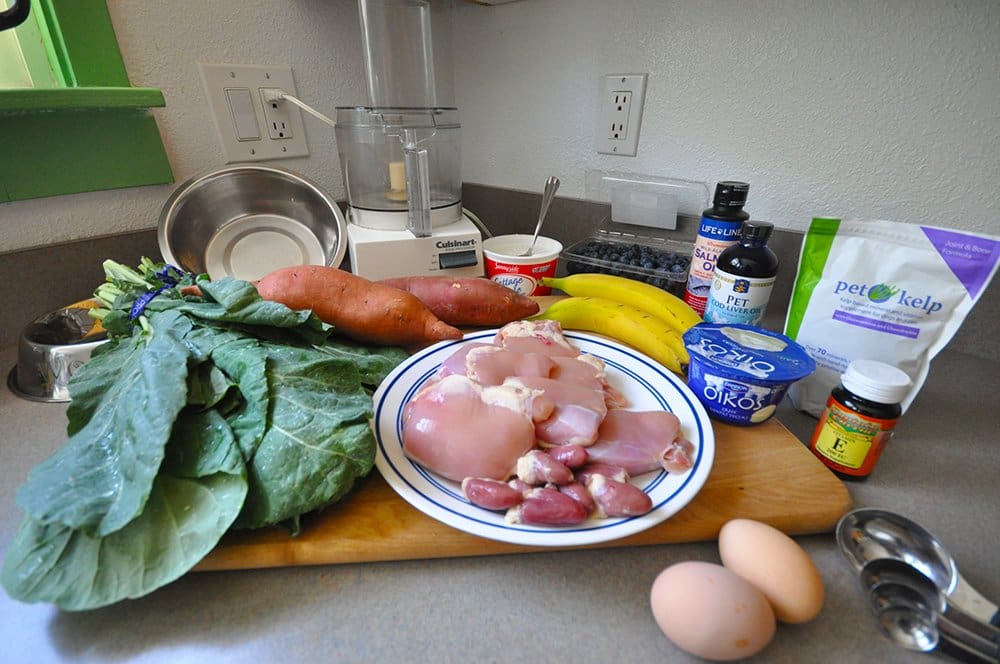
A human nutritionist would never expect someone to follow a single recipe with no variation, as veterinary nutritionists routinely do. Instead, a human would be given guidelines in terms of food groups and portion sizes. As long as your dog doesn’t have a health problem that requires a very specific diet, homemade dog food should be the same way.
For more on homemade dog treats, see “DIY Gifts for Dogs: Homemade Dog Treats & Healthy Recipes.”
Keep in mind that puppies are more susceptible to problems caused by nutritional deficiencies or excesses than adult dogs are. Large-breed puppies are particularly at risk from too much calcium prior to puberty. See “Puppy Food: Nutritional Guidelines to Maximize Health,” for more on puppy nutrition.
GUIDELINES TO CREATING BALANCED HOMEMADE DOG FOOD RECIPES
Following are guidelines for feeding a raw or cooked home-prepared diet to healthy dogs. No single type of food, such as chicken, should ever make up more than half the diet.
Except where specified, homemade food for dogs can be fed either raw or cooked. Leftovers from your table can be included as long as they’re foods you would eat yourself, not fatty scraps.
Meat and Other Animal Products: Should always make up at least half of the diet. A raw diet for dogs can be excessively high in fat, which can lead to obesity. Another potential hazard of diets containing too much fat: If an owner restricts the amount fed (in order to control the dog’s weight) too much, the dog may suffer deficiencies of other required nutrients.
Unless your dog gets regular, intense exercise, use lean meats (no more than 10 percent fat), remove skin from poultry, and cut off separable fat. It’s better to feed dark meat poultry than breast, however, unless your dog requires a very low-fat diet.
Raw Meaty Bones (optional): If you choose to feed them, RMBs should make up one third to one half of the total diet. Use the lower end of the range if you feed bony parts such as chicken necks and backs, but you can feed more if you’re using primarily meatier parts such as chicken thighs. Never feed cooked bones. Read a full report on raw meaty bones here.
Boneless Meat: Include both poultry and red meat. Heart is a good choice, as it is lean and often less expensive than other muscle meats.
Fish: Provides vitamin D, which otherwise should be supplemented. Canned fish with bones, such as sardines (packed in water, not oil), jack mackerel, and pink salmon, are good choices. Remove bones from fish you cook yourself, and never feed raw Pacific salmon, trout, or related species. You can feed small amounts of fish daily, or larger amounts once or twice a week. The total amount should be about one ounce of fish per pound of other meats (including RMBs).
Organs: Liver should make up roughly 5 percent of this category, or about one ounce of liver per pound of other animal products. Beef liver is especially nutritious, but include chicken or other types of liver at least occasionally as well. Feeding small amounts of liver daily or every other day is preferable to feeding larger amounts less often.

Eggs: Highly nutritious addition to any diet. Dogs weighing about 20 pounds can have a whole egg every day, but give less to smaller dogs.
Dairy: Plain yogurt and kefir are well tolerated by most dogs (try goat’s milk products if you see problems). Cottage and ricotta cheese are also good options. Limit other forms of cheese, as most are high in fat.
Fruits and Vegetables: While not a significant part of the evolutionary diet of the dog and wolf, fruits and vegetables provide fiber that supports digestive health, as well as antioxidants and other beneficial nutrients that contribute to health and longevity. Deeply colored vegetables and fruits are the most nutritious.
Starchy Vegetables: Veggies such as potatoes, sweet potatoes, and winter squashes (including pumpkin), as well as legumes (beans), provide carbohydrate calories that can be helpful in reducing food costs and keeping weight on skinny and very active dogs. Quantities should be limited for overweight dogs. Starchy foods must be cooked in order to be digestible.
Leafy Green and Other Non-Starchy Vegetables: These are low in calories and can be fed in any quantity desired. Too much can cause gas, and raw, cruciferous veggies such as broccoli and cauliflower can suppress thyroid function (cook them if you feed large amounts). Raw vegetables must be pureed in a food processor, blender, or juicer in order to be digested properly by dogs, though whole raw veggies are not harmful and can be used as treats.
And while you’re preparing these nutritious foods for your dog, consider boosting your own health by adding more veggies to your diet too!
Fruits: Bananas, apples, berries, melon, and papaya are good choices. Avoid grapes and raisins, which can cause kidney failure in dogs.
Grains: Controversial, as they may contribute to inflammation caused by allergies, arthritis, or inflammatory bowel disease (IBD); as well as seizures and other problems (it’s not clear whether starchy vegetables do the same). Some grains contain gluten that may cause digestive problems for certain dogs. Many dogs do fine with grains, however, and they can be used to reduce the overall cost of feeding a homemade diet.
Grains and starchy veggies should make up no more than half the diet. Good choices include oatmeal, brown rice, quinoa, barley, and pasta. White rice can be used to settle an upset stomach, particularly if overcooked with extra water, but it’s low in nutrition and should not make up a large part of the diet. All grains must be well cooked.
DIETARY SUPPLEMENTS FOR HOME-FED DOGS
Some supplements are required in addition to natural food for dogs. Others may be needed if you are not able to feed a variety of foods, or if you leave out one or more of the food groups above. In addition, the longer food is cooked or frozen, the more nutrients are lost. Here are some dog supplements to consider:
Calcium
Unless you feed RMBs, all homemade diets must be supplemented with calcium. The amount found in multivitamin and mineral supplements is not enough. Give 800 to 1,000 mg calcium per pound of food (excluding non-starchy vegetables). You can use any form of plain calcium, including eggshells ground to powder in a clean coffee grinder (1/2 teaspoon eggshell powder provides about 1,000 mg calcium). Animal Essentials‘ Seaweed Calcium provides additional minerals, as well. And here is a good list of calcium-rich foods your dog may like. Just please note this list is for humans and includes orange juice, which is not a good thing to give your dog as the acidity can cause stomach upset.
Oils
Most homemade diets require added oils for fat, calories, and to supply particular nutrients. It’s important to use the right types of oils, as each supplies different nutrients.
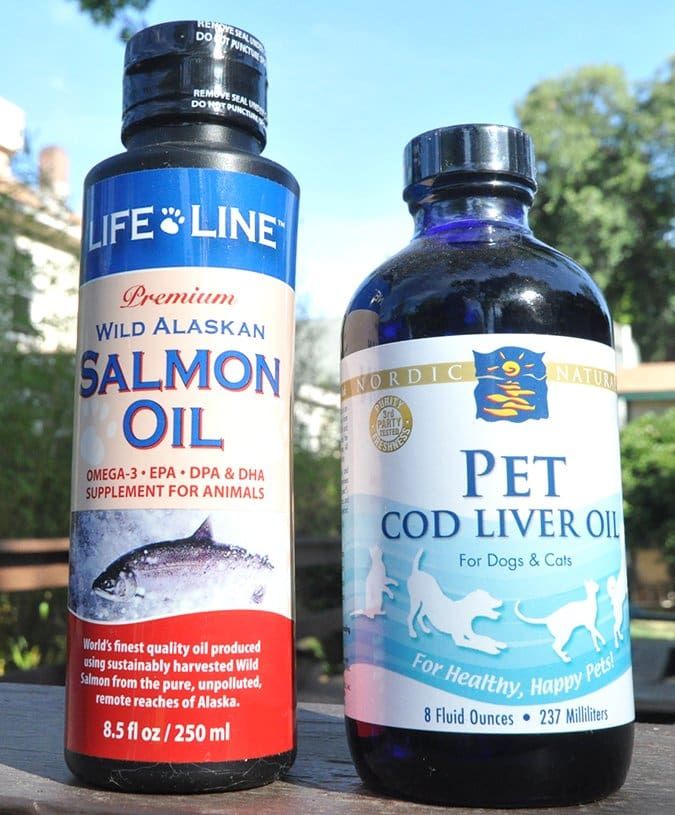
Fish Oil: Fish oil for dogs provides EPA and DHA, omega-3 fatty acids that help to regulate the immune system and reduce inflammation. Give an amount that provides about 300 mg EPA and DHA combined per 20 to 30 pounds of body weight on days you don’t feed fish. Note that liquid fish oil supplements often tell you to give much more than this, which can result in too many calories from fat.
Cod Liver Oil: Provides vitamins A and D as well as EPA and DHA. If you don’t feed much fish, give cod liver oil in an amount that provides about 400 IUs vitamin D daily for a 100-pound dog (proportionately less for smaller dogs). Can be combined with other fish oil to increase the amount of EPA and DHA if desired.
Plant Oils: If you don’t feed much poultry fat, found in dark meat and skin, linoleic acid, an essential omega-6 fatty acid, may be insufficient. You can use walnut, hempseed, corn, vegetable (soybean), or high-linoleic safflower oil to supply linoleic acid if needed. Add about one teaspoon of oil per pound of meat and other animal products, or twice that amount if using canola or sunflower oil. Olive oil and high-oleic safflower oil are low in omega-6 and cannot be used as a substitute, although small amounts can be added to supply fat if needed. Coconut oil provides mostly saturated fats, and can be used in addition to but not as a replacement for other oils.
Other Vitamins and Minerals
In addition to vitamin D discussed above, certain vitamins and minerals may be short in some homemade diets, particularly those that don’t include organ meats or vegetables. The more limited the diet that you feed, the more important supplements become, but even highly varied diets are likely to be light in a few areas.
Vitamin E: All homemade diets I’ve analyzed have been short on vitamin E, and the need for vitamin E increases when you supplement with oils. Too much vitamin E, however, may be counterproductive. Give 1 to 2 IUs per pound of body weight daily.
Iodine: Too much or too little iodine can suppress thyroid function, and it’s hard to know how much is in the diet. A 50-pound dog needs about 300 mcg (micrograms) of iodine daily. Kelp is high in iodine, though the amount varies considerably among supplements.
Multivitamin and mineral supplements: A multivitamin and mineral supplement will help to meet most requirements, including iodine and vitamins D and E, but it’s important not to over supplement minerals. If using the one-a-day type of human supplements, such as Centrum for Adults under 50, give one per 40 to 50 pounds of body weight daily. Note that most supplements made for dogs provide a reasonable amount of vitamins but are low in minerals, and so won’t make up for deficiencies in the diet. Be cautious with small dogs; I’ve seen some supplements that recommend the same dosage for 10-pound dogs as for those weighing 50 or even 100 pounds. In those cases, the dosage is usually too high for the small dogs and should be reduced. Products made for humans are also inappropriate for small dogs.
Green Blends: Often containing alfalfa and various herbs, green blends may be especially helpful if you don’t include many green vegetables in your dog’s diet. You can also use a pre-mix that includes alfalfa and vegetables, such as The Honest Kitchen‘s Preference. Note most pre-mixes also supply calcium, so you should reduce or eliminate calcium supplements, depending on how much of the pre-mix you use.
Mary Straus is the owner of DogAware.com. Contact her via her website if you would like to submit a diet to be critiqued.




Thank you for all the information, Mary!
I am looking to start cooking for my senior boxer/pit mix. He is getting heavier as he is getting older and due to pain and limping I don’t exercise him hard. I only feed him 1x day but he is still gaining weight. I would be interested in any recipes you would be willing to share.
Thank you
Tracy, I’m sorry but I don’t provide recipes. You can get those on the Balance IT website (https://secure.balanceit.com/recipegenerator_ver4/index.php?rotator=EZ). Also see my website for information on weight loss, senior dogs, and arthritis:
http://dogaware.com/articles/wdjweightloss.html
http://dogaware.com/articles/wdjseniordiets.html
http://dogaware.com/health/arthritis.html
Some truly great info , Glad I detected this. “If you haven’t forgiven yourself something, how can you forgive others” by Dolores Huerta.
Hi Mary,
Our 5 month old Golden Retriever was just diagnosed via MRI with meningitis and massive inflammation at C1. They feel it is all an autoimmune response but no idea why. I was feeding her Royal Canine Golden Retriever Puppy Food but feel I need an anti-inflammatory diet that supports immune function now and I’m willing to home make food. What foods do you feel would be best for her? As grains can be allergens would you stay away from all grains? She will be on 3 different antibiotics for about a month and prednisone for about a year.
Thank you!
Kristina, I’m sorry to hear that your puppy is having problems. I’m not sure what the best type of food would be best, but please make sure whatever you feed is approved for puppies or for all life stages (not just adult maintenance). There’s no need to avoid grains unless they seem to cause problems for your dog, but I would try to get her on a higher quality food. If you can afford it, dehydrated diets and cooked diets may be the better than kibble, but they can be expensive (especially the cooked foods). More info on my website:
http://dogaware.com/diet/commercial.html#select
http://dogaware.com/diet/dryfood.html#dehydrated
http://dogaware.com/diet/cannedfood.html#cooked
Whatever you feed, I would also give fish oil, as it helps to support and modulate the immune system.
http://dogaware.com/articles/suppsoils.html#fishoil
If you want to feed a homemade diet, I recommend following the guidelines in one of two books that I’ve found offer reliable recipes for puppies. More info:
http://dogaware.com/diet/bookreviews.html#best
Hello Mary,
I am thinking of adopting a dog soon and wanted to be able to feed the dog homemade meals for the majority of the time. My parents are moving about 12 hours away from me and I am hopefully planning on visiting every once and a while with my companion (as long as they don’t have anxiety or motion sickness due to long car rides). I was mainly wondering about using dry food or canned food during road trips because it is easier to travel with. I don’t know if it’ll cause any digestive upset to switch for a day or two, or if I should just try and make the food ahead of time and keep it fresh in a cooler or something.
I know that every dog is different and I don’t know the medical/digestive history of the dog I am adopting (currently none of my local shelters have dogs that I can provide a home to), so I understand if you aren’t able to fully answer this question but I appreciate any feedback you could give me!
Thanks! Stay safe and healthy!
Hi Rylee,
When I have traveled with my dogs, I find it easiest to use dehydrated foods, such as those made by The Honest Kitchen and Sojo’s. They’re easy to transport, easy to fix (just add water), and have never caused any dietary upset for my dogs. Note I’m not talking about freeze-dried raw, which is usually quite high in fat and would be more likely to cause digestive upset.
With that said, I feed a very wide variety of foods so my dogs are used to eating different things. If you tend to feed the same recipe for long periods (which I don’t recommend), your dog would be more likely to have problems if suddenly switched to a different diet.
Either way, it would be safest to try feeding the foods you want to use while traveling before you actually go on a trip, to see how your dog does with them. I’ve had some problems when trying to feed canned foods to my dogs, which I think is related to their use of gums such as carrageenan, agar agar, guar gum, etc., which can cause digestive upset. Both my last two dogs would develop digestive issues whenever I tried feeding canned foods. It doesn’t always happen right away, so when testing a new food, be sure to feed it for as long as you intend to be gone, to be sure that your dog doesn’t develop any issues during that period of time.
forgot to add that I also put chicken livers/hearts when I can find them or gizzards. with this virus goin on, it is getting harder to find the “organ” meats!!! feel much better feeding her this type of food, the canned food, you never know what they are putting in it!!!
i feed mine kibble, but make her dinner. use 1-1 1/2# chicken thighs (boneless, skinless) sweet potatoes (2-3), brown rice(1 cup), handful of frozen peas, blueberries, spinach, carrots & 2 cups chicken broth. also after about 3-4 hours in crockpot, add ground up eggshells (1 1/2), 1 scrambled egg & 2 tablespoons ground flax seed. i know she gets everything she needs from her Blue Buffalo puppy food & she REALLY likes her dinner. also have started giving her daily vitamin chews. she is VERY energetic (Texas Heeler) she is definately better off since I quit the canned food!!!
Laura, there’s really no way to estimate how much food you need to give your dog without knowing the calories in the food, which can vary considerably depending on the amount of fat and moisture in the food. I can tell you that a dog that should weigh, say, 11 kilos (24 lbs) will typically need anywhere from about 550-700 calories daily, depending on activity level, metabolism and other factors. The only way to know for sure how much food your individual dog needs is to watch her weight closely and adjust as needed to keep her lean. More info in my article on weight loss:
http://dogaware.com/articles/wdjweightloss.html
Home-cooked diets can be cost effective, but it takes some work. I have some ideas on my website:
http://dogaware.com/articles/5waystosave.html
http://dogaware.com/articles/dwbargains.html
Other options that might be cost effective and help ensure that your dog is getting all the nutrients that she needs is to use a pre-mix to which you add water and protein, or to get recipes and supplements from Balance IT. More info:
http://dogaware.com/diet/dogfoodmixes.html
Hello Mary,
Thank you for your detailed and informative article. For health reasons, we’ve put my 5 year old dog on a home cooked diet. I have a couple of questions for you if you don’t mind:
We really don’t know how MUCH to give my dog daily. At the moment we’re doing 5 ounces per meal, but it seems like too much. Can you recommend how much we should be feeding her daily? She’s currently a little overweight at just over 12 kilos.
Do you think that the home cooked diet can be cost effective, while still giving my dog all the nutrients she needs?
Thank you in advance,
Laura
Mary,
I have read for weeks now trying to find a proper but an easier way to make sure that he gets everything that he needs, diet-wise. Yes, I’m guilty of giving him about three to five bits of liver favored bits about three times a week, sometimes less.
I have come across a site https://www.thefarmersdog.com that boasts a complete, fresh-cooked meal plan that is made from your answers on their very detailed online planning form. Has ANYONE had any experience with this pet food company? I’m trying to make sure as I do not have the amount of time to put into “home preparations” to fix his food.
Comments Please before I order a trial package.
Thanks in advance
Paul, I have comments on this and other brands of cooked, commercial diets on my website here:
http://dogaware.com/diet/cannedfood.html#cooked