


Counter-Conditioning and Desensitization (CC&D)
Counter conditioning and desensitization (CC&D) involves changing your pup's association with a scary stimulus from negative to positive. The easiest way to give most pups a positive association is with very high-value, really yummy treats. I like to use chicken canned, baked or boiled.
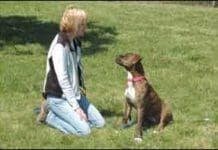
Teaching Your Dog Calm, Slow Breathing
Radio talk show psychologist Dr. Joy Browne offers her listeners a stress-reducing “Square Breathing” technique. To relax before or during any potentially anxiety-producing experience, try square breathing: Inhale to the count of four, hold to the count of four, exhale to the count of four, and hold for four. With practice, you can increase each side of the “square” to a count of eight or even 20; the longer the count, the slower and more calming the breathing.

Counter-Conditioning and Desensitization for Reducing Dog Reactvity
Counter-conditioning involves changing your dog’s association with a scary or arousing stimulus from negative to positive. Desensitization is starting with a very low-level intensity of aversive stimulus until the dog habituates to (or changes his association with) the aversive, and then gradually increasing the strength until the dog is comfortable with the stimulus at full intensity. The easiest way to give most dogs a positive association and to help them become comfortable with a stimulus is with very high-value, really yummy treats. I like to use chicken – canned, baked, or boiled; most dogs love chicken. Here’s how the CC&D process works.
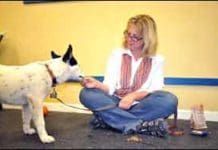
Touch/Restraint Desensitization Protocol
Touch dog’s shoulder with one hand, feed treat with other hand, remove both hands. Repeat multiple times until touch to the shoulder elicits an automatic look for the other hand to arrive with treat. Move touch process to various other parts of dog’s head and body until a touch anywhere on the dog elicits an auto-look for the delivery of a treat. Pay extra attention to any body part where your touch seems to elicit a more intense response from the dog.
The Four Principles of Operant Conditioning for Dogs
The dog's behavior makes something good happen. Positive
Debunking the “Alpha Dog” Theory
so he's trying it again.üIs this dog dominant or acting like an "alpha dog"? No; he's been trained to jump up and bite on cue."
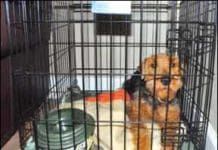
Dog Crate Anxiety
Properly used, the crate is a marvelous training and management tool. Improperly used, it can be a disaster. Overcrating, traumatic, or stimulating experiences while crated, improper introduction to the crate, and isolation or separation anxieties are the primary causes of crating disasters. If, for whatever reason, your dog is not a fan of the artificial den you've provided for him, and assuming he can't be trusted home alone uncrated, here are some things you can do...
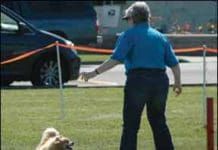
Frustrated With How Your Dog’s Training is Going?
an obedience class
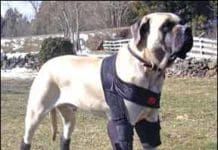
Orthopedic Equipment for Dogs that Increase Joint Support and Overall Mobility
In our March 2011 issue, we introduced you to a very small sampling of some of the neat “assistive equipment” options that are available to help our canine companions who have limited mobility or other physical issues. We received such a great response that we thought we’d share with you a few more finds that can help make life easier for you and your dog, particularly if he or she is aging or has orthopedic or neurologic issues. Remember: the products mentioned here are only the tip of the iceberg. There are numerous companies making innovative assistive products; what we’re hoping to do here is to get you thinking about some of the possibilities!
5 Ways to Train Without Treats!
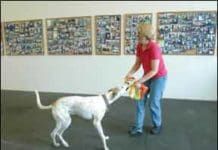
Food treats are an easy and effective reward for a dog when training. But food rewards are only one way to build strong behavior. There may be times when you do not want to or cannot use food, and there may be times when the best reinforcement is something other than a hot dog! Here are five great ways to reward your dog when you don't want to reach for the treat pouch.
What Does The Dog Think?
Current research has demonstrated that many species, including our beloved canines, share brain circuitry very similar to the human part of the brain that controls emotion the amygdala and the periaqueductal grey. While there's no doubt among most dog lovers that dogs have emotions, this concept is still being discussed in the halls of academia. Some insist that even though animals show emotional behaviors that we can observe, we can't assume the behaviors mean the animals who display them have emotional feelings. (I don't know how anyone can think this, but some scientists really do!) Others, such as the esteemed neurobiologist Dr. Jaak Panskepp of Washington State University, argue that if it walks like a duck and quacks like a duck it's probably a duck!