

Barbara Dobbins, my friend and frequent contributor to WDJ, once wrote a post for this space that described how her senior Border Collie, Daisy, had earned a “permanent hall pass” for jumping up on the counter to help herself to any food that had been left out. Two years into cancer treatment, Dobbins was happy that Daisy had an appetite! She also described other dogs she knew whose owners had decided to look the other way when the dogs did naughty things.
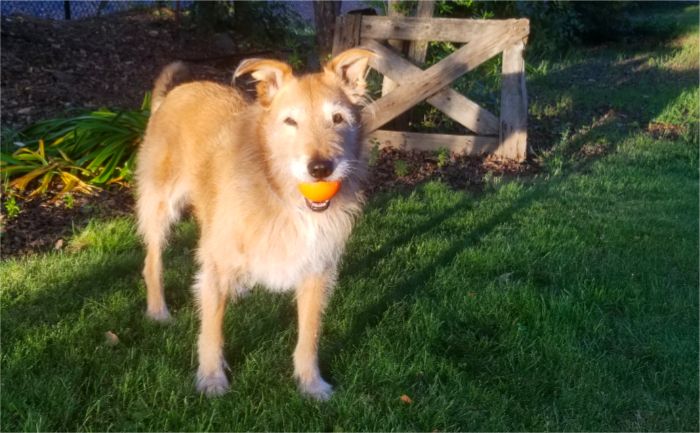
Otto is definitely showing some signs of aging
At 12 ½ years, my senior dog, Otto, has seemingly decided he should get a pass, too. My husband and I are not sure whether he’s getting a little senile, or simply emboldened by the plethora of as-yet uneducated foster puppies that have been trampling the landscaping and chewing drip-irrigation lines (or, alternatively, whining in a crate), or some combination of these things. Whatever the cause, the fact is that his behavior has begun to deteriorate just a bit.
Don’t get me wrong; he’s still a very, very good dog! But, adolescent misadventures aside, he’s always been near perfect – like the kid who sits in the front row and always – ALWAYS – has his hand up in class. If he hears me telling any other dog to “sit” or “down” or “come here,” he’ll pop up out of a dead sleep and run over to prove that he can perform those behaviors better and faster than the other dog can. So it’s a bit of a shock to have him completely blow me off when I call him after hearing him roar his terrible roar at the FedEx truck that’s passing by our house, and see him go tearing down the fence line, determined to chase the truck to the very edge of our property. How do I know he actually heard me and decided not to leave the chase? Because I could see him look over his shoulder and hesitate just a moment, and then decide, “Oh forget it, she’s too far away.”
Otto’s sudden interest in playing fetch
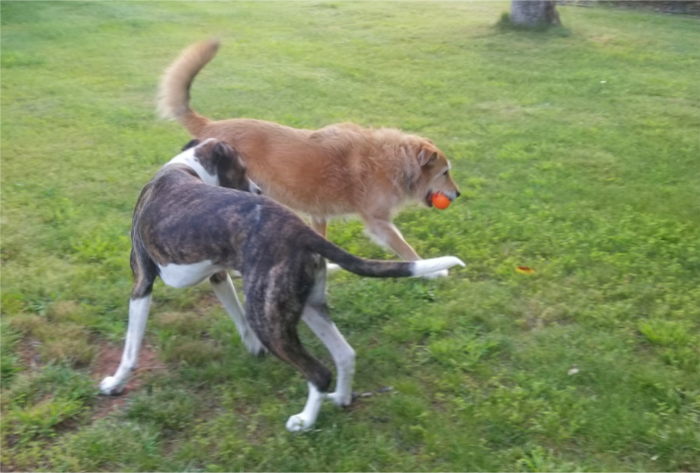
He’s also apparently decided that enough is enough when it comes to the relentless fetching of our younger dog, Woody – one of those dogs who would likely fetch until his feet turn bloody or until he passes out from heat exhaustion. If Otto is by himself, he will fetch a time or two, and then, chase the ball or other fetch item a third time, but just as he’s about to reach the fetch item, seemingly catch a whiff of some mystery aroma he just HAS to check out! “Excuse me, Mom, I think there was a raccoon on our lawn four nights ago, I should investigate.” In other words, he’s never been all that into fetching. But suddenly, he’s started to get very competitive when Woody is fetching.
He’s not nearly as fast or as coordinated as Woody, but he’s started to insert himself into any session of fetch, trying to beat Woody to any throw where that seems likely – which, because Woody never watches the ball, but just takes off running in the most likely direction, and Otto actually visually tracks the ball, Otto can get to more of the throws than he ought to be able to at his age. He also will try to intercept Woody on his way back to me with the ball and forcibly take the ball from him! Thank goodness, even though Woody is 4 ½ years old, he is still very submissive in the face of Otto’s “attacks.” He doesn’t quite give in, but he has not yet once tried to retaliate, either; he either tries to outmaneuver the older dog, or will stop and hunker down in a submissive pose, holding the ball tightly in his mouth and squinting his eyes tightly shut as Otto bites his face, trying to get the ball. “Sorry, man, I just can’t let go!”
Does Otto actually want to play fetch himself? Is he jealous of the attention that Woody gets for fetching? It seems that he just wants the ball; if he gets it, he just leaves with it! “Ha! That stupid game is over!” he seems to say. And, yes, I’ve tried having two balls on site when we are playing, so if Otto steals one, Woody and I can play on . . . Otto will drop whichever one we let him have and come in pursuit of the “active” ball in the game, so lately I’ve been putting him in the house when Woody needs a good, long session to work off some energy. I don’t want him to get hurt trying to overdo the fetching heroics!
It’s just weird, because he used to just watch Woody fetching like, “Yuck! What an idiot!” And now he’s like, “I have to STOP this!”
Other changes in Otto’s behavior
Also new: For most of his life, even if he didn’t want to do something, like, suffer through a bath in the yard with a hose, he would come when I called him. Slowly, sadly, but he would come (and he would get thanked, rewarded, and fussed over). Now, if he sees a hose and thinks a bath might be in the works, he just leaves, even if I’m calling him. “Nope! Just… nope!” He thinks – actually, he knows – I’m just not going to make him suffer through a hose bath anymore if he doesn’t want one.
But the biggest surprise came a few days ago, when my husband left his dinner unattended on the coffee table for a minute, and Otto just started helping himself to the food. WHAT?! He’s NEVER been a counter-surfer or helped himself to food like that before, which made both my husband and I wonder if this is a bit of dementia creeping in. He actually looked a bit surprised when both my husband and I, shocked at the same time, yelled “Hey!” I told my husband, we have to treat him more like a puppy again; we can’t take it for granted anymore that he knows all the house rules and will follow them. While I’m happy to issue him that “permanent hall pass,” and will likely just go ahead and let him have the rest of any burrito he manages to steal from now on, part of me is a little sad at these age-related behavior changes. Dogs just don’t live long enough! We’ll cherish all the time we have together, a little more now.


Sorry, none of my veterans get a “hall pass” that allows unwanted behaviors. I do not tolerate jealousy either and I have had my share of hounds that thought “mom” was their sole property. Just as with children, there are rules and consequences for my hounds behaviors. I do not use physical punishment but do have a time – out area and a horse size spray bottle with 1 part vinegar to 4 parts water that I will use for excessive barking.
A wonderful woman with a special gift as a dog trainer helped me with my first adopted hound who was extremely dog reactive after being attacked several times before I took him into my home. Her patience and guiding lessons were life changing for him and me. His training and the methods Carol taught me helped him become a therapy dog. The reason I mention this is because one of the first and most important aspects of dog ownership that Carol taught is to have a reliable recall. She told me that if I give my dog a call to “Come”, then he should drop every distraction and return to me. If he doesn’t, then I must go to him and gently bring him back to where I was when I made the call. She stressed that no matter how angry you are that the dog has ignored you, you must remain calm and lead them back while saying the command “come” to help reinforce the message with the action. For every time they get it right and Come when called I get a small treat and lots of praise.
Sometimes, even with my adult hounds, there are moments of hesitation or a flipping me off with the paw because something is more interesting, especially with my veteran. So, I keep an extra lead by the back door and will go to the dog and tell him, I said “Come” wrap the lead around his neck and lead him to the back door. No treats, no praise, just a thank you – that is what I wanted.
The only time I allow a bit of laxation in the behaviors I expect from my hounds is during the final illness that I know in a short 6 weeks if we’re lucky will take their life and my heart (Osteo). During that time, many special privileges are granted and some forbidden foods are now treats. Until that time – no slackers – everyone obeys the house rules!
Spoken like an intolerant control freak with very little compassion for your poor canine “veterans.” Maybe you’ll be treated with the same lack of compassion with no “hall passes” in your senior years.
Was thinking the same thing!.
What’s sad to me, also, is that she seems so proud of her intolerance/no “hall pass” attitude towards her senior dogs. BTW, Mike, I can relate to your post about doing whatever you can for Bear and cleaning up his messes. Wish we were still cleaning up our lab/shepherd Kelly’s messes because that would mean she was still with us – she passed about two years ago and we miss her terribly. We adored her. I hope Bear hangs in there as long as possible and is comfortable as can be. I know it’s difficult to see them go through this. My best wishes to you, Bear, and Lulu.
This is so very sad to read you would treat your aging dogs this way. Would you treat your aging parents with the same lack of compassion? Shame on you Sherry.
I used to subscribe to WDJ years ago when my pups were small and I was raw feeding and an avid trainer. I enjoyed the support and guidance and felt part of a group of compassionate, dedicated dog owners. I recently started up my subscription again, looking for that same gentle guidance and heath articles as my dogs advance in age. Then, as now, I frequently think the whole journal is “preaching to the choir,” believing its audience to have a similar mindset of loving, compassionate, tolerant dog ownership. After reading your comment, I realize I have assumed too much.
I have one Airedale now. This little lady was raised with her sister who recently passed. We were a package deal and it was a hard process re-bonding after the triad was broken. Gracie Lu is closer to me than she has ever been, but without her sister it seems like life just isn’t as fun as it used to be. She is 11 and I see her aging and slowing down. Sleeping more and running less. I love her like the baby puppy I brought home and give her all the walks she desires. 100 kisses are dispensed to her each day and I know that every day we have together is a blessing. Gracie is the Queen of the house now and she gets what she wants. in spite of my dotting she is still good to the bone and is ever present by my side. I have learned that there is something sacred about our senior dogs and the rhythm they bring to the day.
My Vienna, and husky/GSD mix, is 13 (14 in July). She’s slowed down a bit and her eyesight isn’t as sharp as it used to be. As far as her hearing, as part husky, she does ignore me a lot, but now I think she’s also losing her hearing. Like Otto, there were times she would stop for a second, but then continue what she was doing. Now, she could be standing 3 feet away from me and can’t hear me. She still loves going for her walks and, most days, would walk until she dropped. I usually allow her to decide the route we take until I think we’ve gone far enough and need to start heading home. There are some days, though, that she only goes around the block. I don’t push her because I figure she isn’t up to a longer walk. My screen saver is a slide show of pictures of her throughout the years (I adopted her from rescue when she was 11-weeks-old) and I look back on those pictures and wonder where the time went. It is sad to watch them get older and they don’t live long enough 🙁
What a GREAT article that captures a lot of nuances in dog behavior-made me smile in recognition.
I’d love to read anything Nancy or anybody else from WDJ has written about dogs going through chemotherapy, as my 10 year old pit/pointer has just started. Two days in and it’s already worrisome. Is it supposed to be worrisome so soon?
Please tell me more about the doggy dementia foods.
now that my boy is 14 1/2yo (55lb) I lightly cook his food, he has never had any kibble type food since the day I brought him home from a shelter (he was 7mths old). He has mostly been on a raw food diet but in the past couple years have been lightly cooking and he loves it. He has different meats (plus organ meats) rotated and I add fresh organic veggies and some organic rolled oats. I use dried egg shells for calcium or raw chicken necks. I recommend making a bone broth as they age, he gets a cup daily. He also enjoys some goat kefir daily for probiotics.
I was watching a reality show on TV a few years ago in which a vet scolded a dog owner for feeding the dog a diet of cooked chicken, rice and vegetables. There are specific amino acids and mineral nutrients that dogs and cats need that can’t always be duplicated even with the best of intentions and apparently this human-inspired diet wasn’t cutting it per the vet.
My late shepherd-chow mix was mostly on a kibble diet — Costco brand. However, we never gave her a single rawhide bone or any of the “mystery treats” from China (which spared her the melamine contamination crisis of 2007). She received the Costco equivalent of milkbones as treats and never shared in any “people food”.
As she got older we began adding pumpkin to her food for fiber at the vet’s recommendation — but I had my doubts about the safety of that given that most canned food contains BPA (even canned food that claim not to have it often do, at least in cases where human varieties of canned food have been tested). She never received Purina anything until the last five years of her life when we began buying the packets of wet food to soften up her kibble along with the pumpkin. (It was mostly our effort to try to spoil her after years on the same old Costco kibble.)
Our dog ultimately lived to 17 years. At about 14 years, around the time she developed some hearing loss, she stopped barking entirely. (She never was much for barking to begin with — but even when other dogs barked continually in her face she took to ignoring them.) She also became more stubborn with age. Playing along with “sit”, “stay” or “heel” wasn’t a priority in the last years of her life. She didn’t forget or misunderstand those commands but she was more selective about hearing them.
Right up until the last week of her life, in February, she still did her “happy dance” at feeding time. In the last three years of her life, she preferred to spend most of her day sleeping — which wasn’t entirely unusual as she had always a “cat napping” sort of dog. Just the same, she had not outgrown her urge or capacity to take off running after a small critter. (Although last year at this time she very kindly pointed out to me a “nest” of baby rabbits in the yard!)
She did exhibit some puzzling elderly behavior in the last six months of her life. Around Thanksgiving she took to chasing my spouse around the house as if it were always time to go out for a walk. One afternoon in January we observed her stop, turn her head and do an unmistakable “double take”. She sped around a piece of furniture seemingly drawn by something only she could hear or see. Even after we redirected her attention she turned back around and returned to where she could take a second look. She had her head raised toward a window, which had held no interest for her in the past (far off the floor and with only a view of a neighbor’s roof). There was nothing to see there.
Normally the only place she wanted to be in the house was wherever we were, but about 2-3x a week during the last six weeks of her life she would exhibit “I have to go” behavior. I would call her name, thinking she just became confused about where we were in the house, and she would look at me/us with a very serious gaze as she walked out the door — as if to say “I can’t ignore this” (almost a sad look). She would go to a specific (empty) room and then reappear a couple of minutes later. Looking back, I think she knew her time was nearing and this was her way of conveying that.
I credit her long life with the fact that she had an unflappable temperament, never prone to anxiety or fear — friendly to a fault (terrible guard dog). I also credit her longevity to the fact that she looked forward to regular walks. It also helped that she was not so frenetic that she wore down her joints jumping up and down as so many high-energy dogs do (she wasn’t allowed to jump on beds or furniture and never took to trying to jump fences, which spared her the mobility problems of advanced age). Lastly, I credit her longer-than-average life span for size (medium) to the fact that she spent most of her time outdoors.
Years ago it was not uncommon for pet owners to keep dogs outside in better weather but my sense is that increasingly people frown on this practice. (To be clear, however, if a dog is chained up outside and neglected it IS a bad practice.) While any kind of pollution can harm the health of people and pets, what many pet owners underestimate is the poor —even dangerous — quality of indoor air. Studies have shown that pollution indoors is often worse than outdoor air pollution (and that’s bad enough!). There are fire retardants in furnishings, VOCs emitted for years following the installation of new carpet and flooring; chemicals in household cleaners that end up on pet paws (that they ingest by licking and grooming). There is a significant amount of off-gassing (formaldehyde) emitted by inexpensive household furnishings and engineered wood products. Additionally, a dog that spends most of the day indoors won’t get as much exercise and vitamin D (sunshine) as a dog that is outside in a securely-fenced yard. Our dog was outside in all but extremely hot or cold weather. Had she not been allowed to spend most of her time outside in fresh air in an “organic” setting that was not treated with any garden chemicals, I don’t think she would have made it past the average life expectancy for a Chow or German Shepherd (~12 years).
In conclusion, although there was no doubt our dog slowed down between age 14-17, it’s possible she could have lived even longer — except that she very suddenly developed gastric bloat. It was tough to lose our family member to any cause — but knowing she didn’t suffer from cancer, kidney or liver failure as so many pets do helped ease our grief.
Enjoyed your observations of some new behaviors from our senior pups. Kindness and patience-gifts they have instilled in us -are now to be returned lovingly. My sugar-faced 12y/o Golden has developed a minimal proteinurea. Can you please direct me to medical and nutritional information for her continued care. ?
Thank you. Sharon
Has she had her kidney function checked? I have a 14 1/2 y.o Brittany mix that is in stage III kidney disease, but still running/having a good life so far. I’m not a vet, but my understanding is that doing an SDMA is a very sensitive test to pick up kidney disease, as well as doing a routine blood chemistry (which would show some kidney values). Hopefully your vet is on top of this?
Start feeding him one of the doggy dementia foods now! There is both an over-the-counter version of Purina One Bright Minds and a prescription version and I have anecdotal evidence (presumably Purina has testing evidence) that it really helps! But it takes a bit to kick in.
Are you suggesting a kibble diet?
I’m afraid such diets are in truth simply marketing ploys. Especially when a company like Purina is the one selling them.
Purina Bright Minds did nothing for my 17 yo old Chow Chow with Dementia. Tried it for 3 mos. back in 2015. Perhaps they have finally improved it.
This is both reassuring as we have seen the same thing. Our senior Chinook, who just turned 13 was always the “Independent” puppy. We trained and had fun a lot so she was great at following commands. Now she is doing things that I haven’t seen in a long time. The most startling has been her escape attempts from the yard. Its hard but my husband and I have gone back to our puppy routine with her and she is such a wonderful dog.
My elderly Briard, Cheyenne, is 13. I let her get away with a heck of a lot that I didn’t tolerate when she was a puppy. It’s just not so important anymore. She knows when I mean business, and that’s all I care about. She’s an old lady – clearly thinking that she has earned the right to make some decisions on her own. I let her. Safety aside, she is going to get her way. She HAS earned it!
We have two rescued hounds. Before we had Scotties. I’ve been shocked at how quickly our Redbone Coonhound is aging. Bigger dogs seem to age twice as fast as small ones. I don’t know if she’s starting to get a “I don’t give a care” attitude or if she’s loosing her hearing, but these days she doesn’t come for the lunch snack call but then shows up in her own time if she decides she’s hungry. Our other dog, Scout, a Black and Tan Coonhound, is two years younger and full of energy. She’s forcing Aggie to stop being a couch potato and get involved in exercise. In fact, she’s taught her some wrestling moves. That’s a good thing. Still, it’s so sad to see Aggie aging. They are with us for such a short while. We really do have to treasure every moment.