

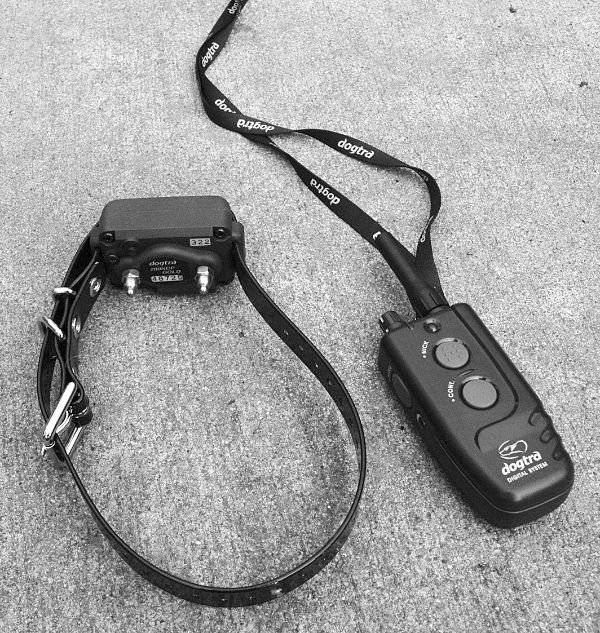
There is a trainer I know who posts a lot of short videos of her own dogs and dogs owned by clients of her board-and-train business. The dogs always look very well behaved and lots of people leave complimentary comments on these posts.
I’ve never seen a comment mentioning the shock collars that every one of the dogs wears. (Or the shock collar combined with a choke chain or pinch collar. Always the shock collar, and often the second pain-inducing collar, too.)
Again, judging by the comments, no one seems to be bothered by the subtle signs of stress and anxiety the dogs in training display. If the dog is “behaving,” the trainer never raises her voice, and the dog’s tail wags at some point, it all looks good to most people (apparently).
Now, it could be that some people DO comment or ask questions about the collars and the trainer deletes them. I would put money on a different possibility, though; I’m pretty sure that this trainer so thoroughly believes in and relies upon the collars that if someone DID comment, she would strongly defend their use.
Quick-fix methods can be seductive, but…
In general, I try to keep WDJ as free as possible from negative appraisals of training techniques and gear that we don’t support. I’d rather that we talk about the many reasons we advocate for the techniques and gear that we love. But I worry sometimes that many people can’t tell the difference between what we would call dog-friendly training and training that’s focused on quick, telegenic results.
I know that quick-fix methods are seductive: “I sent her an unmanageable dog who barked at the door, jumped on everyone, and couldn’t be walked on leash, and two weeks later, now look at him! He’s calm and I can walk him without being dragged down the street!”
But my question is, at what cost? What was that dog’s total experience? A dramatic transformation does not happen that quickly without a certain amount of pain and discomfort and lack of initial comprehension.
Note that I’m not talking about the use of a shock collar to deal with a specific behavior that the owner or training has been unable to stop in any other way, something that may well shorten the life of the dog if the behavior is unchecked, such as taking off after animals (not responding to a recall cue off-leash) or failing to respond to a “leave it” cue in rattlesnake country. That’s a separate debate we could have. But what I’m talking about here is the use of a shock collar to teach dogs to perform every sort of sit, down, stay, come, go to your bed, every-day type of behaviors – the same behaviors we can teach 8-week-old puppies to do on cue with a handful of cookies.
Now, I have to add that this trainer is skilled and experienced. I don’t see the kind of obvious fear that an unskilled force-based trainer induces in his clients’ dogs – the videos posted on social media don’t show dogs who are overtly cringing or flinching. They do show dogs who display more subtle signs of stress: licking their lips, ears back, tucked tails, yawning. In a few videos, it takes a sharp eye, but you can see the reaction a few dogs make when they have hesitated to perform the requested behavior and are being shocked: a long blink or a momentary grimace before they perform the behavior they have been asked for. You can see it, but only if you know what to look for.
I bet her clients are genuinely happy with the results – pleased to discover that their dogs are capable of being calm and compliant and have learned a few behaviors on cue.
Dangers of using shock collars
There is no denying that in the hands of an experienced trainer – an even-tempered person with superior skills at observing body language and good timing – collars that shock or apply painful pressure to the dog’s neck can teach a dog to perform certain behaviors (in order not to suffer a painful consequence) in fairly short order, and without the appearance of violence. But this sort of training is anathema to me, and to most “positive only” trainers, for many reasons. Here are just a few:
- Training methods that use pain can emotionally scar some dogs. Dogs may learn to perform certain behaviors in order to avoid pain, but many lose trust and interest in having a loving relationship with humans.
- There are certain dogs who respond to pain with aggression. You can’t always predict which dogs this will be, but the odds are higher with dogs who are fearful and those who possess more than the average amount of self-preservation instincts. I would argue that from their point of view this constitutes simple self-defense. But the pain-based trainer will respond to the dog’s aggression with greater and greater pain, because if the dog’s aggression successfully (from the dog’s view) ends the training session, the trainer will fail, so the trainer will feel compelled to increase the pain until the dog “submits.” Unfortunately, if the dog’s aggression escalates enough, at some point the trainer is likely to inform the owner that the dog is dangerous and defective and the dog usually ends up dead – euthanized for behavior that was introduced in response to the training method.
- While the trainer might have good timing, observation skills, and judgment, few owners do. When the dog is sent home with his new shock collar and the remote control is now in the hands of his much-less experienced owner, it’s inevitable that the collar will be activated at inappropriate times: when the dog tried to do the wanted behavior but the owner didn’t recognize it as such, after the dog had stopped doing the unwanted behavior but the owner’s timing was delayed, when the owner is angry at the dog for perceived misbehavior, and so on. As the “corrections” make less and less sense to the dog, and he fails to clearly see what behaviors work to stop the pain and which don’t, his “training” will deteriorate – and so will the relationship between the dog and his owner.
In my view, the introduction of a button that is pressed to cause discomfort that will increase compliance from another living being – just this, alone – would indicate to me that the button-presser should spend his or her time with a stuffed or electronic toy dog rather than a thinking, feeling being of another species.
Again, I don’t like to discuss training methods that we would never promote, but I’m not sure that novice dog people are ever told about the potential for harm that quick-fix tools like shock collars can cause. And when a dog owner with an unruly dog sees the “before and after” videos, many happily sign on, without being informed about the potential for fallout. They probably haven’t been told up front that the dog’s seeming calmness and compliance comes with a remote control – one that they will have to learn to utilize in order to maintain those behaviors. Were they asked if they are willing to continue to hurt their dogs into the indefinite future? Or have their dogs learn to associate them with the pain?
The goal of the kind of dog training we describe in WDJ – dog-friendly training, positive-reinforcement-based training, fear-free training, call it whatever you want – is to cultivate communication with and cooperation from our dogs, not just assert control through superior strength or power. Communication and cooperation with other beings is most soundly built on a foundation of mutual comprehension – and this takes a little bit of time! But if the process of learning about each other is rewarding and enjoyable for both parties (canine and human), the bond between them will be strong, even if communication breaks down at times.
Let’s talk about it
*Please note that this place on the WDJ website – the blog spot – is where my personal thoughts are posted. The word “blog” is short for “web log”; it came into being to describe the sort of sites that were devoted to journaling and other personal posts. This isn’t an “article” about the evils of shock collars; it’s where I am trying to work out my personal discomfort with both the use of the tools and the general public’s seeming inability to detect or understand the potential for quite serious fallout from their use and misuse.
Trainers: Do you have personal experience with using shock collars for training garden-variety behaviors? (Let’s confine the discussion to this.) Do you have experience working with dogs who were shocked by different trainers or owners before you were consulted? If so, what can you tell us about these experiences?
Owners: Have you paid someone to train your dog with one of these devices? Were you told up-front that a shock collar would be used on your dog? What has your experience been? Has your dog seemed different in any way?




I find this discussion and your thoughts very insightful and i really appreciate a candid and honest opinion. So thank you. I have 2 dogs. My dog Ryder is 2 1/2. He is a rescue and is incredibly sweet, loyal and although incredibly high energy and very prey driven, manages to trust me despite a less than ideal background. Although I don’t know his breed with certainty, I usually think of him as a Lab/Pitbull. Here’s the point, I paid a lot of money to have him trained at a very skilled and highly successful trainer. All treat, positive reinforcement and absolutely lovely to work with. I was also delighted with the results. Yet, Ryder’s ongoing excited jumping around small children (even after showing control in many challenging situations), led me to be concerned. I used a collar with the vibrate and beep settings only and had good results. And I, in 2 instances used the shock setting. Is this included in the idea of abuse? Those 2 scenarios were not reacted by Ryder with pain. He didn’t yelp, cry or bark. I had the setting very low and tested it on myself first. This is an honest question. Is there any appropriate use for a shock collar? I feel like i am experienced as a dog owner, but have seen so much conflicting ideas (and of course, advertising), but don’t know if it’s a preference or rather something that really could cause mental harm. I understand the difference between the fear based training methods, and positive reinforcement…. I just am honestly wondering. I hope I won’t be judged too harshly for using the shock setting. Thanks.
Sounds like abortion argument.
The whole discussion I meant….
I whole heatedly agree that an e collar should not be used to teach behaviors. Teaching a behavior should be entirely positive for the dog. However, what I think people miss the mark on is that there’s nothing wrong with using tools to aid training when needed. Treats and clickers allow positive reinforcement to be concise and clear, similarly an e collar can be used to make a correction clear and concise, especially in situations where the dog is in a dangerous situation. When used as negative reinforcement it should not be aversive or cause pain, which is how it should be introduced. Negative reinforcement should be removing an annoyance, dog whistles work the same way except with tone. If someone is constantly applying the stimulus and the dog is clearly showing signs of pain, fear, stress, then that is abusive. Also, it should be paired with cues that the dog has already learned, because the tools do not train a dog it’s the owner who trains a dog.
As a side note, as an owner of a reactive dog who has benefited immensly from being open to tools, I’m really tired of trainers being so judgy of each other and of owners who use a different method. I understand wanting to call out abuse, but if a dog appears to be happy, having fun, and not changing personality with the training it’s probably not abusive. Not when there are trainers who will literally hit dogs or shock them into submission, because they think you have to dominate your dog. Over analysing Instagram photos and videos doesn’t help anyone, especially when you don’t know those dogs personally or haven’t worked with them. Dogs can have different stress indicators. For example my dog puts his ears back when he’s relaxed and it can almost look like pinning his ears at times. He’s always been like that even when I did the purely positive training, but now that I walk him in a collar with an e collar also around his neck, I can tell I get judged on walks. Even though he would have looked the same in a harness. I definitely got judgy looks from people when I was using the prong collar for training, which is no longer needed for my dog, even though he’d be calmly walking beside me.
I tried using a shock collar with one of my two dogs to stop her barking; however, had to remove it when my other dog noticed that she experienced a shock he or she barked. So, he would bark and then look at her and seemed to enjoy seeing the result. Not cool.
My parents have a ‘Muscle Stimulant’ collar on my one-year-old puppy and the way they explain it to me is stupid.
Them: It’s not a shock collar, it doesn’t hurt him, it just stimulates his muscles.
Me: What does it stimulate his muscles with?
Them: Well, electricity.
Me: So it’s shocking him and forcing his muscles to contract.
Them: No! It’s stimulating his muscles.
Me: Okay, fine, but why do you say it doesn’t hurt him? He cries/screams half the time when you shock him.
Them: No, he’s just crying. It doesn’t hurt him.
Me: Whatever you have it on, turn it down by half and shock yourself and see how it feels.
Them: Sure!
Then they turn it down by half and touch it and immediately pull their hand away and are like “That was fine! It doesn’t hurt” even though it clearly hurt them. Besides, it would have been even worse if it was on their neck and they still refuse to believe it? Whenever it’s on, the puppy lunges at the remote, nips and bites everyone, jumps, barks, runs away, everything. But as soon as it’s off he’s the perfect little puppy happy to nap on top of me for an hour. How do they not recognize that?
Wow. I would think that our current political and pandemic environment would teach us all to look carefully at our own assumptions. I’ve only been researching this topic for a few days which has included going to a facility that uses the advanced versions of these devices and having them try it on me. For me, the “tap on the shoulder” comparison that some people mention seems much more accurate that anything remotely like “shock, pain, and negative punishment” that many others associate the devices with. It easy to overlook new technology, and to associate stimulation with pain. It’s more difficult to have an open mind and I find it fascinating how people spout off on things they have not carefully researched–the author included. I am not taking a stand either way just yet, and just trying to gather information. Comments based on assumptions, not facts, are detrimental and distracting to those of us trying to understand how these tools can be used. I’m grateful to those who provided logic and research-based replies in this string.
Max was great as a puppy and learned quickly.- all positive force free. He’s now 5. He guarded things but I taught him to drop and trade. At 16 months he had to spend the night at the ER vet and came home changed. He was attacked, while he was on leash by a dog who cornered him. It changed him drastically. He gradually became more leash reactive, and anxious. He is good with people, and loves my grandkids and anyone who comes over, but dog reactive while on leash. He can play with other dogs off leash if I’m not around for him to guard. He started guarding me and developed triggers – such as anyone coming up behind me, or being startled in any way. He would snarl at a person then. I’ve worked with him for 4 years with several different trainers with positive methods. He’s much better but not predictable. I’m 71 and have a balance issue from a concussion several years ago. I’m at the point of deciding if I need to. Re home if that is even possible. I’ve worked so hard with him.
I heard about a trainer who is a balanced trainer. I haven’t met her but several friends had great success with her a board and train. He is well trained with basic obedience, tricks, and we practice almost daily. What I want is to be able to walk him and not fear being pulled down and injured. She said she takes a long time to build a relationship with the dog and trained with rewards, and praise. She may use an Ecollar toward the end. She said it is a vibrating collar not a shock collar. Would this be something that might help me keep my dog. I adore him and 98% of the time he’s wonderful, but I need to be able to walk him and not worry about falling or someone getting hurt. I need opinions please. I have had many dogs and always used positive training, but I’m so distraught about him. Thank you for taking the time to answer me.
I go running with my 9 month old puppy on the beach, where in the excitement of seeing birds and given lots of noise, he sometimes can’t hear me. We sometime go off leash and sometimes on the long lead. When we do recall, I call for him. But if he can’t or doesn’t want to hear me, the long lead serves as the mechanism for him to stop running away, uncontrollably. I’m not pulling on the leash, but like all leash and harnesses, there’s slight pressure on his chest, which tells him to stop. I’ve been debating whether to use a friend’s “vibration only” collar to supplement this. I’m not at all interested in a shock collar. But, I’m not clear why a tone or vibration only (again, no shock) is any different than calling out to him, in order to redirect his attention. I don’t believe any of us would be averse to a tap on the shoulder to call for attention. Am I correct that a vibration is the same as a tap on the shoulder? I tried the collar and it really is just a vibration.
Why are you using a photo from a company that doesn’t make electric shocking training collars? Dogtras stim and vibrate, they do not have electric shocks on their training collars. You’re bashing a company that doesn’t fit your narrative.
Hi folks
I have a Siberian Husky – 1.5 years old and about 80 lbs. I live out in the country and most of my neighbors are at least half a mile away; the exception is my brothers house which is only a couple of hundred yards away. Unfortunately, my dog has a habit of going over to my brother’s house an bringing back just about anything that isn’t tied down. This is a considerable frustration to the folks at my brother’s house. So, I think that I am looking for an e-collar that would allow the dog to ramble around but send him a significant message when he starts getting in the vicinity of my brother’s house. Your thoughts and suggestions are most welcome.
Eric