

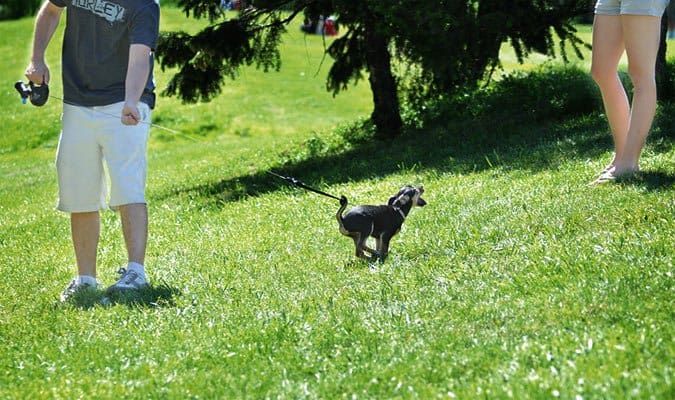
There’s an old joke about if there’s one thing that two dog trainers can agree on, it’s that the third one is doing it wrong. But if you know me at all, you know I hate online squabbles; I don’t participate in digital fights about training methods or tools. That said, I think I’ve found something that very nearly ALL dog trainers agree on, and that I will defend anywhere, anytime, and it’s this: Retractable leashes have no place in dog training.
It almost reaches the level of a joke: If you go to a dog park or almost any gathering of dog people and their dogs, the worst-behaved dogs will be the ones on retractable leashes. It’s sort of a chicken or the egg thing: What came first, the poorly behaved dog or the leash that teaches him nothing?
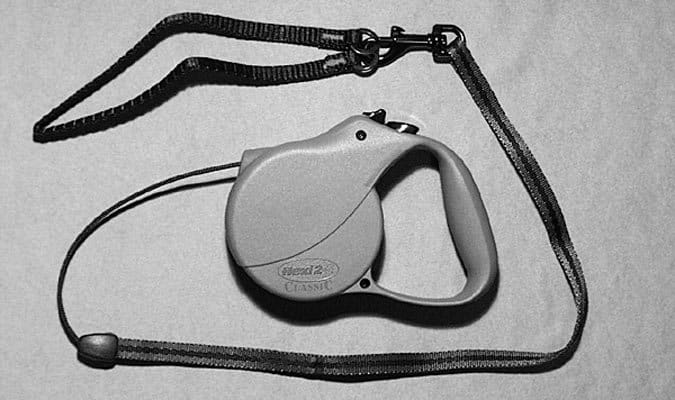
I get how convenient it is to be able to walk along with your dog on leash and have your dog stop for a moment to smell something or take a quick pee, and you only have to slow your pace for a moment, rather than stop dead. When he’s through or he hits the end of the retractable line, he can trot to catch up, and you don’t have to scoop up all that line the way you would with a long leash, you can just allow the spring-loaded retractable thingie to wind it up.
However, what do you do when your dog is at or near the end of the line and:
- You are suddenly confronted by a loose dog, looking a little aggressive, coming your way, fast.
- Someone walks quickly out of a storefront, in between you and your dog.
- Your dog suddenly sees a squirrel on the ground across the street and bolts into the street in an effort to reach the squirrel.
The biggest problem is with these and countless other situations, when your dog is more than a couple of feet from you, there is nothing you can do very quickly to get him back to your side. The products can retract only when there is not tension on the line. As you know if you’ve ever used one, you really cannot grab the part of the cord that retracts into the handle and pull even a smallish strong dog back toward you. About the only way you could pull a dog to safety would be to mash the lock button down, while quickly turning in the opposite direction and trying to call or drag your dog in the other direction – depending on whether you’ve trained him to do emergency U-turns or whether he’s engaged already with the other dog or still on the hunt for the squirrel.
And to retract the slack when there is a chaotic situation brewing, like when that loose dog – or even one on leash! – is squaring off with your dog, and they are spinning around? Lock to prevent the dog from getting farther away, release to retract, lock, release, lock, release . . . it’s darned hard to do in calm circumstances.
When I want a dog to explore his environment without taking him off leash, I use a long line – a 20 or even 30-foot leash. I only use a tool like this in an environment where there are NO other people or dogs who might get tangled up with us, and the line is as smooth and easy to handle as my leash; I can easily grab anywhere on the line and manually reel in the dog if I have to.
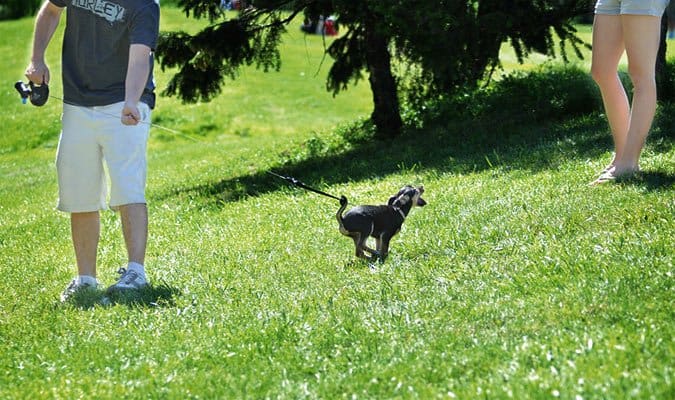
And what about the many cases in which someone accidentally dropped the handle, which started dragging on the ground and clattering loudly behind the dog, and spooked him into running in a blind panic into traffic?
We don’t even have to discuss emergency situations to get most trainers to chime in about how useless these tools are. They more or less train dogs to pull against pressure, by rewarding/reinforcing the dog when he pulls against the product’s spring (there is always some tension, even when the operator isn’t pressing the lock button) in order to reach something he wants to investigate. Getting to sniff something he was curious about is a reward – and behaviors that are rewarded get repeated. Simple as that.
Yes, a person can lock the handle and prevent the dog from pulling the line out of the device, preventing him from getting this reward. But then, you may as well just have a fixed-length leash.
As a final point against them, all I can say is, when this blog gets posted to the WDJ Facebook page, go ahead and post your photos of the deep, slashing cuts that you or someone you know has received when a retractable cord got wound around their leg when a dog was going nuts. That should give a little credence to the warnings against these products.
Can anyone honestly make a case for the responsible use of retractable leashes?




This happened 2 years back: I was walking my Am-staff and suddenly another younger Am-staff was quickly coming toward us! I looked and at the end of the retractable leash was a young boy (8-10) who obviously could not contain his dog, so I had to pull my dog to the other side of the road. I told the boy that he should be careful “you never know if the other dog is friendly”… and that it is not a good idea for him to walk the dog alone not less but on a retractable leash… asked where his parents are…etc.
On my way back, the boys mother waited for me and ask me why did I tell her boy whatever I said. I told her the same what I already said and that at least she should get a short leash preferably with harness and she says to me: Oh, you were scared!
Wow! I was dumbfounded! This is what she got out of it…
And I said: of course I was scared! This dog is my baby (at that time he was 6, now hes 8) !!!
I do not want any problems on my walks with him, I take great care of him, cook for him, buy organic food for him, kiss him, love on him, walk him, play with him, the house is his, we just pay the mortgage (that’s what my husband says) and I don’t want a scratch on him…not to mention the worse, having to watch him getting injured, or taking him to the vet or emergency….and I said some more, can’t remember…she did not said anything after that, just looked at me for a while, even when I turned around…?
Some people should not have dogs.
Or kids.
I have been a subscriber to the Journal for many years and have learned many things I did not know before even though I have been a dog owner all of my life (77) so keep up the good work to try to educate dog owners many that do not have a clue. The leash itself is not the problem it is the one holding the leash, the only positive I can say about it is the handle is easier on the hand.
I live backing up to a walk that is busy everyday with dog walkers. I get a real kick out of watching owners try to keep control of their dog, some with multiple dogs on seperate leads that get tangled up, most are busy focusing on other things than their pets and are not proactive if something goes wrong. I can’t believe walking any dog that is pulling is fun. I love my dogs and they get spoiled but it is me that is in control not the dog, but then some dogs are smarter than thair owners, lol
Reading this article reminded me of every reason why I don’t like flexi-leashes. Actually, I tried one when I first got my recent, very timid dog. He got away from me, and kept running , mostly because here was terrified byf the noises from the handle “chasing” him.
I think you got every point. Having dealt with the slash across my leg caused by a dog who was happy to see me, I was particularly glad that you mentioned that point. I hope that everyone pays attention and throws their flexi-leash in the garbage, where it belongs (sorry, landfills, but we’re talking about dog and human safety here).
I used to walk my first rescue dog on a flexi as she couldn’t be off-lead due to dog=-reactivity. I had it locked along the roadside then released the lock when we were on the heath so she could have more freedom safely. However, one day walking along the road towards the heath the lock went just as another owner was nearby with a Lhasa Apso off-lead. Cherry lunged at the dog and it ran into the road! Fortunately there were no cars at the time but I apologised profusely and felt horrible. I binned it after that. I take my dogs to quite a few dog shows and I wish they would be banned at them. You get people walking along with the lead fully extended and completely oblivious to the fact that their dog is on other dog’s faces which they may not appreciate! I have also recently joined a large garden walking place in Norfolk where it says that dogs have to be on short leads. I joined because o e of my dogs is scared of other dogs running into his “space” after having quite a few off-lead dogs try to have a pop at him. People do not obey the short lead rule though and I saw one elderly lady with 3 Golden Retrievers all on flexi-leads! How can anyone control 3 large dogs on flexis is beyond me!
After scrolling through the comments, one thing I DIDN’T see mentioned was the fact that retractables eventually wear out. The little plastic parts inside will get brittle and fail under pressure, usually when you least expect it (because your companion has never had any issues before), you will be left holding a handle while your dog is disappearing in the distance, trailing the lead ribbon.
I particularly disagree with the person who couldn’t manage with a long line—I have one for each of my two dogs, and until my apartment complex built a dog run, was how I exercised my Cocker and oversized Sheltie (about 30 lbs each) in safety. We learned to keep them far enough apart that the lines didn’t cross, and they actually got to run off their energy more efficiently than with those retractable leads that allow no more than a 15’ radius.
I watched in horror as a small dog on a retractable leash come around the corner and got run over by someone backing out of their driveway. By the time the owner came around corner it was too late. Driver never saw the small dog. I won’t use that kind of leash.
For goodness sakes, if you dont like retractable leases, dont bloody buy one. Leave the rest of us alone. End of story.
I have had great dogs of all breeds using retractables for as long as they have been in existance with zero issues, but then again I do use what little grey matter the good Lord has given me.
I also dislike retractable leashes. We once had a dog who could chew through the lead in no time at all. Spent lots of time trying to get her back. She was a mixed breed, maybe 60 lbs. Give me a tough nylon or leather lead anytime.
A retractable leash is a tool. Used improperly, it is a dangerous tool.
Used properly, it can be very helpful. It should only be used if your dog has good to excellent leash manners.
Here is my case for proper use of a retractable leash.
I use one occasionally with our dog to work on moving recalls. He never extends the full length of the leash and respects the curb boundary. He knows to stay on the easement and off the main yards. I also pay 100% attention to him and the environment around us and reel him in if anything unusual is noticed.
A long line can be hard to manage and can get caught up in the dog’s extremities or the handler’s hands and both can sustain injuries.
This is disheartening. I had just signed up for a subscription to whole dog journal. I can’t stand all the self righteousness that I see in this article AND many of the responses. The leashes aren’t the problem, the people using them are. And to some of you, dogs aren’t people. They pee outside. You can’t expect them to only pee and poop in certain places, and if you’re one of those insanely controlling people who want that out of your pet, get a child instead.
I’ve canceled my subscription, before it even began.
Thanks for nothing.
I’ve been a WDJ subscriber continually since 1998 and although I haven’t been in synch with everything, I have never been disappointed. Hands down, I’ve found it to be the best publication I’ve found anywhere for information to make a better and more healthy life for our dogs. The annual dog food issues are, by themselves, worth the cost of the subscription.
In this case, the article reflects some the reasons why dog trainers have commonly recommended against using retractable leashes and what you see here, like it or not, is a free discussion of the topic by subscribers, something most other dog publications don’t have the “guts” to offer.
You can train your dog to do its business in areas other than someone’s yard. At the risk of sounding self-righteous, my 7 year old intact male waits until we get to a place where it is ok. He has been trained. In regard to the flexible leashes, It is just like most equipment that one might use for his/her dog. Every day when I am walking my dog, I see some dogs straining and pulling at the end of a leash. The owner is struggling to keep up with them while the dog is barking and obviously out of control. What is missing is pure and simple and it is called training. I can tell of many issues with ordinary leashes, retractable leashes and long lines that I have observed in my 40 years as a dog trainer. What is at the other end of the leash (not the dog) is most likely the problem!